Transcript
Automated transcript · Written by software from the replay's audio. It can mishear names and figures; the replay is the record.
0:11 Good morning, everybody, and thank you all for attending today's webinar and panel. The topic today is copper, the metal that will power our greener future and I'm very, very excited to be with you, speaking with you all today, as well as being with all of our panelists. My name is Adam Rosensweig and I'm the managing partner, along with my partner, Lee Gehring, of the investment firm Gehring and Rosenzweig. We are a investment firm based in New York that focuses exclusively on natural resource investments across the equity spectrum. We've been longtime bulls of copper and the various base metals, but particularly copper, owing to several factors which we'll I'm sure talk about all today with our panelists, but particularly the role that copper will play in the emerging energy transition theme.
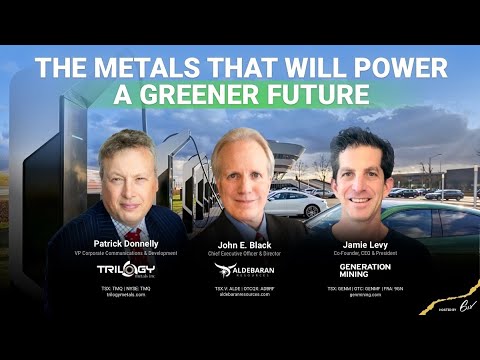
1:01 We have an illustrious panel today consisting of Pat Donnelly, VP of Corporate Communications and Development with Trilogy. Trilogy is a 50% joint venture in the Ambler project with South32. We'll hear all about that today. Also on our panel, we have Jamie Levy, co-founder, president and CEO of Generation Mining. Generation Mining has the Marathon Palladium Copper Project in Ontario. And previously, Jamie was involved with Pine point, which sold to Osisko Mining. Lastly, we're very, very lucky to have with us John Black, CEO and Director of Alderbarren Resources, which is an Argentinian-focused copper, porphyry development company, very, very exciting. For purposes of full disclosure, I would like to point out to the listeners and viewers today that our firm, Gehring & Rosenzweig, does maintain a position in Trilogy Metals.
1:57 So thank you all to the panelists for joining us today. The format of today's webinar and event, first we'll hear from each of our 3 panelists briefly and get a little bit of an overview of their respective companies and projects. Following that, we'll break into a panel discussion and after that we'll be able to actually answer some questions and answers from the audience as they come in through the question and answer module that you'll see attached to your webinar. So without further ado, I'd like to please pass the presentation over to Pat Donnelly, VP Corporate Communications and Development with Trilogy, to hear about the Trilogy story. Go ahead, Pat. Great, thank you so much, Adam, and welcome everybody to our webinar and hopefully We'll provide some insightful color on the space and I'll do a quick go over of Trilogy Metals.
2:55 You know, we're up in Alaska in the Ambler Mining District and we're in the good part of Alaska. And we're about 200 kilometers from, or 200 miles from the Red Dog Mine, which is the world's largest zinc mine. And what's unique about Trilogy is, as Adam mentioned, we have a 50% interest in the upper Kobuk mineral projects. And it's an extensive land package. It hosts volcanic genic mass of sulfide deposits. So, you know, these deposits tend to be high grade. They tend to occur in clusters. We have a joint venture with SELF32 Ltd., which is an Australian company, $13 billion market cap. And we have tremendous support from native groups, the government, and again a partnership with SELF32.
3:42 The 2 assets within the UK EMP we're focusing on in Arctic and Boronite, both very, very high grade. We have a feasibility study in an Arctic, very, very compelling economics. Again, here are partnerships, South32, NANA and Alaska. If you want to do business up there, you can do business. You just got to have the right partnerships and focus on that. So, Excel 3213, Billion Market Cap, NANA is a large native corporation. They own the Red Dog Mine, Tech Resources is the operator. And so, the culture of NANA is fully ingrained within the mining industry. They're very, very sophisticated and a great partners to deal with. Alaska, there's a group called ADA, which is the infrastructure bank owned by the state.
4:27 And they permitted a 211 mile road to our project. And now they're moving ahead with the engineering of this road. Very good shareholders, Electrum Group, Paulson, Bilepost in New York. We have about 7 million in cash and our market cap is around 283 million. These are all US dollars. Here's a snapshot of the Ambler Mining District. From one end to the other, it's about 100 kilometres long. As I mentioned before, it's a VMS district, numerous high-grade deposits, showings and drill holes. We spent $27 million last summer and we expect to continue drilling again next summer and hopefully soon we'll start having some drilling results from a past summer program. Here is just the economics at Arctic again a $3 copper you have a net present value after tax of 1.1 billion dollars and so again very low cash costs and very good cash flow,
5:23 excellent internal rate of return and a very short payback period. So I'll leave it at that and I'll pass it back to Adam. Thank you very much. Thank you, Pat. Really appreciate that. I would now like to turn it over to Jamie Levy, and we can hear about the Marathon Palladium Copper Project.
5:44 Thanks, Adam, and thank you for 6 for organizing this event. I much appreciate it. Quick intro here, just a quick high level of the resources we have. We have just over 4 million ounces of palladium, 1.1 billion pounds of copper, hence the reason why we're invited to this presentation, and 1.4 million ounces of platinum in resource. Just some of the people who we are, we just are one of our most recent hires is John Paul Deco. He was recently over at Glencore. He's gonna help us out with our concentrate marketing. Drew Anwell, our Chief Operating Officer was just over a detour from development to construction. So happy to have him. And we should be talking about some of the new people that are gonna help build the mine for us. Most recent hire was Jeremy Dart. He was over at Hemlo, who's gonna help us through the permitting and through the EA and the environmental assessment and some of the provincial permits. And as you can see, some of these other names, Paul Murphy helped us out, feasibility study over at G mining and Gordon Legge and Pierre Leguerre over at LQ. Steve Haggerty is helping us out with our past metallurgical work, XBP operational support over at Barrett.
6:47 So we're staffed up and ready to develop and build this project. Some of our independent directors, the note is Cassia Meager, chief operating officer at HUD Bay, and Jen Wagner, she's a little busy these days with Agnico and Kirkland, but she's a great person to have as an independent board. Where we are, very good infrastructure here. We got the Trans-Canada Highway going through the project. We got a little airport. We got 2 power lines intersecting the project. We have a town and marathon that's supportive of this project. We have a First Nation group just south of us that we have financial participation with. A road to the project. It's very good infrastructure for being in Northern Ontario. So Hemlo is about 30km to the west of us. So one of the reasons why our little CapEx is because of this great infrastructure that's been set up.
7:36 Just quick high-level economics. MineLife producing just around 245,000oz of Palladium equivalent a year. Upfront capital or CapEx is $665M. All in sustaining capital. Our cash cost is just over $809 per ounce of plating equivalent. We had 2 scenarios. The base case IRR was 30% after tax, 1 billion dollar MPV. That's using consensus pricing using pricing which was I believe sometime in February which was Palladium at 2400 and Copper at just over under 4 dollars we had an IR 47% and an MPV over 2 billion dollars So probably today prices with copper at 450 and pladium wherever it is today Probably be a similar IR as you can see a short payback at 2.3 years on the base case scenario Just gave good on the breakdown of the metals is about a 60 to 30 split with pladium copper at today's prices right now just what you know I like to talk about the upside to copper here this is a copper panel and I think we're all quite bullish on copper here but just keeping copper or plating at 17 and 0.25 which again was our base case pricing and Copper at 450.
8:49 Copper is not quite a byproduct, it's more of a co-product at this level here. We've got an IRR just under 35% and our MPV just under $1.4 billion. So it's about a 30% move in our MPV with Copper prices up at 450.
9:05 Not going to get too much into the Palladium market here, but what's very important about our project is we are right on the grid power, which is carbon free from Southern Ontario. So we're 96% carbon free. It's probably closer to about 100%, but sometimes in the summertime, they got to flick on the natural gas, which when too many people are cooling down their houses. So we're quite happy about this relative to our comps and the Palladium. I can't do the copper. It would be about 10 different slides here, but just on the Palladium, we're very good relative to the rest of the group here. Just quick timeline here, if I have a couple of minutes here, we're going through the EA process. Well, hopefully we'll get that by the 2nd or 3rd quarter of 2022. Within their time we're applying for provincial permits, they can't grant them until we get our EIS. So we're hoping for all that in the 2nd or 3rd 0.25 2022.
9:55 Then we could start breaking ground late 2022. It's about an 18-month construction and we're hoping for production sometime the 2nd or 3rd quarter of 2024. That's it for me, thank you. Wonderful, Jamie, thank you so much. Very, very interesting and thank you everyone. We're keeping pace and time exactly to the minute here. So that's just wonderful. Thank you. Finally, I'd like to turn the panel webinar over to John Black, CEO of Aldebaran Resources to hear about the Alter Copper Gold Project in Argentina. And today, John is calling in from South America. And so, please excuse if there's a delay of a moment or 2.
10:43 John, turn it over to you. Okay, great. Thank you very much. And thank you everyone for tuning in here. What I'd like to talk about today is Altar Copper Gold Project held by the Aldebaran Company. This is actually the third company that our same management team has had and We specialize in projects that are large copper gold deposits, identifying those projects, capturing them, drilling them out and de-risking them, and then ideally monetizing them by selling them to a major mining company. The appropriate forward-looking statements, of course, apply. But let's in the short time we have just jump right into the project. So the Altar Copper Gold Project is located in the southwest corner of the province of San Juan in Argentina. It's a province that has an unusually large number of undeveloped corporate copper deposits. Many of these deposits would be mines if they were located on the Chilean side of the border next door. We can see Jose Arria and Filo de Sol projects in the north part of the province. Those are held by Lundin companies.
11:47 You see Barracks operating large gold mine in the central part of the province. And then Q and Copper has those. Azul is just to the north of us, and El Pachon is held just to the south of us. So we're in a stretch of the Andes. It's extremely well endowed, but underdeveloped, primarily because Argentina has not been a mining company. But that's changing as Argentina is embracing mining at the moment, and we're seeing a lot of interest coming into the country as we move forward. And San Juan in particular is a hotspot in the country as we're looking for projects. Just a little bit about this project. This is a project that has a past history. It was actually discovered by Rio Tinto, largely drilled out by Peregrine Mining, a junior company held by Eric Friedland, and sold to Stillwater Mining Company in 2011 for $487 million US.
12:41 Stillwater subsequently put in about $45 million worth of exploration into the project, But it sold. It was a project, a large copper project that didn't really fit within a primarily PGM mining company. When Stillwater was purchased by Sibani, an opportunity opened up for us to acquire the project. And we reached an agreement with Sidbani Stillwater to acquire the project for a total of $15 million in cash payments, which have been completed. Sidbani Stillwater continues as a 19.9% equity partner, very active and very bullish on the project, And we can earn into an 80% interest in the project by spending $30 million over 5 years with an additional $25 million over additional 3 years.
13:28 We've spent about $17 million of the initial earnings. We're well on our way into earning our 60% interest in the project. And what we like to do is just take a quick look at the project and the time we have you see why we're so excited about this. And this project is high price earlier and then kind of disappeared off the map. So we're looking at a cross section, looking the north across which it's actually a district of porphyries. Like many porphyry systems, this is a cluster of porphyry deposits. And the known resource occurs in the Altar Central and the Altar East deposits, where we see the conceptual pit that constrains that resource on the diagram we're looking at. Within that pit, there are near 1.2 billion tons of 0.5 copper equivalent in the measured and indicated resources, fairly extensively drilled out by the previous operators, with an additional almost 200 million tons at a similar grade. So a very large deposit already, kind of an average grade for this deposit. But what we're really excited about is there are portions of the deposit that have significantly higher grade that we can see by the hotter colors within this. And then we're particularly excited about a new zone to the West that had never really been drill tested by the previous operators called QDM Radio. There's a small gold resource at QDM, but the radio zone will be the priority target for us to be drilling this next year. We've encountered long runs of substantially higher grade in the limited drilling that we have there. There's currently
14:58 no resource in the radio deposit whatsoever at all right
15:02 now. So we're very excited to be drilling that. Our first drill rig is already on site. Keep in mind, this is a South America project, so it's an opposite season, field season on here. Second rig is we'll be starting in the next couple of days. And we'll be up to 4 rigs by early December. And drilling this with our first aggressive drill program to fill out these new areas in the project. If we look just a little bit at the share structure, this is an important aspect of the company. We have 1 large shareholder in Group 1. They own nearly 50% of the company. They've been a strong factor for us in our predecessor companies. Aldebaran is the third company of 3 that our same management team has operated. Our first company was called Regulus Resources. It was sold for about $650 million for the Hikera Discovery in Peru. Our second company is currently on a very exciting copper gold project called Antiquari within the Regulus Company. And then Aldebaran is on this project. So it's what our team specializes in moving forward. And Route 1 has been a very substantial backer for us. And of course, Subani Stillwater has about 20% of the company. So you can see that we're currently a market cap of about $70 million.
16:14 It's a project that's largely been off the map, but this will be the first very aggressive program this season. And I think it's 1 to very much keep your eyes on as we move forward and start to deliver results on this project. It's 1 that's kind of disappeared off the map a little bit from previous operators. So thank you very much. Excellent. Thank you. Thank you for that, John. And thank you, Pat and Jamie, as well, for those really interesting presentations. For the benefit of the listeners and viewers today, you know, The idea of high quality, relatively high grade and large new copper development stories and PGM stories for that matter too, are really few and far between these days. And so
16:57 I should really stress that We're being spoiled listening to 3 good stories here today, but there's really not a lot in the copper industry and the base metals industry today, given ongoing depletion and just basic difficulties related to geological constraints. So very, very interesting presentations and projects, gentlemen, all of you. Thank you. I'd also like to just call out again, there is a Q&A panel on the right-hand side, at least on my screen, it's on the right-hand side of the interface. And please feel free to ask questions.
17:34 We'll go through those questions here in a moment when we finish up with the panel discussion that'll start right now. So thank you, gentlemen, and moving right along. First of all, I would want to take a step back and just ask a question to the 3 of you. And it's a bit of a general question and apologize if it's sort of copper 101. But given the title of this panel, for 1, you know, copper and the metal that will power a greener future. And given all of the recent events coming out of Glasgow and the recent discussions about the role of renewables, the role of EVs, and the general theme of energy transition, I was hoping if you didn't mind taking a step back and saying to any of the uninitiated out there, why exactly is copper this green metal? Why, what do people talk about when they talk about copper as being part of the energy transition?
18:28 And I thought maybe We could start with Jamie. Question, so I would start by saying that the transition to the electric vehicles is obviously very copper needed, if that's the right word. I mean, I think that the number that I heard is about 180 pounds of copper is needed for an electric vehicle.
18:55 Again, solar panels is certainly needed for copper is needed for all the wiring of the charging stations, copper is needed. So I mean, as you mentioned earlier, there is a little bit of a constraint on the metals right now. I think, John, I just heard that it's been the tightest market in a while for copper concentrates. So Again, the need for copper is there. And I guess I could hand it off to the next, but it's really needed for any sort of power switch out of fossil carbon. And John, Patrick, anything you care to add just to bring people up to speed in terms of in terms of energy transition and the role that copper is going to play going forward?
19:41 Yeah, I'll jump in. I was reading a story in The Economist a couple of weeks ago, and it was about connecting areas globally that have a surplus of green energy to areas that require it and specifically these subsea cables. For example, there's a 720km long cable linking Norway to Britain, because Norway has abundant hydroelectric power. And now there's other projects are being mooted. For example, the subsea cable from the north coast of Africa to Europe to supply power. And also perhaps 1 from Australia to Indonesia. Obviously, Australia gets a lot of sun, North Africa gets lots of sun.
20:29 You know, I saw a project, you know, in the news where Quebec was trying to supply the United States with power. The people of Maine had a plebiscite and stopped it. So maybe another, because they didn't want to put these big giant grids going through a forest. So the way to deal with that is put a cable down the East Coast and connect Quebec with the United States. And these subsea cables require a lot of copper. So yeah, we need electricity for cars
21:00 and all kinds of things. But how are we going to get that electricity? How are we going to move it around?
21:04 And so these subsea cables are massive, you know, hundreds of kilometers long, that's a lot of copper. And so, and then also with that is the associated infrastructure to move this power along so we can have electric vehicles. Excellent, John, anything to add? Well, I might add to this too, is that it's not just using more copper on this, is we need to be moving away from a carbon-based economy on this. And so that's going to be the real big push. And a lot of what's coming out of COP26 on this right now is an accelerated move away from fossil fuels and move to more solar or wind-generated power. The other point I'd like to add too is that we're just not very good at finding new copper deposits.
21:52 And you'll notice that particularly in the projects that we specialize in, there are often projects that have known for quite some time, basing a lot of our exploration off of the backs of good work done over decades by previous companies, we will run out of those. These are getting harder for us to find and it's very hard to find new projects. And it's a much longer time period the project's in right now. So just as copper demand really goes up, we're also not very good at delivering new copper projects. And that's the pinpoint we're seeing why we're seeing high metal prices. And I anticipate they'll increase even more now. No, that's fascinating, John. Thank you so much for that. I mean, You know, if you look at really on both sides, new discoveries of large scale mining projects in general, but particularly copper over the last 10 years, it's really been quite abysmal looking at the amount of new discoveries and obviously discoveries go on to become reserves and then ultimately
22:48 production. And so if you're starving the front end of that funnel, there's going to be an impact sooner or later. And we're starting to see that already. And then at the same time, you know, all the existing mining operations in the world are beginning to suffer fairly substantial depletion problems and head grades are just moving relentlessly lower. So it definitely seems like on the supply side things remain extremely tight. And one thing, you know, I just want to add that you guys all touched upon, but this move into a renewable or more of a push to a renewable power base moving away from gas and coal and into things like wind and solar, leaving the carbon aside, it's a lot less centralized. So you don't just have 1 giant turbine spinning and generating electricity. Instead, you have thousands of windmills and solar panels.
23:39 And all of that gathering system and all of that switching system is all incredibly copper intensive. You're seeing now in countries that have adopted these big renewable mandates, the copper demand has just been growing quite dramatically. And I think that's a trend that will probably persist. So thank you all for that. This next question is a little bit more for Patrick, but please feel free afterwards, everybody, to jump in. In the United States, and I'm calling in from New York today, although I'm Canadian originally, as I have my poppy on here, but live in New York, There's been a huge amount of news about the recent hard fought but finally moving forward infrastructure bill, 1 trillion dollar infrastructure bill here domestically.
24:26 And with that there's a, you know, increased focus I think on domestic sources of materials to help meet some of these demands as well. How important do you think it'll be going forward to have a new US source of supply? Well, I think as the panel is well aware, Copper is also a strategic metal. And as John pointed out, and Jamie, it's getting harder to find mines. They're scattered all over the world and there's going to be competition amongst different states such as China and India and Russia and other countries for copper and it's going to become more acute going forward. So the Chinese have been very very good about thinking way ahead of time, investing in projects and making sure they have a steady supply of Copper.
25:21 And so, yes, the Biden administration's passed this big infrastructure bill. That's great. But now, you know, we're going to get this Copper and you're competing against other countries for this Copper. And so,
25:35 right now, a year ago, the United States put out a list of critical metals. Copper is not on it yet. And I'm sure at some point it will. So, if the United States government is serious about combating climate change, they need to get Copper and they need to get it locally.
25:55 And that's something that resonates well in the United States. And On top of that, we're in a state that has always focused on their economy on hydrocarbons and that's changing as well. The government is very acutely aware of that and they want to diversify their economy away from hydrocarbons
26:18 into cleaner forms of energy. And they know that Copper is a part of that. That's why we have tremendous support from the Alaskan government for our projects. That is very interesting. If you look at the scale and scope of some of these big, broad plans here, particularly coming out of the recent discussions in Glasgow, you very quickly, particularly I suppose folks like us that are on the material side of things, realize that there's huge knock-on effects and you begin to wonder, well, are people really thinking where some of the stuff is going to come from? So I think it's fascinating.
26:51 John and Jamie, anything to add to that?
26:58 No, that was a good answer. I'm good. Yeah, I think that covered it pretty well. Yeah, Nate. Okay, very good. Well, Jamie, I have a question for you. You know, again, it's keeping on this sort of theme of transition and whatnot. You know, energy transition in a greener future means different things to different people. And certainly, I think a lot of people, when they hear about the green future, they hear about an energy transition, they think about a move away from internal combustion engines towards electric vehicles. And when you think of PGMs, which your deposit obviously has a huge PGM component to it, you think about traditionally, obviously, you have some jewelry, which is important. But a huge amount of demand in the PGM complex goes into catalytic converters in your automobile.
27:46 And so as we move forward, maybe people might be a little bit concerned. But at the same time, a bigger picture, there's a lot of different elements to energy transition. And there's a lot of new green technology. So what role do PGMs play here going forward? OK, I think I heard a question in there, but I got it. The transition right now, I mean, PGMs are green metal. I guess they are using to clean the air. They are using to prevent the, or convert the carbon monoxide to carbon dioxide or to a water vapor. So they are getting cleaning the air. You know, Biden has said he's gonna increase the, make sure the states increase their loadings to what the California standard is. China is gonna start increasing their PGM loadings. I think it's China 6, Europe 5. I could have the numbers wrong, but they're all going to make sure that the OEM manufacturers increase the loadings to reduce the carbon dioxide in the environment.
28:45 But I believe the transition to full electric cars or full fuel cell technology will happen. It's just going to take a little bit more time than I think what people are anticipating. I think the chip shortage is a good indication of some supply chain stuff. There is, as you mentioned earlier, and I think Patrick and John certainly talked about it, there is a material constraint right now. I mean, there's just not enough copper right now to supply what people are anticipating for full electric cars or solar or whatever they want to go on. So I think, you know, and then the other concern that I have is that a lot of the grid powers right now, which is why a lot of these uranium stocks are going crazy right now, is because all these grid powers
29:28 are coal or natural gas. They're going to have to switch over to some sort of carbon friendly grid. And so just to switch from to have an electric car where you're charging with coal doesn't really make much sense. It's borrowing money from 1 credit card to pay another credit card bill. It doesn't really make too much sense in my mind here. So It's going to take a little bit of time to do a full transition. I read somewhere the other day that Noreal thinks, and I mean, they are biased kind of like myself as being a PGM producer, but they do have a bunch of nickel out there, that they think that the transition will be from hybrid cars. I believe in that as well. I think it's a natural transition. I don't have an electric car, I would like to get one, but I do have a little bit of range anxiety, so I don't think I'm gonna get one, but if I could make some money here, I'd probably get a hybrid car, a plug-in hybrid car, because I feel like I'm being environmentally friendly, but at the same point in time, I don't have to worry about stopping on the highway and waiting for an hour to get the charging spot on there. So I think the transition will be to a hybrid car.
30:24 And I think as most of the people in the audience here realize that the hybrid cars need a little bit more palladium
30:30 or PGMs or platinum than does a regular internal combustion engine. That's just because the on and off of the engine of the electric. So I think it's going to be the transition there. I mean, I'm hopeful that we go electric anytime soon. And we, you know, generation mining has a lot of copper there. So I think it's a win-win on either situation for us. So I'm quite happy with it. But I think, again, that I'm biased, but I think the transition will be from hybrids in the short term. Sorry for the long answer. No, no, that's very interesting.
30:59 It is funny. Everyone forgets about hybrids, but hybrids are a wonderful technology. And in a lot of ways, I think, at least in the short term, definitely a way to be able to make a huge impact here that people sort of forgotten about, but very, very critical technology. And like you said, good for good for PGMs. Well, hybrids are also good for Copper. I bought a hybrid just earlier this year. I have a Toyota RAV4 hybrid. And
31:29 if you try to avoid being a lead foot, you can run a good chunk of it off the battery. I'm like you, Jamie, I do have rage anxiety because I'm an ex-geologist, so I like being outside still and being out in the woods of BC. I wouldn't want to do that with a Tesla, but the hybrids definitely, they also take up a lot of Copper and obviously, the time to prove metals.
31:59 Excellent. John, Would you take your Tesla out into the field in Argentina and Peru?
32:05 Not in Argentina and Peru, no, but cross-country in the US, sure. So very good. So, John, I have a question for you and for your project down in Argentina, you have a large project, both in terms of volumes and in terms of potential. And I remember in the last cycle, we saw more large potential projects in the hands of juniors. But obviously, in the last decade, with capital constraints being what they are, we've seen it less and less. So can you just talk a little bit about some of the challenges and opportunities you have about moving forward with such a large project in a junior company? And ultimately as it relates to that, Is this something you intend to develop? Is it something you're going to tend to partner with? How do you think about having such a big sort of tiger by the tail here?
32:54 Our strategy is basically to take a project like this and advance it through about a pre-feasibility stage and de-risk it during that period of time. So it's not just about finding a lot of Copper, Copper Gold in this case on the project, but it's also about showing that it can be developed and move forward.
33:12 Basically, make a track for a larger company to acquire it and put it into production. We're pretty open that that's our strategy. It's both in terms of our skill set, but also a training for our investors. It takes a long time to go from discovery through drill out all the way to production. And as a single asset company, that gap between when you have your resource defined and when you put it into production can be a little bit like Death Valley sometimes, particularly if metal prices are sideways. So we've had good success with our first company Antares on drilling a project out and monetizing it by selling it to 1st Guana. We're well on our way with our second company, with Regulus, with the Antiquary Project in northern Peru. And the third company here, we're trying to repeat this success. And in this case, it's a little bit different, because we acquired a project that had a lot of previous work on it. And so we benefit from over 100,000 metres of previous drilling that's been completed on the project. So that helps us a little bit on the cost, but we think they only discovered 2 of what
34:15 we anticipate several more zones in the area and they may not have discovered the best part. So you're right, it will require quite a bit of capital for us to move forward. And that's where we're very fortunate to have large backers like Group 1, our principal shareholder. And Sabani is very keen on, Sabani Stillwater is very keen on moving the project forward. So we have good solid backers to move the project forward on this, plus the track record and the experience of having drilled these out previously and moving them along. So it's maybe a little bit daunting to be on such a big project as a smaller company,
34:46 but I think now, the last 2 years, a lot of what our work was done was to put together all the fundamental data sets, really understand the district and see the remaining potential on it. And just now bring this one back to life. So it's a great time to look at an opportunity like this. Our market cap is relatively low, particularly compared to the amount of resources we have right now. So I think you'll see this product come to the forefront in the coming years for these type of opportunities. Fascinating. Interesting. I mean, it's just incredible how this cycle has gone and how long that bear market really was. But now it does seem as though things are beginning to open back up and come alive, certainly. And I think we're entering into this new phase here where hopefully we'll begin to see some of the majors realize that they have large holes in their portfolio going forward. So I think it's a very, very interesting time, certainly.
35:44 Excellent, well, Turning to all 3 of you now, you know, it's interesting to have 3 people on a panel all with potentially world-class deposits and projects here, and all 3 in completely different jurisdictions. I guess there's, you know, there are more than 3 jurisdictions, but usually in a panel you end up with 2 or maybe even everyone in the same area. Here we have 3 people with completely different jurisdictions.
36:10 Maybe just go around the 3 of you, we can start with Jamie, but just talk about, you know, some of the pros and cons of working where it is that you're working and how important do you think jurisdiction is here?
36:24 Well, I think Ontario is obviously one of the better mining jurisdictions in Canada and Canada being, I think a tier 1 mining jurisdiction is great for the project. Happy with it. Going back to it, sorry, John, just to mention Sabani is our partner as well. And the previous operator was Stillwater. They had taken it to a certain level within the EA process. So they had met sufficiency before, so we're going through that same process again. So we're hopeful that we will get our EA, we will get our permits through Canada. We're not too worried about that. It's just a question of timing. So for us being in a country like Canada where they're quite transparent,
37:04 we do have political support out there for it. As I think Patrick was mentioning earlier, this is a critical medal, Canada and Ontario, both of put PGMs on the critical medal list. So that can't help with the permitting, but that could certainly help with the political support by the politicians to get this project moved ahead. We were getting support from the town of Marathon. We're getting support from the Ontario side. Ritford and Premier Ford are very pro-mining. I think they were just up at Hart Rock previously and they were before that at Cote Lake at the opening there. So being in Ontario, pro-mining government and the conservative is definitely helpful. And just one more thing, just to go back to our infrastructure, our infrastructure that's around our property, having the 2 power lines, the rail and the road is very good for us. So very happy with where we are in Marathon Ontario Canada.
37:59 Patrick, How important is it to you to be to be stateside these days? Yeah, I mean, you know United States can be challenging. There's you know You know the pruning process You know in our case for the mine, we're expected to take 24 to 30 months But the good news is there's a very specific process and it's very prescriptive. And so, you know, you got to go through that. The good news is, you know, the thing is, you know, United States has got a stable, you know, government and legal system so that whatever agreements and contracts you have are enforced. And again, we have tremendous support from the state of Alaska.
38:48 Again, they want to diversify the economy, specifically a group called ADA, the Alaska Industrial Development Export Authority, which is an infrastructure bank owned by the state of Alaska. And their mandate is to build infrastructure to develop the economy. And as I said before, the reason this area has never been developed is because it's in the middle of nowhere. The economics has never been the issue. We have 4% Copper equivalent. Our projects make money at US$2 Copper, but the issue has always been infrastructure and there's tremendous support from the state to put this road in and that's what we're dealing with right now. So, but in the end, you could work there, but you gotta have partnerships. You gotta have partnerships with the native groups. They're a big, Nana, as I said before, is a big partner in the state of Alaska, and then having the support from South Africa too.
39:38 And showing the state, showing the local peoples that, you know, there's big benefits for them. And the good thing is, when you're the Red Dog mine, which has been operating for 30 years, and they've been a very, very good corporate citizen. 50% of their employees are indigenous. And Nana's made billions of dollars in the native Alaskans and made billions of dollars from that operation. So there's already been a very good case of how mining benefits the state and all the peoples. Interesting, John, different how how how are things operating in South America these days? Obviously, we hear lots in Chile and Peru. Happy to hear your take really across the board, not only in Argentina where your project is, but obviously you have a deep knowledge base across the region.
40:25 Yeah, it's interesting. I mean, over the, I've worked in South America for almost 30 years now, And we all fled to Peru and Philly early on because of the large known endowment and the fact that they were major mining countries. They're still good countries to find things in, but it's becoming harder to find things there. And both of them are going through a bit of a transition right now politically to at least probably higher taxes on mining and more restrictions on it. And now what we're seeing is a lot of companies are kind of moving to additional countries in the Andes like Ecuador and Argentina that traditionally have been a little bit harder to explore and are less known as mining countries, but they're embracing mining. They see the potential for mining.
41:11 So we're finding that it's easier to identify projects in those countries, and their legislation is evolving and moving forward. A country like Argentina, it's interesting because it's one of the few South American countries that's a federation of states. So each province has a different approach to mining on it. It's a little bit like the US in that sense, in that there could be states or provinces that are very pro-mining and others that aren't. So it's important to know where you're at in San Juan. We kind of joke that the provinces that begin with the letter S tend to be a little bit better to be working in. So I think you will see the province of San Juan, where the Altar Project is located, emerging as a very significant mining center over the course of the next decade or so.
41:56 They have some tremendous opportunities. As I pointed out, there are 5 large copper or copper gold systems queued up for development there right now. So this is a great opportunity for them to make friends. Very, very interesting. Like I said, where to be able to get 3 people all with 3 completely different jurisdictions together in 1 room. I guess that's the benefit of Zoom and Internet and things of that nature. So, you know, a lot's changed here in a hurry from a Copper price perspective. And, you know, like I said, we've been talking about at our firm that copper is a green me years. But really it's be of 2 years that investe to this.
42:41 And when I look resource subsectors, the a lot of money put to work, even in gold and certainly not in oil and gas, but copper has seen some money be put to work. How have you had your conversations with investors changed? Do you start to see, have you started to see the generalist investor begin to become interested here? And what's your feeling, broadly speaking, as to how far that trend can go? Because the base metals, Copper, PGM, these are not huge sectors. How much capital ultimately do you think is coming into the sector and what's it going to do for pricing here? I can speak a little bit to that. We've noticed in the last 2 years or so that there's been quite a bit of pickup of interest in the US, for example, and For that reason, both of our active companies are listed in the US now as well. And we're starting to, particularly with the that we need to move away from fossil fuel based economy and be less carbon consumptive and move to more electric vehicles and other things like that They're starting to see it become more acceptable in a world that's more critical of mining and extractive industries like this. So we're seeing not only increased interest from the US, but we're also seeing increased interest from younger investors.
44:06 It's viewed as, particularly copper, is viewed as kind of a green center with what overall is a mining industry, which may not be that popular for younger investors. So we're seeing a bit of interest in it that way, And there's a tremendous opportunity for us as mining companies to take advantage of it. But we have to do our work carefully and responsibly in that context. So. Yeah, Jamie, Patrick, anything to add? Yeah, what I've seen is, you know, we've been doing it, we've been attending a lot of conferences lately and we're seeing a lot more ESG funds and green metal funds or renewable energy funds. And a lot of these renewable energy funds, they can span the entire chain from electric car manufacturers to renewable energy companies and all the way down to Copper producers and developers.
45:07 So we've been meeting a lot of people I never met before, who in the past were generalists or in other sectors. And the nice thing about being a Copper company, you know, we're wearing the white hat now because as you're well aware, you know, copper mining sometimes often has a native connotation, but it's nice to have the white hat and be part of the solution to help our planet and save our planet. And we're definitely seeing a different type of investor come into the base metal sector. Well, I remember 2 or 3 years ago at the BMO conference, Robert Friedland got up and said He just started a film production company. He said he was going to make a movie about mining on Mars and how ultimately it was the miners that give us the world we have, that we know and love. And they're going to be the heroes of the story and not the villains. And everyone laughed in the room, but maybe you can star in it. Because it does seem to be that that's the way sentiment is now going, which would have been unthinkable a few years ago. But there's been such a disconnect between how do we get what we need and then who's going to give it to us. So, Jamie, Anything to add there? Just a quick question, Adam.
46:17 Was that the same time that Freeland was going of the panel against Lassonde? Was that the same one? I think it probably was. Yeah, it was. It was copper versus gold. It was pretty interesting. Oh, yeah, yeah. Yeah, so it was pretty good because Freeland definitely beat Pierre on that one and I don't think Pierre liked to lose too much. I didn't want to take on Robert. Yeah, no, Robert's better. I'm much more comfortable moderating this panel than I would be moderating the panel. The only thing I would add on it, I mean, we haven't seen much of it in the space right now, but other than as Patrick was talking about some of the ESG funds and the green metal funds, I think that some of the precious metal companies are going to look to green up because that's not going to be a critical metal whatsoever. So if they're looking to get into this sort of green revolution, if we want to call it, they're going to have to start looking at getting into some base metals, some critical metals, some hopefully Copper for one of us in the panel here. I know John was mentioning it earlier, but it would always be nice to get them as an investor or a potential strategic partner, basically an acquirer later on once we get full value. Because, you know, looking at all of our share prices, I believe we're all undervalued relative to our precious metal group. So their currencies are much higher for whatever reason. So I think once we all de-risk our projects, I think they'll probably look to come around and try to green themselves up.
47:38 Interesting. I haven't thought about that. You're probably right. Well, it's also a question of scale for them, too, Because particularly the large gold companies right now, it's hard to compete a gold company on 1 3 to 5 ounce gold deposits that have a relatively short life. And so we've noticed in Spain, we work in copper, become very interested in large port systems, particularly if they have a little bit of a precious metal. So there's every copper company, every gold company out there is actively looking for large copper opportunities as well. Interesting. Yep. Jamie, I have a question that's coming in here now from the Q&A box. I'll put it to you, but also happy to hear from Patrick and John. And it's a little bit specific, But it has to do with batteries, which is an interesting topic in and of itself, and electric vehicle batteries in particular, which has to deal with issues of weight as well as power.
48:43 And in particular, there's been some discussion that potentially you could add palladium to the battery's chemistry in order to help longevity. And for the benefit of listeners, lithium ion batteries are extremely expensive. They're extremely energy intensive to produce and they have a finite life. And if you debate that, just ask yourself, how long does your iPhone last before you have to get a new one? It's because the battery begins to wear out. So anything you can do to longevity is incredibly important. Jamie, are you following those trends and those discussions at all? I've heard about it. I mean, I'm not an expert on it, so I don't want to talk about it. I mean, it would be nice, but Palladium is a little bit of an expensive metal, so I would hope that they can maybe use it as a cathode, but it might make the batteries a little bit more money. So I don't want to lie and say it's going to happen because I think it would make the battery more expensive. But if it does, you know, you know, make the battery last longer than it possibly or less nickel or less cobalt, but again, I'm not an expert on that, so I can't really talk about it. It would be good. I know there was one of my, I got an investor call the other day that Tesla has a project called Project Palladium. Again, I have no idea what that all means, but it's probably nothing to do with palladium. But it would be nice if they had it. I can't speak much about it.
49:56 John, Patrick, anything? A little out of your wheelhouses both, but maybe not. Anything to add to that? I just know we need a lot more palladium. Well, it's funny. We have a very good relationship with a battery scientist at MIT. And he was pushing his students to try to find cost reduction techniques to produce batteries. And one of his students came and said, well, I think if you dip the whole thing in gold, it ends up being a lot more efficient. I think you're going in the wrong direction here. So I think there is a tendency to try to do that. You can maybe eke out more performance, but is it really worthwhile to anybody? I have a question for all 3 of you. Given a little bit of a change in the capital markets and given a little bit of uptick, at least early stages, And most importantly, given the fact that it's been such a brutal bear market for so long, are you guys seeing shortages anywhere, whether it be in employees, personnel, lab, turnaround times, assays, things of that nature, anything you have to do to change from a global supply chain perspective, as you move forward here? Or is that not really hitting you guys too hard? Who wants to start?
51:07 Patrick, why don't you start? Yeah, I mean, you know, it's funny. Absolutely. And it, you know, as you're well aware, there's a shortage of labor in general. We did a drilling program this summer and just, you know, electricians, mechanics, drillers was really difficult. You know, we had 3 drills turning, but we only keep 2 drills turning because we couldn't staff the third drill. Just trying to go out for dinner in Anchorage was a nightmare because half the restaurants are closed because there's no workers and no people to work in there. So We had to work really hard to get our camp staffed up. We got the drilling done. But yes, absolutely. And the other thing I would note, I've always said, again, I mentioned I was a geologist in my former life. We just went through for an 8-year period where mining was really in trouble.
52:05 And so what does that do? Well, it results in less people doing mining engineering degrees, doing geology degrees, that sort of thing. And now this always seems to happen. And then when it turns, it turns hard. And then we're in a huge shortage of skilled people. And so that's the other thing we're going to contend with is attracting talent and attracting talent that knows how to build minds. And that's what we're gonna be dealing with. So yeah, there's lots of capital out there, but we need skilled labor and it's gonna be very, very competitive. And that's what we're dealing with now. Interesting. John, anything to add? Well, just as everyone's been struggling a little bit on how we keep our people safe and how we move forward, we've got to keep the pace right. And it's not just our own teams, it's the companies we work in that we make sure that they're comfortable with how we're working moving forward. But having said that, people want their economies to move and they want employment opportunities too. So we're largely through that. It's been a long way to travel to Argentina. The borders have been closed, but we're fortunate that we have a great team on the ground. And so we're able to operate and now we're able to get back in ourselves, which is helpful on that. So, but we are experiencing a huge shortage of rigs in some places, particularly Argentina right now. There's such a boom in exploration
53:35 in San Juan, the province that we're in right now, that securing rigs is high priority for us. We're fortunate that we have 4 for this field season, but we've had to be really heads up to be able to get quite a boom of exploration activity happening in San Juan province right now. It does put restrictions on supply chains and fundamentally we have to make sure we keep people safe. That means we have to sometimes go a little slower than we'd like to. But that's we're largely overcoming that. It's the uptake in seeking out vaccines and being vaccinated has been pretty good in most of South America. So I think we're through the worst of it now. Interesting. Jamie, anything, anything, final words on that topic?
54:22 No, I think John, John, the COVID angle that certainly slowed things down a little bit here, but I think the assay, the labs are picking up. Obviously, they were a little bit delayed with the lack of workforce and there's a few companies in Ontario that are had a bunch of drillers out there that I think they're starting to wind down some of their drill rigs. So I think that will give some ample supply for some other people. But there was a little bit of a supply shortage of drillers and the assays were taking a little bit longer, but I think a lot of that had to do with COVID. I know you being American right now, or still Canadian, but you guys don't really have COVID down there, but still Canada, we take COVID seriously and we take COVID seriously up at our mine site for our site business, for our employees. We make sure that everyone's doing their testing appropriately or vaccinated as much as we can do. So we try to protect our people, which is obviously important for us. So again, hopefully that's coming to an end and we can get some assays, the labs will free up a little bit.
55:18 Interesting. So no tire, truck tire shortages just yet. That's later in the cycle. That's what I remember from last time. No tires. So Jamie, a question that's coming in on the Q&A here. As far as any financing deal, the generation is able to move forward with. The question here is that it has to have approval by Sabani. What impact do you think that's going to have from your timeline perspective that make things more challenging? Or how do you think about that? I think the question isn't really a fair question. We don't need approval from Sabanay. We are the operator of the project. Sabanay is a minority partner. We're working on dealing with stuff like that. I can't really share it in this forum right now, but I don't think it's gonna alter any sort of financing that we need to do in the future. Okay, good. Well, thanks for clearing that up. Now, John, along with Also coming in from the Q&A panel, I'm going to combine 2 questions here so that they're a little bit different. But 1 basically just talks about the difficulties of operating in Argentina, how even after, granted, in San George province, this is where the question comes from, But even after approvals and money being put in the ground and actual drill activity happening, right when you would think that the government was on side, the government rejected approval on a project from one of our listeners today. He's saying, how
56:49 much has things changed in Argentina? And granted, province by province, but how much support do you feel that you're getting today? And are some of those ghosts of the past still ever present? That's a great question. And it brings out the importance of knowing which province you're in. As I mentioned, there's some provinces that certainly embrace mining. And San Juan, where we're at does, as evidenced by Barrick's large operation there and several other decent-sized mines in the province. And certainly, they're encouraging it to move forward. They're providing tax incentives for some of the Lundin companies to put in infrastructure to their projects up north. We're seeing up in San Juan province where we also have, or up in Salta province where we also have some projects in the North, the lithium mines are coming into production very quickly. They have the advantage of they're much quicker to come into production than we are as copper mines. And the benefits are becoming very obvious. So for those provinces that embrace mining, it's becoming much easier for us to move forward than it has in the past. And every mine that comes in, whether it's lithium or copper or gold, paves the way for other ones to come in as well. There will be provinces such as Mendoza, where the project you're mentioning is in, that was a bit more difficult to bring in into production.
58:11 That province has chosen to do otherwise. Very similar to say Canada or the US, there are areas that embrace mining and areas that aren't. Similarly, you can look at would you prefer to be in Argentina or would you prefer to be in Peru? From some of my earlier statements, I'd absolutely prefer to be in Peru because it's a much more advanced mining country, the pathway is more paved for us, it's just harder to find a project. But if you've got a good project in Peru, that's a fantastic place to be as well. So it's very much dependent on which province you're in or which country you're in and then balancing the exploration history. So the reason we like Argentina is because it's easier to find projects and source those projects than Peru, but it's not necessarily easier to put them in production. But it's very important which province you're in. No, I think that's very helpful. And it's important for people to understand that, you know, Argentina, like you said, is really made up of very, very autonomous, different mining provinces.
59:05 Now, gentlemen, with the time we have left, I think we have a minute here, but maybe they'll let us go a minute more. Would you any sort of closing remarks? We'll start we'll start with Patrick. You know, anything you'd like to sort of close on today? Yeah, I mean, I think John hit it bang on where in Alaska even, it depends where you are if you wanna develop a project. And we're in an area of Alaska where there's a rich mining history because of the Red Dog mine. And we're working with a native corporation called NANA, which knows mining very, very well. So it again, depends where you are in the country. So with that being said, I'm very, very excited for the future.
59:56 I'm very curious to see where Copper is in the next 4 or 5 years and where we are as a global economy next 4 or 5 years as we move away from fossil fuels. And I think, you know, let me put it this way. You know, we haven't talked about the supply side. I won't try to take too much time, but, you know, As John and Jamie be aware, you know, Cadelco needs to spend $50Bn just to maintain the current production. And that's 10% of global supply. And I see BHP has to spend another $15Bn just to maintain their production. So, yeah, I mean, even if we don't hit all the goals for the uptake of renewable energy, electric vehicles, I think the big push is going to be supply side disruptions because, you know, these projects are multi-billion dollar projects and it takes a while to build them.
1:00:51 Yes, I agree, Patrick. I think supply is going to be critical. Jamie, anything to close on? No, I just want to thank you for a good job moderating. Thank you, 6. And please, for the listeners, viewers, audience, please have a look at Generation Mining and Trilogy and Aldebaran as well. I think all 3 of them are good companies that you should keep an eye on. So We all have good metal. Thank you. Thank you for that. And yeah, I agree. For those that are listening in, there will be a replay available. It'll be put online within the next few days. So please reach out to 6 for that. John, last word is yours. Yeah, I'd like to put some of the same comments from everybody else. It's a great time to be taking a look at copper overall.
1:01:39 And projects can be at a variety of different stages. One of the things I've found on our project is that we were really a project that's a large project already from the work that's been done by previous operators, but it's been 1 that's been off the map a little bit. And we've put a lot of care work in to go here. A great time to take a look at it valuation wise, in terms of not quite being back, everybody being aware of it right now. So it's not just project quality, it's also the timing when you enter into a project right now. So I think it's well worth taking a look at this as we're about to launch a much more massive project with a lot more news still coming out over the next year. Excellent, Exciting times. Thank you. Thank you for all of our panelists, Jamie, Patrick and John. I really appreciate everyone's time today. Thank you all for listening in.
1:02:28 And like I said, there will be a replay available within a few days on Six.com. Thank you so much. Thank you.