Transcript
Automated transcript · Written by software from the replay's audio. It can mishear names and figures; the replay is the record.
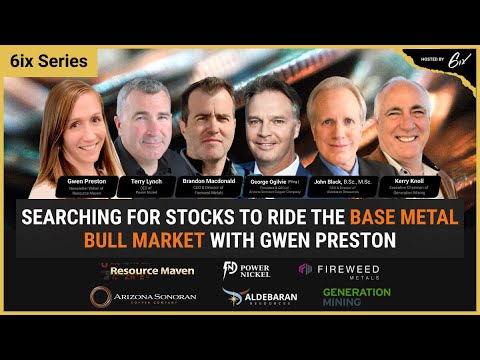
0:08 Good morning everyone or afternoon or evening depending on where you are joining us from. Thank you so much for joining us. I think this is going to be a fun conversation. The topic today is searching for stocks to ride the base metal bull market. I mean it's a little forward looking to talk about a bull market right in this exact moment, But that's what investors need to do, right? Is look ahead instead of look at the exact moment. And so that's what we wanted to do today. Excuse me. I have on the call with me several gentlemen who have lots of insight into the base metals market and one of the things that I think is nice about this group is that they cover multiple metals so I'm going to ask each of them to speak to their metal so we can get some good insight into copper and zinc and you know each metal on their own maybe get some ideas and then talk about about how we think those markets might evolve over the next little while.
1:06 So what I'll do to begin is just ask each President, CEO, Chair, whatever your title might be, to introduce yourself and give just a quick, just a few minutes, who you are, what your company's doing, so that we can set the stage. And then I have lots of questions ready to fire at you once we've gone through those introductions. Audience, please send your questions in as well. I will absolutely incorporate them into the conversation as we go along. And so in no particular order, John Black, would you like
1:36 to kick it off? Just let us know who you are and a little bit about Aldebaran Resources. Okay, great. Thanks, Gwen. It's a Pleasure to be here with everyone. Hello to those of you that I know already and looking forward to this discussion. I'm the CEO of Aldebaran Resources. At Aldebaran, what we specialize in doing is identifying large copper or copper gold deposits, capturing those at an early stage before they're fully revealed what's there, and then drilling those out, de-risking them, and then ideally selling them to a major mining company as our business strategy. With Aldebaran, we're exploring the Altar Project in San Juan province, kind of a hotbed for copper exploration right now, a really fun place to be, exciting place to be with a lot of activity in our project and others around.
2:24 Aldebaran is actually the second of 3 companies we've had in the same management team. Our first company was Antares minerals. We drilled out a deposit that we sold the 1st quantum in 2010.
2:35 And we also have Regulus Resources, which is working on another copper gold deposit in northern Peru. So that's our niche. That's what we look at. And we're pretty excited about the potential for copper in the not too distant future. Fantastic. Sticking on the copper theme, I'll ask George Ogilvie to step forward and tell us a little bit about Arizona Sonoran. Yeah, hi Gwen and thanks for the opportunity. So I'm George Ogilvie, CEO of Arizona Sonora Copper Company. We have the Cactus Project, which is obviously in Arizona in the US today. It's a former producing mine that was owned by a circle back in the 1970s and 80s. The land package is all on private land.
3:21 We already have some substantial permits in hand, namely a permit to take water and the aquifer protection permit. And the good news is that there's an abundance of water in a very strong aquifer,
3:34 about 1,000 feet below the bottom of the current open pit. Because it's a brownfield site, the permitting process should be relatively quick. And given it's on private land, there's no federal nexus. We're only dealing with local state and local municipal authorities. So there's a PEA out on the project with very robust economics. We're working on a re-scope PFS. And we believe in the next 2 to 3 years as we continue to de-risk the project, we can put this into commercial production as we start to see an uptick in the copper markets.
4:12 Fantastic. I think I shouldn't be inserting my own comments yet, but try and stop me. I think the fact that George comments quite a bit on permitting, even just in his introduction, is one of those things about base metals in general, right? It's hard to get projects actually built, and it's become a lot harder over the last 10 years, and that's a big structural part of the markets, the way that the markets are right now. So I'm sure we will have further discussion on that. Terry Lynch, can you give us a little bit of an introduction to Power Nickel?
4:44 Yes, Gwen, and thanks for having us and hello to my fellow commentators, great to be here with you. So Power Nickel is developing the NISQ Nickel Sulfide project in just south of James Bay, Quebec. It's an advancing project. We've got a historical 3.1 million tons of about 1.6% nickel EQ or so, and had some great initial results and we're drilling right now, have been drilling since mid-September. We'll drill until mid-December and we'll post a new 43-101
5:16 and Q1, we would think, end of Q1. So nickel is obviously a great spot to be right now, especially if you're in the higher grade sulfide world. The nickel price curve looks fantastic and 2 things drive nickel, urbanization and electrification. And both of those are undeniable trends so we're pretty bullish about nickel and about our prospects for having what we think will be Canada's next nickel sulfide mine. Fantastic, all right well I will in our next question ask each of you to dive into sort of your metal to give us more, give us a little bit more depth on the kind of things that Terry just referenced there. But before we do that, Brandon McDonald, please give us a little bit of an introduction to Fireweed Metals.
6:01 Yeah. Hi, I'm Brandon McDonald, CEO of Fireweed Metals. We're a Canadian-based zinc slash tungsten developer. Tungsten I won't talk about today, but zinc, of course, at least alphabetically, the last of the base metals. And our McMillan Pass project in Yukon is a truly massive district. I think it's very easy to talk about district. Explorers like to tout district-scale land packages, but there's at least 4 deposits on this. There's a clear trend where we see signs of at least half a dozen more. So for us, we don't think that we're stretching the definition to say that this is a true district. So the 2018 resource that we put out included only a very small portion of this. So, we've been exploring really since then and west of there and identifying a really massive opportunity there. So, this is emerging as a project that is not like
7:03 a good Zinc project, but an absolute best in class. So as the market turns towards base metals and value plays, we feel pretty well situated. Fantastic. I'm going to ask Kerry. I'm not sure, we were having some sound struggles with Kerry in the lead up here, so Kerry, is your sound working at this point? No. Okay, well then I won't ask him to do an introduction because that doesn't work. We will certainly get back to Kerry. If I get the thumbs up that his sound is working, I will absolutely pull him into the conversation. But for now, let's move into some questions. So like I said, I wanted to start the conversation with asking each of these CEO presidents to talk about their metal because you know we're in a bit of a crosswinds here where we have a recession maybe not officially in the US whatever you want to define it as But certainly elsewhere we are facing recessionary contraction type conditions. We certainly have demand declines in China for systemic structural reasons, you know, with a range of opinions about how dire or not dire that will become.
8:16 But then of course we have on the flip side, you know, the needs of the green transition, which I think is an undeniable force and something that I referenced before, which is a lack of new minds, right? We just don't have new minds for all kinds of reasons. So given those 2 opposing standpoints,
8:35 let's talk about each of these metals. Brandon, I'm just going to go in reverse order here. I mean, one thing that I was reading just last week is, you know, zinc, refined zinc inventories are down to like 3 days. Now, this is something that happens to some extent in the zinc market. That's a very near-term comment. But what's your outlook on zinc? With that near-term, maybe there's supply risk shocks in the near-term,
8:59 and then looking ahead for zinc?
9:02 Well, look, the near term's absolutely driven by the crisis in Europe with energy. So if you have a zinc smelter in Europe that is not, I think, other than Beledin, who has a hydropowered zinc lead smelter, you're facing incredible energy prices. So most have been shuttered or curtailed or some of that degree, which is creating a huge shortage of physical metal there. Now, physical metal does not mean a shortage of concentrate
9:36 out of mines, right? So this is the duality of any base metal market. I think the tug of war between smelters and miners tends to be a little more pronounced in zinc than other metals. But right now, if you have a smelter that has a good supply of cheap energy, which I believe does in Norway, tech does it in British Columbia, et cetera, where you've got this hydropower, You're doing very well. So miners, I think, a little bit more difficult. Treatment charge is definitely going to creep up and get into the ugly territory. But the thesis for the medium to long term is related to every base metal, which is that there's been a massive underinvestment, that there's no exploration getting done. The difference being that you think about global reserves to annual demand, that ratio, it's about 0.5 as much in zinc as it is, for example, in copper.
10:37 Now, part of that has to do with where the zinc is being mined and whether you're stating reserves. But it's still a, Zinc is much closer to a just-in-time reserves identification than a copper is. So both of these, not enough, right? Not enough investment.
10:55 But yeah, it's going to be interesting times ahead as a few more mines fall off and it's crisis territory, because I don't see anything big coming down the line. Do you think, just following up on that near-term shortage, do you think zinc has the potential to do something crazy this winter
11:14 because of the refined metal situation? Well, if you get a full stock out, which certainly looks like it's a possibility, then anything's possible. I mean, we hit over $2 a pound earlier this year, and I think easily that again. But it'll be like the recent, potentially like the recent spike in nickel or past spikes in various metals were such a deep backwardation that the market is suggesting that it's not an intrinsic situation but temporary. Got you. All right. Moving along, Kerry, I think we have you joining the conversation. I'm here, can you hear me now? We certainly can, that's fantastic. So I'll hit you with a double question, which is explain yourself, who are you and who is Generation in very short. And then we had moved on into
12:07 explaining your perspective on the sort of supply demand fundamentals for your main metal. And for PGEs, I mean, for platinum group elements, they're a little bit complicated for people to wrap their heads around sometimes so do you want to just give us the primer on your outlook for those metals after you let us know a little bit about why why you're talking about them what generation is doing sure thanks Gwen I'm carrying all the chairman of generation mining We have been around for 4 years. We're developing
12:39 the Palladium Copper Project in Northwestern Ontario. It's just about at the final permitting stage. We did a feasibility study last year. We're close to having it financed. It's going to produce about 245,000 ounces of palladium equivalent a year. And we are just hoping to start construction early next year, depending on a few factors, such as financing. But so as far as the fundamentals go, palladium, of course, is a critical metal. It's unlike a lot of these other metals that are the metals of the future. This is the metal of now because it's required to be in virtually every gasoline-powered car in the world that is sold. So as a result, and there's only 2 sources for 80% of the world's supply, and that's Russia and South Africa.
13:33 The Russian material was never really sanctioned, because sanctioning of that would have cut off probably 30% of the automobile assembly lines in the world. So the government's,
13:45 They've tried to punish Russia a little bit on it, but not really. So the material is all getting to market. There's a very, very low inventories of this. The reason that the price has backed off from its highs of over $3,000 was partly because
14:02 of the recession in the automobile industry, the lack of chips. That is now seeming to be resolved and as a result we're expecting palladium demand to increase significantly through the winter and into 2023. So we think that the timing is good for us to get going on the mine. Fantastic, okay. There's lots more to talk about for all of these things, but let's carry on. I'll leave the 2 copper guys to battle it out at the end but before that I'll take it over to Terry to talk about nickel and I mean nickel is there's again a lot of complications or a lot of questions around nickel a lot of changing technologies suggestions of changing technologies give us a Give us your perspective on the nickel market and the opportunity there for investors.
14:53 Yeah I mean it's got to be one of the best looking base metals I think structurally.
15:00 You know either a small surplus or a small deficit this year, probably fairly similar next year. And then it looks like it's going to just become a serious structural deficit problem. Again, it's not easy to find it, and there's not a lot of new stuff coming on. And it takes, even in the most optimistic scenario, you know, I think Tal Metals is talking about, you know, getting up and running
15:25 from basically a PEA to a mine in 6 years, which would take a miracle in my view. But God bless, let's hope that happens with, you know, permitting being managed and encouraged and some hoops that are removed from the development process, which is the talk right now in the developed world. But yeah, no, it's, you get 2 major driving forces, urbanization, which is stainless steel, stainless steel, 60% of the nickel market. So as people get more urbanized, they move to, you know, cities and out of rural situations, they're buying pots and pans, fridges and stoves, and that's stainless steel. And then electrification, which right now is about
16:07 15% or so of the nickel demand, is expected to be 50% within a few years. So it's just very difficult to bring that level of nickel online in the short order of time. So it's going to have a material impact on the price curve. But all of these base metals on the battery side, they're sort of a puzzle, right? So if nickel price gets out of whack, they'll stop using nickel, or they'll minimize it.
16:34 But if all go up at the same time, if cobalt goes up and lithium goes up and manganese goes up and nickel goes up radically, I don't know what these battery guys will do. But At some point, the economics get a bit wacko. So, there's an overdraft of a broader economic theory to discuss, but generally, the outlook is about as bullish as you could get. Absolutely. I mean, I think one of the things that I often comment on people asking about nickel is that it's hard to wrap your head around the scale of growth of a nickel market and that's true for something like lithium where 20 years ago we barely used it for anything we used it for like making ceramics or something and now we need it for like every battery and every electric vehicle and so that market is exploding. Well nickel has always been a reasonably like a significant market but its growth from here based on electrification is just this like fairly crazy phenomenon like you say trying to supply any metal growth profile like that
17:32 is a crazy proposition, especially in our current try to get a mine built environment. George, why don't I give you the chance to start on copper and I'm sure John will have things to add, but what do you have to say about the copper market? Well, look, I mean, I think in the short term, we're going to see
17:52 supply outstripping the demand. As we all know, you know, copper is a bellwether for the general economy. And you could argue we're already in a recession, but it certainly feels as if we're not heading into a recession, there's going to be an economic downturn throughout the entire world. And obviously, China is a very big player when it comes to the copper market. And as we know, things are slowing down there. Now, the kind of dichotomy is that although supply will outstrip demand, it doesn't necessarily mean that the copper price is going lower. As Brandon's already pointed out with the energy crisis in Europe and a lot of smelters and refineries being closed or scaled back, we're seeing throughout the world bonded warehouses of copper, you know, with extremely low inventories, as you've already pointed out, only down to 1 or 2 days of copper supply for the world.
18:46 So I think the copper price is probably going to be supported by those low inventories
18:52 throughout 2023. And we'll see the copper price itself sort of range bound between this $3.25 and $3.50 that it's been trading at over the course of the last 6 months or so. I think longer term, however, there will be structural deficits with copper as we've spoken about the electrification, the decarbonization
19:14 thesis that's taking place throughout the world. I believe they're anticipating that annual refined copper is going to have to go from its current 25 million tons to something like 50 million tons in the next 2 decades. And by the end of the century, it's going to have to be north of 35 million metric tons. So those are huge increases. And the only way to incentivize those increases is through price. And that'll bring new production online, which is going to be stymied because of the environmental and permitting challenges. And it's going to keep some of the current mines in production and some of those marginal producers in production over the next decade.
19:59 So I'm extremely
20:03 optimistic and very bullish on the green energy commodities and in particular copper medium and longer term. Absolutely. I mean, I reference nickel as a market where it's hard to wrap your head around the scale of growth because of the green transition. Copper, I could have said the same thing about copper, right? This has been the PhD of metals for such a long time and yet the growth profile that is projected based on this green transition is again hard to wrap your head around. John, I mean, what do you have to add
20:36 about copper, about your outlook for copper? You're still muted right now, so just click on your. Yeah, I think George just covered it pretty well that we really have this somewhat of a disconnect. And we see this when we present at investor conferences and other places where there's general consensus that the demand for copper will skyrocket at some point in time, but at the current moment it's not there. And it's obviously due to economic uncertainties at the moment. We have had a little bit more supply come into the market with Kamoa, QB2, Kayuveco coming on. And that kind of coincided with when we have this economic uncertainty.
21:16 However, we still see low inventories. So we've really kind of absorbed that right now. So I absolutely agree with George. I don't think we have a lot more to draw on this. It's really a question of when do we get through these times now and kick in. And the Green Revolution has really started now. There's really not much of a way to stop that. And we've talked about all the metals that are associated with it. It really comes back
21:41 in many ways to copper, because copper is what transmits that electricity around. And it's fundamental. It doesn't matter to us in the copper space whether it's a lithium battery or a nickel dominant battery or hydrogen, you still need to move that electricity and you still need to generate electricity in some ways and they're just The predictions are through the roof. I think I'll rob from what Robert Friedland told us all at Beaver Creek a little bit ago. He pointed out that the amount of copper that we will use in the next 22 years is the same that's been used in history
22:13 up to this point in time. So, Can you imagine thinking about how we develop as many mines as we've seen developed in the past in the next 20 to 30 years? It's mind-boggling, really. There will undoubtedly be a boom, and it's a great time to have your hands on a good copper asset right now. So a bunch of you have referenced political ramifications in your markets. And I think obviously there are massive geopolitical shifts underway in the world right now that are, to be blunt, impacting how metals can move around, right?
22:52 Since that's the topic of our conversation, obviously these geopolitical shifts have much more far-reaching implications as well, but we're talking about metals today. So can we talk about each of these markets and some of those geopolitical shifts? I mean, obviously there's the Russia-Ukraine war, which impacts several of the metals that are in conversation today, but there's also changes in leadership in countries in South America. There's lots of things that are happening.
23:16 So is there anything geopolitical that you think is important to the market for your main metal that you think deserves some attention? John, I'll just head back to you, we'll go in reverse order. Okay, I'll just touch on a couple things, I'm sure George will kick in on some of the other ones as well. In the copper space, I don't sense that the war in Ukraine is directly impacting us as much as some other metals.
23:43 The region of the world doesn't produce that much copper, so it's really not there. What it really affects is on energy costs and inflation and other issues that are perhaps exacerbated by that situation. But you touched on China. That's really 1 that a lot of people are talking about right now. And certainly the strong measures they took to control
24:08 COVID situation and things like that resulted in strongly decreasing certain elements of their economy. But there, I was just talking to people that are at the LME conference this morning, and they were pointing out that there's a general perception that China's quite a bit ahead of other countries in terms of positioning themselves to enter into a lower carbon economy.
24:30 And that's interesting that they're doing that. They're positioned to, EV sales are still strong, housing's down like it is in many parts of the world. But I really view China right now as more like it's a downturn in their market. And that means the upside potential is tremendous there. Sure, like any other economy, there may be a little bit more downside to it right now, but think about the rebound that can come out of that. And then I'd just also like to point out that we focus a lot on China, but people shouldn't forget about India coming up behind this. There's a large population that hasn't even begun to go through some of the increased metal use that we see in China right now, and it's poised to really kick in here pretty strongly as well. Yeah, very good points.
25:15 George, what might you add? I mean, I think partly permitting in the US is obviously near and dear to your heart.
25:22 I often end up in this conversation where people are asking, well, are governments at some point just going to have to be more positive and supportive in their approach to mining? Like, Are we going to come up against a point where there's no choice but that? We're kind of seeing that to some extent, maybe early stages of it in some other metals like uranium in the US.
25:43 I'll touch on the permitting right now, but I wanted to piggyback on what John mentioned there. Obviously, we're talking about copper and we have to mention China. China imports a lot of its copper through scrap and through concentrates because it has smelting capacity and refining capacity.
26:03 But I think in Europe and maybe at a later stage North America, as we begin to realize that a lot of this copper and other electrical vehicle, green energy style commodities, the raw materials are absolutely critical. I think those countries are going to take more of a nationalistic approach and you may actually see less concentrate and actually less scrap heading over to China and it may actually remain in Europe and in North America just because of its criticality.
26:38 So I think you know that those fundamentals in the world politics I think you know the political position and who's vying for you know superpower status is going to play you know massively and where the copper gets distributed in future years.
26:54 And obviously the US of A permitting is obviously absolutely critical. Again, we've got this dichotomy right now where the Biden administration is throwing billions of dollars into critical elements and getting out loans for companies, which is great. But nothing's really happening with respect to the permitting process, which we know if you can get through the permitting from an expiration story all the way to commercial production, at a minimum, it's taking 10, if not 15 years now, from discovery to actually getting a mine into production.
27:31 And, you know, this structural deficit, you know, that we've been speaking about today is, you know, if it doesn't improve, and with the demand that's coming over the next several decades for these style of commodities, it's going to create huge increases in price, as I said earlier, to keep the existing mines in production and bring some of the near term producers or the marginal mines into production to meet that demand. So fortunately, you know, Arizona Sonora Copper Company,
28:03 we're in a situation where we're all on private land. There's no federal nexus. We are only dealing with the state regulators and the local municipality, and we see a clear pathway to commercial production with the remaining permits that are outstanding. So that's good news for our shareholders on a go-forward basis. Sounds good. Okay, let's move into some of these other metals that are, that have different political, geopolitical considerations at play. Kerry, let's talk about, I mean, platinum, Russia, there's no connection there, right? Well, the palladium metal has always been, and then platinum as well, has always been very political. Historically, there were basically 2 sources for them, and that's all there really is now for 80% of the metal, other than recycling is really picked up.
28:57 On the political side, on both the supply and demand side, there's interesting events happening right now, and that's really around the electric car partly because if there was 100% electric cars out there and no gasoline anymore we would be in a situation where there would be very low demand for palladium, and it would be probably $100 or $200 an ounce. However, that electric car market, for reasons of shortage of lithium, shortage of charging stations, shortages of copper, nickel probably, It's going to pan out over decades, not over a few years. They're just not able to do it as fast as people think. In the meantime, so, and governments are starting to mandate it. They're talking about 2035 for no more sale of gasoline cars. However, they are including hybrids in the electric car in those estimates.
29:56 Hybrids bring us around to another interesting fact is that hybrid cars use more palladium than a regular car because they don't burn as hot. And as a result, hybrid cars are far outselling electric vehicles right now. And that's projected to be the case for at least the next 10 years. So You've got 1 situation happening with the politicians starting to mandate electric cars at some big future date, but then you've got the other situation of hybrids. And then the third thing that's happening is that Europe, China, and India are still increasing the palladium loadings per automobile in an attempt to clean up the air. For example, in Europe right now, the bad gases that cars produce are 98% eliminated through catalytic converters.
30:46 That is actually mandated to go to 99%. So they're going to take out half of what's still coming out by 2027. That means more palladium in every car. Same thing is happening. India is really just getting going on this. Then there's Nigeria, Indonesia, Brazil, Mexico. They're all trying to clean up those big polluted cities. And catalytic converters is one of the ways of doing that. So, you've got increases happening, that's government mandated. You've got, and then eventually you're going to have electric cars, also government mandated, but that's a long, long way out. 77% of the world's energy or electricity is generated using carbon. So until you change that, there's no point for an electric car.
31:35 Fair enough. I mean, I opened up a can of worms here. I mean, when I say geopolitics, yes, and I love this. This conversation can cover the whole range, right, from the basics of supply all the way through to the details of demand. So that's cool. It's a good conversation to have for sure. Terry, nickel's another one. Lots of geopolitical shifting factors at play. How would you bring nickel into this conversation? Yeah. I mean, obviously right now with the Russian situation, Norilsk being a massive 20% producer on the class 1 nickel, which is what's needed for the batteries, they're a bit destabilized right now. But I think that nickel honestly finds its way in the market that finds its way through to China and India who are either, if they're not willfully ignoring it, somehow it's passing through. So I think that sort of, you know, there's some structural friction there, which isn't efficient, but I think that still flows. I think some of the bigger issues in nickel is the ESG stuff, you know, like for example, some of the bigger potential future projects in nickel are these laterites in the tropical areas of the world that are hugely carbon negative to develop.
32:52 So, in theory, we're developing nickel as an electrification solution for a cleaner, more carbon-friendly world, but by destroying the rainforest and being, anyway, looking at a super heavy negative carbon impact. So I don't know how the math works in that, but it makes me very positive towards clean nickel sources. So if you've got a high-grade nickel sulfide that's easy to develop, relatively speaking, I think you're gonna be obviously favorably positioned. And I think the politicians, they don't want to be tainted with, hey, I'm supporting destroying Greenfield, or the jungle in Indonesia, or the Philippines, or whatever, things like that. So very much these days, I think you'll be looking at people wanting to have a, you know, where did, where did my nickels come from that's in your car? And if it's, if it's, if it's a not from a politically acceptable solution, you know, environmentally speaking, that could drive demand and, and, and supply. So that's some of the stuff we're seeing.
34:05 Absolutely. Like I say, a wide-ranging conversation. Brandon, where does zinc fit into any of these geopolitical forces? Yeah, well, I guess the Zinc market not overly reliant on Russia, except for the Russian gas in Europe, right? And I think it's a universal thing amongst whatever your base metal that we've had 3 factors converge here that are going to shake up the industry. First is that, you know, I shift to lower carbon and if you do true carbon accounting, you start to question whether you mine and why you mine in Peru, smelt in China, send the agate to America for galvanization of a car that gets sold in Europe.
34:58 You start to question globalization, And then you also look at COVID, which annihilated supply chains, and then you get the Ukraine crisis, which then that much more questions, okay, where is everything coming from? So as you start to onshore these supply chains, as you start to de-globalize, it's going to mean every inventory has to be just that much more, right? Because you can no longer talk about global zinc inventories or global copper inventories or global nickel inventories, because certain inventories are going to be unavailable to different groups. So it means the necessary restocking is going to be that much more than it would have been in a true globalization. So that resource nationalism, if it comes with an actual willingness to permit things in the West, which is a question mark, is a lot to think about.
36:00 We have to think about, okay, so where is our zinc coming from? 30% of it now comes from China, yet they're still a net importer. They're voraciously buying projects all around the world. Do we want them to buy it all? Do we want them to own that value chain? I think it's a universal regardless of the base amount. So I think that's the big question mark is the strict global supply demand balances do not necessarily reflect the actual unique localized supply demand balances that are going to be important in a deglobalized future. You know, the extent of the declopalization we don't know, but there's certainly some of it coming.
36:49 Absolutely. Talk about the tip of the iceberg, but absolutely that is sort of the question, isn't it? Okay, let's move on to stocks. Having set the stage a bit here with metals, let's move on to stocks and if investors who are listening do see opportunity in these arenas. What I wanted to ask was, I mean, right now valuations in the mining sector are low, shall we say, And so if an investor is looking to enter, whether now or sometime in the next while when they believe that things have more bottomed, you guys are all exploration or mining company leaders and you're also investors in this sector, at least I would assume so. So what characteristics do you think will make some base metal stocks perform better than others if when, I think I should say when, A sentiment does swing back towards growth and therefore investors do get interested in investing in things like metals again. What do you think positions a stock to outperform in that moment?
37:58 Brandon, let's go to you to start. I'll look at, I've said it before, but the companies with the best projects move first when the market turns and they move the first. So I'm not a big fan of the trading mentality of I'm going to pick the company that's the most marginal producer, because that gives me the most torque to the commodity price. That is extremely dangerous, because there's bills to pay. That's a very easy strategy to go to 0. I think you start with the highest quality projects that look like they are already Q1 1st or 2nd quartile producers or have the potential to be 1st or 2nd quartile producers. These are not marginal projects. These are not going to be the swing projects and ones that are in the top 10% in terms of size potentially, either there or it's with that.
38:54 If you've got those 2, that's absolutely best in class. And the other thing to look for is companies that have done a lot of work and maybe have less left to do. Inflation favors the incumbent. Those of us who have advanced stage projects that have a lot of money sunk into them, there's a real value underpinning the undervaluation of our stock. Whereas an exploration play, perhaps with just a couple holes in it, can look very sexy, but they've got a lot of spend ahead of them to delineate it and a lot of risk with that, right? So, you know, my personal preference is look for best-in-class, advanced stage projects, and, you know, buy and hold for longer term.
39:45 Gotcha. Terry, in the nickel world, I mean, I would say not that many years ago, there were very few listed nickel companies out there for investors who were interested in playing the spectrum from like exploration through to production, right? It wasn't a great and easy market to get exposure to. Now there's a there's been a proliferation of nickel entities out there. How would you suggest investors sift through those options? Yeah I think you know the song curve is a great guide for mining investors generally. And there's a couple times, you know, as an investor, you wanna be on the left-hand side of the curve when it's just starting. And that can happen on the expiration, it can actually happen in development. So depending on where you're at, you know, that I think that's the first thing is find out where you're at on the Lassonde curve and the project you're investing on.
40:37 And then the next question is, does the company have enough capital to move to the next stage, you know, in the development? And because obviously these are difficult capital markets and the dilutive to the companies right now. So you wanna have that money in hand so that you can actually create additional value because here we are, all of us I'm sure are massively undervalued, I know that. But from a consumer or investor perspective, it's like, what have you done for me lately? So what is the new news that's gonna make me wake up to your great value proposition? So you need to have some catalysts that are funded and they're happening imminently that will get the new news out that actually people can look and sort of reflect on them on the sign curve and say, hey, do these guys offer me unique and sustainable value at this point? If they do, then I should be a buyer. And I think one of the big things I've found is that, speaking to Brandon's point, absolutely people should be looking at what's this gonna be in the longterm buy and hold. This is not a trade.
41:42 Will power nickel be 10 times its price in 60 days? Who knows? But give me a year, yeah, and I would say highly likely there's a great chance that that will happen, you know, in 2 years even better. So it's like if you had to wait 2 years to make 10 times your money, is that a bad thing? So I think almost everyone on this call would be in that type of circumstances. And there's, you know, where can you get that? You know, in a world that's shaky, you're buying assets, as Brendan said, where we've put a ton of money in the ground already, you know, a lot of inherent value built up, but it needs a catalyst. So, you know, that's, those are my thoughts. I think it's, look for the companies that are funded for, you know, for the next catalyst, and then make sure you're at the right point in the curve.
42:28 Gotcha. That's good points for sure. Kerry, what do you look for when you're surveying sort of the base metal or battery metal landscape? What do you look for in companies? What do you like? A lot of it's already been said. Certainly the spot on the Lausanne curve is important, but to that I would add, how are their financing prospects, how are their permitting prospects, how are their First Nations, if you're in Canada, your First Nations negotiations going. But The first and foremost thing is I would look at management and say, have they achieved what they set out to say 234 years ago? Even though we're in a downturn right now in terms of share prices, this is a real time where management should be getting their ducks in order and getting it ready, getting their projects ready to go.
43:19 And if the people have been doing that, and there's mines out there that have taken 8 years to get permitted, there's other ones that have been permitted in 2 years. And how is management handling that? That's management after the metal and the actual reserves in a project, management is by far the next most important thing. So have a look at the management, see if they've done this before, see if they know what they're doing and see if they've achieved the goals that they set out a few years ago on close to the schedule. Nobody makes it all on schedule, but make it at least close. I think you speak to my heart when you say that, because one of the ways that I often summarize my criteria for stocks is does management have a credible plan to create new value for shareholders. There's no guarantees in this business, there's no guarantees in most businesses, but is there a credible detailed plan for how to turn, how to try to create new value and then do they do what they can to achieve that is our real efforts made to progress down that path. Markets notwithstanding, George and John are at different stages in that progressing down the value creation chain for sure given the stages of their projects.
44:40 George, what do you have to say about, I mean a lot has been said if it's a short answer here, but when you're looking across the base metal landscape what might you be interested in buying at this point in the market looking ahead? Yeah, well, certainly, you know, the panel has brought up lots of good points, which I'll agree with. I think the ESG angle, obviously, you know, given we're looking at commodities in the green energy sector, I think it's going to be more and more critical for investors and actual funding as we go forward. Some of the panelists already brought out, I mean, you know, If we're producing these metals to go into electrical vehicles, but we're putting up more carbon dioxide and greenhouse gas emissions into the atmosphere, then ultimately what that metal is going to save when it goes into an electrical vehicle, we're kind of defeating the purpose. So, you know, I think as the world and the green energy sector evolves, I can see more and more premiums being given to companies who have very strong ESG strategies and are actually able to execute on them and can actually deliver a pound of copper for net 0 carbon emissions. Those companies will differentiate themselves from the rest of the pack and they'll be given premium valuations.
45:59 Yeah. I mean, I'm currently in the process of launching a new newsletter that's going to be called Evergreen Investing. One of the reasons is because I do agree with you that there's huge flows of capital coming into that space. It's inevitable. And the term ESG has become a bit too diffuse. And so I think there will be some more tactical focus with that money on, you would hope at least, on projects and opportunities, inputs, innovations to the green transition that benefit broadly that effort in, you know, in sidestepping some of the potholes that you guys have identified already here. John, what do you have to add? I promise I'll let you answer first on the next question so that everyone won't have said everything already. Turn your mic back on.
46:51 John, your mic's, you're muted. Everyone's very careful to make sure we don't get their background noise and then they don't turn their mic back on. Yeah, I think the panels really captured most of the key points. You really focus on the quality of the project, the team, have they done it before? Where are you located at? Can you work there or not? What's your access to capital? So I don't think I can really add too much more that hasn't already been said on that. But what I would like to point out to investors that are looking in this space right now is that when we're in a situation like this and I benefit from more decades than I care to admit of being in the business here. But when we're on a bottom like this it's a natural tendency to be hesitant and to wait to see it take off. And we have a general consensus that, say in the copper space that George and I work in, that the fundamentals are fantastic for things to take off in the sometime in the future. And everybody wants to have that comfort that they're not going early, that what happens if there's another bottom? I can give an example of what happened to us in our previous company in the financial crisis in 2008, 2009.
47:59 As we came into that in 2008, we just delivered a lot of great drill results on a project. We had Antares over $5 a share, everything was flying high, a lot of companies talking to us about buying, and the global financial crisis hit. And we went from over $5 a share to $0.38 a share in a matter of a few months. And it was like catching falling knives and everybody was panicked and everybody was concerned about it but nothing changed on the project or the location or the fundamentals for copper and within 18 months that company was sold for more than $9. Markets can turn very quickly, and by trying to time the bottom, you can miss it. It's wise, if you agree on the fundamentals in a space, to begin to quietly do your research, put some bets down and get positions on this because what you don't want to do is look back and say, boy I knew that was the case and it's already jumped 30% on me and then you get hesitant, you don't go in again and you miss an opportunity.
49:00 So pay attention to that. The other fundamental thing in that situation that happened to us is we made a decision, even though it was really scary times, to continue to drill during that downturn and produce results. And so as we quickly came out of that downturn, we delivered a positive PEA. And that's critical. You want to be careful of companies that freeze up right now and don't do work because as someone mentioned in the panel just a few minutes ago, it's the time for us to be doing good quality work and really have anything set up to go forward. So don't try to overthink it too much. If you agree on the fundamentals of it, it's a great time to put bets down. I think that was a great summary of the situation. And what you just said about companies needing to carry on and be able to continue working in down markets just gets to the heart of that whole balance between raising money and spending money when capital markets are tight.
49:53 But that also gets to the comment about management and whether to be blunt you have access to capital. Have you cultivated those relationships? Do you know how to get it done? And that's a big differentiator I think among stocks too. There are certainly companies out there that would probably like to be working right now but just straight out can't access capital and so they're stuck in the water. So those are different, those are differentiators in my opinion as well. Okay we only have 10 minutes left and so just because we haven't given you guys much time to talk about your own assets, your own stocks, we did a little introduction at the beginning and it's been brought up a bit but I wanted to get let each of you finish up by saying by asking is there 1 point or message like the elevator pitch moment that you would want a potential investor to remember about your stock in the context of this interesting conversation that we've just had? Like, what's the thing that you would want them to remember about Aldebaran?
50:49 John, we'll go to you to begin. Well, the key thing with Aldebaran is we're early in the stage. We're still defining an extremely large resource. We have a great resource in hand already, but it's not fully revealed on the full size. We're working in a province in San Juan in Argentina that's remarkably pro-mining at the moment. We're actually being pushed to move the project faster than we can, which is very unusual in this situation. And we have a lot of peers around us that are developing very interesting projects as well and we have the Argentine government recognizing the importance of developing a mining industry and specifically a copper mining industry and the benefits it can have. So it's a project that we believe is strongly undervalued right now and it's but one that has all the hallmarks of being the type of copper asset that will be of interest to a major company.
51:39 So it's a great time to take a look at us right now, not just simply in terms of project and management and location, but what the valuation of that is. There are other projects that are maybe a little more visible that people have already jumped on and the valuations are high. So there is more leverage to our story right now. Fair enough. All right. George, what's the one take-home message that you would want to send investors away with on Arizona-Sonoran? Well, we currently have a compliant resource today of 6.5 billion pounds of copper in the ground in Arizona. And we know that Arizona supplies the domestic U.S. With over 70% of its domestic copper supply. And we believe that that demand for copper is only going to exponentially increase. And I would say over the next 2 to 3 years, Arizona-Sonoran can place itself so that we can meet some of that demand which is coming based on the drive for decarbonization and green energy. And The good news is we're in a district that's very well known for copper.
52:50 Immediately south of us we have Robert Friedland and the Ivanhoe Electric Group who border our southern boundary. They're reporting 10 billion pounds of copper currently in the ground. We think that's going to incrementally grow. So when you look at our region, we're probably looking at plus 20 billion pounds of copper all on private land with access to water and water permits in hand. So we can put this mine into production in the next several years and meet that demand, which is ultimately coming. Absolutely. I certainly for Arizona Sonoran, for me, it's a new company that is surprisingly advanced in its asset and its speed towards development. I don't remember what order I did everything in, so sorry if this isn't perfectly backwards.
53:36 But, Kerry, what's the key message that you would want people to remember about generation? Well, you know, We've only been in existence for 4 years, our company, and we're in the final throes of permitting and financing a mine. So I think that one thing to remember is how fast we've done what we've accomplished in this company. And the second one, I know you asked for 1, but the second one is that if I'm wrong on the palladium and the electric cars, et cetera, we have about 30% of our revenue is going to be coming from copper. So we have a built-in hedge in our reserves for both metals. So if palladium demand goes down, that'll be because electric cars are popular and that means copper is going to go up. So that's just a bit of a whimsy, but it's also an unusual situation to have a hedge like that. Absolutely.
54:34 Another fast moving asset for sure over the last few years. Terry, a take home message about Power Nickel. I guess fundamentally, I think the first thing I'd say to investors is we're probably the lowest market cap nickel exploration company per pound of nickel discovered in the ground. So that's an important start point. And we're drilling now, have been drilling for about a month, got another 2 months of drilling. So in terms of near-term catalysts, there will be a lot of exciting exploration results coming out over the next 3 months and an update at 43-101. So I think there's an exciting entry point there on that Lausanne curve. So that's what I'd tell people to focus on. Gotcha. Brandon, you didn't even pay me for it, but you got the last word.
55:22 Thank you. Thank you. You know, when you think about fire weight, I would consider the totality of undeveloped zinc projects globally, particularly, you know, those held by a junior as in not already locked up by a major. And when you think about not just our past resource, in fact, you have to think well past our 2018 resource and the tremendous exploration success we've had since then, and contemplate is there another project like ours that is potentially up for grabs? When the corporate development teams and all the big zinc miners get that mandate, and they will get the mandate, and they always get the mandate at the top of the market, because there's the need to acquire these things. When they get that mandate to buy a big splash of zinc acid, who else is gonna be ahead of us on the list? And if we're not number 1 on the list, you gotta consider that we're very high, right? And so these best in class projects, when they transact, transact a lot of money. And the move can be very quick near the end. As John pointed out, you know, a very rapid move, you know, from 38 cents to 9 bucks, Arizona mining from 20 cents to 6.5 bucks in 2 and a bit years, a great bear to 30 bucks from 20 cents in 3.5 years or something like that, right? A great bear in exploration success, but Arizona mining, for example, there was a lot understood there, And it still took off like that, right?
56:47 So great projects, in particular great base metal projects, go unloved right up until the point they are loved to death and that are the glorious, you know, Phoenix, Flip-Mo, death of money, right? So, like I said, consider, you know, if you are, have your hat on and you have to buy the best Zinc project out there, what else are you looking at? So that would be my message. Fantastic answers across the board. Thank you. Thank you first of all to John and Kerry and George and Terry and Brandon for participating today. There was a lot of knowledge on this call. For all of you who were listening, All of these guys are very accessible. If you have further follow-up questions, I'm sure they would be happy to field them from you.
57:36 And either 6 can get you in touch with them or you can find them, I'm sure, through their own avenues. And thank you so much to the audience. Of course, we wouldn't be able to do these things if people weren't interested in listening. And so thank you for spending some time with us today and we hope you learned something and we will see you again here soon at some point, hopefully in better markets. They have to be around the corner, right? Thanks everyone. Take care. We'll see you again soon. Thanks.