Transcript
Automated transcript · Written by software from the replay's audio. It can mishear names and figures; the replay is the record.
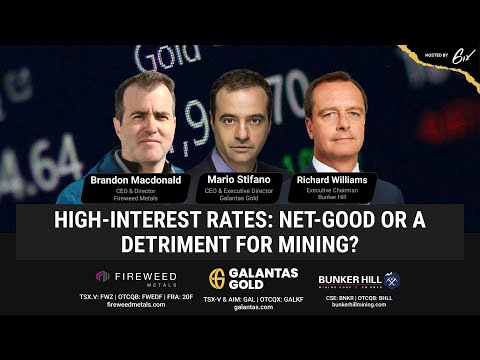
0:08 Hello, everyone, and welcome to today's live discussion on high interest rates and if they are a net good or a detriment to the mining industry. We're joined today by Fireweed Metal CEO Brandon McDonald, Bunker Hill Mining's Executive Chairman Richard Williams and Galantis Gold CEO and Executive Director Mario Stefano. Gentlemen, we know that mining is a capital intensive industry and that capital can come at a cost. So why don't we start off the discussion by going around the room and providing a 2 minute overview of your company and what capital breakdown looks like for your company. So let's start with Brandon.
0:42 So the second part of that question, what the capital, what for it looks like for my company? Capital breakdown. Okay, thanks. So I'm CEO of Fireweed Metals. You know, we have 2 flagship projects in Eastern Yukon Territory, Canada, 1 overlapping into Northwest Territories. Our Zinc project is a large district scale, multi-deposit Zinc-Lead-Silver project, certainly emerging as one of the preeminent Zinc development projects in the world. And right next door to it, we have Emac-Tung, Tungsten deposit, which is the largest high-grade tungsten deposit in the world and arguably a strategic resource. Being a late-expiration, early-development, pre-construction company, we are all equity funded.
1:32 We have about $30M cash on hand, doing a pretty big drill program this summer. And we'll continue to fund through equity markets, I think for the foreseeable future.
1:44 Awesome. Awesome, Thanks. Richard, take it away. Thank you, Maxim. It's always good to follow Brandon. He goes from an exceedingly large and very exciting exploration project into our development project. It's a zinc silver lead mine in a Superfund site in the Silver Valley, USA. We just secured $67M worth of project finance, combination stream and debt to get the mine back into production in the second half of next year. It's our intention to do that and not have to go back to the capital markets for any more finance for the restart.
2:31 But over this year, you're going to see us producing additional insights into the upside in the asset from both exploration and optimization. And we look forward to releasing that information in the second half of this year. Fantastic. Thank you, Richard. And Mark?
2:52 Yes, I'm CEO of Galantis Gold and second chairman at Dory Copper. For Galantis Gold, we have a high-grade Gold project in Northern Ireland. We're next to a world-class discovery, Dalridian, you know, it could be 10 million ounces, 10 grams plus. We think we've got something quite similar, multi-million ounce deposit. And at Dore copper, we have a copper gold project in Quebec, it's a former producing mine. It produced, it was actually Quebec's largest copper and gold region for a long time, but we've got a former producing mine, but we have a new discovery there called Corner Bay, and we think we can get that asset restarted as well. We've got all the infrastructure, we've got high-grade copper discovery.
3:38 On the capital structure, we're a little bit behind where Pendon and Richard are, so it looks like they're fully financed. Galantis Gold is exploring and we are looking to restart our asset. And we're mainly financed with equity, but we do have some debt with some of our key shareholders. At Dory Copper, equity financed and we're very well supported by Equity Fund New York, as well as Quebec Inc. Quebec really wants to see copper production in Quebec, and we're the most advanced project in Quebec to do that.
4:18 Excellent, thank you, Gérard. So let's get started with the first question here. So how do interest rates impact the overall economy and subsequently the demand for commodities? So let's start with you here, Mario. Well, I mean, interest rates could be a double-edged sword, right, and it really depends on why interest rates are rising. In a normal course, if you got, you know, stable, strong interest rates in that 3% to 5% range, like they would have been in the olden days, means you've got a nice steady state economy. Today I think it's quite different. Interest rates are rising because you're trying to manage inflation, while at the same time, and this comes to the gold side of my business I guess inflation could be quite bullish for gold and in this case with the amount of debt the United States has in fact the amount of debt the world has in general is going to continue to drive up interest rates regardless of inflation. And I think what you're starting to see here now is both sides of the equation. You've got the inflation side and you've got the excessive debt side. And I think bonds are going to continue to decline. And I think interest rates are going to continue to go up for a period of time.
5:36 Actually, I'd like to add to that question, how high do you see them going?
5:40 I will look at today, right. You had a very strong jobs report, which is means the US economy is continuing to create jobs. There is some disparity around the view on that because it looks like a lot of people have exited the workforce but nonetheless there are you know the workforce and jobs are being created in the US. Interest rates hit the 10-year rate hit above 4% again and that seems to be problematic for the US economy whether it's from the housing side of things, mortgage rates are going up in Canada and the US, but at the end of the day it seems that 4% rate is what causes a lot of stress in the banking sector and the economy. So my view is interest rates are going to continue to go up. You've got $2 trillion a year of US deficits, $32 trillion in debt, accumulated debt in the US, and that's not going down anytime soon. I'm still of the view that interest rates are gonna be strong for extended period of time.
6:39 How about yourself, Richard? What do you think about the current industry environment, how it's impacting the economy and also the commodities that Bunker Hill has?
6:49 Yeah, it's generally felt, and I agree, that the reason interest rates are going up now, when you listen to what, just say that the Fed says or other central bankers, is primarily to reduce the inflationary rates that have become higher and higher and higher as a result of quantitative easing, particularly done during the pandemic period. I mean, the size of the US money supply is at an all time high. And notwithstanding what the Fed chair has been doing over the last 15 months, it's hardly moved down at all. So The primary reason that interest rates are up high is a government policy reason influencing central bankers to try and increase the cost of borrowing and thereby reduce inflation.
7:45 Typically that's recessionary. And the effects of any move in monetary policy, as is typically the case, aren't felt for 18 months. So if you sit and think about the interest rates that went up yesterday by 25 basis points in the US. If the theorists are correct, the impact of that won't be felt. In other words, we won't see a change to the underlying structure of the economy in the US until November of next year, which, funnily enough, coincides with the US elections. I'd say that at the moment, everyone's trying to work out as a result of that monetary lever, whether we're going to be seeing and there's all this debate about a soft landing, whether we're going to see them bring inflation under control, not kill employment and not kill growth, or are we going to see recession?
8:38 And the markets aren't really sure which way it's going at the moment by all the reading that I've done. And I would share the market's view. It's very uncertain at this point. With respect to what Mario said, that increase from here are likely, I think that's probably right.
8:58 And I think we need to be prepared for higher interest rates over an extended period of time. Now, is that 5 years, 10 years or 2 years? I don't know. But we will get a feel for that over the rest of this particular year. But again, what they're trying to do is bring inflation down. And it's quite a clumsy tool and it's a risky tool to use to do that. And the probability of recession is quite high. What will that do for commodities?
9:32 Well, it rather depends on your commodity. Mario quite rightly put the point that actually inflation and uncertainty is normally good for gold, although gold has an inverse relationship with interest rates and it offsets that to a degree. But with central banks buying gold, and they have been a net buyer of gold since 2009, that also offsets the impact of that inverse correlation for gold price. For Those of us in the base metals business, you've got to worry about recession,
10:04 because with recession, governments and companies and individuals can't spend as much as they previously did. And something like zinc, lead and silver related obviously to the energy transformation, which people are interested in now, but primarily related to infrastructure and industry, we need to worry about what that means for the long-term demand picture. But on the supply side, because cost of borrowing goes up, which is essentially what happens with interest rates in the equity markets are pretty tight for mining. People are having to go like we have to do the debt markets or the alternative markets. The cost of borrowing goes up. You don't want to take on too much debt. So you end up, you have a supply squeeze where people aren't actually building mines because they can't get affordable finance.
10:55 So the impact of reduced demand is offset slightly by reduced supply. And again, you have to be something of a soothsayer or very, very confident in your analysis. I'm neither of those things, to be able to predict precisely what the balance is going to be over the next 6 to 8 years. But What I'd say is that where we're sitting now is increase in interest rates from here is likely. Recessions, I believe, are likely. But what that will mean for commodities, as I said, it's gonna depend on the balance of the demand factors and the supply factors, as it always will. Maxine. Yeah, perfect. Thanks for that. Yeah, I think some people are also saying that there's already a recession, right? It's just, you know, Some are feeling it, some aren't.
11:46 What do you think about that, Brandon, in terms of the whole interest rate environment and commodity impact? Brandon?
11:57 Yeah, sorry. Everyone keeps talking about this recession that's allegedly here and is apparently not, right? I think they've been calling it for quite some time. And as Mario pointed out, the jobs numbers are good. The housing starts much higher than expected this last announcement, right? Showing a pretty sharp rebound. And you would not expect in a punitive interest rate environment for housing starts to rebound that sharply. So I think that the impact of the increased rates is perhaps not as obvious, you know, like the market's still strong and, you know, being led by some tech stories.
12:43 And
12:44 it surprises me that I would have thought, and I think many people did, many who predicted that this system was gonna crack and break much before we got to this point because of high debt levels, and it hasn't. And it seems to remain somewhat robust. So I suspect central banks will continue to raise rates until it breaks. Right. I mean, or at least they're getting a very good sense that it's breaking out either. They're 100 percent share inflation is under control or they start to panic more about, you know, really cratering the system.
13:21 So I think for mining, it's interesting, you know, it's, you know, housing starts is good for us base metal people. I think that the big base metal consumer infrastructure, though big infrastructure spends certainly private sector or PPP sort of infrastructure projects, probably going to be much more driven by lower interest rates. But I don't know, it's interesting times. I would have thought we would have seen the recession by now. I think everyone thought we were going to see it. And yet here we are. It's apparently not here. We're apparently not in a recession. So we'll see how we go from here. Yeah. And I think part of the reason why we're not seeing a recession at the moment is there is
14:10 still a significant amount of liquidity the Fed is pumping into the system. You can call it, call it stealth QE. So most recently with the bank failures where the Fed allowed banks who had mortgage securities or any bonds underwater with losses to basically sell it back to the Fed. And the Fed will hold that. And they basically, I believe it's like 4% interest rate. But that was another stealth way to create additional stimulus, which hurts the Fed in some ways, because as Brent said, the recession is not here, and the recession may not occur
14:55 until sometime next year, and it's likely to occur. But I think that the real fundamental issue here for the US economy. And this is really going to come back to gold. And I'm one of the companies, obviously, I'm involved in copper as well. But on the gold side, you know, when you talk to people, the younger generation, I spend a lot of time in California, spend a lot of time in Toronto. On the California side and the Toronto side, you know, anyone I know that is under the age of 30, they're struggling. Even if you're making 100,000 dollars in California right now, I gotta tell you, you can't pay rent. It's just an extraordinary expensive place to live. I'm sure there's other states like that as well, in New York, et cetera.
15:41 So people are just borrowing more and more and more. And when some of the,
15:49 when the university debt has to start getting repaid I think it's in October's when the official have to start repaying the interest in principal on on their university debt and college debt in the US. Alaska put a much deeper strain on the generation that can't afford anything right now. So the recession is not here, I fully agree, but it's been driven by more debt. I mean, Jesus, the U.S. GDP, debt to GDP, or deficit to GDP this year alone is running at 8%. That's extraordinary. Put it in perspective, they might run say between 1.5 to 2 trillion dollars. Canada, which is 0.1 the size of the US, and we're incurring significant deficits as well, but ours is equivalent to 500 billion versus the U.S. Almost 2 trillion.
16:39 So that's giving you an idea of where all this thinness is coming from. And at some point, It's going to hit hard. It's going to hit extraordinarily hard because no one's going to continue funding this unless it's the Fed and the Fed comes back and buys more bonds. That's going to accelerate inflation again. So we're in this spiral that significant structural changes, I think, need to be made. You have some great points. And how do you think all of this is currently impacting investors in the mining space and potentially in other spaces?
17:11 And how will it impact investors in the future? I'll pass it to Richard. We made the point that the general situation is people are nervous and they're trying to work out are we, should we be organizing our portfolios for a recession or should we be organizing our portfolios for a sort of soft landing and move our way through it. And that's all done in the context of a war in Europe, Ukraine, which is costing an awful lot of money, more importantly than that, lives. Debate about decoupling from the Chinese-led global metals and other semiconductors plus supply chain and some major political events happening in 2024, not least of which is, and probably the most significant is the US elections.
18:03 So, and we're entering that period in the summer, you know, July, August, where most fund managers aren't actually going to make any big decisions, and they're going to wait until September. So I'd say what we're sitting in the moment we sit in right now is 8 weeks of head scratching and researching and reading from wherever these fund managers sit Which way is the world going to go big questions about Ukraine big questions about recession interest rates and so on How does that impact the mining company? Now is not a good time to go and raise equity in the mining, in the equity markets. Not that it's been that for a while, by the way. Richard, I'm not even sure now's a good time. I don't think there's money available even if it's a good time.
18:50 Just to qualify that a little bit. Well, Mario, again, I'm glad you brought that point up. I mean, any of us in the mining industry who's been around for a while knows that in 2008, the global financial crisis took 50% of the money available for mining off the table.
19:05 If the current economic circumstance leads to other financial crises and mining is judged to be high risk, the same thing will happen. We've had since then alternative asset classes take money off the mining table from crypto, from cannabis, from tech and elsewhere. And then you've had the ESG initiative, again, increase effectively the discerning nature of capital going into mining and thereby in effect, reducing it. So Mario is 100% right on all of that. So what do I think investors are doing? What will happen of course, in these circumstances, it's highly competitive, is that money will go to the assets that stand out.
19:53 Brandon and Fireweed are a great example of that,
19:58 given the quality of that asset and what Lundin's done to support them. Marie, again, you must forgive me, I don't know, I actually know Omer in Ireland very well, I used to live there, but I don't know the asset very well. With us, we had to go to, you know, an alternative sources of finance, Sprock Streaming and Finance, and it's not cheap. But you've got to get a project up and running and you can afford it. That's what you do. So I'd say that it's it's the biggest constraint on on the mining industry is access to capital. And this uncertainty typically reduces it. So what we really want from our central bankers and others and our leaders is a view that we're actually moving into an area of greater certainty. I can't speak for gold miners cause they like the uncertainty obviously.
20:46 But for those who are more connected to industrial demands, transformation of the global power systems and so on, a little bit more stability would be helpful. And I think that's how fund managers will be looking at it. So it's tough and it was tough before and it's still tough. Yeah, I personally think I mean, Brendan, kudos to you. You got great financing from Lundin and great support there. You know, when I was CFO of Lakeshore Gold, I became CFO in 2008,
21:21 right in the midst of the financial crisis. And it was tough to raise money. I got to tell you, there's no doubt about it. But, you know, looking back, I see it was significantly easier back then to raise money, particularly in the junior space, and significant sums of money. Doing these $50M, $25M, $100M deals was normal course back then, particularly in the gold mining space and then obviously in the base metal space. Today, you know, a junior mining company that's looking to raise equity, raising $2 million is becoming extraordinarily difficult. And I think it's just the money has left the sector. I don't understand why. But as you said, Richard, it's gone to other things, AI now and cryo-crypto and cannabis and everything else.
22:11 And there's really no funds focused on the junior space. Where in the past we had a number of different sources of funds. So I think in the junior space, it's become extraordinarily difficult, which that in itself is the best opportunity for investors in this space, because, you know, you look at the mining space relative to the value of the Dow or the S&P, I think we're at all time lows. And it's not gonna stay that way forever.
22:36 No, it's true. I mean, there is another dimension out there about, let me go back to the alternative assets, your non-commodity, non-mining related assets. I have listened to people talk about the fact that real estate is getting hit hard, commercial real estate in particular, post pandemic effects and blah, blah, blah. And of course, that's, you know, fund managers going to have to move money out of commercial real estate opportunity into something else. Will mining catch some of that? Crypto has had its up and downs. Obviously, AI is the latest craze. Again, I'm saying it with respect to the way the fund managers work. But we are in a position whereby good assets can contribute to that which the world wants to do, which is the electrification of the power system.
23:21 You know, there's a lot of opportunity there if fund managers wish to take a long view on assets that can contribute to that. We'd obviously make ourselves or present a powerful case for that. The other thing that can happen too with respect to investment is, as we know with being starved of capital, all of our asset values are low. So if you are able to team up with sources of capital that will fund a consolidation strategy, you can actually get assets at a valuation that means the upside is pretty attractive, if you can do that. And so we are seeing a little bit of that. But again, the big if is can you get money to support your strategy? Because everybody on this call could quite quickly pick a series of assets they want to pull together and it would be accretive.
24:11 But without the money, it ain't going nowhere. So it brings us from background to that point, is in this environment where interest rates are high and likely to go higher, where there is recession risk, how are we gonna attract money into the industry and at a micro level, which we will represent into our assets. It's a difficult challenge. Well, I think, you know, with short-term interest rates high I just don't see a lot of risk capital out there being deployed period, regardless of sector.
24:46 But then when there is risk capital, where does it get deployed? You know, I think, you know, Mara, you mentioned, you know, pot stocks, those are well and truly dead. I think there's been some very notable implosions recently, right? But you think about, you know, the junior mining space, we don't feel like, oh, maybe we're gonna get a tailwind. And then, you know, PopStocks stole that tailwind from us, and Crypto did. And then it looked like, hey, we're gonna finally get a sector rotation into value, right, out of growth. And then this AI thing pops up and NVIDIA goes bananas and everyone's right back into growth again, right? And, you know, we keep, you know, standing on the side of the dance waiting for someone to ask us.
25:34 And it doesn't ever seem to be coming. Yeah, that's a very good point. What it feels like it's bizarre that we need a perfect storm for a healthy mining market. Like It should be a perfect storm that makes it difficult, not a perfect storm that makes it normal.
25:54 I think that we're not in a recession is good for mining, or at least not bad for mining. I think the gold mining space is different, you know, as you pointed out. And sometimes it feels a little bit like gold bugs are almost rooting for the world to burn, right? Like they want everything, they want the whole system to collapse because they're, you know, that'll make their gold and their gold stocks worth something. If the whole system collapses, your gold stocks ain't worth anything.
26:26 You actually don't want that because when the financial crisis hit, gold and gold equities all went down, right? Because money flows out of the system into the safest asset and gold is one of them. You know, maybe crypto could be another one. But typically, it's the US dollar and other safe haven currencies that see the biggest inflow. So we definitely don't want to see a collapse in the system. I agree. Yeah. No, and so it's, I don't, it is not a great market to finance. There's not a lot of risk capital out there for us right now. I think the good news is that the rotation and devalue has to happen. And it's gonna be, you know, gonna be so, you know, such a sharp move in our sector because of depressed valuations, it's gonna give people whiplash, right? When it finally happens, I think we're all just kinda sitting there. I can't, none of us here can control macroeconomic factors and I don't, if I could even predict macroeconomics accurately, I would be a billionaire hedge fund manager. Exactly. You know, I'd be chilling out on my yacht outside of Monaco.
27:44 I would not be in my basement here now. Your point is right though, right? Because, you know, on the macro side, the way the S&P and Nasdaq are behaving, and we are all talking about recession hitting late this year, sometime next year, it may be a shallow, may be deeper, who the hell knows. But the way the S&P and the equity and Apple, Microsoft are behaving, it's as if the world is going to see record growth. I mean, I think Apple's approaching again 40 times P. NVIDIA's, I don't know, 200,400 times P. I got no freaking clue, right? You know, so a lot of these bellwether leaders are seeing multiple price to earnings ratios in a in a scenario where interest rates are continuing to rise, in theory, where the world economy is declining, including China.
28:38 So, personally, I don't get it. Personally, I don't get it. And I really do think there is going to be a rotation of value. And it's probably going to be quite significant once the world starts to come to the realization that we're not in this Goldilocks period of strong growth and and declining interest rates, which a lot of people were pricing in literally a month ago.
29:08 Would you say that there's a difference between how retail investors and institutions are behaving in terms of this higher interest rate environment? Are they deploying different strategies for investing? How do you see that happening with your stocks and then your investors? I'll start with Brandon. Well, I think retail is like playing, the survive mode, right? I think when, you know, in Canada, certainly, certainly less than the US, but in Canada, certainly everyone's house poor, whether you've got a mortgage or a rent, you were already house poor before interest rates went up. I think, you know, household debt in both countries is extremely high. I think at these interest rates, people are in survival mode in terms of retail. Now that's not institutions, right? Institutions are going to be behaving differently, But I also just don't see that institutions are gonna be aggressively deploying right now. I don't know that a lot
30:07 have, given the high degree of uncertainty, there's a lot that have extremely high convictions to deploy aggressively. And certainly what I've heard about mining related funds is a lot of redemptions, even, right? Which is not what you want to be hearing because very much through no fault of your own. And even when the fund manager likes your projects and likes your company and likes the team. If they're getting redemptions, they're selling, right? So, tough. So I'd be shocked if most retail are doing much right now. Richard, what are your thoughts on that?
30:52 Brandon said it, there's been a liquidity squeeze for retail investors, courtesy of the cost of borrowing. I mean, every individual is different. But In effect, the cost of maintaining your lifestyle, as we all know, has gone up a lot and it's directly related to interest rates. Remembering, of course, prior to this interest rate hike, the interest rates were 600, this is like as long as records have ever been taken, were a 670 year low. So we all got pretty used to this sort of free money that existed, governments as well as private entity. And combined with the pandemic, there's a fallout to that, which we're living now. I think Brandon made a very good point on on on redemptions, where essentially a funds have got themselves into a pickle and they have to shut it down. And we have we don't have those on our books. Then they have to sort of pull out of where they're going. However, go back to Brandon's point for anyone listening on the call, mining is a sort of fantastic source of value now if you do have liquidity.
31:56 In my view, and I think it's general across the industry, we must repeat 1 exceedingly important point, which is the world needs metal. And the mining industry has been undercapitalized for a very long period of time, and we spoke at about 2008.
32:14 So even In a global recessionary environment, the demand to supply metrics look good because we simply haven't been investing in and building mines for a very long period of time. But for those of us that do have the opportunity to bring mines up the value curve and into production at this time. For investors that are interested, and they believe in the assets, and they believe in the team, this is exceedingly healthy time to invest.
32:41 Because asset prices are below that which we would expect them to be because of these magnitude pressures and because of a flight of capital out of mining. It's a great time to invest in the right assets, but you do have to have the liquidity. Brandon's point about private investors being squeezed is an, again, I'll double down on it, is an exceedingly good one. Because in the junior mining space, your share price does depend upon those retail investors often coming into the market when you're below a certain size of market cap or on a certain exchange. So we do depend upon that. But for institutions and others looking for value that have done the work and perhaps going to do the work over the summer, as they come back in September, if they do believe, I wouldn't use the word mining super cycle, but the fundamentals look good as a result of everything going on. It's a great time to go shopping.
33:37 And we, I guess everybody on the call here would advertise that their project is worthy of that type of examination and investment. So one of the questions that pre-questions you put out is what are the positives of a high interest rate environment you sort of scratch your head a bit, but it comes down to it, taking it from an investor perspective, all asset values are being crushed. This is a great buying time. If you're going into assets that you believe over time will become very valuable, but are discounted right now, that's precisely when you should be investing in us. And that's what we feel. Yeah, And I partake a little bit more of a pessimistic view to the world economy, and not because I'm in the gold space, but just what I see on the debt side. So I think people should be looking for hard assets, as Richard and Brandon were saying. I think the mining space is extraordinarily cheap.
34:37 But a lot of the Western world drives the world economy, and obviously China is now a part of that. But the amount of debt that has been issued around the world to help drive growth And and it's a false growth in many respects. I mean just look around you in Canada or US or anywhere, you know the US basically the Fed has 9 trillion dollars of bonds on its balance sheet, and the U.S. Is incurring $2 trillion a year plus of deficits. Where is that money gone? I mean, I don't see new airports like you would see in China, I don't see high speed rail, I don't see new technologies other than electric vehicles, but that's been around since the early 1900s.
35:27 Even electric vehicles theoretically are not new, it's just now we've got the infrastructure to support electric vehicles, which is great for the mining space, by the way, and for copper. But I'm going to review that as the U.S. Gets weaker from a fiscal perspective, and there is no doubt about it. You've now heard Yellen say that the US is starting to lose the reserve currency but it's gonna take a while for that to happen. I actually think it could happen a lot quicker because it's in the Western world's best interest being non-mining countries to see commodity prices quite low. So if you're in Chile in copper or you're in Africa in copper or cobalt or you're producing oil, You know, the US wants those commodities to be as cheap as possible, because it helps inflation, while those countries are selling their commodities, because they had no other choice, for what they can get. Well, you're starting to see cracks in the system with BRICs, where people are now, or countries are now trying to back their currencies with commodities because the world is as you said the world is driven off commodities everything we use requires steel, copper, gold, zinc, every metal everything I'm not sitting on a chair that's no metal, my computer's full of metal, all that comes out of the ground.
36:53 But the prices have been quite cheap relative to other things. You know, why isn't NVIDIA trading at infinite amount of P.E. While, you know, some of the world's best mining companies are trading near lows. To me it makes no sense and a lot of that is driven by the amount of equity that's been pumped into the system. But you're starting to see some real cracks occurring. And I'm of the view you got to start thinking about holding harder assets, whether it's gold, whether it's physical gold or silver, or even even base metals. You got it. You got to get to physical, tangible assets at some point, because these cracks manifest into something much greater than we're currently predicting. Because no one could predict the future 345 years out in the world we're in. You want to be holding some physical assets, I think.
37:45 Well, it's not. What's interesting is that, you know, Richard, you talked about the era of low interest rates and cheap money. And we have 10 years there of near 0 interest rates and cheap money, and mines were not getting built. Right. So in terms of that, that effect, you know, and and the necessity for metals is Mary, you're pointing out like, we have to build those mines and we missed a 10 year window to build a whole bunch because money was cheap and plentiful. And none of that cheap and plentiful money was particularly interested in our sector, which has, you know, you look at whether it's copper discoveries, zinc discoveries, you know, new project builds or anything, massive decrease in it. You know, this is like with an industry that takes 15 years at least, at minimum from discovery to production, we're setting ourselves up for a nightmare scenario in terms of, I mean, nightmare for the consumers, the dream scenario for producers of extremely high commodity prices. Cause I just don't see, I don't see how we pivot. Even now, if every mining company in the world had a blank check, I still don't see that we solve, the supply shortfalls imminently, right? So It's interesting, there was all this cheap money,
39:17 and yet we didn't get it, and that's gonna be better for us somehow, even though it feels kind of miserable right now. Exactly. I think it's gonna really help the space in the long term, and we just need to get over this period of, you know, this cheap money flowing to the highest growth assets again. I mean, 36 months ago, people were predicting the S&P was gonna implode, and then there was talk of a Fed pivot. You know, I started thinking about this Fed pivot and they always say never bet against the Fed. I'm starting to realize, the mentality is you never bet against the Fed when they're trying to increase the economy and you bet against the Fed when they're trying to slow down the economy. So I guess it depends on, people always say stocks go up and people are motivated to see stocks go up so But I think I think what we're starting to see now is interest rates aren't going down Inflation is probably not going to hit 2% on the core for some time. Oil is back down to $70 a barrel. But a lot of that is because the US, I shouldn't say a lot of it, but the US did sell a good chunk of their oil reserve to help stabilize the gold price. But again, those countries are not going to want to sell oil at $40 a barrel because that's their livelihood. That's their economy is based off of oil in an OPEC plus country.
40:42 So, you know, A lot of this is driven off of this significant amount of liquidity that's been flowing through the system. But that could only last for so long. And I'm still of the view that interest rates are going to continue to go up. I don't know where they're going to peak. You know, the Feds might peak at 6 percent. But 6 percent today is probably like 12 or 15% quite a while back, because we have significantly more debt today at the government level and at the consumer level than we had in the 80s when inflation peaked back then. So, again, I go back, I still think you need to have exposure to the base metal side and exposure to the precious metal side and being able to hold it from physical, That's something you need to consider.
41:34 So I guess just saying that there's positives potentially in the future for the mining space because of this situation and because of all the money going outside of mining to other places. What other positives are you finding that you can take advantage of and have been taking advantage of, if any, during the current high interest rate environment? Richard? Again, I'll repeat a point probably I made before, is that asset prices are suppressed, asset valuations are suppressed. So we are a company, I'll be focused on ours, I think it would be interesting, it may be relevant to others. We're going to be in production at the end of next year. So everything we're looking at, obviously, if you imagine being in this position, you're looking at what's the zinc price going to be towards the end of next year, what's the TC, RC, what's the input costs and so on. Between now and then we're building and we're financed well to do that.
42:33 So our horizon, our first sort of horizon, which everybody who's invested in us are looking at is, what are the economics going to be like at the end of next year, straight start of 2025? And In our view, the fundamentals with respect to the metals that we're going to be selling and the baseline contracts that we've got in place for the sale of concentrates, along with our mine operating model, all indicate things are in green and looking good. Beyond that, what are we going to do to generate growth? And this is the reason I mentioned our strategies. I think it's a sort of, there are things that reflect on everybody else's assets too. We've got to sit and say, right, how do we give increased returns to our shareholders from optimizing our assets, that which we can control, not waiting for prices to move or whatever.
43:27 And for there, we've got an asset that it's got remarkable upside that we seek to increase. And what does that mean? It means taking our processing rate from 1800 tons a day to 2500 tons a day, improving recovery, expanding resources, expanding reserves, all those things that you'd expect us to do. But beyond that, and it's coincident on the appointment today of a new director, the former head of strategy at Glencoe, when they bought Xstrata back in the day, we're also looking at a growth strategy beyond Bunker Hill. And he's come on as the chair of our growth committee to look at what assets with their suppressed asset values are out there that could bolt on or join with us in some way that would reinforce a strategy that is designed to ensure that the business makes money over the long term from this mismatch in the market fundamentals between demand for metals versus the supply as a result of 20 plus years of underinvestment.
44:32 So I'd say that the current uncertainty does suppress asset values and it does create those sort of opportunities if you can get the finance to support it. And so I repeat again that there's that area. Another thing I'd say, and actually Mario touched on it with the oil price piece, it's going to be interesting for all of us mining investors, because we're not just operators. We all invest across the sector as well as individuals in the retail space, is to see how people talk to the inflation that they've had to deal with over the last couple of years. And in the mining space, you know, a lot of that, it's not just this, but a lot of it, remote sites is related to the cost of power. And with oil price coming back down into the range that we were familiar with between 2016 and 2018, when one was running the barrack operations, I'd be interested to see how people's operating costs adjust as a result of that, notwithstanding the cost of debt. And so we'll see, because sometimes a recession that reduces inflation, if that's what happened, can be positive for operating costs and thereby margins, as long as you're in the right metal. But Again, it all depends on the specifics.
45:47 Long-winded answer and a little bit of bunker hill in there, but I hope it highlighted why we think there's some opportunities here in the industry as well. How about for you, Brandon, what kind of opportunities are you looking at with fire reading and what have you been taking advantage of? Yeah, well, look, I mean, I think that the hope and I think we've touched on this repeatedly is that whatever interest rates settle at, when it when it somewhat settles, I don't think it's going to be back to 0. You know, so I, the hope is that we see this rotation into value, right? And I think there's deep value in the commodity space, right? And certainly if you're looking to position yourself, you try to understand as Richard was pointing out that you've got to think 2 years out, right?
46:39 And there's all sorts of great trades. And I think maybe the fast money era addicted retail and even fund managers to fast trades. This like, what's my 3 month trade? It's like, well, fortunes tend to be made on 3 year trades, not 3 month, right? So that's what certainly what FireLead is trying to do, is understand that there's going to be a sector rotation. We're doing okay, right? We are surviving, and I dare say, and certainly compared to a lot of our peers in this brutal market, even thriving a little bit. But when the rising tide comes, the best companies move first and move the furthest, right? And just for us, it's don't blow ourselves up. Don't, don't.
47:33 Financing's are hard, but if there's a big financing on punitive terms, maybe resist, right? Don't blow up your cap structure, you know, preserve things, keep yourself prepared for that rising tide when it comes. And that's really kind of been our focus. And if you can, fuck the trend, swim upstream. You know, get some success anyways. Yeah, perfect. We are running short, A little bit short on time here. So I actually wanted to briefly bring up a question that came from the audience here that's relevant to the discussion. And they're asking what makes a project and asset stand out for fund managers and other investors in this current environment? So I'll start off with you, Mario.
48:19 So it really depends on you know where you are in the cycle for producers you know fund managers are looking for strong cash flow and exposure to the various commodities they want exposure to. In our space which the 3 of us are on, we're in the development stage and exploration stage. What you're really looking for is potential for significant discoveries and the ability to grow your resources. So, you know, Going to Brandon's earlier comment about real estate, if you really think about mining, what you're trying to do is acquire the waterfront property, as an analogy. So you wanna pick up areas and districts that you think have potential for world-class discovery. So for Galantis, we think we're in a major high-grade gold belt, and we know that because there's one major deposit, 10Moz type, 20km away from us. We're hitting similar grades at Atlantis.
49:22 We picked up a property up in Scotland that was drilled in the 70s that appears to be high-grade copper and gold and zinc and other critical metals, it appears. So, we focus on trying to pick up highly prospective districts that we think have potential to find world-class assets. So, investors are looking for exploration and the assets that can get into production. I think that's what I think that's what they're looking for, rather than small little land assets. And I think, Brendan, you have something very similar at Fireweed, at Bunker Hill, Richard, I think that's a restart and similar to what we have at Dory Copper. You know, that was a great asset, but they went bust in 2008 during the financial crisis and they were on to a new discovery, but they didn't really get a chance to drill it out, but we have.
50:17 So, you know, picking up significant land positions that have real potential, I think is what investors and funds are looking for. But I want to qualify something. Right now, there's a lot of funds investing in the junior mining space. And that in itself is the opportunity because they will come in. We know that, right? It's happened so many times in the past, even when I was at Miranda, early part of 2000 after 9-11, you know, zinc and copper in the late 90s. I think copper was 70 cents a pound. I think zinc was 30 cents a pound. I'm trying to remember how bad it was back then. And then China growth started and we were in a huge bull market for the commodities. It's going to happen again. So when money flows into the sector, you'll start to see 5, 10, 20, 30 times returns on some juniors. And I don't think I'm exaggerating because that's probably what will happen when liquidity comes back into our sector.
51:12 Brandon, any additional thoughts on that in terms of the standouts for fund managers and other investors? Yeah, I would say 2 things. 1, Mario touched on it, is that brownfields, and it can be brownfields, literally, it's been past producer, but it can also have significant expirations on it, that a wonderful thing is someone else's sunk costs, right? Like if you're buying, you know, someone else, an asset that's had a lot of money spent on it, you know, Richard's inherited a lot of underground development at Bunker Hill, you know, And we inherited 200 million spent on our projects and we paid pennies on the dollar for that, right? And Mario, what you've got there, Brownfields as well in the copper project, right? So when you're buying this work at pennies on the dollar, again, to use your real estate analogy, it's like buying an 80% complete house that they've spent 400 grand on and you're buying it for 100,000, right? And assuming you don't have to tear it down and restart, that's a good deal, right? And this is one of the things that fund managers look for, is like, where do I not have to start from scratch?
52:19 What is being made easier by the development work, existing infrastructure, expiration spend and good data, permits in hand, this sort of thing. What makes it easier for me to capitalize on this, right? The other thing I would think they're looking for is we're seeing, we're getting inbounds from new funds that are launching that are critical mineral or future facing mineral focused, right? And we talk about interest rates and but what about discount rates? The whole sort of cliche in mining is that you've got 2 projects, one's gold, one's copper or zinc or whatever, or it's not gold. And you know, you calculate your NPV and your gold project at 5% and your base metal project at 8%, right?
53:11 And why? Because precious metals companies get these premiums. I think that premium is going to disappear and it would not surprise me to see it switch I guess this is why Barak is looking for copper assets why other copper or other precious metal producers are looking for critical metal assets to bolt on because as bad as their valuation is, as bad as everyone's valuation is, the precious metal producers are still at a premium to the base metal producers, right? So I think it's going to be interesting as more of these specialist funds with tight mandates start occurring, there's only so many good projects that meet those mandates. If you're a generalist mining fund, you could pick the one, whatever the commodity that has the best value, or whatever the metal that has the best value. If you can only invest in future facing metals with, you know, ex-final work done in these jurisdictions, well, you've just really, you've handed the negotiating leverage to the companies that have the projects that meet that narrow set of criteria, right?
54:21 So I think that's an interesting thing that I think fund managers I know are looking for, is they understand that their LPs are having ESG mandates, which requires them to have ESG mandates. And so I think that that element of it is becoming an increasingly large part of the decision-making process. Awesome. Richard, any final thoughts on that? Well, you know, the right metal, the right jurisdiction, the right long-term margin and the right growth prospects are all what everybody's been talking about. And it's true. I think assets in this period of geopolitical uncertainty and competition that are in areas that don't swing around their mining laws too quickly. I mean, look what happened in Mexico or don't have, I don't think super inflationary environments You know, 114% inflation in Argentina.
55:23 Just to remind yourself of that, 96% interest rates. These are very difficult places to operate having operated down there. So in decent jurisdictions with low inflationary environments over the long term with stable governments is a pretty good place to be. The ESG dimension remains a very vital part of the future of the industry. None of us want to do anything that upsets the environment or damages people. But one of the interesting things as an operator or a developer in North America is that we're bringing back an old mine site as the guys have just spoken about that was closed 40 years ago for environmental mismanagement reasons. It stuck that community, its mean household income back in the 1980s. And one of the political challenges that North America or developed economies have is not the external pressures on their society, but their internal fracture lines.
56:15 And if you did Bunga Hill times 200 times across the US, you would bring a vast amount of people back into employment in areas that are currently depressed. And if that isn't an ESG story, if it's done right and doesn't damage the environment, produces useful metals, I don't know what is. But I remain, and I banged this drum before, absolutely dazzled by the fact that impact funds aren't coming to us because in inverted commas, they don't like mining. But we'll bring 250 jobs back into a depressed area of North America in Idaho. And it's not just us, it's every other mining project in North America that does that. And that really does change chances for people because our mine life in our view is 40 years.
57:04 So the grandchildren of people we're being employing are going to be working at this mine site. And that is quite remarkable to see. And so I'm going to be interested to see whether at this time of geopolitical uncertainty, if sensitivity, economic complications that actually fund managers do what their LPs tell them to do, which is to put money into high impact projects that are gonna help the world. Anka's small, we've got a good case for that and I think the other minds that have been spoken about from the 2 my 2 colleagues on this call are also equally relevant for that given their history and their location. But we want to see that happen And it hasn't happened yet. So that's my last line to you, Maxim, at this time.
57:51 Awesome, thanks for that. Yeah, so now that we're finally at the end, I'd like you guys to all just go around the circle and talk about what upcoming catalysts investors should be excited about. And just, yeah, I'll just start with you, Mario. So at Galantis, look, I'm pretty excited. We are gonna be positioned now to start drilling from surface. As I mentioned, we're next to a 10Moz deposit and we've only drilled 25,000m at Atlantis at our high-grade Gold project. We've identified really 2 veins, but we've found 16. Dalradian, when they came out with their resource, identified 26. And we think we're going to continue to identify veins. But now we're going to be in a position to start drilling from surface. So I'm extraordinarily excited there. And then our project in Scotland, We've been drilling that as well. And there's been some mention of critical metals there.
58:50 We think we locked up a fantastic opportunity to pick up a significant BMS district. It appears to be at least 10km long. We found some outcrops at 1.5km with massive sulphides at 1.5km to the east of the main discovery area. We got Cobalt there and we think there's other potential critical metals there. And I'm extraordinarily excited there as well. So I think, as I said, we've locked up some high potential districts and at Dore Copper on the Copper side, again, critical metals, near production, supportive Quebec Inc. It's gonna be one of the highest grade copper mines underground, all the infrastructures there, tailings, mill, very low cost to get it back into production.
59:41 The market is not supporting anything right now on space, But as I said, this is going to turn around and it's going to turn around really hard. And when that comes in, that's when you're going to see some significant returns. So the companies I'm involved with think they're going to be catalyst rich in the coming months and for the rest of the year. Awesome. Thank you, Mario. And Brandon, what are some fire catalysts that people should be looking forward to? Well, yeah, like I mentioned, we're doing okay. We've got quite a bit of cash. We're doing our biggest ever drill program this year. So drill results, I think as early August as quite possible. We'd already put out an expiration update that we'd hit on some of our targets already. So we're pretty excited for those assays coming in.
1:00:29 But following up On that, we'd expect a resource update on our Zinc project early next year and economic studies on both the Zinc and Tungsten projects in the next 12, 15 months as well. But it's a rich year in terms of catalysts, as you can imagine. We see the next resource update putting this alongside the best of the best of the Zinc space, the biggest of the biggest. So when you can, you know, punch with the big boys and then hopefully you get a big boy valuation and that's what we think is going to happen the next year. And Richard? I think that's exactly what's going to happen to Brandon, by the way. But I think on us, we're getting the mine into production, so let's look over the rest of this year.
1:01:17 Now we're fully financed, expect us to move from CSE to TSXV. I mentioned before that we're reworking the mine plans from our base case 1,800t a day to 2,500t a day. Expect to hear something about that in Q3-Q4. Then, as with all development projects that are going into production, there'll be constant updates about how the construction, what essentially is a surface infrastructure primarily, our processing facility and all that's going throughout the year. Expect also as a follow on from our addition to the board, a number of others as we position ourselves for growth over the long term. And if we manage to get it done, and it's going to be a question of working the budget carefully, again, some more updates on resource and potentially reserves as well as we go forward. So that's what we're doing. And thanks very much for having us on Maxine. Great to see you Mario and Brandon.
1:02:20 Absolutely and with that, sorry, with that we've come to the end of the time that we have for today. So I want to thank each of our speakers here as well as everyone who's joined us in the audience today.