Transcript
Automated transcript · Written by software from the replay's audio. It can mishear names and figures; the replay is the record.
0:08 Thanks everybody for dialing in to a site update from the Bunker Hill Mine. We're going to start today's presentation with just a little aerial flyover of the mill construction site that was taken on July 8th and even in the short amount of time since July 8th I think you'll recognize as we do the walkthrough at the Bunker Hill mill site quite a lot of advancement just in the last couple of weeks and then at that point we'll turn it over to Tom Francis our general manager who's up at Wardner to talk a little bit about and show some of the progress on the mine site up at Wardner. So Maxim go ahead and let's get the video started. ♪♪
2:26 ♪♪ Well, thank you everyone. And now we'll do a bit of a walk through the mill construction site. What you're looking at right here is the coarse ore silo, fully complete and ready for conveyor installation and on the left side of the the course or silo is the conveyor corridor where the conveyors from the crusher will come and deliver ore to the course or silo.
3:32 Here we're doing just a little bit of dirt work and civil works to relocate the road and as we make our way down we'll just wait for this loader to get out of the way. It is a very active work site at the moment so as we work our way through sound may be a little bit of a challenge but we'll just wait for this this loader to go by.
4:05 And as we make our way down the hill, you'll begin to see the mill building come into view behind the course ore silo. And this is a pretty dramatic change from the flyover video that we all just saw you can see that the majority of the spans and structure for the pre-engineered mill building are complete now we have about 4 sections left to go 3 of those will be put in in the next couple of days And 1 section will be left out to allow access to place the ball mill on the pedestals. You can see the pedestals here. The guys are tearing out the forms. The pedestals are complete and poured. We just did a quite a large flat pour this morning, started pouring at about 4 30 this morning. So they're just demobilizing the pump truck.
4:57 And you can see some of the guys at work up on the steel structure. This is actually progressing really quite well. Going in just as planned. One of the key things that we were really focused on when we purchased and through the procurement of the pre-engineered
5:28 metal building is working with a company that have the capability to engineer manufacture and construct the pre engineered metal building. I really kind of simple my simplified the execution and that work has gone very very well indeed. The majority of the of the concrete is now down in the mill building. We have just 1 or 2 small flat for us left. And over the next week. We're going to begin starting to place processing equipment inside of the building. And the cladding will begin to go on on the far side of the building starting in over the next 2 weeks. As we make our way across the yard, you can see the pedestals for the lead concentrate thickener and the zinc concentrate thickener.
6:15 And just coming into view
6:21 is the rebar work for the primary crushing tower. That's the next big pour that we'll
6:42 be doing over the next couple of weeks to get the crusher. Pedestals and structure in place. Which will allow the place the crusher and began pre engineered. Of the on-site refurbishment team. And you can see that these are now ready to place, just awaiting the approval of the equipment. And
7:00 we'll see that as we go through, we'll see some of the refurbished mill equipment. What we're seeing here are the zinc rougher cells and agitators that have been gone through and completely refurbished by the on-site refurbishment team. And you can see that these are now ready to place, just awaiting the appropriate time in the schedule to allow these to transition from the staging area here into the mill building itself. This is the rebuild shop where all the refurbishment of the Pend Oreille mill equipment is taking place. And as we've been saying, you know, as we go through that refurbishment process, we're seeing that the Pend Oreille mill was in very good shape indeed. Very little in terms of corrosion and metal wear and fatigue.
7:48 And the refurbishment is really pretty light in nature, which is nice. As we make our way further down the yard, you can see the primary ball mills being prepared for installation. They've now been sandblasted and we're beginning the process of reassembling the bearings and in caps. And over the next couple of weeks. We'll be moving the ball mill and setting it on its pedestals in the mill foundation in the on its foundations and that will allow for the the erection of the final span and truss of the mill building itself at which point the building will be very quickly clad and equipment installation will begin in earnest inside the mill facility.
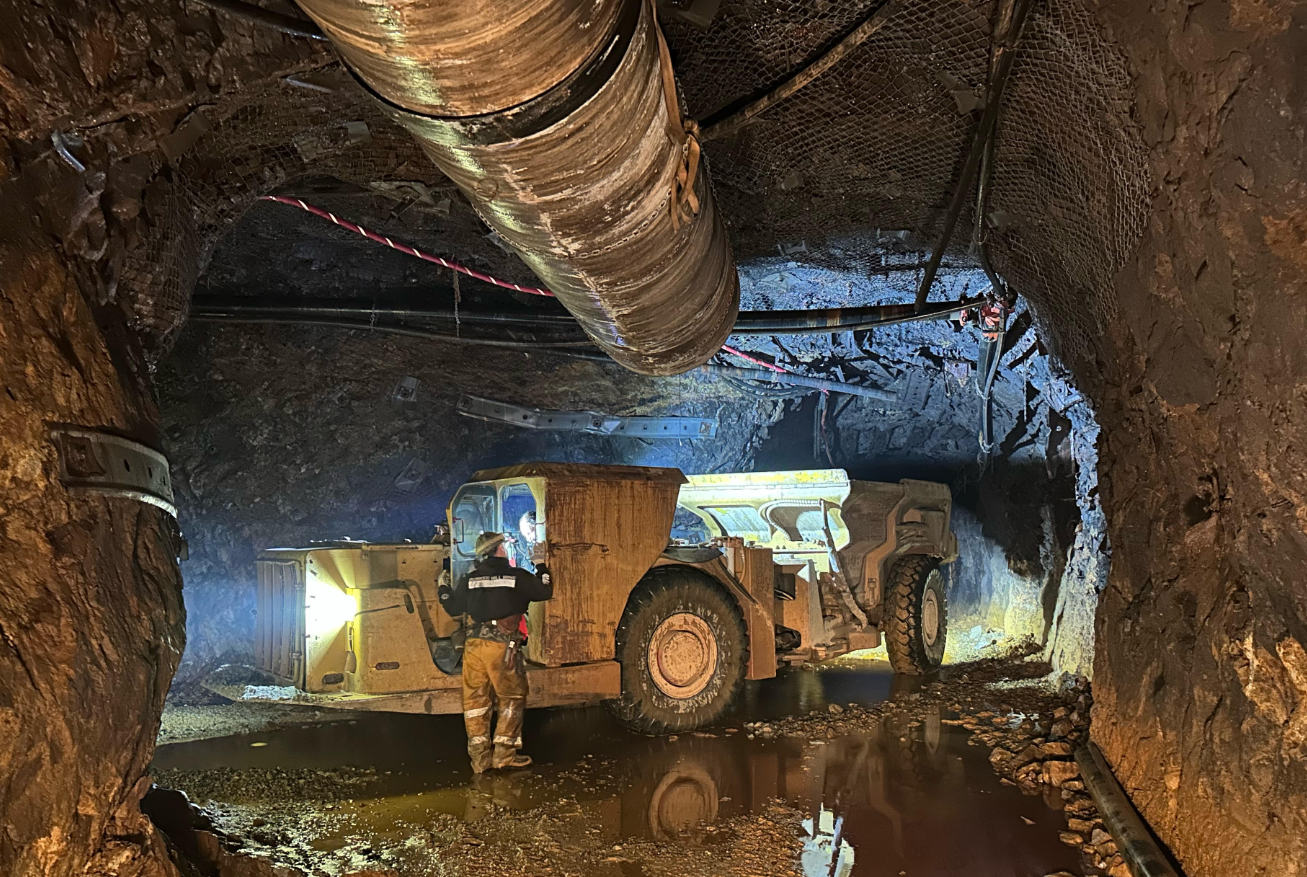
8:40 So I think that's the overview of where we are on the mill construction site. And with that, I think I'll turn it over to Tom to give an update from the Wardner side and from the mine perspective. Tom? Sam thank you very much. Hopefully you and the listeners can all hear me clearly and maybe I'll just start by saying my thanks especially to Mike McCullough who provided that superb drone video for us when he came up on the 8th of July and we look forward to hosting him in a couple more months for kind of further drone video updates that we can share with everyone. So I'm located up at Wardner, the base of our mining operations. As the crow flies I'm about a mile, a mile and a half away from Sam right now and the last time I think we updated from this location was late last year when we were informing everyone of the upgrade and enlargement of the Russell portal and the connection to the mainline electricity grid, bringing power directly onto site. And so right now I'm stood just outside our mine offices at Wardner. I've chosen a spot that is halfway between the compressor and the main load centre, both of which are humming away quite loudly right now so that I can hear myself and hopefully people can hear me, and I just want to give a little bit of an update about what's going on underground because whilst it's clearly not as conspicuous and easy to see in a drone video there's a lot going on underground as well.
10:03 So firstly we're continuing to rehabilitate down the main decline towards Orface. We're keeping the team very small and lean right here but they're working incredibly well. We're 1 mine manager, 2 mining engineers, a surveyor, a diesel mechanic, an electrical superintendent and 4 miners. And they're progressing at a rate of about 25-30 feet a day of rehabilitation
10:27 underground towards the eighth level. I'm stood currently on the 5 level as we call it, the entry level of the Russell portal. We've worked our way down through the 6 level, down to 7 level and we're right now proceeding from 7 to 8 level to continue to rehabilitate and prepare the mine for first initial ore from the 8 level. I would like to say that one of the great things about working at the Buck Hill mine is we already have shovel-ready ore in draw points underground, but the primary mine plan and the initial stopes come from the 8 level and so we're making sure that we're getting there in good time and we're on schedule for that right now to ensure we can kind of mine at the rates we want to underground at the very end of this year and very start of next year. So things are going well underground and 2 other milestones that we've just recently passed are installing from Hoffman Manufacturing, installing our first new set of automated mine electric doors and installing also the primary
11:26 fan, and installing also the primary fan which hasn't yet been turned on but has been sort of secured into a bulkhead and will be turned on next month. Alongside the underground mining, and I'll just pause there briefly and just make sure that people can see me,
11:47 and so there's thank you, sorry, alongside the underground rehabilitation and concurrent with that we're also progressing with a drill program led by our chief geologist Mark Crowther that's about an 8,000 foot program and we're about 2 and a half thousand feet through that drill program. Very roughly half of that drill program is definition drilling and another half is kind of exploration and hopefully confirming and upgrading some resource and that's going incredibly well. They're working a night shift, our miners are working a day
12:19 shift on the rehabilitation so that those activities are kind of synchronized for maximum efficiency at the moment and we're very excited with the good progress being made by Dynamic Drilling Underground, the footage that they're getting per shift And we're just at the point where we're starting to get some of the first results back from that. The initial results, of course, were from just preliminary utility holes. But as those results come in and the chief geologist gets to review them, we will, of course, be updating the markets on all of that in the coming months but that's going extremely well underground
12:50 and that will continue for most of the rest of this year to complete that definitional exploration drilling program. So that's a little bit what's going on up at Wardner underground, less visibly fantastic surface level than the main yard, but a lot of work going on here and progressing on schedule and really very successfully. And I'll hand back to yourself Sam or Brenda or Richard.
13:16 Thank you Tom. With that great update from the site and what's happening at Wardner, I think it's time to open it up for questions. One of the questions that was asked was when will we see the assay results?
13:36 We will begin to see the assay results over the next couple of weeks. And as we acquire and put those assay results together and work that through the QAQC process and make sure that they are in a report ready state, then we would expect to see us sharing the results of those over the next month or 2.
14:03 Another question that was asked was, when would we expect an update on the monetary metals refinancing?
14:10 Yeah, the monetary metals refinancing process is going quite well. And we expect that, you know, we'll have a positive report on the progress and the completion of that over the next few weeks.
14:28 Maybe Richard, you might like to answer this question. What do you think the impact of increased metal prices is going to be for Bunker Hill?
14:40 Richard, you're on mute. Thank you, Brenda. Evidently, as we all know, that if metal prices go up, the first effect is the amount of money that the mine will make will increase over time. What we're obviously focused on is the delivery of the project on the basis of our existing assumptions
15:07 based on metal prices that we estimated would be the case through this year, but in particular 2025, 2026 and 2027. It's our view that the consensus metal prices used by ourselves, but also by the market are highly conservative relative to the projections of demand relative to supply for the key metals that we're
15:34 going to be producing in the mine. We see the actual position for metal prices to be very positive at the moment, but we're tracking that as every miner is, as everybody going into construction, not that many mines is, and it's a vital part of what we look at. But for those dialing in and not familiar with the plans that we put in place, and Sam can talk to this in much more detail than I can. I want to emphasize that the metal consensus that we use for our business plan is highly conservative and far below that, which is the current spot prices. Terrific. Do we anticipate a resource update at any time, Sam?
16:21 Yeah, absolutely. So our intent and as part of the resource drilling program, we'll consolidate the results of that resource conversion drilling and resource expansion drilling. And we will be looking at providing a resource update
16:41 and an updated mine plan based on that resource early in the new year. Terrific. The creator of the video has asked that I give a shout out to Doug Hall and his team for their assistance in making the video and also said how impressed he is with all the progress that we've illustrated today at Bunker Hill.
17:03 Thank you. Tom, do you have any comments that you'd like to leave everybody with?
17:11 Nope, okay. Okay, Tom, I think you've been muted if you wanna say something, Yeah. Tom, any final comments from you up at the Wardner site? No, other than on a hot Idaho day, I'm enjoying being at a higher altitude and things are humming along safely and very efficiently here. And otherwise, thanks, everyone, for the opportunity to provide an update on the underground as well as the surface section. Perfect, I'll say Tom just give us a feel because you and the guys are also working on an underground video that we can share with the market about the progress under there. Just talk a little bit about what you're doing with that and when you think you're going to be able to release it.
17:55 Yes, absolutely. So I kind of saw the first raw footage of that. What we want to be able to share with the market to complement the great images coming from the main yard and the construction of the process plants is just a sense of being able to drive in through the new enlarged Russell Portal and drive all the way down, kind of have a helmet camera, kind of pro cam view all the way down to where the drill rigs are and to where the ore faces are. So I got the first 7 minute raw footage of that last night Richard was having a look at. I think we're just going to basically compress that a little bit so we're not being too abusive of people's time. But the intent will be to share that and so you can have that experience of seeing, driving in through the portal and going all the way down, seeing those automated electric doors that we've just installed that I referred to, seeing the primary fan, seeing just how clean and good the housekeeping is, seeing the power coming down, the decline, and all of the utilities, and then seeing the drill rig underway as well. And so I think we're really in the editing stage, and I think we'll share that, Richard, in the next 1 to 2 weeks.
19:00 Great, thanks. And Sam, from your perspective, what Tom's gonna be showing is a portal access for the mine, which is different to the other mines in the Silver Valley. Can you just explain to people on the call what are the advantages to that and why that makes Bunker unique relative to the other mines, Sam? Absolutely.
19:26 It allows a significant advantage in terms of access to the mining area. The other mines in the Silver Valley, the access to the mining area and to the reserve that's being mined is gained through the travel and material movement up and down a shaft. And that can be quite complex and adds complexity to the mining system and the mining process. So the fact that we can access our mining areas and the extraction of ore by simply driving to it is a distinct advantage, both from a productivity and a cost standpoint. Thanks, Sam. And with respect to the infrastructure, Tom, that you've put in underground, I know people will see this video shortly.
20:19 And Sam talked to it as well, is we have the advantage of inheriting a lot of infrastructure that we've had to refurbish. So the actual startup capital required for a mine like this, relative to other, say, greenfield operations is exceedingly small. Can you talk a little bit about the advantages that we've been able to make most of at Bunker Hill relative to say a greenfield site that's having to
20:47 sink ramps and put in ventilation and the power and so on. Yes, certainly Richard, and I think the point I'd make is the video to which I was alluding, which will give the kind of viewer the experience of driving in as if you were in a haul truck or a loader in through the portal and down to the face, the ore face.
21:10 Only one section of that was driven as kind of fresh new decline in kind of hard country rock and we completed that in late 2022. That was connecting from the 5 level again that's the level I'm on right now, that's the level of the main Russell portal, that was a decline driven from 5 level to 6 level but thereafter we're already using pre-existing decline that we're simply enlarging. And so we're adjusting all accessible parts of the mine to a 13 foot high, 11 foot wide dimension for our drifts and our declines and that accommodates all trucks that can have a capacity of 20-25 tons, 6 yard cat loaders and the size of kind of jumbo drills that we operate.
21:57 But other than that decline which we've completed in 2022, What we're really doing right now is just using pre-existing
22:05 infrastructure and just simply enlarging those declines already to get us to where we want to go. And the other example of that is once we have power delivered from the grid on the surface up to where I'm stood and we dropped that underground through the Cherry Rays, again through a pre-existing raise that's one of our escape ways and didn't need to kind of drill or find additional access for that. That raise was again in position, suitable and ready for that kind of power drop and allowed us to get power where we need it in the most direct and efficient way possible. So the whole mine plan was conceived on the basis of minimising, excuse me, minimising kind of additional work that we need to do and maximizing the kind of pre-existing infrastructure.
22:53 And I think the other point I'd make is, of course from a safety point of view, we're always inspecting ground support, we're always ensuring that's good and that's robust, but when you walk around underground in a bunk hill mine, you realize that kind of declines and drifts and tunnels from 40, 50, 60 plus years ago are in remarkably good health from a ground support point of view. And so the additional work that we need to do, which we are of course, you know, bolting, meshing, putting in kind of additional kind of ground support strips, landing strips, we benefit enormously from the kind of geotechnical robustness of the ground to ensure that we're not having to dig through collapsed tunnels and we're really just benefiting from good natural hard country rock. So those are some of the big advantages that come from the underground infrastructure.
23:43 Maybe one other thing I'd say is that again because of just quite how extensive pre-existing underground infrastructure is, you know we benefit from having not just a secondary escape way which is down through the Kellogg tunnel but also a tertiary escape way which is up through the Cherry Rays as well as the primary Russell portal access and all of these are kind of historic but valid robust and workable kind of infrastructure options that have exist for us already today so so those are some of the advantages of doing this versus a greenfield option. I think I would add to that, Tom, by just saying that it is distinctly unique for a mine restart, an underground mine restart, to upon restart have the first 3 to 5 years worth of ore accessible with the capital development. And that's a distinct advantage that we are well developed, our access to ore is
24:43 second to none, and we're able to have a long runway from an underground development standpoint and access to ore upon startup. So that I believe is a distinct advantage and difference between a Brownsfield restart with existing infrastructure and a new Greensfield project.
25:04 Thanks, Sam. Again, I'm keen also, there's a couple of questions that have come up, but Tom, given that you're, as you said, a mile and a half as the crow flies between where you're standing and where Sam is standing. When the ore comes out of that portal that's near you, it's got to drive over to where Sam is for the processing once it's had primary crushing done to it. You've recently done some work up there to help with dust suppression on that site. Can you talk a little bit about that and perhaps even show what you've done?
25:40 Yes, certainly. And I'll also just try and sort of just turn the camera around again in a second to give a feel for that. But the other advantage again of pre-existing infrastructure and of restarting an old mine is that the haul road that connects where I am to where Sam is, is again a pre-existing haul road. And so we own the majority of the land and we have legal easement through those parts that we don't own and that's a haul road that's in very good state, it doesn't need to be broadened for the capacity that we'll be conveying over it and so we have advanced plans for the surface haulage of the ore that will come out of the Russell portal and then the primary crusher will be at my location where I am in Wardner, then loaded into surface haul trucks that will have a capacity of 40 tonnes or so and then driven and the haul road, I refer to the kind of direct line from myself to Sam the whole road is a downhill gentle decline it's about a 2 and a half 3 mile haul road directly into the yard where Sam has stood
26:43 and where there'll be a secondary crusher and then it'll enter the kind of process plant system properly and in terms of the kind of environmental aspects you know we've we have our pre-permit to construct from the Idaho Department for Environmental Quality, and a key part of that was making sure we understood and we can control and we prove and show that we can control air emissions and dust emissions. And so one thing we've done very recently
27:06 up here is apply a kind of pine tar surface to the haul roads in and around the mouth of the Russell portal and the the Wardner footprint to minimize dust and it's been incredibly effective and I'll just try and give a quick sort of a quick view of that to those watching.
27:29 I see that's the sort of I can see what that is Tom and yeah just just for you know people that are sort of wanting to understand a little bit, that's great, Tom, is that one of the advantages that Bunker has from an environmental footprint perspective is we're keeping all of this construction,
27:50 which includes the road and everything, within a pre-existing envelope, an area that was previously mined and disturbed. We're not looking at expanding this out into greenfield areas And that's very much part of our approach, which is to minimise the environmental footprint, keep it within the existing mine footprint and thereby preserve the best of the remarkable environment in the Silver Valley of Idaho, which is great. So that's another important point that Tom's able to highlight from there. Thank you, Tom.
28:31 Sam, are you still on?
28:34 Yeah, sorry, I had a connectivity issue, but I'm back now. One of the questions here, it says, I understand that this is the same mine as in the past, but will you be focusing on the same ore? Or is this a new version of the company looking to do something a bit different? Essentially, talk a little bit about, Sam, I think from this question that would be helpful, what are the reserves that we're mining? What is the nature of them? There's another question related to the metal mix. Just remind people of the history of them and what we're doing in stages to give the guy who asked this question a bit of a feel for what our mine plan is and what the difference is and what we've done to enhance it since we inherited these great resources. Sam?
29:25 Absolutely. So the Bunker Hill mine operated continuously for 100 years, starting in the late 1800s. And its metals of focus were zinc, lead, and silver. 5 million tons of base metals, kind of evenly split between lead and zinc were produced over that 100 year life and an additional 165 million ounces of silver. That makes it the third largest silver mine and silver producer in the Silver Valley, which is the largest silver mining district in the world with over 1.2 billion ounces of silver produced in over its mining life. Now, historically, the Bunker Hill mine from a revenue perspective was evenly split from a revenue between the base metal component and the silver component.
30:16 Upon restart, Bunker Hill will be more dominant on the zinc front, with roughly 70% of the revenue generated from the production of zinc. Is that over time there's a lot of leverage and a lot of focus, and our focus will certainly be to rebalancing the revenue stream where silver plays a more forefront role in revenue generation over time. Our reserve, our resource right now, we have set a little over 7 million tons of measured and indicated material and 7 million tons of inferred mineralization. Now that is by nature of the area in the mine that we're working is more zinc dominant at the moment and upon restart.
31:11 But as the mine plan progresses and as our access to the deeper areas of the mine are made available by the mining front moving down, we expect and we will, and our intent is certainly to, through exploration and through resource conversion, bring silver more to the forefront of our production profile over time. Thank you, Sam. And for those who don't remember this, I'll remind you is that Sam is particularly is different to the rest of us in many ways. But one of which I'll draw out here is his father worked on the Bunker Hill mine back in the 1970s.
31:57 Sam, of course, and I have known each other for 10 years. He was out developing barracks mines in Saudi Arabia and Africa and so on, and has essentially returned to the place that his father was working to bring this great mine back into production, providing new and long lasting American jobs in an area that will really benefit from it. Tom and I have worked together over the same period of time but in different environments. And himself as an American citizen, who's come from working in Utah to Bunker Hill as our general manager, is again, representative of the type of people that we've got leading the restart of this operation from the ground.
32:43 This is not a fly in, fly out operation. Our leaders live, in Sam's case, 25 minutes walk from the mine site, in Tom's case, 40 minutes drive from the mine site. They live with the community, they communicate with the community and they feed from and gain the support of the community in this vital project that we're bringing back into production for both our stakeholders, our shareholders, the community, and the nation within which it is founded. This will produce long lasting jobs and provide essential metal to improve industrial resilience within the United States of America. What you've seen today, and we're happy to answer more questions when I get off the podium here. What you've seen today is from Sam, the construction of the processing facility and alongside it where our tailings filtration facility will be established.
33:41 And all done within an existing footprint. We're making maximum use of the space we've got available rather than taking a bigger bite out of the environment. We don't need to do that. We're being efficient. And then what you see from Tom, our general manager, project manager up at the mine site, where the mining is happening at Wardner, unfortunately you don't get to see the mining or you don't get to see the mining or you don't get to see the infrastructure. We'll give you a video link to that later. It's the type of base that we've put together and the thoughtful connectivity between that base and SAM to ensure again, the minimum environmental footprint for successful restart of mining operations. Again, I look forward to any questions directly or indirectly on this, but this has given you an opportunity to get from the ground some of the key impressions that we want to share with you of great people doing important work in a wonderful mine site and developing it in stages sustainably using the minimum amount of capital.
34:49 With that Maybe I'd like to just say that one of the comments was that a lifelong resident whose grandfather worked at the mine thanks us for what we're doing and certainly for answering the questions today. I'm in Kellogg this week, and I get that comment consistently wherever I go. People are certainly excited to see what is happening at Bunker Hill. And I invite anybody with further questions to reach out and we'll respond to you as quickly as we can. Thanks. I see there's a question here. We'll keep on going. You keep on asking us questions, we'll keep on answering them. I said, Zinc is now a strategic and critical metal. It always has been. I mean, the US government's been stockpiling zinc as part of its defense procurement program since the 1950s. But it's now a strategic and critical metal.
35:36 Have you asked the US government for assistance developing this resource? We only seek from the government the environment within which we can operate. We're not directly seeking from the US government financial support. We will take any particular advantages that US government wishes to deliver to an industrial project like this in terms of tax, in terms of support to local banks that wish to seek us finance, all of that we'll seek to do. But we're operating as an independent entity in support of both our stakeholders' interests and the national interest. And again, what Sam, Tom, our finance team, not on this call has been able to do, is been able to deliver, is in the process of delivering a restart project on behalf of our stakeholders, of huge benefit to the community and the nation within which we operate without having to need special industrial subsidies or special money.
36:42 But if such money needed to be available, if they wish to sponsor us, of course we'll take it. But I want to make that very important point. We're not in the business of dependence upon the government. We're seeking to do something that is nationally worthwhile, supported, appreciated within the environment and the bounds of the national guidance. Sam, is there anything you else want to say on that? Because there are some specifics I probably brushed over. Yeah, I think what I would say on that, Richard, is that Bunker Hill, right from the start, has been focused on a capital efficient restart, getting back into production and generating free cashflow to reinvest back into the operations.
37:31 So certainly, we see tremendous opportunity that can be unlocked with the access to capital. And if there was a situation where low cost capital or capital was available, we certainly see ways that we can deploy that capital to add significant value. Thanks. Sam, there's one other question perhaps you could respond to from Eric. He asked what pricing per metric ton is a conservative figure do we use? Well, Eric, per metric ton, I'd have to do some conversion in my head. So if it's all right, I'll speak in dollars per pound and dollars per ounce.
38:18 But what I can say, there's a wide view on consensus pricing. I can tell you what we used in our price assumptions. We used a $1.10 zinc, $20 silver, and 90 cent lead for all of our projections. Now, the consensus prices, depending on who you look at, they're sitting around $1.20 zinc, in some cases, maybe a little bit lower, you know, 20 to $22 silver and lead is really pretty consistent around that 90 cents to a dollar range. But having watched pretty closely, in particular, the zinc market over the last few years, there's a few trends that I see, one of which is that at every point in the last 4 years where the zinc price has dropped below $1.15 per pound, you see an almost immediate response with supply dropping off the market.
39:27 So from my perspective, I think that, you know, that is a pretty strong indicator that the zinc price over the long term is really only sustainable above $1.15 an ounce. Probably, I would suspect, closer to $1.20. And is really, you have a healthy supply-demand dynamic, right about where we are now, I would say, at about $1.30 per pound. On the silver side, it's quite interesting. You know, we had a almost a step change, it appears, in silver price from where it had been trading in a fairly tight band between $20 and $25 an ounce for quite some time to about 8 to 10 weeks now I believe where the silver price has been trading in a pretty tight band between 30 and 32 dollars an ounce So it'll be interesting to see over the coming months, you know, if a new floor has emerged for the price of silver.
40:42 Lead, I think that when you look at the long-term pricing in lead and the way that lead is behaving in the global market, not much reason to think that lead won't trade in a pretty tight range between $0.95 a pound and $1.00. Well, I think that's the end of our questions, Maxim. Perfect, yeah, thanks a lot for taking us through the site tour and the questions. So thank you all for submitting your questions and for all the positive comments. It's actually been incredible to see the progress as I, you know, watch and also participate in these events to some extent.
41:28 So as always, this recording will be available to watch on demand in the coming day or so, even the coming hours. So look out for that. And before we wrap up, any closing thoughts from any of you? Oh, Richard, you're muted, sorry. Sam, could you put the camera on to the processing building and the steel that's gone up there? I can't quite see that from the stand you've got at the moment. Yep. That's really quite remarkable. Okay, that's where you're standing. Yeah, you can see the size of the building. It's very substantial. And just before we head off, what do you expect as I look at that, just say over the next 4 weeks that we're gonna see that's gonna be different. Just repeat that particular point, please.
42:21 Well, certainly there will be equipment being placed and mobilized into the building itself. You'll see the building being clad and covered in. And then immediately to the right, you'll see a large crusher tower be constructed, or sorry, a transfer tower for the conveyor system constructed here. And where these individuals are working on the rebar, you will see a large crusher tower being poured and erected in this space. So I would expect that on our next video, we'll see a large crusher tower and installation in this location, a large crusher or a large conveyor tower there. And you will see a building that is clad with potentially a video on the inside showing the progress of equipment placement.
43:11 Greg Phillips Thank you. And just for the people on the call, when we say equipment placement, that's the sort of mill and then the establishment of the mezzanine level, flotation and various other things. Just talk a little bit about that again, please. Yeah, absolutely. So essentially it will be filling the mill building in with the actual processing plant. So primary ball mill, the regrind mill, flotation cells, the zinc thickener, the lead thickener, the concentrate filtration, and the pumping and piping and electrical systems that make it all run. Got it. And what's remarkable about that is our primary ball mill came from Golden Sunlight, Barrick's Golden Sunlight operation in Montana.
44:03 And the rest of it has come from Tech's Pend Oreille operation in Washington State. So again, in terms of environmental footprint, we're helping other companies reduce the footprint of their closed sites and we're making use of the long-life equipment that they have to breathe life once again here into Bunker Hill. It's a great story of recycling and efficiency And I think for all viewers on this call, we'll do what we normally do, which is every time there is something photogenic with respect to the progress, we'll release that, we'll explain precisely what we've done. And you can be as excited as we are about all the steps that we're taking to get this closed and get it back into operation, forgive me, get the job done and get the mine back into operation.
44:58 Thank you, Sam. Tom, any final points from you? I think I would just say with regard to what's going on underground, we will look forward to starting to share kind of drill results as and when it's appropriate and we've got a critical mass coming through and that's something else that we look forward to sharing in due course. That's great. Thank you. I've got no other. I just want to thank everybody for being on the call. Thank you, Brenda and Maxim for setting up. I think it's been really interesting. Sam, I'll leave the final word to you as CEO. I just wanted to sneak in a couple questions here. Sorry Richard, we just had a, I wanted to sneak in a couple questions here from the audience here if you don't mind. I don't mind at all. Just 2 questions here it looks like. Sorry to interrupt, just how much ore in terms of truckloads per day would be anticipated?
45:50 So when we get fully commissioned and we're up and running 1800 tons per day is the base mining rate, so we'll be operating a fleet of 20-25 ton trucks, so we're talking about 80 to 100 loads a day, but we'll be operating 24 hours a day. The Overland haul road from Wardner to Kellogg is a more substantial pre-established haul road as we're talking about and we'll be able to operate larger trucks on that and so we'll be talking about 2 or 3 runs an hour for 40 ton haul trucks to accommodate that capacity. So that's the initial 1800 tons per day throughput.
46:37 We have plans beyond that, but that's the kind of initial base rate and the kind of number of runs we'll be doing underground and overland. Perfect. And last question to quickly just shoot in here. Where will the silver ore be processed and refined? I'll take that. All of the concentrate, which is the product that we sell, will be purchased by Tech Metals and refined into finished product at their smelting facility in Trail, British Columbia, which is about 180 miles away by road from the site. Perfect. Awesome. Yeah, so just gonna pass things back over to you there, Brenda, Richard, Sam.
47:24 Well, Sam, over to you, Sam. Why don't you flick the camera back round onto yourself and give us a few last words and we'll sign off and thank everybody for coming on. Yep. There we go. Thank you everybody for dialing in. We really enjoy doing these video updates. As you can see, there's a lot of work going on by a lot of incredibly skilled people. So, as we sign off, I just want to mention the team that we have, Gypsy, who is doing all of our project and construction management. Maverick who is erecting the pre-engineered metal building. Performance Energy Solutions who's doing all the concrete and foundation work. We have an excellent, excellent team of people hard at work here and are doing a great job. So with that, look forward to seeing everybody on the next update.
48:30 You