Transcript
Automated transcript · Written by software from the replay's audio. It can mishear names and figures; the replay is the record.
0:08 Hello everyone and welcome to Bunker Hill Mining's live event. I'm pleased to introduce their speakers for today, Sam Ash, CEO and Executive Chairman Richard Williams. To provide further context to this morning's press release and afterwards we'll be answering questions. So please do submit your questions in the bottom right corner in that chat box there, and we'll get to them at the end of the presentation.
0:29 As always, the summit is being recorded and will be available on six.com to watch afterwards. So without further ado, I'll hand things over to Sam so we can get started. Thank you, Kyle. I'll kick off and then hand over to Sam just on this early introduction slide for those that haven't been following us. We put together around Sam Ash, who's our CEO, a very high grade team that used to operating in a number of different environments and a number of different scales, based them in Idaho alongside and in many cases on the mine that we're restarting in an active super fund site in the Silver Valley. This Mine will produce 2 concentrates, zinc concentrate and a lead silver concentrate, and truck that to Tech's trail smelter in British Columbia.
1:26 And thereby will contribute, play its part in the reorganization of the metal supply chains that are going on in the face of some geopolitical pressure. This is a brownfield restart in an environmental cleanup site with a very limited amount of capital. It's going to be done in stages. We get a restart operation up and running and Sam will talk to you about progress towards that shortly. And then we then scale up, by which I mean we unlock the world-class value that we see underground, leveraging existing infrastructure, our team, and the infrastructure that we build now to ensure that we can start at, say, 1,800 tons a day, which is our aim now, and then scale that up to 2,500 tonnes a day or so over time.
2:23 It's done in stages. It has to be very, very sensitive to the environmental management needs of operating in the renovated, rejuvenated,
2:36 restored Silver Valley within that Superfund site and has to be done absolutely with the support of both the local community, the state and the federal agencies. We've got to be very careful what we do, which is what we're doing. And you'll hear more about that as we go forward in this presentation. With that, I'll hand over to Sam and thanks very much for dialing in. Thank you, Richard. Just for any new callers and new, just a short introduction to the Bunker Hill Mine and where we're located. So we're located in the Silver Valley in northern Idaho. The Bunker Hill Mine has a long and storied history. It was in continuous operation over a hundred years. It was vertically integrated, had a lead smelter and a zinc plant, and produced 165 million ounces of silver and over 5 million tons of base metals over that time. Now the mine was closed, as Richard mentioned, for environmental performance reasons and it's been in rehabilitation for the last 40 years since closure.
3:47 We joined the team and the project in 2020 and happy to say that at this point we're on the threshold of bringing the mine back into production. We have 7 million tons of measured and indicated material and another 7 million tons of inferred mineralization that we expect to convert at a relatively high conversion rate, considering that that inferred resource was reserved when the mine went into closure. So we are planning on coming into production at 1800 tons a day. And we're going to begin the process of mine restart and commissioning through Q4 and ramping up production through Q1 of 2025.
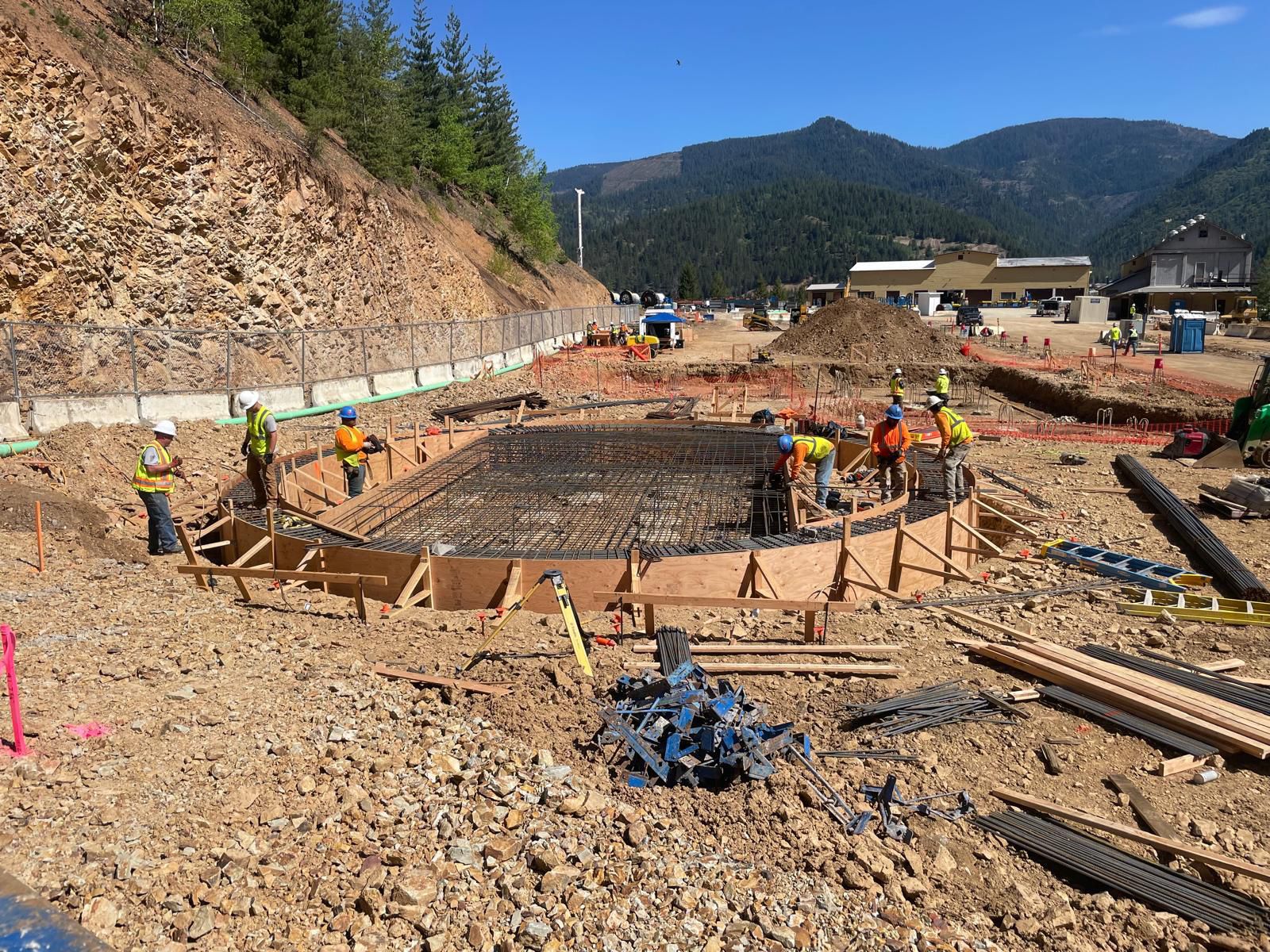
4:33 The exciting thing about Bunker Hill is that this really is just what we've always envisioned it to be, which is a light capital rapid restart to get a iconic US mine back into production. And that's when the real upside potential and the ability to unlock significant upside value comes. So with that, we'll dive in and give a bit of an update on what we've been up to here at site. So we have received our pre-permit to construct, which allows us to advance at pace with the construction process. You can see in the pictures there, the full 3D rendering and model. And if you look closely on that picture below the plant, you can see the deep piers.
5:24 That's what we've been working on for the last month or 2. And in the last few weeks, we started pouring foundations. The foundations that you see there, that's for the fine ore bin. That'll be in front of the processing plant and so the ore will be crushed, put into the fine ore bin and then report to the mill for processing. In addition, we've been receiving all of the conveyor packages and really beginning to receive back and complete the refurbishment of the Pend Oreille mill equipment. So quite an exciting time. And in fact, over the next few weeks, just to give you a scale of the foundation work that we're gonna be doing, we have several pores that are around a thousand yards of concrete coming up over the next few weeks, which is gonna be pretty exciting.
6:15 I'm sure the next time we talk to you, it'll look significantly
6:19 different with foundations in and beginning to work on putting the buildings and the major equipment into place. So all is moving along quite well. The pre-permit to construct, just for everybody's information, it's really based around air emissions and air modeling. And that took quite a bit of time. We wanted to be very, very precise,
6:45 certainly considering that we are restarting a mine on a Superfund site. So we just wanted to make sure that we had all of our ducks in the row and everything was absolutely correct. Happy to say that that was the case and we're moving forward with construction in earnest now. One of the aspects of the processing plant build that has gone through a little bit of change, and those of that have been with us, for some period of time, have seen this evolution take place. But I wanted to talk a minute about the tails filtration, so there was there has been a little bit of a change a a And this change was really to improve the efficiency of tails dewatering.
7:34 We were right on the borderline between being able to use a disc filter and a filter press. Now, the disc filter, it's a little bit less expensive option, but it doesn't achieve quite the same dewatering level that a filter press would. And so we, with the help of our engineers, Asenko did quite a few trade-off studies and the size of the tails filtration plant increased just a little bit and that's really to allow us to have the capacity to expand in the future to a 2,500 ton a day operation and we changed the process from a disc filter to a filter press just to achieve a higher level of tails dewatering.
8:23 So it's really a best-in-class solution and it sets us up well for expansion as we move and as we look to unlock additional value. The trade-off is- Can I interrupt? And this is not gonna be the first dry stack tailing in the Silver Valley. Some of our buddies down the road are doing the same, aren't they? They are, they are. And certainly those familiar with mining and tails management would recognize that dry stack tails is now the gold standard of tails deposition in the mining industry. Now, That being said, most of our tails is going to be going back into the underground and certainly at startup, all of our tails will be going back into the underground.
9:08 But as we move forward and we're setting ourselves up for an extended mine life, the ability to execute surface dry stack tails is part of our plans and certainly is the appropriate risk approach for tails deposition.
9:32 I guess the other thing I should say is that, you know, there was a cost implication to that, but happy to say that, you know, we're completely comfortable in our ability to to fund and build us as part of our financing program and capital structure for restart. And it really sets us up well for the future.
9:56 On the underground side, underground preparations are going exceptionally well over the last couple of months. You know, we've, the rehabilitation has continued in earnest. We've, we have full underground electric, electrical infrastructure in place,
10:13 full underground compressed air in place. We're in the process of putting in our primary vent fans and our first set of air doors. And the rehabilitation is progressed to the point where we now have a drill rig starting to work on resource conversion and resource expansion. And we'll be moving in short order into the construction of an underground maintenance facility. Rehabilitation work is ongoing, but at this point, we have the rehabilitation of the primary ramp complete for the first 2 years worth of mining. Under the drill program, you can see here that we're planning and have initiated a 9,000 foot core drilling program. This was always budgeted.
11:03 And just for everybody's interest, it is focused on 2 areas. One is resource conversion, and 1 is resource expansion. And the area that it's focusing there, if you look on the picture on the right, you can see that the ore body bifurcates and the mineralization bifurcates. And this resource conversion drilling is focused on the lobe that is on the right, which would be the Western extent of the mineralization. And the reason it's focusing here is 2 primary reasons. It's the first area that we're going to be starting mining operations in the underground. And it also happens to be the higher grade area, generally, of mineralization.
11:52 So, you know, certainly focused on delivering higher grade material earlier in the mine life. And quite a lot of potential as well in that resource expansion that we're excited about to extend the limits of known mineralization and higher into the higher into the hanging wall in an area that previously had no known mineralization but certainly the geology would indicate that there is a likelihood of expansion in the up-dip direction. So we will be seeing results coming from this drilling over the next few months and culminating in an updated resource late this year, early next year, it's gonna depend on the progress of the drilling and sample analysis turnaround.
12:49 And this is really focusing on the bottom 2 tiers of our value creation pyramid. Resource conversion of the existing resource, And just to remind everyone, we have just under 7 million tons of inferred mineralization and we expect to see fairly high conversion rates, which is really pretty exciting. And then on the near mine exploration side, that certainly speaks to what I was talking about with the with pushing the limits and testing the up dip extension of mineralization in the higher grade lobe of the quill new guard mineralization which is where we're going to be starting mining.
13:35 So just to wrap things up, and it's a pretty quick and brief summary, but we're on track to begin mining operations in the underground in Q4. We're also going to begin the commissioning process in Q4 and ramping up to full production through Q1. We spoke a little bit about that with the transition from a disk to a press filtration system that there were some additional costs. But I wanna reassure everyone that the refinancing package that we're working on is going to allow us to complete and execute that change. On the financing side, just for everybody who's wondering, Treasury holds about $10 million. We retain a $1 million undrawn facility.
14:33 We don't really want to draw on that, which is why we've been working the last few months on refinancing that portion of the project financing and looking to increase that a little bit.
14:49 But primarily the reason for the increase is we see a lot of value creation opportunities to accelerate in the exploration space, accelerate some operational areas that we can begin to unlock value. But we expect to that, that will be complete within the next 60 days. We're in the execution phase of that financing. So certainly stay tuned, watch this space, and as further details come available, we'll certainly be excited to share them with everyone.
15:25 And with that, I think we'll turn over to any questions that we might have. Perfect. Could you go back to the first slide with the construction slide?
15:40 This one. Okay, for questions. I can see there are a few here. Kyle, do you want to lead us through them? Yeah, I can moderate unless you want to Richard, but yeah, there's already quite a few questions in the chat here. Just a reminder for anyone that came in late, we are taking questions, so please keep them coming in if you have them. The first question is if you could quantify the scope of the capital expenditure slash operating expenditure impacted related to the switch to pressure filtration.
16:13 Yeah, so there was really, there was a, you know, And I'm glad you asked that that way, because there was an impact both on the capital and the operating cost. So the impact from a capital perspective is right around $5 million, but we are still looking to bring that down. We're looking at used equipment opportunities. In fact, our mill manager at the moment is on a visit to a unit that we think may work for us, which has the potential to bring that cost down a little bit. The operating cost impact in part is a slight deferral of the ramp up to full processing capability, about 30 to 60 days, and pretty minimal impact, a couple of million dollars, but what we really need to do and make sure of is that is how do we ramp up and we're disciplined about the ramp up of labor and employment so that it matches that restart schedule, which we have done.
17:26 And to follow up, our walkers wondering if there's any impact on the project timeline with this change? Yeah, so our project timeline has us beginning mining operation and starting the commissioning process in Q4 of this year, ramping up through full production through Q1. So, you know, we will be doing, you know, starting dry commissioning and working through the startup of the mill right at the end of the year and then going into production through Q1, ramping up.
18:03 Pete T. Harris is wondering if you could provide some clarification on the press release this morning. What does marginal increase to cost to complete pre-production budget mean? Absolutely. So the increase is under 10%.
18:23 So there has been a slight increase mostly due to the change from disk to pressure filtration. But again, still well within our ability to finance on the restart. And we're really quite comfortable with that decision and pretty excited about the upside opportunity that allows us to unlock additional value once we're in production. It's a more efficient design and the design has an increased capacity that allows organic expansion post-production.
19:02 Now you kind of touched on this but this question is phrased a little differently. You said 10% increase but how much extra cash are you looking at raising in this financing process? Also how confident are you that the
19:16 financing process will be successful?
19:18 Yeah so we are looking to increase the level of financing, obviously to cover the increase that we've seen in the disk or from the change in filtration process. So we're looking to increase that really, but as much as we're able, in the 5 to $7 million range, we're very confident in the refinancing. As I said, we've selected and we've spent 3 months doing a structured refinancing process. So we canvas and looked across the market. We had multiple opportunities And the opportunity that we're going with, we have a high degree of confidence in,
20:06 and we expect it to close within 60 days. And we're really pretty excited about the opportunity that presented ourselves. It's gonna increase the amount of capital available to us. And at the same time, we are expecting it to have a significant reduction in the cost of capital.
20:28 And it will allow us to not draw on the undrawn $21 million facility. Right. Thank you for that. Adam's wondering for the underground mining work, is Bunker Hill going to use underground contractors or employ and have an internal workforce? Yeah, I'm glad you asked that, Adam, because one of the things that we have done over the last few months is we've integrated the mining contractor that we were using, CMC, into our business. So we will be self-performing all the mining. We are self-performing the rehabilitation right now, and all of the underground activity will be self-performed.
21:12 We have the equipment fleet needed for restart on site now, and we have the mining crews required for rehabilitation and development and we'll be ramping that mining, those mining crews up to support production you know through the end of the year but the direct answer is we are we are going with in-house mining. Thank you. I'll give Richard a chance to start this one, but Brian has a rather direct question. He's wondering how many shares do each of you own? Thanks, Brian. You'll see it in the proxy circular, which doesn't just show the shares that we own now, but also shows the restricted share units that will vest over time.
22:02 So an outline, I've got around about 7 million shares, I think Sam's around about 5. What's really important here, although we've invested our own money in the public market, is the way in which our compensation scheme works is that as we deliver on targets, we as management earn shares over time. So we earn, we are incentivized to build value in this project and we're not just rewarded in terms of cash in the short term. We actually are able to earn sweat equity, if you like, net of tax, of course, in the project over time. And that's really important philosophically for a team like ours, who really wanna be rewarded on what we do, not on what we say.
22:58 And that ensures that we are aligned with shareholders and our stakeholders along the way. And thank you for the question, Brian, I have no problem with it. We came to Bunker Hill because it was a challenge that we figured we could unlock in ways that would generate huge value for all those that support us, the local community, investors, state and federal government, as well as everybody on this call. And we want to walk hand in hand with those investors and stakeholders down this value creation journey. Now, Bunker Hill is very undervalued in our view right now, for all the reasons that are familiar in the junior mining space.
23:44 It's a pre-production project, executing as you can hear today and executing very well under Sam and Tom Francis's, Mike Island's and others leadership based on the ground in Idaho. But understandably the equity markets price in some risk. So don't look at the total value of what we've got in a hundred percent of that. Don't give us a hundred percent of that value right now. They discount it a little. But we feel right now the project is significantly de-risked from where it was a year ago and is de-risking every day And hopefully we've shown you a bit of that. Just to add on that a little bit, Richard, you know, when Richard's talking about de-risking, you know, we're at a point now where 80% of the procurement is done.
24:33 We have full issued for construction drawings for the entire processing plant with the contractors who are gonna be building the plant. The contracts have been awarded. So from a risk perspective, there's very few unknowns left that we're dealing with. And don't expect there to be any significant movement from where we are right now. And then to add on the share ownership, I'm actually really proud to say that every member of the Bunker Hill team is a shareholder and an owner in the success of Bunker Hill, not just myself and Richard, but every employee. Thanks, Sam. That was the point I was about to make.
25:19 And so with respect to sort of value creation, we just pause on this for Brian's good question, is that we getting our refinance project into execution by the end of this year and through Q1 next year is what we're really focused on. If we had more money, we'd probably be doing more drilling and more exploration that will be showing to everybody, our own shareholders, stakeholders today, but those who are interested in coming into the future, the value that we see beyond our initial mind plan. We'd love to do that. But with limited amount of money and money being very expensive and precious, we're focused on getting into production and then unlocking over time. Obviously we're in a complicated marketplace at the moment with respect to assessments of future metal prices.
26:13 Zinc, silver and lead are all moving very much upwards as we talk on this call. And all those factors will add value, but they're external factors. What we can do under our control is deliver on the project and commission it and run it in the ways that maximizes both profitability and then reinvest those profits or net cash from those profits back into the mine that expands the mine life. Watch out for all of that, Brian, but over the next 60 days watch out for financing news Watch out for execution news watch out depending on the turnaround time that Sam outlined from from drill results for drill results to we've got an awful lot of work to do and we'll be updating you along the way.
27:09 Good question. Thank you guys. Scott's asking, and I know you guys are aiming for Q4 production, but you had a race against the clock in terms of weather. Is there anything that might, if winter comes early, is there anything that might hamper Q4 or Q1 production, a race against the clock in terms of conditions, weather conditions? Well, the first thing I would say is that we're confident in the schedule that, you know, we'll be beginning the commissioning process in Q4 and ramping up and coming into production and ramping up through Q1. So we're confident in that. But when we speak to the weather in particular, where we're located in northern Idaho, the elevation of the mill site is about 2,200 feet and although you know we are we do operate under a ski resort, the ski resort is up around 6,000 feet.
28:09 So typical winters in the Silver Valley of Northern Idaho in Kellogg, There's a few days a winter where I have to go wake up early and shovel the walks on the house, but it's rarely snow that sticks around for a significant period of time. And there's certainly, it's rare to have temperatures that are below 0 Fahrenheit. So relatively minor and relatively moderate winters, certainly nothing from the standpoint that would impact the ability to construct and conduct construction activities through the winter. So we're not in a race against winter.
29:01 Thank you. R walker is wondering if you can discuss the impact of the current metal prices and zinc TC slash RCs and your outlook there. Well, you know, I can certainly say, and it's good to mention the TCR sees as well. So, you know, I mean, at current metal prices, there would obviously be a, you know, pretty significant improvement. All of our economics for the project were done at a $1.25 zinc, $1.00 lead, or sorry, 90 cent lead and $20 silver. So, you just look at where the metal prices are now, there's gonna be a pretty significant benefit, but don't underestimate the impact of TCRCs. So, the global benchmark for zinc TCRCs was set at right around $85 this year.
29:53 In our pre-feasibility modeling, that was at $245 and that's a per ton of concentrate so there's some significant benefit there. As far as my personal outlook, I think that the real story in the commodity market is the supply side. I mean, I've thought that for some time, and we've said that for some time. And 1 take on the current move that we're seeing in metal prices across the board is a beginning of a recognition that the real story in the commodity space is the supply side, very much less so the demand side, where we're still seeing relatively robust demand growth across the board on commodities.
30:45 The real story, in my opinion, is the challenge on the supply side. Thanks, Sam. Kyle, this next question from Brian, another good question. Tricky to talk in detail on these things, but I'll hand over to Sam to give the sort of general picture on the agreement with tech, one of our very important partners on the concentrate, Sam. Just, I'm not seeing that question. I'll say it, no worries. Brian's just wondering if you can provide commentary on your agreement with tech for the concentrate. Yeah, absolutely. You know, so there's obviously some confidential commercial information in there, but I can go over the broad strokes.
31:34 We'll be selling a zinc concentrate and a lead concentrate to the Tex smelter in Trail, British Columbia. It's about 140 miles away. That's a five-year agreement. And from a logistics standpoint, it's one of the things that sets Bunker Hill apart. To have a base metal mine where The concentrate is delivered to market less than 200 miles away, 140 miles away by road. It really sets us apart. And we retain the flexibility to look at metal trading as a source of additional refinancing, you know, if we would want to down the road. So, Tech's a fantastic partner, as Richard mentioned.
32:32 You know, our processing plant is a processing facility that we purchased from Tech. Tech is a significant shareholder of ours, and we're really excited to be in business with a smelting operation and a refining operation that is North America based. So you have critical minerals being mined and processed in North America and further refined and smelted into finished goods in North America. And that's a pretty important thing from a strategic metal supply standpoint. 100%. And let's not forget the jobs, Sam.
33:19 We're sustaining jobs by being a part of tech business in trail in British Columbia, but here in the Silver Valley, generating 250 new jobs, that's direct employment. But when you think about the trucking contracts, the supply chain contracts, the support of that, it's a lot of new employment going into an area that could do with it, that will appreciate it and will be done over a very long life of mine by our projections. Thanks for the question, Brian. Over to you, Kyle. Yeah, this next individual, I'm gonna try and, I believe I know what he's asking or she's asking. In terms of warrants, are you seeing any conversion, any injection in the Treasury from the past warrants?
34:07 And on top of that, do you have an IR system or CRM system where since they are in the money, do you intend on reaching out to those current warrant holders? The answer is yeah. The answer is, first answer is we haven't seen those converting yet. Share price moved into the position that they're now in the money. That is very much part of our conversations today. And so standby. We will be discussing and so stand by on that too. So it's not something that we take for granted. The support, the market for Bunker Hill we're delighted by. We don't take it for granted. We're going to continue to work to ensure that support and from that support comes the opportunity that you've just outlined here.
34:58 So stand by. Thank you for the question. And thank you gentlemen for the presentation and the market update. It looks like we addressed all the questions in the audience. For anyone that came in a little late, this is being recorded and our team usually gets this turned around rather quickly. Expect a replay on YouTube within the day. I'll leave it to you 2 for any closing remarks though. Sam, you got 4, sir. Yeah, just thank everybody who is a return visitor to our presentations on 6 Media. It's fantastic to talk to you again. And thank you to everybody who may be new to the project. You know, keep your eye on Bunker Hill. And, you know, in the coming weeks, we'll be doing more, We'll be doing more updates from site.
35:48 And I think we're considering the next one, actually doing a live from the field. We did that a few months ago. That was pretty successful. And there's certainly quite a lot going on. So keep your eyes tuned from that and we'll see if we can get a live from the field broadcast here in the coming weeks. Thank you all very much for your support and we're hard at work here and we're going to get Bunker Hill up and running and it's really gonna be pretty exciting. So thank you. Thank you, Sam. And what I'd say is we held a board meeting of the Bunker Hill board down on site recently. Some of you watching in social media will see that posted.
36:35 This was a great event, of course, but I always watch and listen for the reactions of one's fellow board members when they come into contact with the team on the ground. And the universal impression that was created with them and with me, who goes down there more often than the board, by the team that Sam has pulled together is the complete and total commitment they have in the delivery of this project and the start of this mine and the mission that they're on. Whether you're speaking to Laurie Titus as you enter the office, who does a wonderful job as both the office manager and helping with supply chain. Nathan Bain, who works tirelessly as our financial controller on site, or any of those, Jeff and Mike and team up in Wardner, or of course, Tom Francis, our general manager and others. And I could mention all of them by name.
37:40 All of them come into work, believing in the success of this project and determined to deliver it. And I've always felt as anybody in team sports has always felt that the success of the team is based entirely upon the commitment and skill of its people. And I congratulate Sam here on this call for the team he's put together, how he's leading them, and I look forward to us all being on a sixth call soon to give you the next update. With that, thank you very much for some great questions, important questions. I hope we've answered them faithfully and in good order. And thank you for dialing in.