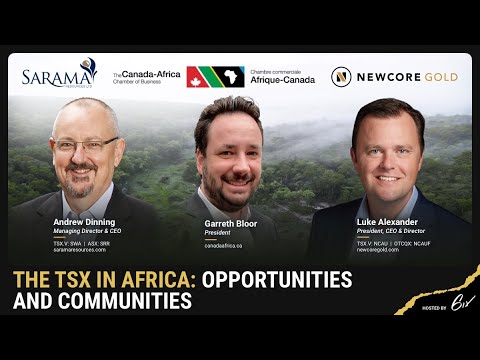
Automated transcript · Written by software from the replay's audio. It can mishear names and figures; the replay is the record.
28:57 how much of the base has been eroded away by conflict. And part of what we did there was benefiting tens of thousands of people within our reach. But we also created an economy, so it brought stability and peace to the area. We built a 180 kilometre road into Uganda, so that meant people living all along that road could get produce to market and they could get their cost of living down. So they're kind of just simple examples of what you can do as a mining company that's mutually beneficial. We require a road in, but if you think it through properly, you can make sure as many people as possible benefit from that infrastructure. If you kind of roll that forward to where we are in Burkina Faso, that's about capacity building in the local opportunity and giving opportunity while at the same time managing expectations.
29:46 So for us, that's our main focus. And then obviously that kind of works its way up through the strata to the district level and the national level. So we also see an important role of the industry is improving governance in, you know, within governments themselves. It's important that we operate in a responsible manner and that all just lifts the level. So there's many, I guess, different layers to this that you can look at from the basic community level where you operate and benefiting them as broadly as you can. And I think someone sitting in the West may feel it's a small amount, but when you're at the local level, it is a significant amount when your child can learn French instead of the local language. And the fact they have French then presents them with opportunities to work elsewhere that maybe they didn't get before.
30:39 So it's very much looking through what the needs are, working with the communities on what their expectations are and putting that in with a broader, I guess, umbrella of things that you need to do. So that's kind of how we approach it and how we try to benefit people. And by taking that approach as well, it makes it more sustainable. And that's without moving on to when you get a mine built, you're talking significant infrastructure, power infrastructure that stays and things like that. So yeah, it's multiple layers, but I think the thing is having it built into your business on how you operate, into how you think and making sure all employees, regardless of where they sit within the organisation, clearly understand that and the governments and the communities where you operate understand that and importantly, the people that invest in your business understand that as well. And I think, going back to your initial comment, it's one of the things that's good to say these days is the understanding of the importance of these things within the investment community. It's not just a moral obligation, it's also sound business principles.
31:48 And most guys I know in the industry or people in the industry, you know, they're very focused and very committed to the communities where they work and the countries where they operate. And, you know, I would challenge many people to dispute that, but have an in-depth understanding of what we actually do on a day-to-day basis. Thank you very much. Yeah, Luke. And I think that's a very important point. I think, you know, the reason, you know, back to the earlier questions about why is, you know, Canada so welcomed in Africa and why is there such a big presence of mining companies led by Canadian companies in Africa. I think there's a long history of being very good corporate citizens and obviously a lot of the ESG practices that have been happening over the last 30, 40, 50 years is the reason that Canadian companies are so welcomed in Africa and other parts of the world because there's a recognition of the contribution that's made to the federal government, but then all the way down to the local communities. I mean, a number of the points that Andrew made, I mean, Canadian companies have been doing those things for years.
33:02 In terms of, you know, today, there's obviously a much bigger push for disclosure of ESG and what companies are doing on the ground and in-country. I think these are things that, you know, Canadian companies for the most part have been doing for decades. And I think it's going to put Canadian companies in a very positive light as a result of the requirement to now disclose all of these things that have been happening for years already. And I think that's a really positive thing for the industry as a whole, because the impact is hugely positive in a lot of these communities. And Luke, if I can follow up on some of those comments, you know, if you look at, NuCo obviously has been well received and well regarded as a leader in ESG, and you stated publicly pretty much what you've just summed up now, a strong dedication to the environment, good governance and the community is an integral pillar to building a successful company."
34:07 But why have some companies failed at CSI or been perceived to fail at CSI? If you look at civil society critiques or other non-governmental actors who've been critical, Would you say it's purely a lack of will as some critics have contended? Or is it really just a case of not always adopting best practice or being able to assimilate best practice? So really, and perhaps in answering that, what does Nucor do? Like what are your some of your best practices that have given you a success in CSI, which you'd be willing to share with peers on this webinar today? I think one of the big things for us in Ghana, and we've touched on a little bit, is we don't have any expats in-country working, so everyone who's working on-site, you know, in-country, Argonnean, have deep relationships with the communities that we work in, have very long-term relationships with the government, with, you know, the Minerals Commission, and as a result, truly understand what the needs of the communities are, as well as the needs and wants of the government.
35:16 That then obviously percolates right through the entire company and how we ultimately operate the business in a socially responsible manner. Being, you know, actively involved with the community is crucial So all of the individuals who are, you know, working on a daily basis with the local communities all come from those local communities. And I think that's, again, one of the real benefits that we have in Ghana is it is a very educated country. It's got a rich history of mining, so as a result it's seen the benefits for a number of communities across Ghana and as a result there's a template there that can then be used for us at an exploration stage as we move towards, you know, developing the project and all the steps that have benefited other communities and how we can ultimately do the same thing with our project. So I think having, you know, individuals from the country is probably the most important thing from that perspective.
36:24 Brilliant. And Luke, I'm going to come back to another question on West Africa as a whole that's in the chat from Adama. But, you know, certainly an incredible place. Ghana is a major jurisdiction and played an incredible leadership role, especially on policy, among other things. But, Andrew, you've always flown the flag for Burkina Faso, and it's a country we've been privileged as the Canada-Africa Chamber of Business to profile on many occasions, working directly with Ambassador Fatima Meite, among others, who represents the country in Ottawa. The Canada Africa Chamber of Business is going to feature the country again at PDAC as we will among other countries including Ghana. In your experience, what are some of the most misunderstood or even outright false perceptions that you seek to clarify as a proud investor in Burkina Faso? You've been very public in commending the country and I'd be very keen, as I know others are especially, to get your viewpoint, your on-the-ground experience and reality check on Burkina Faso.
37:24 Yeah, I think Burkina Faso is an interesting jurisdiction and I think, I mean for many number of reasons obviously, but I think one of the important things to do is you really need to understand the, I guess, the geopolitical dynamic within the country. It is a big country and it does share many borders and some of those borders are obviously not that stable. But I think as a jurisdiction from a mining point of view, you're continuing to see every year new mines being built, ore zones obviously in the middle of the build now. Prior to that, West African built Sambrata, that was built on time on budget. Actually, I think it was ahead of schedule and under budget.
38:11 Taranga built Wahignon, which is now owned by Endeavour. So you're seeing every year a large new mine being constructed. So I think as a mining jurisdiction, you know, there's a fairly deep understanding of the industry. It's got a well-structured mining code. And even with the various machinations with the government, you know, things have prevailed through that. So I don't think that can be underestimated and you can tend to get things done in a relatively timely manner. Exploration permits have been a bit challenging, but when you get to the point of, you know, moving towards development, the government is, you know, very much onto that and very supportive. And I think, you know, if you speak to Patrick Downey at Orzone or Richard Hyde at WAF or any of those companies, they'll attest to that.
39:00 In fact, I caught up with Richard Hyde from WAF today and we were talking about various jurisdictions and we're obviously biased, but we do think Burkina as a country is a jurisdiction that you can get things done in mining, you're not having a 2 or 3-year delay on permitting for operations and things like that. They do understand the importance of mining to their economy, but do have some challenges in the north and the east of the country, and that's quite well known, It's no secret. But I think from that side of things, it's very important to understand the granularity of those challenges, but also don't underestimate the setup that the government's got there, the mining code and the roadmaps that are laid out for you from exploration right through to development.
39:55 There's over a dozen operating mines now, so there's good capacity being built within country. So I guess to pick up from Luke's point with Kaurna, you're starting to see good skills developing in country. So as with New Corp, most of our skilled labour locally are nationals and a couple of expats interspersed in there that are really more to do with training. We've built that team over the last 10-years. I think the important takeaways to that jurisdiction is you do have a well-structured mining code, you have a government that understands the importance of the industry, they're accessible, you can generally get things done in a timely manner. It's important that when you run the Royal Railway of the country, you understand the dynamics of it.
40:46 Businesses are getting things done and they're getting things done in a timely manner, which I think, you know, is kind of testament to it as a mining jurisdiction, you know, without taking away the challenges that you see in the north. Yeah, certainly very impressive when looking at the the net results. Thank you so much, Andrew. Luke, there's a question to the region of West Africa and Adama Sidibe asks, is it because of the safety, I presume safety of investment and safety overall, Is it those aspects of Ghana that have lent itself to Newport's focus being solely on Ghana, or does the strategy you outlined lend itself to the exploration of gold in other West African jurisdictions? Yeah, We've got a district-scale exploration project in Ghana, the Enchi project.
41:35 Our real focus is exploring on that project and continuing to move it forward with economic studies. We don't want to get distracted with other projects in West Africa on the exploration side. We've got a huge amount of exploration work to do on our project and, you know, great neighbors along trend from us. So our view is we can build this to a 3 to 5 million ounce resource. So it remains the focus for us. And yes, we're very fortunate to have been able to secure a project in Ghana, because it is a very politically safe jurisdiction, as well as from a security perspective, it's, it's a very safe jurisdiction. And, you know, those are a couple of the key reasons why we focused in on Ghana, as well as it's got great infrastructure. I mean, that's another thing that obviously we've, Andrew and I have touched on is, one of the things that mining brings to a country is strong infrastructure and as a result, you know, we've got lots of very good infrastructure to leverage off at our project. So There's many factors for why we've focused in on Ghana, but those would be a few of the key reasons.
42:54 Brilliant. And Luke, I just want to keep you on the question of Ghana because you're a Canadian firm, Canadian listed, and yet your description of the operational realities on the ground is it's very much a Ghanaian company, the management, the people, the rising leadership. And certainly one of the things I most enjoy about my role, having just come back from the continent for the past 3 weeks, is this energetic, youthful, dynamic population that's really willing and keen and ready to continue realizing the enormous growth prospects that the African continent holds as a whole. So within your firm, and this is really a question around leadership, what's the sort of advice or lessons that you give aspiring CEOs who are looking to lead companies operating in Ghana, companies like your own? Are they global lessons of leadership that transcend jurisdiction?
43:41 And what is specific to Ghana that really can allow the next generation of CEOs to take the lead and build great companies, really modelled in large part on what NewCore's achieved? I think first and foremost, and we've touched on it, is there's a very skilled labour pool in Ghana who are very eager to see projects move forward. I mean, the mining industry provides very good jobs, so they're very sought after. There's a lot of support from the government for the mining industry. I mean, you've got multiple mining universities that have been built in Ghana. You've also got tax incentives to be hiring new grads in Ghana, as well as the Chamber of Commerce, backed by the government, has declared that they want to have Ghana as a mining hub for a lot of West Africa. And this is something that we've been able to really benefit from at Nucor.
44:44 Again, Ghana exports mining talent across West Africa and across the globe for that matter. And as well as because of the political security and safety that Ghana provides, you've also got it acting as a hub for a lot of West Africa, for a number of mining services companies. So those are all things that I'd say for, you know, anyone looking at Ghana or an aspiring CEO, as you put it, is make sure you leverage off of all of the key elements that Ghana has to offer. And then, you know, continue to, you know, leverage all of that expertise in country. So those would be a few of the things that I would say would be worthwhile focusing in on.
45:34 Brilliant. Thank you very much, Luke. And Andrew, if I may, you know, sometimes these discussions can be quite technical. And apart from specific questions, you know, I've tried to keep it focused as well on the qualitative aspects. But so if I may, your track record is as many have described phenomenal, but I wanna get into some of the underlying aspects of what you've seen and what you've witnessed over the last 3 decades. So for context, of course, in the industry, you're well known for the development of the company's Moto Gold project, Kibale Gold. It was 2 million, you took it to 22 million of ounces, over 22 million ounces of gold, going from exploration to pre-development. And then you had a $600 million takeover by Rangold Resources and Anglo Gold Ashanti in October of 2009. So taking all of that into account, Andrew, apart from the return for investors, can you describe with some of your first-hand experience any sort of anecdotal cases or things that really stand out for you on what the massive economic and social impact of these business successes has had on specific communities. And no need to confine it just to where you're operating now, because I think that really lends itself as we come toward the end of the program to the very theme of TSX and communities and the end results of the billions in investment and the technical expertise, what it really means for people. So I'm gonna hand over to you to share perhaps any personal experiences in that regard.
47:00 Yeah, Okay, thanks Gareth. I guess I'll probably start with MOTO and focus on that because that was a very important project at the time. So when that project was put together originally, they were still disarming rebels. My first trip in there, there was a big disarmament locally where we were. We had to fly everything in, the fuel went up through Sudan and came down to the project. So over time, though, we developed the infrastructure there and, as mentioned before, we built local infrastructure to, you know, help with the local community. We started building capacity back within the, you know, local workforce. So there was some remnants, some memory from, you know, the pre-war period that we could pick up on and develop that. So a lot of the guys we had in there were really developing local talent pool for us going forward.
48:00 And the key things, a couple of key things we did there, we never gave anything away for nothing. We thought that was pretty important. So one of the things to do apart from expectation management is setting minimum standards, minimum expectations. Just because you're operating in a challenging jurisdiction doesn't mean you lower your standards. Your aim is to get everybody up to a higher level. And so there was quite a lot of focus on that. And then I guess over time as we kind of developed the infrastructure where we were. As I mentioned, we built a clinic and then we built a birthing clinic. We had an entomologist there for 6 months as well doing malaria vector studies, so that was really important for understanding which mosquitoes carried malaria, what time of day they were out, what their life cycle looked like. So, we'd have teams out catching mosquitoes at night, which might seem quite strange for a wannabe mining company, but there are all kinds of things that you do but given the the havoc that malaria wreaks in some of these communities it's very important to understand that.
49:10 We had our own doctor and he ran a lot of HIV awareness on market days. We did see a lot of society, you know, their basic skills degraded. So you know, even working at that basic level was very important for impact. So and even, I don't think anyone that's kind of worked in, you know, these kind of places will understand the lack of understanding or the myths around things like HIV and other diseases. So, educating people on that, we were always amazed at the attendance. You get 700 people on market day, coming to hear the doctor talk about that kind of side of thing. So we did a lot of work like that that has intangible benefits, likewise better understanding the local variants of malaria and how best to manage that.
50:04 Because a lot of that you can help just by how you structure things for drainage and getting rid of water and it's not just fogging and stuff like that. Then kind of rolling forward, we built the road through into Uganda. And what that did was obviously made access for us far easier, but also it lowered the cost of inputs for people where we lived. So rice, basic staple came in from Uganda. They used to either come in on old highlights or push bikes, so it lowered their cost of living and at the same time it gave them a mechanism to get their products to market, whereas before they didn't have that. So, you know, I kind of often used to think when we flew in there, the zone of impact for where we operated was probably 100 kilometre radius.
50:58 You know, it created an economy, so it gave people a reason to be. So before we were there, people were just trying to survive. Because we had a large local workforce, we were putting money into the economy, and that created stability, which then in turn created prosperity. So, you know, one of our biggest challenges was actually paying the workforce, because we used to pay 0.5 Congolese francs, 0.5 US dollars. You know, the simple things like that you don't think about. And so We'd have to have a money plane that flew in sacks of cash to pay people. There's many of those kinds of things. I know Rangold took it up way up another level after us because they took it from pre-development into development and really built on that. But we see ourselves as setting a solid foundation in that area. And I guess that's what we take into where we work in Burkina Faso, it's the same principles. It's not as degraded obviously as the DRC was where we worked.
52:05 But, you know, it's still very poor. It's a lot of, you know, basic subsistence farming. So for us, it's about capacity building where we operate, you know, and focusing on the people that, you know, where we can have the biggest impact, which I mentioned earlier, you know, which is really education and health and fixing roads, which really, you know, helps everybody help themselves, which is really what we want to be about, is, you know, set the standards and enabling people and empowering people to improve their lot in life. It's not our job to provide people with goods, it's our job to provide people with means to get their own goods. So that's kind of some of the basic principles that we sit on and a few examples of some of the things that we did.
52:50 But, you know, having worked in the jurisdictions where I have, we have seen, you know, very tangible benefits of the development that we've done. And it's long lasting. So once you put in infrastructure, if it's built properly, then it can tend to prevail for some time post that. Brilliant, Andrew, and certainly very inspiring. And if I may offer one comment, which I hear after every single success story, it's at the root as partnerships, a partnership of equals. As you said, you're guests in the country and on the African continent. As a good guest, you're treated and you're honored. The relationship with communities and people is vibrant, is dynamic, and I think it's very special, if I may infer that, just from the way you've described the experiences you've had. And that is a far cry from a sort of top-down, perhaps even attempt to be benevolent. It really is an economic and social partnership of equals.
53:48 And that's very, very powerful. Luke, I'd love to have you weigh in on this, but if I may, I just want to go to 1 question directed to Andrew from the audience. Adama asked the question, is Serama Resources intending to work again in Mali, Andrew? No, not at this point. And probably similar to the reasons Luke had said for focusing where they are. We were operating in Mali and Liberia, but at the end of the day, we just didn't have the capacity to, you know, work in 3 jurisdictions. We had to focus on, you know, where our best ground holding was. So obviously, you know, Burkina's geologically is a great jurisdiction and where our main project is, we have a great land holding. So our focus will be in that area. If we did something in Mali, it would be opportunistic, but it's not on the radar now.
54:40 Got it. And Luke, I wanted to invite you to weigh in on some of the just the personal experiences you've had as we wrap up this session. But I wanted to throw in a question as well, if I may, and it's, you know, where there are companies that make mistakes, where there isn't true local partnership, is this something you think has happened just in Africa? Or have you seen these sorts of common mistakes, not just characterizing the continent, but easily happening in a place like Canada or Australia as well? And I ask that in the context of, you know, when we look at Africa within a specific lens, are some of the challenges there or mistakes specific to Africa? Or are these really just mistakes and shortcomings that happen across the industry? And so I just wanted to kind of ask that question because you have a depth of experience beyond only the continent, but feel free to weigh in on any of these aspects we've touched on. I apologize for throwing a lot in there, Luke. No, that's fine. Your questions have been great, Gareth.
55:36 I'd say, I mean, the, you know, issues happen globally. I mean, nothing specific to any continent or country. I think inevitably it becomes the mindset of the management team who's operating the project and whether they take a partnership approach or whether they take a more authoritative type approach. I think as Andrew made a comment earlier is ultimately we're guests in these communities that we're operating in, and as a result, ultimately, you know, need to make sure that we work very closely with those communities and the government, you know, as a whole. I think one of the things in Ghana and many other parts of the world is, the government is actively involved in the projects from a licensing perspective.
56:34 But when you talk about partnerships, in Ghana there's a 10% free carried interest on any project in Ghana, as well as there's royalties that the government will receive from mining projects in-country. So that inherently creates a partnership between the government and the company and Nucor operating in Ghana. The government, the communities want to see these projects succeed because it's obviously very important for jobs, it's important for taxes, and as a result, you know, there's an inherent partnership already in place for us in country. And I think you've seen the success of the mining industry in Ghana.
57:23 Another thing that we've seen set up in Ghana recently is a mining minerals investment fund. And the Ghanaian government allocated $200 million to that fund. They've recently made a $20 million investment in Asante Gold, which is developing the Bibiani mine, which sits about 100 kilometers to the north of us on the same Safwi-Bibiani belt. And that's just another thing that I think speaks to Ghana as a jurisdiction that really wants to promote and build the mining industry as a whole. The fact that they're actually now starting to make, pardon me, direct investments in companies is again a further kind of a way of helping advance projects in country for the benefit of Ghanaians as a whole.
58:14 Absolutely brilliant. We've got just 2 minutes left and Luke and Andrew, thank you so much for an incredible insight that each of you offered, a whole variety of insights. And this really does preface an event that the Canada-Africa Chamber of Business hosts and 6, We're very proud of 6 as well as a sponsor and partner of the Canada Africa Chamber of Business. But during the upcoming PDAC, we have the largest Africa focused mining event. So assuming both companies will be represented there, we'd be honored to have you with us as guests. And indeed, anybody on this webinar today, I've just put my details in the chat. Do feel free to reach out and join us as we gather with leaders, industry pioneers, trailblazers, and continue these sorts of important conversations. But what better a foundation than the insights that each of you have offered. Luke Alexander, Andrew Dunning, an absolute pleasure.
59:05 And if I may, feel free to wrap up with just closing comments of 30 seconds to a minute each, perhaps with a view to the future and really any key takeaway message you'd like to leave with the audience today? And if I may, Andrew, I'll hand over to you for any final comments and then Luke. Yeah, thanks, Gareth. Yeah, I guess firstly, thanks to 6 for giving us this opportunity and also yourself, Gareth, for hosting it and the insightful questions. Yeah, I mean, I think the key takeaway should be for people listening, particularly people that aren't involved intimately in the industry, is that a majority of the people that operate in industry are very focused on doing the right thing by the community and the countries where they operate. I don't think you need to generate a $200,000 CSR report to prove your credentials. I think most people prove that on the ground every day of the week. And I don't think people should underestimate that. You do get the odd outlier that kind of ruins it for everyone but I think you get that right across society and I think people shouldn't focus on the outliers and they should focus on the good that companies that operate in a responsible and sustainable way, and what they're doing and the benefits that they bring.
1:00:24 And I guess importantly, you know, without mining, the world doesn't really have a great future. And I think people need to be mindful of that. And really, the responsibility of mining companies is to operate in a manner that's responsible and sustainable. And I guess, work together with everyone to the benefit of moving everything forward. You know, we're really seeing that, the importance of that now with the changing of the structure of the global economy when it comes to energy and that doesn't happen without mining. So it's very much integrated into everything in society And I think it's important that people actually understand that and that most people that work within the business are genuinely trying to do the right thing and balance the need of all stakeholders from people that put up the risk capital through to the people that host where you operate.
1:01:18 So that's probably really my takeaway. Brilliant, thank you so much, Andrew. And to close us off, Luke, final words from yourself. Yeah, I think just to follow on Andrew's comment and a bit of the theme of this, I mean, I think the reason Cerama and Nucor and other Canadian companies have been so welcomed in Burkina Faso and Ghana and other parts of the world is because the communities and governments that we operate in see the benefit of mining and see the real impact that it can have on those communities. Infrastructure is something we talked a lot about. I mean, the infrastructure that mining brings to ultimately benefit the entire community and country is huge. The foreign direct investment that mining brings to countries where you wouldn't see investment otherwise is a huge benefit to those countries. So I think mining is welcomed.
1:02:11 I think the CSR reports and new standards of reporting that are starting to come, I think are going to ultimately shine a very positive light on the mining industry. It's something that's been happening for decades. And the reason that Canadian and other companies are so welcomed is because of all those things. And to put those into reports, I think will be a real positive. And for Ghana specifically, I mean, I think the last thing I'd say is you currently got 4 of the top 10 largest gold producers operating in country. So I think that speaks for itself in terms of what a politically safe jurisdiction it is, as well as what a secure jurisdiction it is, as well as, you know, what a good government Ghana is to work with from a mining perspective to have 4 of those top 10 largest gold producers there.
1:03:05 Absolutely brilliant. Thank you so much, Luke. A perfect way to end it off. And I think if I can summarise any sentiments I'm picking up from the audience, the private chats, the public chats, Indeed, a big thank you for the leadership of each of you in setting the standards and a template for success in the industry. And I certainly know it's no understatement to say many people are very proud of what your respective companies have done and what each of you have done to make that happen. Thank you once again and to everyone in the audience who's joined us, thank you so much for being with us and a special shout out of course to the team at 6 who've made this happen, who've been able to create an environment for this incredible programming. It's been my pleasure and my honor to participate and to moderate this conversation today. A wonderful evening or rest of the morning, wherever you may be, or afternoon across the world. Thank you so much and good day to you.
1:03:55 ♪