Transcript
Automated transcript · Written by software from the replay's audio. It can mishear names and figures; the replay is the record.
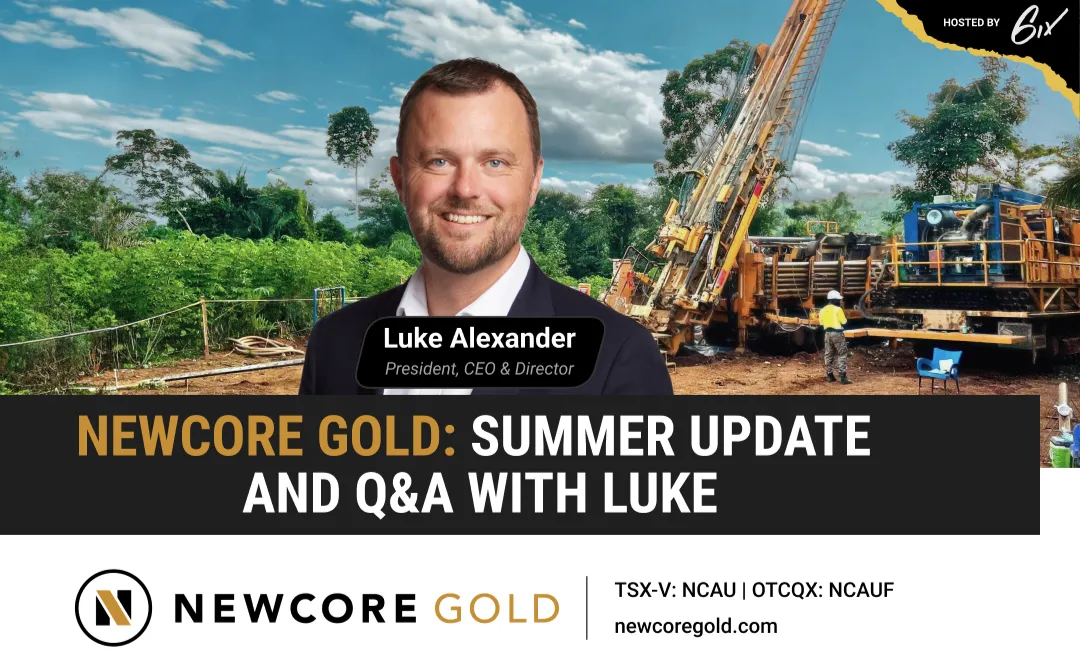
0:04 Good morning, good afternoon, good evening, depending on where in the world you're signing in from today. I did see at least 7 time zones, so we have an international audience. Really glad you guys could join us. I'm lucky enough to have with me today Luke Alexander, Nucor Gold's President, CEO, and director for a summer update and Q&A session. Luke, how are you today? Yeah, I'm great. How about yourself?
0:20 Good. Good. Thank you. It's summer. How could I be upset?
0:23 Now, I just want to tell the folks in the room how today's going to work. So I do have some questions for Luke, but then I'm eager to hear from you guys in the room. So the town hall open forums, please ask your questions in the chat at any point during today's event. That's on the bottom right of your screen. There'll be a little chat button with a square above it. We're gonna try to get to as many of those questions as we can today, but if for whatever reason we don't, it's off topic, we run too long, any reason, I'm gonna make sure the New Court team still gets those questions and we'll get back to as soon as possible. So don't be disheartened if we miss it, but we will try to get to as many as we can today. One last piece housekeeping before we get into the protein for today's event, webinar is being recorded and the replay will be available, likely tomorrow morning Eastern time, so it should pop right into your inbox. Before I get into my question, I do have a bunch to grill you with Luke. I was wondering just for the folks in the room who don't know Nucor, aren't as familiar with the story, just give a quick recap. Yeah, so Nucor Gold were TSX listed as well as trade on the OTCQX in the US.
1:13 We're advancing the ENCHI project in Ghana. It's a district scale exploration project that's fundamentally underpinned by very robust economics that we put out in a PEA in 2024, which we're now in the process of looking to moving to a PFS in 2026.
1:31 Management and board, we own 15% of Nucor, that stock that we've bought alongside investors over the last number of years. So we're truly aligned from a shareholder perspective. And then we're also very strongly supported from deep pocketed, long term focused institutional investor, primarily mining and precious metals investors. So we're currently 55%
1:54 institutionally owned. So great project in a great jurisdiction that's backed by a team with a proven track record of creating value for shareholders. Awesome. I appreciate that recap. I just know there's folks in the room who aren't familiar, so it's good to give them a bit of an update. So Luke, last year or over the past year, you released some pretty impressive drill results, including those wide zones of Gold mineralization with some higher-grade results. I'm looking here for your subjective take as a CEO. How is the drilling program progressing and what do the results tell you about Engie?
2:28 We kicked off a 10,000m drill program in Q3 of 2024. We then raised $15 million in Q1, closed that in February of this year. That allowed us to take the 10,000 to a 35,000 meter drill program. And actually I can share a couple slides here which might help people as well just with some visuals. So to date we've now drilled as part of this 35,000 meter drill program roughly 200 holes which represents about 24,000 meters of drilling. A large portion of this drill program has been focused on resource conversion. So moving ounces from the inferred to the indicated category, That's one of the key requirements for us to move this to a PFS.
3:21 But when we look at our project, we've also been focused on stepping out, going back to some previously drilled tested areas. And with the balance of this program, roughly 11,000 meters, we will be focused on some deeper drilling, which we can get into some detail on as well. But when we look at some of the drilling that's been completed to date, Boeing is our second largest deposit. We have focused a lot of the drilling at our Boeing deposit. And when we look at some of these cross sections, we're very pleased with the results. This hole here, 352 was part of a batch of holes that we put out in May of this year. And as you can see, we intercepted 2.25 grams over 56 meters within that some nice high grade of almost 4 grams over 15 meters. So, having above average grade
4:18 holes that are converting mineralization is something we're obviously pleased with. But then the other key thing is that we have been pushing a number of these holes well beyond the existing pits that constrain our resource today. So for example, if you look here at this hole number 294 and 295, these are the existing 1650 pits which constrain our resource today. And then you can see we've pushed these holes well beyond those pit walls which have ultimately ended in mineralization.
4:55 When I spin this model around for you it becomes pretty clear to see what the potential impact of that will be. So you can see that 294,295, but then beyond that, all of these additional drill intercepts have been pushed beyond the existing pits. When we zoom in, It might be a little bit easier for you to see that. But what we're expecting is, yes, resource conversion
5:21 was the focus within the pits. And that's one of the key things to create indicated ounces. But by pushing these holes deeper, we think we're also gonna be able to deepen the overall size of the pit and add some additional ounces. So resource conversion plus resource expansion has been one of the key things that's come out of the first part of this drill program. You know, Here's another area that I'll point to at Boeing, where again,
5:52 a lot of the drilling was focused on converting ounces within the pit to get into that indicated category, but by pushing these holes deeper and beyond the existing pits we think we'll be able to add some ounces as well which ultimately we would view as a real you know added benefit to this first part of the drill program so very pleased with the the results lots of wide intercepts but also lots of high grade you know within this campaign we actually had our highest grade intercept ever on the project. That was in Q4 of last year, 204g
6:30 over 1m. In April, we put out another hole that had 9 grams over 10 metres. So we're continuing to see some nice high grade on the project, which then obviously complements the very wide zones of mineralization that we got near surface.
6:46 Great. Let's talk about the theme of your expectations. I know, as you just described, you're 24,000 meters into the 35,000 meter program, got a 98% hit on mineralization, which is to me, pretty remarkable consistency. I'm curious, how does this compare to what you thought was going to happen going in? Is this in line or is this beating your expectations?
7:05 Yes, it's in line to maybe a slight beat of our expectations. When you ultimately look at our project, one of the real advantages we've got is we have got over 210,000m
7:20 of drilling completed across the project. What that allows and does is it ultimately gives us a huge amount of confidence in terms of where the resource sits, where the exploration opportunities are. So Greg Smith, our VP Exploration and our team in Ghana have a very good understanding of the geological structures here, where the zones are potentially plunging at depth. We've been able to ultimately use all of that historical data. In the last 5-years, we've drilled about 115,000m. All of that feeds our geological understanding of the project. The fact that we've had very high intercept rates with the drilling that we've been doing doesn't come as a big surprise, given again, our geological understanding of the project, as well as, you know, because the first part of this program has been focused on resource conversion, so infill, drilling, you're gonna have a higher confidence in that drilling as well.
8:34 But with that, obviously, as I was highlighting, those holes that we push deeper and continue to intercept mineralization are an added benefit to the program. That makes sense. Like you said, this program is about converting inferred to indicated state of the pre-fees. But just for folks in the room and myself, for that matter, how critical is that conversion for the timeline you guys are working towards? How does it impact when you get where?
8:58 Yeah. So as I kind of mentioned, obviously converting ounces from the inferred to the indicated category is one of the key elements to be able to produce a PFS. You're ultimately de-risking those ounces, which is one of the reasons PFSs command a higher multiple from the market as you de-risk the overall project.
9:22 So it's a key element. If we look at our existing resource, which came out in 2023 and then was wrapped into that PEA in 2024, we already have about 740,000 ounces sitting in the indicated category. So our goal is to convert roughly an additional 550,000 ounces. Reason we talk about 550 is that would get us to a total of 1.3 million ounces of indicated. If you look at the PEA that we released, it was fed by roughly 1.3 million ounces of resource, which then produced over a million ounces of gold over a 9 year mine life. So that's what our goal is. With this drilling that we've completed, we think we're well on our way to achieving that goal. So we're very pleased with the results that we've had to date.
10:19 Awesome. Now beyond that resource conversion, obviously you're targeting that pre-fuse for 2026. What else? What are the key milestones between now and then that you guys need to check off on the box before you get to it?
10:30 Yeah. Resource conversion, as we've talked about is probably the biggest thing. But beyond that, there's a lot of, you know, call it boring work happening in the background, but this is critical work to de-risk the project to give confidence that it's a project that makes sense to put into production. So you've got hydrological work, geotech work. We're also drilling some diamond holes to do some additional met test work on the mineralization.
11:01 We're doing some additional environmental and baseline studies across the project. So all of that work has been happening in the background for the last number of months. And as we get it completed, we're then able to obviously hand all of those results over to our consultants who are then able to start working on that PFS, which we're targeting for the first half of 2026.
11:24 Great. I want to talk about strategy here for a second, because I know, Suem being your largest deposit, as I understand it, you've drilled to an average depth of 75 metres. And most of this campaign is kind of those first hundred vertical metres for each deposit. So my question strategically is, how do you balance that immediate goal of resource conversion leading up to the PFS with the longer term exploration upside that I would imagine exists at depth?
11:46 Yeah, so I think that's one of the things that, you know, gets our institutional investors and us as management and board, who own 15% of the company, extremely excited about this project is we've got huge optionality. So we've got a project today that makes sense for us to fast track to production as quickly as possible, given the economics of the project. So that's something we're very focused on. And obviously the resource conversion and everything we've talked about so far is part of that process. Beyond that, we have true district scale exploration upside, which I would argue investors ultimately get for free. Maybe I'll just jump in and kind of share a couple slides given you were asking specifically about Seyoum. So Seyoum is our largest deposit.
12:37 So Seyoum
12:39 sits right here. Just to remind people, large land package, 248 square kilometers in size. I was spinning you around our Boeing deposit, which is our second largest deposit where the heap leach facility is contemplated to sit is right in between those 2 deposits. So a kilometer and a half roughly from each of our main deposits. So very nicely located. But when we look at Siyoum and you were asking about some of the drilling and how we prioritize, Siyoum
13:15 is a very large deposit. And as you can see, you know, by the density of drilling that we've completed here at CU across these areas, you know, that has been very focused on resource conversion and moving those ounces into the indicated category. We've then, if you look down here, you'll see in this area here that we've also then again at CU been pushing these holes well below the current pits. So, you know, expectation is we can potentially deepen and widen the overall size of the pits. So that's been part of the focus, but then beyond that, resource conversion, what gets us very excited and one of the areas where we focused on for
14:11 the next 10,000 meters of drilling and drilling beyond that is the opportunity at depth. So when you look at Sioum, Boyne, Niamb, the average vertical depth of the pits
14:24 that constrain our resource today is only down to 75m. One of the questions we constantly get is, when are you going to start drilling some of these deeper opportunities? We're excited to see the potential at depth. So with the additional drilling we've got and capital that we have now, we're going to be able to start testing this opportunity at depth more. To date, we've probably drilled about 45 holes below
14:53 150,200 meters. But when you look at other deposits along the Safeway Bibiani Belt, and what we're looking at here is Asante's Toronto mine, but this would look very similar to Bibiani as well as Newmont's Ahafo mine. These greenstone hosted deposits will really grow in size and increase in grade as you start to get deeper. So there's that 75 meters superimposed across our project. You then compare that to Toronto
15:24 and, you know, they, Toronto today are mining down at roughly 800 meters below surface. So that's an opportunity we're really excited to just be starting to drill right now is some of those is some of those deeper holes and you know if we look at some of the specific results that we've had historically you can see why we're excited about this opportunity. So looking here at Nian for example where we've put about
15:52 15 deeper holes into it you can see some of these high-grade intercepts that are starting to show up 5.8 grams over 7 meters, 5.6 over 8, 6.5 over 4, 5 grams over 9 meters. So we think this is one of those high-grade feeder zones that you ultimately see up and down the Safeway
16:13 Bibiani belt. So getting back in here with some of this deeper drilling we have planned and continuing to chase these structures is something we're extremely excited about. And with any good result, we think we can create outsized return for investors beyond that fundamental re-rate that we're expecting to come with the conversion from a PEA to a PFS. Some more drill results here, 3.2 over 9, 7.4 over 8, 3.5 over 9, 6 over 6. Important to highlight, we're still only at about 250m below surface. So opportunity again for us to keep chasing these structures as well as opportunity to drill a long strike given there's no drilling to the north, no drilling to the south. So this opportunity at depth is something that we're obviously extremely excited about as
17:11 well, Romil. That makes sense. I do think at some degree, markets are understanding the stuff at depth, which I think is neat. One thing, I do want to zoom out a bit and talk about Ghana for a second. So obviously major gold jurisdiction continues to rank as the sixth largest producer globally. But I'm curious just for your input on how do you view the operating environment there?
17:31 And you know, things can obviously change over time. I've worked with a lot of people, a lot of different jurisdictions. What gives you confidence in the jurisdiction being and staying pro mining development? Yeah, so Ghana, it's the sixth largest gold producer globally. And let's see, I can pull up another slide here in case visuals are helpful for people. So you know you look over here Ghana is the sixth largest gold producer globally sitting just behind the US and Canada. All of that gold is concentrated
18:04 into a very small area. So interestingly, Ghana actually produces more gold on a per square kilometer or per mile basis than Nevada does, for example. So a huge amount of mining services as well as mining expertise in country. And one of the things we always say is listen don't listen to me, buy a CEO with a single asset in Ghana but look at what the major gold companies are doing. You've currently got 4 of the top 10 largest gold producers on the planet there We've got newmont anglo gold fields Zijin has aggressively come into Ghana with the acquisition of newmont's non core asset the achim
18:48 Asset Newmont's then also spending another billion dollars in Ghana and looking to expand their Ahatho project, which will take them to over 20% of global production coming from Ghana. So it's a jurisdiction that obviously has a number of the majors and we're very fortunate
19:09 to have amassed and have the project that we've got today. It'd be very hard to put this type of a land package together. And we're also one of the 2 leading gold development projects in the country. So I think that puts us in a very unique position as well. So the government's very supportive, lots of skilled labor in country, as well as lots of service companies to support us. And then another thing we always kind of point to is the desire to get into Ghana. Obviously, Zijin with the acquisition of the Achim asset
19:47 highlights that desire but if you look at Cardinal for example you know Shandong bought that project 4 years ago they put it into production last year and they're going to be producing 350,000 ounces per year from that. We've also got Asante, who's
20:06 come into the country, and then Chi-Fen, who bought the Golden Star Wasa asset. So lots of interest to come into Ghana. But at the end of the day, why do companies want to be there? It's because of the geology.
20:24 Ghana has some of the largest gold deposits on the planet. You've got 2 prolific gold belts, the Ashanti Belt and the Safwi-Bibiani Belt. So this area that we've zoomed into is in the southwest corner of Ghana and some of the largest deposits on the planet. You've got Anglo's Oboesi mine sitting at 66Moz
20:46 endowment, Tarquat 25Moz, Wasat 15Moz, So very large deposits on the Ashanti belt. And then we sit on the, on the Sefuibibiani belt. As we've talked about, Tarano's sitting at 5 and a half million ounce historical endowment and growing, Asante 6 and a half million, and then Newmont's, a half of mine sits at 20Moz and growing. And that's where they're spending that additional $1Bn. So really the desire to get into Ghana is because it's so well endowed from
21:22 a gold perspective. And again, our project is very well located on that CEFWI BBNI belt. Great. No, I appreciate the extra context. I do want to talk about macro for a second. I know gold's been on quite a run this year, making the top collars and the bears look a little foolish over the last 8 months, for sure. But I'm curious, for a development company, how does this environment affect your strategy and timeline decisions more than anything else? Yeah, I mean, obviously the gold price has a big impact on the economics of the project. So, in terms of the NPV of our project, in terms of the IRR, all of those economics are bolstered in a high gold price environment. I mean, 1, you know, maybe one thing I can hone in on, and again,
22:15 I'll share a slide here just because I think visuals sometimes help. So, you know, if you go back and look at our 2024 PEA, we use a conservative 1850 gold price. You can go in there and we have sensitivities, you know, to the gold price and see what the impacts of those are. But if we look, for example, you know, at a
22:38 1850 gold price, you're looking at 524 million of after tax cash flow that our project would generate over a 9 year mine life. You know, you increase that to 2350, you're looking at 855 million. You increase that to, you know, $3,000 gold. You're now looking at almost $1.3 billion of after tax cash flow. So, you know, pick your gold price, but between 2350 and $3,000 gold, this project produces 850 to 1.3 billion dollars of after-tax cash flow. So the leverage to gold that our Inchi project has, again, is something that's very attractive for investors and something that, you know, is is obviously a real benefit for us in a rising gold price environment.
23:34 Sure. Certainly doesn't hurt to go prices on a run. Appreciate that. And that means that all that being said, when I hear over and over again, what you see is the junior mining space is still pretty challenging for fundraising, even with gold. I mean, with commodity prices, I generally the space is still it's still difficult to get capital sometimes. So I'm curious, how are you thinking about capital allocation and financing as you keep advancing? Yeah, so for us, you know, I've kind of mentioned it a couple of times and and maybe I'll just kind of pop this slide up. We're very well supported by a number of deep pocketed institutional investors. So we're currently 55% institutionally owned. That increased from 45% to 55% on the back of the last financing that we completed in February of this year. We went out to raise $10 million.
24:31 We had very strong demand from a number of large institutional investors, so we quickly increased that to $15 million and that allowed us to increase our drill program to 35,000m. If you look at our cash position at the end of March, we're at $15.15 million. While we're drilling, we're burning about a million to a million and a half dollars per month. So everything we've talked about on this webinar so far is fully funded. So our 35,000 meters of drilling, completion of the PEA, so all of that, you know, network, hydro, geotech, you know, social, environmental baseline studies, all of that is covered with the cash that we have today, as well as, you know, money to run the business right through next year.
25:31 Beyond that, one of the opportunities we've got is we've got some warrants that are in the money. So we've currently got about 3 and a half million dollars worth of warrants which expire in less than 2 months from now, so September of this year. So that money has started to come in, strike price of 40 cents on them. So with that additional capital that'll come in, what that'll allow us to do is potentially expand our drill program beyond the 35,000m. So we've got a self-funding mechanism built into the company through these warrants. Beyond that, we've then got an additional roughly 20M warrants which expire at the end of February.
26:20 So call it, what's that? 6 months from now. End of February, which would bring in an additional 10 million dollars into the company. So, you know, with those additional warrants is about 14 million that that could come into the company, assuming we continue to remain in this in this robust gold price environment. So we've got self-funding baked into the company. It's also important to highlight that these warrants, you know, they're 90% owned by institutional investors. So we know exactly where they sit. We know the support that there is to exercise these warrants to see us continue to move this project forward. So from a funding perspective, we're very well positioned and what it'll allow us to do from a capital allocation perspective is most likely increase the drill program significantly beyond the 35,000 meters that we've announced to date. Great, one small little correction you said completion of the PEA earlier believe you meant PFS just want to let everybody know. Yeah, sorry, thanks. Thanks, Romeo. All good.
27:30 I wanted to make sure you were listening. That's it. It's good. It's a good test actually. I appreciate it. And for folks in the chat, I know a bunch of people came in a bit late. I just want to let you know there is a chat button at the bottom right of your screen if you do want to ask questions. I'm almost through mine. We'll be able to get to the ones in the chat relatively quickly. One thing I wanted to ask you, obviously, Nucor has got this kind of unique position that not every company has with the district scale exploration potential, but also a clear path to production. So I'm curious, this is a kind of a communication strategy question. How do you talk about that dual value preposition to investors who I think a lot of them are looking for one or the other. So how do you kind of talk about the opportunity of Nucor? Well, I mean, first and foremost, I would argue you get district-scale exploration for free with Nucor. And Yeah, I mean, I can kind of walk you through that, but when we talk about a fundamental underpinning of value for the company, that's based on the economic study, the PEA that we put out last year, which highlights a very robust open pit heap leach project.
28:34 You know, 1 simple way of looking at it is we use that base case of 1850, which I highlighted produced after tax 524 million of free cash, you know, the 2350 case, again, 855 million. But another way to look at it is for every $100 move in the gold price, we produce, or our ENCHI project returns roughly after tax 50 million US to the NPV of the project. Our market cap today trades around a hundred to a hundred and 10 million dollars US. So for every $100 move in the gold price, we add US $50 million to the NPV of the project.
29:25 So roughly half of the NPV of the project for every, again, $100 move in the gold price. So when I talk about fundamental underpinning of value, that's what I'm talking about. When we then look at it, let's say from a $3,000 to $3,300 gold price, or if you want to be super conservative, you're probably not on this call today but you could look at it at 2350 gold but at 3,000 to 3300 you're looking at after tax 970 to 1.1 billion NPV compared to a market cap today of call it a hundred to a hundred and 10. So we're trading at roughly 0.1 to 0.15 times the NPV of the project.
30:13 IRR 136 to 156 percent, roughly a half year payback for the project. So these economics are the fundamental underpinning of value that I talk about. From a re-rate perspective, and one of our motivations to take it from a PEA to a PFS is that typically PFS stage projects command a higher multiple from the market. So if we're trading today at 0.1 to 0.15 times, we would expect that to increase meaningfully as we de-risk the project to a PFS. Beyond that, as I've talked about and we've looked at with some of the deeper drilling opportunities, we have district-scale exploration which I would argue investors get for free.
31:05 With any hole that we drill, any successful drill result or batch of drill results that we put out, we could see outsized return beyond that fundamental re-rate that I would expect to come with the publishing of a PFS in the first half of next year. So that's one of the optionalities or is the optionality that gets a lot of our major shareholders very excited. Get it into production as quickly as possible. Let's reap that free cash flow that the project generates, but also let's aggressively drill on the project because there's a recognition that that can create significant outsized returns beyond that fundamental re-rate. Awesome. I know a couple of questions came in over email. There's a bunch in the chat, but I just got one more and I don't want to cut summer short, but we are eventually heading into fall. What should investors be watching for? What are you most excited for in the next 6-12 months?
32:04 We've got this 35,000m drill program that we're working on at the moment. We're about 24,000m into that. We've essentially completed all of the infill portion that we wanted to complete with that. So now we're starting to focus more on that, you know, district scale exploration opportunities. So starting to drill some deeper holes on the project. So we've got a diamond rig drilling at the moment. Again, that's something that a lot of investors have been asking about and they're excited about and we're excited about is to start testing some of those high-grade structures that I was walking you through. We've then got that additional warrant proceeds, which are going to come in, or we're expecting to come in between now and September. That has already started to trickle in. With that additional capital, that may allow us to expand our overall drill program, which would be exciting for the company. And then just the work that's happening in the background, the hydro, geotech, additional net testing work, all of that will then culminate in the publishing of a PFS in the first half of next year. But the big thing will be a significant amount of drill results through the end of this year.
33:23 Awesome. I'm getting into some email questions now. 1 very careful listener in your investor group noted that in a prior webinar, You mentioned the potential or desire to expand Nucor's position along the Safi Bibiani belt. He's curious if this still looks like an attractive opportunity given the quality and prospectivity of your current package. Yeah, so we'll always kind of look at opportunities to expand and maybe I'll just flip this up here just to highlight that. So, we get presented with M&A type opportunities and other projects to look at, But the challenge for us is because of the economics of our ENCHI project and the district scale exploration that we've got at our project, it's difficult to find anything that makes sense to ultimately bolt onto the company.
34:19 That being said, where we will continue to look to, you know, grow our resource is, or our land package is through staking. So, good example of that would be this, you know, this area down here, which we refer to as Omanpe. That's an area that we staked a couple of years ago and ultimately added to our overall land package, taking it from 216 to 248 square kilometers. So we added about 32 square kilometers with this staking of the package. So if there's those types of opportunities to stake around our project or within other areas that we think are perspective, then we see that as a low cost entry point.
35:09 So that's something that yes, we will continue to look to do. Great. One question that came in right as the hour started here. Somebody asked, how confident are you in the leachability of your sulfide and transition rock? And have studies been done to support that? Yeah, so we've completed a number of kind of studies on the Met and I can pull some of that up if if people are interested. So to date we've completed over 400 tests on over 400 tests on the oh yeah here we go We've completed over 400 metallurgical tests, you know, obviously focused on the oxide transitional as well as the fresh material.
36:02 We've had good leachability within the oxide and transitional material. We've tested the fresh material as well but a big part of moving from a PEA to a PFS and this is something that I've kind of mentioned a few times is we are drilling some deeper diamond met holes at the moment which are then going to be used to do some additional test work on all of the material from a leachability perspective. So when you look at the results that fed our PEA, we had an average of 81.8% recoveries within the oxide and transitional material, that was 85% recoveries.
36:50 And then within the fresh material, we had 75% recoveries, which then gave us that blended average of roughly 81.8%. So when you look at some of the results that we've had from a column test perspective, as well as these bulk scale pilot tests that we did, you know, we've had within the oxides 91.9% average recoveries from those bulk scale tests. From the roughly 24 column tests that were done within the oxide transitional material, we had roughly 91.5%. So That then got discounted down to represent a commercial scale operation and that's what ultimately fed our PEA.
37:43 The additional work that we're doing right now, We're looking at some different grind sizes. We're looking at different cement levels. So we are agglomerating on this project. If you look at the PEA, we use 10 kilograms of cement. So we're looking at different cement levels, permeability tests. So all of that work is PFS stage work that we're completing at the moment. And once it gets done, then obviously that gets handed over to our consultants that will then use that to produce the PFS. Great, I appreciate a very thorough answer. That's great. I'm gonna jump to the ones from the live chat today. Just a reminder, you can throw them in just until we wrap up today. So Wesley asked, I'll just tackle these in order actually, because they're all pretty good. Wesley asked, what's the cost per meter in Ghana this year?
38:33 So from a drilling perspective, diamond drilling costs roughly $250 per meter. RC drilling is roughly $100 all in per meter. Great, thank you. We are, I'll just highlight as well because it's another question that comes up generally in that same sentence in case Wesley had it on the tip of his tongue as his next question. We are able to drill year-round in Ghana. There are a couple of short rainy seasons in the country and the main thing you focus on there is drilling from the top of the hills as opposed to getting down into the valleys where there may be accumulation of water during the rainy season. So that's kind of the pricing and we can drill year-round, which is a real advantage for us.
39:22 One question from Bridge in the chat asks, are there assays in the lab right now? Yeah, so we obviously were 24,000m into this 35,000m drill program, so we're just continuing to drill as we speak right now. What we typically do is, obviously, once we've finished X number of meters, we get all that cut and logged and then send it off to the assay lab and then we typically get batches of results back. So as you'll see kind of on a every 4 to 6 weeks basis, we typically putting results out to the market. And that's as we get a batch of results back that, you know, are enough to justify putting a press release out, then we'll get those out to the out to the market.
40:13 So yeah, you can assume that at any given point in time, we've got assays in the lab that are being analyzed. Great. RGS, big question, answer the best of your ability. How much cash is required to start mine production? So all the way to production. So as we've kind of discussed, you know, we're fully funded to complete the PFS, the 35,000 meters, all the work that goes with that. So if we were to look at it as just purely advancing to production, So we complete the PFS on the back of that, we would look to complete an FS with the additional work there. You'd expect that to be in the kind of 5 to $10 million neighborhood. And then on the back of that you're at a construction decision point. That's when if you look at our PEA, the CapEx that is contemplated is 106 million to put it into production.
41:15 So that's kind of the path to production. But then the other piece is obviously how much drilling are we gonna do over that period? You know, our view and our major shareholders want us to continue to aggressively drill to look to create, you know, outsized returns, again, beyond that fundamental re-rate. So, you know, but I put that in a bit of a separate bucket and with again, the warrant proceeds, everything else, our expectations will be able to continue to expand that drill program. But those are the rough numbers to push it to a construction decision and then the actual CapEx required to put it into production. Awesome. One question from the chat, 2 questions, but I'll combine the next 2. Graham asks, what permits are still required? Actually, generally, if you could just talk about the permitting process in Ghana.
42:02 Yeah, so permitting process in Ghana is you, you know, we've got exploitation licenses at the moment. You then, once you've, you know, put together an economic study, you're able to move that to a mining lease so you submit a mining lease application that typically takes around 9 or 12 months for them to To process and then on the back of that the next big license that's required is the environmental permit Which also takes roughly 9 or 12 months There's a number of other, you know, smaller permits that may be that that not maybe that are required as well. But those would be the 2 big ones. And to get those, you know, is in that kind of 18 to 24 month combined.
42:49 Great. There's 2 questions left. I'm gonna combine them because I think they're similar questions. Graham asks, is engineering majors? And JJ asks, who in the neighborhood is likely to buy this out? So there's some crystal ball gazing there, but just to the best of your ability. Yeah, maybe I'll just pop this slide up again just because I think visuals are sometimes helpful. So again, As I pointed to, we've got the Ashanti belt and then the Sefui Bibiani belt, which is the belt that we're on. I'll just highlight the scale down here just so people recognize this in the grand scheme of things is a relatively compact area, especially to have this number of ounces.
43:36 So on our on our Cefui Bibiani belt, you've got Chirano, so Asante with the Bibiani and Chirano asset just to the north of us. You've then got Newmont's Ahafo project. Right here is the Cote d'Ivoire border and then directly on the other side of the border you've got Tarako which is Aussie listed who hold the Afima asset. In-country as we've kind of talked about, you've also got a Galliano TSX listed, Anglo Gold, Perseus, who's also in country. We've got Goldfields as well as, you know, Chi Fang who's also in country. And then in the northern part of the country, don't have it on this map here, but we've also got both but we've also got both Shandong as well as Zijin who is now over here on the, just off of the Ashanti Belt. So lots of companies in country and a number of them who've come into the country in the last few years. I mean when people ask about M&A, which I think is where the the kind of question is, is is or the genesis of the question, you know our project again is one of the 2 most advanced projects
45:07 in Ghana. It's a low capex project with good returns. And part of again, the motivation to go from PEA to PFS to FS is as you just de-risk a project, that's typically where interest levels ultimately increase. So, you know, we're in a good neighborhood with lots of companies who are in the country and a number of others who are keen to get into Ghana, given what a friendly mining jurisdiction it is. So lots of company around. Always good. Luke, thanks so much. This wraps up for the questions we got in the chat. If you're like me and you think of the perfect question to ask as soon as I hit the close webinar button, please do still shoot it to us. I'll make sure that the Nucor team gets it. And like she put in the chat, you can always reach out to Mal Kowalska for more questions at mal.nucorgold.com.
45:54 It's right there in the chat for you. It'll also be on their website. Everybody, thank you so much. And Luke, thanks so much for going through questions and running us through today. Yeah, thank you very much, Romeo, and enjoy the rest of the summer, everyone.