Transcript
Automated transcript · Written by software from the replay's audio. It can mishear names and figures; the replay is the record.
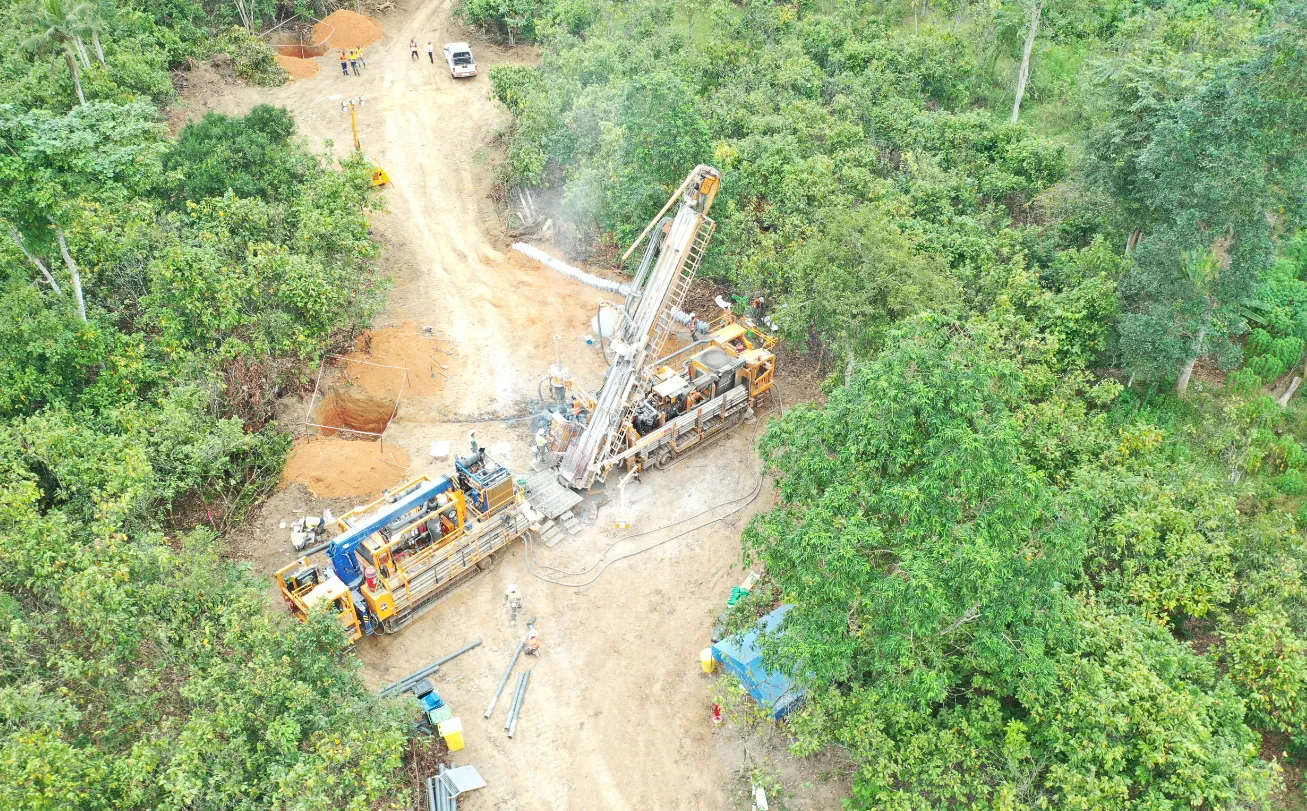
0:08 Hi everyone, thank you for joining us this morning. Most of you likely already know who I am, but for those of you who don't, I'm Mal Karbowska and I'm the VP Corporate Development and IR for Newcore Gold. I'm joined today by Newcore Gold's President and CEO, Luke Alexander, as well as Newcore Gold's VP of Exploration, Greg Smith. Before we get started, I just want to highlight that we will be making some forward-looking statements today. I encourage you all to visit our website, where you can find the full cautionary language. We will also be recording this webinar, and it will be available for replay by the end of the week. We look forward to taking this opportunity to provide you with an overview of the key developments we have made in 2024 to continue to advance and de-risk the development of our NG Gold project in Ghana. 2024 was a very busy year, which was marked by an updated PEA in late April, followed by the launch of a 10,000-metre drill program in the summer, which so far has delivered very strong results.
1:06 We're gonna dive into the key takeaways from these milestones that we have achieved over the past year, and then also discuss what you can expect going into 2025. So with that, we will kick things off with a presentation, after which we look forward to answering your questions. So please be sure to submit those so that we can make sure to address those in the Q&A portion. And with that, I'm gonna pass it off to Luke to kick things off. Yeah, thank you very much, Mal, and hello everyone. I'm Luke Alexander, President and CEO of Nucor Gold. As Mal mentioned, 2024 has been a very busy year for us and we've accomplished a number of milestones. I think right now heading into year end is a great time to be looking at Nucor. Typically, November, December have been challenging months for the Gold sector. We've seen that again, and I think you'll see within this presentation that in our view, we're fundamentally undervalued today and there's a significant re-rate opportunity to come. So we are advancing the Enchi project in Ghana.
2:08 It's a district scale exploration project that's fundamentally underpinned by very robust economics in a tier 1 jurisdiction.
2:17 Importantly, management and board, we own 18% of Nucor Gold. So we're truly aligned with shareholders and share the same goal of creating significant share price appreciation. We did, as I mentioned, put out a PEA earlier this year that was a significant catalyst for us and it outlined very robust economics which we'll get into in a little bit of detail. And we are in a tier 1 jurisdiction. Ghana has 4 of the top 10 largest gold producers on the planet, and we'll talk about that now. We've got Newmont, who has significant operations in Ghana. Anglo Gold and Goldfields, Those are 3 of the top 10 largest gold producers.
3:05 We now have Zijin, which is another one of the top 10 largest gold producer, who's in the process of buying Newmont's non-core asset in Ghana, the Akim asset for a billion dollars. Newmont's then investing another billion dollars into their Ahafo project, which will make it their second largest gold producing mine at over a million ounces globally. So I think that speaks for itself in terms of what a great jurisdiction Ghana is. We've also seen a tremendous amount of M&A activity in Ghana and we expect that to continue as companies look to get into the country. As Mal highlighted, in 2024, we did have a number of significant achievements.
3:55 We'll talk about the PEA, which outlined very robust economics for our project. We kicked off a 10,000 meter drill program in Q3 of this year. We've put out 3 sets of drill results from that, including the highest grade ever grade meter intercept, which was 204 grams over a meter. Within that same press release, 3.4 grams over 28 meters. So we're getting very good drill results from that 10,000 meter drill program. You may have seen this week we put out very strong MET results. 93% average recoveries from 7 column tests coming from our 2 largest deposits on the project. And we do have district scale exploration upside across the project, and we increased our overall land package with the addition of the Omanpay license.
4:52 And then we are well funded through $8.8 million of money raised that came from a financing that we did in September, as well as the exercise of a number of warrants that were well in the money. So well funded to complete all of our drilling. In terms of the corporate snapshot, we've got a good capital structure. So we currently sit at about 210 million shares outstanding. As I highlighted, we are well funded to complete our drill program and a lot of the additional work to take us towards a PFS. And then we've got very strong institutional support.
5:39 So we're currently 45% institutionally owned. Franklin Templeton owns about 10% of the company. Aegis owns about 8%. Rougher owns about 7%. And then these other institutional investors own anywhere from 2 to 5%. So very well funded. And these are groups who focus on the gold and mining sector, and they recognize the tremendous upside potential that we've got on our project. So great to have that support. The financing that we did complete in September of this year added an additional 6 institutional investors. So again, great to have new investors coming in who recognize that upside potential on our project.
6:26 We also recently added
6:31 a new investment bank to cover the company. So Canaccord launched this week. Peter Bell was on site in Q2 of this year. And on the back of that, he left very, very bullish on the project and initiated coverage this week. So if you have access to Canaccord's research, I would encourage you to look at that. And then Justin Chan as well, he's covered us for a few years and does a great job. So I would encourage you to look up his research as well. In terms of the fundamental underpinning of value for Nucor, as I mentioned, we did put out a PEA earlier this year and that outlined very robust economics. We used a modest base case of 1850 gold at an 1850 gold price. We have an after tax NPV of $371 million for the project, after tax IRR of 58%.
7:30 And one of the things that helps drive that is what we've got is a very simple open pit heap bleach project, which ultimately has a very low capex to build of $106 million and a nice production profile of just over 122,000 ounces over the life of the mine. From a production perspective, as I just highlighted, 122,000 ounces of production. We do have peak production in year 6 of about 155,000 ounces. And with the district scale exploration that we're going to get into later in the presentation, what you'll see is, you know, our view that we will ultimately end up extending the mine life with additional exploration success, as well as, you know, growing the production profile as we find additional ounces across the property.
8:26 But my view is what we've outlined today we do not need to find another ounce. The economics speak for themselves and ultimately warrant us taking this to a PFS and then putting it into production. With the cash flow that we will generate from that project, there's then the opportunity for us to grow the overall size of the operation, as well as create a free cash flow generating company that can unlock the value of the district scale exploration. When we look at the after tax cash flow at a 2350 gold price, we're looking at $855 million of after tax cashflow. Year 1, 97 million, year 2,106 million, year 3, 91 million. That cashflow can then obviously be used to explore as well as grow the overall size of the operation.
9:24 It's a great project and something that we're obviously excited about moving towards a production decision and then ultimately putting it into production. 1 really simple way of looking at it is what we've mainly talked about is an 1850 gold price, which was our base case. For every $100 move in the gold price, we're adding roughly after tax US $50 million to the NPV of the project. Our market cap today is roughly $50 million. So we're adding the market cap of the company today for every $100 move in the gold price. When we get to a 2350 gold price, which is still about 200, I guess, 350, $400 below where gold is trading today, the economics are tremendous.
10:24 $632 million of after-tax NPV, 92% IRR, 1.1 year payback. When you compare that to our US $50 million, roughly $50 million market cap today, that has us trading at roughly
10:44 0.08 times the NPV of the project. When you start to compare that to other PEA stage projects, that's where we talk about the fundamental undervalue of the company being fundamentally undervalued relative to other projects out there. So we see a tremendous amount of upside as the market starts to properly price in the value of our project today. With that, I'll hand it over to Greg and he can walk us through some of the met. Again, we did put out some very positive results this week. And I think that's a great photo there of Greg and Mal from site earlier this year. So over to you, Greg. All right, thanks Luke. So yeah, obviously along with all of the drilling that we're doing to advance the project from the PEA stage to the pre-Feasibility, there's a number of technical studies that have to be completed and probably top of that list is metallurgical work.
11:45 We have been really busy over the last couple of years. We've completed over 400 tests on the project. Those are concentrated on our 2 largest deposits, Boyne and Niamh, that make up about 80% of the resource. We've got a series of tests, including bottle rolls, and they advanced to include these column tests. As well, we've completed 2 pilot heaps on 15 tons of material. Again, 1 sample from Boyne and 1 sample from Siyum. So Excellent recoveries, good quick leach curves. This is material that's very amenable to direct cyanidation for the recovery of Gold.
12:35 Our test work has certainly focused on the oxide and transition material, but as well we've now started to complete a series of tests, including these bottle rolls and column tests on the hard rock material. Luke mentioned that we had just released this week some additional test works, 7 columns, again from Sioum and Boyne, Excellent average recoveries of 93%. You can see the curves here. So this is in this case after 90 days and really good to see those recoveries. These were very representative samples. So their average grade material, in this case, the 7 samples averaged 0.56, which is around the average grade of the deposit in a range of 0.3 to 0.8 grams per tonne gold. So very representative material. We've completed some earlier work as well and again had some very excellent recoveries in this case about 92 percent, again within a decently tight range which is what you want to see, and again relatively representative average grades for the material.
13:51 As I mentioned, we're doing some of the first samples now in terms of the bottle rolls and the column tests on the sulfide material. We're using some of this material that we've previously done, some optimized bottle rolls from NIAM and the other samples from SIUM. And again, we've seen to date some excellent recoveries there. In terms of the PEA, We're using 85% recoveries for the oxide and transition material and 75% for the sulfide. So, you know, in terms of these nice high recoveries that we're seeing in this test work, we've obviously factored those in and relatively conservative 85 and 75 included in the PEA. And then I mentioned these 2 bulk pilot heap tests, again, very significant, big size samples 15 ton samples of oxide material from the 2 largest deposits and again they continue to give us excellent recoveries here just a little bit less than 92 percent.
14:57 So we'll go now and talk about the current program. Again we started this 10,000 meter program a few months ago. It's an infill to convert the inferred into the indicated and as well, testing the limits of these deposits, looking to extend the mineralization to depth in some cases and a long strike.
15:24 So, again, the primary goal, the conversion, we're again, as we tend to, focusing on the 2 largest deposits. This is where the largest amount of inferred resources currently sit. The overall resource is currently 740,000oz in the indicated category, over 900,000oz in the inferred. The majority of that is located at Boyne and Seahum and that's where we're concentrating our drilling, but as well, we've completed holes on Niam and other parts of the project. We have released 3 sets of results And as Luke has mentioned, the highest ever gram metre intercept, all of the holes that we've drilled have intersected mineralisation.
16:11 And we do continue to encounter nice wide zones with above average grades in some cases and we'll look at those now in a little bit more detail as we bring up the the property. So this is the property, it's 40 kilometers long up to 20 kilometers wide so a very large project. You can see here the main deposits, Boyne and Sium, the other satellite deposits at Niam, Kwachi Krum and Tokusay is basically an extension of Sium. Excellent infrastructure, We've got a paved road that runs right through the property to the town of Enchi, and then we've got road access to all of our deposits. So just a real joy from an exploration standpoint in terms of being able to complete the exploration efficiently and cost-effectively.
17:06 These are structurally controlled deposits. Boyne is one of the best examples of that. You can see the mineralization is controlled within this structure here. That obviously gives us a good idea, a good control on where this mineralization occurs. In this case, Boyne, the mineralization is open both to the north and to the south, and we've got anomalies there that we will continue to test. In terms of the results that we've released to date, again, these are focused on conversion, but as well, as you can see, some of these holes are outside of the current pit limits. And you can see here some of the results Luke mentioned, 3.4 over 28. The high-grade hit here at 204g over 1m, 1g over 48.5, 3 over 61, and then all the way up to 1.96 over 62. So all of the holes intersecting mineralization, we'll look at them in a little bit more detail here.
18:10 What we're targeting are, in terms of these deposits, a long strike, you really tend to see that these zones are concentrated in these chutes, you know, that are sort of spaced along strike as you go. And that's where
18:25 we're seeing these above average grades and widths, and that's where we expect again, the pit to get extended to depth here. So I mentioned that one of the primary focuses is converting the inferred to indicated in terms of the colors here, the indicated is in green, the inferred is in blue. So you can see that, you know, where you see these blue areas, that's where we've completed the drill holes. These are the ones that we've announced. We've completed drilling here, and we'll be announcing those holes as we get all of the results over the next month or so. And then the rig is now actually working on these other areas. So again, one of the largest inferred resources is here at Boyne and we're looking to basically convert all of this inferred material that you see here in the main area of the Boyne deposit. So in terms of looking at some of the cross sections, this one goes right through the center of the deposit.
19:31 Again, you can see some of these really good widths, you know, 21 meters plus 38 meters plus another 4 meters here, big wide zones at above average grade material over 1 gram per ton there. And then here, a nice highlight hole, 3.4 over 28. So good continuity in this structure in terms of boine basically we've got the main boine structure that is the bulk of the mineralization here and then we've got a secondary subparallel structure here in the in the hanging wall. In this case the higher grade intercept that we've mentioned, the 204 grams over a meter associated with the subparallel structure, still seeing mineralization within the main structure there. Moving along strike a little bit again, Some of these intercepts that we've talked about almost a gram over 54 meters 1.25 over 24 and then a real nice intercept here in hole 288 you see 1.96 over 62.
20:32 This includes a couple of sub intervals that are over 2 grams per ton. You can see here that the drill hole is extended mineralization beyond the limits of what was originally interpreted based on the wider spaced drilling and indeed as extended mineralization below the depth of the current resource pit here. So logically speaking as we go and look at doing an updated resource when we finish our infill, we're going to be driving this pit a little bit deeper here, including additional mineralization. So while these are infill holes, they definitely have the potential by having better than average grades, better than the grades that are in the block model now, and by extending the zone here to actually add ounces
21:21 to the next resource estimate. So we'll now have Luke discuss some of the upside on the project. So that's the work that we've completed over the last few months. And as Luke had mentioned, the PEA underlies the value, the current resource is an excellent stepping stone. But What we really, really like here is the blue sky potential that we see at Enchi. Yeah, thanks a lot, Greg. So from a blue sky perspective, again, companies fundamentally underpinned by very robust economics within the PEA. And then beyond that, we do have true blue sky exploration.
22:07 So 248 square kilometer land package, as I highlighted, we did expand that earlier this year through the addition of the Omanpay license, which took us from 2016 to 2048. So we added about 20% to the overall size of the project. We have identified 25 targets across the project. To date, we've drilled on only 9 of those and 5 of them make up our current resource today. So when we talk about district scale exploration, it's obviously the size of the project, but also the number of targets we've identified and the limited amount of drilling that we've done. To date, we've probably drilled on 10 or 15% of our overall land package.
22:55 In terms of where we're located, you've got 2 prolific gold belts in Ghana. You've got the Ashanti belt and then the Sefwi-Bibiani belt. Some of the largest deposits on the planet have been discovered on the Ashanti belt, including Oboesi at 66 million ounces and Tarquah at 25. The Sefwi Bibiani belt where we're located is slightly less mature partly because it is further away from the from the capital but we've got great neighbors a long trend from us We've got the Toronto mine and the Bibiani mines sitting both at well over 5 million ounces. And then here's that Newmont mine that they're investing another billion dollars into the Ahafo mine, which currently sits at 20 million ounces. So great neighbors along trend from us, directly on the other side of the border, we then have Tarraco, which is Aussie listed, who has been actively exploring on that project.
24:05 In terms of the project itself, what we've got is we've got the main Bibiani shear that runs to the west of us. And if you follow that up to the north it runs to the east of Toronto and and Biviani and then where the mineralization sits is you get these second and third order splays that are coming off of the main Biviani shear. When you add the strike length up of those, we're looking at about a hundred kilometers of strike length. In terms of, you know, the opportunity to continue to expand along strike as well as some previously drill tested areas that we're gonna look to drill in the future.
24:52 Those are near surface opportunities that we've identified and something that we'll look to continue to drill over time but one of the other opportunities we're very excited about is the opportunity at depth. So what we're looking at here is a long section of our Enchi project. We're then comparing it to the Toronto mine.
25:12 The average vertical depth of our pits today, those pits that Greg was showing you, the average vertical depth is roughly 75 meters. So we've really still just scratched the surface, primarily focused on the oxide transitional material that will ultimately feed our heap leach operation.
25:33 When we then take that 75 meters and we superimpose it on this long section here, what you can see is these deposits really increase in grade and grow in size as you start to drill deeper and identify these plunging chutes that Greg was talking about. To put that in perspective, Toronto today is mining roughly 800 meters below surface 1.5 to 2 gram per ton material.
26:06 At 800 meters, that is significantly deeper than the 75 meter average vertical depth that we've got on our project today. We have started to drill some deeper holes across our project and we've started to have some very good success. A number of those holes have been drilled at our NIAM deposit. When we then zoom in and have a look at this in a little bit more detail, you'll start to see these higher grade chutes that we've ultimately identified
26:41 on our project. What we're looking at here is we've got the pits that currently constrain the open pit material that will go onto the heap leach. And as we started to drill deeper, we've hit 5.8 over 7, 5.6 over 8, 5.4 over 9, 6 over 4. So again, these high grade shoots we've started to identify. 500 meters to the south, we've hit 3.2 over 9,
27:13 7 over 8, 6 over 6. So another one of these high grade feeder zones that ultimately plunges at depth. Here at NIAM, we did put out an underground resource of about 60,000 ounces, really as a proof of concept to highlight that with additional drilling, our view is that we will be able to significantly grow this underground resource, which then adds to the mid to longer term potential of our project. When we zoom back from this model now, this includes every single hole ever drilled here at NIAM. So it's pretty clear to see,
27:55 no deeper drilling to the north, no deeper drilling to the south, limited deeper drilling in between. So for us, one of the opportunities is to go back in here and continue to chase these structures along strike as well as at depth. It's important to flag, we're still only down at about 250m below surface. Again, that compares to Toronto, which is mining down at 800m
28:27 below surface. With time and additional drilling, our goal will be to ultimately prove up that we've got a much larger high-grade underground system here that over time will extend the mine life
28:45 for the project. That's an area that we're very excited about. All of our deposits remain open along strike, so systematically stepping out, adding ounces is something we'll focus on. Going back to previously drill-tested areas like Arati, Nkwanta, Kojina Hill, Sioum South. Those are all areas that we've made discoveries but we don't have the amount of drilling required to convert them into resource areas. Going back to those previously drill tested areas is something we'll focus on. And then obviously the high-grade at depth is something that we're excited about as well, and we'll look to drill that over time. And then beyond that, the other kind of 15-odd targets that we've identified, We are doing soil sample, we're doing additional mag on those areas as well as trends work, looking to work those up and see which ones are most protective for, call it green field exploration in the future as well.
29:49 In terms of upcoming catalysts, as Greg highlighted and touched on, we are about a third of the way through a 10,000 meter drill program. We've put out 3 sets of drill results, so 3 press releases. Expect to continue to see a steady flow of news releases from that drilling. We are well-funded through the $8.2 million that we have in the bank. That comes from the roughly $8.8 million that we raised as part of the financing in September and the proceeds from the warrants. So we are with the drilling along with a lot of additional de-risking work on the project, including MET work, which Greg talked about. We're doing hydrological work, geotech work, condemnation drilling. We're doing additional
30:48 environmental and baseline work. So all of that will then ultimately feed us starting to put together a PFS in the second half of next year, which we think will unlock a lot of value for shareholders. When you look at where we're trading today, again, roughly just below 0.1 times the NPV of the project. If you look at precedent transactions in the sector, including Osino and Orcorp, which were both African focused companies. Those both got taken out for 0.6 times the, roughly 0.6 times the NPV of those projects. So the opportunity for us is as you move from a PEA to a PFS is to create a, you know, a multiple re-rating as you de-risk the project and ultimately, you know, take it towards that construction decision.
31:45 So that's something we're very focused on and something that we think will create a lot of value for our for our shareholders. So just as a quick recap before we get into the Q&A, management and board, we are truly aligned. I've participated along with the management team in every single financing the company's done. Good, strong capital structure, 210 million shares outstanding,
32:10 very well supported by institutional investors who own 45% of the company. We do have a good resource base and hopefully you've seen that tremendous exploration upside that we've got beyond what we've got in our resource today, as well as the neighbors along trend from us that have, you know, 5 million ounce plus deposits.
32:35 Our PEA did create a significant underpinning of value for the company. And we see that there's a real re-rate opportunity as the market starts to properly price that in. And then district scale exploration. Yes, we've got the ounces we've identified today, but we're still only at an average vertical depth of 75 meters. As you can see from that long section that I took you through, there's a tremendous amount of opportunity for us to grow that in the mid to longer term as we drill deeper across the project. So with that, maybe I'll hand it back over to Mal and we'll answer some of the questions that you have.
33:20 Thanks Luke and Greg and everyone please continue to submit your questions using the chat function. I'm going to kick things off with a focus on exploration in the drill program that's underway. So Greg, what is the most significant takeaway from the drilling completed thus far as part of that 2024 drill program? Yeah, thanks, Mel. Yeah, as I mentioned, when we look at the results that we've released to date, we've been really successful at every single hole has hit mineralisation. When we do this infill work, basically the distribution of the indicated and the inferred is controlled by the spacing of the drill section. So where we've got the indicated, the drill holes are spaced 50 meters apart and then what they're a hundred meters apart when they're inferred. So by infilling this with this work that we've been doing, we really are assured of converting all of this inferred into the indicated category and by seeing that every hole is hitting mineralization and in several cases, again, some of the best grade meter intercepts with well above average grade.
34:44 So we're not only converting this material, but I think again, the real excellent opportunity for this infill drilling to actually drive the pits deeper, expand the mineralisation outside of the existing pits. So it's really a 2-pronged approach. This conversion obviously, as we move to the pre-feasibility study, we can only use indicated mineral resources there. So that's the focus of converting these to be able to have a robust profile in the pre-feasibility study, but at the same time, we see that again, we're actually potential to expand the resource as well. And so Greg, there's a question on that, that I think is worth bringing up as it follows onto what you just mentioned. So deeper drilling is below the pit shelves is revealing high-grade intercepts.
35:38 What stage could these deeper discoveries be included in a published resource? Yeah, so We talk about deeper drilling and below the pit, but again, keep in mind that these pits are in this case, only a little over a hundred metres vertically in depth. So it's not deep really, again, as Luke mentioned a couple of times, compared to where our neighbour, Toronto, is even mining at this point. All of the holes that we've drilled definitely have the potential to just expand these existing pits a little bit, include that material within the resource pits. As Luke talked about with Niamb, we see the same thing at Boyne here.
36:29 You look along strike and you really start to see these shoots that get developed. If I take off some of the lower-grade material,
36:40 then you can see a very similar situation to what we see, similar except that we haven't drilled any deep holes, but similar situation to where you see these shoots, these higher grade zones, and actually in most cases, the higher grade zones are the wider zones as well. So that's quite encouraging.
37:01 And once we reach the theoretical limit of where the open pits are gonna go, then we're gonna start again to drill these slightly deeper holes and have a real good potential to expand the underground resources here at Boyne, as we've seen with the initial drilling at Niam.
37:21 Maybe I'll just add to that, Mal. As part of our last resource, we did put out a small underground resource. For us, that really was a proof of concept. So roughly 136,000oz of underground resource, as I highlighted, about half of that came from our Niam deposit. And that was really just to show that, look, these underground ounces are ounces that we will be able to wrap resources around. And now the next, again, in the mid to longer term is with additional drilling is to grow it from 136,000
37:56 ounces to well beyond that and show that there's underground mining potential on our project as well. So we see that as real free option for investors today. Again, the underpinning of value that we've got within our PEA and within the ounces that have been identified near surface that go on to the heap leach operation. You know, we think is where focusing our attention at the moment makes a lot of sense, but drilling those deeper holes obviously will create value over time as well. And so Greg, with that drilling at Boyne, the deeper intersections in the sulfide, are they in the sulfide or are we still in the oxides? What depth is the transition? Can you comment on that? Sure, yeah, on these sections that we've been looking at, you can see there's a line here that separates. This is the oxidized material here and so anything below that we're looking at the hard rock, we're looking at sulphide material.
38:54 Keep in mind that in terms of the metallurgy again, we've got good results in both sets of materials but we're looking at a projected 85% recoveries there and 75% within the hard rock. But certainly, as we get deeper here, and again, you can see the length of this hole is 200 meters. So vertically, that's about 180 meters there. Yes, we're definitely within the hard rock there. And call it sulfide material keeping in mind that for us the mineralization while it's not oxidized it doesn't actually have a lot of sulfide. So our typical mineralized intercept here would have, you know, 1 to 3% pyrite. So not a lot of sulfides, but it's not oxidized.
39:46 And Greg, in terms of that drilling, what has been the conversion ratio from inferred to indicated? Can you comment on that? Yeah, as I mentioned, the real sort of defining factor is the spacing on these sections. So, while we don't know the exact conversion ratio because we haven't done the updated resources yet, basically where we have the indicated is our 50 meter space sections and where we don't are our 100 meter space sections. So certainly, you know, logically speaking, as we do these infill sections, you know, we would look to convert essentially all of this material. And in some cases where we're getting the better than average grades and the grades that are better than the existing block model will not only convert it, but we'll add some ounces to the resource.
40:45 Great, thanks. So with that, I'm going to pivot to metallurgy as we have a couple of questions on that. So firstly, how does the recent metallurgical test work compared to the PEA assumptions? And Luke, why don't you take that one and I'll get Greg to do the next one? Yeah, so if you look at the test results so far, so I mean, we're over 20 column tests now, you look at the column tests that have kind of run for 60 days or more, which is your typical leap cycle, you'll see that we're averaging, you know, kind of 92% from those column tests. If you look at the, you know, assumptions that were used within the PEA, you'll see that we used 85% recoveries for the oxide transitional material and 75% for the sulfide material. So we're coming in well above what the assumptions were in the PEA.
41:47 So that's something that could potentially be an opportunity for optimization in the future. But our approach when we did put together the PEA was given how good the economics are for the project, We didn't need to be aggressive in terms of our assumptions from a metallurgy perspective. We viewed it as additional work and proving that up is something that makes sense. We're excited to be continuing to highlight that this tropical saprolite material that we've got on our project leaches incredibly well. And the test work that we're doing continues to support that and we'll obviously then go into the PFS that we look to complete in the first half of 26.
42:36 Thanks Luke. And so, you know, with that, a lot of the test work has focused on the oxide and transition, is the deeper sulfide or leachable? Yeah, so we've done a lot of, sorry, bottle roll test work on the sulfide material and in 2023 you'll see that we did put out test results from our NIAM deposit and that test work through a conventional CIL type process, we had recoveries of almost 92%. We are in the process of doing column tests on some sulfide material on our project.
43:22 So far, the results that we're getting back are very encouraging. We haven't completed the leach cycle for that sulfide material. But we would expect in probably Q1, Q2 of next year to be able to put out some results for the column tests on the sulfide material, but so far we're very encouraged by what we're seeing. And Greg, did you want to add anything before we move on from metallurgy? No, just that again, it's definitely ongoing. You know, we've completed, as I mentioned, over 400 tests. So we've got a good, you know, base to be very comfortable that in particular, the oxide and transition material is behaving really well.
44:15 But we have a lot of additional work planned and as you would expect, as we move forward from a PEA to a pre-feasibility study. So there'll be bigger samples, there'll be taller columns, there'll be, you know, at coarser grind sizes. So all of the additional studies that need to be done. Thanks, and so just a question that we had come in in advance is more focused on exploration. So Greg, before I move on to more of the development questions, wanted to ask you, what excites you most about the longer term exploration potential and what sort of tools do you have to identify early stage exploration work and what is actually happening on the property when it comes to that earlier stage exploration? Yeah, this is, you know, and Luke spoke to this slide earlier. So this is the the airborne geophysics.
45:07 This is the electromagnetic responses Luke mentioned again, you can clearly see the bounding feature here in the Bibbiani Shear Zone that separates Mafic Volcanics in the North to the package that we're working in, which is sediments, volcanics and minor intrusive rocks. And again, these really evident second and third order splays coming off the Bibiani shear. And if you look, you can see that all of our deposits are associated with these structures. But that said, as Luke mentioned, if we've got over 100km of structures that are defined here, we've really only tested 10% or 15% of those.
45:55 The geophysics is telling us where the structures are. And of course, if you're looking for Gold deposits, the best thing to look at are Gold anomalies. When you superimpose the Gold anomalies on transition into that, you can see again where we highlighted all of the deposits. If I take away all those scribbles, you can see that we've got good, strong Gold and soil anomalies associated with all of our deposits. These are kilometres in scale. You're contouring this at half a gram per tonne, so These are really strong anomalies that in part is formed because these zones tend to occur in hillsides and you get all of this Gold getting shed off into the soils, which gives you a good, strong anomaly.
46:45 What excites me more is we've got big anomalies. Luke's mentioned some of them, Sioum South, and Kwanta, Kojina Hill, Erradi, Ajikrum, which sits in here, just multiple, multiple kilometer long zones where we've completed the soils and the geophysics, generated some anomalies in a number of these areas, essentially every one of the ones that I just mentioned. We've gone in there now and completed trenching programs, got good, anywhere from 10 to 60m of mineralisation within those trenches. In most cases, these zones haven't been drilled. It's very exciting to continue, obviously, focusing on these deposits because even the deposits themselves are open along strike and in particular Boyne we've got multiple kilometers to the south here that haven't been drilled yet but some of these other targets are really quite exciting as well and haven't actually seen any drilling yet so very exciting.
47:47 Thanks Greg Always good to have the VP Exploration excited about the district scale opportunity and exploration. So to take a big step back now and talk about Ghana, there's a couple of questions around the recent election. So Luke, can you comment on that recent election and how the change of government may potentially affect our operations at Anchi going forward? Yeah, so we don't expect it to have any impact on what we're doing and for the mining sector as a whole don't expect any impact. I mean, I think both the NDC and the NPP, who are the 2 main parties in Ghana, you know, recognize that mining is the backbone of the economy. You know, again, it is Africa's largest gold producer, sixth largest gold producer globally.
48:37 It creates a tremendous amount of jobs throughout the country. It's important for taxes. It's important, you know, for the overall economy. So we don't expect any significant change. If you look at Ghana, I mean, every 8 years, the government has changed over the last few decades. So from that perspective, the NPP had been in for 8 years. NDC is now coming in. So we expect to see things pretty much status quo. And I think what's great to see again is obviously Ghana is a very stable jurisdiction. If you look at this election, you know, again, free and fair election, you know, the current government, when they recognized that they were going to lose the election. They congratulated NDC on their victory and it'll be a smooth handover of power to the incoming government. So great to continue to see how stable, you know, Ghana is as a jurisdiction.
49:50 And again, I think it really speaks to the reason why so many major companies are currently operating in Ghana, as well as the likes of Zijin, Shandong, Qifeng, who have all come into country in the last 4 or 5 years, why they're wanting to get into Ghana is because relative to other jurisdictions in Africa and around the world, it is very stable and it's very pro-mining. So we're fortunate that we were able to amass such a large land package when we did. And now we expect to have tremendous amount of support as we push it towards a production decision and ultimately look to get it into production. Thanks Luke. So that leads into permitting.
50:35 Has New Core Gold acquired a mining lease to start operations in Ghana? If not, can you elaborate on the permitting process in the country? Do you want to take that 1 Greg or Mel? Do you want to take that one, Greg or Mel? Do you want to take that one? I know you've done a bunch of work on it. I can't otherwise. I'll comment and I'll pass it back to Luke. So we do not currently have a mining lease, but the permitting regime in Ghana is very favorable. So it does commence with a mining lease after which you do complete an environmental permit. Those are not concurrent. Those happen sequentially, after which you can apply for a mine operating permit. So With that, Luke, why don't you elaborate on that? Yeah, so I mean, Mal kind of highlighted it in terms of the process that's required.
51:25 So you can apply for that mining lease, and that's something that we will look to do. And then, we've seen projects in country, get permitted in a relatively short period of time. I mean, I think a great example would be not Chi-Feng, Shandong, when they came in and bought Cardinal Resources. They bought that project in 2021. That was a full-on bidding war between Nord Gold and Shandong. Shandong eventually ended up winning out. Fast forward 3-years later, that project is going into production. They're going to be producing 370,000oz in the first 3-years.
52:13 A very large mine. For them to be able to come into country, get the final permits required to build that mine and put it into production within 3 years, I think speaks for itself in terms of what a great jurisdiction and how pro-mining Ghana is. So our view is getting the application completed and submitted for a mine lease makes a lot of sense as we move through the process of taking our project towards a construction decision. So I think that's a good segue just to comment on ESG programs and the efforts to support the local communities. Greg do you want to touch on that? Sure yeah obviously as we've talked about we've been extremely busy over the last number of years and drilled over 100,000 meters and all of this soil sampling and trenching and geophysics and everything else that we've been doing. And obviously we could only do that with positive interactions with the other stakeholders. So we've been extremely busy for a company of our size, investing in the communities, primarily in education and healthcare, but as well in infrastructure.
53:30 We've got plans to, when possible, we make every efforts to hire locally. So yeah, we've got a, again, we're a small but mighty team, I would say. We've got a couple of really good local engineers that are spearheading all of our efforts and essentially, every day, every week, every month, we've got some sort of program going on and investing into the communities. And like I say, we really couldn't operate and do all of the work that we do without the support of the communities and the other stakeholders. So as Lucas mentioned, big support from the government, from the higher levels, and that certainly helps.
54:19 But as well, you know, we're up there on the ground, you know, in people's areas and this is largely cacao farming. So we interact a lot with the farmers and when we do have to build roads or pads for the drilling that we're doing, then obviously they're well compensated for that. And yeah, we've actually had a great relationship with all of the stakeholders. And that is at least again, in large part to our, you know, activities with our ESG programs. Yeah, it's really great what we're able to do to help support the local communities. And I'll just add to that, some of those initiatives include helping build a sports area, helping pay them, sorry, complete a field for a local school to be able to host some of their sporting activities, you know, sanitary facility constructions, you can see a picture of that, helping renovate a local school and water well installations, supplying the local schools with supplies.
55:21 There's a lot that happens in the background that we don't always talk about to help support those communities, which is incredibly important with what we do. So pivoting to development and next steps, you know, with that PEA, Luke, can you comment on what inflationary environment does Nuquay anticipate to determine AISC throughout mine life, given how good the economics look? Yeah, so I mean, one of the great things that we've got is, I mean, we put our PEA out in the last 6 months. So those numbers are all 2024 numbers. So from that perspective, you know, they're current and we don't expect to see a huge amount of kind of inflationary pressure as we move from a PEA to a PFS. I mean, I think globally we've seen inflation start to taper off. And if you look at a number of the mining companies, you know, that are the major mining companies in mid caps, we're starting to see that reflected in their ASICs, as well as a lot of the commentary in terms of where they think the trajectory is headed from an inflation perspective on their operations.
56:38 So the fact again that these numbers are 2024, they were put out in the last 6 months, we use multiple contractor bids, we obviously leverage Leica Podium's database. So Leica Podium, if you look at their track record in West Africa, you know, they've brought a number of projects on on time, on budget, on time ahead of schedule. They're kind of the gold standard in West Africa. So we obviously leveraged their entire database. They were our lead engineering firm. They're also the lead EPCM contractor for Newmont who's building the billion dollar expansion at a half. So we're very comfortable with the numbers that are in the PEA and we don't expect to see a huge amount of inflation as we move from a PEA to a PFS.
57:36 But without a doubt, it's something that we need to continuously monitor. Thanks, Luke. So now pivoting to cash balance and projections for 2025, Can we start by just outlining how much cash do we have and any in the money warrants? Yes, we don't have any in the money warrants. Last year, so middle of 2023, we did a financing and we issued a 1 year warrant as part of that financing. And really our view there was, you know, that that could create an embedded financing for us in the future, also as an opportunity to reward our existing shareholders and incoming shareholders who participated in that financing. So fast forward 12 months later to, kind of call it May, June of this year, those warrants were well in the money.
58:36 So investors, including management and board, started to exercise those warrants and inevitably, it ended up bringing in 3.3 million. Every single warrant was exercised because they were well in the money. So that created a nice embedded financing, which allowed us to kick off our 10,000 meter drill program. We then at the beginning of September raised an additional $5.5 million. We had very strong support from a number of new institutional investors who we had been talking with for some time, who we had gone through the PEA with and ultimately closed that financing in September. So that took us to almost $10 million at the time.
59:27 And as of the end of September, we sit at 8.2 million. So what we typically do is we lay out 12 to 18-month budgets to make sure that we've got lots of cash to run the business and navigate any market that we might come into. So with that in mind, we're funded to push us through this 10,000 meter drill program, complete the MET work and a lot of the other de-risking work that we talked about and well into 2025 and towards the end of 2025 from a cash perspective. So can you comment on what that budget is for next year for what we have planned and any potential financing needs in 2025? Yeah, so as I just highlighted, the 10,000 metre program is something that we're funded for, and that will go well into 2025.
1:00:23 We are continuing to do a lot of MET work across the project. I mean, that's something that we've been consistently doing for the last couple of years. And we see that as a de-risking opportunity, condemnation drilling, hydro work, geotech work. We're doing some additional environmental and baseline work. So all of that is incorporated into that 12 to 18 month budget that I referred to. So we are up on time. I do think there's a couple additional questions that are worth answering. So we'll keep going for a few more minutes before we wrap things up. But what are the key goals that Nucor wants to accomplish by the end of 2025?
1:01:12 So key goals is, is we do have a lot of work, as I just kind of listed off there that we are completing and that's work really to fulfill the requirements for us to put together a PFS. So, you know, obviously the PEA we put out, you know, had worked to a certain level, but to take it from a PEA to a PFS, there is a number of other items that we need to complete to give the engineers and the consultants that we're working with the data that they need as well as the confidence that's required to be able to publish a PFS.
1:02:01 So really, those are a number of the goals for the first 6 months of 2025 is to complete the additional network required, complete the infill drilling that Greg walked us through, complete some hydrological work, some geotech work. We're doing some additional environmental work. So all of those items are being worked on at the moment or are scheduled for the first half of 2025. So really moving the project towards a point where we can then start putting pen to paper with our consultants to compile that PFS. So that's the big focus for us in, you know, in the first kind of 6 to 9 months of 2025.
1:02:56 Yeah, I think just to summarize that in 1 sentence, ultimately in 2025, what we're looking to achieve is the technical work that is required to kick off a PFS formally with lead consultants. So just to wrap things up with one last question, Luke, you've mentioned in several interviews that the company is undervalued. Can you comment on that and where you believe our valuation should head? Yeah, so I mean, if I can just grab control here, I can pretty simply walk through it with you. So I mean, again, simple open pit heap leach project, 1850 gold creates $371 million after tax NPV.
1:03:45 If we then look at that, you know, from a sensitivity perspective, 1850 gold, $371 million after-tax NPV. We think using probably 2350 today, given gold's trading around 2700, is probably more appropriate. We're starting to see studies come out using those types of levels. So at a 2350 gold price, that produces an after-tax NPV of 630 million, after-tax IRR of 92% and a 1.1 year payback. Today, very simply, we're trading at roughly $50 million US. That compares to a $632 million after tax NPV.
1:04:36 You know, one way that a lot of investment banks, our major shareholders and others will look at it is, you know, 50 million divided by, you know, 632, that has us trading at roughly 0.8 times the NPV of the project. So that's where I talk about the company being fundamentally undervalued. You know, when you look at other companies and I would encourage you to go and talk to your investment advisors and brokers and others and ask them where companies at a PEA stage typically trade. But, you know, I think they'll probably tell you it's at a multiple of where we're trading today. Of where we're trading today. When you then look at taking the company from a PEA to a PFS, and then to an FS, again, if you look at, and I can reference these ones, Osino and Orcorp, for example, they took those projects to a PFS and an FS, and the multiple that they ultimately got was 0.6 times when they were eventually acquired.
1:05:46 So that's the, you know, opportunity is to take us from where we're trading today, re-rate fundamentally based on what we've outlined. And then beyond that, going to a PFS and an FS, my expectation is that we should trend towards what the market is paying for assets, which again is highlighted by the likes of Osino and Orcorp. So that's the fundamental undervaluation of the company that I refer to, and one of the things that we're excited about. And beyond this right here, we've got, which hopefully was highlighted, true district exploration upside.
1:06:34 So, you know, so this here is based on just what we've outlined today. Thanks Luke. So with that we are out of time. If anybody would like to follow up with an email and schedule a meeting with us, you are more than welcome to if we didn't get to your question. I did try to wrap most of them together where possible. I want to ask Luke and Greg if you have any parting words before I take the stage for a final word. So Greg, anything you wanted to say? Just to reiterate with the drills turning, you know, we've again put the 3 news releases out. We'll have many, many more coming out of this 10,000 meter program. We just put the metallurgical news out this week and we'll have more news on that front as well in the future.
1:07:25 So yeah, keep abreast of the information. The team's doing great work in country and I think we'll see some good positive news flow in the next sort of 6 to 9 to 12 months. Luke? Yeah I think you know we've seen the sector under pressure over the last month or so I think that is often seasonal as we head into the tail end of tax loss selling. So I think right now is a great opportunity to be picking up stock in new core and look for a rally into the end of the year and into early next year. And then I guess lastly, I just hope everyone has a nice holiday and get some time with family and friends and get to enjoy the holidays a little bit as we kind of head into that season in the next couple of weeks here.
1:08:22 Thanks, so I do encourage you all to reach out with any further questions. I also encourage you all to follow us on social media, X, LinkedIn, Facebook. We post some really good content from site, from the guys at site and the girls at site and Greg, whenever he's at site. So it's a great way to kind of get to know the team a little bit better and our developments. And lastly, if you are attending any of the conferences in Vancouver in January, so the Metals Investor Forum and the Vancouver Resource Investment Conference, please do come by, say hi to us in person. We do have booths at both of those conferences. So with that I just want to reiterate what Luke said, I hope everyone has a great holiday season and gets some rest. So thank You