Transcript
Automated transcript · Written by software from the replay's audio. It can mishear names and figures; the replay is the record.
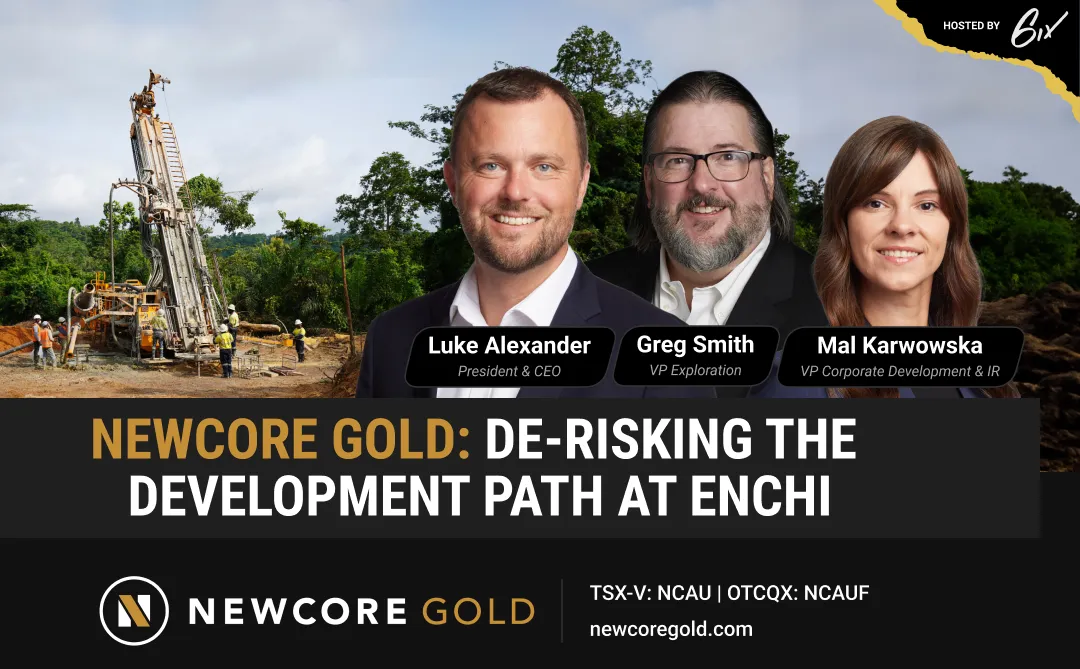
0:04 Good morning or good afternoon. Thank you for joining us today. Most of you likely already know me, but for those of you who don't, my name is Mal Karbowska and I am the Vice President of Corporate Development and Investor Relations for Nucor Gold. I'm joined today by Nucor Gold's President and CEO, Luke Alexander, as well as Nucor Gold's VP of Exploration, Greg Smith. Before we get started, I do want to highlight that we will be making some forward-looking statements today. I encourage you all to visit our website where you can find the full cautionary language. We are recording this webinar and it will be available for replay. We look forward to taking this opportunity to provide you with an update on the key developments we have made in 2025 as we continue to de-risk and advance the development of our Enchi Gold project in Ghana.
0:55 It's been a very busy start to the year with the completion of a $15 million equity financing that has put us in a great position to continue to advance Enchi. And with that strong treasury, we have been able to increase the drill programs. We'll dive into all those details today, including the drill results from this morning. And we'll also discuss what investors can expect in 2025. So we highly encourage questions. There will be a short presentation to start, but please do open up that chat functionality in the bottom right corner of your screen and you can chat and ask us some questions and I'll make sure that we get to those post-presentation. With that, I'm going to pass things off to Luke Alexander.
1:38 Thanks a lot Mal and thanks everyone for joining. We will focus a lot of this webinar today on a lot of the drill results that we've had over the last few months. It's obviously been a very busy 2025 and end to 2024 with that 10,000 metre drill program that was announced in Q3 that then got increased to a 35,000 metre drill program on the back of a $15 million financing that we completed. That $15 million financing was completed in February of this year. We went out for an original $12 million. The financing was heavily oversubscribed, So we decided to increase that to 15 million so we didn't have to cut investors back too much. That allowed us to take us again from 10,000 meter drill program to 35,000 meter and Greg will get into a bunch of the details on that.
2:34 We also were excited this year to be nominated and join the 2025 Venture 50, TSX Venture 50. That's recognizing the company as one of the top performers in 2024. And if you look at the start we've had this year from a share price perspective, we're up over 100% to start 2025. We're hopefully on track to being part of the venture 2026 if we continue along the pace that we're on at this moment. And we do think with all of the drilling that we're doing and other key milestones from a de-risking perspective, which are ultimately taking us from a PEA to a PFS, that we'll have lots of news flow to drive share price appreciation and value for shareholders.
3:25 In terms of the financing itself, we did go out as we mentioned and raise $15 million. So that takes our overall shares to roughly 250 million shares outstanding. We do currently, at the end of February, which was our last reported cash, have 17 million Canadian in the bank, but it's important to highlight that we also have roughly 30 million warrants that are currently in the money. The first tranche of those warrants, roughly 9 million come in in September of this year, that'll bring in about $3.8 million. We've then got an additional 20 million, roughly 20 million warrants that are in the money and will come in in February of 2026.
4:14 So in about 10, 11 months from now, and that will bring in over $10 million. So with the current $17 million plus the proceeds from the warrants, that will take us to over $30 million of cash. So we are extremely well financed to be able to execute on all of the drilling that we've announced, which is the 35,000 meters, as well as de-risk our project from PEA to PFS. Beyond the drilling, some of the things that we're doing, metallurgical work, hydro work, geotech work, All of those are key elements to ultimately de-risking the project from PEA to PFS. And one of the big motivations, which we'll get into at the end of this presentation, is by taking it and de-risking the project through that phase of PEA to PFS, you typically get a higher multiple from the market and we see a real value re-rate for the company by going through that. But ultimately, beyond that, and we'll talk about it with part of Greg's presentation, and I'll get into it in a bit more detail.
5:22 Arguably, we say that you get district scale exploration for free. So fundamentally underpinned by the economics of the project with district scale exploration for free. So that's the real optionality that Nucor, in my opinion, provides for shareholders. With the financing, we also increased our institutional ownership from roughly 45 to 55 percent. So we added some significant new shareholders to the share register. These are deep pocketed, long focused investors who recognize the upside potential in our project, as well as we had great support from our existing institutional shareholder base. So Franklin Templeton currently owns about 10%, Aegis owns about 5, 6%, Ruffer's at about 5, 6%. A number of these other investors sit anywhere from kind of 1 to 3 percent as well as a couple of new large investors that aren't listed on
6:27 this table here. Also importantly, management and board, we are truly aligned with shareholders. So we own 15% of Nucor and we're ultimately looking to create value for all shareholders. And then good coverage from a research perspective. So If you have access to either Canaccord, Peter Bell, or SCP, Justin Chan's research, I would encourage you to go look at that. They've both done a very good job
6:57 of covering the company for us. With that, I think I will just hand it over to Greg and He can get into a lot of the drill results that we've been putting out over the last 6 months. Those have included nice, wide, long zones of mineralization from surface, as well as we've intercepted the highest ever grade meter intercept on our project, which we put out in Q4 of last year. A nice mix of high grade as well as consistent mineralized zones across our project. A lot of that is going to feed into the PFS that we're obviously looking at commissioning in the second half of this year and having it published in the first half of next year. So with that, over to you, Greg. All right. Yeah, thanks, Luke.
7:44 Yeah, and certainly, you know, all of the early drilling that we've done, and it's been concentrated on our second largest deposit, which is Boyne. We've released to date over 15,000m, 128 holes, again over half of those from Boyne, but as well from our largest deposit Sioum, our third largest deposit Niamh and our first exploration target in this round of drilling, Cogina Hill, that being just released this morning. So the focus early has been the conversion of inferred resources into the indicated category, doing that infill drilling, moving those resources along for inclusion in the pre-feasibility study, which we'll start before the end of the year. So as Luke mentioned, we've had real good success with the continuity of the mineralization.
8:43 While this is a predominantly infill program, We are certainly extending holes beyond the current limits of the pits and we'll see some of that in the cross-section. So we're really having a dual purpose here. We're focused on converting the inferred into the indicated, but at the same time, we're actually expanding things deeper and along strike. And as we've mentioned, we've started testing now some of these earlier stage targets, and Luke will go into a bit more detail about the rest of them that exist on the project. But for us, we released this morning the first set of results from Cogina Hill. So this is a Boeing, again, our second largest deposit. You can see here the meters and the holes that we've released so far. Overall, we've done 8 news releases.
9:30 5 of them have been from Boyne. Just a number of highlight holes, and they're sort of highlighted on this plan map here. You can see they've been distributed all along the sort of central 2 kilometers of the strike length of Boyne. So it's really good to see those holes over a wide strike length. And as Luke mentioned, we've had the highest individual intercept at 204 grams per ton. We've got some, a number of, you know, above average grade intercepts. And you can see here that, you know, we're converting a large chunk of material that's at the base of the resource pits for 2023. We had some detailed drilling up in the upper oxides and that was already in the indicated category and a lot of the focus of this program was at the lower limits of the pits.
10:28 Again, we've been able to in many cases extend the holes beyond the previous pit limits. This as I say in the basically a program that's in fill will also be increasing the the overall size of the resource as we include some of this additional material that that was outside of the the previous pit constrained resource. So in terms of the overall project, we've been talking about Boeing here. That's our second largest deposit. Sium is our largest deposit. So these are about 3km apart together. They make up 85% plus of the overall resource. In terms of the PEA that we put out, the infrastructure sits in between them. This is really the focus and that's where we've done most of the drilling to date in this program.
11:20 As I mentioned, Boin had the largest inferred resource. That's where we've been focusing. It is a structurally controlled deposit. You can see here, real straight lines and basically the distribution of the gold results as we go along. Again, a number of them, significant step outs in terms of being well outside the previous resource areas. And you can see some of these highlights anywhere from, you know, 0.6 grams up to the 3 grams per ton and over real significant widths in most cases, 61 meters, 48 meters, 54 meters. So Those are the kind of intercepts that you need to meaningfully expand your resource base. And what's really starting to show as well is as we drill a little bit deeper and hit the bottom of these pits, as we expected, we're starting to see a whole series of higher grade zones develop.
12:18 And These we definitely expect will continue to depth. While we're doing all of this thin-field drilling, we're really generating some deeper targets and this is where we'll start eventually to doing some slightly deeper drilling. We're quite excited about following these high-grade resources there. Look at a couple of extra cross-sections here. Again, this is another good example of where we had lots of detailed drilling here near surface in the oxides. The focus of this program was to convert a large chunk of mineralization that was in the inferred category. Again, very successful here with almost a gram per ton over 96m. Moving along here Again, similarly, a nice wide zone of mineralization here, hitting the target area basically at the base of the previously existing pit. And then in some areas where we're really looking at sort of a long strike extensions, You can see the real modest pit that existed in the previous resource there.
13:22 Essentially, all of this intercept in the oxides existing outside of that pit. Again, well above average grade and above average width. So real good start to the drilling at Boyne. We've got some additional drilling that we've completed and we're waiting on results. This was the distribution in the previous resource of the inferred and indicated. You can see that these results that we've been looking at have been distributed all along this 2.5km. These are the larger zones so these have been the focus of the work in particular here at the Boyne deposit. We've done additional drilling as well at our largest deposit, Sioum. We put out 2 news releases here to date. We've done almost 5,500m, 54 holes here.
14:17 Again, similar to Boyne, we've got a number of areas here where we've had within the resource some above average widths and above average grades. That's been the focus of our drilling to date. We've released results from the central zone here at Checkerboard Hill, from the extension, and as well from the extension parallel structure. We're currently drilling at the ridge zone. If you look at a couple of cross-sections here, Checkerboard Hill continues to be just a really strong mineralised zone, big wide zones of mineralisation here within this 167m long hole. You've got 2 zones there that are over 60m in width. This one well over the average grade. So 1.85 grams per ton, 0.75 here. So this is, you know, sort of true infill and we're seeing good, excellent continuity.
15:13 This is the extension zone here. So this is about 2 kilometers to the south on the main structure. You see again, real good continuity and that's what we're shooting for there. Then this is the parallel structure where this was the newest area that we included in our 2023 resource in terms of the drilling.
15:33 We're actually doing some really good step outs here. This is one of the southernmost holes there and you see 1.24 over 20 again within the oxidized material. Really exciting to see these above average widths and again, some really good grades. In terms of the northern part of the Siem deposit, the Ridge Zone, again, this is a zone that's comprised of a whole series of stacked Gold mineralised zones. It's one of the areas that with the larger tonnages, we've identified areas where we had wide spacings within the previous drill holes where we had to go back in there, put some drill holes targeting what was inferred resource material. And in this case, again, some really good results here at almost 2.5g over 10m.
16:31 And then just this morning, we released our first set of results on the exploration target. This is Cogina Hill. That was along with some additional results from Niam, which is our third largest deposit. So again, our third largest deposit here, exploration target here at Cojina. These 2 zones are just about a kilometer apart. And again, we're seeing really good infill within the oxidized and upper hard rock horizons there with some better than average grades, 2.5 grams over 15 meters. And then you can see some really nice intersections here at Cogina Hill. So no resource at the moment here, but we do plan to do some follow-up drilling. And even on this section, you can see the obvious target is to continue following this up into the oxidized horizon. But we're really liking the width of these structures, like all of our zones, the fact that you've got multiple sub-parallel mineralised Gold mineralised zones, that's how you add the tonnages in this near-surface environment and look to eventually get some in-pit resources.
17:44 This is the most advanced of the exploration targets we have. We put half a dozen holes in it this year but certainly we've got a lot of room to expand this along strike and that will be part of the additional drilling that we do this year. With that, I will pass it back to Luke. Yeah, thanks a lot, Greg, for running us through that. So, obviously, it's been an extremely busy 6 months. And if you look at that 15,000 metres relative to the 35,000 metre drill program that we announced that represents, I guess, about 40% of the total program. So needless to say, we will have a lot of additional news flow to come as we continue to complete that program.
18:33 One thing I just want to make sure is highlighted here that Greg didn't specifically mention is, when you look at the average vertical depth of these pits today, these pits here is what constrains the last resource that we put out. So those pits average about 75 meters. As Greg was highlighting, when you look at a number of these intercepts that we've had, they're obviously sitting well below those pits. So what we would expect is, you know, obviously conversion is a key element for us. And that's one of the requirements to take us from PEA to PFS. We currently sit at 740,000 of indicated with an additional 970 of inferred. So we're looking to move some of that inferred from into the indicated category. And we feel we're well along the path of getting that done with the drill results and some of the internal analysis that we've done. But also from an expansion perspective, what you would potentially see here is obviously these pits deepening and widening to capture a bunch of this additional mineralization.
19:50 Conversion is one key element, but also hopefully we're going to be able to expand the resource a little bit with this drilling as well. That really accomplishes 2 key things for us. When we go back to this model here, again, as Greg was highlighting, in green is that indicated material, that 740,000 that we've got across the project today. Then in blue, you've got this inferred material. So those 2 areas or that area that I was just looking at is right in here. Again, you can see all that drilling that's sitting in the inferred category, which we expect will get converted into the indicated, but also the ability to deepen and widen the pit and add ounces is something that we're feeling quite confident about with the drill results that we've had thus far.
20:42 So in terms of valuation and some of the catalysts to come. Again, we've talked about it, management and board, we're truly aligned with shareholders. Our ENCHI project does sit on a belt in Ghana that does have a number of multi-million ounce deposits. And I will talk about the PEA in a little bit of detail and why we feel that there's a fundamental re-rate by taking our project from PEA to PFS. Management and board, again, we are aligned with shareholders. Mal Karwaska, she's a key part of our executive team. She's been working on this project since we relaunched it alongside Greg, who's been walking you through the exploration results. Dan Wilson, our country manager, he's been working on this project for the last 20 odd years.
21:40 Brandon came and joined us as VP project. So bringing some engineering and technical strength to the team along with Alan Pangborn, who we brought in as a strategic advisor. So again, you know, Brandon and Alan, key additions to take us from PEA to PFS and really work through the engineering elements of the project. From a board perspective, you know, Doug Forrester, our chairman, Blaine Johnson, Ryan King, they're all as well as Omaya and Mike Vint, they're all part of Calibre Mining, which a number of you will be familiar with is currently in the midst of merging with Equinox Gold. You know, Calibre started off as a $40 million company about
22:24 6, 7 years ago, bought the B2 Gold assets in Nicaragua, then grew the production profile there, then went and bought the marathon assets in Newfoundland, the Valentine project that drove the company to about a 2 and a half billion dollar market cap. And in the last few months, we've seen the merger with Equinox. So again, a team with a very successful track record of creating value for shareholders. And if you go back and look at Newmarket Gold, very similar
22:59 story there. $10 million company vended in the Fosterville assets in Australia, made some very nice higher grade discoveries, increased the production profile and eventually sold to Kirkland Lake Gold for about $1.4 billion. And that asset eventually represented at its peak about 6 billion of Kirkland Lakes valuation. So again, this is a team with a proven track record of creating value for shareholders. In terms of our project itself, you know, it is a large land package, 248 square kilometers in size. We've identified over 25 targets to date. Good neighbors along trend, Tirano, Bibiani. There are 2 prolific Gold belts in Ghana.
23:46 You've got the Ashanti belt, which has made some of the largest discoveries on the planet, including Oboesi and Tarquois, which are Anglo and gold fields, a couple of their key assets in their global portfolios. And then we're on the Sefwi Bibiani belt, right in the southern end of the Sefwi Bibiani belt. We have great neighbors, as I mentioned, Toronto to the north, Bibiani to the north of that. Both of those have endowments of 5 and a half and 6 and a half million ounces. You've then got Newmont with the Ahafo project, which they're investing an additional billion dollars into. That will make it
24:23 their second largest producing mine globally at just over a million ounces. So we're on a great belt with lots of large deposits along trend from us. And then directly on the other side of the border, we've got Aussie listed Tarako, who's got the AFIMA asset, and they've been very, they've been performing very well since they started drilling again. When we take a step back from an exploration
24:50 perspective, we often use the common phrase of district scale. So obviously the number of targets we've identified is one of the things we point to. Other Greenstone hosted deposits along trend with 5 million ounce plus endowments would be another example that we use of district scale potential. But then when we look at the airborne geophysics here on this slide, what we've got is we've got the main Bibiani shear that runs to the west of us. This then curls up beside Toronto and Bibiani. And where the mineralization typically sits is you get the second and third order splays coming through the project. When we look at all the strike length of those shears coming through our project, you're at over a hundred kilometers of strike. So this would be another reason why we talk about district scale. All of these structures have the potential to be discoveries
25:48 for us on the project. So it is true district scale across our project. Greg's talked about Siyum and Boeing in some detail. Niamh, Kwachi Krum and Tokasea would be our other 3 resource areas. And importantly, all of these deposits do remain open along strike. So systematically stepping out and continuing to chase these structures near surface, add material that could extend mine life is something that we're focused on. We've then got previously drill tested areas like Arati, Cojina Hill, Naquanta, Sium South. These are areas where we drilled maybe 2,000 to 5,000 metres, made discoveries, but ultimately don't have enough drill density yet to be able to wrap a resource around it. So Cogina Hill, Greg talked about it in his section of the presentation, and we put some results out on that this morning. These are areas we want to go back to over time, do some additional drilling and look to ultimately get enough discoveries to wrap a resource around it. Then we've got a number of other targets across our project that we're ultimately either doing soil sampling on, network, various kind of early stage exploration activity to see if those are, warrant us ultimately drilling them. So all of these things
27:20 combined is, you know, the district scale potential that we've got on our project. I would argue that you get all of that for free because the fundamentals that we outlined within our PEA in 2024
27:35 create a fundamental underpinning and value that will give the potential to re-rate as we take it to a PFS. So if you look in 2024, we put out a PEA that outlined a very simple open pit heap leach project. At the time we used a gold price of $1850, which is obviously well below where we're trading today. So we've actually just recently added this $3,000 level because we have had a lot of investors asking us, you know, what's the valuation
28:09 at today's prices? So, you know, at our base case of $1850,000, you're looking at $371 million at, you know, $3,000 gold price. You're looking at a 971 million dollar after tax and P.V. 58 to 30 to 136 percent IRR. Again, depending what price you want to use, and a nice production profile of 122,000 ounces. Looking at it here, I mean, you can pick your own gold price and see what the impact is. But if we use, let's say today's long-term price, which is consensus long-term of roughly 2350,
28:55 we've got an after-tax NPV of 632 million, after-tax IRR of 92% and a 1.1 year payback. One of our motivations of taking this project from a PEA to a PFS is when I talk to lots of analysts, investment bankers and others, and I would encourage you to go and speak to your investment advisors or do your own research. You know, PFS stage projects typically trade in that kind of 0.4 to 0.6 times ratio is what I'm told.
29:30 When you look at that, you know, from a valuation perspective, you know, pick your gold price and you can start to do the math on what that could potentially trade at. Today, we're trading at roughly $120 million US. So from a valuation perspective and a re-rating perspective, we see the opportunity of taking it from PEA to PFS to create a multiple re-rate from where we are today to where we could be. When you then look at it from a takeout perspective, and If we look at recent takeouts in Africa, including Ocino Resources and Orcorp, those are more advanced projects at that PFSFS stage. Both of those got taken out for roughly 0.6 times. That's the motivation for us to advance this project.
30:21 Beyond the infill drilling that we've
30:24 talked about, we are doing some additional metallurgical test work, which we'll get some of those results out as they come back to us. We're doing hydrological work, geotech work, we're doing some additional environmental and baseline work on the project. These are all kind of more boring, you know, in the background work that's getting done, but ultimately they're fundamentally important for us to de-risk the project with the goal of getting all that work completed around the middle of this year, commissioning the PFS in the second half of this year and getting that published in the first half of next year. And we'd like to think we'll see a similar re-rate to what we saw when we published that PEA in 2024.
31:11 So with that, maybe I'll just quickly recap. So obviously we are very actively drilling on the project with our 35,000 meter drill program. So expect, you know, drill results typically out on a monthly basis. So we will have drill results through the end of this year. We are very well funded with the $17M of cash in the bank. As I highlighted to you, we do have roughly an additional $14M of warrants and options that will come in, assuming we trade around these levels or higher. So that is additional capital for us to potentially expand drill programs, assuming we're still getting rewarded from the market.
31:58 And then we've talked about it in a little bit of detail. You know, our management and board have been very actively involved in a number of successful companies. The one that I've kind of illustrated in a little more detail today is Caliber. And we see, you know, Nucor on the path to being, you know, the next company within this group to create significant return for shareholders.
32:25 So with that, maybe I will pause and we can take some questions if there are any. Thank you, Luke, and thank you, Greg. And yes, we have some great questions in the queue. So I will kick things off with a question for Greg around the strip ratio. So kind of comment on the current strip ratio and then how the strip ratio may increase as the pits go deeper, given the structure of mineralization being defined with the current drill program. Yeah, so thanks Mel. Yeah, it's certainly, and it's to steal a line of Luke's, if the stripping ratio is not in the presentation, then yeah, you should be asking about it.
33:15 But in our case, it really is quite positive. We've got about a 2.5 to 1 stripping ratio on the current resource. In terms of what we're doing with this infill work. As you've seen, it's been very positive in terms of proving up the continuity of the mineralization. It's, as Luke highlighted really well, gonna be driving some of these pits deeper. So there it is there, the actual number 2.67. And what we're also seeing of course is, Luke showed some of the economics at the higher Gold prices.
34:02 Part and parcel of that is basically as you're looking at higher Gold prices, and obviously we're not gonna be driving these pits at 3000, but the last pits we used 1650 and 1850. So even at decently higher gold prices than that, what you're actually going to be doing as well as converting some of the waste that's in those pits into ore. So that's going to have a real meaningful positive effect on the stripping ratio as well. So even though we're making these pits a little wider and making them a little bit deeper, we'll actually see some positive movement on the stripping ratio with a ratio that's already starting at a pretty healthy number at 2.67.
34:50 And then, you know, we've got these nice wide zones that we see in some of these cross sections. You know, the one there at the central area, Checkerboard Hill of Seum on the left-hand side here, really highlights the fact that we've got some areas where the stripping ratio is significantly less than that. Obviously, looking at this section, and if we had a few more sections adjacent to it, these zones continue at these sort of widths. So think of it as, again, in that hole that's 167 meters long, you've got, you know, well over 130 meters of mineralization. So yeah, much less than a one-to-one stripping ratio in that particular area. So we do have that advantage as well as we can, especially within the oxide zones, start in areas where we've even got a lower stripping ratio and here at C.U.M. Ridge, another good example, just because of the stack nature of all of these mineralized zones, again, in terms of the near surface area here within the oxide.
35:54 And in this case, the oxides essentially go right down to the bottom of the previous pits. Yeah, we have a much lower stripping ratio than the overall average in these areas. So yeah, it's a real positive for our project. Luke, is there anything you wanted to add? Just note that you were on mute. No, I think that's great. I mean, as Greg mentioned, you know, with this infill and pushing these holes right to the boundaries of our existing pits, we expect that to bring additional material in and hopefully, you know, either help or maintain the strip ratio that we used in our last resource update. 2.7 to 1 is a very good strip ratio.
36:42 The point about making sure you look or ask about strip ratio is that often you'll find out it's 10 or 15 to 1, which as soon as you've got to move, you know, 10 tons of waste for every ton of ore, that makes a huge difference from an economic and cost perspective. So we're very fortunate to have such a low strip ratio on our project. Thanks. And back to you, Greg, a question around the expected significance of oxide compared to sulfide ore with this additional drilling. Yeah, so We definitely are targeting both as we've seen even here at Siyum, but as well on some of those sections at Boyne. We're creating new mineralization.
37:32 We're finding it by drilling in the oxides. So we'll be expanding the oxide resource. But as well, again, with higher Gold prices, as these pits go a little bit deeper, it is certainly expected. And in particular, at Boyne, where we see some better than average grades right at the base of those pits, obviously, there's a limited amount of oxidized material that exists starting at surface and going, in our case, to pretty significant depths, both at Boyne and Seyoum, averaging 70m, 80m, up to 100m vertically. And Again, in terms of some of the drilling that we've done on the edges of the existing pits, I showed this section where we've got a relatively small pit here that was just getting a little bit of mineralization in it in the previous resource.
38:30 Now we've essentially got this whole 63m of 1.28 that sits out of there. And certainly again, at some decent Gold prices, you'd expect it to at least get all of that oxide, if not a bit into the hard rock. But as we go deeper in these pits, that's where you really do have the upside potential. So yes, these are averaging about 75m deep, But as we saw in this next longitudinal section, as we start focusing in on some of these better grade areas, yes, we will be getting percentage-wise more and more fresh rock in there because that's certainly the open-ended.
39:16 Obviously, we can't go up because we're right at surface here. But this is where we've really got years and years of resource expansion drilling ahead of us is following these things to depth, much like we've just started doing at our Niamh deposit, our third largest deposit. We've got a couple of areas there where we've just gone a little bit deeper drilling than some of our other areas and we've actually been quite successful to follow some of these higher-grade shoots to depth. And then when you look at those results, you know, you're seeing anywhere from 2 to 7 grams over, you know, 17 meters, 4 grams over 8, 7 over 7, 9 over 9. So these are the sort of results that you're then going to follow down and transition from the ultimate depths of the open pits into defining resources that will ultimately be mined underground.
40:16 Thank you, Greg. So This leads well into another question that I'm going to throw at Luke. In terms of extending the mineralization to depth, this moves into fresh rock. With the lower recovery and heap leach processing, Would these be more likely to be saved for a possible future mill? What we outlined within the PEA was a simple open pit heap leach project. At the back end of that, there is sulfide material that does go onto the heap leach. And we obviously, from a recovery perspective based on the test work that had been completed, we discounted that compared to the oxide transitional material. So if you look at the Met work oxide transitional material in the columns and the bulk samples we've done are getting recoveries in the low 90s.
41:09 Roughly 92% was the average recovery on those. When you then compare that to what we used in the PEA. We used 85%, so we further discounted that from what the test work showed. And then on the sulfide material, we further discounted that down to 75% for the recoveries. If I can show you the kind of production profile here, then I can kind of get into, you know, where this project could potentially head. So, you know, from a production perspective, we've currently got 122,000 ounces of production over the life of the mine. The sulfide material comes in in the later years.
41:57 With all of that kind of district exploration that we talked about, our deposits remaining open along strike. What I could anticipate is obviously us extending the overall mine life of the project with additional material that comes in that we just continue to put onto the heap. But as we start to explore some of these sulfide fresh rock targets on our project, start to drill deeper as Greg kind of got into, you know, maybe in years 5 or 6, we start to look at putting a mill in. And then at that point, you know, you put a mill in to process some of those higher grade sulfides and you ultimately have a step change on the project that would take it to 200,000 to 250,000 ounces.
42:46 You continue to run the heap leach operation as you discover additional material but then you stick a CIL plant in here to process the sulfides and now you've completely changed the overall production profile of the company. So that's something that, you know, internally we talk about quite a bit and we look at and it's something I could see in the future for the project. One of the great things is, is all of that can be funded from cashflow. So when you look at the cashflow profile of this project, so if you look at 2350 gold from an after tax cashflow perspective, this project over the life of the mine generates $855 million.
43:37 $1.2 to $1.3 billion using a $3,000 gold price. So, you know, lots of cashflow generation. In year 1, $97 million. Year 2, $106 million. Year 3, $91 million. So all of that kind of exploration work in the deeper sulfides can be fully funded from cashflow. And when you continue to look at that cash flow profile it can also then go and fund that CIL opportunity that I was ultimately highlighting here. So this is one of the reasons why we're so keen to get this project into production as quickly as we can, is because it creates a lot of cash flow to ultimately, you know, look to expand and grow the overall size of the operation.
44:30 Thanks, Luke. I think that really speaks to the optionality of the project, but also that long-term potential. So there was a question around whether we are mining currently or in the feasibility study. So just to be clear, we are not mining currently. We are in the study phase. And with that, Luke, there's a question around whether we're likely to continue using Leica Podium for our pre-feasibility study. Yeah, so Leica Podium is the lead engineer that we worked with on our PEA. We also worked with a couple of other engineering firms as well. You know, reason why we chose Leica Podium as our lead consultant is they've got a very good track record in West Africa. If you look at a number of the projects that they've been involved in over the last 10 years, they've either been on time, ahead of schedule, on budget, under budget. They're also importantly in Ghana, they were the lead EPCM contractor for Newmont and actually are the lead EPCM contractor for Newmont, billion dollar expansion of their AHAFO project. So obviously all of that knowledge then feeds into the work that we did on our PEA and you know now as we expanded from PEA to PFS we see them as one of our logical partners but we're also looking at adding
46:02 a number of other engineering firms, which is typical as you move down the path to PFS and FS, you bring additional groups in who may have technical expertise in certain areas to then complement the technical expertise that Leica Podium has, but our expectation is Leica Podium will be the lead again for the PFS, but then we have other groups that we're working with at the moment on certain aspects of the project where they're technically more strong than lycopodium are. So bringing all of that together into the PFS is something we're working on at the moment. And that leads into a question around expected timeline to production.
46:49 Yeah, so we're, as we mentioned a couple of times, we're obviously doing the infill drilling. We're well on our way to getting that completed. We've released results for 15,000 meters and the drill rig just keeps turning. So we're well on our way from a resource conversion perspective. You know, our goal and target was roughly 1.3 million ounces of indicated. We started with 740, so we need to add about another 550,000 ounces. And the reason for that is at 1.3 million ounces, that's essentially what fed our PEA. So we want to then be able to wrap a PFS around that roughly 1.3 million ounces. So, we'll get that work completed by the middle of this year, as well as, as I mentioned, geotech, hydrological, MET work, a bit of additional environmental, social work, as well as some other test work. All of that's targeting completion by Q3, at which point we'll commission the PFS, look to get that published in the first half of next year.
48:00 Assuming the results are in line with what we're expecting them to be, then we would go back to our major shareholders, go back to the market, discuss with them, present the PFS numbers. And I would expect at that point, we then start the process of going to a bankable feasibility study. That would take roughly a year. So let's say mid 2026, PFS done. Another year from there that you're into the middle of 2027. You're then starting to look at, you know, financing and, and, and partners to help build the project. And that's taking you towards the end of 2027. You then put it into, into construction. That's a 15, 1 5 month period, which has you, you know, starting to pour gold or into production by the end of 2028 into 2029.
48:56 So I would say kind of, you know, first half of 2029, middle of 2029 is when you could expect first production, assuming all of those elements that I just walked you through line up. Thanks Luke. So one last question before we wrap things up and I'll have Greg speak to this one. So when the drill program was expanded from 10,000 meters to 35,000 meters, was there a significant shift in strategy or was this more just an acceleration of the same plan? Yeah, I would say it was, There certainly wasn't a shift in terms of the infill. That was, as Luke's just mentioned, basically always the first step in order to be able to do what we want to do at the pre-feasibility level. We needed to convert this 1.3Moz total.
49:51 So we were always going to get that done. I would say what this additional drilling allows us to do is even to convert more ounces. That'll give us more of that optionality that you talked about, Mal, in terms of the pre-feasibility study to again, maybe expand things a little bit, extend things a little bit. And then certainly it allows us to go out and test these additional targets. So very excited this morning to release those results on Cogina Hill. It is the most advanced of our non-resource targets. Again, nice deep oxidized zone there, again, in terms of where additional oxide material is going to come from. It's certainly going to come from the strike extents of the existing deposits, but we also have a number of areas where we've already done some first pass drilling. Again, Cogina Hill being the most advanced of those and where we can go there and again, find some really meaningful intercepts.
50:49 So yeah, probably not a lot of changes in terms of the infill. Maybe again, we'll actually convert more than we maybe needed, but certainly never more than we wanted. And yeah, it'll allow us to do definitely some additional drilling on the exploration targets. And then as I kind of touched on as well, some of those deeper targets. Definitely, we're now going to be able to spend some meters on following up on these wider than average widths and higher than average grade intercepts that we're seeing, especially at the Boing deposit, which is really, we think, grown with this drilling that we've done. Thanks, Greg. Yeah, I would note that it hasn't shifted any strategy, but has definitely allowed us some more flexibility to accelerate on the larger scale potential of the project. So Luke, any final words before I wrap things up?
51:46 No, I think, you know, we haven't talked a lot about Ghana, but I think that's a little bit deliberate because we've talked about it on a number of other webinars in the past and you can see lots of information in our presentation. But Ghana is a tier 1 jurisdiction to be operating in. It currently has, you know, 4 of the top 10 largest gold producers on the planet, including Newmont, who, as I mentioned, is putting another billion dollars into the country, Anglo Goldfields. You've also got Zijin, who's recently come into the country and they bought Newmont's non-core asset, the Achim asset. They spent a billion dollars on that. So I think this speaks again to what a great jurisdiction it is to be operating in. We're fortunate to have kind of got a land package and been able to raise a lot of capital to aggressively drill on that over the last number of years. So in the last 5 years, we've completed over 100,000 meters of drilling. We've put out 3 resource updates, 2 PEA. So Lots of work has been completed on this project.
53:01 Fundamentally, again, we see a valuation re-rate for the company through that de-risking of PEA to PFS and the increased multiple that PFS projects command, but then layered on top of that, you get the district exploration for free. So it's a lot of optionality packaged into Nucor, and that's one of the things that excites me the most about it. And I think It's one of the reasons why we've been able to attract so many institutional investors. We're at 55% institutional ownership today. It's that potential for significant cash flow in a tier 1 jurisdiction from our Enchi project today without arguably finding another ounce of Gold and then beyond that, huge exploration upside.
53:54 We're extremely excited and looking forward to all of the results that we'll be able to deliver to the market in 2025. Thank you, Luke. And thank you, Greg. And thank you, everyone who joined today and for all the great questions. Please reach out to me directly if you did have any follow-up questions or wanted to touch base with us. And also, We do encourage you to follow us on social media. We post some great videos and content from site as well as interviews. So that's on X, LinkedIn and Facebook. And we look forward to a very, very busy 2025 and keeping everybody posted with our developments. Thank you.