Transcript
Automated transcript · Written by software from the replay's audio. It can mishear names and figures; the replay is the record.
0:08 Hello everyone and welcome to today's presentation as hosted by 6. Today we'll be led by Dr. Kevin B. Heather. Kevin is an economic geologist with more than 40 years of field experience across the Americas, having worked for the Ontario Geological Survey, Geological Survey of Canada and Barrick Gold. Kevin has, for the last 17 years, been involved with junior exploration companies and was a founding member of Aldebran and its sister company Regulus, as well as the management team's previous junior, Antares Minerals. Kevin directed the exploration that led to the discovery of Antares' high-grade Hacquiera East deposit in southern Peru, which was sold to 1st Quantum Minerals in December of 2010 for $650 million. The same management team is now executing their same strategy to add value to Aldebaran's Altar Copper Gold Project in San Juan province, Argentina. This live summit is being recorded and will be available to watch on on-demand in the coming days on six.com.
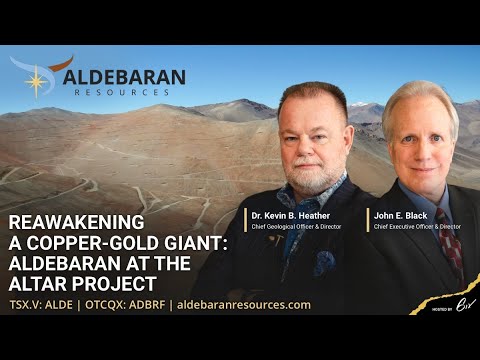
0:57 Following the presentation, there'll be a live Q&A session and you can submit questions anytime using the Q&A panel found on the right-hand side of your screen. With that, I'm going to hand things over to you, Kevin, to present the drill program plans at Alter for the 2021 and 2022 field campaign. Great, thanks Cam. Just bear with me a second here and I'll get my presentation up and running here. Hopefully everybody should be able to see that. So what I'd like to talk to you today about, and the photo looks like John and I are conjoined twins, but I can tell you we aren't, although some days it probably feels like we are. But John will be joining us later for some Q&A at the end. But today, I'd like to walk you through the Aldebaran resource story at Altar.
1:45 And we like to refer to this as a reawakening of a copper gold giant. The typical disclosure, I will be making forward-looking statements during this presentation. When Putting this presentation together, I was kind of balancing between existing shareholders that we have that are probably looking for an update and potential new investors who are new to the story and might not know the background. So I'm going to be going over some things that may be a bit of a repetition for some people, but please bear with me. I think everyone here is probably aware of the demand for copper. I don't really probably need to go over this very much, But suffice it to say that with the net carbon, net 0 things that are going on in the transition to green technologies, the demand for copper is going to be huge over the next 20 to 50 years.
2:46 And a statement that came out of Wood Mackenzie's latest report in 2021 said that of the 19 million tons of additional copper that needs to be delivered to the market for that net 0 2050, this really implies that a Escondida mine, the world's largest copper mine in Chile, need to be discovered and enter production every year for the next 20 years. So suffice it to say, having large copper assets right now are important. And this is really a few years ago what led John and I to review the Altar project. We were aware of it before when it was sold to Stillwater Mining back in 2011 for $487 million, and they subsequently put an additional $45 million into it.
3:36 And we structured a deal whereby we paid them $15 million cash, and we gave them 19.9% equity in the newly spun out Aldebaran, and we put in some of our other Argentine projects, which are also quite interesting, but we won't touch on those today due to the time. And basically the deal is that we needed to spend $30 million in the ground over 5 years. And I can update you that our recent MD&A that we just published, we've now spent $17.25 million And we're confident that we will reach the $30 million earn in for 60% well ahead of the due date for that. And then we'll have a decision to go to another additional 20% more or 80% by spending $25 million more over an additional 3 years.
4:36 Just a quick thing on our share structure, we have 2 cornerstone investors who are very pro copper, Sabanier Stillwater obviously with their 20% and then Route 1 out of San Francisco with 49.5% and then shareholders and management. Our current market cap is roughly 74 million Canadian and our share price as of yesterday was 65 cents. So what is our approach and our philosophy? I'm a big believer in the mining value chain and that accurate ore body characterization is critical to adding value. So we do exploration, we have a discovery, and then it's time to characterize the ore body. And if this is biased or inadequate, it's impossible to optimize the subsequent links on the value chain, such as the resource definition, the geometallurgy, the mine planning, reserve definition, even out as far as mining, the blending of ores, the mineral processing, tailings and waste disposal, the marketing of the metals, mine closure reclamation.
5:51 So this stage of ore body characterization has big implications all along the value chain And shareholder success is enhanced by us getting this right, because if we don't get it right, there's value destruction. Therefore, we're trying to extract as much value from the rocks and decrypting the projects, because We firmly believe that this is in the best interest for future discoveries and the future development of the project. So what is our approach specifically at Altar? Over the last 2 years since acquiring the project, we've really been focused on critical data collection that to our surprise didn't exist at the project. And so it's all kinds of information that really aren't really press release worthy or attract a lot of attention in the market, but they're absolutely critical to the success and setting the project up for future success.
6:51 These include re-logging close to 120 kilometers of historical drill core, doing the first surface geological map of the property, doing a very systematic detailed ground magnetic survey, and you'll see some of the implications and results of that later on. Building of a three-dimensional geological and structural model to understand the disposition of the mineralizing porphyry centers and to understand the geometries and where there might be future for exploration upside. A very detailed regional talus fine geochemical survey, which I'll begin showing some results from, and then a really interesting three-dimensional induced polarization magnetoteleric geophysical survey that we've partially completed last year and will be finalizing this year.
7:47 And this all leads us to a geometallurgical model that has implications for all those downstream activities. But not only are we focused on technical excellence, we really wanna try to be practitioners of best practices because we think that this adds value for all stakeholders. We are committed to being responsible stewards of the environment. We're also developing long-lasting beneficial relationships with social activities with the local communities, the government, and other stakeholders. And we're committed to high governance standards as well. And these are just a couple of photos. You can see We have daily safety meetings every morning with the team at the project site to ensure everything's done safely.
8:36 Where is the Altar Project? It's located in San Juan, Argentina, which is in northwestern Argentina, right on the border with Chile. And you can see San Juan is one of the more mining-friendly province, probably the most mining-friendly province in Argentina. It's a top mining and copper exploration hotspot at the moment. We can see here in the north of the province the Jose Maria and Filo del Sol deposits that are being developed right now. There's the producing Valadero gold mine with Barrick and Sandong. And then we've got McEwen's Las Azules deposit located about 60 kilometers north of the Altar Copper Gold Project, and then 25 kilometers to the south is the giant Las Palambres mine in Chile, operated by Antofagasta Minerals.
9:27 And next door to that is the El Pachon project of Glencore. And we actually share a common access road into the project with Glencore and the Alpachon project. Just some activities, we've been in the field since early October, this is really quite important because historically the project here starts in January because of weather conditions but we've been able to get in much much earlier and the main reason for that being is that there's now a new low elevation access road So this will enable us to extend the field season from the typical 4.5 months to probably close to 8 months. And we're looking at even possibly extending beyond that depending on weather conditions.
10:15 So we've been active in the field now for almost a month. You can see this is a photo that were taken very recently, and you can see there's still snow on the drill access road. So we've been working with heavy machinery to clean those roads so that we can get access to our drill sites. We've also had to do some camp expansions because of COVID protocols, but also because we're increasing the amount of people and drills that we'll have on the project this year. And we've had to install larger fuel capacities and increase generator capacities. And I can say that we're also starting to receive the drill equipment. This is the lay down area for the drillers where they'll be having all their equipment.
11:00 And this was a photo taken yesterday afternoon of the first 2 rigs coming up the road and they should be in camp today. So things are progressing and we should be drilling sometime in this coming days. This is just a panoramic view here showing Altar East and Altar Central. You can see a very large mineralized system and then just over the side of the hill here is where we call the QDM radio area and in the far distance is the camp. This is the QDM South and QDM radio area. So you can see very typical arid, high Andean terrain here at between anywhere from 3,000 to 4,000 meters elevation above sea level.
11:46 Really, it's 1 project, but it consists of multiple porphyry deposits. And these are spread across almost 7 kilometers of strike length, and they are moving from the west, the QDM radio area, the Altar Central and Altar East, where the bulk of the current resource is located, and then another porphyry center here called Altar North. Now I'd like to just show you a longitudinal section that goes through these deposits. And here we can see we're looking to the north and we can see the QDM radio area and the drilling and we can see a small gold resource here sitting above the QDM area of roughly 490 million ounces of gold equivalent. And you can see the main resource that Altar is in an open pit configuration.
12:38 This is the conceptual resource that we did in March of 2021. And you can see in the measured and indicated categories, we've got 11.4 billion pounds of copper and 3.4 million ounces of gold. And then in the inferred category, an additional 1.8 billion pounds of copper and close to 500,000 ounces of gold. So this really is a very large copper project with gold already. Within that, we've identified a super gene copper mineral resource of 3.4 billion pounds of copper at a little over half a percent copper and another 0.16 billion pounds of copper in the inferred category. And this potentially opens the project to some optionality in terms of this mineralization is probably amenable to lower capex SXEW processing and could form an early startup portion of the project. But that's still under evaluation.
13:41 As I mentioned, we've recently conducted an induced polarization and magnetotellurics geophysical survey. We've covered the 2 areas, phase 1 and phase 2, that cover the QDM radio and the Altar Central areas. But Unfortunately, at the end of last field season, we were hit with a very big snowstorm and this basically forced us to shut the project down because we didn't want to get our people trapped up at the project. And so this year, As a first priority, we will be completing phase 3, and then eventually phases 4, 5, and 6. And I put this magenta line on here, and you'll see this referenced in other figures as we move along.
14:29 And this is basically just to tell you that we've got this new, exciting, detailed, deep-looking geophysics for this western half of the project, but it's still not here for the eastern 0.5. But we should have that by Christmas time. So just before we dive in to look at some of the results and some of the drill plans, I just want to go over some quick definitions for those of you who are not technical people. Basically induced polarization and resistivity are 2 electrical properties that are measured in the subsurface rocks and are applicable to things like mineralization. And effectively what we do is we measure them both at the same time by inserting 2 electrodes along lines and those lines can be irregularly located on the tops of hills and the bottoms of valleys and we pass an electrical current through those electrodes and you can see them here and we have transmitters and receivers.
15:31 And the IP resistivity is really a measure of how easily that electrical current passes through the rocks. So it gives us an idea whether they're conductive or they're resistive. And the chargeability is caused because when we put that current into the ground, it has a charging effect, especially of certain minerals, specifically sulfides and especially pyrite. And they act like capacitors. And so when we turn the energy off or the electricity off, that energy that's been electrified in those sulfides then begins to decay and we can measure that. So it's a good way of seeing where there's potential areas of sulfide. And this particularly has a look depth of somewhere between 600 and 700 meters. And we're measuring both chargeability and resistivity and the inverse of that, which is conductivity.
16:27 You can see a three-dimensional map here that we can start to get points and start to see things in 3D below in the subsurface. The other technique is called Magneto-Telluric or MT. And this is a passive method. And we're using the Earth's natural magnetic and electrical fields due to lightning strikes globally. And this is measuring the resistivity of the subsurface rocks. This is really a good complement to the IP method because it's much deeper looking. We can see the resistivity or the inverse, the conductivity down to depths of 1 to 3 kilometers. And so again, this just shows the layout. Again, we've got this detailed data on the west side and not the east side, but we had some old historical data that we've merged together to give us an interim look as to what we might be seeing but we do need to finish the more detailed newer technology type geophysics on this side as soon as we can get the equipment up there.
17:34 And this is just a bit of a teaser, this is a the chargeability at the 3400 meter level and we can see a classic porphyry signature around QDM radio here with a chargeability feature showing up in the hot red and magenta colors, and then something occurring to the south side of the Altar Central and Altar East areas. More interestingly, the resistivity, or like I said, conversely, the inverse of it, the conductivity, these big red areas are showing areas of conductivity. So there's something in the earth or in the rocks that's very conductive. And you can see it has a very good spatial association where we know we have areas of known mineralization.
18:20 And you can see the anomalies are much bigger than where the known drilling is. So this is very encouraging. But I'll talk about that in a little bit more time in a few minutes. So this is just some of the principal drill targets. And I've categorized these by their different objectives for these. And what I've laid this over is on our WorldView 3 satellite hyperspectral image. And you can see all the bright colors, this is identifying different alteration clay and mica minerals that are typically related to the hydrothermal fluids that are bringing the copper into the system. And so these show us the areas where there's more prospectivity.
19:09 And you can see they clearly show the areas of QDM Radio, Altar Central, and Altar East. But we see that the alteration is actually much, much wider spread than just the areas of known mineralization. So this again is encouraging. And so our priorities this year will be to start drilling out the radioporphy discovery, and I'll go into that in a little bit of detail here in a few minutes. And we'll also be doing some extension drilling to known mineralization here at the Altar Central and Altar East area to extend zones of higher-grade mineralization. And then we've got some greenfield areas that we'd like to drill test as well. These are areas that show good either geophysical, geochemical, or geological reasons why we may want to drill a drill hole there. And these areas have had no previous drilling.
20:06 Again, the magenta line there, you can see these 3 targets, these greenfield targets, you're gonna see, I'm gonna show you these 2, the Altar Deep and the Altar South targets, but we'll probably hold off and drill those towards the second half of the field season and wait till we can get this more deep looking geophysics completed here to better help us target some of those initial drill holes. And then finally, we've got a number of other areas that we've identified, but these are much earlier stage areas and require more additional field work and mapping. And some of these may be drill tested, depending on how we advance them.
20:51 But I suspect that these will not be drill tested this coming field campaign. So moving on to the radioporphyry. This is currently not in resource, but we've had some very spectacular drill hole hits here. And you can see some of these drill hole hits. You can see first up here is the small gold resource sitting at QDM Gold. And then below that is the Radio Porphyry system. And you can see whole QDM 34 hit 78m of 2% Copper equivalent. And that was within a longer run of 372m of almost 1% copper equivalent. And then our hole from last year that got us really excited about this target is hole 42. You can see completely open, 111 meters at 1.4% copper equivalent within 333 meters of 0.86 copper equivalent. So really exciting high-grade intercepts here.
21:57 Quick word on the rocks, because the rocks are important. I know that a lot of you aren't technical, but it's important to understand that the alteration here at the radioporphyry consists of very intrusive rocks that are very strongly, potastically altered. That's this pink coloration you can see. And they have a lot of magnetite. That's this black mineral that you can see. And the importance of the black mineral is that it's magnetic. And therefore, this style of alteration, which we can see, is clearly associated with chalcopyrite, and calcicite, and boronite, all copper-bearing minerals that we're looking for. This has a very distinct magnetic signature and will be important for us in terms of trying to find mineralization.
22:44 So now I'd like to take you through some depth slices to look at this. And you can see the conceptual open pit for QDM Gold. This is the satellite image. You can see the drill roads, and you can see all the drill holes that have been drilled to date, along with their copper equivalent intercepts. And what I'd like to show you, this is the hyperspectral showing the hydrothermal alteration. And again, you can see it's a very large area. You can see for scale here, 1 kilometer. So this is 2 or 3 kilometers long by a couple kilometers wide.
23:21 And so what I wanna take you through now is just a series of depth slices at 3,400 meter elevation, 3,026 hundred meters, and show you some of the new geophysical data that we have that's got us really excited to put some of these drill intercepts into perspective. Remember the 3D magnetic inversion we can see down to close to a kilometer. The 3D IP chargeability and resistivity is somewhere in the range of 6 to 700 meters. And then the MT resistivity is anywhere from 1 to 3 kilometers depth. So this is the 3D MAG inversion at 3,400 meters. And what we can clearly see is we get a classic magnetic high.
24:09 And we're interpreting that to be related to that strong magnetite K-Feldspar alteration with quartz veining that has chalcopyrite, boronite, and calcite copper mineralization. And you can see the scale here. That's a kilometer by a kilometer inside. And it's got a classic magnetic low around the outside. This is a very, very common pattern you see in porphyry copper deposits. This is 400 meters below, and we can see the size of the magnetic anomaly has gotten larger. And then another 400 meters below, we can see that it's still quite persistent. If we jump over and look at the 3D IP chargeability, we can now see that what I've done is I've put the magnetic anomaly on here in the white dashed line, and we're now looking at chargeability. And we can see there's a very strong chargeability halo around the outside.
25:06 This has the signature of a classic pyrite moly halo with an inner core of lower chargeability which is essentially the mineralized and strongly altered core of the porphyry system. If we go down another 400 meters, we can still see this, but remember, at this kind of depth, we're starting to get to the limits of this methodology. This is the resistivity. And you can see there's this bright red area. That's very conductive rock. So you can see that it's starting to map out that chargeability ring, and it's being conductive. And we can see the copper mineralization in the center right here.
25:54 And then this is down at 3,000 meters and you can see it starts to blow out to the south here which is quite interesting and will require some follow-up drilling to see what that's all about. So now what I'd like to do is just kind of amalgamate these and we'll go through and we'll look at a couple 2 or 3 depth slices again and I What I've done here is I've put the magnetic high, we're at the 3,400 meter level, I put the magnetic high in white, that chargeability ring in red, and then that conductivity or resistivity low in the orange. And what I've done here is I'm actually showing the actual drill holes with their grade and where they intercept this slice.
26:40 And you can see that up high, we've got pretty good coverage here. But Down to the south, there's very little drill hole coverage. And again, remember, this is a kilometer across. If we go down 400 meters, we can see a lot of very high-grade intercepts here, but all clustered in only a very small area and a large part of the anomaly completely untested. And if we go down another 400 meters, we can see that this is virtually untested. There's 1 hole that bottomed in a post-mineral porphyry dike, and hole 41, which hit very good mineralization but very high in molybdenite, which one might expect because it's out near the edge, out in that pyrite moly Halo.
27:31 But again, no further drilling in this level. Now I'd like to shift towards the Talus Fine Geochemistry survey we did. And for those of you that don't know what Talus Fine Geochemistry is, Basically, we take samples every 100 meters on a grid across the entire project site, and the guys go out with the GPS and they basically find the point, they dig a 20 to 30 centimeter hole, They sieve that material, put it in a bag, and that gets sent off for multi-element geochemistry. And to date, we've collected over 4,000 samples, and we're planning to collect another close to 2,300 samples this season to complete the complete property package. And you'll see, I'll show you some images here in a few minutes, the power of this.
28:29 So why do we want to collect this kind of data? This is a cartoon model of a porphyry copper down here. And when it's in place, fluids that are carrying the copper mineralization come off, and it creates a plume of hydrothermal alteration above that has a very specific geochemical signature. And with the fluids rising, they cool, the pH changes, and we can start to see that different elements occur very high in the system and other elements occur deeper in the system. So we can use these elements as guides to tell where we are in the system, but also where there might be a buried porphyry copper system.
29:15 And this is some of the results here that you can see. This is copper and gold. And you can see it very nicely maps out the known mineralized areas, but also is picking up an area here to the south of Altar Central and Altar East. And we'll talk about that in a few minutes. Some of the elements that you see higher up in the system are really lighting up this large area to the south here, and this has got us excited as well because this is an area that's virtually unexplored. And we're doing more work down there this field season. So some of the other work that we're doing is some of the extension drilling of higher grade mineralization. And there's 1 right here I'd like to take you through as an example. We don't have time to go through them all.
30:04 But here we got a clear surface geochemistry anomaly in copper, gold. And I'll now look at a cross-section that goes through here, and we'll look at some of the geophysical data there. So this is the cross section. We're looking towards the Northwest. And we can see the open pit, conceptual open pit. We can see the drill holes. And this is the magnetics. And we can see that clearly there's an association of the better grade mineralization with higher magnetics. And there's a large magnetic area here that has no drilling. So that's part of the
30:41 reason why we want to drill that hole. The second reason is there's also a large chargeability feature here. And if we look at the resistivity, or in this case, because it's very low resistivity, it's actually conductive, we can see that the conductive feature here looks like it's got a spatial association with the known mineralization. And this area is completely untested, as is this area to the north as well. And you can see this is the block model. And so everything inside the pit is currently in the resource. There are blocks below, but those are not currently in resource. So we have opportunities to extend the mineralization, but also test an area that currently is within the pit and being considered as waste.
31:35 And we can see we might be able to also extend the supergene copper zone here further to the south. And this area, like I said, we plan to test as well but on a different part of a different section, so we don't show it on this one. Another target that's got us really excited is called Altar South, but we currently are waiting to get that deep geophysics
32:01 to do on this one before we proceed further. And you can see we've got really good-looking surface geochemistry from our talus finds, suggesting with the bismuth and the indium that We've got a large anomaly here. And interestingly enough, it's still actually within the footprint of the ultimate pit. So this is quite interesting. And if we look, we've also got copper, and we've also got gold. And again, for scale, that's roughly almost 2 kilometers across there. This is a huge target. So another target that's got us really excited is what we call the Altar Deep Target.
32:50 And this is again, the geophysics. I don't wanna go into all the details of this, but this is basically, the geophysicists put together a combination of the resistivity and the chargeability that most reflects porphyry copper settings, and they've merged that data together. And so basically these magenta areas or these hot areas are showing low to moderate chargeability and low resistivity or conversely high conductivity.
33:24 And you can see in these 2 cross sections, we've put the 0.5 copper grade shells of the known mineralization on here. And you can see how this is really picking out, the geophysics is really picking out the radio QDM area. It really picks out Altar Central and Altar East, but interestingly, it's starting to illuminate that there could be somethings perking in between and this is an area that we historically have called Altar Deep. When we look at the Magneto-Telluric data, it's showing us the same thing. We can see that they're suggesting that there's something buried a little bit in between the 2 deposits, but this area, like I mentioned, we need to complete that survey to get a real full picture of what's going on. For those of you that followed the story, a couple of years ago, one of the things that attracted us to this project was that when we started looking at some of the deeper drill holes that had been drilled at Altar Central and Altar East, here we're plotting up the molybdenite, we started seeing the moly was starting to increase along the bottoms of all the holes.
34:37 And we postulated back a couple years ago that maybe this is a moly halo or shell sitting on a deeper porphyry body that has yet to be discovered. And the geophysical data is suggesting that this may be permissive. So starting to wrap up here, What are the next steps? We have a lot of historical data. Just the drill hole data alone would have now, in today's dollar terms, would have probably cost us over $100 million to acquire. And so we've taken all of that valuable information and we've started to build updated geologic models like I mentioned. And now we're entering what I like to call the re-exploration or the de-risking value-add part, the exciting part of the project. All the heavy lifting was back here.
35:40 And we've started this by putting out an updated resource
35:45 highlighting the higher-grade centres back in March of 2021. We did a limited drill program last field season to test some extensions and to test the radial porphyry area and that's where we got that really spectacular intercept of high grade and drill hole 42. And we did the 3D IPMT, unfortunately we had to stop because of snow, but now we're poised for an aggressive drill program starting here within the next week. And we've had 4 rigs. We want to complete that 3D IPMT survey, and we want to extend that Taylor's fine geo chem survey to the entire project portfolio of properties.
36:34 And we hope to put out an updated mineral resource, including the new radio discovery sometime in early Q4. But we hope to still be drilling as late into next field season as possible. So 10 investment highlights and why I think that Eldorado is a strong value proposition. We're in a high profile location in San Juan and in a very prolific part of the Andes for large world-class Copper Gold projects. We've just completed the low elevation access road and camp upgrades, so This extends our field season by almost double. This is huge.
37:20 We already have a sizable copper gold resource in hand. Like I mentioned, 11.4 billion pounds of copper, 4 million ounces of gold in the M&I category, and an additional almost 2 billion pounds of copper and 500,000 ounce of gold in the inferred category. We've got the high-grade radio copper gold discovery that's a potential game changer and is not in resource at the moment. We're gonna start a significant 4 rig drill program. Like I mentioned, starting within days. We plan to focus heavily on drilling out the radiocorporea. I think you can see based on some of the stuff I've shown that there's large areas of undrilled favorable looking both geophysically and geologically to test and we hope to put this into an interim 43-101 mineral resource estimate.
38:20 We also hope to test numerous exciting targets, some of which I've shown you today, extensions to no mineralization, and then some really exciting previously untested targets that are based on geochemistry, geophysics and geology. I think there's multiple opportunities here to increase both the size and the grade of the Altar Project. I think we're gonna have increased news flow over the next 12 months. There's going to be a lot of drill data, a lot of new geophysical data coming out over the coming months. And I believe that we're extremely undervalued relative to peers and for what we've actually got in hand in the ground now.
39:05 I think we're under the radar and I think it's time to get in. So I think I've hopefully shown you that we've got a clear path to add value, we've got quality partners, we have a team that's got a history of value creation, we're committed to best ESG practices and I invite you to visit our website. We've got a really excellent video series and some CEO interviews and other information for those that want to dig a bit deeper. And before I leave you, I want to leave you with this spectacular view of the Altar Central and Altar East area and confirm to you, and hopefully I've demonstrated, that we really are reawakening a copper gold giant.
39:57 So thanks for your attention, and now it's time to entertain questions. Thanks so much, Kevin, for that. We're joined by CEO and director John Black as we enter into Q&A session now. John is an economic geologist with more than 35 years of exploration experience globally. He was the founding president of the management's previous junior, Antares Mineral Inc. And instrumental in its sale of the 1st quantum. His early career included work with Bear Creek Mining Company, Tencott Minerals Corporation, Rio Tinto, and Western Mining Corporation. And he's now the CEO of Regulus Resources and Alderaan Resources. Welcome, John. Thanks for coming on. We've received a number of live questions. Also have some that have come in in advance. But we're going to get right into it, gentlemen. First, could you provide clarification on the history of the Altair Project and Stillwater's acquisition of the project in 2011?
40:48 Yeah, we received a question on that. Just to clarify, It was Stillwater Mining Corporation that purchased the project for 487 million dollars and subsequently Sabanye purchased Stillwater. So and the combined company is now referred to as Sabanye Stillwater. So they're 2 separate companies, really. OK, thanks. Next question. SXEW type processing is very electric intensive. How far away is the nearest high voltage power? That's an excellent question. The nearest high voltage power right now would arrive to the Antofagasta's mine at Los Palambres, which is about 25 or 30 kilometers away. So there's power up to a very major mining operation at that point.
41:33 I'd also like to emphasize that it's early days on this. We're pointing out that there is that secondary blanket. That's something that we'll evaluate to determine if that's an opportunity to go forward. It'll be a trade-off between different pros and cons on that. When you do SXCW, you get a lower recovery, but it requires less capital to do it. So sometimes it's a nice way to start on a project to get it going at a lower capital cost. You also don't require exportation of a concentrate. You produce cathode on site, which can be attractive in a country like Argentina, where there are some considerations about exportation of products before there's a value add there. So it'll be something that we take into consideration. And clearly, power cost will be one of those that we take into consideration. But given where we're at in the Andes, it's not as bad as you would think with the proximity of mines on the Chilean side.
42:25 Okay, great, thank you for that, John. We've had a few similar questions come in, which I'm going to try to summarize with the following. What are community relations like for the Alta project? Also San Juan has lots of companies drilling at projects this season. Is the province ready for it? What initiatives are there to train local talent? Okay, quite a lot to get into on that. This stretch of the Andes is actually a pretty nice place to work. It's very remote. So there are not communities, there are not people that live right on the project. They're portions of the year when it's relatively inaccessible. And so we don't have the same situation we have in other parts of South America where you have communities immediately in the area. Most of the people that we consider of direct influence to the project are downstream from it down into the Calangasta area and it's there's some pretty I'm pretty excited about Argentina right now, because there are some really encouraging initiatives that are being done, not strictly on our own behalf, but actually as kind of group projects that involve ourselves, some of our peer companies that are working in the area, and some of the educational institutions and the government agencies.
43:33 An excellent 1 to point out on is there's a, in Argentina, it's a federation of states. So each province acts independently and is kind of jealous of keeping things in the province as much as possible. And So if we bring in workers from say Mendoza next door or Chile across the border, that causes concern for the local community members. However, many of the local community members don't have the skill sets for the positions we have. There are not a lot of drillers available in San Juan, Argentina. And so how do we balance that off? And what's happened is we've recently, in collaboration with other mining companies and with several educational institutions, launched a program to provide training opportunities for young people in the Calangasta area so they're qualified to assume these positions. And these would be skills such as drilling. This week, there was just an agreement announced to start a drilling school effectively to train both drillers and drill helpers.
44:32 But there are also other skills that are being taught in catering industry, in welding, various skill sets you could use, and even extending beyond that to winemaking and tourist type activities, which aren't directly related to us, but contribute to the community overall. So I'm quite pleased to see that type of work going on. Other activities we do are involved with around sports or social events, and particularly in the last 2 years, a lot of emphasis placed on providing health benefits in terms of PPE and materials to help work around the COVID situation that we have. So it's working quite well in Argentina. I'm very, very pleased with how that's going forward. That's great to hear, John. Thank you. Next question. How long is your working session?
45:21 Our working season historically has been that we get in for drilling, say, right after Christmas in January, and we could drill until April, maybe push a little bit later than that. It's not because of the onsite conditions. It's because we had 2 high elevation passes that we had to cross. And those passes just easily get snowed in with one big snowstorm. And it's very expensive to cut those roads and keep them open. So like many groups in the Andes, we've had that short intense field season, but with the new low level Asian road, which is a combination of a road that Glencore punched into Pachon last year, and then us providing an extension, we've cut out both of those passes. So as Kevin pointed out, We hope to extend our field season now to as much as 8 months or even beyond if we're if we assume the the cost of plowing snow. We're not the only ones doing this.
46:10 You notice that Filo in the in the north have also recently announced that they're putting in a new low elevation road. I think McEwen is as well. So all of us are trying to extend our field seasons in what will be a pretty exciting campaign here in Argentina this year. There's gonna be a lot of drilling being done and by ourselves and our neighbors. For sure. A bit more of a technical question here. I hope I've got it right coming from Joel. Have you looked at chloride titanium lithium ratios or titanium strontium ratios? Kevin, I'll turn that over to you. Yeah, in terms of the, well, we haven't done work on chloride because there's virtually no chloride to look at. In some of the andesitic volcanics, there is propolytic alteration, but That's distal to the actual places where we have the mineralization. In terms of the tail-as-fine geochemistry, yeah, we've looked at those ratios and they show the same kind of bullseyes that the actual other elements show as well.
47:19 Okay, thanks. How many holes do you have you contemplated and what's the current size of the treasury looking like right now? I can handle that. We currently have a little less than $7 million in Treasury, which is plenty of funding for us to allow us to kick this program off. But with the extended field season, it's likely we'll be in a position to want to increase the size of the program beyond the funding that we have. So it's highly likely at some point in the field season we'll announce a financing to extend the program and add. So it's a little hard to tell how much that drilling will be completed, but with 4 rigs on site, it's in a field season of 7 or 8 months now, it's pretty easy to imagine that we can complete quite a bit of drilling this year.
48:06 Right, okay. Is the ultimate vision for a mix of open pit and underground mining? Kevin, you want to do that one? Yeah, I mean, yeah, I think that is the, you know, eventually that will be the, that will be the situation, because there's definitely the grades that we're getting at the radioporphyry system are definitely high enough to support underground mining. Now the question is can we find the volume and the geometry as well, but the kinds of depths we're at that would have to be some sort of an underground bulk mining method there. And even below the current Altar Central and Altar East open pit, there are, the mineralization does continue and there is some higher grade mineralization.
48:57 So It's possible that could be potentially looked at as an underground operation as well at some point in the future. Okay, thanks for that, Kevin. What's your view on the current and future M&A environment for large projects such as this and the valuation of development assets? I'll step in on this one. I think we're actually just entering into a point that's not terribly different than we had in, say, 2007, when we had a sudden increase in copper prices. And the major copper groups started to accumulate quite a bit of funds and then realized that they needed to grow but hadn't generated their own internal opportunities to do that. And there was quite a spree of purchasing of assets. That's when, as our predecessor company Antares, we sold the Acura deposit to the 1st quantum and a number of other assets, including Altar, transacted in that period of time when companies were encouraged to buy large assets.
49:58 Copper prices dropped off. We saw a lot less expiration for a period of time, but now we're back into a sustained period of relatively high copper prices with most predictions saying that it might even go beyond this. We're starting to see the copper companies pile up quite a bit of cash right now, and I think we're right on the edge again of groups looking to acquire these type assets. With a couple notable differences, 1 is that there are fewer of these assets out there now. These are difficult projects to find. Most of these projects are ones that have been discovered quite a long time ago by majors and have been recycled or ready for re-exploration story like Kevin said. So we're coming back in, we're showing the viability of these projects in more detail and those are being acquired by the major companies. There are not too many of these left to be acquired. And the other important thing to point out is that we're now seeing the gold companies also enter into acquiring major porphyry copper deposits, as long as they have enough gold to justify that. And this project's a bit different than many of the projects around us, in our immediate vicinity. Los Palambres, Pachon, Los Azules around us are all copper or copper moly systems.
51:10 Altar has the interesting characteristic that it has elevated gold associated with it, which attracts an additional suite of potential suitors. Okay, great. Thank you for that. Can you comment on the lab process and why Lima needs to be used? Yeah, I can handle that one. Yeah, basically the, we use ALS, which is a internationally certified and recognized leader in geochemical analyses worldwide. And in Argentina, they have a sample processing facility in Mendoza, but they do not have the equipment to actually do the analysis. So basically the samples are processed into pulps in Mendoza, and then those pulps are shipped to Lima, where they have their bank of equipment done. So it really doesn't add anything to the timeframe.
52:07 And there's virtually no labs in Argentina that we would wanna probably try to use that have the equipment that we need to do the kind of analysis we're doing. So that's the reason why that the samples get sent to Lima. But it doesn't change the turnaround time. Right, thank you for that Kevin. Just a point to that, what may change turnaround time is the fact that there's going to be a heck of a lot of work going on in San Juan province. And so that's what's going to be interesting and we can't judge until we get into the season what the turnaround time will be. But I think it's fair to assume that it's likely to take a little longer than normal given the anticipated volume from from everybody around us. Right. OK.
52:56 Does the company plan to find a buyer in the future. And if so what's the expected timeline on that. Yeah our strategy is a company and within our predecessor companies is to identify these type of opportunities for large copper and copper gold deposits to drill those out. This case, much of the drilling has been done, although there are some very, very important targets that need to be hit still, de-risk the project and then ideally monetize it by selling it to a major company that would be the company that would put it into production. We're not miners. We're explorers and good at identifying these opportunities. We're also, when you have a single asset or principal flagship asset in a company like this it's a long time until it becomes a mine and we like to provide our shareholders with an earlier exit by monetizing it to sell it to a major mining company.
53:46 Okay great thanks for that John. Listen I think that's all the time we have today. We only have a few minutes left. So I'd like to thank everyone who submitted questions. John, Kevin, thank you so much for coming on and going through that presentation and participating in this live Q&A. To the audience members, if you didn't get a chance to get your questions answered or if you think of 1 after the summit, we'll be sending out a short survey where you can leave your contact information and the Aldebaran team will reach out to you directly. You can also find more information of course at aldebaranresources.com. And with that, Kevin, I'm going to pass it over to you for some final words. John, I think you also have some closing remarks, but then after that, we'll be finished up for today. Yeah, I'd just like to thank everybody who took the time to attend the webinar, and I think we're entering a very exciting phase for the project and stay tuned.
54:36 And I think we're going to have some very exciting results over the next few months. Great. Thanks, Kevin, for walking people through this. It's a short period of time we have in a format like this to go through it. So please contact us with any questions you might have. We'd be more than happy to walk you through technical details of the project or just discuss Argentina in general. It's a new area for some investors, but it's 1 that's shining pretty brightly right now, not just for our projects alone, but we have a number of very exciting plays in the immediate San Juan province as well as throughout the country now. So I think it's a great time to be taking a look at an early stage project like us. Some of the better known projects have already added quite a bit of value, and I think this is a perfect time for people to catch us now before we start putting out quite a bit of new information this year. Thanks everybody for your time. Look forward to talking with you when we can.