Transcript
Automated transcript · Written by software from the replay's audio. It can mishear names and figures; the replay is the record.
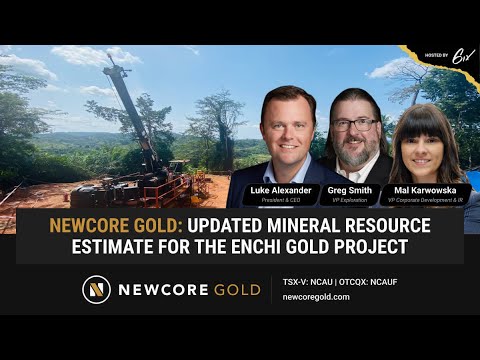
0:08 Hi, everyone. Thank you for joining us today. Most of you likely already know me, but for those of you who don't, my name is Mala Karwowska and I'm the VP Corporate Development and Investor Relations for Nucor Gold. I'm joined today by Nucor Gold's President and CEO, Luke Alexander, as well as our VP of Exploration, Greg Smith. Before we get started, I just want to highlight that we will be making some forward-looking statements today, so I encourage you all to visit our website and read that full cautionary language in detail. We look forward to taking this opportunity today to provide a detailed overview of our recently announced updated mineral resource estimate for our Enchi Gold Project in Ghana, which is a result of several years of drilling that have been successful in proving out the significant potential across the property.
0:56 Importantly, please don't forget to submit your questions. After the presentation, we will be answering your questions, So please do make sure to submit those using the questions tab. With that, I'm gonna pass it over to Luke to kick things off.
1:09 Yeah, thanks Mal and hi everybody. Again, many of you may know me as well, but I'm Luke Alexander, President and CEO of Nucor Gold. We're going to focus this presentation today on the updated resource that we put out at the beginning of March and highlight a number of the positive aspects of that updated resource. And then at the end, we'll talk a bit about Ghana and give you a bit more of a fulsome overview for those who aren't as familiar with Nucor. Maybe just at a high level though, Nucor Gold, we are advancing the Enchi project in Ghana. It is a district scale exploration project on 1 of 2 prolific belts that sits in Ghana, over 200 million ounces of gold historically discovered there. And we've got a number of targets on our project that we have yet to go after.
2:01 The company is backed by a management team and board with a proven track record, but also we're very well aligned with shareholders through our 24% ownership in the business. This is investments that we have made in Nucor over the last number of years. And the company is fundamentally underpinned obviously by the resource, which we're going to talk about, the updated resource that we're going to talk about in detail today. But we also put out a PEA in 2021, which outlined very robust economics for the project. So a fundamental underpinning of value with district scale exploration upside is where we see a very compelling investment for investors today, as well as very well backed by institutional shareholders, currently 40% owned by deep pocketed long term institutional investors who recognize the upside of the project and the company.
3:01 Getting on to the resource, we did put this out at the beginning of March. This was an update from a 2021 resource that we had, and we're really excited with the results of this resource for a number of reasons. Firstly, for the first time ever on this project, we've got an indicated resource. So this obviously meaningfully de-risks the resource for investors. And we outlined 743,000 ounces of indicated resource. A lot of this sits within the Boeing and Sium deposits, which are our 2 largest deposits. And we'll also talk about how a lot of this resource sits within the oxide and transitional zone, which means it is a heap leach project, which is a much lower capex way of producing gold. And that was what we outlined
4:02 in our 2021 PEA. So again, this de-risking of the resource obviously further supports the economics on the project. As well as the indicated resource, we added 972,000 ounces of inferred resource. So this obviously grew the overall size of our resource as well which we were which we are very excited about. Third thing is we for the first time ever added a high-grade underground resource on our project, 135,000 ounces. Greg will talk about this in some detail. And as many of you would recognize 135,000 ounces today is not a mineable resource, but what it is for us is that it's a proof of concept. If you look at a lot of these Greenstone hosted deposits along the Sefuibibiani belt that are 5 million ounce plus resources, looking at the Newmont, A0A mine, that's a 20 million ounce resource, where you start to see them really grow in size and increasing grade is as you start to get into the sulfides and drill a little bit deeper and start to get those higher grades. So for us to be able to put out a, you know, a maiden underground resource starts to highlight that district scale opportunity and the growth potential that there is as we start to chase some of these structures a little bit deeper on the project.
5:30 Fourth thing is we are very excited to add 0.2 resource area at Tocasea. This is an area that you will have heard us talk about a lot in 2022. We made an initial maiden discovery there at the beginning of 2022. We then followed up with multiple drill programs, putting a total of 82 holes into Tocasea. And we're excited to have been able to announce a, you know, 46, 47,000 ounce initial resource there. That again highlights the district scale opportunity here for us to go back and continue to expand on the drill program that we did to put out that initial resource.
6:16 One of the crucial things though is to remember that when we look at the 92,000 meters of drilling that we did, about 20,000 of those meters went into our 2021 resource update. We then had another roughly 34,000 meters, which have directly impacted this 2023 resource update. These are holes that we were stepping out at our existing resource areas, looking to grow them along strike as well as both up dip and down dip to expand the width of those pits as well as Tokasea, for example, which, you know, some of the holes there fed the initial resource at Tokasea.
7:05 But outside of those 34,000 metres, we've got an additional roughly 40,000 metres where we made new discoveries on the project, areas like Siyum South, the parallel structure. We went back to previously drill tested areas, areas like Cojina Hill, Arati, where we've got a better understanding of those targets. We made a number of discoveries and follow-up drilling at those different areas, but still don't have the drill density to add them to the overall resource. So these are meters that were drilled that don't directly grow our resource, but ultimately in our view, we'll feed resource growth in the future, as well as obviously de-risking the project from a construction perspective. So maybe just to quickly recap there, because I'm conscious that I've thrown a lot at you.
8:06 First ever indicated resource meaningfully de-risks the project and further supports the economics that were outlined in our 2021 PEA. Second thing is we grew the overall resource. So these inferred ounces that I'm talking about, the 972,000 helped grow the overall resource at our project. Third thing, first ever underground resource at our project. This is meaningful because it highlights what we see at a number of these other Greenstone hosted deposits and will warrant significant follow-up drilling. Fourth thing, we've added 0.2 resource area at Tokasea. That is nice and close to the existing infrastructure that's proposed on the project, sits about 500 meters to the east of our CUM deposit. So that's meaningful in terms of showing the opportunity to add that to a mine plan over time.
9:09 And then the fifth thing, as I was just talking about, an additional 40,000 meters that helped make new discoveries previously drilled tested areas, which will then feed future resource updates and economic studies. So again, we're extremely pleased with the results from this updated resource. In terms of the resource growth, again, I've highlighted 743,000 ounces of indicated material, first ever indicated resource. We also obviously grew the overall inferred ounces on the project. I've talked to you about Tokaseya, which again, we put a maiden resource out on. And all of this, in our view, really helps de-risk that PEA that we put out in 2021 and further adds to the economics of the project.
10:07 In terms of the underground resource, one of the nice things is that it is spread across 3 of our existing deposits. So we had underground resource at our CUME deposit, which is our largest deposit. We then also had underground resource at NIAM, which Greg will talk about in a little bit of detail, where we've been talking for the last year about some of these feeder zones that we think we've identified. And again, with this, we've now been able to wrap ounces around that, as well as at Kwachi Kroom. So the fact that we've got underground resource at all 3 of these areas really highlights the opportunity for us to go back, do additional drilling and look to grow those areas with that drilling.
10:58 One of the key things though, and we've talked about this numerous times is the average depth of the drilling on our project and the average depth of the pits. If we look at all the pits that currently capture the indicated inferred resource that we've outlined within this update, we're down to about an average 65 to 70 meters. So these are still relatively shallow, shallow pits. And the amount of deeper drilling that we have done on the project is still relatively small with the deepest hole on the project only going down to about 350 meters. To put that in context, Toronto is currently again on the same strike 50 kilometers to the north of us producing gold from 800 meters below surface and they've drilled down to 1.1 to 1.2km.
11:51 So we've still, with the average vertical depth of the drilling only down to 100m, with our pits averaging 65m to 70m and the deepest hole only down to 350 meters still just scratch the surface from a drilling perspective. Some people may look at the grade and say, you know, that looks like a low-grade mine. One of the key things to remind investors of is the fact that over 1 million ounces of this resource sits within the oxide and transitional zones, which again means it's a heap leach mine.
12:37 That's what we outlined in our 2021 PEA. That's what this resource, in our opinion, further strengthens and de-risks the economics of the overall project. If you look at heap leach projects globally, you're typically looking at 0.3 to 0.5 grams per tonne. So the resource that we outlined
13:02 within the oxide transitional sits on the higher end of that, and I'll talk about that in a little bit more detail on the next slide. The resource that we put out was obviously driven by the economics of the project. But if you do want to start looking at a higher cutoff grade let's say 0.5 grams per ton, you're now looking at, roughly 500,000 ounces within the indicated category and about 580,000 ounces within the inferred category as well as about 135,000 ounces of underground material that we obviously use a much higher cutoff of 1.5 grams. So you're looking, if you add all of those up at about 1.2 million ounces at roughly 1 gram per ton. So lots of flexibility within our resource.
14:03 If we want to target some of the higher grade ounces that sit within the deposit. One of the key things with that is it does not have a meaningful impact on our overall strip ratio. If you look at the ounces that we put within our resource, the strip ratio is about 2.5 to 1. When we increase the cutoff grade to 0.5, we go to the kind of low threes from a cutoff or from a strip ratio perspective. So again, those are very favorable strip ratios for our project. And I would encourage anybody to go and compare that to other projects around the world. In terms of, you know, again, a heap leach project, which is what we identified in the 2021 PEA, this resource further supports the oxide and transitional material.
15:02 One of the things that we outlined in the press release that we put out is the fact that the transitional material on our project leaches incredibly well. So if you look at the results from the MET testing that we've done to date, it's about 50% oxide and 50% transitional material. So both oxide and transitional material on our project leach incredibly well and fed that 2021 PEA that we put out. So if we now look at the oxide transitional material, you're looking at about 550,000 ounces in the indicated category, about 74% of the total indicated resource sits within that oxide transitional zone. And then we've got inferred ounces that sit within that oxide transitional zone as well. And those add up to about 460,000 ounces.
16:05 So all of a sudden you've got over 1 million ounces of oxide transitional material, which again will feed a heap leach project. And in our opinion, further support the economics that we outlined in that 2021 PEA. Talking about that 2021 PEA, you know, this is a good segue to highlight some of the economics that were outlined within that PEA. If we look at it, we used a base case of 1650. Important to remind people that the gold price that we used for our resource update was 1650. We've obviously seen a number of companies starting to use 1750, 1800 for their resource updates.
16:54 We thought taking a more conservative approach made sense and being able to compare it directly to the previous resource that we put out, as well as obviously we used a 1650 gold price in the PEA that we did in 2021. So we thought it was prudent to use 1650 again. If we use that same 1650 gold price, we've got an after tax NPV of 212 million, after tax IRR of 42%. If we now increase that to an 1850 gold price, we're looking at an after tax NPV of 302, after tax IRR of 54% and under a two-year payback. So again, the resource update that we've put out, we think further supports the 2021 PEA and the fact that we've got now got indicated resource as well as multiple additional MET tests that we've done on the project are very meaningful de-risking events for the economics of this project.
18:06 With that, I think I'll hand it over to Greg who will jump into the district scale exploration that remains on our project and that we're excited to continue to chase over time. All right, thanks Luke. Yeah, to segue from what Luke was discussing, Again, there's a significant amount of the drilling, plus or minus 40,000 meters, which are essentially outside of the areas where we've estimated the updated resource. They do include some wide space drilling on the edges of the resource areas.
18:51 They include some previously drilled areas where we went back and actually in each of these cases had the best holes ever in these 2 zones as part of the recently completed drilling program, and these greenfields discoveries that Luke was talking about, one of which we've been able now to incorporate into a first-time resource estimate. But Again, even at Tokaseya, there's a number of drilling areas where the spacing was just too wide to do a resource estimate, but where we were successful in outlining some good intercepts and again, that forms the basis for
19:32 the future expansion of our mineral resources. And where are those expansions gonna come from? They're definitely gonna continue to come from the resource areas. They are open to expansion. Again, in particular, Tokasea, where we've just started testing areas there now. We've got these areas where we've made these recent discoveries as part of the recently completed program. Couple of areas of note, again, Siyum South, Siyum Extension, and Tokaseya. As we... And I'll go into the 3D image and what you'll see is that actually all of these areas are geographically located around our existing SIEM deposit. And certainly that's important from a longer term development standpoint to have the majority of your discoveries in your ounces coming from basically a tight space geographic area.
20:23 And then again, we've had as part of the recent program, some real good holes, the best holes ever in both of these zones at Kujina Hill, which sits here, and Orati, which is on the northern end of our project. And again, these areas, along with multiple undrilled targets where we continue to do additional work. We released quite an extensive set of trenching results in December. We continue with the trenching program. You know, certainly to get to where we want to go, we're going to have to, and we're going to continue, I believe, to see success on all of these different target areas. So we'll jump in here to the three-dimensional image.
21:09 The first is actually just the Google Earth image looking down from space. And again, I'll just sort of highlight here the geographic distribution of what were our 4 previous deposits. And now we've added the fifth one here in Tokasea. So within this area in the project and again that's sort of what was outlined in the PEA was a centrally located area there with all of these different deposits feeding the heap leach area. As I've mentioned, we've really got a sort of a critical mass in the SIUM area. I will preface by, we're still updating, obviously getting all of the files into the area. So the block models and the pits that you do see here do not reflect the updated resource, but I think I can speak to them in terms of the fact that basically what we've done now is extend some of these zones. Obviously, we've got some pits now occurring up here in the Tocasea area, but this is the greater Sium area here.
22:10 Again, this is our largest deposits here at Sium, and We're starting to see new discoveries here in the parallel structure in the Tokus area area, and we've actually had some good results and first past drilling at at see himself as well. So this this area, which sort of covers about. 8 kilometers by by 4 kilometers will continue, I think, to be a real focus for future expansion and future discoveries. Putting that into context, again, these are structurally controlled deposits where we were just looking is this area here associated with these electromagnetic anomalies which is what you're seeing in pink. We've got the same thing associated with our Boin deposit, with our Sioum deposit, with our Niam and Kwachi Krum deposits and here in Tokasea.
23:03 And again, we've got all of this expansion potential that we've yet to test and we're following that up all the way up to Arati, which is more than 40 kilometers to the north of here. But again, it gives us and it shows the real expansion potential that we will continue to follow. Why is that important? Getting back to something that Luke mentioned, our neighbours at Toronto, they started with a whole bunch of shallow open pits like we've outlined now in our PEA and in our resource update, but where they've been mining for almost a decade now is following some of these individual higher grade shoots to depth. We've really just comparatively speaking, scratched the surface. But again, in terms of the proof of concept, now we're starting to see that we've got these higher grade areas. Again, a first time underground resource that is distributed again at Niam, Suyum and Kwachi Kroom. It's interesting that again, where we probably had some of the most success with this slightly deeper drilling is on the Niamh Kwachi Krum structure.
24:09 But as well, we definitely believe we'll continue to see the same thing happen at our larger deposits at Boyne and Sioum. Focusing in on the Niamh area, and we've certainly released these results over the last year and a half, this is an area where we've really now put a number of holes following a couple of higher grade shoots to depth. So this one on the Southern end of the resource area here in a central portion, we've actually got 0.333 1 here that we haven't drilled the depth yet.
24:41 And what we really like about it is 2 things. Obviously we're seeing very significant grades and widths, but every single hole that we've put in here is intersecting this underground grade and width type mineralization, keeping in mind that these areas are just at the base of our open pit resource. So, Again, the open pits are averaging about
25:06 65-70m deep. They go a little bit deeper where we see these higher grades, but these underground resources start right at the base of these pits and they start 150-200m vertically below surface. We're not drilling kilometre long holes to define this mineralisation. Again, as I mentioned, you're really seeing consistent grades and widths here. 2 grams over 35, 1.6 over 40, 3 grams over 15, 1.9 over 25, 1.7 over 20. Likewise with the southern area here where we actually see some better grades, 6.2 over 6, 7.4 over 7.7. So, you know, that's the real draw here is not just the fact that you're seeing one hole, but you're seeing a real nice grouping and consistency. Obviously, these zones are open to depth. And again, ultimately, that's where we're gonna continue to grow the underground resources. But as I've mentioned, we've got additional targets just below
26:09 the depth of the current pits. So we've got additional targets here that we can continue to test relatively close to surface as well. So you combine all of that district scale potential near surface, all of those target areas that we've yet to drill, the ones where we've drilled and had success and are going to follow up on all of the areas we outlined with our trenching programs on surface. And then again, these areas with the
26:36 underground deposits, which we have now a toehold into, if you will, with the 136,000 ounces, and we'll continue to grow there. So that really bodes well for the upside potential of the project. With that, I'll hand it back to Luke. Yeah, thanks. Thanks, Greg. So
26:59 as Greg highlighted and I touched on, there's a huge amount of upside potential from a exploration perspective. We see that with a lot of the neighbors along trend from us, but obviously the fact that we've got, you know, very robust economics today and a project that can be built is a real fundamental underpinning of value for shareholders, which we're really excited about. I'll just touch on Ghana now. So Ghana is a tier 1 jurisdiction to be operating in. As I highlighted at the start of this presentation, there are 2 prolific gold belts, the Ashanti belt and the Sefu Bibiani belt. 200 million ounces of gold historically discovered in Ghana. It is Africa's largest gold producer, 6th largest gold producer globally just behind Canada and the US.
27:57 And then a long trend from us, we've got great neighbors. So we've got Toronto, which sits at 5.5 million of his historical endowment, Bibiani at 6.5 million ounces of historical endowment, and then one of Newmont's 2 producing mines in country, the Ahatho mine, which sits at roughly 20 million ounces of historical endowment. Mining is very important for the for the country so as a result you've got a very well aligned government, It's important for taxes, it's important for jobs. And one of the things we always say is, at the end of the day, don't listen to us as single asset company who's completely biased, but look at what the major companies are doing in country. You've currently got 3 of the top 10 largest gold producers who have significant operations in country.
28:54 Newmont obviously being the largest gold company on the planet, they are in the process of investing an additional billion dollars into Ghana and into that Ahafo project, which sits to the north of us, that will take them from roughly 14 to 20 percent of global production coming from Ghana. I think that speaks for itself in terms of the largest gold company on the planet having that kind of exposure in terms of what a safe jurisdiction it is, as well as, you know, politically,
29:28 how good a jurisdiction it is to operate. Permitting timelines, for example, are much shorter in Ghana than you will see in a lot of other places in the world. And a lot of that has to do with the fact that, again, the government is very motivated to see these projects move forward and have a lot of experience in terms of permitting these types of projects. M&A has also been very active in country over the last couple of years. And again, I think this speaks to the desire for a lot of mid-cap and major companies to come into the country. When we look at our ENCHI project in Ghana, it's probably the second most advanced project in the entire country.
30:14 Obviously the economics we've outlined from a production perspective, but then the district scale upside that our project presents. So we think we're in a very
30:26 well positioned in Ghana in terms of our project and the company as a whole. In terms of capital markets and structure, again, as I mentioned at the start of the call, we've got a management and board who are very well aligned with shareholders through our 24% interest in the business, but also have a track record of making investors a lot of money. Calibre and Newmarket would be a couple examples of those. The founders of Nucor are also the founders of Calibre and Newmarket Gold. Very well backed by deep pocketed institutional investors who recognize the big upside potential of our ENCHY project. We've grown that over the last few years from 0 to roughly 40%.
31:17 You know, the likes of Franklin Templeton own about 9% of Nucor, Ruffer about 8% and then Merck and SSI about 5% each. So again, deep pocketed investors who see the big upside of our project. Well covered from a research perspective, we currently have 4 brokers who are covering us from a research perspective, and then a very good tight capital structure, about 138 million shares outstanding
31:46 and no warrants. In terms of upcoming catalysts, obviously we've just put out this resource update. We will have the full 200 page technical report out in April to meet that kind of 45 day deadline that's required. We've got drilling underway, looking at targeting some of that higher grade mineralization that we've identified on our project. We've also been continuing to de-risk the project with additional MET work. So we put a MET results out in 2021 and 2022.
32:25 We're following that up now with an additional 5 column tests, as well as we're preparing to do 2 bulk pilot tests on our project. All of these things are very important in terms of de-risking the project. We are in the process of also completing an environmental and social baseline study. This is the key thing required to get a mining lease on the project. And that's something that we're also looking at from a de-risking perspective. Our view is that a mining lease is something that we could probably obtain within a 1 year period, which again would highlight what a favorable jurisdiction Ghana is to be operating in and trying to build a mine in. If you look at that same kind of timeframe for other jurisdictions around the world, you're looking at 5 to 10 years. So it's another differentiator for the Enchi project is obviously the ability to push it forward in a timely manner towards construction.
33:27 With that maybe we'll turn it over to questions and again please please reach out to to any of us. We're very active on social media. So I'd encourage you to follow us there. Lots of existing and prospective investors and others have found the content we put out there very useful. Thank you, Luke and Greg for a very detailed presentation. I'll kick things off with a question for Luke. We've seen rising political risk in West Africa. Can you address the subject regarding the region around Engie? Yeah, I mean, I think I'd just go back to the comments that we just made and I'd say, at the end of the day, don't listen to what I have to say, but look at what the major companies are doing in country. Newmont, again, is spending 1 billion dollars on expanding their Ahafo project, which again sits to the north of us along the Safeway-Bibbiani belt.
34:24 And you could imagine the size of the political risk team and the security risk team that Newmont would have. So for them to be willing to have 20% of their global production coming from Ghana, I think speaks for itself in terms of what a great jurisdiction it is. One of the things that Mal always highlights to our investors is, you know, For Newmont, the only country in Africa that they operate in is Ghana. And again, I think that further reiterates the point of what a great jurisdiction it is.
34:56 As well as again, back to the M&A activity, you know, look at the number of companies who are trying to get into Ghana because they recognize geologically what a great place it is to be, the history of mining, the expertise that there is in country in terms of being able to find very high quality labor, but then also obviously, the political jurisdiction, permitting timelines, all of those things. So yeah, it's a great place to be operating and we're very fortunate we amassed such a large land package when we did, it'd be incredibly difficult to do that today.
35:34 Yeah, maybe I'll just add there Mel, you know, the stable democratic government and you know, real sort of, you know, security is just, it's a safe country. We've all, 3 of us, traveled around there and you know, again, pointing to these other companies, they wouldn't have their employees working there and relative to their neighbors, again, just a real strong democracy and a real safe place to work. Thank you both. And I was just going to reiterate, I think it's pretty exciting what Goldfields and Anglo are doing by consolidating, you know, to assets, neighbouring assets to create the largest gold mine in Africa. So that was a very recent announcement for the country that I think speaks very highly and positively about the jurisdiction.
36:21 Yeah, that'll produce a combined roughly 900,000 ounces of gold, just to put that in perspective.
36:28 So a question over to Luke, when will you be updating the PEA?
36:34 So now that we've got this updated resource completed, obviously, we've highlighted the overall growth that we've seen in that resource, we've obviously added a meaningful amount of, well, the first ever and a meaningful amount of indicated ounces
36:53 as part of that. So we think that, you know, the resource would support the economics that were outlined within the 2021 PEA, but obviously, you know, that's 2 years dated now. And, you know, one of the things we've seen globally is cost inflation and various other things. We think that a lot of that on our project can be offset with optimization as well as obviously, you know, increased ounces. So it is something that we're really sharpening our pencil on at the moment. We haven't made a decision on that and, you know, give us a few weeks to make that decision. We obviously internally are doing a lot of work at the moment to get the final report prepared, but alongside that, we're also doing a lot of internal analysis and kind of desktop type work in terms of what that may look like. And then we'll make a final decision and obviously announce that to the market in terms of potential timing for an updated PEA.
37:56 Thanks, Luke. I think on the back of that, a good question here is, given the strong economics, what is the path to production? And at what point do you make a final investment decision? So in terms of path to production, obviously, potentially moving additional ounces into the indicated category would be important. So there would require a little bit of additional drilling there. Met work is something that's obviously crucial when you're moving towards a construction decision and a bankable feasibility. So that is something we've been very conscious of over the last couple of years, hence the reason all of the work that we've done to date and the 2 pilot tests that we're doing and additional work.
38:44 Getting a mining lease is one of the key elements to obviously moving this project towards a construction and production decision. And, you know, an environmental and baseline study are a couple of the key things that are required for that. Again, in the first half of this year, we will have those completed. So our view is that within a year, we could get a mining lease and then move towards an extraction permit on the project. So those are kind of the key things that would be required to move this towards a construction and production decision. And what we've been doing in the background is ticking all of those boxes over the last couple of years so that when you look at New Court today, we're in a position that we could fast track this towards a construction decision.
39:40 Obviously, we've outlined a very economic and robust project, And we've got that flexibility to be able to fast track to production, but we've also got that huge district scale exploration upside potential on our project as well. And just to remind people, Heap Leach Project, 100 million dollars of CapEx, that's the kind of project that a company of our size can build that we could get funded. We've got support from a number of our existing shareholders to move along that path towards a construction decision, but we've also got that huge exploration upside that remains on our project. So in my view, and I'm obviously biased as a major shareholder and CEO of the company, but that creates the type of optionality that you don't see in a lot of companies.
40:35 A buildable project that we could fund as well as district scale exploration upside. So it's something we're very excited about and we're gonna continue to de-risk for our shareholders. And Greg, do you think on the de-risking, maybe you can give people a bit of a better sense of the 2 bulk tests that are ongoing and the importance of that for de-risking the project? Sure. Yes. As Luke highlighted with with all of those tables and yes, there's a lot of numbers that come out of an updated resource estimate, but certainly the Boyne and Siyum deposits, which are about 4 kilometers apart, make up a significant percentage of our overall resource and even a larger percentage of the resource within the oxide and the transition materials.
41:23 So, we've got that in a relatively tight geographic area. And as we get all of these files from the update, we're gonna see there that there's going to be areas that we can go back in. And again, keeping in mind the pits are only 65, 70 meters deep, some areas where we can go back in with some very limited drilling, continue to both expand and then meaningfully as well convert some of the inferred that's sitting there now on the edges into indicated. And again, that gives us a lot more leeway going forward to continue to look at alternatives to the development for this project. Thanks, Greg.
42:10 One follow-up question for Luke is in terms of, you know, that optionality and flexibility of the project and development potential. We had a question that said, isn't a takeover a more likely best solution? So perhaps you could comment on that. Yeah, I mean, our view from a management perspective is there's a huge amount of upside potential for us to unlock on this project and you know we ultimately don't want to sell at the bottom from a sentiment perspective and I think most on this on this call and others who I speak to within the capital markets, you know, recognize that the junior gold sector has been very tough for the last couple of years, and arguably, we're at one of the lows from a sentiment perspective, despite the fact that, you know, gold is trading in the mid 1900s.
43:08 Encouragingly, over the last few weeks, we have started to see movement into a number of the seniors and repositioning of portfolios to start adding gold. And that typically becomes a waterfall effect. So as a management team, Our job is to keep all avenues open. So we do have lots of discussions with various corporate development teams and different companies with assets around the world and companies who are looking to get into Ghana in a more meaningful way. Obviously the resource update that we put out has de-risked that potential for a number of companies. The fact that we've now got, again, indicated ounces de-risks the resource for potential acquirers.
44:03 The fact that we've highlighted, you know, some of that underground potential again de-risks the profile of our project for companies. So we continue to have those discussions. But our job is to obviously create value for shareholders and that can be done through calls like this and presentations like this that generate buying in the market. Or if there's an offer that comes along at some point that we think makes sense to take to shareholders, then at the end of the day, we also own 24% of the business. So we're gonna do whatever is best for shareholders and we'll always entertain those offers if we think that they make sense from a value creation perspective for all of our shareholders, as well as the stakeholders in country.
44:56 Perfect. What is Nucor's current cash position and are we raising money soon? So the last reported cash was $5 million Canadian. We will be updating that in April when we put out, so next month when we put out our updated financials. What we've highlighted to the market and continue to highlight is, we run a very low GNA at Nucor. Again, as 24% owners of the business, our view is that getting the money into the ground, getting it into the project is where we're going to create the most value for shareholders. So with that, we are funded for all the work that we've outlined in 2023.
45:44 So Greg talked about the network that we're doing, trenching that we're doing, the drilling that we're doing. So we're funded for all of that and then able to run the business from an overall G&A perspective right through 2023. Yeah, and maybe Mel I'll just jump in there again and reiterate again, the metallurgical work we're doing is focused on Boeing and Sium, as I mentioned, because they're so important to the overall resource. And then specific to those pilot tests, we've actually collected the material for that. And we're finalizing what we need to do to actually do those right on site. And they'll be the most advanced tests we've ever done on the project to really go beyond all of the column tests that we've done and prove the viability and not only the viability, but optimize how exactly these heaps are going to be built and operated.
46:41 And we use 79% as an overall recovery in the PEA. We think that's relatively conservative. We can get a couple of extra percent on that. If that's what these column tests and pilot heap tests are showing us, then obviously that impacts positively on any potential economics. Great. Can you comment on the on ESG initiatives and the local community support that we have for the project? Yeah, absolutely. So as you'll see in our corporate presentation, ESG is right at the front of that corporate presentation. We didn't have a slide in here, cause again, we're focused more on the resource with this presentation, but it's absolutely crucial to our business.
47:33 We've been operating at Enchi for the past 12 years. We have long-term, deep relationships with all of the local communities. We do a number of initiatives in the town of Enchi. We recently built a soccer pitch for the local high school, something that they've wanted for the last 30 years, but never been able to afford sanitary facilities. We've upgraded those at a number of schools, as well as putting water wells in at all of the local towns where we're operating. And then one of the things that we focus on whenever we're operating in an area on our project is we look to obviously employ the locals first. So there's a number of different initiatives that we've got on our project and within the company to obviously focus on ESG.
48:31 And fundamentally, our view is that all stakeholders need to benefit from a project and that's a philosophy that we push the company forward on. Can you comment on Nucor's current valuation and share price performance? Yep, absolutely. So in terms of, you know, again, I think we've been caught up in the overall sell-off that we've seen in the gold sector. We performed well in January on the back of significant tax loss selling in December. Well, actually in Q4, we saw about a third of the company, free flow to the company, change hands in Q4 of last year, and that was really tax loss selling. We then recovered nicely in January, but obviously February, March have been very tough months.
49:34 At the beginning of March, when we did put out the resource update, it seems like these days, anytime a resource update or economic study is published to the market by us or anybody else that's used as a as an opportunity to sell stock. We got caught up in that and sold off on the back of the resource update. I think there were some investors who were hoping for an overall 1.9 to 2 million ounce number. Our view from a total inferred perspective, our view again, was by adding a meaningful portion of indicated ounces, as opposed to only having inferred ounces that that de-risk the project and actually strengthen the overall economics of the of the company. So that's what we focused on. You know if you start looking at it from an ounce in the ground perspective, we're trading at about $8 per ounce in the ground. If you look at it purely on the amount of money that we've raised in the last 3 years, we've raised about $34.5 million.
50:44 All of That money has gone into drilling, to resource updates, to economic studies, network, so significantly advancing the project. And we're trading at about $25 million Canadian today. So we're trading at about 20% discount to the cash that's been invested in the last 3 years. That doesn't take into account any of the historical investment that's been made as well. So, you know, so those would be a few of the metrics that I would look at. I'd also then just go back to the PEA and we've got a full kind of, you know, a full 30 page presentation on our website. But when you look at our project at an 1850 gold price, again, you're looking at an after tax NPV of 302 million, after tax IRR of 54% and under a 2 year payback. So when you look at us at a $20 million US valuation relative to an NPV of 300 million, you can do the math on where we're trading from that perspective as well. So lots of different metrics to look at. And I'd say that if any of you have brokerage accounts with the various groups that that currently cover us from a research perspective, then I'd encourage you to get that research as well because, you know, most of those targets are at multiples of where we're where we're trading today.
52:14 So you can get their independent views as well. Thanks Luke. Well, and the last thing I might just mention is, you know, if you go look at the insider filings, you'll see that management and directors have been buying a bunch of stock over the last couple of weeks. And that's obviously on the back of us getting our resource numbers out that's allowed us to be able to buy stock again. So you know management and directors are obviously putting their money where their mouths are as well from that perspective. Thanks Luke, I think that's a very important point. So just last question, do you think the market is overlooked to anything? Why don't you answer that one, Mel? I have some background noise, so hopefully they don't start drilling again.
53:03 I'm not in Ghana, I'm at home. I think that just, you know, it's been a very difficult market for exploration companies and ones that have a path for development as well. So I think that just given, you know, that disconnect between gold equities and the gold price, we just sort of sit in the camp of being on the earlier stage side and people are looking for liquidity and for production when gold hits $2,000 an ounce, but that the re-rate should come. We've been doing all the right things and I think people are watching us, but potentially what they're overlooking is, you know, the development path that we have going forward and all the de-risking work that is being done and the value add that has both for development, but also for M&A opportunity down the line.
53:51 So with that, do you want to add anything? Yeah, I was just going to say, I think that's a great answer, Mal, and yeah, maybe what I'd just add to that is, You know, at the end of the day, the junior gold sector can be, you know, a sector where you see a lot of hot money coming and going and speculation, you know, chasing different drill holes and projects. A lot of those drill holes and projects will never actually become mines, but because it's a nice headline and there's a lot of spec money out there, then people put their chips on the table at the casino. The reality with our project as Mal highlighted is there is a fundamental project here that can be built and go into production. And, you know, that's a real differentiator. That's one of the big reasons why we've got such strong institutional backing is, you know, these portfolio managers and groups are paid to go out and look for projects globally and determine which ones they think are actually mines and which ones are actually going to get built and create value for their underlying shareholders.
54:57 So that's one of the key things with our project is it can be built, but we've also got the roulette table spinning with that district scale exploration upside. So, when the market is there and drill results are coming and high grade and all of that, We've got all of that excitement within our company, but we've got fundamental underpinning of value with the fact that we've got a project that can be built. Great. So I think with that, we're out of time. Is there any parting words that either of you would like to share before I wrap things up?
55:44 No, I think Again, we're always very keen to engage with existing and prospective investors, so please feel free to reach out and ask us any other questions. Again, we put a lot of very useful information on our website as well as the various social media platforms, so Have a look at those as well. Yes, and just to add, Mel, we continue to be very active on the project. We've got the follow-up drilling that we're doing on the higher-grade zones at Niam. Again, We're continuing with our trenching program to advance all of these, a number of these other targets and we'll, as we've stressed, be very busy, you know, on the metallurgical side, likely on the, you know, the de-risking side in terms of the mineral titles and all of that. So we'll have a lot of news flow coming, going forward.
56:35 Thank you both. And I just want to say a big thank you to everyone for joining us today and for all the questions. Do reach out directly to us. I did put my email in the chat, but please don't hesitate to reach out to us directly if you want to ask any follow up questions or want a conversation with any of us. Also, as Luke noted, we're very active on social so encourage everyone to follow us on Twitter, Facebook and LinkedIn. We post a lot of great content from site. With that, we look forward to keeping you