Transcript
Automated transcript · Written by software from the replay's audio. It can mishear names and figures; the replay is the record.
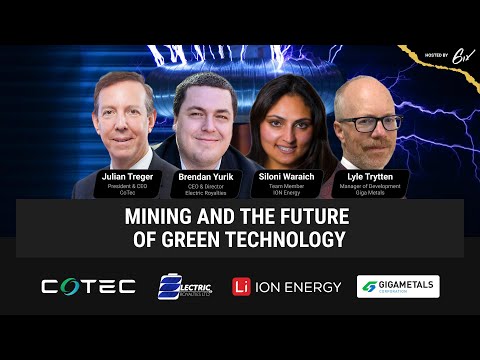
0:07 Hello everyone and welcome to today's panel, Mining and the Future of Green Technology, hosted by 6. The focus of today's discussion is going to be around the minerals critical to the electrification process and the current gap that exists between demand and faltering supply. Today's panel is being recorded and is going to be available in the coming days on six.com for on-demand viewing. I encourage you as the audience to ask questions of our panel today using the Q&A chat found on the right hand side of your screen at any time. With that, let's introduce our speakers for today. From Kotech Resources, we have President and CEO Julian Traeger. From Electric Royalties, CEO and Director Brendan Uric. From Giga Metals, Manager of Development Lyle Triton. And from Ion Energy, we have Saloni Worej, Investor Relations. So now that we're all introduced and settled, I'd love to dive in on it.
0:56 Environmental movements, at least for the most part, remain steadfast in their opposition to the extractive industry. Now, I think it's fair to say everyone in this room believes that their work is to some degree positively impacting the transition to green energy. So with that in mind, how do each of you think the extractive industry can change or has to change how they communicate to influence perception?
1:17 Saloni, we were talking earlier, I'd love it if we could hand things over to you. Thanks so much, Cameron, and thank you to my fellow speakers for inviting Ion Energy to what will hopefully be an invigorating conversation about the future of green technology within mining. As for the underlying theme that we've all been dealing with in the industry for decades around environmental activism, I think there's 2 layers that we have to look at. One is the industry leadership and we see a lot of that, especially here in Canada and globally with ICMM, speaking with confidence.
2:03 We also have the governments showing with their incentivizing that the future is. I think we all here today believe that the mining industry is the enabling industry for a low carbon future between solar, wind, and of course, EVs, which is close to many of our hearts. So on the industry end, I think speaking with confidence and talking about how it is inevitable, we cannot reach the targets that have been established, whether it's by OEMs, whether it's by the government incentivizing. And Moreover, we have to look at consumer demand. And we'll get into that, I think, a bit later around consumer demand. I think locally or as individual businesses,
2:56 you know, funny enough, because, you know, some will say that mining companies or individual businesses are self-serving when they talk about the good that they are doing within their local communities. But the reality is, if you look at something like the trust barometer by Edelman every year. In fact, this year, the results that they showed is that business and employers are more trusted than NGOs, than government. So we, it is incumbent upon us to take the leadership, first starting with our own team as employers and the culture, core culture, the core values that we impart. And then, of course, as our company brand, speaking to investors, speaking to consumers.
3:48 ION Energy has been very proud from the onset, our founding vision in 2017 in Mongolia. We're part of a team, every member of the team has been part of other projects and deals and our sister companies, where local first has been a huge part of our core value. And yes, of course, we are running businesses. So we know that shareholder value is an important part of what we do. But I can tell you that Mongolia is one of the largest percentage wise emerging economies with youth population And in fact, they've been a very activist youth population.
4:34 And anything related to climate change movements and green movements, we see it is the youth pushing, saying we need to do better as a society. So in our talent acquisition, in terms of what we're doing in country and locally, it's about bringing more people into the mining sector with a lot of education and showing that we have the core values that's responsible mining, balancing with shareholder value. Yeah, I would say, don't paint us with the brush of traditional mining because the clean energy metal space, you know, didn't really even exist 10 years ago. And, you know, 80% of the money over the last 10 years has gone into gold. I don't even know where you're mining gold anymore.
5:21 But ultimately, yeah, look, governments are putting a lot of money into this. That Inflation Reduction Act is basically the new U.S. Green energy bill. You had the same thing coming out of Europe. So there's trillions of dollars going into the clean energy metal space. I think the irony is that it probably should have gone into the project side first. It takes 2, 3 years to build out a plant. Your average development timeline is 15 years in the mining space. So I think there's going to be a lot more of a shift from car companies moving downstream. I think the other thing that's really cool is really technology. Every day, this is the most exciting time to be alive, Every day there's a new technology that comes out. I was reading 1 this morning on wind power, where basically they've come up with a new system that might be able to get them to remove rare earth magnets.
6:12 But every single day there's something on the technology side. And this is a space that hasn't had much capital into it. You know, and capital really is going to be a driving force of that technology.
6:23 And you know, now you've got Bezos, whether it be with his AI exploration, you know, for Cobalt up in Ontario there. You got Bill Gates putting money into sorting out how do we extract lithium from clays. You know, and Musk obviously out there, you know, tweeting about nickel and lithium quite a bit. So, you know, that's 3 of the most richest people on the planet starting to shift their attention and their capital towards this sector. So I think, you know, that's definitely going to play a big role. And then I think groups looking for domestic sources of supply. Right now you've got 60% of tin, graphite,
6:57 99% of the manganese for the EV space coming out of China, 60% of Cobalt out of the DRC, about 60% of Nickel out of Indonesia. Countries where the track record on ESG and environmental standards may not be the best, nevermind the security supply, which also be part of that drive, but bringing projects back home where we've got a lot of renewable energy power in Canada. I think that's going to be a trend as well as we move forward. Yeah, and I think you hit 1 thing on the head there, Brandon. The environmental groups that I've spoken to are not opposed to the extractive industries per se. They're exposed, they're really opposed to the sort of business as usual approaches that have led to some pretty significant impacts. We have to recognize that our industry has had negative impacts in the past, will always have some negative impacts with its positive impacts, and we need to find a better way to move forward.
7:49 And doing that here in Canada,
7:51 frankly, you don't have a choice of outweighing your negative impacts because the new environmental approval process, working with the Indigenous communities, getting their consent, you know that it's going, you're going to be held to a very high standard and that's, that's excellent. We're thrilled to be held to that high standard. I think, I mean, from my perspective as COTEC, we're obviously very much in favour of the Green Revolution And speaking to Brendan's points, we are harnessing revolutionary disruptive technologies to achieve that, whether it be through green steel or producing green 3D printed materials or recycling magnets to create rare earths. But I actually think the agenda in this area has really changed in the last year. I mean being in the UK, You know, the cost of net 0 and government policies are all being somewhat reexamined.
8:53 And in Europe, the weaponization of raw materials, you know, the importance of some of the things that we produce for defense, I think is really changing the agenda and the discourse. So I think whilst people still want to get to the green place much as they always did, I mean, clearly with the lights going out, people are now tolerating a slower pace. And I think that will be helpful to our industry as well, because it will give us more time to produce the raw materials, which the world is definitely going to need. Absolutely. Well, thank you all for getting us started strong today. I do have a question for Ion Energy, though. Saloni, earlier this summer, Goldman Sachs stood alone in their prediction that the lithium bull market is over. Spot prices weren't as aggressive in the second half of the year as the first half.
9:48 But what do you think they're going to look like in 2023 and why? Well, far be it for me to say a bully on Goldman Sachs, since I'm not, I don't have a strong capital markets background, but I can tell you that all signs point to quite the contrary.
10:10 Like my peers here, we are very proud of our long-term value proposition at Ion Energy. The writing is on the wall. And as much as all of us spoke to government incentivization, the recent numbers that came out of China are that the consumer demand and adoption of EVs has far exceeded the rate that they thought. You know, many of us have been looking at this in the long term game saying what happens when there are no more government incentives.
10:46 But I think that the trends and the numbers will show the opposite. Benchmark Mineral Intelligence came out recently saying that there need to be at least 300 new lithium mines coming online in the next decade to meet the demand. So we are confident, especially with what we're doing, being the first and only lithium brine explorer just steps away from the largest battery manufacturer. We can't move away from that reality in North America, frankly, that 79% of batteries are still being manufactured in China. That's at our doorstep. And when we're talking about carbon footprints, you know, if you do the math, shipping from other areas versus taking rail a few kilometers away, that's part of what we're proud of, will be our sustainability, you know, long term value proposition as well.
11:52 So, yeah, so we're heavy lithium too. So we got quite a bit of lithium in our portfolio. Lithium prices were up like 4 or 500 percent last year, over the last 18 months. So the biggest average annual increase in gold price over the last 10 years have been 25 percent. So it's been a whole different beast. Now you know there's a lot of lithium on the planet. You know there's a lot of lithium in place in Nevada. But we still never commercially extracted that. You know so we'll see. I think lithium is going to have a good day. Goldman Sachs and the investment banks. I mean, look,
12:21 those guys price predictions are more wrong than the weatherman. You know, so you can go back and look every time that they've made a call. They usually are buying in and trying to find a buy opportunity to get into that sector. So, you know, I wouldn't I wouldn't necessarily hold them up as a candle that lithium is going down the hill. You know, ultimately, lithium has gone crazy this year, the last kind of 18 months. So you'd expect, you know, that can't continue forever. But, you know, it's going to take them a lot longer to bring on supply,
12:48 as always, than people predict. Absolutely. And I mean, one last note, the reality is we've all been dealing with it. The markets are soft. It has nothing to do with which commodity. It has to do with so many other, you know, global themes that unfortunately we're all dealing with, both as businesses and as consumers. And I'll say Mongolia is landlocked between Russia and China. So we're certainly dealing with that reality, whether it's the geopolitical or the general global theme around inflation.
13:24 No, absolutely. Lyle, I have a question for you and Giga Metals. You recently got Mitsubishi on board for the Turnagain project in BC. Mitsubishi is heavily involved in many ESG causes and to some degree on the forefront of green technology in transit. What does the partnership mean for Giga and what impact does it have on your business? Well, I mean, the partnership is huge and this isn't something that happens quickly or easily. We've been talking with Mitsubishi for a very long time and they've got a very long and thorough due diligence process. We're pleased that we passed it and we are representing their first foray into the Nickel business. They've got a lot of JVs in the mining business and Copper and Iron ore and Aluminum and other things, but they've never done Nickel before and they've chosen us to be their partner. And that is a vote of confidence in how we've approached this project.
14:16 We've been looking at it for the last 3 years with a conservative eye to what does this need to be to actually be a successful operation, not trying to take the most bullish possible approach. And I think They've appreciated that we've presented a realistic case and we're now going to work forward through our engineering and metallurgical studies to improve that. They can bring a lot to the table. They're not just equity investors in the project, but they have expertise. They have
14:47 the capacity to help bring in other joint venture partners. They're big in Canada in a number of different ways and in British Columbia, they've got government relations expertise. So those are all really important factors beyond just having the money available, which as a junior, you always need money. That's, you know, that kind of goes without saying, but to bring in the partnership and all the other facets that they can bring to us, it's huge. It's absolutely huge. Last week, we had them up to site up at Turnagain, and It was a really insightful visit because we had a lot of discussions on the sustainability side.
15:21 They work with environmental NGOs directly from their sustainability group. They pose us questions and it's our job to be able to answer them as to how this project will succeed and be a very responsible mining project. They're not going to be in it if they don't believe that's true. And when you look at the areas that they're not invested in the Nickel business, I think you can see that.
15:45 There's not a great amount of options out there, but congratulations. That is a big step forward for you guys. Absolutely. Absolutely. And I have some questions for Coach and Electric Royals, both of you. As companies heavily invested in the thesis of transition to green technology, wondering what drove this thesis and has anything in the last year changed or updated your belief in the profitability of this sector? I mean, Brendan, if I go first, I mean, I think in a way the resurgence of coal is increasing the urgency for a greener solution sooner rather than later. I think everybody's tolerating an enormous increase in carbon emissions this year and possibly next year as the war continues. But clearly, the dependence upon oil and gas, and I do this always from a European perspective, which may be different to yours, is increasing the urgency to find green solutions.
16:51 The governments in Europe are moving fast back to nuclear, they're moving to hydrogen, they're moving to solar. So whilst in the short term there's an acceptance that there's the need for the lights to stay on and to do what's necessary, I think medium term there's much more urgency, first of all, to wean us off the dependence upon Russia for oil and gas, and also to sort of still get to the 0 emission targets,
17:27 which will mean that there has to be much, much more focus and government support to get there faster. So if anything, the agenda which we're pursuing, which is that disruptive technologies, recycling, reprocessing, are all going to be major contributors to the requirements to get there.
17:52 That, I think, has been enhanced, if anything, by the events of the last sort of 9 months or so. Yeah, and I would fully agree. I mean, you do look at the Inflation Reduction Act in the U.S. That's a ton of money that's going in to the green energy space. You look at the European Green New Green Energy deal. That's a ton of money that's going into the space. The G7 just put another 600 billion. So there's a huge amount of money, I think, coming to that space and it's definitely accelerated it. I think also, you know, there's definitely more pressure. I mean, you look around the world, it's really hard to deny that climate change is happening. Here in Vancouver, we've got new words now, atmospheric river, never heard of that before until recently. But you look at the flooding in Pakistan, you look at the droughts in the Midwest US and on the Rhine just this past summer here, it's pretty scary.
18:49 And I think that also is kind of driving a little bit more of a push and urgency to things as we move forward. But yeah, no, look, I think the next 10-years is going to be, this will be the space to be. You're talking about an industry that basically didn't exist 10 years ago. And, you know, the next 10, 20 years, we're going to be essentially replacing, you know, the oil and gas and coal sectors
19:12 out. And, you know, they're very big sectors. So, you know, from not existing to, you know, cannibalizing that, you know, it's going to be an exciting time for sure. And I think they're rather... Sorry, carry on, Salone. I was just going to jump in and say, to piggyback on Brendan's comments, I think that we're going to be on the leading edge as battery metals, as green metals,
19:36 not only for the mining sector to be the solution, to be the enabler of the next phase of our world, but also on the sustainability, the tech, the innovation. We're going to be on the ground up of showing, I believe, other commodities and other mining entities that it can be done responsibly Because all eyes will be on us for the next decade. There's no doubt about that.
20:07 Certainly the transition that we've seen in the US in the last little while, from the discussion about ally shoring to now the Inflation Reduction Act, to starting to really think about the whole supply chain and not just building more factories is really impactful for countries that do qualify under that free trade provision and for other countries to really look at how they can get in on the goods and improve their practices so that they can become, you know, favoured partners
20:39 of North America and Western Europe. I think in addition to the demand for electrification and green, the collapse of globalization and the creation of these competing supply chains, which are much, much more inefficient, will also add to the demand.
20:57 Last, you're going to get new categories. So China can 3D print hypersonic rockets and missiles now. The US cannot. They can't produce those missiles and they can't 3D print them. So there's gonna be a lot of competition between different nations to get the raw materials that are necessary to maintain their security.
21:26 Funny thing is everybody's 15 years behind China. They've already been going around and picking up assets all over the world. But better late than never, I guess. Right. Yeah, absolutely. It's certainly an exciting space, as you guys have been consistently reiterating, and it'll be topical only more and more going into the future. But now we have the fun question. I'm going to drag out your biases here, but I want to ask each of you the commodity that you're most excited about the growth of in Q4 this year, as well as in 2023. Well, if I can jump in here, Cameron, I'm not a huge fan of the question because I think longer term than 2023, but I think what we're seeing, as Julian has brought out with the crisis in Europe that we're seeing with the war and the energy crisis that with companies starting to really focus a lot more on the breadth of green energy portfolios, we're starting to see a lot more talk about geothermal, a lot more talk about nuclear, a lot more talk about a variety of things. And that's going to bring some metals to the fore, some uses that we haven't really been talking about. I'm a Nickel bull.
22:38 I've been in the business a long time. Nickel, we've been talking about batteries for the last little while. Well, that's great, but it's also about stainless steel. It's also about the need for that in geothermal developments, in wind turbines for northern environments, and all
22:55 these other applications in the green energy technology. And of course, that brings us copper as sort of the forefront mineral in the green transition, because if we're going to electrify everything, we have to move that electricity and that's going to be copper or aluminum. Those are your choices. You've got to use them. And so those 2 minerals are poised for some big gains in the next while too, I think. Yeah, well, the cool thing is, look, I mean, if you go back 100 years, I think the population is around 1 billion people.
23:25 We didn't have computers, we didn't have cell phones. Fast forward, it's the 21st century, We're over 7 billion people on this planet. Basically everybody needs electricity. So you need Copper, you need these clean energy metals for all the technologies that we have today. For me, I think probably Copper would be my best bet, short, long term. I think Zinc in the short term, just because you've had so many smelters get shut down over in Europe, that's taken a lot of supply off. But you know, Copper, we've been scouring the planet to find every piece of Copper that we can. We're mining out all the best deposits right now, you know, today. And we're going to need a lot more Copper as the world moves forward, you know, in this 21st century, you know, in the world that we live today. So I think all these metals have a very bright future, to be honest.
24:13 You know, I think there's just such a lack of attention, you know, such a lack of capital, and you can't really overcome that period of underinvestment.
24:21 But copper long term, just because we've already been looking for all the best deposits, I think it's definitely going to have a good day here over the next 5, 10, 15 years. I know people are expecting me to say lithium, but on a very personal note, because you said 2023. And I agree with Lyle that is short term in my view versus our company outlooks. And I'm a personal fan of gold still, it is original money, it is tried tested in the current economic environment. There's a reason why central banks have been scrambling for gold supply
25:04 at record volume, especially in the first half of this year. And not to be repetitive in terms of what Brendan said, on a more professional and from ION's perspective, I have a soft spot for copper for all the reasons that Brendan said. And of course, we're seeing all of the majors have come out publicly saying in the last 18 months that they're focusing all of their energy resources on copper versus their other commodities. Bright future, especially
25:45 in the perspective of what we're discussing today, which is green technology. And lastly, Ion has a strategic JV agreement with the Ranjin Resources. And we just came out with a significant new copper nickel discovery, the victory discovery. So very proud of that announcement.
26:06 So from my perspective, we don't really look at the short term. And honestly, who would have forecast, you know, thermal coal to be the best performing material for 2023, you know, far exceeding the value
26:21 of coking coal, which has never been seen before. So, it's a mug's game. I mean, we are bullish about battery materials because there is this 250 giga factories or so being built and they will need supply. But I also wouldn't underestimate human ingenuity in creating new things. We have seen, you know, without technology bias, a product which fuses graphene and alumina to create a new alloy which mimics copper and can do so in a much lighter form that has a lot of the conductivity and special features that have only produced it in a few hundred grams so far. But things will come from left field, but definitely the space of greening the world and helping to supply strategic resources is gonna be a very exciting one for decades to come.
27:18 No, absolutely. Looking at a couple of questions that have already come in for the upcoming Q&A session. Let's put our futurist hats on now at this point. But what do each of you see as being the biggest upcoming shift in technology and technology trends? And how do you think it's going to affect the commodity sector?
27:37 I think around, if I may jump in to piggyback on some of the stuff that we've said, I think that we are going to continue to be on the ground up. We're going to be on the leading edge, all of the battery metals companies of any innovation technology to show that mining can happen sustainably. Every article that you see related to our commodities is around recycling, the circular economy, you know, battery production scrap is going to be the main source of recycling. And from an ion perspective, We've publicly talked about DLE, direct lithium extraction, and
28:24 there are some great things happening in Argentina that point to the viability of that in the long term for sustainably mining lithium brine and ensuring that the water supply is not impacted long term in the local community which is very important to us. Yeah I mean we weren't optimizing things you know over the last 40-50 years there was a you know a few Lithium mines and they did it the way that worked. You know, there wasn't really a capital incentive or, you know, outside incentive to really change things. You know, it worked and that's, you know, that was enough. But I think technology is going to find a way. I think there's going to be a lot of exciting technology that comes out. There's a lot more money that's coming in the space. Bill Gates is putting a lot of money into a company that's working out Lithium extraction.
29:13 I think that that's going to continue to be the trend. And I think that's what's exciting. Ultimately, we make 1 bet and that's that the world's always going to try and use cheaper metal if they can. I think that's always just going to be a push because there's a lot of people on this planet. There's a lot of demand out there that's going to be coming. And it's going to be a scramble. I think to fix it with incoming technologies, helping shore up how much we need and what metals, but ultimately we're going to need a lot more mines coming into development. I think Julian said 250 Gigafactories. That's 10 times more than the amount of clean energy mines that are coming into construction right now. So there's definitely going to be a misbalance there. Like I said, it's 3-4 years to build a plant, but it's an average 15-year development timeline to build a mine. So I think that's going to be a real overriding theme. And I think that's going to keep pricing strong really across the board for these metals over the next 5-10 years.
30:15 Yeah, so one of the areas that I'm really excited about, you know, the mining space is slow to adopt new processing technologies. We're very conservative. You know, you don't want to bet billions on something that doesn't work out, which has happened in the nickel space from time to time. I'm looking forward to a return to hydrometallurgy on the Nickel sulfide space in North America. If we're going to bring on 300,000t a year of Nickel capacity in North America, it's not going to be by building 3 times as many nickel smelters as we have today in Ontario. It's going to be by other newer, better, cleaner technologies. Nickel pressure hydrometallurgy was pioneered here in Canada back in the 1950s on nickel concentrates. It hasn't seen a lot of adoption lately until Ballet did at Long Harbor.
31:05 There are really good ways to deal with good nickel sulfide concentrates, good clean concentrates that don't have the environmental impact that smelters have historically had. And I think you're going to see that being the way of the future for development in our space. And it will make the products that the battery metals industry needs in short, simple supply chains. And that's going to be fundamentally important here in North America. Yeah, and then I think that's absolutely true. And then, you know, from our perspective, I mean, just talking to Brendan's point, I think the recycling, and Sloane mentioned it too, the recycling, the reprocessing, the circular economy is the way in which the world can extract commodities much more rapidly than building new mines.
31:55 But that can't fill the plug. But I think it will be an area of enormous growth in the next 05:10 years. And then quite a few technologies we're looking at are like enhancement technologies. So we've seen a technology which can like enhance the fertilizers by 10x, which helps as well because fertilizers aren't so green, or something which can enhance the effectiveness of concrete and make the life of concrete much longer. So I think there will be a lot of those technologies as well which you know allow us to use the things that we have much more efficiently going forward so I think it's a very very interesting and exciting space and human ingenuity should not be underestimated.
32:50 I'd agree. Well, listen, we just passed the halfway mark a few minutes ago, guys. So I think now's the great opportunity to enter into our Q&A session when we are stacking up at this point. I'd like to remind everyone in the audience that you can ask your questions if you'd like in the Q&A tab found on the right hand side of your screen. But let's dive right in, folks. First question, the incumbent cathode materials process currently produces a significant sulfate waste stream. So with the ramping up of factories in North America and Europe, do you think that the waste stream is going to be an issue? And how can this be addressed with new technologies to processing without waste streams to meet environmental standards? Can I jump in on this, Cameron? Go ahead. So, you know, It's true, but it's a feature of the way that supply chains are currently built and they don't have to be built that way. We've been talking to Natural Resources Canada and others about how you might build a supply chain that gets away from that.
33:45 And it's about where you choose to do certain processing steps. So, for example, for tournigain, we're going to make a nickel concentrate at the mine. We could upgrade that at the mine site to a better product, a mixed hydroxide, and ship that somewhere else to get refined into the final battery chemicals. But the problem is they then have to add a bunch of sulfuric acid and then they have to make that sodium sulfate waste stream. If you integrate units, you can actually take a sulfide concentrate like we have all the way through to the battery metals without making all of that sulfate as the byproduct along the way in multiple steps. And you can simplify it and reduce that amount of waste through being more selective in where you choose to do which processing steps and how you integrate them. And that's really where the efficiency, both the capital efficiency, the operating efficiency and the reagent use and waste efficiency comes into play is by, you know, really synchronizing that entire supply chain to do the right things at the right places.
34:49 Oh, absolutely. Thank you for that. No one else wants to touch on that. We'll go to the next question. Well, I think it's just a great example of, you know, how we haven't really optimized, you know, putting your mind in production is pretty tough. If you looked at the groups that have done it historically, these are multinational companies. You go in and you've got a certain amount of capital and you scraped it together. You have systems like this where it was more about capital allocation decision, and being able to get it done than anything else. I think there's lots of room for improvement and, you know, as, you know, like Laos, they've got Mitsubishi now, you know, those kind of partners coming down and helping out, I think is going to be a real critical part of, you know, mining for the future here. Absolutely.
35:36 This is a question about sort of geopolitics and also how it deals with mining in the future green technology. But history has shown that war is unavoidable and with winter approaching in the northern hemisphere, there's a scramble to secure fossil fuel energy. So the question is to the group, how likely is society going to move away from fossil fuels in the next 100 years when, during conflict, everyone seems to default back to fossil fuel? I mean, that's just a function of where we are in the evolution of different forms of energy. I think in 10 years' time, the global dependence upon fossil fuel will be significantly reduced and Gradually it will be scaled back so that it may not be part of the energy equation at all.
36:25 I really don't believe that people will be fighting over oil in 100 years time. They may be fighting over lithium or copper, but it won't be about oil and gas. Yeah, I think the goal is, you know, kind of 100 years out, we're closed loop, hopefully. But, you know, it takes time, right? I mean, you have the entire global infrastructure is really set up around supplying energy via fossil fuels. And so you don't just update that overnight. I think you're always going to have more of a last gas or just like in coal, before oil and gas as well, where there's a longer period of time than you think. It's going to still be around. But yeah, to Julian's point, 100 years from now, I do not think the world is going to be fighting over oil and gas like they are today in the Middle East.
37:15 Yeah, I think the point that a lot of people miss, we hear a lot of stuff against the mining industry because of all the waste and everything else. But once you've built that renewable energy infrastructure, you've got it and you're not buying oil to burn every day, buying coal to burn every day to get your energy. So your global need for resources actually goes down over time because you're generating your energy from capital infrastructure that's in place. People aren't fighting about the steel to build an oil refinery. They're fighting about the oil supply. Once you've got the minerals in place and you've got that renewable energy infrastructure, that decreases global tensions, not increases. Absolutely. Thank you for that. Matt has a question about lithium in general, but he says that the European Commission is supposed to declare lithium, lithium carbonate, lithium hydroxide, and lithium chloride as a category 1A toxin, which is a reproductive toxin, by the end of this year.
38:13 How does this impact lithium mining and subsequent battery manufacturing in the long term? Well, our lithium would be for batteries. So you shouldn't be eating it. Like, you know, maybe they've used it for medicine in the past. I don't necessarily know if it would impact, but that's news to me. I know it's listed as one of their critical minerals. They have huge critical minerals lists for Europe and the US. I know Lithium is already on there, but I don't know how relevant it would be to Lithium as a battery metal. There's a lot of metals that you wouldn't want to go out and eat. I'm sure it would be harmful for reproduction. So fair enough. So I know you're in the Lithium business and you've probably got a view on this, but we went through this for Cobalt a few years ago.
39:02 It was declared category 1B and there was a lot of debate about whether Cobalt would get phased out in the European Union. But the issue is that it's not there in the consumer end, right? It's a manufacturing ingredient. It's done in controlled environments where you use occupational health and safety to manage it, rather than the public health tools that they're really trying to get at with the breach regulations and stuff like that. So I don't think it's a big deal, as Brendan said, and I think there's a long future for lithium ion batteries in the EU. You got hundreds of billions of dollars building plants. You know, that's the thing, right? Once you've spent that type of money to commercialize something, you know, it's going to be around for, you know, a period of time because, you know, They took a bet to build those, they got to make money, they got to pay that back. So once they've got that type of investment and you know, what technology is going to be around, you know, 10, 15 years at least.
39:55 But lithium's got a bright future. Absolutely, absolutely. I'm not going to add much more. I'm not going to pretend to be the expert on some of the on the science ends of things and the geology. But the reality is, you know, some would say that we're an overregulated world. And with a question like this, that's actually to our favor, and that it will be used properly for the right reasons. And once again, governments can't suck and blow. As Brendan said, EU has also listed lithium as one of the top critical minerals. No, absolutely. I appreciate it. Next question, To what extent is water scarcity a significant risk regarding the extraction of green metals, particularly in countries with inadequate infrastructure?
40:43 What technologies are currently being developed in the mining industry to minimize water usage without compromising the environment and communities? I mean there are lots of technologies which are not using water or recycling water. Less heat and less water usage are the commonalities that we see in the technologies, as well as much cheaper and more modular and more flexible. So I think that's a general thematic. I mean, we've already seen, ultimately, there's going to be no more tailing dams. I mean, We're going to have dry stack tailings. There are ways that have been patented now of creating different metals without using water. I know Vale has one.
41:33 That's definitely a theme. I think the world is very cognizant of water scarcity as well as carbon emissions. And they have almost equal prominence in the sector. Yeah. I think water scarcity generally is an issue, whether it be for drinking or just general use, forgetting mining of clean energy metals. But I think it's definitely an issue. Something definitely needs to be thought about. It's probably one of the chief concerns about where you can build an operation, how's it going to work? And to Julian's point, I think that's where a lot of technologies, a lot of commonality would be about using less water. That process they're working on for Lithium in Argentina, that's definitely a big part of it. But water scarcity, yeah, it's definitely gonna be an issue. You look at Chile and Argentina as well, where a lot of these mines are, water is especially tight. So it's gonna be a continued thing for a long time to come.
42:33 It is, and once again, not to be too repetitive, but I did state earlier that we've already been on record, even when we're considered a very early stage explorer, that DLE is in our future. We are strong proponents of that technological advance. Also because we worked with locals and all levels of government right from the very beginning and in order to have that trust and confidence that we're going to leave our community, if not the same, better than when we first arrived to our project. And the reality is, putting water back, brine-less water back into the water supply and having very minimal impact, which has been tested and is now working towards commercial viability, that's really important to us locally. And in fact, one of our strong long-time partnerships has been with the Mongolian University of Science and Technology.
43:42 So to kind of come full circle in terms of what we said around our core values is the doing what's right locally and embracing new technology and innovation, but also working to ensure that Mongolian talent and and that we're bringing world-class processes and technology in-country, and making sure that the entire jurisdiction is looking at a more sustainable way of mining. Absolutely. I appreciate all the great context, guys. The next question, is Uranium classified and accepted as green in the current context when the world is crawling to net 0?
44:27 And maybe more to you guys, but if the nuclear waste could be efficiently utilized to eliminate the negative impact, how would that impact other mainstream green metals in terms of demand, do you think? Well, so we cover pretty much all the clean energy metals. We don't do uranium. It could be classified as cleaner than the alternatives. For me personally, it's a bit different. There's some danger to Uranium and nuclear power that you don't necessarily find from a windmill, a wind turbine. And so we kind of stay away from it. But it's a tough one. There's definitely an argument to be made for both sides.
45:15 Maybe the technology will come a long ways and it'll be different. But yeah, it's a tough one. I mean, I think, again, the view of uranium has completely changed this year because of necessity. And we now see Japan, Germany, the UK all really trying to ramp up their nuclear generation capability. The fact that the French nuclear reactors aren't operating has been seen as a sort of real tragedy because there's not enough water or whatever. So I think the view of uranium has changed and we've seen the price of uranium going up accordingly and we have seen some technologies but they're in the very early phases which could liberate energy from nuclear waste. And obviously if that was to happen in a commercialized scale, then that could be a potential game changer for reducing dependence upon oil and gas.
46:18 Yeah, certainly I think we have to be clear that we're always going to have a need for baseload power. And over the next 50 years, I think nuclear is going to play a huge role in that. Hydroelectric is great. Geothermal is good, but there's not nearly enough of it in most of the world developed yet, and it's going to take time to do it. Nuclear is going to be a significant feature for quite a long time to come, if not the foreseeable future, and it's going to be an important part of our overall energy mix. And that's okay, right? It just needs to be managed and we need to put the investment in to make sure that that's done. But Germany had this debate this year and Japan has had the debate over the last 3 years as Julian said, and they're bringing on 17 of their nuclear plants in Japan over the next year that they've had shut down for several years.
47:08 They voted, and their vote is that it's a technology that they need to have. Absolutely. Pete has a question for, well, the panelists, obviously. He wants to know if you feel pressure to make more detailed public disclosures on your own scope, 1, 2 and 3 emissions. Certainly this is a discussion that's very live for us at Giga Metals because we're focused on being a very low carbon producer. In the exploration phase where the junior miners are, the scope 1, 2 and 3 emissions are generally pretty small, right? It's not like we're an established mining company at this point. So it isn't as relevant as it will be in the long term. But in the long term, it's absolutely critical.
47:57 Life cycle analysis to really understand scope 3 is a big deal and we should be doing it, adopting it as a standard across the industry and not just focusing on scope 1 or scope 1 and 2. We need to cover the entire aspect. And those scope 3 emissions will be very surprising for some companies when they don't realize the impact that some of their commodity reagents have. Explosives, steel for grinding media, other things, chemical reagents, those all can carry significant inputs and we need to be aware of them and work to minimize them. I mean, as a royalty company, our emissions are essentially 0. You know, we don't, we're not responsible for development. That's all done by the operators. You know, so for us, it's really about choosing the teams up front that we trust that have that plan in place.
48:51 But even so, that said, we are actually going to be working to give some more disclosure on that stuff as we move forward. So even though it's really would play a very, very small part in a world economy, we are planning to do that. I think that just speaks to the continued trend that you're going to see on that side of things. Absolutely. ION is definitely early stages, to echo what Lyle said, but philosophically, how I kicked off, you know, what I've, today's session was around our core values as a company, as a team. We've always been committed to transparency with our shareholders, with our local government, and anyone that has heard me speak in the past.
49:41 I am a little bit of a governance nerd and have spoken to sustainability best practices, And that's part of the reason why I'm proud to be part of this team, knowing that it is core part of our ethos, as our CEO says, and always has been in whatever project we're working on. That being said on a very operational level, when we get to the point, once again, we're very proud to be already supporting new technologies when the time arrives to make sure that we leave little environmental impact to our local community through the DLE technology, and also no shipping costs, hopefully, when it comes from an environmental perspective, because we won't be using the usual concentration being shipped to another area.
50:36 We're mere kilometers once again by rail, so we're very cognizant of making sure that our carbon footprint will be low. We're also looking at options around giving back to the grid from whatever our operational vision will be in the future. And then lastly, from Kotex's perspective, very much like Brendan's company, we're an investment business, so we have a very low carbon footprint. But what I wanted to correct was the word pressure. For our technologies, we don't feel pressure. We rush and embrace the opportunity to show how green our technologies are. You know, our cold acclumeration technology has a 2% carbon footprint versus the current standard way of creating induration pellets.
51:34 So for us, it's actually something we are embracing. It's something we can't do fast enough to show investors how revolutionary, how disruptive these technologies are and what the implications are for the global carbon footprint. Oh, absolutely. Well, guys, we have just under 10 minutes remaining with our time and I have the opportunity, so I'm going to take it. That looks like all the questions you received from the audience, but I'd like to give you each the opportunity to just talk about some of the upcoming catalysts, which with each of your companies, I know in the backstage before we went live today, I sort of said, we'll keep it tight, but I'd really like to offer you guys sort of 90 seconds, you know, a real fast elevator pitch each, before we wrap up the day.
52:21 Whoever would like to take the reins first? I'll go. We're Electric Royalties. We've got a portfolio of 20 royalties right now. We do have cash flow that's coming in from our producing Zinc Royalty in the US. We're diversified across all clean energy metals, really targeting those deposits in North America, Europe and Australia that could fit to be a domestic source of supply of these metals. And we've got catalysts, we've had over 400M raised over the last 18-months by operators that's going into our assets. We should have several more assets coming into production over the next 18 to 24-months. And catalysts are coming every day. We've had, you know, probably 30 updates over 12 assets, I think, around that just this year alone. So, you know, stay tuned. We had some news this morning. You know, another asset, Medium Associated, put it out of PEA, it's going to pass about $750,000, 1.5 million a year.
53:20 That's probably about royalty 10 or 11 on the depth chart. So check us out. Ticker is ELEC. Definitely undervalued today. So that's for me. Appreciate it, Brendan. I mean, I don't know if I'll sound as exciting and as excited as Brendan. It's hard to top that. But I am very excited and the ION team is extremely excited because we're at the perfect phase where everything is a catalyst that's coming out. We have already identified, I mean, first of all, we are the first mover. We are the largest 1st lithium brine explorer developer in Mongolia, near doorsteps to the largest consumer base and manufacturer.
54:07 We have over 110,000 hectares of prospective license territory and entered into the JV agreement with Aranjan Resources. You heard about our copper discovery on one of those licenses. In our early exploration and drilling results, we've already seen the highest grade ever reported in lithium brine within Mongolia. And our CEO will be on a site visit in less than 2 weeks. And we're getting very close to a resource indication, so it couldn't get any more exciting. And we're in a jurisdiction that is still untapped, very much an emerging economy. And I think that the recent announcement from Rio Tinto and the negotiations, money talks, the shareholder values, $3.3 billion shows to 100 year mine life, shows that Mongolia is the place to be for quite a while.
55:13 All right, thanks, Solana, That is exciting. You go next, Lar. So just really quickly, as you progress a project, the scale of Turnagain with 1.1 billion tons in the mine plan and the PEA, every step gets harder and more diligent as you try and bring this to a real mine. But now that we're launching the Free Feasibility Study, we expect to see that wrapping up in Q2 of next year. It's going to be a big effort for us. Metallurgy, engineering, lots of different aspects. But as we bring that resource further and further forward, cement our plans, get ready to enter into an EA, and really make it more obvious how we're going to bring this forward, I think that's all going to be excellent news for Giga. And we'll be looking to further diversify our partnership structure as we go through that Prefeasibility Study and bring that out to market. And eventually, this will need another partner or 2 to bring this on whether it's you know a mining company an OEM something like that a couple of those and and we'll look forward to eventually having the next nickel mine in Canada.
56:29 Awesome and over to you Julian. Yeah I mean I'm super excited about Kotech because I think our sector hasn't seen the disruption that other sectors have seen. There's no Amazon or Tesla. And I think using super green disruptive technologies, which are scalable, have high margins and widespread applicability, we can create a challenger to the existing majors. And that's the long-term aim. But in the short-term, using the expertise of people like Tom Albanese who ran Rio's on our board. We have a number of super exciting technologies each one of which could be worth 1 billion dollars. We don't own all of them but we own significant stakes in them. And also what we're interested in doing is taking those technologies and applying them to assets. So we now own an iron ore reprocessing facility in Minnesota which has over 1 billion tons of iron ore which is using these technologies to create a super green product, a DRI pellet product and an EIF pellet product for the US.
57:35 And you'll see more catalysts as we announce new technologies coming forward. But there's a huge opportunity here. I'm absolutely excited to invest in it and dedicate the next decade of my life to daylighting the possibility of what's here and helping the world in the process. Absolutely. Well, Julian Saloni, Brendan Lyle, I want to thank you so much for coming on today and going through a great conversation and a really interesting Q&A. I of course also want to thank everyone that joined us, especially those who asked questions. But without folks, That is all we have for today. Again, thank you all for joining us. I hope you all have a good rest of your day and rest of your week. Cheers.