Transcript
Automated transcript · Written by software from the replay's audio. It can mishear names and figures; the replay is the record.
0:00 Awesome. Thrilled today to have a chance to sit down with Nucor Gold's President and CEO, Luke Alexander. How are you today, Luke? Yeah, I'm doing well, Romeo. Nice to see you again. Awesome. Now, before we get into your work history and New Core Gold's projects, etc., I would love to, I honestly don't know, to learn a little bit more about the Luke Alexander origin story, as it were. So I'm curious, where'd you grow up?
0:29 Well, I guess I've lived all over Canada. I was born in Nova Scotia, grew up in Montreal, my formidable years, then lived out west and then lived in Toronto and lived in London for 12 years and now back in Vancouver. So I've kind of lived in a lot of different places. That's fun. There are certainly worse places to do an adolescence in Montreal.
0:53 Yeah, I know. Montreal is a great city. And yeah, I mean, obviously, I was fortunate to be able to learn French while I lived there. And then from there I have lived all over the world. So yeah, real fortunate from that perspective. That's great. And Otto, you learned French too. It's a regional thing. But from what I can see, you've been involved in capital markets since at least 2003, I think at least that long. So over the last 20 years, I'm really curious your perspective on what you think has changed the most in Canadian investing, how much the landscape changed.
1:28 Yeah, I mean, so again, my background is, as you highlighted, I spent 20 years on the investment banking side of the business, as in Toronto. I lived in London for 12 years, covering all the big global natural resource funds out of the UK and Europe. And these were primarily institutional investors.
1:51 And I guess in the last probably 10 years, and there's been a number of kind of, you know, charts that have been circulating in the last few months on this, and I'd be happy for any of the viewers if they want to reach out to talk about this in more detail we can. But there's been a real exodus of money out of the mining sector. So, you know, a number of the dedicated funds that there were 10 years ago who were focused on the sector have contracted and become
2:25 much smaller pools of capital than they were a number of years ago And that goes for the global funds that are out there, as well as a number of the funds based in Canada. We've seen a real contraction in terms of dedicated money to the sector. So as a result of that, you end up seeing the institutional investors who are still primarily focused and dedicated to the mining sector. They're being much more targeted in terms of the investments that they're making and really looking at projects with big district scale exploration upside that are backed by strong management teams. Those are a couple of things that we're very fortunate to have at Nucor. And as a result, We still maintain 45% institutional ownership in our share registry today.
3:22 But that's not the norm anymore with that fleet of capital that we've seen move away from the mining sector. So I'd say that's probably the biggest thing that I've seen throughout the last 15 or 20 years is a lot of the regulatory changes that have meant that institutional funds may struggle to invest in smaller cap names and then just that fleet of capital away from the mining sector as a whole.
3:53 That makes sense. It'll be interesting to see what happens when some of that money comes back into the sector, but we'll see when that happens. Well, And I think that's one of the big things. I mean, part of the reason why you can see real parabolic moves in the mining sector is because when you look at it from a global perspective, the mining sector still represents a very small percentage of the overall equity and capital market. So as a result, when you do see
4:27 a movement of capital back into the sector, then you can ultimately see parabolic moves because you've got money that's chasing a very small concentrated number of investments to put that money into. I mean, one of the large institutional investors who I've worked with over the past 20 years and as a major investor in Nucor,
4:51 he said, you know, Luke, stocks can go up 400 percent and they can come down 80 percent for no other reason than market sentiment. And the piece that I would add to that is, yes, market sentiment, but what drives those moves is ultimately that capital that's getting funneled into a very limited number of investments that are available when the sector does become attractive.
5:20 No, it makes sense. And to jump back to your history, so I know you started trading desks across a solid portion, dare I say the majority of Canada's big banks. I know you started your own consulting shop in 2018, focusing on natural resources. Love to know more about that transition and what Park Road Capital, the name of that shop's mission is. Yeah, so again, My career has been focused on the investment banking side of the business. So I helped start up a couple of institutional desks in London, which were primarily focused. They were both Canadian banks and brokers, or actually all 3 of them are Canadian banks and brokers, which were then primarily focused on Canadian equities that were focused on the mining and natural resources sector as a whole.
6:17 When I moved back to Vancouver, I did move back with one of those investment banking, groups and we did start up a office here in Vancouver. And then ultimately went out on my own and started Park Road Capital, which was a consultancy
6:37 and advisory business, you know, focused on a concentrated number of companies within the mining sector that I had worked with very closely, you know, the individuals involved in those companies throughout my career. One of those companies, for example, Caliber Mining is a company that I had worked with Doug Forrester, who's our chairman of Nucor Gold today. Blaine Johnson,
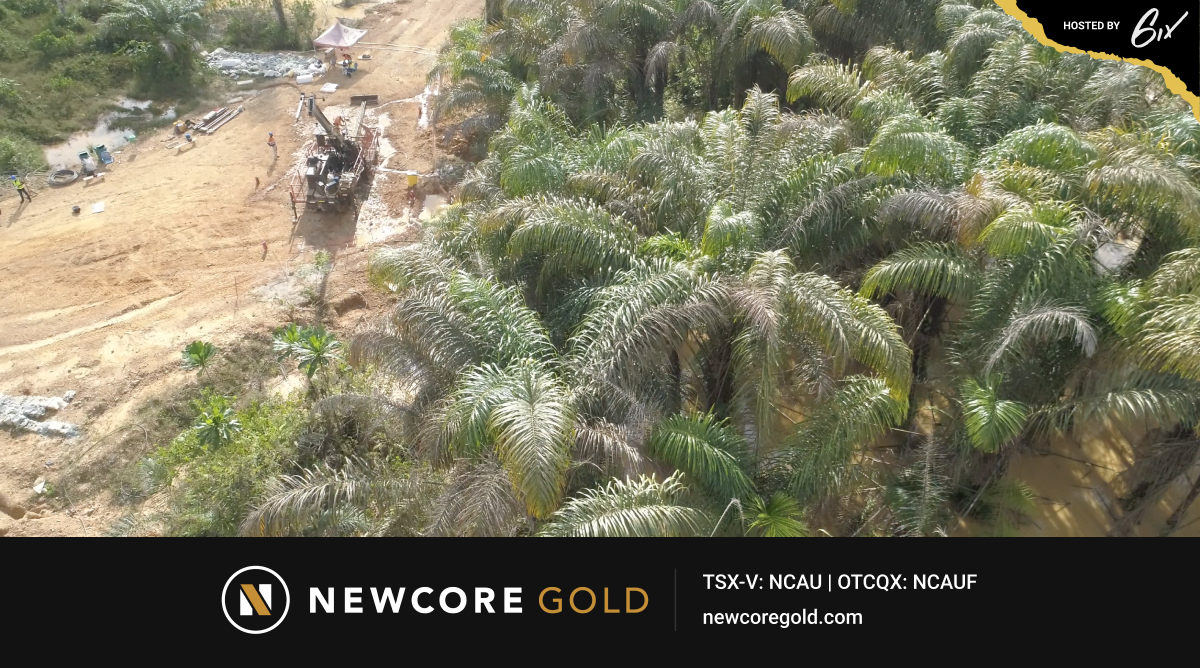
7:09 who is the lead director for Nucor Gold, also involved in Calibre Mining. Prior to that, we were involved in Newmarket Gold. I had worked very closely with them on both of those companies and ultimately we recognized a huge opportunity with our Enchi project in Ghana to ultimately recapitalize the business and aggressively go after exploring and de-risking the overall project. So if you look at what we've completed over the last 4 years, we've completed 95,000 meters of drilling, we've raised almost 40 million dollars which has been invested into the project and into the business. We've put out 3 resource updates
7:57 on the project, so we've grown the overall size of the resource, as well as we've put out a PEA on the project in 2021 and we're in the process of updating that PEA today. So, a big opportunity to really focus on a district scale exploration project in a tier 1 jurisdiction. So I guess, you know, that's how I transitioned from the capital market side of the business to ultimately
8:25 becoming the CEO of Nucor Gold. And it really was on the back of having worked with a number of the individuals who were involved in Nucor today. I appreciate that. It jumps to my next question of kind of zooming into Nucor. I know one interesting thing is you were appointed CEO moments, I think actually literally weeks after COVID-19 was declared a pandemic. So I really appreciate that context on what made you make the jump, but I'm curious how COVID impacted your initial strategy and your role just getting started.
9:04 Yeah, I mean, it was without a doubt an interesting time to be stepping in as CEO of a company. I guess, for me personally, and I think for the overall team, one of the things that we're very fortunate to have is very deep relationships within the entire industry. Then specifically for me throughout the capital markets, whether that's
9:34 with the various investment banks, institutional investors, research analysts, all of those types of groups who are crucial to the success of any company. So the fact that we had those deep relationships and regardless of whether we were meeting in person or virtually, we're able to leverage all of those relationships to pull the fundraising together required to move the project forward, as well as obviously our team in Ghana have been working on this project for the past 12 years. Dan Wilson, our country manager, Greg Smith, our VP exploration, you know, we've got a long history with this project as well as the communities that we ultimately operate in. So, you know, having that history and that ability to, regardless of whether we're able to meet in person or travel, to be able to pull all of that together, you know, was something that we were very fortunate to be able to do, regardless of all of the restrictions
10:42 that there were imposed on, you know, on everybody globally. Interesting to see how everybody dealt with it. And I think Nucor made remarkable moves during that period to make sure it kept you networked. But speaking of your network, I know often when people talk about the role of CEO in junior mining, the network comes up a lot, who they know, right? And across the course of your career, you made enormous number of contacts across Canada, London, various other financial hotspots. What
11:11 do you think is the core value of that network in the role of CEO for Junior Mining? I think trust is probably the biggest thing. I mean, you know, when you work with people over an extended period of time, in my case, a number of the investors who are invested in Nucor today I've known or worked with for the past 15 or 20 years, and worked on a number of different deals and opportunities with them globally. And I think through that whole process of working with anybody over an extended period of time, through good times and bad times, ultimately you gain a professional respect and trust for the individuals that you're ultimately working with. So, you know, if you can look at the investors who invested in Nucor today or the investment banks who we work closely with, you know, that trust has been built up by our entire team from the board right through to, again, the team on the ground in Ghana who have established very deep relationships with the government in Ghana, the various stakeholders, specifically at our project, but also at a federal level. So, from that perspective, those relationships and that trust
12:42 is something that we obviously have built over a long period of time and is probably one of the most important things to ultimately
12:53 push a project forward. That's certainly a trust is a big part of the industry. But I do want to talk about Ghana a bit more because obviously it's a jurisdiction with a lot going for it. It's the safest country in continental Africa. The geology is obviously historically significant. I'm curious what you like most about working in the country. You've been there for quite some time now.
13:13 Yeah, I mean, I think you've touched on a couple of things. Obviously, geologically, 200 million ounces historically discovered. I mean, It's called the Gold Coast for a reason. There's over a thousand years of mining history there. All of those things are crucial for being able to move a project forward. I mean, me personally, you know, I really like the people in Ghana. I've built up a lot of very good relationships with obviously our team in Ghana, but as well as a number of our other stakeholders. And they're all very motivated to see this project become a mine and get built. And when you've got motivated stakeholders, that's one of the crucial elements to ultimately get a project built. And when you compare that to other jurisdictions where it's mainly roadblocks being put up every single time you try to get something done. I mean, that can be very frustrating and disheartening for any management team to constantly constantly be battling to move a project forward.
14:24 Whereas us, one of the biggest questions we get asked every time we're in country or every time we're engaging with you know whether it's local stakeholders or stakeholders at a national level, is when's this project going to be built? Can I get a job with the company? How many ounces are you going to be able to produce? So those are all very
14:51 positive messages and very positive steps for us in terms of moving the project forward. So that's probably the thing that we like the most is that there's a deep history of mining in the country and the government and all stakeholders ultimately want to see more projects being built because they see the huge benefit that it brings to the local communities as well as, you know, Ghana
15:20 as a whole. I think looking for opportunities versus putting up roadblocks is the core of a good jurisdiction for sure. And one thing I know that the role of CEO is something people don't talk about as much is amassing a team. You really have amassed a great team at Nucor. So I'm curious, how did you bring that group together? I know everybody talked about Dan Wilson, but also Greg and Brandon. How did you bring that team together? Yeah. So when we relaunched Nucor, or I guess launched Nucor when I joined as CEO, we were very fortunate that Greg Smith, our VP of exploration, he came and joined at the same time. He's got over 35 years of exploration experience. He's worked on this project on and off for the past 12 years. So he knows it incredibly well, has a very deep understanding of the geology and the district scale opportunity that there is.
16:17 So we're fortunate that he came and joined at the same time as I did, as well as Mal Karwoska. She heads up our business development and investor relations side of the business. She's got a very unique background in the sense that she's worked on the investment banking side of the business, she's worked in private equity for some of the biggest funds out there, as well as she's worked in West Africa for TSX listed companies. So we were fortunate to also have her come and join the team. Brandon Fraser, he joined us about a year ago. We had worked closely with him when he was a consultant. He fell in love with our project so much that he actually wanted to come and join us full time.
17:08 And he bought, you know, a couple million shares when he did join us because he sees that huge upside potential that there is in the project. So I think, you know, having a great project is something that every single one of us on the management team has gone through and done our own due diligence. So that's crucial. And then, you know, being in a jurisdiction that we feel we're safe to operate in, that we know is politically aligned in terms of getting projects built and put into construction. So Those are all key things. And then I think also crucially, we all enjoy working with each other. So we're all able to go out for lunch and dinner or go and do social activities together.
17:57 And we ultimately enjoy each other's company because At the end of the day, you end up spending a lot of time with your colleagues. So being able to enjoy each other's company is, I think, another crucial element to all of that. In terms of Dan Wilson and our team in Ghana, Again, we spend a lot of time in Ghana, so we engage very closely with the team there. And the team in Ghana also sees the huge opportunity that sits in front of us to ultimately put this project into production. A number of them come from the town of Enchi and they recognize the benefits that there are for the local communities for us to put these into production as well.
18:44 Over the last 4 years and over the years before that, we've done a number of social programs within the various communities. The team in Ghana ultimately gets to see firsthand the benefit there is to having an exploration company today operating in a region like Enchi, but the big upside benefit there is once we put this project into production. Sure. I know there's obviously a lot going on this year, but if you could summarize, what should investors be most excited about at Enchi in 2024? So I know a lot of companies and coming out of PDAC earlier this month, you know, there's a number of companies who, from what we understand, have kind of gone into hibernation mode and haven't really been able to actively continue to move their projects forward. So I think one of the things that's really exciting about Nucor and something I've been saying as and when we see the market come back, we should see Nucor hopefully re-rate quicker is the fact that we've continued to do a lot of work on our project.
20:01 So last year we put out an updated resource which grew the overall size of the resource, moved ounces into the indicated category which de-risked those ounces. We've completed a huge amount of network over the last few years. We've completed environmental social baseline study on the project. We're doing condemnation drilling where the pad will ultimately go on our project, hydrological geotech work. All of that work significantly de-risks a project towards construction and that's something I think that really differentiates Nucor is we've continued to be extremely active despite a challenging market and we expect that to get reflected in the stock.
20:50 In terms of this year, some of the focuses for us, the big catalyst that we see in the next couple of months is us putting out an updated PEA. So that'll come out in the first half of this year. As I mentioned, it is going to incorporate a larger overall resource. So we see a slightly larger project that we're going to be able to present, but also all of those de-risking things that we've been doing in a challenging market will also get reflected in that PEA. And we see that as a big de-risking event for the company, as well as a big catalyst for the share price. If we look back at the 2021 PEA at a 1850 Gold price, we were looking at roughly 100,000oz of or about 90,000oz of production over a 10-year mine life. That produced a NPV of $300 million for the project, an after-tax IRR or internal rate of return of 54% and less than a two-year payback. So those are extremely attractive metrics for a project.
22:05 And obviously, all the work we've done since 2021, we think will further support an updated PEA. And hence the reason we see that as a big catalyst for the company. Awesome. Looking forward to seeing what the year's got. Just for your app, just on the, on the personal side, let's say it's a summer Saturday night in Vancouver. What is Luke Alexander up to? Summer Saturday night in Vancouver. I assume you're, you're, you're referring to summer cause it's a nice, warm, hot evening. I'd probably be down at the beach with my with my family you know going for a swim you know playing on the beach having having some pizza or sushi or something along those lines. But yeah, I mean, something along those lines would be a typical sunny Saturday night for me in Vancouver.
23:03 Hard to beat pizza on the beach with the kids. So there you go. Well, thank you