Automated transcript · Written by software from the replay's audio. It can mishear names and figures; the replay is the record.
23:51 a block model was done. It was mineralized right to the edge of it, which is these drill holes right here. So nothing was tested near surface to the east of that along the whole eastern boundary of the main zone, as well as depth. This is all, you can see there's fairly high grade hits all the way to the ends of these holes. And these are up to 400 meters depth, I think, in this one. But they're 45, so it's closer to 300-ish. Oh, yeah, right here. And then this greater than 300 meter vertical depth extent is one of our other main targets below this to try and catch the high grade zone at depth as well as well as the broader envelope of mineralization.
24:46 So these are these black lines are all potential drill holes which are just kind of would be to test these deeper target areas. The southern soil anomaly, it's not... This image makes it seem like it's to the to the west, but it's to the south. It's more of a oblique view along strike of this zone. So it's just a kind of an odd angle for it. Oh, this is a kind of a better compilation overview of everything we were just talking about. Okay, so Everything you just saw in the drilling was this small zone right here, the main mineralized zone.
25:43 Same as before, All of these spheres are the surface soil samples that are greater than 150 ppm copper. So that southern extension target anomaly zone here is that how I was saying that it just appears like it's offset is the southern extension here. Right. And then as you can see, this mag model, rimming the mag over here is another fairly good anomaly zone of copper that we're pretty excited about over there as well. And you can catch the kind of scalloping out of this, the high magnetics through this as well that were the coppers associated so Or you're kind of getting a conjunction of anomalies that are very promising when we know what's here on surface and the grades we're getting here.
26:52 And then you're getting the same 2 and a half kilometer long by, I believe it's, was it 6, yeah, 600 meter copper anomaly up here. Same geophysical target subsurface anomaly. Same with this over here, you're getting the around the edge of this geophysics and over here as well. And it's on strike extension. There's a bit of an offset going on with this later regional here, but this is a strike extension of this zone here. It's been turned a little bit, it looks like. And then the same with over here is another anomaly, which is everything's been, is untested really. So this is that kind of just really reconnaissance terraspec survey that we did. There's very few samples.
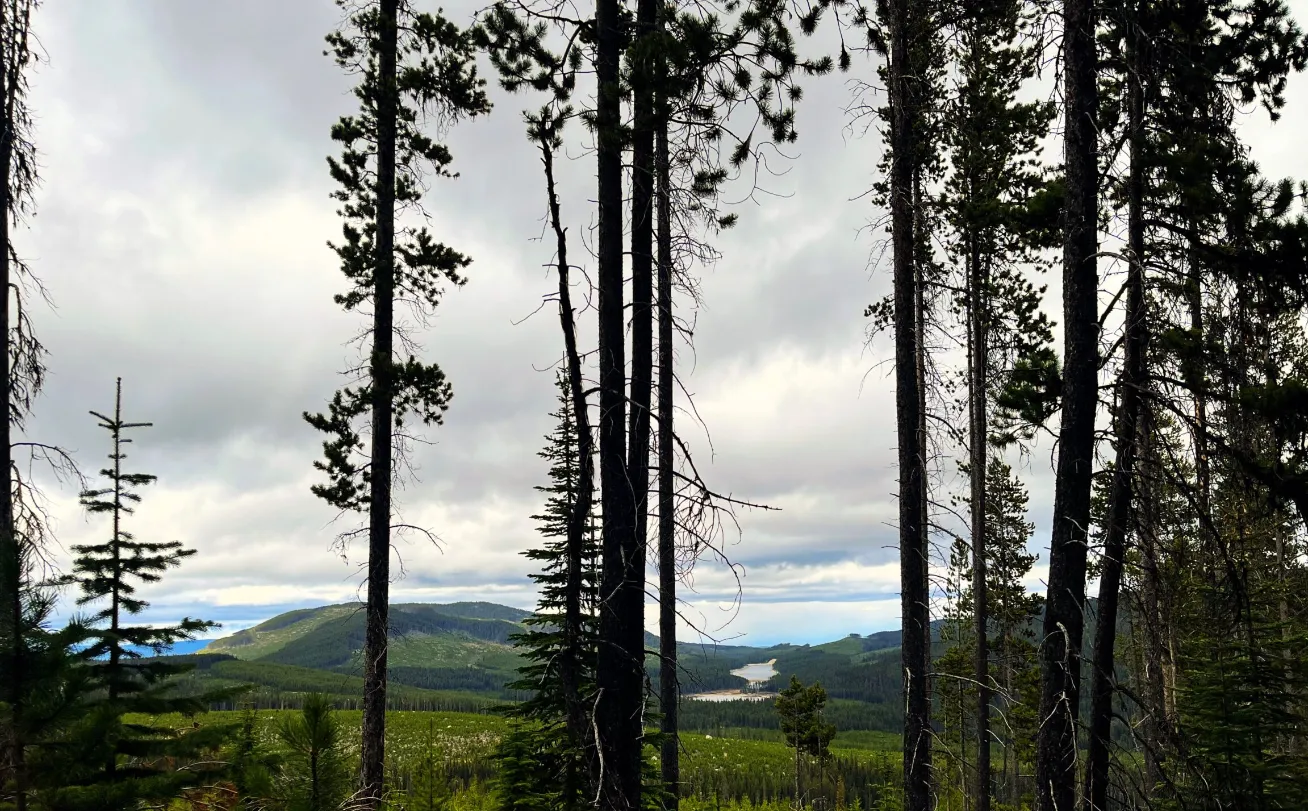
28:03 It's as a saying there, there's not a lot of exposure, it's a thin, flat plateau and thin glacial veneer that's maybe 2 to 3 meters covers the area. But I went out with a colleague of mine and we found a few areas that had some good samples that we can get teraspec readings off of and then and assayed as well and that's just this what's exposed on surface. But one of the better takeaways from that was that we found it was a newly discovered zone because it was on a brand new logging road that was just built within the last year or 2.
28:50 We picked this out of the side of the logging road, not float, it's an actual outcrop that was exposed by the by the logging company. That ran 11.35% copper, 0.17 moly, 1.5 gram gold and 130 grams silver. And that's not high-grading either. That was actual, like taking chunks along it. It was at least probably a meter and a half wide from what we could see exposed. And that was a minimum width. And This was the backside of one of the samples as well. You can see the fairly concentrated moly along fractures as well, cutting through.
29:40 There's quite a bit of boronite and there's chalcopyrite in it and molybdenite. So we were pretty excited about that. It's a brand new exposure. And so the high-grade zone through drilling, we know kind of comes through this area. And now we found it here striking just west of north so maybe 350 degrees or so which puts it straight through the main zone up here so we're can potentially be confident that that extends at least down to here and we've it's been hit and drilling over here as well. So we're getting even more excited now about this.
30:31 Absolutely. The main zone here that you have been mainly talking about. And most of the mineralization is concentrated within this small portion of it here. And then this is the southeast extension that I was talking about that It's mineralized right up to the edge of this where the historic block model was done. And then there's the Northwest extension over here where some of the historic percussion holes were mineralized out over here as well.
31:17 And then the broader untested soil anomalies with just shallow percussion holes and no rock sampling. But this summer is going to be out trying to find surface exposures now on the new logging roads that network that's been built through this area. So our ongoing work is near term planned work. So this summer we're going to be starting with project-wide reconnaissance on, as I was saying, on all the newly built logging roads, which is the most cost-effective method of really expanding on this project.
32:09 And then continue on with compilation, interpretation and building geological models based on all the historic drill logs of the 18,000 meters of drilling. And I'd like to take hyperspectral readings on core as well to build it into the 3D model. And probably some 10 sections of petrography to get a better idea of the mineralization and what it's associated with. So 60 plus line kilometers of deep penetrating IP. So I forgot to mention that these black lines are the proposed potential IP.
33:03 And this is just a rough grid. They'll likely be adjusted, like these northern ones will be shifted to the west a bit more to cover more of this here, because this whole block's been shifted. And then these would be probably extended this way a little more to get a better coverage. So these are wide and spaced deep penetrating proposed IP lines to really get a good, build a good 3D image of the subsurface architecture, I guess, of the whole region, or the whole property. And since we have near surface, fairly detailed 3D IP over the main zone right here.
33:53 We can use that, the signal from that and the surrounding area to really hone the target generation across the rest of the project as well. So this is part of the ongoing right now, as I've already done the 3D inversion of the magnetic data and then we'll compile the rest of the IP in and then after we've done it, we'll do a 3D inversion of that as well. And right now, just up to 2,000 meters of diamond drilling is planned in a few holes within the next year and a half, year to year and a half.
34:42 As everyone knows, drilling is expensive, So we want to really get a good understanding of the ground and the system before we just go start plugging random holes in, especially if we start going to the farther anomalies to the northwest and southwest. The original or the initial drilling will likely be focused on around expanding on the main zone and to depth. And I believe that's the end. All right, Shannon, do you wanna throw up the 3D model just to sort of give us a closing view? We can have a quick look at that. And while you're setting it up there, maybe I'll just talk a little bit about how we were able to acquire the project.
35:40 When we first became public in April of 2023, we had a couple of projects under our belt. We wanted to expand because we saw that copper was going to be a real strong contender in the market going forward. So we wanted to grab another copper asset, especially in British Columbia. So we identified this one. It was in a portfolio of an oil and gas company that had used a shell to basically go public. So these were sitting in the closet more or less. And this project in particular, we liked that of the portfolio and we reviewed it. So we did basically a purchase deal right off the bat, no option, nothing like that. So we went to the company and said, look, why don't we get 100% or at least a majority? So we did a deal where we own 90% of the project, the oil and gas company, name is Tuck 2 Resources out of Calgary.
36:39 They own 10% and they are on the ticket to contribute 10% of all expenses as well on the project and they're happy to do that. But what it means for us is that we have not only the majority interest, but there's no option payments, there's no royalty on the project. So it's very unencumbered and we see long legs to this thing. So I think in the long term, it's going to be, I think it'll be quite a deal that has been done in the past for us. So maybe I'll hand it back to you, Shannon, you can kind of explain what we're looking at here. So this is just the the interactive model basically of what the figures we had up there.
37:29 So this is the the more modern drilling that was done from 2005 to 2008. And this is the 0.1%. So just showing that that's basically cut off grade throughout the entire drilling zone. And then to the south, southeast I guess. Yeah, south. It becomes wider space drilling, but even up to where the last holes I drilled, it's still all mineralized. And those 2, those samples that we found on surface are actually right here.
38:18 So the original kind of block model was done up to down here. And the high grade core cuts through here. So as I was saying, we have a pretty good feeling that it does extend through here now and cuts down through here and down into these holes. So this is an obvious kind of expansion now and infill here and to the southeast over here and up in this direction as well, and to depth. Because as you can see, it's all at least the low-grade mineralized halo or core, right to the bottoms of all these holes.
39:05 Oh, and so this is that higher magnetic zone I was speaking about earlier, that kind of almost like a cupola that comes up and where... So just above here. So here and here were My colleague and I found the quartz magnetite veining throughout here. So that could be a driving factor for this within this magnetic high here that's being surrounded by mineralization. And these are the 2 of those percussion holes that I was speaking about that have never been followed up, but they're mineralized.
39:57 This is the 0.1% as a same cutoff, so right to the bottoms of these holes. And just like these ones, those type of percussion were drilled over and through here as well. But The modern drilling, they never followed up on this side of it. So it's another fairly significant target for us on this side of this cupola, magnetic cupola that comes up. And I guess the only other thing maybe would be here to show that this magnetic kind of scalloping through this zone as well above for these other percussion holes up here.
40:45 Yep, and then for reference, I'll just quickly Put this on show the So this is the again the 150 greater than 150 ppm copper and soils Throughout the area and you can see we're just that small or the main zone mineralized was done And it continues all the way up through here. Yeah, that's quite impressive when you layer it that way and you can see how the geochemistry and the magnetics sort of are aligned along that one area, or at least where the low is in the magnetics and the geochemistry.
41:38 Yeah. Points to a great looking target. I think that's pretty much it for the... All right, thanks Shannon for that. And Romeo, if maybe we can just open it up if there are any questions, Shannon and I'd be happy to answer. I think Shannon is still there, he's just the younger self is showing up. That's temporarily degraded internet looks like, but I think we set it up. Yeah, it's much better. And I think maybe the storm's messing it up. That actually sounds about right. That gets me here too. There are some questions in the chat, but I had a couple first, if you don't mind. Sure. Just run through based on the presentation. First one, I'll throw it to you first Jeff, but Shannon feel free to answer afterwards as well. I know the historical drilling at Copper Plateau had some really good results, so that's 19.86 meters of 2.02 copper equivalent. I'm curious, when you were looking at and evaluating the project, what aspects of the historical results really excited you to pursue the project? And then, as a corollary, how did those elements compare to similar stage copper porphyry projects?
42:45 Yeah, well, I think the 2 together, really, the 2 questions are 2 parts, really, are the core of it, basically, no pun intended. But the, the idea was that, you know, when we're looking at some of these numbers, It's like, well, wait a minute, like people are mining over at Tech at Highland Valley, like they're mining 0.23 or 0.25 percent copper and a little bit of moly on it too. So when we saw those numbers, especially with some high-grade intersections over quite substantial lengths. We're going, well, there's gotta be more here. So what we were impressed with was not only the grades, but also the data that was available, like historic data, recently drilled, well, 2008, I guess, was the last drilling that was done. So having all of that stuff available, oh, Shannon's back, was quite impressive in having it in a package enough for us to review it.
43:46 And then I think what was the difference for us is that we were able to then put this data into that kind of 3D viewer that we saw at the end there that Shannon was showing us. And it kind of really put everything together, you know, and it was like, this is a great story and it needs to have more told about it, more work done on it. So that, in a long answer to your question, we were quite impressed right from the start because of many things. And great as king. And then when you start seeing the length of intervals that you're getting throughout the region, it's pretty impressive. Plus critical medals as well, strategic medals. It's all copper, moly.
44:33 That makes sense. And Shane, I actually have one for you. With a target of potentially over 200 million tons, which you indicated in the presentation, I'd love if you could just, for folks in the room watching the replay, walk through your confidence on that target size and what indicators kind of support that scale? I don't know if I should bring up the presentation to show up again but so I guess we can't technically talk about it but there's a non-compliant historic block model that was done in 2011 just over the main zone drilling where it didn't include the outer peripheral drilling, just the core of it.
45:18 That was 75 to 110Mt. I don't think I can say the grade, but mineable grades potentially for BC porphyry. And that was just over that one small area so it's kind of arm-waving but with everything kind of being similar looking in target wise for geophysics, geochemistry, even drilling the percussion holes that were done historically have fairly similar grades, like broad, not even really low grade, just still 0.05, like 500 ppm to 1000 ppm copper, 0.1%. And being on strike from the high grade zone, we're fairly confident that there's more there to be discovered.
46:28 And I think 200, if 100's at the main zone, I think 200 is fairly reasonable to estimate. No, I'll submit with quotes and forward-looking statements. We got the slides. I will ask, The 2023 reconnaissance sampling revealed some really like crazy high-grade samples from what I saw There's 1 with 11.35 percent copper 0.17 Molly 1.5 grams per ton gold 129 grams per ton silver. How representative do you think those surface samples are of potential mineralization at depth? Like anything else with with exploration, It's very difficult to replicate surface samples, sampling to in drilling.
47:22 But that being said, I'm the one who took the sample on surface and I know I didn't high-grade. And looking through the drilling, there are very high-grade zones. We haven't fully gone through all the drill logs to try and get mineralogy and see if it's the exact same zone and model it yet, but there are 6% zones, 9% over 4 meters and 2 meters respectively. And these are at 60 meters depth, 69 meters depth. And also there was a 12, so almost identical grade. So 12% copper equivalent over a meter and a half, 1.6 meters but that was down below at 250m depth.
48:25 It gives us quite a bit more confidence that that's just not a small little one-off on surface, historic drilling through the core of it and at depth and along strike seem to be fairly, can't say continuous without knowing, but It looks fairly representative of what is potentially been drilled at depth. Great. Just never found on surface because of, as I was saying with the glacial till veneer cover. Yeah, it's... Sure. I got one that's kind of either one of you can answer. I particularly want to hear if you guys disagree. I saw that there were 3 coincident copper moly soil anomalies that remain largely untested.
49:11 Which of those do you consider the most promising? So, Jeff, I'll go to you first, actually. Well, I would say that the one I like the best, and it's because of the length of it, is the one to the north and west. So if you follow up from the main trend of the main zone across that, sort of that resistive fault zone, You go across into the more continuous soil geochemistry with a coincident magnetic low in the area. And it's 2 and 1 1 kilometers long, 600 meters wide. So that's the one I like the best because it has the potential for, you know, hosting a fairly decent size resource of some sort.
50:00 Maybe Shannon can tell you another one, I don't know. Yeah, no, I completely agree for untapped blue sky potential as well. The size is fairly amazing in my opinion for the strike length and width of it. But I guess ease of discovery, I guess, is probably expanding on the main zone and our targets that are to the southeast and at depth and on the other side of that mag high cupola I was talking about that hasn't been tested. Those are fairly easy follow-ups as well.
50:46 So it's a toss-up because we can potentially get fairly significant numbers which would be good for market and just optics kind of thing. But you also always want to get that new discovery at depth, high grade intervals, or large intervals that have never been tested before. So, yeah. We'll take it all. Basically like, take it all. Like a brown fields to green fields type. Yeah, that's a good point. All of them is a decent answer, for sure. I do want to quickly zoom out, Jeff. I know your team has really so much experience in across North America, Latin America, the Caribbean, Africa. I'm curious if there's any lesson from past exploration that you're applying to Copper Plateau specifically, you or anyone on the team?
51:34 And maybe I'll start it off first is, I think probably the first thing that you have to do is, and it's the cheapest thing, the cheapest exploration is to make sure that you gather all the historic data that you can. You can imagine that 18,000 meters of drilling, 7,000 soil samples at Copper Plateau. If you had to go and do that yourself, I mean, that's a big amount of money. So for us, anywhere we go, before you even get on the ground, you try to gather up as much as you can. And that works well in whether you're in Africa or South America or the Caribbean or wherever. The other thing that we've learned is that you're dealing with a lot of stakeholders, no matter where you are in the world, whether you're in Peru or in Jamaica or in Zimbabwe, you have to go and talk to the local stakeholders, have a good communication with them, let them at least try to understand what you're doing there and manage expectations. So that's sort of on the ESG level of things.
52:44 So that's kind of where I come from and see that, you know, it's like the first steps of any program. You've got to get that under your belt before you can even go and put a hammer on the ground. So Shanna, maybe you can kind of add to that. I was actually going to say pretty much the same thing. Yeah, community engagement from the start is one of the biggest factors. They're all very appreciative of you coming to them and stepping up and saying we're coming to do this and we'd like to work with you on it and come to an agreement and try and help both ways, like help us at the project, which helps the community with jobs and resources and things like that as well.
53:34 That's my biggest thing is that. That makes sense. I do, I got a couple of questions from the audience that I did want to get to. So Wesley asked right at the beginning of the hour, Is Copper Plateau the main area of concentration for this year? Is it your top priority? Maybe I'll answer that. Yeah, we've got, I guess, 2 projects that we're kind of focusing on and Copper Plateau is one of them. And the reason why I say that is because it and our center fire are probably pretty well close to drilling with a small amount of work to be done. So that's our mandate in 2025 is to get some drilling done. And I would say Copper Plateau is probably at the top of the list. We have started our permitting process.
54:21 That is a little bit of an unknown in BC, but I believe that the mandate with the government is to make that a lot quicker. Yeah. With the most recent election and a new ministry basically that's focused on mining and exploration. So that, fingers crossed, we'll be able to get into Copper Plateau sooner than later this year. I appreciate that. Graham asks you to gaze into a crystal ball here, Jeff, and I always hate making people do this, but here we go. Yes, two-part question, both hard to answer, but let's go for it. First is, will copper prices continue to show strength through to the end of the year? And when did juniors start seeing the benefit from that in financings, et cetera? Yeah, so those are 2 great questions, and I wish I could say things with confidence. I can only give you my opinion on the strength of the copper price, the copper as a commodity, and I think it has some good legs to it.
55:19 And I think the recent price increase, but then decrease of tariff issues, I think it's only temporary. I think we'll see the demand continue increase. I think supply of Copper will be a challenge for many reasons, whether it's closing off taps and closing off countries from trading. But it's just how many mines out there are going to be able to produce copper for the amount that we need. So bullish on copper prices, and I think they'll continue to increase over the next, I'd like to say decade. So keep an eye on that. We'll see how, let's have an interview in 10 years and see where we are.
56:06 And then as far as the, sorry, maybe you can remind me on the other part. It's when did juniors start to see the benefit? Yeah, okay, yeah. Yeah, that's a great question. And I think a lot of the majors, a lot of mid-tiers and even offshore companies are really seeing it's a buyer's market to come in and look at juniors that have decent assets like Copper Plateau. And I think you'll see, you know, some acquisitions or some joint ventures. And I think once that starts rolling, it draws attention to the junior market. And we can look at the deal, you know, that A-Mark did with Freeport. It took, you know, a little bit of time, but having that investment from a major company pays dividends all along. Just gets the stock, makes a discovery, gets the stock going.
57:00 So I think that could be the way things will go is that the attention from third parties into the junior market will stimulate the market, will stimulate the companies having discoveries and then the stock prices will then go to the moon after that. That's my other prediction. No, appreciation, indulging a little crystal ball gazing at the sky. So with only 2 minutes left, I do want to throw it to you guys just to wrap up on Copper Plateau, give some final words, and talk about what's going on with Cascade. So Jeff, I'll leave the floor to you to wrap us up here today. Yeah, I'll start it off and then I'll let Shannon have a couple of last words. But we're really keen on getting on the ground and doing some more work on Copper Plateau, as Shannon mentioned, the IP, just looking at the new open ground that's been created by the logging roads and eventually getting in there and doing some drilling.
57:55 But that all takes money. So we do have a private placement that is open. And if anybody's interested in looking at that, please give me a call. And we can make sure that my coordinates are available or on the website, please go ahead and get in touch. So I'll hand it over to Shannon for his final words. Sounds ominous. For this, yes. Pretty much the same words as Jeff. I'm pretty excited to get on the ground and check out all these new exposures on the new logging road system. Just from being there that single day on a new road, we found that high-grade zone on surface which gives us a lot of confidence about extent.
58:49 So fingers crossed, I guess, we'll get out and find a few more like it this summer. Absolutely. And then get the ball rolling. Awesome. Well, Jeff Shannon, thanks so much for the presentation. Ran through some questions with me today. Thanks, Romeo. I think it was great. And folks in the room, thanks for joining us. The replay will be available in just a few short hours, so it should end up right in your inbox. But everyone, thank you