Transcript
Automated transcript · Written by software from the replay's audio. It can mishear names and figures; the replay is the record.
0:03 Hello everyone, thank you for your patience and for joining us for this live Cascade Copper update. I'm pleased to be joined by Shannon, VP of Exploration, who will provide further context on this week's release regarding the Centrefire Copper Gold Project in Ontario. As this is a live event, please feel free to submit your questions in the chat box, which can be found in the bottom right corner of your screen. Also note, this event is being recorded and will be available for review shortly after we conclude. So Shannon, thank you for your patience. First off, Cascade has many projects in his portfolio. What stands out to you about the Centerfire project? Centerfire actually has quite a bit going on for it. The 2 biggest things that are usually a hindrance for junior companies are location and access.
0:56 You can have great geology and whatever else, but If you're in a terrible location or a bad jurisdiction, or you have no access or helicopter only access, that could completely scuttle your entire projects and burns your money like crazy. So, Bitterfire is located in Northwestern Ontario, and Ontario is one of the, now it's one of the better jurisdictions in the world for mining and permitting and things like that. We're approximately 40 kilometers from Dryden, kind of in between Dryden and Sioux Lookout. And as for access, we're about 40 minute drive off of the trans, directly off the Trans-Canada Highway.
1:51 And half of that time is on another major highway to Sioux Lookout. So you're less than 20 minutes off of a major highway. And those 20 minutes you're on a multi-lane major artery of a logging road that goes directly through the property or the edge of it.
2:12 And then usual things geology and geochemistry. We're in the right terrain for what we're looking for on this project, which is VMS and then banded iron formation, posted gold. We're in mafic, yellow volcanics and slobosalts and there's rhyolites nearby in that regionally extensive banded iron formation.
2:46 Geochemistry-wise, it has pretty good targets. It's copper and gold dominant.
3:03 There's a lot of intense alteration as well, at least in the main zone. So there's also open and sorry and geophysics too. There's region, like I said, regionally extensive banded ion formation, which are horizon markers, and they go right through the property. And then we have some pretty good magnetic disruptions that are probably hydrothermally related. And some good V10 anomalies as well, at least on the western part of the project.
3:44 And the eastern part doesn't... Another good thing about it is the eastern half of the project has basically no work done on it at all, because there's very little outcrop. So none of the old timers would have really found anything to push the project forward.
4:04 And power and water, There's a high-tension power line that goes right adjacent to the project. Water nearby and being near Dryden, it's one of the major mining hubs for the area. So, you're near skilled labor drill contractors locally that we've worked with before. So it has quite a bit going on for it. Thank you for that. So based on the press release, what potential do you see for further discovery along strike to the northeast within the expanded claim block?
4:41 There is actually pretty good discovery potential. The main zone that we have, the Gossan zone, is on the western side of the project. Then we have at least another 10-kilometer extent that you can trace with the magnetics. It's the same horizon, the same volcanic package. And there's another parallel one just to the north, about 500 meters or less than a kilometer to the north as well. That will probably extend it to 15 or 20 kilometers of strike line just within the claim blocks.
5:25 And so similar to the main zone, in the Northeast, There's also magnetic disruptions that have never been followed up, which could be hydrothermally related as well. And as I was saying, there's extreme lack of L-Crop, so there's very minimal work, so it really ups the discovery potential. So we will be, the plan would be to, after I'm working on magnetic inversion right now, the drone data that we've recently flown, And then after that would be to fly something like an EM survey as well. So then we can match up similar to the main zone flying coincident EM and magnetic anomalies to more 0 in on targets. And then you do ground work and drilling to go from there.
6:21 But it's really a good target. Let's continue with the progress. And Jacques, thank you for joining us. He just started to answer next steps, but maybe Shannon, you could provide more specific timelines for the plans within 2026. Sure. So right now, if permits are submitted and Ontario's pretty good at getting, efficiently getting permits done and back to you and approved
7:00 significantly better than a lot of other places that it worked. I'm not going to name names for provinces or anything. And so we're expecting that back in Q1, sometime in Q1. And then we have a few samples that are still in analysis right now. And then the magnetic inversion will be done shortly. So we're likely looking at pending permit approval, looking at drilling at least a few maintenance holes at the main zone. Likely starting April, and April approvals will probably be by March, but I'm looking more towards April 1st just to take advantage more of the OJEP program, the Ontario Junior Exploration Grant program.
7:57 It starts April 1st, so it makes sense to extend by a few weeks your mobilization to take advantage of that 50% tax credit grant. So once you get the green light to drill, Are you able to drill all year round? Yes. As I said, it's a main artery. It's used to go around to some of the other communities. Even if it's snow-covered, it's great access. You can still drive through and plow if you need to and drill all winter long. Kieran from the chat is wondering, will any of the BC properties see any type of work over the winter? So maybe provide an update, take the opportunity to talk about other projects if you'd like within the Cascade portfolio.
8:54 Yeah, sure. Right now I'm putting some,
9:01 Not feelers, but quotes out, I get quote requests out for surveying our Fire Mountain project. Probably with, depending on what quotes I get back, likely with something like ZTAM or mobile MT, and that'll be within the next few months. And then we're awaiting permitting on Copper Plateau. And once that comes through, we'll likely get the IP permitting first. So that IP is gonna be planned first and likely in the spring, early spring.
9:51 Bender, I am doing the magnetic inversion. I'm going to work on Centerfire first. I did the partial inversion, but I need to constrain it a bit more on vendor, and then we're building the 3D plan a bit more. Then I'll be putting in permitting applications for vendor and likely Fire Mountain as well, actually. I mean, I'll probably wait until we get the results back from the airborne survey that we're gonna do. So I'll do, but I'll probably put something like an IP survey request in first or permit in first and then drill 1 after that.
10:39 Yeah, but other than that, it's mostly things like that because everyone knows that in higher elevation type areas you can't really work much during the winter, but we do actually our copper plateau for that stored in Brambrook, that we're planning on resampling some of it as well and analyzing so that could potentially start a bit earlier than spring. Great. Plans for BC at the moment. Thank you for that. Just to remind people, feel free to submit your questions. I have one more question for Shannon before we close things off here. Going back to Centerfire, as this was regarding the Centerfire press release, how significant are the Copper, Gold and Silver grades in terms of the overall project potential?
11:34 They're pretty significant. They're decent grades. And copper, silver, and gold are 3 of the hottest commodities or metals at the moment. Having a project that contains all 3 of them in decent quantities is an envious position to be in. And especially with, so copper's, everyone knows copper's a critical metal.
12:10 Silver, as I mentioned in a previous interview, silver has just been approved in the, or added in the US to the critical metals list and Canada is likely about to follow suit with it. And there's a push to add gold to that actually too, to the list. So our recent sampling, we've come back with quite a bit, and our historic stuff from the last couple of years, we've had quite a few samples that have come back over 1% and up to 3% copper. Quite a few, a lot of them were like half a grand gold. And the release we just put out with our recent sampling I think we had samples up to 2.86 percent copper 2.84 grams per tonne gold and Twenty-nine 0.4 grams per tonne silver so I mean our 2.84g per tonne Gold and 29.4g per tonne Silver. Our channeling last year, we had quite a few hit our channeling last year too. We had quite a few channels that would be over 1% copper equivalent and that's over like 4 to 9 meter intervals.
13:35 So these new samples are all graph samples, which are, they're always gonna be higher than something like a channel or drilling. I haven't done the copper equivalent numbers for these new assays, but I think with the new numbers for copper and gold, or even using like $5 copper and $3,500 gold I believe it's probably it's about every 1 gram of gold you have adds about 1% copper to your copper equivalency number having a lot of half gram or up to close to 3 grams adds quite a bit of value to the project.
14:32 And I guess I already kind of said a forward-looking or cautionary statement that these are grab samples, so just don't be cautious, I guess, of them. But, I mean, I took them myself, so I know they're hydrated, right, like that, they're just spread out throughout the main zone. So yeah, if our, I guess, yeah, the numbers are significant to the project upside overall. I guess I didn't talk about it in the geology, but we think we're kind of in the feeder zone of this system.
15:19 It's already kind of the lower grade feeder zone, the hydrothermal upwelling, where it comes up before it deposits massive sulfides onto the surface. There's a lot of upside potential of hitting high-grade zones. So I'm kind of rambling now, geologically-wise. So say you have a... We've historically mapped things around the region to show that we're on the northern limb of a sink line fold. So if you have a hydrothermal system coming up like this and depositing VMS, like massive sulfides on the surface, and then it got folded over like this.
16:06 So we're hitting this lower stringer hydrothermal or replacement zone on surface right here, but all the actual high-grade zones are still below. It's counterintuitive. But as we're drilling down, we're actually going up in stratigraphy towards the higher grade type of type of system So I'm pretty excited about it really looking forward to see where we can what we can do with this project. I think we can build a lot of shareholder value out of it. You touched on sulphide, but there is a question in the chat, so let's just wrap it up in a nice bowl. Is copper mainly a sulphide or some near-surface oxidized?
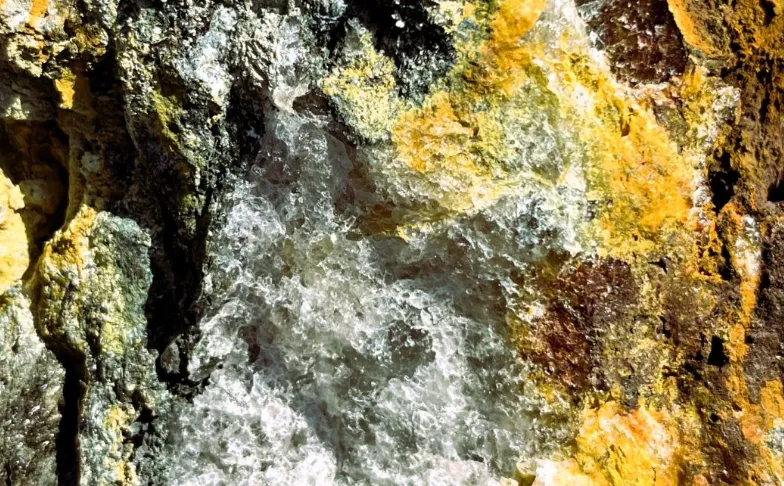
17:02 No, there's a lot of sulfide. It's mostly chalcopyrite that I've seen in it. I don't think it's really upgraded on the surface. It's not oxides or carbonates like malachite or azurite or anything like that. It's all just copper pyrite that I've seen and then a lot of like oxidation, but it's not getting copper minerals, copper oxides. Gotcha. Karen's wondering at this point, do you have any idea of potential footage or number of holes for center fire, or is it still too early for that?
17:53 I'm assuming they're asking about like our upcoming kind of made in drill program plans. You can touch on that. There's another question that actually weaves into that nicely. What is your budget for work in 2026 at Centrefire? It'll probably be small, not 1. Small in the sense that it's still our first pass and we want to get, we'll likely try and do like say 500 or so or maybe up to 700 meters of drilling. It's mainly to get, like I was saying, get down below and get a fairly good profile.
18:40 Then you can do slightly more academic studies and get hole rock geochemistry and all kinds of things for pathfinders for trying to vector. And then based on the results of that, we try and do a couple other adjacent holes. And then from that, you can do things like a cross hole tomography, like a EM type system where you can try and mean the 2 holes using EM to look for a massive salt size lenses and stuff too. But The first pass will likely only be less than $200,000. So, 5 to 700 meters would you say about a depth of 150 or so? 50 or so, like 3 or 4 holes?
19:35 I believe right now I'm thinking of 1 deeper hole that there's a couple of shallow old, like historical holes. So I was thinking 1 kind of deeper hole that went undercut everything. We're on the northern limit, but all the Strategia Breeze is dipping about 65 to 70 degrees to the northwest. These other holes did these shallow things across it up top and they all hit mineralization through it. The main zone is right on top here and dipping down. Yeah, we'll probably try and go from the back side and get a whole profile of that whole feeder zone.
20:25 And then you can use that to see your heat vectors and where you are in the system. And then potentially another 1 or 2 shorter holes. I haven't exactly done it yet, but our permit has 1 to the south, 1 to the east, and another potential platform to the west, where we had this release. We had 2% copper, and the gold number was higher gold there, though, too. And that's 450 or so meters west of the main zone along Strike.
21:12 So that could be another just short test hole as well. It's not set, but I'm fairly set on trying to do a full profile below to see if this mineralization continues a couple hundred meters below depth. Great, well thank you very much Shannon. That's it for the questions in the chat. So thank you everyone for your patience with the technical difficulties at the start. If you came in a little late, this is being recorded. The replay should be up after a few hours here. So keep an eye open for that. But Shannon, thank you. Any final closing remarks before we sign off here? No, I don't. I guess I should mention, we talked about budget, I should mention that everyone here probably knows, but we just closed the oversubscribed private placement. So We're getting a lot of interest in our company and plans.
22:07 We have the money to do the work and we're moving forward to build that value for all of you. Great. We look forward to hearing more updates from you and Jeff in the future. Thank you so much, Shannon. It was a great chat.