Transcript
Automated transcript · Written by software from the replay's audio. It can mishear names and figures; the replay is the record.
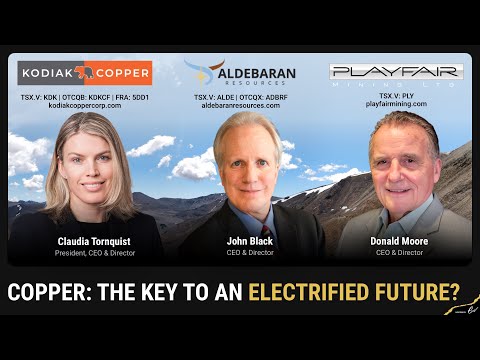
0:07 Hello, everyone, and welcome to today's live panel discussion featuring the title and today's primary question, Copper, the key to an electrified future. I'm pleased to introduce our speakers today, John Black of Aldebaran Resources, their CEO and Director, Claudia Turnquist, Kodiak Copper's President, CEO and Director, as well as Donald Moore, CEO and Director of Playfair Mining. I'd like to begin today by going around the room, allowing each of our speakers the chance to introduce themselves and their companies. After we'll be beginning the conversation in earnest before finally moving on to the live Q&A
0:38 period. I'd like to remind audience members that you can submit any question you like using the Q&A panel found on the right hand side of your screen at any point during today's discussion. And as always, this event is being recorded and will be available to watch on six.com in the coming days. Without further ado, I'd like to pass things over to our first speaker, John Black of Aldebaran. John. Hey, great. Thanks, Kim. Hi, I'm John Black. I'm the CEO of Aldebaran resources. I'm an exploration geologist by background, but I've been working in the junior space for quite a number of years now. Altar is a company that specializes in looking for large copper or copper gold deposits. We've got a very experienced management team. This is actually our third company that we've run with the same same exploration strategy overall. Our first company was called Antares Minerals and we had the good fortune to discover a large porphyry in southern Peru which we sold the 1st quantum.
1:27 Spun out Regulus Resources which is currently working on an exciting copper project in Peru and from that we spun off Altar which we're working on the or Aldebaran which is working on the Altar project in central Argentina. We have an option to earn an 80% interest in the Altar project from Sabani Stillwater. Altar is a very large copper gold system. It's like many copper systems, it's a cluster of porphyry. And we have a large currently defined resource at Altar Central and Altar East with a little over approximately 1.2 billion tons at 0.5% copper equivalent and measured an indicator resource with an additional nearly 200 million tons of inferred resource at similar grade. So we already have a large resource in hand, but what we're really excited about in the system is that there are a number of underexplored or unexplored opportunities within the district. And so we have spent the first 2 years of our joint venture setting the project up. And this we're just kicking off our first major drill program to test some of these additional areas. We think there's considerably more to be found in the system and potentially with much, much better grades.
2:35 Much of our focus this year will be on the QDM target to the West of the known mineral resources. It's an area that has no currently defined resource. And we were following up on pretty exciting drill results from our previous campaigns. These are our last hole that we reported from the system was hole 42 last year, where we intersected over 600m of a little better than 0.6 copper equivalent. But within that, there was 111 meters of 1.4% copper equivalent. So we're seeing these zones of higher grades, much better gold content associated with them and a very clean style mineralization material that mineralogically
3:14 should produce a superior concentrate. So we're very excited about these. We'll be hitting these targets pretty hard this year for the first time. We'll have 4 drill rigs. We have 4 rigs turning right now. And shortly we'll begin to put out what we think will be pretty consistent and regular drill reports coming out of the project as we move forward. It's also a very exciting time to be in San Juan in Argentina. We're one of at least 5 major porphyry copper systems that are being drilled out in the district. So it's a very exciting time to be in San Juan. There's a lot of activity in the neighborhood. As I mentioned, this will be our first real big program that we put out consistent results on. We've set the project up well now and it's a great time to be watching. So in a moment like this, when we're entering into what I believe is almost an unprecedented copper market.
4:04 I would recommend that many of you would be looking for opportunities to invest in projects that have potential to make major copper discoveries. And if you're looking for an undervalued copper explorer that has a large resource with potential to substantially increase it, I'd highly recommend you take a look at it. So it'll be an exciting time in San Juan this year, lots of drilling activity, lots of results coming out from ourselves and our neighbors, and it's game on in San Juan. So please contact us if you have any questions about what we're doing. It's a pretty fun time now. Great. Thank you so much, John. With that, I'd like to pass things over to Claudia. Thank you, Ken, and thank you, everybody, for listening in. My name is Claudia Torntquist. I'm the president and CEO of Kodiak Copper. Kodiak is also focused on copper porphyry exploration in North America.
4:55 We made a discovery at our main project called MPD in British Columbia, which was a real game changer for the company just about 18 months ago, and have significantly expanded on it since and expanded in its size, and have a very large store program planned this year to further build on our discovery success. The people behind our company, I should mention first and foremost Chris Taylor, who is the founder and chairman of Kodiak. Many of you will know Chris from our sister company, Great Bear, which was one of the major gold discoveries in recent years. And Chris just got a $1.8 billion takeover offer from Kinross, which is a fantastic success for him. Chris is a very creative geologist and a big part of Kodiak's success as well.
5:50 And another important person in that team is John Robbins, shareholder and advisor, and John has put together the Discovery Group, which is a fantastic group of companies that Kodiak is part of that gives us really good access to whether it's technical expertise, contacts, et cetera. So that's sort of the corporate side. And a couple more words about our MPD project where we made the discovery. It's located in Southern British Columbia in a producing area between 2 large copper mines. Very easily accessible, great place to work. And it's historically explored, but all very shallow. We dwelled deeper and made the discovery in our maiden drill program. We drilled into a nice high-grade zone called Gate, and we then gained tech as a major shareholder. It was quite some excitement in the market, so a big jump in our share price.
6:49 And that set us up for a very busy year last year, where we drilled 22,000 meters and increased significantly the size of the gate zone. And now We are well funded for another 25,000 meters this year, where we will be drilling the gate zone further. There's still a lot of room to increase the size of what we have already. And then we have multiple other targets, and I'm particularly excited to drill those, because if we can replicate what we did at GATE successfully at these other targets, we have the possibility of another game-changing discovery. So very excited to get drilling again soon. We'll have the builds turning in the next couple of weeks. We still have exploration results coming from last year and then throughout the year more exploration results and lots of news flow and looking forward to reporting back from our drill work.
7:48 So that's in a nutshell what Kodiak is about. Wonderful, thank you, Claudia. And with that, last but not least, Don, the reign's yours. Well, I'm on the opposite end of the scale here. I'm in the small end of the deposit business. We're looking for VMS deposits. My name is Don Moore. I've been in this business far too long. And I'm joined by 2 very experienced geologists. Our team is just the 3 of us. And We're starting to talk about a century and a half of experience between the 3 of us. It's one of those companies that not only enjoys a lot of experience, but also enjoys a very small market cap. For those of you who are out there and looking for speculation in the Copper discovery area, Small companies like ours are really something to look at because the stock's cheap and we've got a great corporate structure.
8:42 half of our stock is owned by serious people, Albrecht McComb, EMX, funds out of Norway ourselves. And we've sort of lucked out and ended up doing a deal with EMX on a property in Norway that covers a whole district of VMS potential. It had past producing mines. The area has gone unexplored for over 50-years. We're the first to use, let's call it innovative exploration, to have a look at it. And we've come up with a series of targets. Some of these targets are in areas never before looked at with any kind of potential. We use a combination of artificial intelligence and MMI. We developed these targets over a period of a couple of years by going back and narrowing down the field.
9:29 Last year, we wanted to get to drill. There were all kinds of obstacles last year, but we did figure a way to get over those obstacles. We ended up buying a drill, a man-portable drill. We got it located in Norway. Unfortunately, last year we had a very late start, so we didn't have a chance to do a lot of drilling, but we did get started. And this year we're going to proceed with that program. We've got something like another 5.5 targets to check. We've only checked 1.5 so far with interesting results. And now that we're going back in the field, we're looking for new raw discoveries in areas that have never been looked at before. So the speculation is VMS deposits come in a wide variety of sizes and grades. And it's that unknown that we're saying is worth having a look at.
10:19 Our website with lots of technical information and you're welcome to go there and have a look, playformining.com. And as Don Moore says, let's get at it. Wonderful, Well, thank you each for giving everyone in the audience that little bit of context about not only yourselves, but your companies. With that, let's launch into the conversation. And to begin with, I wanted to ask the group, do you feel that the base metals extractive industry gets a fair shake when it comes to its role in rapid electrification, explicitly Copper, obviously why we're here today. Why or why not do you think that? Don, we spoke earlier and I think you have some really great points about this. I'd like you to take the lead on that. The institutional guys are really great supporters of the mining industry in general, but there's a limit. If they don't see a bit of a deposit on the table, they just will not look at, let's call it greenfield exploration. Brownfields is always good. If you have a start on a deposit and you have a group of deposits, the institutional guys, there's a group of them that will come to the table. But there's very, very few will come for greenfields exploration.
11:29 Greenfields exploration is basically left to high net worth individuals and people within the industry that are willing to take a punt on these early stage programs. And now that we're going into this era where Copper, as far as I'm concerned, Copper is going to be a critical metal. We don't have Copper going forward.
11:49 We're not going to have a green conversion. We need Copper. It's a critical thing. It would be time for some of these institutional guys to sort through some of the greenfields and support that early-stage exploration so that when we get lucky, people like Claudia and John can come back and pick up those pieces and run with them to bigger things and then on to even greater glory with possibly a producer. But the bottom rung in the ladder is this Greenfield exploration. And this is nothing new. This has been sort of a status that we all have to enjoy. When I was a broker, I steered my clients away from Greenfield exploration things. I understand. I know what it's like. But right now, with the critical need for Copper going forward,
12:38 our financing abilities with a whole bunch of brokers has been dismantled over the last number of years. And the institutional guys are still managing mom and pop's money, but it's hard to get mom and pop's money into a Greenfield exploration because the institutional guys have brokers that say, don't bother with it until they go to Discovery Hole. So it's kind of a catch-22. I don't think that there's a, for guys that are experienced and been around for a while, we can get the money to do it, but just generally speaking, there should be a little bit better access to some of that Greenfield's money. And that's what flow-through was meant to stimulate in Canada. And I was lucky enough to be at the table when Flowthrough was approved in August of 1981 with the federal cabinet and got it going.
13:23 The whole idea was to convince people to put money into early stage exploration. As you well know, it's now more of a tax issue than anything else. So it didn't really, it helped. It helped a lot. But now it's time for the institutional guys to say, come on, let's get in the game. I think, Don, you hit on a good point. More copper will be required. Electrification is underpinned by several, a number of very fast-growing technologies, whether it's electric vehicles, solar, wind, And all of those are very copper intensive and need a lot more copper than the technologies they replace. In an electric vehicle, there is 345 times more copper than in a conventional vehicle.
14:11 And it's very much the same story for solar, for wind, and for other items or areas of electrification.
14:20 So no question, a lot of copper demand on the horizon. But the flip side, the supply, is just not there. The discovery pipeline in Copper is at an all-time low. There have been very few discoveries in recent years. Over the last decade or so, there were only 4 major discoveries of more than 1 billion pounds of copper. And that means there are just not very many mines being built. And on the other hand, of course, a lot of supply, sorry, demand, and something will have to give and more copper will have to be found. Yeah, and we're seeing it just in the space that we work in that many of the major companies are clearly shifting to copper and not just as a business opportunity. They see the likely pathway we are on copper prices in the future, but they also see it as a green metal and a more socially acceptable aspect of mining. So I think back to the original question on here is we are seeing that shift right now. You see major companies like BHP move away from carbon, coal or petroleum and focus on metals.
15:28 And copper is one of the ones that are really highlighting because it does have that important role for any sort of decarbonization or electrification or development of sustainable energy. This is really about developing sustainable energy overall. And we see it more directly in our particular case in Savanya Stillwater, who we're earning an interest in from the project, they're developing what they call a battery metals initiative. They're
15:51 intentionally looking for copper, nickel, lithium, the type metals that will be needed to drive this green future that we're all striving for. So that's pretty good. And we're even seeing it, for example, in Argentina, they just announced about a month ago, a new sustainable energy initiative centered on San Juan, the province that we're working in, where they want to develop 25% of the energy needs for Argentina from sustainable sources, which means the use of a lot of copper to do that. And
16:22 they tag in the importance of copper mining into that initiative. And so they're helping us pave the way for more social acceptance of copper mining as being an essential part for us going forward. So I think absolutely we're seeing not only increased demand for copper, and as Claudia pointed out, a scarcity of new discoveries on this, but I think we're on the cusp of seeing more social acceptance for the necessity of copper as well. Okay, great. I think that's been a great start to today's conversation. And really tied up in that, the next question I'd like to ask the group here is, do you believe that large institutions recognize that potential that you're all speaking about that increased demand coming in the future for copper exploration place, but also more to the point, you know, what makes a copper project valuable to a major and what do you feel juniors can do to make themselves more attractive?
17:18 I think the big copper players are all looking for new projects. If you look at their public statements, they're very bullish on copper. There's BHP forecasting $5 plus copper. Rio Tinto CEO said there will be more copper used in the next 25 years than in the previous 500 years. And so on. Tech is refocusing or focusing their portfolio on coppers and sees a very strong role there. So all the major, many majors are really looking for good copper projects. And I can certainly also testify to that from my firsthand experience. When we made our discovery, we had lots of companies knock on our door wanting to know more because they are looking for good copper exploration projects.
18:11 And yeah, what is high on their agenda, Many companies, I would say all of the big players, really look for sustainability. The whole ESG side is very, very high on their agenda. They are on net 0 carbon targets and they want to be seen to do the right thing. And so a project that's in a good jurisdiction that ticks the boxes on ESG, that's very, very desirable. Yeah, I think you hit on a really key thing. And as an exploration geologist, when I made the jump to a junior company, I think like many exploration geologists, you get focused on finding copper or finding the mineral that you're looking for. So you're thinking grades and tons. And what we learned in our first go around with the company was it's, you have to do that, you have to have the deposit, but you have to de-risk it. You have to address the ESG type issues that a major will be looking for.
19:12 You're asking them to write a pretty big check to acquire a project from us as discoverers, and they have to be comfortable. They can build a mine and do it in a way that's good for their reputation going forward. So it's fundamental that we have the deposits, the grades and tons are important, but there's a lot more to it than that, as we really have to make sure we're delivering a project that can be developed responsibly and provide benefits for everybody around us. So your question also involved institutional investors. I absolutely agree. The major mining companies are extremely interested in what we're doing. It's
19:45 their livelihood. Institutional investors follow the trends and follow the stories on that. Sometimes I think in this market, there's just increased social media, increased information flowing around on this right now. So sometimes the expectations are a little high. Don, you work on that early part of it with some frustrations and attracting capital. Sometimes once we're onto a good project too, everybody expects the next hole to be better than the last hole. And they expect the results to happen very quickly. And they don't understand it sometimes takes us a few seasons to develop a project and really understand what we have. So there are some challenges there on it,
20:23 but overall it's a fantastic time to be finding copper projects right now. There's a lot of interest in them. Yeah, I think we're at the cusp of 25 or 30 years of really good base metal markets ahead of us and Copper is going to lead the way. I have no doubt that this project we picked up in Norway, picked up because it's a district scale potential. Where you have 30km of strike length of really good targets, there's a mass of MAG-EM targets on the ground, tens of miles of MAG-EM targets that were on this ground and a couple of past producing mines. We know that these VMS deposits can be very payable. One of the advantages, of course, is that they're underground operations.
21:14 Back in the day, you'd say, well, we all want an open pit, but there is a place for underground operations, particularly a place like Norway, where you're not making a big footprint on the surface. And what we're looking for is grade. You know, we're looking for higher grades in these underground operations. And the potential of a 30 kilometer long belt is it could be quite immense. And no 1 really knows, no one's looked for 50 years. So we came up with this innovative way of narrowing down the 300 square kilometers to specifically look at targets, drill targets. We've created drill targets by the combination of AI and MMI and now we've come up with this other, let's say continuation of the green approach by having a man portable drill. We leave virtually no footprint.
22:03 We've used drone mags to reaffirm our mag targets or the mag portion of the target. When we leave the property, there's 0 impact on the property. And this is important at this stage of the game, at the exploration stage of the game, not to leave any footprint, not to leave any bad stuff behind us, because when we get something that's worthwhile, then you just concentrate on that particular area. And then, you know, obviously other stuff starts to happen. You can't have a mine without a footprint. But in the meantime, while we're doing the exploration, we're, let's say, breaking ground and being the green boys. I think that touches on an important point about leaving no traces behind and doing the exploration in a sustainable way.
22:55 That's the whole environmental side also what goes closely together with that obviously the consultation and discussion and involvement with local stakeholders, in our case in British Columbia, First Nations also, is so much more important these days than it was 10 or 20 years ago. And the expectation to do things right is there from investors, from the market, from everyone. And in my view, putting all the right pieces in place, having a good environmental program, good rehabilitation, looking after the land, communicating and engaging with First Nations or indigenous populations early with the local stakeholders.
23:47 That's just very important to de-risk a project. And it's not anymore like in the olden days where companies would just go wherever, wherever they found a deposit. Grade was king and they just went there and explored and maybe consulted when there was a problem. That's not how it's done anymore. It's really already at an early stage, working in a sustainable way and working together with local stakeholders and indigenous populations to shape the project in a way that's acceptable, that is key to success. Agree with everything you say. Yeah, fair enough. Absolutely. Okay, moving on to the next topic. And, you know, we've talked about You were each in 3 different jurisdictions, but how does jurisdiction affect the development of copper projects?
24:36 How can regional hurdles be identified? How have you identified regional hurdles and overcome them? Are they different in your jurisdiction compared to how they used to be? Are there changes being made? Is there evolution occurring with all the context of what's going on in the copper world that we've been speaking to earlier today? That's an easy question to answer, yes. That's it, okay. I think jurisdiction is an important part of the puzzle and you always have to look at the overall picture. In porphyry, in copper, you have South America as a very important
25:21 geography where lots of copper produce and copper production is and then North America as well and we are obviously in British Columbia so more of the North American camp and if I just generalize broadly what you have in South America what speaks for the South American opportunities is often fantastic grade, really good size, but then you have to weigh the jurisdictional risk against it, maybe the lack of infrastructure or the lack of water, things like that. Whereas in North America, British Columbia, typically you have deposits with lower grades, but you have fantastic infrastructure, very safe, stable jurisdiction, and you have hydroelectricity with a very green footprint, you have water available.
26:12 And so there's not one way to make a viable copper project, you have to look at the whole picture and yeah, there are different jurisdictions that have fantastic copper deposits and you just look at all the aspects of what make a good project. Absolutely agree, Claudia. And an interesting thing that we're seeing in South America is that it's not static. You have to watch how things change over time too. So I've been exploring in South America for nearly 30 years And Argentina was always a country that intrigued us geologically with fantastic potential, but it was a difficult place to work. And it wasn't difficult in the sense of safety or things like that.
26:57 It was more just in monetary policy and the politics within the country. It's hard to
27:02 move money in and out. It's hard to have stable understanding of tax situations, inflation's traditionally very high at times. And so it was frustrating that way. But what we've noticed just in the last few years is Argentina is becoming a much more attractive place for us to invest in. And it's partly things that they're doing themselves. They're recognizing they have the potential to develop a mining industry that hasn't been historically an important part of their culture. It's been very centered on agriculture and on other activities. They're realizing now that they have a number of known deposits that are sitting there and very exciting projects. And it's a perfect time to be developing particularly copper and lithium moving forward. So they have an opportunity to have an emerging mining industry that'll help drive their economy, particularly out of the pandemic situation. And so they're making steps to make it more attractive to mine. And at the same time, some of the neighboring countries, Peru and Chile in particular,
27:58 are experiencing a bit of a swing to the left politically and starting to talk about a lot more introduction of taxes, possibly even nationalization of projects. So it's a little bit that your attractiveness of a jurisdiction depends a little bit on what's happening in the other neighborhoods on this. And I would caution overall in my experiences going through several of these booms is that it's great to have fantastic metal prices, but it's almost inevitable as metal prices go up that countries and jurisdictions look to take a greater piece of the pie. So we will start to, we're already hearing it in places, but we'll start to hear about increased tariffs, increased taxation, possibly even nationalization. And that's natural. That happens if it's done in a responsible way. It's fair that good projects under high metal prices share that equally amongst all stakeholders. But sometimes it crosses the line a little bit to make it unattractive for us to be in a particular jurisdiction.
28:57 It usually helps the metal price. So if there's a problem in country X that decides they don't want to have copper mining or they make it too crazy tax-wise for doing it. It's probably better for all of us in the other countries that are choosing better pathways. So it will be interesting times as we get in further into this boom of copper prices to watch how the attractiveness of jurisdictions moves around and changes. You can go from a fantastic place to a really bad place pretty quickly, or the other way around, which is what we're experiencing in Argentina right now. Now, our experience in Norway has been very interesting. Norway as a country made an obligation or made a pardon me, a directive that they go back into the mineral industry. They've been chasing oil now for half a century, and they've been very successful at it. But they realized that the day of their oil revenues is going to be diminished.
29:49 And they've stated that they want exploration to resume in the country. The area that we're in is part of an area that was mined back as early as the 1600s, early 1700s. It actually produced a lot of the Copper that's fueled the industrial revolution in Europe. So they do have mining history, but it's been long forgotten. And now the DMF is trying to rejuvenate an interest in mining. And they're out in the world seeking people to come and explore. But the country itself has got to adapt to the fact that mineral exploration requires certain access and the way you can approach things. And although the country wants it to happen, they have rules and regulations at different levels of government that are conflicting.
30:40 So it's a process. Now they're trying to change the rules and adjust the rules so that it's going to make it easier for explorers to work within the country, to have more security of access and this type of stuff. They're not going to have to jump over the hoops we have to jump through now.
31:00 It's all part of this philosophy that should change. It should make mining exploration easier going forward because we need these metals. There is no choice. We need to have these metals. You are sitting on huge volumes of Copper And the chances are that you've got a really bright future with a Copper porphyry going forward, because that's what's going to be needed in a big way. But there is room in countries like Norway to develop a VMS belt where we can get good grade, You can have underground operations, low environmental impact and produce a lot of Copper. Some of these VMS deposits can be quite big. We have no idea what might be lying hidden in the ground. But just north of us, there was a 30M tonner that has been mined out over the last couple of hundred years. So there are deposits that are worthwhile in that belt of rocks.
31:53 And it's not the only belt of rocks in Norway. There's other areas that are also of interest and will get more attention going forward. But the whole idea of Norway, who wants us to be there, still having all these stumbling blocks that they didn't even know about. So now they're getting corrected. And I think that that move just globally has to take place in order to make it easy for us mining explorationists to do our job and to get out there and find new deposits and bring deposits along so that they can be part of the global solution. Part of the greening of the planet, the electrification of the planet. Without us guys, it's not going to happen. That's fair enough. Listen, before we move on to the Q&A session, I'd like to ask one final question of the group. This is a bit more of a pullback question in scope, and I think it ties up nicely with not only the entire conversation we've had today so far, but also the first question that I asked. Speaking to the history and current trends of copper specifically, why have copper discoveries declined in your opinion over recent years? And how do you think that's going to affect the industry's future?
33:01 Claudia, maybe you could begin with that. I think the decline in exploration is largely driven by weak commodity prices. We are off a decade of very low copper prices and that just simply meant not many dollars were invested in copper exploration and we see the result now that there is just not very much there in terms of a development pipe and not many projects have been discovered.
33:34 And what's also I think a big part of the puzzle there is that the grade of copper discoveries have has been declining quite rapidly in the last, what was it, 15% in the last 15 years in Chile. I think I read this morning. So real decline. And That also then obviously plays into what's available for the future and the copper prices that will be required to make a mine viable. So I think going forward there will be more exploration needed and higher copper prices will be needed to incentivize this exploration and also just to compensate for the grades getting lower over time.
34:33 And particularly in the porphyry copper space, most of the projects that we've discovered have some sort of a surface indication to them. And we've really started to explore a lot of the world in that sense. And then particularly in the 90s, the world opened up, there were a lot of countries that moved towards governments that were more, provide more favorable areas for us to work, Peru, for example, Chile, other areas. And we all rushed in and we found kind of the easy things to be found. And now, if anything, we're seeing the world shrink. We're seeing some countries become less attractive for us to explore. And we're seeing a lot of areas become off limits for environmental or social reasons, or it's just the areas that we can work in are restricted more now.
35:19 And we've explored many of the areas that are there. And so we've gotten the low hanging fruit right now and it's harder now, it costs more money. It takes more time for us to make those discoveries. I think on both of big corporate systems that Claudia and I are working on, we've had to go deeper to find the projects. And that takes some money and some time for us to do. And that's going to slow down the discovery rate as we go forward. So until we develop a technology that allows us to truly look deep and mine deep in the next 2 or 3 kilometers of the earth, it's going to become increasingly hard for us to find new projects right now. And with a skyrocketing demand, it's a double whammy. We need a lot more and it's harder to find it right now. So that's just the situation we're finding ourselves in, which is a tough situation globally, but an ideal situation for those of us that have nice Copper projects.
36:12 You mentioned this whole idea of seeing the upward extension of some of these deposits, John. What we did in Norway, we developed this MMI approach in order to see if we could see the upward extension of any of these BMS deposits along this belt of Maggie M targets that has been developed there. And we're sort of looking for the tip of the iceberg, but what we think we've come up with is a way to see through the overburden and to find that, let's call it the low-hanging fruit, just below the overburden. All these targets that we're drilling, they're new targets. What we think we're looking at is the upward extension of a VMS system of some kind. And until you start to drill and chase it, you don't know what it's going to be. But that's the thing that got us into these different areas. And there's other ways to do it. If you have endless amounts of money, you just start drilling the MAG-EM targets. But the problem in Norway, there's a lot of pyrite.
37:11 And so there's no easy way to discern which are your, let's say, Copper targets and which are the Iron targets. This is why we use this approach, but your idea of the low-hanging fruit is gone, has been prospected in Norway for 400 years. All of that low-hanging fruit is gone. What's left underneath the overburden is sort of the next layer as far as we're concerned. And then beyond that, the only other thing is drill. You have to get out and drill a number of these targets and cross your fingers. And that's a real high risk, expensive way to go about things. I might point out that people like Texas Gulf in the past did exactly that in the Timmins area. And I don't know if you know, Timmins is an area mainly known as a Gold mining camp, but really the Timmins was a very large base metal producer. The Kidd Creek mine is still producing now. It founded in 1967, shook the world. And we don't hear about it now because it's sort of buried in time, but a marvelous deposit.
38:11 And it's still operating to this day. So VMS type deposits can be significant. Absolutely, fair enough. I diverted. Go ahead, Don. I say I diverted, it's okay. Hey, it's all right. That's what we're here for today. And I think it's been a great conversation, But to that point, we are getting close on time now. So I'd like to launch into the Q&A. We've had some questions come in already. I'd like to remind everyone in the audience that you can access the Q&A panel. It's found on the right hand side of your screen and you can ask any question you like. Time allowing, we'll get to it. But to begin with, I do have a couple of questions. I have a question for each of your companies. So they're a little bit rapid fire. I'd like to get into those before we dig into some of these broader subjects. Don, question to you. What depth can the man portable drill that you guys are operating go?
39:00 The one we have can do 100 meters of NQ and 150 meters of BQ. Last year the deepest hole we drilled was 92 meters of NQ. So the little drill is capable. There's nothing special about these things. There's a wide variety of them. The model we have is ancient, but it suits our purposes in Norway because it truly is man-portable. But the man-portable part is challenging because when you have to move a hole, you have to dismantle part of the drill and move it. Because you're only moving it short distances is a time consuming thing, and you still need muscle to do it. We were forced in Norway that a group of guys who are basically construction workers, like working out in the gym, and they got along good with our drillers and they come to our rescue. So we have the muscle boys that come out and move our equipment from 1 hole to the next.
39:56 And to get it up the hill, we came across a horse and a carry. So we actually pulled the drill up the hill with a horse to get it up high enough before the muscle guys would come and move it. So it was a lot of challenges along the way. The good part of that now is that our drillers, our Canadian drillers, are going to be back in Norway and working with some of these guys that were the muscle men last year. And we're looking forward to a much smoother operation of everything going forward. We're also working on a helicopter assist to try to get a helicopter to be able to move the drill in and out of some of the locations. So all of these challenges, you know, last year we couldn't get the helicopter. This year we can. There's still restrictions on it and it's really not that practical, but the egg is cracked and now we're starting to open up the whole process. So did I answer your question, Cam? I think so. I think so. That was from Eric in the audience, who also has a question for Claudia.
40:58 Claudia, are you planning deep pilot holes and wedges on Gait? And is an 85 million tons at about 0.6% copper the current size? The follow-up question of, you know, do you plan to work in the Mojave Project in Arizona? That's several questions in 1. The first question about more drilling at GATE. So GATE will be our priority and the early stages this year when we start drilling. In the next couple of weeks we will go to GATE And we've identified big targets for further extending the zone. And we will then also move on to other targets on the property like man prime.
41:51 Lookalike, gate lookalike that we just recently saw in new geophysical data. It's just a couple of meters, 100 meters to the east of gate. So several other targets. And in terms of depth, I think the question also focused on we typically drill to 700 to 800 meters in length per drill hole. And that's what we'll keep doing. And the question also asked about our Mojave project, that's a good question. That's our second project, also copper porphyry. It's located in Arizona and very similar story to MPD. It's been historically drilled, has a lot of smoke, but nobody has really figured it out yet.
42:37 And we will be doing a maiden drill program there this year and very much looking forward to get to work on that project as well. It has a lot of discovery potential. Great, thank you, Claudia. And John, question for you, what milestones can shareholders or potential investors expect from Al Boran in the coming 12 months? As I mentioned, we're really focusing on getting enough drilling into this new QDM radio porphyry zone. It's a QDM radio. We have a small gold deposit on the surface, about 600,000 ounces of gold on the surface. But when we drilled beneath that gold porphyry, we encountered copper gold mineralization with much better grade than we've seen elsewhere, but we don't have enough drilling in that area to even report the initial resource. So much of the drilling this year, we were targeting about 20,000 meters of drilling. Much of that will be putting in the first grid to determine the size and general nature of the radioporphyry system with a milestone of being able to put up an initial resource by the end of the year on that project.
43:46 So that's the most immediate resource. I will undoubtedly have to continue with a very aggressive drilling program next year to finish drilling that area off and any of the other targets that we test right now. So the more significant milestone that we're looking towards is an eventual PEA. And we don't, we, we could do a PEA on the mineralization we already have. We have a large deposit to start with right now, and that would be a positive PEA would look attractive, but the P your 1st PA is your first look at your deposit and often kind of sets the tone for the deposit. And we're not sure we've found the best part of the project yet. So we really want to continue the exploration to find these other areas first before we enter into a PA. So it's a little early for us to commit to when we'll do that until we know what we found as we move forward. Fair enough, thanks, John. All right, moving on to another question we've received from an audience member last day.
44:39 I'm just gonna read the whole thing out so that it's clear in her words. To me, It's becoming clear that there are no good jurisdictions in general. Chile, Peru, and the Congo represent approximately 50% of the world's copper supply, and yet they all have increased levels of geopolitical risk. The United States has recently denied projects, and a project in BC has also been denied too. So the question is, what are the solutions to this if copper production must grow going forward? Does the copper price have to rise significantly so that miners can afford to focus on ESG, their local communities, and still pay higher taxes? Well, that's a pretty big question. Yeah. And much of that's a little bit beyond the scope of things that we can control ourselves.
45:27 I think, unfortunately, in many ways, we're reactive to that and we move to the areas that are more receptive for us to work in. I think to me, it's fundamental that countries and administrations begin to try to take a more balanced approach to this as they move forward. And so they're not simply looking at, let's make as much money as we can off the industry and then that can sometimes stifle the industry. And it's great. We're seeing overall much more concern in the world to move towards just addressing things like inequities of income distribution and things like that. And so it's very natural for people to say, well, we just have to raise funds from somewhere to solve a different problem. But if you make a knee jerk reaction and put a real high tax on a particular industry to be able to provide other benefits which are important for groups, sometimes you end up not being able to do either. You scare off the industry and then you don't have the funding to go forward. So I think we need to begin to see countries take a balanced approach. That's what we're a little encouraged with in Argentina. Right now, they're starting to move in that direction, but there's a lot more room for countries to do that. Canada, in some ways, takes the lead on this.
46:47 They work with countries in South America. They try to provide good frameworks for people to evaluate the overall tax structures. And I think maybe we can look to leadership from countries that have established functioning mining industries to begin to work with other countries that maybe are struggling a little bit with how they go forward with things. Those are just some random thoughts on the challenge there. Just to add to that, there are obviously projects that don't make it and never get developed for various reasons and also in jurisdictions that generally are very pro-mining like Canada or the US.
47:36 And that's often also the projects that get the publicity. But we shouldn't forget that there are many other projects that do not get the negative publicity that are being developed. And what I think is important there again is what we touched on before, the early engagement with stakeholders, just as an example, with our project in Arizona now, before we go drilling, and we did the same in Canada as well, before we even touch the ground, I will speak to the local indigenous groups and just make sure there isn't any opposition or any real problem and or if they have any issues or questions that we can address them and shape the project in a way so it's acceptable.
48:32 And so yeah in Arizona there has been a project that got stuck that had a lot of publicity, but there are lots of other projects that are being developed, mines that are working, and it's a fantastic geography to work in. And I think just companies taking a different approach and taking this consultation early as a priority can mitigate that risk. All those are good points. And I think what we should, as a mining industry, do is try to get the greenies on our side a little bit more because without us, their future is pretty glum. Copper is going to be a required metal. And if we spend maybe a little bit more time trying to get the green lobby to understand how important this Copper is going to be for the green future without the Copper coming out of the ground, we're not going to have a green future.
49:28 It's going to be pretty dismal. So all of these, on a big global basis, that's one thing that we maybe should spend a bit more time as a group doing is trying to convince the green people that, hey, yeah, we're part of the solution. We're not part of the problem, we're part of the solution. Think that's well, Not so easy to deliver on, but in terms of different jurisdictions, I mentioned Norway, how they want to stimulate their mining. And you just keep working with them and trying to get the rules and regulations changed the best you can to make it easier for all of us to operate on an international basis. It doesn't matter where we go. If it's not guns and dynamite or political unrest or something, Mining has always been flexible. The guys that operate in our industry are an amazing bunch of people.
50:22 They've been able to pull the rabbit out of the hat numerous times over the last 100-years and will continue to do so. Mining has lost some really great deposits. I mean, BC, Windy Craig, gone, turned into a park. We could solve a big part of the green Copper shortage, you know, with Windy Craggy. Pebble, another huge operation up in Alaska is still struggling along. I don't know what the end result will be at Pebble, whether it's going to get going or not, but immense operations that can contribute big to this next 25 or 50 years of Copper production. There's not that many spots that we know about where we can achieve these things. I have a personal view about going to the bottom of the ocean. I don't think we should.
51:12 So I take a different point of view there. I say, keep mining off the bottom of the ocean. That's my personal little niche in the green side. Fair enough. Claudia, I think you had something to say as well. I just wanted to touch on the point that Don mentioned, that the anti-mining discussion and if people want to keep benefiting from houses, cars, refrigerators, televisions, you name it, then mining is required. And I think to keep benefiting from everything our civilization has to offer, we need to mine and we just need to do it the right way.
52:02 Unfortunately, the mining industry got caught up in an era where it was just clumped together with a bunch of other issues that made big footprints. Texas Gulf had this amazing Kid Creek mine in Timmins, and it's produced so much metal for the world. And yet, if you fly into Timmins, I challenge you to notice where it is. And when you're up in the airplane and you're looking at the ground, it's really difficult to even find it. So the footprint of our mining projects is so small relative to some of the other issues that are out there. For example, a stretch of highway. I think the stretch of the Queenie Highway from Toronto to Hamilton takes up more space than all of our mining projects in Canada.
52:49 So there's all of these other issues that are happening, but mining sort of gets swept under the rug as being, they're the bad guys, just leave them alone. They're part of this big problem. But mining is not part of the problem. Mining is a really good thing. I come from a mining town. I was born, my dad worked in them. I worked in the mine as a kid. Lots of good people, lawyers, judges, doctors, they're all fed by the material that came out of those mines. And mining is good, it's a good solid economy. You got a mine, you got another 3 to 5 jobs that are getting supported out in the community just because you have a mine. There's a way of opening up countries by opening up new mines and new jurisdictions, you open up a new cell of humanity that can prosper over the next 100 or 200 years. So it's important, it's a good thing. Mining is a good thing.
53:45 Well, thank you, Alfred. No, thank you. What a question, pardon me. No, Thank you. That's been a great answer and a great conversation. Unfortunately, the clock is running low at this point in time. I know that there are a few questions that have gone unanswered, and I apologize, But for the sake of time, I'd like to, at this point, thank our speakers for coming on. Don, Claudio, John, thank you for coming on today. I'd also like to, of course, thank everyone in the audience for joining us today, especially those who asked questions to bring this conversation to the public. If you didn't get a chance to ask a question or if you think of 1 after the fact, each of the companies represented here have contact information that you can find on their websites. But before we wrap up finally for today, I'd like to just go around the horn one more time. Closing remarks, talk about what's happening, what are you excited about for your companies in the near or far future?
54:37 I think we can start with John again. Okay, great. I'll make this brief and I'd like to echo your thoughts, Cam. I appreciate everybody taking some time to listen to the conversation today. And if you'd like to learn more about our company or just talk in general about the mining industry or the copper space on this, please don't hesitate to contact us. You can find information on our website to do so. I'd also like to point out on our website that Laura Brangwen, who runs our IR, and Kevin Heather, who's our chief geologic officer put together a number of videos that not only describe our project in much more detail but they also describe the thought process. How do we go about exploring the importance of de-risking a project, not just finding the metal, but also understanding it, understanding the setting, and producing a project that has potential to be a good mine that contributes to everything.
55:29 So I'd highly recommend people take some time and look at those if you'd like to learn more about us or the process overall. And just in a short snapshot for us, I think Aldebaran as well as all of the presenters here today, we have projects that are in very interesting positions. We've either identified copper mineralization that has potential to be very significant, or we're in a good spot like Don is to find new mineralization. So these are companies that are early on. We're not companies that necessarily have it all drilled out and all known what it is yet. So as an investor, it's important to kind of try to catch companies when it's earlier this way. And it's a great time to come in. So particularly for us in San Juan, this is our first real year that we're gonna be drilling hard on the project, A lot of new information coming out. We've seen a nice increase in our share price over the last year, but there's a lot of room to go on it as it moves forward as we deliver information.
56:25 And we're in an exciting province. The only thing harder to find than a drill rig right now is a driller to run the darn rig right now. It's pretty active in San Juan. It's an exciting time. It's a very exciting space to be in right now in Copper. We've spent the last 20-years really looking for projects with a strategy to find them and provide them to major mining companies when they're looking to acquire them. At these elevated prices we have for copper and gold, the major companies are piling up a lot of profits right now, and they're not finding deposits themselves. So they'll be highly motivated to come out and identify projects they can acquire. And increasingly, they're depending on groups like ourselves to to prep these and find them for them. So it's an outstanding time to have it. I think we're probably right on the leading leading edge of what's likely to be a big M&A cycle over the next few years.
57:18 Wonderful. Thank you, John. Claudia, over to you. Thank you, Cam. Thank you, everybody, for listening in. And it's, as John said, a very exciting time being COPPA. I'm very excited to get drilling again with Kodiak at our NPD project where we made the discovery where we have the chance to make another game changing discovery this year or several at our new targets. So really looking forward to getting drilling again. And then of course there is also our Mojave project in Arizona where we'll start with the Maiden Girl program. So lots of news from us to come this year for our shareholders and investors. Thank you, Claudia. And finally, over to you, Don. Well, thanks everybody for listening in.
58:05 I guess it's kind of been interesting for me to participate. This is my first panel discussion ever and I really quite enjoyed it. And the projects that we've been looking at here are really exciting. I like both your projects. I'm not a porphyry guy. I never have been. But I've got to let you know that Playfair did play around with some big project potential down in Newfoundland. We look for Tungsten and Molly. We have something called Granite Lake that we still hold in the company. And we also have a Tungsten project down in Newfoundland called Grey River, waiting for the opportunity for Tungsten to come on full steam. We think that's also going to happen as a result of this greening effect that's going forward. But the Norway project is really something special.
58:53 And we believe in the philosophy, first of all, if we start with a small market cap, which we have, and we have a discovery, which we might do, If we have a discovery, there's lots for everybody. New discovery creates wealth for a lot of different sectors, for the shareholders, for the communities, for the provinces and the countries. And in this case, because we're looking for Copper, maybe it'll give us some sunshine 30, 40, 50 years from now, if we're successful by getting some of that Copper produced. Playfair is an interesting little company. We've been around for a long time, experienced guys. And anyone who would like to talk to us, we're completely accessible. On the bottom of all my communications, you'll find my cell phone number. So we're not hard to get ahold of. Neil Briggs, amazing guy, has been involved with and found deposits in the past.
59:50 Greg Davison, 50 plus years of great experience. So I got 2 really great geologists over a century of geological experience in my own to contribute to what will hopefully be a successful year for Playfair once we get that man-portable drill going in Norway, which should be early in the spring. So keep your fingers crossed, keep your eyes on us. And the best way to be is to be a shareholder. Well thank you so much again for coming on today. All of you, Don, Claudia, John, thank you again. I'd also like to, of course, again, thank everyone in the audience. That's it for today. I hope you