Transcript
Automated transcript · Written by software from the replay's audio. It can mishear names and figures; the replay is the record.
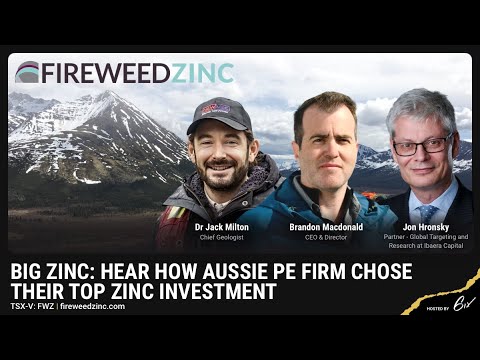
0:08 Hello everyone, thanks for joining the webinar today. This is a joint webinar with Fireweed Zinc and Ibera Capital. This is a relationship that really started prior to Fireweed Zinc about almost 10 years ago. I met one of the principals of Ibera Capital at a conference in China, their managing principal, James Walbank. And out of that relationship formed a discussion in the early days of Fireweed, which led to many years later an investment, which you saw last year. And I bear as a very globally focused group, but based in Australia. And they took a good look around, and as Dr. John Horonsky, who is with us today, can attest, they looked at a lot of projects, and for a zinc project, they chose our project for an investment.
1:04 You know, and John is, you know, no stranger to big projects and these, you know, exploration. He's a PhD in geology from the University of Western Australia, currently principal, not just at Ibera, but at Westmin Mining Services. You know, he has a history in BHP and currently also an adjunct professor at the Centre for Exploration Targeting at the University of Western Australia and also recently awarded the Medal of Order of Australia for his contribution to the science and practice of mineral exploration. So it's a pleasure to have John here and it's always a delight to hear him talk. And then presenting on the fireweed side is going to be our own Chief Geologist Dr. Jack Milton, who many of you know, started his education in England but did his PhD here at UBC.
1:54 Joined Fireweed in 2017, 1 of our first hires, and has really been contributing to the science around exploration of these sediment-hosted systems. So this has been a big year for us. Well, I say last year was a big year for us, really highlighting some much more size at Boundary West and some real intriguing great potential there, which Jack is going to go through. So without further ado, I'm going to hand it over to the 2 docs. I'm John Horonsky from our general partner at Ibera Capital, as Brandon has introduced me. So thanks for that kind introduction, Brandon. And I'm just going to take a little bit of time to share with you why Fireweed Zinc, what our investment thesis is in Ibera for making this investment. I'm going to give you a little bit of background on who we are first, but then talk to you about the process that we went through to focus and target our investment on fireweed. And that was as I'll run through a global process to do that and we are very much a globally focused group.
3:03 A little bit on Ibera. We are a private equity fund. We're based in Australia, but our investments are global. They're in Africa, they're in Europe, they're in North America. And we look widely, we're mostly funded out of the US, actually. And our investors invest in us, because they believe our unique proposition is an ability to use our technical expertise to identify high-quality opportunities and then do something with them to help improve them, either by ourselves or by working closely with management teams, such as we see with Fireweed. But In terms of our overall investment strategy, we're no orphans here, but we have a really strong focus on investing in the future-facing minerals that are the enablers of the energy transition that we're all aware that we're going through and the demands for metals. We'll talk a little bit more about that with respect to zinc specifically, because I think that's been a bit of a sleeper in this space. But the massive demands for minerals and metals to underpin this change, I think people sort of understand it, but they haven't, they're not really acting yet like it's true. They're not really factoring it into their investment strategy. And to me, the analog is people's attitude to iron ore in the early 2000s.
4:27 There was a lot of data coming out of China that said the world was going to change with respect to iron ore. But really, a lot of groups were very slow to appreciate that. The ones that got in early did very, very well. The early investors in Andrew Forrest Fortescue metals, for example, did very well. But a lot of people were slow to recognise the real impact of the thematic. They talked about it, but they didn't actually realise the impact. We have a view that these future-facing minerals, these future-facing metals will be broadly the equivalent economically and I suppose even geopolitically of oil. As oil was in the 20th century, they'll be like oil in the 21st century. So that's our strong focus. Here's our team, our partners, very strong expertise, plus 100 years of mining experience. I regret to say I bring a really big chunk of that myself and the other guys may be a little bit younger, but they've all had a lot of experience.
5:28 A group of them, James, Peter and Paul, all came out of Fortescue Metals and they were involved with that very rapid sensational growth process there of generating a lot of value. My background is very much mineral exploration. I work for Western Mining Corporation, a well-known and very successful Australian exploration company. I finished there as Chief Geoscientist. Then I was with BHP for a couple of years in the senior technical role in their global exploration group. Then since 2007, I've been consulting, working in the junior sector with listed companies and the last sort of few years as well with Iberia in the private equity space.
6:14 My passion is bringing science and strategic thinking regarding exploration and the mining industry to investments to basically do a lot better job and to see the potential, to reap the potential in these opportunities. I've been lucky enough to be involved with a number of significant exploration successes over the years, working with good teams. We discovered with Western Mining, the entire West Musgrave Nickel Copper province, which Oz are developing at the moment, being involved with the Kalawinda Bore District, the Venus Nickel Sulphide Discovery and the Greer Gold Discovery. So I feel like I've got a sense for, you know, these opportunities and that we'll talk about later, but that's the sort of sense that we have very strongly at Ibera for what we see here at Fireweed.
7:08 That's our leadership team. In terms of organisation, we currently employ about 70 staff globally, a majority in 2 major projects, 1 in Ghana, 1 in Serbia, but we actually operate across 4 continents. I won't spend too much time on it, but by the standards of the various groups analyse these things, currently we're doing pretty well in terms of our return on investment. Apparently, number 1 performing fund, so we must be doing something okay. This is about our investment model, and it's basically about trying to create value in that space between the initial discovery, and by discovery we mean will people recognise a major mineralised district or deposit has been found through to the construction phase where a mine's been built.
8:12 And we feel that putting capital into that phase, but also putting expertise into that phase is a really important lever for building wealth for us, but also for the shareholders that partner with us through that process. We're very, very focused on geological upside, and that's a big part of the fireweed story. We've got strong technical skills in mineral exploration, from the resource delineation to the real greenfields grass roots aspect of the business. There's myself there with some of my background, and there's my other geoscientist partner, Paul Lehipenia, who's our operational exploration manager in the work we do. Paul came out of Fortescue and had a lot to do with their early discoveries that built that company. So we think we've got a track record of involvement in significant greenfields and brownfields discoveries.
9:15 We have a strong focus on conceptual geological analysis and targeting. We don't just chase the numbers. We put things into geological models. We apply the latest exploration science, mineral systems science. That's something I'm particularly passionate about, but also the latest exploration technology. And I think you'll hear a little bit from Fireweed about what they're doing there, using techniques such as muon tomography. But that's what we like to do. We've had discovery success in Iberia and Serbia in the last year or 2 by applying cutting edge geophysical inversion technology. So we believe in the value created by that technology. But we're not just scientists. We have a strong experience in practical exploration management in the industry and a strong focus on what is it that actually makes economic sense.
10:05 So after we invest, we use this tech, so we use our technical expertise to select investments, but after we invest, we use our technical expertise to increase the value of our investments. And here are just 2 examples from 2 of the projects that IBERA are currently involved in. So on the left-hand side is a major new blind polymetallic discovery. We made it our 100% owned Rogozina project in Serbia. And we've just recently released an exploration target on that. And it's expressed the way it is because that's the way JORC says you have to do it. But we're basically talking about, 4 million ounces of gold equivalent at about 2 grams gold equivalent. So a pretty significant contribution.
10:52 The right-hand side diagram shows what we've been able to do to our West African Gold Project from the point at which we bought in in 2017, where it basically had a 0 NPV. We drilled a lot of holes, we found a lot more gold. We also did, I think, some better things in the project design. And now we're looking at a project with a $600 million NPV. So we do think that we're not just passive, we do think we can actually add value with our investments. So that's Ibera, but I want to focus now a little bit on fireweed zinc in particular. And what we see at Ibera as our investment proposition for fireweed zinc. And we really see 5 key points that motivated our investment.
11:40 First of all, exposure to zinc. We were quite interested in zinc because we think it's a currently underappreciated component of the clean energy transition thematic, and I'll come to that in a minute. We looked at Macmillan Pass as a high-quality development project, both in terms of size and grade, and our global scale analysis concluded that it was the best project in the world that was not currently held by a major. In other words, the best project that was available for a group like us to invest in. Very importantly, and I know we're gonna hear a lot more about this from Jack, is that we identified very significant geological potential to grow the project. Then, of course, it's in Canada. So tier 1 jurisdiction, Canada, Australia, those parts of the world where
12:32 We know that there's a regulatory regime where no one's going to take the all-body office and we can go through and develop a mine. We also felt like the company was doing a good job on its community engagement, social licence process. That's something we always like to see. That's very important for us and I think should be important for everyone investing in mining in the 21st century. So, a little bit on zinc, right? I mean, Unless you've been living under a rock, you've been hearing a lot about lithium, you've been hearing a lot about nickel, and copper, of course, is always there for electrification. But I think what people haven't really understood enough, and this is from last year's International Energy Agency report, which really highlighted, had a report come out really highlighting the role of critical minerals in the clean energy transition. If you look at wind, which is a really big part of this transition, there's a lot of zinc used in wind and it's basically about corrosion resistance galvanisation, particularly in the offshore.
13:37 So if you just look at that diagram and you can see the zinc bar there, the dark purple, there's almost as much zinc as what there is copper, kilogram per megawatt hour. And I don't think this has been appreciated. So that's what we've seen as a bit of an opportunity. Zinc assets still relatively undervalued compared to the big run you've seen in nickel and lithium in particular, but also copper. Then we carried out a global review and I can't obviously go into the details of all the parameters that we put into that, but when we identified Macmillan pass as a deposit with about 50 million tonnes at 10% zinc equivalent. You can see in this diagram where it sits on a zinc on a grade tonnage graph.
14:28 So just on the edge of the cluster of a handful of deposits, not even a dozen deposits that we think are absolutely world-class. So on that threshold, already it was one of the largest undeveloped zinc deposits, But, and this is the important point, we identified significant upside, multiple additional prospects and a plausible pathway with discovery success that we move it fair and square into that field of world-class deposits. And of course, as I said before, other aspects of our global review were its presence in a tier 1 jurisdiction in Canada and not being held by a major miner. So we then having identified at a high level, at a global level, identify the opportunity. The next thing we do in Ibera is we do deep technical DD.
15:23 I think a lot of private equity companies, because they don't have the depth of technical expertise we do, don't do this. They operate maybe at a more superficial level. But we get into the data. We download the drill data. We build our own models of the mineralisation. We build our own models of the regional geological context. And we assess what the thing actually could be. We did assess that and we've got a number. I won't share it with you now, but it's significantly bigger than the current number as to what we think is the ultimate target here. But just as one example, we were particularly excited by the potential of the new boundary zone discovery, where we saw a very large bulk tonnage, arguably a new style of zinc mineralisation being developed. That's on top of the resources already developed before.
16:18 We saw, apart from that, multiple opportunities to grow the existing deposits. And then what was interesting to us is that Firewood have only recently really consolidated the district. And then we saw multiple earlier stage exploration targets. Now, these are not all deposits that we expect to be brought to resource status tomorrow, but I think from the point of view of a real world class tier 1 mining camp, we know they're characterized by multiple deposits and mine life that are much, end up being much longer than originally anticipated. And we also know there's only a handful of these things in the world. And this is what the big boys want. These are the sort of deposits the majors want. So if you've got one of these, in terms of an exit, you're probably in a different category to the vast majority of deposits, which are much smaller. We also looked at the historical paradigms that had been applied to exploration here.
17:20 Macmillan Pass was where the SEDEX zinc concept was first developed, and that has a very strong stratigraphic focus on it. It's really a 1960s concept, and I don't think we think about these deposits like that anymore. We saw lots of opportunities exploring different parts of the stratigraphy, for example, to find more mineralisation where the historical paradigms would have said, oh, there's nothing there. Then we saw the potential to apply innovative new exploration concepts and technologies. Zinc exploration has always struggled somewhat because it doesn't have a nice, clear electrical geophysical signal like we used to have in nickel sulphide exploration or volcanic mesosulphide exploration or some of these other styles. But what we've increasingly seen is the power of high resolution gravity data to find these deposits. And then, as Jack's probably going to talk about, also some newer technology like the muon tomography.
18:15 So that's basically our thesis. And I think that's probably enough from me. You can ask me any questions later, but let's hear more about this exploration potential from the management team and specifically Jack. Thanks very much, John. Yeah, I'm going to dive into some more technical detail here of where we see the upside of Mac Pass. And just before that, I'd like to acknowledge that the Macmillan Pass project is located on the traditional territories of the Ross River Danube Council, the Liyad First Nation, and the First Nation of Natcho and Ayakdán. And I will be making some forward-looking statements during this presentation.
19:04 So prior to delving into the technical detail, I'd like to give you a quick overview of what we see as a roadmap for creating value on the project. And essentially, where the project is right now, it's on the left-hand side here. We have Tom and Jason, our main deposits. And there's a 2018 PEA, Preliminary Economic Assessment, on Tom and Jason. That had robust economics, almost $450 million MPV after tax, and an after tax IR of 24%. Now on top of that, over the past 4 years, we've had 4 years of drilling and exploration success on the project. And we think that these are going to be crystallized in some milestones this year.
19:53 And that will be an inaugural resource on Boundary Zone, which is our new discovery, new prospect, in addition to an update and an upgrade of the resource at Tom and Jason based on some of the drilling that we've already done in the past 4 years, but have not yet crystallized, and lots of improvements that we see to various engineering studies in the next PEA. And what we're targeting after this expiration season and after the next PEA is a project of over 1 billion dollars MPV. That would include evaluating Tom, Jason, and Boundary Zone in an updated mine plan.
20:46 And a little on our exploration approach. So John alluded to this, the district was fragmented. Tom and Jason had been owned by different groups and they were United by HUD Bay, did a drill program there in 2011, and we purchased this from HUD Bay in 2016. And on top of this, we acquired the NID property, which is the location of the boundary zone system, from Tech, who are now a shareholder. And we purchased that in 2018, and we drilled that first in 2019. So the district was fragmented, and we've brought that together and consolidated the district. And we can look at that as a more holistic opportunity, looking at the development of these deposits alongside one another.
21:38 And the other half of our approach is using innovation, and also John alluded to this, the old model for Sedex that was born in the Selwyn Basin, I've put a strike out through that. That's no longer what we think, based on the latest science in the district, is what's going on. These deposits don't form from exhaling into very reduced seawater, but rather they're replacing certain layers in the stratigraphy that are more reactive in the subsurface. And that really changes the game in terms of looking for other deposits in the district, and it opens up this search space into other parts of the stratigraphy with a now perspective, as you're not limited to that one stratigraphic interval, as the previous model would have suggested.
22:35 And we're adopters of new technology, too. We've been using, for example, passive seismic technology to support detailed ground gravity surveys that we've finessed a new technique for terrain corrections. And we've developed a system whereby we can execute a gravity program and pivot on that immediately and drill a target, which is what we ended up doing in 2020 and making a new discovery. Further to that, we have partnered with IDEON as part of Canada's digital technology supercluster, which involves federal funding for this new technology, muon tomography, which is using muons generated in space, and they're detected by these muon detectors that fit down drill holes, And we're using that going forward this year to detect density contrast in the subsurface.
23:39 And we think this is a game-changing technology for exploring for dense mineral deposits. And it's going to open up another search space. It can see deeper than gravity. It's directional, and it should result in very precise targeting for these kinds of deposits. So with these search spaces in mind, We've executed exploration programs over the past 5 seasons and made a discovery at Boundary West, which is what I'm going to focus a lot of this talk about. And we're now on the pathway to development with an updated PEA coming in around about a year. So to sort of step back and give us some context of where we are, we're in northeast Yukon, near the border with the NWT.
24:31 We're at Macmillan Past, and it's really a district of zinc-lead silver deposits hosted in barite and shale barite sequences. They're in mid to late Devonian host rocks, and Tom and Jason are some of the largest undeveloped zinc deposits held by any junior. And we control the whole district at Macmillan Pass. But the Selwyn Basin also hosts the Faroe Mining Districts, which we don't own. But at the time of operation, it was the world's largest open pit zinc mine. It's hosted in slightly older rocks in Cambrian stratigraphy. And Howard's Pass, there's a huge zinc deposit there, over 400 million tons. Again, hosted in slightly older rocks in latest order vision to early Silurian rocks.
25:20 It's not owned by us, but it's showing here that the Selwyn Basin is a prolific zinc basin.
25:31 So here's a property overview map. You can see in that red box there, Tom and Jason, they sit either side of the Cannell Road, which is a Yukon Highway maintained by the government as an airstrip at Tom.
25:46 And the PEA that I mentioned earlier, we've got some details on that here. That is based on a resource at Tom and Jason only of 11.2 million tons of indicated at 9.6% equivalent and 39.5 million tons of inferred at 10% Zinc equivalent. And that results in these robust economics that you can see here, an after-tax discounted MPV of $448 million Canadian. The CapEx is less than that, and that's for a mine life of 18 years on the basis of starting with a couple of starter pits at Tom Adjacent and then going underground to chase the high-grade mineralization. That PEA was done in 2018, and it did not encompass any of the rest of the property.
26:39 And we've slowly added different claim blocks to this property through acquisitions over the past 4 years. And we now have almost 1000 square kilometers of highly prospective ground in the Selum basin.
26:56 And boundary zone is not included in the 2018 PEA. So boundary zone here, you can see there's a couple of drill highlights, 100 meters, that's true thickness of nearly 8% zinc from surface, within a broader interval of 230 meters of 4.1% zinc. And we'll dive more into the technical detail at Boundary Zone later in the talk. So the blueprint for the value creation, we see the 2018 PEA established the base case, working Tom and Jason only. We believe that there's multiple ways that we can increase the value of this project going forward. The first of these is a commitment from the government, which they've made, to commit $71 million to fund the road leading to the project, upgrading the road. We accounted for that within the PEA.
27:52 So we'd anticipate that an updated PEA would look much more favorable.
27:58 There's many engineering optimizations, such as all the geotechnical data that we've gathered in the past 4 years of exploration, we can use to evaluate the steepness of the pit wall at Tom, which is going to make a big difference to strip and the early part of the mine life, the open pit. But very significantly, we see a lot of potential for expanding the resource, both at Tom and Jason, and upgrading that resource, not only in category, but increasing the grade of the resource. And I'll walk you through here a few examples from Tom and Jason where we see that. So this is the Tom deposit. We see that 3D image there. We've got Tom West, Tom North, and Tom East. These are 3 separate zones that make up the Tom deposit.
28:53 The majority of the tonnage is hosted at Tom West, and a very high grade part of those tons is at Tom East, too. On this slide, you can only see drill holes that we have drilled since doing the 2018 resource.
29:11 And in a lot of those drill holes, the grades that we encountered are significantly higher than we predict from the 2018 block model. And that's due to much better recovery with modern drilling methods and a lot of the higher grade material is softer and has been washed out in historic drilling due to the use of small diameter core. So even with the drilling that we have there already, we'd anticipate a higher grade in the block model if we were to redo the resource today. And with a small amount of drilling, We think that there's potential to increase those grades at Tom West. And that's very significant for the mine plan because this would be the first part of the underground production, years 3 to 8 or so at Tom West.
29:59 And a small change in grade in those years makes a very significant change to the overall project economics. We've also stepped out down dip at Tom West, and we think that there's potential there for the resource to grow. Tom North was a discovery in 2019, or a rediscovery, and is not included in that 2018 resource. So here's a bit more detail on Tom North. And this is a long section here. So going through Tom West and on the left-hand side, outlined in dashed blue, you can see Tom North, our exploration target. We put 7 holes into Tom North in 2019, and we were getting grades of about 6.1% zinc, about a percent lead over intersections up to 22 and 1 1⁄2 meters. And we drilled this about 100 meters down dip and think there's potential here to add this on to the existing resource.
31:00 And it may add as much as a year or more to the open pit mine life at Tom. A quick look at Jason. Jason split into Jason Main and Jason South, which are on opposite limbs of a syncline. At Jason Main, there's potential to do a small amount of drilling and step out the resource into some areas in which it's open, and potentially increase the grade in the block model there too. Jason South is a very high-grade part of the overall resource. It's very lead-rich, it's very silver-rich, and there's a couple of stranded historic intersections, which you can see on the left-hand side of this cross section, where there's very high-grade numbers in these intersections, but they weren't included in the 2018 resource.
31:59 And we now understand the geology much better than we did back then. And we can see that Jason South has essentially been cut in 0.5 by a fault. And there's very little drilling on the other side of this fault, just these 2 intersections. And with a small amount of drilling, we think that there's potential there to define some high-grade tons, which could potentially displace lower-grade tons in the mine life, earlier in the mine life, and therefore improve economics. So another part of how we see increasing value and upside in the project is Boundary Zone. We first drilled Boundary in 2019.
32:46 It was discovered in the early 80s by Kaminko, and we acquired it from what became TEC in
32:56 2018. We drilled some holes at Boundary, Maine, and encountered significantly higher zinc grades than anticipated. We followed that up with a new discovery at Boundary West in 2020, and last year in 2021 discovered a new zone of very high-grade laminated strata-4 mineralization, similar to Tom and Jason. So by integrating an inaugural resource at Boundary Zone And integrating that into the larger mine plan for the 2023 PEA should, we'd anticipate, adding significant value.
33:43 So here's a quick look at boundary. This is a schematic geological map. But note the hesphalt. This is a significant crustal structure. It's a since sedimentary feature.
33:56 It's fundamental to the architecture of this basin. You have very significant differences on the stratigraphy on either side, showing that it's a syncytometry fault and that mineralization seems to be associated with volcanic rocks and coarse plastic rocks in the hanging wall of this fault. So on this map, the yellow lines are draw hole composites that are over 1% zinc. And this is really sort of following up on the ideas that mineralization is not only located in that one particular stratigraphic interval, but can be found in other parts of the stratigraphy in other reactive host rocks.
34:45 And the way that we discovered Boundary West was through a ground gravity survey that we did in August 2020. Then we, this is the results of this ground gravity survey. Huge gravity anomaly over a kilometer wide, significantly over a kilometer wide, at about 600,700 meters across. There was a large part of the high on the western portion of that high that had no historic drilling, No outcrop in the area, blind discovery. We drilled the first hole into that and hit 26 meters of massive sulfide.
35:28 The size of this gravity anomaly suggests that it's a truly massive system. It's barely been drilled. And even if the grades were low, which we know at least in quite a few circumstances they are not, the metal endowment could be staggering. So this is cross section A to A' so looking at boundary main. The mineralized zone on the sections highlighted in that kind of red-orange color, and it extends from surface to about 250 meters down dip. We think it's about 2 to 250 meters thick. And there's higher grades that tend to be concentrated in the near surface. So a few highlights here. Looking at hole 2 from 2019,230 meters of 4.1% zinc from surface, including much higher intervals, 100 meters true thickness of nearly 8% zinc, and 6.5 meters of 42.5% zinc. So those are the very high grade vein breaches that we see at Boundary Zone.
36:41 We also identified some copper mineralization this year in hole 21005. We stepped out in the down dip direction. We confirmed zinc mineralization over a width of over 200 meters. But we also hit a zone 1.5% copper, 5.4% zinc over 2 meters in this hole. And that was significant because the first discovery of copper mineralization at boundary probably means that we're getting into a hotter part of the system. And that hole significantly extended the mineralization down to it. So what does this stuff look like? Well, it's extremely different in character to the mineralization at Tom and Jason. Tom and Jason are the classic stratiform laminated mineralization, very fine grained, hosted by barite and shale sequences or mudstone sequences.
37:42 What we see at boundary is coarse plastic rocks. So We have mafic volcanic plastics that are carbonate altered, replaced by siderite. And we see an infill around these clasts, and sometimes replacing the clasts themselves, in the volcanic plastic rocks of sphalerite and galena. We also see lots of veining. And it's a kind of stockwork nature to these veins rather than being sheeted. We see vein breches, and we see thick banded veins of sphalerite galena, siderite, and pyrite. And we often see this biogenesis of this early red-brown sphalerite to a lighter tan-beige sphalerite. And so that was Boundary Main. Boundary West is about 500 meters to the west of Boundary Main, and we're going to look at cross-section BB through there.
38:39 These 2 areas may connect geologically. We don't have much drilling in between these 2 deposits, but they may well connect together. But the mineralization at Boundary West is a slightly different style. So what this cross section is showing is a few of these different styles. So the purple layer that you can see in the center of this cross section is what we discovered in 2021. It's a high-grade zinc-lead silver mineralization that looks very similar to Tom and Jason. And it looks like you might be on the edge of one of these kind of systems. It's exactly what you'd see at the edge of Tom West, or Tom East, or Jason South, the same colors of sphalerite, the same kind of grades.
39:32 And these grades, in talking, you know, 10.4 meters of 23.7% zinc, 3.4% lead, and 75 grams of silver. That was a new discovery last year. We hit it in these 2 holes and another 2 holes in another section, and we're excited to follow up at down dip on this target. The discovery hole, hole 4, intersected 26 meters of massive sulfide, and the massive sulfide is the red color on this section. That goes from surface, where the grades are about 4.7% zinc over widths of about 43 meters intersected. And those grades increase as you go down dip on this section. So we go from about 4.7 at surface to 6.4% zinc.
40:26 The next hole to 7.7% zinc. And in the deepest hole, between 8% and 10% zinc. So we're increasing in grade as we head down dip, increasing in smell right content, increasing in copper content as well, but not to economic levels, more sort of geochemically anomalous, up to about 1,000 ppm in the deepest hole, but all indicating that we're getting closer and closer to the feeder of where these fluids originated from. And in these areas, we'd anticipate higher grades. So what does this system represent? Well, this bottom image gives us a clue here where we have needles of barite that have been replaced by pyrite. And you often see them replaced by sphalerite also within this massive sulfide layer.
41:18 And surrounding these layers are zones of silicification that extend up and above these layers into the stratigraphy. So this is likely the replaced product of a bedded barite sequence. This is what the massive sulfides look like. The spectacular rock to see, a very exciting hole to come back to camp and see. 26 meters of massive sulfide. And I'm told this stuff would look not out of place in the core shack at Red Dog. Looks very similar texturally to what they see in that deposit. Other styles of mineralization that we hit at Boundary West include Howard's Pass style mineralization, and that is in the white circle in the top right image there.
42:15 Steely gray sphalerite replacing radial area in Chertie Black Mudstones. This is in the exact same age host rocks as the Howard's Pass deposit. And that was the other deposit there in the Solon Basin, over 400 million tons, very large sink deposit. Mineralization has not been found in rocks of this age at Mack Pass before, until we drilled this hole. So again, was good validation of following other parts of the stratigraphy, looking for mineralization in this search space. Underneath that, there's over 200 meters of stockwork vein mineralization, as you can see by these other 2 images. So many different styles of mineralization at Boundary West.
43:05 And I think that's really significant for how we view the system. This is a sort of summary of what I think a working model is for the geological evolution and genesis of the deposit. And that at this latest Ordovician Early Silurian Age rocks we have stratiform replacement zinc mineralization. We also see that in the younger rocks in the mid and late Devonian mudstones and barite sequences that are replaced by massive sulfide. These potentially could be the same event. We don't know. We don't have dates on them. But it could be distinct events. Then we have a highly localized minor remobilization of zinc in little syntaxial quartz veins. And then the veining, the stockwork veining that we see, I think is an additional influx of zinc into the system, bringing in these fowl right veins, the brecciation, and flooding some of the coarse-cracked plastic rocks, the volcanic plastics, and the conglomerates. And we don't know this age, but it could be even as young as Cretaceous in age.
44:12 But what we see in general at Boundary is these early-formed since sedimentary structures influencing mineralization. We see favorable reactive host rocks, barite, and volcanic plastics, multiple pulses of mineralization in a long-lived hydrothermal system where we see different episodes of overprinting and mineralization. So there must have been a large time-integrated fluid flux to form this system. And the plumbing architecture is deep for this system. It's plumbed into the asphalt. And I think that all of these things are very important geological factors that make very large sediment-hosted ore deposits. So an analog for this geologically and in terms of discovery could be red dog. This is a cross-section looking at Akaluk, which is being mined at the Red Dog Mine in Alaska.
45:11 In yellow, you see vein ore, and there's a couple of pictures on the right examples of that. And the red, you see massive sulfide. So you see isolated lenses of massive sulfide underlain and surrounded by vein ore. And surrounding that is silica rock, so silicification. And I think this is a good geological analog for what we see at Boundary Zone and Boundary West. It's a discovery analog, too, because I'm told that the initial discovery at Red Dog was made at surface in the vein ore. And it wasn't until several years later, when they started drilling it out, that we discovered the massive sulfide, which is replacing barite at Red Dog.
46:00 So an interesting geological analog. So how big could boundary zone be? Well, we think that the size potential is huge. There's at least 2 different sort of focuses of this hydrothermal system. There's boundary main and boundary west. And each one of those has dimensions in each direction over a couple hundred meters. On this diagram, you can just see zinc assays that are over 4% zinc. And we think that the tonnage potential at boundary is likely greater than the combined tonnage at Tom and Jason, perhaps as much as double that is plausible, at a grade that is somewhere around half the grade of zinc at Tom and Jason to about three quarters of the grade of zinc at Tom and Jason to about three quarters of the grade of zinc at Tom and Jason.
46:51 And that's on the basis of the first dozen or so holes in each of these systems, Boundary West and Boundary Main, and our initial interpretations of the geology in 3D. So it's truly a district-scale opportunity that we have at FireEat, as John mentioned in his talk. We've focused exploration around what we've termed the Fertile Corridor that runs through Tom, Jason, End Zone, another prospect that we've drilled since 2018 and is not in our 2018 resource, through boundary zone and beyond. And in 2021, we did continued ground gravity surveys down this fertile corridor, accompanied by soil surveys, which we are currently awaiting results for, but are showing some very interesting looking gravity anomalies in the Cobuck area.
47:51 So we think there's lots of blue sky potential for the project, and another avenue where we can unlock value at Macmillan Pass. So I'll finish with this roadmap of where we see us going in 2022 and 2023. We anticipate the biggest drill program yet at Macmillan Pass, expanding the resource at Boundary Zone and Boundary West, and potentially also drilling Tom and Jason and capturing some of the value that we see in upgrading and expanding resources there. We'll be pushing forward with Muon tomography surveys and anticipating a new global resource, including Boundary and Boundary West in 2023.
48:42 This is running in parallel with our engineering and ESG streams, where we see a lot of value in both of these streams, including looking at lots of trade-offs through the PEA, concurrently aiming for a new PEA next year. And for that, we're targeting to be in top 15 zinc-lead silver projects globally. We're already the largest project held by a junior company, and we want to do that by a good margin. We're targeting over 1 billion dollar NPV with a top 10 production profile with 1st or 2nd portal costs. And we think that these steps will lead us to a de-risk project with an accelerated permitting timeline.
49:30 And this lays out a roadmap to production. And we think that we have the potential here for what's truly a tier 1 project. So thanks everyone for listening. Great. So we're going to move on to the Q&A portion. So if you do have a question, feel free to submit them. We do have a few questions already. But the first one, I guess, is from what is the timing of the new resource and PEA? Yeah, I had to ask this question myself because one of the things I wanted to address was that, you know, our last PEA was, well, the resource was published in January and then the PEA came in May.
50:15 With the delays we've seen on assays these days, you know, like we haven't had our final assays from last season, I would anticipate the same delays this coming season, which means they're reasonably we're not going to see the resource until probably February, March next year instead of January. And that's likely to result in the same delays in the PEA, which I'm guessing would be June, July next year is a bit of a thumbs up. So before, you know, the usual people start freaking out because it's later than they expect. And it's pretty clearly, unless the lab somehow find a way to operate better than they have in previous years, everything is going to be slow this coming year, like it has been the last 2 years. Thank you. James is asking, what is Iberia's cost basis for Fireweed shares and how does the position compare in size to Iberia's other positions?
51:11 Cost base was about 80 cents Canadian. How does it compare? Look, it's a little bit smaller and we're open to opportunities to grow our investment. Great, thank you. How big is the boundary zone? That probably is for you, Brandon. Or for Jack, I think Jack can touch on that a little bit. Yeah, I could have mentioned a little bit about there. I mean, it's clearly a very large hydrothermal system. There's what I focused on the talk was boundary west and boundary main. What was drilled more broadly by Kaminko in the 80s was a much broader hydrothermal system that's over 1.5 kilometers in width.
51:59 It's probably over about 800 meters in the other direction. And we found 2 major centers of mineralization within that boundary west and boundary main. We think there's potential for more and the size of boundary plus boundary main together, as I mentioned, likely more than the tonnage Tom and Jason put together, but perhaps even as much as twice that. So Jack, you guys would probably almost have enough data to release an exploration target, wouldn't you? Yes, we'd be getting there. I think there's lots of geological uncertainty given the early nature of the discovery.
52:52 So we've perhaps shied away from releasing a formal target on it, but we're certainly getting there and with a sizable draw program this year I think will you know comfortably be in a position to put out the resource by the time the last assays come in towards the end of the year or the start of 2023. And interestingly exploration targets are far less common in Canada than they are in Australia. Although there is a mechanism for releasing them in Canada, it's not anywhere near as common, you know. So I think, I don't know that we necessarily feel apprehension about it because we've certainly discussed that internally and you know whether it was... I think you've got enough drooling.
53:38 Yeah yeah yeah yeah yeah you're right. Paula is asking how does it compare to other zinc players in terms of logistics given the location? Yeah, I mean look, the number 1 differentiator about our project, outside of perhaps size and size potential, is the location. And there's no escaping that we're 800 kilometer drive from port. You know, this, I'm guessing would put us quite frankly, probably in the wrong decile in terms of logistics. But look at projects like Red Dog, for example. Okay, a little bit closer to their own port, but their shipping window is 5 months, is it? Something like that, 6 months of ice-free access out of there, which adds significantly to the working capital requirements of that. Trevally's Roche-Penal mine in Africa, a very, very substantial trucking to port. And as John can probably attest, there's lots of mines in Australia that run those big road trains and truck a very far way to port.
54:50 As a challenge, it is the project's chief challenge. I would say 100% if this project was 200 kilometers to port instead of 800, it would be a hole in the ground and we would not be talking about it. But, you know, it- But then it wouldn't be an opportunity for investors like us. Right, exactly. And I think, you know, in terms of, I view it as a challenge, not a risk, because a risk suggests uncertainty. There's not a high degree of uncertainty around transportation. I think everyone on this call probably has the ability to phone some trucking companies in the North and get a quote on that and piece together what our costs are and verify that what we said in their PEA is pretty reasonable. And you know, what's amazing is that despite that trucking distance, the economics are still very robust. There's the size and grade such that we can, you know, overcome that. And I think in our next study, we'll move from our 2018 study was a Q3 sort of cost base, you know, third quartile.
55:53 You know, we think there's a real chance that we can work our way into the second quartile of cost base in our next study. That kind of, You kind of answered my next question, which was, would it not be prohibitively expensive to build a mine such a remote site? But I think you. Yeah, I mean, you know, because we're not building the road, I mean, we were originally in the 2018 PEA budgeting to improve it, the existing road, but we didn't have to build it from scratch. Now that the government's made a pretty big commitment on that and has indicated, will be further commitments coming as the project gets de-risked and advanced. I don't think, you know, your mill and all that stuff. Yeah, look, absolutely. It costs something to truck all that to site, but that's not a major, major component of the CapEx.
56:42 Thank you. James is asking which minimized zone boundary Tom or Jason is likely to be mined first. Is boundary shaping up to be entirely open pitable? This is the second question. One of the things that we, in the 2018 PEA, we viewed Tom and Jason being mined in parallel because they both had high grade zones. And so it made sense to proceed with both high grade zones, you know, front loaded as much as you can. One of the opportunities of the upcoming PEA is to throw everything out and say, well, you know, starting from scratch, how might you proceed? You know, we had looked at starter pits at Tom and Jason and I think that was those persistent into the new study. But you know, do you do a big pit at boundary?
57:30 And Tom and Jason that go underground there? Is Boundary just a parallel bolt-on? Do you do Tom and Jason and then do Boundary? Is it some weird sequence of them? Are you sharing mining equipment between the 2? We don't know. And I think that's, those are a lot of the trade-offs that we're exploring now because as long as we have a conceptual resource on boundary we can we can evaluate some of those opportunities in advance of of having the full resource. You know in terms of whether boundaries entirely open pitable. You know, some of the high grade we're seeing at depths in boundary West certainly look like they could be underground targets. You know, a lot of what we see at boundary is big. It's below strip from surface and maybe wouldn't support underground, but Boundary West is a different beast. And certainly there's lots of targets around that area that could well be underground.
58:27 Think quickly, we just have time for one more question with one more minute here. How does the development of the project mesh with the emerging ESG guidelines? Yeah, well, it's kind of a question of which guidelines. I think that there's, it was brought up at the recent Roundup conference in Vancouver, that most ESG standards and reporting standards, there's only kind of a checkbox for Indigenous engagement, which is basically to say, like, Are you being sued by the local indigenous groups? If not, that's a check, right? And so literally, is there legal problems? Is the standard to be below or above, I guess? You know, that's probably not the way it should be in any country such as Canada that has significant Indigenous groups where engagement is essential. And it's not just about whether or not they're actively blockading your road or suing you. It's about whether you have MOUs, whether you have, you know, eventually a SIPA with, you know, some sort of participation agreement and, you know, the benefits of construction and production.
59:42 And I think that these are things that are well understood in Canada, although it's still an emerging practice. It's been a conversation for a while and I think that kind of does put Canada at the forefront of understanding how to do this and I mean rest assured, you know, people think that Canada's a complicated place to get a permit because of that. But it's going to be the same thing the whole world over once they catch up. I mean, look at the nations that ratified the UN Declaration of Rights of Indigenous People. So I'd rather be in the jurisdictions doing it right. So Brandon, from an Australian perspective, you know, we're very much focused on partnering with the traditional owners.
1:00:29 You know, From our perspective, I think some of the Canadian companies could do a little bit more in that space. I think you guys are doing a great job. One question just came in here, so maybe quickly we can address it and then I'll wrap things up. But Victor's asking, what is the status of the end zone? Sure, so, excuse me. So end zone is, it's called end zone because it was found in the early 80s at the end of the Jason property. And It, you know, just 1 claim over was the start of Kaminko's property. And there was even a, you know, a staking dispute at that time over who owned it and who would stake that first. Part of our exploration thesis was the consolidation of all this ground.
1:01:17 And I think that the company that owned the Jason property had been reluctant to put any money into it because it was right on the edge of that property. Now we consolidated this ground. And in 2018, we drilled a handful of holes at Endzone that confirmed what the early drilling there saw. Very lead and silver-rich zone right at surface, thin but very high grade. We've now done enough drilling at Endzone in 2018 that we think that it's sufficient to support a resource. And also at Endzone, there is a strong lead in soil anomaly, and it's located uphill and up ice of the end zone. So in other words, that lead in the soil is not coming from the known mineralization at end zone.
1:02:14 And we put a small soil grid over end zone last year, and we're still awaiting those assays, but that'll be something to watch out for. I think it's a very intriguing target. End zone is this high grade silver and lead rich mineralization, which is typically this feeder mineralization. And the question to me there has always been, OK, well, Enzone's there. It's a feeder mineralization, but what has it been feeding? And where is that? So we will perhaps answer some of those questions if we come back and take another look at Enzo this year, which is certainly on our list of targets that we're evaluating for this season. Great. Well, we are a bit over time, so I just want to thank you, Brandon, John, and Jack so much for taking us through the presentation and the Q&A. And also thank you for everyone who joined us today and asked questions. If you do have any follow-up questions, feel free to reach out to both the companies directly. I'm sure they'll be happy to follow up with you and you can also find more information at their website so firebeadsinc.com and ibera.com.
1:03:23 I'll pass it back to you Brandon if you have any final words. Nope I don't think I have any final words other than to say thank you everyone for joining us. Thanks to Dr. John Hronsky for being here. I'd say for traveling for the event, but for logging in from Australia. And we will be keeping you