Replay available

Advancing Frontiers: Fireweed's Record-Setting Year & 2024 Outlook

Explore the strides made by Fireweed Metals in 2023, marking it as a pivotal year in the company's strategy. This session delves into the specifics of its extensive drill program across key zones and the successful use of cutting-edge drilling techniques. Gain insights into the impressive drill results from Fireweed Metals' flagship Macpass Project, the significant mineral resources for the Mactung Project, the exploration potential of the Gayna Project, and how these developments position the company at the forefront of critical mineral exploration in Canada.

Tue, January 16, 2024 at 12:00 PMendedReplay
Advancing Frontiers: Fireweed's Record-Setting Year & 2024 Outlook
Company
Fireweed Metals Corp. (TSXV:FWZ)
Date
Tue, Jan 16, 2024, 12:00 PM ET
Replay
Watch the replay on this page · 1 h 3 min

On 6ix: 6ix.com/event/advancing-frontiers-fireweed-s-record-setting-year-and-2024-outlook

Replay

Transcript

Automated transcript · Written by software from the replay's audio. It can mishear names and figures; the replay is the record.

0:08 Hello everyone and welcome to Fireweed Meadows live event. I'm pleased to introduce the speakers for today, Brandon McDonald, CEO, Jack Milton, VP of Geology and Alex Campbell, VP of Corporate Development. This event is being recorded so you can watch it afterwards on YouTube, but as this is a live event, we're encouraging you to ask questions in the chat. You can find the chat in the bottom right corner of your screen, and we'll get to them in the most logical way possible.

0:35 But without further ado, I hand things over to Brandon to kick things off. Thank you very much. So today's format, I'm going to give a little intro and to fire away some context, cover our accomplishments in 2023, and then hand it over to Jack to really talk about geology and the outcomes of our 2023 program and where our headspace is at for exploration for 2024. But really we want to leave quite a bit of time for Q&A, so do please use the question function in the chat to fire some questions so we can have a good hopefully 25-30 minutes at the end to really go through an in-depth discussion with the 3 of us on the questions you ask.

1:32 In summary, I think most people who are habitual or perhaps degenerate, as I described it, junior mining investors such as myself understand that the broad thesis, that we've had a decade of chronic underinvestment in metals and mining, that that underinvestment means the cupboard is pretty bare in terms of quality development projects. FireAid feels pretty good about our development projects. MACPAS emerging as a premier zinc district globally. MACTUNG probably without question the best tungsten deposit globally, certainly in the West. We understand that these critical metals are essential, that there's limited, no substitutes for these, and that particularly in the case of tungsten, very geographically concentrated in terms of the supply.

2:28 So The endorsements we received in the last 14, 15 months have really elevated the company, not just been an injection of capital, but really raised our profile. 2023 was not when Lundin's came in, but they did close the financing with us their initial 1 in late December 2022 so almost a sort of 2023 event you know they put in 20 million dollars that initial financing put it about another 7 in the top-up we did in August 2023 massive endorsement from us, obviously a well-known mining family, huge amount of success, very, very sharp eye and disciplined due diligence process, looking at projects and investing. So, you know, certainly for us, feel pretty good about that endorsement.

3:25 Tech Resources also, you know, continues to invest in us. You know, They now own 8.4% of the company, pretty significant investment from them over the years, around $10 million through I think about 6 financings they participated in. So the world's third largest zinc mine or an operator of the world's largest zinc mine, when they like what you're finding, that's a pretty good sign. We still have quite a bit of catalyst coming in the first half of this year, amazingly, well, perhaps not amazingly, given the consistent disappointment with lab turnaround. We do actually still have probably about 34% of our drill results from 2023 pending, 6 holes from Boundary and a handful from Tom and Jason.

4:15 And we are expecting a resource update on MAC Pass, I would say Q2-ish. And then as well a preliminary economic assessment on MAC Tung as well, Q2, probably a little bit later in Q2. So quite a bit to come in the first half of this year as we lead into then again the 2024 program.

4:37 The cash position right now is $17 million-ish on hand. I don't remember exactly, but it's right around that. As noted in my intro, strong ownership from Lundin Group, Tech as well. Ibera Capital, which is a PE funded of Australia. They're ex Fortescue and BHP. Pretty good eye for quality projects as well. 12.8 percent, actually probably higher now. Larry Childress, a voracious consumer of shares on our open market, has bought 400,000 shares already this year. He has about 13% of the company.

5:18 And as a quick reminder, 3 projects, we're going to touch on all of them today and certainly open to questions on all of them. The real flagship is MAC Pass, That is a zinc-lead-silver project on the Eastern Yukon Territory right on the board with NWT. Right next to it, of course, is MacTongue, a tungsten project. And then north of those 2 is our Greenfields early-stage gain-up project in Northwest Territories. MacTongue and MacPass benefit from road access. We're able to bring in truck and trailer, fuel by a tanker, et cetera. Certainly keeps our operating costs reasonable for summer exploration. But critically, the government committed $71 million in terms of access or funding for access to our project in 2020 and are deploying that now.

6:12 That's a huge endorsement from the government that they recognize the significance of these deposits. 2023 was kind of a record year for us. I think that was the title of this forum here. You know, we completed our largest ever program. This wasn't largest by a little bit. This was largest by a factor of about 3x. I think 2022 was pretty, but you know, until that point, our largest ever program and that was, I want to say 7,500 meters, and we completed over 22,000 meters in 2023. So a real change for us. A lot of that came from, or the capacity to do that came from the introduction or construction of a new camp. You know, as a junior mining company, you're frequently hand to mouth in terms of financing to expenses.

7:05 So it's often hard to invest in these significant capital projects that save you money and expand your capacity in the coming years. You know, you typically, if you don't have a payback period of 1 year, it can be hard to justify the capital of these sort of investments. But with the backing from the Lundin's, etc., it really allowed us to take a look at how do we extend our season, how do we lower our operating costs, how do we increase our capacity in terms of total people. So the camp you can see there in that photo was put in last year. And we installed a new hybrid diesel solar generator, which is just reducing our fuel consumption, it's reducing our greenhouse gases. And we had a good record of environmental stewardship and a safety record that included 0 lost time injuries.

7:51 So of that 22,000 meters, our new all-time best holes came out of that. And as I said, we have about 40% of those holes pending. And In terms of market and finances, it's 15 months or so, or 14 months, we've raised 50 million bucks in what has been an enormously challenging mining and metals market. I think there's been some statistics that perhaps 2023 was the worst market for capital raising in perhaps 20 years or certainly the top 3 for the last 20 years. A real statement that during this time with these enormous headwinds, firewood managed to do pretty well. So not only did we raise that 50 million bucks, we closed the acquisition of MacTongue in 2023.

8:47 We'd announced that initially in 2022, but finally got it over the line with the government of NWT in 2023. That's something our analysts give us about $150 million in NAV for, is the broad consensus on that. And that acquisition cost us 15 million bucks. And so you know given where we trade at on a PNAV basis that's a pretty substantial return on that investment. And I would note that of that 15 million we've paid 1 and a half, we owe another 3 and a half this year and then the remaining 10 is is backdated to construction. And you know during this year from basically the beginning of 2023 to now we've outperformed the venture mining index by about 40 percent. I'm hugely biased, I think we should have outperformed by a lot more and we had a great run in summer last year, but we're unable to defy gravity when the whole market showed a lot of weakness in the latter half of last year. We have, however, had a great start to this year.

9:51 And some context in terms of the markets we're operating in. I think most people on here probably understand why we need Zinc. It really dominated the usage by galvanization. This is infrastructure, automobiles, etc.

10:14 But you also have to consider alternative and emerging uses, fertilizer, batteries, particularly grid scale storage, you know, but also when thinking about grid expansion and renewable sort of deployment, a huge amount of galvanized steel in that and going to be important that the significant zinc usage for that as well and I think to me I can't Look people in the face and tell them that zinc necessarily has the demand story that a for example copper does What I would say is that the supply story of zinc is maybe amongst the worst of all the major base metals. Looking at this list here, this is the top 15 zinc mines globally as of 2022.

11:06 I would note that Kapushi and Ozernoye will appear in this list, if not 2024, 2025. You know, Take a look at the life of mines left there. 10 out of the top 15 zinc mines globally, officially, are closing in 10 years or less. Now, some of these we'll see brownfields expansion, some extension of mine life, but this is a pretty dire situation. So this is, you know, copper for example, you take a look at the top 15 copper mines globally, only one has a scheduled shutdown in the next 10 years. So for Zinc being 10 of the top 15 really reflects upon the crisis that is coming for Zinc.

11:55 And you think about the amount of quality Zinc projects that may emerge to pick up the slack when quite a few of these shut down, there's not a lot, right? In fact, there's very, very, very few that can credibly, you know, hold court with these sorts of projects. So we feel like we're in a pretty good place with MagPaths, you know, something that will eventually appear on a list like this and should stay on a list like this

12:24 for 20, 30, 40, maybe more years, right? So it's going to be a significant Global Zinc producer at a time that we're quickly running out of global zinc, or our significant producers. Tungsten, quite a bit different. There's characteristics of tungsten that make it truly indispensable. It is the highest melting point of all the metals, as tungsten carbide is the hardest of the metals, and its hardness second only to diamond. It is about the third heaviest of metals, just slightly heavier than gold. This makes, in certain applications, it difficult, if not impossible, to produce. So yes, like this is machining for manufacturing, this is drilling, boring, cutting, mining, logging, etc. But also a lot of uses in integrated circuits and electronics, a lot of uses in aerospace, particularly where that super high temperature is needed, and a lot of use in defense.

13:28 You know, the heaviness and hardness of tungsten, particularly important in defense. And that really has brought tungsten, among other metals, to the news recently. And the US government highlighting tungsten as a key supply chain concern for defense. And they recognize that 85% of tungsten is mined in China, another 4% in Russia. There are no tungsten mines in north america

14:04 yet to you know 10 ish percent of tungsten it's used for defense applications and this puts them in an extremely you know makes me extremely anxious about how they secure this so I think the u s who is always considered you know access to raw materials I'm not just an industrial concern but a national defense concern, probably one of the best nations or fastest nations to really take this critical mineral zeitgeist and move with it. You know, the 2024

14:35 National Defense Authorization Act had a couple of key things that I would encourage people to consider. First, that the national defense stockpile is now authorized to purchase or to engage in offtake agreements effectively for up to 10 years. They can also co-fund feasibility studies

14:57 and it expands the scope of eligible projects to US allies. I mean, Canada was always kind of eligible because under the Defense Production Act of the US, they consider us effectively as good as an American project. You know, other changes coming, you know, advanced procurement for critical metals is possible through the new defense, National Defense Authorization Act,

15:23 including multi-year and advanced payment as well. So, potential possibility as well for advanced procurement there. So, all of these things, really, we recognize that MacTongue's in a unique position and Jack will touch on the new resource, but it's a resource that's big enough to not be a band-aid for North American concerns around tungsten, but to be a solution for it for multiple generations. So this puts, you know, totally in a, you know, what I think is a great position for Fireweed. We've got 2 great projects, very topical, both of them in the coming years and decade. And so I think that's why we've got a great few years ahead of us. So I'll turn it over to Jack now.

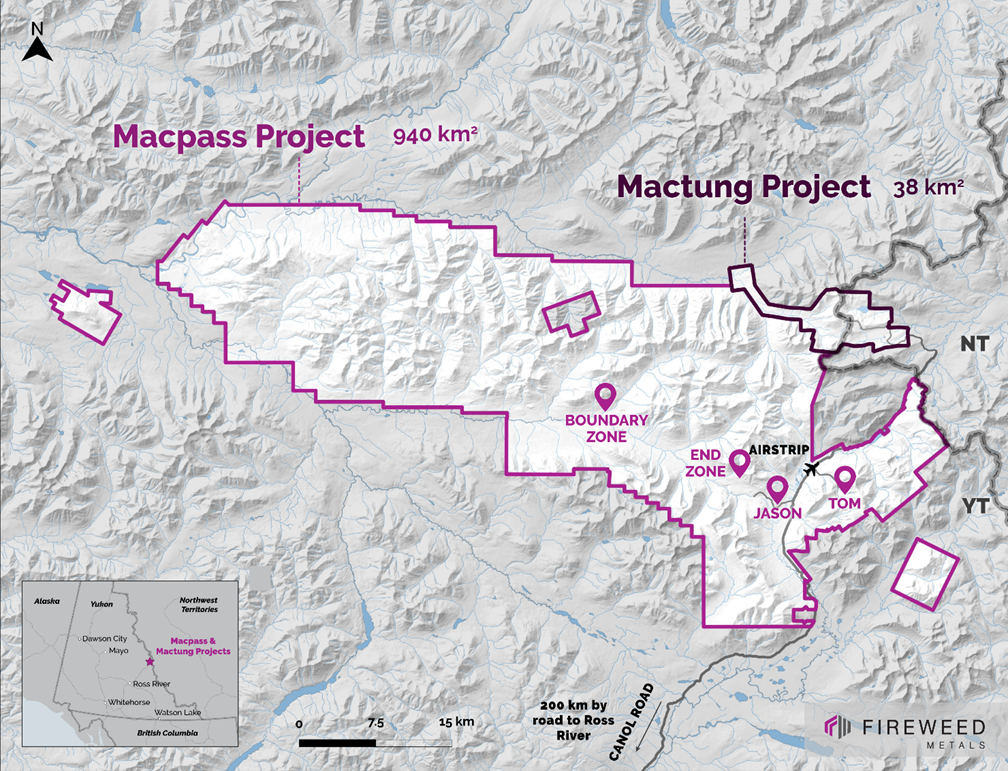
16:14 Thanks, Brendan. So I'm gonna review our successes in 2023 and talk a little bit about 2024 plans. First, I'd just like to acknowledge the projects located on traditional territories of indigenous peoples, including Kaska Nation, First Nation, Natcho-Nagta, and the Saatu-Sasquat area of the Nakta. I'll also be making forward-looking statements, and these should not be unduly relied upon. So this is the map here of where we're sitting at MagPass. You see it's a very large property, look at the scale bar there. Almost a thousand square kilometers.

17:00 And our success is really this year of Augusta Tom, Jason, and particularly at Boundary Zone. We'll take a look at those areas in detail, but first we'll take a quick look at Magtang. As Brandon mentioned, we published an updated mineral resource, which was our first mineral resource on this property, since we took it over. And this establishes it with over 41 million tons of indicated at 0.73 W03, and over 12 million tons of inferred at a grade of almost 0.6% W03. And this establishes Magtang very firmly as the largest high-grade tungsten deposit in the world, And it really stands out there amongst tungsten deposits as an outlier in terms of both tons and grade.

17:53 You know, there's tungsten deposits that are much higher tonnage, but much lower grade. And there are tungsten deposits that are also high grade out there, but they typically tend to be quite small. At MacTongue, we have both, and we demonstrated that in a resource that we put out in June last year. We also included copper and gold in that resource, demonstrating a small amount of both those elements as byproduct metals. And what does this look like? Well, naktung is a classic calcic scar and that is where these deposits take out limestone layers that are sitting next to or above an intrusion. And these are the same sort of cretaceous intrusions that make up the Tombstone-Tungsten Belt, like associated with other deposits such as Canton to the southwest where the Canton Line operated, but also in a similar suite of plutons that host, for example, the Snow Line discovery, it's also in similar age plutons.

18:58 And these plutons are enriched in tungsten, copper and gold, And these fluids come out and interact with the limestone layers and replace the calcite in the limestone with calcium tungstate, which is sheolite, which is mineral that makes up the mineralization in these different layers of scum. The underground is particularly high grade. That would be the lower layer there that was constrained by underground mining, whereas the open pit would be in those upper layers that are slightly lower grade but still extremely high grade for tungsten deposit. We drilled a few holes at Magtung this year. And that was for, rather for an exploration, these were info holes for metallurgy that we needed in order to update that to kick off the PEA, which is ongoing and should appear at some time this year.

19:58 So heading from Mactan, if we go about 10 kilometers or so to the south, we get to Tom and Jason. And in 2018, we put out this resource, Tom and Jason, 11.2 million tons of indicators and 39.5 million tons of inferred, both at a grade of about 10% zinc equivalent. And this establishes Tom & Jason as the largest undeveloped zinc faucet owned by a junior company. And since 2018, we've had success in our exploration, including in 2023. And we are yet to announce draw results for those years, but we have announced that we successfully hit on those targets. And we'll be receiving those assays and disclosing those imminently.

20:51 And so we had success at Tom, we had success at Jason, and about 15 kilometers up the valley along trend from Jason is Boundary Zone. And Boundary Zone, we discovered a new zone there in 2020, and this is really what we've been focusing most of our exploration on, and we've had some very good successes here this year. And when we approached the expiration in 2023, at the start of the season, we had some strong indications on this long section here that there was this untested potential feeder zone at the sort of intersection of boundary west and boundary main. We now just refer to it all as boundary zone as this year we infilled that gap and stepped out from some of our best ever holes on either side of this gap and replace those with holes that surpass that in terms of the grade and thickness of those holes.

21:57 So we successfully connected these 2 zones with something that's rarely found in these kinds of deposits, which is a feeder zone. So we have drilled that out in a couple of these holes this year. So this box that we see, this rectangle, relates to that previous long section. And what you can see on this long section is our interpreted truth thickness of a zone, a steeply dipping zone, of laminated to massive sulfide mineralization. And in the boxes, you can see the grades where we're trending towards higher grades at greater depths and the colors on the section in that are contoured of the true thickness. So we can see that we get up to 40 meters or over 40 meters up to 50 meters true thickness of the zone at its thickest point, and it thins towards the edges. And if you look at the scale here, those squares on that long section are 100 by 100 meter squares.

23:00 So what we've discovered at Boundary is, I think, really something quite substantial. The holes that we've released, we see on the left here, NB23007, that hit 2 distinct zones, an upper zone, which is not on this long section, and a lower zone, which is within this massive sulfide laminated body. You can see the true thickness from the long section there. And that created, you know, 82.5 meters of 11.9% zinc, 2.2% lead, and 81 grams of silver in the upper zone and even better grades for a greater intersective thickness in the lower zone. And we surpassed this hole again with a hole that we put out very recently, hole 28, that intersected 143.95

23:52 meters of 14.45% zinc, several percent lead, and 60 grams of silver for a true width of 50 meters. So we still have some assays to report on this and other 5 or 6 holes at boundary, plus the assays from Tom and Jason. But so what we can see is a trend to higher grades and greater true thicknesses at depth. And what we're doing right now is working on the resource, which we aim to put out and complete and then put out by Q2 this year. And a boundary, we're now at the stage where we think, you know, we've drilled out this massive sulfide layer substantially enough to put it into a resource.

24:47 And it's not only this stratiform layer, but outside of the stratiform layer, there is a substantial amount of vein mineralization that we've in this halo around on either side of this steeply dipping layer. And we'll see a quick video of what this looks like here in 3D. So we'll take that long section

25:08 and this is gonna appear in 3D. And what you're gonna see is a wireframe in purple of our interpreted massive sulfide to laminated zone. And down the drill holes, you're looking at everything that's over 1% zinc in those drill holes in terms of the acid. So you can see on either side of that steeply dipping layer, there's between 100 and 150 meters of a halo that contains significant amount of this halo vein style zinc mineralization. And this will also be included within our upcoming resource. And I think that, you know, the scale that we can demonstrate the boundary zone will be substantial, and it will be sort of rubbing shoulders with Tom and Jason.

26:00 We're not done with the exploration at boundary. We still haven't found the edges of this thing. There's plenty of places where we can step out from no mineralization that we successfully drilled this year. We sort of, you know, run out of time and drill meters in the drill season would have kept going if we had had more time. But there's plenty of places where we think that we see the potential to make this, you know, even larger in terms of its known footprint and extent. So aside from boundary zone, looking forward into 2024, we're going to have a renewed focus into doing some generative exploration and focusing on some of this early stage potential that we see on the rest of the property.

26:52 So if you were to draw a line between Tom in the east through Jason, end zone, boundary zone, and continue along that trend, you would get a sort of roughly northwest, southeast striking vine. And this is the trend of zinc deposits and occurrences that occur within some of these major districts within the Saltwater Basin. So we have the Anvil District, Rampharo, those deposits all trend along that exact same strike. At Howard's Pass, the deposits that make up that resource and mineralized system all trend along that strike as well. And at MACPASS, we see the same thing in the known deposits and advanced prospects and showings, and we anticipate that this trend will continue on the basis that it's formed by one of these early sedimentary faults that forms these very prospective areas for fluids to focus and these deposits and prospects to form.

27:57 So it'll be a renewed focus on that moving forward into the 2024 program, in addition to targeting step-out holes at Boundary Zone and certainly at Tom, where we've seen success this year. Jack, can I say a couple of questions on that previous slide? Absolutely. So in terms of – there's a massive area there with blue sky potential. I'm sure many people are – have a question. How many targets do you think are there that we could potentially drill in the future? And if so, which ones would be the ones which you would allocate a higher priority to and Why?

28:47 Yeah, great question. So there's many targets within this area of Blue Sky. That part of the property we picked up a few years ago, it was initially explored by goldfields in the boom in Yukon for Carlin-style gold exploration. And there was a huge amount of data gathered in that part of the property. They flew detailed EM mag. They did about 30,000 soil and rock samples, and they assessed those only for gold. So they were looking for carlin-style gold mostly, also intrusion-related gold. And they found a few things. We have the oro showing, which is a known showing around there. It's a very small mineralized system.

29:39 But they didn't really find what they were looking for, which is these large carlin style deposits that occur in these calcareous soil stones and shales and limestones.

29:53 But what they didn't do is go back and reassess for base metal potential. And so we inherited all those data when we acquired that property. And we have a great opportunity to look at these data sets that were collected using modern methods and multi-element geochemistry. And instead of gold, target zinc, lead, silver, and all the pathfinders, barium, mercury, and arsenic, and all the things that we use to identify these kind of sediment-hosted massive salt bite systems, and go in and target some of these very early stage prospects. And from there, we've already identified a number of these anomalies. We can go out, do some prospecting, do some early stage geophysics.

30:43 For us, ground gravity is a very effective tool. That's what we found boundary west and drilled the discovery hole boundary. That was following up on a gravity anomaly combined with a geology and a soil geochemistry. And we can use these tools to define and act on drill targets within the 2024 drill season. Outside of that area of blue sky potential, there's a few targets that are ready to drill test. For example, at Endzone, We have a target that we've wanted to drill for the past few years. There's a lead in soil anomaly that's sitting up ice and uphill from the known mineralization at end zone, which we think is a very compelling target for discovering a sort of satellite zone to end zone or a new zone there potentially.

31:38 We also have another target near Jason, it's drill ready. And we have a target called Bog, which is right next to boundary zone. And that could even be included within boundary zone. It sits a little bit away from the area where we've been drilling so far. So we have some drill rating targets, and I think that we're well set up and well positioned and experienced to generate a lot more of those in 2024 and potentially act on those by the end of the season. How does the scale of the lateral extent of the main fault here, and, you know, the distance between Tom and boundary, how does that compare to the major districts like Howard's Pass and Faro and what have you?

32:30 Yeah, so in terms of the scale of the controlling fault, like this is a crustal scale fault. It's a very large fault system. And that's a good thing in these systems. You want to be able to tap deep into these basins and provide a pathway for these fluids to come up and interact with the reactive host rocks, which in our case is barite, at time adjacent, could also be carbonate, where these things get replaced in the subsurface. So you need a big enough fault to generate those fluid pathways that you need to be sufficiently large to form large deposits. In terms of the spacing, between Tom and Jason, that's 5 kilometers. Between Jason and end zone, that's another 5 kilometers.

33:18 And between end zone and boundary, that's 12 kilometers. So it's about, you know, these things tend to occur in multiples of about 5 kilometers spacing. And that's very true at Howard's Pass, it's true in the Anvil districts, they have, you know, Van Gorder, Grizzly, Dye, Swim and Faro that are all spaced by almost exactly 5 kilometers. And we think this is something to do with the spacing in which large fractures occur due to the sort of thickness of the crust at these levels, and could be where cross faults intersects this main structure that forms the trend. So these would be at right angles to this, so the northeast-southwest intersecting faults. And where you have those 2 faults intersecting, you form a great area in terms of where the fluids can come up. And if you have the right host rocks there, then you have the potential to form large deposits.

34:24 So we have this curious area between end zone and boundary zone where it's a multiple of 5 kilometers. And there's always been this question of, is there something halfway between those 2 known prospects? And both of those, by the way, will be included in our resource update. And we have some indications in the soil geochemistry, a few sort of subtle geophysical indications that there's something anomalous going in there. And in 2024, we'll go in and do that work to let us assess those more fully and get those to a drill ready stage. But yeah, about sort of 5 kilometers or multiples of those is typically what you see in these kinds of systems.

35:19 Then maybe as a follow-up question to that, Jack, it's evident that there's plenty of areas that we could potentially drill. But how are we going to—I think Brandon has mentioned this repeatedly. This is kind of a triage exercise where we have so many different targets and we need to, you know, prioritize which ones to target. And so how are you planning, and this may be a question for both Jack and Brandon – how are we planning to allocate the drill meters between, you know, exploration, like, generation – generative drilling versus infield drilling at zones that we already know, and how are we balancing these?

36:11 Yeah, that's a good question. And each year when we approach the expiration, we go through this very rigorous targeting exercise of saying, what do we think the value, the potential value that we could add by drilling more meters at boundary zone, adjacent, at end zone, and known deposits or prospects? And we come up with a very rigorous way of ranking those targets and identifying those areas of opportunity where we see we could add the most potential value. The early stage of exploration, I think, is a different, something quite different entirely. Very difficult to estimate what you think the value of that could be.

36:58 You know, finding another Tom or another Jason or another boundary zone has potential to add tremendous value. It's obviously a more difficult thing to do, a sort of higher risk prospect. So in order to support those, we develop a targeting matrix and we assess, what do we know about the geology? What do we know about the geology? What do you know about the geochemistry? The geophysics? Is the gravity good? Is the EM and the mag consistent with targets of what we'd expect in these areas? And that's actually what we're going through right now. This week is going through some of these targeting exercises and figuring out which ones are our best targets and where we should allocate those meters.

37:45 And perhaps Brandon can talk about how we might attribute that in the overall program to each of those areas. Yeah, because you have to make decisions with imperfect information and ultimately decide what the balance is going to be struck between expanding the known zones where I you know in many cases we have nearly a hundred percent conviction that a hole will hit and I mean as evidenced by the fact that our step outs at Tom Jason and Boundary this year, 100% of them hit. So how do you balance that? I think we recognize that generative exploration is a different thing to undergo and it has to be equally important.

38:41 If we want to continue to demonstrate the district thesis here, finding another deposit would be extremely meaningful, even outside of the actual economic impact of that. The conceptual impact of that is actually much higher than the economic impact. So that's part of what we figured after the last couple of years. Really, since 2020, we've been quite heads down on boundary zone. And I think it's time to, And it's not that we've hit the edges of boundary zone yet, but it's time to kind of maybe look up and take a look around and do some generative work to identify some targets, firm up some existing targets, and test some existing targets.

39:28 Understanding that's a multi-year exercise, right? And I talked a little bit about budgeting, how it can be hand to mouth as a junior. Well, news flow is often a little hand to mouth as well. Like, it's tough to engage in things that don't bear fruit the year you do them, right? Because we have an extremely impatient market in the junior mining world. People want to, if you haven't done something transformative every 6 months, they're like goldfish, they've forgotten all about you and moved on to the next thing. So investing in these multi-year strategies is a commitment and a risk, but we think it's the important thing. You know, I take for example, put a couple holes in Kobuk this year, which was a good target and it was drill ready, did not hit what we were hoping to hit.

40:19 But we understand that the Cobox not dead, the first intersections into boundary were, I mean, almost all the intersections in boundary by the time we got it were modest, right? So it takes some time to kind of firm up targets, drill them, what do you learn from the drilling, refine your target, you know, drill test again, etc., right? So you don't want to repeatedly drill something that's not giving you anything. But I think you have to understand that not every target is the first hole gonna be a winner. So yeah, like that's broadly where our head's at. I think there will be more generative work this year than in past years, for sure.

41:09 And so just following the topic here, how does GANA, For instance, there's a question here in the chat room. How does GANA River fit into the targeting matrix and trade-offs related to the MacPass exploration targets? Well, I think Jack can say. Go ahead, Jack. I mean, really, I was just gonna say that GANA is really quite a different beast from Magpas and just to sort of step back, Ghana's 200 kilometers north of the area we're looking at on the screen right now in NWT. And it's very different geology there and very unique geology that really only occurs in 2 places known on Earth. One is at Gainer River, and the other is at the Kapushi mine in DRC.

42:01 And what's going on there is that we have these reefs, these stromatolite reefs. And this idea that this might be similar to Cappuccino came about in 2018. And we staked and acquired the property in 2022 based on this new idea. And this new idea sort of opened up the search space within the area to test this in the exploration environment. It's very different to MacPass. It has a sort of different risk profile. It is very early stage. But the potential reward there, I think, is very high. These CUSHI systems tend to be extremely high grade.

42:48 So even a modest size discovery there could really be quite significant. Yeah, and I think it's important to understand that the challenge with gain is that with a high degree of certainty, I believe we'll hit something, right? But the threshold for success there is very high, right, very high, given how remote it is. I mean, Rio Tinto sunk 27,000 meters of drilling into Gena. And Jack, I don't know if you know offhand, like what are some of the best intersections they hit? Like they weren't, the reason. Yeah, they hit some okay stuff over very short intervals, but what they were looking for there are these blanket type deposits that are very different from the vertical massive sulfide targets that we'd be looking for on the margins of these reefs.

43:41 And at surface some of these things are quite spectacular in terms of the zinc and lead mineralizations that's exposed at the showings. And really it's scaling up the thesis of how we found massive sulfide in boulders at Gainer and trying to find that on the scale of something that we could turn into a deposit? Yeah, so I think it's, you know, Gainer is part of our, you know, it's gonna be one of the targets we evaluate for 2024. You know, it has to be considered in the context of being a more difficult place to have success than MacPass, although not appreciably much more expensive than MacPass, actually, because the drilling is so much faster there in terms of testing the targets.

44:34 And then we have to give, and then there's no right answer because we don't know how the market will react to a discovery at Gana versus a discovery at MacPass. And I can't tell you which one is gonna be more rewarding for the company, right? So we don't, you know, we have to kind of figure that out and decide whether it makes the cut or not. And I would note, there's a question here I can ask, and someone's asked whether we're aiming to convert some of the resource into indicated for 2024. The answer is kind of. Like I think we're still mostly focused on resource expansion. However, I think it's quite likely there are going to be some targeted infill in areas where the resource is most uncertain and most valuable.

45:26 So if we were putting our hat on and trying to decide where are the risks with this resource? What would a partner or acquirer want to see? Where would give them heartburn if they were going to pay a significant sum for the company or project? What parts of the resource would give them heartburn, and maybe some selected infill there. We're not ready yet to engage in the comprehensive infill drilling to methodically convert the early years of the mine life to Indicator. Which related to that in terms of the conversion to indicator and plans, I think there's some questions around both what projects more advanced and what do we kind of think our timelines at. MAC passes is what I would consider advanced expiration.

46:35 I mean, some parts of it are early expiration, really the generative targets. Slash earlier pre development. Right, we are doing the baseline. To work towards environmental assessment and permitting. But we haven't delineated the edges of the system, so it's hard to submit a permit yet when you really don't know the disturbance area that you might be looking at for a mine plan. So we're not ready to really engage in permitting for MACPASS yet. MACTUNG is different. MACTUNG has been through the environmental assessment. It's had a positive recommendation to proceed. We feel pretty comfortable about being able to rely on that environmental assessment, which means that all we have to do is get final licensing done.

47:20 No, by virtue of the fact the past owner went bankrupt, there's a gap in the baseline. We're plugging that gap now. We need a couple of years of water, wildlife, et cetera, monitoring to get into the final permitting process. But I think it's quite possible that we break ground on that in 3 or 4 years, subject to a lot of things. But that's, I would say, quite near term. So that's part of the reason, again, MacTongue doesn't need a lot of drilling for indicated or much at all, It is a dominantly indicated resource. There might be little bits of inferred that appear early in the mine plan that we might selectively infill, but for the most part there's minimal drilling to do there and the spend required to get the MAC tongue to get the Mac tongue to final investment decision is many, many quantums lower than Mac pass.

48:31 I have a couple of questions from not necessarily from this chat, but stuff that I've been seeing people ask lately. It's more corporate related. So you mentioned our cash balance of 17 million as of today. How are we planning to deploy that cash over the course of Q1? And this ties to another question, which is, when are we planning to do a financing? And what would be the quantum of that financing? What should we expect around that? Yeah, you know, we wanna drill quite a bit this year, right? We've got the new camp, we're set up for more people for an earlier start, for a later finish. We could do more than we did last year. We could do 25,000 maybe 30,000. I think Jack we'd figured what that that it got a little tricky trying to get more than about 32 or 35,000 but up to that is doable.

49:30 We got 22,000 last year while also building the new camp and having that camp not being able to be occupied Until end of July was it early August, right? I mean, so It's we do it's we'll have a little easier time doing more. We got drills on site for an early start, but there's no escaping that are all in cost for drilling is something around a thousand bucks a meter, I think, fully, fully loaded, Jack, is that about right? That's right, yeah, just over. Yeah, so, you know, it means if we wanna get 25,000 meters done, you're gonna need about 25 million bucks. I think the timing and size of a raise is really driven, you know, more by the deliverables on our end and how we feel about our upcoming catalysts and as well, driven sometimes by whether or not a major new shareholder wants to come in and what their timing is at. I think a key thing for us is that in contrast to the situation that a lot of our peers in the broader market is in, we don't have a financing risk.

50:47 We can make a financing happen. There's no risk that we can't do something. And I think as evidenced by our last 2 finances, we'll even go further back than that. Typically, 0% discount to maybe a 5% discount and no warrants. So these are not usurious financings where the new shareholders get this massive benefit, no substantial discount, no four-year warrants, or anything like that. So for us, I tell you, as a CEO, massive, massive, you know, reduction in stress when you know you can make that sort of thing happen. So, you know, no firm answers there.

51:34 But I think we might look to do something probably before summer, even though we still have 17 million bucks in the bank. But we're going to be a little strategic about how and when it happens. Yeah, and partly, I guess it's contingent on our share price right which thankfully has been performing better this year. You know we're all a little bit disappointed with you know our announcements being that incredible and not impacting share price that much. But what's your view on that, Brandon? What's your view on what do you think is driving? What do you think can actually, you know? Well, I think that you have to consider that liquidity across the venture is terrible, terrible. Right, so, you know, last year was one of the worst years for fundraising, also one of the worst years for for fundraising also one of the worst years for liquidity on the market, right? So what it means is is that if someone wants to sell and and selling is not always about disliking the company Unfortunately, sometimes when you're doing well that puts a target on your back because people look at their portfolio, they need to make their mortgage payment or they got to pay for their divorce or whatever and it's like what's green in my portfolio because it feels easier to crystallize a win than crystallize a loss.

53:03 This is a major psychological problem of trading and investing that everyone needs to give a think about it, but why we do that, right? Why we sell our winners and ride our losers, right? So when you're a winner, unfortunately, you get good news, people sell. Now I think we benefit from having it's not that many sellers right the really great hole we had recently we did have a little quite a bit of liquidity into that I happen to know exactly who that liquidity was, unfortunately. But without naming and shaming, they're done. And yeah, so the hope is that now onwards and upwards, right? So I think we're certainly well positioned to massively rewrite.

53:53 And based on your view, Brandon, what do you think were the key milestones hit lately that drove that positive momentum that we've been having lately? Yeah, look, I think it's engaging, you know, like you mean just this year, right? I think it's a new year. I think a fresh look, I think as we're getting close to these major catalysts. I think as typical, we're expecting a pretty big change in the resource. I think we'll trade very well leading up to that and I hope we trade very well after that as well. I hope we surprise the market as we did with the last one. That's pretty typical, right? You know, I think other great news, we'll have some more drill results coming.

54:43 You know, hopefully we have all sorts of other surprise news to come as well, right? There's always some kind of out of left field stuff that, you know, long lead time stuff that's happening in the background. You know, and people talk about government endorsement and stuff like that. We are engaged with various levels of Canadian government, American government, et cetera. All this stuff, unsurprisingly with government, takes a while. But I think those are maybe some of the biggest catalysts we can have is continued endorsement and investment from the government. Because as you begin to see that the government feels like a project's inevitable, that really gives confidence to the investment community that the government's got to wait behind something, that it's not going to get held up unduly in permitting, that it can get a permit.

55:41 Because you assume before the government invested significant money, they would have at least had some sense of whether a project's permittable, period. So I think that's another potential major catalyst that could come, and I can't promise anything soon or at all. It's just a, it happens on a government timeframe. Yeah, I mean, my view is that as long as we continue, you know, doing stuff and pushing forward, and thankfully we have the backing to do that, things will get, will improve, right? And as you say, there's a bunch of catalysts in the horizon.

56:28 There may be a few more beyond that this year. And so thankfully we have the ability to push forward with what we want and what we need. And my view is that markets will pick up. We will be probably one of the top picks among all of our peers. And hopefully we can, as you say, re-rate. Well, I think that's a major thing, right? That Fireweed's not trying to be a beta play, right? Like we constantly generate alpha. We work our ass off to generate alpha, right? But I think everyone investing in the junior mining space, you know, like long suffering uranium investors who are finally getting a bit of torque now, right? That we understand that we pick the best-in-class companies for the alpha, but also sometimes for the beta, for the thematic trade, right? So and I talked about this in my first slide, about that there is a very, very compelling thematic trade in mining from producers down to junior mining, probably more junior mining who are more beaten up and therefore have the more you know to move and and the best companies when that rising tide comes move first and they ultimately move the furthest I think this notion that you buy marginal

58:00 companies because they have the most leverage is silly because marginal companies get blown up and that just doesn't work out that way. You buy quality companies if you want to do that thematic trade. So I think That's a big thing, right? And I don't want to tell people that they should buy fireweed because it's a great part of a basket that you can do beta in, but it is a good part of a basket. And I think picking that basket is also about picking the ones that have the best alpha as well, which I think we can. So, you know, I think that's, to my mind, important part of the investment thesis. Let's see if we have any questions here.

58:53 Oh, there's a question from James. Has the UConn government started on any of the promised 71 million in road upgrades? And that was 2020, I believe. So yeah, so the RFP, the RFP for a bunch of that work went out late last year. So we're expecting the ceiling. Of the Robert Campbell to happen or at least start in this summer and engineering work and the commencement of bridge replacement on the canal to likely start this summer as well. They just start, it's supposed to start last summer, but it didn't happen. But that's the critical first step is that the RFP goes out to industry and we've got responses to it and the tender's been awarded, right? So that's a good first step.

59:45 Sure. We got 3 minutes left here. Do we answer all the questions? I think we did. There's a quick question Peter that I could answer there about the MacTongue strip ratio and removal of waste before exposing the mineralized material. And the section that I showed was an east-west section, but if you were to cut the north-south section through that same model, you'd see that those top layers actually come right to surface. And so it's not like there's going to be a huge pre-strip, and then we get into the mineralized zone. It will be right from surface.

1:00:31 And there's actually exploration potential beyond that, where we see it exposed in the cliffs of the mountain, just in the Northwest. And the resource was just cut off at an arbitrary distance from the last draw hole. But I think there's a lot of exploration potential between there and where we see mineralized sheet light in our crop. So there's a bit of potential to make MacTongue even bigger, not that we really even need to because it's already enormous. But We haven't done any cash flow scheduling because that was just a pit that we pulled to constrain and report the resource, but we will be doing that as part of the upcoming PEA. Yeah, and lastly, before we sign off here, and I just gonna say the people from 6, I can just wrap it up now.

1:01:19 You don't need to introduce me to wrap it up. But the last comment there from Neil's asking whether the Lundines will be part of financing onwards. Yes, and we're moving towards more formalizing that relationship with the Lundins and being tighter integrated with them. So I've described this as Lundin group adjacent before, but I think that's getting a little closer in the coming years and months or more months. You know, we feel pretty lucky that we have a good relationship with them, that they're backing us and that we're really, from their viewpoint, one of their companies. You know, which, to kind of sum things up is why I feel like we don't have that financing risk. It's not just that the Lundin's themselves can write the checks, it's that there's a lot of people that follow them in. They bring us an incredible amount of credibility when talking to everyone from retail investors. I've had a couple great visits to Sweden. I look to be back in spring this year for the Swedes on the line.

1:02:28 I'll do another presentation there. And you know it's built us from that retail crowd to small funds to large funds to major mining companies. It gives us audiences that were difficult to get before. So I think Fireweed has the right audience, we have the right news flow. We've had quite a bit of torque already. I think we expect to have quite a bit more. We hope that you sign up for our mailing list, keep following us on Twitter, etc. And we hope we can deliver not just some excellent results in 2024, which I dare say is a given at this point, that we will have some incredible results.

1:03:14 But I think it will also be game changing as well. So thank you very much, and thank you everyone for attending.
Follow Fireweed Metals Corp. into a list and get an email when it puts out news.

Latest news releases

Companies on this call

Speakers

Speaker profile Brandon Macdonald

Brandon Macdonald

CEO & Director at Fireweed Metals

Brandon is a registered Professional Geologist with diverse experience focusing primarily on international exploration geology and investment banking in the metals and mining sector. Brandon began his career working in structuring financings and risk management at Macquarie Bank in London, England. After graduating from his MBA (with Distinction) at Oxford University, Brandon returned to the mining sector and for the last 10 years has focused his efforts on exploration and development working as a Director, Chief Financial Officer and/or Consultant to various junior mining companies in Canada. In 2016, he was appointed as CEO and Director of Fireweed Zinc Ltd. where his long history of mining exploration work, specifically focused on zinc projects in the Yukon, is advantageous to the projects. Brandon originally hails from Ross River, YT, near the Macmillan Pass Project site. Brandon holds a Bachelor of Science in Geology from University of British Columbia, and a Master of Business Administration with Distinction from Oxford University.

Speaker profile Jack Milton

Jack Milton

Vice President Geology at Fireweed Metals

Jack is a registered Professional Geologist and a Fellow of the Geological Society of London with over 14 years of experience working on projects across Yukon, Northwest Territories, and British Columbia. Jack has a passion for testing new ideas and technology in the exploration environment and brings experience from grassroots exploration, resource expansion, and developing advanced-stage projects. He has expertise in sedimentary rock-hosted base metal deposits, and the geology of the northern Canadian Cordillera, with multiple publications in international, peer-reviewed journals. Jack holds a Ph.D. in Geological Science from the Mineral Deposit Research Unit, at the University of British Columbia focusing on the Redstone Copperbelt. He also holds a Master of Science in Mining Geology, and a Bachelor of Science (Honours) in Applied Geology from the Camborne School of Mines, University of Exeter.

Speaker profile Alex Campbell

Alex Campbell

Vice President Corporate Development at Fireweed Metals

Alex is a mining professional with over ten years of combined expertise in South American mining operations, mine finance, and Global Capital Markets. He began his career at Antofagasta Minerals, working at the Los Pelambres copper mine in Chile. Subsequently, he relocated to Colorado to pursue his master’s degree while concurrently working at Resource Capital Funds and the Critical Materials Institute, a U.S. DOE innovation hub focused on the development of secure and resilient supply chains for critical materials crucial to the energy transition. Following this, Alex spent five years with CIBC’s Mining Investment Banking Team in Vancouver, BC, covering a broad spectrum of mining and royalty companies. Throughout this tenure, he played instrumental roles in executing diverse corporate transactions across various commodities and asset-level stages. Alex holds a Bachelor of Science and a Master of Science in Engineering (Mining) degree from the Pontificia Universidad Católica de Chile, as well as a Master of Science in Mineral and Energy Economics degree from The Colorado School of Mines. Mr. Campbell holds a Bachelor of Science and a Master of Science in Engineering (Mining) degree from the Pontificia Universidad Católica de Chile, as well as a Master of Science in Mineral and Energy Economics degree from The Colorado School of Mines.

More from Fireweed Metals Corp.