Transcript
Automated transcript · Written by software from the replay's audio. It can mishear names and figures; the replay is the record.
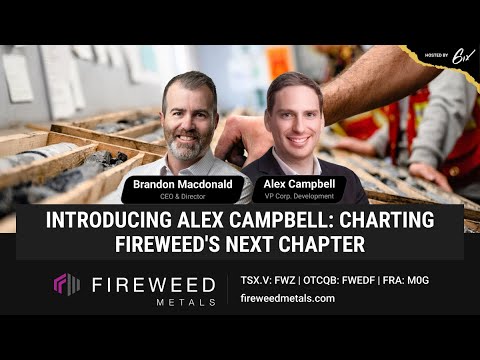
0:08 Hi everyone, thanks for joining today. This is a bit of a new interview or a new format for an update for Fireweed. We're here to introduce our new-ish Vice President, Corporate Development, Alex Campbell, who joined the company about 2 months ago. So, you know, we're going to go through some Q&A, some discussion, some maybe debate on, you know, the path forward for Fireweed, how Alex is involved and what his role entails.
0:48 So without further ado, we'll get started. I would say, good to see you, Alex, but you're like 1 room over for me. So- It's kind of awkward, right? Yeah, yeah, just a little bit. Would have been tough to do it in the same room. But to get started, how did you become aware that Fireweed was looking for someone? So I think I started hearing some chatter early in the year about, you know, Corp Dev role opening up at Fireweed. To me, at, you know, beginning of the year, the company's name wasn't like it had rung a couple bells. I know it was
1:37 it was out there. I had read about it a little bit, but I didn't get to know as much about it until further along the year and, you know, I started starting to see a little bit more chatter in CEO.ca.
1:54 And ultimately, the way I got introduced to Fireweed was through, before joining Fireweed, I worked at the CABC mining investment banking team here based in Vancouver. And so as part of this group, I became heavily involved in the execution of the sales process for Great Bear Resources, which as you all know, culminated in the acquisition
2:23 by Keen Rose for $1.8 billion. And so that gave me a lot of exposure to the Great Bear management team, including Calum Morrison, who ultimately introduced me to John Robbins and the rest of the Discovery Group. And finally, I think that's ultimately what influenced my introduction to the Fireweed team. And yeah, it was good that Callum introduced us. And for anyone watching this, I think it's probably goes without saying that a personal introduction is a lot better
3:05 than going through a recruiter or something like that. Oh, we did have a recruitment process. Ultimately, Callum's recommendation carried a tremendous amount of weight, right? And when you joined the company, what was your understanding of what the role would be and what it would entail? Well, it's pretty much in line with any corp dev role at a company like this. So just analyzing potential business opportunities, execute on key value-add projects, growth initiatives, acquisitions, dispositions, partnerships, you name it.
3:54 Also entails deepening relationships in the investment community, sourcing investors, including institutions, and fostering at the same time relationships with banks, with the analyst community, making sure that the the messaging, our value proposition is properly messaged in the market and you know making sure that our communication strategy is homogeneous across the organization and ultimately of course make your life easier Brandon. So I know that you've been putting a lot of effort into
4:34 all of these initiatives. It's been quite challenging for you, attending a lot of conferences. You've been quite busy. So hopefully, this role also, And me joining Fireweed also enables you to perform a little bit more free in the CEO role. Yeah, well, that's the ambition, right? I think
4:57 it's interesting as a company, when Fireweed got started, It was kind of me and then part-time George Korzynski, who just recently retired.
5:10 And that was kind of ample. And then I was doing our maps and website and stuff like that. And then suddenly, well, suddenly, 6, 7 years later, here we are and there's an army of people and we're still extremely busy.
5:28 So back to your background. So you were CIBC, you were in the investment banking team there focused on mining. But you know your background, you're originally a mining engineer, so maybe
5:43 run through the, you know, 1, your experience, but also why mining? How did you end up in mining engineering to begin with? Well, that's a complicated question, but
5:59 I don't know. I mean, as you can tell, and as everyone can tell here, I'm not originally from Canada. I'm from South America, Chile more in particular. And as you know, the mining industry there is significant. It's a significant contributor to the growth of my country. And from that perspective, I think I saw it. I saw being a mining engineer, like the romantic side of helping my country grow in that industry.
6:35 But from a technical perspective, I think it had the right fit for me. I'm a pretty square-minded guy. I like rocks,
6:49 and I like big industrial operations, So I think it was a great fit for me. Actually, I started my career as a mining engineer working at Los Pelambres mine.
7:02 As many of you know, this operation, this is from Antofagasta Minerals. It's a very large copper operation. We, in the north of Chile, we moved, back in the time, I think it was 400,000 tons per day
7:19 of material, another 200,000 tons of ore per day. So it's quite a sizable operation in the middle of the Andes, so rough winter conditions. There's many, many similarities actually to an environment in the Yukon, actually.
7:41 And then I initiated my career working in mining operations. And I came to a point where I wanted to try something different, you know, a little bit of a shift into the more corporate side of mining. And for that, I thought, you know, making a master's abroad would, you know, open a few more doors for me. And so I went to the Colorado School of Mines. I got the chance to be sponsored by a great company, Resource Capital Funds, and also participate, intern at one of their deal teams, which was great. I got a taste of, you know, the mining investment world, mine finance and of course, assets different than copper assets, right. I got exposure to, you know, rule tile,
8:34 to gold, you name it. Right. So that that that incentivized my, you know, my passion for mining. And then it opened the gates also for me to land a job at CBC Investment Bank, where I worked for roughly 5 years, got great experience in capital markets, some great M&A exposure. And it also helped me understand being in the minds of CEOs, CFOs, and corp dev people, how they understand, how they strategize, how they view,
9:20 how they target growth initiatives, et cetera. So yeah, that's why I ended up here. And your time at CIBC, do you have a ballpark estimate of how many deals you looked at or closed or? I mean, definitely we looked at several, But in terms of deals,
9:48 deal involvement, several equity races, M&A transactions, I would say maybe 4 big ones, the merger between Capstone and Mantos, the acquisition of Tahoe by Panamerican, the sale of Great Bear, among others, the acquisition of Mavericks by triple flag. So it's a potpourri of really great money exposure across different sectors, across different commodities as well, which is great. And that experience, I think for those people who don't know, you know, VP Corp dev roles or Corp dev roles broadly, it's pretty common to hire people out of banks who have been working on a, you know, IB team there, because they see a lot, right?
10:49 So they've seen both sides of it.
10:53 And how do you think that sort of, your experience, the totality of your experience is gonna help you looking for opportunities for Fireweed? Well, as I mentioned, I think, you know, having exposure to all these deals and also it's not just the deals, it's like the daily conversations that you have with your clients from a banking perspective, it gives you a great insight into what CEOs think drive value. What are the key aspects
11:27 that they look into when they are looking into organic growth or inorganic growth? What are the key aspects of a financing, for instance. And so I think from that perspective, it gives you a great, great, you know, knowledge of, in terms of how you will navigate
11:57 any corporate initiatives. Yeah, and so you're working on these Interesting transactions you're seeing a lot of transactions What was the thought process to move from banking which is you know, I wouldn't say it's completely predictable, but is more predictable, you know, and then going to a, you know, the risky, you know, high risk, high reward world of junior mining.
12:38 What was the motive there? What excites you about that move? Yeah, I mean, it's of course before moving, you have to make a risk assessment, right?
12:50 Banking is pretty stable over time. It's pretty predictable. The pay is great, but the upside potential is capped. And so as I was evaluating to move, I thought about, you know, I've seen a bunch of companies during my time in banking, very good companies, very bad companies. And I think the common denominator for very good companies was A, they had a great asset backing them. B, they had a good management team with people who were experts in their field.
13:36 C, of course, and this is one of the biggest focus points for me, they had good backers. And in the case of Fireweed, we have tech resources. We have the Lundin family and a few others that provide a little bit more certainty in terms of our ability to execute into the future. And lastly, I think fireweed's values, one of the key fireweed value, I think, is respect. And from that perspective,
14:16 And under that umbrella falls transparency. And what I came to see as I was making that decision is that the fireweed, and including yourself, Brandon, is incredibly transparent. You're not afraid to share, you know, share information with the market. You're not afraid. If you don't know something, you're transparent about it. You don't you just say you don't know it, but you're working towards getting an answer. And I think not many, there's very few, you know, especially in the junior space, mining companies that are as transparent
14:55 as Fireweed. And I think that was a key decision point for me as well, because it aligns with my values too. I don't like to oversell anything if there's nothing backing them, right? And in the case of Fireweeds, there is space to be transparent because we actually have a great asset. Yeah, that's always kind of joke is that, and it's kind of like 0.5 joke, that we're able to be transparent because we have a good project, right? And I'm not saying that if MacPass and MacTongue or whatever were, you know, crap that I would be a pathological liar but I'm saying it's you know you can't pat yourself on the back too much when
15:43 it's easy to take this route with these assets, right? So, but yeah, so and you know, did, when you gave notice,
15:58 was your boss surprised or what did they think about you, Rev? No, I think it was a pretty logical move for me, I think. And from that perspective, my boss or everyone was not as surprised. I think I, despite the fact that I did have a clear runway, I think, you know, to become at some point, like an MD or something,
16:28 they knew that I had a, you know, a technical basis that I wanted to exploit, and at some point that I would eventually go back to industry. I had 2 avenues, either go to a large mining company and be lost
16:50 within the sea of employees, or maybe have an impact at a smaller company that had a lot of upside potential. And that's where it ended up landing. So, yeah. And, you know, so you joined us and you've got experience in mining and private equity and banking.
17:14 How do you use that to
17:17 evaluate what opportunities are present for fireweed, right? How do you, you know, what rigor and methodologies can you bring?
17:29 Of course. Yeah, I mean, as you know, banking is pretty rigorous from that perspective, especially when you're evaluating an investment opportunity or a divestment opportunity. And so I definitely bring that rigor from banking. But also from that rigor, I bring an understanding of what are the
17:55 key things that you need to communicate when you execute on these deals. It's not just ticking the boxes in terms of, in the case of M&A, for instance, it's not just ticking the boxes from a technical, strategic merits and financial standpoint.
18:16 It also necessitates the deal to be, a deal to be perceived as a good deal, not only needs to tick the financial or technical boxes, it also needs to be validated as such by the market. And from that perspective, I think, coming from the banking industry, I understand which are the, like, what's the methods, what are the methods that we can effectively communicate that our deal actually makes sense to the investment community. Right, so, you know, communicating effectively what are the strategic merits of a transaction, you know, performing, you know, benchmarking, benchmarking analysis, relative valuation, precedent transactions, all of the stuff that validates a deal to the face of the market.
19:12 And also, you know, and I think from a Corp Dev role, I think it's also as equally important as communicating effectively
19:23 what a good deal is or a good transaction is. I think it's also important that whatever value proposition you're, you know, whatever your value proposition is, that value proposition is well read by the
19:39 unbiased third party or the analyst, which in this case is the analyst community. Analyst consensus is a very good marker to bridge value expectations between buyer and seller and so my role as VP Corp Dev is to communicate our value proposition effectively to the analyst community, which by the way, we were recently initiated by PI Financial, so that's great. We get another validation market there.
20:12 And so, being in line with, and being able to communicate our value proposition effectively to this community is also an important factor. Yeah, you know, you hit on a good point, which is that
20:28 a transaction, whatever type, merger, sale, disposition, acquisition, whatever, the technical or financial merits of it really are secondary to market reaction. And that tells you kind of whether it was a success or not. I mean, I think sometimes you need to give it some time to cook. The market may not exactly understand it. It's interesting, when we bought the initial MacTongue announcement, there were some shareholders who were in the minority, but there were some that were not impressed with that transaction Because they thought it was a distraction, right?
21:19 This is a secondary project, it's not as big as MacPass, it's a distraction from MacPass, which is the ultimate blue sky, right? And so there's some post-deal messaging, which I think you've hit the nail on the head there, that's a big part of corporate development is not just doing it. The job's not done when you sign the deal. There's integration, closing, then eventual execution of this new strategy and selling it to the market, right? So, yeah, it's each of those ingredients probably as important as the next. And, you know, yeah, and as we're as we're looking for this, you know, and and You know, I would describe fireweeds You know strategy is as Opportunistic or at least part of it is opportunistic.
22:16 It's a core component of our strategy. And I don't, you know, I think I've said this a couple of times recently, that I don't, M&A is not a strategy, you know, certainly a sale of a company is not a strategy, that's an outcome of a strategy, you know, that you've either done good exploration or good de-risking or advancing or engineering or whatever. M&A comes as a result of that because you're attractive.
22:43 What do you think, What are the big challenges facing Fireweed to realize value? And what opportunities as well do you think exist for that? Yeah, so I think, I mean, there's various challenges and opportunities, but I'm going to focus probably on those where I actually have a more significant impact perhaps. One of them, and it's quite evident,
23:15 And this could be viewed as both a challenge and an opportunity is, you know, optimizing our shareholder base. You know, we have a great and strong backing from both, you know, tech and Lundin, you know, reputable miners
23:33 and, you know, credible players in this space. They, we know that they, you know, they will ultimately help us financing, you know, all of our drill programs and potentially, you know, even if we have to construct the project, like we're probably going to get their packing as well. But however, like this could be viewed as a blessing by many, but at the same time, it can also be viewed as a curse, right? Because our float is quite low.
24:03 We have low institutional ownership and low liquidity. And so we need, that's a key challenge that I'm trying to tackle at the moment. Institutional investors often have a longer investment horizon and are less prone to engaging in short-term trading or panic selling during periods of market volatility.
24:32 And this reaching out to institutional investors can provide the stability, the share price stability that we need and also provide at the same time, you know, the liquidity and the volumes that we require in order to graduate into the upper end of the junior development space. Right. And potentially a re-rate which is what I what I'm what I'm expecting to happen should the markets accompany us. And from that perspective, how am I tasked on this endeavor? Well, a big part of my day involves contacting and reaching out these investors and making sure that they hear our story and kind of supplementing your scope of action as well there, Brandon.
25:25 And, you know, from a strategic opportunity standpoint, that's, I'm constantly viewing, you know, where we're at relative to potential. I mean, there are a lot of options out there
25:42 that we cannot ignore. We have a flagship project, 2 flagship projects, but at the same time, we're relatively better valued than other peers out there. And I have to be looking into potential for inorganic growth opportunities. And also from the perspective of perhaps disposition of assets, maybe not disposition, but there's been a lot of chatter around
26:11 the spin out of Mactang. And that's something that we have to evaluate constantly, right? Yeah, and I think you've touched on something there that is important that when Fireweed got launched, our liquidity was maybe 0.2 or whatever it is now, right? And there was a point where I could go to a retail investor show and if I scored a couple investors, if I converted a few people who were gonna buy 50 to 80,000 each, which is a big retail. That was huge for us, huge. Now, that's fantastic, but that's not moving the market.
26:57 We need millions of shares in buying. And this is that transition period for a junior minor where you kind of graduate from retail driven to institutional driven or at least a mix period, right? You always have retail trading, but can you be truly driven by retail? I don't know. And so we're certainly not going to neglect our roots. Retail has been hugely important for us. And one of the things I am extremely grateful and humbled by is the loyalty of a lot of our retail investors. We've had a very good loyal following, I think because of the honest discourse. But Now we need that loyal institutional following.
27:48 And I think it's great that we have that concentrated push to that. And hopefully, if markets are willing and some sector agnostic institutions start playing in the space as well, right? Because that would be amazing for everyone. We've seen little hints of that with various companies. You touched on the point of being accompanied by the market. And, You know, we're doing things right. We're hitting milestones. There's a lot of catalyst in the horizon and And I think that you know provided that the markets are, you know in better shape. We we have a pretty significant You know chance of and provided that we get in institutional, you know, backing as well, I think we have a pretty significant chance of re-rating and, you know, graduating for sure. Well, yeah, and I think, you know, the re-rate can, and actually has happened in the last year, independent of the market, because the market's been bad, certainly it's been terrible most of this year.
28:56 We're just a little bit up on the year, but that's way better than our peers, right? And that's not the ambition, the ambition is not to beat our peers by 342 percent the ambition is to beat them by 300 percent, right and You know, it's you try to catch the lightning in the bottle you try to defy market conditions or you try to prime yourself for the wave when it comes, and be the first to catch it and ride it the furthest. So I think it's no, you try both for sure. And obviously, these challenges and opportunities and stuff like that, and one of the things you touched on, and I would note to the audience for anyone here who thinks that we're out to empire build, We have no mandate to do acquisitions.
29:53 But like MacTongue, I think you're crazy not to be opportunistic. I don't know. There was actually a point years ago that we were, you know, I think kind of really before we had such amazing success at Boundary that we were like, you know what, let's be very serious about a second project. And we ended up canning that because our relative valuation wasn't terribly good and because Mac pass kept getting better, so it was like a you know, it's a Distraction right but all the same you have to be in you have to be Opportunistic and I think it's foolish to not, if something falls in your lap, to not take at least cursory look at it. So when you're taking these first passes, like what do you think are the key ingredients to a partnership or maybe an acquisition or something like that? What do you think is the key ingredients there that you think you'd want to see before you did a deep dive?
31:04 Yeah, so I think there are a couple, but probably the most important ones to me at least are timing, and that's the first one. And the timing dictates the state of the market, your relative valuation versus peers, if you're in a good comparable position versus not, is your paper worth more than your counterpart than your opportunity? I think that's a big one. You know, another key ingredient to, you know, a good transaction is, you know, strategic merits, right? Is it aligned with our values? Is it aligned with where we want to operate?
31:52 The type of asset that we're developing, does it make sense to the markets? And of course, can we meet value expectations? Like if we are starting a negotiating process, are we able to meet what their internal value is? Does it make sense to us or not? I think those are key elements to a good transaction. And of course, does it have the potential to either enhance our trading liquidity or unlock a re-rate potential to us. And so, yeah, those are, that's kind of my thinking behind it.
32:41 Yeah, and kind of related is what we talked about earlier, which is the, you know, there's a sales process after any transaction. And, you know, I've talked before to people about how, you can present to me the best possible deal on a gold heap leach project in Nevada. And I would be like, yeah, awesome deal. I don't know why Fireweed would buy that, right? I would be, you know, graciously decline and you know, pass it off to someone who I think would be better suited for it. It'd be sad because I'd be like, oh, that's a really great deal. I really wish we could have done that. But how do you sell it to the market? The market would be like, hold on, you're a critical metals focused explorer, developer, and you've got this gold heap leech in Nevada, like, what?
33:38 You know, so, you know, there has to be some sort of harmony or something, you know, some consistency in what it is, right? And we even had like, a while back, copper gold project brought to us. And it was like, I mean, I didn't really love the deal anyways, but it was like, I just told, I guess it's kind of critical metals, right? But it's, and it's also a question of, okay, is there any of our internal expertise that we can leverage on this? If we wanted to look at something, is there anything we can bring to this? Or do I need a whole separate team to manage that project?
34:26 Because there's nothing this team knows about it, right? Like we understand how to execute very well in Yukon. We understand sediment-hosted deposits and zinc deposits extremely well. We understand a lot about government, et cetera, relations specifically around critical minerals. These are things we're very good at and and some of we can apply that to unlock value yet, maybe but I Think critically, you know because I I'm of the opinion There were a likely and M&A candidate ourselves That That we wouldn't want to you know be the buyer unless it was hugely compelling, hugely compelling.
35:18 And believe me, I think as we continue to grow, the number of opportunities available to us will grow as well. So yeah, we need to keep an eye on them. Yeah, and lots of people have been successful in roll-up strategies before. I mean, some incredibly successful, Lumina Copper, et cetera, right? I don't know that I wanna be the roll-up of Zinc projects. I mean, I guess show me the proposition, right? But It's not really, when you've got the best, adding a bunch of also rands doesn't strike me as a winning move. And so with that in mind, you're in this new role, you're VP Corp Dev, and Corp Dev can cover a lot of things.
36:09 What's your vision for where we're likely to end up? How do you specifically make that happen? I think, of course, my vision, well, it has to be positive, but like I'm pretty convinced that you know we have a lot of interesting catalysts in the horizon. You know our drill program has you has had exceptional results. We're going to probably announce a resource update on MacPath next year. You've been signaling Q1. We continue to hit milestones And I think at some point we will see that being reflected in our value appreciation of our share price.
37:04 And as we move forward, I'm going to, you know, make every effort possible to, you know, communicate our value proposition as best as possible. And you know, be as aware of opportunities out there as possible so that when the time comes to execute, we are prepared. Yeah, and I think that's the, yeah, it can be a variety of styles of opportunities. Like I said early on, selling the company is not a strategy. You know, I think that's how you end up kind of a paralyzed or stagnant, right? So, you know, our intent is to grow these projects, de-risk, engineer, permit, and build and operate if that's what we need to do. And the team will shift as we go through that transaction, you know, those transactions, but process transitions, but that's okay, right?
38:13 So we got A few questions here as well, but people who are online, do please submit questions to the chat. We got a couple here that I want to touch on. You know, when you mentioned, you know, the recent coverage from PI, and we have coverage from Heywood and Cormark as well. How do we get more analysts on board? What's your thoughts on that? Do you have a strategy or like? Yeah, I mean, it's a good question, and if I had the definitive answer, I would, it would be great. But I think honestly, it's a bunch of factors, I think. One of them being, you know, trying to communicate our value proposition more broadly.
39:14 Being 2 instead of 1, I think that that'll help out and that'll bring attention from from from from the larger banks as well. And as we grow bigger, that I'm pretty sure that'll be the case. So I think from that perspective, growing in size in terms of market value, I think that'll drive more interest. And at the same time, try to have a concise, a very clear value proposition and a broader outreach so that we resonate a little more with these bigger banks. And we've been having conversations as well with them.
40:01 But yeah, that's probably my focus will be on the communication side of things, reaching out and having a broader outreach of our value proposition. Yeah, and it's not like analyst coverage doesn't manifest instantly. I think Connor McKay, who just initiated on us, I met him at Beaver Creek last year. Right so that was September. 2022. He came to site this summer along with a variety of other analysts I might add and then you know initiated here in October 2023 so that was 13 months right?
40:49 And I think Cormark and Heywood were similarly, you know, significant time, you know, to get from introduction. Because, you know, there's a lot of juniors up there, right? And analysts, they're already covering a lot. So the odds, you have to find 1 who has space to cover someone new And then sell them that one more company they can add should be you. It takes time. And again, the coverage list for these larger banks is pretty extensive. Some of them have analysts managing a lot of names. And so, yeah, it's quite challenging.
41:40 Like adding another name into your list of coverages is quite, It implies a lot of due diligence, and it does take time. Yeah. Because the analysts will produce a price target based on the nav and stuff like that. But there's a question here about, how do we know what the fair market value for fireweed is in a healthy market? Because we understand now that the market is unhealthy. So we'll say that the market doesn't recognize their potential and that the market, you know, that the TSX Venture is beat up, all of these things are true. But, you know, without stating a number, what do you do to kind of look at, get your own internal price target?
42:38 Well, of course I have my own personal models of how much we think we're worth. But I think in terms of daylighting value to the community, to the analyst community, I think it is important to communicate your, the way you are thinking about it to them so that they are aware of what the right approach is from our perspective. They can take it or not, but they're getting it from the source. So I think from that perspective, sharing your approach with the analyst community is a good first step for them to crystallize the appropriate value that your company is, that you think is your worth, right?
43:34 Yeah, and I think that you can build a valuation up from first principles. You can do a corporate-wide discounted cash flow. I Think it's a good thing to do. It's a good sense check. But you know to my mind. It's the the precedent transactions are ultimately the greatest indicator unfortunately for Zinc lead And you know, there's not necessarily a lot of precedent transactions. So you kind of look in Similar ish metals, you know a copper nickel That sort of thing where you've got other transactions that you can add into your base and sort of say All right, they got purchased for this P nav He you know on a comparable Nav build up, you know, what would our price be at the same PNAV?
44:29 I think that's a good understanding that there's different external factors at that point in time. But and also understanding we're a relatively early stage company. We don't we don't have a mind plan yet for the bigger portion of our deposit. Right. So things could change dramatically. So, you know, an Excel DCF model can stand anything really, but you know, ultimately... Yeah, before you have a real mind plan, you know, it's kind of like the how many angels do you hit on the head of a pin, right? Like, is it? I don't know, like, what does the mind plan look like? And this is this was the Great Bear situation, right? Like, you know, I, Ken Ross had their own internal model, no doubt.
45:16 But, you know, I did, there wasn't anything close to a mind plan, right? And so it's very different. Sometimes it works to your advantage quite honestly because I think it's important to recognize that corporate development departments in majors are not immune to hype and FOMO, right? I think there's this idea that they are just hyper disciplined and regimented. And there is a lot of discipline and a lot of regiment. There is also an excited CEO or maybe a CEO who's under pressure to make a splashy transaction, right? I mean, there's a lot of things that can positively affect value that may not be reflected in the classic, you know, valuation calculations, right?
46:07 Yeah, absolutely. So Thomas is asking, are there any plans for dual listing, which is kind of a funny question because without mentioning who it was, Alex and I were on a call this morning with an alternate exchange. I wouldn't describe it as anything as a plan right now. We have our OTC listing, which is a pseudo-US listing. We would certainly entertain a full US listing. Something like the NYSE American or something like that. Our share price would have to be higher. I think they need a $2 US share price. We meet all the other criteria.
46:54 We had looked at an ASX listing. Cross listings between TSXV and ASX are actually incredibly uncommon. And we've been kind of told that if you don't have a presence in Australia, you can kind of be orphaned down there. But we do no doubt kind of look at those valuations with a bit of envy sometimes. But any other thoughts that go into that, Alex? Yeah, I mean, we're also like, as you mentioned, we're trying to to boost our trading volumes and enhance our liquidity the best way possible. And there's various opportunities out there. And rest assured that we're evaluating them and that we're going to choose the right path moving forward.
47:54 It is something that we keep top of mind. Yeah. And you say we choose the right path. We choose what we think is the right path, you know, ultimately, you find out whether it was or you don't even know, because you choose 1 path. And you could say, well, this was the wrong path, we should have done x, but you didn't do x, you don't know what x would have done. Right? So, you know, you can have these hindsight biases, but you try to make the most sensible, informed decision you can when you do, understanding it's always on incomplete information. Right? And probably the biggest piece of incomplete information is just about the world around us, right? So what's the supply demand balance of zinc, lead, silver, tungsten, et cetera, gonna be? You can try to predict it, but it's tough, right?
48:51 So we got one more kind of multi-part question here from Nate, which is less corp dev, but I think we can kind of touch on here, is access to the site and kind of unlocking value there by the road. I'd make a couple notes. The road to our project is permitted, right? So the North Canal Road runs from the village of Ross River to McMillan Pass, which is where Mac Pass and MacTongue are. That is a government highway, So it is naturally permitted. In 2020, the Resource Gateway Project, which is a joint venture between the feds and the Yukon government, committed $71 million to improve the access roads to our project.
49:46 We'd like to see more. And we think the onus is on the government to improve a government road. I don't really think that fully, you know, my internal roads, yeah, that's my burden, but you know, a government highway, it's their responsibility to make it fit for purpose. And with all these federal funds for infrastructure to critical mineral projects, it'd be crazy that there's not more allocated to us. And I would note, it has not gone unnoticed that, yes, our neighbor to the north and south of us would use the same road. So although they're not a critical mineral, it is undoubtedly emerging as an interesting economic opportunity.
50:34 So you've really got 3 potential projects unlocked, at minimum, by 1 road, which the government is fully aware of. So the government moves at the pace of government, which is not always ideal for industry, but lobbying is a serious part of our focus now. We actually have one person who's fully dedicated to that. Yeah, and it's you know, we kind of have like Venn diagrams of response, you know, of what sits where and the lobbying aspect is kind of is the overlap in the sustainability bubble and the corporate development bubble.
51:25 So that is an area that you're working with Ian on, the lobbying. And related to that, now that you're 2 months in, what's the most surprising thing you're doing that you didn't think you were gonna be doing? That's a complicated question, Brandon. I'd say probably attending conferences, I would have never thought I would have joined. We just recently attended the Osaka International Tungsten AGM, and it was a great insight into this very niche market, which I wouldn't have expected I would have been associated with. And now it seems that we're a big discussion topic within this area of the market.
52:30 And getting involved into a space where I've never been before, it's challenging, but having the fireweed banner behind me is a big door opener. And I think that's the weirdest thing probably, but everything else, I think it's in line with my expectations, to be honest. So we'll just one last question, and we'll wrap it up here. And Thanks, everyone, for attending. But Tom was just asking, you were talking about institutional investment. What do you think, what are they citing as a barrier to investing? Is that a question to me? Yeah.
53:21 So I think there's a few. The early stage aspect of the project is 1 barrier. I'd say probably some people are sceptical about the potential issues with, you know, in the Yukon as a jurisdiction, for instance. But it's our duty to communicate what, like, how on top of things we are and how well we're progressing on that front. Another aspect I'd say is size.
54:11 Our market value is still maybe not as attractive to a large institutional investor. Yeah, and it's worth pointing out there that institutions, your billion dollar fund, and you're limiting yourself to 40 positions, because you only have the staff to manage 40 positions, that means you've got to allocate $25 million average per position. Now, there'll be some, even if you're a mining-focused fund, there might be some big ones. You might have $100 million in tech or something like that, right? Or Lundin mining or Glencore, something like that. But you're probably still not looking at a less than 5 to $10 million position in a junior, right?
55:00 And if you have restrictions on liquidity, you might say we can't represent more than 10 days liquidity or something like that. Exactly. And our trading liquidity, how much is it? Like between 2 to 350,000 shares a day or so. So yeah, there you go. Yeah. So it just becomes like it it becomes no matter how much they sometimes They really like the story and it's and it's a kind of this weird thing where you're too cheap Right because they know what an incredible value you are but they cannot touch you because of that, because it makes your liquidity too low. Given their necessary bite size and liquidity requirements, you are too attractive, right, for them to invest in, right? So, and I could tell you, you feel like a head butting a wall when you hear that kind of thing. Or like a big fund who could completely change your fortunes says like, oh, we love it, can't touch it.
56:00 It's just like, oh my God, right? So, but that's, you know, that's why you find another path forward and you know that you're on their watch list, right? And hopefully when you meet the requirements, you know, they can come in and move the market, right? So. Yeah, that's the idea. All right, look, we'll wrap it up there. I hope everyone enjoyed this introduction to Alex We had a good conversation He'll be around for those who come to the conferences. He'll be with us at V rec and round up and PEDAC and he'll be in Zurich for the Precious metals summit in 2 weeks and there'll be in Lines of Money London at the end of November, so do take a chance to introduce yourself if you're there.
56:53 Otherwise, if you're late joining today, this is recorded and will be posted online and hopefully tomorrow. So thank you very much everyone. Have a great day.