Transcript
Automated transcript · Written by software from the replay's audio. It can mishear names and figures; the replay is the record.
0:07 Good morning or good afternoon, depending on where in the world you're tuning in from. Very pleased to be joined today by Aldebaran Resources CEO and Director John Black and CGO and director Dr. Kevin B. Heather. Thank you for joining me today, gentlemen. Good to be here. Just before we get into the main events, I'm going to get into a bit of housekeeping. So first, today's event is being recorded and the replay will be available this afternoon for sharing. There's also an interactive event. There's a chat box in the bottom right corner of your screen. If you click it, you'll be able to ask all the Brown team questions. After a brief presentation from John and Dr. Kevin, we'll get to as many of your questions as we can, but please do pose them at any time during the event. We'll try and tackle as many as we can. We've got some questions in advance over email that we'll get to as well. But that's enough out of me.
0:54 I'm gonna throw it to John to get us started for today's presentation.
1:03 Romeo, can you hear me? We can, yes. Romeo, my connection appears to be pretty bad right now. I cannot hear what you're saying. Just throwing it to you to get the presentation started. Romeo, my connection appears to be pretty poor. So I think what is best if we turn it over to Kevin, and then I'll see if I can get reconnected by the time we get to the Q&A. Perfect. We'll let Kevin get started. Okay. All right. Yeah, John's traveling today and he's in a corner of the airport in Denver with poor internet connection. So apologies for that.
1:45 So I'll start us off. Today, we're really happy to be here and we welcome everybody and thanks a lot for taking the time to tune in to this webinar. We're going to explain the most recent results that we put out yesterday, of which we put out one of the better holes on the project, over 1,000m of 0.6 Copper equivalent, within which there was 650m of 0.81.
2:13 The usual disclaimer, I will be making some forward-looking statements. Just a quick recap of the project timeline. Things are on course, as we explained in the last webinar. We have multiple catalysts coming up as we advance the project. We are, you'll see very close to finalizing this year's drill campaign, and I'll go through the status of that.
2:41 We have delivered the Newton samples and Those are in getting prepped right now. We are well advanced on establishing where we're, what we're going to do with engineering studies and environmental monitoring as part of our move heading towards the PEA and eventually a PFS. And really the next big milestone is that we're aiming to get a updated resource out based on the drilling from this year's campaign plus previous campaigns. The last update we gave was back in 2021. So we've done a lot of drilling since then and we hope to get that resource update out towards the second half of this year. And we're on schedule to do that.
3:28 We hope to see some Newton results early next year. I think that'll be another interesting milestone. And then obviously we hope to get a PEA out by the first half of 2025. And I think that will also be a big milestone and a catalyst because it'll be really the first time that the Altar project has a full PEA wrapped around it. And then obviously moving on, we hope to deliver a PFS in 2026. So those are kind of where we're aiming. For those of you that might be tuning in that aren't familiar with where we are, we're located in Northwest Argentina within San Juan province, a very pro-mining province.
4:14 You can see the map here of the province of San Juan. Our main office is here in San Juan, capital city and roughly about a 6.5-7-hour drive into the high Andes is the Altar Copper Gold Project. We're located about 25 kilometers north of Los Palambres and El Pechon, and about 50 kilometers south of McEwen Copper's Los Azules. And then up in the north, you can see the Jose Maria, the Lunewasi and the Filo del Sol or the Vicuna District cluster up there. So winter is coming. These are photos from our project site just 2 days ago. We got hit with the first real significant snowstorm.
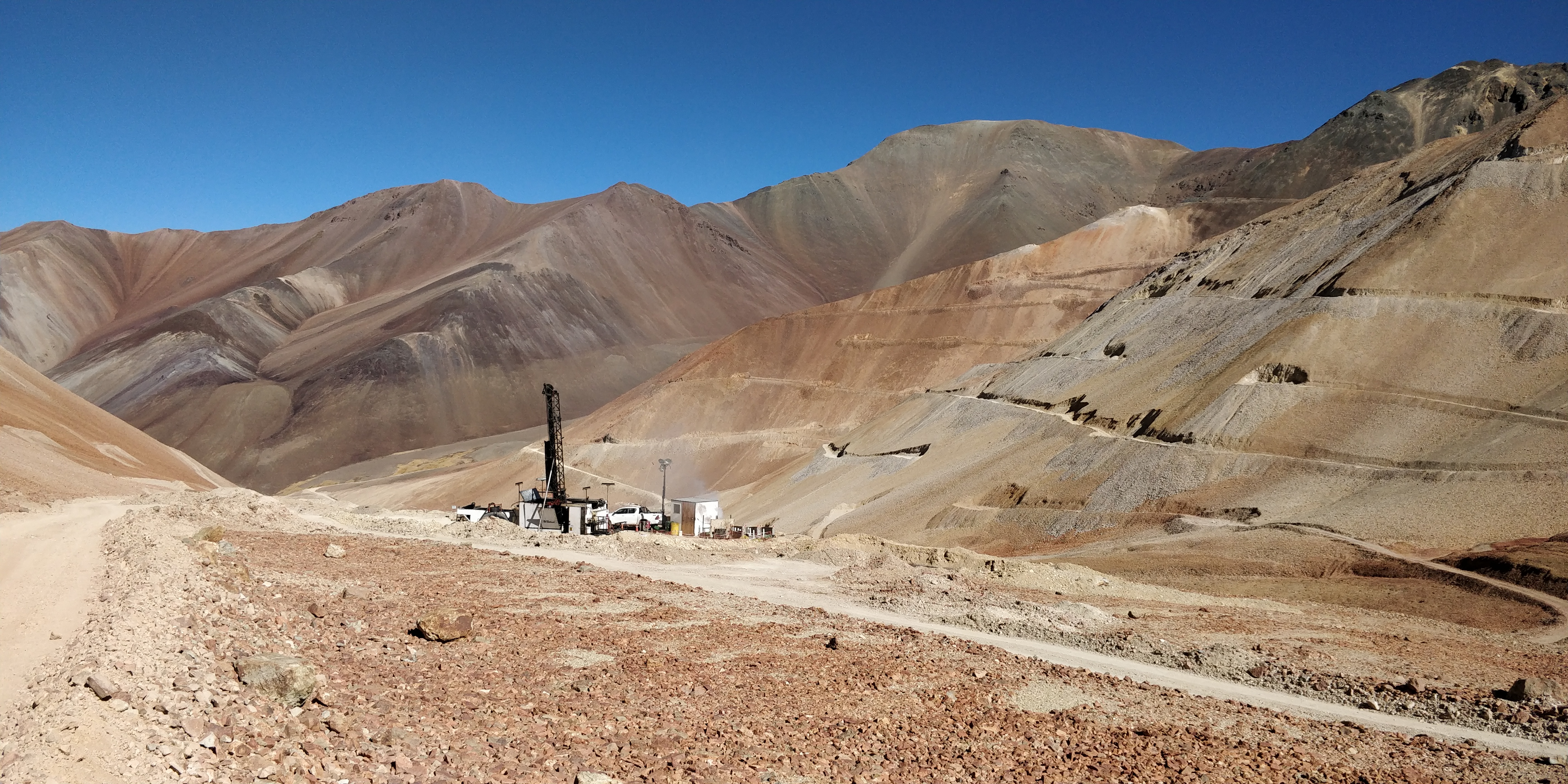
5:03 We got between 20 and 30 centimeters of snow. We are back drilling again, but a couple of days ago in camp it was minus 17 Celsius and much colder up at the rigs with the blowing wind. Here's a picture of one of the rigs in a whiteout and the road. So we had to shut down drilling for basically about 12 to 18 hours while this snowstorm was going through. But we're back operational again, and I'll go into some of the details of that. So this is the current status as of this morning, I've updated all of the figures here. So this is the typical plan map. This is the main Altar Central, Altar United and Altar East areas.
5:53 In the white line, you can see the 2021 conceptual pit outline that hosts our current resource. And you can also see in the black dotted line is that large Magneto-Telluric or MT resistivity anomaly in the geophysics that we've shown multiple, multiple times over the last couple of years. So just to recap, we've already put out 9 holes that we've released over the last little while and you can see the locations of those. You can see that most of those were located outside the areas of known mineralization and were really designed to test for the footprint and expand the known mineralization. The holes that we're reporting today are a mix of holes. We've got a hole that again was testing for outward expansion of mineralization to the South, probably the furthest South hole that we've drilled to date on the project or anybody's drilled on the project.
6:56 Hole 240, which is kind of in the centre here in between the main Altar Central and the Altar United area, and then 2 holes that are clearly in the mineralized trend here of Altar United to Altar East. And obviously, the most important hole is this Alt 241, which I'll go into in a few minutes. We also have 5 holes that are now complete. They're shown in the cyan dots. These are pending assays. And just a quick note on assays, the turnaround time now at the lab is roughly between 40 to 50 days. And it's roughly more skewed to the 50 day mark than it is the 40 day mark. So the turnaround times have greatly increased and I suspect that's a function of the labs being inundated by a lot of samples coming in towards the end of the Argentine-Andean field season here. So please be patient.
7:56 We're not withholding information. It's just that the turnaround times are quite a bit longer than when we first started. And we currently have 1 rig drilling and that's active here on hole 245, which is almost dead in the centre here of the main area. So I always like to say the quotes say it all, and I'll put these into more bullet form. If you look at John's quote, really what we're reporting today expands the mineralized footprint of the deposit. It's also showing the growth of that higher grade mineralization within Altar United. And all of this information will be valuable as we move forward to the mineral resource update like I said, that's planned for later this year.
8:47 In terms of my observations, really we intersected some interesting oxide hosted Gold mineralization on the top of 241. This may offer some opportunities to expand this style of mineralization that could be amenable to some low-cost heap leaching early in the operation. But that right now still requires further follow-up, but it is something that we are interested in pursuing. In terms of hole 241, obviously this is one of the better intercepts on the project to date. It confirms both lateral continuity of the higher grade mineralization as this hole was drilled roughly perpendicular to most of the other holes.
9:34 And that's really an important aspect is that because of the way we've been drilling it, you always have to make sure that maybe you're not biasing the results because of a preferred orientation. So this hole was designed to drill at a completely different angle, the mineralized zone. And what it shows is that we aren't biasing the mineralization. The mineralization has the same character and the same grade distribution in both orientations of hole. So that's good news. And this also fills in a large gap within our previous drilling, and that'll become apparent here in a few minutes. So let's get on with hole 241. Again, the plan map, there's again, the location of hole 241.
10:22 We'll look at a cross section oriented diagonally like this, and we'll be looking towards the Northeast. So there's our cross section again, in the black dotted line is our conceptual 2021 resource pit. And we can see hole 241, there's that upper zone of roughly 159m of 0.45 Gold in oxide, which is quite interesting. It's actually closer to 0.5g because there is some Silver that could also be recovered potentially in a heap leach. So that remains to be seen whether we can create a volume large enough that would be potentially of interest to be a small heap leach operation early on in the project life.
11:12 And then obviously a very long mineralised intercept here over a kilometre of 0.61, of which 0.55 of it was Copper. Within that, a sub-interval of almost 800m of 0.7 Copper equivalent or 0.66 Copper. Within that, a higher grade sub-interval of 650m of 0.8 or almost 0.74 Copper. And then 2 very high-grade intervals, over 100m each of close to 1% Copper equivalent or 0.9 Copper straight up. So really good hole. However, this hole was lost due to operator error.
11:57 We had intended to drill this hole a lot deeper and unfortunately we lost the hole, but the hole did finish in the last 7m of 0.8 copper equivalent. So the high-grade mineralization continues at depth. This is just a geological view of the same section, and we can see that this hole is collared completely within the porphyry intrusion, right from the start, right to the finish.
12:31 This is the MT resistivity geophysical anomaly. And again, we see a very, very good correlation that when we drill into this anomaly, we hit mineralization. So it's really helping us guide us towards areas of mineralization. And You can see there's still gaps that potentially need to be drilled in the future in this anomaly. This shows the resource model of 2021 and I think you can clearly see that these are the blocks that are currently within the resource because they fall within the pit shell. And then these blocks are stranded blocks that currently do not report to the resource. And you can see that all of this drilling over last year and this year, you can see this whole 241, this is going to significantly add volume of resource and a very, very interesting grade.
13:31 Just some quick rock shots. Those that follow us know that we're a very geologically oriented group and we think that rocks and the investors understanding the rocks is actually an important aspect of your buying into our company. And you can see here, like I mentioned, we drilled right into the porphyry with strong quartz stockwork veining. This is a really good indication that we're in the centre part of the system. As we get out of this leached area where the Copper has been stripped out, but we still have that sort of lowish to moderate-grade Gold, we go into the Sulfide and we see very strong Potassic alteration with a lot of Kfeldspar alteration and biotite, the black mineral here, and a chalcopyrite with some pyrite.
14:25 As we go deeper, the potassium alteration picks up, but we also start to see the first signs of this green saricide or green mica overprint, and locally that becomes very, very intense. So we not only see copper associated with this potassiic alteration, but we also see very intense Chalcopyrite coming in with some local Boronite associated with this green Sarasite alteration. And so this probably accounts to why the grades are much higher in this hole. We've seen this pattern in some of our other holes and many of the other holes in this area. So it seems to be a repetitive pattern that we can track in the drilling in the Altar United and to the Altar East areas.
15:16 Then we also see good cross-cutting relationships. You can see the earlier biotite and secondary K-Feldspar, that carries copper. We can see one of these more serocytic veins cross-cutting that potassiac alteration. And then finally we see late quartz moly, plus or minus pyrite veins, cross-cutting all of that. So we've got evidence of multiple alteration and veining events here. And you can see some of the very strong molybdenite. Most of these holes in the Altar United and Altar East area and also in Altar Central, the amount of molybdenite increases with depth, which is quite intriguing and is suggestive that maybe there's another porphyry system yet to be discovered sitting underneath of everything that we've drilled to date.
16:12 So moving on now to hole 74, located here just on the boundary between Altar United and Altar East. We're going to look at a north-south section looking towards the east. And here we can see the section again the 2021 conceptual resource pit. You can see drill hole 74 there. This is an extension of a previous drill hole that was drilled to roughly 650-ish type metres. We went back into that old hole and extended it. You can see that right below the pit shell, the grade starts to pick up. That hole again hit a long run of sort of low to moderate grade Copper.
16:59 And this will definitely help us when it comes time to building the new resource model. You can also see that we, at the top of the hole, hit 82 meters of pretty decent copper grade in secondary enrichment near the top of that drill hole. The part that's interesting again, as I mentioned, this was an old hole that we extended, but also that the final 11 meters of that hole returned 0.6 copper equivalent, suggesting that the grade was starting to increase towards the bottom. This hole was terminated because we thought that it was better to make sure that we get the program complete this year than drilling this hole much deeper.
17:49 And again you can see that hole was drilled completely within the porphyry intrusion shown here in the purpley magenta color. And again completely within the geophysical anomaly And you can see on this particular section, this part of the anomaly has not been tested yet. Again, just the block model, Again, the same story that we discussed before. Again, just some quick photos, repetitive, that like we saw in the previous drill hole, we see very strong potassium alteration, overprinted by this green sericite. The green sericite becomes progressively more intense with depth, bringing in chalcopyrite along with it. Here you can see the green sericite is almost completely obliterated that earlier potassic alteration. You can just see a small remnant of the biotite here in the brown color.
18:51 And then that's associated with chalcopyrite pyrite. And then again, like we saw in the previous hole, late moly chalcopyrite veins coming in, overprinting everything. Moving on to drill hole 240, that's located in this area. Again, a north-south section, we'll look towards the east. Here again, you can see the conceptual 2021 pitch shell. Hole 240 hit another kilometre run of roughly 0.34 Copper equivalent, of roughly 0.3 Copper. But within that, there were some shorter intervals of higher grade. The thing to take note of in this hole is that this fills in a significant gap in our 200 meter grid. So this will definitely help with the upcoming resource update.
19:49 And you can see that this hole was drilled completely within wall rocks, and significantly a lot of the upper part of the hole was drilled in rhyolite, which we know typically is a less favorable host rock than down and deeper when we got into the andesite composition volcanic rocks, which tend to be better host and tend to have slightly better mineralization. Again, good correlation, mineralization to the geophysical anomaly. And again, you can see the block model from 2021. These are blocks that are currently in the resource. These are blocks that are currently not in the resource. And you can see between hole 222,
20:34 240 and 232, all of this area will fill in with blocks and hopefully will fall into an open pit when we go to do the updated resource later this year. Again, don't want to belabour this, but exactly the same kind of sequence of alteration and style of mineralisation, Potassic alteration overprinted by strong green Sarasite with chalcopyrite and pyrite mineralization.
21:11 Just another way to look at both hole 240 and hole 74 extension, because I think this will give you a much better appreciation of why these holes are going to be important when we go to do the resource update. So this is going to be an East West section, and we're going to be looking towards the north now. So there's our east-west section. You can see this is drilling from the Altar central area. This is drilling in the Altar United, Altar East area. And you can see drill hole 240 here fills in a significant gap. You can see that it was almost a 500m gap here. This hole fills in roughly in between that large half a kilometre gap and shows that it's still mineralised there.
22:02 And drill hole
22:04 74 does a similar thing here filling in this very large gap as well. So these holes are very critical towards helping us to build the resource model and hopefully allow us to float the pit even deeper than it is currently based on the 2021 resource update that we did.
22:27 Again you can see the 2 porphyry centers, Altar Central and then the Altar United Altar East system, shown here, Altar Central, Altar East, the rhyolites in blue, the andesites in green. Again, really, really good correlation to the geophysical anomaly. In this particular section you can see we've got pretty good testing of that anomaly. Still a few areas where we might want to do some additional holes, but in general on this particular section, we're covered pretty well.
23:06 And again, these are the resource blocks right now that are reporting to our 21 resource. These are blocks that are currently not reporting, they're stranded. And this is the infill drilling that we've done. And I think you can start to see now that with this filling in, I think we're going to eliminate this weird bump in the bottom of the pit because the previous drilling was too shallow. You can see the 240,
23:34 289 extension, all of these holes in here are holes that we've drilled since the 2021 resource update. So all of this potentially will fill in, hopefully with resource blocks. So moving on to the final hole, hole 240. Again, as I mentioned in the intro, this is the hole that's the furthest South that's ever been drilled at Altar Deposit. We're going to look at again a North-South section and we're going to be looking towards the East. And here's the section again, there's the resource pit 2021 for reference. And you can see hole 242 here, a fairly large step out, almost 200 meters step out from hole 222, and you can see that it hit the bottom 219 meters of 0.3, a copper equivalent roughly, of which 0.26 was copper.
24:38 But the interesting part is the bottom, there was a clear indication that the grade was starting to pick up. This is very interesting. This drill rig was at its maximum capacity. So we didn't have the ability to drill this hole any deeper, but the hole is in good standing so that in the future, if we ever wanted to go back and extend that hole, we can.
25:02 The part that's interesting for me is that really, this is a large step out south of any previous drilling, and it really starts to suggest that the system is potentially much larger at depth than what we previously thought.
25:19 This just shows that the hole was drilled completely in wall rocks and within the geophysical anomaly and you can see on this particular section this part of the geophysical anomaly has no drill holes. We'll have to see after we do the resource update later this year, then that'll tell us where we might still potentially have room to infill or extend mineralization in the next drill campaign. And again, same story here. You can see now we've got resource blocks that are stranded down here. Those are coming from an adjacent drill holes and an adjacent section.
26:05 These 2 holes will help to support that there's mineralization down here and hopefully start to pull the pit a bit deeper in this area. We capture some of these higher grade blocks that are currently orphaned in the current 2021 resource. Again, don't want to belabor this, but exactly the same pattern of very strong secondary biotite alteration overprinted by this green sericite. And when we start to see this very strong green sericite, we start to see more chalcopyrite, in this case, magnetite associated with it. So all really good indications that the system is getting stronger with depth.
26:52 So going back to and sort of summing things up here, going back to the original map I showed, this kind of shows where we're at with in terms of status of holes reported and holes that are still pending. We still have 5 holes that are complete that are still pending assays. And we have 1 hole that's still active and obviously is still pending assays. There's another way to look at this and by almost like by objective and we drilled these 3 early holes here to test for the Southern extension. All of those holes hit mineralization of sort of low to moderate grade. We also drilled these holes along the southern flank of which the hole reported today, 242, is part of.
27:44 And all of those holes were successful in converting in-pit areas of undefined waste to areas that are above the break-even cut-off. And they also all indicate that the mineralized system at depth is still persistent. So saying that the mineralized system looks like it could be ballooning as we go deeper. We also drilled 3 holes to the north. Again, these holes hit lower grade mineralization near the upper parts of the holes. But again, we're up fairly high topographically here up the mountainside. There's the top of the mountain right here. But they all hit mineralization down deeper. Again, that will help support to pull the pit deeper on the main Altar Central area.
28:37 And then finally, all of these holes in magenta are really holes designed to expand and to add better definition and infill gaps in this higher grade trend between Altar United and Altar East, of which hole 241 has been reported, hole 240 today, and then we still, and also hole 74 extension, And then we still have 4 holes that are pending final assay results to report from that trend. And then finally, we have 2 holes here that were designed to test for lateral east-west extensions of the main Altar central area. And both of those holes have been completed, but are pending final assays.
29:26 So again, to just reiterate, we already have a very large mineral resource. We think that this mineral resource is set up to expand significantly moving forward. The other important aspect of this is that a lot of the current resource is already in the measured and indicated category, which means that we can move very quickly from a PEA to a PFS without a lot of costly infill drilling. So to summarize, there's our timeline, the drilling objectives, we currently have 1 drill rig still turning, 3 rigs are being demobilized as we speak.
30:15 We have budgeted for 20,000 meters. And as of this morning, we're about 19 or 80, sorry, I should say 79 meters short of that 20,000 meters. With the one remaining hole that we're drilling right now, we probably will go a little bit over 20,000m, but that will mark the end of this year's drill campaign. And as you saw, we are starting to get hit by winter storms and snow. So I think the timing is perfect. And I think a really important aspect is this is the first time
30:52 in the last few years that we've actually been able to work with our contractor and get the drill meters drilled that we wanted to accomplish. And so although we've had some local growing pains with the operator, I want to thank them for working with us and allowing us to achieve
31:14 the 20,000 meters within a good timeframe. And so that's going to help us to deliver a much more robust resource update here in the latter part of this year. As I already mentioned, assay turnaround times are currently between 40 and 50 days. They're much slower than they were earlier in the season. So please be patient with the results that are still to be published. It's not that we're holding on to things, it's just that the turnaround times are slower. As I mentioned, big catalyst coming up will be that updated mineral resource estimate. And I think you can see that That we hope is going to be a significant upgrade from what we have currently.
32:06 And that would certainly put Altar into the large porphyry elephant category in terms of its size. But we'll see what that resource comes out to be. We're also moving forward to that PEA in early 2025.
32:25 And just an update, we do have sample preparation underway at the SGS lab in Chile for the 10 samples that we selected for Rio Tinto Newton sulphide leach work. And so that program is moving forward.
32:44 In terms of core scanning, As of last night, we've scanned almost a little over 24,000m of core. That's going to be very valuable data for future geometallurgical modelling and also helping us with engineering slopes, stability studies, et cetera, et cetera. And finally, I just put a plug in that we are having an in-person investor day presentation to be held on May 29th, I believe at 1030 AM at the TSX offices in Toronto, where we will be giving a much more thorough review of the project and not just from a technical point of view, but also from Argentina country point of view and some other things and we'll also be unveiling
33:37 the use of Verify to better help our investors visualize things in 3D.
33:45 As always a real special shout out and thank you to our exploration team in Argentina. They're up there right now under very severe winter conditions and I just want to thank them for all their hard work and making sure the project has moved forward in a safe and effective and successful way.
34:04 And finally, I think that there's really a lot of news flow, a lot of upcoming catalysts coming. We already have a significant resource. I think I've hopefully made the case that you can see that this resource will significantly increase. I think it's a bit of a sleeper in the market. I don't think people fully realize what we have here. It's in a really good location in Argentina. And I think there's compelling valuation and we're funded to get through the PEA phase of the program. So with that, I will close things up and we can open it up to
34:48 questions. Awesome, Dr. Kevin, thank you so much as always for a really thorough review and welcome back John. Now there's a number of questions, some we got via email first. The first 2 will be for John. So the first one, and this is a kind of combination of a few questions I got, but basically, people are looking for a bit more information about the investor day Aldebaran's putting on on the 29th. Just a bit more scope for that event, I think it'd be helpful for people to know. Okay, great, thanks, And thanks for patience with the airports a bit of a mess here this morning. So I think Kevin just covered the main parts of it. What this came out with is we were toying with the idea of having a site visit for analysts. We're getting increased interest that The whole copper space is heating up, which is wonderful right now.
35:36 It wasn't very practical for us to host that at the end of the year. We thought after the resource update next year would be an outstanding time to have analysts visit the site. But it gave us the idea that maybe there'd be a way we could transmit more information about the project to a broader audience, which would include analysts, it would include representatives of major mining companies that want to learn more about the project, retail investors. And Ben Cherrington, our manager for IR, came up with the idea of working with the TSX that we could use their space and have an investor day. This is meant to be an hour and a half or two-hour deeper dive into the project overall. Kevin will continue with the same type of presentations he's been doing now, but into greater depth with some new views, easier ways to understand what we're doing. By then we should be complete with our drilling and we'll have the final tallies of the year.
36:33 And Javier Roberto, our country manager, will go into much more detail about what's happening in Argentina. I think everybody's interested in that. Everybody has a feeling that things are improving there, but there are a lot of details that I think would be good for people to understand. So it's meant just to be a longer, deeper look at what we're doing and a great time to do it right as we close the season. And even more probably good timing in the sense that right now the whole copper space is just really picking up and getting pretty interesting at the moment. So it's a I can't be more happy about delivering a project like this and into times like these right now. Awesome. Yeah, looking forward to investor day. One more question for John before we get to quite a long number of questions for Dr.
37:18 Cohen. So this is a question that I've seen on message boards. It comes up in email, lots of people message us in. Some shareholders have commented on a lack of liquidity and difficulty in establishing a significant position in Aldebaran because of the capital structure. Just looking for your perspective on that. Well, we do have a tight shareholder structure, which has been really beneficial to us as we've advanced the project. The style of work we do is drill intensive. So we do need to raise cash to move forward. And we've been very fortunate when we acquired the project as well as the last several years is that we've advanced the project to have outstanding strategic partners. Route 1 to start with, Sabanyeh who we're earning in from, but also South 32 and now Rio Tinto, not in an equity sense, but in helping us out with conducting work on the project. So that's been great to get us where we are, but it does mean we have a relatively tight share structure.
38:14 However, I would note that with patients, we've had some groups come in and establish pretty good positions. So it is tight. Don't use that as an excuse not to buy. Most of our shareholders are really looking at this as an end game, as we are. And so it's buy it on weakness, tuck it away, and be ready for the final event, which is what we're really setting it up for. Great, thanks. Just before I get into the geological questions, there's one question from the chat that kind of follows up directly to this one. So I'll jump right to that. J-Mac notes in his words, you'll need to do another financing for the fall program. Again, his words, but as we enter the end game for the company, is it correct to assume the next financing would be taken up by the pro rata rights of the existing major holders and management, possible strategic, select funds and friendly hands, rather than trying to grow the shareholder base.
39:09 2 points to that question. First is timing for a raise. We have funds in hand that allow us to complete the drill program that we're on right now to do the resource update and even to do the PEA. But what we will need to do is raise funds for next season's field campaign, which will commence September, October really. And so between now and then, we would like to raise additional funding that would allow us to move forward. I think Kevin pointed out, we still have a few gaps to fill in on the project, but we'll also be making a shift to more pre-feasibility type activities. So much more metallurgical testing, much more geotechnical work, much more information about siting studies and things like that. And that does require some funding to move forward. So I think we'd like to get the data out from this field campaign. There's more to come. We saw some pretty exciting results that Kevin presented today.
40:04 And I think you can anticipate more in the next probably 2 more batches of drill results to come out. So we'd really like to get that out and get it tabled. I'm anxious to watch this Copper market continue to improve, but at some point it would make sense for us to raise. The second part of that question is a composition. A number of our strategic shareholders have pro rata rights and so they have the ability to take up their percentage, which is nice. It means the financing that we complete, a large portion of it is generally spoken for. I can't speak for each one of those shareholders, but we can point out they've been very supportive in the past moving forward. But I think that does create the possibility of additional groups coming in. But we'll see.
40:51 The reason I'm in the airport right now is I'm on the way to the Commodity Discovery Discovery Day in Amsterdam next week. We've been invited to present this project as one of their projects they've noted as a major discovery worldwide. And we're seeing a lot of interest out of Europe to come in. Commodity Discovery is a good shareholder for us right now as well, and they want to take advantage of this to expose us to more of the investors they have in their funds. And so we are seeing interest there. Some people are proactively picking away. And if you watch, there are shares that come out. Probably can't wait for them to drop to you. You may need to step up and move it up a little bit. But when you take a look at the value of the company, we're still remarkably undervalued for the size of deposit that we have already.
41:38 We won't name peers, but you can see a number of other projects that are a little more advanced than us, but have notably higher market caps to them right now. So I think it's still early days to be able to come in with us. Perfect, thanks John. Dr. Kemp, if you're ready for gauntlet, I've got a number of questions directly for you. Fire away. Yeah, let's go. So 1, this also came in an email. Can you elaborate on the mineralization encountered at the top of hole 241 and whether it could be amenable to heap leaching, low-cost heap leaching early in the operations? Could this allow for a smaller and cheaper starter pit? Yeah, I mean, that's the concept. I mean, I think we're a long way away. We've done no metallurgical work. Right now it's just, we've hit this 0.4 to 0.5 locally higher-grade Gold sitting in oxide material.
42:31 As I mentioned during the presentation, it does offer the opportunity that that's something we might want to entertain, but we don't have any ideas on the metallurgy. We don't have any ideas on the volume of that material. I put it out there more of it as Right now it's a geological observation or oddity that we need to follow up on. Whether it's going to be material remains to be seen. What type of cut-off grade do you envisage for a project like Altair? Typically these big Copper porphyry deposits, the break-even cut-off is around 0.1, 0.12. They're big because you're moving huge volumes of material here. This is not a Gold mine or a small mine where the cut-offs are high. So typically in big open pits, the break-even cut-off is, and I think I went through the break-even cut-off and what that means in some of the, I refer people back to some of the previous webinars where I've explained that and what that means, but pretty low grade material ends up, if you have a choice between moving it to the crusher or to the waste dump, it's going to the crusher or a low grade dump that could be then potentially heap leach and that's where Newton potentially is, you know, is something that we're quite interested in because that could be amenable to some of that lower grade material.
44:01 Speaking of Newton actually, Adrian asks in the chat, this for a general who wants to provide further information on Newton in terms of the time needed to complete the whole trial process, and how it breaks down into phases, if that's relevant. Typically, we're just prepping the samples now. There's a very specific crushing and sizing and things that need to be done to the samples and that work is being done at SGS in Chile right now. Those samples will then get shipped to the US where the actual column tests will be performed. Typically that process takes about a year to get those results. We will have some indications before that, but those won't be results that we'll be making public because they are just kind of interim and but we should we internally will have some idea whether the technology is going to work or not but typically the final results the idea is that we would have some results that we'd be able to use in the PEA.
45:04 Great. Mike from the chat asks, how much drilling in meters has been conducted all the way back since the 2021 resource report? I would say, I was just thinking about that. I don't have the exact number in my head, but it's going to be somewhere between 45,000 and 50,000m. A pretty significant amount of drilling has been done since that resource update. Tony in the chat asks, I think he covered this already, but always good to reiterate, how much drilling can be done left this year before winter? We're only planning to finish, we're budgeted for 20,000. We'll probably go a couple of hundred meters over that and then that's it, that's all. So yeah, so that'll be this year's campaign.
45:51 And then, like I said, the weather's starting to turn on us. And so the quicker we can get this year's program as we laid it out is complete. And that just means we can start moving on to getting the resource update out. Great. Somebody in the chat asked how deep is the 2021 conceptual pit and he's assuming it is at the max potential depth. Well it's at about 800 and that is not the max potential depth. Many of the big pits in South America are going to over a kilometer, 1.2 kilometers deep. And So that's not unheard of now here in South America. Chukwikumata is more than a kilometer deep.
46:36 I'm pretty sure Bingham's more than a kilometer deep in Utah. So these big pits are going deeper. And one of the things we've got working for us, and that's why John mentioned we're really going to start pivoting and working towards the geotechnical aspects is that the rock at Altar is very competent, much more competent than a lot of other projects in this part of the Andes. And that will allow us to probably have potentially steeper pit walls, which allows us to better the strip ratio. So for instance, our 2021 resource was done with 40 degree pit slopes. We've done some preliminary geotechnical work by a geotechnical group out of Tucson, Arizona, and they've indicated that we should have no problem for the resource going to a 45-degree pit shell.
47:37 That 5-degree difference is huge in terms of the strip ratio and also just getting to the mineralization deeper. Those are both positives. We're definitely not at the maximum pit depth. Thanks for reiterating. Bernhard Mausner asks from the chat, can you comment on what made you continue hole 243 to 1800 plus metres? Now, Bernie, you know that I'm not going to tell you what I saw. You know, no, we drilled, we drilled 1800 metres of tombstone, Bernie. Now, obviously, the hole was encouraging. So we we kept the hole going. And one of the one of the one of the things about that hole and the reason why we drilled it as deep as we did is that one of the objectives of that, apart from trying to infill a gap in the mineralization that we had was also, like I mentioned with hole 241,243 is drilled from south to north. Almost all of the previous holes were drilled from north to south. And so We drilled that hole to get a better idea where the northern contact of the porphyry is.
48:54 The fact that we drilled it as deep as we did tells you that probably we had to go a bit further to get to that northern contact than we originally thought. Thanks, Hans. Adrian asks in the chat, approximately how deep do the unreported holes go? Those are all listed in the press release. I don't have those numbers at the top of my head, but if you refer back to the, they're all listed and they'll also be they're listed in this presentation so when this goes on to our website and when you guys make this public for viewing people can refer there all the final depths are shown great and just people watching that replay we've only a couple hours D Haney in the chat asks will be including Altarn North in the updated resource estimate?
49:42 No, we won't, because there's not enough drilling there to justify doing a resource update. There's not enough density of drilling and at this stage it's an interesting target but you know we've already got probably several billion tons of mineralization so anything that we find at Altar north is really gravy. Gravy's good. Dr. Kevin, thank you. I got a couple of questions now for John after the geo gauntlet. John, I did throw you on mute. So if you want to just unmute while I throw these 2 questions at you. So Hakuna Matata, great screen name, by the way, from the chat asks, what in your opinion differentiates Aldebaran from Regulus when it comes to stock price behavior? He asks, have you got any ideas for making Aldebaran more tempting comparatively?
50:31 I refer to this as a who's your favorite child question. And it's really they're very similar stories and they're both very, very large copper projects. Altar has potential to be a much larger system than the portion of the Antiquary project that we have with Regulus. So the amount of Copper we'll have as a company contained in the Altar Project and for Alderbron will be significantly greater than what we have at Regulus. Regulus, on the other hand, is more of a brownfield setting. It's a project that could be developed more quickly and more rapidly, which is one of the reasons we have a lot of interest in that project right now from major mining companies, is they can see everybody knows that we need new Copper coming on. And to date, the M&A activity is really focused on buying, producing assets, which allows some companies to increase the amount of Copper they produce, but it doesn't result in new Copper being produced to solve the supply gap that we have. So a project like Regulus, it's easy to envision that it, or the Antiquary project with Regulus, it's easy to envision that that would come to market much more quickly. But I think Aldebaran and Altar is a bigger prize.
51:48 And I think right now, it's very interesting to note that Argentina is very clearly trying to establish a mining industry. They're making it much easier for us to permit things and move things along. I think in the very near future, we'll start to see announcements from some of our peers that are a little more advanced of us, of arriving at long-term tax stability agreements and the type of things that we need to see major mines developed in the country. So I think that's something to watch for. Bigger prize with Altar and probably a country that's more committed to move quickly to establish a major mining industry. So I think it's an exciting place to be right now. Both good opportunities. If I made a recommendation, I'd say cover your bets and take a little of each.
52:39 There you go. I got one last question for you, John. It came in over email. It's an industry question, so I was just curious for your perspective. Someone wants to know why you think there are so few juniors working on projects at the scale of Altar and why do you personally find them attractive given the different costs involved to the project of the scale? 2 reasons on this. One is to work on a project like this requires a lot of capital. And so and that's not easy for junior companies to do without diluting themselves to oblivion. And so that's we've been very fortunate to have good partners, It helps to have the track record with our first success on a similar project. So it's not a game that all junior companies can play easily and keep funded well. So you need to have those backers and you need to have a good track record to move forward on them. But I think more fundamentally right now is that these type of projects are increasingly more difficult to find. If you take a look at the in South America where we focus our work, over the last 20 or 30 years there have been a number of projects like this discovered by peers operating with the same business model we do, most notably Ross Beatty's Lumina Copper Group or say the Lundin family.
53:54 And almost every one of those projects are a Hakeer project that we had with our first company Antares. All of those projects were originally discovered by majors and we've come back in and followed up on the initial work that was done on those. But quite frankly, we've somewhat cleaned the cupboards of those projects. I just don't think there are many of them left. We keep an eye out for them all the time. That's why we entered into the Altar Project, as we were happily working away on the Antiquary Project with our sister company Regulus. And when Altar came up as an opportunity, it was on our list that we were watching for. And our project, Route 1, strongly encouraged us to put our hands on that because they know as we do how rare these beasts are and how hard it is to find an opportunity like this so I don't think you're going to see a lot of new new projects like this coming out I think the ones that are there are what's left right now.
54:48 Awesome, appreciate that. So that's all the time we got for today. Dr. Kevin, John, thank you so much for joining us, running through your presentation and jumping in for Q&A. And thanks to everyone who joined us. Appreciate, as always, your attendance, but also interesting questions you guys asked. The replay should be available for sharing soon this afternoon but I'll throw it back to Dr. Kevin and John for the last word before we head out for the day. Just thanks everybody for tuning in. Hopefully you're as excited about the project as we are and that these were really good results we put out today or yesterday. And I think you can see that there's probably still more to come. And so we look forward to the next webinar and please stay posted. Yes, and thanks, Kevin, for an outstanding review.
55:38 As always on these, we like this format to be able to communicate a little more information to people as quickly as we can once we put results out. We'll be able to go deeper on the upcoming webinar that we'll have for the investor day at the end of the month. So for those of you that are following the story, please make time to take a look at that. And it's an exciting time to be in the Copper space right now. I'm living on the road moving between projects and opportunities to talk to investors right now. And there's a notable change since March with the Copper price moving up, Gold price moving up as well, but a lot more investor interest into coming into the commodity space. And we've been aware of it for some time, but I think we're beginning to see the majors reveal their hands and their desire to be acquiring projects too. So we view this process as the first step is always you have to have the project, the rocks are the fundamental aspect of the project that's necessary.
56:38 But we also then have to have good market conditions. Once we've made a discovery and we're delivering a discovery, it has to be into the right time. And this has all the sense of a perfect storm coming up for what we like to do. So couldn't be happier with what we have and how the markets are shaping up. Exciting times. Well, thank you everyone for joining us today and expect the replay in your inbox soon. Ciao. We'll talk to you again real soon. Ciao.