Transcript
Automated transcript · Written by software from the replay's audio. It can mishear names and figures; the replay is the record.
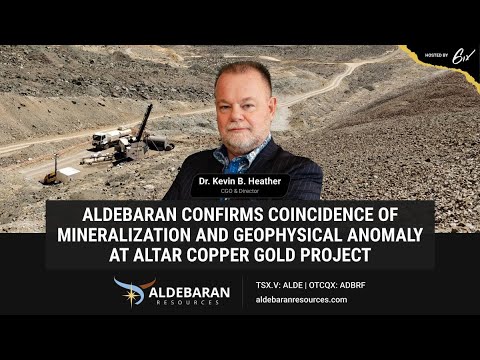
0:08 Hello, everyone, and welcome to today's live Investment Summit featuring Aldebaran Resources. I'm pleased to introduce our speakers for today, Chief Geological Officer and Director, Dr. Kevin B. Heather, as well as CEO John Black. Kevin's gonna walk us through some of the company's latest news and following. There'll be a live Q&A session that John's going to take part in. You can submit questions anytime using the Q&A panel found on the right hand side of your screen. And as always, the summit is being recorded and will be available to watch in the coming days on SIX.com. Without further ado, Kevin, I'd like to hand things over to you. Welcome, everybody, to another one of our continuing series of webinars to really disseminate our latest information and maybe explain, hopefully, and not too technical in terms, what the significance and why we're excited by the latest results from some of the drilling at Altar Central and Altar East. So without further ado I'll move on.
1:03 The typical disclaimer we are a junior company trading on the Toronto Venture Exchange, so I may make some forward-looking statements, and of course all of you who know me know I never do that. So, But anyway, here's the disclaimer. For those that might be tuning in for the first time, the Altar Copper Gold project is in San Juan province in Argentina, right close to the border with Chile. We're in a very mining-friendly province. Right now, there's a lot of activity. There's activity in the north with Jose Maria and Filo del Sol. It's quite often in the news. And we also have just 60 kilometers north of us, the Los Azules project of McEwen Copper.
1:49 And then 25 kilometers south of us is the El Pachon project of Glencore, another big porphyry copper deposit. And then the producing mega giant Los Palambres of anaphogasta minerals sitting just across the border in Chile. So we'll just get right into it. Really, the purpose of today's webinar is to walk you through, in a very brief period of time, the results from our recent press release on drill holes 220 and 221. And you can see them located here. This is Altar Central, this is Altar East. You can see all the historic holes, the collars here in yellow dots, and you can see hole 220 was drilled down here to the southwest of Altar Central.
2:42 The concept here was to test for possible extensions of mineralization in this area. And then hole 221, which was drilled into an area to the northern side of the gap that's between Altar Central and Altar East. And this hole is drilled into an area with no drilling previously. You see there are some drill collars nearby, but most of these holes are quite shallow, never got more than 400 meters deep and most of them are holes that are topographically up the hill, up on the sides of the hill. Whereas this was drilled right here in the bottom of this gully that runs up through here.
3:28 So now I would like to take you through and show you a section AA prime and we're going to look towards the northwest and just give you a quick rundown on the latest results. So here's our view, you can see the topography, you can see the conceptual 2021 open pit that our current resource sits within. And you can see the location, a hole 220 sitting in here and the hole of 221 sitting right here. Obviously we reported a short interval of roughly 284 meters of 0.4 copper equivalent. You can see the metal distribution here and you can see it occurs right really where the conceptual pit boundary is. So this intercept will definitely open up the possibility to push the pit a bit further to the southwest.
4:24 The whole hole was mineralized, but relatively low grade. And it looks like we're starting to get out towards the southwestern edge of the system down there. But rock is still mineralized down here. Moving towards more interesting and really the focus of today's webinar is hole 221, where we intercepted an upper horizon of 89m of close to 0.4 Copper equivalent, most of that being Copper in Supergene, so secondary copper sulfides, calcicite, and then a long run down here of over 1000 meters of 0.4 copper equivalent. And you'll remember that that's roughly about the average grade of the resource, slightly below the average grade of the current resource.
5:18 Here you can see now I just superimposed the geology. We don't need to go into all of the details here, but suffice it to say that we've got a series of intrusions shown in red, and then we've got the host rocks which are andesite volcanic shown in green and then some rhyolite composition volcanic rocks and and sub volcanic intrusion shown in blue. What I've done now is I'm showing the results of the recent 3D MT inversion that we did in this case resistivity And there's a previous webinar where I walk people Through the significance of this survey and What this is showing us are rocks that are very conductive.
6:04 And they're typically, when you see this kind of conductivity, it's normally indicative that we've got sulfides. And you can see that there's a very good correlation to the historic drilling where we hit mineralization and this anomaly. And you can see we've drilled a hole way out here to the up to the, towards the North. And you can see here that there's mineralization in the middle of this large feature here. This is the current block model. So all of these blocks that sit inside the pit are in the current resource. These blocks down below are not in the resource, but if we can somehow get the pit to go deeper those would eventually could get captured into a resource and you can see where hole 221 sits in here really it's no man's land out there.
7:01 And I've just for completeness now superimposed the hole onto that MT resistivity or conductivity feature. You can see it's really indicating that there's a very good correlation between this geophysical information and known mineralization in drill holes. It opens up a huge area for future exploration. Now I would like to take you and just walk you through what some of the drill hole look like. Now, to do that, we'll look at a section that's east-west, BB prime, parallel to the drill hole. Here we can see again, the open pit from the conceptual 2021 resource.
7:51 You can see a lot of historic drilling here. It doesn't actually even make it to the bottom of the pit floor on this particular section. The other thing you'll notice is the pit has this little hump in the bottom. And that's really because there's no drilling in this gap area between Altar Central and Altar East. And you can see why that's potentially significant because we've now hit mineralization in that area and over a quite a long interval. So this opens up the possibilities that many of these holes probably need to be extended and deepened to test that geophysical anomaly. The other thing that's interesting is when we look at this section is the upper part of hole 221, and I'll show you some photos in a minute, but that actually intercepted intrusive rock and then went out into the rhyolite and the andesite wall rocks.
8:49 But having said that, despite that we're out in the wall rocks here, the rock is still fairly well mineralized. And even the rhyolites, which historically here at Altar are bad host rocks because they're very felsic rocks and there's no iron and so they tend not to be good precipitous hosts for the mineralizing fluids. But yet in this hole we're seeing that those rhyolites are well mineralized in places. And you can see a couple of sub intervals here of higher grade material. Again, this is the large resistivity, conductivity feature. And once again, you can see it's suggesting that a lot of these drill holes were never drilled deep enough and that opens up a huge area for future exploration.
9:41 Again, just for scale, that's 2 kilometers across there, 2.5 kilometers across. This just shows the existing block model again. And again, we can see the blocks that are in the resource sitting within the pit. And then you can see this drills into an area that currently has no resource to find. And again just for completeness you can see how the block model relates to that large geophysical feature. So what I'd like to walk you through now is just some quick photos of the rocks so you get an idea. Those of you who have been following me and the Rock Doctor series know that I'm very big on showing rocks and what the rocks look like because understanding those rocks is really critical for success and adding value long-term to the project.
10:38 Up near the top, as I mentioned, we actually did hit intrusive. Interestingly enough, that intrusive had a lot of quartz vein stock working, but you'll see it's got this brownish yellow color. That's iron oxide. So in this case, those veinlets were actually mineralized with copper, but all of the copper now has been leached out of those out of those veinlets. You can see there's still a bit of remnant Gold sitting in those rocks. And again just to show you more examples, we're in the leach cap. The intrusive rock is very well veined and you can see at some point in its history had a lot of sulfide minerals in there, probably pyrite, chalcopyrite, and that's been leached out now. So knowing that, 1 would expect that we should encounter a some kind of a supergene sulphide or enrichment blanket down below this. And lo and behold, the 89m we reported is in fact dominantly calcite. You can see the black mineral here precipitating on pyrite.
11:47 And here again, all of this black material in here is Calcicite, which is a Copper sulfide mineral. And that mineral contains 82% Copper in its crystal structure. So typically when you see this, it's quite encouraging and that moves the possibility that that Superg enrichment blanket couldn't continue in this area where these other drill holes were drilled way too short. They never got down to the enrichment blanket. As I mentioned, the rhyolites are also not very commonly well mineralized here at Altar. But in this particular case, we're actually seeing some decent Copper grades developed within these Rhyolites and a lot of fine veining and alteration, which is suggestive that perhaps we're on the side of a very strong system that's capable of mineralising even poor host rocks.
12:47 We always know that the andesites, on the other hand, are receptive host rocks because they have a lot of iron. And so they're a good place to participate copper sulfide minerals. And You can see that we've got very strong Potassic biotite alteration here in the dark brown colors, and that's locally cross-cut by green Saracitic alteration that's carrying Copper as is the earlier Potassic alteration. And you can see some of the grades in here. As we go a little bit deeper we're starting to see very intense secondary biotite development. You can see the pink K-Feldspar is part of the potassium alteration here but we start to see this very coarse secondary biotite. You can see the secondary biotite here, clearly fracture controlled. And in this particular instance, you can see a strong association here with chalcopyrite.
13:47 And you can see that the grades are elevated here as well We're also starting to see the molly starting to pick up a little bit here as well a little bit deeper you we can see that there are places where we get this strong potassium alteration like I showed you in the previous slides but now it's being overprinted you can see this kind of greenish gray color and this is what we call ceracite chloride alteration and this is dominantly ceracite it's a mica and You can see in places it completely obliterates the rock, but that's also bringing in very nice Copper mineralization with it as well. We've got copper associated with the Potassic event and then we've got copper associated with this overprinting Sarasite event. You can see some of the grades here, very nice, and you can also see elevated molybdenum values as well.
14:50 As I mentioned, the rhyolites are currently modeled here as being part of the volcanic stratigraphy, but there is evidence starting to emerge that some of these rhyolites may actually be intrusive bodies. And we have evidence here where we can see that the rhyolites are mineralized, but they have fragments of the wall rock andesite sitting in them. So that's one of the pieces of evidence we're starting to re-evaluate the geologic model, that some of these may be intrusive in nature. It might be indicating later pulses of mineralization associated with them. And you can see in this case, we see a lot of quartz molybdenite veins cutting across, hence the very elevated moly values.
15:39 And then even in the deepest parts of the hole, we still see strong potassiic alteration within the andesites. And we can see Chalcopyrite and Pyrite associated with that. And then we also still see that strong Sarasitic overprint of the Potassic alteration and Copper coming in with that as well. And again, I note that there is higher moly down. So it almost looks like we're on the edge of a very strong system and we're out in the sort of transition from Copper to Copper Pyrite with some moly.
16:19 So This is just an oblique view looking to the Southeast to give you some perspective on the entire system. You can see we've got the QDM radio system sitting over here. We've got the Altar Central system sitting here. We've got Altar East sitting here. You can see the conceptual 2021 open pit sitting in here. And just for reference, you can see our camps sitting down in the bottom of the valley over here. And you can see where drill hole 221 is. It's basically drilled in between these 2 into a completely previously untested area. This is the magnetic susceptibility from the inversion of the ground magnetic data.
17:07 And what this is starting to try to show us is that we know that there is a strong magnetic signature associated with the Potassic alteration and the Copper mineralization here at Altar Central. Not so much here at Altar East. It looks like it's been destroyed by that overprinting Sarasite event. But we can see here this very strong magnetic feature here where 221 intercepted the top of it where we saw that porphyry mineralization with quartz veins that had been leached out because it was up high in the leach cap. It opens up the possibility that there could be quite a large porphyry body sitting in here that has not been previously explored. The other thing I want to point out on this is that there's also a very interesting sub-vertical large mag feature sitting over here in the gap area, which is currently not drilled. And that would probably be one of the areas that we'll definitely want to test in the upcoming campaign starting later this year.
18:12 This is that same 3D MT inversion resistivity just to show you you can see the large body sitting in here. And you can see this would be the area where we had that high mag sitting in here. And you can see that just opens up just such a huge area for future exploration. And you can also see that there's also a bit of a conductivity feature sitting here where that other mag feature was in the gap. And then we can see the conductivity feature sitting here that's associated with the QDM
18:43 radio area as well. So that's really quickly an overview. And so In summary and conclusion, we think that Hole 221 has successfully tested the northern margin of the large 3D MT resistivity, the conductivity anomaly, and it encountered over 1km of average grade 0.4 Copper equivalent in an area that previously was thought to be barren. This really opens up a completely new ballgame here at the Altar project. This has really been a strong proof of concept that the geophysical anomaly correlates very well with known mineralization and that all of the current in-pit resource that we reported in 2021 at both Altar Central and Altar East fall within that geophysical anomaly, but there's lots of room to expand both laterally and away from the current conceptual pit, but as I showed you during the presentation, there's places where currently the drill holes within the pit are not deep enough.
20:01 Mineralization, as I've shown, can be within the favorable host rock andesites, but more importantly it's even found in the less favorable receptive rhyolitic rocks, which potentially suggests we might be on the margin of a strong system. So based on the size of the anomaly, this deposit really does have the potential to become much larger and put this into a different category of resource and project. Hole 220 also successively expanded the footprint of Altar Central towards the southwest. However, I would suggest that it's probably starting to tell us that as we go towards the Southwest, we're starting to get out towards the outer part of the system.
20:54 So looking forward, we're excited to get back as soon as we can. Once we have experienced heavy snowfall up at the project. So we'll be trying to get in there as soon as we can, weather and snow pack permitting, but we're really excited to get back in. We're fully funded now with a strategic placement from South 32, And we're eager to get drilling again on this sizable geophysical anomaly from potentially more strategic locations now having that
21:28 geophysics in hand. And also we'll be evaluating the other target areas as well as radio QDM area as well. So I'd like to thank you for your attention and we'll open it up for questions and answers. Thanks for the presentation, Kev. As you just said, we'll be entering into the Q&A period now. I'd like to remind everyone in the audience, you can ask questions using the Q&A tab found on the right hand side of your screen. We have a couple of questions that have already come in, though. First and foremost, the continuous mineralization and hole 221 suggests that the deposit is much larger than previously thought. How do you plan to test the scale of the project in the upcoming campaign? Basically, what we'll plan to do, I mean, it's a huge area.
22:18 And so Our idea right now is we're working on the drill plan as we speak. We haven't completed the full analysis yet, but the idea would be to start putting holes in on quite a widely spaced, almost grid, 200m grid. We wouldn't necessarily systematically drill it on the grid, but the holes would be widely spaced to really get an idea of really where and
22:45 what size we could be dealing with here. And when I said strategic in one of the last slides, what I meant by that is we do from our previous drilling and some of the modelling we've done, we do have areas that we think would be higher priority areas to start to do that and extend and test that geophysical anomaly below some of those historic drill holes. Absolutely. Okay. Thank you. This question is for John. Why do you think there's such a scarcity of Copper projects of scale owned by juniors?
23:22 That's a good question and a really good observation. Keep in mind the style of company that we have is that we specialize in using our experience to identify projects that have the potential like this one to be very large copper or copper gold deposits and the type of project that a major mining company would be interested in acquiring from us. And we're not the only ones that do that. There are a number of other companies that have operated very similarly to us. And I think if you look at ourselves, Ross Beatty's Lumina Group, many forms of the Lundin companies or Richard Works companies, one thing in common is that there are experienced geologists like Kevin and myself who have a lot of years on the ground, a lot of contacts. And many times we're identifying projects that have already had a little bit known about them, oftentimes drilled by a major. This project was first drilled by Rio Tinto in the late 1990s, for example.
24:13 And it's changed quite a bit since that time as it's come along. Well, we've kind of cleaned the cupboards of many of these. There was a big batch of these that ourselves and others worked on in the early 2000s, and quite a few of them were sold to major companies. We had the good fortune in our group to sell our Hakir deposit with our predecessor company, Antares, during that period of time. And that kind of took a pretty good batch of them out of play at that time. Now we continue to look for these, but they're pretty tough to find. And As an industry, we're not discovering many new projects, truly new projects. A lot of these are effectively recycled, reexamined, perhaps with different metal prices. A lot of times, it's just additional work on them to show the true size and potential, and we're starting to run out of those. You combine that with what everybody's talking about in terms of an obvious increase in demand in copper, as we see electrification of almost all aspects of society right now, and fewer deposits being found and taking much longer to put them in development than before and the existing mines dropping in grade and lowering their production. So it's going to create quite a pinch point in deposits. But fundamentally, it's just that we've kind of scoured the earth and identified a lot of the easy ones and they're just harder to find right now and there are more constraints on us socially and politically on how we operate, how we move, how we access capital. So it's a harder business to find
25:43 them and they're few and far between. So We feel pretty fortunate to have our hands on a really good one with Aldebaran. Our sister company, Regulus Resources, has another really nice project in northern Peru as well. We're pretty pleased that we're on to 2 really good ones right now, and we think the future is going to be pretty positive for these. Sounds good.
26:05 Jim asks, he believes that there are still, are there still some outstanding assays from QDM radio? Yeah, yeah, there are. We currently have a backlog that we're going to be getting out here as quickly as we can. We've now got probably complete assays on almost all the holes except for 2, where there was 1 batch that's still pending. And unfortunately it's in the middle of the holes for whatever reason, the lab processed them in that manner. So, but I think that we should have information coming out quite soon, right, John? Yeah, I would think right around the end of the month, very, very first week of September, we should have all the decks cleared of all of our holes. The remaining holes will probably be all in 1 release.
26:56 Okay, fair enough. How many assays are left for this program? And when does the next program start? Well, I think we just answered the assay question. So, but in terms of when the next program starts, the idea is, and as I mentioned in the preamble there, is that, you know, everything's weather dependent. We're working at very high altitude here in the Andes and this year has been a quite a heavy snowfall year. So our idea is to try to in as early September as possible to start trying to make our way up to the project, plowing snow off roads and things like that, as will some of our sister or our companies that are working very close to us. We typically do that work as a team so that we can maximize the efforts and reduce the costs.
27:47 So the idea would be to get up there and what we're hoping to be able to start drilling by sort of mid-October. But like I said, it's all dependent on how much snow and how long it takes us to get cleared and get up there. No, Absolutely. Another question coming in. Could you please try to list a few similarities and differences between the Altair and Los Azules or the El Pachon?
28:17 Every porphyry deposit is different. It's difficult to say. But I think, you know, Pachon, I don't know a lot about it because there's not a lot in the public domain on that deposit. And there's in the case of Los Azules, there's a bit of information out there, but I mean, they're both very large, very large tonnage kind of you know, intermediate type grade deposits. And then you got Los Palombres, which is a giant, but it's not super high-grade. So there's a point in these systems where grade becomes less of an issue. You just have so much volume. And I would suggest that people think more along the lines of Cerro Verde in Peru, where they're processing 360,000 to 380,000t a day of 0.35t type material.
29:20 But it's by volume where they're making their money. So there's a tipping point where projects just become so big that scale starts to become an important factor. John, I don't know if you want to add anything. Yeah, I think you covered most of it. The one thing I would point out is that the deposits are very similar in age as they should be given their proximity. But one thing that's a little bit different about Altar than the neighbouring deposits is that we seem to have an elevated gold content in portions of the deposit. So we have portions of the deposit, like radio, for example, that have notably higher gold associated with them. That does bring in some cases, a little bit of arsenic with it. And there's gold that's associated with arsenic and gold that's not associated with arsenic. But the amount of arsenic we see in our system is certainly surmountable. It's something that's easily manageable in terms of marketability of a concentrate that could be produced from it or alternative processing techniques for it. But to me, that's that's one of the things that stands out as being a little bit different.
30:21 No, fair enough. Another question for you, John, what's changed in Argentina and particularly San Juan to make producers start investing in the region?
30:31 It's been interesting, I've been working in the Andes for 30 years as is Kevin. And I think I can say for both of us that over the decades, Argentina has been oftentimes a fascinating country in terms of endowment or potential down, particularly potential to find new things because of less exploration than some of the neighboring countries. But it's historically been kind of difficult to work there. And not particularly due to security of title or safety. It's been much more just politically how it operates, how you move money in and out of the country, how you manage to deal with high inflation rates. And that's changed a lot. In the last few years, Argentina has kind of emerged as a center of stability in South America, as we've seen some of the neighboring countries go through some political and social challenges.
31:19 And not that Argentina is without those, but they've recognized now that there's tremendous opportunity to improve their situation economically by attracting foreign investment into the resource sector. Historically, as everyone knows, they're a strong agricultural center and they've depended on that to great success over the decades. But mining and to a lesser degree oil and gas have never been fully developed to the potential they could be. And so there's a very concerted effort right now to attract foreign investment in. We're good examples are the federal government is asking us what we need to see to be more comfortable to invest in the country. We're not hearing that from some other countries around the world right now. And they're acting on that. They're trying to improve situations for us to be able to bring money into the country to work and to provide a more stable environment. And I think the best evidence of that right now is if you take a look at some of the committed investments that have been made over the past few years only. We've seen BHP come in really heavy on Filo, a fantastic deposit, but they're coming in very early and strongly on that. We're seeing Rio Tinto come into lithium projects in the northern part of the country.
32:33 We've always had Barrick working in San Juan. Anyway, we're seeing Fortescue talk about opening green hydrogen opportunities in the southern part of the country. And these will lead to multibillion dollar investment opportunities going forward. So we're seeing many major international companies and not the type of companies that would normally be operating in fringe areas. They're endorsing the investability of the country right now by making the commitments they are coming in. So we're happy to see that. And our work now is to position our deposit to be attractive to other companies. And I think most recently, more directly related to us is South32. South32 is a fascinating company and 1 that's well known amongst our peers as being a good partner to move forward. And they undoubtedly had their opportunity to invest in a lot of different projects around and this project caught their eye to come forward. So we view that they'll be able to help us move forward and pairing them with with Sabania Stillwater and Route 1, our other 2 strong partners on this, put us in a pretty good position to move forward. So it's recognition of a kind of undeveloped, in a way, Argentina is going to benefit from all the decades of not making it very easy for us to work there. And all these deposits are sitting there now and they may actually do the best of everyone as they develop these projects into what I think we're going to see is a very different world for commodities prices in the coming decade.
34:03 All right, all balances out. Sam has a follow-up question, kind of just the point you were talking about there, John. Has the emergence of San Juan as an exploration hot zone made it harder or more competitive to produce rigs and competent personnel for the upcoming season? Absolutely, on both of those counts. It's been a mad scramble. It's a fun place to work in San Juan right now, just because of all the activity that's going on. And we see, it's not just in our space. I mean, the city itself, we've been working there off and on for, as I mentioned, several decades, and the city's improved notably. And the general public recognizes that much of this is due to mining investment. Barrick's strong presence there, as well as others that have produced good paying jobs. And you see development of government infrastructure, the government building complex there is new and largely financed by mining. And it's notable.
34:57 It's quite good that way. But the downside to that is it's been really hard to get rigs, particularly this past year because everything boomed so quickly. And Argentina does have, continues to have a policy of making it a little bit difficult to import things from other countries and combine that with supply chain challenges anyway. We all scrambled to get rigs last year. And I think part of the question hit on another key point is one thing is having a rig, another thing is having an experienced operator. And so our production was low. None of us really met our marks last year in terms of the amount of meters that we wanted to have. We've been working recently in PDAC and other places with the drilling companies to try to improve that this year, have access to more rigs, and probably just as importantly, have a better supply chain, better planning, better production from the rigs when we get forward. But we're still, we won't be able to get as many rigs as we could use on the project next year, I think.
35:52 And it's going to be another challenging year, but that's part of the fun. Fair enough. And speaking of the future, what are some of the main catalysts that you expect to drive this story forward throughout the rest of 2022 and into 2023? Well, I think Kevin really kind of hit on this. The main thing now is to finish off the results that we have from last year. We have a few more of those results to come. And then in September, we'll be in a position we can announce what our program is going forward and start to talk about the individual targets. So it'll be a very aggressive program. We aim to drill more than we did this year on the project moving forward. So those drill results will begin to flow again by the end of the year, and we'll be able to see what's happening on the project. I think we'll probably see continued announcements of M&A type activity in our space as companies position themselves to be either monitoring or slightly participating in projects or outright acquiring projects. And every one of those that goes is good news for us because it means fewer and fewer left. So we'll wanna see that activity increasing as we move forward.
36:56 No, fair enough. Well, listen, Kevin, John, I wanna thank both of you for coming on today and going through not only this great presentation in depth, but also this great Q&A. I'd like to remind everyone in the audience that if your question unfortunately wasn't asked due to time constraints, we'll be sending those along to the team and you can of course reach out to the Alverone team directly or find out more information on their website, heldeprimeresources.com. But Kevin, I think I'll hand things back to you or John, for that matter, for some final words before we wrap up for the day. Kevin, why don't you wrap it up? Yeah, I mean, just once again, thanks everybody for your attention and patience. These kinds of deposits take a lot of effort, money, time and Rome wasn't built in a day here.
37:44 But I think this project is starting to divulge what we thought from the very beginning, that it's a very large system. As John mentioned, there's a scarcity of Copper moving forward and to have this much Copper all nestled in pretty tightly together here, I think is going to be attractive to some of the major companies who need this copper to meet the future demand. Thanks for your attention and hopefully in the next few weeks we'll have more results coming out for you and maybe some follow-up webinars to explain some of the results of those as well.