Replay available

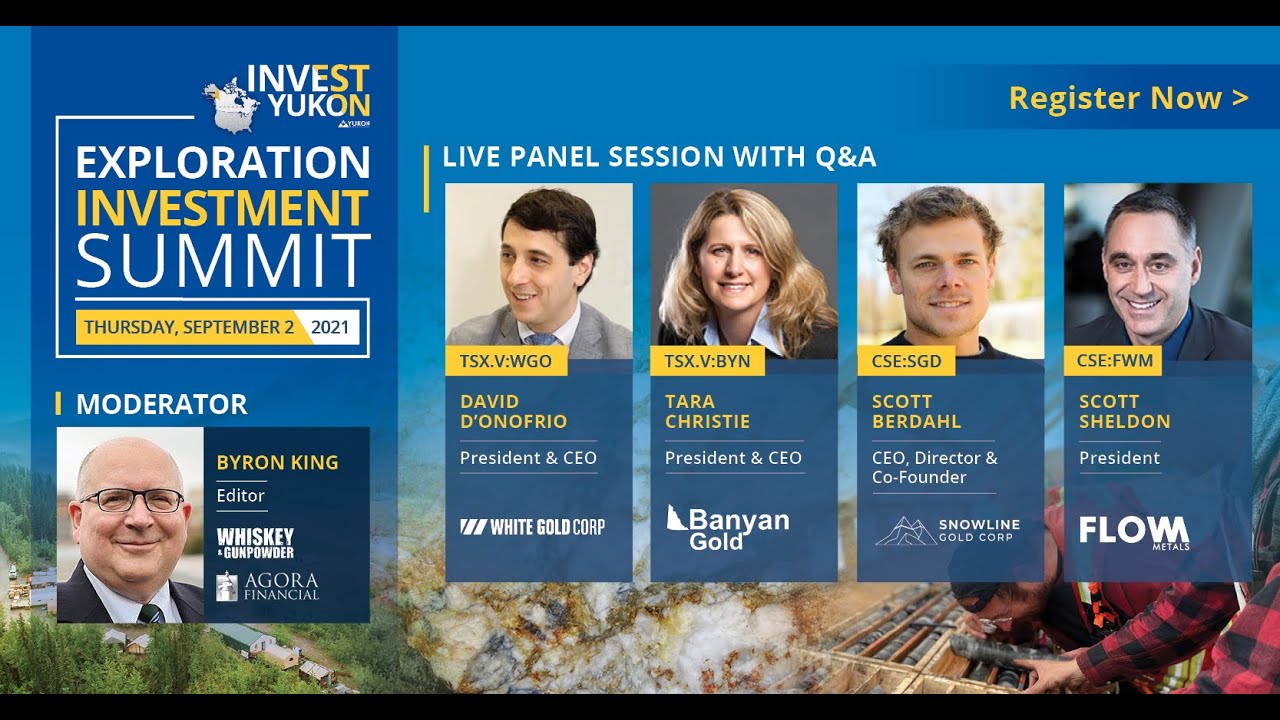
2021 Yukon Exploration Investment Summit, Part 4

Join us for a great event!

Thu, September 2, 2021 at 1:00 PMendedReplay
2021 Yukon Exploration Investment Summit, Part 4
Company
Banyan Gold Corp. (TSXV:BYN), Snowline Gold Corp. (TSX:SGD), White Gold Corp. (TSXV:WGO), Invest Yukon, Agora Financial, Flow Metals Corp (CSE:FWM)
Date
Thu, Sep 2, 2021, 1:00 PM ET
Replay
Watch the replay on this page · 1 h 1 min

On 6ix: 6ix.com/event/2021-yukon-exploration-investment-summit-part-4

Replay

Transcript

Automated transcript · Written by software from the replay's audio. It can mishear names and figures; the replay is the record.

0:08 Well, greetings everyone. Good day. It's a pleasure to have everyone out there who is watching or listening in. We actually know who you are because we can, we see on the screen how many people have logged in and for that we are grateful, we thank you. I'm Byron King, I am a newsletter writer, coverer of the mines and minerals industry, I've been doing this for quite a while. I'm a real geologist. I actually have a real rock hammer and I actually have a real Brunton compass. This one's from 1913. I use a more recent one to do other field work. Today we're going to travel to the Yukon. It's been a tough 18 months. People have been locked down, hard to travel, hard to cross borders, hard to cross provincial borders even within Canada, but that's starting to break away now. The ice is melting, so to speak, and we're able to get out and about.

1:05 Today we're going up to the Yukon and we're going to talk to 4, let's say relatively small but very promising exploration companies from the Yukon. We're going to look at Banyan Gold, and we have Tara Christie who will tell us about Banyan. We're going to look at White Gold. We have Dave Onofrio who's going to tell us about that. We have Flow Metals. We have Scott Sheldon to give us a rundown on that, and then we have Snowline Gold with Scott Berdahl. And they are going to, again, introduce us or tell us more about what's going on. My presumption here is that a lot of people, you know, haven't been to the Yukon, you don't really know the geology of the geography that well.

1:51 Maybe you do, if you do, bear with me because a lot of people don't. So the first thing we're going to do is I'm just going to ask all 4 the pretty much the same question.

2:01 You know, tell us, you give us the elevator pitch, the real quick pitch about your company, where you are, what you're doing, and you know, what is the purpose of your efforts here. Let's start with dear friend Tara Christie and Banyan. Tara, good afternoon. It's great to see you. Thank you for being here. Tell us about Banyan. Some of us know, but for those who don't, let us, you know, let me in on the secret. Yeah, thanks, Byron. So Banyan is focused in, you know, the newest district in, mining district, I think, in Canada, the Mayo Mining District in the Yukon with both Alexco and Victoria right beside us. We are very focused on advancing our Ormac property, rapidly growing the resource there from the initial 900,000 ounces. By the end of this year, we'll have 40 kilometers of additional drilling since that resource was put out last June.

2:56 Our geological model is continuing to guide us on that. We've got the airstrip, which we've already expanded by 300 meters. That's where we had 774,000 ounces. Power line we've taken from an area of 250 by 250 meters to 1.8 kilometers by 1.2 kilometers of mineralization.

3:16 We're really well funded with just $17 million in the bank now having finished the financing with Victoria Gold, Alexco, Cisco, and now the Franklin Gold and Precious Metal Fund as big shareholders. We're ramping up to 3 drills this fall. We'll drill until December, pick it up in February next year with another big program. So you can watch us, we plan to

3:40 show shareholders that we can re-rate by getting more ounces in the ground and more value for those ounces. So an exciting story and year ahead and 2022 for us as well. Very good, thank you. We'll come back with other questions for you later. Dave Onofrio of White Gold, you are an iconic, your company's an iconic name up there, anybody who knows the Yukon knows White Gold. Tell us about what you're doing. Great, thanks so much for having us, pleasure to be here. White Gold, we are focused in the Klondike District of the Yukon, that's centered around Dawson, and this area first became infamous 120 years ago. It was the epicentre of the gold rush. We've all seen the videos and the footage of people just leaving their livelihoods to go to the Yukon in search of riches.

4:31 From that time, amazingly, over 20 million ounces of gold were Mined on a plaster basis from these Creek and you know it wasn't until About 15 years ago that anyone sort of really went to look at you know what was the source of this hole right and that's a head scratcher anywhere else in the world you'd have this thing you know been drilled you know 50 or 100 years ago but nobody sort of for whatever reason put the time in until 1 infamous prospector now Sean Ryan he went there with his outward thinking and then came up with an interesting model and it proved almost immediately to be extremely successful and led to 2 multi-million ounce gold discoveries, which were immediately, You know, you had Underworld being taken out by Kinross, then Kaminak getting taken out by Goldcorp for 500 million right away. It was a true second iteration of the gold rush. And at that time, you know, as you see in one of these hot areas, numerous juniors had sort of flocked there, and it was a real buzz, you know, for about 5 or 6 years. When the junior markets got a little softer in 2012 a lot of that area that Sean had staked up and done deals with these juniors he got it all back with the benefit of 25-30 million dollars of work being done on it he sat there he said listen I've just been here I had some theories the first 2 worked out I see what I got I know what led to these discoveries.

5:55 I think you know, the prospectivity of this package is as good or better than what I had before. So I'm going to put this all together and put it into one vehicle, sort of optimize my chances. And that was the genesis of White Gold. So we have a lot of history. The company itself is fairly new.

6:11 It's got an incredibly massive land package. It's a true district scale type company. We have 1 million acres of property, which is 400,000 hectares and effectively we're the consolidation of what was 10 different dunes. So you have really a lot of different irons we're betting on. As part of that we have our flagship project, our Golden Saddle deposit. That's just under 1.8 million ounces now, 2 plus grams open pit material

6:38 you know that on its own I think is a very robust value for the company you know there's just not that many deposits of that size of that quality in the world let alone in a tier 1 jurisdiction like Canada. So we're very keen to see what, you know, we've grown that by 50% since we've taken over the company or founded the company. We think there's a lot of low-hanging fruit that continue to grow on the radar of a lot of people and we have this massive you know blue sky opportunity with the rest of our district with 30 different targets we've been actively exploring those as well we've had 2 or 3 bona fide major high-grade discoveries in the last year We're very fortunate to have these efforts backed by Nico and Kinross who are our partners. We really think that this validates the thesis and the belief that there's a lot of opportunity in this district to have some of the best miners in the world partner with us. And we are active up there through working on our different assets.

7:36 We have our deposit, which we think we're going to continue to grow. We have these new discoveries, which we're very excited to follow up. Some of these targets are literally stone's throw away from major deposits like the coffee deposit with Newmont now owned and they're literally being dry and drilled for the first time ever this year under our ownership. You know this is a truly unique opportunity in our opinion to be able to have this type of underexplored opportunity in such a great jurisdiction with so much recent success. So a lot going on, a lot to talk about, but that's our brief overview. Very good. Yeah, if you've ever met Sean Ryan, I mean, he's unforgettable, And if you've never met him, you've really missed something. And but what a what a what a what a what a solid guy he really he really is.

8:24 Let's let's move on now to let's go to Flow Metals. And we have Scott Sheldon. Scott, tell us about tell us about Flow. Sure. Thanks, Byron.

8:36 Yeah, so I'm Scott Sheldon, obviously president of Flow Metals. We have 2 projects that we have 100% stake in. One's in BC, that's the new Brenda project, and 1 is in Yukon.

8:49 We consider our Yukon project to be our flagship, mostly because it's had the most work done in the past. And that's where we focus most of our attention the past couple of years. So we're kind of a similar story to David and White Gold, looking for the source of Placer. But we're not on the Klondike Goldfields. We're in the 60-mile Goldfields, which are just to the west. So we bump up right against Alaska. So our area has definitely had a long history of plaster mining and surface mining. Miller Creek is kind of, it was the hotbed of activity right around the time of the Klondike Gold Rush. And then everyone kind of ran over to the Klondike for all that action. But it's great. It's been, we actually have 3 plaster mines active on the property right now.

9:40 Mike and Jace are the 2 of the operators and they're actually the guys that sold us our, the courts rights. So they're all in as well. There's lots of roads and quite a bit of heavy machinery on site. And they're more than willing to help us when the time comes. So we first drilled it in October of 2020. So that's pretty late for the Yukon. And we actually got really lucky with the weather. We left mid, like October 15th, and about 3 days later it got, the temperature dropped about 15 degrees. So we got out just in time. That program was basically focusing on some of the past, some of the best platter results that Mike and Jace had told us about.

10:33 So that's what we did. And we also ended up re-assaying some of the historical drill core that was on site from the previous program in 2010, 2011.

10:43 And we actually used, We've been using a metallic screen assay, which is like a triple assay, but it's been found to, in the last few years, it's been found to be more effective looking for the nuggety gold that we have on site. And we actually discovered a new zone based on this historical core that was sitting there for the past 10 years. So we actually ended up calling it the Easter Egg Zone. Yeah, so we followed up those results in 2021, this early this summer, and We targeted 3 zones, 1 on Miller Creek, the Easter egg zone, and some of the better results we had last season. And results still pending from that. We're excited to get those back. Yeah, so we're pretty much, we're a pretty small company. So we have to be creative with our limited budgets.

11:33 We're definitely a science-first company. So we actually ended up reaching out to the MyTax program this summer through McMaster University. So we got Alex and Jeremy up to the property, 2 PhDs, and they did a structural study on the region and our property as well. So that should benefit us and our neighbors.

11:55 We're a pretty young group as well, so we're not afraid to use bleeding edge technologies. We've been playing around with some of the AI and machine learning. We've been developing some through another company that we work with as well. So yeah, it's fun. If you want to learn some more, check us out at flowmetals.com or I'm on Twitter at Scott Metals as well. Very good. Thank you. Let's move to Snowline and Scott. Scott, same question. Please tell us about Snowline and what you're doing. Sure. Well, thanks, Brian. Yeah, so Snowline is a publicly traded Yukon-focused gold explorer. We're on the CSE under the symbol SGD. We just launched in March and yet we've had a pretty aggressive and successful first season out here.

12:47 We're newly listed, making some exciting new discoveries, but we're not a new company. We've,

12:54 you know, officially we are, but the company goes back for about 30 years in terms of its pre-history. My father and I, well, my father's a long time Yukon prospector, and he started hauling out into the bush when I was about, well, in the single digits age-wise. And so, yeah, and I think I grew some kind of Stockholm syndrome because eventually I started to like it and I kept going out there and I ended up going on to study geology.

13:25 And my dad would come up with these really big blue sky ideas And yeah, after long enough with him, I started to realize he wasn't completely crazy. And so we've actually had some good successes over the years. And one thing that happened around the time of the white gold rush that David was talking about is that, you know, everybody sort of got to ride the coattails of that and we got some, you know, big money onto some of our projects. And one area in particular, which and With all respect to Tara, I think that we might be exploring in the newest gold district in Canada. It just has yet to be proven. So, but we got some money to explore this and we optioned out 2 huge land packages to 2 different companies. One was a private company called Antill Resources, and another was a company called Golden Predator, who at the time had just massive land holdings all over the Yukon. And through this work, we secured about, let's see, I don't wanna get the number wrong, but it's about 3,000 square kilometers, give or take, like a percent of the Yukon, basically.

14:37 And this was done, this was specifically in the Selwyn Basin, so rocks that are analogous to Nevada. And in this sort of Luxembourg-sized area, there were almost no historical results. The Yukon does a great job of tracking earlier exploration and recording it. Just like Scott was talking about, you can go in and find a lot of really interesting old data and make new life out of that. But this area had just a handful of min files and really just had not been looked at. And so but with this baseline work done by Antil, done by Golden Predator,

15:15 We now have this huge data package worth, that had tens of millions of dollars spent on it, probably $15 million on Einerson and Rogue alone, our 2 flagship projects. And in this data, we're seeing just

15:30 jaw dropping anomalies. We have a soil anomaly, golden soils, that is 30 kilometers long. We have others that are kilometers scale and high-grade discoveries on surface. Grab samples up to 152 grams. I went out there with shoestring exploration programs, just me and 2 soil samplers in 2019 and 2020 and both times found new discoveries of nice high-grade quartz boulders on surface assaying up to an ounce per ton. So it's really exciting. And Snowline is the embodiment of all that. Last year we finally got some backing, found some enthusiastic shareholders in the likes of Keith Neumeyer, Eric Sprott, Crestcat Capital and Quinton Henning.

16:18 And yes, we suddenly have the resources to explore these blue sky ideas and swing for the fences.

16:26 Thank you. A couple of, 1 or 2 points real quickly for the people listening or watching out there. If you have any questions at all, to either generally or to any specific company, please type them into the box on the side of your screen. Towards the end, we're gonna have some time and we'll ask our guests to answer the questions.

16:51 The second point that we see what's going on here is that the Yukon has been prospected over for many years, well over a century, probably into the 1890s people were walking around looking for shiny things. And like much of the world, but certainly in the Yukon, it's been prospected, but it's never really been explored, you know, using what we call modern techniques. And some of our guests here have mentioned the things that they're doing, you know, slow sampling geophysics, you know, some of the chemistry that really gets down to the truly atomic level of what's in there. So there's a difference between all that past prospecting and rock kicking and what is going on today. The next sort of theme that I want to explore with our guests, though, just has to do with working

17:40 in the Yukon. Obviously, it's in Canada. Obviously, Canada's an advanced country. It has a legal system. It has all sorts of environmental protections and human protections that you may not see in other places, not to disparage other places, but you probably know what I'm talking about. And so I'm going to ask each of them, is there any particular

18:07 element of working in the Yukon and where you are that comes to your advantage? Either working, you know, either the social license or perhaps the logistics as in roads and power or you know the ability to get your permitting done things like that. I'm going to just take it in the same order Tara with Banyan Gold tell us about you know your project and sort of how it fits into the social and the geographic situation of where you are on the map. So yeah, you know, right off the bat when people think of the Yukon, they think of cold and snow. That's an advantage for us because we are able to use the full seasons. You know, we drilled to December 15th last year, we picked up February 15th. That's because we have exceptional infrastructure on our property, which is a huge advantage for us. Main highway, all season road, year round maintain, power line, even cell phone service. I've never actually had a property where I had cell phone service at the drill, which has its own unique challenges.

19:06 From a permitting perspective, the type of project that we're working on is potentially an open pit heap leach mineable project. We have 1 right next door that was permitted in the modern day. We've worked very hard with the community and the First Nation to develop relationships with communication regularly on our activities, re-permitting recently. I think that is an advantage for us. We're Yukoners. I spent 12 years on the Environmental Assessment Board. I think that gives us a bit of an advantage in understanding what's needed for getting into that

19:36 environmental assessment process in future. So, you know, now that we're setting up to expand our resource, start our PEA, that permitting's in view. And Yukon does have an established process, which is well known. We have 2 mines that came through it. So that's great for all of us working in the Yukon. We have a template and that's unique from other places in Canada and the world to have a modern system that respects socioeconomics

20:02 in the environmental assessment process and where you can still get mines through it that actually can get built, financed and built in the modern day. So it's a huge advantage, all of those things. And we use the weather to our advantage because we like drilling when we don't have to build roads and have snowpack and we're northerners so we know how to do that. We're getting ourselves set up right now so that we can continue to advance our project really rapidly through the winter. Yeah, For those who are listening or watching, if you don't have a geographic image of the Yukon in your head, I mean, obviously it's up in the northwest part of Canada. It's half the size of Alaska, which is a pretty big place. So that makes Yukon about the size of, more or less, the size of Texas. So you can be one part of the Yukon and somebody else can be another part of the Yukon, and it's a long way, and it's a lot of geology, and it's a lot of unbuilt roads, or perhaps built roads, and it's a lot of power lines, or not built power lines. There's a lot of distinction and difference between where you might be in the Yukon. This is not like doing mining

21:09 in the first hundred miles north of the US in Quebec or something like that. David and Michael, tell us about your locale. I've been up there. It's beautiful, and there's plenty to see and do.

21:24 Tell us what the environment is, how the environment's treating you. Yeah, I'm glad you're touching on this point, because I think that the fabric of the government's and the local community's interaction with the companies and the ability to sort of progress a project from a discovery through to ultimately a mine is so important when you look at these opportunities as investors. We've all heard, seen the horror stories that have happened around the world with nationalization of projects. And this is a risky business and that is a huge risk factor. So to have the ability to eliminate or significantly reduce those risks from this business is hugely important. That's why from our view as investors in this industry, we've been so focused on places like Canada or the US or different jurisdictions where we know the legislative environment and how to progress

22:18 a project along. So, apart from my involvement with White Gold and also with the Power 1 Group, we've been investing in the junior resource sector for over 20 years now, and we've been major supporters of the Yukon, partly because of that. And we've continued now with White Gold sort of being directly involved with the process to see that to be the truth. To your point, it's a good one. Yukon is a relatively big place. So, and sometimes you may hear sort of stories about 1 company or another, but what I find because of that, you have to really understand which district it is that you're looking at. You know, there's territories within the territory. White Gold's case, we're very fortunate, we're in the Klondike, and as I mentioned, you know, this has been the site of the gold rush 120 years ago so mining has been part of the community there for a long long time and

23:13 the the the local community the First Nations community they're very supportive of these initiatives just because it's part of their fabric as well. And that's been a huge help from that perspective. Absolutely, we ensure to maintain open dialogue with the community and First Nations and I think we've developed a great rapport. So we've been experiencing tremendous amount of success from there. Another thing I'll touch on from the Yukon, from the government support that we've seen, is they've taken it to a level I've really never seen ever before in some regards. In 2016 or 2017, the Yukon government partnered with the federal government to announce what's known as the Resource Gateway Project, where they were investing I think it's $360 million specifically to support the advancement and development of mineral exploration and development.

24:09 You know, I can't, I really can't think of many other places in the world where anything's been that, it comes even close to that. And that's a funded program that's real. We've seen you know a significant amount of that investment happen already where they literally upgraded road systems, built airports, etc. Specifically for the support of this industry. So when you have that kind of support come from the top it's much easier to you know to have the support of the other different levels of the government where you need to do the permitting to progress these projects along. So our experience has been phenomenal, particularly in the Klondike,

24:44 and like I said, It was a huge box to check for ourselves and our partners as well, Kinross and Nikko. That's a very important question for them. I think that was why they were so comfortable to make the significant investments they have to back us as a true district scale opportunity. I think what they see is what we see is, this is like being able to own 1 million acres in Timmins, 100 years or 1 million acres in Nevada and some of these hotspots. You know, what could that be worth in the future? You know, we're talking billions of dollars of opportunity

25:17 and to have a be able to do it in a place where you have the government support and the local community support you know you couldn't ask for more it's almost a little bit too good to be true but we're thrilled you know the geology is a separate part of the conversation we'll get into we've also been very fortunate that we've had so much success in that regard as well. But you know, those are a couple of boxes I think that the Yukon checks and you know, they help themselves stand out on a global scale in terms of and they're ranked, right? You have the you know, all those independent resources that rank these places and it's always been high up on the list.

25:50 Okay, thank you. We could take anything that you just said and really run with it, but right now let's give the same question to Scott Sheldon. Scott and Flo, Tell us about the work in the 60-mile district

26:11 and how are you situated there with the people and with the geography, the whole logistical side of things in terms of doing what you need to do there. Sure. So we've been working as a group in the Yukon for at least 10 years now. And one of the first things we did with our first project, starting with our first project at Wells Gold was to engage quickly

26:36 and engage First Nations, engage with the government and just figure out kind of the lay of the land. And that model has worked pretty well for us. For our 60 mile project, it's kind of off to the corner of Yukon a bit. It's just off the top of the World Highway. So it's about an hour and a half drive from Dawson. And actually, if you continued along the top of the World Highway into Alaska, you'd hit the town of Chicken, which is a neat little place, but we actually convinced one of our cooks this summer to go to the project because going to Chicken or getting close to Chicken was on his bucket list. Anyways, but yeah, so it's obviously, as David was saying, Dawson has a big culture around mining. You go to the town and there's tourists

27:27 who are there to see the history and it's a pretty neat place to go. But obviously mining's kind of worked into the fabric of the town and the area. So that makes it a lot easier for us. There's actually a Dawson Regional Plan that's going on right now. So that's gonna definitely help clarify mining in the area. I believe it's in the draft form right now. So basically, they're classifying areas of higher protection and areas that they would rather people work or spend more development on. And pretty much most of the placer mining areas have been qualified as areas where it's encouraged to work. Yeah, so I think that's kind of what I've got right now.

28:16 Okay, thanks. And now we'll go to Scott Dash 2 here and Snowline.

28:24 Give us a summary of your relations with obviously the First Nations, locals, government permitters and what have you up there, logistics, what have you? Sure. So yeah, we've been in close communication with the Nacho Nayak Dan,

28:41 whose traditional territory our flagship projects are, and I was actually reaching out with them and in communications with their dev corp even before Snowline launched. So that's been sort of a foundational building block. And in this inaugural season, we've partnered with several companies that are associated with the Nacho Naik Dunn or their Dev Corp.

29:05 We have New Age Drilling who have an agreement with them and we've employed Big River Mineral Exploration who are a wholly owned mineral services company with the Nacho Naik Dunn. So, yeah, that's been fantastic having them work out on the project. And you know, we're a company, I was born and raised in the Yukon. We're built by Yukoners, you know, for everybody, but I want to build a company that can stand behind as a UConnor when I walk down the street here. And yeah, I think there's a lot of room there to really build an exemplary company and just follow best practices as we work and that sort of thing going forward. So yeah, I'm really happy to

29:54 have been a part of launching Snowline and to to produce something that will be a benefit to the territory. Great. Okay, thanks. Now, again, I'm going to remind all the listeners or viewers out there please, if you have a question, put it in there because the last, about 15 minutes or so, We're going to ask your questions to these representatives here. This is your big chance. Let me just throw a little arm waving. I'm literally going to wave my arms and throw some geology just kind of at everybody. But I mean, where we are in the Yukon, where you guys are in the Yukon, you're right in the middle of what's called the Tintina Gold Belt, which is a major geological stretch that goes really from western Alaska, from the coast of the Bering Sea over there, all the way across Alaska and then through the Yukon, and then geologically it trends down into British Columbia.

30:50 And there's a lot of fascinating geologic history, why it's there, what happened, plate tectonics,

30:57 these terrains, chunks of land up north, lots of volcanism, lots of faulting, folding, everything else. That said, I'm going to go kind of in reverse order now, and I'm going to start with Scott Berthold of Snowline, and I'm going to say, give us just a real quick sort of a sense, we don't want to get all technical here and all, you know, too geological, but give us a sense of the geology that makes your exploration play promising. What is it that you're, You know, what happened in the Earth process that put the minerals in the ground that you're trying to figure out, you know, what's the code here? Sure, well, we're kind of in a neat area because I think it was overlooked because the rocks look so boring.

31:45 It's a whole bunch of mudstones and a few carbonates. And there are creeks there that you walk up and you see these quartz boulders like I was describing. It's just obvious that a prospector hasn't even traversed that stream before because they are hard to miss. But when you dig a little deeper, you see that these rocks, this big sort of sedimentary package is it's the same age, same environment, same tectonic setting or historical continental margin setting as the Great Basin in Nevada. So the Selwyn Basin is hugely prospective. As you know, Nevada is one of the world's biggest gold producers just as a jurisdiction, also has, well, a very rich, diverse mineral potential. And the Selwyn Basin has that too. And you see that Banyan Gold there, they're in another part of the Selwyn Basin and that whole district is very fertile.

32:41 And so we've gone out here and what we've recognized, these rocks are sort of boring by 1 sense of the word because they've never really been subsumed deep into the crust where you really get a lot of things churning around. But they've been rafted around for the last 500 million years. And so the structural preparation is immense. And then they've been intruded by a whole bunch of rocks from the Tombstone Plutonic Suite, which hosts deposits like Fort Knox in Alaska, Brewery Creek and Eagle here in the Yukon, as well as I would presume Banyan's targets as well. And so you have this beautiful package of rocks, just kind of this layer cake stratigraphy waiting with tons of folds, tons of folds, and then intruded by these fertile plutons.

33:28 And yeah, that's where you start to get into just these great rocks with just, you know, this is riddled with stylolites and arsenopyrite brecciation, but you said not to get into the technical details, but this is kind of, you walk upstream and you see these boulders and you see, you know, rocks running 5 ounces with visible gold in them, it's a pretty exciting place to be. And I think these new discoveries that you see in places like Newfoundland are really sort of starting to shine a light on this epizonal, this really shallow level fertility. And so that's what we're seeing here. And then, you know, testing these kind of wild hand wavy ideas, this summer with our inaugural drill program on our first target, we had some really spectacular results coming out on a blind target, which, you know, it's one thing to find a boulder float train, it's another thing to hit it in core with some great numbers. So we just put out those results at the end of last month, and I encourage everyone to go on our website and take a look at what we're on to.

34:32 Thank you very much. That's, yeah, that's great. You know, I'll just remind people who are watching or listening, if you really want to get into technical details, then get in touch with the company, with the CEOs, with our reps, and they can give you the deeper, the deep dive in geology. I'm going to bounce over to Terra because Scott just mentioned the Fort Knox deposit in near Fairbanks, Alaska, which has been a very, very productive deposit. And it is very analogous to something that you know very well, which is the Eagle Gold deposit which you are adjacent to, which is the site of the new Victoria gold mine, working towards 200,000 ounces a year.

35:18 Tara, tell us, give us the quick summary of your geology and how did that gold and all those other elements get there that we're looking for here? Well, Scott gave you the brief overview, but again, we're a sediment-hosted, structurally controlled, intrusion-related gold deposit, to keep it very simple. We are, you know, our airstrip deposit, we see this 100-metre thick package of calcareous rocks dipping at about 30 degrees, which is where we're seeing this pervasive mineralization. At Powerline, we see the mineralization is more structurally controlled, contained within roughly 6 sub horizontal layers of where we get these concentrated of sheeted veins.

36:04 And remarkably, similar to Scott, we're seeing lots of visible gold. It's really, it's actually really encouraging to see visible gold. Most of the time you gotta wait for the assays to come And it's like Christmas you're waiting for to get those assays. And assay times have been a little bit extended now that it's so busy in the Yukon. And I think the fact it's busy in the Yukon is a testament to how great the geology is. There is still, I'm a big believer that there's a lot to be found. You know, we have a big land package as well, you know, 254 square kilometers. We're focused on a very small area because our model's working, but we think, and we're adding ounces so quickly and cheaply, like $2 an ounce for our initial resource, $5 to $6 an ounce now. We think that that's fabulous, but we know that our model is applicable elsewhere on the property.

36:52 And I think regionally, I think, you know, sharing information and looking at what some of our neighbors and both further away are seeing. It's a really testament that the Yukon is under explored. We're right beside a highway and made a brand new discovery. What's out further? There's lots to be had in the Yukon. It really is a treasure chest and it's going to get lots of attention. There's a reason why majors are making investments in juniors. There's a reason, you know, and your comment about Eagle, being a having a mine is great for all of us. It shows the majors, it can be built, it can be done. And it shows that you can have an economic mine, producing 200,000 ounces, and then you know, they want another 200,000 ounces per year, because mines either, they either, they have to grow and get bigger. So, they'll be looking at all the rest of us and which one of us will be able to get our project advanced further enough to be the next one to go into the permitting and development process. It'll be exciting to watch the Yukon for that.

37:50 Yeah, absolutely. The Victoria mine, the Victoria Project at Eagle, was built very rapidly. Raised the money fairly quickly, but in big, solid chunks. And at one point it was, I think, the largest capital project in all of Canada, for a period of construction. I mean, you're spending like over 1 million bucks a day to build that mine, but It was built relatively expeditiously, which is a very, very positive development, showing the world that not only do we have brown stains on the hill, we can actually find things. Not only can we find things, we can work up a resource. Not only can we do that, We can design a mine, develop a mine, build it, get it done, get it up, get it running, and be pouring gold bricks.

38:38 I know this personally, I was watching the Victoria group from the time they were literally a brown Stain on the side of the hill, too. I have a photograph, I think, that John McConnell took of me holding a 66-pound gold bar in my rotator cuff, injured arms here. But yes, it's pretty cool. Let's go to Scott Sheldon and Flo. Give us the quick geology kind of summary of what it is. Where's your geological magic? If you look at a map of past producers and other deposits, They're just kind of scattered around the area. So it's definitely a hotbed to be in. One of the things that the blast reminders have noticed on the property is that it's really coarse grain gold.

39:31 So generally what that means is it hasn't traveled very far. Gold's obviously very malleable and it'll round off quite a bit if it travels quite a bit. Yeah, so it's an interesting area in terms of, You're talking about brown stains. If you look at our area and the creeks, it's basically covered in arsenic. So you've got this kind of deep, deep reddish brown staining in the water. You definitely wouldn't want to be drinking the water if you visit our property. That's not your fault. You didn't do that. Exactly. It's all natural. Arsenic is definitely a good indicator mineral for gold for those that don't know, at least on our project.

40:23 What we've actually been doing is looking for the Arsenic because it's a little easier to pick up. We've been using an extra Afghan as well, which is good at picking up arsenic, but not gold. If you look at strike length, if you add up the 3 plaster operations or the 3 plaster creeks on our property, that adds up to about 20km of strike length. Then there's little faults that obviously they come off each. But yeah, no, it's it's pretty exciting property. And, and yeah, if you want more detailed geo, feel free to get in touch with us. Yes, very good. Yeah. David and White Gold, give us you know, you're in a you're in a different part of the world up there. Same province, but different place. Tell us about the geology. Yeah, that's what we're finding to be particularly unique about our district. Such a large patch, land package. We're seeing a lot of, you know, these types of geologies and different lithological packages like some of the other people have touched on. You know, our flagship deposit, you know, it's structurally controlled, which is very important. It really helps the hunting game. What we've been doing differently, right, you know, what's new like that we're doing with the data we've had and the work we've done is we brought in some very highly sophisticated structural experts to just review all the data, right?

41:44 You know Sean Ryan, his passion is data. He starts from the soil. I believe Waco probably has, if not the largest, one of the largest geochemical databases, you know, on the planet. And now, you know, we've been augmenting that with the other sort of aspects of exploration, where you need to look deeper and deeper. LIDAR was something we implemented a couple of years ago, which has been great to help sort of assess the structural controls. And you just really see it, you're seeing it all these intrusion related things. You got, obviously, the south end of our area, you have the casino, 20 million ounce plus porphyry deposit. Then you've got coffee on the doorstep, which is a heap leach. The gold saddle again is a different type of deposit.

42:30 So we really have the full gambit. As Tara said, we are really just scratching the surface here. You know, I know from our perspective, you know, we're talking, you know, most of these discoveries are all have all come from surface, right? You know, blind targets now we're starting to hit. You know, you know, you know, I think the opportunity is basically just endless. And as you learn one thing, as more people work, I agree, you can totally collaborate, look at your neighbors. Success is going to raise the tide for all of us here. It's a really interesting area, different ages of mineralization type events. You know, we've been using some of the universities in Ontario with this synchrotron technologies to help age date some of these, the rocks that we're finding. And that's, again, you know, just opening your mind to different ideas. Like, okay, well, you know, this, we thought this was so different, but maybe it's not, you know, maybe we should take a different look at it.

43:23 It's really, really interesting part of the world from that perspective. And, you know, it makes things a little more difficult because, you know, things are different, but I think that is part of the opportunity, right? As we integrate more of this modern day exploration, this AI, stuff like that, I think is going to be immensely beneficial because there is, you know, there's data there to now analyze and let's like put the 2021 technology behind it. And the sky's the limit. Yeah. We're at a, we're in a real unique point in both mining history and sort of investment opportunity for the people out there watching and listening. I mean, we as a society have advanced to the point where, here we have the Yukon, which you can, like as we've mentioned before, today, you can acquire a lot of acreage. You can get a lot of big land parcels put together that would just be impossible to do in a place like Nevada.

44:15 Nevada is very picked over, very, very, very prospected and pretty heavily explored. I mean, there's a few places that haven't been, but I mean, there's a real industrial exploration complex in a place like Nevada, you know, looking for gold. The Yukon is sort of like Nevada, pick a number 60, 70 years ago, in terms of your ability to acquire a package and then, you know, and now you can throw modern resources at it, everything from, you know, from classic geology to, you know, aerial to space-based to drones to, you know, the geophysics, the geochemistry, the, just the measurements you can do today down to the parts per billion and even trillion on some things. You're really down at the atomic level of exploration if you want to do that kind of work.

45:03 We're at the point where we're going to ask our guests some questions that have been coming from our audience. And so this is a very general question, something that I've heard a lot, too. I'd like you to address it. For all the excitement of what's going on there, and because of COVID and the economy and various other things, there's an issue with just being able to get drillers and drilling companies and just the people that you need with the brains in their head who can actually go out there and safely conduct a drilling program. Scott Sheldon of Flow, why don't you tell us what has been your experience in the last year and a half and then recently for what you're doing with the drilling support base out there. Are you satisfied? Are you getting what you need? Or is that an issue?

45:55 Yeah, so the last couple years, we've been working with Ground Truth. It's a company that operates out of Dawson, great outfit, very professional. So we basically, at the end of last season, part of the reason that we started so late was because we were waiting for this particular provider and it paid off. It was a flawless program, went really well. But the bonus to being so late in the year was that we decided to winterize the drill and leave it on site. So it effectively reserved for us first thing this season. So that was pretty easy, and that worked out pretty well for us. Some of the other logistics were a little more difficult, like as I said, finding a cook and some of the other smaller pieces.

46:44 But yeah, that worked out well for us. Don't understate the importance of a cook. A good cook can make the morale and a bad cook can destroy it. That's right. And in my experience of visiting sites, sometimes you learn more from the ladies in the cook shack than you do from management, because they're the ones that, speaking of ground truth, not to mix our metaphors here. Scott Byrd of Snowline, tell us about your experience with the drillers and the drilling. Are you satisfied with what you can do? And are they with your program? And are there any issues there? Yeah, we're very satisfied with the drilling we've had this season. It's been phenomenal. But we were in a similar situation where We launched in March and we were hitting the ground in late May. So it was kind of an extremely quick ramp up and I honestly don't quite know how we pulled off this field season. But it's a testament to the team and a lot of people we have working out there for us, including some fantastic cooks.

47:50 And so, yeah, that went really well. But just across the board, not just drilling, it's been hard to find almost anything this season. You know, I was getting a microscope for a core shack and I had to call the service company. They were out and I actually bought the used microscope off their geologist's desk. So he just, you know, shrugged and put it in a box and sent it up to our camp for us. So yeah, it's been a difficult year to get what we need, but we've managed to tape together a program that's definitely produced for us. Very good. David and White Gold, do you add anything in terms of your perspective with the drillers? From what you see out there, it's been a challenging year. I think across supply chains globally it's been a challenge. We've been extremely fortunate. Our relationship with Sean Ryan, his tenure in Dawson for 20 plus years, he really has that infrastructure established.

48:51 That's something you can't understate. People go to different jurisdictions just to go somewhere new, set up a camp, set up this or that, that's millions of dollars, right? That's a lot of expense. To be able to go there, have the infrastructure in place, it's invaluable. To be working with the community, have the community so closely integrated with the company, it just helps. There's certain things you can plan for, there's certain things you can't plan for, right? But when a small community like that, when someone's got a flat tire, no problem, I'll call Jim down the road, maybe he'll let us use his pickup for a couple of days or whatever it is. So we've been very fortunate, the seasons have been ticking along here extremely well. The labs are another thing, You obviously everyone that knows this industry has been hearing that they're slow. They are. What we've noticed this year though I think is at least the timing's been more predictable.

49:40 Whereas last year, you know, they did not know what they were up against and they told you at one time and you're just sort of in this abyss until eventually you got an email. Whereas now it's been a little bit more predictable, but challenging. But, you know, we've been very fortunate not to have any significant impediments at all. OK, thanks, Tara. I was looking at one of your press releases not too long ago And I think you included a photograph and what caught my eye was the visible gold in the core. So How did how what's your experience with coring, you know, since you're I mean, they're good enough to bring up the visible gold, I guess, but do you have anything else in terms of the supply chain and the, you know, the drillers and such? I just want everybody to answer kind of the same question.

50:26 Yeah, you know, we were starting in February, so we're really lucky we could hire primarily Yukoners and Yukon geologists and get our team early. And it's pretty unique to be able to offer pretty much year-round work in this business, which makes it a little bit different. You know, they're going to get another 0.5 off except for my geo now wants to start drilling in January, but I'm still pushing for February because people do need a break. But this business is tough for people to have lives. So we've been very flexible with our schedules. We made sure we hired enough people that we could have different schedules that work for different people's lives. We even have people that commute daily from the community of Mayo who get to be home in their own bed, come work for us for 8 hours a day, go home. And that's the benefit of being so close to the community and having that infrastructure that we have. But, you know, very similar to David, we've been putting in camps, We've been making sure that our accommodation is attractive, having cell phone service and additional internet is critical to employees.

51:24 We have a long-term drill contractor that I've worked with and known for over 20 years. The drillers I've known and the foremen, you know, they're UConners. Actually, we've got 2 teams of brothers who work for us on one of our drills, but we're also, we took a break down to 1 drill while we were waiting for some of our results and to let some of the other companies have drillers. But now as all those other smaller companies are shutting down in the summer, we're going to be hiring. We're actually just starting a massive hiring campaign for our fall program and for 2022 now. So as their drills shut down, we'll get the other drillers and get 3 drills turning and and keep them pretty continuously. And that's a real advantage Year-round work is something that our industry has to find more of to keep people in the business. Oh my goodness, the manpower, the people power, person power, you know, issue is critical. I heard 1 sort of tale that all 4 of you seem to have avoided, but I mean it was that there was a drilling crew was flying into Whitehorse for a particular project for a particular company, which is not one of your companies, but a different company. And the drilling crew came off the airplane and somebody knew about it and was literally standing at the airport, ready to poach them and offer them something, you know, $4 an hour more and you know, signing bonus and all that stuff. And they all They all just broke their old conjurer and went with this other guy and this other poor fellow was left with no drill crew for his drills.

52:52 Now we have just a few minutes left. What I would like to do again is ask each of you to give a quick, sort of minute and A02 minute version of your financial status at this point. You know, how are you doing with, you know, cash in the bank? How are you doing, you know, in terms of the need to raise money and, you know, the burn and just kind of give our viewers and listeners a sense of where you stand in terms of balance sheet and the cash burn. Tara, why don't you start please? You have some pretty good news there. Yeah, We're in a good position and a unique position to have. We're funded for our GNA into 2023. We're funded for 2 very major exploration programs, upsizing our 2021 and over 30,000 meters of drilling next year, plus updating the resource and our PEA. So that's a, you know, we've got a really clear work plan ahead of us.

53:54 And now we just have to really focus on delivering value, adding ounces and coming up with a positive PEA. Great. Scott Urdahl of Snowline, what would, tell us about your financial situation right now. Yeah, so We did a strong raise when we came out of the gate and we've been fortunate to have a more productive season than we anticipated and yet still come in under budget. So we're actually in a comfortable spot where we also have our G&A covered for another year and actually enough to most of what we have would go into the ground with still a fairly substantial program next summer. So we are comfortable there, but we're very excited by what we're seeing so far and definitely think it justifies ramping up. So we can kind of look at what the markets are doing and if we think the value is there, we can certainly turn on the jets a little and hope to go with a much bigger program next season.

54:58 Okay, Scott and Flo, what is your flow of cash and money in the bank here? So we raised about 1 million bucks early in 2020, and we've been able to stretch that into 2 drill programs. We're pretty obviously a low-cap company, but we learned pretty early to stretch our budget quite a bit. So we have pretty low overhead. So we're basically in a position where we're waiting on results and we'll ideally raise on good results. In the meantime, for the rest of the summer, we're gonna be working on our new Brenda project, which is, it's not quite as advanced as 60 Mile, but it's a really easy project to explore. It's got road access and it's right beside Gold Mountain and their Elk high grade gold mine are soon to be mine. They're expecting to open that in November.

55:55 We've been avoiding it a bit this year because it's been on fire. So it's been a little more difficult to explore in the interior. They've had some pretty bad wildfires. But it's a sad situation for everyone who lives there, but it's actually something that geologists don't mind too much because it gets rid of the cover. But yeah, so we're looking forward to get some results from out there and fingers crossed we get some good results from the drill as well. Very good. And David and White Gold, can you give us a summary of where you stand? Yeah, we've been quite fortunate to have some great institutional support. We just completed a oversubscribed broker financing led by Clarisse Securities, Hig Capital and Stifle.

56:43 You know, they've been great supporters of ours. You know, we have institutional analysts covered from them, targets north of $3. Unfortunately, our stock here is trading at $0.60. I think they were able to show people there's a deep value opportunity here and We completed that financing about a month ago. That was sufficient to cover our program for this year and well into next year. Our key partners, Agnico and Kinross, both maintain their pro-rata interest in our company as part of that financing. So we're very fortunate to be in great shape financially. You know, future, you know, you sort of evaluate that as you go forward. We have a lot of interest in our different projects from different suitors.

57:30 So, you know, there's opportunities in that capacity. Again, you know, we're very active in our drill season right now. So we're looking forward to starting to get those results out from now through to the end of the year. And hopefully, we generate some more excitement in the back of those. We've got some great projects we've drilled this year right beside the Newmont's coffee deposit. We've got some great anomalies. You know, Beth has never seen a diamond drill in all this time, which is unbelievable. So pretty exciting stuff we're looking forward to here at the back of the year. Okay, well thank you. We have just about 2 minutes left. I'm just going to sort of use the master of ceremonies privilege here and just say that to the listeners, the viewers out there, thank you for being here. Thank you for watching or tuning in on us. This has been recorded. It will be available on YouTube and other other sites if you missed something or if you want to go back and re-listen to something.

58:26 Of course all 4 of our companies are available for your questions. You go to their website, you find the investor contact, you know, little blip on the top there and you send them an email or you get their, you know, sometimes they have phone numbers, you call them up, they'll get back with you if you have specific questions. We're in the Yukon, we're Yukon focused in this discussion. In my humble opinion, Yukon is one of the world's great mining jurisdictions. People want to pump their chest and say, oh, we're the greatest. There's a lot of great mining jurisdictions. Yukon is just right up there at the top. I mean, when you look at some of the problems people have in other parts of the world, of course, other continents, other places, other countries with different social structures and politics and what have you. Yeah, I mean, the Yukon's great. When you look at the rest of North America, when you look at other parts of Canada, for example, when you look at the United States, for example, you look at places that are mineral rich, but value poor, what California comes to mind.

59:33 Yukon is terrific. And the other thing is that when you're looking at junior explorers like this, you're not looking for them to build a mine next year or the year after. No, no, no, no, no. The value add here, if you don't have, if you're new to this game, the value add is in the drill bits and the cores and the geology and the geochemistry and the geophysics that everybody's doing here. I sort of said that backwards. You first, you do the soils, then you do the geophysics, you do the gravity, you do the mapping, then you drill. There is a reason why you drill a hole and there should not be just sort of random holes drilled whenever because you feel like it. It's because you think you're going to find something, you're going to prove your model. All 4 of these companies are in that mode right now. The upside is outstanding on all of these companies. You've got people who are great. You've got assets that are great. You've got a jurisdiction that is great.

1:00:28 And so just remember these names, you know, Banyan, White Gold, Flow Metals, Snowline. And with that, I thank You
Follow Banyan Gold Corp. into a list and get an email when it puts out news.

Follow Snowline Gold Corp. into a list and get an email when it puts out news.

Follow White Gold Corp. into a list and get an email when it puts out news.

Follow Invest Yukon into a list and get an email when it puts out news.

Follow Agora Financial into a list and get an email when it puts out news.

Follow Flow Metals Corp into a list and get an email when it puts out news.

Latest news releases

Companies on this call

Speakers

Scott Sheldon

President at Flow Metals

Scott Sheldon, BA, started working in the mining industry in the early 1990s. He later became a provider of web services and campaign management to various junior miners in Vancouver. He is also President of Go Metals Corp., the company responsible for extending the Yukon White Gold district south with the Wels Gold project.

Speaker profile Byron King

Byron King

Editor at Agora Inc

A trained geologist, Byron King has been with Agora Financial – and now an Agora subsidiary called St. Paul Research – since 2002. Over many years, he wrote a series of newsletters covering the energy and mining sectors to include small cap juniors. He has traveled extensively, and visited exploration, development and producing sites in 6 out of 7 continents. Byron has also spoken at many resource-themed conferences. Presently, he writes a letter entitled Whiskey & Gunpowder, which explores large scale historical themes and macroeconomic issues, often with angles relating back to basic resources and the fundamentals of wealth creation. Byron is also a retired officer in the U.S. Navy. He holds earned academic degrees from Harvard, the Naval War College and University of Pittsburgh.

Speaker profile Scott Berdahl

Scott Berdahl

CEO, Director & Co-Founder at Snowline Gold

Scott is a professional geologist with over 15 years’ industry experience. Born and raised in Canada’s Yukon Territory and based in Whitehorse, he brings a strong technical grounding to discovery-stage exploration alongside in-depth local knowledge.

Speaker profile Tara Christie

Tara Christie

President & CEO at Banyan Gold

Ms. Christie has over 20 years’ experience in the exploration and mining business. She became the President and CEO of Banyan in 2016. Prior to that she was the President of privately owned Gimlex Gold Mines Ltd. (2006-2016), one the Yukons largest placer mining operations and was involved in consulting for exploration, mining, environmental assessment, government, community and First Nation relations, including working with First Nation development corporations. She is currently is on the Boards of Constantine Metal Resources Ltd (since 2006) and Klondike Gold Corp. and Western Copper and Gold. Ms. Christie has been a board member of PDAC, AMEBC and other industry associations and was a founding board member of the Yukon Environmental and Socio-Economic Assessment Board (2004-2016). She is active in non-profits and charities, including being President of a charity “Every Student, Every Day” that works to improve attendance in Yukon schools. Ms. Christie has B.Sc. and M.Sc. degrees from the University of British Columbia and is a registered professional engineer in BC and Yukon.

Speaker profile David DOnofrio

David DOnofrio

CEO & Director at White Gold Corp.

David has over a decade of experience in corporate finance and capital markets with a focus on the natural resource sector. As an executive with the PowerOne Group he has developed a depth of knowledge in representing, advising, and assisting emerging companies in accessing capital, advising on mergers and acquisitions and managing their businesses. David is a Chartered Professional Accountant and has also served in a variety of executive roles and director positions to a wide array of private and public enterprises.

More from Invest Yukon