Automated transcript · Written by software from the replay's audio. It can mishear names and figures; the replay is the record.
27:02 And a lot of that's going to have to do with how you've managed that and how you've engaged them, right? So I think it can't be an afterthought anymore. You have to come in with a, how do we make sure we do this continuously and properly to make sure you don't get behind on it because there may be no catching up if you're behind. Do you have any initiatives going on from an ESG standpoint with the community in your region, Brandon? Yeah, you know, I mean we work very hard to, I think about almost 50% or maybe just over 50% of our work goes through Indigenous-owned or joint venture companies. You know, we want to make sure that, you know, we're looking at skills within the community and thinking about that long-term, about not just what skills we want now, but what skills we do want, and how do we work towards having the community being engaged in the higher value work rather than the sort of, the lower-end job positions that traditionally, I think companies have focused on hiring locally with, let's say, well, why aren't we looking for, you know, training up accountants and geologists and, you know, human resource managers and stuff like that out of these communities.
28:22 And I think that takes a long-term focus. And I think Peter, Greg and myself have all been working in Yukon for a while, but you always get these sort of people who come in and leave and they're looking to promote and they're not thinking about long-term. They're just trying to get the drill results out. I think that the players that have a real belief in the Yukon and a long-term commitment to it are looking at those things about how do we make sure that the skills are here for us? Yeah, excellent. Thank you guys. Real popular topic. So I thought, let's just get that. Let's lead with that question. But really let's move, let's shift gears a little bit here because exploration is exciting. It's high risk, it's a high reward business.
29:10 Peter's smiling, he's like shaking his head. Maybe you guys can talk about, you know, the upside that, you know, investors in particular can enjoy if you find the right project. I guess that's what keeps you guys going every single day and continuing to go back and raise funds and continue to drill because I think all of you have some in your past have some you know big successes and and I've tasted that so you're all looking for that. Let's talk about that upside, let's talk about exploration and I'll start with you Peter. Exploration is the best right? So I've made 3 discoveries in my career this one is the fourth I was offered Klondike gold on a platter basically to take this project on and again when we started it was like oh Jesus this plot of land in the Yukon and has gold on it that everybody thinks there's no gold in the bedrock there.
30:08 What, 20 million ounces, how do you ignore that? Anyway, so yes, that was just, that was the first bit. And I spent 4 months reviewing the project and went, you know what, the previous exploration hadn't addressed obvious target models and they came to the conclusion that it had all been eroded away. That's geologically untenable. So it's worth the shot to go have a look. And you know from an investment perspective we're all here to make money on these things. And for me this is it wouldn't be a job for life nothing is anymore. I'm happy doing what I like to do, which is explore and find things. And for me, the Klondike was a great opportunity to go drill.
30:55 Well, to see if there's anything there first and then try to unravel the, quote, mystery of the missing gold in the Klondike. And a couple of years later, just as an example, drilling the one hole, which that was now 2 years ago, it was 1000 grams gold, thousand grams silver over a meter. It was the time, the second, well, It ended up being the third best hole in Canada drilled that year, but it was one of the top 10 in the world. Yukon has that potential just generally, it doesn't matter what project or metal it is. Yukon is a corner of Canada that is virtually unexplored relatively. The geologic background behind it is broad brush and really poorly, I think, understood from a tectonic perspective.
31:46 And so all of us are trying to unravel these things and so it's a great geological puzzle, it's a mind game and we're using other people's money to do that and that means that you have to be prudent with it because if you go blow a whole lot of money and don't produce anything, they never give it back to you the next time you go and ask for it. And so, there's just, it's a great job. I personally love what I do. I really, truly enjoy it. I can't believe people pay me to do what I do. In return, I have to go find something for them. My career, I've been able to do that. In this particular instance, Klondike, again, we've gone from moose pasture with berries growing on it to by next year, within 6 months, we'll have a mineral resource and hopefully wrap that up with some PEA level study, at least that says, hey, this stuff, there's money in the ground and all that. Well, I also run a type chip. That's another reason why people like giving me money, so we haven't spent a whole lot to locate what I think is a significant, what will potentially be a significant resource on the ground.
32:56 Yeah, excellent, thank you. And what about you, Greg? You know, high risk, high reward business. Maybe you can, and you've been around in a few different companies that has some pretty significant discoveries as well. Share a bit about that. And also the upside investors can enjoy if they, you know, get in with the right company here. Go ahead. Yeah, you bet. No, I've been fortunate to be involved in a number of major discoveries with NovaGold and Wellgreen and others. And so it is exciting. I think one of the things investors like about investing in exploration development stage companies is that excitement. If you look at the value curve on a relative basis, the discovery through resource growth phase is one of the fastest creation of wealth periods that you can see in a project. And oftentimes, the valuations until the resources really get settled on how big they are can, on a per share basis, be as high as you'll see again until these things go into feasibility.
33:58 So we tend to see investors who are looking for a little more risk, but with the idea that they're going to get a higher return to invest in these companies. And the returns can be spectacular. We've got some recent examples in the industry of companies that have gone from no 1 even heard of that company to multi-billion dollar valuations. Here in this cycle, certainly there was a number in the last cycle as well. So, I mean, I think all 3 companies are really focused on opportunities where we see the ability to apply our skills that we've built over our careers to making new discoveries, growing those resources, and then ultimately de-risking them. Our focus is on projects where we see scale measured in kilometers, raids that are some of the highest grade for silver in the world. And so we know we're in the right neighborhood. We know we're in kind of elephant country.
34:54 And so that means the probability of finding more is much, much higher than if we were in a remote greenfields kind of type situation because mines have already been discovered and deposits have already been built and we're going to find more. That's the way our mining industry works. The best place to find a mine is generally in and next to another mine or another deposit. I think the excitement here is that if you can identify high-quality companies and you particularly want to look at not only the deposit and the style and the model, but the team and their background and making sure as well that they're in a good jurisdiction like the Yukon, which is a mining focused jurisdiction. And then, you know, probably with a balanced, you know, not just 1, but probably a basket approach. Hopefully a few of those are gonna make those home runs, create that value and give investors the exposure they're looking for in terms of something that can have multiples to their investment. I mean, our objective is to take our exploration skills and experience, focus in the right place, try to take an investor's $1 investment and hopefully turn that into 3, 4 or $5 in a few years time with some hard work and some good luck too.
36:06 Well, I've seen 10X on some great, great discoveries to guys and you all have too. Yeah, I know it's definitely that's the one of the phases in a mining company period where there's the biggest opportunity. Anything you wanted to add to that, Brandon, before we move on? No, I think I would just reiterate that as a CEO, you have to constantly remind yourself that your investors are paying you to take risks on their behalf. Yeah. Right. So actually, this is not the right job for someone who is risk averse or who is uncomfortable with a high degree of uncertainty, because exploration has a very high degree of uncertainty and is risky by its nature, right?
36:51 So you want to go into a producing mining company or whatever and optimize operations. That's a very different skill set than a person who does exploration. Exploration like I said, it's about taking the best data you can, doing the best analysis you can, and then making a gut decision on what the right move is. And I think that it is, as Greg pointed out, potentially the biggest value creator, right? So that's the daily reminder of like, okay, look, because if you're thinking maybe this isn't the right move, this is too risky, it can be, there is such thing as too risky for an exploration company. But like I said, that daily reminder of like, take a deep breath and like, this is what you're being asked to do, right? And that's in good faith and with your best ability to take these chances.
37:52 Yeah, excellent. Well, let's switch gears a little bit here, guys, and talk about the government support for some of these programs and what you each have been able to tap into, either Yukon Geological Survey, Yukon Mineral and Exploration Programs, the YMA, which is Yukon Mining Alliance. Like, what has worked for you or what do you sort of tap into, Peter, we'll start with you. I don't really tap into it. It's just done. So, I mean, the Yukon government in general just is supportive of mining. They had through a Canadian government, Yukon government partnership that was announced several years ago, $360 million to upgrade roads to resources. Within the Klondike, all of our roads, our resource roads that are maintained by the government.
38:43 So we don't have remote access. We, you know, the Bonanza Road is plowed all year round blah blah It's it on top of that right now the Yukon government are upgrading the Klondike Highway, which comes basically from Whitehorse to Dawson Yeah, particularly the last segment of it, which is 150 kilometers long. They've gone dug it all up and are repaving it. It's not pavement but whatever. And so our accesses, they also paved the Dawson Highway or sorry the Dawson Airport a year ago. All of that, that's infrastructure related. One of the slides that I put in my investor presentation is that infrastructure for us is the probably the most valuable thing that we have.
39:31 All of that is built by the Yukon government. And so we're sitting directly on all the, a paved airport with 737s landing on a paved road that they like to, that they maintain on a paved highway, which gives us access for heavy equipment and everything else. I found also just dealing with the Yukon government, they are amenable to suggestion and are just generally helpful in terms of ways to approach things. So in my experience it's the best jurisdiction in Canada I've worked in in terms of that. And so I don't access in fact the mineral of the prospecting grants and the other things. I'm happy to leave that for other people. We, Klondike Gold, gets far more benefit already from the Yukon government without accessing things like that. Yeah, no, it's excellent. It's worth mentioning because we've got, you know, viewers today patching in from all over the world. And, you know, some are just maybe not aware of the government support and different programs that are available. And I've spoke with many CEOs in your region and they do tap in and they do get the support. So Greg, let's hear from you on how you guys utilize government support.
40:54 Yeah, I would echo, first of all, Canada is one of the best mining jurisdictions in the world. So already You're off to a good start. Yukon, I think I agree, is one of the best jurisdictions in Canada that I've worked with. You know, one of the benefits of a smaller population base is that this is a more responsive government. If you need to talk to the minister, or you need to talk with folks at the government, if there's something that's pressing, you can reach these people and use your cell phone. Right, so it's from that perspective, I think it's much easier to work and be able to express either concerns or to be able to ask for things that could be of assistance. I mean, in Keno Hill, we've got hydropower on site. We've got a highway to site.
41:43 They just recently upgraded the highway. We asked them for safety reasons to bring in, expand the cell coverage. We now have cell phone service at our drill rig. So these are all things that just make it easier for us to operate. And fundamentally, I think the way for people to think about a territory versus a province is a territory hasn't yet. We're still very reliant on the federal government. So they're trying to build their economy. Yes. And trying to encourage business in the Yukon. The number 1 thing is resource development is how that that economy is going to get built. And so they really are trying to respond. Recent permitting, Lexica got their permits in 2 years. Show me another first world jurisdiction where you can get a mine permit in under 3 years. There aren't that many, right? So this is a place that does understand mining.
42:32 The requirements for mining are well understood. They communicate those. I mean, every project has its challenges, but it's a great location. And the YMA, as you mentioned, is an organization. I think we're kind of unique in the Yukon that a lot of us know the CEOs and the other companies. We collaborate. In a way, we're not really today on this panel here. We're silver focused. Brandon's zinc and Peter is gold. We collaborate. We're not really competitors in the sense of perhaps you might be competing with someone to stake a claim. But once you've got your ground and once you're doing your work, there's a lot to benefit by collaboration between companies and with the government programs. We recently had the Yukon Geological Survey out.
43:17 They're looking at regional things that could be significant to our project. So I just, I think in general, investors should know if you're thinking about mining investment, Yukon is one of the places that should be on your radar. I don't really understand why Yukon companies in general are lower value than a comparable Ontario company. I don't think it's justified. In fact, I would argue it should probably be the other way around based on the geologic setting we have in the Yukon and the very significant support for mine. Yeah, no, thank you. Thanks, Greg. Brendan, what about you folks over at Fireweed Zinc and some government support and programs? What have you guys accessed? Well, you know, we, last year at PDAC, unfortunately during the chaos of the initial onset of COVID, the government did announce that they were committing 71 million dollars towards the Robert Campbell and Campbell Roads, which are our access roads, right? So that's, you know, a mixture of federal and territorial money directly going to supporting our project and our projects near us.
44:25 So that's critical. But I think there's more than just writing a check. There's that through YMA and through that promotion, yeah, the government supports that, but, you know, the Minister of Mines or Minister of Economic Development or the Premier might come to some of these events and talk. And it's really about recognizing that their words and their presence and their actions, you know, increases the visibility and appeal of a jurisdiction. You know, ultimately they understand that investor dollars are mobile and that, you know, any dollar invested in Ontario could be relocated to Yukon and vice versa, depending on investors relative perception of the appeal of these jurisdictions.
45:13 So this, you know, getting out there, Making the jurisdiction better, of course, makes sense. But then also telling everyone about the jurisdiction is the next critical step, right? So I think that's been an excellent job. And Peter joked about using his phone to call the premier, but you know. No joke, no joke. Well, and I can't tell you any other area where I've talked to a CEO where they're able to do that in the mining space honestly yeah what's what's the odds you have a project in Ontario and you can just ring up Doug Ford and no no Doug yeah okay you know and it's great in Newfoundland another small yeah population base where you kind of have that knowledge and those relationships.
46:01 So I think that we know Premier Sandy Silver as Sandy and Minister Ranj Pillai and Minister John Stryker as Ranj and John. I think this makes a big difference And it's having them hear your concerns directly, rather than it being filtered through a low-level bureaucrat who writes a summary report, which is vetted by a high-level bureaucrat, which goes onto the minister's desk and he reads for 2 minutes, right? That critically changes the responsiveness of a jurisdiction. Yeah. You can't, there are so few people in Yukon, like there are more bears and moose in Yukon than there are people, that's true. And it's a small town. So you can't like Sandy Silver, Ranch Polize, so the Premier, Deputy Premier, whatever, I mean, you meet them at the grocery store.
46:55 You can't avoid them. And so it is a private, not private, but it is such a small. It's a community. Yeah, community is the word I'm looking for. And so, you know, we all share the same concerns, which is developing how best to make all this good for everyone in the territory. And we're all on the same page about it. Awesome, well listen guys we've talked about like the enormous upside and potential that your region has and exploration mining. Obviously though that doesn't come without its challenges So I'd like to hear from you guys each on, you know, what your current challenges are facing, you know, overall, your particular company, I know, but it's good to know. It's good for the investor to know there's a lot upside here. We've talked about this high grade that each of you have in your projects respectively, but Peter what would you say was is one of your your biggest challenges you guys are facing right now?
47:58 I could say last year that was the COVID and the implementation of COVID protocols and how to just get a full season in without getting whacked was the most stressful season I've ever had managing a program ever in my career. This year, on the flip side, everything is gone. We had all the stuff in place this year everything went absolutely perfectly there were no hiccups there were no major no equipment broke nothing broke down and it's been probably one of the easiest. In terms of challenge though, I mean, again, it's us against mother nature always. So we have to drill holes that hit, spend money wisely, drill to get the most done for it. Actually, the first geologist that taught me as a young student, he said, an exploration geologist is a geologist, anyway, an exploration geologist can do for a dime what any damn fool can do for a dollar.
49:04 And that really boils down the challenge of, here you're trying to find a mineral deposit for the fewest amount of dollars, other people, investors' dollars, they're not really yours, they're paying you to do this and you have to do it quickly and on budget and for just as little as possible. So that actually keeps me awake daily and that's the spur on probably all of our careers is just trying to do that. Like I said, this year has gone swimmingly well for us and we're, yeah, I'm just looking forward to the data rolling in coming soon. Awesome, thanks Peter. What about you Greg? What sort of, you know, current challenges are you guys facing as an exploration company?
49:53 Well, certainly as Peter said, the COVID situation, last year, there was a lot of uncertainty. Many of us didn't even know if we'd have a program and then suddenly, in the Kino district, I think there were 7 drill programs with different groups going on. And so that's led to a challenge with getting drills and experienced drillers of the industry right now. And we've got 3 companies in the metallic group. We have been struggling to get high quality drillers and drills at the level we would like. And that's going to be something, you know, we've just come out of a bear market that was, you know, an 8 plus year bear market. And so a lot of people that were in the industry before have left. Now all of a sudden people are funded, they're trying to do drill programs, they're balancing that off against COVID. And it's all, yeah.
50:38 But what we're seeing is that the experienced drillers aren't out there. So guys will have a drill, but they won't have a crew. And that's gonna be something that's gonna take some time to be able to get that depth again in the industry so that when we say we wanna go to 3 drills, we actually have 3 drills we can bring in. So that's gonna be a big challenge. And we're seeing that in the Yukon, but we're also seeing that as a North America wide thing. And I'm guessing it's probably a global situation. So that's probably one of the biggest challenges we've seen. Yeah. Yeah. Yeah. Well, hey, maybe your new friends here can help you with when they're done with their drilling. It's been handoffs. Someone finishes and then they're done. Absolutely.
51:25 Yeah. Well, I would imagine it is like I know you've got a drill program. Can you send your guys down here when you're done? I would do that. Brandon, what about you? Some challenges? I'll reiterate Greg's point that this year people was a challenge and we had 2 rigs on site and to be completely honest not every driller was great. So there was some midstream replacements of worse. And, but that's, that's just a shortage of people, right? Like that's, that's what's going to happen as the industry starts to take off that, whether it's drillers, or geologists, or heavy equipment operators or anything like that, it's not gonna be easy to find people.
52:11 So I think that the medium term risk for all companies is not just about having money, it's about actually being able to execute the program with people. Of course, capital availability is always a concern. Do we have the valuation we want? Do we have the capital we want? Particularly as a project matures from, as we are, from exploration to sort of pre-development and development, it starts to get pretty hungry, particularly as it's a big project. Everyone likes to have a big project, but it's hungry. It requires a lot of capital. So it's that managing, for an exploration stage project, like early exploration, I think Peter's point is spot on, that every dollar needs to go into drilling that possibly can or targeting and then drilling.
53:01 But then as you get into exploration, it's that managing your retail that cares only about drilling to understand that actually as you mature, there's a lot that goes on that's not drilling, a lot. And that in my budget, 4 times as much, but I'm only getting 20% more drilling done. It's not because my drilling is costing that much more. It's because there's so many other activities, pre-permitting and engineering activities to do, right? So I think, you know, all development and early sort of transition companies have to work on that, okay, do I have the valuation necessary to support this transition? Can I then get the capital? Can I then get the people? And then can I get my shareholders to understand what I'm doing, right? As I transitioned out of the lottery of the expiration stage to the grind and the de-risking development, right?
53:57 That's certainly what we view as the big challenge right now. Awesome. As the shame was plugged for the Yukon and Klondike gold our drillers We have so we have good drillers and in point of fact one of their nice pleasures this year was they were setting records for meterage So 1 drill pair drilled 2 drills worth of drill core through the entire season, they're still going we have so we have a bunch of drills going but we've been able to source people they are there are people available. It is a shuffle. So maybe, you know, you guys, you can talk to me later. I was gonna say, yeah. But you know, like, there are there is an experienced cadre of people working in Yukon available around. It is true that it's tough to share them around and it's kind of like musical chairs a bit, but they're there. So I just, you know, UConn is a great jurisdiction for professional quality people of all sorts.
55:03 Awesome. A couple of other questions I want to lob out there and probably not a chance for everyone to answer just so I can get them in. And then there is a question up here for Greg that we'll ask too. But if anyone wants to jump in, feel free. Is there, mining is not known as a technology driven or a technological industry at all. And I get it. But the fact is, if I look at the conversations I'm having today with CEOs of mining companies versus 20 years ago, there have been many advances in technology. So maybe, you know, share with us something that's been disruptive or game changing for you. Because all of you have been in the industry for a while, some longer than others, maybe share with the viewer, the investor that you do use technology and what's something that's been a little bit disruptive or game-changing for you?
56:00 I think about my first ever job in the industry, 1993, I was 16 years old, I was soil sampling on a project in Yukon and it was still... You were young. Right? Yeah, there was no GPS, It was just like, you know, you pull the rope between the stations and you're, you're citing everything with the compass. And, and, you know, it wasn't probably until almost a decade later that they, they pulled the error out of the GPS, the built-in error. And then suddenly now, you know, now our soil samplers have a tablet with them. They record details of every station they're at. Nobody's, it's one person per station and it's just so much faster, right?
56:48 And better quality data to boot. And then, you know, things like a magnetometer has not changed much. An EM loop has not changed much, but we now have access to so much computational power that was never available before. I can remember Sid Visser having a room full of computers 20 years ago that probably had the total power between them of my laptop, right? And you also, you know, inversions and machine learning and stuff like that, you know, particularly machine learning is just starting to, you know, really- It's coming into this industry, isn't it? Yeah, yeah. Yeah, And I think that companies that aren't taking advantage of that, that are looking at, OK, well, how can machine learning help me? And it's tricky, because if you don't know how to do it, if your data isn't high quality, if you haven't sanitized and normalized the data across different sets. Yeah. It's not gonna give you anything.
57:50 Yeah, so it is alive and well in your industry, even though a lot of people consider it an older antiquated industry. I do want the message to be that technology is alive and well in this sector and it's quite prevalent to make things more efficient. Well, it's a data rich business. So it's, you know, there've been the issues in the past where getting that data into a format you can work with was challenging, but now that this stuff is being computerized, now that you've got all these layers, this is an area where that kind of big data approach can start to be applied. We've engaged across the Metallic group, a group called Gold Spot, and we've been doing a deep dive on their process, which is basically take all your data layers, start to distill them down, clean them down, and then eventually the outcome will be take your 46 different data layers and start to combine those in innovative ways to try to find new vectors maybe that are very subtle, but could have implications for controls to mineralization and things. And so this stuff is, it's early days, but this is coming and this is coming to companies that are at our stage where it could really mean a big discovery on something that's subtle, but with the right information and the right way could really make a big difference. Oh, We got a quick question for Greg here.
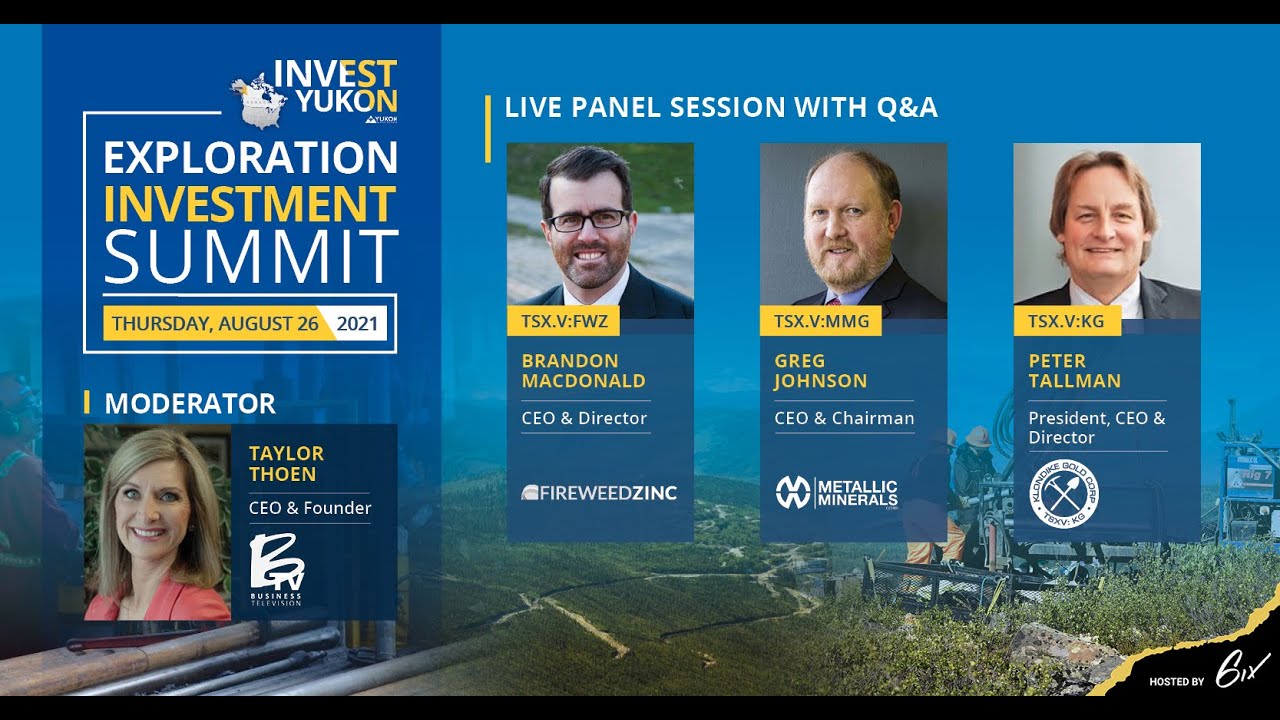
59:16 And then I'm just looking at the time. We got 1 minute left and I gotta do a close. Greg quickly, how's the exploration on the Keno East going and what's the progress or what's been done so far this year on Keno East? Keno East is this under explored parts of the Keno district on the eastern side. This is where we have the big targets that we discovered last year. So that's a big focus of our drilling. I can say it's going well. We're discovering some new things and we've just completed this deep geophysical survey. This is giving us some really exciting information. So there'll be a lot more to come. Okay. On Kenoist. Awesome. Well, that brings us to a close. I want to thank Brandon McDonald from Fireweed Zinc, Greg Johnson of Metallic Minerals and Peter Talman at Klondike Gold. I hope everyone garnered some useful information here today for these robust investment opportunities that are obviously in this high grade, prolific region of the Yukon.
1:00:15 This will be available on the Invest Yukon's YouTube channel. And I just want to thank everyone, BTB, Taylor Tone. We are back on Tuesday, August 31st at 10 a.m. Pacific Standard Time with another live panel and Q&A. Please register online at investyukon.ca. Whoo! That's 11 o'clock, guys. Thank you. You