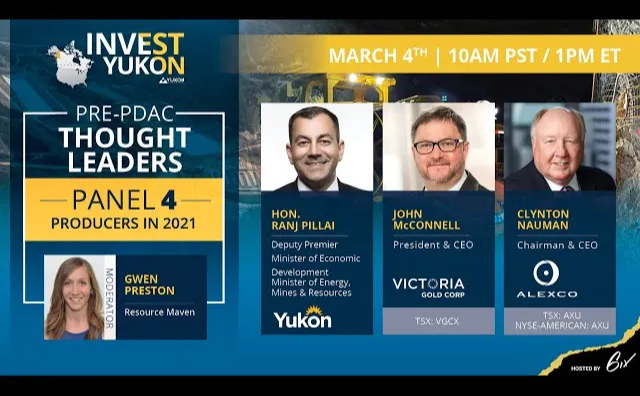
Automated transcript · Written by software from the replay's audio. It can mishear names and figures; the replay is the record.
24:12 Clint, do you have anything else to add about that? No, I just, I think that John said it extremely well. It's all about all in sustaining costs. You have to be in a jurisdiction that's competitive. There's no question that that's the case in the Yukon. I would say that the Yukon does tend to lend itself to either very large high capacity deposits, such as John is working with, or in the alternative, very high grade deposits, maybe not quite as large on the other side. So, I mean, you can mitigate that risk to the extent that it exists. But John's exactly right. The paradigm is different. People fly in and fly out.
25:00 And so long as there's a paycheck in that mix somewhere, it really doesn't, it really puts the Yukon in the same footing as a lot of other jurisdictions, for sure. At the end of the day, I think it's highly competitive. Okay. You both, obviously a big part of your job is talking about what you're doing, what you're building, what you're producing to those who might want to invest money in it and so bankers, brokers, fund managers, investors of all sizes and from all parts of the world I'm sure. I wanted to ask because of that exposure that you get to people's perceptions of UConn, what are some of the main questions you get from people about Yukon? What are the risks that they perceive?
25:52 What are the answers that you give to some of those questions? Clint, do you want to take a stab at that? Yeah, I mean, it's a fairly common question, But there are a lot of people around the world, investors for sure, that are very familiar with the Yukon. And a lot of them have traveled there, in fact, to better understand the environment. So you get the normal questions about, well, what do you do when it's cold? Fact of the matter is, when you look around the world in the cold areas, mines are pretty efficient in cold conditions, sometimes more efficient than they are in the summer, you know, in some of the big open pit operations.
26:38 And so, and underground, the ambient temperature, you know, doesn't change a lot, you know, 1 or 2 degrees between summer and winter. So yeah, we do get those questions. I will say, though, that jurisdictional risk is, on one hand, is extremely low. The Yukon is a tier 1 jurisdiction. It's a great place to invest. It has sanctity of title to the extent that you're successful in the expiration phase, you know that no one's going to steal your deposit from you, with all due respect. On the other hand, I would say that there's a fairly high awareness now of the protracted nature of the permitting process.
27:26 And I can say with some confidence, talking to some of the larger fund managers in Europe that have invested in Alexco, that they are keeping a very close eye on what is going on and quite frankly, they're anxious. So for exactly the reason that John is saying, he needs an amendment to his permit, he's starting way early. Alexco do the same thing by virtue of the fact that we have small deposits in a lot of them and things are going to change. So People are certainly focused in on the efficiency of their investment in terms of how long does it take to mature, you know, relative to the to the permitting and execution phase that goes along with that.
28:16 Fair enough. That's a very, yeah, that's an interesting point for sure. Interesting you comment too about how many people have traveled to Yukon. YMA gets a lot of credit for that, I mean they were certainly groundbreakers in creating that sort of regional alliance of explorers and developers that helps you all get people up to your territory to look at things. John, anything to add about what people worry about or how you respond to those concerns when it comes to considering investing in Yukon? You know, I find it interesting, you know, as we've matured as a company and our market cap has gone up, we've attracted the attention of a number of large funds and they spend a lot of time doing due diligence. Like the order of 6 months doing due diligence, I can think of 2 groups I'm talking to right now. Fortunately, it's all worked out and they're both shareholders now.
29:13 But, you know, Both of them, just recently, there was an article in the Narwhal Magazine about a tax road permit being squashed. And both groups called to ask me about that. They saw that as very negative for the Yukon. And, you know, I've talked to Ranj about it, and you know, Ranj being the great guy he is, has agreed to talk to them. So we've set up Zoom calls for him to give his side of the story, you know, to try and help put their mind at rest that, you know, future permits or applications won't be squashed in what seemed like, you know, from reporters, you know, that it was a government decision, no road.
30:11 Right. Interesting. Yeah, and it's so interesting how there can be, and this applies to lots of places, lots of companies, you know, there can be lots of good things that happen, even a steady stream of positive moves in 1 area like infrastructure, and then there can be a negative light shone, and that's what grabs people's attention. But so it goes, that's awareness of risk and that's what investors have to keep their eyes on, right? Sorry, Clint? I said true enough, exactly. Yeah. I wanna give just one question to each of you specific to your actual company and operation. Before I get to just wrap things up here, Clint, let's start with you. You've certainly, I mean, you've obviously just gone through getting back into production. Your share price has shown that in a nice re-rating here.
31:01 What would you describe as for those who are interested in Alexco, you know, over the next sort of 6 to 12 months, what are the key catalysts that people can look for if they're looking at the share price now and thinking, oh, maybe I missed the boat because this thing has already lifted a bunch. What's what's happening in the next 6 to 12 months for Alexco? So we have a project that we initiated the development on some months ago. It normally comprises 1.1, 1.2 million tonnes of 800 gram of silver per ton material, which will be mined primarily from 2 deposits. And we are on that track. And we've talked about the influence of COVID on this And this ramp up so we are on this track We are operating pretty much as we originally anticipated as modified by the pandemic, productivity issues that John was talking about.
32:10 So at the present time, we are mining ore from the initial deposit that was always on the books to be mined to sort of bed in the mill. It turns out that deposit is probably going to be a little more, is going to overproduce in terms of capacity and grade. And so that's good news. On the other side, we'd like to get out of that deposit so we can get into the 2 other deposits, one of which we had to sideline because of this productivity issues and get mining in those. So at the end of the day, we will be, you know, at design capacity 400 tonnes per day at a run rate of, you know, around 4 million ounces of silver per year in the third quarter of this year.
33:03 And That's a little slower than we anticipated for all the reasons that we've talked about here. Currently, we've got 120,130 people on site, 20, 30 contractors. 40 per cent of our workforce is Yukon-based mills. We've got, as per the original plan, is running on a two-and-two basis, and we're looking to modify that to full-time mill operations. We're focusing on metallurgy and efficiency in the mill recoveries. The mill is operating well. We're shipping concentrate. It's commercial concentrate. And so we've started down the revenue path.
33:49 So normally, 200 tons per day, 250 tons a day when we're operating at the present time, working our way towards 400 tons per day and 4 million ounces per year in the third quarter of this year. Sounds like enough on your plate. Just, you know. Yeah, well, and also like John, we'll be operating a very large exploration program, which we're pretty excited about, because it has the potential to strategically change people's view of the Keno Hill District, I think. That's a tantalising little comment that I'm going to cut you off on in the interest of time but there may be questions that should come from people to follow up on that a little bit. John, same sort of question for you.
34:36 I mean, it hasn't, Victoria Gold's had an incredible share price run up to initial production and then there's been a bit of a step back, which is not uncommon as the realities of mining set in. The run up to initial production is all about the anticipation of things being perfect. And guess what? Mines are realities, not perfection. So why don't you talk about where Victoria, where the mine is now and where you're headed and what you're optimistic about, or I guess concerned about in the next 6 to 12 months. Yeah, We had a bit of a step back in the third quarter of last year. 3 things. One was COVID. We've talked enough about that. We found the ore was far more abrasive than we had anticipated. So we had to change out liners, the hardness of liners in some cases, had to go to ceramics, in some cases to rubber.
35:31 And in some cases we had some design problems. I mean, you know, the engineering was just, doesn't always get it right. And so we had to completely pull out things and redesign them and rebuild them. And after struggling through the third quarter, we said, let's fight the bullet and get this plant back. So we missed our guidance for the second half. We suffered from that. And I would say we're in the penalty box right now because of that. But, you know, we've essentially completely rebuilt the plant now, and we got started stacking here a week ago.
36:16 And I would expect, you know, we'll ramp up to name plate capacity very quickly and sort of, we haven't provided any guidance on gold production, but we will hear in the next couple of weeks as we see how the plant runs. Gotcha. Okay. Yeah. I just want to wrap up. I mean, both of you are, have been involved in, lived in, worked in Yukon for a long time. And so- Are you suggesting we're old? I would never say such a thing. You said it. But no. No, I wanted to talk more about, I guess this is a bit of a, just the sense of accomplishment from now you're both operating mines in this territory where you've spent so much of your, so many years of your, of focus.
37:13 That's got to feel like an accomplishment, John. Yeah, no, it's been great. And you know, like Clint, I've spent just about all of my career in the North. So Nunavut, NWT and now the Yukon. So, you know, but I would say the Yukon is where I've been able to flourish. You know, it's just a great jurisdiction and we've got a great mine and great people running it. So, you know, I, despite all the negatism around COVID, I have to pinch myself every day at the success that we've had. Yeah. I mean, Clint, just to add to the question a little bit, I did hear in preparing for this conversation, the sort of the anomalous statistic that you kind of posted positive GDP growth in 2020.
38:07 It's like the only province or territory in Canada to do that. And I, you know, the 2 of you and the operations that you run were a big contribution to that. So I mean, that's, yeah, that's got to sit with you, right, Clint? Yeah, well, John, much, you know, much more than us. And, you know, I have to sort of, you know, reframe your question and put my geology hat on for just a second. One of the most satisfying things that I have seen that's come out of this period, huge investment and scale up and new mines in the Yukon is the recognition, at least from our perspective, of you've got developing now, I think, a sort of a large metallogenic province. I mean, if you can get your head around the central Yukon, I mean, John, you know, his 2, 3 million ounces of gold sitting over there.
39:04 We're right next door with more than a hundred million ounces of silver. There's other operators working in and around us. So, I mean, companies and investors around the world need to understand that, at least my opinion is, you're seeing emerging a new metallogenic province which will foster, you know, a lot more investment, there'll be more discoveries, and I think it's a great story, and of all the things that I have done, I think it's a great story, you know, and of all the things that I have done. I think it's a great story. This is certainly one of the most satisfying. Well, I think that's a pretty nice note to leave it on. So how about we, I will stop asking questions now and we'll hand it over to the audience. So, let's transition over to a Q&A and see what everyone else has to ask these guys.
40:06 Welcome to the Q&A portion of our panel here. There are certain questions that have come in, so I will start off with those, and then I have some more of my own that I can keep asking for sure. In my discussion with the minister, which you can tell from the fact that I was wearing a different shirt, was pre-recorded. He referenced that there was an infrastructure decision coming, and that infrastructure decision has happened since that discussion. And it is about a road. And it's a road that helps the 2 of you. So who wants to talk about, I really want to talk about 2 sides of it. One question is, can you give us a little look into how decisions like this, which is a major infrastructure decision, how it comes about in Yukon, the stakeholders, the process, how much mining, how much voice perhaps you feel like you have in those sorts of conversations. And then I also want to ask about what sort of tangible impact a major investment like this from the government has for operators out there. So I don't know. John, do you want to jump into that?
41:14 Let me take a shot at that. So yeah, the government just a day or 2 ago announced an investment of more than $60 million in the road which extends from Stewart Crossing to Keno City, actually, so there's a total of 100 and something odd kilometres, and a very significant investment in an infrastructure and roading system that is—the Yukon has done a reasonable job of upkeep and maintenance on those roads, but it has been subject to significantly increased traffic, you know, with both of us building operations as heavy equipment, heavy trucks on those roads, we're shipping concentrate on a regular basis.
42:10 So, 40, 50 tons of trucks. So, yeah, so it's a welcome investment in an area where you've got 2 fairly major projects and a lot of traffic, it'll increase safety and efficiency. I think it's a great, great move. I will say, And we certainly are appreciative of the investment. And I will say that the Yukon is also upgrading the power grid in the area that John and I are in. And, you know, just as an off-topic remark, I mean, John and I are looking anxiously here in the next week or so, because they're gonna take the major grid offline for 3 or 4 days to hook up all of the new infrastructure they've got. So yeah, hats off to the Yukon again, you know, they've done the right thing at the right time. So you get to really test out whether your backup power systems work for 3 or 4 days while your main power supply goes away. Exactly right.
43:17 Exactly right. Interesting, okay. John, just to expand on the road decision here a little bit, do you, I mean, it's a brand new decision. I wanted to talk, the other part of the question was sort of how these decisions come about, How much were you maybe engaged in that or in the process of the government making the decision to invest in this road? Can you talk a bit about how that process looked from your end? Or did the announcement just come out of the blue? I harass government continuously. So, but in terms of the specifics, I wasn't involved at all. Sure, okay. Well, it's a good thing, a better road I'm sure will lower costs for both of you, whether it's dramatically or a little bit, every little bit helps, right?
44:10 I'm gonna go to some questions that have come in here. We talked in our panel there about some of the challenges of permitting in Yukon, primarily being about it being quite slow. And there has recently been another thing thrown into that mix, which is this BMC decision about needing another layer of consultation. John, you referenced an article in a magazine making investors call you. So what thoughts do you have on this new requirement around a longer permitting and consultation period? And how are investors responding to that if they are? Yeah, actually, I'm getting a lot of feedback here. I don't know if the sound's coming through okay there.
45:01 Pretty good. Okay. You know, I haven't had any questions about that. I'm appalled, as was the Premier, that now all of a sudden the Feds are taking an interest in the Yukon. I think we have a very robust process in the Yukon and one of the real benefits was not having the federal government involved. So it's a disappointment And I think our premier is pushing back very strongly and hopefully it's effective. Right. Okay. We'll see how that one plays out, I suppose. Clint, we have a specific question, a few specific questions for you. One of them is, can you just expound on, I mean, the question that came in is, what is the situation with the Wheaton deal?
45:53 So do you wanna just take us through that aspect of the Alexico story for everyone? Well, really nothing's changed with the Wheaton deal. In the last 6 months or so, we've renegotiated such that it's a price-driven arrangement whereby we stream 25% of our silver to Wheaton Precious Metals. They pay for that silver based on the price of silver, the average price of silver on a monthly basis. So when prices are low, they pay close to spot price for the silver. And I'm talking in terms of $14, $15, something like that. When prices are higher than $23, $24, they pay us 10% of the spot price of silver.
46:43 So nothing really has changed in the last 6 months or so. It's a vast improvement on where we were 4 years ago, where the Wheaton arrangement was essentially a plus 20% NSR. We have it to a point now with this equivalent of less than 10% NSR. So I mean, it's a big improvement. We have very high grade deposits. Revenue on our side, the revenue continues to increase as prices go up. And Will, another specific question just to follow on with that, the coverage for that deal, it is the entire project or it's resources that were defined when the deal was signed? Like how do new discoveries play into the deal? Yeah, it encompasses the district as a whole And there's an area of interest, I think it's 1 kilometer around the outside of the current claim block that we have, which admittedly is very large.
47:43 Fair enough, okay. John, here's an interesting one for you. It's not necessarily so specific to UConn, but as someone who has just been going through this transition from exploration, building, and now production, do you wanna talk about the capital market side of that from where you sit as the president of the company. I mean, there's obviously a shift in who invests in a company as it goes through that transition. And that takes a lot of conversations from you and a lot of sort of dealing and moving, perhaps moving shares around. Do you wanna just talk about the capital markets or share management side of the transition that Victoria has gone through? Yeah, as you said, it's different groups that invest and I alluded to earlier, you know, you become under the attention of some large funds.
48:34 And I wouldn't say they're necessarily more sophisticated than the smaller funds or retail guys. They do a lot more technical due diligence. You know, They have engineers and geologists on staff. They give the operation a pretty good scrub and put myself through pretty rigorous questioning. But they come with the big money. 1 group, I was talking to them yesterday as part of the BMO conference, and they've purchased 17 million US in Victoria shares in the market over the past 3 months.
49:25 I mean, that in itself is quite a statement, because when you're in an earlier phase in the mining space, when you're an explorer or even a developer, the bigger funds who would be interested in those companies would never put that much money into the market. They would want to do it through a financing. But once you're a producer and financings aren't on the table anymore, then all of a sudden it has to come into the market, like just buying on the open market, which is a big difference, right? Yeah, no, it's a real change. Yeah. Yeah, it's just an interesting, I'm sure an interesting process from where you sit. I wanted to, Clint, a specific question for you on the exploration side of things. Obviously, Alexko, you, as we discussed in the panel, focus mostly in the next 6 months on operational, on getting up to your design capacity and all of that. But Alexco is also very much an exploration story with the district. So do you wanna just talk about your list of targets, how you prioritize them, how much money or attention will be going into exploration in the next little while and how you balance those needs?
50:32 Well, the mercenary answer is that we look for the highest grade deposits that we can mine the cheapest and get to the mill fastest. It's pretty simple. Priority. But Yeah, we've been pretty lucky and I've done a lot of work, technical work on the exploration side which has been pretty successful. We're focused in the short term on this Birmingham deposit, which has a resource of more than 900 grams per tonne. There's only 3 or 400,000 tonnes of that in the current mine plan, even diluted out 30%, it's still more than 900 gram per tonne delivery feed grade at the mill. We last year drilled below that deposit.
51:19 We have strong indications over a fairly significant strike length, at least in terms of the scale of the ore deposits that we look at that there's more ore beneath the existing deposit. And all of our focus this year is going to be on seeing if we can convert that to resource. So yeah, we have a panel down there of rocks, if you like, that's at least 500,550 metres long, number of drill holes in that that are anywhere between 5 and more than 8 metres true thickness, grades ranging from 1,500 to more than 3,000 grams per tonne Silver. It's a great discovery. And as I mentioned, as we were going to put another 25,000m into that, starting as early as the next couple of weeks here, 4 drills, whatever we need to get that stuff drilled up as quickly as we can, because it is within a couple of hundred or 250 metres of the current bottom of the design ramp, production ramp at Birmingham, which we are already driving.
52:33 So it could have a very significant impact on the future of the district for sure. So in essence, it is exactly what you just said at the beginning. It's the highest grade and it can come into the mill quickly. Exactly right. Fair enough. Okay, as 2, you know, engaged Yukoners, I'm going to put you on the spot and ask you what other Yukon stories, explorers, whatever stage, whatever commodity, whatever part of the territory, what other Yukon companies are you watching? Are you interested in? Do you think have potential to grab attention over the next year? John's laughing because he's trying to decide whether to mention his wife's company. But we all know that that I'm sure is a lot of people who are interested in.
53:24 John? I'll let Clint go first. Okay, let Clint go first. So it's not even a diplomatic answer, but yeah, Banyan, I mean, we've invested in Banyan. I mean, John and I sort of cobbled together that deal on a piece of ground that was not often, but certainly wasn't on the priority list for either of us. And Tara has done a great job and her group there of taking something that was pretty preliminary and stayed in the exploration world and turning it into an area where now, I mean, you can see there's fairly widespread gold mineralization, low grade maybe.
54:17 God doesn't think it's low grade. Yeah. Well, no, I mean, it's not dissimilar to the Victorian grade. But I mean, I'd go back to my original comment. I mean, in terms of the Yukon, you cannot turn away from the fact that this portion of the central Yukon where we are working has turned out to be very bountiful in terms of its metallogenic assets. And they're widespread. There's clear deposits. And there'll be more of them found. So yeah, I would, I am really excited about what's being generated in this part of the Yukon.
55:06 And I think that there's a lot more to come. Okay. John, do you have anything to add? Yeah, I think there's an awful lot of attention gets placed on area around Offbeat and Western Copper, great district there. But I agree with Clint, I think that, you know, Banyan is really onto something and probably the next new mine in the Yukon is gonna be a kilometer one of our access road. Whether it's just a pit that sends the ore to a mill that's already in place or not, that could work out in multiple ways. Certainly this part of the Yukon that you're in is getting more attention. And there's also in a territory like Yukon that is so vast and where there are roads, but certainly they do not penetrate everywhere. New roads can certainly help. I mean, the thought that comes to mind is Sitka Gold.
56:07 They've accumulated a land package, and that's partly because it's an area they've been interested in for a long time. But now there's a road going through there. And so all of a sudden it becomes sort of a reasonable place to explore. And who knows what they might find, because as Clint says, there's a lot of metal endowment in the area. I think we're good. I think that's been an hour of chatting Yukon. Unless either of you have anything else that's just burning to get out, I would like to, we've answered the questions that have come in, so I'd like to say thanks to the 2 of you for taking the time to chat today. And thanks of course to Invest Yukon for putting this all together. And with that, thanks to the audience for your time and your attention, your interest in UConn.