Transcript
Automated transcript · Written by software from the replay's audio. It can mishear names and figures; the replay is the record.
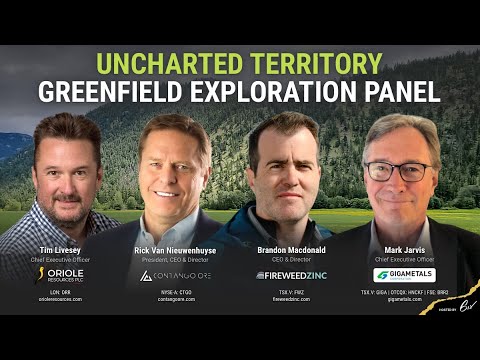
0:11 Hello, everyone, and welcome to today's live panel discussion hosted by 6, focusing today on the Greenfield properties our speakers work with. I'm joined today by Rick Van Ewenhuizen, Contango Ores president and CEO, Brian McDonald, CEO and director of Fireweed Zinc, Mark Jarvis, CEO of Giga Metals, and Tim Libsey, CEO of Oriel Resources. Today's panelists are going to be having a discussion about the unique, untouched, and unexplored greenfield properties that they work with. And after we'll move on to a live Q&A session where we'll be accepting and answering some questions. You can submit your questions using the Q&A panel found on the right-hand side of your screen at any time during today's panel. As always, this video is being recorded and will be available to watch afterwards on Six.com in the coming days. But to begin with, I'd like to offer a few minutes to each panelist to introduce themselves and their company before we begin in earnest. So with that, Rick, I'd like to begin with you and Contango Org. Go ahead.
1:00 Well, good morning and thanks Cam. Thanks everybody for joining us this morning. Contango is working on a number of projects in Alaska from advanced stage to grassroots. And so I'm going to talk to you a bit about all of those. I wanted to just mention we are a bit of a unique company and we don't have a lot of shares outstanding. We're New York Stock Exchange, American Traded, symbol CTGO. We only have 6.7 million shares and we have $25 million in cash. So we're well funded for what we're about to undertake here.
1:34 Our main project, Manchow, is in Alaska. It was discovered as a grassroots discovery. We've outlined 1.3 million ounces at 4 grams open pit, right next to the highway on private land owned by the Tetlin tribe. We entered into a business combination with Kinross. They paid $93 million for their 70% interest, so they're all in, if you will. The whole reason we did that is to be able to transport the Manchot Ore up to the Fort Knox Mill, which is shown here in red. Mancho deposit in yellow. So this is the Mancho area. There's 2 deposits. It was found with stream sediment geochemistry. Nobody had ever done any work in this area. It was on private land owned by the tribe and the tribe had never invited anybody in to do any work.
2:24 Our plan is to get this into production quickly because we don't have to build a mill in the tailings facility. We'll start construction next year and finish it up and be in production, full production by 2024. Ken Ross guidance is that the joint venture will produce 220,000 ounces on average a year. Our 30% would be roughly 66,000. They've given us guidance of $130 million on a high end for capital. Our share would be about 40 million and are all in sustaining costs about 750, which today's gold price gives us just over 1000 dollar margin. So we're generating 60 to 70 million dollars of free cash flow a year. A pretty nice place to be for a junior exploration company.
3:12 Lots of exploration upside here. These are the 2 main deposits that you saw in the photo. Lots of geochem at surface that indicates that there's big anomalies here that are still untested. And this only represents, this map represents about 2% of our 688,000 acres of exploration land. So you can see we'll be plenty busy over the next year here. So walk in Ross is advancing the project to a production decision. We'll be working on our other early stage exploration projects are man showed the project is here. This is the joint venture in yellow. Next to that is the Eagle Hona project, a large area of stratigraphy that's continuous with the Manchurian area. Our ZZZ project, where early stage exploration is outlined a porphyry target.
4:00 Our Shamrock project up here in the Pogo District, right next to the highway, produced 120,000 ounces of alluvial gold, and we're looking basically for the source of that gold. And then finally, our Lucky Shot project, which is just located just outside of Anchorage. Lucky Shot's an interesting one. It produced historically 250,000 ounces at 1.5 ounces per ton, so about 40 grams per ton. High-grade, narrow-vein structures. They mined free gold in quartz here. Very simple gravity recovery of the gold. And there were 30 operating mines in this district. We've now consolidated a good part of those.
4:45 There's a number of patented claims that we're still working on consolidating. And we see this as both an advanced stage project. We have a plan here to advance the Lucky Shot mine itself, but we're going to also be looking at the other 30 historic mines in the district, which all were in the Granite Iorate, which is the lighter colored rock here. We see all the Xs and Ys. What's never really been looked at is the Schist, the purple rocks down below there. And that's something we'll, they didn't mine those because they were too low grade. They like these high grade narrow high grade veins that were running 1 to 2 ounces. So again a bit of a combination of early stage and advanced stage projects. So while we're generating cash flow from our operation in 2 years at Manchot, $60, $70 million of free cashflow. We can then use that money to advance our other projects, find more gold without dilution to our shareholder base.
5:45 And I'll stop there and turn it back over to you, Cam.
5:49 Thanks a lot, Rick. With that, I think we'll pass it over to Brandon from Fireweed Zinc to lead us on their presentation. Thank you very much. Glad to be here. I think everyone's familiar with the crisis we've entered with COVID and the optimism that comes out of it. And part of what Fireweed sees is that Already, base metals have had a tremendous move in the last couple of years, and we see it's just really the beginning of a nascent, long-lived bull market for base metals. And Zinc specifically, we're thinking around infrastructure stimulus and what that's going to do to demand. So when you think about increasing demand, there's not a lot of projects like the Mellon Pass, our flagship project located in Yukon territory.
6:39 It's big. It's a standout in terms of scale, but also in terms of exploration upside. We've attracted investment from tech and had a lot of big companies with eyeballs on us. It is greenfields though, and we've made some great exploration successes there, including the discovery of Boundary West last year and the expansion of that with some new high-grade zones this year. And despite all its potential, like a lot of companies, we're still dirt cheap. One of the things about Greenfields, and I don't want to belabor economics of the project because the project looks a lot different now than it did in 2018. But when you're Greenfield and you're remote, there's not a lot of benchmarks for a project. So we considered it important to do early stage economics on it, a PEA shortly after we bought the project.
7:39 And we kind of hit the marks we wanted to see, clear, multi-cycle mine life, healthy NPV and IRR. And the project's got so much better than there since 2018, in no small part because of exploration success. And when we did that PEA, when we did that resource statement in 2018, we were really looking only at the Tom and Jason deposits which you know is in the southwest or southeast sorry of our project. You know at the time we we bought the core of the project of Hud Bay and it had been idle for for 20 plus years and you know we had 54 square kilometers and we've expanded that to 940 square kilometers. And we see a real thesis for this being a district. We see a repeatable thesis for exploring and discovering additional set-ex and set-ex proximal I guess styles of deposits.
8:37 The success, particularly at Boundary and Boundary West the last 3 years, has really demonstrated the scale potential of this project. And What we see at Boundary West is not SEDX.
8:53 SEDX is a deprecated term. Shale hosted base metal deposit better, because we no longer think that it's exhalative. But nonetheless, what we saw at Boundary initially was nothing like that. This was sphalerite veining, breccias, class replacement, et cetera, and not like the classic finely banded shale baryite hosted stuff that we saw at Tom and Jason. So it got us thinking and made us think that perhaps what we were seeing at Boundary was a feeder to some type of stratiform system. And that's what we found at Boundary West 2020, and then expanded in 2021. So this was a brand new discovery at Boundary West in 2021. And we've been iteratively expanding that in the last couple of years.
9:47 And we see various different styles of mineralization there. We do see the the vein style of mineralization that exists at boundary nearby, but you know, we see Tom and Jason style strata form stuff, which was a great success to see that. And very high-grade, 10.5m of almost 24% Zinc, 3.5% Lead and 75g Silver. So that was a major success, the discovery of Boundary West there. But beyond that, we continue to explore and using new techniques. We use gravity extensively. We're deploying a new style of geophysics called Muon Tomography with our partners, Ideon, which is kind of a subsurface X-ray to look for these dense bodies, which contrast nicely against the country rocks.
10:38 So, we're looking forward to more success there. And we really see that the 2018 PEA was a base case. We've had government commitment to funding our road since then. We've had massive exploration success at Boundary Zone. We've got all sorts of brand new targets to explore. So we really see that as the core of a much, much more large and robust project going forward. That's it. Thank you very much. Wonderful. Thank you, Brandon. And with that, we'll hand it over to Mark Jarvis of Giga Metals. Okay, well, thanks very much. And you know, I'm glad everyone's here. So we, our company, our core project is in North Central British Columbia, the Turnagain project.
11:28 It's a very large, low grade, open pitable, Nickel and Cobalt and Sulfides deposit.
11:37 We did a PEA recently modeling production of nameplate capacity of 37,000 tons per year of Nickel with a 37-year mine life. So, you know, truly a giant deposit. And we're going through a development process with that. But what I'm here to talk about today is we've got a greenfields exploration project in Brazil that's quite interesting.
12:09 And it all started with this thought that, you know, South America and Africa used to be the same continent and the San Francisco Craton in Brazil is thought to be an offshoot of the Copper Belt in West Africa. And so we started with that concept and did tons of research in this area of Brazil. Some areas of interest were already fully state, but we found a couple of areas and 1 in particular that had quite a bit of open ground. And so what we're chasing here is a red bed copper mineralization. It can be copper cobalt, it can be copper silver, and we're early stage.
13:01 So this is where we are. And it was interesting as we had geologists in there doing stream sediment sampling, you know, some geochem, we also came across water wells that had been drilled by the locals. And these water wells had, you know, piles of blue chips beside them. And so our geologists picked them up and, you know, sure enough, they contain meaningful amounts of copper. So We're looking for these pre-Cambrian, in age, red bed, copper type deposits. Our exploration is being managed from here by Dave Tupper, who's an old friend of mine.
13:47 He's a very experienced exploration geologist and we're working with someone named John Hill, who is actually living in Brazil. He's married to a Brazilian woman and you know it's very important he's a hexangle. It's very important that you understand in a challenging jurisdiction like Brazil that you understand how things work locally. It's less challenging, however, than the Congo. So that's why we're pressing ahead with this. We are currently drilling with a percussion drill. We're doing a series of 10 holes to about 150 meters just to
14:27 prove the concept that we do have these sedimentary horizons under shallow ground cover. And so far, we are seeing sandstone, we're seeing a bit of blue in the sandstone. Don't really know what's going on yet. We're going to complete the program. It's actually been halted for a couple of weeks over Christmas. There was some flooding down there, so we're planning to restart the program in the new year. It's just very interesting and you know, whenever you're turning a drill, you know, lightning could strike. And that's sort of one of the things that I enjoy about this. And that's, that's all I'll say. We can move on.
15:20 Thanks. Absolutely. Thank you so much, Mark. And with that, we'll move on to Tim Livesy from Oriole. Thanks very much, Cam. Good afternoon, everybody. We're going to leap across to Africa now from the Americas, although we are effectively a continuation of the last project across on the Cameroon side of the Atlantic.
15:46 You'll recognize if you relocate Africa and Brazil, we're actually in Cameroon, we're operating in a mobile belt zone between the Congo Craton and the West African Craton, which is where We have significant land holdings and an area that we consider to be a grassroots greenfield discovery and also an area for a potential new gold mining district. We also have a project up in Senegal, which I'll come to at the end of the presentation. Senegal is currently under an earning agreement by IAMGOLD. They're in the fourth year of an initial four-year program with an option to gain up to 51% and then there's a renewal date early next year for them to option up to 70% if they so wish.
16:40 So we'll move into Cameroon. Cameroon's quite an interesting jurisdiction. We have 2 licenses in the north of Cameroon, Bibbimi and Wapusi, and these were originally an exploration success, a new discovery in a previously unexplored area for a company I was previously COO for, Reservoir Minerals.
17:04 There was a discovery here in 2012, gold in nugget form and in rock chip sample form on surface on both the Bivermey and Wapusi licenses. Unfortunately, the projects didn't get a great deal of attention after that discovery because for Reservoir at the same time we discovered the Cekaropeki copper gold project in Serbia just next to the Bor Mardinpek mining complex And that took our main focus. So these 2 licenses, to some extent, were kind of orphaned. And when I came into Aureal Resources a few years ago, we restarted that relationship with the local partner, got in on the ground. And what we've been able to do this year is put 28 holes into the Bibbimi targets.
17:53 We've got over 8 kilometers of surface normalism, which has been identified and followed up with trenching and sampling at Bibbimi.
18:02 And we've extended orogenic gold mineralization down to depth of 100 meters in all the holes we drilled, or in over half of the holes we've drilled to date. At Wapusi, just to the north of here, we're a little bit behind that we're targeting and we're working up some drill targets right now. So both those real classic greenfields discoveries. But in Cameroon, the really exciting thing for us is what we call the CLP or the Central Licence Package. And this is 3500 square kilometres divided into 8 licences in the middle of Cameroon. It's associated with the Choliro-Bano Shear Zone, which is a splay off the central Cameroon shear zone, which if you relocate, runs across into Brazil.
18:49 And you can see from this image, we've done some early work in here, we've done some stream sediment sampling, and we've identified good mineralization along, or good anomalism should I say, along the 35 to 40 kilometers of Cholera Banio, Chiazon in the 3 licenses on the east and we're also seeing some what appear to be extensional systems, corridors of mineralization running north-northwest to south-southeast. So a really exciting place for us to be and real virgin ground. This had never been licensed before. Cameroon is undergoing a, or has undergone a big investment from the World Bank to develop the mining sector. They put in place new mining laws, they put in place new geological data sets, new geochemistry, geophysics.
19:39 And we picked up this ground and targeted it in 2019 and we've granted the licenses early this year. And we believe there's a great opportunity here for a new gold district.
19:51 In Senegal, we have a large license, 472 square kilometers with 5 prospects on it. The most promising of which to date is the Farae project in the north. And here we have over 6 kilometers of gold extension. Again, this was primarily drilled about 5 or 6 years ago prior to iron gold coming in. And then iron gold have followed up with that exploration. And we're getting some really good intersections from the work this year. You know, long wide cuts,
20:21 50, 60, 70 metres wide, a couple of grams and some in the far a far south target, a new discovery this year, 35 metres at 3.6 grams, including 18 metres at 6.4. So certainly decent widths that indicate to us the opportunity for a new mine target in this greenfields area. And that's it for me, thank you. Wonderful, Thank you for that, Tim. Well, now that the audience is a bit more oriented and introduced to each of your companies, I think now's a great time to dive into today's real topic and greenfields. I'd like to go around the horn. Tell us about specifically and tell the audience specifically more about your property, more about your greenfield and maybe what led you or attracted you to those properties. Tim, let's bounce it right back to you.
21:12 Well, the key thing for us in Cameroon was the fact that it was so massively under-explored.
21:18 You know, the economics of oil deposits change over time. You could have an area which is previously mined, which gets abandoned for a number of years for whatever reason. Rick had a good example earlier on, where the previous mining had focused on the very, very high grade narrow veins. And now they're looking at the wider section, slightly lower grade, but in today's climate, certainly economic.
21:40 In Cameroon, we've had other reasons for not investing recently. The government was really up until sort of 5 or 6 years ago was really not that interested. They were more oil and gas focused. So we've really timed it right. We've hit that window of opportunity.
21:57 And to me, it reminds me a lot of I went into Tanzania in the 1990s when Tanzania was opening up. And in the space of 10 years, you went from having no operating Gold mines in Tanzania to having 5, discovered, developed, constructed and into operation within that 10-year block. And we believe Cameroon has that opportunity. It's a mobile belt zone between 2 cratons, so deep structures reactivated with fluids, mineral-rich fluids coming up,
22:29 compression and extension, the right type of host rocks, the right age of rocks, the right type of alteration. So geologically, the whole package is just there. And what's been holding it back perhaps has been the politics and the sort of interest in typical mid-tier major companies going into more, shall we say, more mature jurisdictions in West Africa,
22:55 you know, Ghana, Senegal, Mali, Burkina Faso. And what we're seeing now is Cameroon is playing catch up, which is great opportunity for us. And that's where we see the opportunity to get in and to be first movers. We've been there for over 3 years now. We've built good relationships. We've picked some fantastic ground, open ground, So we can operate quickly, cheaply, importantly, very cheaply and very efficiently to progress these early stage greenfields areas into target development and hopefully new discoveries.
23:33 Absolutely. Thank you for that, Tim. Mark, what about you? What about Gigametals?
23:37 Well, one of the reasons that I got interested in Brazil is that our core project is more at the development stage than the exploration stage. And I've been involved with that since 2004. It's been something of a labor of love.
23:55 And, you know, so so what that is, is an extremely large deposit with economics that are marginal at the low end of the commodity price range. It's now coming into its own because of the electric vehicle revolution. Nickel has caught a bid. And so the leverage in a deposit like this is quite incredible and it's gotten interesting for that reason. But there have been times when things have been quite slow, when the nickel price is quite low. And I just got interested, you know, personally in this whole idea of, well, if there's an extension of the West African copper belt in Brazil, well, wouldn't it be interesting if you could find anything like what you see in the Congo? I mean, these deposits are phenomenal that they've got in the Congo.
24:50 And just
24:52 as an aside to the copper production, Congo provides 70% of the world's cobalt. And it's just an amazing belt of mineralization. And you know, it's just if you could find something, anything like that in Brazil rather than in the Congo, Brazil is not an easy jurisdiction, but it's
25:18 workable and it's certainly much, much better jurisdiction than the Congo. So, you know, it's just I find it interesting. We're able to operate relatively cheaply in Brazil. We're spending $100,000 on this 10-hole program with a percussion drill,
25:40 drilling to about 150m because we want these deposits to be close to surface. And we think we are. That was it. It started off as something that we were pursuing because it was a slow time. But that has changed in the last few years. We're quite busy with Kernigan, But we're continuing this Brazilian exploration program because it looks promising.
26:11 Absolutely. Brandon, maybe you could talk about Fireweed Zinc.
26:17 What attracted us to the project was that exploration is hard and there have been a tremendous amount of work done on the project and that work was sort of half finished, so to speak. So what we saw was a project where we were able to build on a lot of sunk costs of our predecessors, right? So when you're able to come in and buy a project for roughly $5 million that's had $100 million spent on it, you've got a lot of data to work with. And so you know we took a look at it and we said like look that this hasn't been properly delineated, the district has potential,
26:57 the change in thinking around how these deposits are formed also highlighted a lot of potential, which is now manifested, right? So,
27:09 but it all kind of started with like, look, this is a Selma Basin is prolific for these styles of deposits. There's 2 really great ones there already. We think those have potential. We think the district has potential. So it made sense to take a shot at it. And so far we've been right. Oh, fair enough. And Rick, what about you? Yeah, so Contango got involved with the Tetlin tribe
27:36 in 10 years ago and The tribe had never opened their land up to exploration. So not even to the USGS You want United States Geological Survey or to the state survey, state of Alaska survey. So this truly was a totally greenfields area. They had set aside a reserve for the Tetlin tribe to keep basically to keep all the white prospectors out. This was at the, of course, the turn of the century. And then with the Alaska Native Claims Settlement Act passed in 1971, the tribe said, well, we just want our land. Just give us our land and we'll be happy with that. So the tribe owns, It's the largest block of private land in the country owned by 1 group. It's 700, or sorry, yeah, 788,000 acres. So it's the size of Rhode Island, a small state in the United States.
28:29 And Again, no one had ever really stepped foot on this land geologically.
28:34 And the way the Manchuro project was discovered, basically it is one of the closest areas to the highways, the Alaska Highway. And so, they set up their camp close by and started grassroots exploration, stream sediment sampling and concentrate sampling, old time prospecting, and then get boots on the ground. Next year, you have some anomalies, you follow them up, you go upstream and lo and behold, you find some gossamness material,
29:05 get the assays back at the end of the summer and, oh geez, it ran 9 grams. Come back the next year and do some trenching, do some hand trenching, get some equipment in there, start to drill and you can quickly find a deposit. This happens to be a very high-quality deposit, 4g open pit right at the surface. I think that's the magic of Greenfields exploration, particularly when nobody else has been out there. It's that excitement of discovery and you can go from 0 to 60 in a few minutes.
29:44 It's also just a hell of a lot of fun. Sounds fun. And as you say, right, you know, 0 to 60, Mark, you mentioned it can be like lightning. I guess that sort of leads into the next question, but are greenfield mines better than exploring a historic mine? I'd love to pose that and hear from the entire group. Whoever would like to hop on that one. Well, I think, you know, doing brownfields exploration is probably more lucrative or less risky. But, you know, as Rick was saying, it's fun doing greenfields exploration because, you know, it's intellectually simulating, you know, it's a lot of plotting work. But, you know, you don't get hit by lightning unless you've got a drill turning. And so, you know, it's very methodical.
30:33 You take all these steps towards defining a drill target. But my God, I guess part of it is that all of us that are in this business have a bit of gamble in their blood. And so it's that, you know, rolling the dice and hoping to find something that's really the fun part of this business to me.
30:56 I think, Mark, also, isn't it also tying together, you know, that opportunity? Brownfields, as you say, is is quite sort of de-risked to a point. But Greenfields exploration, really, you get the chance to test your hypotheses, you get the chance to test your theories. I happen to have worked with both Mr. Tucker and Mr. Hill in Africa previously. I've been knocking around there for about 30 years, so I've worked with them both and you know the excitement of identifying a new area that you are convinced has opportunity and then being able to go out and having to prove it to yourself and to your investors is really quite, it is quite a special feeling.
31:44 And I think The other thing about Greenfields is it gives you the chance to, if you're going into a brand new area, virgin territory, it gives you the chance to do it right from the beginning. I think we've all been exposed and we've all worked in areas where Brownfields, there's legacy stuff out there before you and kind of half of the work you're doing is to try to tiptoe through
32:10 previous work programs that perhaps would have done a little bit differently to how you would have done them. Whereas if it's a completely new target area, completely new district, then you get the opportunity to put in place your plan as you and your team think is the best and ultimately the most sustainable way to do it. So I think it's great.
32:33 Also, of course, there are fewer and fewer really untramped areas of ground left. You have to have a reason. Cameroon, it was the politics a little bit. RIC, with your explanation of the land ownership, again, There's a reason why nobody's done it before. So it's a bit of that explorer's spirit, isn't it, to sort of try and get around that and get in on the ground and have a look for yourself. Yeah, when it's truly new territory, you can literally stumble across an outcrop that
33:05 is mineralized and meaningful. And in brown fields, the low-hanging fruit's gone. So that's not to say that if you find something, it's going to be easier to develop for sure, but it's the finding something. You know, like you're looking for the little slivers that were faulted off or something, you know, the odds that you're finding another giant in a big brown, very brownfields location is just reduced. So that's the appeal of greenfields. It's like the jewel of the crown is maybe still there. Yeah, I mean, one of the things we did when we were looking at Cameroon was we did a very, very simplistic distribution curve of orogenic gold deposits in geographical terrains and looked at the typical spread of, you know, smaller 100,000 ounce, 500,000 ounce, million ounce, 10 million, 15 million ounce deposits.
34:08 And if you look at the typical areas in the sort of Senegal, Mali window, you get a distribution curve and you can plot on the distribution curve, the smaller deposits, the mid tier, and then the occasional real outliers of super giant deposits. And we did this for a number of different terrains for orogenic gold around Africa. And we did it for Cameroon. And Cameroon, the graph was completely empty because nobody's found anything yet. I mean, there's some gold mining going on but it's alluvial mining dredging in the rivers. So it's that opportunity to trip over that outcrop as you say, Brandon, to literally come across something nobody's ever really put into context before is the exciting thing.
34:55 And there's all, as I think Tim mentioned, there's all sorts of reasons why at a particular moment in time, nobody's doing any exploration on an area. And then in the case that our Lucky Shot project, there was a very active district from the 19-teens up until 1942, when the War Act shut down all non-essential mining in the United States, and gold mining was considered non-essential. Copper and tungsten was essential mining, iron ore was essential mining, but gold, it wasn't. And so all these mines just boom, 1 day we're open, next day we're shut down. They're all owned by small families and time goes on. The first exploration work that was done in here after the shutdown was in the 1980s.
35:46 And then only sort of sporadically here and there, a few companies drilled some holes. And so you've got kind of in our situation that like you said, you've got kind of a combination of having a lot of data. It's all old historic data, underground mine plans, etc. But you say that this 5-foot zone has 1oz and 0.5 per ton, that gets your attention. And then you've got new modern techniques, airborne surveys that you can apply. And it's, again, you can go from 0 to 60 very quickly. So that's what's, and that's the most exciting thing about greenfield exploration. I think you have to also consider that, you know, the part of the appeal of brownfields was like, OK, it's already disturbed.
36:37 Right. So so there's already a mess there. So nobody should mind if I make more of a mess. But there's a lot of changing, certainly in Canada, that there's a lot of change around on that sort of thinking and particularly around what they call cumulative impacts, right? So being next to a mine in certain parts of Canada now may make it difficult to make a mine because they're going to say that this area has already had quite a bit of impact and the cumulative impacts of another mine is too much. So the blessing of brownfields may not be what it once was. Sometimes being the only project in an area can actually work in your favor.
37:29 Yeah, On the other hand, not to be a Debbie Downer, but on the other hand, you don't have the infrastructure that being next to a modern mine has. What that does really is it ups the scale of what you've got to be looking for, usually in terms of both size and quality. Size is to be able to afford to get a 20-year mine life in front of you and be able to plan on infrastructure. Quality is always better than low-grade. I think it's an important thing. I've always been a proponent of, you only find what you're looking for. So if you're looking for low grade, you're gonna find low grade. If you're looking for high grade, you're gonna find high grade. And You have to plan your exploration out around that thesis.
38:18 If you don't have infrastructure, you've got to find a large high-grade deposit. We did that at Donlon and it's one of the best, largest undeveloped gold deposits in the world. It does take time to build that infrastructure and get the thing permitted and all those things. But you got to set your sights on the right target. I think that's an important thing for Greenfield exploration. Yeah, completely agree. And I also think part of the fun is, you know, putting together a team of geoscientists and, you know, having them all work together from geophysicists to geologists, to, you know, in many cases, you know, you want to learn something fairly early with the metallurgy of what you're finding.
39:08 And, you know, as a non-technical person, as a non-geoscientist, I just, I just like putting teams together and, you know, letting them run and it's fun. You know, the sort of, you know, when the ideas start floating around and, you know, somebody figures out something new and, you know, other members of the team jump on that. It's really, really thrilling, I find. Brownfield sites tend to come with a lot of dogma about what works and what you should be looking for and how you should be looking for it, right? So, Greenfield sites does give your geologists and broader geoscientists a chance to kind of think outside the box a little bit, right?
39:54 Cause it's not well understood, right? So anything's possible. Yeah, you've got- one of the things I always like to look for when I go into a new project area is things called boundary fault. Those things always get my attention because somebody's drilled a couple of holes over there and they didn't find what they were looking for. It gets written off. I love those kinds of situations because you look at the geology a little differently, interpret it a bit differently, and you come up with a different interpretation that says, okay, well, I got to drill 1 more hole over here to test that theory. Yeah. We literally have, we're exploring the boundary zone, which is a boundary of nothing. Right? Like, there's not, it's not bounding anything. It's in the middle of the project. Right? So.
40:42 So I'm wondering about the processes to getting mine permitting and main properties. Are these processes a bit more stringent because there is no history to these properties? What are some challenges that you're faced with when you're dealing with the greenfield? I think it really depends on where you are, which kind of jurisdiction you're in. You know, as Brandon has already mentioned about this cumulative impact thing in some parts of the world, that is a much more important driver behind permitting. I mean, in Cameroon at the moment, Cameroon's biggest issue is to try and attract investment in exploration and mining because they primarily have been focused on the GDP has come from oil and gas and timber and tourism.
41:29 So mining is a real good step for them as a primary industry. So that so that potentially we have a different set of challenges is, you know, if we find something that's of interest, we might be going through early stage permitting with with a ministry that's perhaps not as used to doing it as in some more developed countries where the mining industry is more developed rather. But as Brandon says, you've got the flip side, you know, maybe it's too developed and maybe they're holding back. I think it's very difficult to sort of pick the ideal time and the permitting and the focus on different areas of it will change over time as well.
42:15 You know, Obviously, we've just had COP26 here in the UK and the focus on mining companies getting involved in reducing carbon footprints and climate change stuff is going to be part and parcel of the focus of permitting in the future. So we're all, I think one of the great things about the extractives industries in general is we're all very good at adapting. I think that's one thing that perhaps we as an industry, we don't necessarily get credit for very often, but we are very good at adapting to the situation. I think that if you're in a place that doesn't see much of any mining, maybe they don't have a negative perception of it, but they may also not have a positive perception of it. So when you've got an established mining industry somewhere and you've got families that are mining families, et cetera, they wanna see more of this, right? So sometimes in a Greenfields location, it's kind of like a shrug, like maybe we don't need these jobs or that sort of thing. So you are dealing with, for better or for worse, a bit more ambivalence perhaps about the project.
43:28 Yes, well look, there is a large company with a large lithium project in Serbia at the moment where part of the population which is used to mining are really pro getting the project up and running and part of the population feel they're not going to benefit from it so they're against it and you know It's a really good example of that, of getting that sort of split. And these days, mining companies all have a requirement to develop sustainably. And to be quite frank, you just will not be able to develop a mine unless you develop it properly. I think as an industry we've got to just be better at how we educate the people we're working in whose communities we're working. I just think Tim's raising a very interesting point there about acquiring what they call social license.
44:17 In fact, I know that Rick was a pioneer of that in the deal he cut with the Talltown. God, how long ago was that? 15 years ago, 20 years ago? But That was kind of a pioneering deal. I can report because I deal with the tall town that they are very mining friendly and I give some of the credit for that to Rick. They just learned that you can make a lot of money in the mining business and You know and that they're high paid jobs and you know a lot of the elders Want these high paid jobs in their territories so that the population doesn't continue to shrink So, you know and these are jobs where you can go to Hawaii for a vacation. I mean, you know, it's it's they're they're doing very well the tall 10. They're actually doing extremely well over the mining business.
45:13 And, you know, and so I think you have to be looking for that social license wherever you go. You're not going to tend to spend money in greenfields exploration. If you're in a jurisdiction where it's almost impossible to permit a mine. I don't think I would spend money in Michigan, for example, you know, the U S is state state, you know, Alaska, you can certainly, you know, get a mine permitted. It's not without challenges, but it can be done. But, you know, I think you make it easier ultimately to permit if you have the support of the locals. And I think that's a very important part of this whole discussion. And that comes basically from opportunity. I mean, most people, you know, I ran a project in Pakistan and the local tribes, the local communities, the only thing they wanted was a fair crack at the whip. They wanted an opportunity just like everybody else for their people to get the jobs that were coming up.
46:20 And so sometimes you have to help level the playing field by providing a bit of training, bringing their capacity up to meet your level that you need in the mine. But the extractives industry in general, apart from a few specialized roles, these are very cross-transferable skills. Drivers, mechanics, fitters, boilermakers, carpenters, electricians. You know, a lot of the mining skillset is day-to-day jobs that you can then, 10 years later, take off into construction or civil engineering or other other fields and the communities, certainly communities I've worked with in Africa and Asia, they just want the opportunity to be able to get those jobs alongside everybody else. And we are an unusual industry in that we can't relocate.
47:10 The deposit is where the deposit is. And we can't move it, not until it's been mined. That's why setting up, working with groups like the Tall Tandem and supporting them and setting up a trust, which they did now in 2006, I think it is, so it's more than 15 years. But they used that vehicle then to, I think they've got a war chest of say $80 million now. And They don't use the principal, they invest the principal, and then they use the interest to fund programs, to fund training, and get in the business of mining. That's why the Tall Tanners are so supportive of mining, because they are in the business of mining.
48:04 And they've been very proactive and it's been, it's a good model. It's a really good model. We've worked the same way with the Tetlin tribe. They're going to make a lot of money with their underlying royalty from the Manchurian deposit, and use that money for building a community base and reinvesting back into the community. That's what British sustainability is fundamentally all about. It's a good model. Sorry, Brendan. One of the things with Greenfields is you're able to make a huge difference to those people, a much bigger impact, a much bigger positive impact in a greenfields area where there's nothing, than you would be in downtown Detroit or something.
48:55 Your impact on the local community is so much bigger in a greenfields area. Just to say one of the things that Mark hit on is, I think it was Mark talking about, you need to be somewhere where you can permit it, right? And I think that's, if there's a weak point of greenfields exploration, a lot of it tends to be geologist driven and the engineering is a very late afterthought. Engineering and permitting and social license, et cetera. Right. And so I think injecting some pragmatism into the early greenfield exploration is critical, because, you know, you don't until you delineate your deposit, you don't know what it looks like. And you don't know what the mines going to look like. But you should have some concept, right? Like of like, this is what I'm looking for. And this is what the mines probably going to look like.
49:48 Is that feasible here? And is it allowable? Right. Because if it's if it's one of those 2 in there, then then it doesn't matter how sexy the geology is. Right. So That's a critical thing is when you're looking at your potential search spaces, because there's all sorts of wonderful places that you can find great deposits, but they're not going to make great minds. Right. So that's that's the critical differences is understanding your challenges and making sure that it's not just a great deposit, it can be a great mine. Exactly, yeah, and that's why the experience base of your team has to be broad. It's great to have some really active boots-on-the-ground exploration geologists out there, but you need to have that broader experience base within your management team to understand that and to be able to manage that and put in place just some really basic first steps, you know, a register for communication with the communities, you know, make a list of who you speak to when and what you talk about, and make sure you're not planting seeds and perceptions that are just wholly unrealistic, that are gonna come back to haunt the project in the future and that sort of thing.
51:01 Well, I think there's a great opportunity for the mining industry as we shift to a non-carbon future, both in terms of energy production and transportation. The amount of metal necessary to make that transition, I don't think people really have gotten their heads around. And so when you sort of look out over the next, not just 10 years, 20, 30 years, a plan to decarbonize energy and transportation by 2050 might start to look somewhat realistic, but the amount of metal that it takes to do that, I don't think anybody's really gotten their head around. And then in Alaska here, we're seeing, I think somebody else mentioned the shift in Cameroon. Tim, you mentioned that.
51:47 We're starting to see that here in Alaska where people are starting to think about 20 years from now, what's the amount of money from oil going to be? What's the revenue from oil going to be if in this new future 20, 30, 40 years from now. And frankly, there's not a whole lot of things you can do in Alaska competitively because it's cold and dark like it is right now, 35 below and dark outside still. So Mining is really that next tier. You can only fish so much, you can only log so many trees, and you can only stuff so many tourists on a boat in a three-month window of summer. I think people are starting to understand that mining really is, 1, we need it to achieve the green energy future, but 2, for Alaska, it's like the number 2 industry up here. It's the only one that wasn't shut down during COVID.
52:46 And I think people are realizing that mining can be done in a sustainable and environmentally sensitive manner. The disasters that people point to typically are from mining projects that were 50,100,150 years ago. And it's legacy stuff that really, we have the opportunity now to try and clean up and maybe reset the people's focus on mining as a good thing, rather than just sort of a necessary evil. That's exactly what we're doing at the Geno Hill mine in Yukon. It's an old legacy site, 100 years of mining without regulation. We took that project on in Lexco and we're cleaning up the legacy work and we're finding new Silver mines to put into production.
53:38 It's a good sustainable model. I think you're correct about the low-carbon future and critical metals for that. We're not going to brownfields our way there. We're not. There's simply no conceivable way that we can even tread water on brownfields expansions and exploration, let alone build the base we need to supply those critical metals. So you kind of deal with the... You're talking about the mines where the metal is, right? That's where the deposit is. You can't move it. And if it's too close to a town it's like you know not in my backyard if you're too far it's pristine wilderness you know so you're you're always dealing with one thing and you know you tell you about the the environmental disasters that preceded us we kind of end up with the kind of mining original sin, which is that all of us wear the sins of the miners before us. We go to talk to communities, etc. Right. So, you know, hopefully with a modern era of better practices and safer and 0 or very few, you know, contamination, etc. Issues, opinions start to shift. Right.
55:02 And there's been massive underinvestment in the sector. So I think that when it comes around, it's gonna be fierce. Yeah, I really, to pick up on what Rick was saying earlier, people just have no concept how much metal is going to be needed for the electric vehicle revolution and then sort of the electrification of everything. Copper, of course, nickel, etc. So if you want to be green, you need the metal. People are interested in sustainable production of metal. Just one interesting little side light is that at our Turnagain deposit, we've been doing a lot of research into sequestering CO2 in our silicate tailings.
55:50 You expose silicate minerals to the atmosphere, they will absorb CO2 and convert to carbonate minerals. The CO2 is gone basically forever. We've been working with UBC on this, you know, quite extensively, and it's meaningful. It's when you grind silicates up to, you know, sort of 80 to 100 microns, which is what we're planning to do, and you spread it out in beaches and expose it to the atmosphere, it's a meaningful amount of CO2 that gets sequestered. And so this is the sort of thing that helps to get the communities on side, the politicians on side, anything you can do to point out that you're doing it more sustainably, you know, helps with the permitting process.
56:40 Gentlemen, I think today's conversation has been really, really great. You know, I think we might have to do a second episode, so to speak, in the future. Unfortunately, we don't have all the time in the world today. So before we wrap up today, I'd like to ask one final question that we've received that can be posed to the entire group, but to everyone else that's asked questions, especially questions to specific speakers today, we'll be passing on those questions and make sure that you have the opportunity to receive an answer. So I apologize for the time issue here today, but Maybe we'll start with Rick and we'll go around the horn before we wrap up again. How do you see the progress in your exploration route from the day you began operations to today? Well, again, I think we're in a bit of a somewhat unique situation that we're, we have an advanced stage project that'll be in production in 2 years and we have the capital available to us to meet that.
57:38 We don't have a lot of shares outstanding, so we're highly leveraged to any increases in prices or increases in the margin. With roughly a $1,000 margin and producing 60,000oz to 70,000oz a goal a year, that's $60M to $70M of free cash flow. We can lay out a long-term plan of exploring our other lands and find new big deposits and high-quality deposits. My mantra is to work closer to infrastructure these days. I spend a lot of time in Alaska in remote areas, but I'm going to try to not get too far away from the highways so that you can see our land packages are right in and around the highway network.
58:31 That's our plan for the next few years here. Absolutely. Brendan, what about Fireweed Zinc? We bought the project. There were 2 deposits on it. We expanded the land package and we made some additional discoveries there. It was kind of a, it's a bit of a Hollywood problem to make discoveries and have to go back in the progress. You know, we could have had a PFS and perhaps been starting permitting on just the Tom and Jason deposits, but we made that choice to re-evaluate the district and do some exploration. And I think that's paid significant dividends in terms of what we discovered and the project looks a lot different and we're happy to now be making that transition into engineering and permitting on the right project.
59:23 So that's the near future of Fireweed is taking the results of this exploration and then the significant new deposits we found and reframing the opportunity there and then putting the big boy pants on and getting stuck into it. Absolutely. Mark, what about Giga Metals? Well, Our project in Brazil really started as a research project. And in fact, we hired an artificial intelligence firm called Minerva Intelligence to go through the reams and reams and reams of data in the San Francisco Craton of Brazil. I mean, there's academic papers, there's regional geochem surveys, there's geophysics, etc. And so it really started as chewing through a lot of published data to kind of narrow in on areas of interest. And so we've taken it from a research project to we've actually got boots on the ground there now.
1:00:25 And we're already drilling very inexpensively with a percussion rig, but it's just an initial kind of survey. These kinds of deposits don't lend themselves very well to exploration via geophysics. And so you need physical exploration. So it's exciting, It's still very grassroots, but you can really see the progress from sort of an idea to boots on the ground to who knows what happens next. We'll see. Thank you, Mark. And Tim, Last but not least. Well, Cameroon. You know, we have a great belief that Cameroon is going to open up as a new mining jurisdiction for multiple commodities, not just gold.
1:01:12 But certainly on the gold space, We've been able to, over the last 3 years, we've been able to pick up a sizable piece of what we believe is the best, most prospective ground in central Cameroon for Orogenic Gold. We've proven Orogenic Gold along that structural trend to the north, up at Bibbimi and Rapuzzi, and done some prospect drilling up there and currently with some follow-up drilling. Our techniques, we're an AIM-listed junior company, a London-listed junior company, so for us it's about getting the best bang for your buck. And that is boots on the ground, early stage, soil sampling, stream sediment sampling, mapping, little bit of trenching, then ultimately drill testing.
1:01:58 That to us is a great way to progress the land holdings we have. And we're pretty confident that certainly based on the first 6 months work we've done, the central license package will deliver. And, you know, fast forward a couple of years and we could be looking at a real mining boom in Cameroon and we would be very happy to be one of the first companies leading that. Great, thank you, Tim. Gentlemen, thank you for the great presentations and the great conversation today. I'd like to also, of course, thank everyone in the audience for joining us. And with that, I hope everyone has a good rest of their day. Thank you very much. Thanks very much.