Transcript
Automated transcript · Written by software from the replay's audio. It can mishear names and figures; the replay is the record.
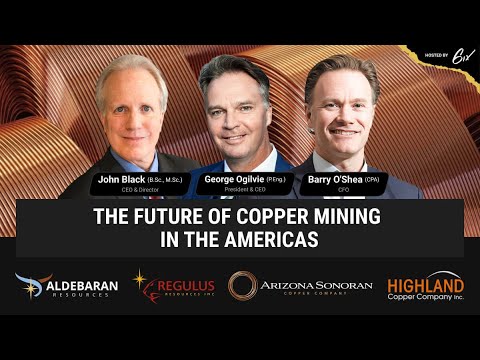
0:08 Hello, everyone, and welcome to today's panel as hosted by 6, the future of copper mining in the Americas. I'm joined today by 3 speakers representing companies, each of which has a stake in that future and who are hopefully going to share their insights and thoughts on what it could look like with us today. As a reminder, today's panel is being recorded and is going to be available on demand on six.com in the coming days. And if you'd like to participate today, please ask questions in the Q&A chat found on the right-hand side of your screen at any time. And as I mentioned, I'm pleased to be joined today by George Ogilvie, President and CEO of Arizona Sonoran Copper Company, Barry O'Shea, CFO of Highland Copper Company, And John Black, CEO and director of both Aldebaran Resources and Regulus Resources. We want to start off today with the obvious, though, gentlemen. Copper demand remains and is projected to remain high.
0:55 Supply comes nowhere near meeting it. Copper prices, however, are in a slump. So I'd love to hear from all of you on why you think that this is happening and what your outlook for copper prices into 2023 are and how that's going to affect junior miners. Maybe John, I'll pass things off to you to get us started. Okay, well, thanks, Cam. And thanks for setting up this forum. I look forward to the conversation today and it's nice to do something that's a little bit less direct to our projects only and more about what's going on in the industry and where we're at. So I think this could be an interesting conversation for all of us. We're in a business that's notoriously noted for the extreme swings we can get in price. So we oftentimes get prices that are quite disconnected from either future projections or even reality at the moment. And we're certainly in one of those points right now where at a real low point in the copper price.
1:47 But despite that, I think all of us just came out of the Beaver Creek conference, and there's an incredible buzz and optimism about the future of copper. And there's very clearly a shortage of copper coming up. So we're in a strange situation right now where we have a depressed copper price, but very good reasons to believe that we will probably have record copper prices in the not too distant future. So that's kind of the challenge we're in right now is this funny disconnect. And that affects our market caps, it affects everything. But I go to comfort in a market like this just by talking to the major companies and hearing how hungry they are for projects looking forward. So that's what gives me a lot of optimism and makes me sleep well at night. Oh, Absolutely.
2:31 George, your thoughts? Yeah, thank you, Cam. I would certainly agree with what John had just stated there. Obviously, it appears as if the entire world is heading into an economic downturn or maybe even a recession. And as we all know, copper tends to be a little bit of a bellwether for GDP and actually how the economy is going to perform. So I think the market and the participants are, and investors are really just looking at this kind of very short-sightedly. Obviously, there's a lot of fear in the market, given the, you know, the dramatic falls on the TSX and the New York Stock exchange and other exchanges around the world. And I think that's being reflected in the copper price.
3:21 But as John rightly said, we know this industry is very, very cyclical.
3:27 And when eventually we do come out of this recession or downturn, I think for those commodities that are in the green energy sector that are associated with battery metals, which obviously copper is, I think there's going to be significant demand. The supply will not keep up. And subsequently, we're going to see a super high elevated prices, you know, on a go forward basis. Okay, fair enough. And Barry, your take? Yeah, I'd add a little bit to that. Obviously, we're in a tougher time at the moment, arguably a recession worldwide, pending or looming. Interest rates are high and inflation is high. So it's going to be a challenging period. And I think we'll need to settle into that a little bit and understand it could last for a period of time.
4:15 I suppose the good fortune for developers is that we're not selling copper at the very moment. So we're not having to deal with the lower copper prices. But naturally, you know, as developers,
4:25 we look to the long term. And you know, John mentioned, you know, there's a global supply demand imbalance also looming. It's well documented and well understood. It's known that copper is needed, not just for the traditional components for urbanization, but more so for electrification.
4:43 And one interesting thing that I'd point out is that that supply-demand gap is even heightened in the US. I think in 2035, we're projecting a supply demand gap where demand is 3 times in excess of supply. So there's plenty of reason to believe that the future looks good for us copper developers. Oh, well, that's good to hear. You know, I want to make a note, you know, of course, it's not just supply and demand that affect copper. There's also a geopolitical element beyond market conditions for that matter. And specifically, China is steadily increasing its imports of physical copper, particularly at low prices. What's your perspective on the political element to copper mining in the Americas in that regard? Anyone who wants to take that. I'd happily step in again just to follow on 1 or 2 things if that's all right. Yeah. I mean, geopolitics play heavily into this.
5:35 Naturally, China is very active from an import perspective, the US less so, but geopolitically, I think all countries and certainly the US are at the forefront of thinking about both resource and energy independence.
5:50 I think it's something that's going to very much bolster support in the US to build mines, simply copper mines amongst other battery metals. Geopolitics are going to play strongly into which mines get built in the future. I agree with what Barry was saying there. Most of the Copper that does get produced within the US actually stays domestically within the US, but certainly we know there are other countries in the Americas and obviously Peru and Chile are the number 1 and 2 copper producers in the world. But I think over time as well, those governments are going to start realizing that copper and other commodities are critical metals and you're actually going to start to see less exports and therefore less imports probably going into China.
6:43 So I definitely can see that happening throughout the world. And we're not talking here about Europe, but if you look at the energy crisis, which is taking place there, and the decarbonization thesis is probably going to accelerate.
6:59 And the demand for battery-style metals in Europe, I think, is going to be exponential in the next 5 to 10 years. Absolutely. John, I think you had something you wanted to mention. Yeah, I think Barry and George have really kind of covered it. To me, in many ways, copper is such a metal with so much demand for it that you think of it as in terms of a worldwide demand and that geopolitics wouldn't enter into it that much. But recent developments, particularly what's going on in Eastern Europe right now have really heightened this regional necessity to make sure that you have access to it. It was there anyway, but I think it's just brought it really to our forefront right now. So I think particularly for companies that have projects in North America or to some degree Europe, this could play very much into their hands, or countries that have strong alliances with North America. So I think that's where we're really going to start to see groupings develop in terms of where sources come from and countries and individual companies or industries trying to make sure they secure a supply chain for what they produce.
8:11 And Ken, you're already starting to see that federally, certainly in the US, the Defense Protection Act, identification of critical metals. So the geopolitical pieces, I think, is playing out certainly at a federal level, and we're certainly seeing it at a state level as well. And John made a really good point. You know, corporates,
8:30 which these days are economically the size of some small countries, are also starting to play their role influencing, permitting timelines, and naturally looking to get supply directly within their own countries. As someone that has projects in South America, when I first saw some of this news, I was a little spooked by it because it looked like, oh, wow, there's going to be a premium for projects produced in the US, for example. I noticed that quickly the US expanded into North America when they realized there probably wasn't enough supply in the US. And then that quickly evolved into and friends that we like that have those connections with us. But that it's very real. There's, I haven't seen something like this way back in the 60s and 70s. There were incentives given to companies to explore in the US specifically, very like one-to-one tax incentives.
9:22 And we could see that type of thing emerging again. That's really, really interesting. And it'll be interesting to see how that actually evolves and changes. But speaking of jurisdiction, Michigan, Arizona, Peru, Argentina, they all come with unique challenges and unique opportunities as you guys are just discussing. You've all worked in multiple jurisdictions, but what sets apart the place that you currently operate from elsewhere?
9:46 Maybe over to you, George. Well, obviously, Arizona Sonoran's project is in Arizona. Arizona supplies the U.S. With over 70% of domestic supply of copper. So obviously, it's very important when it comes to copper. Within Arizona, it's actually, it's very dependent upon which county your project is actually located. And we're very fortunate within Arizona that we're within Pinel County. And of course, we're very close to a community which is Casa Grande, which is in favour of mining, very supportive of mining, and we have a very strong social licence given that the mine is a former producing mine and was in production in the 1970s and actually in the 1980s.
10:41 So we got a lot of support from the local community. Our specific project has no federal nexus, which actually makes the project permitting a lot easier. And when you're only dealing with the state regulators, it really streamlines that sort of process. So I think Arizona is a great jurisdiction and particularly if you are fortunate that you're in the right county and you have access to private land and your project isn't on public land. No, that's great. What about you, John? Well, it's been interesting working in South America for the last few decades. We have countries like Peru where Regulus is based on their antiquary project, which is a mining country. It has been, it always will be, it's a very important part of the economy. So that that provides us with a backdrop that there's a general recognition that mining is important.
11:39 However, having said that, there are always challenges. And in Peru, the challenges are really political and social, that kind of stand out. We've recently had a shift to the left and resulted in a current government that's not the strongest government by any means at all and not particularly well-prepared to govern. There's been a realization that the idea of introducing things that would threaten our industry just don't make sense and wouldn't help the economy. And so that's largely overcome right now. And the fact that it is a mining country will prevail and go forward. But we do have to work closely with communities in our areas and make sure that there's acceptance of our projects. And that's quite a challenge. That's really a challenge for all of us throughout the world.
12:25 But in the 2 countries we work in in South America right now, Peru is a bigger challenge on the social front and making sure that everybody understands that. It's been interesting with COVID in that mining really stepped up in COVID. I was quite proud of our industry. We provide a lot of PPE, a lot of good support for the communities where we work, a lot of support for the hospitals. And I think that helped people realize the importance of mining, not just in terms of driving the economy, but also being good corporate citizens in the country. Argentina is slightly different in that Argentina has been a country that historically hasn't had that mining industry. It's quite different. It's for various reasons. They have chosen not to really provide a fiscal environment that promotes foreign investment in mining.
13:12 They depend largely on agriculture and other industries. But now there's very much a realization that mining could potentially provide tremendous benefits for the country moving forward. And as George noted in Arizona, it's very fragmented in Argentina as well. Certain provinces are very supportive of mining and others aren't. We have the good fortune to be in San Juan province, and it's been outstanding. So right now, in many ways, Argentina is kind of standing out as the country to be in in South America, partly because of intentional efforts on their part to attract mining as a way to improve the economy and also some of the tensions that are happening in other surrounding countries.
13:52 Absolutely. Barry, over to you. Yeah, so we operate in Michigan, which I think is a great place in the U.S. To operate. We have the good fortune of being a past producer as well. So naturally, and you see it when you visit these towns, they're desperate to be brought back to their former glories. Michigan produced, it has a fantastic copper belt that produced for 100 years up to the mid 90s, and we're looking to bring that back to
14:20 being. But a couple of things that I think make Michigan stand out and one of them is similar to what George had said. Michigan land is predominantly private and I don't think it can be understated the value of having private land as opposed to federal Bureau of Land Management in the US. BLM land is, you know, it's just more difficult to permit. You know, it's a comprehensive and good federal process, the NEPA process it's called. But it, you know, it has considerable timelines and challenges. So from a private perspective, working directly with the state and particularly a state of Michigan that is very motivated to support electrification, it's made our permitting process relatively smooth.
15:05 We have all 7 permits required to operate in state and those were received within about 1 year of application. So That's the thing that stands out most for me. And I guess just acknowledging that Michigan itself, as I say, they have outwardly expressed an interest to support industry
15:26 that supports electrification. And they're putting their money where their mouth is. They have developed a fund called SOAR. There's about $1.2 billion remaining in that fund, particularly to assist, I guess, 2 things, companies that are going to bring industry back into Michigan but also supporting electrification. So I think there's a fair bit of momentum in Michigan. Great, absolutely. Now I have a question for, well, you Barry and George. The permitting process in North America can be quite different from jurisdiction to jurisdiction. So what stage are you at with permitting and what's frustrated you and also what's edified you about your jurisdictions process?
16:10 Maybe George, we can go to you and then over to you Barry. Yeah, well, first of all, we're very fortunate on the permits that we already have a permit to take water for the next 50 years. And of course, you know, being in the southwest of the US, having the right to take water is absolutely critical. So we're delighted that we have that project, that permit. The other key thing is we have a permit which is known as an aquifer protection permit, and that's a critical component for us as well. And What was really pleasing about that permit was that we applied for an amendment to that permit last year, November. And within 5 months, we had received the physical permit in our office in April of this year.
17:02 And during that process, there was a 30-day public consultation period. And neither ourselves nor the state regulators received any concerns or any negative feedback or pushback on the amendment to that permit. So that was absolutely critical for us. That was very pleasing. On a go forward basis, there are some additional permits that we're gonna require. The key ones would be a construction and industrial permit. And there's also a mined land reclamation permit and our intention is to apply for those permits before the end of this year. We believe that by the summer of 2023 those permits would be in hand.
17:49 We don't think by that point in time we'll have our new re-scoped pre-feasibility study actually published and completed.
17:58 So after receiving those permits, we would expect probably to have to make an amendment to the permits. But part of the reason for doing it this way is actually just to basically show the market that we have now the permits in hand and use it as a bit of a de-risking event. Obviously, it's much easier to get an amendment to a permit than actually get the initial permit. So that's some of the strategy around the permitting with respect to Arizona-Sonora. And I would have to say that, you know, as Barry said earlier, the fact that we're on private land, there's no federal nexus. It really streamlines the permitting process for us. And in the 18 months that I've been with Arizona Sonoran, I would say that we have no frustrations when it comes to permitting.
18:47 We're very open, we're very transparent with all of the regulators. We keep them very informed of what we're doing. We give them as much notice as possible and they've been absolutely wonderful to work with. Right, Absolutely. And Barry, what's going on in Michigan?
19:03 Yeah. And as I mentioned, I think we're having a similar experience. Naturally, you need to be diligent, you need to be forthcoming, but assuming you do so, the state of Michigan, and I assume it's the same for Arizona, that they're not there to trip you up. They're there to receive your input, make sure that you're going to mine well, safely and environmentally well. And they're there to try and help you get your permits. So as I had mentioned, and just to give a little background, we have 2 assets that are very close to each other, about 60 kilometers apart in Michigan. The smaller of the 2 is Copperwood that we intend on moving towards funding and construction in 2023. And that's the one we have all 7 state permits for. So that includes our mining permit, tailings, and the critical one, which is the wetlands permit that has been a challenge for others in our general region. So we're fortunate to have those.
20:00 One area I would say of frustration is we do have one remaining permit to get from a federal perspective. We intend to draw water from Lake Superior and that is federal jurisdiction. So we're working with the US Corps of Engineers to receive that one. We are hopeful that we will be receiving that this year. I mean, you know, what we have done is, is generated an alternative solution to
20:21 the extent there are issues there where we would accumulate water in ponds and for startup processing a few years from now. So we do have that. Our second asset is 60 kilometres down the road. It's called White Pine North. It's a past producer. It operated 50 years up until the mid-90s. We have the benefit of having held on to about 4 of the 8 permits that we need there. Interestingly, we already have the water permit to draw water from Lake Superior 60 kilometers down the road. Unfortunately, we can't transfer that one over to Copperwood, but it does show at least that we can get those permits. And you know, the team that led our Copperwood process is in place again and engaged on White Pine North.
21:06 So we feel pretty confident there. Barry, it feels like you just need to get a 60 kilometer pipe and pump.
21:12 But it's really interesting to hear from, you know, 2 American jurisdictions, 2 states and the differences and some of the similarities. John, San Juan and Peru are very different jurisdictions politically though. I'd love to pass things over to you and see if you could contrast your experience working in both of them for us though. Okay, great. Both of our projects are slightly earlier stage than the 2 projects we just heard and several projects we just heard about in the US. So it's in some ways a little bit simpler for us. We're predominantly at the expiration stage of activities still, even though we have large resources and we're clearly pointed towards projects that will
21:48 advance in the feasibility cycle on this. So, in both countries, it's relatively simple. We have experienced some slight slowdowns in permitting in Peru. It's somewhat project dependent more than anything else. But in our projects, we haven't had any particular difficulties. We're actively drilling and moving forward there. In Argentina, it's actually become much easier, particularly in San Juan, where we explore right now. We've had such wonderful surprises as both the provincial and federal government reaching out to us and asking what can they do to make our lives easier? What can we do to move the projects more forward?
22:32 We go back and forth a little bit on whether it's the best way they can motivate us to move forward as a stick or a carrot sometimes on how they do it. But it's a good conversation and everyone's aligned in the importance of getting projects responsibly developed and into production. So that's good. I think one of the frustrations that we've encountered in South America in both countries or all countries we've worked out in South America is that at times there have been
23:04 laws passed in South America that are very general in nature. It's kind of a concept. The ones that we see in Argentina, for example, are protecting glaciers or glacial-related activities. But in Peru, it's more related to protection of headwaters, basins, and there's emerging concern about wetlands in Argentina as well. And in Colombia, it's what they call the paramo above 3000 meters. And there are often laws that are passed with very good intent, but there's very little regulation around it, or it's not very clear on how they'll be applied. And so that leaves a lot of gray area to go forward and leaves a concern for us on how we can responsibly work in that when the real parameters and regulations associated with it aren't defined. And so that's 1 challenge that we face, particularly in South America. I imagine there's some element of that throughout the world, but It's the one that we see out there that could be improved most for everybody. It could improve protection of
24:07 the sensitive areas that are seeking protection, but also allow key industries to move forward responsibly. Absolutely. Well, thanks guys for walking through the jurisdictions. And anyone that's walking into this new or unaware of any of your projects, I think has a good basis to work off of going forwards. With that though, let's dig into some ESG topics. And before we get into project specifics, I assume to some degree, all of you agree that copper is fundamental to adjusting away from fossil fuels. And I think you all touched on that throughout this conversation. But that being said, the mining industry still tends to be one of the targets of environmental activist groups. So what do you think the industry can do to better speak to the market about the need for copper from an environmental perspective?
24:56 I can I can I can jump in there, Cam? I mean, for me, it really comes down to education. And, you know, I think the industry can always do more when it comes to educating the general public. And in actual fact, I think, probably getting into the high schools, and actually, you know, informing the young children and the future generations that the Apple Watch they're wearing has got rare earth metals in it, probably a little bit of gold and platinum, palladium, and there's probably copper in there, their iPads, their computers, et cetera, et cetera. A lot of them don't understand how those products get put together and where the basic raw materials come from. I remember years ago at high school, we had a business fair, a career fair, lots of industries came to the school and they spoke about what they do and how it impacts our lives and what products they actually produced.
25:57 Actually, one of those companies was a mining company. Now, all of my forefathers were coal miners in the Scottish pits and my father was a metallurgist. So I was already in tune with the mining industry, but even to this day, some 45 years later, I'm giving my age away here, it still struck a chord with me that, you know, people from business would take time out of their busy days, come to the school,
26:24 speak about what's going on in their industry and educate the children. And I think if the industry did more of that, I think in future generations we'd be better off and we'd find that you know these younger generations, millennials and the Gen X and Zs would support the mining industry and maybe that would negate some of the negativity that comes from, you know, these various environmental and NGO groups, which, you know, obviously are speaking through or looking at it through a different perspective. That's a really good point. I'd maybe add on, You know, the metal that we are looking to produce is needed for a cleaner future. I think it is something that people are coming to understand.
27:11 You know, copper, amongst other metals, are used considerably more in electric vehicles, solar, wind power, so on and so forth. So, we're producing a metal that ideally will have a benefit from a future perspective.
27:26 But in addition to that, I think, and I think copper companies are doing this more so than other miners. We're really identifying the frameworks that we need to measure ourselves against. It's one thing to say that we will be good corporate citizens and so on and so forth, but there are emerging frameworks, UN sustainable development goals amongst others that really define how we should and need to be operating. And I think, you know, many of our companies are really looking to adopt and hold ourselves to account, you know, identifying what our goals are, the goals of our stakeholders, and making sure that we're measuring and meeting those, you know, with with the ultimate target of 0 emissions to the extent that we can achieve that.
28:14 So from our perspective, you know, that that is a critical goal of ours over the next year is really to, you know, identify the appropriate framework that we want to measure ourselves against, the goals important to both us and our stakeholders, and begin to measure so there's no ambiguity around how we how we operate.
28:32 Absolutely. What about you, John? Well, I absolutely agree with George and Barry on what they just mentioned on that. I'd like to add one other twist to it that we've noticed, and this comes from our experience more on the social front, is that a lot of times as an industry, we go to schools, we reach out, we try to help people understand the importance of it, but it comes as us speaking about who we are. And what we found is a tremendously powerful endorsement is really third party validation. So other groups talking about the importance of mining. And I think we're potentially coming into a moment in time where we could have that, where we see key industries, When Elon Musk starts to talk about the importance of metals, and people relate more positively to what he's doing, and he links to us. When we see certain investment funds certify copper as a green metal, as a safe investment moving forward. I think that we get a broader support and a broader recognition of society, of the importance of mining that way. So absolutely agree that we continue to emphasize the positive nature of what we're doing ourselves.
29:46 But I think it's really important now that we reach out and make these links with other industries or the investment community as a way to get a broader exposure. And it's much better for our projects if someone else is saying we're doing a good job than if we're saying we're doing a good job. We're always assumed to have a bias there. Yeah, totally agree. I think one of the other things that may actually transpire as companies push for stronger ESG principles and how they operate, I mean, we all know that potentially there are some companies out there that are just sort of greenwashing. But I think there's an opportunity where you could actually see commodity prices actually bifurcate. And if actually a company is audited and they can actually produce a pound of copper or a kilogram of copper for net 0 carbon emissions, and it's auditable, why shouldn't that company get a much higher price for their copper concentrate or copper cathode.
30:49 If you have a company that's potentially just greenwashing or doesn't care, and they're putting up tons and tons of greenhouse gas emissions into the atmosphere, then obviously they should get a much lower price for their pound of copper. And I can see that happening with all of the commodities associated with the green energy sector and the battery style minerals. Really nice to see if that does happen. I mean, we'll see, I suppose. Gentlemen, I want to start the Q&A in about 10 minutes. So we're going to get through a couple more questions and dive into some project specifics. It'd be great to hear from each of you first off about what you're doing to reduce the carbon output of your own projects.
31:34 George, I'm going to slam it right back to you. Was that George or John? George. George. OK, yeah. Well, last year we conducted what's known as a life cycle analysis. It was done through a group called Minviral out of the UK and essentially they took our PEA and they did a baseline analysis of how much greenhouse gases we would emit over an 18-year period, which is the current life of mine. And on average, we're somewhere between sort of 5 to 8 kilograms of CO2 emissions per kilogram of copper actually produced. Now, that's actually without implementing any action plans.
32:22 So from that report, we actually generated about 20 action plans that were prioritized. And again, we're in a very fortunate position, but one of the biggest positive impacts would be that the Arizona Power Service utility provider has a main power line which actually runs right through the property. And we have the ability to take 100% green energy actually from that power line if we want to pay a small premium when it comes to our kilowatts per hour. So when we run that in the financial and economic model, obviously it makes business sense to actually pay that extra, 1.5 cents per kilowatt hour or whatever the number actually was, and actually get access to 100 percent green energy. So that's one of the initiatives.
33:15 The other main area where we see greenhouse gas emissions obviously comes from the mobile equipment that a big open pit would operate, obviously the trucks. And to a lesser degree, underground mine. So we're also looking at electrification of that equipment and or maybe utilizing biodiesel fuel or, you know, to try and minimize the use of diesel. So that's another big area. And then I think the third largest area was the movement away from ANFO, which obviously is an explosive type that's diesel based, and moving to something that's a little bit cleaner. So if we implemented, I believe, 12 of the 20 action plans, we could actually get down to somewhere in and around 1.5 kilograms of CO2 emissions per kilogram of copper produced, which obviously is a significant reduction.
34:15 And if we wanted to get into net 0, then obviously we'd be looking at things like carbon credits. So, you know, we do have an action plan. And as we, you know, move to our re-scope PFS, I think in the second half of next year, we'll be communicating to the market just exactly what those action plans are and how we intend to get to net 0 carbon emissions. That's really cool. John, I'd love to hear from you. It's fascinating to hear what George is talking about in the more advanced stages on this. We're at an earlier exploration stage and in very remote projects. So what we're focusing on are some of the simpler things to work on at our stage at this point. We've just completed a really interesting piece of work, working with the San Juan government. The San Juan government's introduced the concept of doing audits for carbon emissions for mining companies.
35:10 And we're one of the pilot groups that's being, this is being tested on just to see how it'll work. They started with an exploration group in Argentina. So we've just completed that. So we now have the important baseline of what we're producing in terms of carbon and what the impact of our project is at the exploration stage. We're not at the stage where we ramp that up into projecting into a mine yet. And there's some interesting outcomes of that. We're predominantly, it's all related to the use of diesel on our project is what's really related to. And that's not an easy one for us to change Due to the remoteness of the project, using electric vehicles is not very practical, or we don't yet have drill rigs that are available for remote exploration sites in South America that are electric at this point in time. But there are important steps that we can take to do things in our offices, in our facilities like that, moving 1st LED lights like that. And then we're exploring the possibility of solar to generate the small amounts of electricity we use onsite at this point. But of course that could be ramped up into much more serious use at a mining level as we go forward.
36:22 And in our stage, one of our conclusions is that the best thing that we can do at this point is really offset. And there are a number of groups that are developing opportunities to facilitate offset by supporting planting of trees and forestation projects in areas that are seriously maintained and monitored and you can measure that. We will take that as a simple first step to make sure we're working in that direction. But it gives us ideas on how we can begin to apply this to the eventual projection of what a mine will look like in the areas that we're at. So in many ways, Argentina is a little bit ahead of some of the other countries we work on in South America. They're starting to implement this, but we see a tremendous opportunity for us to take the experience we've just had in Argentina and proactively apply it in Peru. So we're going to use the same concepts to voluntarily start this on our exploration stage project and prove, hopefully kind of setting a standard for others to follow going forward. That's exciting. And Barry, over to you.
37:28 Yeah, obviously, you know, We similarly are assessing the viability of battery operated vehicles for our mines. I was taking some notes there as George was talking about power. I mean, it's interesting. We are also on the grid and we're certainly in discussion with our power provider in terms of what level of green energy they're providing as opposed to traditional energy. And we know that they certainly have a component of green energy, but the thought of incentivizing them to provide 100% is certainly an interesting one and a note I've taken away. 2 other things that we're looking at, I'd say even on a broader scale is how we develop our 2 projects. Right now, as I mentioned, we have 2 standalone projects, 60 kilometers away from each other.
38:15 You know, We just initiated an internal study to see if we can develop 1 central processing facility and essentially eliminate the need for the likes of tailings processing plants amongst other infrastructure at one of the 2 sites. So really a combined scenario as we call it. And that would naturally and very quickly, you know, minimise the environmental footprint and also emissions. So that's one big area that we're looking at. And actually, we're quite hopeful, bearing in mind some of the synergies that that would bring for us. The other bigger thing that we're looking at is producing Cathode at site. When we look at our 2 sites right now, obviously we have a Feasibility on 1 and a PEA on the other. They both contemplate generating concentrate and then naturally shipping that further afield.
39:08 We've assessed the viability of putting a cathode plant at site. We know metallurgically it's possible. We now need to see if it's economically viable for us. But if it is, it would eliminate the need to continually ship concentrate. And ideally we would be establishing direct supply contracts in Michigan to the likes of big 3 auto. And really that, you know, really reigns in again, our footprint. And also, you know, from a good perspective, keeps all of the benefits inside Michigan, which Michigan would be particularly happy with. Fair enough. In the same vein, you know, and it's true of all mining projects, there is a great degree of local cooperation. So I'd like to hear from each of you about some of the ways that you've earned the right, so to speak, to work in the community.
39:55 Barry, I'd like to pass things right back over to you maybe. Yeah, yeah, of course. I mean, again, we're all at the kind of exploration into development stage. So it begins with community engagement, town halls, and our CEO has been very strong in that area, knowing the area, knowing the people. We have the benefit that it's a historic mining district. So we are quite welcome establishing a relationship with local universities, local authorities, really doing all the things to do to ensure that you are known in the area, and of course and importantly establishing relationships with tribes that operate in the area. So those are the things that we're doing. Again, as we step further towards development, those activities will increase and we look forward to that. That's great. John, I'd love to hear from you about this.
40:43 I can point out a little bit from each country. In Argentina, one of the things that we faced is because there's not much of a mining industry, there's a real shortage of skilled laborers for the type of work we do. And that presents a challenge for us to get good drillers or good drillers assistants or even catering companies. And so we're engaged with a program that's working extremely well. That's a collaborative program with our peers in the area to collectively support the local universities to provide opportunities for the smaller communities closer to where the mining activity is to pick up skills. And so we support that the professors come out to the local communities and provide classes And skills that we obviously need like drill technicians or geologic assistants or things like that.
41:36 But we also extend it to tourism, to you can get a sommelier's certification for wines. You can do a number of other activities that way that support a broader industry in the area. And that's been very well received because like many countries, Argentina insists that we hire locally as much as possible. And that's our policy as well. But that's difficult when there aren't professionals that you need in the area. So that's one example of how we're working in Argentina. In Peru, I can point out an example that's a little bit different, and it harkens back to what I had mentioned before, where as we were coming out of COVID, we encountered a situation where we had some opposition to the project.
42:21 And that opposition was largely politically and driven for personal financial motivation, but it quickly escalated into drawing in a lot of people from outside the project area to object against the project. That accelerated to a situation that we were concerned about. We voluntarily stopped our drilling until we could resolve it. One of the things that we did is, rather than us going out and trying to convince everybody of why we're doing things responsible and what we're going forward with, we helped capacitate the local communities to organize themselves in a manner that they could speak on their own behalf. Because we had a situation that's common in the mining industry where people in the immediate area of the project are in favor of the project. They're the ones that receive the most benefits and arguably potentially receive the most impact too. But oftentimes their voices are swamped by people from outside.
43:17 And so we worked closely with them to help them organize themselves and have a stronger voice and a more visible voice. And that was quite effective. And it really kind of brought an alliance with us together on it, because they, to some extent, had just assumed that we would always be providing jobs and now they realize it's important for them to stand up and support us and move forward in that sense and hold us responsible for doing good work as well. It's not everything's wonderful on that relationship, but it's worked out really well. And so those type of alliances are very important for us moving forward. Thanks for that, John. And George, over to you. Yeah, very similar to what Barry brought up. Obviously, we have a lot of community engagement on a regular, frequent basis, town hall style meetings.
44:09 Obviously, we're not generating any revenues, but we do obviously sponsor several events throughout the year, small sums of money, but bring together the community and other businesses. Currently right now we're doing a needs assessment of the community to try and determine where we can help them in the future as our company evolves and grows. And one of the areas that we've sort of identified right now is potentially with respect to scholarships, helping some of the students go to college and or university. And of course, similar to what John had said, we would look to provide scholarships to some of those students who could actively then come back into the mining industry. So particularly I think in the sort of trades and in the IT field is probably an area where we see the biggest need on a go-forward basis at Arizona-Sonoran.
45:04 So those are the type of things that we have done and that we're considering on a go-forward basis. Great. Gentlemen, we have a bunch of questions in the Q&A. I want to start off and dive into those. I honestly don't think we even have time today to get through all of them. So apologies to the audience, but we'll go through as many as possible. First question, and also just as a quick note for anyone in the audience that does want to ask questions, if we don't get to them, we'll pass them on to the gentleman here who can follow up after the fact, of course. So please, if you have questions, ask them in the Q&A. We will follow up with that. But first question from Mark Turner. Goldman Sachs, Morgan Stanley and Citi are all calling copper to be US $6,600 per tonne. So why should we believe 3 copper company mining CEOs who say copper is bottomed?
45:56 Well, from the conversations that we've had today, I don't think anybody actually said that the copper price is at the bottom. We were saying that certainly, you know, we're heading into a recession and a downturn. Copper is a bellwether for the economy, and if the economy is going to start going down, there is the potential that the copper prices today could continue to decline. But I think we're all in agreement that at the end of the day, when we come out of this downturn, the demand for copper is going to rise exponentially and it's going to be accelerated, as we said, through some of the events that are happening throughout the world geopolitically. And obviously there's a war going on in Eastern Europe. And we think that that places ourselves as corporate developers, near-term potential producers, and a great position for the shareholders of the companies to realize significant returns from these low levels that may not be the bottom.
46:54 Yeah, I agree. Yeah, we're in for some tough times for sure. And how long they last, that's also uncertain. Certainly, I think 2023 is going to be a difficult year for copper, because I don't think concerns around global recession are going to dissipate in the next 3 to 6 months. So that's, I think, understood. But yeah, we hold ourselves to understand the long-term fundamentals. Interestingly, if Copper price remains low and especially if the larger producers continue to hold development to other larger assets, the supply gap is only going to grow. We'll be patient in the meantime. The good thing for us is we continue to develop our studies, our resources and be ready as and when Copper moves again. Fair enough.
47:41 I'd absolutely agree. I'm not sure we're at the bottom by any means at all. Most rational ways to take a look at it would say there's risk for continued downside for a little while right now. Remember, we had $2 or something copper only a couple years ago. And since then, we've had $5 copper and now we're back to where we're at. So it moves around a lot. And it's just something we have to be aware of in our space of the cyclicity of prices. No, fair enough. Kerry in the audience wants to get the group's perspective on investing in copper mining royalties versus mining stocks. Well, I mean, certainly from my side, I mean, the royalty companies have done tremendously well over the years and acquiring royalties, not just in the copper space, but all of the commodities. Obviously, they have very, very low overheads.
48:35 And provided the mines remain in operation, they generate significant cash flow and therefore, dividends for shareholders involved in royalty companies. But I think when you look at the potential leverage and the multiples involved, if you can pick the right stock, the right company with the right commodity and the right management team, you can recognize significantly more multiples than what you can get from a royalty company. But obviously there's a little bit more risk involved, particularly at the expiration slash development construction stage. Yeah. And development companies like us stand to be undervalued as long as copper price remains low, even if we see that as somewhat short-sighted.
49:24 So, from a value perspective, royalty companies of course have done well, they serve a great purpose and they've attracted the valuations as a result. But I think you might get better bargains in the development side. And also an important thing to note is you have to be careful which one as well. There are some that are much more attractive than others. And there's been an explosion of royalty companies over the last few years. And hence there's a real competition. There just aren't that many royalties that are free and available out there. And so we're seeing royalty companies increasingly pay higher and higher premiums to go for royalties or chasing royalties that are farther down the road. It's great news for those of us that could perhaps benefit from financing that comes from aggressive buying, but they're probably pushing the edge in some cases on what they're purchasing right now. So it's a more competitive sector of our business right now and less beaten up, if you will. And so then the opportunity for much greater returns, I think, lies in the more deeply discounted sectors like ourselves.
50:34 Absolutely guys. Adrian in the audience says this, or asks this rather, will the looming shortage of supply eventually lead to changes in the permitting process to accelerate the timeline to production? Or do you foresee a status quo, even though that has negative economic consequences? I certainly think it will change and I think it'll change quickly. And I think pressure is being brought to bear by industry. GM and Ford have come together in the US essentially to lobby the US government. They've identified that the US permitting process, particularly the federal processes, is considerably longer than that in many other countries, specifically Canada. I think that pressure is being brought to bear. I think the US also and other governments, again, talking about the geopolitical side, understand their need for critical metals, copper being one of them, and they'll need to act.
51:31 I agree. I'd like to think that it what it does is it cuts through some of the less logical components that slow us down, but we still preserve the overall intent as an industry. I would hate to see it get to the point where it short cuts things to the point that we go to bad practices by any means at all. So I think a balanced approach to this, and there are a lot of things that can be streamlined and move forward for the benefit of everybody. Absolutely. Sean in the audience asks this, why invest this year and not wait until the bottom at tax loss selling time in December? That's a great one to think about. It's just when is the true bottom here? But what I'd remind people is that we, I think we're all in agreement that we're quite significantly down right now. Whether we're truly at the bottom or not, it's hard to tell, but it's still a great opportunity right now. I think it's wise for people to put a few chips out on Copper Blaze at this moment.
52:37 I can give a direct experience example. Our first company, we had a great discovery in Peru. It was 2008. We were coming out with a new resource. Things were flying high. Copper price was high. The projections were through the roof. And for reasons less fundamental than what we have right now to believe that copper is going to increase in price. We had a share price of over $5 a share. And within a period of a few months, as we entered into the 2008-2009 global financial crisis, our share price dropped to 38 cents. On the way down, it was my first kick around as a junior managing a junior company, myself and Kevin Heather, our chief geologic officer, we were buying on the way down and our chief financial officer had been through a few more cycles, was advising us to watch out for falling knives on this and to wait for it to bottom. But we bottomed and within 18 months, we'd sold the company for $9 a share. So it snaps back very quickly in many cases.
53:42 And so what you don't wanna do is wait until it's clearly moved to be back in. If you're convinced that the thesis is valid and it's a good time to put bets on copper stocks, start looking, do your research, look for good companies, look for good management teams, good projects, take your time, but don't let the opportunity pass. Well said. Yep. Awesome. LLR has this question. How many tons of copper are expected or required worldwide to meet the demands of the global energy transition by 2030, 2040, or even 2050? Well, I was reading some documentation in the last several weeks that basically was saying that on a global basis today, we're using about 25 million tons of refined copper, and they're forecasting that in the next 15 to 20 years, that number is going to rise to 50 million tonnes.
54:38 So essentially it's going to double. And in the next 2 decades, we'll need as much copper as has been used in mine over the last 100 years. So even if that forecast is off by 50%, there's going to be a dramatic demand for Copper. And based on all the things we spoke about today, timelines, permitting, quality assets in tier 1 jurisdictions, they just aren't there. And the only way to sort of incentivize the further supply of copper is probably through pricing. It's interesting, Robert Friedland just spoke at the Beaver Creek Conference and in his special way of being able to put this to everybody and showing things, he pointed out that the total amount of copper that's been mined and used in history is about 700 million tons.
55:35 And so you can imagine if we go to 50 million tons a year, how that is. He put it in perspective as saying in the next 22 years, we're projected to need as much copper as has been mined in history. So that really brings it to focus. It's certainly a fun fact. Gentlemen, we are coming down close to the wire at this point. I wish that we could get through the rest of the Q&A. There are some still interesting questions waiting in the bank. Unfortunately, we don't have time. Again, I'll reiterate to the audience members who asked those questions, we will pass this on to the gentleman here and their teams who can reach back to you after the fact. But guys, Before we wrap up for the day, I want to go around the horn and give you guys your soap boxes to stand on. Talk to us about what's coming up with your companies in the next 6-12 months. What's exciting? What's the news? George, I want to pitch things over to you.
56:30 Thank you for that, Cam. Yesterday, we put out a maiden resource estimate on Park Salier. It essentially showed there was 3Bn pounds of contained Copper in the ground at well over 1%. So we've doubled the resource. We're in the process now of infill drilling that between now and the first quarter of next year. So there will be exciting infill drilling results coming out. And we would anticipate in the second half of next year to be in a position where we could put out a re-scoped PFS that doesn't just include the core cactus project but now brings in the Park Salier deposit which we think is going to be quite material. I think over and above that as well we're going to continue to explore on the site.
57:17 There's a kilometre of open ground to the northeast heading from Park Salier back to the Cactus Pit, which is unexplored. And we know we've got the northeast extension, which a Sarko drilled, hit the copper porphyry system. The company has never followed up on that. So if the stars aligned and we thought from a blue sky potential, I think there's the opportunity to add another 2 to 3 billion pounds of copper here and ultimately end up with a global resource closer to 10 billion pounds. So expect more expiration results over the course of the next 12 to 24 months. Thanks, George. Barry, what about you? Yeah, and just a quick refresher on our company, because I find sometimes we're a little overlooked.
58:03 You know, our 2 assets have about 8.5 billion pounds in all categories. 5 billion of those are in M&I. So a pretty significant scale, I think, which as I say, I think is a bit overlooked. At the first of our 2 assets, Copperwood, we've moved to an updated feasibility study to update the 2018 study naturally to look at increased input and CapEx costs, but also to bring in some optimizations at a higher Copper price. So we'd look to put that out before the end of this year and arguably move towards funding in 2023. At our larger project, White Pine North, we're going to do infill drilling this winter to again move resource into the M&I category and progress to a feasibility study. And probably of most interest is this combined scenario that we're doing a study on. And we'd love to have some information out in the market mid 2023.
58:56 You know, on a combined basis, it would be a 20 year mine life with about 75,000 tons annual copper. Again, a wonderful scale in a wonderful region with support from Michigan. Our CEO actually today is in Michigan meeting with state senators as we're preparing to put in an application for funding from the SOAR program. So again, we'll hope to look at announcing some partnerships and funding with Michigan and ideally progress into construction in the coming year. Very thank you. John, you've got the double feature and you've got the anchor position. Finish this off. Okay, great. As you mentioned, I'd represent 2 companies here, which is a little bit different. The 2 companies we have in the 2 key projects that those have are actually the 2nd and 3rd companies that have been managed by our group.
59:44 And what our group specializes in doing is identifying projects that have potential to be very, very large copper or copper gold deposits, to drill those out, de-risk that. And then we intentionally try to position those to be monetized by selling them to a major company that would put those into production. We specialize in working in South America. That's where our contacts and our experiences is best. And our first company, Antares Minerals, we turned our business thesis rather well. We made a discovery of the Kere deposit. We sold that to 1st Quantum in 2010 for about $650 million. We learned a lot in that process on how to do it. And when we spun Regulus out of that sale, we quickly landed on the Antiquari project in Northern Peru, which is a fascinating copper gold system.
1:00:34 It's a large scarn and high sulfidation epithermal system. We have about half of a deposit that is shared with the neighbors next door. And the neighbors next door are currently mining the oxide cap over the top of that deposit and basically pre-stripping down to the sulfides underneath. And we believe that it's the best way to develop the project going forward, would be some type of an integration of the district. And so we continue to increase the size of the pie that we have. And it sounds like we only have 0.5, but at that 0.5 that we have right now, we have over 8 billion pounds of copper equivalent and we're actively drilling and we'll increase the size of that as we move forward. We always knew this would be a large and quite high grade deposit. It has a copper equivalent grade of about 0.7, which is relatively good compared to other pre-development projects right now. But what's even more important about this project is it has a remarkably low strip ratio, and it's effectively in a brownfield setting. So the complications are it's a busy district with intermingled land positions. When we get that solved, that's going to be the point that can really break things through and reveal the full potential on the project.
1:01:49 As we were developing and capturing that opportunity and putting it forward, we identified the opportunity to put our hands on a substantial piece of another large copper gold system in Argentina. And one of our fund, one of our principal backers, one of the funds that provides funding for us to move the projects forward, strongly encouraged us to put our hands. These opportunities are very rare. What you'll notice for groups like ourselves, or say, Ross Beatty's Lumina Copper Groups is, we use the same business thesis of trying to put our hands on these projects, but many of them are projects that have been known for some time. They're areas that have been previously mined or deposits been partially drilled out. We're clearing the shelves of those. There just aren't too many of those left right now. And so when the opportunity came up for us to get an agreement with Sibania Stillwater to earn into the Altar Copper Gold project in Argentina, we pounced on it. And the best way for us to do it was to set up a separate company. Some of our investors like both countries, some like 1 country or the other, and it was easier for us to separate them into 2 countries.
1:02:54 And we solved the challenge of having double duties by strengthening our management team and increasing the size of our management team to better spread ourselves across the 2 opportunities. The Altar Project in Argentina is an extremely large corporate copper system. It's one that was discovered by Peregrine Metals, a junior company working in the early 2000s. They partially drilled that out and actually sold it to Stillwater Mining for equivalent of $187 million at that time. And then it kind of fell off the map and wasn't in sight. It never really fit very well within Stillwater. It was a Stillwater is a platinum mining company based in the US and an early stage copper development project in South America didn't fit very well.
1:03:41 When Sabania bought Stillwater, we entered into discussions with them about the possibility that we could take the project and advance it forward and move forward. We're doing that in partnership with Sabania Stillwater as an approximately 20% equity participant in Aldebaran. And then we earn into 80% of the project for various considerations to move forward. So they have the benefit of having 20% of the project and 20% of our company as we move forward. And we're in a stage now where we're just hitting some of the heavy drilling to really define the full potential size, despite it being a large deposit, we're talking more than 14 billion pounds of copper equivalent already, and it has potential to increase substantially from that moving forward. So we're trying to define the full scope and nature of the project right now. And we're very fortunate that we're in a country that's really embracing mining and moving forward. So San Juan's a hotspot to be right now. It's a great part of the planet to look for recovery.
1:04:39 Thanks, John. Gentlemen, I hate to say it, but we are in fact over time. I hope you can all beg forgiveness of the meetings that I'm sure you're jumping to. But I wanna thank you again. I wanna thank everyone in the audience for joining us today, especially those who asked questions. The recording's gonna be available in the coming days on six.com. Guys, with that, I wanna say goodbye. Thank you again, and I hope you have a good rest of your day and good weekend. Cheers.