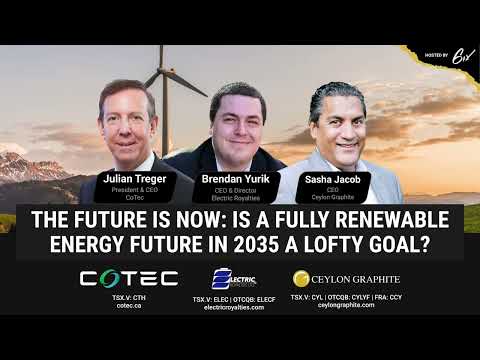
Automated transcript · Written by software from the replay's audio. It can mishear names and figures; the replay is the record.
16:45 Yeah, I think, you know, I agree with what Julian's saying there for sure. You know, the roadblocks have to be removed, but also, you know, the regulatory constraints we often see as a real opportunity. It defines where the opportunity is, where there's gonna be increased investment, for example, because of those stricter regulations. So whether it's CSG standards for funds, whether it's that stimulus capital that's coming from the Inflation Reduction Act, which is finally providing some capital, arguably definitely not enough, but some capital towards resource development. I think that's all beginning now and starting to accelerate.
17:32 But of course, the US market alone isn't enough. And we need some global regulation. For example, carbon credits are not fungible from jurisdiction to jurisdiction. And that's an issue. There's gotta be national, international frameworks and standards that allow that to be easier, easily monetized and fungible between jurisdictions. No, absolutely, guys. I maybe want to take a second to maybe dive a little bit more into the narrow focus with each of your guys, what you guys are doing in your companies. And sort of to preface this part of the conversation, I'm thinking there has been global initiatives that have succeeded through widespread awareness.
18:23 I mean, I'm just immediately thinking of the hole in the ozone layer. That was a significant issue, or acid rain. It's been a long time of people taking a strong initiative and working towards that goal and, you know, to whatever degree there is success found in those topics. Is that what's happening now? Is it just going to be a slow roll until we get oriented here? Or is it gonna take something a bit more dramatic potentially for us to sort of give our heads a shake? And really this is where I, sorry for the long preface, but I wanna know if you guys are currently satisfied with specifically where your own companies are trading at, and how you think that we can further foster both public and private investment in renewable energy technologies?
19:18 Well, I guess I'll kick it off. I'm definitely not happy where our share price is. I think we're undervalued by multiple. We have 22 royalties. They're all on Premier Clean Energy Metals assets in Europe, North America and Australia. We have 2 cash flow royalties. We have another one that's expected to come into production over the next 6, 12 months here. You know, we do sit back and do nothing. You know, our portfolio is going to generate significant cash flow. That's going to go on for decades to come here. And we have no extra cost to that. So yeah, we're undervalued for sure where we are. I think, do we need a wake up call? I think we have them all around. I mean, I live here in Vancouver. You look at the forest fires that we've got. I mean, the smoke has now hit Europe today. It's basically blanketed Eastern Canada for the last couple of weeks.
20:06 It's already burned 12 million hectares, I think it is. That's crazy. The world is burning around us, literally. And this is probably the 3rd, 4th year out of the last 7 that we've had it like this. So, you know, the world's going to be burning around us and we're going to be wondering, oh, do we need a wake up call? I mean, come on. You know, it's I think the wake up calls are here. I don't think they're felt by everybody equally. You know, especially you look at the island nations that deal with the rise of the ocean. And but I think yeah the wake up calls are here and they're happening. And are we going to do something about it. I hope so. I mean I think the public markets are broken down And I'm sure we all believe our shares are undervalued and they are significantly. And you know even the largest companies have derisory ratings by comparison to other sectors because the basic Bottom line is that our sector answers the major problems in the world. It answers inequality.
21:06 It answers how to climate change. And it answers security issues. And I think as that sort of becomes more widely understood hopefully the valuations will change. But in the meantime I think the governments are making the running and we're starting to see OEMs step into the breach of the public markets. I honestly think as a public company you should not rely upon the public markets to save you. You've got to think much more creatively about other sources of capital. There are lots of other sources of capital. The public markets aren't there, then they'll be crowded up by other people who understand the strategic imperative, the importance of our sector and the way in which it can be a saviour to the planet on those 3 fronts? I think it often takes a crisis and you know is that crisis a major deficit of some of those battery materials happening pretty quickly and everybody wakes up and realizes, you know there's some very controlled supply chains that a majority of process material comes from China. And it takes a long time as my colleagues were saying earlier to get mines up and producing. So maybe we are at that crisis point. Totally agree with Brendan, it's now more tangible than it's ever was before.
22:24 These climate changes are real. And I think that's becoming acute and it's not a day goes by where you don't see stories about it on the news. So I think we are at that inflection point. And also agree with Julian on alternative forms of financing. I mean, I think this, as an investment bank, we did a lot of project finance arrangement. I mentioned we did the first ever production tax credit modernisation in geothermal, which was for plants in the US. We sold a $37M note to Goldman Sachs. There are innovative ways to do things that aren't dilutive. And we certainly are looking at all of those options to scale production. You know, we've had a lot of delays in production and we're also finally at that inflection point. And, you know, of course, I think our share price is undervalued, but you have been working in the background on, of course, the customer side, but also those alternative options for financing, whether it's related to repurchasing and offtakes or non-dilutive sources of capital.
23:33 That's definitely an option while the prices are low. No, absolutely. No, thank you for all that guys. And I'm just sort of touching on what, Sasha you talked about there and Julian. I'm just wondering are you guys currently seeing investment banks and other potential investors demanding more green and ESG investment alternatives? Yeah, well, there's I guess a number of different factors. Of course, the inflows of capital to these investment areas have grown dramatically. And I'm not talking specifically about mining, just in general to renewables and ESG investments. And we've seen that very tangibly as a firm on my merchant banking side.
24:21 You know, there's funds that we've dealt with for 15, 20 years, some of the biggest funds out there that have 20 times, 30 times the capital, almost some of them are doubling almost in capital to deploy every year in the broader sector. And what we found very interesting is they're also going a lot earlier in the investment cycle. So where there was people that would only invest in post commission, for example, power projects, renewable power projects, they're now going pre-commissioning and making investments to try to secure the pipeline because they just need to deploy so much capital. So that's a very interesting development and there's more and more of that capital for sure every year. And it's driven also by the investor demand or the LP demand or the endowment stakeholders as students at the university demanding divestiture of fossils and more capital going, exclusive capital going into this area. So it's a really huge change and shift. And we finally also have standards.
25:24 A big development this week was the ISSB, which is now, has published actual rules for ESG certification for public companies. And this has been under development for years, but just finally happened this week. And I think that's gonna have a big impact. We already have some of the biggest fund managers in the world saying that they want all their portfolio companies to adhere to the ISSP standard. And ISSP, by the way, is a body underneath the IFRS. So the same standards that have been applied to accounting are now going to be applied to ESG. So it's definitely an interesting time and We definitely expect a lot more capital to be coming into the sector, hopefully a lot more of that capital going towards resource development. I sort of think that whilst everybody talks the talk, very few people walk the walk.
26:16 And the banks, you know, talk a great story about ESG, but I was meeting with one of the biggest banks in the world last week and they were saying there's almost nobody left in the world who's prepared to lend money debt finance mining projects. And in fact some of the biggest banks have withdrawn from investing in mining you know quite recently still. So there's enormous headwinds that are facing the sector in terms of the public perception. And whilst there is a lot of green money, we hope that that money will come in the form of equity to the sector, but we haven't seen an enormous wave yet, you know, financing developments. I mean, it's more the OEMs which have been prepared to take a bit of risk, I think, than the traditional funds. And certainly the banks, for all that they say, you know, they're not financing. Even BlackRock, you know, hasn't seen enormous inflows into their mining funds, despite what they may be saying at the top.
27:20 We've met with a lot of these ESG focused funds and look these are just getting off the ground. These are newly formed groups over the last couple of years. They have mandates to deploy capital you know for those purposes. But yeah to Julian's point I didn't see very much of it coming to mining. You know, what they met with us, they saw how critical we were to, you know, the whole thing happening. But they just couldn't get comfortable with the mining part of it, you know, in their mind, it's kind of anti ESG. So you have a lot of ESG money that doesn't consider clean energy metals mining to be something that that money should go towards. So it's kind of it's funny. It's a tough situation. I hope that also changes. I think we have a better chance to be quite frank of some of the guys who have made a ton of money in coal and oil and gas coming back to clean energy metals because we are the future. We are going to cannibalize them eventually.
28:10 But they've got hundreds of millions in cash. We've met with a lot of groups that are sitting on some big cash piles right now. I think those are probably the groups that will end up making that first. But yeah, ESG funds so far what we've seen, we haven't seen many actually investing in mining. Okay. I mean, it's an incredible situation. The ESG movement, I think, were very good at identifying the problem but they sort of sabotaged the solution at the same time. It's an extraordinary circumstance that we're seeing. I say it's the biggest own goal in history. You find the problem but you destroy the solution at the same time. And that really is where we found ourselves today. So it's very concerning.
28:57 Oh, absolutely. I mean, I'm very tempted to just sort of, I feel like I'd be rehashing previous questions and we'd just be going in circles with the conversation because I'm going, you know, what's the solution? You know, obviously a very complicated answer there. And we've talked about it. Feel free to dive in on anything you guys like with that. But kind of coming back around to an earlier part of the conversation, you know, Brendan, I think you said it specifically, you know, China's looking at 2060. I'm wondering... Yeah, well, yeah, exactly. It makes 2035 kind of tough. Yeah, right. And so I'm just wondering from you from what you guys have heard Maybe it's 2060 But what's what do you guys believe to be the most? Credible prediction in regards to this process that we've been talking about getting to that fully renewable energy or Like what do you guys think the timeline might actually exist on? Are there ways to speed it up?
29:55 Are there hurdles that may slow it down by such and such? We've talked about what hurdles there are, obviously. But yeah, what are the most credible ideas that you guys have seen? What are the credible ideas that you guys actually maybe believe? That's a really tough question. I think, funnily, one of the things is the numbers on all of this haven't been done properly. The International Energy Agency, they put out a report that one of the biggest of its kind just diving into the extra demand for these metals required for renewable energy. You know, never mind necessarily the energy storage base, because, you know, it's a lot of speculation. We don't know exactly how it's all going to play out, when it's going to play out, which technologies will play out. My prediction, quite frankly, is the world's going to need all of the different technologies we have and all of the metals that we can mine sustainably to really get there.
30:45 And so I think that's kind of a fundamental shift that needs to happen. I think 2050, 2060 is probably a decent bet, to be honest. If China is betting on that date and they're the world's largest emitter, it's going to be pretty tough to kind of get there ahead of them. But these things always take more time than people predict. People talk about clean energy metals cannibalizing the oil and gas sector. The oil and gas sector is still doing very well. That will persist for another 10, 15 years, longer than people think. It always does. But ultimately, the world is heading there. I mean, governments are funding this, you know, whether it's the French, I think they recently said they're going to start taking 100 billion from the rich, just to fund some further stuff. So, you know, it's really mandated by governments from the top, it's funded by governments. And I do see a global push from the people to kind of make this happen as climate change obviously takes a bigger toll on everybody, people are concerned about our future on this planet.
31:44 Yeah, I think It's probably easier to try to define when that tipping point is of no new fossils. I think we're pretty close there as that IEA number showed. There's virtually none that were added over the last year. I think that's easier. What's difficult to predict is how long the mothballing of other fossil generation or full adoption of EVs takes place. I mean, that's a lot more difficult because as Brendan's saying, he can't predict what the governments are going to do. And let's take Germany, right? For example, they were on a great track to be one of the cleanest countries in the world. They began these initiatives in the 80s, and then to take a huge turn and decide to mothball all nuclear reactors, which was crazy, and then restarting fossil plants, and now trying to convert those gas to biomass.
32:39 And so that's the harder part to predict, is the mothballing and when those fossil assets come offline. We have the same issue in Canada. We still have provinces that are burning coal and even though there's incentives there now to get off it, the larger carbon penalty there trying to stretch it to the last possible minute. So that's, I think, one of the big challenges. It also is net 0 in terms of pure production. And there's, of course, the GHG levels and the goal of all the signatories to be below 2% and then 1.5% hopefully of pre-industrial levels and temperatures.
33:25 That entails a whole bunch of other aspects that are also very difficult to measure, such as nature-based climate projects, marine, forestry, etc. So a lot of things that are a little bit difficult to predict as to how quickly they will scale. And then overall, from the macroeconomic standpoint, Is economic growth going to continue at the same pace? Are there other challenges that will come in the way there over the next few years? Yeah, I think those are my distraction, but I agree with Brendan, nothing's going to happen until China is there. And I think probably we'll overshoot. So you know we won't make the target. Maybe we'll get there 10 years later. But hopefully in the subsequent decades you know we'll continue the acceleration.
34:21 And so there'll be time to make up. And that's what I believe. But in the meantime, I do think a combination of recycling and changing regulations and a lot of sort of thrifting and substitution, which will come as well, will help to make this less of a crisis, hopefully. No, absolutely, guys. I really appreciate all of these great insights. Each of you may have touched on this a little bit with all of your most recent answers. I'd still like to ask it as we're coming close on time. Essentially, it's, you know, our government's looking at potentially the wrong metrics.
35:09 Should net 0 be what, where our politicians' focus should be on? I'm wondering, are we approaching this situation, in your opinions, maybe from the wrong end of things? Do you think that this just needs to get rolling? Or do you think maybe that there are better avenues that we should be focused on more? And what are those avenues? What are the best avenues maybe? Well, historically, government's not the most efficient organizations and bodies. So just generally because they're leading the charge, I think we're a little bit in trouble. I think Julian touched on it, permitting, right? That's a big one. You know, you look at BC, BC has a lot of copper, Copper is a very key metal, but I won't put a dollar into BC, to be honest. And it's very hard to get investment money in BC because the permitting process there is just absolute hell.
35:55 So I do think that that definitely needs to be some kind of a change that happens. But governments, yeah, look again, we touched on the money. Where is the money going? They're talking huge sums, trillions of dollars, Europe, the U.S., all towards a green energy future and the amount of money going to the longest lead item, which would be the mining space on that. It's getting very little cash. So I think those are 2 real fundamental things that really need to change. I mean, I think there needs to be a movement. Someone was saying to me yesterday, I think in the way that there was an anti-pollution movement there's gotta be more of a global coalition of really influential people who say this is the necessary solution.
36:42 And you know, mining can be responsible. And as I mentioned, I am speaking to various people at the UN now who are actually thinking about how to include responsible mining in COP 28 and changing the narrative around the sector. So I think that is going to be maybe slow in coming, but I think that's going to be part of the way in which the agenda is altered, if possible. And they are trying to get like really leaders in ESG, like that Mr. Stern, whatever, to get on the bandwagon and say, actually, this is important. This is what's necessary. Yeah, I guess your question was if it's the right measurement. I mean, you need some measurement. I think at the end of the day, it's, you know, carbon neutrality is probably easier measured than the GHG analysis I was mentioning earlier because there's so many different factors.
37:44 But you need some standard because you need each country to be striving to achieve that standard and then implementing the policies that are needed, whether it's in mining, whether it's in renewable power generation or other transportation, you've got to start with a measurement. So, you know, the UN formulated nationally determined contributions that each country had signed to is, I'd say, a lot more difficult to measure and implement in place to GHGs than the pure net carbon neutrality or transportation in particular. So yeah, I think you need that framework. It's a decent one to start with. And as I say, allows the governments to set the policy frameworks to implement them. Lots more has to be done. I can agree more with my colleagues about the permitting hurdles related to resources and hopefully we see some movement there as this deficit of battery materials is emerging as a potential crisis over the next couple of years.
38:49 Okay, well gentlemen, I think it's been a great conversation. I know that you guys have busy days today, so I want to thank you just once more for coming on. I want to thank everyone for joining us. I do want to go around the horn just one last time provide you each the opportunity to discuss and highlight what's what's exciting what's upcoming with each of your companies. And Julian I think I'd like to start with you. OK great. Well you know we are making major progress in our strategy. We've just announced our fourth disruptive technology. We've just announced a significant uplift in the valuations of our technologies. We expect more uplifts in a major way to be announced in the coming weeks.
39:35 And we are starting to look to identify the unutilized commodity rich deposits which we can use those technologies to unlock and help to produce the commodities which the world is going to need. And the interesting thing about these technologies is that you can do that you know not in 15 years or 20 years but in 2 to 3 years. And I think that is not the solution but it is definitely a solution. And the technologies themselves are really interesting. I mean our technology for pelletizing or at ambient room temperatures pelletizing globally accounts for 1 percent of carbon emissions. If this technology was rolled out we would reduce the carbon emissions globally by 1%, which is significant.
40:24 And so I'm pretty excited that we are going to be part of the solution, and we're going to make a lot of money for our backers and shareholders at the same time. It's really wonderful that there's no compromise between doing good, making a difference, and, you know, creating value for the shareholders in this model. So, you know, we're looking to the next couple of months with great optimism. That's great to hear, Julian. Thank you so much. Brendan, maybe over to you. Thank you. Yeah, sure. So we offer investors really exposure to the entire clean energy metal space at the very basic building blocks those metals required for clean energy future. We've got 22 royalties in our portfolio. Over 450 million has been raised by operating partners at no cost to us. That's all gone into our assets, moving them forward to production.
41:17 And really, as we move forward, you know, lithium prices went from 400 a ton up to 7,000 a ton. And that's our cash flows go up proportionally, right? So royalties really is royalty rate times metal production times metal price. So in a supply shortage like we see coming over the next decade, we see prices going. That should be very good for us. We offer exposure to 9 different clean energy metals and really have royalties on those best assets across those metals in North America, Europe and Australia. 2 producing Royalties, third one, which will be the largest producing Lithium mine in Canada, expected to come into production here shortly. And so things are gonna look good here for the next couple of years. We've already had about 30 updates this year across 14 different assets. So lots of work going across our portfolio and lots more news coming out over the course of this year. Great. Thanks, Brendan. And last but not least, over to you, Sachit.
42:12 St. Louis Graphite is producing the purest graphite in the world, so 95% plus carbon in situ. Also the lowest carbon, as there's no primary processing and all underground mine, no open pit mining and using renewable sources of energy. We've had lots of delays leading up to production but are now at that inflection point and we'll be scaling production with a very clear mine plan from our new mining manager Klaus Leiders. Klaus is very experienced on being graphite systems, having run one of the mines in Sri Lanka. We're very excited about that. He's a fantastic addition to the team and has been extremely hands-on and is not only going to be stealing production but also looking at upgrading at site as well to a 99% plus material.
43:07 In addition to that, in the meantime, while we've been advancing the production side, we've been continuing discussions with all forms of buyers, so direct ship buyers, value-added graphite product buyers and of course OEMs for SPG, which we've been advancing for quite a while. So we're excited to be getting into production quickly and then to of course be generating revenue with some of those customers and then as we scale planning on looking at different operating options ourselves ultimately leading to manufacturing of the Andorid material probably in the United States. Wonderful, well gentlemen thank you again folks Thank you all for joining us today. I appreciate everyone's time. That is it for the day.
43:55 So we will be signing off. I hope everyone has a good one. Gentlemen. Cheers.