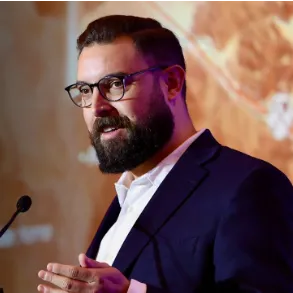
Joaquin Marias
President, CEO & Director at Argenta Silver
Replay available
Únase a nosotros para una conversación reveladora con Romina Sassarini, Secretaria de Minería de Salta, y Joaquin Marias, CEO de Argenta, mientras discuten la jurisdicción minera de Salta, sus oportunidades de inversión, marco regulatorio y el futuro del desarrollo minero en la región. Tenga en cuenta: Este evento se llevará a cabo exclusivamente en español. La repetición incluirá subtítulos en inglés. ------------------------------------------------------------------------------ Join us for an insightful conversation with Romina Sassarini, Secretary of Mines of Salta, and Joaquin Marias, CEO of Argenta, as they discuss the mining jurisdiction of Salta, its investment opportunities, regulatory framework, and the future of mining development in the region. Please note: This event will be conducted exclusively in Spanish. The replay will include English subtitles.

On 6ix: 6ix.com/event/salta-mining-jurisdiction-secretary-of-mines-joins-argenta-ceo
Automated transcript · Written by software from the replay's audio. It can mishear names and figures; the replay is the record.
0:04 Okay, as folks are filtering into the room, thanks so much for joining us today. I know it's quite a large audience, so really appreciate you taking the time to join us today. We've got with us Joaquin Marias, the President, CEO and Director of Argenta Silver, and also Romina Cesarini, the Minister of Mining and Energy of Salta Province. Today should be a very fun event, but keep in mind that it will be in Spanish. That being said, you can still feel free to ask questions in English in the chat function in the bottom right of your screen. We'll try to get to as many of the questions as we can today live. But if for whatever reason we don't get to your question, we still will send them over to the Agenda team, and they'll be able to tackle them over email or phone depending on what information you enter with your registration. One last piece of housekeeping, today's event is being recorded and will be available for replay.
0:52 Probably you'll pop in your inbox in the mid afternoon
0:56 today and subtitles will be in English. So if you are an English speaker, subtitles will be available in that replay once it pops up as well on our YouTube channel. But, ahora cambiaremos al español y le pasare el microfono a Vanessa. Muchisimas gracias, Romeo. Me escuchas bien?
1:17 Hello everybody, I'm just going to do a quick introduction on la doctora Romina and Joaquin Marías. La doctora Romina Sassarini es la secretaria de minería y energía en la provincia de Salta, abogada y escribana con postgrados en gestión integral minera y en derecho de los hidrocarburos, energía y sostenibilidad.
1:37 Con más de 14 años de experiencia en los sectores minero y energético, ha ocupado cargos clave en la administración pública y hoy es docente en varias diplomaturas de minería y litio. En 2024, se convirtió en la primera mujer en presidir en el CoFemin, and now she is a professor in the Department of Public Administration and now she is a professor in various degrees in Mining and Lithium. In 2024, she became the first woman to preside over the COFEMIN, leading a management focused on sustainability, transparency and the strong growth of mining activity in Salta. Doctora, it is an honor. Thank you very much for being here with us today. Thank you very much.
2:12 Good afternoon to the entire audience. For me, it is an honor to be here today sharing with you the mining policy of the province of Salta. Excellent. Thank you, Doctor. Now, Joaquin Marías is a geologist and CEO of Argentina Silver Corp. With more than 14 years of international experience in exploration and project development in the Solomon Salomon, Argentina, Australia, Canada y Alaska. Es uno de los fundadores de Argentina Silver creada junto a Frank Joustra y el equipo de Fiori Group. Y bajo su liderazgo, la compañía he recargado más de 35 millones dólares canadienses, pasado de una evaluación inicial de 10 millones a más de 170 millones en capitalización de mercado. Under his leadership, the company has raised more than 35 million Canadian dollars, from an initial valuation of 10 million to more than 170 million in market capitalization. Joaquin, Thank you very much for being here for this very important conversation.
3:05 Thank you, Vanessa. It is also a pleasure to be here with Romina doing this webinar today. We are very happy and we hope it is very informative for the public. We are very anxious to hear what Romina has to tell us today.
3:25 Very well, Romina, I think we're ready to start. I would like to make a brief introduction about Argentina and tell the audience that Argentina is
3:39 a federal republic that has different provinces. Argentina has 23 provinces plus an autonomous city, which is the capital of Argentina. And it is a state that has 3 very well-defined powers, where there is an executive power that is presided over by the president of the nation. At this time, the president is Javier Mireille. And then there is a legislative power and a judicial power, so the 3 powers are very well separated in Argentina. And well, it has an economy that at this moment is opening up a lot to the market, it is opening up a lot to the market, to the world. And also in economic terms, it is important to note that Argentina has approximately 5 to 6 economic regions, depending on how we see it.
4:33 One of the most famous in the world is Patagonia. Everyone talks about Patagonia. Patagonia is an economic region in Argentina. And then we have other economic regions, like La Pampa, which is where mainly cattle and grains are produced.
4:48 And then there are provinces like Cuyo, the northeast, and the northwest of Argentina, which is where the province of Salta is located, in the northwest of Argentina, being the province of Salta perhaps one of the most relevant provinces in economic terms.
5:09 Salta has a whole sector that is covered by jungles and very green mountains, and on the west side it has a mountainous area, which is more like a desert area, and that's where you find mainly the mining projects that have become famous in recent years in the world, especially lithium projects. I would like to share at this moment a QR code, and I would like, Romina, if you could tell us a little bit Yes, of course, Joaquín. Well, in that QR code, SALTA has worked a lot on the transparency of the information and on the continuity of the information. So, we have this QR code that has a lot of information that you can access and verify different presentations on the state of progress of
6:04 mining projects, distinguished by categories, as well as the portfolio of mining projects that we have in Salta, both what refers to gold, silver, copper, lithium in their different states of progress. You can also see different presentations
6:20 from the province of Salta in particular in relation to mining activity. You will be able to find the Sustainable Mining Development Plan 2030, since Salta does not carry out isolated actions, but since 2021, Salta has a north marked by this mining development plan, which is aligned with the Sustainable Development Goals of the United Nations. And that has marked in recent years that north, where it wants to arrive from the province of Salta to finish consolidating mining activity in the province. They will be able to find regulations, particularly a regulatory compendium of my authorship, where they will find the regulations both national, provincial and municipal, with the direct links to the regulations published in the national and provincial official bulletins.
7:08 This allows for no distortion when reading those documents, and there you can find a compilation
7:17 to observe what the legal requirements are from the point of view of mining, environment and water resources. And then you will find more information about the contact data with the Ministry of Mining and Energy.
7:34 Fantastic. Thank you very much, Romina, for sharing this. I think it is very important for those who are more interested in all this information that we are going to talk about today and who want to go into much more detail. The information that is in that drive is, the truth, very abundant, very important. And as far as I understand, that information is also updated periodically, correct? Correct. Correct. Every year we update it. The one that is published now is the 2025, but during the month of January and February, surely there will be some modifications that already make the new content for next year. Excellent. Well, I was just talking a little bit about Argentina and how it is distributed, right? And many times there are people who ask me what is the law in Argentina?
8:21 What is the mining law? And I always explain to them, well, Argentina is not a mining jurisdiction as a country, but there are different mining jurisdictions.
8:30 Do you want to tell us a little bit about why Salta is considered a mining jurisdiction? Yes, correct. Well, this has origin in what you mentioned at the beginning, because here in Argentina it is a federal country, and according to what the Argentine National Constitution establishes, particularly in Article 124 of the Constitution, it is determined that the original domain of natural resources corresponds to each province. Each province can and must manage its natural resources and manage them. Clearly, mining resources are one of the categories of natural resources, and that is why the legislation of the different provinces can vary in terms of that management and administration. The particularity that Salta has, and that it is the only province that still remains under this scheme, is that the mining concession is given by a judge of mines.
9:23 As Joaquín just established, the difference between the different powers of the State, the Judicial Power has within the mining concession the character that the concession is adjudicated as a judicial sentence and it is maintained through time, unalterable, without the need to be reviewed every time the provincial government changes, which corresponds to the executive power, and that gives the mining concession the character of perpetuity, as long as it meets the requirements of the mining protection, which are to make the investments and pay the mining fee mainly. That is to say, that while the investors maintain those 2 unalterable conditions over time, the concession will accompany that non-alterability. And on the other hand, it appears from the executive power, the Ministry of Mining and Energy, to which I belong, of the government of the province of Salta, administering those resources in terms of technical and environmental management. That is, the player grants the mining concession and the Secretary of Mining
10:23 and Energy grants technical and environmental permits so that the projects can be carried out in the province of Salta. In addition, the Secretary is also, as within her competence, a promoter of mining investments. That is also why I am here and I thank Joaquín for having called me to this webinar to be able to contact all of you. And another of the main functions is also to control the execution of mining projects. That is, we have an area of mining management and police that, in addition to evaluating environmental impact reports, controls that they are carried out in an adequate way on site.
11:00 It is also very important to highlight that these particularities of Salta do not necessarily apply in other provinces. Each other province has its own legislation in mining, right? Exactly, and this dual scheme of concessions by a judge of mines and the technical and environmental administration by a secretariat is the only scheme that is still in force at the country level. There is no other province that has it this way, with 2 different powers. With 2 different powers. And we always highlight that this is one of the most important assets of the province of Salta to maintain the mining concession at the judicial level and also preserve the foreign investments that we know are high-risk and long-term for mining. We understand that and we continue to value that this continuity is in the hands of the mining judge in charge of the concession.
12:00 Something that caught my attention and possibly those who have traveled to the north of Argentina, is that when you travel through the province of Salta, you see fields, you see oil wells, you see cattle, you see mining everywhere. What is the economic matrix of Salta, If you can tell us a little bit about that, Romina. Well, I'm going to repeat the words of the governor of the province of Salta, Dr. Gustavo Sainz, when he says that Salta is a miniature continent, right? And this is because it has a range of possibilities. Just now, Joaquin, you explained a little the geography of Salta, from east to west, from north to south. We have such a varied and rich territory in different natural resources and in different possibilities that Salta today has a productive matrix with a range of very large possibilities ranging from agroindustry, that is, we produce, we are an industrialized region that produces corn, beans, soy, chickpeas, as well as other citrus grains, tobacco.
13:07 We have a very strong region oriented to viticulture, to the forestry industry. We produce fruits, vegetables, peppers for pimentón and other species. We have multiple crops in relation to the livestock sector. We produce cattle, cattle, pork, capri, agricultural.
13:27 We also have tourism, we have other industries related to food and drinks, such as flour, sugar, dairy, canned goods, beer, water, and particularly the specific application area of this Secretariat in Mining and Energy, of course, the issues that have to do with hydrocarbons, oil is produced, gas is produced, renewable energies are produced, and of course we also produce mining. And in relation to, in general, how all these, All this matrix within the province of Salta has its primordial rank, in that, of course, today, at this moment in which we are, the grains occupy the first place, but the mining occupies the second place within the exporter Complex of the province of Salta, only with a mining project converted into a mine since 2020-2021,
14:22 which is the Lindero gold mine. That is, only with the production of Lindero, full production, Today we are located in the second exporter complex. Later we will comment a little more on the rest of the projects, but we have finished 3 projects that finished their construction phase recently, and surely for the year 2026 we hope that those lithium projects will be produced, and definitely the productive matrix and this order of prelation will be modified in Salta and that mining will be consolidated as the first exporting complex. And we are going to become province with minerals to a mining province. Well, I think that's fundamental to highlight what is the focus of the province today in terms of governance and I think you just mentioned it, that those minerals
15:19 or deposits end up becoming mines. I would like you to comment a little on what minerals the province of Salta has, and if you can tell us a little about the projects that are in Salta. Yes, of course. Well, Salta is historically a mining province, but a province that, some time ago, about 5 years ago, produced, above all, minerals of what the mining code here in Argentina calls the third category, which are the construction minerals,
15:50 the onyx, the lajas, the arid ones, and we have historically been borato producers, that is, we are, within Latin America, the first hydroboracite exporter, for example, but a few years ago, these 5 approximately, Salta started to work very hard with projects of what is the first category, gold, silver, copper, lithium, and on that path, almost abruptly,
16:19 after the pandemic, we have had a lot of international interest, especially in lithium projects. From that moment on, we have consolidated as the province that has the largest number of lithium projects. We are still on this path, with 29 projects in the advanced exploration phase of lithium. And after the exploration, we have consolidated projects that have gone through their construction and mining phases. At this stage, we have 3 projects that have finished their construction phase. We have the Posco project, which is called Gold Salt,
16:57 to produce phosphate and lithium, and then in an industrial plant much closer to Salta Capital, to produce lithium hydroxide. We have the Mariana project, in the Salar de Yurayayaco, very far from Salta Capital, about 12 or 14 hours, which speaks of the territorial extension that the province has, where lithium chloride is produced. And the third project that has already finished its construction phase is the Centenario Ratones project of Heramines Sudamérica. These projects have passed their evaluation phases at the provincial level, of course, previously their concession phases at the judicial level, and today they are enabled to produce the lithium products that I just mentioned.
17:45 Today they are in the stage of
17:48 putting the processing plants in place. And after that, despite the low lithium, 2 more projects have been incorporated this year. The Rincón project of Rio Tinto to produce 50,000 tons of lithium carbonate in the Salar del Rincón. And the project also has the large pastures of Ganfen Lithium to produce 50,000 tons of
18:14 annual lithium carbonate. These projects consolidate the province of Salta as the province that has put the most mines in production in relation to lithium, because in relation to the other provinces such as Jujuy and Catamarca, in Jujuy we have 2 projects enabled for production, in Catamarca 2 projects, and we are today with 5 projects.
18:34 That in relation to lithium. Then we have great advances with the other categories of metalliferous, as I mentioned earlier, the Manfield project, which is in production since 2021, produces gold and has as its product silver and a little copper. Then we have the AbraSilver
18:58 project, which is very advanced in technical evaluation, which is called the Diablillos project. And after those who have also presented production reports, we have the Taka Taka project of copper, which is a world-class copper porphyry, which is really a very important project for the province of Salta and will generate a dynamic. And from there, well, also, Joaquin, your project,
19:22 which is already in the phases that we catalog of advanced exploration, advancing strongly in the consolidation of information through the perforations, I hope to soon also move on to new construction and production instances. Definitely, it is something that we also expect. And well, it is very clear what you are marking, Romina, that definitely in the province mining projects are being opened and they are moving very fast, there is a constant flow of acceptance of these projects and opening up of mining projects, which I think, at an international level, puts Salta in a very favorable situation, because there are many places in the world where There are mines operating, but for many years new projects have not been authorized. And I see that in Salta that is completely different, things are moving quite fast. There is a video that I would like to show about the province of Salta. This is a video that
20:33 the government of Salta has made and I think it's very good to show. It's only 2 minutes, so if you'll allow me, Romina, I'm going to show it. Yes, of course.
20:48 It's only 2 minutes, it's a video with sound and it has English subtitles. So we're going to leave you with the video and see you in 2 minutes. It looks good there, right? Yes, yes. Perfect. Salta has among its virtues an important territory rich in minerals, the Andes. Located to the west of the province, covers more than 25,000 square kilometers, a unique region in the world, at an average height of 4,000 meters above sea level.
21:30 Here, in La Puna, there are people prepared to build a better future through mining. Men and women activating the potential of the Salton economy. The mining policy of Salta bet on sustainability, ensuring productive chains that boost the growth and development of communities. Because mining generates decent employment, promotes growth, and drives development.
22:07 The change to a more sustainable world will require more mining. And Salta can offer lithium for clean energy, Copper to transport electricity, silver and gold that require electronics, expansive and filtering pearls for agro, lajas, onix, arid and other key substances for the industry. The potential of Salta is active in its people, in its projects, in its government, companies and institutions.
22:46 Salta can move the world. Salta can move the world. Government of Salta. Government present. The government of Salta, present government.
23:10 The video is very good, I congratulate you for the video you have made. I think it gives us a foot to talk one more hour but we do not have for so long so I'm going to focus a little on some of the things that we would like to tell people but the truth is that the video is fantastic. We have talked at some point about how the disaster has been updated,
23:43 the employment page, also some updates on the legislation associated with investments. And for my part, as CEO of a company, to be able to disembark or take a group as large as the Fury Group to Argentina and to be able to enter Salta and meet a lot of things that are being modernized and that have already been modernized. The truth is that it was very good and
24:15 very valuable for us to be able to get the company to work quickly in the province. I don't know if you can tell us a little bit about the latest advances that have been made in the field of disaster, the job site, updates on monitoring. Yes, I think that the important thing that you are saying, Joaquín, is that first for the province of Salta, mining is a state policy. We are totally determined and willing to convert, as I said at the beginning, mining into the first exporting complex.
24:49 And within that path, from the sustainable mining development plan 2030, we want to position the province on that path and at an international level. For this, we have worked hard on a lot of issues, and the important thing is to emphasize that we always listen to the private sector. The needs and requirements always come from there. Perhaps the regulatory modification and the momentum of management systems, digitization and all that, comes from a requirement of the private sector. So it is important to mention that we listen to what companies need to be able to position Salta and to give them the benefits and the needs they have in the province of Salta. On this path, we have worked hard for transparency and continuity of information. Salta has been one of the first provinces to join EITI, which is the international standard of transparency for extractive industries. We are doing our second annual report, we have done this year, and on that path we have transparented and published a lot of information.
25:55 Part of it is contained in the QR code that we mentioned at the beginning, where you will find that drive that I mentioned, and another one also has to do with the digitalization and the public and free publication of the mining disaster in the province of Salta. Until a few years ago, even other provinces also did not have a public disaster. Today, if you enter Catastro Minero Salta on Google, you can download the disaster and you can see all the concessions, the services of any category of minerals, from a small quarry of arid to a large mining enterprise of lithium, gold, silver, copper that I mentioned earlier. They will have the identification, where the coordinates are located, the locality, who is the concessionary company. For this management, it is very important to have transparency
26:44 in these mining disaster issues and that anyone, anywhere in the world can review it and have that update. Even the catastrophe is updated month by month, so what you can see in the catastrophe is quite dynamic and quite real. After that, we have worked on the SIMSA system, which is the mining information system in the province of Salta, where all mining projects are digitized, geo-referenced and localized, the employment data, the data of investments, the data of suppliers, the data of the communities of areas of direct influence of the projects, and also things can be done, such as paying the mining canon from anywhere in the world with a payment button, and those who are in the production phase,
27:29 already reporting royalties based on that production, all digitally, systematized and organized in this system, and we can also have a real and dynamic record of what is happening and be able to show those results over time with different graphics. Another of the issues that we have worked a lot on, which also arises from the Sustainable Mining Development Plan 2030, is the professionalization of human resources. SALTA is determined to take advantage of the opportunity that mining generates today. And from the secretariat, we have worked a lot with universities, with the technical schools and even with the secondary schools to work on the educational offer necessary for the mining industry that is coming. And today I am sure and I can say that the province of Salta has the human resources necessary to face the mining industry that we have and the one that is coming. And the same goes for the local suppliers.
28:28 In relation to local suppliers, Salta has the particularity of having a local mining promotion law that implied the increase in employment that occurred during this last time. Salta had more than 40 months of uninterrupted employment growth, a very encouraging number in relation to the whole country, and a provincial public register of local suppliers of mining companies where these suppliers are certified. So, we can also offer mining companies the register of mining suppliers and the registration of the people trained for the different jobs. This of the jobs is certified on a page called Trabajo Minería Salta, where the trained people upload their Bit.ai CV, upload the certifications that accredit that training, and the mining companies upload the necessary employment announcements, and that's where the meeting between these 2 extremes and we promote the development of local employment and of mining suppliers as well. And in relation to the investments that you were saying, Joaquín, and as we heard from mining companies, during this time when there was a significant drop in the price of lithium, Salta worked very hard on a promotional regime of rates of access to
29:58 mining properties, which are certain canons that are paid when mining properties are requested. And understanding the current situation of the price of lithium, we wanted to promote new investments in that area. And a decree was issued, which was later ratified by law, which aims for a year to lower the rates to the world they were in in 2023 for a year. That is very important for us, and it will be in force until next year. It was very important for us to promote the activity, even though it emerged and was managed at a low price. Lithium is applicable to all minerals, so of course we are waiting for you with the doors open to all those who want to invest in Salta and take advantage of the promotional regime.
30:48 Perfect, fantastic. It is very interesting to be able to review all this information that Romina is commenting on in all these public places, because I really think that there are provinces in Argentina that have not been completely modernized, and also other jurisdictions around the world, especially in Latin America, that have not been completely modernized. And in Salta a very strong work has been done to achieve this modernization. Another notable thing, Romina, and I always mention this in my conferences, is the amount of infrastructure in the province. The province has a very large network of railways, a very large network of routes, a very large supply of gas and electricity, which I think is also a very important strength for companies that arrive in the province. I don't know if you can tell us a little bit about what tasks the province is doing in terms of infrastructure that can be positive for mining.
32:04 Yes, the whole infrastructure network is being improved with this vision that mining needs infrastructure to be competitive with other points in the world. And the first thing I'm going to say is that Salta is within what is called the bioceanic corridor. It is in a neuralgic and central point and has the possibility of going out both through the Atlantic Ocean and the Pacific Ocean. And from that point on, we have worked hard on the integration of that biocentric corridor. And from there, everything that is infrastructure, both roadways, where There are routes, as Joaquín says, but they were still without asphalt. Today the province is assuming the commitment and the burden, regardless of whether the route corresponds to a nation or a province, understanding that mining is, for mining this is neuralgic, it is asphalting all the routes that are necessary to reach mining projects.
33:09 We are working hard with the railroad. The railroad has existed for a long time in La Puna, even in operations since the 40s, 50s, that were used, had lost capacity, had lost modernization, as Joaquín just mentioned. We are putting the railway in place, we are doing some transfer tests, Today they are used to transport mostly materials. We are working on the integration of routes with Chile, because many of our projects are at the border with Chile. And competitively it is better to go out through, for example, the port of Angamos, Mejillones, which are in Chile, because they are much closer than going out through Rosario or Buenos Aires, which are another of the ports that exist in Argentina. So We are working hard on the railway, on the railway line, on the improvement of technology and on the necessary wagons to supply the mining industry and to transport minerals in the production phases.
34:12 And we have a comprehensive development plan for the electrification of the Puna, a very ambitious plan for the province of Salta, where we have already collected the energy demand that at least 15 mining projects will need, which are now being supplied with diesel generators or solar energy panels typical of mining projects, and we have worked together to supply the nearby towns with electric generation, which is part of the interconnected network system, and which are also generated from different solar or photovoltaic energy enterprises that we also have in the Salton Puna and that allow us to supply energy in a much more sustainable way. We have a gasoduct that goes through the entire Puna as well, which today allows us to bring gas to mining projects such as Eramine, POSCO, Boras, which is the one I was talking about at the beginning, and from there there are also potential ramifications towards other mining projects.
35:21 Yes, it's incredible, and sometimes when I show the map of our project, what is the location it has, And when I explain to people that our project, our camp, is 3 km from the railroad, 3 km from a gas station and a route that takes us in 4 hours to the capital of Salta, when I show them the images of the 2 solar farms that we have in the north of the property and the electric tent, when I show you all this, I really see in the face of the public that they hear me, the surprise, because it is not very common to reach such inhospitable areas as the Argentine highlands and find all this infrastructure in place.
36:15 Sorry, Joaquin, it is important to mention that, leaving the cradle, Salta is a place, a province, that also has international connections from the airport. Today We have connections with Panama, Lima, Peru, we have connections, even if they are temporary, with Florianópolis, with Iquique, we have connections with Sao Paulo. So, really, that generates an opportunity for mining, for the development of the industry, but also for tourism, very important. And we also have 5 industrial parks in the province of Salta and today we have companies like Gamfen and companies like POSCO that process or do a first process in the mine, in the cradle, and transport the mineral through all this infrastructure to, for example, the General Güemes Industrial Park, which is half an hour away from Salta Capital, and there they finish their mining process of lithium hydroxide or lithium chloride, and this is also important to highlight, because mining companies not only choose to eradicate the mines in the cradle, but they continue to choose to continue with their industrialization process in industrial parks that have absolutely all this infrastructure that we mentioned, the railroad reaches there, they have energy, they have gas, they have road infrastructure to get there and that is also very important to highlight.
37:46 Yes, very, very important. I think you just commented a little about human resources and the ability to provide services. It is important to highlight that almost all major service companies and an infinity of smaller companies have their base in Salta, so it's very easy to provide those services in Salta. A very recurring question that I get in my conferences or every time I have a meeting with investors, they ask me, well, the infrastructure is there, the economy is there, the projects are there, everything is modernized, it works, for now it seems that everything works well, But what about the permits? They always tell me that, and also when I give them the answer, they are surprised. I don't know if you can tell us a little bit about the process of obtaining the permits, if it is slow, if it is fast, what have they been doing lately, if permits have been issued in recent years?
38:48 Yes, yes. In 2023 we modified the Law 7141, which for us is the code of mining procedures, which is the one that marks us how these procedures are. And we also modify it, listening to a requirement from mining companies. This article establishes that although the procedure is done entirely within the Mining Secretary, as there are activities that are transversal, such as environmental, hydric and other secretaries that intervene in the process, the idea was to be able to concentrate and optimize and give celerity to mining projects so that they can obtain their results or their environmental impact statements as quickly as possible.
39:37 The first thing we tell them is that if they follow the regulations and follow the steps as they have to follow, the processes are relatively fast in terms of requirements. The Secretariat accompanies mining companies in all these processes, interdisciplinary meetings are held with the different Secretariats to accompany them, meetings are held with the technical teams of the mining companies. We make available our human resources from the Secretariat to solve any conflict that may arise within the process of environmental assessment. And if you take into account this normative, I tell you that it is determined in the environmental mining digest, which is also in the information QR code. And if they comply with all the sections established in the regulations, the process is quite fast. The issue is to comply with everything that is established in the regulations.
40:30 Because this new procedure, which we were able to regulate since 2023, generates precisely that need and that accompaniment of the different areas of the government of the province of Salta, aimed at achieving the ease of the exchange of information between the company and the different secretaries, and the rapid obtainment of the data. Yes, it is worth clarifying that it is a strict process, I mean, I explain this as a SEO, it's a strict process, it's not completely lax, obviously there are a lot of issues that need to be solved, and I already value the incredible work that the team has done in Argentina, our company, to be able to take the time and complete each of the requests and requirements that the legislation has in Salta.
41:31 But it is also very valuable to say that it is not impossible. It is rigorous and I think that also gives us security, Romina as a company, to know that We are entering a place where the rules of the game are very clear and that also allows companies to solve quickly with the government many gray areas that one finds in other places. In are the regulations and requirements to be able to apply for a permit, right? Yes, what is also important to highlight is that we are looking for continuous improvement. So, although in the environmental mining digest they have all the regulations, what we are doing now and what we are working with an international body is to review all the regulations, which may be contained in different resolutions and be able to compile it in a single resolution with different annexes, where in those annexes it will be established what are the requirements of prospecting, what are the requirements of advanced exploration, construction and production, and identify it differently for the different types of minerals, in such a way as to have that kind of checklist and validate it prior to the presentation with that information. We are working on that now, and I estimate that it will be launched
43:03 by 2026. But as of this year, we are approving or issuing 74 environmental safety declarations. Wow, wow. And that also speaks of the speed, the speed that the Ministry of Mining and Energy of Salta has to review, understand, contact the companies, that is, review and understand the permits, contact the companies and follow this process. For us, I think it was a very important channel, we opened a very important communication channel with the different areas and the truth is that I think it was very important to do that and yes, no, 74 permits I think speak for themselves. Yes, they are in different phases, right? You have superficial exploration, advanced exploration, construction and production, but it is a very important number for us too.
44:00 Sure, sure. Believe us, for us too, because on this side it feels like the province pushes very hard for mining to develop in the province. There is a very important issue that I would like us to talk a little about, and it is the issue of communities. Salta has a very important native population, especially in the highlands of Salta, in the Salton Puna. And for us it has been very nice, I have to say, to be able to work with them because we have found a very important ally, which is mainly the community of oppositos, to whom I take the opportunity to send a greeting, in case you are watching us today.
44:55 The community has been very receptive to our ideas and has also been very good at giving opinions and helping us to progress in a relationship that we have started to build together. And the truth is that I also started to see how the government is working a lot with communities, and especially with the Secretariat. Can you tell us a little bit, Romina, what is being done in the communities? Yes, well, first of all, that concept and community relations are the basis of the social license. Today we know that if there is no social license for a project to develop, no matter how much the geological, technical and environmental aspects are involved, the project will not develop.
45:47 We understand that perfectly. And that is when we propose that communication and link with the indigenous communities should be from early stages of mining projects. We, at least since 2014 or maybe before, we already had a lot of contact with the original communities of La Puna, with whom we work side by side so that the activity is developed, but the communities are also developed by hand, the infrastructure for the communities is developed, employment is also intended for the communities. In addition to the standardized methods of participation, both of the communities and society in general, as is the 169th Convention, the OIT, in relation to the free, brief and informed consultation, and in relation to the public hearings that every project has to be authorized in its phase of construction and production, we propose that this link with the communities is permanent and that is why we have issued different types of resolutions from the Secretariat that approach companies, communities and the government.
46:53 One of these resolutions is the resolution of the social work tables. The particularity of the PUNA is that the communities are well identified and also very well organized, and their institutions are also organized. So this allows us to have direct contact with each of them, and the particularity is that there are many mining companies and, on the other hand, few communities. So this also allows for that differential treatment and that approach, as Joaquín says, with the chiefs, with the different authorities of the community. These social work tables promote collaborative and participatory spaces. This year they were given 1 every 2 months. Both the social teams of the Ministry of Mining go, the companies that are working there in the area of direct influence go, the communities go, requirements are exposed, consultations are put, advance states of the projects are put. The communities can get rid of the doubts they have directly with the authorities and with the companies.
47:53 The generation of local employers and suppliers is promoted. And above all, social and business responsibility actions are articulated. Because we understand that the actions of responsibility are important, made by mining companies, but if we put together all the actions of social and business responsibility, among many companies, we can achieve much bigger goals and work on what the community is really interested in, issues of training, infrastructure issues. And well, accompanied by the resolution of the social work tables, we have the resolution of participatory monitoring. In this path of transparency and continuity of information, we have regulated that At least once a year, from exploration stages, a participatory monitoring is done with the community, where the community can raise points of demonstration, where it accompanies, where it verifies, together with us, if the activity is really being done correctly or not. And for that we have worked with a public university here in the province of Salta training 150 people from the PUNA so that they can develop critical reasoning and intervene in the participatory monitoring with awareness and knowledge of what needs to be done.
49:02 And then, of course, all mining projects have their communication and linkage plans with the communities, which is project by project, to tell them before starting and then, as time goes by, how that project is being modified. But, well, we have a very good relationship with the communities. This does not imply that there will be no problems. We always have problems, we have requirements, but both the companies and the Secretariat address them in that way of trust that we have mutually. And when we have requirements, for example, of inspections or new joint monitoring, we quickly hear their voice and they are the ones who are directly closer to the project, so they are also great secretariat collaborators when it comes to auditing. Perfect. Yes, the task you are doing is very valuable.
49:53 I would like to emphasize again, and I think to close, that social licensing in Argentina is very important, and having the work of the government, of the community, of the companies, interrelated through this type of regulations, makes that social license be visualized between the 3 parties and there is always a way to reach a consensus. And that consensus is what allows companies to work and communities to develop. I think that is very important. Romina, we are very close to completing the time of today's interview, but to close, I don't know if there is anything else you would like to add.
50:45 We will have time for some questions. So, if there is something else you want to add. Yes, I would like to tell you that we also work hard on aspects related to gender within mining activity. Salta has been one of the pioneer provinces in also issuing regulations that make public policies that have to do with the greater incorporation of women, gender and diversity within mining activities. With this, we register a fairly differential growth in the rest of the country in terms of the number of female jobs that there are in relation to the activity. There is still a long way to go in terms of what positions women occupy in charge of decision-making. Today I have the chance to be Secretary of Mining and energy. As you said at the beginning, I also have to be president of the Federal Mining Council, which is the one that brings together all the Argentine provinces.
51:38 I have been elected unanimously. The truth is that for me it is an honor, but there is still a long way to go, because in addition, women occupy other positions at the business level, because of their capacity and because they are absolutely training themselves and they can climb the different levels of the organization or mining companies and also compete, of course, from a positive point of view, to compete with men in all those types of activities. So we are a province that is also looking at the integration of communities, we are looking at the integration of women in a historically masculinized activity, We are looking at the integration of suppliers and local employment. We are also working hard on the training of these human resources through the different tools that we can have, both public and private, with universities, with technical training, and above all, listening to the requirements of the sector for what is coming in Salta, which we really hope for a 2026 with a lot of activity, a lot of work, and where mining will continue to be enhanced in the province of Salta.
52:49 Yes, it is very important to highlight that. We are very proud, Romina, because we have recently made some more incorporations and today we have a ratio of 4 women to 5 men in our company, so we are betting a lot on diversity as well. We are very happy, I thank you very much for your time and we will enter in a few minutes to the questions and answers section. But first of all I would like to comment to those who are not familiar with the El Quevar project, which is located in the province of Salta. El Quebar project, which is our main project, is a pure silver project, which is very rare in the world. There are very few pure silver projects in the world.
53:46 We have 45 million ounces of silver in the indicated category and 4 million ounces of silver in the inferior category. In a very high law, for the indicated category it is 482 grams per ton of silver and for the inferior category it is 417 grams per ton of silver. The project has a main deposit, which is where those almost 50 million ounces are located, and We have the camp already built, more than 80 km of routes. It is a very large property, it has 57,000 hectares, and we are focused mainly on developing this resource, on adding ounces through what we call resource expansion.
54:35 And we are also very focused on exploration outside the resource, because only 3% of the project has been historically explored. So we see a lot of potential, as we said, the project has a lot of infrastructure that reaches the project and is active and can help us put the project into operation in the future, to start producing quickly in the future. I think the province of Salta deserves a very important place on the map, because for us, particularly, it has been very good to work with the government, to work with the local communities. We have 50% of the staff from the local communities and between 80 and 90% of our team is from the province of Salta, including contractors. The country, including contractors, thanks to all this effort that the province makes to be able to offer different options of suppliers, to offer different options of human resources, which we have clearly accessed very quickly because it is a lot of trained staff and many service companies that have a lot of experience in the area also to work.
55:57 I would not like to leave without first showing the QR code again for those who want to have a little more information about the province. This is the QR code, as Romina mentioned earlier. I recommend that you scan it. You will enter a Google Drive where you can download the different information that is there. And as Romina was telling us, this Drive is periodically updated with new information. So, if you agree, Romina, we give the floor to Vanessa so that we can get to the questions and answers. I don't know if we have time, but Vanessa, if you are there. Thank you very much Joaquin, Romina. It was very interesting, I learned a lot today.
56:50 We have some questions from the audience. One is, what is the opinion of the Secretary on silver as a critical mineral for Argentina? Well, the truth is that for us development is very important, particularly for Salta and then Argentina, but particularly for Salta. What happens is that Indero, which is our gold mine in the production phase, has a small percentage of silver. But 2 silver projects follow in this category, which is the Diablillo project, which is already very advanced and has presented its environmental impact report to move to the production phase in a limitroph zone between Salta and Catamarca, where there is an agreement between the 2 governors to provide legal security to that interprovincial zone. And the El Quebar project, which Joaquín just mentioned in his speech, which also has results that surprise us every day after the advanced exploration, the authorizations for perforations to gather more information.
58:04 This is going to be very important for Argentina, not only to position Salta on the international map in relation to this mineral, but also to the whole country. So we are very happy and enthusiastic because these projects are happening. In particular, the KeBAR is a much older project, but as Joaquin said, it is unexplored or is explored in a very small percentage of its capacity. So, new technologies and new results allow us to obtain more information in relation to that, and that will allow us to position ourselves internationally on the map of new minerals that we produce today. We are very grateful.
58:51 There is something that I think is also very important to highlight, Vanessa, your question, which is that Argentina has a lot of silver mines, which have been in production for many years, and particularly there are very important silver projects in the country. The province of Salta has 2 of the 3 largest projects in Argentina of primary silver. The largest project in Argentina is the Christmas project, which is in the hands of Pan American Silver. Then follows the Diablillos project, which Romina mentioned earlier, about that project, which is the Abra Silver project, and the Quebar project follows. The Quebar project of Argenta Silver is the third largest primary silver project in Argentina, and as Romina says, having 2 of the 3 largest projects in Argentina aimed at becoming future mines within the province I think is Very relevant. Thank you for your comment, Joaquin.
1:00:06 Another question. There is a lithium table. Do you want to tell us what it is about, Dr. Romina? Yes. Well, The Lithium Table is a strategic alliance between the 3 northern provinces that have the most of this resource. Both the province of Salta, the province of Jujuy and the province of Catamarca, each one with its own provincial schemes, as we said at the beginning, the governors have had the vision to constitute a joint work table to address the different challenges that lithium generates, which was generating with the abrupt growth of the requirement of this mineral at a global level. And from that moment, the governors, sitting at a table, decided to work together on the approach to the different challenges that this mineral generates. Thus, the Lithium Table was formed, which later ceased to be a table and became an interprovincial treaty.
1:01:05 The first interprovincial treaty, legally constituted as established by the national constitution and approved by law of the 3 provinces. Operatively, the Mesa del Litio has a general secretary, but then it has different work commissions where the governors put their own work teams at their disposal to form those commissions, such as, for example, to solve issues that were technical-environmental, that always emerge through new technologies, to respond to infrastructure issues, to respond to irrigation issues, or what are the best ways and practices of controlling a mineral that, according to what was established in the code, was quite distant from the rock mineral, because here in Salta the lithium mineral, and in Pujuy and in Catamarca it is also found in salt mines.
1:01:57 So, from the generation of those work commissions, we permanently articulate the 3 provinces of the NOA in this joint work for the lithium activity. Excellent, thank you very much. Another question, is there any company that has applied to the RIGI? What are the benefits of this? Well, the RIGI is a national disposition, at the Argentine level, it is the incentive regime for large investments. The regime has very important exchange rate, tax and customs benefits, both for mining companies and for suppliers, which of course aims to promote investments, not only in mining, but all the investments in Argentina, because we understand, and the national government understands it too, that the investments are the ones that will generate the necessary movement in the economy to generate more employment and resources for Argentina.
1:03:04 Within the province of Salta, who appointed the Regi and already has approval, is the company Riotinto for its Rincón project, which is the one I was telling you about, of the production of 50,000 tons of lithium carbonate. It was the first lithium project to achieve the formal approval of the Regi, and also one of the largest, or the largest, in terms of lithium, because it is an investment of 2.5 billion dollars. After that, in Salta, 3 applications were submitted for the RIGI, 1 is from the Gold and Lithium Salt Project, another is from the Los Angeles Salt project, from the Plaza company, or Potasio y Litio de Argentina S.A., which is a subsidiary of a Chinese company called Tibet Summit.
1:03:57 And recently, AbraSilver, which we were just talking about, the Diablos de Plata project also submitted its request. Those 3 are in the evaluation stage, those are national procedures, before the Ministry of Economy of the Nation. And finally, the company Gamfen for the project of lithium-possol-prasto-grande has expressed its interest in presenting the decision to RIGGY, but has not yet formally done so. Thank you very much. Something that I am always asked is if ArgentaSilver can subscribe to RIGGY. And to subscribe to RIGGY, an investment plan of at least 200 million dollars. Today, the company, we, ArgentaSilver, are exploring the project. We have a long-term plan, but immediately, we don't have 200 million dollars to invest.
1:04:53 But there is a law before the RIGI, from 1993, called the Mineral Investments Law, which shows that the company in Argentina is inscribed, and that Mineral Investments law provides fiscal stability for at least 30 years and has a lot of benefits including some deductions in income taxes, some in the return, for example, of the tax on added value. So there are a lot of benefits that are from the RIGI, but that are also within that mining investment law, of which our company is subscribed to. And we are working to be able to recover some of those things in accordance with this 1993 mining investment law.
1:05:47 Thank you for that, Joaquin. Well, I think the time is up. It was so fast. We will call Romeo to wrap up this webinar. Thank you very much. Awesome. I just want to thank the audience so much for joining us today. A reminder, the replay will be available with subtitles in English. So for those of you who joined through our English speakers, thanks so much. But you'll be able to read it in English as soon as that replay comes out. And for the speakers, disculpe, mi español no es muy avanzado, pero Joaquín, Secretario Salín y Vanessa, muchas gracias por la excelente conversación and I hope everybody has a great end of their week. Gracias, muchas gracias. Gracias a ustedes. A todos. Hasta luego. Hasta luego. Que estén bien.
Follow Argenta Silver Corp into a list and get an email when it puts out news.
President, CEO & Director at Argenta Silver

Secretaria de Minería y Energía at Provincia de Salta
La Dra. Romina Sassarini es la Secretaria de Minería y Energía de la Provincia de Salta, abogada egresada de la Universidad Católica de Salta y escribana por la Universidad Siglo XXI. Cuenta además con una Diplomatura en Gestión Integral Minera y un posgrado en Derecho de los Hidrocarburos, Energía y Sostenibilidad por la Universidad de Buenos Aires. Con más de 14 años de experiencia en los sectores minero y energético, ha desarrollado una destacada trayectoria en la administración pública, donde fue Directora General de Asuntos Legales y Técnicos y Coordinadora de las Mesas de Trabajo Social Mineras, fortaleciendo el vínculo entre el Estado, las comunidades de la Puna y el sector empresarial. En el ámbito académico, es docente en diversas diplomaturas vinculadas a minería, litio, sustentabilidad y gestión empresarial en la Universidad Católica de Salta, COPAIPA y la Universidad Austral. En 2024, se convirtió en la primera mujer en presidir el Consejo Federal Minero (COFEMIN), liderando un fuerte impulso a la gobernanza minera y energética con enfoque en sustentabilidad, transparencia e inclusión. Bajo su gestión, Salta consolidó su transición de ser una provincia con minerales a una provincia minera en pleno crecimiento. ---------------------------------------------------------------------------------------------- Dr. Romina Sassarini is the Secretary of Mining and Energy for the Province of Salta, Argentina. She is a lawyer who graduated from the Catholic University of Salta and a notary public from Universidad Siglo XXI. She also holds a Diploma in Comprehensive Mining Management and a postgraduate degree in Hydrocarbons, Energy, and Sustainability Law from the University of Buenos Aires. With over 14 years of experience in the mining and energy sectors, she has built a distinguished career in public administration, where she served as General Director of Legal and Technical Affairs and Coordinator of Mining Social Working Groups, strengthening the relationship between the state, the communities of the Puna region, and the business sector. In the academic field, she teaches in various diploma programs related to mining, lithium, sustainability, and business management at the Catholic University of Salta, COPAIPA, and Universidad Austral. In 2024, she became the first woman to chair the Federal Mining Council (COFEMIN), leading a strong push for mining and energy governance with a focus on sustainability, transparency, and inclusion. Under her leadership, Salta has consolidated its transition from being a province with minerals to a mining province in full growth.