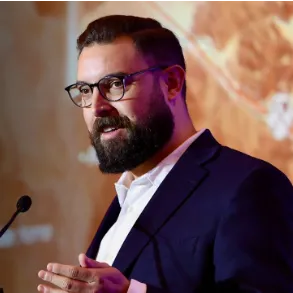
Joaquin Marias
President, CEO & Director at Argenta Silver
Replay available
Join Joaquin Marias for a recap of what has been accomplished so far this year and what the next catalysts are for Argenta Silver as we move forward in this precious metals bull market. Following the recap, he will be available for questions.

On 6ix: 6ix.com/event/argenta-one-year-recap-and-next-catalysts
Automated transcript · Written by software from the replay's audio. It can mishear names and figures; the replay is the record.
0:03 Good afternoon or good evening, depending on where in the world you are signing in from today. I am thrilled to be talking to Joaquin Marias, CEO of Argenta Silver, on the day after the Argentine midterm elections. But that is not the topic of today's webinar, though I will bring it up at some point. We're instead doing a one-year recap and look into the next steps for our agenda. Joaquin, how are you today? I'm doing great and this is a great day for us. We put news out today
0:27 and well also the election in Argentina yesterday. I think that it was a fantastic event. So ready for this presentation today on a one-year recap and commenting a little bit about the results that we put out today. Awesome. I'll just do a bit of housekeeping and then I'll throw it back to you for the protein of today's event. This is an interactive event. I know some questions came in in advance over email, but there's a chat button on the bottom right of your screen. Please feel
0:52 free to ask a question at any point during today's event. We'll try to get to as many as we can. If for whatever reason I don't get to your question, we ran out of time, it's off topic, etc., I'm still gonna make sure that the Argenta team gets those questions afterwards, and they'll be able to get back to you either over email or by phone, depending on the registration data that you put in. This is also a recorded event, and the replay is gonna be available in just a couple hours, probably by 5 p.m. Eastern at the latest. It'll pop right in your inbox but also be available on Six's YouTube channel. That's enough out of me. I'm going to go off screen and leave it to Joaquin for a presentation.
1:23 Well, thank you very much. Please just confirm Romeo that it's been projected that everybody can see it. Well, Yep, looks great. Okay, fantastic. So thank you everybody for coming today and to this 1 year recap, it's been, believe it or not, 1 year since we created ArgentaSilver. This has been an awesome journey. There has been some news today. I will talk about those when I get to that slide. But as you probably have seen, we were disclosing some great results today as well. And I will address those on this presentation. But today I'm here to talk about the 1 year recap of Argentina Silver.
2:10 As I said, it's been a fantastic year for us. Tomorrow, October 28th, It's going to be 1 year since we have been trading as HGAG on the TSX Venture Stock. So let's go through this. There is a forward-looking statement. And I would like to mention some of the topics that I will be presenting today. So in case you want to see the record, you just want to go straight ahead to where these topics are being addressed. First of all, I will be talking a little bit about our timeline, Then a little bit of the numbers from this year. We will talk and address the financials. A little bit on the results. I will talk how this potential of the project still on top.
2:58 I will show you which areas are the ones that we are going to be exploring soon and what's the work that is going to be done on there. I will touch a little bit on the resource and the metallurgy and as well about the infrastructure. You probably know that Javier Millet has won the election in Argentina. This is a major event for the country. So we'll talk a little bit about that and about Argentina, finalizing with the capital share structure and a closing note. So let's jump on it right now and start with the timeline. So this is something that I have called to this chapter the opportunity financing and acquisition. So in late August 2024 is when I identified the opportunity of Elkivar and I brought it in to the attention of Frank Giustra and the other people on the FIORI group, a group that I have been working with for the last 4 years.
3:57 So this is a project, as you know, that is located in the north of Argentina in the province of Salta. It was in hands of golden minerals and golden minerals was kind of in distress. So we were able to acquire the project for a very good price and Then we were able to move things very, very fast, thanks to the Fiore team and to this huge administrative support that the Fiore team has been giving us. So the 3rd of September, we put the letter of intent and the 20th of September we did a no broker private placement for 15 million and 15 cents. That was with Frank Giustra's lead order and that's how on the 24th of October we were able to complete the acquisition of Enkebar and I was appointed at that time, the VP of Exploration for Argentina Silver. On the 28th of October, that Monday, we were back to trade on the TSX V as a Gigi at that moment our market cap was approximately 10 to 15 million dollars and our share price was 15 cents That was the point of start for this great story that I am just about to tell you. So if you can see here from August to October, it took us only 60 days
5:28 to do the due diligences, the legal due diligences, the technical due diligences, to go to the project, to check things, to send consultants there, to present every regulatory paper, to be back trading on the TSXB. And that's impressive. We did that all in 60 days, including the financing and completing the acquisition. So the build up started right after on the 4th of November. When I was in Argentina, I went there, I started engaging the community leaders, I started engaging government leaders as well and the community leaders as well. And I started doing an assessment of the infrastructure and the assets that the company had in Argentina.
6:16 Soon after, we started to build a team. It was the key personnel and the most essential personnel that we started with. And that's how Diego Mendilarzo became the legal representative of Argentina and the president of the subsidiary in Argentina. The subsidiary in Argentina is called Xylex Argentina. We also appointed Guillermo Peralta as the chief geologist. We start to prepare all the infrastructure for the restart. The 3rd of January, 2 months after, we were going to be starting the exploration, surface exploration with the teams in place. At that moment, we already had geologists, assistants, technicians, the people that was going to give all the support in camp and we start also building a team here in Canada. So the company was growing up a lot during this month and in March 2025, this year, it's when we announced the strategic investment of Eduardo Edelstein for $5 million.
7:24 That was a major breakthrough for the company because we got a director with that investment and also a technical advisor. They have been excessively helpful for a company, super, super helpful. I have to say that we feel super comfortable of having Eduardo Selstein's group support. It's very important to notice and to mention that this is an Argentine investor. It's somebody from Argentina who is investing and betting for a project that is in the country. I was appointed CEO on the 28th of April. At that moment, the market cap of the company was approximately $45 million at 26 cents. As you can see, the market cap was increasing as well as the share price.
8:20 So after that, on the 14th of May, we were going to be completing the first phase of this foundational programme. The foundational programme was expecting to create all the necessary baseline for jumping into a drill season, which is the one that we just finished. And that would be phase 2, which we started on the 26th of May, as you can see. So in between phase 1 and phase 2 is what we have used to create that solid foundation. That is the one that we are using now for the incoming program that will start very soon. So phase 1 allow us to compile all the database, to digitize a lot of information. Remember that this is a project that was dormant for 10 years. There was a lot of information that was not digital. It was in paper. So, we have to bring all that into digital systems.
9:23 It was 15 years of information that we had to compile, validate, unify codes to do a lot of work on top of that. We also re-log a lot of historic core. We did some mapping, some iteration studies, and we end up having a 3D model that is the one that we are using up to date. So the 26th of May, we started the phase 2 of the foundational program, which comprises the 4,244 meters that we completed recently on the drilling. So in June, we start to receive the first samples and send those samples to the lab. In July, the 21st of July, we disclosed the first batch of results.
10:09 That's when we could get the information, process the information, and be able to disclose that. And on the 24th of July, just after putting those news out, we got a bought deal announced. At that moment, the day of the bought deal, we had a market cap of $96 million at a share price of 49 cents. So the bot deal was completed on the 1st of August. It was closed with 1 share at 40 cents, half worth at 60 cents. With that, we raised $15 million and Eduardo Elstain did use of his pro-rata, right, of US$2.5M. So in total it was US$17.5M coming into the company.
10:59 The 1st of August our market cap would increase drastically at CAD$125M
11:07 approximately at a share price of $0.50. The 13th of August we put the second batch of results. The third batch could come on the 23rd of September. You can see that the 27th today, it's when we have put our fourth batch. So we have been consistently disclosing information as it has been coming to us. We have been very careful in processing information in the right way and being able to disclose that to the public. Well, tomorrow it's going to be 1 year, as I said. It's going to be the 28th of October. It's going to be our anniversary. And our market cap at this moment, it's approximately $170M market cap with a share price fluctuating around 68 cents.
11:57 We have a high of 1.13 and a low of 15 cents. That was the price of the opening in 2024. So I think that it's been a fantastic year for us when you see this timeline it looks fantastic at least to us And we believe that this trend should keep going. We are going to start working very soon, and you will see these results coming one after the other in time. And I hope that we can see better markets for Silver, but so far we are in a very, very good position and I will talk about that in a second. So, 1 year in numbers.
12:42 We start doing some minor infrastructure arranges to come. When I say some minor infrastructure arranges, it was mostly on the electrical, wiring, maybe changing some things in camp, putting some things in order. We clean a lot of the area because we receive a project that had a kind of an abandonment situation. So we had to clean a lot. We did a lot of rehabilitation. Most of that was opening roads. So we rehabilitated 8 kilometers of roads. We re-logged 24,500 meters of pre-existing resource. We also, sorry, the pre-existing resource diamond drill holes. So we split the re-log in 2 areas. One was the historical drill core from the resource, and the other was the historical drill core from exploration targets. So from the exploration targets, we re-logged 4,255 metres.
13:44 We re-sampled 25 historical drill holes, which equals to 850 meters. We had really good surprises resampling those drill holes. Actually, for some of those, I wouldn't say that it was a resample. There were drill holes that were not sampled before. And we have to sample those sections that the previous operator didn't sample before. We had really good results on some of them. There has been 6,000 of historical drill hole plus new surface samples that have been sent to study by TerraSpec. This is an alteration study that we have run. This has given us a lot of information that is very, very particular. For example, the thermometry of
14:35 the mineralising events. And this is telling us what are the temperatures of formation in the different places of the deposit, which help us to target better in the future. So there were as well 13 square kilometers of geological mapping at a very, very detailed scale. We did 2 to 3 kilometers of new roads to get to some other places. In between all the sampling that we did, 486 rock chips were sampled, 903 soil samples were collected and assayed. We have been doing as well a lot of studies on pH, for pH on samples. This is a study that we are doing in-house, and this is also very good because it's telling us plenty of things about the terrain, and that's information that we will be using for targeting and for vectoring.
15:29 We still have a lot of terraspec samples, like 1,400 samples that have been collected and are still all whole and ready to be read. So when we find a certain amount, we will start reading those samples. And that's going to give us, again, an idea of different technicalities on relation of the mineralization and the alteration itself on El Kevar. We drilled 4,244 meters, They were completely drilled, completely logged. We also did the samples, we sent the samples to the IASE for those 4,250 metres.
16:16 We have on hold from the drill core that we have drilled, we have 2000 samples for teraspec and we also have 2000 samples waiting for density. All these are studies that we will be doing along the deposit and this is going to give us a lot of information on what is the situation of the temperature, the density and many other characteristics of the deposit itself to target better zones with more mineralization.
16:51 There are 27 samples of core as well that have been sent to Petrography. And these are samples that are very important because we are using them along with historical information to understand much better what is the distribution of the mineralogy along the deposit. We will probably be doing very soon some metallurgical tests with some of the samples that we already have, with some of the information that it's already in the project itself. That's something that we will be doing very soon. It hasn't been done, but we will be doing that very soon. So all of this has been done so far. This is 1 year in numbers. And we need to remember that most of this happened through the winter.
17:41 And the winter has been very harsh in the Andes. But we did it. We worked it out. It's been all merit of our world-class team that we have in Argentina. They have been fantastic with us, the same with the drilling company. We have had a great season with a lot of information out of this winter season that we just run. So the next one is the financials. I want to stress this first line. We are fully cashed up. So probably the markets are not the best now, but for our luck, we are fully cashed up. We have $23M in treasury. We also have somehow built in finance with the warrants that we already have. So there is money on the Treasury.
18:37 With that money is that we are planning the season that we are going to be doing now. There are no pending payments, no debt at all. We have raised since September $2,059 million. $5 million was the cost of the acquisition and $7.5 million is the money that we have spent since we started in November 2024. So the graphic that you see on the right side of the image is showing those 3 lines with those numbers. So, you can see how, considering the expenditure that we have had, how much is the market cap that we have created with the work done so far by the excellent team that we have in Canada and in Argentina.
19:25 In terms of finance, to put this in another perspective, the project acquisition, as I said, cost us CAD$5M that happened on Q4 2024. You can see that there is G&A and exploration. Exploration expenditures or expenses in orange and G&A in blue. At the very beginning, it might have sound that, wow, G&A was the same amount of exploration, what's going on? Well, we were just starting. It was just Q1, we were not drilling. Now we are starting and we are estimating these expenses in the future. So you can see here that for the totality of the company, for Argenta Silver Corp, so far, our G&A and marketing costs are a fixed cost of the company and that's looking smaller and smaller as we progress in time with the exploration seasons growing up in time. Remember, we drill 4,000m in a span of many months. We will be drilling on the same amount of time, 15,000m, we will keep going into the future. So this is the expectation for the future. If we think about what are the expenses of Argentina itself, just the subsidiary in Argentina, this is how it is looking. Same story, we have a fixed G&A and marketing cost in Argentina, and then most of the money is going
20:57 into the ground, into exploration. So We are very careful on how we spend the money. My command to the company, to every team in the company, has been every time, please use a dollar, only and only, if that dollar, it's going to bring us a return. So we are very careful on the return of our investment on the dollars that we are using. And this is probably reflecting it. We are trying to put as much as we can into the ground and using those dollars of G&A and marketing very wisely and very precisely. And these graphics, I think that they are showing what we are doing with the financials of the company.
21:47 In terms of the drill results, the 2025 Resource drill results, I think that they have been spectacular. We drilled different things here, but you can see from left to right that we started with QVD 408, that was a step out drill hole of 50m. The 50m sign there, it's moved to the left, but we started with QVD 408, which is 50m away from the resource. That was a fantastic hole telling us that the deposit might continue in that direction, giving us or encouraging us to drill more on that area as well. QBD 409,410,411B, 413 were pretty much drilled in the resource itself, confirming a lot of the things that we were looking for.
22:40 These drill holes came back confirming mostly mineralisation and the grade of this deposit, telling us that the grades are constant, are continuous and that they keep staying there in the deposit all along the trend. QVD 412, what is a spectacular drill hole that we drill on a gap of 60m diameter and in that gap we obtained this 40 metres of 1 kilogram with some record breaking results in it. One of the latest holes that we disclosed was QBD 414. This was drilled 70m away from the existing resource. So this is a 70m step out. We hit mineralisation.
23:27 And this is also a breakthrough event for us. It's telling us that the trend should continue that way. We will start putting drills now in between US$414 and the border of the resource envelope and we will keep drilling on trend to prove if the continuity is still there and if the deposit is still there, if the trend continues. So, impressive results so far. This is something important. We drill the deposit not only along the deposit, but we also drill on the up deep. And This is to test if there are more gaps that we could fill with drilling. This is what happened with QBD 413. We filled a little gap that is on the side of the resource on the up deep and now we are planning to do some more up deep drill holes to prove if there is more mineralisation there. So as you can see, we have been trying to add ounces in different places.
24:31 The meaning of these results, well the confirmation holes were helping us to understand a lot of technicalities that we need to understand on the drilling and not just by looking historical core. Historical core has been sitting out there for 10 years. So we really needed to drill new drill holes to confirm mineralization, confirm alteration, and confirm a lot of things that might have deteriorated just for being outside of the earth for 10 years. That's why we need to drill these new confirmation drill holes. The successful step out drill holes, well, they are building this incredible opportunity on both ends, 50 meters step out and 70 meters step out on the other side.
25:21 We have the successful up deep drill hole that I just explained and the successful infield drill hole that is telling us that in the deposit there are these voids or gaps when you look through the resource. And those gaps are drilling gaps. There is mineralisation and we believe that they are just drilling gaps. We need to drill in there And that was the proof of that drill hole that we drilled that came back with 40m with 1kg of Silver. In terms of the exploration results, as I was saying, the previous ones were the results on the resource, on the resource trend. These are the results that are related to the exploration drilling.
26:10 The exploration drilling, we focused ourselves on Atenea, which is a new target in Andrea. There are 2 drills in Andrea, in Manicopa. We have been successful in all of them. We acquired the information that we were looking for. In some cases, they surpassed our expectations. For Ateneo, we had 2m at 314g per tonne of silver and anomalous silver values for QVD 418 and QVD 417. We also obtained anomalous values telling us that the rock, it's been in contact with a mineralising system, telling us that this is very big, and it's not only focalised or focused on the existing resource, that the system is much larger.
27:04 419 and 420 are also 2 drill holes that are exploration. They were drilled in Manicopan and these drill holes, they came up with a lot of anomalous values for Silver. You might be asking yourself, why are they disclosing 30g of Silver, or just an ounce of Silver, or in some cases less than that? Well, actually the rock in El Kevar, the rock in El Kevar, if it has not been in contact with the mineralization system, it should be having below 0.5 grams per ton of silver. That's what we call the background values of Alkevar.
27:52 So the rock with no mineralization at all should be below 0.5 grams per ton of silver. In these cases, when we find 30 grams per ton of silver, well, it's telling us that that rock has been in contact with those fluids that carry the silver. Now we are using that information to target better and to try to understand how big is this system and where to go to find the mineralization that might be economical in this case. We have been through a record-breaking year. And this year has been awesome. 18,467 grams per ton over 1 meter. That was an all-time record-breaking result.
28:38 And I have to say that there are no samples in the deposit that are just similar to this result that we drilled in that meter in the drill QBD 412. Not every sample will come like this, but this is giving us an indication. The same happened with the surface sampling. We had record-breaking results on surface, like these samples that came with over 20 kilograms of silver. They reached the upper detection limit of the laboratory, and we found visible silver. But again, not every sample will come like this in Alkevar. This is a clear message. It's telling us that the system is oversaturated in silver.
29:26 And wherever those fluids oversaturated in silver have been navigating, wherever those fluids have been passing through, well, there might be a deposit. So we need to find that volume of rock that has been in contact with these fluids. And that's why we are doing all this work, trying to target and trying to find that volume of rock that might have economical grades of silver. El Quevado is still pretty much on top. The potential is still there. This is a very, very big property. It's 57,000 hectares. Only 3% has been explored. As you can see that red rectangle that it's in the centre of the property is where the previous operator focused pretty much on getting the resource and trying to drill those other targets.
30:20 That's where probably 70 to 80 percent of the historical exploration has been channeled. Now we need to come out of there. We need to explore more. Kevar North is still a target that we haven't even planned to come in yet. Kevar South is the one that we are addressing. Further south, it's the other target, which is called Azufre, that we hopefully can get in there very soon. So big property with a lot of potential. We need to understand that this is a volcanic complex. So there are multipulses of hydrothermal events that might be bringing all this mineral up to surface. We have knowledge that there is Gold on surface. We have hit Gold in recent drillings, 1m at 0.84g per tonne of silver, but historically there are 2 metres with 13 grams per tonne of silver and some other really spectacular intercepts that are telling us that this system has silver in some places and gold in some others.
31:30 No lead, no sink so far. Each one of these erosional windows that you see there, that we call them bowls, and actually are erosional windows, Kebab North and Kebab South, they have 4 kilometers long, each one. So it's a huge amount of ground that we need to cover. And this image alone, from left to right, it has 20 kilometers. So the area that we have been working, the surface that we have been covering, it's that red rectangle that I showed you previously. It's that area where the previous explorer was also working. We focus ourselves here because we were wondering to create that foundation to start jumping into more robust and compelling drilling seasons and exploration seasons. So this foundational program was focused pretty much here. We have working Andrea, Tenea, Manicopan.
32:31 We have sent people around surface to collect samples all over this place. As you can see, there are 2 drill holes pending results. They should be coming very soon. And we hope to put those news out very soon. So if we think about what's the area that we have been working on, this is it. So what it's in between the dashed line, that's the area where we have been working during the last year. So now we are going to zoom out, You have the scale bar down there, that's a kilometer. So we are going to zoom out. And this is the area where we are going to be working in the future. And what I mean by the future is starting November 1st, going through the next year, we are going to be working pretty much on the green area.
33:20 So we want to cover areas on the north and on the west of the current exploration area. We are going to start driving ourselves into Kevar South. We will start getting ourself into Kevar North probably in 2026, 2027. But we are slowly starting to get in there with some sampling and some ideas. We are starting to think about running some geophysics in Kevar North, but in Kevar South, what we are going to do, well, we will run geophysics, we will put people on the ground to collect soil samples and rock chip samples. We will do a lot more of mapping in the area. We will be planning a lot of drilling for late season as well in this region.
34:08 The targets that we are going to be working mostly are exploration targets that are within the red dash line. In terms of drilling, we are going to be working pretty much in there. And that means that we will be working in places like, I will start writing now. I love to write. So we will be working a lot here in this area in Andrea. Probably that's not the best color to point out Here in this area that it's called Andrea We will be working in this area that it's called Rosa and we will be working here in this area that it's called Argentina We will move ourself to Copan which is this area here We will be doing some things in Mani.
34:53 So as you can see, we are starting to cover these areas. We will cover a little bit more of our Ateneo. As I said, we are going to start moving ourselves concentrically, always starting to drive ourselves into Cuba South and lately into what is Cuba North. So that's the idea so far. And let me erase this. Perfect. Let's keep going.
35:23 So what we are going to do, it's a dual approach, and we will be spending the capital, the funds, on a
35:32 very simultaneous way, on a way that we believe that it's the best so far for the company. We will spend 40% on resource expansion and 60% into new discoveries. So this dual approach will be run simultaneously. With that, we mitigate a lot the risk of the exploration because we will be spending 40% of the capital allocation into resource expansion, which is so far for us as we consider low-risk drilling on the resource itself. We are going to be starting on the 1st of November to put the rigs in place to start drilling. We are planning to drill in between 12,000 to 15,000 metres.
36:21 This is going to last until probably May or June. And in between May and June until October, we are going to be coming again in what is the winter in the Southern Hemisphere. There probably we will drill a little bit less due to the winter conditions. But until then, until May or June next year, we will be drilling 12,000 to 15,000m.
36:46 We are fully cashed up. We are ready to go. The team is working to put things in place and I believe that in the coming week or 2 weeks, we will start seeing the drill rig turning. This deposit is still fantastic.
37:07 It has 49 million ounces of Silver combined. You can see that 90% of that is indicated. So it's a deposit that has pretty much its resource, the risk it, and the amount of infer is very low. So we can add in the future a lot of houses by drilling, drill holes that will allow us to increase probably the Infer category. This is a recurring question from many of you, when we are going to update the resource? Well, the resource update will come when we see material changes in the amount of ounces that we might add into the resource itself. So far, we have 90% indicated,
37:52 10% only inferred, pure silver. There is nothing else. This is also an advantage for us. When I show you this, what I want to show is that there is no gold, no lead, no zinc, and no copper on the drills. It's mostly silver.
38:13 The silver is very continuous. There is a lot of continuity in the deposit itself. And the grades, in some cases, as you can see, are spectacular. But in most, most, most cases, the grade is fairly constant, always average grade of the deposit, 480 grams per tonne or above. In terms of metallurgy, this is a fantastic advantage because we don't have lead, we don't have zinc. So when you concentrate, your concentrate will be mostly silver with no lead, no zinc and very little copper on it. So that's very, very good because then we can decide who is going to take it. If it's a smelter that will produce or that will receive a Lead concentrate or a Zinc concentrate, we don't have that issue.
39:03 We can send it to 1 or the
39:05 other. And as I say, this is going to be potentially a concentrate in the future. These studies are historical and they have been done mostly on the 50Moz of Silver that we have today. We are looking for much more. Our target is between 200Moz to 250Moz.
39:25 So I am a believer that the metallurgy will be determined by the 200Moz that we need to discover and not by this 50 million ounces. The deposit itself is not homogeneous in terms of mineralogy. There are no homogeneous deposits in the world.
39:47 That's how geology works. That's how nature works. Nature works as an artist. It's like a paint. Not all the paint will be the same. If not, it will be like a blue canvas. This is not like that. There are different places of the deposit with different mineralogy. That will carry different concentrations of different elements. In this case, there will be more Silver in some places and less Silver in some other places. And this is very beneficial because we can use that in the future to blend areas of high grade with low grade and so on to get a concentrate that is not only consistent on the silver amount, but it's going to be also consistent on some elements that might be deleterious, like arsenic, antimony, and bismuth, that we have them.
40:42 In our reports, they are stated as elevated, but we see no concern. What we see in our reports is that these levels might incur penalties on PAs that were drafted in 2018. But we haven't run any PAs, we haven't run any metallurgical tests now, and we don't know if a new concentrate at the price of today and the regulations of today, we will be paying or not penalties. So making the assumption that we will pay penalties today, Well, it's probably not the right thing to do. We need to assess those things. That's why we are going to embark ourselves in the biological tests to understand much better that situation. And the great thing, as I say, of this variability is that the blending allow us not only to get a constant silver grade on the concentrate, but also to lower whatever deleterious elements we could have. When I say elevated deleterious elements, I want to point out that these elements are elevated considering that they get into penalty levels, but if you compare this to other deposits around the world, well, they are not extremely high and they are not something again that are of our concern. We are still working on the project. We will keep working on the project.
42:07 We have plenty of advisors that are suggesting that this is a beauty for mental illness. You can see the recoveries down there that are in between 90 to 93% on studies that are in between 2012 and 2010. So they are studies that are 14 years old. We need to run our own studies, and we will start doing that now. Now that the foundational program is over, we will start addressing all these kind of topics that might be concerning for some people, but to us so far, we are not worried at all. Let me clear that from the screen. No, that's not what I want. There we go. Perfect. So in terms of infrastructure, if we think now that we were talking about the future, and if we were producing a concentrate that we don't know as well if it's going to be a concentrate or a durex. So far, we believe that it could be a concentrate. But one or the other, well, we have all the infrastructure in place. So we haven't been required to build a camp for exploration. We haven't been required to build roads, we haven't been required to move all that equipment up to the mountain.
43:21 We acquire a project that has all the infrastructure. So this is a fully operational camp for 100 workers, it's fully permitted, we have been upgrading some things in camp. We have the core in there. And the best is that this camp has been designed to be scaled up. So we can start adding modules all over the place. And the camp serves perfectly for a lot of people. So if in the future we want to keep doing things and we want to probably bring this into production in the long-term future or in the near future, we need to start moving equipment there. Well, we have a railroad, we have a road, we have the gas pipeline, we have a high voltage power line. So we acquired a project that over a year we haven't been able to spend not even a minute on thinking about infrastructure, because the infrastructure is there. And this is fantastic.
44:26 We have increased a little bit the amount of roads that we have. This year, the incoming year, we will be drilling more roads, building more roads for sure, because we need to address new targets. But most of the infrastructure is there. And this is phenomenal for us, a huge advantage. In terms of Argentina, not minor, this picture is from last night. Javier Millet won the midterm election in Argentina. Argentina is the third largest economy of Latin America. We are one of the largest producers of gold in Latin America. We are a very big silver producer. And Javier Millet has been mentioning every time that he's going to rebuild Argentina, basing himself on just a handful of industries, the agribusiness, the mining, and the oil and gas industry.
45:24 There is a lot of emphasis from the government to push projects like this into the future. This election that he just won is giving him a lot of support to keep doing the changes that he wants. And it's stating as well that this party is going to stay in place with the support of the people for the next 2 years and potentially the future. So, Argentina, it's the tenth largest Silver producer globally, but there are mines that are closing. There are mines that are getting depleted. El Quevar, as you can see on the screen, is the third largest deposit in the country. The largest 1 is Navidad and it's completely halted. The Ablijos is also in the Salta province and they are in PFS.
46:10 El Quevar is the third largest. It hasn't been worked out in the last 10 years, So we have a fantastic opportunity here. We have the support from the national government. We have the support from the local government of Salta as well to push this project into the future. The service providers, the contractors, everybody, it's been very, very helpful on helping us to move this project forward. Talking about people, we have full support from the community. As I said, one of my first meetings was to engage with the leader of the Coya community in the Andes. We have their support. We have been having regular meetings with them 1 to 2 times per month.
46:58 We are in constant communication with them. Over 45% of our workforce is from the local communities. We have 90% of contracted services from the province of Salta. And we have been increasing our women to men ratio. Now it's around 5 to 6. We feel that this is giving a lot of life to the project. This is a multi-diverse, multicultural company that is grabbing the best of these people that we are bringing into the project. Our team has been growing up very quickly and now we have increased the size of the team because we will see much more coming on in the nearby future. In terms of the capital share structure, 1 year after we can see that the Einstein Group still own a majority of the company with around 12%.
47:55 Frank Justra still also a major shareholder with around 12%. We have seen him buy on the open market recently. Around 15% are institutions, many of them from Europe, some of them from North America, really high quality institutions. And we have 46% of very good retail. 250, approximately 250 million common shares outstanding, $23 million in the bank, no need to go and look for money right now. 0 debt, no pending payments, and we are ready to jump into the future. So there is something, and this is probably my ending or closing note, there is something that I believe that this company has had that has changed nothing.
48:56 It's the vision. We started with nothing, A lot of things have changed. We changed the teams, we changed the amount of people, we changed the amount of meters, we changed the amount of roads. We changed all that by doing more. Our vision has been the same. We want to be a leader in Latin America that is looking for Silver and that can be in production as well. So we are still looking for opportunities are there. Our vision is very clear. We want to be a leading mining company in Latin America, focused 100% on Silver. So, in between Frank and I, we have constant communication and We are still envisioning this company coming into the future much bigger than what it is today. So far, we have 15,000m of drilling coming up to us. We have a lot of surface to cover with our crews.
50:03 I think that we are doing great. It's been a whole year. I can't say not much more than thank you because you are our supporters. You are the people that are making us being better and stronger every day. And here we are. We are steering this company into the future. I hope that we can still have the support of our shareholders in the incoming year, in the future as well. So please stay tuned. You can subscribe to our social media if you haven't. You can subscribe as well to our newsletter so you receive the latest information.
50:49 And if you need to contact me or contact Vanessa Bogart, who is our VP of Investor Relations, please let us know. You can see in this picture, there is the team. I try always to finish my presentations with this, because this is a company that is made by people. And it's people, great people, the ones that are making this a great company as well. So I think that there is not much more from me. Romeo, I'm open to questions. Awesome, and thank you so much for a really thorough presentation. You knocked out a lot of the questions that I was gonna ask, so I won't make you repeat yourself too much. There are a couple that came through in the chat that I think could be interesting to tackle. So 1 that also came in over email is people are just looking kind of the long term timeline of when do you think El Camar will go into production?
51:38 Well, long term, I think that the best example is when we think about Abrazil versus the Ablijus project. So they started 7 years ago, as we have started with the difference that they didn't have any of the infrastructure. They had to build infrastructure and they still don't have it, not having all of that infrastructure. We have the infrastructure and we started on the same level as they. That happened 7 years ago, now they are in PFS and it's a fantastic project. Mining conditions for sure. For us, Well, we have just gone through the first year. We have advanced a lot. I think that we need to wait for the incoming years to see how we upgrade our resource, how much we can do in the resource area. And if there is another discovery, If there is another discovery, that's going to be a game changer as well.
52:35 When we are going to get into production, well, I think that it's going to be on the regular times for this kind of projects. We need to think about 4567 years, no less than that, because it would be irresponsible for us to jump on just mining whatever we have now without having enough ounces that we can say, okay, this is going to be a long-term operation, that it's going to embark the company into something new in the future. We are looking for opportunities around the market. And some of those opportunities that we are looking in Latin America are producing assets or assets that are very close to produce. So if you are a shareholder asking this question and you want to see production, well, that might come through the addition of other assets.
53:27 But so far, El Kevar, it requires exploration. We need to be laser-focused on finding more here to put this in production in the future. Great. That actually covers the next question in the chat, which is from Nick Del Rey. When will you be acquiring other properties? So glad we covered that. Play 0 from the chat asks, what's the situation with the water for a possible future mine? Well, water is, we have a fantastic situation with water because, can you still see my screen? Yep, absolutely. Yep. OK, so let me get here. So you can see these 2 bowls, these 2 erosional windows. These are high mountains. They receive a lot of rain and some snow. The snow will fall because of the altitude. It will melt really, really quickly. So in a matter of a week, you can have the rocks again on the surface. And all that water, it's coming into those erosional windows that are super permeable.
54:30 So the mountain itself, it's a water reservoir for future operations. We have 2 water wells that supply water to camp, and we have no issue with that. It's crystalline clear water. We don't drink it because it's too loaded in different things, you know? Sure. But if we do a very small purification process, it might be drinkable, but we use it for everything else. For drilling, well, we have seen that on the historical underground, the historical underground decline, it's flooded. So we pump water out from it for drilling and every time that we pump water from it, the water level stays there. It never goes down. So the recharge from the aquifer, it's really high. No issues at all so far with water. Great. As kind of a follow-up question, Alay asked while you were speaking, how winter conditions could influence future operations at the site.
55:30 What is Argenta doing to, or considering to reduce any impacts from winter? Well, I think that what we are doing, it's considering warmer clothes for people because it's, yeah, it's not really hard actually. We just came out from the winter and we did all, all those things. Let me show you again. All this, all this happened in between May, June, July, August, and September. And those are the coldest months. That's the peak of the winter, the start of the winter, and the end of the winter is there. We did all this during winter. And the snow, as I said, it's not much. It melts really quick. It's not something that will stop operations for a long time. So it's a project that can be worked all year round.
56:22 We haven't seen major issues now. We have minor issues, very minor, with some freezing, minor issues with some wind conditions, but nothing that would be like, oh, we will be a month waiting for the conditions to compose. It's been great. The winter is harsh, but it's workable. Here, This is the proof. This is the proof on the screen. Awesome. I've only got time for one more really quick question. So I'll throw you 1 that hopefully will kind of sum it up. What are you most excited about for the rest of this year at Argenta? Oh, let me show you that with an image. So the image would be this one.
57:10 Again, look, we have the resource, we are going to spend 40% of our capital on the resource. We have been successful drilling on trend. I'm very successful knowing that that 40% is going to be drilled in places where we have high rate of success. So I'm Very, very happy there. And I'm super excited about all the area that you see in green, because these are exploration targets that nobody has addressed before. On the lower right side of the image, nobody has been walking around there. We will put crews there for the first time, we will send mappers for the first time, we will be doing a lot of work in those areas, and we will be drilling exploration targets that have never been drilled before. So if I'm excited, I'm excited because of all the potential that NKR has.
58:06 Awesome, well, love to see excitement. And thank you so much for going through this really thorough presentation. I know we didn't get to every single question. Some of them were tackled actually during the event. So that replay will be in people's inbox at 05:00. Thanks, everybody. I know this is a big crowd today. Thanks for joining us so much. And Joaquin, as always, thanks for sitting down and making time. Thank you. Thank you very much.
Follow Argenta Silver Corp into a list and get an email when it puts out news.
President, CEO & Director at Argenta Silver