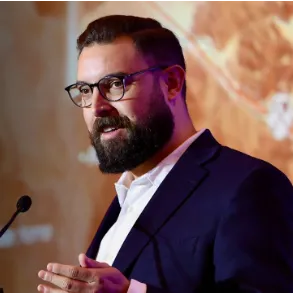
Joaquin Marias
President, CEO & Director at Argenta Silver
Replay available
Join Joaquín Marias, President & CEO of Argenta Silver, for a market update and learn how we are on track for the future. Following the update, he will be available for questions.
On 6ix: 6ix.com/event/argentas-update-on-track-to-the-future
Automated transcript · Written by software from the replay's audio. It can mishear names and figures; the replay is the record.
0:04 Good morning, good afternoon, or good evening, depending on where in the world you are signing in from today. I did see I think at least 8 time zones. So I really appreciate everybody joining us from across the world. I'm trying something new today. I'm going to speak slower. I have heard the comments on YouTube. I do speak like an auctioneer. So I'm going to try to slow it down for everybody. I've got with me today our Genta CEO, Joaquin Marias. Joaquin, how are you today? I'm doing great, Romeo. It's fantastic to have so many people from so many places in the world. Yeah, it's a fun, fun audience today. So here's how today is going to work. Joaquin is going to go through a presentation, giving some updates on the company and the Alkivar project. There's some exciting stuff in there. I've prepared a few questions for him following that presentation, but this is an interactive event, so at any point during today's time, I know there's quite a few of you in the room, please do use the chat function at the bottom of the screen. You can ask questions at any time during today's event.
0:59 If we don't get to your question for whatever reason, if it's just off topic or doesn't quite fit with time, I'm still going to make sure that the Argenta team gets those questions after and I'll get them to get back to you. I'll also direct your attention to a request meeting button at the bottom of the screen. I'll bring it up again once the presentation is over. You can click that at any time, and I'll try to connect you with the Argenta team
1:20 following today's event, so you can meet with them directly. I will also say this event is being recorded and will be available for replay probably end of day, Eastern time. It'll be at the same link, but also on Six's YouTube page. OK, I promise, the boring stuff is now done. Joaquin, the floor is yours. I'm looking forward to the presentation. Thank you very much, Romeo. Before starting, I also want to remind everybody that if you need to contact us, please feel free to do so. We are very glad to talk to our shareholders, some potential future shareholders. So stay connected because we love to talk to you and tell you more about our project and where we are going. So today it's a pretty much an update on where we are standing up now, where we want to go.
2:05 I think that one of my latest or last slides actually in the presentation it's about our timeline, how we are going to develop the project in the future. So stay with me until we get to that slide. But again, we are showing you today Argenta's Silver
2:27 flagship project, Elkivar project. This is our only project just in case. That's why it's still our flagship project now. This is an update for May 2026 and forward-looking statements as we always do. You already know that I'm the president, the CEO and the director of the company. I am an Argentine living in Vancouver for almost 5 years working in the extraordinary Fiore Group that is led by Frank Giustra. It's really good to be in the group because we are living this environment of a lot of creativity with new companies coming out to the market. I would suggest to the audience to go to fiorigroup.ca where you will find the web page of the Fiori Group and you will learn more about the Fiori Group, the companies that are being created, the protagonists of the group. I am one of the CEOs, managing one of the companies that has been created within the group. So feeling very proud of being part of the Fiori group family.
3:37 We were awarded in 2026 with the TSX Venture 50. We were listed number 30 in this ranking. And this is because of the market appreciation over our stock, our share price and our market cap and the volume that we had along the year of 2025. So we saw 208% a share price appreciation and 371% market cap growth. I would like to show you quickly something else that I have here. These are some comparisons with some other stocks. The one that you see on the solid light blue, it's our stock. This is the behavior that it has.
4:25 I'm comparing this with a 2 other silver companies. You can see the tickers there. And I'm comparing this to some junior stock ETFs or junior market indexes like the CJ or as well the gold junior index the JD the GDXJ On the silver price and you can see that we have been outperforming some of these indexes Many times along the year and then with the performance of the market and silver price going down, we have been pretty much copying or replicating what is happening in the market and still outperforming some of the indexes out there. The one that is there on dark is the S-I-J, and we have been outperforming those. So just to bring that to your attention, back to our presentation, It's worth to mention that we are feeling very proud about this because it's been only 1 year for us working at the project.
5:40 Actually tomorrow we will be 1 year after starting drilling. So we started drilling a year ago at El Kevar. We have had really good results to put out to the market and market it's reflecting their reaction with these numbers that you see on the screen. So our project still has the same mineral resource estimate. Hopefully, this will change in the near future of the project because we are wondering to create an update of this mineral resource estimate, which is going to be happening hopefully on the first half of 2027. So this is the mineral resource estimate from 2024. We still have close to 50 million ounces of pure silver combined, where most of it is in the indicated category at a very high grade of 482 grams per tonne of pure silver.
6:40 We do not have lead and zinc here, and this is not because we don't want to. It's because we can't add that. In the rocks itself, there are no other elements in economical amounts. These are 2 examples of drill holes that we have. Here you can see that There is no Gold, no Lead, no Zinc and no Copper in economic amounts to be included into the account of elements of these rocks. These are 2 examples of many drill holes that we have within the resource. You can see how it's the continuity of the grade, how stunning are the grades in some cases, getting closer to 10,000 grams per ton of pure silver, with the lowest ones being close to our cutoff grade of 150 grams for the resource.
7:35 El Quevara is located in a very friendly province in the north of Argentina. Things are still changing for good. So if I could have to give you updates on this, I would say that government is becoming more and more involved in company and corporate relationships. They have been having an excessive amount of conversations with us on where we are standing, where we are going to go, and always for good. This is great for us because it's telling us that the government wants to see these kind of projects moving into the future, and they have been super helpful with us. The same with the community relationships in this area, we are strengthening the relationship that we have with the local community.
8:21 We have been participating in every event. And recently, the 7th of May, it was the mining day in Argentina. We were very present there and we were very involved in that event in the middle of the Andes, helping the community to make that happen in their local town. Our infrastructure is fantastic in case you have missed this before. We have a road that can be drove all year round. We have a gas pipeline and we have a railroad coming 3 kilometers from camp. Then we have a high voltage power line that is connected to 2 solar farms. That high voltage power line, it's connected to the national power grid. So all the year it has energy.
9:11 And we are located at 4 hours from Salta City, which has a fantastic international airport and a lot of resources we can travel from Salta to most places that we want, making stopovers in Lima or Panama or Buenos Aires and some other cities. Internally we inherited a project with 60 kilometers of internal roads and we have been building a lot of roads. I would say that we have now over 80 and closer to 90 kilometers of internal roads that we have completely maintained and that we use all the time. We have connected both areas, Kevar South and Kevar North with new roads. And we also have this fantastic camp that we have intentions to expand in the future from 100 workers to 120 to 140.
10:06 The idea of this is still there. We already have assessed different providers to expand their camp. We have some foundations, as you can see here on the right, that are very good for us in case that we want to bring more modules and add very quickly more capacity into camp. Again great relationship with the communities we keep strengthening the relationships There were some mining Olympic Games in the middle of the Andes that happened in May as well at the beginning of the month. Our team was there representing the company. And this is something that we are also very proud because a lot of our workforce is from the local communities. And this is showing how involved they are in the future of the company.
10:56 And that's why we protect that relationship and we want to keep strengthening that relationship so much with the communities and with the local government. The project itself is located over a major structural fault. This structural corridor actually, it's the one that hosts some of the most important copper deposits in the north of Chile. These corridors are parallel 1 to the other, and they crosscut the Andes. You can see them coming down south from the Pacific Ocean into the continent, and all of them host major mines in Chile and Argentina. The only one that hasn't been tested on the Argentine side properly for porphyry potential is this corridor, and the place with the most amount of potential to test that for porphyry is actually El Quevar.
11:53 So we are starting to make our mind that in the future we will need to drill further, deeper into the ground trying to find what could be there, and if there are some porpoises or not. And we already have some hints of what it could be happening there. I will talk about that in a second. So Keogh North, Keogh South now have been connected through roads. That's fantastic because we can access both areas from different zones, from different sites. I will draw very quickly here. So in red, I will right here, this is the access to Cuba North, and this is the access to Cuba South. Now we have created a lot of roads that come up to here, and we have connected both projects with roads that come over this way. So we can literally circle around, work all over the place with no problems at all. I hope to erase everything there and keep moving forward. Let's see if it works. There we go.
12:58 So the resource, It's located in the red rectangle that you can see in the screen. This is the 3% that we usually speak about, and the 3% of property that was explored by the previous explorer. It's interesting that that's what we inherited, And now the coverage that we have in terms of surface exploration, it's close to 8 to 9%. So we have added a lot of ground that has been covered by our team, a lot of mapping, a lot of surface sampling, a lot of reconnaissance of different rock types that are outcropping and that will guide us to new targets to be drilled in the incoming year and in the future as well. So from left to right, this is the image of Alkebar.
13:49 This has 20 kilometers long from left to right. You can see Camp Kier, the road and the railroad and the mining gas pipeline, the town of Positos, very close to our property. And This is a gigantic portion of land with these volcanoes that have been beheaded, and they have these 2 bowls or bodies where we are exploring. We have gone to some places that no one has been before. Some areas from Azufre, which is on the back of the project, are places that we have gone during the Argentine summer. Now we are starting to resume some, sorry, to stop some of those activities on the high altitude portions of the project, because winter is coming in Argentina.
14:38 So that's also part of the update for the audience, to know that We have covered a lot of ground that previously hasn't been covered by anybody else. This is a very big property. You can compare this to Vancouver or to Shanghai, Manhattan or Paris. If you are familiar with some of these cities, you are now relating the property to those cities. And now you can see that this is a very big land package. It's 57,000 hectares. And we have increased the coverage by a lot. Let me write very quickly here as well. So what we inherited was a property that was pretty much explored on that area. Now what we have covered with surface exploration is pretty much all this that I'm marking here.
15:30 That means that we have expanded a lot of the exploration ground. We want to keep moving towards these areas to keep exploring and trying to find more things. We also have to move to some places that are further away in the future. But so far we have covered a lot of new ground. This is impressive because we will start getting results from all that sampling and all that work that our surface crew has done. We will start getting those results, hopefully very soon. The deposit is still open, And this is something that I always tell people, please split in your mind, the 2 things that we have here. 1, it's the exploration potential of district scale.
16:18 And the other one, it's the mineral resource that we already have. So this is our low hanging fruit. And this is where we are expanding our resource. We are drilling in both open ends where you see these arrows. This is where 80% of the historical drilling happened before. And on the red contour, it's where the 50 million of ounces approximately of pure Silver are located. And we are drilling in both ends, trying to expand this very quickly. This is fantastic for us because it's a single body, a single deposit that contains this high-grade Silver at a very low tonnage and it was open in both ends. From one side to the other, this is 1,500m to 1400m. And we have already expanded 270m to 300m, the footprint, which is a lot. It means that we have expanded probably close to 20% the footprint of the deposit.
17:21 Great results after 1 year of drilling. Here we have put this on a plan view so everybody can start relating where things are located. Andrea is the target that is giving us fantastic anomaly of Silver results. That's why we are starting to understand that we need to move ourselves towards this direction. This portion here and everything that is on the other side of this ridge is called the Golden Creek, and there is potential for Gold discoveries, that's why it's called Golden Creek. We are starting to move our surface crews all over these places to start understanding what is going on in there. Argentina, it's a fantastic area with known mineralisation in this portion, but now we have discovered a new zone here with this drill hole that came back with 725g per tonne of pure Silver over 3m, not that deep as it could get in some other places.
18:25 We have high-grade results on this end of the deposit, still expanding this, trying to drill all over this place, covering that open gap that we see there. And here on the other end, on the North Western end, we have drill holes that came back with 40m having or containing over a kilogram of Silver, 43m containing over half kilogram of Silver. We're still expanding towards all this area. This is where we want to go. We want to keep expanding ourselves towards this area. Some of the more technical people in the room might be asking themselves, okay, what is the structural complexity of this or what is happening?
19:11 Yes, of course, there are some structures here. I don't want to get too technical, but we have some structures that crosscut the deposit in different places, but it doesn't change much the situation of the deposit. It just slices the deposit. We are starting to see that better and better in the geological models that we are producing. And that's also an update that we have that we are getting a better knowledge of what's going on. The other thing that is very interesting to mention, it's Manicopan. It's this target on the south. All this region here, it's what we call money coupon. It's called money because this portion here, it's money. This portion here, it's a coupon. So the one on the left, which is a money coupon, has gave us really good results. Some of them are close to surface, like 40m in depth, and some others are a little bit deeper. I will show you that in a second on a slide that I have, and I would like to share with you one of the images of one of our press releases.
20:16 But stunning grades. We are still having close to 5,000g per tonne of pure Silver over 7.5m, even closer to 7,000g per tonne of Silver. It's impressive the amount of Silver that we can see on some of these through holes. But remember, what you are looking in the image is just that 3% that has been previously explored, where we are expanding our resource and discovering new things. And we need to keep moving towards the other areas where new exploration targets and new drilling targets are being created by our technical team on the field. So more of what I was mentioning to you now on section or long section view.
21:06 For those who are familiar with our previous deck, we finally flip over the image. So it matches the plan view. This on the left is the northwest of the deposit. The right is the southeast of the deposit. As soon as we start getting deeper, we are starting to see stunning grades in longer segments or intercepts with beautiful grades that are way above our cut-off grade. This is part of what we expanded during the winter of 2025, winter in Argentina, summer on the northern hemisphere, and we drilled some record-breaking results. I would like to get a little bit technical here to remind people
21:55 that this is telling us what is the carrying capacity of the fluids. So the fluids usually are like a bus. And as a bus has a different amount of seats, if the bus has 4 seats, you can carry 4 elements or 4 molecules of the element or 4 atoms of that element, but if the bus has more seats, if the fluid has more seats, you can carry more elements in that fluid and that's the carrying capacity of the fluid. When you have such high grades, it means somehow that your fluids have a high carrying capacity and that is very, very good for a deposit because it's telling you that the endowment of mineral could be very high wherever those fluids were transiting or moving forward. So we are very happy to see these grades on our deposit
23:01 And they are telling us a lot of the story of the deposit in the past. 2026 drill results, so the past summer that it's already ending in Argentina, winter on the Northern Hemisphere, We have also stunning results, keep expanding the deposit towards the deeper zones and towards the southeast with new drilling that we are drilling on some gaps or some areas that we found potential to get good results.
23:36 These are some of the latest news that we put on our news releases. Here you can still see that we have really good grades over our cutoff grade of 150 grams. And even in the deeper portions, we are still getting really good grades. We will keep expanding that. We still drilling on both open ends. Hopefully we will have those results from that very soon to keep putting them out to the market to keep the news flowing.
24:13 This, it's a money coupon. Money coupon is the new emerging target that we are developing. It says that it's a parallel high-grade zone, but it's actually more oblique than parallel to the main Jacques Che deposit, which is the main deposit that we have at El Cuevar. And Manicoban, it's interesting. We have these surface samples that are high-grade. We will zoom in here to understand what is going there. Here you can see that there are some samples that are up to 20,000 grams per ton of pure silver. These samples reach the upper detection limit of the laboratory.
24:56 And in some other cases, we see samples of 2 kilograms, 16 kilograms, 6 kilograms, and so on, on surface. What we have done is we are starting to explore more and more on this area, trying to understand if this could be economical as it is on surface. And Hopefully soon we have some results that we can share with you. We will identify or not if this is economical
25:24 to bring into a future plant. It's just on surface. That's why we are so interested on exploring more and more that path on Manicopan. What is happening in Manicopan is that we have 2 things. We have this layer on surface, or this mineralization on surface, and suddenly, when you go deeper, you have another layer.
25:52 So the upper portion would be somewhere here, I'm painting with blue, let's try to paint this maybe with yellow to make it brighter. So the upper portion is right here and then we have a level that is somewhere here. We have identified this other level that is here. So we have these gaps with the excess and those are areas of interest that we will be drilling soon to understand this deeper portion in Manicopan. The grades
26:26 on those drillings are stunning. Those are the 4,000 or the 7,000 grams per tonne of Silver that I was mentioning to you in Manicopan at depth. We need to keep testing this area to understand more of this structure down there at depth. Then we have this shallow structure and then we have this surface structure up here with mineralisation. So very interesting. We will keep working on Manicoban as much as we can. We will be disclosing the results as soon as we have them back. On top of that, it's our Gold and Copper discovery, and this is related to the porphyry potential of the area. So we are starting to believe that this could be one of the hot zones of
27:16 the district. And we have hit 44 metres with 0.57 grams per tonne of gold and 0.58% of copper on QBD 425, which was later confirmed by a second drill hole. What this is telling us is that probably we hit a conduit or a channel coming out from a completely different system than the main system at El Quebar. And the reason because of that, it's because this main system that we have here, it has silver, but it has no copper and no gold.
27:56 This other drill that we drill here in Carmen, It has copper and gold, but it has very little to no silver, which is telling us somehow that the fluids from 1 and the other might be different. And if that's the case, Karman might be a channel or a conduit coming from a system that is completely different to the main deposit. So, this is the Karman Discovery, as I mentioned, with really high grades in smaller intercepts, around 4.9 grams per tonne of Gold
28:45 and 8.5% of copper in some minor intercepts within those 44 meters. We're really good grades. We confirmed that with a later drill hole. We need to keep drilling the area, keep understanding what's going on, and in the future put some deeper drill holes in that portion of the project. The samples that you see behind are the samples that came out from Karmen, stunning grates, and stunning rocks as well.
29:15 So we inherited a project that was pretty much explored or that where most of the capital was allocated to the blue rectangle that you see on the screen. Now what we have decided to cover is the red contour. So that's the amount of footprint that we are covering, and it's a substantial change compared to the previous operator. We are moving very, very quickly on covering this amount of area. As I told
29:50 before, we have covered pretty much of Kevar South with surface exploration. We started exploring Kevar North. We have been running geophysics, which are currently being run as well. We are trying to cover 60 square kilometers of geophysics.
30:12 And we have also decided to do a new environmental baseline. This environmental baseline, it's on the way. Hopefully it's going to be finished
30:24 by the end of next month of June. That baseline, it's going to help us to move forward with more permits and future of thinking. The same with Blue Coast Research is the firm that we have engaged to run our metallurgical tests And our metallurgical samples are on their way from Argentina to Canada to start performing the studies
30:53 here in Canada. And hopefully we will have results from that in the coming months. But lots of new ground to be covered by the company. We are doing a lot of effort. Remember, it's been only 1 year drilling at El Kevar, and it's been 1 and a half
31:14 years since the acquisition from Golden Minerals into Argentina Silver Corp. We are very, very serious with the capital that we have. We want to put all our capital into the ground.
31:30 Working capital of the company represents for us approximately 90 percent. The blue square that you see on this chart is what is going to Argentina to be allocated into exploration and resource expansion. Another one of the big budgets that we have, it's investor relations, going to conferences, talking to you, and just communicating the news that we are bringing from all the work that it's been done by the blue capital. The other is what we call G&A, pretty much. After our bot deal in January, which was a bot deal of $23 million, we had in Treasury $40 million.
32:17 And from that $40 million, we still have a lot of money in the bank. We have $32 million in working capital today in the bank. No debt, no pending payments.
32:31 We still have really good backup and support from Frank Giustra, from the Elstein Group, represented by Eduardo Elstein, lots of high net worth people in our share structure, very healthy retail, and a lot of institutions that are supporting us. These are some of the institutions, actually these are the institutions that have gave us permit to put their name on our webpage, but there are many other ones that are supporting us and we are very thankful for these institutions to have partnered us and be supporting us into this incredible
33:08 project. This is why we are here, where we are going. And This is the slide that I was asking you to wait until we get here. I hope that you're still there and you haven't gone anywhere. But these are the key catalysts. This is what is going to be driving value, still driving value for the company. So drilling, it's pretty much happening on big time during our summer season. In winter season, we usually make a very, very, very short break of a couple of weeks to rearrange everything and keep going. But I would say that we can drill all year long. We just make a break to rearrange things for 1 to 2 weeks, and then we keep going. The goal is to increase ounces into the resource and to discover
34:01 new targets that can add ounces in the future to this project. The metallurgical studies are estimated to be coming to us around September. This is pretty much because we have been selecting samples. We sent the samples. The samples are now in customs in Argentina waiting to be exported into Canada so we can start our metallurgical test work and surface work. It can be done all year long because we have zones that are
34:36 at high altitude and lower altitude, so we can move our teams to different areas and we keep mapping, we keep taking samples, we keep collecting data and we keep moving forward. We recently acquired a TerraSpec
34:53 gear or instrument that is measuring the different alterations and the different clays that we have on the rock. Measuring the clays helps us to understand what's the alteration, understanding what's the alteration and what's the crystallization on the clays, is helping us to understand the thermometry of the area. It means where has been more temperature or where has been cooler or hotter in the different areas of the deposit. And this is going to help us to target as well, very, very much. We have close to 7,000 to 10,000 surface samples that are waiting for this instrument to measure.
35:40 We will start that very, very soon. So a lot of information will come from that as well. 60 square kilometers of geophysics are on the way to be finalised during 2026. We hopefully can update our mineral resource estimate by H1 of 2027. So with this, what I want to tell you is that we will have metallurgical test work before the end of this year, and after that we will do some updates on our mineral resource estimate. With that information in our hands, the metallurgical studies and the update mineral resources to meet, obviously we can start making our minds on future economic studies.
36:27 We are envisioning some of these economic studies and engineering studies to be happening by the end of 2028 or beginnings of 2029. So we are very excited with this plan. We are pushing really hard, our crews, our teams, everybody's working really hard to move this forward. Well, I think that there is going to be a lot of information coming out from this. So stay tuned and wait for all this information to be disclosed until we have the meteorological results, the update mineral resource estimate, surface sampling, geophysical results, drilling results, all that will keep being disclosed to the market as we have been doing in the past.
37:16 The leadership of this company, as you know, I am the President, CEO and Director. Aaron Triplett is our Chief Financial Officer. Vanessa Bogart, VP of Investor Relations and Communications. Probably Many of you have seen her in different conferences. Please reach out. We love to talk to our shareholders, as I mentioned. Then we have a beautiful team backing us up. Michelle Borthwick, it's our VP of Corporate Affairs and our Corporate Secretary. Diego Mendilar, it's our legal representative in Argentina and our leading man on the subsidiary in Argentina, which is called Silex Argentina, Guillermo Peralta, geologist with a very well-known track record on exploration. He worked for King Ross in Fruta del Norte, in Lobo Marte. He's part of the discovery team of Cerro Negro from Gold Corp in Patagonia.
38:11 So very, very well-known geologist. He's leading our technical team with flawless record. So we are very happy to have him on board. With the middle group, it's been advising us. Then we have a beautiful board of people with one of the directors coming from the Elstein Group in representation of Eduardo Elstein into our board of directors. We have a clear vision to scale this into a much larger company. I keep saying that, Frank keeps saying that, We are working really hard to make this something bigger. When I say that we are working hard, it's not because it's impossible. It's because we are working hard to make things happen now.
39:00 It's been only 1 year that we have been drilling. It's been only a year and a half since we got this project. And I think that the amount of progress that we have done, it's clearly a lot. We want to bring this into production in the future. We are working towards that. We need to add ounces into our resource. Once we have those ounces, we need to start thinking on economics and bring this into production in the future. That's our wish. That's our mission, our goal. Meanwhile, we have a lot of ground to cover, a lot of new discoveries to be made, and we will keep working on that exploration forefront, trying to make new discoveries and bring more value into this project. Argentina, it's getting better and better. Hopefully, Romeo asked me something about Argentina, but this is going really well for businesses.
39:58 The Obligios from Abrasilver just applied to, or just got approved for the RIGI. There are plenty of projects that are getting approved for RIGI. I want to make a mention there, in the 90s there was another law created, which is called the mining investment law. Our subsidiary in Argentina has applied for that in the early 2000s. That law has very similar terms to Rigi, with the advantage that the concessions that we have from that law doesn't expire. Really, I believe that they have some expiration in the future, but the law which we have applicated on the past with the subsidiary in Argentina, Those concessions don't expire.
40:49 Very similar terms. We are pretty much covered on that end as well. So that's something that everybody is asking me on the conferences. Now I'm telling you here on this update, Argentina is still exporting Silver to the world and Elkivar is still the third largest pure or primary Silver deposit in Argentina. Primary Silver deposit in Argentina. Let's remember that Elkivar is potentially one of the only economic pure silver deposits in the world. That's pretty much it to us. Subscribe, stay tuned, don't miss our news. There is much more to be disclosed. I'm all yours, Romeo, and before that I will ask the audience to get our contacts, email, phone number, and just stay in touch with us. We love to hear from you and to give you more insights.
41:48 Awesome. Joaquin, thank you so much, as always, for walking us through a presentation. I love there are so many good questions in the chat. I'm going to run through a couple of my own first and then a couple of questions that came in advance over email. I'll move pretty speedy because I know we only got 18 minutes left for today. My first question will actually cover a question that's in the chat. Frank Juscha remains a major shareholder and you quoted him saying he's been dreaming of building a pure silver company for 40 years. Beyond capital, what has his track record on the cap table actually change about how you operate day to day and where are you leaning on him for advice or marketing or anything in that direction? Well, that's a great question, Romeo, and yeah, we lean a lot in the people that have experience, obviously. That's why we have William Middlecoupe as an advisor, Sean Kunkun as an advisor.
42:38 We have a lot of support from the Fury Group and great people supporting us here. Eduardo Elstein as well, Eduardo Elstein's group, giving their insights to us and advising us on certain things. And the same with Frank. Frank, it's involved, he knows what is happening. And we get a lot of advice from our major shareholders. At the end of the day, they own the company in a bigger proportion than some other people. And obviously for us, it counts from the little shareholder to the largest shareholder. Everybody counts the same. But having Frank and Eduardo Estein with that amount of experience and that amount of proven track record from the past, it's very important for us.
43:30 We stay very, very close to them on the day to day and on the larger picture of the company as well. Awesome, no, appreciate that very much. But speaking of kind of influences, I know the deck mentions Richard Sillitoe and Greg Corbett too, the most, say, respected names in epithermal and porphyry geology, probably globally, what are those guys reported about Alcavar that gets you the most excited and what does it mean for the company to have that kind of technical endorsement behind the story? Yeah, as you can see, this gets me excited as soon as you mention. Because El Quevara is a volcanic complex, I want to be very quick here, but El Quevara is a volcanic complex and Let's focus on the red line. So the red line is bringing fluids on surface, and it's creating these volcanoes that are very clear on the image.
44:24 But as soon as you find north-south faults, like these ones that I'm marking here, as soon as you find those folds with the red line, when that intersection happens, is that you don't have any more single volcanoes. You have all this amount of extruded material and this is what we call the volcanic complex. We have counted several volcanoes here, these are pretty much the 2 most evident, but there are many more, we have counted around 20 volcanoes in this region, with all of them bringing fluids to surface. This amount of volcanic activity is what Greg Corbett and Dick Sillito found so interesting of this area. The point that what they mention or what they report is that somehow here at depth, you know, somehow there should be major magma chambers or fingers that are related or that might be related to pore-free copper deposits, right? So let's remember that the pore-free deposits, they happen around these fingers coming out from the magma chambers And if the ones with the X are the magma chambers, somehow these fingers have to be there. If not, these volcanoes shouldn't be there. So
45:57 they gave a really good picture of what could be happening. So these are actually the projections of the historical volcanoes. But again, we have counted over 15 to 20 volcanoes over here in this region. And there are so many that there is a lot of potential for porphyry to occur in these zones. On the upper portion of the deposits, we can see the evidences of the upper portions of the system. In the deeper portions where we can walk at the bottom of the creek, we see things that are more related to this. So that's what Richard Sillitoe and Greg Corbett saw. And that's why we are also so excited of the geology of this place.
46:46 Great. One thing I want to talk about is Moneykopan, because the surface samples up to 20,000 grams per tonne silver, and I know you're saying the chemistry seems to match Yatche. If that turns out to be a true parallel structure, What does that do to your view of the research potential at Alkivar? Between us and the audience, how aggressively are you chasing that in this year's program? Okay, well, we are chasing this really aggressively. This is the surface portion. Maybe I have exaggerated myself there. Let me correct that. This is the surface expression where we want to measure that to see if we could include this in the answers in the future. But from this point to this point, it's like 800 metres, 600 metres, it's really close.
47:37 The structure that is below, it's going somewhere here below at depth, So we want to test that below depth to understand what's going on. And having 2 deposits so close 1 to the other at a really high grade, it's fantastic. This area here is where the previous operators thought to have part of their processing plant. If you think about that from here to there it's only 400 meters and from here to there it's only 200 meters. So it's really, really good and We are being very aggressive on pursuing money coupon to understand what's happening down there. Awesome. I appreciate that. Just to get some of the questions in chat, I'm going to shorten some of mine. I know right now you've got roughly $40M in Treasury with 0 debt going into the $30,000 to $40,000m programme. My only question is, what's the plan if results kind of force you to scale up mid-year?
48:36 Just so you know, what you see makes you need to put more into the ground? Well, if we want to scale up during the year or in the incoming year, of course, we will be looking for further financing. Our $35 million, they have obviously an end at some point. Money is not endless. And we want to move forward into the future, trying to bring this into production. So we will see further financings. We will see further strategic partnerships from corporates. We are working as well on that front. We have a lot of interest from different people looking at the project. And we will see much more happening in terms of the financial point of view of our project. What we can do with this 35 million, it's what I showed you on the screen before, We will keep drilling the meters that we want to drill and we will keep moving forward.
49:36 If things go terribly bad in the market, we still can slow down our pace and extend our capital into the future. But that's not what we want. Obviously, we want the market to recover. We want to keep moving forward as fast as we have been doing. But you know, I can't control the market, Romeo. It's a market that's going down and It's affecting every silver company. It's not just us. Silver was in January. This January, it was $120. 2 weeks ago, it was $70. So It means that it lost almost half of its value. And it's so, this is a company that has a very long future. We don't see what, to what it's going to happen tomorrow.
50:26 We want to see what it's going to happen in the incoming years, not just days. No, appreciate that very much. I'm gonna talk about politics a little briefly, because I know, like you said in the deck, Argentina under Malay, obviously, it looks very different than it did 3 years ago. And the deck, and I think you made the case very, very clear, which I appreciate. But obviously, political cycles, they do turn sometimes, not just in Latin America, but worldwide. What's protecting you on the ground at the provincial level in Salta, regardless of who sits in the Casa Rosada? Well, I think that This is not the slide to show that. I want to show you another slide, then, if that's the question, because the question is not what's happening with Malay or with Argentina or with the administration, right, because at the end of the day, governments are administrations.
51:14 But when we see this slide and what it's protecting us is that we have in this province, we have the Ablijos here, which is the second largest silver deposit in the country, and then we have El Kevar, that is the third largest silver deposit in the country. Both of them are within the same province. So it means that Salta as a province could become a major exporter of silver in the future. And it could even be the major silver exporter of Argentina and probably the South American region as a single location, right, as a Salta province. That's why I believe that independently of whatever administration you have On turn, this is strategic for whoever it is on power. Today, it's Millet. Millet is very convinced that the country economy needs to be rebuilt.
52:11 With mining, agribusiness, and the oil and gas industry, he's betting big time on this. You can see companies that are applying to really all the time getting those concessions granted The obligations is the last one to get a Rigi approved We have that law that is protecting us for the future as well. And you can see that that's the push where we are going. We have beautiful conversations with the minister of production of Salta, who I'm sending a Big Hug, Ignacio Lupión, the same as Gustavo Carrizo, the secretary of mines of the province, they are super supportive. And we understand, for what they are telling us, that it's not just their intention to push this forward.
53:01 It's a politic of state. It's something that the state is looking over the years, over the decades, not just because of this administration, and that it's very supportive to us. Great. One of the last questions for me, and then I'll get into the stuff that came in over email. I know 2 of the biggest de-risking events coming up on the Argenta timeline are the Met study close to around September 2026 and the updated resource estimate in 27. For an investor watching the news, like I said, There's lots of people in the room and people watching the replay. What are you testing in the network that you don't already know from the historical operator? And what's the result that would make you say, this is even better than we thought? Okay, so we are Testing, first of all, new drill holes that have been drilled on both ends. That's going to be completely new on the Metallurgy.
53:52 And we are going to test now much more in detail the distribution of grades, mineralogy, geochemistry, and everything on the different zones of the deposit. Why is that happening? Because it's our request to the meteorological firm that it's going to run that. And why we made that request? Because in November last year I went to visit 8 smelters, refineries, traders, some other people that are in the business of buying raw materials. And I asked them different questions that told me that doing reverse engineering was the right thing to do. So we understood that what they want to see is how they can blend the ore coming out or the concentrates coming out from producers like Elkevar could be in the future.
54:50 So that's why we requested to this metallurgical firm give us a picture of what's the distribution of grades, mineralogy and geochemistry on the deposit. And that's going to be new. Is it going to be better or worse or this or that? We cannot see the thing on that angle. We need to understand that this is going to help us to create better blendings or better combinations of ore for the different buyers that are out there in the market. Great thank you. One question this came in over email it's also reflected in the chat should be pretty speedy but on the current timeline when is production at Elkivar scheduled for according to the current timeline? Oh, well, great question.
55:38 So if we think that Q4 2028 or Q1 2029, we might be thinking on a PA or something like that. Then we need to understand that we will have to the risk more of the deposit. We will need to convert, infer into indicated, indicated into resources, into reserves. And that might take us from 2029 1 or 2 or 3 more years. So I'm being very global with wide ranges because this is, As you know, it's not mathematical. It's not that 1 plus 1 is 2, but we need to think that towards 2030, 2031, 2032, we could be starting to get where we want to get. There are other areas of the deposit that are close to surface, we are studying manioc pan to understand how many ounces we have close to surface.
56:37 If those things can positive to us, timeframes could be moved earlier and so on. Again, this is not mathematical. We need to think that a PEA could be processed in the early 2029s. Then we will need to risk and convert from resource to reserves to start producing. So that's what could be my answer to that question today. I appreciate it very much. One person asked on email, they're pleased to see there's a 60 km2 area to be covered by some form of geophysics. They want to know if you can be specific about the type of surveys you're contemplating. Marc, we are running ground magnetics on the areas that we see that the magnetics are excessively interesting.
57:24 We will go and we will run an electromagnetic surveys like IP or CSMT. We want to do that in certain areas. We don't want to do that all over the place. That's why we run the Mac, very detailed 3D Mac, Ground Truth, and we will then run IP or CISM on smaller scales. Great. One person wanted to know, was there insider selling last month? Just a question I asked over email. No, that we are aware. No. Okay, great. Thank you. A couple of questions from the chat. Again, I won't be able to get to them all but I promise I will send them through to the Argenta team as soon as it's done. So apologies if I don't get to them today. I know there's lots. One person asked right as we got into the event, so I'll ask their question first. Is the team mostly or all local to Salta?
58:13 The team is mostly from Salta. 80% of our team, I would say that it's from Salta and we have very few people coming from other places. It's a thing because Salta is exploding on projects to explore So it's running out of geologists. So we have to bring some geologists from other places. Some of our geologists are from Salta. But I would say that 80% of our workforce is from the province of Salta pretty much. Okay, awesome. One person wanted to know, how close to the rail line is Alcabar? They must missed it during the presentation. 3 kilometers from camp, 15 kilometers from the deposit.
59:04 Awesome. One person wanted to know, have we seen all results from the 2025-26 summer campaign or are there any more goodies coming up? Oh no. Up to date, from May 2025 up to date, we have only disclosed 60% of what it has been drilled. Of what it has been drilled up to today. So there is much more that it's been drilled. Up to today, there is still 40% to be disclosed. So there is a lot of drilling to be disclosed. We have disclosed pretty much 10% or 20% of the surface work that has been done. So there is 80% of surface work to be disclosed. We are waiting for those results, the interpretations, and then we will be disclosing that. So there is a lot more to be disclosed.
59:56 Great. So to answer your question, Julio, lots more goodies to come. So stay tuned. The last question I got time for today, and Nick, I know you threw in a bunch of questions there at the end. I'm sorry. I will send those through to the Argenta team so I get those answered. But one was, does the team plan to do deep drilling to find out if there's a deep-seated source? Is that on the plans right now? We have them on the long-term plans, not immediately. We are focused on expanding the resource now, understanding the shallow levels. The deeper that we have gone, it's 450 meters on the vertical line. We obviously need to go deeper for that. We want to put our drill holes very well because they are going to be 800-meter drill holes, so we don't want to rush things. So it's a great question.
1:00:45 We have them on the plan, but not for the immediate plan of now or the coming months. We will do that on the near future. Okay, right at the end of the hour, I think we packed a lot in. Thank you so much, Joaquin, really appreciate it. Thank you, obviously, to all our viewers. And of course, muchas gracias a todos nuestros televidentes en español. La repetición tendrá subtítulos en español. Esperamos que se sea más fácil. But good afternoon, buenas tardes to everybody. We'll see you again next time we get news. Looking forward to it. ♪ Looking forward to it. Thanks for watching. We'll see you next time. Thanks for watching. We'll see you next time. Thanks for watching. Thanks for watching. Thanks for watching.
Follow Argenta Silver Corp into a list and get an email when it puts out news.
President, CEO & Director at Argenta Silver