Transcript
Automated transcript · Written by software from the replay's audio. It can mishear names and figures; the replay is the record.
0:03 Good morning, good afternoon, or good evening, depending on where in the world you're signing in from today. I've got with me John Skladnik, CEO and Director of Nevada King. John, how are you? Great, Romeo. Thanks for having me on. Awesome. Yeah, looking forward to it. So the goal today is to kind of wrap up 2025, put it behind us and look forward towards what Nevada King has in store for 2026. So here's how today's going to work for the folks in the room. I've got a number of questions that I have for John. And then obviously some of you have already submitted questions over email. So we'll certainly tackle those. This is also an interactive event. So if you want to ask new questions, that chat button in the bottom right of your screen is available at any point during today's event. Please do feel free to ask any question. Likely we'll get to it. On the off
0:43 chance we don't, I'll make sure that John and the team at Nevada King get that transcript afterwards. They'll be able to get back to you separately. Only other piece of housekeeping before we get to the good stuff. This is being recorded. Will be available for replay in the early afternoon. The screen time, probably about 02:00. It'll come right in your inbox. At that point you can share it. It'll also be on Six's YouTube channel. But that's enough out of me. I want to get straight into at the point of this event is John, that's as we close out 2025, I'd love if you could just reflect on the year's kind of key milestones and achievements, what stands out to you most? You're looking back on the year with what does the team accomplish that you're most proud of? Yeah, for sure. And there was a lot of reflection happening over 2025. I mean, really, I guess 2 lenses that I'd used to look back on the year and 1 was positive.
1:29 I think what we accomplished at SiteWeb was hugely positive and a lot of major milestones. Namely the resource update, what was obviously a big milestone coming in June, that was just preceded by phase 2 network as well, which was a huge milestone as well and a lot of work went into that. So that was good. Also, some management changes as well. New board additions, me coming on as CEO, we've got a new VPX, a new CFO. So a lot of transition and a lot of good things that happened with the management team, I think, and at site. The other lens, though, would be the stock price and very frustrating as a shareholder myself and I'm sure for other shareholders on the call.
2:18 So that's the other lens where you're looking at the share price and just wanting a lot more. And I think the frustration emotion was because of everything happening at site and the progress being made yet it not being reflected in the stock. So that's something you can't directly control and you just want to so badly. So great to see this thing finally get moving. We put out that press release on Thursday. Stocks went up about 40% on Thursday and Friday on the back of that successful phase 3 and then announcing phase 4 fully funded.
2:57 A lot of new targets developed as well at site, so just huge progress being made. The gold price where it is, us having more targets than we've ever had, you know, exceeding that million ounce threshold, just a lot of progress was made. And I expect, you know, this catch up trade to continue into 2026. There's a lot of room to make up and a lot of gap to close in terms of valuation. It's exciting to see it start to move. And like you said, in June, you announced more than doubling the M&I resource to over 1Moz at 1.14g per tonne. I'd love to know, if you can get a little technical for us, what drove this 122% increase and what does that mean for Atlanta's development potential? Yeah, so I mean with that, I was at the time maybe naively excited with this update. I thought it was huge. I was in equity research covering this stock.
3:52 This was in line with what I was expecting in equity research. I think that there were other expectations out there floating around that exceeded what we put out and that caused the share price to turn down. But in a vacuum, this is an incredibly high-quality resource. There was a lot of work that was done on infilling the area. This is an updated resource. The previous resource showed about 600,000oz. That was based on about 75 holes and you had about 400,000 of that in an M&I category. I thought that was a fairly low-quality previous resource that was done. We did a lot of infill work to both justify that M&I and then push the boundaries as well. As we're doing the infill work, we're trying to
4:40 find these cross-cutting structures and that's where you get these Bonanza grates. We put out in October 2023 the 11.64g per ton over 108m, just obviously a phenomenal hit in oxide material. But if you step out 20m to the west, then you're getting 3g over 100m. So you can see it's still great, but you can see how important it is to find these cross-cutting faults, to find these high-grade zones in terms of tapping where this grade goes within the resource. So, there was a lot of infilling that was done and that really helped us with our understanding of the deposit and it's now helping us tremendously to find Silver Park, for example. That was part of it. The other part of it was pushing the boundaries as well.
5:29 Pushing the resource envelope to the south, to the north as well, and to the west. And so it was kind of those 2 prongs, finding high grades within the already defined area and then pushing the boundaries of the resource. That's where we got that 122% increase. Yeah, nice. I do want to talk about the high-grade core, which was included in the updated resource. That 524,000 ounces averaging 3.99 grams per ton at that 2 gram per ton cutoff, so more than triple the average grade. How important is this high-grade component to the current economics of the project?
6:03 It's that high-grade core that really drives the economics. It's that high-grade core that pulls the pit as large as it does. It's absolutely critical having this high-grade core. It's a kind of bimodal system where you've got this really high grade Silica breccia material that's going to go through the mill. And then kind of some of the lower grade material in the non-solidified volcanics that can just be stacked on the leach pad. So it's really critical, this high-grade core, both in terms of pulling that pit and now that resource was done at about $2,200 Gold, $25 an ounce Silver. So now obviously, very quickly we're very offside with our Gold price assumption.
6:50 But now looking at that resource, there's material that sits above that high-grade Silica breccia area, that high-grade core. That's currently considered waste at $2,200 Gold, not included in the 1.1Moz. But if you were to go to mine this right now,
7:09 you'd probably stack that on a heat-bleach pad at $4,000 Gold. So there's a lot of material here that could potentially be converted from from waste to ore. Sure. I know the phase 2 met results showed those strong gold recoveries with a simplified flow sheet. Can you explain how that more simplified processing approach could impact both your operating costs, but also the initial capital requirements compared to that original flow sheet? The Phase 1 flow sheet showed a three-stage crush for the mill and it showed a crush material for the heap leach pad. The phase 2 work that was done, which adds to phase 1, we're examining more samples.
7:55 We found that in the non-solidified volcanics, it's very insensitive to the recoveries. We're now going to stack that on a heap leach pad run of mine. That just means you blast the material in the pit and you just take it and you put it on the heap leach pad rather than having it go through another process of crushing, which obviously requires some operating costs as well, as well as capex.
8:20 From the mill, now we're going down to a two-stage crush. Each layer of processing adds both initial capex in terms of that infrastructure, but also adds cost to the operating costs. To be able to go from a 3-stage to a 2-stage crush reduces both initial capex and aupex. And same thing on the heap leach side of things, where now we don't need to crush it, it goes straight to the heap leach pad. That's really the lowest processing method that you can have for material. And we're very fortunate to be in this oxide type of material, which allows for that heat bleaching processing method and it'd be able to do a run of mine. It really doesn't get any cheaper than that in terms of processing. Yeah, I appreciate it. Now, I know Silver Park East has emerged to me as the most significant discovery, we'll call it, from phase 3.
9:09 With hole 25SP32 intercepting 0.83 grams per ton, gold equivalent over 67 meters. So the highest grade hole drilled outside Atlanta, as far as I understand it. What makes this discovery so important for the district scale, potentially, you guys have? Silver Park's important on a number of fronts. When we went into the phase 3 exploration program, that was meant to find oxide satellite deposits to both add ounces to the Atlanta resource, but also it adds some flexibility. The other thing it does is it negates the narrative that maybe there's not mineralization outside of the resource zone. That was never our belief.
9:54 But, you know, before coming on board, I know that was an area of pushback. That was an area of concern for investors is, all right, fine, You've got some Gold in this historic pit area. Is there Gold anywhere else? And now, as we're exploring around the margins of the caldera, yeah, absolutely, there is Gold in other places. And so far, our most advanced target is Silver Park East. So It's critical from both those lenses here. It's really important in terms of adding ounces and what that does in terms of if we look at project economics and cautionary statements here, I'm getting ahead of myself, But if we were to be able to infill this and bring this into an inferred resource, now you're spreading that initial capex just over that many more ounces. You're also adding significant flexibility.
10:45 If you're looking at maybe this gets processed first, we've got a drill hole, SB21, that starts 18m from surface. We're also exploring with our phase 4 an area close by that where we've got a drill hole that actually hit at surface. So this is near surface, maybe this gets mined first and just increases that payback period. So that could be key. It could also just be mined in conjunction with the Atlanta resource zone, or maybe it fills in production gaps. It just adds a ton of flexibility. That's exactly what we're looking for.
11:24 Why we wanted to continue to search for more ounces and not just put out a PEA on that 1.1Moz, Is that part of the pushback and questions that we get from corporates when we're talking to mid-tier producers? They like the 1.1Moz, but like everyone and like us, they want more. To be able to show that there's more ounces here to get to that maybe 1.5Moz level for a resource, that's what could get you to that 100,000oz per year production over a 10-year mine life. I think that's really what some of these mid-tier producers, if you're producing let's call it 500,000oz, that's still what can move the needle for you to get to that 600,000 ounces of annual production of potentially very high margin material as well in a safe jurisdiction.
12:15 Sure. I know early on, reflecting on 2025, you talked about bringing in some new management. I know you announced Justin Daly as VP Exploration, who, reading his background, got expertise in AI and machine learning, some of the newer mining methods. So I got 2 questions, I guess, really. First, I want to give you an opportunity to talk up Justin's Bonafides and experience, but I also want to know how these types of advanced technologies, including hyperspectral scanning, are changing your approach to exploration, helping discover targets like Western Rim, which
12:46 I'm about to ask you about as well. Sure, yeah. So I mean, for Justin, who was CEO of another junior Gold Explorer in Nevada, for him to leave that position to come work with us at Nevada King, I think it was just a huge endorsement for the prospectivity that he sees on the land package. Like any geologist, you want to find that major gold discovery, or I guess major discovery of any sort of, depending on what you're looking for. But he sees that potential with our 130km squared land package, the caldera setting, the analog to round mountain, the fact that there's 25Moz found there. All of this stuff is obviously something that gets him really excited, enough so to leave his previous post and come over to work with us.
13:33 Additionally, the skill set is huge. He's got the experience exploring in Nevada and in the Great Basin. He also did a machine learning program at Harvard as well, so very well trained in that and bring a lot of that new technology to us. You mentioned how these technologies impact our exploration.
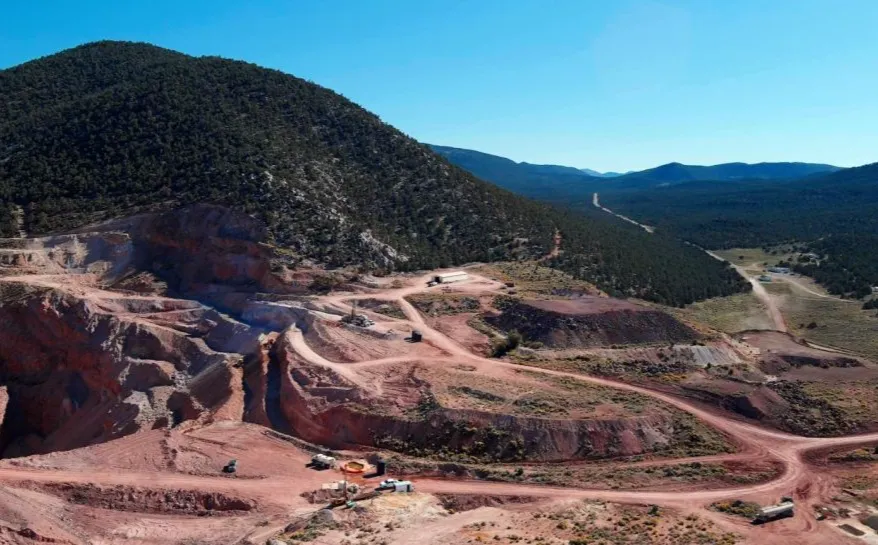
13:58 There were only 2 areas that outcropped and that was the Atlanta pit, where the formerly producing Atlanta mine and then the Silver Park mine. Any place that outcropped became a mine effectively. The rest of the land package is generally undercover, under a post-mineral cover. The challenge for previous owners of the property was being able to look undercover without the technology. Now we're benefiting from significant technological advancements. We've been using CSAMT, a number of different geophysical tools. Justin wanted to bring in this hyper spectral technology and that's just another tool belt, sorry, another tool in our tool belt to look undercover.
14:43 And we've recently put all of these different data layers through a machine learning process to come up with a ranked order of targets. And they generally corroborate what we're seeing from the field team, but it adds some new targets as well. Because we've got the existing data at the Atlanta Resource Zone, for example, and at Silver Park, where we know there's significant mineralization there already, it really proves these targets. And if we're seeing the signals that these technologies show us in the Atlanta Resource Zone and Silver Park, and then we're seeing them in these other target areas, that's something that is certainly worth investigating. These new technologies have been critical in discovering both Atlanta South, Silver Park and now Western Rim as well. It's been key to us investigating those areas. Sure. Like I said, I wanted to get into Western Rim a bit because it represents a new style of mineralization with those rock chip samples up to 20.8g per tonne gold and quartz veins traced over 2.5km.
15:48 How does this discovery fit into your understanding of the whole Atlanta hydrothermal system? I don't think we're shocked that this Western Rim target sits on the margin of the caldera. All of our targets do generally sit on the margin of the caldera. This is on, as the name indicates, on the western rim of the caldera. The Atlanta resource is generally on the eastern rim. So not shocked that it exists there. It is a little bit different in terms of the style of mineralization. Yeah, these quartz veins, swarms of them extending over 2.5km with single veins extending over a kilometre. So yeah, pretty exciting, I think for the team at site. One of the things that the hyperspectral showed us was this Illite crystallinity really just lighting up in this area. The other areas where it really lights up is the Atlanta Resource Zone and Silver Park.
16:45 What the Illite crystallinity indicates is that there was in the past some magmatic activity. It shows that there was a significant heat happening here. That's why that shows up there. We want to investigate this magmatic activity. Of course, a caldera is a collapsed volcano and you typically have the magma around the edges. So all of that sort of checks out. The fact that we're seeing these same prints on the Western Rim target as we are in the other areas with no mineralization
17:15 is pretty exciting. And I think for all of the targets that we have, the team at site might be most excited for this one. It does seem to show the largest potential. This could be the biggest deposit on site. It's the earliest stage 1. We just added it to our list here of prime targets for us to follow up on with phase 4. So pretty excited I mean to have that 20.8g per tonne rock chip sample. Obviously love to see that and would love to hit some intervals with that kind of grade. So yeah, stay tuned for that with our phase 4 drilling. Last thing about phase 3 before I get into phase 4. Phase 3 identified mineralization in Poconip limestone at Atlanta South with the highest arsenic values on the property. But given that deposits like Long Canyon and Archimedes are hosted in Pocono, how significant is this discovery for finding a different deposit type at Atlanta?
18:10 Yeah, I think this one's kind of similar to Western Rim in that it's been a huge technical success And the team at that site is really excited to dig into this one and see what they have. The past operators of this property in the early 90s was Kinross and then Goldfields. And it was this target area that they were most focused on because of this Poconip limestone, The fact that it is a common host rock for Gold in Nevada.
18:35 So pretty exciting and seeing the scale of the target as well. This is another area that shows the district scale that could be much larger than the Atlanta Resource Zone in itself. So yeah, a very common host rock for gold in Nevada. We know it does host gold mineralization. We've had gold intercepts there and now really the challenge is factoring in on the higher grade areas. Like I mentioned with the Atlanta Resource Zone when we're doing the infill drilling. We've got that one hole that's 11.6g per ton over 108m and then you step out and you get 3g over 100m and then you step out further and you're at 1g. We feel like we're so far on the edge here. We just got to vector into the centre where we've got those higher grades and hopefully we can find some proper crosscutting structures and those higher grade zones at Atlanta South.
19:27 I appreciate that. I just want to say I noticed about 2 dozen people came in a bit late. Don't worry, the replay will be available. You'll still be able to catch everything that we didn't catch at the beginning of this event. But I also wanted to direct you to the chat at the bottom right of your screen if you do want to ask questions. I'm almost through mine. I know I have long questions sometimes, but I appreciate everybody's patience. I don't want to talk about phase 4 because I know it's fully funded for 20,000m, but 5,000m dedicated specifically to Silver Park East for resource conversion drilling. A couple of questions. What are the key objectives and what is success going to look like for phase 4 in terms of expanding that base? Yes, so phase 4, it's really following up on phase 3 and the 5,000m allocated to Silverpark East. This is for infill and also pushing the boundaries of the resource. So right now we want to infill it, sorry I shouldn't say resource, we want to get to a resource.
20:17 Right now we've got a number of drill holes fairly closely spaced, but we want to tighten up that drill spacing to allow that to potentially come into an inferred resource if we're having success with the infill campaign. So that 5,000m allocated will be more than enough to both infill the area of mineralization, which so far we've traced over 450m by 300m mineralized footprint. So infilling that. Also, we've got a drill hole about 270m to the southeast, so we want to fill that gap in as well. That could significantly expand the mineralized footprint. And I mentioned before, there's a historic hole that was drilled right at surface, just south of the Silver Park East. So we're also gonna see if we can expand towards that. So that 5,000 meters is allocated to seeing if we can put an inferred resource together and then seeing how big that resource could be.
21:12 So that's kind of the key there. The other thing that would show success is then, Silver Park East is either gonna come into an inferred resource or it's not. And that's gonna be critical. We believe that we've got strong potential for that to come into a resource. But then with these other 3 areas that are more advanced, being Atlanta North and Atlanta South, which were kind of focuses for exploration, being able to show that that's the next one coming up in the pipeline that is going to be ready for an infill program at the end of phase 4. So we're going to see if we can get one of those targets there. And then the other thing that came out of phase 3 was being able to backfill. So if we're moving
21:51 Silver Park east now out of this kind of regional exploration area to infill, but we're still maintaining this pipeline of 3 areas for regional exploration for earlier stage reconnaissance type exploration and it's Western Rim that then replaced Silver Park. So we want to have this sort of pipeline of steady targets that can potentially be added to the resource. And right now Silver Park's at the front of that line. Western Rim came up to backfill it. So if we can have success with phase 4, it's going to find that next target where, you know, maybe Atlanta South, Atlanta North will become the next area to be infilled. And then we want to find that other, right now we don't know what it is, but we've got a number of different areas that we want to be investigating, partly from the work that we've done for machine learning. The team at site has a number of areas that they want to be investigating.
22:39 So it's finding that the next Western Rim to then backfill that pipeline. And It's a massive land package here, 130km2.
22:48 We believe that this Caldera area, the entire Caldera sits within our land package. We want to explore that entire area and just continue to backfill that pipeline. We think that there's a lot of upside in terms of resource growth and Silver Park East should be hopefully the first one to add to the resource. But some of these other areas could dwarf the size of the Atlanta resource zone with Atlanta South and Western Rim being at the forefront right now. Great. I know this webinar is called Look Forward to 2026, So I wanted to wrap up my questions by directly doing that. And that's looking ahead to next year. So with plus, you know, 1 plus million ounce resource, positive network, multiple high priority targets and phase 4 drilling underway. Investors in the room, there's quite a few of them. What are the key catalysts and milestones that they should be watching for and kind of what's your vision for advancing Atlanta towards development?
23:39 Yeah, I think 2026, it's set up to be a big year for us with a number of catalysts. As I mentioned, infilling Silver Park, pending success there, maybe we'll be able to put out a resource estimate at Silver Park East in 2026. At that point, We haven't put out economics yet and that's something we may look to do as well. So that would be an absolutely major catalyst. And then the other one is, obviously, we've got ongoing exploration.
24:11 Phase 4 is a fully funded exploration program. We're going to be drilling Western Rim under that 20g per tonne rock chip sample, trying to hone in on higher grades at Atlanta South. We had some success at Atlanta North too. We've only put in 7 drill holes there. We had fairly close to surface 0.3g per tonne over about 37m. That's the type of thing that we're looking for to add. So yeah, the fact that we've got a fully funded drill program, I think it's going to be a huge year where already I think the ounces that we've delineated, that 1.1Moz, they're still significantly undervalued compared to peers and compared to recent takeouts in Nevada of oxide projects. So there's the huge re-rate to happen, I believe, in our ounces that are already defined.
24:57 So you're getting those ounces at a significant discount. Then you're also getting this exploration upside. I mean, if any of these areas hit, the stock is going to continue to go higher. I won't speculate on where, but obviously, if we can hit one of these areas, it would be very exciting. So we've got a lot going for us in 2026. I think because of the underperformance in 2025, there's a huge valuation gap here to be closed out. Fun. That's the end of my questions, but speaking of forward-looking statements, the question I got over the weekend on email is someone wrote in wanting to know what's your long-term M&I target for the entire caldera? It's obviously pending success and forward-looking statements, but we didn't put this land package together to get 1Moz.
25:44 We think that there's a lot more. It is certainly the next Round Mountain, which has 25Moz or so discovered on that property, but when Round Mountain went into production, it only had 1Moz at that point. We've got a very good start right now with the 1Moz. I think, hopefully pending success, I don't want to speculate too much by throwing numbers out there, but I know that the mid-tier companies, they want to see us get to at least 1.5Moz. If we can have success at Silver Park, I think that's a good start. And like I mentioned, I think Western Rim could potentially be larger from what we can see from the technology that we've used. The footprint area, the scale of these veins looks like it dwarfs the size of the Atlanta Resource Zone. Atlanta South as well looks like it could potentially be much larger than the Atlanta Resource Zone. So if you've got 1.1Moz at Atlanta, we think Western Rim could potentially be larger.
26:45 Atlanta South could potentially be larger. Atlanta North feels like potentially a continuation. It is along that same West Atlanta main mineralizing fault there. So it could potentially add some ounces there. And then Silver Park is probably the nearest term. So definitely see a lot of ounces potentially to be added. Not necessarily all in 2026. There's a lot of work to be done, but see this ultimately being a multi-million ounce land package for sure. Exciting. The next person has a multi-predict question,
27:16 so I'll shoot and shoot 1 at a time. They're all pretty simple questions, but I'll just kind of tack them one at a time. What drill phase does the 1 million ounce resource represent? So it was after phase 2 that we shut off. That was a cut-off date for inclusion in that resource estimate, So that only includes a few holes that were historical holes, are phase 1 and phase 2 drilling. Great. So all phase 2 and 3 results have been reported? There's Still a few outstanding from phase 3. Phase 2 has absolutely all been reported. Most of that included in the resource update. Still have a few results to come for phase 3 work. And phase 4, obviously, we're fully funded. We've got a drill turning at site currently.
28:01 Okay. And then they got 2 questions and I know there's no precise date you can give, but they wanna know when we'll get the final reporting from phase 3 and when will phase 4 be actually completed? Yeah, so I think phase 3, I mean, we should be getting those out, I don't think probably by year end, but certainly, hopefully January should be getting the rest of those drill results out. There's just a few left. And then phase 4, This should be wrapped up, I would expect by, it could be the first half of the year, probably, yeah, I think kind of through the first half, we could get through 20,000m of drilling. Right now, we've already started that with Silver Park, it is the first area for exploration.
28:48 After that, I think we might look to, we're trying to bring in a second drill rig here and got that at site that should be mobilized shortly. And then we'll have that at Atlanta South exploring. Next target would be Atlanta North and then Western Rim. That'll be more of a mid-year drill target. What we want to do there is we want to get a plan of operations expanded to allow us to get better access to this area and to really hone in on some of those targets. In the meantime, we're going to be doing a lot of geophysics and trying to get a better understanding. There's a lot of work that we can be doing outside of drilling and really sets up to really de-risk the targets when we're gonna go in there and drill that.
29:35 Awesome, appreciate it. So I think- Sorry, one thing I just add to that is when we did phase 3, we initially put out a 20,000 meter program and then it's kind of contingent on success that we might look to increase the budget on that and get to a 30,000 meter program, which is what ultimately happened at phase 3. 0, great. Makes sense. So, Bon, from the chat, just to kind of wrap up this timing of everything category, is it likely anything else is going to be released by the end of this year, or if we're looking at January for any pending SE results? I mean, it depends if we get something in that we really need to rush out, but otherwise I think we typically put out a year end summary press release. We've done that in the last couple of years. So we'll put that out. And really, I think that the conclusion of phase 3 and lead up to phase 4 is the main, was that kind of main press release that we wanted to get out before year end, before things quiet down. But the next one, next press release will probably come out in a week or 2 and be more of a look back on 2025.
30:45 You know, if we have some some assays worth reporting with phase 3, we might include them there. But that's kind of the general plan for the next catalyst. That makes sense. Ben Peer from the chat says, first, congrats on the share price finally waking up, which obviously I echo to. Be wants In terms of the upcoming drill program, I want to know if you can settle investors' stomachs on cash balance and when the next raise was likely to be, if it's in the immediate future. I also want to know if you can touch on the low cost of exploration. Yeah, for sure. And I think those kind of work hand in hand. We put out our last financials as of September 30th that showed 8.55M Canadian in cash. We really are fortunate for low cost drilling. It's about 80 bucks an hour, or sorry, 80 bucks a meter here to be drilling. And that benefits from the infrastructure on site, the fact that we drill RC.
31:33 When the drill crews come, they can typically stay at site and so that negates the per diem cost. It's really as low cost as you can get for drilling in Nevada particularly. When you look at that, if you could just do the math there, US$80 a metre, a 20,000m drill program, I think you're around US$2.5M. We're very comfortable with our budget. We can certainly get through the first half of the year. We don't want to be slowing down drilling to extend it, but we certainly don't want to be doing an equity raise at levels near where we're at. So that's kind of the balance here. We want to have success at the drill bit and I think that's going to help the valuation.
32:22 If we can put out a resource update at Silver Park, I think that's another massive catalyst for the valuation as well, both showing how quickly we can turn around a resource. We put out the Atlanta resource in June to be able to shortly put out an addition at a new regional target. I think it would be huge for the market. As well as showing if we're able to do that could show a very low discovery cost per ounce with that $80 a metre drilling. So all that said, that's what we're looking at. We can certainly get through the first half of the year and beyond depending on pace of drilling, but right now the 20,000m in itself would cost about $2.5M. 1 fun question from the chat. They want to know if you could touch on how your experience as a research analyst helps you get the best ROI for investors and who else on the team compliments your skillset?
33:15 Yeah, I think, you know, you have a certain lens, I think when you're looking at these companies in equity research. They have done a really good job in terms of trying to put as much money into the ground as possible. Those are the 2 areas that I'm pretty focused on, is making sure that we're being very efficient with our budget and drilling. We've really reduced the amount of money going to G&A and management. We've had some management changes. We no longer have an executive chairman. We just have a chairman and so the board just makes a standard amount for a... ...Myself, a CFO.
34:10 So that's pretty key, I think, in terms of making sure that all dollars go into the ground and are well used. My real focus here is letting the site team really figure out where to drill, obviously with some overview on what's going to get the best ROI and making sure that we're drilling to an inferred level. I don't think at these regional targets, I don't think we're getting a whole lot of additional value in terms of going to an M&I resource over inferred. How do we drill to 100m spacings to bring that into an inferred? We don't need to be drilling more beyond that. Let's keep that for regional. So it's really kind of, I think, using that lens, trying to maintain the balance sheet as strong as we can and be as efficient as we can with the dollars spent.
35:02 And I think that was partly, I think making sure that as much dollars are going to exploration and not towards management salaries and making sure that management's well aligned. That's always something that I really wanted to see when I was looking at companies. And that was one thing that gave me a lot of comfort with coming over to Nevada King was that the management and insiders are own about 37% of the stock. Also that this is a story that resonates with institutional investors and with corporates. So when I was in equity research, testing that narrative with the institutional investors I'd speak with and talking to other corp dev groups. And so continue to get that strong feedback from those groups. I guess the other thing would be just bringing a strong team that has fun, that wants to be doing this, that enjoys working together. We've got a really good team at site that hasn't changed at all.
35:58 They know this project better than anyone. They're a group that likes to explore, that likes to find gold. So, yeah, it's been a lot of fun and really happy to have made the move over from equity research to Nevada King. It's been a lot of fun, a good challenge, I think, for 2025. And, man, I'm fired up for 2026, for sure. Amazing. Well, I can't imagine a better note to wrap on than that. So John, I'll say thanks so much for running through. I know I threw a lot of questions at you and folks in the chat and over email. It's really appreciate your willingness to go through it. If anybody here, I know there's a big group of you who has any additional questions, please do let me know. I'll make sure that we pass those right along to John. But thanks everybody for joining me. And John, I hope you have a great rest of your day. Thanks, Romeo, and thanks everyone for tuning in. Cheers.