Transcript
Automated transcript · Written by software from the replay's audio. It can mishear names and figures; the replay is the record.
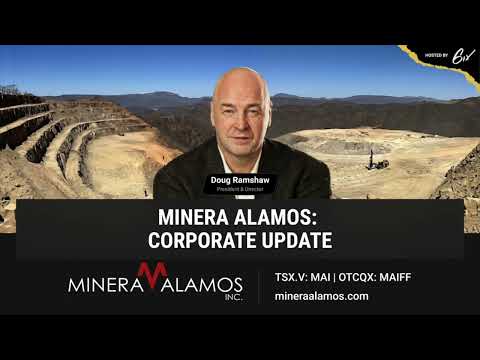
0:08 Hello everyone and welcome to Monero Alamos live investment summit today hosted by 6 I'm pleased to introduce the president and director of Monero Alamos Doug Ramshaw. Doug is going to walk us through company presentation today and after we'll be taking questions live. I'd like to remind you that you can submit questions using the Q&A chat found on the right hand side of your screen at any time during today's presentation. And as always, this event is being recorded and it'll be available to watch afterwards on six.com in the coming days. Without further ado Doug I'd like to hand things over to you. Thanks Cam and thank you everyone
0:40 for coming along today. Let me just make sure my okay it screens there. Without further ado I'm going to make some forward-looking statements today on this June 2022 corporate update. I thought in light of news that we put out yesterday, It was a very appropriate time to update the investment community on what we've been up to. So I will be making a few forward-looking statements today. And well, we have some topics I wanted to address. It's, it will be a bit of a page flip presentation, but there are some main themes that I think- if I was sitting on your side of the camera I would want to be hearing about so we are obviously going to talk about- our big news this week which of the surface rights agreements in place now at Cerro de Oro, our planned second mine.
1:35 A little bit on inflation and costs in the sector right now. Obviously a project update at Santana, our 1st gold mine. And a couple of other themes I wanted to address including building over buyout. And I've got a few data points on where I think that there's a lot more value in building a business and then continuing to build it rather than building something or advancing a company for a liquidity event buyout. And I've addressed that in the past when I talked about Money left on the table when Argonaut Gold bought Castle Gold and Pediment Gold and then went to 1 billion dollar market cap.
2:23 You know, it kind of highlighted that that liquidity event of exiting a company is not always necessarily the best way. And I think some of the numbers I'll talk about today on that kind of make that point. Certainly I think the Monera business model is very, very well suited for the current environment we find ourselves in. And now obviously with Cira de Oro, a second project, also comes additional news flow. So hopefully, you're going to have a pretty packed second half of the year. And happy, as always, to answer any questions from the audience that might have been sparked from comments I'd make today or have been in your mind for some time since we we last spoke.
3:13 So if people are new to the story I am going to address some of the you know what I think makes Monera different so there are going to be some some slides for sure that you know often repeated but I think are worth repeating. We are mine builders that's our business We've built a lot of successful mines over the last 13 years and under the Minera banner have built our first one in the middle of the pandemic and very much looking forward to building our second one next year. So we've got 3 projects right now. One's in production, still in its ramp up towards commercial production. Second project that we will be building is Cerro de Oro, where we've got surface rights agreements now in place, which will allow us to advance the permitting. And the third one waiting in the wings is already sitting there with permits.
4:08 So we think we have a very nice pipeline to build organic production growth from the foundations we've put in place over the last few years. We've got a growing institutional ownership and a strong balance sheet, debt-free, 0 warrants. Very proud of how we manage capital because you know when we spend up our money I mean that's effectively our shareholders your potential money that we're spending so we we are very smart I believe operators in terms of how we deploy our capital and and the value we get for it. Growth strategy, obviously, multi-mine, just like you want to be multi-jurisdiction, in time as a de-risking event, we're very comfortable in Northern Mexico.
4:59 The other de-risking step is to obviously be a multi-mine builder. And I think that's really the significance of yesterday's news that we're going to be on track to get that second mine up and running towards the end of next year. We are not immune from inflationary environment that we find ourselves in right now, but I believe we are very insulated from it. And part of that is we build small, low capex projects and then grow them out of cash flow. We're not dealing with multi hundred million dollar CapEx builds which have very much been in the news in the last 6 months with significant funding gaps in some cases.
5:48 You know on where costs are going to come in now against feasibility studies and PFSs that we've done in recent years. So I think we are very insulated from inflation. And in many ways, I kind of, you know, there's maybe a little sick side of me that embraces the current environment we're in because I actually think that it shines an even greater spotlight on how smart our business model is.
6:17 So we think we have a realistic path to intermediate production. That's building out Santana and continuing to grow Santana out of the cash flows there. Obviously bringing on a second mine and then a third mine. And realistically, the projects you see there, if we were to never acquire 0.25 asset, we can see easily surpassing that 150,000 ounce a year producer status. And I think that's important. And I'll go into why I think this sets us apart as a new emerging goal producer. But important to say, well, who's the team that can do all this? And it's a very technically minded team. Our board consists of geologists, engineers and metallurgists.
7:06 And our team in Mexico, largely in Mexico, again has worked with Darren Kernighan, our CEO, for the best part of 10-12 years. And if they haven't, it's people like me that have come in to take over the role of the capital market side of the business or when we've made smart hires like bringing Chris Sharp over from Sentara Gold. As the company grows, we expect our team to grow. But again, we're always very conscious of GNA and budgets, believing that the real value is created from investing in the projects, getting money raised into the ground. I think we have an exceptional track record of doing just that.
7:54 We're sitting at roughly a 240 million market cap. We're debt free, as I said. Cash, cash equivalents around $6 million. Working capital close to $15 million. And that, I think probably on this page, 2 things I'd address. We've been basing in a trading range for the best part of the last 2 years I think. You know we should be demanding of our companies we invest in of absolute. Returns but I think relative to a pretty beat up market- Manera's performed very well- that being said I think we have the news flow ahead of us now and the developments with Cerro de Oro that can return our shareholders into absolute return territory.
8:43 You deserve nothing less than that. But, you know, we have a very loyal shareholder base and that patience in us was probably tested with the time it took to get our surface rights at Cerro de Oro. So for shareholders that have stood with us through this last little while, I appreciate that. That 60% wedge that is retail is, I think, a little misleading in that there are, that is a very strong retail wedge. I think in time we'll have more institutions wrestling hand, wrestling stock away from it but and we'll hopefully continue to see a growing institutional awareness to the story and ownership of the story as we continue to execute and advance the projects.
9:39 I've switched these around a little. Anyone who's seen this presentation would see Santana at the top. And that is indeed a picture of our Santana heat bleach facilities. You've wondered what a 10 million US mine built in the middle of a pandemic looks like. Well, that's it, or that was it some months ago. I switched Cerro de Oro up to the top For no other reason than I kind of want to talk to the surface rights first. Cerro de Oro is located in a fantastic part of Mexico in northern Zacatecas, surrounded by some new mines like Camino Rojo of Ola and old established huge mines like Penasquito. Zacatecas is a very historic mining state in Mexico.
10:29 It was no surprise, but it was still pleasant to see that when we got our surface rights finalized there was unanimous support in the local community for the project. That doesn't surprise me to some extent because the people in these communities have grown up around mining. Mining that provides them either direct or indirect benefits. We're looking at Cerro Dororo as a new gold district there that again can convey benefits to all our stakeholders. That includes shareholders but also includes the governments, both state and federal, and our community stakeholders. And we've made commitments as part of these surface rights towards
11:14 employment opportunities for qualified people and social work programs in the community and the municipality there as well. It's important Mexico does permitting right you have to start with social license but then it's it's incumbent on you to maintain that and I think a good working relationship where you're showing tangible benefits to the communities whether it's be with schools or medical facilities or employment are all key components of maintaining that social license. So I had a little bit of fun with this one, I must confess, because it has been a source of frustration, both for our shareholders, but also for management that it took as long as it did to get these surface rights in place.
12:00 And what do they really mean? Well, it's a couple of red polygons on a map. Doesn't, you know, maybe convey all the hard work that went into this point and just how key it was. But Monero is a big believer that it is better to do things the right way than rushed. And we certainly took our time to do things the right way.
12:27 The main mine area is, or proposed mine area is highlighted there in that dashed yellow line. We have a large municipal surface rights agreement that surrounds that, but also, and what we wanted to make sure we had as well was that hashed area to the right-hand side. That was a deal constructed and executed with a local community. As I said, that gave us 100% support for this proposed development. And what it allows, we believe this mine, like all mines that we start, can potentially grow to be much bigger. Then then how it will first look and will present that first look at this mine and a P.A. Hopefully in the next couple of months, which will just be the base case example of this mine, but it can grow. And I think it's really important for a project which we can see from the outset has this ability to expand that you want to make sure that you've got more land, if necessary, under surface rights agreements than having to go through this process that can inhibit that expansion.
13:44 So That was why we took our time to ensure that we had that ability to have additional pad space here. One of the beauties of this part of Zacatecas, and you can kind of see it on the relief there, is large areas of flat ground. Santana in comparison, we're building heap leach pads in a kind of a valley fill sense. You know we're blessed here with a lot of flat ground which is important because this mine we're talking about tens and tens and tens of millions of tons that need to end up on a leach pad. It's a giant earth-moving exercise with a life of mine strip ratio that I'm not going to spoil today but will be in the PEA that will demonstrate just how much of that resource that is in our pit constrained report from late 2020 actually makes its way onto the pad and not onto the dumps locations identified there. So it's taken a long time but it was worth the wait we feel and hopefully our shareholders will see the sense in that as well as we outline the the economics of this project in that PEA to come out in Q3.
15:07 But yeah, a lot of fuss and a lot of delays for some red polygons on a map. And that is the original resource and this will be what will inform the PEA whilst we know it can expand and it can be bigger you know if we were to use a more aggressive gold price in fact we will have that PEA using a 1450 gold price because I think it is very important to highlight operations that work in lower gold price environments as well. We started Monera in a 1250 gold environment with a view that projects that we take on have to work in a 1250 gold environment. So it's a 1450 pitch shell that incorporates about 59 million tons of material and 48 million tons of those are the mineralized resource. So you get a kind of a sense for where strip ratios could end up here, even factoring in some of the additional waste created by mine development activities.
16:17 So a big, earth-moving exercise. And I've moved the order of these slides around a little. I've talked about what the problem with a lot of junior gold producers, and it's no fault really of theirs, is that they are forever junior gold producers. They're not able to break free of that sub-100,000 ounce production level. The reason Cerro D'Oro is so significant, and I've been highlighting this for months now, is because it is the project that dramatically increases our production profile so that we can leave the sub-100,000 ounce junior producer status behind us in very short order.
17:04 To put in perspective, this was a project we picked up in September 2020, came out with its maiden resource in November 2020, and within 3 years of that, Well, a little over 2.5 years and it should be going into its construction phase and 3 years after putting out the resource it should be in production. And so It's the ability in Mexico to do things in a very cost-effective manner
17:37 and with a permitting environment that allows you to build these things rapidly as well, that I think means that as you add production, it's add new mines. You're definitely raising the production profile of the company and in some jurisdictions, it can take so long to permit the second project or the CapEx requirements of the second project are prohibitive that by the time you actually get around to building it, all it's really doing is replacing a declining first operation that you had into production. So I think the Monero model allows us to achieve escape velocity, allows us to break free of the sub 100,000 ounce a year producers. And I say all this with Fortuna waiting in the wings, which is a 50,000 ounce a year operation as well. So that's where we can get to that kind of 150,000 ounce profile in rapid order.
18:33 So Santana is still going through its ramp up. We are in that pre-commercial production phase and we don't feel pressured or rushed to to make a premature commercial production decision. We showed in the first quarter of this year on very modest production levels, you know, a little over 1,000 ounces a month, that it actually is cash flow neutral. Does that make it a commercial operation? Maybe by definition, you know, it's not costing you money at that point, but we're not in the business of building 12,000 ounce a year mines. So, you know, to us, it's when 2 particular parts coalesce, the leaching cycles working fine. I'll get onto the subject of rain and water shortly.
19:22 But I think we also want to get the mining rate to a level that we view as commercial as well. And that involves us opening up the second pit there, which effectively, from a open pit perspective, is our second work face. If you were in an underground operation, it's all about number of working faces to get your mining rates to a level that you need. For us, the second large open pit at Nicho, the main pipe, is gonna be key to getting us up to the production levels that we would then view this as a commercial operation, starting up from a commercial standpoint at north of 25,000 ounces a year, and then growing from that. So we're not there yet, but we also, and this is one of the beauties of not having kind of some debt-like gun to our head, we're not also in a rush to get there.
20:19 I think we know the pace at which things can naturally happen. I think if we'd had a rainy season that had started in April as opposed to June, maybe things would have been happening a little bit more rapidly. But something to be said about this Northwest state of Sonora, and you can see it also impacting California over the last couple of years, is there's been a significant drought. And to put in perspective, whilst you can set your watch by the rainy season in in that part of the world And we saw it again this month as the rain started coming to Sonora typically From January to June you see about 100 to 120 mil of rain before the rains really come down hard.
21:10 Last year was a dry year. There was 45 mil of rain during that six-month period, 30 of which fell in January, and then about 15 millimeters of rain from February through June. This year, in comparison, 2 millimeters of rain have fallen at site. And so what that meant in the most arid and drought-like conditions you could possibly want or not want, by May, we were really starting to see all available sources of water, both what we drilled and other sources of water that we had were kind of running dry. And so we're happy now to see the rains falling because that recharges things. And so there's a bit of a seasonality here in that Q2 will be a little lighter and then Q3 will make up for it in a big way, because we have close to 12 million US of recoverable gold sitting on the pad that we wanna put under leach in short order as the water levels rise.
22:19 So that will more than balance out a slightly softer, or what we expect to be a slightly softer Q2, just as a function of this being a truly, if we thought last year was dry, this one was, well, I say, you can't really see it getting any drier than 2 millimeters of rain falling in close on 5 and a bit months. So we're comfortable with the situation there, which is why we pushed ahead with the development of that second mine, second pit there. That's the access road to it, to the main Nicho pit. And we're just doing a little bit of stripping of last vegetation and stuff before we open up that with our first blasts.
23:06 But, yeah, happy to report that the rains have started falling in Sonora. It's been, and not just for us, for the communities there. When you see the cattle that they have and stuff looking pretty skeletal, we do what we can, first and foremost, to support the community, knowing that the gold that we've mined will happily leach as those water levels increase. This is a second half of the year thing but you know what Santana is is a cluster of these hydrothermal breccia pipes. The main pits, Nicho and Nicho Norte, are being developed right now. But we also know that there's 5 or 6 more of these pipes that we've identified to date.
23:57 They're all gold bearing. We've surface sampled them. We've got a sense of the volumetrics from their surface expression. We want to now determine which ones will be priority for,
24:15 I'll get to that question in a little bit, Howie. So we want to prioritize which ones are going to be subject to infill drilling, because what Santana as an operation is going to be is a series of open pits servicing a central pad. So this is the expiration drilling that I love so much. I just hate the cost of expiration drilling. So I think our business model suits that mindset pretty well and that we'll explore a lot, but we'll fund it out of cashflow from operations. And so we expect to start looking to drill those other pipes in the second half of this year. I'm waiting in the wings and I won't dwell on this too much because it very much is in the wings.
25:03 We have a PEA that we did in 2018 on the La Fortuna project in Durango. It has exceptional economics. It's a 3 and A04 gram open pit, 6 to 1 strip. Back in 2018, pre-production capex of about 26, 27 million US. At a guess right now, that capex number is probably closer to 35 million US. And I think this is where I'll address that early blackboard scribble about today's topics and talk about inflation. I think the beauty of our business model is when we combine, say, Cerro de Oro and La Fortuna's total combined CapEx at maybe 60 million US between the 2 of them. If we were to see the kinds of cost inflation on CapEx numbers of some of the big projects out there that can be 25, 30% even, 30% on 60 million US is 20 million bucks.
26:04 It's annoying for sure, but it doesn't create a funding shortfall. And it's also the beauty of getting our first operation up and running. So we're not really particularly sensitive to a lot of the inflationary impacts in the market right now. And again, this is another project that we ran at 1250 gold. I think at some point we'll reframe this project at a 1450 gold price. But whilst we're developing Santana and developing Cerro de Oro, La Fortuna needs to get bigger. If there's one thing on here that, well, shouldn't concern people, But would be maybe the one eye-opening kind of, or I'd like that to be better, it would be MineLife, which is 5 years.
26:52 It was just a high-grade starter pit we based this PEA off. We know that there are extensions of that. We know that there's a lot of exploration upside around it. But there's certainly Brownfields extensions to this pit. So one of the reasons it's moved behind Cerro Doro, a Cerro Doro is going to be a bigger project. But also La Fortuna needs some drilling. I would much rather start this mine up at A78 year mine life minimum, rather than that 5. And so we'll remodel it at higher gold prices and get some drilling into it in due course. But it's a great third project to be sitting waiting in the wings. Now, one of the other topics I wanted to discuss today while I have your attention was building value.
27:41 Without citing any particular companies out there, we've probably seen M&A done in this space in the last 12 months, looked at 10 transactions that had happened on an all share basis in this business in the last 12 months. And these are some median data points from those transactions. I think it's very easy to sit waiting on a liquidity event, waiting on a takeover. You know, that's often the thesis for a lot of companies such as Monera, you know, we never actually get to build things because we get taken out first. No, well, we're in the business of building. And if you want us as a takeout story, we're not your story. But I think it's also a question of careful what you wish for.
28:26 Because the reality is when that liquidity event comes along and if it's an all share transaction, the premium that you see in those press releases looks pretty juicy, often 30 to 40% range. And the median of these 10 transactions was 37% on an unaffected basis, that 1 day premium. But by the time the stocks settle, the end of that first day, that premium is 9%. And on a 30 day basis, as things settle out and people happy with the deal or unhappy with the deal, moves happen, it's still only 15%. And I think you have to ask yourself the question, I certainly do, if I'm going to have my capital tied up in something that is a takeout target, what am I really seeing at the end of it in terms of premium. I mean there are obvious examples. I was involved with Great Bear which was definitely an outlier to these kinds of metrics.
29:25 But in reality with these all share transaction premiums We are seeing a very muted response in the marketplace, and it's probably why mergers of equals, which is how Monero formed, or the merger of equals between us and Corex Gold in 2018, are the way to go. You spend a long time cultivating a shareholder base that believes in you, that has followed you, that has seen you execute. There's definitely something to be said for 2 sets of similar shareholders, seeing the value of a transaction unlocked by having to stay with it and seeing a 1 plus 1 equals 3 play out over time, rather than relying on, what might seem on day 1 of the announcement, a healthy takeout premium, but that quickly evaporates in these kinds of all-share transactions.
30:21 So just food for thought there and a little bit of data to kind of support a thesis in my mind that again I think plays into the Monero business model that there's much more value from building a new gold producer on the block and starting out small with a strong foundation and growing from that into something much more significant. After all, all the big gold producers today started as much smaller gold producers. So the key, I think, to the ones that have lasted over time has been making sure that they built a very strong foundation And probably doing things in a less rushed sense, even though sometimes you feel like there's a need to satisfy the wanton desire of the market for news and stuff that they can react to.
31:14 Sometimes it's better just doing things at your own pace. And finally in terms of news, well, Santana operations will continue to ramp up, especially with the rainy season upon us, towards commercial production at Santana. I look forward to when we can make that declaration. I think it will be an indication for institutional investors to start eating into that retail wedge. Santana expiration and Cerro de Oro expiration in the second half of this year and obviously a key step will be that Cerro de Oro permit application. While we were waiting on the surface rights, we said it in the news release yesterday, most of the the work that's required for the permits has been done. There's a couple of minor surveys that now need to be completed now that we have those surface rights in place.
32:09 Our permitting consultants down there believe within about 8 months of those permits being submitted, we should be in receipt to the federal permit. So sometime in the second half of, well, second half of the first half of next year is a horrible way of saying it. So let's call it sometime in Q2 of 2023, we hope to be in receipt of those federal permits that will allow us to construct and Cerro Duro is about a 6 month construction time 5 to 6 we'll want to try to get ahead of the supply chain which is certainly impacting getting some even basic supplies in Mexico. So making sure long lead items like pad liner and stuff, deposits are down on those earlier this year to ensure a timely startup of construction activities and ultimately the operation, which we hope can start up towards the end of next year.
33:14 And with that, I think I'm gonna hand it over to the audience for questions. I noticed that Howie had asked a question because I think I might have confused him on how I would describe the gold on the pad. So 18,000 ounces have been loaded on the pad. The 7 I'm talking about is right now, at least as of some weeks ago, there was over 7,000 ounces of recoverable gold just sitting on the pad. So slightly different than 18,000 ounces. We're looking at recovery rates there of close to 75 percent, something like that. And it will probably in the end get closer to 80 percent, like our test mining had shown. So I'm just talking about this slightly weaker Q2 as a result of the rains will more than make up for it in Q3 as that loaded gold, recoverable gold that's on the pad, can be put under leach. Right now we just don't have sufficient water to actually get it under leach, but the cost of mining it, the cost of stacking it, all that's been sunk. And so we have this very juicy amount of recoverable gold that should come off in relatively short order as we can put it under leach.
34:43 So I hope that addressed it. Sorry, Harry, if it was a little confusing with how I expressed it.
34:51 Mark, question on Cerro de Oro. Yeah, in terms of, so the nice thing about the surface rights agreements that we have is they cover areas that we will want to tie up
35:15 in terms of expansion of that base case resource. So it does give us a major lever that we've now got the surface rights over those properties. The original Cerro de Oro project was Not just our claims, but some surrounding claims were all owned by Noranda Gold. And they were exploring there in the 1990s. We have the core. And in fact, anyone that wanted to reconstitute that original Noranda ground, you wouldn't do it without the heart of the system, which is what we ensured that we originally picked up. So now there are some land deals that we think we can do to basically start putting back together Niranda's original land package. And we know we've already got the drill data for some of those areas. So we can see with virtually not a single new drill hole needed ways to expand that.
36:19 Cerro de Oro, we feel can be 1 million and a half to 2 million ounces in due course. And some of that will be expansion drilling on our existing ground. Some of it will be looking to consolidate some of those original NIRANDA claims. But it's gonna be big and it's why we wanted to ensure that we had the expansion capabilities of pad space and the light to accommodate it. And that's still just talking about the oxide there. We, at Santana, the sulfide zone leaches. The gold is in free form. We need to optimize some crushing for it. But the reality is, when we get down to the sulfide zone at Santana, the gold leaches.
37:08 When Darren built El Castillo, the sulfide there didn't leach at all. That was always a pure oxide play. We haven't got much data on the sulfide zone below our oxide mine effectively that we're targeting at Cerro de Oro. Spidey senses of our team are that the sulfide will leach. That work will add to our metallurgical, additional metallurgical work we want to do in the second half of the year. But if the underlying sulfide does leach, similar to how it does at Santana, then the importance of, again, having this additional leaching capability under our surface rights agreements is paramount because Cerro de Oro which will start out as kind of a north and a south pit, probably will coalesce into one large pit.
38:08 And so that was that question. Another question on Santana. Which are your highest priority breadshear pipe drill targets? I think Zadar in particular. It's just across from our campsite there. It's a good size pipe. Good grades at surface. I'm not going to put him on the spot but our VP exploration Miguel Cardona you know thinks he can drill good grade in that out the gate. The Goldridge target is another interesting one because it's got some real scale to it. A couple of historic holds in that one as well, I believe. Those are 2 targets that I think would be Zadar in particular.
39:00 It's just so proximal to where we look up over towards it from our camp. So Can you give production and cost guidance for Santana in 2022 and 2023? Not easily because we don't have a PEA for it. It's one of the reasons I'm going to be delighted that we will have a PEA out on Cerro de Oro, so I don't have to tiptoe around that. You will have seen in our latest financial 0.25 we had to start reporting it was a new accounting measure brought in. Typically you wouldn't talk about revenues and costs of goods sold pre commercial production but in fact now with this new accounting rule that was precisely what we had to do. You can kind of back out the cost. It doesn't involve depreciation or depletion, which I think is kind of crazy because you're not really, you're only showing part of the story, not the full story here, but that was the rule. So we had to start reporting revenue and we have to start reporting the cost of goods sold.
40:16 And you can see from backing out those that we were, I think, about sub $900 an ounce. And this is over a very few number of ounces as we scale up. You know, we see Santana as a sub $800 an ounce deposit. Cerro de Oro will be sub $800 an ounce ASIC and I don't want to get into the specifics on the PEA but that's certainly our internal modeling which suggests it's gonna be in that kind of range. So as we advance Santana, you know, the hope is as we pull in a couple of these other pipes to show the upside potential, Maybe we do a PEA, just because it's going to make my life and your lives way easier.
41:08 We do a PEA that looks at the expansion operation there, where we can show the larger resources, show the capex of that expansion that can be funded from the cash flows of the operation and allow us to actually put some of those metrics around it. That would certainly, I don't like having to dance around some of this. You'll notice the dance of glee when we come out with the PEA on Cerro D'Oro because I can put my tap dancing shoes away because that's what Santana felt like a little. But it's a very efficient operation. We only need to produce around 1000 ounces a month to cover the cost corporately, you know, both the project level and the corporate level. So that speaks to the efficiency of our capital deployment, I think, more than anything else.
42:04 Too early in terms of those spidey senses on the sulfide leaches for the question I was asked there. I mean, you know, the key thing will be is that gold free and will it leach? Thereafter, it's going to be about doing a lot of work to optimize what kind of crush size you might need to liberate the gold appropriately against your recovery curves. And Cerro D'Or will largely be a run-of-mine operation, with us employing portable crushing equipment in areas of higher grade but it's largely going to be run-of-mine I'm sure that from a sulfide component, if we're right and it leaches, there'll be an element of crushing required on that.
42:57 Sentiment as bad as I've seen in a long time. Any idea what will change it? Not really. Yeah, it's rough. But I think it's also because this market peaked in September 2020. I mean, that was the time where we saw all these majors talking about record free cash flow and the like. I haven't done the math, but I bet you would need to get back to $2,200 gold, you know, just to get to the, you know, to the kind of margins that they were enjoying back in the fall of 2020. So, you know, yeah, it's not really surprising right now with cost creep and a flat to slightly declining gold price over the last 18 to 20 months, that we're seeing the majors, the GDX or the GDXJ, well off their highs.
44:02 I think right now, and I don't concern myself too much with the day-to-day movements in the gold price. Maybe that's because I'm fortunate that we're not a high-cost operation, but in reality, you'll drive yourselves nuts trying to predict things. So instead just build a business model that doesn't need a particular high gold price to function. And so yeah I don't I don't concern myself too much with the gold price. I think gold is doing exactly what it should be doing right now, as everything but a trading call seems to be melting down around us, whether it be the bond market, the S&P, crypto, whatever. Gold's actually holding up very nicely. And this is a very healthy gold price for well run operations.
44:51 You know, can we see higher gold prices? I hope so, because you know, that's a lot of extra gravy from an era to plow back into the business, to grow it still further on a more rapid timeline. But you're right. Sentiment's pretty bad right now. I'm not going to blame PDAC in the summer months either. It's been bad for well since the beginning of this year, going back into last year. So growing institutional, yeah, in terms of growing institutional ownership, well, we've seen it. We have funds such as Invesco that now own close to 4% of our company, adds a $2 billion resources fund that started buying 18 months ago and have continued to be picking up stock. They've seen what we've done to date and they're happy with it, I guess. And we've got other existing institutions that have added to their positions.
45:55 And from time to time, I see new institutions crop up and then maybe they disappear. It's incumbent on us to deliver things which make us more comfortable for an institutional investor to invest in. So that's going to be a commercial production decision. Not all of them need to see it, but it certainly will help. It will be the initial resource study on Santana. It will be the PEA on Cerro de Oro. So we can help their process by being, as forthcoming as possible in terms of technical disclosure, for sure. That's going to be a theme that I'll be hammering home internally over the next 6 months.
46:46 I think that Monero is a new growth goal producer that has a good low cost base and doesn't have surprises on the CapEx numbers, you know, can be an appealing institutional candidate. I'm not going to get drawn on commercial production start for Santana except to say it will be sometime in the second half of the year. Now we're 8 days away from the start of the second half of the year, It's not going to be 9 days from now. I think we want to see you know water levels naturally recharge as the rainy season takes hold so that we can get our leaching you know levels up.
47:32 And we also want to see that opening up of the main NITRO pipe which is you know 4 or 5 times as big as the main NITRO or the NITRO Norte pit we started mining at so it's a much more significant deposit that needs to be opened up and that's what we're working on right now so those 2 things will combine to lead towards that commercial production decision. Can you address a recent talk to Mixer? Well in terms of, it's a good question because there's a lot of stuff that you see in the press on voices coming out of the Mexican government.
48:20 The question is recent talk from the national government saying no new permits for mining. In terms of our experiences, We also saw similar voices in the fall of 2020, I think it was, forgive me, talking about how the AMLO government had not issued any mining permits. But in fact, they had, you know, both to us and to Silvercrest, at less cheapest. So there's a lot of noise. Now, you have seen in the case of lithium that noise really seems like it's it's got some substance behind it.
49:10 So 1 shouldn't discount noise just because it sounds it feels noisy because I think that there's there's certain pushes in things where it's practical for for the government there to actually follow through on things but But there is also a lot of stuff that comes out of Mixed Code that is very contrary to what we see on the ground and in our discussions down there and in our moves down there. So yeah, There's certain stuff that seems tailor-made for Bloomberg clickbait headlines. And the difficulty for us all is being able to sift through those and determine which ones have substance and which ones don't.
50:02 And any news on your small separate copper story? Yeah, I mean, it's not a primary focus right now, but we're working on it behind the scenes. For anyone that didn't know, because we don't talk about it, it gets 4 or 5 lines on our, in our MDNA, we do actually have a copper project that sits directly north of Santana called Las Verdes. And it's a bit of a hidden asset, doesn't really belong in a gold story. And the thing about copper is everyone thinks that copper has to be huge capex. And in reality, it doesn't. And so we are conceiving a plan to at some point look to monetize that asset for the benefit of our shareholders. And my preference will be in a capacity that sees a spin code done of what I like to call Manera copper shares to our shareholders.
51:13 And what we want to do on the copper side and what we believe we can do with our initial copper assets is build a new copper producer in very similar fashion to how we're building a gold producer, low capex projects that can scale up over a course of time. And you don't just want one of those, you wanna find what's gonna be your second project behind it, so that leveraging off that early cashflow from project number 1, maybe you can go after something that's a little bigger on the CapEx side for project number 2. But the one thing for sure is, you know, it's something that can be monetized for the benefit of our shareholders. We've done that numerous times over the last few years with assets that were, we were looking at, or had at one point, options on, and we've consistently been able to magically create value out of almost nothing. I think Las Verdes will be no different.
52:14 But right now as shareholders of a gold producer, I think you would want our focus to be on what we're doing on the gold side. And so, you know, it is a plan. It's kind of being whiteboarded right now as to how we best do that value creation off Las Verdes, but it is a bit of a hidden asset and at some point, maybe later this year or maybe the focus will be 2023, we'll look to take it through a course of execution to get most value for our shareholders from it and hopefully build out a kind of a sister copper company, which I think would do very well with the business model we have for that asset and the brand that we've got as mine builders in Manera. So I guess stay tuned, but thanks for asking that question.
53:12 Do you have a projected total gold production from? Well, I mean, if Cerro de Oro, Santana, and Fortuna can get us to 150,000 ounces, I mean, and that's the starting point of annual production. In reality, I think that there is a, you know, there's room for those 3 assets to combine and deliver closer to 200,000 ounces. So, but 1 step at a time, you know, our first mine isn't in commercial production yet. And then our second one is, has will only go into permitting in a couple of months time. So, but yeah, that's the big scheme here is, is, you know, to grow out a meaningful production base for the company and its shareholders.
54:03 Okay, selfishly, I would probably have to recuse myself from a dividend committee that we might have. I mean, we have more than enough growth potential. This is a question about dividends. We have more than enough potential assets to reinvest our free cash to grow. And I know I've only got a few minutes, so we'll make this the last question. But it's close to my heart. I think we see dividends in this space right now from majors where you look at it. They're so small, you can hardly say you're buying a yield, a stock for its yield. But I think it's an optics thing. This is an industry that has been railed against for its capital discipline for so long that by showing a dividend it's showing some comfort from a company level of you know being able to be consistent in that return of capital to shareholders.
55:06 You know, the reality is at our stage with the growth potential of reinvesting capital, I don't see 1 anytime soon. I think there are far better opportunities to add value for our shareholders. That being said, as a very large shareholder myself, the only way I'm ever going to reduce my cost base and get any money out is a dividend policy, which is why I'd have to recuse myself. I'd love nothing more. I think that this company's cash generation capability is something that we could be able to pay out in due course. A very considerable dividend for our shareholders. And I think there are good examples of companies in this space. Gold Resource Corp was 1 for a while, had an exceptional return for its shareholders in terms of a dividend policy. And it was a great investment, traded up considerably off the back of that yield. So and finally okay debt funding.
56:09 I have no problem, I'm happy with debt-free right now it leaves lots of options open to us but I'm not going to wear debt-free like some badge of honor. So I absolutely expect that we will fund Cerro de Oro's development with debt. And in fact, well before those permits come, I want to have whatever that package is going to look like negotiated so that we can make that announcement to the market as early as possible, so that they can see that it will be funded in that form. You know, the reality is the CapEx number on Cerro de Oro is so modest that even 80% debt funding that with the other being sourced from cashflow from Santana, it's gonna feel more like a short-term bridging loan. At 14.50 gold, it would pay back inside of a year.
57:01 So we're not talking long-term debt anyway. But I have no issues whatsoever taking debt on for project number 2. I would always have had a problem taking debt on for project number 1. So in that regard Santana this little starter motor to get things going, pays lots of intangible benefits to us as we grow up the second one. And with that, I know what time, I didn't think I was gonna be able to talk this long, but I appreciate everyone tuning in today. Everyone knows I said all the time you can reach me on my cell phone or personal email address they're both on on the bottom of every press release. Don't think that you need to tune in when I wanna talk to you. If you've got questions, always reach out to me.
57:51 I'll do my best to get a response back to you same day. And I love hearing your questions because it often makes me think in my own little goldfish bowl here, you know, what it is that you guys are looking for as well. So thank you