Transcript
Automated transcript · Written by software from the replay's audio. It can mishear names and figures; the replay is the record.
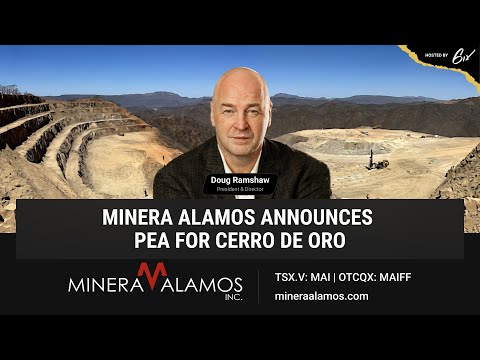
0:08 Hello everyone, welcome to Monero Alamos live investment summit today hosted by 6. I'm pleased to introduce the president and director, Doug Ramshaw. Doug's going to walk us through a company presentation and after we're going to be taking some questions live. So please feel free to ask anything you'd like in the Q&A chat found on the right-hand side of your screen. And as always, today's recording is going to be available on six.com in the coming days. Without further ado, Doug, I'd like to hand things over to you and get us started. Thanks, Cameron. Thanks, 6, for hosting this, and thanks everyone on short notice for signing up to listen to me. Not the
0:40 usual company presentation, going to talk specifically about our news yesterday. Finally, put out the PEA for Cerro de Oro, and we're very excited about what it means for the company. So I'll walk you through the basics today. Really not much more than was in the news release, but certainly hopefully with some added context of why we think this is a significant development for the company. And obviously looking forward to any Q&A that you have. Now I will say as a caveat to that, I will try my best to answer things that come up today, but I'm the first to admit that I don't know everything. So if there are questions I can't answer, I'm not going to give you an answer, just so you feel happy that I've answered everything.
1:31 I know my own shortcomings, and I will be happy to get those answers from our team down in Mexico that curated so much of the information that we presented in the in the PEA. So apart from the forward-looking statements about my own knowledgeable limitations, I will be making other forward-looking statements today. Cerro de Oro was a project we picked up in late 2020. We thought it was significant enough at the time that it pushed back for tuna, which was already sitting there with permits in hand And I think the PEA yesterday showed why? So, you know, I think if you were maybe I'm biased on this but if you were to look at Mexico as a whole, and you were asked to put an X somewhere in Mexico that you would most want to build a mine or be comfortable building a mine, and Mexico is very diverse in its jurisdictions, I think a lot of people would put an X very close to where Cerro de Oro is. It's a great mining jurisdiction here in northern Zacatecas.
2:42 Great new mines that are being built, being brought on stream like Camino Rojo of Orles and other established mines. And with established mines comes established communities that understand mining, that either are working directly in mining or certainly are supported by the activities of the miners there, and this part of Zacatecas is no exception. Infrastructure is great, there's a paved highway that runs within a couple of kilometers of the project, there's grid power that runs along that highway. I think importantly for big open pit heat bleach operations, there's plenty of flat ground, which when you're establishing a project that's going to require big heat bleach pads, more so than waste dumps with our strip ratio, but big heat bleach pads.
3:38 Very important to have good availability of ground, flat ground for building those. And this is a project that I think will be the second one that our team has built that Niranda Gold discovered back in the early 90s. So the data that is presented in this PEA is from 2 periods of work. There was Niranda's drilling in the 90s And then there was a private company that in 2016 through 18 had the project. And they drilled another 40, 50 holes and did a lot of met work. So the met work is quite recent. We're obviously going to be doing some more.
4:25 And the drilling is from 2 areas of work, both the Naranda Discovery and also the Galileo work that was done in 2016-18. So a tremendous database that we picked up when we grabbed this project and put in context, It was a smart acquisition at the time. Really, if 1 included the stock payments and the cash payments over a 4 year period, we picked this project up for about 7 million dollars US, so roughly 10 dollars an ounce. Now, there are lots of projects you can pick up for $10 an ounce, but not many of them can be brought into production with the CapEx that we're talking about and produce gold at sub $1,000 an ounce. So incredibly accretive transaction back in the fall of 2020, the merits of which I think have been demonstrated with the PEA that we put out yesterday.
5:27 It is still open. Monero is kind of known for its, it's not really a quirky business model, but this bootstrap model, which was always a sensible way of building mines with low capital intensity. Santana is a good example of that, where we don't necessarily need to start with huge mine life or huge resources, but we have visibility on where the growth from the resource can come as we redeploy cash flow from operations to expand. In many ways, Cerro de Oro is much more of a conventional mine. For us, it averages 60,000 ounces a year. Here, we'll jump to the PEA. The initial 8.2-year mine life exceeds anything that we have in our other projects.
6:20 We're the good annual production of close to 60,000 ounces a year. In fact, in the first 4 years, we're between 60 and 70,000 ounces a year and considerably lower costs, sub $800 ASIC. So we have great runway on mine life. And where this project maybe fits into the kind of bootstrap approaches, we'll start it on this resource, but we know already where there are areas where we can expand. We have a management model we can include in the PEA, which is considerably larger than that presented in the PEA and it will be something that will be proven out, some of it, probably before we break ground on construction. Others, as the project develops, deploying that capital back into expanding the resources, and hopefully expanding the resource sufficiently that not only can we expand mine life, but that annual production rate can probably approach the 100,000 ounces a year, or certainly into the 80s or 90,000 ounces a year on an expanded case, which is kind of a profile that we want to feel that any project we build has the potential to get to.
7:40 That's how we can build a very solid production base of not having to keep bolting on small operations. This is not a small one, and it's going to get a lot bigger by the time we start. It's nice that I've finally been able to, I've always talked about how Cerro de Oro is very much an earth moving exercise. And it really is. It has remarkably low strip. So 0.37 of a gram, it seems low until you look at a strip ratio of 0.3 to 1. And actually to put that 0.37 grams in context, where I've talked over the years about how our team under the Castle Gold banner built the El Castillo mine, in many ways, Cerro de Oro is very, very similar to what we developed at El Castillo.
8:36 Notwithstanding both deposits were found by Niranda. The difference was at El Castillo, that starting grade was very similar. And in fact, actually, during years 1 through 4, it's higher than that. It's in the low 0.4s. But life of mine, that grade, very similar to El Castillo. The difference being El Castillo had a strip ratio that was probably closer to 1.5 to 1 and not 0.3 to 1. It also had a much smaller starting resource, although it grew into something much bigger, just as we expect Cerro de Oro can. So we've got more starting ounces, similar grade, obviously better mine life, but with that much lower strip. And so, this is not dissimilar.
9:26 I think what's nice is since we put this out yesterday, No one has questioned our very good CapEx numbers that we put out with this study. And they included a 30% contingency, which I think is prudent right now. When we built Santana for $10 million, we had so many people wondering, how is that possible? Even though we'd done a similar operation to that before and built it with similar cost. In many ways, I think Santana has demonstrated now that we can do that. And there weren't any questions that I faced from analysts or investors alike with regard to these remarkably low CapEx numbers. Because all these numbers have been informed by our operating experiences and construction cost experiences as Santana.
10:18 But even then, we'll put in a contingency, which is to ensure that we're certainly, I would not expect us to use all that contingency up. I think the other nice thing here is we use $1,600 gold. We didn't use a $1,600 gold price to juice the IRR, although I see there's an error in the sheet. It's not 93%. It's 111%, as it is on the right-hand side. That's an error on my part
10:52 Clearly we weren't using a gold price to back in an IRR that would be acceptable to the market and to put in perspective if you wanted to run this at $1,400 gold the IRR still Approaches I think it's actually just over 80%. Even at 1250 gold that we ran the Fortuna PA at back in 2018, the IRR is 41%. So, you know, these returns, I think, are defendable, given consensus outlook for gold prices, but more importantly, defensible in a market where gold actually falls. This can still be a very profitable operation for us. And that's important. We want to build mines that make sense in whatever gold price environment is presented to us.
11:43 And I think in that regard, That's why our business model, as I said in the press release, is smart and nimble. We're not in a situation where a single asset developer developing something which has hundreds of millions of capex comes into an inflationary environment and those cost overruns on the capex numbers can be crippling. For us, these are numbers that work in any market. We haven't juiced pre-production capital by putting a whole bunch of sustaining capital there instead. I mean our sustaining capital runs at a couple of million bucks a year and that's really as a function of expanding the heat leach pad over time. We'll start with about 400,000 square meters of pad And then as the operations continue, we will continue to expand the pad. And that's largely the sustaining capital number here. So, yeah, I think this is a great study for Monera.
12:47 And it's a great study in light of the current market conditions facing the sector. So yes, some key highlights, obviously the first 4 years, 60 to 70,000 ounces a year with a sub 800 ASIC. And whilst in years 5 through 8 we start to see a slightly higher strip and a slightly lower gold production, more in the 50,000 ounce range, That's where in fact years 5, which raises our ASIC a little bit. In reality, because we can see how this project can expand, I would expect years 5 through 8 to actually see us expand production and deal with an expanded production and, you know, see the ASIC actually drop from what we're presenting in the PEA.
13:42 But the juice of the deposit in the first 4 years is remarkable in terms of its economics. It would have been 2 years ago, I think even more so now. It's a largely run of mine operation. There are zones of high grade material and as such to maximize returns on our modeling, we will be probably running 30% of higher grade material through a two-stage crush, and then convey a stack on the pads. But roughly 70% of this deposit goes straight to the pad.
14:23 First couple of years, strip ratio of 0.2 to 1. You know, if you're the unfortunate ton of waste that has to go on the waste dumps, you're going to feel pretty lonely there as most of the mineral ends up on the pads. And even then over the latter part of the mine, we still see a quite remarkably low strip ratio life of mine at 0.3 to 1. As I mentioned, the capital intensity, we are very comfortable with our numbers because our recent Santana build informs both these capital costs and also an understanding of the op costs that we're dealing with in Mexico right now. We, just like Santana, just like El Castillo, we have an in-house fabrication of the carbon plant.
15:11 Other than that, construction is largely earthworks, pads and ponds. And we will have crushing facilities here, unlike Santana that we use portable crushing equipment provided by the mining contractor. Here we, a few years ago, bought a complete crushing system for about 1 million and a half dollars of memory serves. It has more than we need but it always had components we thought we could apply at Santana and then when we picked up the Cerro de Oro project we always assumed that largely that crushing system would be used at Cerro de Oro. It does need some refurbishment for our purposes, but it's in pretty good neck. We thought that at the time when we bought it, we believe so now. So I think we've got an allowance of about $2 million to get that crushing system where we want.
16:04 But again, it's a huge, huge CapEx saving over what you'd see in a study where everything is Rolls Royced by third party consultants. And I think it's one of the strengths of the Monera team as to how we build these things with seemingly,
16:24 you know, highly competitive capital requirements. Projects open both at depth and in multiple other directions. And depth is interesting because we've seen some projects,
16:42 the gold in transitional material and sulfide material just simply won't leach. El Castillo was a good example of that. Santana, we know from metallurgical testing, the gold's in free form. And depending on your crush size required, the gold does leach. Now, we believe, based on some very preliminary work, that there is some upside potential here at Cerro de Oro in terms of bringing in both transitional and potentially sulfide material into the mining plant, while still keeping this a heat beach operation. The current PEA is looking purely at oxide. Our expansion model is looking purely at oxide.
17:29 But this, to me, is very critical upside opportunity for the project and could make Cerro de Oro a very large mine if some of that preliminary work actually does actually give us that upside potential for bringing in both transitional and sulfide mineralization. And even if it's just a transition, it will have a meaningful impact on how we plan the expansion phases at Cerro de Oro. We adjusted. There's an updated resource statement that is part of this PEA. There was an additional drilling. We just looked at the gold price.
18:15 We did a PIC-constrained $1,700 resource estimate, and from that, informed a $1,600 base case for operations. And that was just taking into account additional cost information we have and looking at the outlook for the gold market. But as I've already demonstrated, this project is incredibly defendable, even at lower gold prices. So we feel that this was a reasonable base case to use for this study. The minus it stands right now would be contained within that yellow outline. The red outlines are basically the surface rights that we had in place earlier this year.
19:04 They helped support both the base case presented in the PEA right now, but we wanted to make sure that we had surface rights in place that would allow for our management case upside model. And that's what we did. It took longer, as people saw earlier in the year with the delays on surface rights. But Just like everything with what we do, we believe that it's better to do things right than rushed. And I think for a project that can get much bigger, having more land than you need initially under surface rights
19:47 is smart when looking at the upside cases here so that you're not going back for further negotiations. You've got everything tied up with a nice little bow out the gate. These things are always fluid and I hate using that word and I will continue to use it when certain things are outside of our control. Obviously once we submit permit applications, things are in the control of the Mexican authorities. Now, our experience in Mexico has been very positive with permits. I have no reason to think that our team is suddenly going to mess things up in that regard. We've permitted lots of things in Mexico.
20:34 But certain things are definitely outside of our hands. So, you know, typically we're looking at about a 9 to 10 month process upon those permit submissions. And they're just being finalized right now to go in. So sometime in Q4 we'll aim to have the permit applications submitted to the government. That hopefully will see us receive those permits sometime, I'm going to guess, in Q4 of next year. And really with the MIR and ETJ permit, that would allow us to start
21:08 breaking ground on construction. In fact, they allow you to do pretty much everything but start mining. It's during that construction phase, the certain ancillary kind of state level permits and other permits, the water permit, explosive permit and the like, all are finalized. Now we're still going to advance those permits well in advance so that hopefully, yes, everything during the 5 to 6 months construction period lines up. When we break ground, hopefully around the end of the first half of 2024, we're ready to go. I hope that we're pleasantly surprised, but I think it's important to kind of plan realistically based on best information to date.
22:00 And right now our best estimations follow somewhat in line with this timeline. And I always say, I hate to say it, but there is always a question of delays and stuff. What I will say is permitting in Mexico, the process has never changed under the current government.
22:24 And we, as well as Silvercrest, as well as Orla, have all built mines under the new government. You've recently seen Agnico make a major commitment at San Nicholas. This is a good jurisdiction to be in and we're very happy to be in it. Finally, I'm just going to use this slide 1 last time because I've been saying for a while, a lot of junior producers, or perennial junior producers, by the time they build their second mine, it's really just replacing lost production from their first. I think Monero has shown an ability to move rapidly in building out a stream of multiple potential mines that will allow us to actually escape that sub-100,000 ounce production profile that so many junior producers can never break free of.
23:17 Cerro de Oro and Santana gets us there, with Fortuna waiting in the wings and both Santana and Cerro de Oro having the ability to expand beyond their base case production. I think that's what's special about Monera. It certainly has, we've appreciated the support for our business model from the market.
23:38 And in light of the current pressures facing the sector, both in op costs and capital, and also just delays on permitting, This is a smart and nimble business model perfectly suited for the current environment we're in and we look forward to developing Cerro de Oro to make this slide a reality. And with that, I thank you. That's a little overview of PEA and I'm happy to answer any questions, Ken. Absolutely, thank you for that great presentation. I'd like to remind everyone in the audience, if you do have any questions, please ask them in the Q&A chat found on the right-hand side of your screen. Let's dive right into it. First question from Dave, is it correct to assume that you'll be able to transition from the PEA to a construction decision or production without spending capital on a PFS or FS?
24:27 Yes, quite. I mean, Right now, at least we have a PEA for this one. I mean, I get that people had concerns about Santana because there's 0 visibility on what our mind plan is. It's, trust me, it's made my life, and if it's making my life hard, it's making our investors' life hard on understanding what Santana is. In fact, I think as we've come out with Q1 and Q2, 2 and what I expect to be a good Q3 and good Q4 at Santana, it's living up to what we've always said it's going to be. The difference being it's like that you have to take our word for it. Cerro de Oro, We've got numbers out there and we're we're comfortable Building we were comfortable building off no study out to the market this time. We wanted to inform the market correctly.
25:20 But open pit heat bleach, so long as you have a very good handle on the map and a robust resource. And whilst this resource looks like it's inferred, There's notes in that press release with regard to what very limited work that's actually required to bring this up to indicate it.
25:41 So we have a robust resource, very homogenous system, and it will be up to us to demonstrate the metallurgical characteristics of this deposit. I have extreme confidence in anything metallurgical in our company because of Darren Kernighan's credentials as a very accomplished metallurgist. So he bleaches our bread and butter that there's not anything that concerns us about this project building it off a PEA and in fact I have no doubt that we will get debt funding off that PEA. One of the reasons why the PEA will have a lot of detail in it, like just how we approach discussing power, which is obviously in everyone's mind right now in that release.
26:35 This is not something that's designed off the back of a whiteboard. There's a tremendous amount of work that goes into it.
26:45 Santana had more metallurgical data available to us to make that determination, then you'd see in a feasibility study with the 50,000 bulk ton heap leach test there. Just like not all companies are the same, not all studies are the same. How we approach things is with a very conservative approach. And trust me, when we come to looking to fund Cerro de Oro's development with debt, those lenders are going to want to see the data to support that. So even though it might not be presented in a PFS form or a FS form on CDAR, the behind the scenes discussions with bankers are going to require, it's incumbent on us to have all the data that would inform one of those studies, but we think that there's more value in getting these things built and getting them advanced than incurring a lot of costs that we view as unnecessary costs to get something to PFS or feasibility levels, which in reality, when you look at it right now, there are a lot of projects that have had feasibility studies done on that don't work.
27:54 And PFS is as well. We like to demonstrate that our projects work in the best possible way, which is to get them up and running and making money. And Santana is a good example of that, a $10 million build that is making money consistently every quarter at a time where the sector is seeing margin contraction and probably gonna be printing a pretty bad Q3 and at large, just because of the inflationary pressures, both impacting development decisions on the CapEx side, but also obviously op cost, which is leading to a lot of margin contraction in the current gold environment.
28:40 All right, great. Thanks for that. Ron wants to know if you have any sense of timing on bringing on 0.25 project. I mean, we're always looking. Cerro de Hora was conceivably going to be our fourth project. We'd been looking at, for the longest time our deck talked about Santana and Fortuna and a possible third mystery project. We were looking at something for 2 years at desktop level and put a bit of money into it, not much, we're pretty adept at getting to a decision point without incurring a lot of costs. But ultimately, that that project didn't make sense, not at the prices and the way that the acquisition cost was going to be structured.
29:27 And so we pivoted and we pivoted instead of doing that deal, we looked at our list because we're constantly reviewing things. Just about anything that's in Mexico we'll review, but we've also looked at parts of the US and parts of Canada that might have longer permitting times, but I always joke that you only live the bottom of the Lassonde curve, that orphan period that shareholders hate, because the only news you hear is permitting updates and construction updates and nothing much more besides. You can look at stuff in Canada or the US that has longer permitting times because that's not, it doesn't matter because you're developing on your first mines in Mexico. So we're expanding where we're thinking in the Americas for sure.
30:14 So when we're now talking about what could be our fourth project, it could be 1 on a list of 678 things that we, we constantly are kind of cycling through. Some get kicked off the list, some stay potentially interesting.
30:30 You know, the reason we talk about it, though, is we're not going to rest on these assets. And for us, you know, if there's a if there's a smart deal that our team can can build accretively for our shareholders, we absolutely will look to to further the kind of the base on this platform. But the key thing is building the platform correctly, the foundations of this. Santana, Cerro de Oro are going to give us great luxury in terms of cash flow generation for going off the bigger projects. I think we'll scale out of the smaller stage ones as we should expect to be going off the bigger size projects over time, but they're often projects which are still somewhat orphaned.
31:22 They don't make sense for the midsize, but they do make sense for a team like us, which is a mine building team. And we're fortunate that there's not a lot of competition between groups actually wanting to build things. No, fair enough, absolutely. Howard wants to know if there's any possibility of more ore deeper that could extend the life of the mine, you know, 10, 15 years?
31:47 Almost all the, yes, in simple terms, but we really, we haven't factored it into our mine plan. There's very limited drilling of, there's only half a dozen holes out of all the historic ones that really went much below the oxide layer, oxide and some transitional. So that's why we know that there's sulfide mineralization that we want to do. But it doesn't come into play unless we're right about, I said yesterday, our Spidey senses that it's potentially leachable. But there's expansions, even at surface, to the current pit that we're talking about, to the Southwest on ground that we own.
32:34 So, yeah, we believe when we have a management model case that we hopefully, it would be nice if by the time we're building this, that we've almost updated what we put out yesterday with a new resource and expansion of what we've got right now that informs the bigger mine plan that we absolutely believe can be built here at Cerro de Oro. All right, great. Mark wants to know how much infill drilling will you need to convert to Indicated? Is it the pre-production drilling included or rather is the pre-production drilling included in the CapEx projection? No, It's not included. I think there's maybe about 1 million dollars, but there actually, Mark, there's, a lot of that resource right now is drilled off sufficiently for Indicated.
33:29 The only reason when we first came out with the resource and in this updated one, we've kept everything as inferred, is there's some, the original Niranda drilling was drilled on a local grid. And there's some translation errors of about 5 to 10 meters on a lot of that. We can there was also a lot of trenches done back then and those trenches are still there. So we were able to looking at our new satellite imagery and our new grid that the later drilling was done on, that a lot of that Miranda drilling is off by 5 or 10 meters. So we've done some translation on that for hole locations to determine that in fact, you know, everything's fine, but we do need to do some additional holes just to confirm that.
34:27 There was also some missing lithological contact data from that early NIRANDA drilling. So it's not that it has to be repeated. I think we just have to drill a little bit just to almost demonstrate that everything's fine with NIRANDA drilling. It was just some data missing and some translation errors because of the local grid used at the time in the 90s and the grid that was used for the Galileo drilling. But for a system like this, 85 meter, are the resource QP is looking at the 85 meter approximate spacings of holes here. There are certain areas where there are gaps in that for sure. But actually, we could probably, I think by the time we're building this, we are building it off of basically indicated resources, And it won't take a lot of drilling to allow us to make those adjustments in the resource confidence.
35:27 And we'll ensure that drilling that's done that's kind of expansion drilling will be done to the same criteria to hopefully bring expansion drilling into indicated from the outset. No, absolutely. Thanks, Doug. And actually, Mark just has a little bit of a follow up here, just regarding the inferred indicated drilling. He just asks, because the relatively low grade means that any unexpected or discrete zones of waste would become an issue. So how homogenous is the mineralization, is the other way of asking the same? Yeah, it's pretty homogenous. I think for us it's critical to be identifying obviously those areas of higher grade where it makes sense to send to the crusher.
36:14 It's a pretty homogenous ore body, which has made life a lot easier for us from a mine planning perspective, for sure. We definitely want to have the confidence that we're not, you know, if there's high grade that we want to drill it correctly so that we're not sending that run of mine to the pads and it's material that's going to go through the crusher. But it's a big disseminated system. This was what Miranda were drilling off in the early 90s where they made a number of discoveries. They've never built any of them themselves. El Castillo is 1, La India is another, and Cerro de Oro is another of their discoveries.
37:06 It was a different time for gold prices though and so sub 1 gram wasn't really very interesting but it's obviously perfect for the current environment and smart open pit heap leach operations which weren't necessarily the vote back in the time for Naranda and also Echo Bay that were drilling in the same area. We've put out a release where about 5 6 kilometers to the southwest of Cerro de Oro, we discovered a bunch of workings, but more importantly, a bunch of Echo Bay drill data from there and some reports in Echo Bay's reports talking about the work Miranda were doing at Cerro de Oro and they were looking at higher grade material but we found a nice 2km long zone of lower grade but our classic heap leach type grade material there that absolutely warrants follow up and I think it highlights a district which we have big surrounding claims that is underexplored in context of the current current market and current targets especially targets for a team like us that like like to build these lower grade open pit heap leaches.
38:21 Right, absolutely. Mark wants to know if you could expand on the MET work done. Has the bottle roll covered a range of mineralizations and grades? Yeah, but there was extensive bottle roll testing done, and this will all be in the report, so forgive me if I don't have all the charts in front of me here. But there was not just bottle roll testing done, but column tests as well done. And we've also augmented that with some additional work that we've already started on transitional and sulfide material. But so yes, you know, not looking at both high-grade zones and low-grade for the bottle roll test. Likewise, I think there were relatively, I want to say 300 or 500 kilo, you know, column tests done for it as well. But I mean, I'm certainly happy that the network that was done past Darren Smuster, and more importantly, there was a complete record of it. It was done 5 years ago, not 25 years ago. So, you know, Darren's a bit more of the whiz kid on the metallurgical side.
39:43 But yes, to your point, it was done across a broad range of grades within the deposit. Great. Jack wants to know how you plan to finance the mine construction. Yeah, I'd say debt, Because I've always said that we're debt-free right now. We elected to take royalty money to build Santana because I think you can get yourself in a lot of problems taking debt on from mine, number 1. But what that has created is huge flexibility on taking debt on to build the project, you know, second project in the row, in the sequence.
40:29 And In reality, when we're talking debt, if gold prices were to stay at $1,600, I mean, if you were to take on $20 million of debt for this, it's payback in a year. It doesn't really feel more like a bridge than classic debt. I mean, it will be defined as debt for sure, but the payback on it is so quick. Interestingly, on this subject, before we acquired Cerro de Oro, it's exactly the same approach we were going to take with building Fortuna. And we were talking to groups then, and they were very happy with, I mean, I think Fortuna was 26 million US capex. There was an option of a royalty on it, no longer exists, that would have covered about 6 of that.
41:15 And We got an indicative term sheet from 1 lender and they were on very, very competitive terms for 20 million US. Basically, fully funding that thing with that. One of the questions at the time was about Santana. Because if you're going to put debt on project number 2, what they don't want is your first operation to be a bit of a millstone around the operating performance of the company's neck. The great thing here is, by the time we're building this, we're going to have 18 months of operating data from Santana. There's not going to be those concerns of, yeah, but what if Santana is dragging down your company? It would be quite the contrary. I want to make sure that we have something lined up.
42:05 Obviously with the condition precedent of permits received before we can draw it down, but I would like to have something so that the market is informed and we're informed from our decisions, we have to make a company level before the end of the first half of next year, well in advance of permit receipt, so the market knows precisely how this is going to be funded. Absolutely, We are happy to be debt free. I'm not going to wear it as some badge of honor, but in reality, with the quick payback of these projects, I think we're going to be debt free. Oh, we've got debt. Now we don't have debt. Oh, we've got debt as we build another one. Now we don't have debt because these projects are designed to pay back so rapidly.
42:51 So yes, it's always been my intention that Cerro de Oro can be debt funded. No, that's great. And speaking of Centeno, I just want to make sure you might be reiterating things, but Neil wants to know if you could say anything further about declaring commercial production at Centeno. Yeah, I mean, well, we will, you know, because somehow it's become vogue for companies to make an announcement that was really more of a internal declaration between them and their lenders. Now it's become something that the investment community wants to see. And that's fine. I have no problem with it. I have had a problem and continue to have a problem with it being used aggressively by companies. And we've been the absolute counter to that.
43:39 I will say that commercial production, all things being equal, your operation is making money. And yet it often gets used in the, you know, you're a milling operation and you've reached nameplate capacity of 85% for 60 days. Checkmark commercial production. It's a completion test for lenders But if the if the feed you're putting through that mill is 0.5 what you planned and you're losing money What's commercial about that? This is the problem I have with it with the term, but I don't have a problem with using it. I would prefer to ensure that when we use it, that anyone can look and go, okay, yeah, that's good. You can retroactively look over the 3 or 4 0.25 leading into it and say, yeah, there's a lot of visibility on how this operation makes money.
44:35 So as we get into Q4, the other question comes up, that when you declare commercial production and only making money definition, we're there. But we also want to get there on the scale of the operation too, which I think we all see through Q3 and Q4, as we continue to get to our starting first iteration scale of Santana. But the other consideration is there is a complete change in your reporting accounting standards. And out of deference to my CFO, a lovely lady called Janet who's been with the team, came back into the team last year, but knows and work with the team. She was the CFO of Castle Gold.
45:28 If say November 14th, we declared, You've got our financial and calendar year at the same. Now you've got an audit for 2022, which is 10 and a half months of 1 accounting standard, and then there's 1.5 months tagged on at the end. And honestly, if people want that declaration so quick that it just complicates matters for us, they're not going to get that. Instead, I would expect the earliest you will see it, and it's nothing to do with the operation, but more to do with not making audits and accounting unnecessarily complicated when you're so close to your fiscal year end, that I would expect a January 1st declaration so that we have a full year of pre-commercial production and a full year audit of that and that accounting standard, and then going into 2023, a full year for the future audit of a commercial operation.
46:31 But if I go back to my first suggestion that, you know, all things being equal, commercial suggests profitable. Well, the operation's been making money at the operations level since Q1. In fact, making sufficient money at the operations level that we've been adding to our cash, even at the corporate level since Q1. I think that's a testament obviously to how Santana is working, but also what good stewards of capital we are at Monero. No, absolutely. Paul wants to know, what do you see as your key competitive advantage in being able to achieve such a low capital intensity for the project? I mean, our team has been doing this for a living for 14 years in Mexico. We understand everything from how we build a plant to our understanding of costs on Earthworks and PANTH, which are often way better informed than a consulting group that will roll a project and look in their benchmarks of data and come out with a different number. I mean, ours are informed by real world experience of operating down there. This is a team that lives and breathes and is largely Mexican nationals.
47:54 We live and breathe Mexico, then we understand the cost regime. I mean, the other thing, we just make smart decisions. I say we, Darren and the team. I've just told the market how smart they are for the last few years, but it's true. The ADR, we're not dealing and producing Dorian site. We're dealing in shipping loaded carbon. And in reality, even in some of the best parts of Mexico, you can operate it. And if you're producing Dorian at site, well, your security costs out of an abundance of caution have to rise. So that, you know, and they rise more than the sub $15 an ounce it costs to ship and strip that carbon in the US where it goes.
48:42 So there's an op cost saving, but we've also just eliminated $10 million off the front for the ADR. And obviously, in Mexico, we have an abundance of mining contractors. So we work on a contract miner basis. You can see a lot of studies where they have to price in the full fleet cost. And they've got the full, and the ADR cost, and everything else. These projects that we're building can avoid all of that and largely through the experience of our team of understanding why there are so many benefits of working in a jurisdiction like Mexico. Yes, it has its foibles, every jurisdiction does. But I think for our business model, the benefits of operating down there are absolutely sensational for us.
49:32 Well, listen, Doug, I want to thank you for the presentation and a great Q&A session yet again. That's all the questions we've had come in, so before we wrap up for the day I want to pass things over to you for some final words. Well thanks everyone for joining today. I hope it was a useful and some added context for the study. You know, obviously we're really excited to get this one built. There's some steps that need to go between now and then, but I think you also saw from the study today that it's now, it won't be just a sit back and wait till you hear permit news on Cerro de Oro. There's a lot of work that our team will be doing there to add value and keep you informed. As always, any time, More and more shareholders are doing it and I'm loving it.
50:19 You can reach out to me directly. My contact details are always at the bottom of every press release. Don't be surprised when you call the phone number that I pick up at any time of the day or night. It's my cell number and it's there so that people can reach me. I'm excited about what we have and I love sharing that excitement. So yeah, thanks for attending today, thanks Cam for putting this on and have a good rest of your week, everyone.