Transcript
Automated transcript · Written by software from the replay's audio. It can mishear names and figures; the replay is the record.
0:08 Hello everyone and welcome to Bunker Hill Mining's live event. I'm pleased to introduce the speakers for today. We have Sam Ash, CEO, Gerbrand Van Heerden, CFO, and Richard Williams, Executive Chairman. They go over a quick presentation and afterwards we will be answering questions. So you can submit your questions at any point during the conversation in the bottom right corner of your screen there. As always, the summit is being recorded and will be available on six.com to watch afterwards. So without further ado, I hand things over to Sam to kick things off.
0:39 Thank you very much. And it's a great pleasure to be speaking with everyone. Normally I'm speaking to you from Kellogg, Idaho, but this time we're in Toronto getting ready to attend the PDAC Investment Conference. So hope to see some of our audience there visiting us at our booth. Just wanted to take a moment to talk about and refresh everyone on and any newcomers, you know, what what Bunker Hill is, what our vision is, and a little bit about what we're we're working on. So. We have a strategy to become a leading mid-tier critical and precious metals mining company, North America focused, with multi-assets in the near term. Now, our primary first step is the restart of the Bunker Hill mine, which is a Brownsfield restart with over 160 million ounces of silver produced historically and 5 million tons of base metals.
1:40 The project is significantly de-risked. We own the processing facility and We're in the process of constructing that. And we're looking to be in production in 2024. So a kind of a unique story from that perspective. It's zinc dominant, but comes with significant amounts of silver and lead as well. We have a very strong management team, very execution and operation focused. A clear distinction with Bunker Hill's mining company is we're not an exploration company. We're a developer, we're mine builders and mine operators. And finally, the Bunker Hill asset has a significant upside value creation potential. What we're doing here is starting a small low CapEx rapid restart to get into cash flow generation and then use that cash flow generation to reinvest in the Bunker Hill asset to unlock significant upside value.
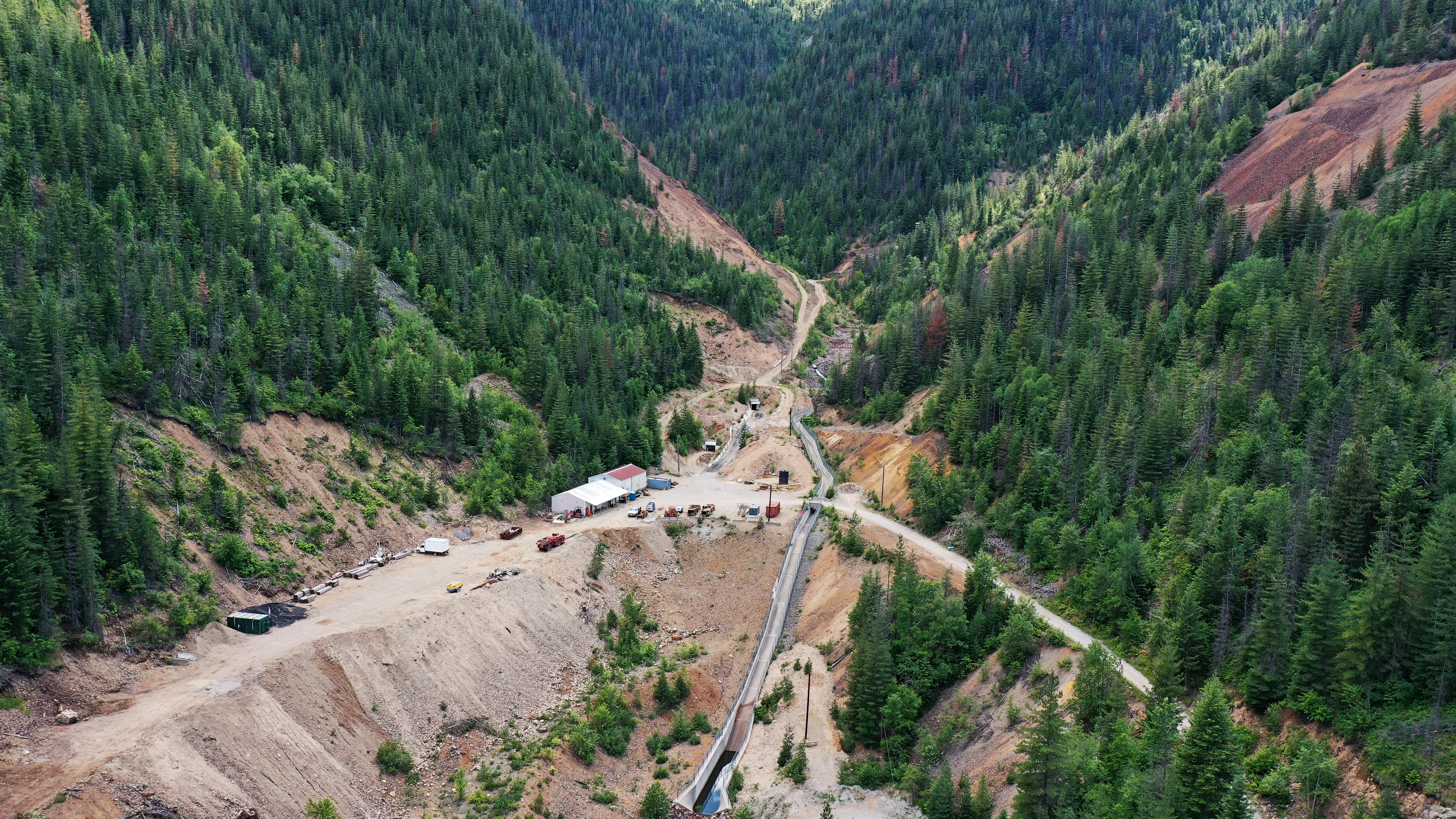
2:37 Now, just a little bit of progress on what's happening at site. You can see here at the mill site what the overview of what the mill site looked like about a year ago, and then subsequently what we're looking at and where we're at now. So where we're at now is we are in the process and have initiated some of the pre-foundation deep peers and are working on just a final piece of demolition and relocation of the administration and engineering offices.
3:13 Also, just in the last month, we had the golden sunlight ball mill arrive at site. And with that, that's a pretty nice milestone of 80% of the critical path processing equipment is actually on site and ready to go back together. And you can see on the right, we are mobilizing in a deep pier auger cast piling company. And they're mobilizing this week and will be on site working going forward into next week, which is the first key critical step to the foundation work for us. On-site, we are also in the process of refurbishing in-house a lot of the equipment that needs refurbishment from the Pend Oreille mill.
4:09 And you can see some of the examples here, and interestingly enough, the group and the mechanical contractor who demobilized the mill and moved the mill to site is now the same group who was working through the refurbishment and will be an integral part of the reconstruction and reassembly of the plant, all of which is a big advantage and a de-risking aspect of our restart philosophy. And then finally, just to want to remind everyone that we also have a tremendous value creation opportunity through exploration. And we really, we talked about this a couple of weeks ago, and we really see this in kind of 3 fundamental key areas.
4:57 The existing resource conversion, which is looking to convert the over 7 million tons of inferred mineralization and upgrade that to measured and indicated. That aspect of drilling is budgeted and funded, and we will begin work in earnest in April with an eye towards having an updated resource at the end of 2024. In close proximity and available to us throughout the entire existing mine are near mine exploration opportunities And we will begin to work on a couple of those through the resource conversion drilling that's starting in April. But perhaps the most exciting upside potential at Bunker Hill is the exploration potential that exists outside of the existing mine footprint, but still on our claim block. And we've identified 2 very significant geophysical anomalies and it would be our intent to begin to put some initial drill holes into that late in 2024.
6:08 And with that, that's really a very brief update from the from site. What I can say is that things are going exceptionally well. The team is continuing to perform beyond my expectations. We're fully funded for restart and the activity at site is really ramping up and it's gonna be a very exciting year for Bunker Hill as we cross at the threshold into production. I just want to add to Sam, we're tracking very well from an expenditure point of view, tracking with budget at the moment. While we are obviously closely tracking the project expenditure,
6:51 we are putting in place the building blocks for good systems and processes for the mine to be operating efficiently into our production year in 2025.
7:03 In conjunction with that, as Sam has mentioned, we fully financed up to restart of the mine. While we are being fully financed, we are also out in the market and looking at optimized financing options or refinancing or renegotiations to improve our balance sheet and to get ourselves down the cost curve from a cost of capital point of view. Those discussions are ongoing. A couple of really interesting options on the table and we are continuing to work with that and looking forward to PDAC and meet some of our stakeholders and investors. Thank you and Herbrand and Sam, for completeness sake and particularly for the equity holders, could you talk through how you see the re-rating of our value as we go from where we are now in the pre-production phase to being in production
8:04 using the sort of standard metrics that the market tends to use. If you can talk through that, I think that would also be helpful. Absolutely. I mean, just From a pure valuation perspective, on a PFS level, which doesn't include any resource conversion or upside growth through exploration, we have a project in PV that's fully funded at 55 million NPV. Our market cap right now is sitting at 30 million Canadian and that's 55 million US. So you can see that there's a big disparity right off the bat, just in terms of the base value of the project.
8:51 Now beyond that, and so it's pretty clear to us that there's gonna be a substantial re-rate of the Bunker Hill as recognition
9:01 and acceptance that this mine is going into production and will be a low cost producer for an extended period of time occurs. Now there's a transition that will happen there, but I would suspect that, we are going to see a significant re-rating and value, and there's a significant value opportunity that presents itself with that. But Airbrand, from your perspective, what are your thoughts? You know, We've obviously been tracking ourselves from a market cap point of view against some of our peers out in the market. And as you know, it's always difficult to find peers that are exactly in the same position. There's not a lot of companies out there that are basically 9 to 10 months away from production.
9:51 We fully permitted. There's no issues from a stakeholder or regional point of view. And we'll be coming on into production from a global perspective very soon. That said, looking at our PNAV multiples is very low. We've obviously from a PFS point of view added value to
10:15 that sort of NPV basis that we've been working on in terms of engineering studies, going into the actual physical work from a project and a plant point of view. We're still trading at a multiple of about 0.15, 0.2 compared to the averages from a peer perspective that is in most cases not fully permitted as yet, not financed,
10:42 haven't embarked on engineering studies, looking at multiples of 0.7. So just from that perspective, we have a lot of value that's going to be unlocked this year, and we're certainly really looking forward to prove ourselves in the market and to kick off phase 1 of Banker Yield. So From that perspective, we are, although we really want to hire multiple, we are actually in a very positive position from a potential equity point of view in getting re-rated once we get closer to production and actually going into production. Thank you. And again, moving from the technical interpretations that Herb, Brad and Sam have said to more of a lay interpretation.
11:32 In essence, you probably have all heard of the Lausanne curve. We're in that pre-production dip. And really from where we are now in March to being in production at the end of this year, it's only very few months before the production plan is proven. And then conventional wisdom in the market should see the re-rate that we're going to deliver then. So expect, therefore, the equity value to be increasing through this year and considerably. By this time next year in production
12:13 this team would have delivered that which 4 years ago people said was impossible, which is the profitable low capex restart of a historic and fine mine with a long life ahead of it in a US Superfund site. Quite unusual.
12:39 Over to you, Kyle. Yeah, I'll jump in and moderate the chat here then, fellas. Thank you for the presentation. We do have a question and just as a reminder for anyone that came in a little late, we are accepting questions. So please feel free to ask them. First question here is about the following financial options and if Bunker Hill is open to any of them or which one is preferred? Equity investment, debt royalty investment, prepaid offtake agreements, and I'll leave it open for you guys to discuss. Well, I think what we're working on right now, and thank you for the question, is refinancing specifically, as everyone would know, the undrawn $21 million facility.
13:25 So specifically, that's what we're focusing on. Now, how to refinance that? We're certainly open to
13:35 and exploring multiple options for refinancing. I think just quickly on the equity side, We certainly would see and would appreciate getting more equity into the business, but really I don't think, not for this refinancing effort. Specifically,
14:00 when we are thinking about the equity side of the story, the only reason that we would really seek to go and do that is for a specific and targeted value creating opportunity. For example,
14:18 on this slide, you can see the new exploration target. If there were an opportunity to accelerate the value creation, accelerate value creation through bringing additional capital into the project and target it specifically towards unlocking the upside value, that is potentially something that we would consider. But for the current refinancing that we're working on, we're looking at refinancing in a more outside of the equity markets in a, to bring down the cost of our capital. And just to add to Sam, what that form of financing would be sort of likely to be something that suits our cash flow profile over the next couple of years to ensure that we do have significant free cash flow generation.
15:19 Obviously current pricing are really tight. And that said, we are seeing after attending the Zinc conference last week, We are hoping for slightly stronger pricing to the end of this year. From that perspective, we think that we will time this project right going into production in 2025. Going back to the financing, certainly whether it's working capital or replacement of debt, would basically be done based on the basis of suiting our cash flow profile, number 1, and ensuring that we've got significant cash flow to fast track phase 2 of bunker yield, what we call bunker yield 2.0, from 1,800 tonnes a day to 2,500 tonnes a day.
16:14 And we have obviously, as previously mentioned, kicked off desktop studies on that work, and that needs to be fully financed from an internal cashflow point of view. So any financing
16:25 that comes in will be lower on the cost of capital curve, as well as suit the cashflow profile to ensure that current equity holders have got skin in the game and growth perspectives from a business perspective in growing Van Kiel.
16:45 Perfect. Thank you for the thorough overview. Chris has a question here. With start of production late year, what is the present expectation as to the quantity of metals that can be recovered?
16:58 Also, where will final processing be done at your plant or delivering a concentrate to a smelter?
17:06 Thank you. So our business plan and the pre-feasibility calls for between 50 and 55 thousand tons of zinc concentrate to be produced a year and between 25 and 30,000 tons of silver lead concentrate to be produced a year.
17:25 That will be going to a smelter for final treatment. We will be producing and selling a zinc concentrate and a lead concentrate. And that zinc and lead concentrate will be sold and refined to a finished product at tech metals trail smelter about 140 miles away from site. I think that also answers your question there RR Profili. Please let me know if it does not, but I'm pretty sure that covers it. William has a question here with it getting close to production. Have you had any interest in a potential buyer? Is the board interested in selling Bunker Hill at this point? If not, how are you going to defend against such a thing?
18:16 I'll answer that and then others can jump in. As we've said before, the point of optimal value for Bunker Hill, for its equity holders, is not just after the re-rating when we go into production, but when Sam and team has been able to invest from cash flow, not the market, into the asset so that the resources and then subsequent reserves are expanded significantly. One part of that is the delivery of what we're calling bunker 2.0, which is a 2,500 ton a day operation. And as you'd have seen on previous presentations, we see the NPV going from the $50 million or so, which is our restart, get you impact where we are now low cap x restart into something that is many multiples above that you're north of 200 250 300 billion dollars potentially so for us equity holders the point at which we would like to sell, if sell was ever something we wanted to consider, would be when we've maximized that value.
19:32 So I would say that although a number of people have looked at this asset and would like to have it in their portfolio, not just because of its value today, but because of the value they and we can see can be unlocked from here.
19:51 Those discussions have been passing. They've been an interest in what we're doing. The second thing I'd say with respect to the value in the asset, and I was down at the BMO conference spending time with a number of fund managers and other industry players that I've known for some time, is what we've been able to do at Bunker Hill is put together an exceedingly competitive team within the mining industry. Just remembering, Sam Ash ran the multibillion dollar copper business for Barrick in Zambia, which he turned around from a period that it was losing a million dollars a day, at very low copper prices, into a position where it was making a million dollars a day, while copper prices hadn't really moved.
20:47 Herbrand van Heerden came through Glencore, Travalli, BNC to us. Tom, who's running the project on the ground and will be general manager, came out of Kennecott's Rio Tinto. Mark Crowther came out of Lucky Friday for Heckler as their geologist. Mike Island ran Barrick's refractory oil processing in their largest and most significant operations globally.
21:16 It's very unusual for a small cap team like this to be of that quality and it's not with no criticism for any other small cap company. So when someone comes in and says they're interested in buying us, are they interested in buying the team and the asset to leverage the operation, operating and commercial skills that the team has got, or is it purely the asset?
21:45 And as a board, we are very proud of the team that we've put together. Not surprised by the remarkable results that they're delivering. On an asset that everybody in the industry had forgotten about.
22:03 So to answer your question specifically, are people interested in buying Bunker Hill? The answer is, of course they are. There's enormous amount of value there. But are we as a team interested in selling at this point? The answer is no. Not until the story has matured to the point at which the quality of the team and its output has been proven on this remarkable and exciting challenge. And I say all that with all humility, given the fact that we are in a market where equity capital is exceedingly tight, non-equity capital is both tight and expensive, Permitting in North America is difficult and regardless of government statements, looks like it's going to remain difficult.
22:58 And the world needs metal such as Bunker can produce like it's never needed it before. So we're seeking to get Bunker Hill into production, proving the thesis it can be done at very low cost and run a low cost, high margin mine and consistently with Herbrand and his network support, lower the cost of capital and thereby increase free cash flow per share, and then reinvest that cash flow in ways that converts Bunker Hill from where it is now into what Sam consistently and fairly calls a world-class asset. So for all you equity holders there, all those considering investing in Bunker Hill, pay attention to that part of the story, I would suggest, that this isn't a quick flip asset.
23:57 This is precisely what the mining industry needs, which is a very high quality team looking strategically at the potential of an asset and then unlocking it over time at the lowest cost of capital. Bunker Hill is going to be around as a producing asset for decades. And we were proud of it and very pleased to be part of this, are going to be one part of a multi-chapter story. And so I'm very interested in your question. I'm delighted to be able to answer it in a rather long-winded way, but nonetheless I hope it gives you a little bit of a feel for how we look at the asset, how we look at value creation, how we value the team, and how we're not going to do anything that's going to do anything other than return significant value to our equity holders.
24:55 Thank you for your question. Thank you for your response. I wish we could have ended the webinar with that, but we do have another question in the chat here, Richard, one more here. AMKLJ1982 is asking if the silver values differ in the lead versus zinc concentrates. Yes, I can speak to that. So they do. 95% of the silver reports to the lead concentrate and the remaining silver in the zinc concentrate is under an ounce per ton. So all of the silver reports to the lead concentrate, which is what you want, and it's the more favorable concentrate to contain the the silver component of the resource.
25:48 Thank you. That was the last question from the chat gentleman. I will leave it for any closing remarks. Oh, so to follow up on Richard's comments, What does he think are the disconnects in the market? Yeah, thank you. And again, apologies, I can't read out your name, but what do I think of the disconnects? We're all dealing with the fact that most mining stocks, the value of their future metal is directly related to, as we know in a market, the relationship between forward demand and forward supply. The world is fearful of moving into a deep economic depression.
26:42 And so as a result of that, many people will look at metals like zinc, silver and lead and say demand is going to be falling because economic activity is going to be reducing. On the supply side, People underestimate the impact of limited investment in zinc, lead and silver over the last 10 to 15 years. South 32 in Arizona has just announced to put $2 billion into the restart of, or not, forgive me, that the construction and operation of the Hermosa or Taylor project in Arizona, good news. Good news for zinc consumers and silver consumers and manganese consumers and so on.
27:31 But it's not a huge amount of volume. We see at the moment that demand versus supply over the short and the medium term in zinc is in deficit. Others will disagree, but we think the impact of underinvestment over the previous decade or 2 decades in zinc, lead and silver supply is going to create a structural deficit, even in a situation whereby economic futures look depressing. So how can I say that? We were at the International Zinc Association Conference, and by the way, it's a very good conference to attend. I think they run a really good show and they get some really good speakers and participants there. And we were very lucky to be there and grateful. So you always learn a lot.
28:22 And if we listen to the various people with their projections, not everybody aligns. As I walked away, I listened in my head multiple times, repeating to the presentation made over around about 40 minutes by the Chinese representatives who emphasized the importance of these metals, zinc in particular, obviously, to their energy transition, not just in the old, in the typical case of batteries, which zinc does play a part when it comes to static storage, but also in terms of the infrastructure required to support solar, wind, and power transmissions.
29:13 They wish to achieve energy transition not just because it will help the planet, but because they wish to seek strategic independence of energy supply. They don't want to have to depend upon oil being transported through seas where their competitors may stop it. An investment in infrastructure requires a shed load of zinc. The reason I mentioned that is because demand is related, as I said, to economic activity, it looks a little bit moldy right now. But that is until you superimpose what governments, including China, will do. To sustain economic activity in a downturn, they spend money, whether they can afford it or not, and deliver on energy transition not just for the planet's sake, but for strategic security's sake.
30:15 So I think the first answer to your question is why is there market disconnect? It's good. I think people are overweight economic depression and Underweight supply constraint. That's the first thing Second thing where there's market disconnect There have been consistent project overruns over the last period of time, let's say pick a time, 5 years. Be it in Brazil recently with the nickel project, be it in Quebec with the gold project, you can list them. So understandably the market, when it listens to Sam and our team saying, we're on forecast, we're at a critical phase of the project, let's wait and see. I'm not gonna price in project success yet.
31:04 That's the second disconnect. And the third is, because there is very little equity capital out there, we've had to go to expensive sources of capital, which reduces the amount of free cash flow per share to us equity holders. We're very grateful for the capital because without it we wouldn't be moving this business forward. But the market is watching to see whether Herbrand and his part of the team can successfully lower that cost of capital between now and the end of the year, maybe even quicker, to increase the free cash flow per share. And the market is in a wait and see mode. And then the final thing I'd say, and then you get long-winded answers from me, but I hope they're useful, is that we're a small cap company and money isn't flowing into small cap companies, even at this stage, like it used to.
32:05 There are alternative assets where people put their money. And therefore we need to deliver and deliver well and sell well what we're doing to catch that attention, which is why we do calls like this. But we're humble, we're realistic, and we're focused. And so what you're gonna see happen over this year is Sam and team deliver on everything I've just outlined. And the market will return to us once those things have been delivered. So it's a great time to buy. It's a great time to hold. If you believe in our story, if you believe in our team and if you believe in the macros, all of which quite evidently I do.
32:54 Thank you for that Richard. It's a great way to end the webinar here. We have no more questions from the audience. Any closing remarks from you Sam or Gerbran before we close things off and before that just a reminder if you did come in late this is being recorded so it will be available on YouTube afterwards but I'll kick it over to you for any closing remarks Sam. Just thank you everyone for tuning in and listening to an update. Really exciting things going on at Bunker Hill. I would say for anybody who's in the audience who's going to be attending PDAC, our stand number is 3214, And it would be absolutely delightful to meet some of you all in person and face to face.