Transcript
Automated transcript · Written by software from the replay's audio. It can mishear names and figures; the replay is the record.
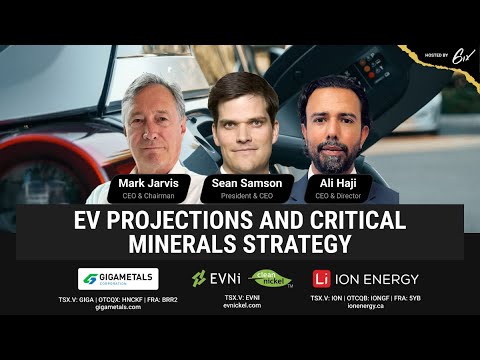
0:07 Hi everyone and welcome to today's live panel focused on electric vehicle projections and critical mineral strategies. I'm joined today by the president and CEO of EV Nickel, Sean Samson, the CEO and Chairman of Giga Metals, Mark Jarvis, and Ion Energy CEO and Director, Ali Haji. So just as a note, if you have any questions, please feel free to submit them in the Q&A chat on the right-hand side of your screen today. And like always, this event is being recorded, so you'll be able to check it out again in the next couple of days on SIX.com. But gentlemen, before we begin in earnest, I'd like to go around the room for just a few minutes introducing yourselves and your projects before we dive in. Ali, would you mind kicking us off? Sure, thank you Cam And thank you for everybody that's dialed in. As Cam mentioned, I'm Ali Haji, Chief Executive Officer and Director of Ion Energy. Ion Energy is a company focused on building a diversified lithium portfolio in jurisdictions that matter most. We have 2 assets in Mongolia. One is on the cusp of an inferred resource. And we recently acquired an asset in the Northwest Territories, the Bliss Lake project, which we're very excited about to start exploration this summer.
1:10 Okay, great. Mark, over to you. Well, we've got one of the world's giant Nickel and Cobalt resources. Our joint venture partner Mitsubishi Corp is in town right now. And in fact, right after this, I'm going to a meeting with Mitsubishi and our engineers, Tetra Tech. We're very close to being finished our preliminary feasibility study within a month I think.
1:36 And I can tell you that it has done a significant job of de-risking our project. I think it's going to be a very interesting document and an absolutely critical milestone for our company. That's awesome to hear. And Sean. Hi, Sean Sampson. I run EV Nickel, Toronto based, and our project is just outside Timmins, Ontario. And we have an enormous land package with nickel mineralization. We have a couple tracks there. One is a high grade track where we had an historic resource that we've been drilling off the last couple of years. We're coming out with an updated resource later this month. So that's the W4. And then on my second track, I have a low grade, near surface, enormous deposit. Mineralization goes for 10 kilometers. We
2:28 drilled the first 20 percent And we came up with 1 billion ton resource. It's at 0.25. So we've got 2.4 million tons of nickel contained in that resource. But again, that's only the first 20%. So those are the 2 tracks we're working on. And then we wrap it all together With R&D we're doing in the lab, mostly funded by government money around clean nickel. That's our trademark term and that's where we spend a lot of our time. Okay, great. Well, gentlemen, now that we're all introduced, we're going to start with the big question from the news this week. As China is experiencing a slower than anticipated rebound and likely bear market generally is existent, will the world meet the forecast that half the world's cars bought in 2035 are going to be electric? Do you think so? Do you not think so? I open it up to the floor.
3:19 Well, I'll jump in then. Yeah, China's interesting everybody. I mean that that that whole 0 covid policy was so dumb and and then they decided well, let's throw that away Probably 1 million people died. We'll never know. And then everybody was expecting a big bounce. And there certainly is a bounce in the Chinese economy, but not as big as people were hoping for. So that has impacted a bunch of things. But despite that, I mean, that's a few months. I mean, I think this whole EV revolution is something that has consistently
4:03 played out faster than even the most bullish prognosticators expected. It's just, that's just the way it's going. And I think it's going to continue to go that way. Yeah, I think I'd echo those statements as well. Looking at China, it's always been sort of racing ahead of what the expectations have been or the estimations have been. And with the IEA estimating 60% of all vehicles in North America and Europe being electric by 2030,
4:33 I think we're well on track towards that. So like Mark said, it's a small blip. It's 1 that's sort of expected. Not everything runs at, you know, 100 percent capacity. You do have these ebbs and flows and I think we'll still achieve that goal. Yeah, I echo that. I think focusing on the IEA numbers, which have the global in mind, it's, this is really sort of short-term noise. The reality is the world is transitioning to a different way to drive ground transportation. And I think that this will just be a blip on our way to depending on electricity for moving vehicles as opposed to internal combustion engines. So I've got some numbers here that I think are quite recent. This is a very recent benchmark report.
5:21 Global EV sales grew 59% year-on-year last year. And that was in the face of the 0 COVID policy in China. I mean, China is leading the charge. But these are crazy numbers. But they're real. This is 2022. What's happening in 2023? Well, we'll have to see. But I just suspect that it's just going to be crazy. Okay. So the train is on a roll. Then, you know, the next thing I want to dive into, and it does sort of play into this, but just given the general geopolitical landscape now, and the fact that some key battery metals are concentrated in just a few countries. Do you guys believe that the current critical mineral strategies that countries are adopting are going to be enough to change the uneven playing field and de-risk the battery metals economy?
6:13 I think they're heading in the right direction. There needs to be more of them. And you see that when you look at the IEA scenarios where they have the stated policies and where they get us and then what needs to go beyond that. So I think what we're seeing is really just the beginning because it seems as though politics levels of politics of all stripes are all in line with the requirement that this is one of the key parts towards climate change. And
6:43 if I think that different political, different parts of the political spectrum can agree on that, then I think that there's going to be ongoing consistency from governments of different stripes. And I think this will all just continuously add and try to get us closer and closer to what has to happen. Yeah, I do agree with Sean that I mean the politicians are saying the right things and thinking the right way. Execution is everything though. And so, you know, so for example, you know, the U.S. Is putting, is making a lot of money available and also through the Defense Department to develop critical minerals. Up critical minerals.
7:32 But it's a bureaucracy. I mean, holy smokes, is it a bureaucracy?
7:36 You know, if you want to access that, you need to hire someone full time that knows what they're doing and work 60 hours a week to do it just to, You know, so anything that comes from the government comes with a bureaucracy.
7:50 And in Canada as well, the politicians are saying the right things. Fingers crossed that they do the right things, because it's necessary, for example, with permitting to change things in order to make development of critical minerals. I think, you know, just to add to that, I agree with the panelists. You know, it's important that we have a secure supply in various jurisdictions. You look at the world today and lithium consumption, over 53% is consumed by China, yet it comes from LATAM or from Australia. It's shipped 15,000 nautical miles away to that market where it is required. And what we're doing at Ion Energy is really trying to diversify our portfolio to be in those jurisdictions where it may be required so that we're abiding by those government strategies and principles. And we're able to supply that local market given our assets are in those local markets as opposed to 15,000 nautical miles away. Bureaucracy, absolutely big problem.
8:50 And sometimes the government tends to run before it can walk. I think that was evidenced when the government announced the critical metal strategy back in October last year that prompted an organization that's listed on the TSX with an asset in Chile to look at divesting some of its shareholders. So yes, you have to be very concise with this and you would need somebody working, you know, a good 60 hours a
9:12 week as Mark pointed out to ensure that it's executed correctly first time around. Okay, fair enough. So definitely hurdles to be looking forward to. And there's a couple of questions coming in from the audience actually right now that I'd like to address just while we're kind of on that topic. But Mark puts it succinctly, where is everyone going to get the power to charge the vehicles?
9:32 Rock is asking, are you working in the energy generation space as well as the battery space? Great to have batteries, but you need to film with something. Any comments? Yeah, I can comment on that. So that's a great question, Rock. That sort of hits the nail on the head. We can do all we can to put electric vehicles on the road, but if jurisdictions are burning coal to generate power, and that's how we're charging up the vehicles at night, that doesn't really help us with the overall cause. So I think that has to happen in parallel. It's also a knock on for not only do we need the power to be able to energize those batteries once they're built, but also when we as mining companies are looking for where we're going to be developing future assets, being in places that already have clean power generated, for example, hydro in Canada, we will want to be locating our mining assets near those because the new carbon accounting is going to bring in everything.
10:30 So we're incented to have clean power generation, not just around
10:37 how our batteries eventually get charged, but also for our businesses to ensure that our inputs are lowest carbon possible. You know, and we're not just answering the question directly. We're not involved in the power generation. At the Giga, we are involved in, shall we call it lobbying, to get the BC Hydro power line extended up Highway 37,
11:06 which would open up all sorts of generation activities. The Cascadena who are in Northern BC and in the Yukon have run a river opportunities. They've got a huge amount of geothermal potential. And so, you know, as much as possible, if we can be opening up the grid to these, you know, clean energy
11:34 opportunities, that's good. So we're talking to all sorts of people because it's in our direct interest for the power line to come on up Highway 37. I guess I suppose to touch on what I spoke of earlier, you know, putting something on the back of a bunker burning ship and saving it 15,000 nautical miles, that's not a good environmental footprint. Given the fact that our assets are in Mongolia, which almost 99% of their power is generated from coal, of course is a big negative from a carbon credit perspective. But in the Gobi, you have an environment that allows you to use wind and solar. And so they are building 1 of the largest wind farms in Asia in that region, which will of course offset that carbon credit. And then if you look at the Northwest territories, the vast majority of power that comes from there is hydro driven.
12:23 So there is the potential to be clean, but finding that jurisdiction, and then again, working with the government and the lobby groups to bring those clean green energy power solutions online is something that needs to be done as well. OK, fair enough. You know, definitely hurdles that are out there. This question is, you know, can you like considering the potential for economic recession? Can junior companies focused on battery metals like lithium and nickel afford to withstand the financial challenges that might arise? How can they adapt their strategies?
12:53 How are you guys planning on potentially adapting your strategies to remain competitive in a changing market landscape? Yeah, that's a really good question. I mean, you know, the market has been bad for juniors for, it seems like my entire lifetime. No, but for about the last year, it's been a tough market for juniors. And if you've got, you know, really, really big, you know, CapEx intensive projects, there's no other way. You really have to find a partner that's willing to come in at the project level. And so that's necessary, because I'm not holding my breath waiting for government money, that's for sure. Yeah, I think becoming more creative is the theme.
13:42 Partnering up, as Mark says, tapping into different sources. So far I've had pretty good success getting early stage government money. But when the real numbers come down the pipe, if the market continues to be as dry as it has recently been for traditional equity financing, then we definitely need to become more creative.
14:02 But I think that even before the recession you mentioned, we're already there from the perspective of junior minors. As Mark says, it's been a hard market for a while and it's forced those that are alive right now to have become more creative. So I think there'll just be more of that. And especially as we all transition along the stages of development and the numbers become bigger, those more creative sources of funding are going to put us in better position.
14:33 Yeah, I'd echo those sentiments. I think, you know, junior mining is, requires a thick skin. And I've learnt that firsthand having co-founded ION and sitting alongside some co-founders and chairman myself here. But you have to have a credible team, a seasoned team, 1 that can manage the ebbs and flows of junior mining. It is not like turning on an application that you put on the Apple store that you can turn around in a week. These things take time and you have to be dynamic. You have to be able to weather the ebbs and flows. No, fair enough. And, you know, talking about dynamism and being creative, like Sean said, Oren has a question here and I think it ties in neatly to this. It's a bit specific. He's just wondering about going forward in regards to investment from potentially bigger mines. Is that like a part of the plans that you get to allow you guys to grow? Or do you think that you're going to be able to do so without that?
15:25 Are you anticipating buyouts or MNAs with bigger miners? And if this is the case, How do you think that's going to affect share price in the next 5 to 10 years? Well, we, you know, we do have NDAs in place with quite a few companies that include a couple of large mining companies, you know, as well as car makers and battery makers. That's kind of where our focus is. So, yeah, I think it's going to take big money. I mean, we're looking at a $2 billion project, US. So, how are we going to do that? We're not. It's going to be,
16:08 and car companies don't want to run mines. They have realised that they need to be involved upstream, but they're not in the mining business. So I think everybody would rather see an experienced producer build the mine and produce it. And yeah, I think that's where it's going to go. Any comments, Sean or Ali? Well, the mining circle of life has historically been that companies like ours develop them along to a point and then get picked up and taken out by a larger company. I began my mining career working at one of those larger companies growing by acquisition. So acquiring smaller companies that had advanced to belong. So that's historically been the way our industry has gone. I think a couple important things to note.
17:00 One would be, you're never sure if that's going to occur, but you've got to make sure you're building and you're planning the thing from the beginning, the right way. So it could potentially be you're the one in the shoes or it's in better shape for a major to be taken out. So back to Ali's point about having the right team around you, you need to ensure that you've got the team that has the experience of knowing what good is. So you're always targeting that as opposed to just packaging things up for the shuffle.
17:35 And I guess my second point is that's something that investors should be very aware of is that there are many companies that are trying to jump on to say the bandwagon for what it's worth of critical minerals and the excitement around that, but without necessarily an eye towards what that next stage looks like, knowing that from their perspective they're just going to be passing it off to someone else. So it's an important thing for investors to keep an eye on as to where these companies, where they're at the stage and the size that ours are, where they're headed to, because you want to make sure companies have their eyes open, as Mark says, that that's likely what's going to have to happen because there's big dollars involved, but that also means it needs to impact some of the moves you're making at these early stages.
18:23 Precisely, Sean. And I think the big money requirements are one thing, but of course, the skill set is another. And you may have a team that's very focused on exploration and bringing an asset perhaps to feasibility where it can be built but ultimately building and running it much like Mark said you know auto
18:37 vehicle manufacturers don't know how to run mines and some junior miners know how to explore and get assets to you know infer or even feasibility stage but they ultimately don't know how to build. So building a mine, and particularly in the lithium space, is a bit more complex than perhaps a hard rock project, purely because there are various reagents that are involved and various technologies that may need to go into the extraction. So understanding that skillset, or the gap in your skillset and having that vision, I think is extremely important to being successful. You know, if I can jump in on that point, Ali, you know, in terms of skill set, you know, I don't even believe that every large mining company knows how to build mines. That has been lost and particularly on budget.
19:24 There's been some remarkable budget blowouts. So, I think it's possible for a junior to attract that skill set, I mean to build a mine, you need to hire one person. It has to be the right person. It needs to be somebody that knows how to build a mine and that person will bring a whole team with them. And similarly, to run a mine, you need to hire one person. And you can afford to pay them a lot. And so, I mean, a junior, if it was properly backed financially, could do it. And if they hired the right people, and that's a huge if, they could do it better than a lot of majors have done.
20:16 Okay, fair enough. Absolutely. You guys have all, well, you've been touching on it, especially. This next question is in regards to those auto manufacturers. How far down the supply chain are they willing to invest in order to secure the necessary battery metals for their electric vehicles? And Mark, I think I'm going to pass this over to you just to start us off, seeing as Giga has such a strategic investor. Okay, well, Cameron, I think you mean up the supply chain. Maybe I do mean that. Thank you. Well, I think the automakers are getting more and more serious all the time. We're talking to one of them that has a whole team of mining engineers, metallurgists, geologists, and they're serious about investing upstream.
21:03 So it's just a question of which project they choose. You know, some of the car makers know that they need to invest upstream, but they haven't hired teams yet. So, it's gonna be interesting to see who survives amongst the big car makers. I think some of the big car makers won't make it. They will be present in a much diminished form 10 years from now. And I think the ones that are moving quickly to secure upstream supplies, and particularly of nickel and lithium, those are the 2 bottleneck
21:45 metals that are in the supply chain. I think the ones that move quickly will do well. And the ones that are just kind of, yeah, yeah, yeah, I got to invest upstream, but they haven't done anything about it. There's a danger that they could be left in the dust.
22:05 And this may seem, so Mark, I agree with that. And it's interesting to discuss this point. Because when you're talking to the car companies, you do see radically different levels of expertise on their side. And we're in the same sort of labor crunch as they are in a way, trying to find the right people, whether it's on our teams to advance projects or whether it's on their teams to try to assess our projects. So it's interesting though to say that
22:33 this may be the sort of thing that sets the car companies up for differences going forward. And some may not survive, because if you look at it, as they are all consistently planning to pivot over to electric vehicles and we know very well the situation on the supply side for these metals, you know, that crunch and ones that are much better set up going into that crunch may actually, as you say, differentiate and lead to consolidation on the car company side. That's interesting to think about. I'll echo both the sentiments made here, but I'd also say that the auto vehicle manufacturers are indeed paying attention. The likes of Mitsubishi and Mitsubishi Mark, of course, as you know, is a multi-tentacled organization that does just about everything.
23:26 But the likes of GM and deploying capital with Thacker Pass and Latino Americas, that's a prudent move to ensure that they have their critical supply aligned for their growth strategies. Tesla has looked at nickel, Tesla has looked at a few different things already. So they are paying attention and they are looking at juniors. Baccarpas is a LAC project that's a bit beyond perhaps a junior state, but it is 1 that's receiving $700 million from GM. And so they are paying attention. I think that's gonna help to bring these strategic centers of production online and ensure the supply chain for the necessary elements required for the transition.
24:04 Okay, great. All right, gentlemen, so we've talked about the strategic investors, the big boys, but what about the more broad investment base now, especially in the absence of deals with strategic investors, are battery metals-based junior companies experiencing enough interest for survival, not only survival, but growth?
24:23 Boy, it's it's you know, that is a tough one, Cam. I mean, I look at you, I look at our company, I look at Canada Nickel,
24:35 FPX, I mean, FPX announced a deal with Otukunfu. Now that is obviously leading towards more of the stainless market than the battery market, because that's what OtoKunfu does. And Canada Nickel announced a deal with Anglo and we've got a deal with Mitsubishi. What's it done for our stock prices? Almost nothing. And in fact, we got 3 days of volume out of our announcement and that went right back to where it started and below. So I don't know what it's gonna take. Maybe it's gonna take
25:18 what it always takes, which is 1 company doing extremely well, its shareholders make a ton of money, and then everybody gets driven by fear of missing out. So it just hasn't happened yet. I think it's going to happen, but who knows when. Sorry, Ali, go ahead. Yeah, no, I was just going to say, I agree. Signing a strategic deal sometimes does not help your share price. And I think that may have to do with a number of things, including perhaps market sentiment here in the Americas with interest rates and everything else rising, people have margin calls, and the general cost of living increasing. Folks have bills to pay and things to do. And as a result, there's just no love in the junior equity markets or even the broader equity markets right now. But in terms of investment coming from additional sort
26:12 of sources, we're now seeing organizations like Lithium royalty corp that's backed by Warrata. There's a $165 billion IPO, 1 billion dollar market cap today. But they're deploying capital to juniors in the literacy space specifically that gives them the ability to advance their asset just a little bit more while taking a bit off the top in terms of a royalty. But there are these additional funding sources that are coming online that I think will help those with sound teams that can execute and really turn it around for their shareholders. I also want to add that the institutional market is notably absent, particularly for companies with a smaller market cap.
27:00 So for example, I think we're sitting around $25 million market cap right now, which is crazy.
27:07 But if we had the same story, the same asset, the same partners, and we were sitting at $150 million market cap, the institutions would be buying our stock. So, you have to be more expensive before the institution will start buying, because they'll just look at you and go, well, there's not enough liquidity. It's always been like that. It's always been crazy. Like, they don't want to buy it cheap. They want to buy it more expensive. It just, that is the way it works. And so, you know, at a certain level, you can start getting into the institutional market. And this is not my first rodeo. I've done this before where you move up from a micro cap to a small cap to a medium cap and you get ever more institutions and fall.
28:01 So, but that is missing, particularly from the smaller end of the junior market. And that's the investor side. It's a similar sentiment on sort of the strategic side, from my experience, whether it's the car companies or the majors where you'd be talking to them about your asset. And as Mark describes, it's almost as though they want you to revisit them when it's more expensive, because then you're up to sort of the level of justification of doing work, which is a really sort of perverse bit of feedback where you're talking about a project, which is at a point in time and you want to be advancing it along. And we're talking about they'd be interested in that same project at this point in time if it was just more expensive. You know what I mean? Because then it checks the box. And this is having worked at major mining companies. This is sort of big company stuff.
28:55 It's at what point do you allocate work towards a potential investment? And it's almost as though you just need to be more expensive. And I've heard this explicitly from major miners that were inside on. You just need to be more expensive to check the box that then it's worth their time. So there's strange things happening. But net net, we all need to be just more creative about the pools of funding we're going after. OK. No that's awesome and appreciate the conversation guys. So I mean if anyone's just tuned in obviously we have representatives that are both working with Nickel and Lithium both commodities which have been labeled as critical minerals from the Canadian and US governments. So I'm asking you if projections are anywhere near half of all cars for 2035, which I think we all agreed that's definitely reasonable.
29:44 There's a significant supply gap on those commodities. So what do you guys think that needs to happen so that we can tighten up that supply gap? You got to build mines and you got to be starting now. So, you know, and I think to a large extent it's going to happen, but not to enough of an extent. You look at Nickel prices in the next year or 2 and you go, okay, well, it could be slightly in oversupply, it could be slightly in deficit. And I don't care, because what I care about is what's the nickel price going to be in 5 years? What's it going to be in 10 years? And I don't think there's any doubt. The price simply has to move higher to incentivize construction of mines.
30:32 And the nickel price has moved higher over the last couple of years in general, but just enough to barely incentivize building of new projects. I think, you know, it's got to be, you know, you almost got to hit him over the head with a baseball bat to wake them up. And again, one of the companies has gotta make a ton of money for its shareholders to stimulate the whole market. And I happen to believe that's going to be our company. So there you go. Yeah, the snowball will be great to get us all rolling, But yeah, it's pretty straightforward answer, Cam, to get supply of any of our metals at some point in the future, like 12 years out.
31:24 You need to have projects identified on the shelf and you need them coming off the shelf and being developed into operations. You know, it's pretty straightforward, our business, to actually get metal to demand. But it's all the steps up to that which are not straightforward. And it's, you know, we need to be doing enough exploration to be identifying more projects. The projects we know about now need to be advancing. All these things need to be happening if our business is going to be able to supply that required critical metals, you know, 12 years out. I echo what Mark says. I don't open up the newspaper and focus on the nickel price. And it's actually I struggle with how to respond to investors about questions about the short term nickel price, because like Mark, I don't care.
32:09 I believe the macro story and I'm building to fill that demand. Or I should say I'm working towards filling that demand. I suppose I'd echo both those sentiments, but on the lithium front, we've seen the price run to exorbitant numbers over the last sort of 18 months or so, down 60% now. But we still need more mines. Then the pricing was heavily dictated by a surge of contracts in China that are not truly based on any offtake or any market indications. So the price of lithium coming down now, I think is a great thing. I think that'll still incentivize additional miners to come online and fizzle out those that perhaps we're looking to produce at higher prices, much like the oil sands in Canada. So that's the price paradigm. But beyond that, I think the government, alongside the private institutions, can do something to build perhaps refinement centers or smelters in a region where various juniors exist so that they have the platform for their raw materials to be processed and brought into market. So it's sort of a public-private cooperation as well as the coming together of all the juniors to help facilitate that supply gap that brings us forward.
33:23 OK. So as demand for EVs is growing, there are also concerns about the environmental impacts as battery metals mining increases. What steps are being taken in the industry to adopt more sustainable and environmentally friendly mining practices? And how might these changes affect the overall cost and supply of these metals? Well, You've gotten onto one of my favorite topics here. So if it's OK for me to lead off back on this is you look at where most of the nickel's coming from in the world now. It's Indonesia. And the environmental practices there are obscene. That's, I think, the word for it. They're strip mines, they're mowing down tropical rainforests, they're dumping tailings into the ocean.
34:10 It's just all about what's the cheapest way we can get this stuff out and into these batteries, and it's largely the Chinese that are doing it. So if there's lots of electric vehicles in Beijing, well, hopefully some of that smog will clear up. But what it's doing in Indonesia is horrible. And also, the carbon intensity of the nickel that's mined out of Indonesia is crazy. I mean, something like 60 tons of CO2 per ton of nickel is produced if you take nickel pig iron and then convert it to matte and put that into the electric supply chain.
35:05 And even the HBAL projects, the nickel or the carbon intensity is about 20 to 25 to 1. Now in Canada, A lot of the projects that are similar to ours are big sulphide projects, big low-grade open pitable sulphide projects. The tailings will actually absorb CO2 from the atmosphere. We think we've got a path to get to carbon neutral. And also, in Canada, we've got really high environmental standards, which is, in strict economic terms, uncompetitive, because I can get a permit in Indonesia very quickly. In Canada it's a long process. Now, they're talking about speeding it up, and I hope that the actions follow the talk.
35:57 And what I suggest is that Canada should adopt more of an Australian model where you can do a thorough, effective environmental assessment in 2 years. So, you know, I think there is a solution there to make Canadian assets more competitive economically with Indonesian assets. But also, you know, the downstream buyers should care about carbon intensity and environmental damage in the near term, they don't. So we also have to be not only environmentally better, but we also have to be able to compete economically. Yeah, I think that gradually the demand is getting more focused on this.
36:45 And that's really the way that we're going to change the way we do supply. So with on the carbon front versus the sort of broader environmental on the carbon front, with the change in the legislation in Europe, as of January of next year, every vehicle sold in the EU is going to be stamped with its carbon cost. And this is what the car company has been talking about for 3 years now. It is real. It's approved. It's happening January of next year. That's 2024. And then subsequently, they're going to start having targets and turning the screws on the car companies. So all of a sudden, there's this calculation of the carbon cost for all the inputs, including in the battery electric vehicles, the big slug of metal that's going to be going into those. So when you go into a dealership, a Volkswagen dealership in Germany, as of January, you're going to have an internal combustion engine car and a battery electric vehicle car that's going to have a higher footprint, a kilometer 0 than that internal combustion.
37:44 So At least in the European market, it's becoming very real very quickly. The focus on the carbon cost of all the inputs. But we've got to think about whether that's going to be approved elsewhere around the world and become the trend. That's on carbon costs. Then there's the broader environmental calculations. And the more you dig in to whether it's Indonesia or Philippines, it's as Mark says, that we're getting nickel out of the ground at huge environmental cost. And perhaps it's clearing the air in the Chinese cities, but it's really just transferring that terrible problem to another market. So for how long that can continue, not sure. But surely the way the world is going is towards ensuring that we get environmental benefit out of this thing we're doing by electrifying ground transportation and not just shifting it from 1 market to another. So I think all in, these things are very real, whether it's because of jurisdictional requirement like car makers in the EU and maybe other markets match that, or just generally as well, better transparency of what the overall environmental impact is.
39:00 And I think that's the way the market's going. And it's great news for clean projects. And that's why my company is so focused on clean nickel and all of the R&D we're doing away from the exploration R&D. That was great, Sean. And yes, it's fantastic that we're gonna start to track just how much of an impact we're having per vehicle per ton of metal produced, so to speak. And that's why I think, you know, with what we're trying to do with ION is looking at very localized supply chains. So we're not looking at assets that are halfway across the world in order for us to ship our product much like Indonesia or everybody else would be shipping to North America. With Mongolia we're focused on China. With our Canadian acquisition we're focused on North America. And I think as far as lithium is concerned, if we're talking about environmental impacts, the industry is making great strides towards using direct lithium extraction.
39:53 And that would have been a very conceptual pipe dream perhaps 5 years ago, but it's now gained enough traction. And for those of you that are not familiar with it, DLE is essentially where you pump up the underground solar or paleo solar up to surface to a plant, a processing plant, that ultimately extracts the lithium ions from that brine. And you pump back between 95% to 98% of that spent brine back into the aquifer. Whereas historically you would have done so with evaporation ponds that are not only massively capex intensive but also cover a fair bit of acreage, so you're destroying ecosystems, which is of course environmentally damaging. And then through that evaporation process, a lot of that water ends up in the atmosphere as opposed to being returned to that water table. So there are these improvements that are happening in the mining space, allowing us to be more sustainable as we continue to get these necessary minerals for the transition to electrification.
40:46 And that'll continue to happen. And DLE being a pipe dream 5 years ago, much like everything else that we do today, technology is exponential. And it grows exponentially. So we're going to start to see these improvements that affect the environment in a positive manner come online a lot quicker as we progress towards the electrification of our planet. Ali, do you have an opinion about which DLE technology is going to take the lead? Well, it's hard to say. I'll tell you that there's a group in China that's been doing it for quite some time, well before the rest of the world comes online here, and that's done resin. There's Lilac Solutions. They've done a fantastic job with a number of juniors. There's also Aramit, which is a French mining company that is, I believe, already broken ground in Argentina in Centenario, and they'll be online next year in 2024, producing between 20 and 24,000 tonnes per annum of lithium carbonate.
41:44 So there have been those advancements, and I think we're gonna start to see that come online in a major way as of next year. I find that really interesting. Just kind of talking about that, there's a lot of ongoing research, obviously, and development in battery technologies. I think this would be a cool opportunity to talk about what potential breakthroughs or alternative materials that the panel here thinks could significantly disrupt the current battery metals mining landscape. How do you think that the industry should prepare for such changes? And I mean, like, yeah, what directions do you think it might go down? Well, I think if you're producing lithium, you're pretty safe. And particularly, in fact, as you know, I think the big breakthrough is going to be when when they develop solid state lithium ion batteries, that'll be great for lithium, obviously, but also for nickel, because with a solid state battery, you can really pack that, you know, nothing can compete with nickel in terms of energy density and so you know, there's all sorts of new technologies.
42:52 There's sodium batteries and so forth. There's also LFP batteries, which don't contain any nickel. But LFP is an excellent, safe technology. You can recharge it a lot. But it's heavier and less energy dense. So you're not going to ever get the range with an LFP battery that you get with the nickel chemistry. And then in terms of other technologies, generally, if you can make something work at the lab, you are at least 20 years away from commercial production, assuming that you can make it work in the lab in the first place. So I think the whole lithium ion battery story is safe.
43:43 And the evidence is, I mean, look at all of the Gigafactories getting built. The people building and spending billions on Gigafactories, believe me, they're aware of all of the emerging technologies and they're placing their bets on lithium-ion. Yeah, I think when we talk about battery chemistries, I think the energy density of nickel makes it relatively safe. I'd also highlight that the current winning chemistry, the decisions that a lot of these car companies are making are to tool up for this chemistry. And as Mark says, an idea in the lab takes 20 years to sort of hit. And we've got a lot of time to go before the ideas in the lab around battery chemistry change the game as to what the demand is going to be. So what we're working towards to supply, I think that track is relatively set and we need to find the lithium and the nickel to be able to supply into that.
44:43 So I know there's a lot of interest and excitement around new potential battery chemistries. But I would just, the way I think about that news is, A, it's a long ways off, and B, it's an enormous potential pie in terms of trying to electrify ground transportation. So even if there is a new chemistry or an old chemistry like LFP, LFP plays a role, and I've heard this from car companies, it plays a role, but it's still not taking a majority share of the pie. And it comes back to energy density and the winning current chemistry, which is nickel and lithium intensive. These car companies are gearing themselves to require this. And yeah, I echo the vast majority of the statements here, the lithium, the LFP battery has been around since the 50s, so it's a tried, true, and trusted mode of power. As you introduce these new technologies that are born in a lab and take 20 years to come to commercial operation, you still have an adoption rate issue. So your consumer needs to be comfortable with that technology before they start to adopt it. It may have uses beyond what our traditional lithium ion batteries are today.
45:53 And it's a good way for us in this industry to continue to push ourselves to improve the technologies that we currently have. So competition, in my view, is a healthy thing. But I do believe that the lithium ion battery is here to stay and lithium will absolutely play a big component or continue to play a big part of that of that electrification. And Cam, if if it's okay, I realize I just see a question in the chat. I want to make sure that we weren't sort of misunderstood around timelines. We were talking earlier about 2035 as being sort of a nebulous focus point, thinking that the value of our price of our metals is likely going to be much higher by then because of all these changes that are underway. But Patricia I would think you know what we are doing now and how we need to move our companies along to address that challenge certainly is going to be advancing the investment opportunity within our companies and should begin realizing a return for investors well before 2035. So I don't think anybody on the panel is proposing that by 2035 is when we'll start seeing returns. You know, we need to be peddled down on the work we're doing now to be able to address that challenge. And frankly, moving our projects along at such a speed that should be recognized by the market as we move them along. So I just wanted to address that question that came up in the chat.
47:21 No, no, that's perfect. Absolutely. Mark, Ellie, if you have any comments on that, or we can go to a next question. Well, it was also another question I saw go by about positive engineering reports. Do they really affect the market? I expect, as I say, we're expecting to get our pre-feasibility study out in July. I know we have significantly de-risked this project, particularly in terms of metallurgical recoveries and understanding how much recovery we can expect from different parts of the deposit significantly de-risked. And that is important to the strategic investor.
48:10 Whether it's important to the retailer or the institutional investor, we'll see. We'll see. It might be. But I tell you, to the people that might be thinking about putting up US$2Bn to build something, de-risking is extremely important. And again, that's where our project shines is that it's so, the processing circuit is so simple and therefore so low risk. So most of our de-risking is focused on the deposit itself and what we can expect and predict from different parts of the deposit. No, absolutely. And Mark, that comment as it went by referred to the Lassonde curve. So it's important to note that the Lassonde curve, I think, is really focused on solely retail and institutional investment side. What we're talking about getting more creative and tapping into, whether it's the strategic investors and or the car companies, These are the real users of the nickel, the market participants.
49:21 And once you get them involved, I think, as you say, anytime you advance your project and make it more real, those real investors see that value And to them, it becomes more valuable. So the Lassonde curve is a wonderful way to assess for an investor where a project goes by stage. I don't think necessarily in this market it directly reflects what goes on because we don't have anybody paying attention to these earlier stages. The Lassonde curve should say we should be attracting more attention, but it gets even more complicated comparing to the Lassonde curve when you factor in these other pools of investment, which are really focused on, is the project more real today than it was yesterday? And if today you come out with an engineering report to those investors, my sense is it becomes more real. So We should begin seeing a realization in the market value. If we don't, rest assured, these other pools of capital do see value in it.
50:27 Yeah, I do get the sense. I think We've got a room full of strategic investors on the edges of their seats waiting for our EFS. And I can hardly wait to get this thing out. Anyways. No, absolutely. Just seeing how the question he was just wondering how accessible are U.S. Critical mineral public funds to Canadian companies for Nickel, Lithium, Cobalt, etc.? I think, Mark, you were talking earlier about the workload required to tap into the DOE. It's bureaucracy. And again, I'll just repeat what I said before. You need, if you want to go that route, you need to hire someone full-time that knows what they're doing. So it won't be a small ticket salary. It's just a lot of bureaucracy.
51:20 Is it worth it? Well, maybe at some point. We're not spending a lot of money or time pursuing that right now because it's just too expensive to pursue and you don't know the outcome. So No, that's fair enough. I mean, listen, gentlemen, we're coming up a bit closer to time. So I do wanna offer the opportunity for each of you to describe any upcoming catalysts, what news you're looking forward to with each of your projects. So maybe we'll go around the room spending a couple of minutes doing that. What's near? What's upcoming? What are you excited about? And Sean, I'll pass things over to you to get us started with that. Thanks Cam. Yeah, So my project with EV Nickel and the Shaw Dome property just south of Timmins, on our first track, our high-grade, we are about to come out with our updated resource on the W4, which is pulling together all the data and the drilling we've done over the past year and 0.5 on the W4. So we proved that it went deeper. So the historic resource was down to 200 meters from surface at 1%.
52:27 We think it's going to be at least double that going deeper. Plus on the eastern flank, we've come out with data saying this thing is bigger. So watch for that news that's coming out before summer. So later this month, that's on my high grade. On my low grade, I continue to sit on the first 20% came out with a resource of 2.4 million tons contained nickel in the ground, which works out to that just first 20% is the fifth largest undeveloped nickel sulfide project in the world. And on an enterprise value basis, per nickel resource ton in the ground, we trade at $1. And the average of the 10 largest projects in the world are close to $200. So there's a massive value disconnect.
53:14 Nothing's been acknowledged in terms of this resource we've come out with. So we're going to continue to be talking about our low-grade resource on the car lang. And then we've got tremendous news coming down the pipe as well, as we get smarter in the lab on our clean nickel work. We haven't talked about it in this discussion, but the bio leaching, which is really a rethink of a way to recover the nickel. We came out with preliminary results on that, looking forward to new, better news on that coming down. And then I have the carbon capture and storage, which Mark mentioned similar to his on the low grade deposit, the car laying as a potential to capture an enormous amount of carbon. So that's my news on the 2 tracks and then the clean nickel. I appreciate it, Sean. Mark, why don't we go over to you? Pre-feasibility.
54:01 That's it, I expect it within about a month. And it's a major milestone for us. It's huge for us. So that's really all I need to say. Fair enough. Short and succinct. And Ali, over to you. Thank you, Ken. For us, for Ion Energy, we have Urgak Nurun, that's very close to an inferred resource calculation. It's in Nongobi province in Mongolia, 29,000 hectare licence located very close to infrastructure, around 7 kilometers from the national grid, 25 to 30 kilometers from high-speed rail into China. But importantly, from a volume perspective, we've seen about 22.7 billion cubic meters of low resistivity at 6.5 ohm, relative to our peers from an EV perspective using a metric that Sean would have used. We're trading at about a 20th of what the closest competitor had in terms of that volume. In terms of grade and historical drilling we've done on site, we've got almost 3x higher grade than Albemarle Silver Peak in Nevada, which is the only operating brine asset in North America today. And then of course, we're going to start to focus very much on our Northwest Territories pegmatite deposit here in Canada over the course of the summer as well. So busy couple of quarters to go with significant catalysts that hopefully allow us to re-rate in a positive manner.
55:25 All right. Well, gentlemen, that all sounds amazing. I'm really happy and glad that you're all able to come on today. I think it's been a great conversation, a great panel discussion. I do want to make a note to everyone in the audience. Thank you for joining us. Thanks to everyone who asked questions. We have received a lot of questions, unfortunately, that we weren't able to get to just based on time restraints. So I'll be passing those along to the gentleman here so that maybe you can get answers on your queries. But with that, we are done for the day. I want to thank you