Transcript
Automated transcript · Written by software from the replay's audio. It can mishear names and figures; the replay is the record.
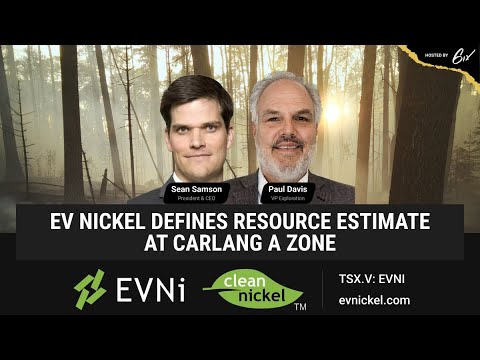
0:07 Hello, good morning, everyone. Welcome to EVNickel's live summit today. I'm pleased to introduce their president and CEO, Sean Sampson, and their VP of exploration, Paul Davis. Sean and Paul will take us through a company presentation. After that, we'll be accepting questions. As a reminder, you can submit your questions on the Q&A panel at the right-hand side of the screen at any time during the presentation. If you'd like to get in contact with the EVNICO team, feel free to fill out the survey linked in the chat. As always, the summit is being recorded and will be available live at six.com to watch afterwards. Without further ado, I'll hand it over to Sean
0:38 and Paul to get kicked off. Great, thanks, Romeo. Thanks, everyone, for joining as well. Uniquely, Paul and I are in the same place today. So with the busy meetings for PDAC and pre-PDAC, we're downtown, so we're doing this together. We're gonna run through some slides which are available on our website. For folks new to the story, I'll start off just with a general overview of why we're doing this and what we believe. So from our perspective, there's not enough nickel for the electric vehicles that are planned for the market. And we also know that the EVs, they require nickel with a low carbon cost. So that's a new consideration in the mining business. So that's a big focus for us. In addition, there are complications that go beyond just the carbon.
1:27 So that's what really we have stepped in on and we're setting up our business around. So if you look at what's going on in the world with nickel, the EV growth, the forecast for growth, and we've got here in the top left of this slide, sort of what those forecasts are looking forward. And it's a real hockey stick in terms of the expansion. And what that means for nickel is with the current winning nickel battery chemistry, where it's, sorry, the winning battery chemistry, where it's nickel heavy. Nickel right now is primarily for stainless steel. And that looks to be shifting. And there's a date further out where it seems like nickel will flip from being a stainless story to batteries for EVs first. And bottom left, what that looks like for the nickel space is that they're forecasting a gap out in the future, where supply, which they're able to stack up, knowing where the mines are and where production is coming from, supply is not keeping up with demand.
2:26 It's real interesting to look at legislation as well, Where that so far has just really been, can we find the nickel? But if you look at what's in place right now in the EU with the emissions requirements for vehicles, where by 2024, all vehicles are going to have to have a kilometer 0 stamp, which shows what their footprint is. And what that leads to is if you go into a Volkswagen dealership next year, you're going to see the internal combustion engine Volkswagen beside the battery EV Volkswagen. And the big difference between the 2 is going to be the huge chunk of metal in the battery EV for the battery. So the car companies are out ahead of suppliers on this, ahead of the mining industry, where it's very important to them to be able to source not just the nickel, which we know is going to be in short supply, but also 1 with the lowest possible carbon costs.
3:20 And then looking a little beyond carbon, there are guardrails that are sort of coming in on car companies, where supply is becoming very difficult for the car companies and the battery companies that work with them to source. So there's just a simple access issue. With the terrible war in Ukraine, that's taken sort of Russia off the board from all Western companies being able to deal with them. So just accessing the nickel is a challenge. Plus, if you look at the biggest producers of nickel in the world, both Indonesia and the Philippines, there's so much Chinese money involved in those operations that there is concern and I've heard this in meetings, if Taiwan heats up or relations with China continue to degrade, it could potentially lead to limited access to that nickel supply.
4:09 So that's a big chunk of geopolitics. Plus you have sort of the rising protectionism. The Inflation Reduction Act is great news for us, sitting on a bunch of nickel in Canada, because it is considered domestic for the American buyers. But generally speaking, protectionism is a challenging thing, especially for those who are outside the tent. I know that the European, the EU is potentially also including Canada in with future legislation. Again, that'd be good news for us. But just generally speaking, when you put up protectionist walls, it's as though these guardrails are coming in closer on these companies that are trying to source the nickel. Plus there's then also general ESG ones that go beyond carbon, whether that's the massive environmental degradation that occurs in Indonesia with deep water tailings, for example, labor conditions, where in different mining jurisdictions around the world, there's vastly different laws in place.
5:06 And then as I mentioned about this issue around Indonesia and Philippines, who are the actual owners? That becomes murky. And that's the sort of thing that car companies, especially from the West, really struggle with sort of wading into that world and looking for the nickel supply. So we think what's going to happen with all these things occurring is that the new demand, the car companies and the battery companies serving the car companies are going to be coming up the supply chain to try to secure their supply. So what EV Nickel has is an enormous land position. We have over 30,000 hectares, more than 100 kilometers, a very interesting strike, And we have 2 tracks to potential development. Our first track is our high-grade business, where we hope to be starting with the W4.
5:53 W4 has an historic resource on it. We've done a bunch of drilling. We made a discovery for an extension that looks like it's mineralized down below the 200 meter level, down to 500. We're going to talk about that today because that's been some activity earlier this year. And then the big focus this week, of course, has been our second track. That's the large scale, sort of also known as low grade, starting with the car laying deposit, where we came out with a resource this week, 1 billion tons. It's really exciting, especially when you consider how much more there is on the car laying. And we'll talk you through that this morning. And then alongside, there's really neat differentiators with the car lane deposit, where it comes to surface, which when you start thinking about how do you actually get the rock out of the ground, being able to start right in it is a big differentiator.
6:43 So we have those 2 tracks and we wrap it all together with the clean nickel focus. So that's a trademark term we use, and we've got a bunch of R&D on the side, which is going to help us get at the lowest possible carbon cost for the eventual nickel when we're producing. So just to orient folks, where we're talking is Timmins. So an hour flight north from Toronto, a huge mining town, big population, more than 85,000. That has been traditionally one of the biggest, most productive gold areas in the world. So we're just down southeast of Timmins with our huge land package. So we're within 50k, very close to town, a wonderful place to be able to set up a new business. Plus we have historic production down where we are. But the neat thing is this land package has never been cobbled together by 1 company before. So we've got these 30,000 hectares and what I'm talking about today is going to be the large scale, so that's the CAR LANG. We'll talk today about the new resource on the A-Zone and then the W4 deposit which is our high-grade track and that's down in the southern part of our land. Also interesting to note on this slide is just across the street as we say from the W4 is the heart deposit that's 3.5 kilometers away that's owned by a private company.
8:03 The same company controls the operating Redstone Mill. Those guys, we did a transaction with them last year when we expanded our land package. So they're a large investor in EV Nickel, So we're very close with them. And that is a very interesting sort of synergy and business opportunity, especially around the W4 and looking at how the W4 can work with the heart just across the street and then the operating mill down the way. So that's our business. Let's jump in now on track 2, which is the large scale. So on the Shaw Dome, where we have our land, there's 2 opportunities for what we thought were these large scale genetic deposits, 1 in the Northwest, Adam Zeldorado, and then a second in the Northeast, Carmen Langmuir.
8:49 So these are those 2 deposits. And with the MAG maps, you see there's big chunks of mineralization based on the MAG surveys that have been done historically. And this is where I begin to introduce a company and their deposit, Canada Nickel and Crawford. You see in the oval on the bottom left, that shows to scale the size of the Crawford main zone. And when you compare that to the pinks and purples on both of these bag maps, it shows you that the things we're going after are hugely interesting from a size perspective. So we've got the Adams El Dorado in the northwest of our land, and then in the northeast, Carmen Langmuir, which we call Kar Lang. That's where we're going to sink in now. That was our initial focus. So this is the Kar Leng. What really interests me is you see it goes up in that big boomerang over 10 kilometers long.
9:41 It has historic grab samples on this deposit. So based on both the interpretation from the government geologists around the mineralization underground, they interpret a certain way. Plus, this grab sampling, which was done in the past by other miners, was also followed up with drill holes. So we have grab samples and historic drilling, which tell us that it goes for this 10 kilometer stretch. We've been focused in on the A zone. That's where we've drilled, the Carlang A. And again, you see on here the oval for the size of the Crawford from Canada Nickel. And we could see comparison wise, the thing that we drilled is almost the size of the main zone, but it's only just the beginning of the potential out of the car laying full area.
10:34 So also Paul will talk to you about the outcrop, which makes it a very interesting place to be operating. Paul, do you want to run us through the work we did on the A zone? Sure. You know, basically the company completed 8,500 meters of drilling last year on the A zone to define an indicated resource over Karlang A. So on this map you can see the distribution of the drill holes separated on 200 meter lines about 200 meter tow spacings. Everything that's in light gray is actually outcrop. And so that's showing that we were able to map and we know what type of rocks were there in car-laying A, drilling confirmed it, every hole hit the mineralized zone in the car-laying A, and that led us to what we have now put out as our maiden resource on February 28th.
11:22 Which I know you guys waited a long time for this, but yes, it came out combined, indicated and inferred at 1 billion tons of about 0.24. We have indicated a 510 million tons graded 0.25, which contains an estimated 1.2 million tons of nickel, which is fantastic outcome for us. You can also see up top there that a big portion of the indicated is higher grade at 0.27 forming the core of our car laying zone. This again just represents the first 20% of the car laying area and really shows the potential which we knew we had before we started to drill it. Yeah, thanks Paul. And it's neat now that we've got the resource to look at this in comparison to other large-scale deposits around the Timmins area. So our view has always been that these large scale targets, they exist around the Timmons camp.
12:21 You know, I know that Canada Nickels had a wonderful run of, of, of marketing and they're a couple of years ahead of us in terms of the development, But when they set up Crawford as the world's largest nickel sulfide discovery since the 1970s, we would say, you know, we've got this again. And you just heard from Paul, we're potentially going to be 5 times bigger. So if you compare what we've got with the A zone and how it stacks up against some others in the region. The neat thing is we always need processing. None of us have the processing in place to make sense out of 1 billion ton resource. So we're all on the same page in terms of requiring some sort of big processing investment to be made. But then if you look at on a few fronts, 1 being access to drill, ours has all been clear cut across the car laying. So our drillers drive up to the drilling versus other deposits around the Apatibi need to rely, for example, on chopper access, which gets expensive, but also it's indicative of the area and the geography in which you would eventually be needing to operate.
13:27 Another huge differentiator is we're very lucky in that our mineralization comes up to surface. Paul talked about how outcrop covers, you know, more than 15% of our project. So our average overburden is inside 5 meters. So we could be up and running with an operation into the mineralized zone right away because it comes to surface. Versus if you look at studies that are done on other abatibi deposits, coming in with 40 meters of overburden and working through the overburden for 2 years with a big-time strip ratio, that's a big differentiator when you're talking about mineralization. Deposits are not apples to apples. You need to consider where they lay and ours is right up at surface. So then also the depth of the mineralization is another consideration.
14:16 We drilled down and we're modeling now to 400 meters depth from surface. We do that because we've got 10 kilometers of it. So the thing to do and of course go along trend with production before going down into a super pit. If you look at how Crawford's been modeled, it's been almost 700 meters deep with their pit. That is a huge amount of rock to be moving to get down to that depth. Also Aston came out with a resource which was almost 850 meters deep. That's how deep they modeled it. So again, we're 0.5 that depth, more than half of our holes collared in the dunite, sorry, bottomed in the dunite. So we know it goes deeper, but we think the wise thing to do is to go along the trend. Again, thinking about it, what it would look like as a potential operation.
15:04 Paul, jumping back to track 1, maybe you could run us through sort of what we've got on the W4, and update us on where we stand. Sure, W4, we'll take a lot of time on this. It was a resource historic cut out in 2010, had about 677,000 tons, grading around 1% nickel, a majority of which fell within the first 200 meters of the W4 zone. You can see that in the slides on the right, that kind of pit shell they have down to it is the major part of the resource. Things to note here, it's a unique deposit with very high grade nickel tenors. We're talking anywhere from about 30 to 40 percent nickel and 100 percent sulfide. So even though it's not a massive sulfide, it really does contain those high grade nickel intercepts that drive deposits that actually become mines in the past and what we think we can advance fairly quickly here on W4.
16:01 This is a picture of the high grade mass of sulfide that we had in 2021 as part of our first phase program, looking at deposit, trying to define the boundaries in the tier 1, which was from 0 to 200 meters. You can see this is a nice piece, 17.4% nickel over 17 centimeters, which fell into a broader zone that was about 15 meters of 0.9 from hole 1. This is now our next stage of exploration last year in 2022. And we were really looking at that next level down, the tier 2. So between 200 meters and 400 meters from our work in 2021, we reinterpreted the deposit and we felt there was a great opportunity to extend the mineralization to depth. And we wanted to drill it from the north side of the river, which would give us a better hit into the mineralization, give us better widths on mineralization, seeing what the true width of the deposit is. Also, it gave us the opportunity to confirm our belief that it was actually the same stratigraphic horizon that was shown up in the tier 1, which originally was interpreted as being 3 separate lenses. Now we see this as one continuous zone. That's going to lead to really a couple of big things. 1, we're going to see continuity of mineralization, so that should relate to better modeling and better tonnages. As well, We're going to see grade continuity. So we're going to be able to really determine what the grades are. The 2022 program was very successful, quite excited about it. We've done some recent drilling in 2023, testing 50 meters further to the east. And that was the result of
17:31 our press release we put out a couple weeks ago, saying that we hit sulfide mineralization in the holes. We're just waiting for those assays. They should be coming in the next 2 to 3 weeks. So we're really quite excited about the 2023 program. And then this just forms part of our high-grade strategy on the Shaw Dome. We're looking at W4 as that red star kind of in the bottom there. We also have the down-plunge extension of Langmuir No. 2, which was a historic mine, as well as a redstone trend, which contains a nickel hit that was about a 1 meter of 1% nickel that really wasn't followed up along that trend. We also have the Matthew Target further to the south which is another high grade zone, a different type of rock but still very exciting for us.
18:18 This is our 3D mag model for the Shaw Dome. And what I'd like you to take away from this one is that everything that you see kind of in the elevated colors of golds, reds and purples is actually identifying the ultramagnetic units which host the nickel mineralization within the Shaw Dome. EV nickel, we have ownership over such a huge portion of that. I believe we have 100 kilometers of strike length to test for these high-grade nickel zones. We have over 100 VTEM anomalies that are still yet to be tested and defined. So I see a lot of exploration potential to add to this. And the next slide, I think, will demonstrate why I think this. Here is the comparison of the Shaw Dome to the Combalda Dome in Australia. I had an opportunity to work in Australia and see the Combalda Dome for myself.
19:09 But really, these rocks are very similar. We have the same age dates, same type of units that are hosting the nickel miniaturization. At Combalda, they've mined over 50 million tons of high-grade nickel since the 1960s.
19:21 And what you really take away from Combalda is that when you find one of these nickel deposits on a given horizon, that the likelihood of finding additional nickel monetization goes up significantly, and that they happen in clusters. So then if we take a look at the slide on the left, which is a shawdome geology map provided by the government, you can see in that dotted box is the same aerial extent as the Cambalda dome, and we have a number of nickel deposits that have had past exploration and mining on them, as well as a number of hits within that. I think that by exploring along these known stratigraphic horizons, the chances of finding additional nickel zones within that of similar mineralization is quite good on the Shaw Dome. We just have to get out there and start testing it. And this is Groves. This is another project we have. It's located just south of Gaugama.
20:11 It's about 80 kilometers south of Timmins. It hosts more of a mafic intrusive type nickel mineralization. So you're looking at nickel copper ratios about 1 to 1 potential for a little bit higher PG's as well associated with this mineralization. Very early stages. It was discovered by Northern Sun back in the 2010s, 2015 area. But they really didn't develop it much. We're looking at going back in here and seeing what we can do with the historic data and identify really higher level targets which could have the size potential that we're looking for to develop down in that particular area. And then I'll hand it back to Sean. Yeah, so we're really excited in terms of what we've gotten up to, especially last year. Last year was a year of Paul's team making 3 discoveries with the W4 extension. So that was the mineralized zone below 200 meters, which was a big piece of news last year. Then also the Groves Matthew zone, which Paul was just mentioning, that's the 1 80 kilometers south of the Shaw Dome, but we had great success there from last summer. And then of course the Karlang A-Zone.
21:24 So that's this enormous mineralization in our Northeast where we're really just getting started. Hopefully that's part of the message. So to the complete picture for us is we have track 1 with the high grade nickel, where we have very interesting opportunity there. We've begun the permitting process on the W4. We're looking at potential production 3 to 4 years out. There's real synergy potential there with the nearby mill. And then we've got this track 2, the large scale, where we've come out with the resource now, we're only starting out with 1, 1 5th of what potential is up there. If you look at what's there and the historic drilling going up the 10 kilometer long trend, it is enormous and it could be one of the world's largest deposits.
22:12 So we're excited to have that out. I think on the last 6 event, I referred to feeling like we were a horse in thoroughbred ready to start the race so now the gates are open and and we're out and we're excited to be talking about it. So last year was the year of discoveries with those 3 This year is coming out with the details. We've started now with the A-Zone resource. We're going to have more detail about clean nickel, for example. I haven't spent much time on this talk about it, but we have this R&D we're doing in conjunction with government, who are hugely supportive on that front. Anticipate some news on that coming soon. And then we've got the W4, where later this year we hope to be updating the resource. Paul's team's had great success on the drilling.
22:57 We came out with the release a couple weeks ago about the visuals on that. We're gonna have assays for that step out drilling on W4. That's going to be news and hopefully the second half of March. There's a lot happening. And then we'll have some details later this year on the bio leaching. Also back to the clean nickel. So that's what we're working on for the first half of the year. Very busy. And then we have to figure out what we're up to for the second half of the year. Now let's shift over to sort of the news of the day, which is I'd like to set it up by tempering folks by seeing the news of last year was that the share price traded down and we were sitting despite this great news last year as we went through, nothing seemed to happen out in the markets.
23:43 So and This is a couple of days out of date now, but you see our shareholders, we've got a tight float. We have a bunch of insider ownership. We have a bunch of cash in the bank. So We're over 1 million bucks of cash available right now. We run very light. So if we took our foot off the pedal, that could run us for a long time, but that's not our plan.
24:14 But we do have the cash to be able to pay for the things we plan to do the first half of this year. So we're in great shape financially. And the neat part is that we think that the market is generally beginning to wake up and pay some attention to what we have. I would highlight though how deeply undervalued we were last week at 10 cents. And even with a significant run versus our competitors, we are vastly undervalued. So again, this is a couple of days out of date, but even if that's a bigger number us on the left with EV Nickel, we're still deeply undervalued versus other companies who have usually just one of the 2 tracks that we have. So first, if you compare us to another Timmons play, Class 1 nickel has the Alexo Dundonald which is looks like our mineralization, very similar grade.
25:09 We know that deposit well. Paul actually discovered a big chunk of the Alexo Dundonald. So we know well when we say that in Timmins, they seem to have sort of finished out their exploration potential. And even just on the high grade business, we've got a huge amount more to get going. And you saw that when Paul talked about it. So on high grade, we're really managing our opportunities, trying to prioritize. That's our biggest focus. Class 1 doesn't have that challenge, yet they still trade for a lot more than we do. Then if we look at other companies that are focused in on low grade. So that would include Canada Nickel, who we've talked about. Plus you have FPX out in BC. Again, they're traded for many times higher than us.
25:56 And you heard us say today, the thing that we have on that large scale, we think can be much bigger than we've got now, we think maybe 5 times. If you compare what we've got now and our potential to those companies, they are working with their known resources. In the case of Canada Nickel, they've pulled together lots of disparate resources around the district. From an operations perspective, stepping in on something that is 10 kilometers basically contiguous versus pockmarked all around the district, very different.
26:32 But nonetheless, we have still really no value in our stock for this thing we have with over 1 billion tons of resource. And I also put on here and we've compared ourselves from the beginning to Talon, where They have a wonderful mineralized zone with Tamarack. That's great grade. I'll just say a couple of things on that. 1, the exploration potential for our high grade across the 30,000 hectares is staggering. And we may have that sort of deposit on our land. And I'll tell you, and here's the second thing, if one was to find that sort of mineralization where we are just outside Timmins, Ontario, I think it's probably the best place in the world with support from government and to permit something new. And it's a polar opposite from trying to get that done in Minnesota. So it may seem silly for me to have a comp on here that's so much bigger than ours, but it's worth investors knowing that that's sort of where in my mind we are headed.
27:31 We've got something that's bigger and better than those that are out there now on the large scale, and I think we also have a high-grade business, which is very real. So that's a quick run-through, that's a quick run-through, guys. Romeo, I'm not sure if you wanna open this up to questions now.
27:50 Yeah, absolutely. So we got a couple of questions that came in from our friends at co.ca, so I'll run through those. But for anybody who's live in the chat right now, please do add your questions to the Q&A tab on the right. Noted there's a couple already, we'll get to those as soon as we run through these first set. So goodasgold on CO.ca asked, he's curious about the planned footage slash meterage of the current drill program at W4. So the current drill program, Paul, how many meters are we? 3000. 3000. Yeah. So, and the focus there was 2 part. 1 were the step out holes, which we news released on a couple of weeks ago with the visuals and we'll have those assays, we hope in the second half of March. And then finishing off that 3000 is to get met samples. So we're back into the heart of the deposit now, pulling out core for our metallurgical analysis. But once we're done that 3000 meters, That's the work for this phase on W4.
28:49 Great. There's also a precise question. So along with that, what are the approximate all-in costs per meter to drill?
28:58 Well, we've said publicly before, all-in, all-in. So that's with owner's team, management, right down through the drillers with the assays, all in, all in. We have said, and we continue to model, and it comes in pretty much online for about $250 per meter. Right. Also, now that you've announced a resource at the A-Zone, what are the next steps there that suggest continuing to drill off the deposit along the strike? Yeah, so that is the many million dollar question. What we do in the second half of this year. So we've laid out the things we plan to do in the first half. Those second 0.5 year could include, you know, drilling off the car land. So you've seen, We did about 8,000 meters and we got that billion ton resource on the kilometer and a half.
29:50 So to do the remaining, it would look like a similar number to go up the trend. But we need to determine what is the next step. Is it drilling off that sort of thing, or is it back on the very good prospectivity of the W-4?
30:07 We're, of course, as we mentioned, permitting on that one, applying for our mine lease. And as we move down the path on permitting, we need to do more drilling there to move more and to indicate it. So those are our options on the 2 tracks. We haven't set in what we plan to do for sort of later this year work, But that is how we think about it with the 2 different tracks. And of course, I've said we have the cash in the bank to run the company and to deliver on the things we've said we want to do. We need to determine what that next big chunk of work is. But it's a wonderful place to be to have all of these options in front of us as to where we're going to spend money. The drilling we're going to do is the sort of drilling you want to be doing, which is looking for additional discoveries up on Karlang, where we have historics already, or really trying to figure out how much bigger this W4 can be. And with that news release a couple of weeks ago about stretching it to the east, it's a really exciting target because it's clearly looking bigger.
31:14 A couple of broad questions from the chat, so please take these in whatever direction you'd like to. This one's from SR Rogers. As you noted, you're a few years behind other development projects. What are your plans to accelerate? Yeah. Hey, I said we're a couple of years behind CNC and that's what it would require is a bunch more drilling and moving these studies along. And then the third track, of course, would be around permitting. So I mentioned on W4, we're already started down the permitting line. The studies, that's a function of lining them up with enough money in the bank that you want to push them as hard as you can. That would be our intention. On the drilling, it's a similar deal. It's a function of the capital investment on the drilling. But I'd like to highlight that again, where we're operating in Ontario for permitting, you see announcements where, for example, the new legislation that they announced yesterday, it's hugely interesting, because it means that these long timelines to get nickel deposits into production, critical minerals generally, where we are in Canada, in Ontario, they're doing all the right things to shorten that up. So we on the company side will be aggressively pushing down all 3 of those tracks.
32:35 And I'll tell you, on the other side for permitting, we have huge support from government and they're very keen to ensure they're able to get these assets up and running as quickly as they can. So we're playing right into that. And to your question about how can we accelerate and catch up to the others in the space? That's our plan. And I think we've done the work to this stage faster than they did. And I anticipate that we'll sort of narrow the gap in the coming years. This one, it's to some degree of an answer, but we can ask it more pointedly. This is from Mike in the chat. Would Carlang have an advantage over CNC in terms of mining? He's heard that CNC has had some challenges in terms of recent mining, but their new partner should improve that. So really just looking for the comparative and what advantages you might have.
33:24 Yeah, I don't want to talk about sort of operating because that's well down the path for both of us. But Paul, perhaps you could, let's have you answer the, again, that comparison between the deposits and how we see the mineralization. Well, like, you know, these deposits I think are fairly common in the Abitibi. And through my experience with exploring there for so many years, I've drilled many of them. And like our threshold was to look for a Mount Keith, which was a 0.6. So we came across a lot of this style of modernization, but I think that it is those 4 characteristics Sean talked to that are gonna be the things that differentiate which ones actually will be developed and which ones won't when they're proven to be economic. And ours being close to town that you can drive to it, that we have outcrop exposure that's 15 to 20%. Plus we know that the overburden is so much shallower that it's a natural evolution that you kind of winnow down to the best project to advance for these mega scale, decadal long type of deposits that you can operate.
34:29 Yeah. So a little more background there. Paul's a lot older than he looks. So yeah, in a former life, Paul drilled all these deposits, right? South of town, north of town. And as you mentioned, Mount Keith was your target. So that's the producing mine in Western Australia. So you were basically looking for 0.5 or 0.6, or you moved on? So that's why we have all this historic drilling up our deposit. And that's why Paul has done drilling across many of these claims, again, looking for that 0.5, 0.6. Fast forward to the 2020s, when mineralization down at these numbers is potentially economic. So the CNC resource, Aston's resource, our resource, it's a new day.
35:21 But this is really being able to play on all of Paul's knowledge from this past life where he drilled them all as the guy in Timmins, the gold camp, looking for nickel so many years ago. So to compare us to what's at Crawford, it's this overburden issue. It's the access issue, but it's also this contiguous nature where they're the ones who have the partnership with the major. So the major came in with enough interest in their deposits. From my perspective, from Paul's perspective, having worked at majors before, we think that 10 kilometers contiguous at surface would be very interesting to a major who comes in with sort of line of sight towards actual operating. So those are sort of the facts at play here.
36:10 But we're working in a very similar part of the world with the same sort of support of government. And it'll be interesting to look at how these assets are compared, you know, based on I think the variables we just laid out. Plus, the world's going to need all these deposits. Yes. That's the other catch, right? Like if you look at the hockey stick forecasts for EVs, As the world becomes a smaller place and directs car companies and their battery companies servicing them to places like Northern Ontario, all of this nickel is going to be needed. Great. One question from the chat, this is from Paul Acollino. He says, Sean and Paul, your enthusiasm and knowledge of the resource is very obvious, but he's really looking to know how we're planning to get the market to take notice. You're planning to increase exposure to investors over the next few months.
36:58 Yeah. So I've said before, I'm sort of a stoic on this one. I control what I can control, which is the story. So from my perspective, it's saying we're going to do stuff and then subsequently doing it. So I think we have the best exploration team in the business, and that's why we keep making discoveries. So I want to add as much as I can to that story and then tell that story as broadly as possible. So in response to Paul's question, we're just going to keep doing more of that. It's great to have the market begin to notice what we're doing. But if you go back on our website and look at what we were saying 6 months ago, it's basically the same as what we're saying now, just we've been delivering on the resource. So I'd encourage investors to look ahead at what we say we're going to do and consider that we're likely going to deliver on these things we say we're going to do.
37:56 And then you'd think that the market should have a view of what that would be worth at that point. But between now and then, we are completely working hard on delivering. That's what the team is doing. And then externally, we're hustling and telling that story as broadly as we can. We're gonna continue to do that. This is obviously a very big period where our days are filled with telling that story. We were doing it yesterday, getting in front of more and more people. And I think the coming week is a huge opportunity for that as well. Great. One more question from chat. Tony asks, what's the anticipated news flow over spring and summer? Yeah, so news flow, we mentioned the other day, we sort of teased out that next week with folks in town for PDAC will be a big focus for clean nickel.
38:48 You heard from Paul that we're going to be getting the assays back second half of March for the W4 step out drilling. Specifically, the first round of data we get on those are going to be the ones we talked about a couple of weeks ago on the step out. Then of course we have the subsequent drilling, the drilling we've been doing over the past week. That's right into the core of the deposit for the metallurgy. That will be news that comes out after those initial assays. So that sort of gets us into spring. And then from there, we have very interesting stuff lined up on the clean nickel side as we talk about developments and things we're learning out of the R&D. And then of course, we're going to be pulling together the W4 resource. So that's taking the 2010 historic resource and now that we've done the extension, discovered the extension from 200 down to 500 and this step out drilling, pulling that all together and delivering on a new resource out of W4.
39:47 So those are sort of the dominoes we have set up in front of us. And there's a huge amount of news flow, frankly, from my perspective, as we're delivering on these things we say we're going to do. Right. Mike from the chat asks, how much outside interest, partners, et cetera, are there in the Carling project right now? Yeah. So that's, hopefully that's something everyone's hearing and realizes, right? Like a company of our size, you know, everybody's eyes wide open. It would be not the sort of company that's going to be developing 1 billion ton resource, especially if we say it's potentially 5 times that size. So that very likely needs a much different looking company than ours. So clearly something that could happen is we grow very quickly to become that size. But the way it's likely done is with some sort of partnership. And we'll tell you that there is significant interest in that mineralization for all the reasons you've heard us run through.
40:43 We've seen it done with Crawford and Canada Nickel and we're having similar talks for ours. These are the things we're balancing our days with, right? Head down delivering on drilling and building the company, telling the story as broadly as we can, and then having these conversations with groups that would help us get to the next level. So we're talking to both financing groups, large miners. They're all sort of the usual suspects in that pool who are interested when you talk about a resource the size that we released this week. One question from Richard, another kind of broad question, but what's the 9 to 12 month investor thesis for EV Nickel?
41:31 Yeah, so I think you just heard the news that we're talking about for the first half of this year, which we lay out on our slides. It's delivering on the resource we came out with this week. It's delivering on the resource for the W4. That'll be our next big one. In addition to coming out with developments out of the lab on the clean nickel R&D. Those are big picture along the way, as I mentioned, we're gonna have a bunch of news flow sort of feeding into those. And then we need to be deciding where we go with, you know, the tracks with W4, there's a bunch more drilling for us to get that into indicated and support the next phase, which will be PFS and FS, to get us towards that production in 3 to 4 years, which we're hoping alongside the permitting we've already applied for.
42:24 That's track 1. Track 2, knowing that it goes 5 times bigger than we've already talked about, there's a huge amount of potential drilling to be done there over the coming years. So 9 to 12 months window, it's really the milestones we've laid out, the news flow that feeds into those milestones. And there's just going to be continuing news as the story grows and we become bigger with these 2 tracks towards possible development. Great. Thanks. That looks like the questions that we've got for today. So obviously thanks, Sean and Paul, for taking us through the presentation and walking us through the Q&A session. I want to have a special thanks to everyone who submitted questions. If we didn't get a chance to get to your question, or of course if you think of 1 following, please reach out. Contact information is there in the chat.
43:15 There's also going to be a survey that will pop up as soon as the event is closed that you can complete. Leave your contact details and EV Nickel team will be happy to follow up with you directly. You can also, of course, find more information on their website, evnickel.com. With that, I'll hand it back to Sean and Paul for the final word. Yeah. Appreciate everybody participating. Romeo, thanks for moderating us along. We reiterate that what we're focused on doing is delivering on these things we say we're going to do. You saw it this week with the resource, and we've got this new news coming down the pipe. We will deliver on those things and continue to tell the story as broadly as we can. So there's a lot of excitement and interest in the market right now. But again, I bring us back to that comparables where we have to go a long way before our valuation is right sized. So hopefully folks don't think it's just a pop for this week because the fundamentals, the story that we're pulling together to support a valuation is continuing to grow. And I think there's a long way to go from here in terms of our public valuation.
44:20 But again, thanks everybody for joining and continue to keep an eye on this space.