Transcript
Automated transcript · Written by software from the replay's audio. It can mishear names and figures; the replay is the record.
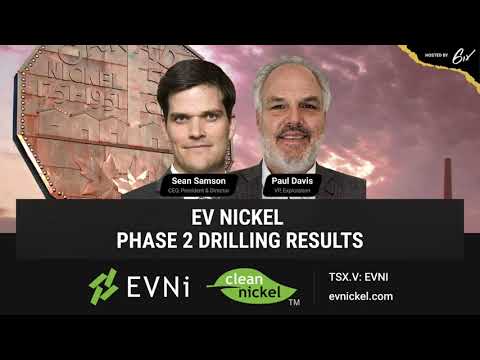
0:07 Hello everyone and welcome to EVNickel's live summit today. I'm pleased to introduce EVNickel's President and CEO, Sean Samson, as well as their VP of exploration, Paul Davis. Sean and Paul are gonna take us through a company presentation and after we'll be accepting questions live. As a reminder, you can submit your questions using the Q&A panel found on the right-hand side of your screen at any point during today's presentation. And as always, the summit is being recorded and will be available to watch on six.com in the coming days. Without further ado, Sean, I'm going to kick things over to you to get started. Thanks, Cam, and thanks everyone for joining. To new people, welcome, and to existing followers and investors, welcome back. Paul and I are going to run through real quick about EV nickel. All these slides are available for download through 6 or they're also on our website.
0:57 So to summarize, what we're all about is the new demand for nickel coming from the electric vehicle side, where the electric vehicle companies, they prefer nickel
1:07 sulfide, class 1 nickel as preferred. And they're going to try to source the cleanest nickel they can. And we have up at the Shaw Dome in Northern Ontario, hydropower, high-grade mineralization, exactly the sort of thing that they're after. We have accumulated an enormous land package, we're going to talk about that. We have a starter resource on that land package at 1% nickel, the W4. To summarize, we're basically Ontario, critical metals, and we're funded to drill. We have great location, great grade with mineralization, with the type of grade that has historically been turned into nickel mines, and we have an enormous potential as well. So we're doing 3 things, finding more nickel in the shah dome, we're going to secure more nickel in the shah dome, sorry, secure more land in the shah dome, And we're going to wrap it all together by creating a clean nickel business.
2:05 So I run the company. My background is I've worked in mining for the past 15 years. Prior to that, I used to work at private equity and used to be a trader in New York, Capital Market stuff. We have a pretty tight management team joined by my colleague Paul who I've worked with for over 10 years. Paul's my VP of Exploration. He's really the secret sauce for our company based on his experience specifically in these types of deposits. Paul do you want to run through a bit of your background?
2:33 Sure. I've been involved in nickel exploration now for about 33 years, much of it in the Timmins area working for both majors and juniors in that area. I worked for Falcon Bridge and Loiro-Kaupu. I was Loiro-Kaupu's Eastern Canada Regional Exploration Manager. We focused on exploring the Kmat'inika units within the Timmins area. We discovered 4 new zones of nickel mineralization. I've also been involved in permitting and advancing projects straight from grassroots exploration all the way up to production in regards to nickel mineralization.
3:08 Super, thanks Paul. Rounding out our team is our board. We have importantly, half our board is from Northern Ontario. We've got Linda who's based in Timmins, my friend Michael Fox who's based at Thunder Bay who are very deep experience around permitting and First Nations specifically. Michael's a really well connected guy. And then rounding out the team, we have an accountant and a Toronto-based investment banker.
3:36 So I don't spend much time on the macro, but if you take a step back and think about sort of what excites us about nickel is this growing demand coming into the space from the electric vehicles. So the neat thing about nickel as compared to some of the other battery metals, whether it's cobalt or lithium, you have already a global supply demand balance that has been figured out for nickel because it's been supplying stainless steel. So you bolt on top of that new demand from the electric vehicle batteries and you have, as we've got on the bottom left here, a forecast gap between supply and demand. And that's a good place to be for someone who thinks they have a lot of nickel in the ground. Also a great place to be is where we specifically are and our potential to be able to produce low carbon nickel. And that's really our focus. We're a junior nickel company.
4:32 I need to have a picture of Elon Musk in my slides. Everybody latches on to the fact that he encourages everyone to increase production. But the thing I'm more interested about, the statements that Musk has made, have been around specifically the ridiculous complexity of the global nickel supply chain and how nickel that gets produced in Ontario goes to Europe for final processing, and it just circles the earth. Those guys have picked up on that at the EV companies. This idea of localizing supply chains are very real. And that's what electric vehicle battery companies are demanding. Local sources of nickel, and I think we're very well positioned where we have our nickel. And the reason that we're talking about carbon so much is that it's very real for these electric vehicle companies. So, generally, across industry, there's, of course, the protocols around scope 123, or disclosure and talking about what goes in in the indirects and scope 3.
5:33 But with automakers being in the crosshairs, and we've got some headlines here, where there's this
5:40 popular conception that you're buying an electric vehicle, but it's not very clean because of the big, long history of the inputs that go into that electric vehicle. With the new regulation in Europe, the electric vehicle companies and the battery companies are being forced to deal with this. And this is why carbon cost per nickel unit is first and foremost to focus to these guys, because you're going to have declaration of carbon footprint for all electric vehicles sold in Europe starting in 2024. So our thing, the Shaw Dome, We're up in Northern Ontario, southeast of the very large mining town of Timmins, Ontario, famous for its gold production. This is where Paul mentioned he worked up there for a couple decades.
6:26 We have an enormous land package southeast of town. So we've pulled together 30,000 hectares. It's all within 50k of Timmins. So our guys, they sleep in Timmins at night. So it's a great place to be
6:40 setting up a nickel business. Also as miners, the best place to find more nickel is near where there's been nickel produced. And there's been historic production across the Shaw Dome at the types of grades that get turned into traditional nickel mines. So our project started with just the Langmuir, which is the beige area there. And specifically the W4 is our starter resource, the W4 zone.
7:07 So we have an existing resource on W4. It was done in 2010. Paul, do you want to talk a bit about the W4 resource? Sure. When Sean and I took over management of the company, W4 was part of the land package that came with it. In 2010, they defined a resource of about 600,000 tons of 1% nickel. That sub-crop to surface had open pit component to it, so it's very attractive that way. But really what makes W4 quite unique is the structure and type of nickel sulfides that are contained within W4.
7:41 W4 is almost composed of 100% pentalindite which gives it a nickel tenor which is nickel in 100 percent sulfide of anywhere between 30 to 40% nickel. So that being said, in the pictures of the core on the left, in picture A, that particular piece of massive sulfide would run on the order of 20% nickel, but what I find more fascinating is in picture B, a piece of core that doesn't look that exciting, it has maybe 3 to 5% sulfide in it, that would actually grade 1 to 2% nickel in the W4 deposit.
8:14 Also being made entirely of pentalidate, it would mean that as we concentrate the sulfides in the milling process, that we should be able to come up with a really high, unique grade concentrate that would be attractive to anybody throughout the world. Yeah, and that the existing W4 resource is above 200 metres. And that's sort of what we picked up. That was what EV Nickel, when it was started up last year, had acquired from Rogue Resources, was the Langmuir project, specifically the W4 deposit. So last year we did some drilling which we came up with the results of in January and
8:54 we proved the mineralization continues up and down trend. Paul, do you want to talk a bit about last year's drilling? Sure. Last year we hadn't really ever seen the W4 prior to last year's drilling. So we put a couple of holes straight into the middle of it. Hole 1 of course hit like in a 1 meter of better than 8 percent nickel. But then we also wanted to define the edges and see if we could expand the mineralization further to the east and the west. We were successful on both of those abilities that we hit, like nickel mineralization of 15 meters, grading about 1 percent both on the east and then 10 meters of 1 percent on the west, showing that we could expand the size of the deposit above 200 meters. We also hit some seminated sulfide mineralization further to the west indicating that that particular chromatic unit was sulfur saturated along its length and that poses more exploration targets both east and west of the W4 deposit.
9:52 So that was last year's success. We proved to ourselves that it goes east and west, the W4. And then the big news this week is the initial results back from what we call phase 2. That was all of our drilling in the first half of this year. So Paul, this is W4 again. Do you want to orient us and show us what our new news this week was? Sure. This is a section through W4 on the first holes that we put in, in the extension drilling that we just completed in the last couple of months. As you can see the first 2 holes
10:24 we have reported the intercepts on and these are the only ones we've seen from the labs so far. But what it does show us is that the mineralization continues down this trend from surface now to the next level, which is between 200 and 500 meters below surface. It's also maintaining its width, as you can see in the hole 12. We intersected over 14 meters of 1.5% nickel with a core of about 5 meters of 2.66% nickel. That's a fantastic hit. Also, drilling from the north, we're hitting the mineralization at a much better angle so that our drill intercept width of 15 meters is really representative true width. Another thing that we've done with this drilling is that we've proven to ourselves that the nickel mineralization doesn't occur in 3 separate lenses, which is how it was interpreted back in 2010,
11:17 that it's actually one continuous lens focused on a single stratigraphic horizon, which will enable us to probably increase the size of the resource as we go down because we won't have these breaks and gaps within the mineralization that we're seeing. I think these results from the first 2 holes of the W4 extension kind of show why I'm so excited about this part of the project and the potential to continue tracing this down this trend and like with most convolvulus style deposits, They are long-lived deposits that extend for several hundred meters to kilometers along the trend of the mineralization.
11:54 Yes, that's where we're at now with this new mineralization below the known mineralization, and we're calling this the W4 extension. So Paul, you spoke a bit to your excitement about how these things go and flows. We'll come back to that in a moment when we talk about the Combaltas specifically. But I also want to talk about, we've got a much more land on our hands now. Earlier this year, we tripled our land package by doing an acquisition of a bunch of land across the road. So we're up over 30,000 hectares now. And there's a huge amount of high grade potential across that expanded package. So high grade and large scale. So we'll talk right now about the high grade. So across this broader package, in the West, there's a really interesting anomaly called Croxall. We think that's a potential sort of shadow of Redstone, which is the crossed hammers there just below it. So we've got Croxall to potentially go after. Then in the east, there's Langmuir number 2.
12:56 This was a mine which produced and then it got halted in the 70s because they had crown pillar collapse. Away from the crown pillar, there's actually mineralization we know of in the ground, good high-grade mineralization. They produced a 1.47% nickel. And then to the south, we think there's some interesting potential on a piece of land that's called Groves to the south of us. Well, when we think about these high grade targets and how how you find them, talk a bit about how this compares to what's in Western Australia. Sure. Like the Combalda style mineralization is after a region in West Australia where they first discovered this association of chlamydates with nickel. And basically there, they produced over 50 million tons of better than 2% nickel from a number of deposits that have been discovered. But these deposits are found being associated with like a river channel, if you can picture that, with bends and meanders. And in the bottom of the river channels where the sulfides accumulate, that's where you find your deposits.
13:59 And in Cumbalda, really, once you find 1 deposit with a flow, your likelihood of finding a cluster of deposit goes up significantly. You can see the square on the right represents what Combalda region is. The little dashed square on the Shaw Dome shows just that is 1 section of the Chardon. We probably have 3 or 4 additional sections of that and we have 100 kilometers of perspective stratigraphy to test for these Combalda style deposits and like I said once you find one you can see like Langmuir number 2, Hart, Redstone, Langmuir number 1, all look like they're associated with a single stratigraphic horizon, and each one is hosting nickel mineralization. So we see something very similar for the Shaw Dome to what you see in Cumbalda, where you're able to chase these mineralized horizons all the way along the dome.
14:51 Yeah, so prioritizing our targets is a big part of our job here. So we think there's a huge amount of potential with the high grade targets with, as Paul said, over 100 kilometers of strike for us to go after. Then if we shift a bit towards what we call now large-scale targets, that's something that's new for us. It's a second focus for EVNICOL. And I'm going to talk a bit about some targets. There's 1 to the west in the Adams and Eldorado Township, and then in the northeast, the Carmen Langmuir Target, or the short form, Car Lang. So when we talk about large scale targets, we're talking about ones which have a target grade of something like 0.3 to 0.5 near surface. And we've been churning through all the potential data we have from this new land that we acquired earlier this year.
15:42 There's a bunch of historic drilling as well. So Otocopu, Paul's former employer, actually Paul drilled this land in the past.
15:52 And Paul, do you want to talk a bit about what your grade focus had been? Sure. When we were with Otocopu, our grade minimum was a 0.6, which was really reflective of what Mount Keith was mining in Western Australia in an open pit scenario. So anytime we drilled a done, we didn't get a minimum of 1.6 nickel hit, then we would move on to the next target And basically put that into the expiration bank as something that was tested, but didn't hit the 0.6. But now now that the market is rewarding assets that are lower grade than Mount Keith in Australia, so 0.3 to 0.5, there's really interesting potential here because we've got drill experience on this land. We've also got, and we're going to show you here in a minute, airborne, which shows very interesting mag highs, plus this mineralization comes to surface with outcrops.
16:49 So we have outcrop analysis, which I'm gonna show you here in a sec, which has been done and proves out really interesting, appealing grades. So there's a whole lot of data up on the Carlang. Wanna run through that. So the reason it's so interesting is if I shift over and look at a great example out in the market, Canada Nickel's Crawford deposit, and specifically its main zone. Now, Canada Nickel, of course, trumpets that this has been the largest nickel sulfide discovery since the 1970s. So it's very material, and the market has rewarded them significantly. But if you look at what the Crawford main zone is, They roughly drilled 15,000 meters to find a deposit that was 1.8 kilometers by 360 meters, and they got themselves 1 billion tons at 0.25.
17:42 So remember that 0.25 grade as we talk about what we think we have on the Carmen Langmuir up in the corner of our project. So these 2 targets, if I look at them on the mag, very interesting, very large. You see on this slide, we've got this oval, which is to scale the Crawford Main Zone, the largest nickel sulfide discovery made since the 1970s. Now, if I zoom in on those 2 mag highs, and again, we've got the oval to scale, it shows you that what we're talking about here, as the pinks and purples are the interesting stuff, We've got a huge amount of potential here for large-scale targets on our new acquired land. Now this is a new part of the Kerman-Langmuir, so that was up in the northeast.
18:28 This is from grab sample work that's been done. Again, we've got the Crawford oval there to give a sense of size perspective. But this group from the States, University of Alabama, in a summer study years ago, we've got all this data, went and did grab samples of the outcrop and Carmen Township, the northern half of this, they had 40 samples that averaged 0.33. So that's at the outcrop. So we're now drilling on the carlang. Again, we're targeting something that's 0.25 or better. And we're really excited about the grade that's there. Plus, it's got a huge stretch. We've got marked on the slide 6 kilometers for the bottom part, 4 kilometers for the top part. And again, the Crawford main zone for CNC was 1.8 kilometers long. So this is really exciting for the potential here.
19:25 And the thing is, and again, Crawford was the world's largest nickel sulfide discovery since the 1970s. But Paul, do you want to talk a bit about sort of the frequency of these types of deposits in Timmins and then how we begin to think differentiating them? Sure, sure. Like, you know, based through my experience, I think that these type of deposits are fairly common, associated with these dundanic bodies in the area. Now, I think that there's really 3 things that differentiate, are gonna differentiate the deposits and the quality of deposits. And that is really location and access. And like, you know, the Karlang deposit or Karlang zone is located approximately 30 kilometers from Timmins it's within 30 kilometers of several bills that have processed nickel in the past and currently it also you can drive right up to the outcrop with a pickup truck. And this is unique for the Timmins area is that it's very wet and swampy and very difficult access to get to the actual location.
20:24 Second place. Most places in Timmins, not ours. Not ours. Second is grade. Like a difference of 0.5% grade doesn't sound like a lot, but when you start to look at the economics and the scale of these type of zones, it makes a huge impact on your economics. And the third thing is the amount of overburden in the area. We know we have about 15% outcrop exposure so we can see the rocks on surface and take samples of it. We also know from past drilling that I've done and also assessment files that you have less than 10 meters of overburden in that area. It's probably going to average 6 to 8 meters over the entire
21:04 zone, which differs significantly from the other areas where you have tens of meters of overburden, which means you're going to have to dig out 30 to 40 meters of overburden even before you start to see the rock at the bottom. So we'll start talking more about this when we get our arms wrapped around the potential of Kara Lange. This is our phase 3 drilling. This is what we're into right now. And we think that We've got something that's enormous and comparatively, we think it's going to size up and compare really nicely on grade overburden and its access and proximity.
21:43 So to sum up, what we've got going in the Shaw Dome, It's a wonderful location. We've got great grade with our high grade plus we have this enormous potential across the large scale. And then we have a huge land package with over 100km of strike and we're just getting started on trying to figure out what's there.
22:03 So we've talked a bunch about how we're finding more nickel, we're going to bolt on more land on the shawdome. Then if I talk about the next part, which is wrapping it all up together in a clean nickel business. So clean nickel is a term that we trademarked, EV nickel and clean nickel in the US and in Canada. And for us, it really is the DNA of the company, as we're trying to accelerate the transition to clean energy. So what we're doing is we're targeting the lowest possible carbon cost per unit of nickel. And by doing that, but to do that, we're questioning everything. So we're working on electrification of mining, working of course on sorting of ore, and we'll draw electricity for both of those purposes. Where we're located, we draw on hydropower.
22:50 It's good, clean, low-carbon cost stuff.
22:54 Then we're looking at leveraging creative processing techniques, including bioleaching. Where in collaboration with government, we're doing work in the lab right now on that. And then finally, we're doing analysis in the lab right now with the smartest people in the world around carbon capture. So we have a similar geology, as you've heard, with Canada Nickel and a couple of projects out in Western Canada, where we're able to capture carbon from the atmosphere and sequester.
23:21 So we anticipate that there's value to be had in that. We're putting numbers on it right now. The neat thing is, I think, in combination with the grade we're talking, it's a nice to have for us, as opposed to a potential need to have in the economics for some other projects. So clean nickel for us is how we're wrapping it all together. And if I think back what we've achieved over the past 6 months, so we went public last December at 75 cents, and I'll come back to that in a moment. That was our IPO. Then we announced this phase 1 drill results, which confirmed that W4 extends east and west. Then the first half of this year, we got in and we were drilling below the W4.
24:07 Those are the results we're talking about this week, or starting to talk about. In April, we tripled our land package. May, we rolled out the clean nickel. We've been running at a good tilt for the first half of this year. If we overlay that to our share price, it's been a bit of a ski slope. So we've traded down from the 75 cent IPO with a couple blips as we went along. People took notice when we tripled our land package. We disclosed a good high grade metallurgical testing hole last month and market woke up briefly. And then this week, we had a nice pop yesterday with some good volume around confirming the W4 extension at depth. But to sum up, we are still deeply undervalued, whether compared to that IPO price or compared to our comps, and we'll show you that in a moment. We have a tight share float,
25:04 44 million shares. That's broken down with the initial founders and Rogue Resources, the company that initially vended in Langmuir. Both of those blocks are tied up at over 3 years. And then our raises at 30 cents, 75 cents. And then over the last couple of weeks, a flow through raise at 18 and 24. So we've got a nice tight float, Trade at $8 million or so. A chunk of it is in broadly defined hands of friends and family. And we're cashed up. We've got $3.5 million in the bank. Right now we can pay for all of our exploration for this year. Everything we're talking about we can pay for. On the comps at $8 million equity value, no matter how you look at it, we're deeply discounted.
25:58 Huge amount of potential. If I compare us out to Talon, which obviously is a different quantum of market valuation, they have really good grade deposit. We think we potentially have something similar or bigger across our enormous land package, a good high grade deposits. And I'll tell you, being able to permit in Timmins is a different story than Minnesota. So that's Talon. Then of course, there's Canada Nickel. We talked about the potential of our large scale as compared to what they currently have at Crawford, Maine. Then with the guys at West at FPX, they've had great valuation as well. But again, if you compare what our potential is for finding either their game or more of the high grade game, we think we've got a lot of potential all wrapped up. Very close to home, the Alexa of Don Donald deposit in the hands of class 1, they trade for 3 times our value, but we have an enormous amount of exploration potential as compared to them. So, this is all sort of primitive stuff when you're trying to do a comparable slide for something that's worth only 8 million bucks. But I very realistically believe we've got something that's comparable, if not better than some of these others on the slide.
27:17 And regardless, I think there's a huge amount of potential for us to move closer to their valuations. So that's us versus other project comparables. To sum up, I think this is a huge potential for us to help accelerate the transition to clean energy. You know, what we've got is what the world needs and we're gonna find more and more of it and we're gonna keep pulling it together into this clean nickel story. So last month we launched on Carlang, that's against the large scale. If I talk about additional news we've got coming, this week we announced our first 2 holes out of the work we did in the first half of this year. So that's on the W4 extension. We've got more of that coming. So that'll be news. The second half of this year, we'll be talking about the phase 3 results.
28:06 That's the Carl Lang stuff. Then I anticipate beginning of next year on phase 4, we'll come down and we'll drill more into the high value targets, the high grade targets, including W4, all to wrap it all together in a new tech report second half of next year about the broad shaw dome. And I think we'll have a phenomenal amount of mineralization in that one, as we're talking about the potential across this 30,000 hectares, playing this dual game of the high grade with the large scale to be able to combine the 2 into a really interesting clean nickel business. So that's sort of where we're at and where we're going. Quick drive by. We're really excited about this week's news about the W4 extension.
28:52 We think we'll have more of that coming as more holes come. And then hopefully you've heard our excitement around car laying and the potential for the large scale. Cam, do you want to jump into questions? Yeah, absolutely. Thanks, Sean. Thanks, Paul, for the great presentation. As we leap into those questions, I'd like to remind everyone in the audience, you can ask any question you like using the Q&A tab found on the right hand side of your screen. But to start, when can we expect more results from W4? Yeah, I guess I'll take that one. I would expect that you'll see more results coming out of W4 over the next 2 to 6 weeks. The samples have been submitted to the lab. The lab's working on them. It's just a process of them providing us the analytical results from our remaining 10 holes.
29:42 Great. Next question. How big do you think Carlang could be in relation to Crawford? Sean, do you want me to? Sean? Well, if we take a look at Carlang and we know that we have at least double the strike length along that trend than what we see at Crawford, I think that we would be very comfortable at saying that it'll be similar in size to Crawford as a minimum and potentially could be much larger, 2 to 3 times the size. Right. Brian wants to know, would you expect a maiden resource on Carlang in that new tech report you mentioned? Yeah, that's the target. So we're setting up our drilling up on Car Lang with that in mind. So being able to pull up and shoot with a resource second half of next year. But of course that's all exploration dependent, but that is the target.
30:34 Do you think there are synergies to potentially develop W4 with HART across the road? Yeah, I love that idea. This is one of the ones that I've been floating out there to Sean for a while now. They're separated by about 2, 2.5 kilometers of distance, the HART and the W4 deposits. Now one of the main goals of our company and every every company should be is to minimize the environmental impact as you're mining these things. And being able to access heart and W4 from a single ramp between them would make a lot of common sense and that way you're basically doubling up on the amount of material you could mine using a single access and having a lower environmental impact.
31:20 Like at the W4, you could basically just have a vent raise would be your only surface impact to mine out that deposit. Yeah, so we think there's a huge amount of potential there. And one of the interesting things, Paul and I have worked together for a long time. And I do know some of the best mining engineering ideas come from the geologists. And we used to work with a mining engineer who was a very aggressive geologist. So importantly, I want to put some actual work on that, wherein we're going to be adding to our team, I anticipate, in the coming months, and looking at things like this. So synergies across the camp and being able to think more creatively as well, which is the way you need to address these things.
32:12 And the great place to start is with as much mineralization, and I've got the Shaw dome slide back up with the historic mineralization across it. With this type of mineralization, there's a lot of room for creativity and trying to wrap together an actual nickel business. Absolutely. Well, listen, Sean, Paul, I want to thank you for taking us through the presentation and this Q&A session. That looks like all the questions we received for today. I also want to thank everyone who did submit questions. And if you didn't get a chance to, or if you think of 1 after, we'll be following up with you. And you can, of course, get in contact with the EV Nickel team. You can find their website at evnickel.com. They'll be happy to help you out directly. Their contact information can also be found in the handouts tab on the right hand side of your screen where you can also download today's presentation. But Sean, I'd like to hand things over to you for some final words before we wrap up today.
33:03 Sure, thanks Cam. So today we're really excited about this week's results. We think this new mineralization below the existing, the known resource, the W4 extension, should be exciting for investors. We're pulling together this dual track, this high grade with large scale. And frankly, we're just getting started. So the thing we're building here is going to be a large, clean nickel business. And we think it should be exciting for investors. And there's a lot of news catalysts just on the near horizon and looking out even further. So look forward to more of these and thanks a lot for your time. You