Transcript
Automated transcript · Written by software from the replay's audio. It can mishear names and figures; the replay is the record.
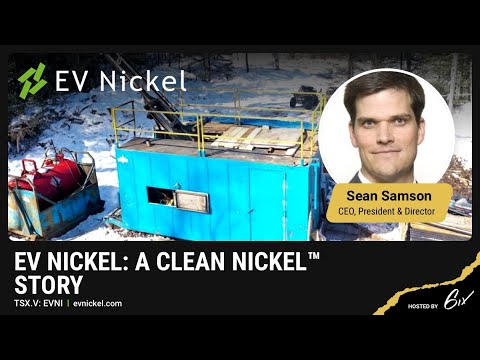
0:08 Well, hello everyone and welcome to EVNickels Live Summit today hosted by 6. I'm pleased to introduce EVNickels President and CEO, Sean Samson and their VP Exploration, Paul Davis. Sean and Paul will be taking us through a company presentation and after we will be accepting questions live. So as a reminder, you can submit your questions at any time on the Q&A panel on the right-hand side of the screen, and we're going to try to get to them after the presentation is over. And as always, this is being recorded and available to watch afterwards on SIX.com. But without any further ado, I'll hand it
0:39 over to you, Sean, to kick it off. Super. Thanks very much, Dasha, and thanks, everyone, for joining today. Really excited to get into this part of the story about EV Nickel as we are really growing the company and this is an interesting track to be going down. So I'm gonna go through some slides, you'll see them up on the screen. These will also be posted on our website as well. So the usual highlighted warnings about the forward-looking statements. Today, it's gonna be me. I run the company, and for folks who've been on 6 summits before, my background is non-technical. It's from the commercial side of mining, where I've spent extensive time in financial markets and private equity and consulting. And then for the past 15 years, really trying to run the business side of mining companies, both for the majors and for juniors. And I'm joined, especially on this call, it's important to have Paul, who's our VP of Exploration, who looks after everything technical.
1:37 And the stuff we're getting into today goes beyond just exploration, but Paul actually has, and I'll have him introduce himself here in a moment, but he has a tremendous amount of experience actually in bio leaching, which not a lot of people can say. And he's been at this for quite some time. And as we begin to think more creatively about our projects, it's interesting that what Paul brings to the table from a varied experience. Paul, you wanna talk a bit about what you've done in the past? Sure. I have about 35 years experience in exploration, looking primarily for nickel in the Timmins area. So this is a project that is close to my heart. In terms of the bio-leaching, I've been involved in that for over 15 years and basically looked at studies and developing bio-leaching techniques for these type of nickel-hosted deposits throughout Canada.
2:30 Super. Thanks, Paul. So I'll start with the same introduction, sort of who is EVnickel. We're here and you're likely on the call because of all of the excitement around the forecasted growth of electric vehicles. So that is really what drives the company, pardon the pun. It's the new demand coming into nickel where the EV makers require the new sulfide or they require new sulfide supply, class 1 nickel. So the EV companies are after the cleanest metals they can get. And what we have with the Shaw Dome, it's in Canada, drawing on hydropower, it's high-grade sulfides. We're really excited for the fit there. We've acquired now, we have over 30,000 hectares of prospective land in the Shaw Dome.
3:17 It's Southeast of Timmins. On the Shaw Dome, we have our starter resource at Langmuir called W4. That has 15 million pounds on the ground at 1% nickel. So overall, what we're really excited about is the location of our project. It's got easy access to Timmins. It's an established mining camp. As I mentioned, we can draw on clean hydro power there, which is a big part as we get into the clean nickel story. The grade of what we have is great. We start at 1% and we're in an area with historical production that's even better than that. And then there's huge potential for us to find more mineralization. There's 3 things we're doing at the company. We've spent a lot of time talking about the first 2. That's finding more nickel and getting our hands on more land in the Shaw Dome.
4:06 And we've really, again, with what we've done has been our phase 1 drilling last summer at Langmuir. We drilled over 4000 meters. We confirmed that the W4 is bigger than we currently have on the books, where it extends up and down the trend with the mineralization. We have secured more land. Our transaction that we closed in April, again, tripled our land package and gives us more than 100 kilometers of strike to go after. And now we're focusing on this week announcing more of what we're doing on creating a clean nickel business. So we're making great progress so far on the 3 things we said we were gonna do. And now we're gonna tell you a bit more about where we're at with the clean nickel business. So if I bring it back to our mission, we've talked about this before with investors.
4:52 Our mission is to accelerate the transition to clean energy, very broad and very lofty. But that's really where we're headed. We think decarbonization is one of the greatest challenges that we'll ever address. And we want our company to be there helping society along towards clean energy. So what we've done is we have applied for trademarks for the terms EV Nickel, the company's name, plus Clean Nickel, and also our new LEAF logo, which we have there on the slide. So really showing Clean Nickel. We've registered those in the US and Canada. We're looking at other markets as well. And we're hoping that this, it's really part of our DNA. And we hope that this will differentiate EV Nickel and help us draw attention to our strategy and also strengthen what we're doing on the community level.
5:43 We know this plays very well with our surrounding communities and they love their alignment with us for the clean nickel. Also for drawing people in as we grow our team, as we grow the business. We think this helps us there. We also think that it resonates well with investors. Not all investors are either drawn to mining companies or drawn to exploration companies. I've spent a lot of time dealing with investors and there are investors currently invested in our company who are here for the play on decarbonization. And then most importantly, perhaps It clearly aligns us with the buyers of nickel for this new demand for nickel, which is coming from the EV companies. So again, we're here because of this EV revolution. And as folks who've been on these summits before have heard me say, it's not just about Tesla and Rivian and the standalone EV companies. It's really the scales are getting tipped as the existing car companies are beginning to shift more and more of their plans with almost a full commitment out over the next 10, 15 years of having all of their vehicles go electric.
6:53 So with that revolution though, it's funny to look at what the EV companies are being challenged with. If we think more separately, general industry has begun to come up the curve with the greenhouse gas protocols, and investors hear that from almost all companies. That's the scope 1, scope 2, scope 3, talking about what the footprints of their products and their businesses are. EVs on the other hand, even though they're on the front lines and really helping society address decarbonization, there have been lots and lots of focus on across the media about whether when buying an electric vehicle, it actually comes with a big footprint attached to it. So the EV companies are out ahead of actually the miners around what is the footprint of our inputs.
7:45 So the EV batteries themselves are going to have more and more regulation. If we look at what's happening in Europe, and this is all very real with what was brought in with the sustainable batteries regulation in the EU, it requires in 2024 a declaration of the carbon footprint of every vehicle that they produce. And then there's going to be a classification label a couple of years later, looking out to 2027, where there's going to be footprint thresholds for vehicles. So they're setting this up, which means the EV companies really need to be focused in on the footprint attached to the inputs for their vehicles. And again all junior nickel companies are talking about what Elon Musk said a couple years ago where he said they need more nickel but that always comes hand in hand with asking for it to be done in an environmentally sensitive way. Frankly, the EV companies are going beyond Tesla and into the automakers generally. They're asking nickel miners to rethink their businesses and asking for a better way. And it's really neat when you think about a couple months after that earnings call where Musk made the call, he needs more nickel.
8:56 At battery day, one of the most interesting things I heard at the battery day was Musk calling out the complication of the current supply chain for nickel, wherein the atom sort of zips all around the world before it becomes a finished product. That stuff is gonna be changed. The EV companies are demanding that nickel miners rethink their businesses, and that carries straight through into our focus on clean nickel. So what we're doing at EV Nickel is we're questioning each of the steps of our nickel business because our intention is we want to target the lowest possible carbon cost per unit of nickel. And where we're at right now, our current plans include a few different fronts. We'll go into some detail on a couple of them, but starting with our mining operations.
9:42 When we're up and running, we plan to electrify as much as we can. That requires the shovels, the trucks, moving material. We'll do everything we can to electrify that. Again, because where we're located in Northern Ontario, we're drawing on clean hydroelectricity. So that's the first thing. Secondly, we're going to again draw on electricity to try to sort our ores. We think in the high grade material where we can sort the massive and the semi-massive sulfides from the waste, we can really help that along. It'll be feasible, we anticipate, in our higher grade deposits to raise the head grade and not be moving waste from our deposits into our processing. Another thing we're working on, and we'll go into a bit of detail on this today, is we're looking at creative processing techniques, which will include bioleaching, which is really exciting stuff. So again, this is questioning how the typical approach to processing nickel, getting the nickel, the metal we want, out of the rock, how can we do that in a new way, which helps with the footprint and the lowest possible carbon cost coming with that unit of nickel?
10:54 And then finally, another thing we're working on and we're going to talk about today is analyzing potential for carbon capture, where we use the waste rock and the tails to actually absorb CO2 through natural mineral carbonation. So it's the sort of thing, and Paul's going to talk about this a bit more, it's almost like creating a bark on a tree, wherein trees draw in CO2. As it turns out, the geology, the rocks that we're into, if we expose those to atmosphere, they can draw in naturally. And we can actually improve it a bit, where they're able to do carbon capture into the rock. So it's really exciting. We are funding research in these areas. We have government support in these areas.
11:40 The work is underway and we're really trying to pull these pieces together and the plan will have more and more detail obviously as we go forward, pulling these pieces together so we can begin to deliver on clean nickel. And we're going to step into the technology here, but it's really worthwhile to take a step and to think about how the best possible starting point for a clean nickel business is the highest grade you can find. If you can start with high-grade nickel ore, it helps you along the path. And we think we have that across the shodown. So let's jump in now to a bit more detail on at least a couple of these areas we're working on. Paul, do you want to tell us a bit more about bioleaching? Sure. Thanks, Sean. Bioleaching really is a very natural process that occurs throughout the world, pretty much everywhere. If you have, when your car rusts, when you see the rocks weathering that is basically bioleaching and it's releasing certain elements out of their their minerals and into a a solution.
12:45 And really what our study bioleaching is is to improve upon this natural process, increase the speed and provide these bacteria the environment they need to excel and really rapidly release the nickel from the sulfide ores. Through that, I've been working with RPC since about 2007 on bio-leaching of nickel and nickel ores throughout the world. It is a low-cost, naturally occurring process, and it has been used to extract both nickel and copper in the past. It is much cleaner than smelting. You're not putting out the harmful gases. It is an in-situ process. It really is contained. It's a small environmental footprint. Also, as Sean mentioned, since in the Shaw Dome, the rocks that host our nickel sulfides are very rich in magnesium, which is one of the key components of carbon sequestration, that it represents an excellent opportunity to capture carbon as part of our ongoing process.
13:50 Now we are developing these conceptual processes, RPC, and really what we're doing there is we're using the naturally occurring bacteria in the area of the shawdome. So the bacteria is already adapted to the temperature, to the rock type, to the sulfides, and to the metals within them. And then we're using those bacteria to grow and make a bacteria type solution that is used then to extract metals out of the sulfides. We've shipped samples of W4 to RPC as well as local waters and RPC is well underway with their program developing the bacteria and growing it further. Now this research has been actually funded in part by the National Research Council of Canada, and they fully funded actually our phase 1 and phase 2 parts of this, and we're moving forward with phase 2 as we speak.
14:48 So then, what is a comparison between smelting and bioleaching? Traditionally, smelting is a flash smelter. Basically, they put the sulfides into a furnace, mix it with some oxygen, and the sulfides burn. They give off a lot of heat, but during that process they also give off a lot of sulfur dioxide, which eventually leads to acid rain. I'm sure you're all very familiar with the acid rain story in and around Sudbury, Ontario, where the lakes were all acidified and basically crystal clear, but absolutely nothing was living in them. And you can see here that, as you burn off the sulfur, you're leaving behind the nickel and the copper, but the sulfur dioxide mixes with your rainwater and then falls out of the sky down the wind patterns from the super stack.
15:38 Also, most ores are impure, it's not a pure nickel sulfide going in, so they tend to mix in with silica flux, which helps to separate the metals from the slag, but then you're left with a large slag material that then has to be stored and also has some negative environmental impacts with metal leaching and acid generation. Now large scale nickel smelting was developed in the early 19th century and it still produces greater than 90% of the market today. Back in the at the turn of the 1900s what they actually used to do in Sudbury would they would cut all the trees down pile the ore on top of the trees, burn the trees, and that's how they would smelt out your nickel and copper. Now, bioleaching, it's well understood, it's non-pathogenic, there is no risk of these bacteria escaping from our heap leach or our vat leach, and then causing all of the nickel and copper to be extracted out of the rocks in the shaw dome.
16:38 It doesn't work that way. You have to provide the environment to get them to work quickly, plus they're naturally occurring. We crush the ore. If it was a heap leach, we would stack it, irrigate it with a mildly acid solution that is pregnant with the bacteria, and then provide aeration through the bottom. The bacteria, they attack the bonds in the sulfides, basically acting as a catalyst to release the metals from the sulfur and then put them in a solution and leave the sulfur as a sulfate or a gypsum. All it requires is air, water, and nutrients, being the sulfuric acid and the oxygen, and then bioleaching produces no gaseous emissions from the process, and the bacterial process actually does consume CO2 as part of the process.
17:29 So here's a typical flow sheet for a nickel sulfide ore. So it's mined out of the ground, it's put through a crusher to get it to the desired size. If you're doing a heap leach, which is the picture on the left, it's stacked and then irrigated from the top. If you've made a concentrate and you're gonna vat leach it, it would go into tanks as depicted on the right.
17:50 Nickel goes into solution at which point is either precipitated as a nickel hydroxide or it's electro wind out as a nickel metal. Those are well understood technologies. It's a known process and it's just a matter of being able to scale it up and extract it from your solutions. So now moving on to the carbon capture. This is something that's really gained a lot of traction here in the last few years of trying to find ways to sequester carbon dioxide out of the atmosphere or out of our industrial processes to reduce the impacts of our industrialization on the atmosphere. We've partnered with Dr. Greg Dippel and his team at the Carbon Mineralization Laboratory at UBC, and they are also leaders in this type of technological advancement.
18:42 They work with a number of companies looking at all of the different opportunities to store carbon dioxide through their process. The group is composed of a mix of geoscientists and engineers working on these large scale sequestration projects. We have already shipped out samples from our W4 and our shaw dome projects to them for work. We're looking at their analysis, they're working through phase 1. We're looking at the CO2 capture from air as well as from the more concentrated streams, i.e. The fossil fuel combustion, flue gases, direct air capture, or the potential of off-gassing from biolegion. But really, CO2 sequestration
19:29 in these serpentinites is a function of surface area. So the finer your surface area, the more carbon you can capture. And therefore this is another aspect that we will be reviewing as we move forward.
19:45 And then I think I'll pass it back on to Sean to summarize and discuss. Yeah, thanks, Paul. So basically, we've had great progress within the company around our drilling, confirming the mineralization, getting our hands on more land. And now we're really getting revved up on beginning to pull together the pieces of this clean nickel business. So it's exciting. We're in the labs trying to figure out how much potential there is there. We'll figure that out on bio leaching, on the carbon capture, plus in the other areas I mentioned earlier around electrification or sorting, plus more. So we're always looking again as we're questioning every one of the steps for the nickel production. And that's why it's really exciting what we're trying to pull together here. And also it plays very well with the EV companies who are coming to this space need to buy a lot of nickel and are questioning themselves the current setup and situation.
20:47 So you'll hear a lot more from us on each of these 3 fronts. It's exciting to get launched now in our clean nickel area. As mentioned, it's part of our DNA as a company, and it'll be with us as we're trying to find more nickel across more land and pulling it all together into a proper clean nickel story. So Dasha that's it for us on our proposed material. I know there's some questions coming in from the group.
21:15 Great yeah Thank you. If anyone has any questions, feel free to continue submitting them now. Sean, do you think your carbon capture will get to net 0 carbon with your production? Yeah. So that's our target. The lowest possible carbon footprint or carbon cost attached to our nickel units. We're going to have to see how this goes. So we're in the labs now testing on these fronts. We're going to see how many more fronts we can develop as well. But that is our objective, as low as we can go with our carbon costs. And again, I think the greatest starting point you can have for all of this is the grade. So as we go after the high-grade mineralization that we know exists on the Shaw dome because of historic production and because of mineralization in the ground that we've confirmed.
22:07 That is where you want to be. If you're looking at how low you can get your carbon cost, you want to start at the highest grade possible. And I think we're in a great position on that front.
22:17 Great, thank you. So what are some examples of bio-leaching around the world? Examples. Paul, do you want to run us through it? Sure, sure. I'll run you through that. As expressed by RPC to me, that like, you know, bio-leaching really has been occurring since about 1000 BC when the Romans were extracting copper out of the streams running through the ore deposits in Spain. But modern-day examples would be Tavavara is a very large example of a bio-leaching process in Finland. So it is in a subarctic environment, so it does show that the process is applicable
22:55 to cold environments. As well you have the copper SXCWs in the Southwest US all have a component of bioleaching within them, and there's been examples in Australia at Western areas, Cosmic Boy, where they're using a bioleaching technology to extract nickel and copper out of their waste streams coming out of their concentrator. Yeah, thanks, Paul. So it's been going on forever. And today there's examples that are active around the world and each of those parts of the flow sheet that Paul referred to, for example, at the end, you know, with the Electra winning as one of the potential options, each of those steps are done. It's really trying to pull them together using existing old technologies and rethinking
23:42 how to recover nickel instead of doing smelting. And what do the permitting authorities think about bioleaching? Paul? The authorities don't have any issues with the bioleaching. There has been heap leaching within the Timbons area in the past, so there is some familiarity with it. And really it does have a lot of economic or environmental benefits to do heap leaching versus the other forms of metal recovery. And the process actually can be used to treat existing tailings that currently contain high levels of these metals, so you're actually cleaning up the environment. Yeah, that's a good point. Like the potential for bio-leaching for whomever wants to wade in and really figure out and begin applying the technology, the potential for that is massive. So we're talking about using it as one of the ways to process our ores out of the Shaw Dome.
24:39 But I'm really excited to figure out the possibility for the Shaw Dome. And then frankly, if we can nail bioleaching up there, it's really just going to get us started because there's a lot of potential feedstock around Ontario.
24:51 All right. Thank you. How is clean nickel any different from how peers are pursuing ESG? Yes. Okay. A cynical viewer could say everyone's doing the same thing. I guess what I'd like to do is really have it come through that we are questioning everything. The analysis here is going to direct us down various paths. So it is real for us. I guess what I would say would be a differentiator is we're doing all of this with clean nickel. It is in our DNA. But again, our starting point is that we intend to have lots of mineralization up at a high grade, which allows us to really prove it through.
25:38 The type of grade, and investors have heard me say this before, the type of grade that traditionally gets turned into mines. That's our primary objective up on the Shaw Dome. And
25:47 we think that bolting on the clean nickel focus together, that should be a real point of differentiation. All right, thank you. How is the phase 2 drilling campaign going? Right, Phase 2, that's what we're into right now. So last year we did 4,200 meters in phase 1. That was across, that was around the W4. That was where we confirmed up and down trend that the mineralization extends. Now we're into phase 2, which is the 10,000 metres that we've been up to in 2022. That includes going after a couple of really interesting high potential targets. Those are the anomalies out in TZ3 to the west, W2, Although we're going to see if we get there, but then going deeper on W4, taking deep shots on W4.
26:36 It's been going great. We're in a spring breakup right now, but the drilling contractor is still getting us meters. We're really excited to start having some results we can get and talking in the market. We should have those within the next month. Some talk about our initial drilling out in the West on TZ3, that anomaly. So we're excited to start talking about that. And then, of course, the next phase of drilling is going to be across the entire Shaw Dome. So when we tripled the land package, we got a bunch more land under our belt, and we have some targets, both high-grade targets and large-scale targets across that land package, and we've applied for and hope to soon have permits to be able to drill across that expanded land package. And then in line with some third party research we're doing, rerunning all the geophysical data, we hope to have a clear list of targets to go after what's called phase 3.
27:30 So to answer that question about drilling phase 2, we hope to have news pretty soon. It's going well. We're excited to start sharing that with the market. And then we're even more excited to get into phase 3, which has us poking holes across that broader package, which we're really excited about. We want to begin to prove it by showing you what's in the core. Yeah, that's what I was going to ask. Are you looking beyond the Shaw Dome for potential land? We are. You know, there's great mineralization nearby the Shaw Dome. We're always in talks. We did that large transaction and we've done a few other smaller transactions to begin to really secure the Shaw Dome position. But more broadly around the Timmins Camp we're looking and then other mineralization in Ontario, Quebec, we're looking at other potential projects which can fit in and this is the third leg of our stool now, this clean nickel story, we think can apply to more and more potential assets. So long answer, we're always looking, There's very interesting opportunities out there and we're trying to figure out what more we can be adding into our story.
28:38 Great. Well, thank you so much, Sean and Paul, for taking us through the presentation and also all the questions. Thank you for everyone who joined us today. If you do have any further questions, feel free to reach out directly. The contact information is on the slide here. You can also find more information on EV Nickel's website, evnickel.com. But before I close out, I'll just pass it back to you, Sean, if you have any closing remarks. Yeah, Thanks, Dasha. And again, thanks, everyone, for joining today. We're really excited about what's going on, both in the stuff we've been talking about before today around our drilling, getting our hands on more land. But really, it's this clean nickel thing that's most exciting, whether it's the bio leaching and a way to rethink the way you get the nickel out of the rock, or if it's trying to calculate the potential of pulling carbon out of the atmosphere, either just simply or adding some gases in. This is really neat stuff. And it's exciting to be running a company which as we build, we're questioning everything that's been done before. So we hope that investors do see this as a bit of a differentiation.
29:45 We'll continue to come with lots of news on the drilling land and then importantly, this clean nickel as we begin getting more results back from the analysis that's underway. All right. Well, thank you, everyone. You