Automated transcript · Written by software from the replay's audio. It can mishear names and figures; the replay is the record.
19:07 He was a general manager of Lumana Copper, which was one of Berwick's most challenging mines. He led an extremely successful turnaround in Zambia. And after our time at Barrick, we started to ask ourselves, well, where do we see ourselves working in the future? And confirming that number 1, we believe that as a team, we could do something pretty exciting, but we wanted to spend some time really defining the area of opportunity. And as we did that, we added another critical piece of our team, David Weins, our CFO, who is great cultural fit, but brings capital markets experience and extensive investment banking experience. Before getting into some of the things that as team builders and doers, we eventually went on to do over the course of the last 15 months, I wanted to spend a little bit of time talking about why are we doing all of these things?
20:05 And one of the things that I took out of my experience as the head of closure with a focus on redevelopment at Barrick is that across the Western United States, there is a huge landscape of opportunity. And it arises really out of that critical difference that we see in the way that mining as a business closes its operations. It's fundamentally different from the way that almost any other business shutters. And in general, I mean, it isn't as simple as just removing some hazardous materials in a proper disposal process and calling it a day. When you start acid mine drainage as a process, it continues on often beyond, you know, decades and decades and even into centuries. So these are issues that environmentally as a society, obviously need to be taken very seriously, but mines in general are highly vulnerable to unforeseen changes in market circumstances.
21:10 And because those things happen unexpectedly, proper planning for closure of these activities is not often undertaken in the best possible way. That ends up transferring a whole bunch of negative externalities onto society as a whole, but we see that some of these changes have come at very specific points in our past, especially in the Western United States, where for most of the 20th century, the United States was a leader in minerals and metals production. But then as we saw regulatory evolution with the Clean Water Act and eventually the Superfund Act or CERCLA in the 1970s and 80s, you start to see a rapid widespread closure of many, many mines around the Western United States.
22:01 But therein lies both a challenge and a problem that needs to be addressed, but also a huge opportunity. And the reality is that the technological constraints that existed at the time of those closures meant that they were mining at cutoff grades that by today's standards are extremely attractive. And so when we started to look around at the opportunities that we felt fit that mold, we saw a few common characteristics. We see that A lot of these environmental challenges that existed and still exist today, through the benefit of technological evolution, now can be dealt with in really cost effective, efficient manners. We see that a lot of these, as I explained a second ago, a lot of these mines have remaining mineral endowments that allow for long life production upon restart.
22:54 We see that A lot of these mines have remaining mineral endowments that allow for long life production upon restart. We see that a lot of these mines have reusable infrastructure that not only allows for more rapid restart timeline, but it also means that you don't have to create a great surface disturbance in other locations to start new mines, which has social benefits. Almost without exception, around the areas of closed mines, you see that the communities that once used to depend on these activities and thrive are now economically challenged. And so we see that in seizing these opportunities, addressing these challenges, We have the opportunity to provide real sustainable solutions that will also provide our investors with solid business performance and we believe lead to overall better mining practice as an industry.
23:43 Bunker Hill really is the proof of this investment thesis. And so some of the things that we did after arriving on the scene, the new management team started in March of 2020, was because the mine, as many of these mines closed in the 70s, 80s, and 90s, that occurred before the advent of NI 43-101 at JORC. We needed to bring a lot of the historical mining records and existing resources into modern compliance, which is what we started with in March of 2020. But almost right on the heels of that as a major priority, we initiated a weekly call with our environmental regulators to make sure that everybody was on the same page and all of the actions that we would begin to take, making environmental management a major priority for both the company and the operations in and around the mine, ended up taking place in ways that were meaningful to all the major stakeholders. So we speak to the EPA's Superfund team here at the Bunker Hill Superfund site on a weekly basis in addition to the Idaho Department of Environmental Quality.
25:00 We went on to later publish our inferred resource in August of 2020. We embarked on a widespread water management program which led to the commissioning of an in-mine water treatment pilot program that allow us to generate major efficiencies in the drive towards our own water discharge permit. We then published a water quality tracking platform. That's part of an initiative that is aimed to provide our stakeholders with the maximum degree of transparency. Allow them, to, engage in a vibrant and active dialogue and to start to build trust.
25:46 As a relationship building tool. We went on later to update our resource through additional drilling. We recently published in April our preliminary economic assessment that outlines the plan for Bunker Hill's restart. And in May, we launched a sponsored research program with the University of Idaho to start to map out ways to limit water infiltration into the mine as a measure to limit the future environmental management challenge here at Bunker Hill. So the work that we will undertake in the future, we are currently raising capital for this restart. That's a process we anticipate will wrap up in the course of the next 2 months.
26:31 That'll lead into a variety of initiatives. One is a local workforce training. We've committed to 90% local employment. And in this case, that means Shoshone County and Kootenai County. We're gonna need to work with local suppliers of other services and materials to make sure that they can hit specs for all a variety of our different needs that are outlined in our PEA, make sure that they're competitive and cost efficient. We'll be participating in the broader real estate development in the Superfund site over the course of the next year and beyond. That's a big part of the initiative to make sure that the positive economic impacts that Bunker Hill generates are felt way beyond just the mine itself and extend well beyond what we believe will be multiple decades of productive life of the mine, but propel into the 22nd century and beyond.
27:37 We'll begin commercial production in 2023. And as that occurs, we then have a paste production in our processing that becomes major part of the environmental solution at Bunker Hill, which currently discharges water of poor quality that's treated across the street from the mine at EPA's owned central treatment plant before it discharges into the South Fork of the Coeur d'Alene River. But the solution here is to generate paste that will choke off all of the sulfide ore bodies and make sure that there is no acid mine drainage production in the first place. That'll be good news for the residents of Shoshone County and mine communities as we transport lessons learned into additional projects.
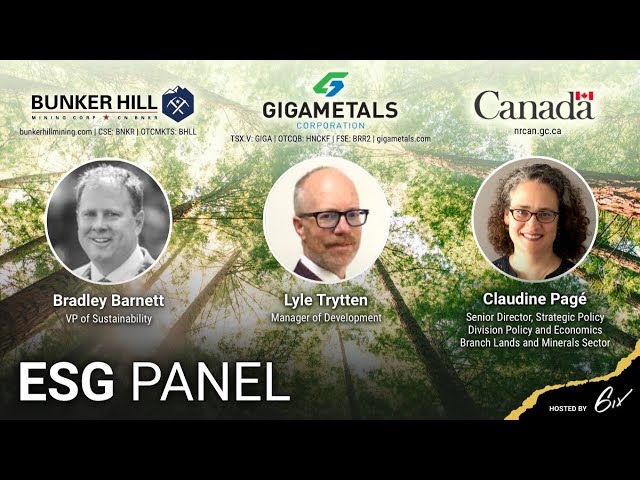
28:31 Thank you, Disha. Great, thank you so much. All right, I would love to jump into the discussion. How and why does ESG impact the mining industry specifically? Lyle, I'll start with you. So really, I look at this as there's 2 major routes that it impacts us. Certainly our stakeholders care. Local stakeholders are directly impacted by our ESG practices. Shareholders, many shareholders want to invest in companies with good ESG records, which might be different than practices. Working with regulators becomes easier when you can demonstrate that you've got good ESG practices. So those all matter. But there's also, we have to recognize a financial impact to the company as well in the ESG world. And it's really twofold.
29:25 Some of the top tier ESG practices can cost more than operating a business differently. Some of them can actually be cost effective and save you money in the long run. Just look at Simarco and some of the other companies in Brazil and the difficulties and liabilities they're facing over their tailings failures. And you see pretty quickly that in the long term, good practices can pay off. But one of the other factors that people don't recognize it as much perhaps is that with right now the proliferation of ESG reporting formats and systems and practices globally, whether they're coming from the financial industry or out of sort of an NGO type industry, compliance with multiple, multiple systems costs you money too, right? It costs you effort and resources and time and focus that you might want to be spending on actually doing things in the field rather than filling out paperwork.
30:26 So, you know, there's sort of a twofold impact there. All right, Thank you. Bradley, anything to add? Well, I think the most direct positive impact is just much better risk management across the board, which any business needs and any investor would want. Ultimately, I think that some of the direct outcomes of better ESG implementation are just increased levels of trust through better information, better dialogue. And I think ultimately that lands the mining industry in a position of having easier, faster, better permitting of new projects and restart of brownfields.
31:16 Absolutely. Claudine, what are your thoughts? Well, I think from my perspective, you know, there is definitely a little bit of confusion out there in terms of all the standards that exist and, you know, what will emerge in terms of something that can be used as a benchmark, and how will companies be compared. And I think that we hear a lot about that aspect in particular. I think also companies will need to think about all these different metrics that they will need to measure and how they will go about that. You know, emissions intensity, GHG reduction efforts. We don't have a ton of data available right now, but we need to build that capacity to then be able to demonstrate how Canada's making progress.
32:09 And so I guess essentially, you know, it's not just about having good financial statements, it's really how you produce and how you partner with others. So it's very much looking at it differently. But at the same time, I think the mining sector's done considerable strides in the recent past, including through the Mining Association of Canada, you know, the Towards Sustainable Mining, and also the Prospectors and Developers Association of Canada through their E3 Plus approach. So I think, you know, we've done a lot of thinking all that, and it's a matter now of making it into a comprehensive approach.
33:00 So definitely pushing the limits a little bit more on those aspects and figuring out how best to report and position companies in the future. Great. Yeah, we'll talk more about that. The questions that came in for you. But so the EU recently announced sweeping new climate measures, including a carbon border adjustment mechanism. What does that mean for Canadian metals production? I'm going to throw it back to you, Claudine. Okay, well, thanks for that one. And yes, so part of our team looks at the policies of other countries. We're always very keen to see what's going on in our big markets, and especially the EU, who can influence regulatory decisions in other countries.
33:50 So basically this mechanism, the EU carbon border adjustment mechanism, was just recently announced and it's part of the wider FIT455 climate and energy package that the European Union has put forward. So there's a few things for us to keep in mind in terms of what it could mean for the for Canadian minerals and metals production. So obviously the increased importance for industry to be carbon competitive. So, in order to be able to attract investments and target new markets as well. So, they'll have to be much more ready to be able to respond to those kinds of requirements.
34:38 And there's also the potential for eventual price premiums on commodities with lower embedded emissions. So, you know, that's an opportunity where we can increase our competitiveness. And there's also, there will also be some increased need to develop traceability and be able to trace commodities back to their production. So we're still going over the proposal and what it can mean and the fine details of that. And right now it's open for comment. So the European Commission has a public consultations portal that everyone can access, and comments are open until September 10th. So, we continue working with stakeholders and other government departments to be ready to respond. But some other key sort of process points are that there's going to be a three-year transition.
35:39 So from 2023 to 2026, where only the reporting requirements will be foreseen. And then it will really start by covering certain industries. So, they're really targeting cement, electricity, fertilizers, iron and steel, as well as aluminum and only direct emissions. So, not indirect emissions from electricity inputs, for example. So it would also recognize the carbon prices that are already in effect in exporting markets. So that's good news for Canada. So from the short term, we think aluminum might be the most sort of implicated in the short term impacts here, where about 98% of the value of in scope Canadian exports to the EU.
36:34 So that's about 970 million dollars per year. So under the current design of the mechanism, it might have limited impacts overall on Canadian exports, especially in the short term, but those impacts in the longer term might have increases because of the scope of the products when it's going to start applying to more products. And when So anyways, overall, it does send a really strong market signal in terms of increased scrutiny and regulatory requirements around this. So that, you know, if we're looking to make investments in terms of carbon competitiveness, there will be some market opportunities as well.
37:25 So it's kind of looking at it from both sides, what does it mean in the short term, but in the long term, if we're able to really be carbon competitive and also meet our domestic requirements now, it does open the door to some positive impacts as well. Great, thank you so much. Bradley, what are some of the ESG related initiatives Bunker Hill has led in the past? Well, we're just starting the whole reboot process of Bunker Hill And the new management team arrived on the scene in March 2020. But, you know, as I described a little bit in the slides, one of the things that we wanted to do right away was to increase the dialogue and start to build the relationship with the whole ecosystem of stakeholders.
38:23 Obviously, we need to get to know them. We just arrived on the scene, but we want to do it in the right way. And the team, Richard, Sam, myself, and David, all believe that transparency and accountability is a huge part of that. And so one of the things that we did was put a water quality tracking platform on our website that gives stakeholders free access to real time information about the water that leaves the Kellogg Tunnel, which is the single point of discharge from the Bunker Hill Mine. It gives them key data points, but if they want more detailed chemical information and a whole variety of other metrics. We do collect water samples every 2 weeks from 30 different locations, both in and around the mine. And we have also published that on our website as an interactive database for stakeholders to play around with, get familiar with the environmental dynamism and specifics of the site, and to try and inspire some dialogue and build understanding and trust, but that is a main tool.
39:33 That's great, thank you. And Lyle, what about for Giga Metals? Well, we've been operating in Northern BC for quite some time and ESG has always been top of mind for us, working with the local communities, critically important, but not dictating to them how we work with them, you know, involving them in our discussions and making sure they're informed. As Bradley said, that transparency is critically important because that's how you build trust. And trust is how you get that social acceptance that we're all looking for. Over the last several years, we've been focused quite intensively on the carbon footprint piece, especially the carbon sequestration that we have going on. You know, our minerals are quite reactive with CO2. And, you know, if we wanted to put enough energy into it, if you grind it fine enough and subject it to pure CO2 at high pressure and temperature, you can sequester A0A ton of CO2 per ton of tailings in our material. That's not the route we're going because at this point in time, it's not a cost effective route, but the passive sequestration that we're now working on with the University of British Columbia can sequester a couple of kilograms per ton through exposure of those minerals in the proper manner with the right moisture content to the atmosphere. It just happens naturally all the time.
40:55 Understanding that process better and how to maximise that is really key for us right now. Of course, we've been focused on how we do manage our tailings properly right from the beginning. Every PEA that we've done has focused on that because it's for a low-grade deposit like Turnagain, there's going to be a lot of tailings and they have to be managed properly. Right. And we, we understand and accept that right from the get go. Great. Thank you. Just my last one here, for you, Claudine, and then we're going to open the floor to attendee questions because there are a lot of them and I want to leave some time. So, but Claudine, do you see a time when there will be agreed ESG standards that apply across the globe, like financial reporting standards? And if so, would it be a universally good thing?
41:44 Yeah, that's a really good question, because that's a question we get asked by a number of our stakeholders and I think right now Canada has a lot of opportunity to play a leadership role on this. You know, we're really trying to be proactive to think through with industry, what would make the most sense. And also, as I mentioned before, working through the recommendations of the panel and now the new action at Council, I think there would be some great merit in having more standardization so that people can actually figure out what they should be meeting. But I think for a global standard to be effective and beneficial, Canada really needs to participate in designing it and in making sure that it's something that's implementable and that's really reflective of the areas that Canada values as well for measurement and performance on the ESG front.
42:49 So we know that also the chartered professional accountants of Canada also agree that, you know, right now it's very fragmented and confusing. Companies kind of, you know, some don't know where to start or stop. And there's lots of ambition in the climate agenda, including for governments to be able to keep track of what we're doing and also reporting. So for example, through the net 0 emissions bill and the climate accountability framework, as a country we'll have to do much more reporting, but we also have to think through how industry will be able to report in a way that's fair and transparent, and that allows them to know where they stand when comparing themselves to other companies and being able to play at their advantages in terms of getting some reward, basically, for being a good performer on these new areas that are now becoming really important. So I do see a demand for a more streamlining, definitely.
44:03 If it's 1 standard or how that would work exactly, I think that's the process that we're going through right now to see what would make the most sense. But definitely there needs to be a better grasp in terms of what this means and how it's applied. Great, yeah, I think that actually leads really well into Kareem's question here, asking if the NRC is working towards guidelines on how to measure ESG performance for these companies. For example, he's saying a company such as Giga Metals should benefit from its product, nickel towards the environmental side of ESG credits. So that's a question for me. So NRC, they're clearly our partners in terms of research and development.
44:52 So I think right now there's a lot of focus on, okay, we've set the agenda, we've set the measures that We hope to pursue, but now we have to figure out exactly how all of this will work. So for example, Environment and Climate Change Canada are working on the Net 0 Challenge, which is an approach that was announced in the budget in April, in terms of how do we help companies set their net 0 plans, and that very much includes how they will measure their CO2 emissions and how they will be asked to report about that. So it's very much a work in progress, I would say, in terms of how we will work together to actually come to an agreement of how we measure this. It's relevant to other programs we've put forward in terms of ensuring that stakeholders and proponents that receive funding are able to be were able to calculate their their emission reductions.
46:01 So I don't have much to add at this point, but it's definitely something that technically we have to grapple with and communicate. Great, thank you. This next question, I believe, is for Lyle, because it came up during your presentation, But Richard is asking if you can explain the CO2 tailing sequestrion potential a little bit more just the basics Sure, and you know, it really is an inherent feature of our deposit some minerals that exist in the earth And primarily these are the ultramafic minerals that host our nickel sulfide deposit, are naturally reactive with carbon dioxide. They contain magnesium that when exposed to water and carbon dioxide, the magnesium will dissolve a little bit, it will react with the CO2 from the air and make magnesium carbonate, a different mineral that's geologically stable.
46:53 Thousands, tens, hundreds of thousands of years, it will sit there. So it's not like a sequestration in say a forest type environment or soil carbon. Also those are good, but you know they are perhaps more time limited. Different minerals within the deposit have different reaction rates. Brucite is the most reactive of the minerals. Serpentine is reactive. Olivine is less reactive. But as we expose those in our tailings facility, and this is one of the keys of having a dry beach facility instead of a submerged tailings, those minerals are exposed to the air. They come out of the tailings process wet. So they're already primed for reaction right at the get-go. And then we're focused on ensuring that we get the maximum uptake of CO2 into those minerals by, for example, agitating them a little bit. There's some things you can do with stirring the tailings facility.
47:49 It's hard to imagine on, you know, 1000 hectare scale, but it's kind of like, you know, tilling a farm field where you can re-expose tailings and improve the capacity. And some of the research that we've just completed at UBC shows, you know, a significant increase for that churning process, as we call it, of the tailings. It can be 25 or more percent more reactive than just leaving a pile, sit there and react. Thank you. Bradley, this is a question for you. Richard is asking, how will Bunker Hill measure and reduce its GHG emissions on scope 1 and 2? Well, I think it starts, Aisha, just with running the mine on all electric power?
48:39 What will source clean hydro power? Lyle mentioned that earlier in his presentation, Idaho and the surrounding states do a good job of providing hydropower to those who want to source it. That's our plan. As a result, our carbon footprint is very small. There are opportunities in the surrounding environment similar I imagine to Lyle's project. We're in an area that's pretty heavily forested and so there is a lot of opportunity to engage in agroforestry and to do some carbon sequestration and harvest some credits that way. In general, 90% of our carbon footprint will be really just the transport or concentrates to smelters.
49:30 We're in commercial discussion, so the exact distance and exact magnitude of that carbon footprint is unknown. But if we were to reach agreement with the smelter in closest proximity, it's only about 250 miles from our mine. Either way, we will be purchasing offsets for that footprint to reach carbon neutrality from the get-go. Great, thank you. Barry is asking what the difference is between green credits and carbon credits. He says, could a sewage treatment plant gain credits in the new market or would this market only involve carbon? And just asking if you all could explain this new system?
50:18 This is an open question. I'll jump in quickly here. I don't know of anything specifically called green credits. We're really focused on carbon credits specifically. That's the big thing in the industry. There has been some work internationally on developing similar credit systems for other parameters of interest, but it really hasn't gotten very far yet. So all the work right now is on carbon dioxide and its equivalents, methane and nitrous oxide and such. Anything to add? Oh, I'm sorry, Dasha, I'm not qualified to comment on that one. Perfect. Dasha, just to be clear, something like a sewage treatment plant, waste treatment and sewage treatment often emit methane from their process. And a lot of facilities are starting to now capture that methane and utilize it to produce power and reduce, therefore, the emissions, because CO2 is a much less potent greenhouse gas than methane. And a lot of waste treatment facilities are now generating carbon credits from that process of capturing byproduct methane.
51:34 Okay, thank you. So this next question from Barry is, is the Canadian government getting into the business of investing in mining similar to China? I believe this is a question for you, Claudine. Thanks, Dasha. So personally, I would think it would be great if we could invest in directly in mining. I would be very supportive in terms of certain projects, But that's not exactly the same system, so we're kind of comparing apples to oranges. But we're very much looking at, for example, right now, critical minerals are very high on the priority list in terms of those metals and minerals that will be key in supplying the value chains that will be central to developing new technologies for the low carbon economy. So in particular right now, we're looking quite a bit, for example, at the mines to mobility value chains. So basically, from mining all the way to 0 emission vehicles.
52:43 There's been quite a few announcements around that. Obviously, Canada's trying to develop their battery value chain and what that could mean in terms of business opportunities here. So we have the minds, we have a lot of capacity, but there's areas where we need to fill in some of the gaps. So we're very much, for example, focusing on the net 0 accelerator strategic investment fund in terms of supporting certain initiatives and seeing how we could accelerate a little bit the development of that value chain, for example, in Canada. So it's very much looking a little bit more at our industrial policy and thinking towards the future and what Canada wants to play in terms of role in those new technologies and those new markets.
53:38 So we, you know, it's difficult to do a direct comparison to other countries with that respect. But I think Canada's approach is very much in terms of setting some desired outcomes and means by which proponents of projects that fit within those outcomes can apply for funding and lead towards those new industries that we see emerging quite quickly and hopefully working with other allied countries like the US in particular to spearhead some initiatives. Transportation is a really significant source of emissions in the US. It's a huge source.
54:24 So we all have a similar interest to try to bolster battery production in North America and advance some of those initiatives, as well as other value chains where critical minerals are key, for example, for the production of semiconductors and all sorts of applications. And we're looking at research and development. Obviously, that's a really important component, but our recent budget had some features in terms of supporting research and development for critical minerals, where we need to develop our capacity for processing, for example. So that's more of the approach that we're taking at this point.
55:13 Thank you so much. We do have- Dasha, can I just add that for a second? Yeah, of course. I think there's a couple of key things there. The government's role is mostly in creating the right conditions and in sponsoring R&D to enable future projects, future technologies to be implemented. But one of the areas where governments in the West sometimes do get involved is in the development of supporting infrastructure on a regional basis. So, for example, for Giga Metals in British Columbia, the Northwest transmission line that runs part extended the British Columbia grid part way up towards our project was partially funded by 2 levels of government and you know it needs to be extended further and that's an area where there might be some potential support in the future.
56:00 You know But we are seeing Western countries now investing, for example, in battery manufacturing plants. So if we're going to invest in making the batteries, maybe we should be thinking about that whole value chain as a government, as all the Western governments in Europe and Canada and the US, the battery plants don't really do us any good if we can't feed them, right? And so if we're going to invest in those, maybe we should really think about investing in the whole value chain itself. Great, thank you. So we do have some questions left, but we are running out of time. So what I will do after this is just forward all the questions that we have here to the appropriate panelists to answer. So all of your questions will be answered after the session. Thank you everyone for joining and submitting all these great questions.
56:50 And thank you, of course, to our great panelists for your insights and for joining us today. This session is obviously recorded and will be available to watch afterwards on six.com. And stay tuned for other responses to the rest of your questions. So thank you all so much. Thank you. Thank you. Thank you.