Replay available
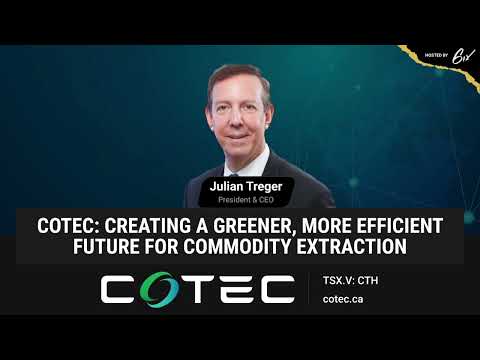
CoTec: Creating a Greener, More Efficient Future for Commodity Extraction
Join us for a great event!
- Company
- Cotec Holdings Corp (TSXV:CTH)
- Date
- Thu, Apr 27, 2023, 11:00 AM ET
- Replay
- Watch the replay on this page · 38 min
On 6ix: 6ix.com/event/cotec-creating-a-greener-more-efficient-future-for-commodity-extraction
Replay
Transcript
Automated transcript · Written by software from the replay's audio. It can mishear names and figures; the replay is the record.
0:08 Hello, everyone. Welcome to Kotech Holdings Live Investment Summit today hosted by 6. I'm pleased to introduce the President, CEO and Director of Kotech, Julian Treiger. Julian's going to be reviewing their corporate presentation and afterwards answering questions that you submit live to the Q&A chat at any time during today's event. If you'd like to get in touch with the CoTech team, feel free to fill out the survey that's also linked in the chat. And as always, this event is being recorded and it's going to be available to watch on six.com in the coming days. So look out for that if you want to refresh on all the information you listen to today. But really without further ado, Julian, I want to pass things over to you so that we can get started properly. Great. Well, thank you, Cam. And thank you, everybody, for tuning in today. We're very excited about the Kotex story.
0:54 And as an introduction, perhaps I could talk a little bit about where the idea comes from and to give some background. I've built several businesses in the commodity extraction area, which we've made multiples of our return on. Coal business we sold for 3.5 billion dollars, a copper business last year for 1 billion and a half. And I was thinking what's next. And it seems unusual to me that the commodity extraction sector doesn't have the equivalent of a technology driven disruptor like an Amazon or an eBay or a Tesla. And in short, Kotech is a response to that.
1:40 The long-term aim is to create a mid-tier green disruptive player in the commodity extraction industrial material space. We think that by identifying really unusual revolutionary technologies and then applying them to a series of assets, we'll be able to build an extremely valuable business over a period of time. So we have great ambitions. The business started roughly a year ago when We took over a shell company with $90 million of tax losses, which we're starting to use through as we generate our own profits.
2:27 And in the last year, We just announced our results for 2022. We generated a small made-in-profit, but importantly, we also increased the market cap of the business by roughly 10x. And we intend to continue growing the business rapidly during the course of this year. I'll talk later about the very experienced management team and the board, which signify the scale of the ambition that we have. And I'm happy to say that we have already invested in 3 technologies plus an asset to demonstrate how these technologies can be applied.
3:16 And We are close to investing in a quarter, which we hopefully will be announcing in the next couple of weeks. All of the technologies we've invested in are super green, and they share a commonality in that they use much less heat, much less water, they are much cheaper than historical ways of doing things, and they are modular. And so they allow the businesses that apply them to do so in a much more flexible way than has historically been possible. And so we're very excited about the potential for these technologies as they get applied to assets.
4:05 Obviously the commodity extraction space has become much more in vogue over the past year or 2, particularly with the weaponization of commodities, both by Russia and China. And so a lot of commodities are quite well valued by comparison to the historic way in which they could be bought. But we are focusing in our asset strategy on the assets which are not highly valued today, even if the commodities are. We're focusing on waste in particular, on recycling and becoming part of the circular economy.
4:53 We're also focused on mines which historically have not been very profitable, but could with the application of technology make a leapfrog in their financial and economic models. And we're also looking at mines which have been shut, which are brownfield expansions. So in general, we're looking at, in a sense, the other assets of the commodity extraction space, the ones which have not been highly valued until now, but which we believe with the application of the technologies that we're acquiring, And when we acquire technologies, we acquire the rights to apply these technologies to assets.
5:39 We think that this group of assets can be transformed economically through the application of smart technology in the same way that many other sectors of the economy have been revolutionized by the application of new technology. So, you know, Cotech is designed to answer some of the challenges that the world is facing, particularly climate change. And you know, we think that recycling has a major part to contribute to getting to the extraction of the commodities we need, using less water, going with new innovation, as I said, recycling waste, including radioactive waste, and really trying to move a sector which has been resistant to change into the 21st century.
6:38 We've looked at those problems and we believe we can provide a solution, as I mentioned, using our team, using the network, having these extraordinary technologies under our belts, which can really make a huge difference to the way in which commodities are extracted going forward and you know, will be a facilitator to us reaching our carbon targets. The strategy, as I mentioned, is to acquire stakes in the technologies and then apply the technology to assets, but focusing always on safe regions, working also much more in an open model with other people in the ecosystem.
7:27 So we've looked at the Silicon Valley universe, and we think that we need to be much more collaborative, doing more joint ventures, sharing information and that way we think we can build the business which the world is going to need in the 21st century. So, you know, we start with the technologies and we've invested in a number of those. As it says here, the ones we have so far are creating a green steel. They are helping to lower the carbon footprint of that sector enormously, to recycle magnets and get rare earths for the West in a super green way.
8:13 And shortly, hopefully, we'll be announcing our next investment, which hopefully will be in the green copper space. And then from that, moving into the asset model, which we'll talk about further. And then ultimately, that is the way in which we expect to produce revenues, but produce revenues much more rapidly than historically has been the case in the sector. Because most of the things that we're doing are much quicker, much more flexible, and also rely a lot on reworking commodities which have already been extracted, which may be in waste, which may be in mines which have been built, but have been mothballed because they weren't profitable using older technologies.
9:11 And so we think that that will allow us to bypass a lot of the delays, the 10 to 15 years on average, it's taking to get a new mine permitted. We think we'll be in production within 2 to 3 years on average. So a much quicker model to get to revenues. We have an enormous funnel. We have since we started evaluated around 200 different technologies. And as I said you know we've we've invested in a handful of them. And we're currently evaluating a bunch more. But any technology we invest in has to meet a number of criteria. So it has to be unique. It has to be disruptive.
9:56 It has to be run with a competent management team. It has to be scalable. It has to be very green. So we occupy a space which is at the adjunct of impact investing, green investing, commodity extraction, and climate change investing. So it has to fit in that box. And then finally, it's gotta be at a good price because like everything, we are only gonna make money if we invest reasonably cheaply. And myself, together with the other directors, have around 60% of the Kotec equity. So every time we invest a dollar, 60 cents of that is ours.
10:45 That's a very good segue into talking about the team. I've introduced myself briefly, but on the operating side, we also have Brahm Yonker, who's the CFO, who is integrally involved in a number of North American mining businesses. We have John Singleton, our COO, who recently joined us from a gold mining business, but previously had a lot of experience at Rio Tinto, an Anglo-American, and Eugene Herkin, who is the VP of Finance and Corporate Development and effectively runs the business in Vancouver on a day to day basis. And then we have a very eminent board of directors, which, as I said before, signifies the scale of our ambition, starting with Tom Albanese, who used to be the CEO of Rio Tinto, one of the biggest mining companies in the world.
11:44 Sharon Fay, who was the CIO of Alliance Bernstein, one of the biggest asset managers in North America, Lucio Genovese, the independent chairman, ran part of Glencore and is involved with a number of mining companies, including a significant iron ore business, which he chairs. And then we also have John Conlon, who's well experienced in mining. Margot Naudé, who used to advise CPP on their mining investments. And finally, we have a very well-respected technology consultant who ran previously the venture capital arm of Rio Tinto, the Rio Ventures business, in the form of John McGar. So I think you can see that we are serious people and are looking to do something quite significant and transformational here.
12:41 The business has been going for about a year. As I said, we've made a few investments, and perhaps I could just talk a little bit further about those in due course. We are expecting a number of announcements in the next couple of weeks. So For those who follow the business, there should be definitely more to come. At the moment, we have around 55 million shares outstanding. The stock is about 50 cents. And then there's a number of outstanding warrants. But the tax losses have considerable value by comparison to a number of other companies. So if I just quickly canter through the existing investments and commitments, our first investment was in a business which has a revolutionary patented binding technology for making pellets for steel.
13:39 If this business was rolled out globally, it alone could reduce the world's carbon emissions by 1%. As you can see here, the energy usage is a fraction of what it used to be, as is the CO2 emissions, because this technology can make pellets at ambient room temperature compared to the 1200 degree centigrade, which historically pelletizing plants have required. Excited about this business, we invested in it at a valuation of $75 million, and we expect imminently a new investment at around double that to occur. So there has, in the meantime, been investment of $130 million by a prominent Asian-based corporation.
14:33 And we think that this business has the potential to become a business close to $1 billion. But more importantly and interestingly for Kotech, What it can be used for, in addition to making pellets from new iron mined, is it can be used with waste from historic steelmaking or ironmaking or ferroalloy waste. And in combination with the concentration technology, the waste, the metallic content of those waste materials can be repelletized and reused. And Kotec has the right to this technology in a number of jurisdictions.
15:21 Any single one of these would have a value of a multiple of the current market cap. And we are in pretty advanced discussions in 2 or 3 situations at the moment. So I think that's a way in which you'll see the way the technology can be applied to assets. So this just talks about the application of the technology to assets. We're pretty excited about that and we expect to make real progress on it during the course of the coming months. The second investment we've made is, and we're super excited about this as well, is into effectively a revolutionary technology using hydrogen, which can take the rare earths out of used magnets and recycle them to create new magnets which can use such rare earths. Obviously, rare earths is a major hot button for the West. The Chinese control the rare earth market, but they also control the rare earth processing market, both the mining and the processing.
16:48 But recycling processed rare earths allows us to bypass those restrictions. And so we own on a look-through basis around 20% of this technology, but more importantly, we own 50% of the joint venture that's being established to take the technology to the US. And the US is very, very interested in this particular area. Various aspects and parts of the US government are aware of the technology. It's a technology, by the way, which the UK government has already financed a pilot plant for, which is in operation in the UK.
17:41 And the EU is in the process of building a larger plant for this, which should open early next year. So this is a business which is getting the attention of major strategic players. And we think that in the US, there'll be great scope for this. And it's a business which should be worth several hundred million once it's built out in due course. And the other investment we've made is in a business in Minnesota which both has significant assets. So it has 200 million tons of tailings. It has over 1 billion tons of iron ore, which is ready to be mined. And it has significant plants, which have had hundreds of millions of dollars spent on them.
18:34 And it also has a proprietary technology which can concentrate hematite iron, which we think is very interesting and we're exploring further the potential for this to be rolled out into other situations. We're in the process of looking at restarting this complex as an input to green steel in the US. We initially invested in the business at a post money valuation of 12 million. The NPV of the restarted plant is over 1 billion dollars. And we expect news shortly of a new funding round at a multiple of our initial investment.
19:29 So within a couple of months, we'll have seen several x on our initial cost. And what's interesting about this plant is that it can also become a demonstration window for the pelletizing technology. And one of the ways in which we want to get the plant restarted is to explore building a cheap and flexible pelletizing plant using the BSL technology in due course. We're looking at a lot of other things. So I've talked a little bit about, you know, base metal leaching technology, which we're well advanced on. We've also looked at a number of cement opportunities, green iron or powder for 3D printing, which we think will be kind of a big thing, and also graphite and graphene.
20:30 So we're trying to stay away from the very crowded areas, like lithium, for instance, which is quite volatile. We're staying away from the next electrified truck or the next battery invention. All of those things we think are replete with risks. Instead, what we're looking for are differentiated technologies, which are pretty unique and have a real advantage over other people. This in a way is the other thing that we are looking at as our potential fourth technology.
21:20 Depending upon the developments on the due diligence next couple of weeks, hopefully we'll be able to announce something in the near future. So in conclusion, we think that Kotech is a super interesting story. The board have put their money where their mouths are. We think that at the current price, the company is extremely undervalued. The sum of the parts is much, much greater than the current market cap. But more importantly, as we evolve the business, as we build out the asset applications of these technologies, there's enormous scope for growth because we will be getting assets at very low prices and really transforming their economic potential.
22:15 And so, you know, we think that we're on a good path, and you'll see lots more progress during the course of this year. Hopefully that was a good and short-ish introduction, But now we'd love to see if you have any questions and have a more interactive discussion. And I'll hand you back to Cam, who will chair this part of the presentation. Cam. Absolutely. Well, thank you for going through that, Julian. And just as a note to everyone in the audience, this is the Q&A period. Feel free to submit any questions that you might have to the Q&A chat down on the right-hand side of your screen. Time allotted, we're gonna get to all the questions. But to start us off, Julian, first question for you. Do you think of yourself as more of a tech business or a commodity extraction business?
23:05 Well, I think ultimately we see ourselves as a commodity extraction business, but we see ourselves as a commodity extraction business using technology. So the technology enables us to extract the commodities in a much more green way, in a much cheaper fashion. And we think that that's a good model for the way in which the sector needs to evolve. Absolutely. Okay. Another question. How are you planning to generate revenue in the future? Well, there are a number of models for revenue generation. The obvious one is within 2 to 3 years as we get the plants up and running, all the waste recycling plants up and running, we'll be able to start to generate income.
23:57 Again, we hope to make real progress on this front during the course of this year. So by the end of the year, we'll have a more asset based business, but even the Magine business we've invested in, the current plan is to get the business into production in the next 18 to 24 months. In addition, the technologies which we are investing in, in order to unlock the value of the assets, they have a lot of value. And we've already seen huge increases in the valuation of those technologies in various funding rounds. And so in due course, we also hope to spin off to the investors in Cotech in species distributions of these technologies as they get IPO or potentially get acquired. So there are 2 models, commodity extraction revenue model, and then obviously the revenues from the technologies we've invested in.
25:00 Right. Question for Paul in the audience. Is there a particular point in the tech or corporate development where you target to invest? Are you looking at pre-seed, Series A, etc.? And what target time horizon are you looking at to be able to monetize your investment? So I think that's a great question. You know, there are obviously different stages 1 could invest at. In general, we look at technologies which are beyond laboratory stage, which are at pilot plant stage, where the laboratory stage has proven that there's something, there's clearly economic interest, and then we can help the technology scale. So, You know, the people involved with Kotech have a great global network in the commodity extraction space and considerable experience in finance and strategy.
25:58 And so we generally look to find businesses which are at an inflection point, where we can make an investment at a reasonable valuation. We're not going to be investing in things that are $1 billion already, because we're quite a small company. But we look at technologies where we, as a group, can really add considerable value to them by you know rolling up our sleeves once we're shareholders and really helping them scale. So we sit on the boards of all these technologies, we you know connect them with the traders, with the finance, with our potential customers.
26:44 So it's that connection where we can make the biggest difference. Right, absolutely. Ronald's just wondering which of your holdings or your bets are likely to materialize the most quickly, looking at those horizons. I mean, we put our mind, we hope that all of them are doing quite well. So the signs are very positive for all the things we've invested in. We see significant valuation amounts occurring. But I think it's probably 2 to 3 years for all these technologies to be acquired or sold.
27:38 And equally for some of these businesses to be built out. Absolutely. Okay. Your connection is just degrading a little bit there, Julian. Apologies to everyone. Hopefully it refreshes itself a little bit and it gets a bit stronger. And it looks like it might have. If anything was missed there, everyone feel free to let us know. We can reiterate that point. But going to the next question from Jerry, Julian, how does your team determine where and how much to allocate to a project when we're in a down market? I mean, you know, given that the board are supporting the company, we really look more at the upside or the criteria of the investment.
28:26 But our main interest is not to put too much money to work into the technologies. More we're interested in allocating capital to building out the assets. That's going to be the more capital intensive area. And we are in discussions with major strategic players globally who are interested in helping fund recycling magnet plants in the US or recycling iron ore waste plants in other parts of the world. So, you know, it's small amounts of money and interesting technologies, And then we will need more money to get these assets up and running. But a fraction of the cost of traditional ways of getting new commodity extraction plants to to cash flow stage.
29:17 Great. And Jerry actually has a follow up question just to this previous one. Are these holdings in your view recession hedges. And how do you anticipate the summer is likely market to impact your decisions going forward. I mean absolutely. We are part of a long term trend. We're not affected by the short term market volatility. These technologies are super useful over the next couple of decades to green the world and to get to the targets. And so we're seeing already huge valuation increases regardless of the short term volatility of the markets.
30:03 And we think that trend is going to continue. Obviously we are trying to pick commodities which we think have good long term prospects. So the pellet premium you know copper rare earths we think have good secular trends associated with them. But we are very much medium to long term investors. We're not trying to play the latest trend in the stock market. Right. Paul in the audience has another question. Do you seek out co-investment alongside you like GPs and private equity on the funding rounds or do you prefer to go it alone? Well, often We are involved in funding rounds. So there are other co-investors.
30:51 And in fact, in all situations, we only own a small proportion of the businesses. And we do that in partnership with other people. And we are increasingly talking to Silicon Valley funds who are interested in impact investing and also investing in the assets which will support this transition to lower commodity markets. And we are working with them. So absolutely lots of lots of partnering. Great. Robson is wondering if it's your strategy to pursue primarily institutional investors concerning the strategic complexity that might dissuade rank and file retail?
31:37 Well, I think in due course we will, and we've had enormous interest from very large institutions in this technology, in this strategy. As I said, there's sovereign wealth funds and trading houses around the world who are watching very closely what we're doing. And so I think in due course, we will be tapping into those markets, but we need to get our market cap and liquidity up further. And hopefully with a series of announcements we're going to be making in the coming weeks, that will start to occur in on its own way. Right. Ronald wants to know, do any of these investments rely on or even would they be helped by having government funding vis-a-vis critical minerals or green funding plants. And he's also wondering if you know specifically if Makango is seeking government funding. Yes is the answer. I mean we are obviously we've already got Binding Solutions has been funded in part by the UK government.
32:43 Mekango is funded by the UK and the EU and is in discussions with the US government. We also think the various states in the US will be interested in creating green steel through Magneta and copper is strategically interesting, particularly in North America, there are not that many copper mines. So I think there are a variety of ways in which we can engage with the relevant authorities. Right. Don Nicholson in the audience is just wondering about if you have any competitors and who they might be. I mean, we're not aware of people who are following the same strategy at this stage. The mining majors have spent a lot of money looking at technologies, but they haven't really cracked the nut in using those technologies to transform their businesses.
33:47 There are also some businesses which invest in mining for technology. But our business is investing in technology to create better mining. So we're not aware at this stage. You know we think we're quite pioneering. We believe that we are at the beginning stages of what we will refer to as mint tech or com tech or co tech is obviously our name. And we think that those are akin to where financial services technologies were 20 years ago. We think that we're a pioneer in developing a new category here. All right. Don has another question. What are the additional funding requirements to meet your production forecasts. Well those could be quite considerable and we're working on those at the moment with regards to a medium term business plan.
34:41 I think our first strategy was to get our hands on the interesting technologies. But you know it looks like we'll be able to, for instance, build 5 or 6 plants or mines, effectively, doing recycling for a few hundred million dollars. Historically, that amount of money would have been required to build 1 mine. And we think that there'll be a lot of subsidized funding from governments and green technology sources on the debt side. So, you know, the returns for the equity should be considerable. All right. Just as a reminder, folks, we only have one more question that's currently queued up and ready to go. So, if you have any other questions, feel free to submit them now while Julian provides the answer to Chris's question, which is, would you enter into offtake agreements or partnerships with auto OEMs or magnet manufacturers, for example?
35:43 Yes, is the answer, particularly on the Magneto-Makango side. We're very interested in exploring those in due course, and they're very interested in obtaining sources for their inputs. And we also are involved with various traditional trading houses involved in our technologies already. So we sit at the nexus of trading and commodity extraction. All right. Well listen Julian I want to thank you for coming on today going through the presentation to provide this introduction to Kotech. And also I wanna thank you for going through such a great Q&A session. Of course, I'd be remiss not to thank everyone in the audience who's joined us today, especially those who have participated in the Q&A. We appreciate you joining us. And we think that these engaging events are very valuable. We hope that you feel the same. If you'd like to get in contact with the Kotec team, feel free to fill out that survey that's linked in the chat. But Julian, before we wrap up for the day, truly, I wanna just pass you the reins for any closing remarks that you might have.
36:49 Well, thank you, Cam, and thanks for moderating that so well. I mean, I hope that via this short period we've spent together, you get a sense of our strategy, our excitement, our commitment, and our ambition. We think that Kotech is really an answer to how we can extract commodities in a responsible green way in the 21st century and change the image of the of the sector as a real force for good, with a lot of circularity, a lot of recycling, and we think we'll make a lot of money on the way. So hopefully it will be great to get your support.
Follow Cotec Holdings Corp into a list and get an email when it puts out news.
Latest news releases
- TSXV:CTH — CoTec Holdings Corp. Announces Investor Awareness Agreements · Mon, Oct 19, 2026
- TSXV:CTH — CoTec Holdings Corp. Notes HyProMag USA Deployment of Mobile Inserma System, Extending Hard Disk Drive Processing to Customer Sites Across the United States · Mon, Oct 19, 2026
Companies on this call
More from Cotec Holdings Corp
- Jul 31, 2025 Critical Minerals in America
- Jul 30, 2025 Cotec Provides Investor Update
- Apr 24, 2025 CoTec Provides Market Update
- Mar 17, 2025 Strategic Investments: Navigating North American Resource Development
- Mar 14, 2025 CoTec Provides A Live Investor Update
- Feb 07, 2025 The Ground Floor Advantage: Emerging Tech in Resource Innovation