Transcript
Automated transcript · Written by software from the replay's audio. It can mishear names and figures; the replay is the record.
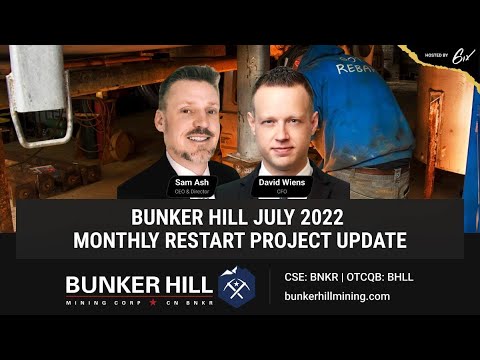
0:08 Hello everyone and welcome to Bunker Hill Mining's live investment summit today hosted by 6. I'm pleased to introduce the CEO of Bunker Hill, Sam Ash, as well as the CFO, David Weins. Dave and Sam are going to walk us through a company presentation, show us a video, and then afterwards, they'll be taking some questions live. I'd like to remind everyone in the audience that you can ask questions at any time using the Q&A panel found on the right-hand side of your screen. As always, this event is being recorded. And in the coming days, it'll be available to watch on six.com. Without further ado, Sam, I'd like to hand things over to you to get started. Yeah, thank you very much. Welcome everybody this
0:40 morning. It's really a pleasure to be able to do another pretty significant project update. We've been busy since our last call about a month ago, and in that time we've made an awful lot of progress. We'll go through some of the details of where we're at and why we're having such a great summer. But to kick off, we have a little bit of a video like we did last time, introducing you to the project, showing you some of the progress actually on the ground, and meeting some of our business partners and team members that are really leading to the success of this project. So Without any further ado, let's start with a video and then we'll get into the discussion in the slides. Hi, I'm Justin Hoffman with Hoffman Manufacturing. We're here at the Pend Oreille mine in Medellin Falls, Washington.
1:32 We're contracted with Bunker Hill and the Silver Valley Metal Corp team to decommission and transport the Pend Oreille mill to Bunker Hill and Kellogg. We started working on this project with Bunker Hill in 2021 in the planning stage. We've been working on it for the past year, getting ready, figuring out the logistics and the handling of the equipment. We've been here for 8 to 9 weeks And we've moved approximately 40 truckloads of equipment up to Bunker Hill and Kellogg. We started the project in the crusher facility and we took out all the crushing and screening equipment and we've moved our way through the mill, prepping the ball mills and removing the drives.
2:21 So we're in a phase now of the project where we're just making last preparations for the heavy hoisting in which we'll remove the ball mills and the last flotation cells and some of the bigger silos. That'll take place next week. We'll have a 265 ton crane on site. Got some holes in
2:37 the roof that we're getting ready to take equipment up through the roof. After this heavy hoisting stage, we'll go through and we'll clear the remaining equipment, lights, ancillary equipment to support Bunker Hill's operation. And we'll advance underground and remove the 900 crusher and any other equipment deemed necessary for Bunker Hill. We'll be completing our portion of the project in 5 to 6 weeks. We developed a very aggressive schedule for the project, but at this stage of the project, we are tracking on time and under budget, which is a big achievement for the amount of work that our crew has done. Yeah, so you can see the project from one of our key business partners' perspective.
3:25 And just a little bit more about that, it's really key to our project the way that we have gone about this. The Hoffman Manufacturing, they're a local business partner. They had experience at the Pend Oreille Mill. They really went a long way towards making this project a success. And one of the key things from my perspective. Is that not only have they stayed on time and on budget- you through this point in the project but they've done it completely safely. With no accidents or injuries or equipment damage. So we really couldn't be happier with the way that it's progressing. You know that video is actually a week outdated now and here at site all the ball mills are actually at Bunker Hill now And the last really kind of remaining component is the underground crusher, which they're gonna be moving onto and looking to bring out over the next couple of weeks. So, you know, it's safe to say that, you know, in the yard here at Bunker Hill now, we have almost a full processing plant, which is a pretty big achievement and a pretty big milestone. Looking forward to being able to say that that part of the project is complete and behind us. And I expect to be able to do that in our next update call.
4:51 I want to also carry on and talk a little bit about the underground development. The decline is now 1100 feet in at the end of July. We're a little bit further now. We have put in our booster ventilation and that fan will get us to the full breakthrough that is planned in September. But I really want to talk about why this is such a substantial and important milestone. It's more than just kind of the key first piece of capital development. What this does is it gives us access with rubber-tired equipment to the first 3 to 5 years of mine life. And that really is a pretty big accomplishment. You know, when you're looking at most underground projects, you know, the capital development is typically a critical path. For us, because of the amount of existing in-place infrastructure, This first piece of development provides not only early access to the mining areas for the first 3 to 5 years of the mine plan, but it puts us in a great position to look at resource conversion and resource expansion within that first 3 to 5 years, which we're really excited about and think is going to have a very positive impact once we get into operations.
6:13 So the CMC, the mining crew contractor who we introduced you to on a video on the last month, is continuing to do a fantastic job, and everything is going as expected in that decline development. Here at site, we've continued to work at preparing the site infrastructure. The work at the Bunker Hillside is largely complete, and we've been utilizing that for storage and staging of the Pend Oreille mill equipment. You can see in some of the pictures that the equipment is starting to arrive and our focus at site preparation has really transitioned and began to look at the Wardner yard which is where the Russell portal and our primary access to the mine is located and we have initiated and are well on our way to doing a similar type cleanup that we did at Bunker Hill at Wardner creating space for lay down yards to support the operation beginning to work on rehabilitation of the road access and haul roads between the Wardner area and the Bunker Hill mine and that's going really quite well. The site is looking really pretty nice and nearing operational ready.
7:38 In addition, we've continued to look and be opportunistic in the acquisition of underground mining equipment. We've acquired 2 haul trucks and a jumbo, and those will be arriving on site over the next couple of weeks, which is really a big step on the equipment side towards building the mining fleet that we're gonna need to bring ourselves into production. So, it's really the message from Bunker Hill is on the operation side and the project execution side that we're really happy with the progress, we're on track, on budget, and with the culmination of the Pend Oreille mill demobilization, we're going to be looking to pivot and ramp up the construction activity here at site. Over the next few months, we'll finalize our selection
8:32 for project management contractor and we'll also be finalizing the you know the detailed engineering and we'll be having that pre feasibility published in in early September so everything is looking very very good couldn't be happier with our progress And then just to reiterate what that larger project timeline is looking like, you know the mill demobilization is finishing, is on track to finish on time on budget. Detailed engineering is continuing to advance, going very well. Underground development we spoke about. The process plant construction will be pivoting from demobilization efforts towards early construction activity. And we're still very much on track for mill commissioning and production in Q3, Q4 of next year.
9:24 So you know a pretty brief update you know we're about 10 minutes in but really the key message is that everything is on track, everything is going well, and we're making great progress, beginning to fill out the team, and really settling into a restart construction phase as opposed to a more technically focused phase. With that gentlemen, I think we can enter the Q&A session for today. We've already received a couple of questions. I'd like to remind everyone in the audience that if you'd like to ask a question, please do so in the Q&A chat found on the right hand side of your screen. But Sam, how exactly are you organizing all of the equipment when it arrives from the Ponderay? And do you have an inventory or warehouse system?
10:08 Yeah, absolutely. That's a great question because there is quite a few components and parts. And in the more effort and focus you put on cataloging, categorizing and storage on the demobilization phase, you know, the easier it's going to be to put everything back together. So we have on both sides of that project, both at the Pend Oreille site and at the Bunker Hill site, we have dedicated individuals who are cataloging before the equipment is demobilized and taken out of the plant and then categorized and given specific locations before it arrives here at Bunker Hill. So it's all very well organized.
10:59 And in addition to the outside storage for some of the larger components, we have a significant amount of indoor storage as well, so that the components that are sensitive to environment are gonna have a safe location to be stored while we're in the construction phase. Oh, absolutely. Question from Rob. Notice that Echelon put out a price target of 60 cents. Are you able to post or share their calculation to arrive at 60 cents?
11:30 I'll take that one. I wish I could, but certainly the Echelon's research, which is a great capital markets partner, that is independent research, so certainly is not coming from us and can't explicitly repost calculations and price targets. But as you say, we are aware that they've put a 60 cent price target on us. They were involved with our financing. And I would encourage any viewers to reach out to Ryan Walker. Who is the research analyst over at echelon who's an excellent- and very well versed in bunker hill- and his price target is based on a very deep dive. Of our plans and knowledge of management etcetera.
12:17 All right thanks for that David- Michael has kind of a double barrel question so we're going to hit it one at a time. What are you seeing in terms of inflation impact? You know we've learned that the mill is on budget. What about everything else? Yeah absolutely. I mean it's a it's a great question. You know we we we're seeing you know and keeping pretty close eye on inflation like a lot of mining companies right now. But I would point to a couple of key things. You know, the acquisition of the Pend Oreille mill created a high level of certainty. And that and that all the contracts and the costing around that. You know we're set in place. The earlier in the year before we really saw inflation ramping up and spiking so you know the cat the process plant represents you know the largest component of capital spend in the restart so it's very helpful that the acquisition cost of the you know the majority of the components for the processing plant.
13:19 Was done just before we saw a huge uptick in inflation that's nice you know we certainly are seeing the impacts- it across you know fuel steel input price. Are seeing that- your Fuel is a big one for a lot of mines and mining projects. It's a little bit less so for us. We do have a diesel component in supporting the mining activity, but the limited amount of capital development that's required compared to comparatively speaking. And the fact that. You we are on grid power and- and in the Pacific Northwest it's primarily hydro based so you know we're not seeing a cost escalation and pressure on the electricity side.
14:07 And in addition your begin we're beginning to see and we're beginning to notice that you know some of the- the peak prices you know particularly in in fuel is starting to have a bit and- and appears to be kind of. Just at the right time for us so it- cost
14:24 escalation. Is certainly something we keep an eye on. And certainly something that that we're focused on. And you know it is- having an impact. But I would say that that impact is, you know, as a quantum is very much not changing the overall story and the overall economics of the project in a material way. No, fair enough. Thanks for that, Sam. The second part of Michael's question is, what part of the restart project are you most anxious about? Most anxious about?
14:57 Well, anxious is kind of a loaded term, but on the one hand there is excited about it and on the other hand there's concerned about. But what I'm most excited about is really, you know, beginning is that we've, one of the key components of this restart was executing a mill demobilization on time and on budget. And we're really quite close to being able to tick that off the list. Another key component was getting that first critical piece of capital development done. And we're well on track for that. As you look forward in any mining restart, in any mining project, there's still a long road ahead of us. There's still a lot of challenges in front of us, but I think that we're certainly off on the right track.
15:55 We have a strong team and we're continuing to build and bring in the skillset that we need. There will be a lot of challenges, but I think when I look at the team that we've assembled and I look at how we're progressing so far, it really gives me comfort that we've been able to perform and achieve at the level we have right out of the gate. That's good to hear. Paul wants to know if you intend to hedge.
16:27 Yeah, I'll take that one. No immediate plans, and I'll also say it's not an active discussion that we're having there's certainly pros and cons obviously you could look at the price of our metals zinc lead and silver today and we had a nice little uptake it in particular the price of zinc which is as of this morning almost a dollar 60 a pound and you could look at that and say well why don't you lock that in. You know what first of all we're quite bullish on our metals and secondly I would say that you know given our cost position we're quite confident that we'll be able to generate you know significant free cash flow even at lower metal prices. And I'd also say that hedging can be quite expensive in terms of the credit that it requires in terms of the practicality of it, particularly on the base metal side after you go out a little more in the future. So all those factors combined is we don't have any immediate plans to hedge and you never say never but nothing on the horizon there. No thank you for that David.
17:29 Rob wants to know are insiders in a blackout period right now? He's wondering why he's not seeing any insiders buying at these price levels. Yeah, so certainly I can't sort of, as you can imagine, reveal when and when we're not in a blackout period. There are times when we are, when there's sort of confidential things that we're aware need to be press released and material information and that's a constant legal judgment. But I would say certainly speaking for myself and Sam and others, we're quite bullish on Bunker Hill and I think you saw that in the financing that we did a couple of months ago, which was at a much higher price. There was significant participation from management.
18:15 I have personally bought quite a few shares on the market. Not recently, which may be where the comment is coming from, but certainly that is, I can tell you for myself, not a reflection of at all of any change in bullishness on Bunker Hill and I think going forward you will continue to see in general management being quite putting their money where their mouth is if you will. Absolutely. Paul wants to know if you're going to toll mill or after breakthrough until the new mill is ready. Yeah, that's an interesting question that we've, you know, that we've kind of guided on before, and I just kind of just I'll just reiterate that guidance. You know, there is pre-production revenue opportunities, and we are actively in conversations and discussions and doing technical work on on how we can make that happen.
19:12 Great thank you Sam. Tony wants to know what level of employees are going to be utilized once mining and milling starts and are you facing any issue in obtaining miners. Yeah so the you know the total head count when we're fully in production- you when you- it take. Into account- contractors and- and- the Bunker Hill employees is going to be between. You know 210 and 220 people- it depending- on where we're at in. In the- ramp up schedule- and I would say on on the other question- you know- sourcing- sourcing- qualified- people and miners you are mining contractor CMC it's a fantastic contractor there a local mining contractor. They have an excellent reputation.
20:01 And what we're seeing is both in the mining front, the processing front, and the technical and leadership front, is that this project is gaining quite a lot of interest from a wide swath of the mining industry. And so as of yet, we are finding that our phone is ringing and people are coming to us, which is really nice to see. So it's not to say that it is a it is quite a piece of work to build you know a- workforce of around 200 people. Over the next 18 months. You know I think that and the way that I think about and characterize the challenge is to make sure that as we build that team and that workforce you know that we're that we're creating it and able to build you know the right entrepreneurial culture in that work in that team as we bring those people online.
21:03 So from my perspective, it's more about making sure that we get the right people with the right culture in place. And that is the larger challenge than being able to actually staff the mine. Right, absolutely. You mentioned that the breakthrough to the- 6th level will allow you access to mineralization does that mean that you can be in production early. All the critical path is the processing plant It always has been and it remains the critical path to organic production at the Bunker Hill mine. So from a mining perspective, we will be in a position to be a consistent producer of ore before the processing plant is finished, which is why we are looking and actively investigating the opportunities for pre-production revenue and pre-production ore sales and toll milling treatment.
21:59 Absolutely. Well, listen, Sam, David, I want to thank you for coming on today, sharing the slides, going through this Q&A session, and of course the video. I also want to of course thank everyone who submitted questions up to this point. You can of course find out more information at Bunker Hill's website, bunkerhillmining.com. But before we wrap up for the day, Sam, I'd like to pass things back to you for some final words. Yeah, I think that from my perspective, it really is a pleasure to be able to come on and talk about the good work that the team that we have in place here has accomplished. We're at the beginning of a long road that's going to see us go and be one of the only mines in North America to come into production in the next 18 months. That's a pretty exciting story.
22:45 We particularly when you look at the macro- you know metals and economic climate. You know certainly we're in a period of- of- some economic turmoil. But I think and we believe that you know the macro fundamentals for all the metal mix that we're going to bring to the market. Is meaning, it means that we are gonna be coming to the market right at just the right time, coming into a metals market that is showing significant price increases. And we're really couldn't be more excited about not only the project advancement, but the timing of when we're going to be coming into production. Wonderful. Well with that, Sam, David, I want to thank you again, of course, and I hope you both have a good rest of your day. Cheers.
23:33 Thanks, Scott. Thank you.