Transcript
Automated transcript · Written by software from the replay's audio. It can mishear names and figures; the replay is the record.
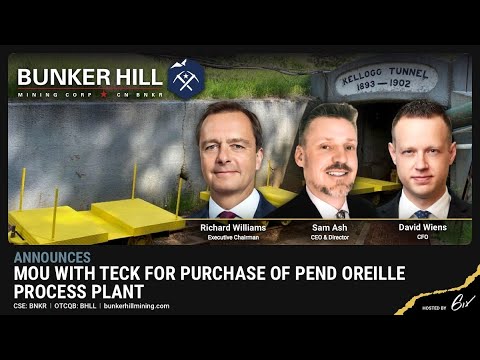
0:08 Well, hello everyone and welcome to Bunker Hill's live summit today, hosted by 6. We're joined today by Richard Williams, the executive chairman, Sam Ash, the CEO, and David Weems, the chief financial officer. The team is going to go into detail about Bunker Hill's most recent news and after we will be accepting questions. So as a reminder, you can submit your questions at any time on the Q&A panel on the right-hand side of the screen, and we'll get to them after the presentation.
0:36 And as always, some of it is being recorded and will be available to watch afterwards on six.com. But without any further ado, I'm gonna hand it over to you, Richard, to kick us off. Thank you very much, Dasha, and thanks, 6, again for setting up such a great facility. And thank you all for dialing in. This is a very important brief to all those that are watching the Bunker Hill story. The acquisition of this plant, working with tech, is a really important milestone for the delivery of our engineered plan to restart the mine. Now, when you look at it, and I'm going to hand over to Sam, I want you to remember that we issued a PEA, which is defining some very important and useful economics.
1:26 And within there, there's a CapEx budget.
1:30 And all of you that are observing us will be wanting to know as we move to the construction decision underpinned by a PFS, how that capital budget is moving. And in this environment today, which is inflationary for mining input costs, you quite rightly will want to know, is that capital budget going to move upwards or is it going to stay the same? And I'd like you to look and listen to Sam carefully when he describes how this plant is firstly going to be useful from a mine operational perspective. And then secondly, how it's also going to be incredibly useful when it comes to keeping our CapEx numbers within the range that we're working towards.
2:20 It's a really important milestone. This and I really appreciate you dialing in. So with that, let me pass over to the team that have really done the work here, which is Sam and David. So, Sam, over to you. Yeah. Thank you, Richard. And as you said, the acquisition of the Pend Oreille mill is really a key milestone that takes a big step forward in de-risking and creating certainty, not only about that capital cost, but just as importantly about that restart timeline which we'll get into in a minute. But to start off, I just want to talk a little bit about the Pend Oreille mill and the suitability and why this is such an important acquisition for us. So the Pend Oreille mill, it's ideally suited for our purposes.
3:10 It's a well-maintained 2,000 ton a day full processing facility. We're not just buying a mill. We're buying the full processing facility which is which is when it was in operation a differential flotation plant creating a zinc concentrate in a lead concentrate. That is exactly what we were looking for and is absolutely ideally suited. We have been, this is the culmination of about 6 months worth of work. So we've been to the site multiple times. We've had a long discussion to reach this point, And we are confident that this is the ideal solution. In fact, we're so confident that all of our engineering and technical work has been focused on the Pend Oreille plant up to this point. So it's really a pretty exciting, exciting milestone for us. This processing plant, let's talk a little bit about what we're getting for that $2.75 million purchase price. We're getting an underground crusher.
4:15 We're getting 2 surface cone crushers. We're getting the full processing plant, which includes 3 ball mills, a regrind mill, a full differential flotation circuit, all of the process control equipment, concentrate and concentrate filters, a weigh scale and an analytical lab. So, you know, this is a full processing solution for Bunker Hill that is of the same scope and the same scale that fits our needs exactly. Now a little bit, you know, what does the road look like from here, you know, with this processing plant? You know, we, You know, we'll be working on finishing the definitive documentation over the next couple weeks.
5:09 And then we're on track to begin, you know, the demobilization process sometime around the end of Q2. And that's going to involve relocating this processing facility to Bunker Hill. Now, the nice part of this as well is the relatively close proximity. We're about 145 miles away on paved roads the whole time, and roughly half of that distance is on a major interstate highway. So, you know, transportation and the complexity involved with transporting this is really greatly diminished because of the local nature of this processing plant. Now, once against the Bunker Hill, I would just wanna give you a little bit of insight on what we're looking at and some of the trade-offs involved. What you can see on the picture on the right there is the site here at Bunker Hill. So I'm speaking today, as I always am, from the building labeled administration office.
6:10 And I'm looking out the window, just past my computer screen now, at that building on the right that is labeled potential process plant location. That's 1 of 2 options that we're currently doing trade-off studies on as a part of our pre-feasibility technical work. The other location is locating the plant in the underground in close proximity to the mining footprint that at which will be mining. Both of those solutions are technically viable solution. We're convinced of that with our technical work to date. The decision and the key decision point that we are investigating right now is the differential cost between constructing the plant in the underground versus the incremental increase in haulage costs from bringing raw ore out of the mine out of the Kellogg tunnel along that 10,000 foot access way. So as we complete that, that final solution will be put forward in our PFS.
7:11 And it is purely an economic decision and economic drivers because both are technically viable options. And just a little bit more about that building that is the potential process plant location. That's not just a trick of photography. That is an exceptionally large building, well constructed, and is in very good condition, and can easily be repurposed to house this processing plant, if that is ultimately the decision we want to go. And although we don't have pictures, in the underground environment, there is existing excavations that we would be able to repurpose and reuse for the look, if we choose, and the economics direct us to build this processing plant in the underground environment.
8:05 So it's really an ideal solution and one that we've been working on delivering for quite some time. And it's a significant de-risking event, both from a cost standpoint, an inflation standpoint, and just as importantly, from a scheduling standpoint. The world is facing really kind of some interesting challenges in an inflationary environment and also the supply chain disruptions that we've seen over the past year and A02 years. And this goes a long way to addressing those risks. And we're very, very happy to talk to you and let everyone know about that today. I'll just jump in for a 2nd, Sam.
8:50 It seems like there's some technical difficulties and viewers aren't able to see the slides on the platform. The slides are available on the handouts tab and if you'd like to go to our website, BunkerHillMining.com under investors presentation, we're sharing slides 9, 10 and 17, just for reference if viewers would like to, but we'll keep going with the slides in the meantime. Sorry, Sam. Yeah, no problem. And apologies for the technical issues there. But I'm just gonna talk through and
9:24 the project timeline. So in those slides, if you download them off the website, what you'll see is a new addition to our corporate presentation, which outlines at a high level the plan development timelines that are going to take us from where we are now through to commercial production at the end of 2023. What we're working on now is using the most recent mineral resource estimate, and I'll just remind everybody that that mineral resource estimate was a significant, represented a significant increase in the measured and indicated material
10:04 to a inventory of 6.6 million tons. Using that mineral resource estimate, we are updating and modifying the mining plan and sequence. And in addition, we're advancing the technical studies in the areas of plant engineering, geotechnical work, finalizing the final metallurgy, and working on the engineering around the paste and tail solution. All of that with additional work streams around ventilation, electrical reticulation, dewatering, water treatment will all be included in a PFS study that is expected to come out in early Q2.
10:51 At that point, we will be in a position to begin the demobilization process of the Pend Oreille Mill by the middle of Q2. All the while, detailed engineering will be ongoing to make sure that we have robust construction-ready designs and engineering drawings. And I'm happy to announce that we've begun the process of and initiated the rehabilitation in advance of the commencement of the underground development drifting.
11:27 And process plant construction is scheduled to initiate in earnest in Q3 of this year, is projected to last around 12 months, which will allow us to begin the commissioning of the mill and the move towards production in Q3, Q4 of 2023.
11:52 And I'm gonna turn over to Dave right now to just give an update on the catalysts and just remind everybody of some of the significant milestones that we reached right at the end of the year and give a bit of some insight into some of the upcoming catalysts. Dave. Thanks Sam. And for those following on the website, now on slide 17, we just covered slide 9 and 10. So you can see on the left-hand side, as Sam just alluded to, all the results that we've delivered over the last year. I think if you went back 18 months, there was very few, if any, of these tick marks there. And they would have been on the right hand of the side as catalyst coming which you know for us is important that we'd actually deliver on what we say we're going to deliver on and I think the proof is is there. So, I won't run through each through all of them. As everybody knows, a few weeks ago, we had the big announcement about the EPA settlement agreement amendment, the $50 million project finance package, and the purchase of the Bunker Hill mine.
12:57 As an update on the financing, The first tranche closed a couple of weeks ago, the $8 million tranche. The second tranche is scheduled to close very imminently, and I would look for a press release on that. So that is all going according to plan. And then the final tranche of the financing will come a little bit later, likely in the second quarter of 2022. So looking forward, we've got lots on the horizon. You'll see lots of updates on the restart in line with the development timeline that Sam just went through. You can look forward to appointment of key personnel, including a general manager, awarding of mining and EPCM contracts, all the trade-off studies that come along with doing the hard yards to make sure that we do this right on time and on budget.
13:45 And that's what this team does. And towards that formal construction decision and drawing down on the stream. So we are moving forward on all fronts and you can also look forward to, and we're in the process of formulating plans with respect to exploration for 2022 as well. We're looking at, as you would have seen a couple of weeks ago with the geophysics results coming out, that's delineated some possible surface targets. We're looking at how we can possibly work that into the budget for 2022.
14:15 And in addition, the London joint venture, we're closing that and we see a lot of low hanging fruit to potentially delineate a 43-101 resource there. And or some near surface drilling. And as a reminder, the historic mining there was upwards of 23 grams a ton gold. So very perspective and a lot of value to be unlocked there. And lastly TSX Venture. That is probably the one tick mark that we talked about last year that it's still not there. But we're we're getting close. So obviously can't control exact timelines with respect to listing committee, but we're partnering with them and they're very pleased to see the progress that we've made here. And so stay tuned on that front. So lots to come.
15:06 Thank you, Dave. And just to kind of sum up, you know, the Bunker Hill with the EPA settlement, modified settlement agreement, the 50 million in non-equity financing, the purchase of the mine, the mill purchase, you know, you're going to see a definite transition and pivot in Bunker Hill as an organization. You're going to see us really move forward in a technically prudent fashion and begin to enter a construction and execution phase here at site. We're very, very excited about what 2022 has to hold and the activity here at site is going to really pick up and it's going to be a very interesting and important year for Bunker Hill as an organization, as we begin to crystallize and catalogue and achieve our stated outcomes, which is to become an operating mining company with an eye towards growth.
16:16 And I can't say how excited the whole team is here at site. Great, well thank you so much Sam, Richard, David. I think we're going to move on to Q&A, So if you do have a question, feel free to submit it now. Our first question here is when was the mill last in operation and what what was it producing?
16:40 The mill was last in operation about 5 years ago and it was producing, it's a differential flotation plant and it was creating a zinc concentrate and a lead concentrate. So, very, very similar in that respect to Bunker Hill. As everyone would know, we are going to be producing a zinc concentrate and a silver lead concentrate. So ideally suited for purpose. And I guess I would just add another piece of information. You know, we've spent time up at inspecting and taking a look at the mill. And I have to say that a fantastic job has been done on the was put into care and mai that it's been maintained in exceptional condition.
17:35 So much. Gregory is asking what is the plan for tailings and waste? So, certainly our plans in the PEA and in the PFS, you will see that underground, let's talk about tailings first. So the tailing stream coming out of the process plant is gonna be used for 2 purposes. One of it is gonna be used in a geotechnical paste fill that's going to support the transverse longhole stoping mining method. That's going to represent around 50% of the tails. The remainder of the tails will be made into a paste and put into historic mining voids. On the waste, there is, and we are blessed with this with Bunker Hill, is that there is enough open space and capacity in the underground that the waste generated from the capital development will be able to be stored in the underground mine.
18:35 And that has the benefit of reducing the amount of haulage required to haul it to surface, but also is a very environmentally responsible manner in which to handle that waste. Great, thank you. So it seems like you guys are moving really fast. Do you think that there is a risk that you'll have a capex blow out like a lot of other mines recently? Well, it's certainly at the forefront of our minds. You know, any time you're in a situation that is inflationary in nature, coupled with the supply chain disruptions that we've seen over the last year, it's certainly a concern and it's a valid question. But I think that when you look at Bunker Hill and you look at the project and you begin to understand the project, you know, there are, you know, we have some definite benefits to where we are located geographically and in the Pacific Northwest, in close proximity to a major interstate highway and transport corridors, in close proximity to light industrial capacity in the Spokane Valley.
19:45 So we're building this project in an area where, we're not going to have to have a man camp. We're not going to be flying materials into site. We do not have exceptionally long logistics corridors that we're dealing with and that we're challenged with, all of which are impacted in one way or another by inflation and supply chain logistics. And then when you look at the process plant in itself, the opportunity that this represents to acquire a a full processing solution in close proximity for a known fixed price is incredibly beneficial to us. That's a significant de-risking event.
20:36 We're not under the position where we're going to have to calculate and speculate on timing deliveries from manufacturing of a processing plant in China, the deliveries with shipping and and sea transport. What we're dealing with is the transition of a mill that's in very good condition from 140 miles away over excellent transport corridors to our site and looking to install that either in an excavation that already exists underground or a building that already exists on surface. Thank you. Leslie has a question here. They're asking, how does the plant purchase for 2.75 million affect your financing facility?
21:30 I'll let Dave answer that, but I think the simple question is really not in any significant way. Yeah, so I would add a couple of points on this. I think it's a great question. So as part of the diligence that Sprott did on Bunker Hill, and as you can imagine, you know, if you're going to put $50 million into a project, you're going to want to send an army of engineers and geologists down to site and they liked what they saw obviously and worked well. But part of that was, and I came along for this personally, is we went to the Pend Oreille mill and they were very pleased with what they saw. So Sprott and ourselves and tech are all very pleased you know, with this acquisition. Now, in terms of the actual purchase price itself, It's worth noting that in the PEA, there was about $20 million budgeted for the process plan. Now, I don't want to suggest that we're saving $17 million here because we bought it for 3. Most of the cost will be the construction at site.
22:34 However, I think it is entirely, not only have we de-risked that $20 million number, but we're seeing potential savings, particularly as we do this surface versus underground trade off. And as Sam noted a couple of times, the close proximity of the plan, we're seeing the potential cap back savings versus what we what we budgeted for in in the P.A. So pretty exciting from that perspective. Right, thank you. Earl is asking, could you comment briefly on your geophysical study? Yeah, absolutely. I'm glad you asked the question, Earl. So the Bunker Hill mine is comprised of over 400 patented mining claims, you know, underneath around 5,800 acres of land. Now the Bunker Hill historic mine footprint is a fraction of that, around 900 acres.
23:32 And the remainder of that claim block, although there was some prospecting and and good geologic surface mapping done, it was very lightly explored. So the geophysical survey that we did was really to begin the process of looking at understanding and unlocking the potential mineral value associated with the full claim block, as 1 would expect we would do. You know, we, you know, when we look at Bunker Hill, we see this as an absolutely world-class mineral endowment. And certainly there's an obvious interest in understanding the opportunity that exists on the larger claim package. Now, last summer, we did a 3D high resolution IP geophysical survey.
24:18 And the results that came back from that were really quite interesting. In particular, there was 2 anomalies that were detected that are in a favorable lithology, favorably oriented, and could represent some quite interesting mineral potential. Now we're in the process of developing plans, refining our analysis of that data with the expectation that we'll be looking to follow up on that in the coming exploration season. Great, thank you. Tim is asking, what is the projected throughput through the mill, and do you have that hoisting capacity? Thank you, Tim.
25:04 The projected throughput is 1,500 tons a day. Now the existing hoisting capacity, so historically the Bunker Hill mine operated at about 1,500 tons a day, peaking out at 2200 tons a day, over 100 year operating life. Now the hoist that was used to achieve those production rates is no longer in service, although the service shaft and the service hoist is still operable and in operation. So our PEA, and we're going to be following up and refining this in the pre-feasibility study, calls for a replacement of that production hoist. And obviously that will be at the appropriate capacity to support mining.
25:49 What's also important to note is that as we resume operations, you know, our mining activity is going to be happening at in the area between the 5 level and the 9 level. Now that hoist and shaft collar is at the 9 level itself. So we have a bit of a runway in timing and to support the mine plan to come into operation and the material flow will be down from the levels above the 9 level to the 9 level where either ore haulage to the surface or the processing will take place in the underground environment. Now, from the 9 level down, we will have and be developing a rubber-tired access drift to support mining, but the current plans are certainly to replace the production hoist with an appropriately sized hoist to support mining below the shaft collar on the 9 level.
26:53 All right. Thank you. And to wrap up here is there anything that management wants to highlight and that investors should be looking out for. I think really you know what I would like to highlight is the veracity of the technical work that we're doing. You know, we are moving quickly, but we are moving quickly for a couple of very specific reasons. The amount of in-place infrastructure, the wealth of historic technical knowledge and data is very, very high at this site. When you're looking at building a mine, you look at, and a large part of it is about managing risk. And the number 1 risk that I would 0.1 to that one needs to take account of is the resource risk. Now, just to remind everyone, the resource that we're working with here was an SEC compliant reserve that was in operation and being actively mined in 1980 and had been for over 100 years.
27:59 So we have come in and we have certainly done the technical work to validate, verify, and make sure that that is robust and accurate. But because there is so much information about that resource historically, we have a high degree of confidence in that resource. That's number 1. Number 2, the amount of in-place infrastructure in the underground means that the access and the ability to access that resource for mining is well advanced. We're looking at rehabilitation, certainly some additional development is required, but from a standpoint of comparing this to a Greenfield restart, we have a year's worth of head start on that access and development to that underground mineralization.
28:53 And then I think finally, when you look at some of the aspects around ground-controlled geotech, metallurgy, all of those are based not from starting from scratch, but building on 100 years worth of institutional knowledge that exists here at Bunker Hill. Well, thank you so much, Sam, Richard and David for taking us through the presentation. I do apologize for any technical difficulties. So make sure you download the presentation from the handouts tab before we close out. And of course, thank you to everyone who joined us and asked questions. If you do think of another question, feel free to reach out directly to the Bunker Hill team and they'll be happy to follow up with you. You can also find more information at BunkerHillMining.com.
29:40 Before we close out, I'll pass it back to you, Richard, if you have any final remarks. No, Thank you, Dasha. And for everybody listening in, I'll remind you what I introduced this at, is I asked you to listen very carefully to what Sam is saying about the advantages that this Pend Oreille plant provides us for our restart, and listen very carefully to the specifics of what he said about our get the mine going plan. I think he gave you a lot of detail and I think you should expect from us more of that detail coming out as we close to our final construction decision.