Transcript
Automated transcript · Written by software from the replay's audio. It can mishear names and figures; the replay is the record.
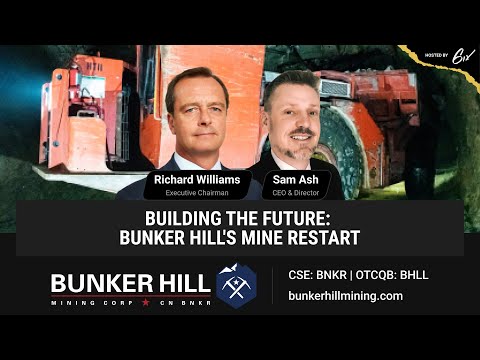
0:08 Hello everyone and welcome to the Bunker Hill Mining Live Summit hosted by 6. I'm pleased to introduce our speakers for today, Richard Williams, the Executive Chairman and Sam Ash, CEO. They'll take us through a company presentation, and after that, we'll be accepting questions. As a reminder, you can submit your questions in the chat at any point during the presentation. If you'd like to contact the Bunker Hill team, feel free to fill out the survey, which will be linked in the chat. As always, the summit is being recorded and will be available on six.com to watch afterwards. Without further ado, I'd like to hand things
0:39 over to you gentlemen so that we can get started. Thank you very much, Mike Suman. Thank you, 6, for setting this up for us and for all of those that have dialed in. Today's presentation is gonna be split into 2 parts. Firstly, I'm gonna talk about what's happening in the world with respect to global supply chains, zinc, silver, and where the United States is looking at the development of that supply chain and how Bunker Hill could fit into it. And then I'm going to hand over to Sam, who's going to talk to the specifics of the restart project, as well as the subsequent value creation that is actually ongoing at the moment.
1:30 So in the first part of this, I want to sort of highlight, and anybody that is watching the news will have picked up parts of this, how we look at how the zinc market, and I would refer to the zinc market here specifically, because it's one of the critical metals that Bunker Hill will be producing and how it's looking right now with respect to a series of pressures, as we outline it here, at a strategic level that is impacting the forward supply and demand situation for that metal. As you can see from this slide, long-term zinc demand is typically driven and this is consistent by investment in infrastructure, transport and construction, to underpin both population growth through urbanization, and economic stimuli, such as being delivered at the moment by the Inflation Reduction Act, and now the green energy transition.
2:42 Demand for zinc is strong and getting stronger. But on the supply side, particularly when you look at the West, there has been decades of underinvestment in zinc exploration, mining and production, where production in this case refers to smelting and refining, outside China. Since the environmental regulatory improvements of the 1970s and the global financial crisis in 2008. On that latter point, 50% of the money available to mining prior to 2008 was taken off the table as a result of that financial crisis. And then now we are dealing with what some call an emerging geopolitical competition.
3:35 It's probably already absolutely active that threatens to cut the global metal supply chain in 0.5, destabilize high-risk countries, and we've just seen that in Niger, and tighten zinc supply to the West further. What this means is that the long-term prognosis for zinc supply to the West is fundamentals are likely to be 1 where we see a deficit of supply, placing a premium on sustainable, long life zinc silver mines in North America. And I refer to silver here because of its silver credits and the fact that we personally as a company are focused on the highest margins that we can get. And typically where you have a lot of silver credits, your zinc margins are particularly high.
4:32 Next slide, please, Sam. Let's have a look at the history of American annual domestic zinc production between 1889, approximately when bunker started, and now. You'll see 3 key phases. One of which up to the 2nd World War is United States is self-sufficient in zinc. There are a series of ups and downs related to the wars that are being fought, the New Deal financial stimulus, similar to what people are proposing now. And then the second phase, where you can see an ESG correction, where some very sensible and longstanding environmental and governance regulations, the Clean Air Act, the Clean Water Act, and the Superfund Act in particular, led to the shutting down of the majority of hard rock mining in the Western United States.
5:33 To give you a feel for statistics, prior to 1969, there were 17 active primary, large scale primary smelters in the United States producing zinc. There is now 1. Prior to 1969, There were thousands of small zinc operations operating now. We're less than 10 and you saw the closure of Bunker Hill Mine happening as a result of that necessary correction to the way in which the environment was being managed. And then you end up, it's the third phase where production was recovered as a result of the development of the Red Dog Mine by Tech Resources, now Tech Metals, in Alaska, which now provides 75% of annual US zinc production, but unless there's a considerable more investment, is due to end from 2031.
6:32 So US domestic zinc supply is dependent upon 1 large asset in Alaska that will be shutting down in the next 10 years. Next slide, please, Sal.
6:48 Let's have a look at how America's zinc consumption is evolving. Well, you can see top left, the typical slide that explains that the majority of zinc is used for industrial purposes. You can't put up an offshore wind farm without galvanizing the steel with zinc. It's a critical part of the defense industrial base as well where key elements of defense technology, not just through military grade steel, but also a lot of the key components that require to weather well in the combat and sustained operations that ships, air, tanks, drones, and so on operate in require zinc or brass casting.
7:41 And as a result of that, the US has put zinc on the critical metals list in 2021, and the US Defense Logistic Agency actively manages U.S. Domestic stockpile and have been doing so since the 1950s. Now the emerging demand trend, as you can see upwards, is driven by the Inflation Reduction Act funded infrastructure targets, as well as the wish to transfer American energy supply from a dependence on fossil fuels to green energy. Now, zinc is not a battery metal yet. Others may call it that. But it does provide inputs to existing battery technology.
8:26 And there are some very interesting new zinc ion and zinc air technologies for static sites, not electric vehicles, that could over the next 10 years become something very meaningful. Not yet though. A defense investment increase not just as a result of the Ukrainian war, where there is just as we all know considerable shortage of critical capabilities to the Ukrainian side, but also getting ready for what this global competition may mean in terms of active combat operations in the future. And then finally, with respect to zinc demand, unlike other metals or battery technologies, zinc recycles extremely well, and that's going to be an important part of the future supply chain.
9:16 Next slide, please, Sam.
9:21 So let's have a look at where zinc is produced. And I've color-coded these slides deliberately. If you look at global zinc production by country, You can see United States is now sitting around about 6%, primarily a result of Red Dog. Prior to 1970, it was at 15%.
9:42 And you can see color-coded in blue, those nations that are typically referred to as allies or partners of the United States. And you can see that only 37% of zinc is therefore produced in countries that declared the annexation of Eastern Ukraine by Russia to be illegal in the United Nations resolution dated October 2022. And the other nations, color-coded in red or brown or beige, are either sitting on the fence or actively supporting that operation. And you'll also notice that China dominates the global zinc supply.
10:30 Where does the source of imported refined zinc come into America, given that it hasn't been self-sufficient since 1945? Well, the good news is you can see color coded in blue primarily, it comes from so-called friendship countries or allied countries, and is dominated by Canada. And 3 key electrolytic smelters, 1 trail in British Columbia, which will be producing processing concentrate from bunker flint. Flon owned by Hudbay, but shutting down and Kid Creek, Glencore on and off care and maintenance. And these 3 Canadian smelters import their zinc concentrate from America, i.e. From tech, Peru, Australia, Mexico, and Bolivia.
11:21 Next slide, please. So if we're just gonna strengthen the supply of North American zinc as part of a supply chain adjustment to ensure that the United States is less dependent on the vagaries of zinc from Africa or zinc from other complicated parts of the world. You're gonna need to increase investment in certain key projects. Now, Red Dog Mine, as I said, is shutting from 2031. Now, tech may put more investment in there. It may go on. But just for the sake of argument right now, assume that it is shutting. So 550,000 kilotons of zinc is going to leave the market from that time.
12:08 Other projects, major projects, do exist. Fireweed Zinc, a superb Macmillan Pass project with a long permitting timetable ahead of it potentially, needs over $500 million worth of capex to produce, under current estimates, 220,000 kilotons of zinc a year from an open pit operation. Now, that will evolve over time. And we should all watch to see what the drill results and the study results over the next 12 months deliver us. Prairie Creek, that has been fallow for decades, now owned by the Resource Capital Funds, will, with $400 million worth of CapEx, get in production, but probably not before 2030. Kudusikaya, owned by privately again by BNC, will, with a $500 million CapEx bill probably, pending First Nations and permitting support, deliver 100,000 kilotons of ore a year.
13:09 And Pine Point, recently Appian-Asisco partnership with a 650 million dollar capex, probably not before 2030, delivering 160,000 kilotons of zinc a year. And then most recently in the news, the Taylor Project by South 32, just suffering a 1 billion dollar capex blowout on a 1.6 billion dollar capex estimate in Arizona that will probably push that mine's production out beyond 2030.
13:42 And so into this picture comes Bunker Hill Mine. And we're gonna start with around about 50,000 kilotons a year. And you're going to hear from Sam how we're going to increase that to a target of 120,000 kilotons conceptually. We've got to prove all that by more work for a mine that will last well over 40 years and will be the first mine into production in this panoply of North America that we're showing you here today. And really importantly, the impact of that mine beyond just the supply chain is going to be significant. 250 direct jobs, 1250 indirect jobs into a community whose mean household income has still been stuck in the 1980s as a result of the closure of the mines.
14:32 And it'll be the first major mine restarted, an EPA-funded, EPA-run Superfund site. So the first real correction, positive development since the mines closed in the 1970s. And all of this coincident with the US presidential election results in November of next year. If that doesn't paint for you why Bunker Hill is significant in the global position that we find ourselves in today, I don't know what will. And I look forward to answering any questions that we have time to deal with on this call. But let's move from the strategic and why bunker is important to the tactical, to Sam who lives and works on site in the Silver Valley, Idaho, about what's actually happening at the project today, and what he and the team, with all of our guidance, is going to be doing to add value to the starting point at Bunker that we've been telling you all about.
15:34 Over to you, Sam. Thank you, Richard. It's really, really happy to have everybody on today and be able to talk to you about what is shaping up to be a very successful construction and build phase at Bunker Hill. Really the first key activity that is happening at site is the portal rehabilitation.
16:00 And what's nice about this is the contract has been awarded. We're currently mobilizing the contractor in to achieve that work and execute that. And what is great to see from a capital perspective is that our estimates and budgetary estimations are exactly what we are achieving with GMS coming in on budget. And certainly over the next month, month and 0.5, that will be one of the first milestones achieved.
16:33 And again, the cost of that is exactly what we projected. We finalized the ball mill purchase and we'll be moving that over later this summer. The process plant engineering is moving along towards completion very nicely. And we are working with our Ibista, the local utility, to upgrade the power into the underground mine up at Warner in that new portal that we're rehabilitating and putting online. And one thing that's interesting to note about on the power side is we're actually seeing that there's a potential to significantly reduce our power costs from the 6.5 cents that we had projected down to 4.7 cents a kilowatt hour. So it just gives you a flavor of the area that we operate in, in the Pacific Northwest, the advantages that we have around the ability to achieve long range, long-term, low cost electrical costs.
17:40 And then probably most excitingly is the ongoing work around optimization. It's been our strategy from day 1 to focus on restarting the Bunker Hill mine in a low capex fashion and get into free cash flow as quickly as possible. That will allow us to use that free cash flow to unlock the significant upside potential. Just an update on kind of where we are right now. You can see a few pictures here. I'm currently at the Bunker Hill Admin Building. There's a little bit of demolition and site preparation underway for the location of the processing plant.
18:27 Again, all of the major components for the processing plant are here at site now, and we're just awaiting final engineering to begin the construction process. The portal work is going to be up at Wardner, where we have already completed the first key piece of infrastructure, and we now have rubber-tired access to the first 3 years of the mine life. And the expansion of the portal, it will really support not only the production rates that are in our current plans, but support the potential expansion that we're investigating now. Just to give you a flavor of the work that's going to be done at the Russell Portal, we will be taking out the existing portal, which is around 10 feet by 10 feet square. And we will be expanding that and making that larger to 16 by 16 feet. That will allow us to support productivity increases and fully utilize the capacity of the underground mining fleet and ensure that the productivities are where they need to be as we move into production next year.
19:43 But what is really exciting is what comes after we're in operation and generating free cash flow. And that is the potential for significant value creation that exists at this asset. As you all know, our feasibility study is based on the measured and indicated material, right around 7 million tons in the measured and indicated category. But keep in mind, we have another 7 million tons of inferred mineralization. And we expect that mineralization to convert into measured and indicated material at a relatively high rate, considering that it was all a reserve that was actively being mined when the mine went into closure.
20:28 That coupled with a potential throughput increase up to potentially 2,500 tons a day. Again, still a lot of work to do to prove that which is underway along with bringing other technologies like ore sorting into the, into the operation and continuing to optimize recoveries all lead us to believe that the real upside potential at Bunker Hill could be $200 million plus of NPV. And that's before you take into account the significant upside potential that is reflected in the mineral opportunity around exploration.
21:15 To remind everyone, the Bunker Hill mine, it's the shallowest of all the major mines in the Silver Valley. And operational records when the mine was in operation indicate that in particular, silver grades were increasing at depth. And there was never any significant exploration done below the bottom of the existing mine workings, which we're pretty excited about. In addition, Bunker Hill has a dominant land position and a dominant claim to this block,
21:49 and early and preliminary geophysical results have indicated that the potential exists for significant mineralization outside of the existing mine footprint. All of this leads us to believe, just as Richard said, that the mine life and the mine potential is multi-decade in length with a lot of upside.
22:15 And to close out, we just want to talk a little bit about what you'll see coming down the pike in terms of catalyst for us. Over the next few weeks, you will see us migrating to the TSX-V, upgrading from the CSE,
22:33 putting a lot of work into the engineering and study of the upside potential, and really looking to move forward and move the project forward and deliver this restart on schedule and on budget. And what I can say right now is that we are on schedule and we are on budget to deliver this mine in in back into operation in Q4 of next year. As we as we begin to initiate contracts and follow up and execute on long lead time procurement, we are seeing that our estimates in the pre-feasibility are spot on, and we are moving forward in an on-track and on-time basis right now.
23:26 And with that, I'd be happy to answer any questions that anybody might have. Yeah, thank you, Maxime. Before you do, there's one other catalyst I want to sort of mention here that's obvious to anybody who studies our balance sheet. And that is We have the option to refinance elements of our existing finance. We'd be wanting to do this to improve our free cash flow per share to our shareholders on the base case position. Watch out for that, too, because I know that some commentators and I welcome the observations obviously pointed out that the expensive finance with respect to our asset is a challenge that we have to look at very seriously and we are.
24:17 So watch out for that refinancing element in there as well. And thank you Sam, that was a great presentation and I see we've got a whole bunch of questions here Maxime, which I presume we've got time to answer. Yeah, absolutely. And thank you both for that presentation. So to start off, what's the plan for the US market stock symbol? Is there a plan for an upgrade out of the OTC? I'll answer that quickly, Sam, and then you can come on to the end. The answer is, yeah, as you can see, move on to the TSX-V. I noticed a question here from Mark, which what advantage does the company see to the move from the CSE to TSX-V?
25:00 When we first started this, Mark, a lot of investors said they wanted to support us, but they wouldn't do by if we were sitting on the CSE. And we said to them, well, when we get onto the TSX-V, we will come back to you and we'll assume that your interest in both the project and us will have been maintained, and we could see ourselves getting their support. Let's see if they're good for their word, Mark. They certainly encouraged us to do this and we actually, to be frank, see from an internal governance perspective that actually moving from the CSC to the TSXV does produce some useful guide rails that we're already operating to anyway, but at least it gives us that credibility.
25:54 In the ideal world, given, as you can see, the US flag all over this, and this is an American company, American registered, obviously we're, you know, Canadian holding business, We'd love to get ourselves into a position where we could be on the American exchange in New York. We think that's the right place for a company such as this and in the geopolitical circumstances that we find ourselves. But we have to be adaptable about, we have to be, forgive me, flexible about all of that, given the demands of market capitalization, share price and so on and so forth. So I'd say that the advantages, Mark, that we have been told will be there, we're very keen on grabbing hold of, interest, liquidity, profile, governance.
26:44 I'm interested to see whether they're delivered as fast as some of those that promote it tell us. Maxine? Awesome, thank you. That's answering 2 in 1 right there. So will there be more financing before the completion of the restart tasks, Paul? Sam, I mean the answer is no, but Sam why don't you answer that one? Yeah, absolutely. So the simple answer is no, there's not. We're fully funded for the restart of Bunker Hill. All of our capital estimates remain intact. And that is with the initiation of major mining, major contracts and long lead time procurement, we do not see that we will
27:32 have any additional financing. Now, as Richard mentioned, we are looking, and that is one of the catalysts that everybody should be on the lookout for, is the opportunity to refinance to lower the cost of capital going forward. And we're always interested in the opportunity to do that. And we're actively working towards that. Yeah, and I'll add a little bit more to it, too.
27:57 Because you know what? We know a lot of the people at the Homoza-Taylor project, obviously North American mines have a lot of ex-barrack people in there, and they're really exceptional people. And so we look at that project with a huge amount of respect.
28:17 And when something like that happens, where they have actually take account of things that they hadn't anticipated, that clearly hadn't been anticipated, everybody in the market looks at all projects and says, will the same thing happen to them? That's a perfectly reasonable assessment of both possibilities and probabilities. When we came to Banco, there was a number of advantages that we saw that will help us with respect to this. And I'm just going to list them for you. And then I'm going to come in at the back end here for another question I've seen with respect to US government funding and the financing question. Just to remind you, one of the things that was really important to us in a regeneration site such as this, which is in a cleanup site, was an intact mining permit.
29:05 One of the things that creates capital blowouts, as they're called, is delays associated with permitting because of all the holding costs and other adjustments that you have to make. We have that.
29:18 Secondly, Sam's touched on the power. And I see a question here from Seth on the power which Sam will deal with after I finish talking. But The ability to gain access to the Pacific Northwest power grid, which itself is funded as a result of that investment in US hydropower done in the 1920s, 30s, and 40s,
29:43 is a really big advantage, not just to us at Bunker, but the other mines in the region. And that 4.7 cents per kilowatt hour power really is a significant advantage to us. Then as where Sam is sitting, it's a very short walk to where he lives. It's an exceedingly short walk to the highway, which connects you to large centers of industrial support, most notably Spokane in Washington state. And then We have labor and contracting capability that is local, that is keen to support us. And then in addition to all of that, the quality of the underground infrastructure that is not degraded
30:28 in the way other mines have degraded. Yes, there's been some degree of degradation and part of the mine is flooded and so on. All of those things have actually defied
30:39 what most people's expectations are. They're in better shape. And then finally, Sam and team have done a brilliant job at acquiring through the acquisition of the Ponderay mine, the critical elements of our capital budget expenditure already through the Ponderay plan. So, we have all of these advantages. It doesn't mean that we aren't working on a week by week basis to ensure that the contracts, the procurements,
31:06 the timelines, all the things that we need to do to make this project deliver on time on budget aren't managed carefully. And so you're quite right to highlight both the probability and the possibility of CAPEX overruns, timing delays. And all we would say to you is we're leveraging all of those particular advantages that I've listed and more to try and bring those risks down to a level at which they don't come and bite us. We're confident at this stage. Now, to touch another point on US government DPA or DOD or Department of Energy or in the panoply of the Investor forgive me, Inflation Reduction Act, there is a possibility, I think a good possibility, of securing funds from the US government.
31:59 We, Not because any of us in particular want to resonate with Ronald Reagan, but he did say once, he said, one of the real things to do is try and solve your own problems before you go to the government first. And the history of our involvement in Bunker Hill is to do precisely that. Now, could we secure US government money that would make the project more robust? The answer is we're working on it. By which I mean, could it help us strengthen our balance sheet with respect to some of the debt obligations we've got? Possibly. Could it help us bring forward our investment, our wish to invest in a fully electrified mine? Quite possibly. Could it also help us extend our resources so that we can truly show that Bunker Hill in that map for the future US metal supply chain is as significant as we believe it can be?
32:56 Yes. And could it also, at a time when the US needs to invest in its deprived, rusted areas of former industrial strength and thereby create jobs and social and socioeconomic impact, the answer is yes too. So for whoever asked the question, I'll have to find it in the chat, about the DPA and other US government. Chris, it is here. Thanks for the question, Chris. Is we're working on it. We're very keen to partner with the US government as we have done with the EPA on the development bunker and other parts because we think it's a good strategic fit. Sam, why don't you touch on the question from Seth with respect to energy costs and the two-year implications on cash flow, which might be a little bit more specific than we can give to you at this moment, Seth.
33:51 But just talk generally on what the reduction to energy costs could mean to us, please, Sam. Yeah, absolutely. So the impact on the first 2 years of cash flow is, I would say, is certainly interesting and certainly there's value there. But really what this does is that it is a potential game changer over the long term for Bunker Hill. And when you think about the ability to achieve stable, long-term, low-cost electrical power to run the mine, And then you compare that against the, you know, the, and the incremental and growing incremental shift between a stable, long-term low cost electrical power supply and the somewhat unknown and inflationary fuel prices, particularly diesel in the underground mining environment.
35:02 What's really quite compelling and pretty interesting to us is the opportunity that that presents for greater electrification in the underground mining environment.
35:14 And believe me, when we're talking about, you know, the delineation of upside potential, the opportunities that stable long-term power provides as a counter to diesel and the impact on material haulage in the underground, it is really what's compelling and what we're pretty excited about. So certainly there is a modest impact in the first 2 years, But what's really interesting is the potential to unlock the future value from underground haulage and material haulage in particular. Yeah, Sam, just remind me, again, sorry to put you on the spot. When you were running the Lumuana copper mine in Zambia, what was your, you just talked through the power challenges you had there and why it's, again, I'm putting you on the spot because we haven't rehearsed this, why bunker is quite a much stronger position than what you had to deal with over there.
36:21 Well, obviously, you know, in Zambia, from an African context, you know, the power infrastructure in Zambia was really, really very stable. We were on the national power grid and relatively speaking, it was pretty reliable. But that being said, power was a major input and a major challenge in Zambia. There were times when we had extended service downs because of power, because of problems in the transmission and distribution, but also because of the way that the water resources were managed in Zambia.
37:14 So somewhere around 90% of the power in Zambia was hydro-based. And of course, in an extended drought period, the supply and the consistent supply of hydropower could be a challenge. And from a cost standpoint, the electrical cost was a significant input in Zambia, and the upside pressure of that was certainly a challenge. So the energy inputs for Zambia were pretty significant, but I would also say that it still made absolute sense to depend as much as you could on electrical power, considering that in Zambia, there was a supply chain for diesel fuel that crossed 3 countries and was quite long indeed. So we, even in Zambia, although the service was not as secured as it would be where we are here in the Pacific Northwest, that differential between diesel fuel and petroleum-based power was still significant.
38:33 So it's a similar story. And I think that as you see mining going forward you're going to see a transition and an continued electrification of mining that is driven just as much by economics as it is by the dependability. So, it's certainly, we see that the opportunity to let electrification has in mining is significant. And you see a lot of support now from the OEM equipment manufacturers. There are battery offerings for primary production equipment in underground hard rock mine at the moment, as you would expect, those are a little bit larger than what we would necessarily be able to use at Bunker Hill, but that technology is scalable.
39:34 And I believe that over the next few years, we're gonna see high quality offerings in the equipment size that is optimal for Bunker Hill come to market. And we're watching that space very closely. Now, yeah, thanks, Sam. And again, I don't need to go back to the map, but obviously the air, the many of the very interesting zinc silver or polymetallic, but got zinc silver projects in Northern Canada are very dependent on, on, on diesel fuel and the costs are much higher than ours. I mean, those things may change over the long term with modular nukes and so on, but let's wait and see what happens. Powers are really, as we all know in mining, a very important part of the puzzle. I see a question here from Mark, And again, thank you again, about the impact, potential impact of the 2 smelters in Bolivia and Peru, moving back to full capacity.
40:30 And have we run any studies? We haven't done yet, Mark. I'm going to take that question away. And as you'll note, with a new board member who is former head of strategy at Glencore, Paul Smith, we're getting some really good, how can I put it? We've very much upgraded our understanding, our strategic understanding of the way in which concentrate and metal flows are moving around the world. And we're learning quite a lot as a result of that. I'll take that question away. I'll scratch my head on it a bit. We'll have a discussion and I'll be prepared to sort of provide you a much more fulsome answer on it. The one thing I would say in general, by the way, is that I was asked a question on copper the other day, Mark, and you'll know my background.
41:19 And the future copper supply dynamics in a world that is potentially splitting the supply chain, where you have China on one side, if we simplify it, and us on the other, Doesn't necessarily take account of the undeveloped projects in places like where I used to work as a miner as well as something else in Afghanistan, the INAC copper deposit or the development of the Teffian copper belt through Iran. Both of those things could be achieved quite, not easily, but quite deliberately by China and Chinese engineers now. And that's not included in the projection of forward copper. They weren't necessarily matter to us because actually all of that copper will be moving eastwards towards the Chinese supply. So they become independent and self-sufficient.
42:12 But what it does indicate is that when we're trying to project forward what the forward supply will be, there's always these outliers, these black swans, these differences, and they're becoming increasingly frequent as a result of the turbulence that's been created as a result of this geopolitical competition for the last 20 years or so. Some of you may have predicted the Niger coup. I know Niger pretty well, as well as Burkina Faso, Mali, Chad, and Sudan, from many different chapters of my life. And it's certainly the case that the West, if we call ourselves generically the West, has under-resourced governance and security across the whole of that belt.
43:02 And that has created an opportunity, which has been exploited for other parties to deliver change there in ways that aren't necessarily in the interests of those countries, but that's for them to judge, but certainly not in the interests of us when trying to secure from them critical metals. It's very dynamic position that we find ourselves in. And I will be reflecting a lot on that. And we'll try in our next 6 call to provide this strategic update at the front end, because it doesn't just affect us. It affects all of those mining operations that we're all interested in, in both zinc, silver, and wider.
43:48 If I just switch now to this, actually, we'll do the electric one, and then we'll come to the London joint venture 1. Is the existing mine capable of being electrified without major changes in design? I'm gonna hand that over to Sam, but I'm gonna tell you a little story on, we wished when we started that we could start this mine fully electric, all modern, all bells and whistles, and have a net 0 startup. But that required us to secure more capital than the current resources and reserves would support, according to the market, ironically. So what we're having to do is we're having to start with a system that isn't taking account of all of the many advantages we have. And what we'll then do is we'll then invest in the mine from cash flow to fully electrify the mine to achieve an emission standard that we'll all be very proud of, but really importantly, because electric equipment delivers significant cost advantages, improve profitability over time.
45:03 But Sam, I know we've looked at this at a high level, perhaps you could touch on Mark Erickson's question about is the existing mine capable of being electrified without major changes in design? Sam? Yes, I mean, the simple answer is yes, it is able to be electrified. When you think about, you know, how is the mine design now and how would it operate as you move forward as a fully electrified operation? First of all, you know, the mining method wouldn't change transverse long hole stoping. That would continue to be the same. The difference on the mining method perspective is that rather than diesel equipment, we would be transitioning to electric or quite frankly, battery powered haulage and excavating equipment.
45:56 Now, in terms of material movement out of the mine, from the mine to the processing plant, there are quite a few options and opportunities that we're looking at and investigating. Any thing from trolley assist to potentially conveyor belts and conveyors, several different conveyor technologies. Now that's probably where the largest change in design would occur. But it's all a matter of scale, the trade-off around the capital investment that would be required to make that, and the return on investment of that change, and how far you take the electrification.
46:51 And at the end of the day, it's really around capital allocation and that capital allocation of the free cash flow that we're generating once we're into production. So I think there may be design changes. The existing mine and certainly the mining method is supportive of electrification. And really what 1 should look for us to do is to make prudent, well thought out, and technically sound capital allocation decisions around electrification. No, thanks, Sam. And Mark, Erickson, and everybody in general, one of the other things about when we came to bunker, you know, a few years ago now, was we thought that the amount of capital that's been put aside, in the Western capital markets in particular, into so called impact funds, investments that would deliver a triple bottom line, that actually mining could benefit from that because mining delivers products, if done the right way, that is essential for the green economy.
48:01 What's been rather disappointing to us and shared by many, many mining companies that have approached the same is not everybody, but in the main, those impact funds have failed to deliver. It's a very interesting strategic issue, Because when you go back to that first slide that one put up there and said that the amount of capital available for mining has reduced as a result of a number of things I listed there, the list can go on a little bit further. And we deliberately came to bunker because we thought that its socioeconomic benefits to both America, the community, as well as a broader would attract that type of income investment. It hasn't happened. And I really hope that actually those in the impact funds have a much closer look at what it is that stops them getting involved in mining and just making these adjustments.
48:55 Because it's a critical thing for us in the West, in the mining industry in the West, to have access to maximum amount of capital. And for those of us who, and I think it's the speaking for the majority of mining in my experience, although I admit you're always down in your particular lane, you don't see everybody in every country. But for those who are seriously trying to raise money for mining in the Western capital markets, the standards of environmental management and social benefits, health and safety and so on, set as they were from the 1970s and improved thereafter, are that which guides you. And I do wish that impact funds would pay a little bit closer attention to that, because they're really missing out on both the opportunity to make a difference, but also the opportunity to make money.
49:42 And then, again, we're going to keep on banging that drum, believe me. And I really would like, go back to that TSX4V question mark, I really would like to be able to bring some people in to the bunker story who are particularly excited about that socio-economic benefits, because I think across the industry many, many good companies could benefit from it too. We're just a little one, but there could be many others that do it. So sorry, I found myself on a soapbox there for a second, but prompted by a very good question. London Joint Venture. What I say, why are we entering the London Joint Venture? Well, again, it's the regeneration of an old mine in ways that deliver positive impact to the economy and deliver returns for our shareholders.
50:30 Now, the metal, the London Joint Venture is primarily focused around the London mine, which is a gold mine. But in the area, there are other polymetallic mines that interest us. When developing a capability or a position as a company, and we say that we are interested in regenerating North American mines. They have to meet a series of criteria. 1, they either have to have an existing permit or the ability to go into a permitted situation exceedingly quickly. There can't be any doubt about the metal in the ground and it needs to be a sort of low capex sustainable restart that will deliver meaningful socio-economic benefits. London meets all of those things. But really importantly, it was introduced to us by a most remarkable guy called Joe Harrington that runs Minewater LLP that it helped us with our dewatering and our long-term dewatering solutions in the mine. And often, I don't know how you guys find it, but in business, opportunity knocks as a result of partnerships developed in 1 project where you can see economic opportunities elsewhere.
51:38 Now as a company and for our shareholders if we do develop the London joint venture we have just say the London mine operating as a gold mine would that sensibly sit within our portfolio? Well, that would be a nice problem to have to sort of head scratch on in a few years to come about what we do with that. But we're in the business of returning significant value to our shareholders as a result of regeneration. And that's why we came into London Joint Venture. But Sam, perhaps you've got something else you'd want to say in addition to that too, because you've been there and you're closer to it than me. Well, yeah, just to remind everyone, the London Joint Venture and why it's interesting to us. Number 1, it fits our strategy to a tee. It's a historic US mining district, 650,000 ounces of gold produced pre-World War II.
52:33 There's 7 kilometers of unexplored strike length on the main mineralized vein. It's entirely private land, patented mining claims, and with a partner who has a fantastic relationship with the regulatory authority in Colorado. We see that it is a significant opportunity to really duplicate what we're doing here at Bunker Hill, which is to bring a fantastic, historic mining district back into production. Yeah, no, it's good. And Sam, thank you. A couple of other questions. I'll go straight to the tailings one actually and then we'll come back to the biggest risk of the project. Chris, thank you for this. What are your plans for tailings given land package? Lucky Friday was able to secure acreage per decade.
53:25 Well Sam, why don't you go straight at that because and start with the fact that what we've done to secure the surface rights and so on and so forth, and the size of Bunker Hill with respect to the territory in the Silver Valley and what our plans are? It's a great question, Chris. Thank you for bringing it up. And we've, and Sam will outline, we've got a number of solutions for our tailings. Sam? Yeah, thanks Chris. So, first of all, let's talk about what our plan for tails is. So, It's really a three-part plan. First of all, we have 100 years worth of open mining voids, and we certainly will be filling those with tails.
54:17 We also, around 50% of our tails will be used for paste backfill, refilling the mineral extraction that concurrent with mining. And in addition to that, we will have a limited amount of surface dry stack tails. So all of those together it's a multi-pronged strategy and approach. Filling the historic mining voids not only is there a significant space to deposit tails but that is also going to help begin to mitigate the intensity of the acid mine drainage and water treatment ongoing as we move forward. Now, to the specifics of land package, Richard kind of alluded to it. At the moment, we own right around a little over 200 acres of surface rights over the top of the Bunker Hill mining claims.
55:17 And we have recently entered into a lease with an option to purchase an additional 900 acres that overlie the historic Bunker Hill mining claims that we own. So piece by piece, we're beginning to put back together the historic land package that overlays the claim package that we own and control. So, the short answer to your question is that we certainly have a long-term plan to meet decades worth of tails management. Thanks. And thanks, Sam. Good answer. I think it gives Chris a bit of insight. Just on Lucky Friday, when people are doing sort of comparisons in the Silver Valley and again, Chris, I don't know whether you know the Silver Valley work very well. I make the assumption that you do. But but just for everyone on the call is that there's a big difference between the Lucky Friday mine and Bunker Hill.
56:15 Often people I've seen it written somewhere before. We'll have a look at Bunker Hill and say, oh, it's narrow veins or it's exceedingly deep or it requires a huge amount of shaft infrastructure or the geotechnical conditions are very difficult. That can be the case elsewhere in the Silver Valley. That is not the case in Bunker Hill. This is a portal access mine, mining initially in zones that are over 150 foot wide. Geotechnical conditions in the main are exceedingly solid and we have a, and relative to those other mines, we are very shallow. Sam, anything else you'd want to say when pitching our position at Bunker, its differences to the other excellent Silver Valley mines that exist, but they're different to ours, Sam.
57:04 Yeah, absolutely. So it is different in all of those ways that you articulated. And I think that What's important is what does that result in? That results in an operating cost framework that ends up being significantly different as well. Again, portal access, relatively shallow, and certainly within the first 3 to 5 years of the mine life, within a couple hundred feet of surface, coupled with the ability to do transverse long hole stoping, which is a very productive underground mining method, particularly coupled with a concurrent paste filling.
57:55 And the fact that being so close to surface, the stress environment is such that the geotechnical concerns are just not the same as a lot of the traditionally challenging geotechnical environments in the Silver Valley. All of that, again, what it culminates in is a underground mining operating cost basis, which is significantly different. Thank you, Sam. Mark, thanks very much for following up on the tailings. Is that what additional infrastructure and investment will be required to facilitate the strategy that was just mentioned? Sam, why don't you highlight to Mark what we're doing on all that?
58:50 Well, certainly, you know, in our restart plan and our capital estimates, we have a paste plant, we have an underground paste delivery, and we also have the accommodation for a small dry stack tailings facility. So the additional infrastructure that's not, it doesn't exist right now will be a pace plant, which is in our capital estimates, a paste distribution system, which is in our capital estimates, and a dry stock tailings facility, which is in our capital estimates. Thanks. And Sam, could you go back to the first slide of mine again, please? Maxime, by the look of it, and I'm sorry I'm jumping across to you, it's gone bad. We seem to have addressed all of the questions from everybody on the slide.
59:48 Yeah. Everybody, we'll finish. We wanted to give you a feel for, you know, based on our latest press release because we, you know, you you you raise the money and everyone then analyzes quite rightly what that money means for the balance sheet and free cash flow for share and so on in exactly the same way as we do. It was a very tough thing to raise that money for a project of this size, given its legacy. Team did brilliantly. We're very proud to have partnered with Sprott, Caroline Donnelly and Mike Harrison's team there and with tech and all of our shareholders. But then there was this hiatus. You know, now you've got the money, what are you doing? Just to remind you, we we we'd actually had to put everything on hold in the early part of the year. And that was, you know, as is often the way and shared by many, many miners and many businessmen, a period of some considerable strain. So our partnerships with the community, with our workers, with our contractors was put under strain because we needed to we need to defer payments.
1:00:57 And so really the first thing we did once that money came in was was embrace those relationships seriously to ensure that everybody was paid and work started happening again and so on and so forth. And we had the long-term trust of those that we don't take for granted. And so our press release that we put out the other day saying look this is what we're doing, where engineering is ongoing, here's some physical construction work and here is the optimization. It is a really important message that we wanted to send to you all. You know work is going on, we're on track for what we are going to be delivering next year, which is profitable production by the time, in my view, that the new US election, the US president is elected or the current one is reelected, anyway.
1:01:47 But I thought it would be interesting for everybody to just take a step back from our perspective and just see what is happening in the world. We believe bunker can play its part in this Western supply chain puzzle that has been forced upon us by the way the world is at the moment. We ourself aren't going to be producing like the Red Dog mine, 550,000 kilotons of zinc a year and 75% of US domestic production. But we believe that from our base case start point, we can expand to become a meaningful contributor, which is certainly north for 100,000 tons a year of zinc.
1:02:37 And as you saw with those other projects, be part of a jigsaw puzzle here in North America that could help solve some major strategic challenges. And I think everybody in the mining industry, when we look at what we're doing next, must take account of these 3 factors. Demand is gonna continue to be strong. We're trying to recover or deal with the legacy of decades of underinvestment. And those little pockets of capital, like impact funds, capital needs to be brought to bear if we can get there and government funds as well, but let's get the private capital moving as well and recognize that the unfortunate reality of the world we're in at the moment is geopolitical competition is going to make this even more of an urgent requirement.
1:03:32 And so I say all of that because next time we speak, who knows what will happen. But none of us sitting with some insight predicted that Niger was going to change as it did the other day. And I think we need to watch all of these countries as they make decisions in these parts of the world where there is increased volatility and realize that actually there is a real premium on building an American, North American focused business that produces just as China is doing with its businesses. A secure supply chain, or at least being modest, play its part in a secure supply chain, as you see here. So thank you very much for attendance.
1:04:17 I think the one, I see it on my screen here now, is what is the biggest risk to the project? Look, we've got a project that has been financed off a PFS initially from a PEA, and where our engineering is to be concluded over the very short period of time. What we're finding is as that engineering is concluded, our capital estimates are being supported and substantiated. And then, and there are even upside opportunities in terms of reductions. We're not moving the other way, but we must be alert to the fact that there can be a change here and there that will move us into a different way. So when we announced to you that we're fully engineered, all contracts awarded, and that capital is looking robust, then that part of the risk will have moved away in terms of the estimate.
1:05:23 Thereafter, what we have is the execution risk. Can we get the right people? Are we running it properly? Are we not making silly mistakes? But we've invested quite a lot as a team in ourselves and in bringing the right contractors and others in to ensure that that execution risk is minimized and we do have the support of the local community, government, and others for this particular endeavor. And then thereafter, there's the big test, which many on this call will know, is has our estimate with respect to cashflow, cost, grade, all those other components, proven to be right. And again, for that, I come down to the fact that we've inherited a vast amount of data and infrastructure, and what Sam and team were required to do was to produce a conservative base case plan for our financing with a lot of upside that we will start to unlock.
1:06:25 So watch this space probably from September time for us being able to give you a little bit more insight into how that's all looking. And I know that the other side of August, everybody will be putting out new news, but that I think will be our next point to highlight to you all how the risks and the opportunities are evolving in this project as we go forward. Awesome, thank you very much indeed. Yeah, so that looks like that's all the time we have for today. Any additional questions I'll send over to Sam and Richard. So thank you both for taking us through the great presentation of the Q&A session. I also want to thank everyone who submitted questions and chats today. Today's recording will be available to watch on demand in the coming days, so feel free to look out for that. And you can also find more information on Bunker Hill Mining by going to their website. Before we wrap up, I'd like to pass things over back to you 2 for any closing remarks you'd like to make.
1:07:25 Sam, why don't you start and I'll do one at the end. You got anything? Yeah, absolutely, Richard. And I think, you know, my final comment, I think, will really be around that risk question as well, because mining is a risky business. There's no doubt about it. And I think that there are risks out there, which, Richard, you spoke to and we're absolutely in line with. But I think what you have here and the important part of the question that perhaps went unanswered is, is the team capable of addressing those risks? And I think that we are. I think that, you know, when you look at our track record since April of 2020, there has been significant challenges and significant risks that have come up. And we're here today because we've been able to work through and address and manage those risks. And I think that that is really the measuring stick for a management team and a company, is how do they manage risks? How do they manage the challenges as they come up?
1:08:36 Are they identifying them in advance and able to address and respond and react and generate positive outcomes? And I think that's the critical part. And I think that that's what the team that we put together has and is able to offer. Thanks, Sam. We're remaining alert. And the only thing I'd say is thanks very much for all of this and tolerating us on the soapbox here. I noticed in the chat, there's a dear friend of ours called David Crederman, who is from the Silver Valley, who was formerly the CEO Plasser Mining, who we at Bunker exercise the option to purchase. Thank you, Dave, for dialing in and for all the work that you've done and continue to do for Bunker Hill. You represent the very best of the Silver Valley, and we're very proud to work with you. So thank you very much indeed.
1:09:33 I will say thank you Maxim, thanks to everybody and thanks to you all for dialing in. Awesome and there's just a quick question on when it's going to be available on but that should be later today.