Automated transcript · Written by software from the replay's audio. It can mishear names and figures; the replay is the record.
38:04 When we were doing our due diligence, we recognised in some of these drill holes that there were indications that there was maybe a missing part of the ore body that hadn't been recognized by the previous operators. And so in 2022, I believe it was, we drilled a drill hole, a wildcat hole, hole 221, right in the middle of that gap area. And that hole was very encouraging. It hit 1,250m of 0.35 Copper equivalent. Now the grade doesn't sound high, but the important factor is that it's all in wall rock. We know that a big significant portion of that intercept was in wall rocks, i.e. The rhyolite wall rocks that are not very good host rocks typically.
38:59 The fact that we're seeing these kinds of grades in that kind of host rock is very encouraging. So we were very excited. At the same time, we were doing three-dimensional geophysical work and the results of that three-dimensional geophysical work identified this very, very large conductivity feature in both magnetotellurics and in the IP data. And again, I know many of you maybe aren't technical people, but really what that blob is telling us is that there's a mass in the rock there that's very conductive. And that's typically indicating that there's a lot of sulfide, okay?
39:45 So fast forward to the drilling that we've done over the last 2 years, and we've now infilled that on 200m centres and every single hole that we've drilled into that anomaly has hit long runs of mineralization. And I think you can see just from this diagram that this is the new Altar United discovery and we're actually seeing better grade material down there. So that's the same diagram and What I've just done is to show you that the radioporphyry also shows an association with this conductivity feature in the geophysics.
40:34 Quite frankly, one of the target areas we also see out here is what we call the gap zone that has not been drilled. There's an historical drill hole that was drilled here. It was obviously drilled way too short. So that's a target potentially for the future. So I just want to show you that that geophysical anomaly actually has 3 dimensions. And you can see that it's as long as it is almost wide. This is a very large feature. And like I mentioned, every time we've drilled into it, we've hit mineralization. It's not an indicator of grade, but indicator of mineralization. Again, this is a similar diagram, but really what I wanted to point out is on the bottom here, just a few of the more significant intercepts that we've hit during the last 2-years into the new Altar United Discovery area, which is in here. Here you can see hole 225B, which was 950m of 0.6 Copper equivalent.
41:48 You can see hole 228 here was 565 of 0.6. And then just recently, a couple of weeks ago, we released hole 241, which was again, 650 meters of 0.8 Copper equivalent. So very nice grades over very long intervals. So what I want to walk you through really quickly here is just to give you an idea of the distribution of Copper. So again, we're focused mostly here on Altar, the main Altar ore body, but you'll see the radio ore body off to the West there. This is the Copper grade shells for everything greater than 0.1. So you can see that really mimics very nicely that geophysical anomaly. They're very, very similar in scale and size.
42:41 If we go down to a greater than 0.3 Copper cut-off, you can see there's a lot of it that falls within the resource pit, but I think the thing that you can really see is how there's a lot that's down below that pit that's currently not in resource. And again, you can see over here as well, radio is also not in resource. Okay. And then if I even make it a higher cutoff to greater than 0.5, I think you can see that really what's happening here is those porphyry centers are really where the higher grades are. They're focusing around the intrusions. And then you can see how down deeper in the Altar United area, it's really going to help us because it's going to start to, you can almost imagine that we might see something like that.
43:32 You can see the way the existing pit has this funny bottom to it, and that's just because there was never enough deep drilling in the middle between the 2 known centres. And now we've infilled that and it's actually better mineralization than what's been in the 2 centres that were previously known. We can look at Gold. Gold is interesting because although the Gold grades are not high, it's very unusual for this part of the Andes for the porphyries to have Gold in them. And you can see that we're talking here about low-grade amounts, but when we're talking about a large-scale deposit like this, these kinds of by-product credits could be very important. And if you look, again, I apologize for the color. So I actually, I think I put a slide in here that I took the pit out so you could see these.
44:21 This is showing the greater than 0.1 Gold. And what you can see is that in Altar Central, which is this area right here, We've got gold, but it's gold that's associated very high up in the system. Whereas if we go over to Altar East we can see it's Penetrating down much deeper because it's a different style of gold that's occurring with the copper mineralization deeper in the porphyry system. And then if we jumped across and we looked at, sorry, if we jump across and we looked at the radio system, you can see radio is a bit unique in that it's almost a one-to-one copper to gold porphyry system, okay? And so you can see there, it's got some characteristics, sorry, there's the seasickness part there.
45:11 You can see it's got some characteristics that look, in terms of geometry, these 2 guys here look somewhat similar, okay, in terms of we're clearly seeing similar type geometry. What I'm showing you here now is molybdenum and reason why I want to show you molybdenum is that there's molybdenum down deeper in the deposit And why this is important is that in the future, this could be probably not in the early stages of a potential mine life here, but certainly towards the end of the, as we get deeper, Moly could be an important by-product. But more, I think from an exploration point, the reason why this is interesting is that typically in porphyry systems, we have molybdenite forms a halo around the outside.
45:59 And so What this is very suggestive of, and I'm just going to rotate it here to a position where we can see it a little bit better, is what this is very suggestive of is that this might be a halo on another porphyry sitting down here. Now, whether that porphyry is too deep for us to go after or whether it isn't, it still could be bringing in mineralization that's then being superimposed on this earlier mineralization related to earlier porphyry systems. So this is a classic setup that we'd like to see in really big systems, is we get multiple pulses of mineralization stacking, or what we call nesting, 1 on top of the other.
46:48 So we just look at copper equivalent really quickly. It shows the same thing, but I thought just for completeness, I would run you through just to show you that it shows the same thing. Now let's jump and talk about arsenic. This is still a work in progress, but I thought I would share this with you today. We're still in the process of modeling some of the arsenic distribution in the hypogene. But what I'm trying to show you here is that you can see there's this large orange mass sitting up in the top here, and that's arsenic that's hosted only within those leach cap rocks, so the rocks that have been leached out of copper, and those are rocks that will probably go to a waste dump somewhere, and also arsenic in the super gene. And again, that material potentially is going to go to a heat leach pad, and that arsenic will be then converted to scoridite, which is an arsenic oxide that's inert and becomes stable. And so the point of showing you this is that although there's always been a knock about arsenic at Altar, a lot of that arsenic occurs up in rocks that are either going to the waste dump or they're going to a heat bleach pad and they're not going to a potential copper concentrate.
48:10 The levels of arsenic down here in the hypogene, there is arsenic locally, but it's much, much lower than this stuff up in the upper part of the deposit. And I just thought I'd throw a couple of photographs in because I am known as the rock doctor. So if I don't put a few rock photos in, I wouldn't be living up to my name. But what I wanted to point out to you here is if you really look at this, you can see the arsenic is actually controlled by these little tiny narrow veinlets. And because a lot of the historic drilling is sub-vertical, sometimes and these veinlet zones are vertical, sometimes the old holes drill right down the same veinlet for several tens of metres.
48:55 So it accentuates the amount of arsenic that's there. And so what we've recognised is that these little veinlet zones actually occur as discrete structural zones, and they're not everywhere. And so that's what we're in the process of modeling is those discrete structural zones in order to constrain that we're not blowing arsenic out where it doesn't belong. Okay, just a quick note, this is a fairly busy slide, but I just wanted to update people where we are with the current drill program. We've officially stopped drilling. We've shut our camp down now for the winter. We've got probably about a meter of snow up at the project. So it was time to leave.
49:42 And pending right now, we've publicly reported all the holes in green, and you can see there's 13 of those, like I mentioned, 4 of those we just released 2 weeks ago and then we still have 7 holes that we're waiting on final assays. The turnaround times are somewhere now, they were a couple weeks ago between 40 and 50 days, They're down now to closer to maybe 35 to 45 days. So I'm hoping that in the next couple of weeks, we'll have the next batch of holes ready to put out to the market. We accomplished our goal of 20,000m. You can see we just got a little bit over 20,000m and that's really an accomplishment because the last 2-years before that, we were always quite a bit short because we had a lot of issues with our drill contractor, but we worked really hard with them this year and we were able to achieve our goal.
50:39 So what I want to just take you through really quickly here is just to quickly show you again, the porphyry centers and that there's a clear association within those porphyry centers of very strong quartz stockwort veining. You can see the quartz stockwort veining here. This comes from a hole from Altar East. You can see this was a hole that hit 900 meters of 0.5 Copper and just 0.3 Gold for a Copper equivalency of 0.63. But this interval that we're seeing right on the screen here, that actually ran 16m of almost 0.94% Copper equivalent, of which 0.81% is Copper. So the reason for showing you this is that Altar has always had the knock that it's low-grade.
51:29 But in fact, it's because it's so large that there are high-grade cores in each of the porphyry centers, and they get diluted out a bit because we're encompassing so much mineralization that obviously the further we get away from the source of the mineralizing fluids, the lower the grade gets. But there are some very, very sweet high-grade portions of the deposit. And this is just a 3D representation to show you the very clear association. This is showing you the Copper grade shells and with the density of quartz veining, you can see there's a very, very good correlation. And you can also see that our new drilling into the Altar United area here continues that trend where we can see with the red colors they're very high quartz vein density and veining density in general.
52:24 Just a few quick shots. And before anybody calls me out on it, most of these samples are higher grade samples. And the reason why I'm showing you these higher grade samples is by design for 2 purposes. 1, they're really nice examples of the style of mineralization, so you get an idea of what they look like. That the metallurgy here is very simple and the recoveries are very good, but also to show you that there are these high-grade cores to each of these individual porphyry centers. So these are from the radio porphyry and again, what you can see here is that it's very, almost a one-to-one relationship between the Copper and the Gold. If we jump over to Altar Central, here we can see it's dominantly all Copper.
53:12 We see mineralization associated with Potassic alteration, but we also see in these 2 examples, but we also see that there's a event coming in and overprinting, it's bringing in also very high grade copper, and in this case, a bit of gold as well, associated with green Sarasite. And we suspect that that's the outward manifestation of that hypothetical porphyry that I mentioned that's down deeper related to that molly shell. So we've really got 2 superimposed styles of mineralization here, right, which again is the kind of setup you want to see in big systems. You want to see things that are complicated, because that tells you there's been a lot going on.
53:59 Similar story at Altar East, where we can see mineralization associated with potassium alteration here. But the other thing that's very interesting, and again I know that you aren't geologists, but it's the kind of things we as exploration geologists really look for, is if you look at these 2 slides right here, you can see they're very chaotic. And what's happening here is you can actually see quartz veins that are coming along and they're being truncated off. And that's because we've actually got the younger intrusions coming in, and they're starting to assimilate the early intrusions. And both of those intrusions are mineralized. So you have an early porphyry that's veined and mineralized, another porphyry that's coming in, assimilating those mineralized fragments, but also is mineralized itself. And again, that's the kind of thing you want to see.
54:57 And this is some pictures from our new Altar United discovery. Again, we see mineralization associated with biotite, secondary K-Feldspar type alteration, but we also see this green Sarasite overprint. So there's a real pattern and you can see that that green saricide really brings in very spectacular chalcopyrite and as we move down deeper as I've already shown you significant amounts of molybdenate. Okay so we're getting close here to the end. So I just wanted again to reiterate this association of the grade with the porphyry centers, but also that the mineralization does extend out into those wall rocks as well.
55:49 So now if we go back to our resource model, as I mentioned earlier, we have a very sizable resource in hand. That resource is only those blocks that are falling with inside that pit. So all of these other areas here, here, here are currently not in resource, okay? And you can see where our new drilling is. You can clearly see now that that's probably all gonna meld into one large mass of mineralization sitting immediately underneath that pit.
56:36 To put it into perspective, there you can see the same thing in the hillside. So I think that we're setting ourselves up for a very, very significant uptick in our resource. And to put this into a little bit of topographic perspective, obviously during the PEA and then to PFS, we'll be evaluating how much of this can fall into a large super pit and then how much might be more amenable to Underground block paving but with that in mind, we haven't made any decisions. We still need to do those trade-offs But the part that's important to recognize is that we've got topography working for us. So we come back to the camp location, which sorry, this is a, so we come back to the camp location sitting down in here and that's at roughly 3,100 meter elevation.
57:34 You can see that the bottom of the current known Copper mineralization is sitting here at about 2,238m. It wouldn't take much to put a decline in to come in underneath all of that and commence an undercut to do underground block caving. So this is not a case where we're putting in a shaft or we do have topography working in our favor if we decide to go to an underground situation for some of that deeper mineralization. And again, just to again, reiterate, this is just a more same kind of view to show again, we've got this large flat area where potential infrastructure and things could be built. So we got a few more slides and then we're done. But what I'd like to leave you with is that we also have other exploration targets that need to be tested.
58:29 We've got the Southeast Gold trend here, which looks like it could be epithermal Gold-type style mineralization. We've also got geochemical indications. There might be another porphyry centre down to the south here. We've got obviously the Altar North porphyry, which does require more follow-up drilling. I mentioned before this gap zone, and then we've got this QDM south zone that I showed you on one of the earlier slides, and then this newly identified Cenocero Center here as well, which we just completed a road in there at the end of this year. And so hopefully next year, we'll be able to get in there and drill a couple holes and see what we have there. And just to conclude a little bit, we also, apart from Altar, which has been clearly the focus of today's presentation, we do have a number of other very interesting projects in the company's portfolio.
59:30 You can see them located up in Northern Argentina in favorable mining provinces of Jujuy, Salta and Cajamarca. And I think the 2 real projects that are the ones that I particularly am pretty keen on are Rio Grande, which is another potentially large Copper-Gold porphyry system and the Aguas Calientes, epithermal Gold-Silver project. We're evaluating, we've had a number of companies under CA looking at these projects. We're evaluating the strategy that makes most sense to us and to our shareholders on how to advance these, even including potentially spinning those out into another company, if that looks like it might be the preferred route. So we are, although we're not actively doing work on the ground there, they are projects that we are evaluating and seeing what the best way forward, especially coming into this, what looks like a very, very bull market for metals.
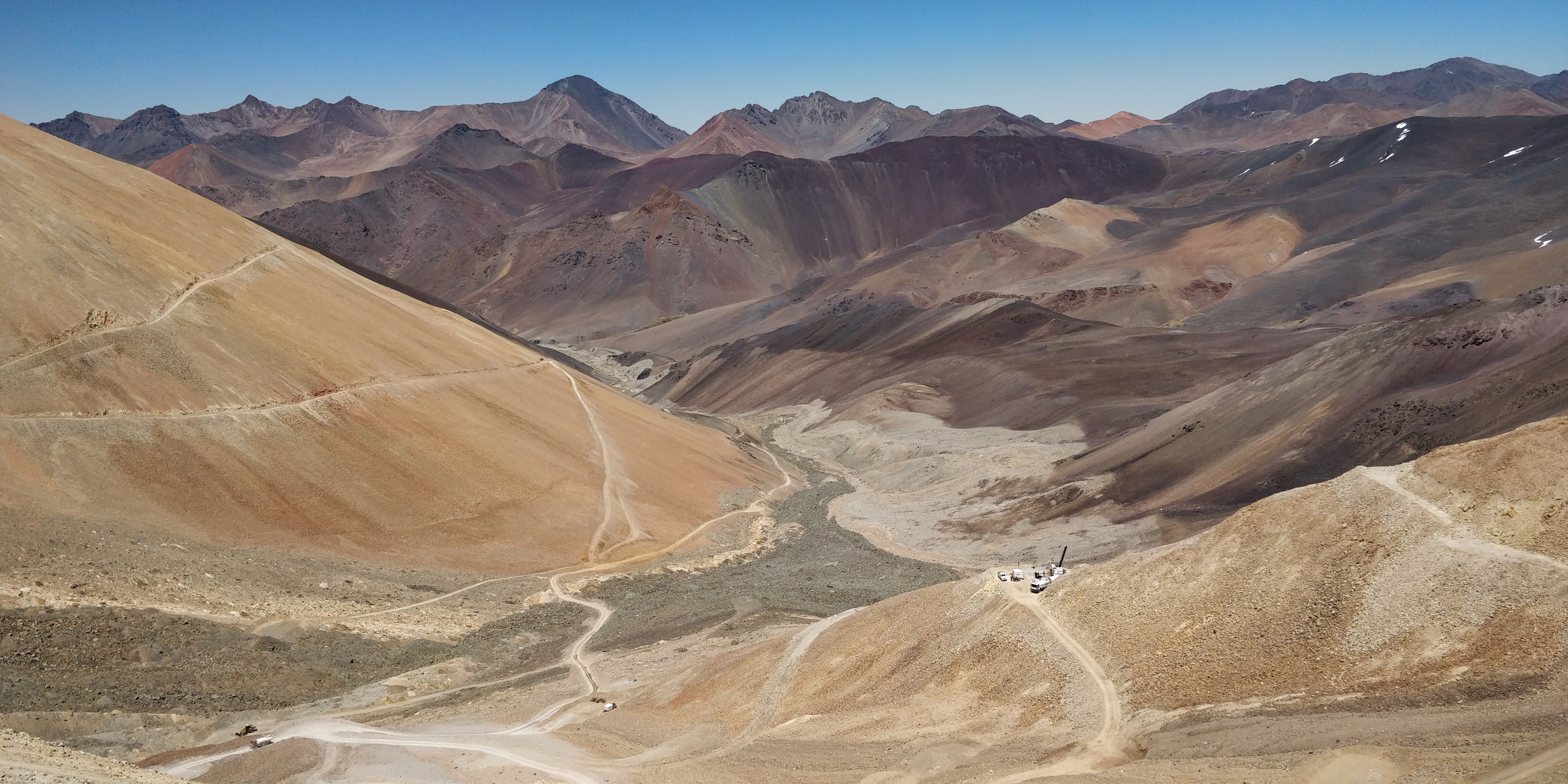
1:00:34 So I just want to conclude with a final video. It's kind of a bit of a scenic tour of the project and then after that I'll pass it off to Javier. So there's the camp. We can host roughly a little over 100 people in our camp. That's the road heading up to the project. That's our core logging facility at the project. All of the people that make it work, I'd like to have a shout out to all our workers in Argentina. Again, you can see a drill rig there, a couple of drill rigs. Very spectacular landscape.
1:01:19 It almost looks like an open pit mine now just from the drill rods and the drill pads. We have big rigs. We're drilling holes that are going down to close to 2,000 meters depth, so we need big rigs to do that. Don't worry, they don't listen to me anyway, so. Very few junior companies work on projects of this scale. So I think that's one of the things that sets us apart from a lot of juniors out there in the copper space.
1:02:21 And with that I'll end my portion and I'll pass this off to our Vice President of Argentina, Javier Roberto. Okay, thank you, Kevin. Hi everybody. So today I'm going to present some brief considerations on Argentina, Argentina in the region, and then we are going to talk a little bit more about San Juan, as John mentioned, has become a really hotbed worldwide for mining. So first of all, The 1 thing to consider about Argentina is it's a federal country. So we are a federation of provinces.
1:03:07 And the very important thing about this is that each province is the owner of its own natural resources. So that is why it's really, really important where are you located in the country. So there on the left, you can see Argentina. And this is a map that has been around for several years that actually shows in different colors, which are the most mining-friendly jurisdictions in green, and then moving to the less mining-friendly jurisdictions in red. You can see there San Juan, which is kind of like in the central west part of Argentina, and also the other very mining-friendly area is in the northwestern Argentina, where most of the activity with the lithium is located. So location is really important.
1:03:54 The one thing to mention here is that changes are coming in this country. So the province of Mendoza, which is in central west of Argentina, and middle east, south of San Juan, has been the most anti-mining jurisdiction in the country, actually put the first anti-mining law in place. And now you can see that that has been changed to yellow. It's no longer red, and that it's more like a bet that the industry is having in the current administration. They just started in December last year and they have already made some changes into the mining code, provincial mining code, to actually allow mining investment and exploration to start in the southern part, in the Malar municipality that actually has a social license in place to move forward. So we will see how that goes.
1:04:43 The anti-mining law is still in place, But it's a bet in a long time to see how that changes. And the other important thing here is that San Juan is viewed as the model in the country. We have several of the other governors in the country actually visiting San Juan, its mines, and its authorities, and actually learning how to export that model into the other provinces in the country. This is just to see Argentina in the region. This is South America in the map, but we have highlighted 2 countries there, which are our neighboring countries, but also direct competitors for mining investments, which are Chile, immediately adjacent to Argentina to the west, and then Peru to the northwest.
1:05:32 So those 2 countries are also represented in the chart to the right. So first column, you can see Chile. In the middle column, there's Peru and Argentina on the right. So there are 3 parameters that we have put regarding mining so you can put a perspective of what is the potential and the growth potential of Argentina. So first, you can see those parameters are from last year, from 2023. So mining exports, You can see that Argentina, it's very, very low. It's only like $4 billion, while Chile and Peru are much, much bigger than that in the $40 and $50 billion ranges. And the percentage of those mining exports into the GDP, you can see that it's 15 and 9 for Chile and Peru, respectively, while in Argentina it doesn't get to even like 1%.
1:06:24 And what is even more important to see is the copper production in millions of tons. You can see the ranges there, and Argentina stands at 0. Argentina did have a copper mine, a big copper mine, but that was the Bajo la Lombera mine, but that was closed in 2018. And since that year, Argentina hasn't had any copper production. And so that's why current authorities actually want to take part of the global revolution with copper and actually insert Argentina into that scenario. One important thing to consider regarding changes is our current president. So who is Javier Millet?
1:07:10 I'm sure that most of you have heard about him because he's kind of like shocking the scenario worldwide. So he was recently elected. We had a presidential election a year in 2023. And after a ballotage or second round, he actually won in November 2023 and went into power in December. So he won that election with more than 55% of the voters. He, by background, he's an economist. He actually taught in several universities And also for the last 15 or 17 years, he was in the private sector working as a head economist for a corporation America. That is a big corporation of companies that is not only present in Argentina, but also other countries in the region.
1:08:01 And it's all over the place with airports, technology, real estate. And so that is why he's a true outsider into the political scene. So he actually formed his own party. He ran for the member of the lower house. He won, him and also with Victoria Villarreal, who is currently the vice president of Argentina. So he was for 2 years a representative in the lower House, what we call Diputados in Argentina. And then he decided to actually run for presidency. It was really, really rapid, the growth of his whole platform. He used a lot on social media. But the one thing here is that you have to remember that Argentina has been immersed into populism and socialism for the last 20 years, with only that little hiatus or gap in the middle of Macri's administration.
1:09:01 But people were absolutely fed up in the country with that model. It was extinct. So he actually made a promise. You can even tell by the name of his own political party, La Libertad Avanza, or freedom of advances. So he got elected on a promise to actually end socialism. And he plant the seed into people that the Argentinians have been held hostages of socialism for 2 decades. And it's time to actually take control of their own lives and be free. So what is Millet's plan or the first actions that he's taking? So The 1 thing to consider here, he started and all the main efforts are doing an abrupt decrease in inflation.
1:09:54 So the bar chart that you can see there in the upper right is actually the evolution of the inflation in the country during the Mueller administration. Remember that he has been in power for only for 6 months. So each bar is actually monthly inflation. So started in December 2023, He inherited the country with 26% inflation, and he has been dropping that dramatically and steadily over the months. So the last official number that we have is for last month, for April, which stands at 8.8%, or we round it to 9%. But the polls at the moment for this month, for May, says that it's going to be in the order of 6%.
1:10:41 So Argentina was in the verge of going to hyperinflation. Probably those numbers are hyperinflation for Canada already, but for us, it's high inflation but we were in the verge of going to be much worse. So he is in the process of correcting that. So he's doing a really strong adjustment in the country, but that has gone, causing a major recession and a lot of undertaking and suffering from the population. So every single Argentinian is doing a big effort at the moment and is supporting the president because it is appreciated that this is needed after 2 decades of populism. So that's why I put there his approval rate, which is the images there, even with all the suffering that we are undergoing in the country in this moment and the adjustment and the job losses and everything, his approval rate stands at 55% in average. Depending on which poll you take, it can go up to 60%.
1:11:45 So it's actually the first time in Argentina that we see this kind of support when we have adjustment going on. So he's also doing a big control of the central bank. So before with previous administration, we were printing pesos like crazy and just giving out to everybody. And now the bank is no longer printing any pesos. He's doing also a big reduce of the size of the state. He's not renewing contracts. He's proposing a voluntary retirement to different divisions. And also he's in the process of making the necessary changes to go into privatization mode for the state-owned companies.
1:12:30 And also part of those structural changes, also it's a big reduction of ministries and also the discretionary funds that are given from the federal government to the provinces have been reduced in 95%. So that's a lot of adjustment there. And then the other very important thing, it's Millet and Millet's team is actually working hard on what is hopefully going to be his first bill, a law bill approved. We call informally that bill the Omnibus Bill, but the actual proper name is the basis for the reconstructions of Argentina. So that bill actually encompasses several topics. So it goes into privatization, changes in labor, but there is a specific chapter there, the one that we are interested in, at miners.
1:13:24 It's one that is called the RIGI, and that stands for an incentive regime for big investments. That is actually, when you actually see the law proposal, the law bill, it actually, it is thought to be for 7 different industries, not only mining. It's mostly thought to be for mining and oil and gas, which are the big things in Argentina, but it's also for technology, artificial intelligence, forestry, et cetera. So the one thing is that it's considered benefits not only on the fiscal side of things, but also customs and exchange, and it brings stability agreements for 30 years. The threshold that you have to surpass there in order to be eligible with your project, it has to be new investments for over $200 million.
1:14:14 It has several benefits points, but I just put kind of like the main ones here. So the corporate tax is going to be reduced from 35 to 25%. There is a mechanism for accelerated value-added tax recovery, which is really important, especially with these big mines being built. Also regarding the customs part, that there is with importation, with everything that is necessary for construction and operation of the mines, there is an exemption from importation taxes, and also you have mechanisms that you can do a carry forward of your tax losses for several fiscal years. So this low proposal was already treated at the lower house at the Casa de Diputados, and it has already been approved.
1:15:06 After that first approval, it has moved over to the Senator's House, and it's in this moment being treated at the Senator's House. So it hasn't been approved yet. There has been some delays because there are negotiations with the opposition. So it is likely that some changes are going to be introduced to the overall bill, not only this incentive regime chapter. So if some changes actually get introduced, then it has to go back to the lower house and get final approval over there. And then some other things to consider is an accelerated amortization scheme. And that has huge implications because that actually means that you pay less taxes at the beginning of your project or your mine, which of course, it gives a more healthier cash flow and quick returns on investment.
1:16:01 Then this is very important to consider. Yes. Did it address repatriation? That's always been an issue. Yes, yes, it actually does. And it also goes into the export taxes. So this actually like it's a stage. And after the third year, you actually, if you're freely, you can freely move that, the money and also you don't pay importation taxes. It actually first year is 20%, second year is up to 40% of free disposal. And after the third year, it's no restrictions. And this is really important because, as you know, Argentina is immersed in a big crisis. It's bankrupt, Argentina. So the current administration has openly said that it is relying on these 4 pillars to actually bring Argentina out of the big crisis.
1:16:55 The one that is more known for the Latinas actually the fourth one, which is the agriculture. And Argentina has been historically an agricultural country and 40% of the exports actually come from there. The one thing very important is that Malay is saying this out loud, but also last year in the presidential election, all the candidates, even the left-wing candidates, were all saying that they will support this in order to get out of the crisis. So first one is copper mining. Remember that in Argentina we have 7 big copper projects that are in different stages, but most of them into feasibility or even pre-construction stage like Jose Maria. So they are ready to go and waiting for the necessary structural changes to be due to move forward.
1:17:47 Then we have the lithium mining, that it's a really big in Northwestern Argentina in those all that little triangle that we share with Bolivia and Chile. And that is already a reality in Argentina. We have more than 50 projects in different stages in the country, but we do have operating mines that are already producing and exporting. And then the big bet is also on oil and gas, that we have the big fields in southern Argentina, in the Patagonia region, especially with the Baca Muerta shale oil and gas, which is a tremendous source there. And then moving to San Juan. So why San Juan is emerging or has already emerged as a big mining district worldwide.
1:18:34 So first of all, mining is a state policy in the country, and it has remained like that for several administrations, even during the deep heart socialist part of the previous administrations in the country. And so there is a very, very strong government support. We do have an exceptional setting. We are sitting right in the Andes and we share the border with Chile. So we have the same geology. And as Kevin mentioned, we are in the right neighborhood with other sizable copper and gold projects and mines. The government of San Juan is also very interested that we as an industry move forward with our project. And that also has to do that, as Kevin mentioned, we have 2 operating mines, Veladero and Huayca Mayo, gold mines. But those are in their mature days and reaching their life of mine. So the province is really interested that those mines are replaced, especially for tax payments and job positions and everything.
1:19:38 So we have a quick permit process that is a big plus. So every time that we actually file our environmental or water permits to do our job. It only takes us between 3, 4, or 5 months to actually get those permits in place. In other jurisdictions, like in the North, where we have projects, that can take up to 12, 14, 16 months so that it's really, really positive on San Juan. It's all clear processes, very transparent. And also San Juan has a very strong social license in place, not only because it has been historically a mining district in Argentina since the 1800s, but also because people have seen all the benefits from modern mining in the last 25 years.
1:20:25 And then also some changes are happening in San Juan. So the graphic in the left actually comes from the Fraser Institute. I'm sure that you are mostly familiar with this, but that shows which is the investment attractiveness of different jurisdictions, especially this one in LATAM. So you can see there, this is very recent. This is from this month that LATAM, sorry, San Juan sits in the second place in Latin America for investment attractiveness. And that's even more top-ranked than typical mining jurisdictions like Chile and Peru that you can see a little bit lower there in that chart. And the other important thing to mention is that if you actually do pay attention to the top 3 rank positions, that's Salta, San Juan, and Cujuy, those 3 jurisdictions are all in Argentina.
1:21:16 So the changes that did happen in San Juan are, we also have elections of governor last year. So we, Marcelo Orrego got elected. And that's a big change because San Juan have the Peronist Party for more of the last 20 years. So there was a change in the political color there. And it's the first right-wing party that won. And we are working very, very close with Governor Orego, which is very, very pro-investment and pro-mining. And he's even pushing harder to actually put these minings in place. So we do see true actions happening. Like We have the biggest mining show that goes in the country that is called the San Juan Mining Expo that happened this month. And there were more than 15,000 people registered.
1:22:10 And it was also a good place that the government launched the copper roundtables. We as an industry have a private, like an industry corporate roundtable that has been around for the last 2 years. And with that roundtable, we actually do a lot of actions with the industry and communicate with the federal government in order to have the necessary changes done and what do we need in terms of infrastructure bring to our sites, tax benefits that we need to get. Part of this incentive regime was actually built on what the industry fed the government on the needs. And also the other thing about San Juan is that you can see there that there are already major players of our industry already in place in San Juan.
1:23:00 And some of those are actually a strategic partner of us, like already mentioned South32 and Rio. And then finally, I just want to take the opportunity to show you and stress to you that our commitment with our presence, not only in San Juan, but also with our communities that are closer to the project. So over there, we have the community, the biggest one is called Calingasta and Barrial, those are the 2 main ones that we work with. And so on the social side, our social efforts and investments from all the different areas that we can actually tackle, we focus in these 4 main ones.
1:23:50 So first of all, we do a lot of education and we actually have agreements in place with the local universities and we actually brought some careers up to the Andes hills, to the foothills of the Andes where our communities are, and they can actually study like tourism or mining or nursery and stuff that never existed before. Then we do a lot of health with infrastructure and some programs with the local hospitals and also sports and environment. We have a recycling program for plastic and other stuff that then we convert into like for plastic things for kids playground in kindergarten. And So the other important thing to mention here, and this is the end, is that it's a pleasure for us to actually be in this Southwestern portion of San Juan in Calingasta, because we see a lot of joint effort with the other companies and our neighboring projects.
1:24:51 So some of these programs are actually done by Aldebaran itself, but we do a lot also in conjunction with Glencore or Fortescue or McEwen. So that speaks highly of our industry and the involvement with the communities. So that is what I wanted to show you. Then afterwards, I'm sure that you might have some other questions on Argentina because there are a lot of things happening, but we can tackle that. Now it's time for John to come back. Thank you. Okay, great. Well, thanks, Kevin and Javier. This portion of the presentation is where we've gone much deeper into the projects than we typically do in the time we have allowed.
1:25:39 So get your questions ready. I'll just wrap up with a few short words here on this, and then we'll open it up for question and answers. I thought it might be good just to go a little bit deeper into the Rio Tinto Newton agreement that we have right now. This is an agreement that was announced earlier this year. It's a simple agreement. There's no equity position by Rio Tinto or no investment into us from it. We simply provide samples from the project to Rio Tinto and they conduct test work at their cost to identify whether their new primary sulfide leach technology will work on our project moving forward. The reason we have such an easy agreement with them is because we have a strong relation already established with our sister company, Regulus, on a project in Peru. We're working very closely with them.
1:26:25 This technology, for those of you that are not familiar with it, basically is investigating whether heap leach technology, which we can apply to the upper weathered portions of porphyry copper systems, might be modified and made applicable to the lower unweathered primary sulphide portions of deposits. So it has tremendous potential to unlock projects. But some of the benefits that this was originally investigated for were to reduce your capital costs to build a mine, to be able to process lower-grade material moving forward and more economically. But it also has some very notable potential ESG benefits to the project. If we can demonstrate this is applicable to this project, it would utilize significantly less water. It would also utilize significantly less power per unit of copper produced.
1:27:15 It's great that copper is now identified as a green metal, essential metal for use in anything that involves electricity right now. But mining of copper still can be carbon intensive. So if we can demonstrate that this type of technology will reduce the carbon footprint of a mine. That has tremendous benefits. And then finally, it also produces copper in country, which adds additional value within the country. So it's very socially and politically expedient as we propose moving a mine going forward. This is the project timeline. And one of the things I'd like you to come away with from this presentation is that we've been very active on this project. We've been producing a lot of drill results over the last 2 or 3 field seasons, but this coming 12 months will be a very critical point in time for the company.
1:28:09 As Kevin pointed out, we still have 7 drill holes from this season's campaign. That'll probably be 2 more batches of drill results coming out in the next few weeks to 2 months on those that will take us to mid year. But most importantly highlighted on this diagram are 2 key studies that we anticipate will be coming out in the very near future. We will do a middle resource estimate update in Q4 of this year. As Kevin has indicated that clearly is anticipated to be a very significant addition to the overall size of the resource. And that even more importantly, will set us up for the first PEA on the project. And we are currently forecasting that to be within the first half of next year. We're giving fairly broad guidance on that. That's partly because we want to make sure we get those results from the Rio Tinto Newton test work to determine if we can evaluate that as a potential pathway to go forward with the project.
1:29:02 So within the next 12 months, continuous flow of typical drill data from the project and those 2 major milestone projects. If we reach all the way back to that history in Antares, when we saw that very rapid increase in valuation of the company, It was because of delivery of these types of significant reports moving forward. As Kevin's already outlined, the Altar project is currently very large. This is some work that was put forward by Desjardins, indicating the size of undeveloped copper projects held by junior companies. You can see Altar is already positioned very well within this chart and is poised to significantly increase and move to the left and increase size on this moving forward. And then just finally to wrap up, a little bit of words on M&A in the Copper cycle. We believe that we're already strongly into what I consider an M&A cycle associated with the shortage of Copper that has come up, as Adam has indicated on this. But to date, it's really been major companies buying, producing assets.
1:30:08 So it's companies that are buying smaller projects from other groups already in production or buying other companies that are in production. Very important stage of this. They're doing this because they felt that the companies have been undervalued. It's a way for the larger companies to grow in their percentage of the Copper market. But it's very important to point out this does not result in new Copper production. This is simply changing ownership of already producing assets. It's safe M&A because there's production already in hand. It's easy to evaluate. As those assets get either the available ones for acquisition get taken up or As the price of those assets increases to the point where they're no longer attractive to acquire, we anticipate in the very near future, we'll see major companies move towards acquiring pre-production stage assets, the type of asset that we're delivering with Altar. So this is very well positioned.
1:31:01 As just a little bit of a kicker, I think in the last stages of this M&A, we're seeing major companies attempt to acquire other major companies. And we're seeing those acquisition attempts become increasingly difficult as evaluation of a group like Anglo starts to run, at some point it will no longer be attractive to acquire at the price that's necessary. And then companies will have to seek other avenues to grow as they move forward. Very obvious opportunity is to put new projects into production. But many of the major companies don't have those projects on their current books. And that's the groups that we're catering to by producing and delivering a project like Altar at the right time for them to go forward. So just to wrap up, I think we've demonstrated we already have a large deposit in hand.
1:31:47 It's about to become very significantly larger. Javier's provided a more in-depth look at why we've used San Juan in Argentina as a very attractive site to do this. And with the partnerships we have in hand, we're in a strong position to continue to fund our projects moving forward and advance them technically to be de-risked to the point where they become an attractive opportunity to move forward. So I think with that, we can move into question and answers. So Adam, do you wanna take over and guide with that? Okay, great.
1:32:33 6 is still populating the questions coming in from the live stream. But for those in the room, if there's any questions, Ben Charrington, our manager for investor relations can bring around a microphone and ask away. So if you do have a question, just pop your hand up and we'll get to it. Hi, sorry, Bob, The 20,000 meters that were drilled in 2024, can you talk about the cost of that? John, do you want to answer that? Yeah, we typically budget approximately 400 US dollars per meter, And that would include direct drilling cost, assay cost, and supplies directly related to drilling, like core boxes and material like that. Doesn't include labor.
1:33:24 So despite the hyperinflation that Argentina's been experiencing, it's actually not that expensive to explore in Argentina. It's very easy to move money into Argentina and spend it in Argentina. The challenge has been getting money out, which is what we're excited about, the changes that are coming up to make that possible. So with trailing inflation of 289% in the last 12 months, I assume your workaround is to pay everybody in US bucks to provide some stability. How do you deal with that kind of inflation rate with your supplies and your workers? Is it all US dollar source so you could care less or what impact does it have? It's a wonderfully complex situation in Argentina and how we do this, but typically our major costs are priced in US dollars but paid in local currency.
1:34:10 And we've benefited from their 2 principal exchange rates, the official rate and what's called the blue rate in Argentina. That blue rate has allowed us to import dollars at a more favorable exchange rate and pay it that way. So overall, our cost in US dollar terms, both for labor and general cost, have actually trended down over the 5 years we've been working on the project in sort of a seesaw faction. We adjust salaries, for example, locally on once every 2 months to keep up with inflation. Hopefully that will start to decrease now as we get more stability. But our costs haven't been bad on the project at all to move forward, that hasn't been an issue for us. With your guess As far as the little Fisher-Brice drawings that you had of, you know, okay, let's get C-sec and rotate these things around, it appears that the guess is you had 1 deposit is now deeper, second deposit is deeper, and now there's a blob in the middle, as well as the piece over here, which was not part of the original description.
1:35:19 So wet finger guess says, looks like a crude 3 X increase in your 11 billion pounds. Is that within the ballpark is what you guys figure when all your to the tenth decimal place stuff gets done? Kevin, do you wanna tackle that one? Well, because I'm sitting here inside the TSX building, I've got to be really careful about what I say. I don't know what the number is going to be, but I think visually just looking at it, a double is possible. I don't know if I'd go as far as saying a triple, but let's see what it comes out to be. But any way you slice it, it's a significant increase to an already very large project. So, I mean, we've already, quite frankly, we've already got the threshold where major companies are looking and interested. And that's usually about 10Bn pounds of Copper in the ground.
1:36:15 And we're past that. And I think you can see from what I showed you today that we're going to significantly increase that. What the exact number is, I don't know. And I know that we put a forward looking clause on our first slide there, but we've got to be careful because that's the kind of stuff that can come back and bite us. It's going to get bigger, a lot bigger. Just to look at sunk costs, you've said 169,000m have been drilled in total, and that may or may not include your 20 this year. So if you value those at 400 bucks us a meter, that means there's some cost of 89 million dollars Canadian. So approximately half your market cap at the moment is value of stuff that's got you to the point where you are now, the 11 billion ounce or pounds that you've got, is that pounds equivalent, including the gold, or is that plus gold on top?
1:37:07 No, that 11 billion pounds is just copper. And if you were to throw the gold on equivalent on top, would it push it up by 20%? I don't know, We have the Copper equivalent number on that slide. We don't do Copper equivalent. Yes, because you get into trouble with the exchange. You guys may not see it, but we got our wrist slapped a couple of years ago about Copper equivalency. That's why I put that statement up front that we will talk about it and here's the conditions we're using, because you guys aren't regulated like we are. If I had to look at the gold of 3.4 million ounces from recollection, would a $1,500 ASIC be a reasonable guess as to the cost of extraction?
1:38:00 I don't think we're really at the stage where we can do that, but once we get to the resource estimate, particularly the PEA, we'll be able to address that more directly. And we would view it very much in a copper, with a copper lens. 90% of the project value is in copper, and maybe 10% is in byproducts, most notably gold in the latter years of the projects in molybdenum. So we've got the numbers right. If I take 11 billion pounds of copper divided by 170 million shares outstanding, I get 65 pounds of copper per share. If I hopefully will 2x that, going back to the Desjardins chart, how does effectively either the 65 pounds rank you or a 2x rank you versus the other guys? We'll move considerably to the left. Some of those projects that were to the left of us on that diagram are already fully drilled out, so we don't anticipate they'll grow in size. 1 or 2 of them, just like ourselves, are continuing to expand, so we're all trying to move up. But Kevin made an important point that we're already through the threshold to be of interest to major companies.
1:39:07 We're now moving into territory where we become an extraordinary deposit. What we want to do is stand out in the in the top 5 or 6 on that list. Okay, one last one. Access to water, you suggested that Newton might give you 30% reduction. Setting all that aside, what's the availability of water in the local neighborhood? Javier, you might be better at to answer that. Yeah, So in this part of the Andes, you actually do have, especially in the southern part of San Juan, there is access to water. So we have streams over there and also underground water. The actual process in actually to get your water permits, you have to actually go to the authorities with a more advanced project in feasibility stage and actually demonstrate what is going to be the magnitude, the parameters and the magnitude, and you actually get your quote of water.
1:40:09 So we have several projects in the area. So it's a sensitive issue, the water, and So we need to better understand not only us, but also our neighboring projects. So far, the only project in the area that has a secure water right is Pachon from Glencore. And then the rest, we need to better evaluate which are the sources and then ask for the authorities. But there is in the area. I can jump in on that. Yeah, that would be our preference by far. Desal technically could be considered.
1:40:56 It's only a short distance to the coast. There is currently desalinated water provided to Palombres, 25 kilometers to the south of us. So it would be the same distance for us to bring desalinated water to our project. But it would involve taking water across an international border, which becomes a more challenging situation. It's certainly possible. It adds cost to a project. We obviously prefer to design a mine that uses less water and use locally sourced water would be our first preference, but that is something we could consider. With your drilling that was done the past year, I know most of it or a lot of it anyways was that depth, kind of looking at increasing the overall size and extent of the deposit, but was any of that directed towards the peripheries, the edges of the deposit, maybe reducing some of the strip, filling in some of the stuff that's classified as waste currently in the past resource that could maybe help the economics of a PEA? Yeah, that's actually, I'll take that one. That's actually, I was taking it whether you guys wanted me to or not.
1:42:09 That's actually a great question. I've gone through this a fair bit in some of our webinars. Some of our drilling was designed to kill 2 birds with 1 stone, 1 to look at trying to expand the deposit at depth. But by virtue of doing that, we had to drill, obviously, through the upper part of the rock. And those were in areas where in the block model from 2021, there was no drilling. And so in our model, we have 2 kinds of waste material. We have defined waste. That means that there was a drill hole or a series of drill holes that defined that there was no mineralization there. So that's defined waste. And then we have a thing that we call undefined waste and it's because there's no drilling.
1:42:55 And so we focused on doing a program specifically to the south of the deposit, where we drilled 4 holes with big step outs, 200 meter step outs, both from the deposit and then a long strike and every one of those holes found below or above break even cut off mineralization in the areas of the pit. So what that means is that those would probably go to some kind of a processing and not go to a waste dump. So yes, that will help. The other thing that's helped the strip ratio. The other thing that I think is really going to be helping us, at least at the resource stage, is that we've spent a lot of time and effort this field season in doing geomechanical studies.
1:43:45 Part of that was to look at what were the optimum, what pit slopes could we get away with using for a resource shell. And the historic resource here that I've been showing 2021, the pit slopes were 40 degrees, okay? Because there was not sufficient geotechnical information to warrant a steeper pit slope. We've done that preliminary PEA level geotechnical work now and the numbers that we're getting back from the geotechnical firm are somewhere between 45 and 49 degree pit slopes. That doesn't sound like a big difference, but it's huge. And that's because the rock competency here at Altar is incredibly good.
1:44:33 And so that's what's giving them the confidence to allow us to use steeper pit slopes, at least for the resource. So that will also have a huge impact on strip ratio. Kevin, while we wait for the next question, maybe you can just talk a little bit about the average depths of pits now in Latin America. Yeah, one of the questions that we get quite often is that a lot of people still live in the world where pits are 500m or 700m deep. And really a lot of the big Copper mines in South America now, those pits, there's quite a few of them that are getting close to 1,000m deep and some have gone beyond a thousand, and many are projected to go to at least 1,200.
1:45:22 I can tell you that our rock competency is much better than those mines. I suspect that us being able to float a resource pit to 1,200 metres here is pretty standard practice now in South America. These are big scale features. Like I showed you there, the mineralization is 3 kilometres long by 2 and a half kilometers wide by quite frankly, probably close to 2 kilometers deep. So it's a huge volume. And so these are real super pits that we're talking about, Bingham Canyon's below a kilometer depth now. So that's, I think, an important aspect that you see what I was saying today that we can deepen the pit.
1:46:08 That's within the realms of reality. All right. So Just on the economic numbers, if I caught the kind of quick flash, your numbers were 3 bucks for copper, now 450, up 50%. 1,400 for gold, now 2,400, up 71%. So it was a wet finger impact on the kind of economic feasibility or expansion. If you end up saying, geez, we could probably crank our numbers up by 50% since 90% of the value of the reserve or resources is in copper, what impact might that have on your 11 million pounds? Huge. Just a few thoughts on that.
1:46:54 In fairness, despite those metal price increases, other costs increase as well. So we do have to be a little cautious to just assume that full benefit from that percentage increase in metal prices. And as a policy, when we take on a project like this, we interact a lot with the major mining companies, both currently with Altar and other companies as well. And so we know how they evaluate a project like this. And even if we're allowed to use 450 copper for projection going forward, people that evaluate the projects we have will use more conservative numbers. So you'll find that we tend to use slightly more conservative numbers than that. And that's just to pass the optic test from the major companies that are looking at us. So that's the lens that they'll use to evaluate our projects. So we believe it gives us more credibility to not max out the numbers that we could use.
1:47:52 But we would typically when we put out these kinds of studies, we will put in sensitivity tables that will show you what could be at different metal prices, right? So we have a question here, Javier, this is probably for you. Can you talk about the omnibus bill and how it could affect glaciers? And are there any glaciers on the project? Yes. Yes. So as I mentioned, the Omnibus Bill has been around and being treated at the lower house and the Senator's house for the last 4 months. So the first omnibus bill that was submitted by President Millet actually was over 660 articles.
1:48:39 And in that first bill, there was a chapter on the environmental changes that included the glacier law. Now, the one that is being treated at the Senator's House is iteration number 3, and with several negotiations with the opposition, actually that whole environmental chapter was taken out from the omnibus bill, together with several other aspects like on labor and many other things. So the strategy now from what we hear from the government is actually those that were kind of like more sensitive issues are going to be tackling in separate bills. And right now the omnibus bill that is 1 at the Senate House, it doesn't include anything on glacier. Then regarding the actual wording and the changes that were proposed in the omnibus bill is very good, because it actually sets parameters on what needs to be protected, because the way that it's written, the law that we have, the glacier protection law from 2012, is actually really wide and a big gray area, and what should be actually protected.
1:49:49 And the changes that are being proposed now by the current administration actually tackles exactly that matter and says, within the periglacier area, which are the features that you have to protect. So specifically to Altar, that was part of the question, there are 2 levels of glacier consideration here. There is a federal law that has its own federal inventory, and there's also a provincial law that was put by San Juan that has its own inventory. So that was also part of a political strategy by previous administration in San Juan that when there was noise that it was going to be treated at the federal level. San Juan and also with the other mining provinces actually moved really fast and put together their own provincial glacier protection laws that are less restrictive. And actually they say specifically what has to be protected.
1:50:49 Because the spirit of the law, both laws, national and provincial, the actual spirit is to protect the source of water and not a glacier feature by itself. And that is a really key part to consider, because it's part of the strategy that companies and provincial governments are using. Because, for example, in the case of Altar, and responding to that question, in both inventories, there are some glacier features in the mining concessions, also in other projects. But we do not have white glaciers. So it's not with ice that you can see. It's what we call rock glaciers. That is just a pile of rocks that actually has some ice caught in the inner part of that rock glacier.
1:51:40 In the case of these ones, these are really old, really mature. And actually, you can see that they are kind of deflating. They are losing. They are dying because they've already lost most of the ice. And that's become really important because the strategy behind this, and that has been already applied by a neighboring project that's Pachon, owned by Glencore, is that if you can scientifically demonstrate that some geological feature that is in the inventory, it's not contributing a lot to the overall water balance in the basin, then that specific feature shouldn't be protected. So that is part of the strategy that we are following. And this law has been around for 12 years. Aldebaran and previous operators have been continuously taking a lot of scientific information year after year. And it's actually mandatory by law that every season we have to take information and then submit that to the government and to the Glacier Council.
1:52:46 And so we have tons of information on which is the water quality. We have done isotopic studies to see if the water is actually like juvenile water from the past snow last winter or if it is ancient water kept from the glacier. And then you can submit that to the authorities, actually at the provincial level first. And at the end, if you can scientifically demonstrate that any specific feature is not contributing water to the overall balance, then it can be declassified from the inventory and it doesn't have to be protected. And then each province actually submits that to the federal level for consideration to be actually declassified from the federal inventory.
1:53:33 And a working example of that is our neighbors at Pachon Glencore actually went through this exact process. They have very similar features to what we have, and they were successful with this strategy in having their glacial features declassified. So that's the same route that we're currently in process. And like Javier mentioned, we've done a lot of monitoring. It's part of our obligation on the project. And so I think we've got a good chance that we'll be able to do what Pachon, our neighbors to the south were able to do. Okay, I think we have time for one more question because we're standing between people on lunch here. Oh, here in the front. Just setting expectations on the budget, you spent roughly, my guess, 10.6 million bucks on drilling the 20,000 meters in 2024.
1:54:30 You got 10.3 million cash on the shelf, most of these are reported. What's the gases to the kind of cash burn that's required to basically get the pre-feasibility studied, finished, so that we can end up saying, yeah, you're probably gonna have to do a raise. Once you end up saying, yippee, our resources have doubled and we're all happy and the stock's gone up and we're going to raise another 3 million bucks. Anyway, so what's the guess as to the cost of the pre-fees? To feed a project like this at the scale we work at, we typically spend around 15 to 20 million Canadian per year. That includes all costs associated with the project. And you'll note that on the diagram when I showed our share price we've done approximately annual financings in in that range and the last one we did was last year in 2023.
1:55:17 The cash position we showed was in March so we've drilled with 4 rigs since that period in time. So we're pretty well utilized the funds that we have to complete this year's program. We can complete the resource estimate with that, we can even complete the PEA with that, but we won't have the funds that we need to do an aggressive drill program next year. The next year's drill program will continue to test additional areas, but we'll also see a lot more focus on geotechnical type test drilling to get samples to further evaluate Newton technology and begin to move into more pre-fease type activities on the project. So we will wanna be well-funded to move into that. So I think it's fair to assume that we'd be looking for additional funding between now and say October.
1:56:11 I think we're assuming the, should be in 20,000 in 2024, you do 30,000 I guess in 2025. We're still formulating the plans on that as we go forward, but for right now, I would say a similar amount to what we did last year, just changing in character some of it from being purely extension drilling and resource definition drilling to incorporating some of the other drilling styles We'll need to move forward. Including water wells, and importantly, including water. Yes. So why don't we? Why don't we end up there? John, you want to make a few closing remarks? Sure. Well, thanks, everybody. This is kind of an inaugural event for us to investigate this type of a forum. Hopefully it's been helpful for those of you who've been in live attendance today, those that are listening on the live stream, and for those of you that picked this up on a feed Afterwards, I'd particularly like to thank Adam and Ben from our team who came up with this concept.
1:57:06 We're trying to explore ways that we can provide additional information in an effective way. We can't get everybody down to site frequently. We hope to get many of you down to site next year to further investigate, particularly when we have the new resource out with more information. So thanks very much. And we look forward to additional questions. If we haven't been able to answer your questions today, it's very easy to get in contact with us. Ben Charrington manages our IR function. You can contact him, you can contact myself or any of our team members with questions about our project. Also just about the copper industry in general, where we see the state of things going forward or specific questions about Argentina. Javier is a fantastic source to get deeper into things about Argentina moving forward. So thanks for your time. Look forward to further interaction.