Transcript
Automated transcript · Written by software from the replay's audio. It can mishear names and figures; the replay is the record.
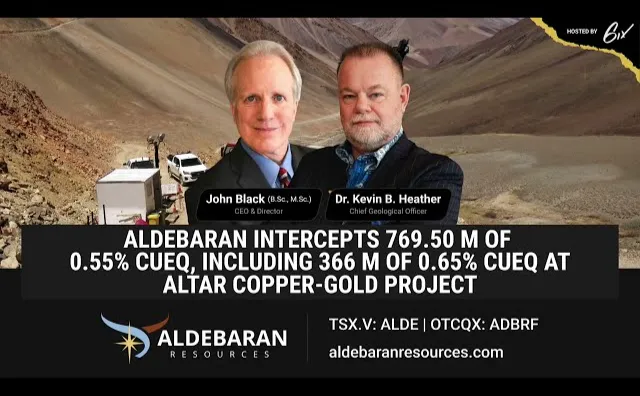
0:07 Hello everyone, welcome to Aldebaran Resources' live event today. I'm pleased to introduce our speakers, their CEO and Director, John Black, as well as their Chief Geological Officer, Dr. Kevin B. Heather. John and Kevin are going to be walking through a few presentations regarding their latest news and after we're going to be entering into a Q&A session where you can ask questions of them. Please feel free at any time to submit those questions to the Q&A chat found on the right hand side of your screen at any time. And if you'd like to get in contact with the team, feel free to fill out the survey that's linked at the top of the chat. If you need a refresher on the content today, the video is going to be available on demand
0:37 on six.com afterwards, the coming days. Without further ado, John, I want to pass things over to you so we can get started. Great. Well, thanks, Cam. And thanks to 6 once again for providing this format for us. Today what we'll do is we'll walk through the results of a press release that came out late last week. It's the second release for this year's drilling campaign and once again we've hit a really nice run of mineralization as we continue to drill out what we see as potential for a very substantial increase in the size of the Altar system. Kevin will walk through the results today. We are continuing to drill with 4 rigs. The weather is holding pretty well. We'll get just as much drilling done as we can before we take a short break here in the South American winter in a for say June to about September we'll break.
1:23 So I think I'll just turn things over to Kevin right now he'll walk through the results discuss what it is and then we look forward to any questions you might have pertaining to this release or just in general on how things are moving on the project. We'll get to as many of those questions as we can. If we can't get those we'll receive those and we'll follow up on those in the in the coming days. So I'll turn it over to Kevin to go forward with the presentation. Thanks, John, and thanks, Cam, and good morning to everybody, and thanks for taking the time to watch today's presentation. Again, just a short disclaimer here. We are a Canadian junior company on the Toronto Venture Exchange, and I might make some forward-looking statements, and those of you who know me know that I don't do that.
2:12 Just for those that might be new to the story, just a quick overview of where the Altar Project is. We're situated in the northwestern portion of Argentina on the border with Chile in San Juan province. Here's the province of San Juan. You can see the project is literally 3 to 4 kilometers from the border. We're 25 kilometers north of the Los Palambres mine, an operating mine in Chile for anaphylactic minerals, and 25 kilometers north of Glencore's El Pachon porphyry project that's in development right now. And you can see about 50 kilometers to the north of us is McEwen Copper's Los Azules project. Just a quick update in terms of, for those that might not be familiar, there's already a very large resource at the Altar project. Here you can see a long section showing the in-pit resource.
3:11 The current resource is an Altar Central and Altar East. It's roughly a little over 6.1Bnlbs of Copper and 2Moz of Gold in the measured category and another 5.3Bnlbs of Copper and 1.4Moz of Gold in the indicated. And then close to another 1.7Bnlbs of Copper and 0.4Moz of gold in the inferred resource. We also have off to the far west here, the Radio QDM system. Currently the Radio Porphyry is not in resource, but we do think that after we've defined this current drilling campaign, and we think that there's a significant reason for putting out an interim update on the resource, we will probably include the radioporphyry as well.
4:04 One of the things I want to point out here, and I've said this on many previous occasions, is you can see the way the pit has this very peculiar hump in the bottom of it. And really, it's effectively because there's no really deep drilling in this area. And because of various geological parameters and geophysical parameters, we envisions that there could be some potential here and that's what we've been working on. So Just to recap where we left off from the last webinar update, when we released Drill Hole 223, this is a long section. Again, you can see the pit, you can see the resource block sitting inside the pit, and You can see that we drilled hole 223 located here, and we hit a long run of over 1km of 0.5 Copper equivalent.
4:59 Within that, a higher grade portion here of 418m of almost 0.7 Copper equivalent. That was a 500m step out from drill hole 221, which also hit a long run of mineralization. You can see the geophysical anomaly, the MT resistivity, or in this case, conductivity feature sitting in here. That's where we left off. Now we'll move on and look at what the new drill results are and what they mean. Just quickly before we get into looking at the sections and the drill data and some rock pictures, I just highlight that typically when you read our press releases, I think quotes usually give you a good indication of what we're thinking. And you can see that in John's quote, he said, step-by-step, we are expanding the Altar mineralized footprint with every additional hole we complete, we are gaining more insight into the precise potential of this vast mineralized system.
6:03 And I've added that really the drill hole 224 is starting to confirm our belief along with drill holes 223 and 221 that there could actually be 1 large mineralized system that connects Altar Central and Altar East that we're right now calling the Altar United. And also touch briefly on Hole 226, which didn't return very good assay results, but actually gave us some valuable geological information. So here's the plan map. And again, just for reference, you can see the white outline here is the conceptual pit outline from our 2021 resource calculation. I've superimposed on this, the conductivity feature in the geophysics in the black line.
6:51 And you can see we've previously reported drill hole 222 and 223 located here. And today we're gonna look at drill hole 224 located here which is a 400 meter step out to further to the west of drill hole 223 and we'll also look at 226 which was drilled quite far to the south and very high up the hill. And this could explain why the results there were not as good as we would have hoped. But now we'll just look at a cross section north south. We'll be looking towards the east. And here we can see the section with drill hole 224 on it. And you can see that hole intercepted a nice long run of mineralization, quite good grade, 770 meters of 0.55 Copper equivalent, dominated by Copper.
7:49 You can see 0.5 Copper and significant moly. And you can see the geophysical anomaly again here. And you can also see 2 of the holes that are currently actively being drilled, we can touch on that. We're drilling hole 229 right now, and we went back into old historical 189 and we're drilling off the bottom of that hole. This enables us to test this geophysical anomaly and not have to redrill the top 500-600 m. We're starting to utilize some of these old holes as long as they're not so old that they've maybe perhaps collapsed. This hole also hit just below the pit shell, a much higher grade segment of almost 366 meters of 0.65 copper equivalent. And again, dominated by copper, almost 0.6 copper and quite nice moly.
8:52 This is just showing the chargeability, just showing that there's a chargeability features off on the shoulders here which are typically indicative of high pyrite content in these kinds of porphyry systems. This shows the resource block model. So you can see that's the in-pit resource, and you can see this is drilling into a completely new area in an area where there's absolutely no resource blocks currently defined. And you can see that by drilling drill hole 229 and the extension on 189, we'll be able to build hopefully some inferred resource blocks down here. So now what I wanna do is just quickly go through and just show you some rock shots. If you follow, you can see the green star here will indicate the location in the hole where the photos are coming from. The upper part of the hole hit rhyolite intrusion.
9:45 You can see some quartzite here. Here it's quite strongly oxidized. The sulfides have been leached out. A little bit deeper, we get out of the leach cap and we're into bedrock. It's mostly pyrite. As what you will remember from previous webinars, the rhyolite tends to be a not very good host rock, but here we can see it's very strongly fractured by micro fractures of pyrite. This is not usual, and this gives us an indication that we could be on the fringe of something. As we go down further, we end up going into the porphyry intrusion, and we can see within the porphyry intrusion very strong quartz veining with moly, and then later pyritic overprint in this particular sample.
10:36 As we go down a little bit deeper and as we're starting to enter into the more favorable higher higher grade portion of the hole, We can see the remnants of the intrusive porphyry texture here and here. And you can see this area here, the texture has been completely destroyed. There are a few little windows preserved and this is very strong green sericite alteration. And this is just full of fine disseminated chalcopyrite. In some cases running up to 5 or 7% chalcopyrite. You can see other places where the rock texture again is completely destroyed by the green Ceracite and we see quartz and hydrate veins with lots of strong chalcopyrite mineralization If we look in detail in some of those Saracenic, those green Saracite halos, we see a lot of disseminated sulfide. In this particular example, we can see 5% chalcopyrite.
11:45 So you'll remember that Chalcopyrite has 33% Copper in its crystal structure. So if we're seeing 1% Chalcopyrite, that would be equivalent to 0.33 copper in the grade. So 5%, you know, we're looking at like 1 to 1.5% copper in this particular interval. Here you can see a really nice example of that green Sarasite alteration. You can see the original porphyry texture here with potassic alteration. It does have disseminated chalcopyrite in it as well. But as soon as we get into this serracitic alteration, you can see the ghosts of the original porphyry texture.
12:30 And here we're seeing very strong introduction of disseminated chalcopyrite. Here the rock is completely been destroyed in terms of the original texture and now is just all green sericite and again very high sulfide content. Just another example showing some of the relic porphyry texture, very strong green sericite and then even some later quartz veins coming in with chalcopyrite and molybdenum. Again, as we go deeper, the mineralization appears to be getting stronger and we're seeing both potassium alteration and the green sericite.
13:16 Here you can see again a nice halo on a quartz vein with the green sericite. But again the important factor here is when we start to see this green sericite and these veinlets start to coalesce together, We see long runs of very attractive grade, and even like I mentioned earlier, this potassium-altered porphyry, you can see the black minerals in here, that's the secondary biotite. There is disseminated chalcopyrite out in this rock too. If we zoom in, we're starting to see not just calcopyrite, but we're starting to see the presence of boronite. Again, boronite is important because it's telling us we're getting closer to the center, the hot part of the system.
14:02 And also Boronite has 45% Copper in its crystal structure. So that obviously helps to augment the grades. And there's a possibility we might be starting to see some Hypogene Calcosite. And the importance of that is, is that Calcosite has 82% Copper in its crystal structure. So even just a little bit of Calcocite here can really help to bring the grade up on a local short basis. And even towards the bottom of the hole, we're still seeing strong mineralization, chalcopyrite, very strong quartz veining here with anhydrite and molybdenite. And even at the very bottom of the hole, we stopped the hole at 1210 meters depth, There's still very strong alteration and the mineralization still continues.
14:56 Okay. So now let's look at hole 2 26, again, a North South cross section. We're going to be looking to the East again and remember that hole 2 26 is on the same section as the previous hole 223. So here we can see drill hole 223, which was in a previous webinar. And you remember we had a long runs of mineralization there. And you'll see 226 again is very far to the south and very high topographically up the hill. And you can see there's chatter of mineralization here in the hole, but no really good reportable intervals. But this hole is strongly mineralized. The problem is that most of it is pyritic in nature.
15:45 And you can see towards the bottom of the hole here. We started to get into some better looking mineralization Although the overall interval was low the indications are down here and I'll show you some photograph quick photographs here in a second is that we were approaching probably a porphyry center.
16:05 Again, this is the geophysical anomaly, and again, I think this is a good lesson that not necessarily all of this geophysical anomaly necessarily is going to be mineralized with economic mineralization. Because remember, pyrite can also be conductive. And I'll show you in a second here the chargeability. And you can see the chargeability anomaly here, which is very typical of finding more pyritic material. We're very close to that pyritic shoulder which tends to explain why we hit more pyritic material. This is the existing block model so you can see again Drill Hole 223 there obviously is going to add. We're currently just completed Drill Hole 227, still waiting for final assays that was drilled as a 200-250 meter step out to the north there.
17:03 Just some quick photos again follow the green star down hole 226. You can see we hit a very very thick package of volcanic pyroclastic rocks. They are altered, they are strongly mineralized, it's just that it's dominantly pyrite which again can be conductive and also gives a very strong chargeability feature if there's enough of it. We also hit numerous veins and veinlets of anhydrite with sphalerite, pyrite and carbonate. This is again typical of when you're on the fringe of a system, you start to see more base metals such as zinc and lead.
17:53 We also start picking up with depth, we're starting to see more and more alteration in the rock, we're starting to see veinlets of quartz and molybdenite. When we start to look on many of the fractures as we're getting down towards the bottom of the hole, we're starting to pick up a fair bit of chalcopyrite. You can see here chalcopyrite with pyrite. And then towards the bottom we go into the andesite host rocks and you can see we're out of the pyroclastic volcanics now and we're into more favorable host rocks And you can see these rocks are very strongly stock work, veined and altered. When we look at some of the veins and the fracture surfaces, again, we start to see our old friend green sericite, which we know in other holes, like I just showed you in hole 224, bring in a lot of chalcopyrite.
18:51 And you can see the chalcopyrite starting to pick up here, associated with that green Sarasite. And then finally, the hole was terminated at 1,146 meters. And you can see the rock here now is starting to take on this very strongly altered with green Sarasite appearance. And so it really looked like we were starting to come on to something here, but we elected to stop the hole and move on in order to make sure that we got enough drilling done this field season to hopefully do an updated resource at some point before the end of the year.
19:29 So now Just to put this into a little bit more context from previous drilling, again, this is an East-West long section and we're looking towards the North. You can see the pit outline here with that little funny hump. You can see historical 212 drilled here. You can see 221 drilled here and there's 223 drilled here. And you can see 224 was a 400 meter step out from hole 223. And although it looks like it's very close to hole 221, it's a bit of an optical illusion because the holes are actually being drilled perpendicular to 1 another and they're being projected onto this section and they're roughly a little over 200 meters apart.
20:18 So You can see that we still got significant area for expansion and infill drilling on this. You can see the existing block model here, and again that funny hump, and you can see some of the better grade materials sitting just below the current pitch shell. That just puts the large geophysical feature on there. I've now added the assays. Again, you can see drill hole 212 hit almost 1 and a half kilometers of 0.53 Copper equivalent. Drill hole 23, obviously hit 1.167m of almost 0.5 Copper equivalent. Drill hole 221, hit over 1km of 0.4 Copper equivalent. And then the hole that we just released and we're discussing today hole 224,770 meters of 0.55 Copper equivalent.
21:10 And again, some of the better grade material is sitting just immediately below this pit shell.
21:19 This is the standard oblique view that we've been showing throughout many of our webinars and we're looking now towards the southeast. And again, you can see our camp down here in the south and you can see the pit shell here in the black line. You can see Altar Central, Altar East and over here is the radio QDM deposit. You can see again the large geophysical conductivity feature. You can see hole 212 drilled here. You can see drill hole 223 drilled here and 221 and you can see 224 here. And again, remember the scale here, that's roughly about 2, 2.5 kilometers across here. Okay. And you can see an important hole coming up probably in the next release will be hole 225 B, which is drilled in between 223 and 224.
22:16 And this will be a real test to fill in that 400 meter gap and test for the the continuity of the system. So where are we at? As of last night we currently still have 4 rigs drilling. The weather so far is holding out quite nicely. We've completed almost 12,000 meters of drilling to date. We've now reported 4 holes, 222, located down here, 223,224 today, and 226 down to the south. We currently have 4 holes completed, but we're still pending some assays from those holes. So I'm guessing within the next few weeks, we'll be putting out another new release with some of these results.
23:10 And these will be hole 225B, 227,228, and possibly 229. 229 is actually still active and you can see that there's 4 holes that are currently active 229,231 which is located right here, which is another 200 meters step out from where 224 was.
23:38 232, which is another 200 meters step out from where 231 is. And then of course, I mentioned earlier, 189 extension, which was drilled right here to help infill this section right here, which has hole 229,224 and 189 extension.
24:01 So with that, that's a real quick and dirty overview and thanks for your attention. And now we'll open it up for questions. But before I do, this is a really nice view of Altar East in the background, Altar Central in the foreground, And you can see 3 of our drill rigs. There's a drill rig here, drill rig here. Those are 200 meters apart. And there's 2 more rigs nestled down in here. And so it gives you an idea of the scope and the scale and the size of the opportunity here. Thanks for your attention. Great, thanks Kevin. And yeah, just as a reminder to everyone in the audience, if you'd like to participate in the Q&A, please feel free to ask those questions in the Q&A chat found on the right hand side of your screen.
24:46 Is South32 planning to buy more shares on the open market and does their deal have an opportunity to expand? I'll pick that up. We do have very good contact with South 32, but we can't speak on their intentions on what they'll do going forward, but they are quite excited about the project. I think they're very happy with San Juan as well. As many of you might know, they have 2 other agreements in San Juan for earlier stage projects where they're earning in. They just announced some pretty good results from their MN-SUD project as well. So they're extremely pleased with the progress of our project and with the advancement of many projects in San Juan as well All indications are there they're very happy with the project moving forward But I really can't speak to their intent on buying additional shares. Their agreement does allow them to participate in a pro rata sense. If we do a financing, they are allowed to participate in a financing and maintain their pro rata interest.
25:46 In some of our presentations right now, you'll see that there are 9.9% interest has dropped to 9.3. That's because over the past few weeks, we had the exercise of a number of warrants from a financing from 2 years ago. That slightly diluted them to 9.3. They do have a top up right. So they will be, if they choose to do so, they'll be able to move back to 9.9 by exercising that top up right. It's not the same price as the warrants we're at. It's a price based on a VWAP in the market for them to make that decision to come forward. So we anticipate we'll have news on that in the very, very near future. Okay, great. And Ron has another question. And I think Kevin, you maybe definitely touched on this, but it might bear repeating. He's just wondering if the drilling season is over for the year, and if not, how many more months of 4 or more drills operating do we have?
26:43 Yeah, I touched on it. Basically, normally by towards the end of this month to the first part of June is normally when we start to shut things down. Like I mentioned, the weather so far has been very good. And So we're going to keep pushing for as long as we possibly can. Obviously being cognizant that safety is important and we don't want to get trapped and have our people trapped in by a big Andean snowstorm, which they can happen without much prior notice. But we monitor the weather every day and we've got connections to some pretty sophisticated weather reports. We watch that very carefully. We'll keep drilling with 4 rigs for as long as we can here, but we are reaching the end of this year's field season.
27:36 Understood. Another question that we have, if you do a resource update at the end of the year, will it be an interim one? And if so, what type of tonnage could you expect to add? Do you want me to do it? No, go ahead. You expect to add? If we decide to do an updated resource, it's definitely going to be interim. Really all resources are interim because there's always room to expand and improve the resource. If we put something out, it will definitely be interim. In terms of upgrade of tonnage, no idea at this point. That's why we're drilling.
28:19 What we can see so far, and I think the results speak to this, is that we're opening up a vast new area that was previously not drilled, both laterally from known mineralization and also immediately below the current pitch shell. So one could expect that this would hopefully be a significant increase, but how much? No idea at this stage. Fair enough. We have a question coming in from Adrian. Does MOLLE complicate or improve recovery rates? MOLLE doesn't complicate things at all. MOLLE is basically a byproduct of metal and you need to put in a separate MOLLE recovery circuit.
29:06 And many big porphyry Copper deposits in the world do have MOLLE recovery circuits. And so it doesn't do anything in terms of recoveries, as long as you're doing flotation. If you're going to be doing any kind of XXCW or heap leaching, then the molly is not recoverable. One of the interesting things that I mentioned in a previous webinar is that there are some indications that the Mollie at Altar does have high Rhenium content. That's something we're keeping an eye on, but it's not something that's very easy to systematically assay for. It is potentially a by-product element as well. And it's one of the strategic elements. So it's something that is interesting. But a lot of the moly at Altar is sort of in the deeper portions of the ore body. So in the beginning, a moly circuit may not be needed, but it might come into play as the mine develops.
30:11 Understood, okay. Another question, could the shape of the conceptual pit change when the resource is updated? Yeah, most certainly it probably will. Every time you do a resource update, you float new pit shells on it, the pit shell could change. And again, it's all going to depend on how all this pulls together. The indications are right now, every hole apart from hole 226, but every hole we've drilled in that centre area has hit very long runs of attractive mineralization. And so that bodes well, I think for the future holes that we're drilling and also for the potential resource update in the future.
31:01 I'd like also just to point out that one of the media impacts on this is in our current pit it really to capture the 2 known zones of mineralization it has that septum in the middle. So that's one of the more obvious things is that will very likely flatten out And that's of immediate benefit. It's a high impact mineralization there for us. Right, okay. The other question that we have is, to what extent is the arsenic content in this deposit a concern? I'll tackle that one. As those of you that follow the story have realized that there was originally a perception that arsenic might be a challenge at this project. It was primarily because there was very little constraint on how the arsenic was distributed and where it was at. So one of the important things that Kevin and his team did when we first started on the project was to build a much more accurate geological model, both in terms of lithology and mineralization styles and alteration styles as well. And so that allows us to better portray where the arsenic is.
32:00 When we did our updated resource a couple of years ago, what we were able to do is show precisely where the arsenic is. And much of the arsenic is high up in the system. It's a late epithermal overprint on the more porphyry style mineralization that we see through the bulk of the deposit. So it's up high, much of it's in the leach cap. So it's in waste rock. It's not in material that would be processed whatsoever at all. And the upper portion does have some, some elevated amounts of arsenic, but it's arsenic that can be very well managed. Arsenic levels are going up in deposits worldwide and mining companies are increasingly preparing themselves. Mining companies and smelters are increasingly preparing themselves to be able to handle this arsenic. So we have several pathways we can go forward with it. We don't see it as an Achilles heel on the project whatsoever at all. If we go conventional concentrate, it'll be penalties in the early stages of the mining, but manageable, certainly an exportable concentrate.
32:59 There are alternative processes that we're investigating that could allow us to process that with no issue with the arsenic whatsoever at all. All right, great. Mark is wondering if you can address Argentina's inflation rate and whether it's affecting your costs or budget in dollar terms. Argentina's very high inflation rate, over 100%, but inflation has been high for a long time in Argentina. Just something that we're accustomed to working with there. It affects us in some ways. For example, we have to make more regular adjustments to our contracts and even how we pay our employees. We make salary adjustments now on a quarterly basis as we move forward just to keep employees whole and in good shape to address that.
33:48 It actually works to our advantage as an exploration company. It's very complex how you bring money into Argentina, but the overall setting is that they like to have money come into the country. And so we have access to very favorable exchange rates. And it keeps our costs relatively low compared to what they might be moving forward. So the net effect when we budget is we get kind of a saw type pattern to it where depending on how things are adjusted, we will see our prices go up or down or up or down over time in kind of a cyclic fashion. But our cost in US dollars for drilling, for example, have gone down over time, which is good for us in that sense. So difficult to manage in sort of a lot of changes, but the net effect to us in terms of our costs in U.S. Dollars is slightly to our favour, actually.
34:42 Okay, great. Thanks, John. Another question. Why do you think San Juan was rated the number 1 destination for mining investment in Latin America last week? That's a great, great point to bring up here is that for those of you that are not aware of the background of this question, the Fraser Institute came out with their ratings last last week of favorability for mining or mineral exploration worldwide. And so they rate countries, and in some cases, for countries that have a variation internally of how mining's approached, they rate individual provinces or states. So say Canada, the US and Argentina are all based on provinces or states, whereas other countries like Peru, Chile, Ecuador are rated by the country because the country is rather homogenous in how they go forward. And it was very, very interesting to us that we saw that San Juan came out as the number 1 most favorable destination for mineral exploration dollars in Latin America and number 19 worldwide.
35:43 So very notable improvement on that. We absolutely agree that that rating is indicative of what we're seeing on the ground and moving forward. I would point out that this is in many ways kind of a sentiment index. So it judges trends, it judges tendencies on movement. And so the fact that Argentina or San Juan in particular came out higher than, say, Peru or Chile is more indicative that San Juan is becoming a much more attractive place for us to invest. And Peru and Chile are recently facing some minor challenges, but it by no means means that Peru and Chile are bad places to invest. They're traditional mining countries going overall. So it's more of a tendency of trends, but it's very important to watch that.
36:28 And it's a it's a result of interviews of people like ourselves or people that are actually doing the work in the countries and the perception of the industry. So it's an index that's well worth watching and we certainly see on the ground what that index is saying right now. Right. Jim is wanting to know if there's anything to note about the other properties. I think what Jim's referring to is our other properties in our basket on this in our portfolio. We're really focused on Altar, particularly when the drilling season's up and running like this. I think we originally envisioned that when we acquired the option to earn 80% in this project that we might have 6 months hard on Altar and the other 6 months to work on the other projects which are primarily up north in Salta and Jujuy and in areas that we can work throughout the year.
37:21 As Altar has become much more promising and as we've extended the season, it's starting to occupy much more of our time. So we are working on the other projects right now. We're working on getting permits to allow us to move forward with August Calientes and Rio Grande, the 2 projects of most notable interest right now. We're also fielding a lot of interest from other companies in those projects and we're evaluating what our best pathway forward. But we don't have work programs on those that we can announce at this time, but we have not forgotten about them. Okay, fair enough. How has the drilling situation evolved in terms of getting rigs and drillers? And how are you preparing for this for the next drill season. Kevin, do you want to go into what we've been doing on the drilling and the results that have come out of that?
38:09 We were having quite a few production issues. Over a month ago, we contracted on a part-time basis a drill specialist out of Canada who's worked a big portion of his now retired but consultant and has worked a big portion of his career in the high Andes not far from where we're actually drilling now. And so it was very familiar with the terrain, the operators, and he's been helping us out and helping the drillers out. And we've seen a real improvement of production rates. Still trying to access rigs and qualified crews is still an issue. And basically ever since the roundup and the PDAC earlier this year, we've been in contact with several providers trying to secure rigs for next field campaign.
39:09 You need to get on it quickly because there is still a lot of competition for rigs and getting qualified drillers. I think we're seeing a much better penetration rate per day now. And we're hoping they can maintain that till the end of the current field campaign. Yeah, I'd like to point out too, that It's not a unique problem to us or our particular drilling contractor. All of our peers have been facing similar challenges. So a lot of it's due to every available rigs out there. Some of these rigs are a little bit older. Experience for drillers and assistance is spread very thin. And we're still facing supply chain issues that some of which are a bit more unique to Argentina itself. So the drilling specialist we brought in was actually brought in in coordination with one of our peers to help them as well. So certainly not something that's just unique to this project. Our drilling is actually quite easy on this project It's good. It's good rock. And so we we anticipate we'll see continued improvement from the drillers as we move forward Right. Okay Another question. What would be the timeline to move Altar to the PEA stage?
40:19 What we envision right now is, as Kevin laid out, we'll have 12 holes finished this year. There's a chance that some of the rigs that are nearing total depth right now might squeeze in another hole, particularly if we do those extensions from existing holes. That will allow us to internally do an evaluation of what the resource looks like. And depending on the nature of that, put an interim resource out late this year. But by no means will we have an idea of the potential overall size of the system. It will require another full season of drilling next year, I believe, for us to get close to knowing what the real size potential of this system is. But I would anticipate that after a full season next year, which would start in September of this year and drill to once again, to about June of 2024, that we'd be in position to put out a more complete resource of Altar United, and it would make sense to do a PEA on the heels of that. So say late 2024 would be a good projection.
41:20 I need to caution that this all depends on how the drilling goes and what we see on it, but I think that makes the most sense. We would all love to move to a PEA. We have a lot of data. We would be able to do that right now, But it's important to note on a system like this, that first PEA is really your first look at the economic viability of the project. And you want that to come out strong because it's really kind of the nameplate of your project going forward. So caution, a little more patience for all of us as we get to see the full size of this and I think we'll be rewarded handsomely when we put that PEA on. Okay, great. Jorge is wondering, have you reached the milestone to earn in 60% in the project? We have completed enough expenditures to do that. We're in the process of auditing that and providing the information to our partners.
42:10 That takes a little bit of a process to go forward. So when we, it's tied into quarterly report, quarterly financial statements and having those audited and completed. So the amount of work has been done to trigger that. There's a little bit more time on the process to do that, but I think you'll see that notice coming out sometime in the not too distant future. OK. And also remind that once we cross that, the further expenditure begins to accumulate towards the 25 million that we need to spend to earn in the remaining 20 percent to go to 80 percent. So we're not losing time by how we do that by any means at all. OK, great. One more question that we have is what catalysts can investors expect for the rest of 2023?
42:58 So for the rest of 2023, you'll see continued news releases. We've only released the results for 4 holes to date. There are at least 8 more holes, perhaps a few more than that to come. So they'll come in a series of news releases every month or so, month or 6 weeks throughout the North American summer. By the time we're done with those releases, we'll be in a position to be outlining what the full drill program for next season will be, which we anticipate will be probably much more extensive than what we've drilled this year. As Kevin mentioned, we're in the process of acquiring additional rigs. So we'll be in a position to announce projected meterage and total number of rigs going forward about the time we finish putting out these results.
43:44 Other key pieces of news that'll be coming out is what we just talked about. The announcement that we crossed the threshold so we become owners of 60% of the property. Which is an important threshold for us to cross. We may see some news on whether South 32 decides to top up and match, bring their amount back up to 9.9, which involves a little bit more financing for us, which is always welcome. And at some point later in the year, we'll be talking about size of budgets and how we go forward. And that's dependent on access to capital in the markets. So quite a good news flow. If we're in a position that it makes sense for us to put out an interim resource late this year, we'll do that. If not, we'll wait and do it when we go to the full size, which we'd anticipate would be into 2024.
44:33 And then as we discussed, projecting towards a PEA at the end of 2024. So quite a bit of news flow. This is a good project. We're in a very active area. Another thing that's not directly related to us, but I would have those that follow us or follow projects in Argentina overall kind of keep an eye too, is we're not the only big porphyry that's in Argentina. There are quite a number of very interesting projects in Argentina. We've seen some movement from majors on making strategic investments. We saw BHP come in on FILA. We've seen South32 come in on us. We've seen Rio Tinto form an alliance with McEwen Mining, Stellantis coming in. We're starting to see a pickup of activity in our space.
45:19 And that's very, very good indication that major mining companies, and major international companies that are traditionally not particularly risk tolerant on this are starting to make first moves into Argentina. It's also in the Lithium space up in the very far north part of the country. So watch those type of movements. That's continued endorsement of the mining, emergent mining industry overall in Argentina, and particularly as the increased interest in lithium and copper deposits moving forward. We'd love to see in the not too distant future announcements of not just acquisitions of projects or strategic placements into companies, but announcements of projects going forward to the build stage. That would be a really, really critical milestone for Argentina and our industry, and all of us exploring in Argentina to see companies making that decision to begin to actually build projects in countries. So keep an eye out for those, If you see anything like that, it's really game on in our space.
46:20 Okay. Well, listen, John, that looks like all the questions that we received for today. So I want to thank you and Kevin for going through the great Q&A and presentation. But before we wrap up, I want to pass things over to you guys for any closing remarks. Kevin, you want to go ahead? Yeah, I'd just like to thank everybody once again for tuning in and watching the story evolve. I think the next few releases are going to be very interesting. And so stay tuned. I mean, I think we're on to something very special here. I don't think the market's quite woken up to it yet, and it doesn't help Copper is below $4 right now. But when the stars start to align I think we're gonna be one of the few junior with a very large copper asset on our hands here and be sure that we're gonna have people knocking on the door.
47:14 Thank you for your attention. Great I think Kevin just summarized it quite well on this. We've got a great project with potential for it to really expand in size going forward. Certainly a lot of eyes on us in our space right now. And I think I've just come off of meetings at SESCO in Chile and a one-to-one conference in London. And there's a lot of picked, clearly a lot of interest in copper. There's, I think, a lot of people perching and kind of waiting to see where it'll go. But the supply story for Copper is clearly emerging that there'll be a pinch point in the not too distant future. And these type of projects will be highly sought after. If we see Copper prices increase on that pinch point, it will draw a lot of interest into our space. We don't need that higher price for our projects to be viable.
48:05 But when we see that higher price, the major mining companies start to pile up cash and start to get pushed to grow instead of focus only on dividend to shareholders like they do when copper prices are low. So I think a lot of things are really lining up for us to have a great remainder of this year and particularly next year going forward. Okay, guys, that sounds great. I want to thank you both again for coming on, as well as everyone who's joined us today, especially those who've asked questions to make this Q&A great. With that though, we are wrapping up. I hope everyone has a good rest of the day. Cheers. Great, thanks. Bye everybody. ♪♪♪ you