Automated transcript · Written by software from the replay's audio. It can mishear names and figures; the replay is the record.
34:13 like Patricia, Sister Pat, the great work you've done at Ivanhoe and Ivanplatz. When we look at it, I think in a certain sense, from the outside, it looks like, wow, that is a beautiful company, that's a beautiful skyscraper. But it's those who have built it who can tell you how difficult it was to build it in spite of the capacity constraints. So in a certain sense, guys, I think that when someone even looks at the chamber Right now, we have hundreds of people watching us from all over the world. They are the beneficiaries of leadership because somebody had to plan all of this. Somebody had to get a digital platform to work. Somebody had to find a venue. Somebody had to orchestrate all the participants to come. Somebody had to come up with the titles, the topics, et cetera, et cetera. So in a certain sense, I think Leadership is actually, the definition is quite straightforward, and that all of us in each of our lives have to deal with that every day. We want to achieve something, and we don't have enough capacity.
35:28 We don't have enough money. So I think that while the reason this topic is extremely important is that in Africa, oftentimes you hear leaders say, oh, we want to have water in every community, but there's not enough money. We want to have good schools, but we don't have enough teachers. But that is precisely why you're a leader. You have to figure out how, with 6 teachers, you are going to educate 1,000 people. Precisely how, with just $10,000, you are going to drill 100 wells. That is the essence of leadership. So I think that whenever we look at a great leader, oftentimes there's a lot we don't see. And what we don't see is the sacrifices, the ability to call people to their higher selves. I believe very much that, and I'll make this comment and defer back to my big sister here. I believe very much that a foundation of leadership is, in a certain sense, appealing to the inspirational hope in an individual.
36:40 So you are crossing a river, you are a general crossing a river with very little logistics. You have appealed to your troops to believe that when they cross this river they are going to change something. So in a certain sense I think leadership is really just bringing limited resources and limited capacity to still achieve an objective. Thank you so much, Mr. Chair. Dr. Bekesha, that limited resource component is one that you no doubt address every day. You've got stakeholder perspectives that you bring together. You've got investor considerations, government, You're working toward a bigger picture, but you've got investor considerations for judiciary duties, governments, policy makers, relationships are obviously key. I know you're almost every day, you're in a different capital on the African continent.
37:29 What has been integral in your experience to bring all of these different groupings into one single grouping to the point where now you have one of the single biggest mines in the world on productions of any given commodity? It starts with a vision. Ivanhoe Mines is very fortunate that we have visionary leaders. You know, we're very enterpreneurial. We don't have red tapes that holds us back. You know, we're in a position where, as a collective, as executive, we're able to make decisions around 24 hours. So I will say a great leader will share the vision with all the followers because there's no point in knowing what you wish to achieve. If people are going to implement are not seeing the bigger picture, And I'll make an example in our continent, which I won't mention the country. I know of a great leader, a great president who was a visionary who knew exactly what he wanted to achieve.
38:30 I remember talking to him and he themed his vision, Vision 2024, which was very inspiring, you know? And it was a master plan. It was going to change lives. It was going to impact people. It was going to create jobs. It was going to, we are going to see a classic case study of women empowerment and youth development at its best. But that plan will never materialize because unfortunately he was unable to share the dream and the plan with people who were going to benefit and make it work. So the people lost faith and thought, you know, we're gonna be poor for the rest of our lives. We don't see a vision, so we need another leader. So if you're a leader, you need to be able to translate your vision to your followers so that they can implement it and vision can be turned into action.
39:20 Secondly, the internal business processes, again, whether it's a company, whether it's government, any institution needs to make sure that the left hand knows what the right hand is doing. Because if there's no communication between everybody that is involved, you know, you'll deal with silo mentality. You'll deal with people who are doing their own things in their own space without actually integrating and synergizing their effort. That is critical. And we're still talking about the internal environment here. We haven't gone to the external environment. Now moving forward to the stakeholder perspective. You know, I always say to the workforce in Ivanhoe Mines, you're all the ambassadors of this organization. You know, when you look at Toronto Stock Exchange, when you look at our share price, when the share price goes down, it's easy to look around and say, did our ambassadors actually give a positive narrative in terms of what we are trying to do.
40:21 I'll make an example of Mokopane, where Blood Reef Mine is. If you have a workforce coming from your villages in the communities, And they get into a public transport, a taxi, 16 of them. And one person says, I hate my work environment. Everybody in that public transport, in a taxi, is gonna have a perception of IvanPlace is not a good company. By the time the 16 people reaches their respective homes, they're gonna be translating that message of that organization is not good. So your workforce, your internal workforce are your ambassador. They're your first point of entry. And that internal business process arrangement is very critical.
41:06 They need to own the process. They don't have to wake up in the morning and feel like, I'm going to work because I need to pay bills. No, that is not work. That is paying off bills. You need to encourage a culture where people feels I'm waking up in the morning because there's a bigger picture. The platinum that we're striving to produce is actually gonna make sure that we have cleaner air in terms of fuel cells. You know, there must be something bigger than just waking up in the morning, going to work. There must be impact. So a leader should be able to translate that. And whether you're a cleaner in the organization or you're a general manager, you have to share the same vision. And I want to say when I was studying MBA, I had a case study of having to study 30 companies and find out which company is best in terms of really translating their vision.
42:01 And I sent questionnaires to the CEOs. Some responded, some didn't respond. And I decided I'm going to walk to these organizations, and I'm going to have the first-hand experience and see how it's going to work. And to date, I'm still impressed by how Microsoft was able to talk about their vision. I walked into their boardroom. A person was making tea, asked me, can I serve you coffee? I said yes. And I asked, what is the vision of this company? Deliberately so, because I needed to test to see if indeed whoever I'm going to meet with, did they communicate the same message to the workforce? And she looked at me and she spoke to me in Zulu, and that was years ago. And she said to me, is to put a PC in each and every household.
42:50 And if somebody who's actually making tea understands the vision of the company that she's working for, it gives you hope. And by making that example, I want to talk about Africa as a continent. If we all understand where we want to take our continent, if we all share the same vision, and we stop saying, oh, we are in South Africa, and when you go to Angola, I'm going to Africa. No, you're not going to Africa. You're already in Africa. So we need to start really seeing ourselves as Africans before anything else. And then we'll be proud in terms of what we do and taking it forward. But that's not going to happen overnight. There's a lot of work that needs to be done. And I'd like to pause there. Thank you so much, Dr. Makesh. And a quick follow-up question and the same, well, in fact, as long as answer is needed, because it's quite loaded, and I invite the chair to add his insights as well. But where do you where do you draw the line when the wheels go off? How do you actually then overcome those real challenges as they arrive? I would assume that the vision, once it's in place, has a key role in energizing and motivating. But what are some of the practical actions you've taken amidst some of the most challenging of circumstances, and the companies continue to grow and to thrive.
44:08 Any insights there that you would share with us? Yes, definitely. Corporate governance. When I started, I spoke about the resource perspective being the foundation. Obviously the internal processes are the walls that holds it. And your corporate governance, it covers everything. It's your roof of this house that you're building. Most people tend to think from a corporate governance point of view is only from the financial perspective. It's not just about dollars. It's not about friends and sense. It's not about euros or pounds. It really is about the way you do business. It shouldn't be compliance issue of ticking the box. I remember when I arrived at Platt Reef in 2014 as the MD, somebody asked me, so how are you going to make sure that we comply and we become a level 3 BE compliance?
45:01 I said, No, I'm not going to make sure that you become level 3 be compliance. I'm going to make sure that our way of doing business. It's so correct that it takes us there because it shouldn't be about transformation from compliance point of view. It should be about way off life. So there's a very thin line when it comes to ethical leadership, you know, and I always say people need to pause and reflect in order to move forward. Because you get so intertwined in what is happening every day in your life. You become part of the finisher. You become, you don't see a crack on the wall when you walk into a boardroom anymore. And you always have to put those glasses to say, yes, I'm part of the solution, but can I take a step back and ask myself if I was in this position, how will I make a decision? I'll make a practical case study. If you look at the South African contest from a mining point of view.
46:03 You have what we call localization, where you have to make sure that the footprint community where you operate becomes the shareholders. Blood Reef as an entity is among 20 villages in Mokopane. The 150,000 household actually hold 26% shares in the organization. And when you sit in the boardroom, you have to ask yourself, everybody has hope that 1 day we're going to see this biggest platinum mine in the world. How do I share that vision that firstly, we all know about the platinum price being below 1000. How am I going to say Copper is the best commodity compared to platinum.
46:48 How do I talk about this message and still give people hope that we're still on the right track? So From a corporate governance point of view. It's important that you take your stakeholders along with you If there are challenges there must be the first point of entry to know that we have these challenges. We invite you to give your input. How are we going to resolve it together? Each and every relationship is about communication, whether be it family issues, whether be it business, whether be it government. If you don't communicate and if you don't share that communication, you open yourself up to misunderstanding. And governance really, for it to work, policies needs to be in place, procedures needs to be in place. And people tend to differentiate and confuse policies and procedures and think, well, I can hide behind this processes and not deliver at the end of the day. You know, you see a lot of organizations, particularly when it comes to public sector, the institutions.
47:53 Where talk is there, but talk is cheap if you cannot actually put actions to what you're saying. You know, we all want to see the better Africa. We all want to see Vision 2030 being implemented. But what are the action steps that we are doing? Where are the milestones? How are we going to get there? You can say you want to move from Cape to Cairo, but you need to know how you're going to get there. Are you going to hike? Are you going to fly? How long is it going to take you? When are you going to arrive there? And when you arrive there, what is the intention when you get to that destination. So, corporate governance plays a critical role, and it's not only financial, it's how we do business, our way of doing business. Thank you, Gareth. Thank you, Dr. Makesha. And, Mr. Chair, coming over to you, Many know you, of course, in your capacity as chair of the board and the growth of the chamber, but you also have another extensive life and career advising on the billions of dollars on major transactions.
48:42 When you've seen the wheels come off there, what are some of the key aspects of leaders that have been able to pull through and really succeed on the continent, because not everyone does, but for those who do, it is phenomenal. If you could share a little bit about that, and particularly the point on resilience, Any examples of resilience you wish to share would be fantastic. Thank you. I think in a certain sense a leader has to almost assume that one wheel will come off. It would be impossible to drive from Cape Town to Cairo and not blow up a tire. So actually going back to Big Sister Pat's point, you actually deciding that I'm going to drive from Cape Town to Cairo. You have to assume that there'll be a problem along the way, probably, with one of the tires.
49:32 And so you would have to have some spare tires in the back of the car. It's not when you're in the middle of the forest in Congo or in Sudan, then you'll say, oh my god, the tire has blown up. What do we do? So we should assume, for instance, that when we are going to put this conference together, there will be challenges. I remember a few days ago, one of our colleagues here lost his laptop. But that is a challenge that can happen. We should assume that some planes would be delayed. We should assume, you know, so in a certain sense, my sense of great leaders is that great leaders already assume when they are going to war that a few people will die. They sort of know that. It will be almost naive to go to a war and not plan for a few people dying, so to speak. So when the wheels have come off, I think once we anticipate, some wheels will come off. 2, when it comes off, you would have to stop and communicate that as Dr. Bakesha said to your stakeholders, we want to develop a mine.
50:39 We assumed the price of copper, the price of platinum, or the price of gold would be X in our business plan. There's something that's happened in the global economy. It is now X minus 200. It's now X divided by 30, whatever the change in the variable is. This is what it means for all of us. It means that maybe something, a mine that we are to build next year may not happen for another 3 years. Or it may happen actually this winter, not next year, because the prices have changed. And Because of those changes, this is what each and every one of us is supposed to do. We are all supposed to cut our salaries, or we are all supposed to do X or Y. So I think, in a certain sense, great leaders should anticipate that there will be challenges.
51:31 Great leaders, when the challenges occur, should pause and explain what that challenge is to their stakeholders and to their colleagues and beneficiaries. And then inspirational leadership should lead in the sacrifices that are necessary. You cannot say, we are driving from Cape Town to Cairo. The tide blew up, but you know, friends, family, I am taking a helicopter to Cairo. Why don't you guys stay here in South Sudan and figure out how to solve this problem. That is not a great leader. A great leader should be able to be seen by the stakeholders as also being part of the struggle to resolve the problem. And I think When you do it that way, whether it's a family, whether it's a business, if I say, for instance, that we want to move, as you know in the board and from your own visionary leadership, Mr. Bloor, that we want to take this organization of the Canada-Africa Chamber from Toronto to the rest of Canada.
52:35 Somebody has to actually move from Toronto to the rest of Canada. We cannot sit in Toronto and say, well, we want to be in Vancouver. But somebody actually has to pack their bags and go to Vancouver. And so that inspires the next person to also move to Calgary. So in a certain sense, I believe very much in a leader who not only inspires, but who also joins with the sacrifices. And I think that in many African countries, in all my travels, and you're talking about my private work, I've had the privilege of traveling to so many African countries. And I would say that the people of Africa, by and large, are waiting for that type of leadership. They want to see a minister of water resources who says, I am also going to drink the same water that I'm trying to drill. As opposed to, I'm importing water from Switzerland, but you drink water from the well here.
53:34 Excellent, Mr. Chair. Thanks very much. Dr. Bekesha, the issue of responding to challenges, I think, has been dealt with. A lot of great feedback coming through. A question, though, on mitigation and internal business controls and processes. Could you share some of the aspects of that that you lead in your company and also the issues raised by Sebastian around how much leadership and example and indeed sacrifice is a factor in those internal control processes. The fact that they're not all technical. Thank you. Thank you, Gareth. I think the business schools taught us that this is how work environment should be. But what they've missed is there's a people perspective in everything that we do. And human beings are not machines.
54:24 Human beings have feelings, and you need to take that into consideration as a leader. I remember somebody asking me, why are you leaving the office at 11 o'clock at night? You know, you should be able to do your work from 9 to 5. I said, that is not possible. Because if you are a leader, you should be able to make time to hear the pulse of the organization. And for you to hear the pulse of the organization, you should make time to touch base with different people within the organization. And again, going back toe when I arrive in the mining sector, I've had the pleasure off working with some of the most open-minded people. And we came up with a policy that in our organization, we're not going to call each other by employee numbers. There's no employee number 1011.
55:15 We have names, and we're going to know each other's name. And when I walk down the corridor, and everybody here, oh, Pat is coming because I'm the late arrival. I come to work when everybody's now sitting having their coffee. When I walk in there, everybody starts saying, I'm coming in the next 5 minutes. And when you sit down with different individuals and they explain to you that from this department, this is the challenge that we have. It's not a management meeting, it's a one-on-one touch base to hear how things have been because I travel most of the time and when I go back to the office, it's time to touch base and understand what has been happening. If you don't make that time to understand the pulse and the heartbeat of the organization, you're missing a lot as a leader. Because all that you know is documentation, is your monthly report, but you don't get to the heart and soul of what is happening. And it's important because those finer details is actually what shapes the organization is actually what gives you an in depth knowledge of where we are. Where are we heading? How are we going there?
56:29 And other people still on the same boat or are you now having a workforce that you have left behind, you know? And I want to encourage one thing that I think is a good lesson for all corporates. You know, you don't exist in isolation. And most of our competitors tend to be critical of Ivanhoe mines to say, oh, you're involved with the AU, or you're involved with this. Why are you getting yourself into government issues? It's because you don't exist in isolation. You need to make sure that you do your part as a private sector to influence the decision making within in which you operate the sphere in which you operate and starting from policies, you know, there's so many policies across our continent in different countries. I mean, you look at the mining codes of Zambia, you look at the mining codes of Angola, of South Africa, of DRC, everybody has different ways in terms of talking about localization.
57:26 Can't we have 1 definition of what do we mean as our context of African localization? If we say we are going to put youth development as a priority, women empowerment as a priority, what does it take? And in most cases, I hear leaders talking about, oh, we're gonna upskill our workforce. Yes, you're gonna upskill them. And then what? What comes after that? So I want to go back to results-oriented kind of outcome. Yes, you do skills development. But I want to go back again to say, you can do that, but don't do it only focusing on your workforce. There, the community in which you operate must also feel that impact. Feeling that impact doesn't mean if you're a mining house, you only have to focus on core mining functions.
58:13 Diversify your skills. Make sure that the non core are also taken care off because not everybody is lucky to have life of a mine of 100 years. Other life of minds is 20 years is 12 years. What happens after that? You have created a ghost town and you have left. What about the economy of that town? So what I want to say is in our strategic thinking, we really need to be futuristic. We don't only have to think about now. The here and the now doesn't help. We need to think about long term. What kind of legacy do you want to leave behind? You know, whenever we have investors conference, I always say. When somebody drives on anyone in limbo, and they look on their left and they see platter of mine That will be 100 years from now. We all won't be here.
59:03 They should be able to say there was a cadre of leadership. There were young men and women, diverse from all walks of life, and they've built something that we are proud of. If the vet students are doing the syndicate assignment and they were to analyze mining in the continent, they should be able to look back and say there were miles in this countries and we are seeing the impact of it. There was beneficiation. That is the dream that I think all African leaders should have. The broad-based impact, not for a few individuals, but for everybody who can be lifted. That is critical. Thank you, Gareth. Thank you so much. And something that you shared that many remember 2 years ago when you were with us in Toronto, Dr. Makesha, the fact that Ivanhoe is an incredible example of Canada-Africa collaboration, and you passionately speak and teach and share the African approach. But you were also very open in sharing what you've learned from Canada.
1:00:04 And of course, Canada, its people, its companies have touched millions across the continent. We're all gathered under this auspices. Could you share any insights there on business practice and values from this country that you think really do give Ivanhoe its essence and its advantage as such a leading firm on the continent. Definitely. Gareth, not only Ivanhoe Mines, but even in my previous career before Ivanhoe Mines, because I used to work for a Canadian company, the Global Forest Product. And there is a very distinctive, authentic leadership when it comes to Canadian business. And I always say, I was very fortunate to have 2 Canadian mentors who happened to have been my bosses that I still even keep in touch today.
1:00:49 We've become friends for life simply because the ethical way of doing business. You know, if you were to go to a country and you want to start investment there, The most important thing is you're gonna look at issues of transparency. Are they transparent enough? Can I actually trust the people that I'm dealing with that? When I have challenges, they're not gonna attend their back on me, you know, and I've learned those principles from Canadian ways of doing things. Canada believes in partnership. Canada believes in empowerment, you know, and you are empowered as a Canadian leader to make decisions. You're not there because of your gender, and you're not there because of the color of your skin. You are there because you add value. And that is a critical lesson.
1:01:40 When you're sitting in the boardroom, you'll be asked, what is your view? How do you think we should resolve this? Nobody makes decision on your behalf. Whereas in terms of other cultures, it is assumed that, yes, you are there, but we're going to help you to make this decision, you know. So Canada is different in its way of doing business, in its way of empowerment, in its way of learning, because when you're a leader, you also have to think and brother Sebastian spoke about this so many times when we have our 1 on 1 conversation that when they're gonna be gone and there must be succession. Somebody has to. You have toe. Make sure that you handle what you've been doing and you hand over to somebody to continue, sustainability point of view. Because we've seen a lot of great businesses.
1:02:31 And as soon as a leader vacates, you ask yourself, was this that great business that used to exist? You know, what happened? It's lack of sharing of knowledge. The Canadian way of doing business is about knowledge sharing, is about empowerment, is about trust. You know, the leaders trust you to do us best for the organization, and the organization comes first. It's never about personalities. We don't. If you look at one of the code of ethics, We don't use the word I. We use we because we take collective liability. When we do things, we believe that when we fail, we feel as a collective. And when we win, we win as a collective. And I still remember my former boss saying to me, it's so easy to take a stick and you bend it and it will bend immediately.
1:03:23 But when you take a group of sticks and you try to bend them, they don't because they remain solid, they stay together. And the we concept comes from that, you know, and I think that is the culture that Ivan Hormans says, and the moment you feel that things are not going your way, you know that you have the support structure around you to lift you, because days are not the same. There are days when everything is high and good, and there are days when things are down, and you do need that support. That's what business and leadership is all about. Thank you so much, Dr. Makesha. And you know, touching on a point on the role of Canada and some of the practices and the exchanges of knowledge that have taken place. Mr. Chair, we've often heard here that Canada has a red carpet on the African continent, something our Vice President, Jacques Moutoumbier, often pronounces.
1:04:13 You've been at the forefront back on the continent of making the case that Canada is a preferred partner, a trusted, honest broker in global politics and in international relations. With the edge that Canadian companies enjoy, with the positivity around Brand Canada, what do you advise those business leaders from Canada to whom you're consulting, how do they utilize that edge effectively? What do they need to know about going into an incredible market like the African continent and taking with them all those positive attributes that Dr. Makesh has outlined so that their business practice, you know, really secures that vision and enables that growth with Canada as Africa's trusted business partner going forward? Thank you. I definitely, I mean, Canada, brand Canada is positive in Africa. I mean, it's, you know, Canadians, Canada doesn't carry with it the same complex colonial legacy that say France or Britain or even Germany could have in Africa. If you are a German company operating in Namibia, you know, your relationship with Namibia will be quite complex in a way that Canada doesn't have that kind of legacy.
1:05:29 So That's quite positive. So you would very rarely see some huge demonstration against a Canadian company. I mean, the way that sometimes in different countries you would see political agitation against maybe a Chinese investment, for instance. But I think where the challenge has been, much like a child of a famous, successful person, You cannot just, we cannot just live off that brand, Canada, without some level of investment and coordination. So the fact that Canada has a great brand in Africa doesn't show up, For instance, in the trade statistics.
1:06:17 When you look at the trade statistics between Canada and Africa, it's a fairly anemic number. And I think Goldie Hyder mentioned this on the first day. So there's still a way in which you have to leverage that great relationship to support businesses from Canada or Africa. Most Canadian businesses who are based in Africa would often tell you that they sometimes don't feel the support of their government in a strong way. Sometimes they would say that they feel a bit lonely out there in the middle of some African country, despite the great work that the Trade Commissioner Services does, despite the great work that global affairs Canada does. So I think that on the Canadian side, there's a lot of coordination we need to do.
1:07:10 In a certain sense, the Chamber is 1 such forum where government, private sector, academia, the African diaspora in Canada can all work together. The one last thing I would say is that I'm increasingly of a strong belief that when Canadian companies are going to an African country. They shouldn't bypass the Canadian diaspora from that country in Canada. So you are a Canadian company from Saskatchewan, you want to go to Zimbabwe. But there are Zimbabwean Canadians, there are thousands of them, and I know many, and they are some of the nicest, most intelligent people. So why don't you find some African Canadian who knows some expertise in that field and work with them before you enter Africa? So don't do this parachute approach, And then when you get there, you're like, OK, I'm here, and I'm stuck.
1:08:08 So I think that the chamber really becomes a great forum for all of us to bring these different stakeholders together. Because the Prime Minister is definitely supportive of Africa Vision. The leader of the opposition is supportive of Africa Vision. There are major companies like Ivan who are already there. There are academic institutions, McGill, University of Toronto, so many other institutions who are supportive. But I think there's a lack of a coordinative mechanism. So we are all working in different silos, but we don't have a way in which to talk about shared vision. The vision is not clear to the stakeholders, and there's very few times where we can convene. So I think a conference like this is an interesting opportunity for us to listen to a different stakeholders. We just had Juan Kele's vision, we've heard from the Prime Minister, we've heard from Ivanhoe, we've heard from academia. So by the time the conference ends, we are harmonizing our vision.
1:09:08 Brilliant, thanks so much Mr. Chair. And I mean, Dr. Makesh, you've spoken about businesses understanding that their responsibilities, their roles, are much more than just the companies, hence your involvement in the African Union, your engagements with governments in a way where other companies might say, aren't you stepping outside of your box? What motivates you to engage? And specifically, you know, It's incredible that this is the second year where it is an African company's office or subsidiary that is backing an event here in Canada that is cross-subsidizing the participation of millions of Canadians, oh sorry, thousands of Canadians, but of course open to everyone to come in to participate. What leads you to believe that that is important? But what are the risks as well for those Canadian leaders or African leaders watching who are saying, look, I'm in business, but I'm hesitant to get involved in the political discussions at risk of being seen as being political or politicizing?
1:10:02 It's a question of balance, many say. How do you assess that, Dr Mukesha? As you say, it's a question of balance, Gareth. It is indeed a question of balance. But I do believe business can be the truth barometer to politicians. Truly speaking, I speak my mind in all the forums of governments in terms of what I think is best for business and what I do believe is best for investors, And what I also believe is best for citizens, you know, because if nobody voice out the true feelings about the situation, you're missing an opportunity of fine tuning some of the problems that our continent face, you know, and I still remember was heavily criticized when we started a highly mechanized mine methodology.
1:10:55 And somebody in government said, Are you aware that normally a platinum mine employs 10,000 people and this so called Ivan place of yours. The platter of project will only employ 2500 people because it's going to be a mechanized mine. And I said. Give me a platform where I can address all the ministers of mines and educate them in terms of what does mechanization mean? Everybody talks about the statistics of lost time injury, the fatality in minds, but Nobody thought that when you do highly mechanized mine, you're creating the most safe environment in mining. And we put a presentation together, and we said, if you really want to see safe mining, this is the mine that we are going to build.
1:11:49 Air condition underneath, The highly technological way of doing things for the simple lack of a better word is almost like you have operators on the joystick instead of really having a minor with a hard head where the rock is here and is drilling. Gone are those days. That is old. Generational way of mining. We know We need to move beyond that. We need to be the trailblazers. We need to show change in terms of the industry progressing. So how are we going to educate our policy makers in the mining sector if we're not sharing the same platform with them, you know? So the industry can talk in terms of the chamber of minds and say, yes, mechanization is a good thing. But if the decision makers don't understand what do you mean by that, you miss the opportunity of influencing the perception of the thinking. And I always refer back to Lewin's model.
1:12:51 You do not change an attitude by hammering things. You allow the process to take its place. And in this case, it's almost like you're dealing with an ice cube. If you really wanna change the shape of that ice cube, you cannot hammer it and say, I'm changing the shape. You need to allow it to melt, you unfreeze it, and you put it in another container, you refreeze it, and the shape has changed, and you haven't lost any quantity in terms of the content of that ice. So it's the process that we are going through. When you engage with government, you're not engaging with government because you want to be given a first priority or is it favoritism or anything like that, but you are a change agent. That is making the triple P to work, because whether we like it or not, business doesn't exist in isolation.
1:13:41 There must be private public partnership that takes place. And particularly with infrastructure projects as well. You know, I'll make it classic case. In South Africa. We have a water plant called Masodi Water Plant, and it's supposed to actually assist mining and communities in terms of supplying water. The project comes to a standstill simply because the local government had become non-functional. So what do you do as a business leader? You need to service your community. You need to make sure that mining works because there's no mining without water and without electricity. Do you fold your arms and say, you know what, I'm not going to get involved. This is a government issue. It's local government. It's failing. Therefore, I'm staying out of it.
1:14:27 No, you don't do it. You are a corporate citizen. As a corporate citizen. It is your face. You tell you to make sure that you also get involved in unblocking things that are blocked. You cannot say the municipality that you're actually paying taxes to for it to function. If it fails, you not going to be involved because all no, I'm business. I operate in my own corner. That operation at own corner mentality is gonna have an impact in terms of affecting your business plans as well. So we are unapologetic in terms of being involved in the AU, in terms of being involved in SADC, in terms of being involved in BRICS. We shall be there and we shall fly the flag of businesses there. If other businesses want to join us, by all means.
1:15:17 Dr. Patricia Makesh, thank you so much, Mr. Sebastian Spiogabara. A wonderful note on which to end. And truly, thank you for the leadership for each of you in this chamber, the fact that we are open and that we've brought together, as Mr. Spiogabara alluded to, people across various divides, partisan, business, other types of backgrounds. And so it's my great pleasure to once again, in conjunction, no doubt, with wide applause virtually from all across the continent and Canada to convey my sincerest thanks and congratulations for your role in the Canada-Africa trade investment relationship. Canada can play a vital role in Africa's economic restart. It is important, as both Canada and Africa recover from COVID-19, that we are committed partners.
1:16:09 During the recent election, Canada's Conservatives committed to negotiating new agreements with free countries that safeguard workers' rights and the environment. Our approach will greatly benefit Africa. This includes implementing a strategy for long-term engagement based on partnership and mutual interest. Conservatives have voiced our interest in engaging in the African Continental Free Trade Agreement, particularly in infrastructure, energy, technology, minerals and food security partnerships. It is important to Canada's Conservatives for our country to establish a long-term strategic outlook with key African nations. As we address challenges and build solutions together, our nations will thrive.
1:16:55 Thank you, and I hope everyone enjoys the event. Thank you very much. A message from Ottawa. We want to thank the Prime Minister. I want to thank the ministers, particularly Minister Mary Ng. Incredible support for the African trade agenda and the African continental free trade area. That was a submission of some remarks. Thank you to the leader of opposition for also expressing that support. Indeed, as you say, Dr. Vikesha and Mr. Sebastian Spiogarber, it's about bringing everyone together and ensuring that those who buy into the vision that we work together and we collaborate. We've got ministerial remarks as well on the continent. We'll be taking our opportunities throughout the program to bring in some of those voices. Apologies to those who we won't get to. Of course, time is limited, but please keep those remarks coming in. We do want to offer the floor and the platform to you at future events, but wonderful to see support again across the aisle in industries and business and public policy for the African Continental Free Trade Agreement. And again, we're proud as a chamber to welcome all together to have these discussions and dialogue. So far, it has been immensely productive.
1:17:56 Well, of course, this doesn't happen without our generous sponsors and supporters. And there's no doubt that the virtual platform with which thousands have been able to register and enjoy this event, it's made possible by 6. I wanna thank Daniel Berranking for his leadership. He is the founder of this company, an amazing tech startup that is rapidly growing right here out of Toronto, and a firm that has been backing the chamber in terms of digitization from even prior to COVID, where no doubt this form of conferencing became a necessity. And we're proud to work with you, Daniel, going forward, because no doubt that as we get together in the hundreds and thousands in person in the years to come, even the months to come, if possible, will be using this sort of technology. And you would like to address us today on a specific topic that you were relaying to me earlier this morning.
1:18:41 Why, the question of why you're mobilizing retail investors worldwide to invest into African projects. Because of course, retail investors are an important part of capital in addition to those institutional investors from whom we're hearing from a little later today. So Mr. Daniel Barankin, CEO and founder of 6 from right here in Canada, who has been at the forefront among his generation in advancing to Canadian businesses and future leaders, the Africa story. It's my great pleasure to hand over to you. Thank you for that wonderful introduction. Before I begin, I'd like to extend a few words of thanks. First, I'd like to thank Sebastian Spiogarbra, the outgoing Chair of the Board of the Canada-Africa Chamber of Business, and I'd like to also thank Gareth Blore, the President of the Canada-Africa Chamber of Business, for the great assembly of speakers at this year's Africa Accelerating Conference, including Canada's incumbent Prime Minister Trudeau as well as former Republic of South Africa President Madelante.
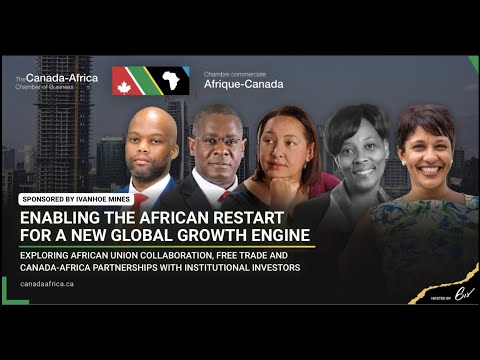
1:19:40 Several governments and governmental agencies are represented in this year's conference, along with various speakers from private industry and nonprofit organizations, as we explore topics such as mobility, trade infrastructure, logistics, environmental and socioeconomic well-being, as we chart a path forward to enable the African restart for a new global growth engine through trade and partnerships. These topics have weight, the speakers have influence, and it is an honor and privilege to enable these conversations to happen out in the open as people from all around the world participate in this historic event for free from their laptops, tablets and mobile devices here on SIX.com. Nearly a decade ago, we set out to build 6 out of a hypothesis.
1:20:30 We theorized that there could be a market-based solution to address the problem of social mobility and economic inequality. In particular, we believed that we could improve the world by creating an economic incentive for the people and companies with influence and power to build in public, out in the open, and to allow everyone to participate alongside them in the process. Our belief was that by making the process of building companies transparent, people could learn from each other about how to unlock their own economic potential, whether that was by investing in the companies building in public or by building something in public through 6 of their own. As people we learn from each other and there is tremendous value in watching and seeing how others succeed and integrating that success and learning into our own lives.
1:21:16 Our flagship product, Six.com combines the power of community and technology by making it easy for anyone to attend, host, and market virtual investment summits. Virtual investment summits such as this one, hosting Africa Accelerating 2021, are live interactive events delivered over the internet by video and are specifically designed around the unique capital markets needs of investors, analysts and companies. Virtual investment summits are powerful because they function as time-based events that bring people together at the exact moment when decisions are being made. We're in a virtual investment summit on Six.com right now and as an attendee you have access to world leaders, to titans of industry and to aspiring and budding entrepreneurs along with investors ranging from hobbyists, retail, accredited and institutional investors as well.
1:22:11 In a phrase, 6 is a place where capital and ideas meet. More than 300 events have been hosted on SIX.com since February 2020, and more than 100,000 people have participated in some material sense, whether it was by visiting the website and opening an account, registering for an event, or attending live. The virtual investment summits we host on 6 are global, with companies and operations all around the world represented and accessible to all. Investors on six.com are connected to projects and entrepreneurs in Burkina Faso, in Ghana, in Namibia, in Zambia, and in many, many other countries throughout Africa and around the world. The geographic barriers of being far away are becoming less important compared to the character and content of the vision for the future that is being presented.
1:23:04 Entrepreneurs of large companies and small ones have an economic incentive through Six.com to become more accessible with their activities because they can speak to large, engaged audiences all at once. This is important because it means that the smallest, least economically significant person in that audience gets the same access through Six.com as a much larger, more economically significant person or firm. Access is everything. When we set out to solve and address the problem of social mobility, what we're imagining was the ability of an individual to improve their socioeconomic status as a result of their actions. And for many people around the world today, the perception is that social mobility is becoming harder and for some, impossible to achieve.
1:23:54 Here in Canada, young people are struggling to own their home, while the cost of living rises, discontent brews. Similarly, in Africa and around the world, people are feeling disenfranchised as factors outside of their control, such as inflation, make it harder for them to rise in socio-economic status. Notably, Throughout the pandemic, in the past 2 years in particular, as we see the real economy struggle and millions lose their jobs, the stock market soars and continues to soar towards new all-time highs. The gap between people and individual economic outcomes is widening. 6, as an antidote to that, is a place for people to come together and to succeed together. Everyone is welcome, regardless of geographic region, regardless of socioeconomic status. There is no cost to participate.
1:24:45 All that matters is your ambition from the future and where you want to go. And it matters much more than where you are from or what economic means you may or may not have. Access, whether it's to the heads of states such as incumbent Prime Minister Trudeau or former president of South Africa, or to executives and CEOs or to investors, access matters because it allows for learning, knowledge sharing, and ultimately an opportunity to raise capital or to invest it. And yet if access is so important to socioeconomic outcomes, to social mobility, to solving and curing the problems of economic inequality, what are the greatest barriers to it? Why don't people have access already? We believe that the single greatest obstacle to access is logistical constraint.
1:25:34 There are more than 8 billion people on planet Earth. We don't all live in the same place, and for all of us to get in a room together at the same time would overload any conference venue, any city, any country, any continent. One of the things that's so interesting about hosting Africa Accelerating here on Six.com is that there are no limits to who can access the content and the speakers and attend and participate in the dialogue. Everyone is invited and with more than 7.1 billion mobile phone users around the world, we have space for everyone to attend. Our ambition is that in the future, all discussions, whether they are political, commercial, or material for other reasons, will be accessible for free here on Six.com as we come together and participate in building the future.
1:26:24 But this dream of shared prosperity and trade is threatened. Around the world today, people are becoming more and more disenfranchised and discontent as a result of no fault of their own. Inflation is eating away at their savings while increasing the cost of living as salaries are absorbed in rent and gas and food. And as the cost of living rises, The ability for ordinary people to take economic risks declines whether that risk is investing or starting companies or some combination of both. In order for social mobility to prosper, innovation is required and innovation requires courage. The courage to put capital at risk, the courage to go build companies, the courage to join companies, the courage to invest.
1:27:09 And whether you are an operator or an investor, in order for the promise of social mobility to be fulfilled in Africa and beyond, we will need courage in a context where fear and anger is rampant throughout the world. We will need courage when people feel that the dream of social mobility is becoming harder to grasp. We will need that courage in a time when in every country, in every continent, populism is rising and people are discontent and angry. And as the question looms, what has trade done for them? As people question the merits of capitalism, of trade, of cooperation, and even of peace. Africa Accelerating 2021, hosted by Six.com, represents an alternative glimpse into the future. A world where every discussion, political and commercial, happens online, in full view and access of everyone else, transparently and for free. A world where geographic barriers and boundaries are less important than the content of your character and the quality of your ideas.
1:28:10 By aggregating the global supply and demand for ideas and capital here on Six.com, through events like Africa Accelerating 2021, we are empowering more people to improve their socioeconomic status through their actions, either by investing or raising capital or both. 6 is where capital and ideas meet, and it is my great honor to host you all on our platform today. Together we are demonstrating the best of politics, the best of commerce, as we usher in an open transparent system where everyone is welcome, where trade flows freely, and where people through their positive contributions to each other, prosper. Thank you. I'm Daniel Berenkin, the CEO of 6. My email address is danielatsix.com. Please feel free to contact me if you want to get involved in unlocking social mobility on a global scale by empowering anyone from anywhere to invest in anything.
1:29:04 Thank you so much for your time and enjoy the rest of the conference hosted here on six.com. Daniel, thank you so much. You're also the youngest ever director of the Canada Africa Chamber of Business. If I'm not mistaken, Mr. Chair, I think you were 21, if not maybe 20. And of course you were well into running this incredible company from startup to scale up. Congratulations and thank you for enabling the Canada Africa agenda the way you do. Dignitaries, ladies and gentlemen, business leaders, we are now going into 2 parallel sessions before we return to the main stage at 12 o'clock at Toronto time, 6 PM in Johannesburg and elsewhere. It's my great pleasure to moderate the breakaway session, which will be taking place both virtually and in person as a breakaway event. And that is with Export Development Canada. We know that for Canadian businesses, they're partners of choice.
1:29:56 There was a recent headline in the National Post that said, forget Asia, the prospects for Canadian companies lie in Africa. I'm paraphrasing there, but it shows the incredible influence and the incredible messaging that is coming across in driving the narrative. So we've got the leadership at EDC on standby, ready to begin our next session. From the main stage, our esteemed chair, Mr. Sebastian Spiogabra, will be leading the private equity discussions and the policy discussions over the next hour and a half, and he'll be introducing our first panel. Thank you so much. To those joining in the EDC session, you have your links. They've been sent to you individually or should be appearing either on screen if you have registered for that session. And if you need any assistance, do feel free to respond to the email that you've got on hand. A warm welcome for the main stage panel to Mr.
1:30:41 Sebastian Sbio-Gabra. In just a minute, I'll be seeing all of you, the exporting companies in the EDC parallel room. Thanks so much. ATI is a proud member of the chamber and Deepak Dev brings over 20 years of global experience in banking, capital markets and private finance. He has served in senior positions at GE Capital, EDC, Barclays Investment, and founded a Riverside advisory. He joined ATI, the existing four-member management team, in his new role. ATI created the role to strengthen its risk management functions at the back of great growth. ATI's preliminary results over the last few years have shown that the institution has grown to have an exposure of over 6.4 billion US dollars and an equity of over $350 million, a 34% increase. Without any doubt, ATI remains a very important institution facilitating trade and investment in Africa. In Africa.
1:31:55 Good day to all of you watching our panel from across the world. I have the honor to have a chance to glean some insight on behalf of all of us from 2 experts on what the preconditions would be to attract greater volumes of commercial capital from institutional investors into African markets. As the Chief Risk Officer of the Africa Trade Insurance Agency, I oversee the risk management of a $6.5 billion balance sheet supporting capital markets, derivatives, FDI, project and trade finance in African markets. We play an important role in protecting capital, but ultimately, what drives the supply of that capital? We have all heard from persons as distinguished as President Abyssinia earlier, of the African Development Bank, that Africa's capital needs now include the development of a market for money.
1:32:56 For example, the Nairobi Securities exchange now has a derivatives trading platform. The Kenyan government recently announced the setup of the Nairobi International Financial Center to augment peers in the region, such as Mauritius and South Africa. In line with all of this, our panelists are both subject matter experts, but have also been on the sharp edge where investing tools carve a niche in economic systems and financial markets. Madam Franny Lauthier is known to many of us in the region's development financial institutions as both a distinguished academic who has also been a skilled executive, enrolls at the World Bank Group, and then she later took on the challenge of being Chief Operating Officer at the African Development Bank, the TDB Bank, and is currently CEO of SouthCreech Investments.
1:34:01 Andrew Brainion has had a glittering career in Canadian financial services, starting with several years at the Bank of Canada before rising to become Executive Vice President and Chief Market Risk Officer, and after that Group Treasurer at the Scotiabank Group, an organization which has close to a 780 billion dollar deposit base alone. He's now the managing partner of Brannion Harper Advisory. So, perhaps we could start out with Madam Franny answering a couple of questions. Madam Frenny, could you describe some of the innovation you have observed on the ground to strengthen and deepen the management, regulation and legal framework in selected markets to help attract private capital, private international capital from institutions to Africa. We know such activities are often supported by the World Bank Group, the IFC, African Development Bank or our partners in the Canadian government and the UN Economic Commission on Africa.
1:35:10 Thank you very much, Mr. Deep. It's a pleasure to be here. I will give 5 examples. The first one is capital markets development. The World Bank Group, particularly through the IFC, has done a lot in capital markets, legal systems, and improved the regulatory environments. And a good example of the impact of that intervention is the merger of the capital markets of Rwanda, Uganda, and Tanzania, which has given a huge boost to the opportunity to use local capital to finance development. The second example is the African Legal Support Facility that is hosted by the African Development Bank.
1:35:56 This is a facility that supports African governments in complex commercial negotiations so that they can speed up agreements with the private sector, or for complex debt structures. And this has been operating since 2010 and has many good examples across Africa. The third one is the work that has been done for financial services deepening. A good example here is what was done for Diamond Bank PLC to extend their capacity to bank the unbanked, particularly women. And this is work that was supported to bring in fintech solutions to get the revolution in bringing in digital solutions.
1:36:45 So the financial and banking, and you have the support from FSD Africa, and along with entities like Women's World Banking. The fourth example are the forums that are brought to bring investors, whether they are public or private. And here you have the Africa Investment Forum, you have the CEO Forum that's done by Jean-Henri, and you have the World Economic Forum Africa that all bring together these dialogues, conversations at the high level. And then finally, in terms of removing barriers, there are a lot of opportunities that have been brought into the market. For example, in dealing with risk, guarantee solutions like the African guarantee facility, in providing insurance such as the Africa Trade Insurance, and of course on the currency hedging side where you have entities like TCX which are funded by more than 22 different investing entities to provide hedging against currency risks. So these are 5 examples to respond to your question.
1:37:54 A follow-up question would be, given your expertise in the area, could you draw us a line from how these sort of financial market innovations also drive what we would think of as real economy solutions, particularly employment and productivity? Thank you very much for the second question. I think there are a lot of opportunities to attract market investments and have them then deliver jobs, deliver productivity, and also have an impact on trade. I'm going to give some examples. So on the job side, when you bring market solutions and foreign direct investments or investments in general, it helps to create jobs that first ensure business continuity.
1:38:48 And this has been very important, particularly during COVID, where a lot of the investment that came into Africa went to support existing jobs and maintain business continuity. But then of course, in normal times, non-pandemic times, those investments generate new jobs, and they create opportunities for innovation, and even different types of jobs that didn't exist in the market before. On the productivity front, I think here's where investment really delivers tremendous results on productivity. First, labor productivity. When you bring in capital, it deepens the opportunity to use previously invested infrastructure, for example, or other capital assets, and that raises the labor productivity.
1:39:41 Expansion of productive capacity is also very important because Productive capacity tends to be lumpy, so those investments, when they come in, they also generate important productivity improvements. And then finally, when you look at urbanization, and the majority of countries in Africa are urbanizing at a very high rate, where you have concentrations of educated people in big cities, their creative ideas, their consumer driven innovation and their demand are served very well to get productivity improvements such as in the markets.
1:40:28 And then finally, which is another critical and multifactor productivity improvement and growth. For the trade side, investment is very important for trade, and particularly at the moment, the African continent has the highest rate of investment of all the markets. And because of the continental free trade area, that means there are even more opportunities to invest. So I give some examples. In intra-African trade space, green field investment instruments, and that generates the important infrastructure, whether it's for energy or for transport, to create trade between countries.
1:41:17 A good example here is the Africa Green Corporation Company, which is a Zambia-based energy company that does renewable energy through a grid to Eastern Africa. The other example is e-commerce. Again, with the continental free trade area, e-commerce can come and support entire supply chains. You have the example of Togo, which was able to crowd in a private investment from Erise and Olam to build on the cotton value chain, to go all the way from producing cotton to making textiles to making circular economy type solutions can really be very well supported with investment in market-like instruments.
1:42:07 I take the example of Twiga Foods in Kenya, which received investment is now having an impact on entire food and nutrition value chain. Or you take the example of textiles that I already mentioned, but which could also generate garments trade. This has been very important during the COVID time, for instance, to make all these protective gear, the PPPs that were so needed, and to transport them across borders in order to meet the demands that were coming from countries that didn't have manufacturing capacity. So I think attracting market instruments is critical for jobs, productivity and trade.
1:42:54 Andrew, given your expertise in the area and the business development work that you've been doing over the last few years, What is it that you've noticed Canadian investors are usually using as parameters to measure Africa's attractiveness as a financial market's investment opportunity compared to its peers such as Latin America or other Asian countries which might be at a comparable stage of development? Some more technical answer I think would also be fine. Well, good morning and thank you for the question Deepak. And first I'd just like to thank the Chamber for the invitation to participate in today's panel and for having the pleasure of speaking to the 2 of you. You know, it's interesting, Canadian investors traditionally are somewhat risk averse. And if you first talk to them about Africa, what you hear, you hear the traditional answers of, well, I'm concerned about political instability.
1:43:45 I'm concerned about bureaucracy, rule of law, corruption. The list goes on and on. But for the more astute investors, they're able to parse through those negatives and see the tremendous opportunity that the continent affords them. And You mentioned Latin America, and I very often draw a parallel to a country such as Peru. My former employer was very active in the Pacific Alliance countries of Colombia, Chile, Mexico, and Peru. Why Peru? Well, Peru had a strong central bank. They had good reforms underway at that point in time. Most importantly, they had an up-and-coming middle class, and they were tremendously underbanked. I think banking penetration in Peru was in the low 30 percent, whereas, of course, in North America, almost everybody has a bank account or has some access there.
1:44:36 But Latin America in of itself has all the same sort of issues that I just mentioned off the top as when people think about Africa. So why the difference? And I think that's where you have to get into a level of detail. Other things we hear about is that investors struggle to become aware of some of the traditional deals that are available to them. They're concerned about deal size. I think the continent has suffered with some pullback in private equity recently because they're just not able to find the deal size that they typically are interested in. And of course, then you get into more traditional concerns around market risk, development of financial markets, and Dr. Lotier obviously talked about some of the progress that's being made there. And then obviously into credit risk. At the end of the day, you've got the continent with 54 countries, I believe 4 of which are investment grade.
1:45:26 So that is certainly a consideration as people look to invest their money. The other consideration for investors is how does the project get commercialized? So you know is there local expertise on the ground that can make a project profitable at the end of the day and And how do we find access to those sorts of people? So those are some of the considerations that people go through. And maybe Deepak, if I may, I'd like to talk about some of the things we're trying to do to address that. I've had the privilege of being invited to advise the Africa Foresight Fund, which is a private equity fund being set up to invest in the continent and hoping to draw in institutional investors from Canada, principally pension funds.
1:46:13 So why is this different? I think first and foremost, it's about a philosophy of the fund. It recognizes that any investors are actually visitors to the continent. You know, we're there to invest in projects that are going to create local good and help the continent achieve its full potential. But the other thing it offers is an opportunity for people to come in and take advantage of some of the smaller deal sizes that are out there that still offer very good returns on investment. So a pension fund is going to be hard-pressed to think about a $25 or $50 million investment because they've got so much else that they're considering at the end of the day. By investing in funds such as this, you can invest and get in and active with smaller sized transactions and achieve the returns that you're looking for.
1:47:04 It's actually a good stepping stone as well. So traditionally, the pension funds have not been active on the continent. They've been active across the world. And I think the time has come now to consider the opportunities that exist there. And here's an opportunity to take a step, get a feel for what the continent's about, see what type of projects are available, look at the performance, and get comfortable with the investing environment. The other thing that we're trying to do is to bring expertise to the table. So on particular projects, let's try to bring some Canadian expertise that can help with technology, or as the case may be, and then find good local partners to employ people in the countries that we're investing in, again, with a goal of leaving some good behind and leaving a profitable enterprise and helping to really shore up the fabric and the foundation of the continent itself.
1:47:57 Fantastic. That's fantastic work. So Andrew, just to follow up to that, you've talked a bit about what the investors would be looking for and what they'd be concerned about. What about extraneous to the investors' own commercial interests? Are there things such as tax implications or regulations from regulatory bodies in Canada that in some quirky way are actually bottlenecking or hampering Canadian institutional investment in the continent. Is there things that government could be engaged with to perhaps smooth the path to private capital finding its way to Africa? I say this from my own experiences in the UK almost 20 years ago, where there were all these hidden challenges in the regulatory books and tax codes and things like that. And that's where that question comes from. You know, frankly Deepak, I think it's more about awareness and its education. So I think forums such as, you know, the conference that we're all participating in today helps to raise awareness and bring information to people at hand.
1:49:01 You know, when you think about investments, yes, you're focused on risk reward. You know, whether or not you perceive and whether or not you're right to perceive some aspects of Africa as being risky, then, you know, then you look for the returns that justify those risk parameters. And then you look for ways to protect against the risks that you're concerned about. So if you're concerned about, you know, foreign exchange convertibility at the end of the day, if you're concerned about political risk or risk of nationalization, as the case may be, then you seek out ways to mitigate that. And Deepak, with your own organization, I think there's a tremendous opportunity there where you're providing insurance against some of those risks wherein you buy the insurance and you're still protecting the returns that you're looking to try to achieve. So it's a work in progress, I think, for sure. I think the important thing for the continent itself is to continue to make progress on the reforms that it's making. And again, I generalize recognizing there are 54 different countries in the mix. But I think, you know, The free trade agreements is a great step towards collaboration moving forward.
1:50:06 And then it's really just about being able to find the projects that are going to actually get traction. I think there's been a number of projects in the past where they seem to be high profile, there's a willingness to try to get it done, and for whatever reason, they just slow down, lots of bureaucracy as the case may be, and never actually get off the ground. So you wanna be able to find local partners who understand and have the connections in the various countries, who know which projects are important to the country, look for potential co-investment opportunities from the local governments or the pension funds there, and really work hand in hand to try to get these things done. I think the, you know, Entities such as the African Development Bank, I think, have done a great job in terms of promoting the region and facilitating investments.
1:50:56 And I think the other thing, again, investors are looking for is just continued development of the financial infrastructure, finding the instruments that are going to allow them to get the debt financing at the local level that they need to support the projects that they're involved with and work together. End of the day, it's all about finding good partners and moving forward together. I've always been a firm believer that you put all your cards on the table, the good, the bad, and the ugly, and you parse through it, you figure out how to mitigate the risks that you're not comfortable with, and then you find a path forward. If there's a willingness to cooperate and do those sorts of things, I think there's tremendous opportunity for Canadian investors in the African continent, and I look forward to seeing that come to fruition. That's wonderful. And I'll take that example you just gave and tell you that at the Africa Trade Insurance Agency We have French banks doing currency derivatives in Africa through us.
1:51:50 We have German banks and German and Dutch banks funding water and agribusiness projects that are insured by ourselves. We have Japanese banks supporting structured commodity financing that goes out 5 or 7 years. The only ones really missing at the table are, in fact, regrettably, the large Canadian banks. And that's an area that we really want to go into because where the banks lead, asset managers, insurers and fund managers tend to follow. And so we very much look forward to further engagement on that side. So, Dr. Lodja, just apropos on my comments regarding, you know, finding good partners locally to help drive the investment agenda. Based on your experiences with the African Development Bank and all the other roles that you've played, what would you recommend to people looking for those partners, or what is a good way to try to advance that particular agenda to really get investors interested in investing in Africa?
1:52:46 Well, thank you very much for that question. And I was really listening to your example from Peru and wondering why this cannot happen in Africa, because I worked in Peru also when I was working at the World Bank. I think as an investor, you can come with the, that you have learned in other kits, engage with local partners who are able to bring customized entities like the Argentine Bank. But I've seen great successes when you have that kind of partnership, especially if you have a good advisor on the ground who's able to bring the parties to the example I mentioned. Huge in taking place during COVID. It was an investor coming to invest in Togo, a very small supply chain. And it succeeded because the investor was very keen to go ahead.
1:54:00 The investor had local knowledge and local partners that they could engage with, and they wanted to do it in a unique way that opens up opportunities not only for themselves in the global market, but also for the country they were investing in. And I think these 3 ways of working could deliver tremendous value for investors. Perfect, thanks Deepak. Just in conclusion, I think I'd like to come back to my initial point that I think there's a tremendous opportunity for investors on the African continent in general.
1:54:47 And it really is about finding partners on the ground who understand what's going on locally, who can really help to affect these projects. And it all serves to really raise the bar in terms of the infrastructure and everything else within the continent. And it's spending the time and getting across there and meeting with pension funds and meeting with local governments to really understand what their objectives are and what they're trying to achieve and to get a good sense and a good confidence that the projects that you're focused on are actually gonna move forward. So, again, I thank the chamber for the opportunity to participate in today's panel. I also thank the Chamber for raising the profile and the potential of the Canada-Africa relationship.
1:55:36 And I look forward to seeing that build and seeing some successful investments by Canadian institutional investors. So thank you. Thank you very much, Deepak. It's my pleasure to welcome him to Indian Africa. I think there are great opportunities and the areas to mitigate risks are also there, including from the innovations that you are bringing in to the Chief Risk Officer. So, very much for inviting me to this conversation.
1:56:22 Okay. Thank you both to our distinguished panelists and of course particularly Madam Franney also for those very kind words at the end. Certainly the Africa Trade Insurance Agency is an institution that's prepared to support investors and traders with and on the continent. And of course, the Canada-Africa Chamber is always here to help make introductions, to help smooth the path and to assist in any way where we can to make sure that the Canada-Africa relationship remains as strong as it has always been and goes even further than it does today. Thank you all for listening in and thank you to both our distinguished panelists for being here today. Panelists for being here today. Thank you so much Deepak Dev and to our wonderful panelists for this excellent session.
1:57:22 Coming to you from the breakout session boardroom here in Toronto, I'm Samantha Mandigora and I'm the operations, the head of operations at the Canada Africa Chamber of Business. Now, 1 institution tasked with playing a major role financing the continent is the African Development Bank. I'll be asking Solomon Kweina, Vice President of the African Development Bank, a few questions. Solomon Kweina is currently the Vice President for Private Sector Infrastructure and Industrialization at the African Development Bank, where he started in May 2020. He has over 25 years experience in development finance and investment banking. He is an emerging markets specialist investor with experience investing across banks, infrastructure, energy, manufacturing, agribusiness and services.
1:58:17 He has experience supporting executives and board leadership of corporates in strategy development, key government and private sector partnership relationships. He serves as a trusted advisor at the C-suite with companies across multiple sectors in Africa. To Salman Kueina, what an incredible career to date. You now have a massive mandate on the African continent. Can you please share some details of your day to day roles and responsibilities at the bank? No, so thank you very much for the question. The African Development Bank, you know, strongly believes in private sector development. And that also means that we have to find. You know ways to not just deploy our capital in our- African development bank but really mobilize.
1:59:09 You know other you know other other investors as well. And so annually- people of it- between the 20 16 to 20 19 period- we- invested. Over 2 billion dollars a year in private sector. In sectors such as the financial sector. The transport sector. Are the industrialization sector agribusiness you know our telecoms- and also renewable energy. And in all of this we always look to really mobilize beyond what our balance sheets and right. And so we're looking to you know through syndications and other innovative ways of mobilizing. To bring in our institutional investors such as pension funds. We're primarily a lending organization- but we in addition we also have. A fund of funds private equity business- where we've invested- I mean today our total outstanding- investment is about 1.3 billion dollars in 66 different private equity funds. So we're quite experienced in the private equity space you know in Africa.
2:00:16 In all of this we are seeking to achieve the sustainable development goals and to do so we've prioritized 5 key areas which will tend to be very interesting to, you know, international institutional investors. The first is to light up and power Africa. The second is to feed Africa. The third is to industrialize Africa. The fourth is to integrate Africa. And the fifth is to improve the quality of life of all Africans. And in doing so, we create very attractive investment opportunities in areas like infrastructure. We create attractive investment opportunities in service areas, in industrialization, like in the pharma space.
2:01:06 And for me, part of my role is to really guide, strategize, and motivate my teams to proactively engage with clients, both globally and clients regionally and locally- that are invested in the space and we come in to actually- you know not only. Deploy capital but mobilize additional capital you know to support. You know these slides and also to bring in institutional investors such as those gathered here today. There are there are some bigger initiatives that we look at that would once again further support private sector development. So for example the African Continental Free Trade Area is a key initiative that really expands the markets for various businesses.
2:01:59 And So these are examples of what I focus on every day in terms of trying to enable private sector development across Africa. The last 2 areas I want to touch on is private investors or private companies always need the right enabling environment. And we as the African Development Bank engage with governments to create the right enabling environment, whether it's policy reforms, regulatory reforms, legal reforms or institutional reforms. We engage with governments to create the right environment for private sector to thrive. Lastly, and very particular to this particular audience, the African Development Bank, working with partners, have established the African investment forum. And this is a very unique forum that was set up 3 years ago- it's a transactional platform- it creates the opportunity to present and promote.
2:03:04 Transformational projects in Africa. And you know over the first few years we were able to. You know develop about 78 billion dollars worth of investor interest- in in transformational projects you know in Africa- and this you know These are some of the things that I focus on overall to make sure that not only are we supporting private sector development in Africa, but we're mobilizing capital from domestic and also global sources to achieve it. The African Development Bank is covering a lot of ground. What would you say are the main trends favoring private investment in Africa? The first key area I would say is that Africa is the most reforming, you know, continent in the world. You know, pre-COVID, based on the global reforms that one has seen in the ease of doing business, Africa was recognized as having contributed to 33% of those reforms in business reforms and regulation.
2:04:12 I mean, that goes to show that governments are actually biting the bullet, making the right decisions to attract private sector, to attract private sector into their markets, you know, so that's number 1. Number 2, urbanization is actually expanding, you know, in Africa, and this has created also a middle-income class, you know, a middle-income bulge. And this is also leading to you know the rise in consumer story- and with the increased purchasing power with you know the increased opportunities- you know in urban environments- you know this actually creates an investment opportunity in several consumer related businesses whether it's- pharmaceuticals whether it's health care whether it's- fast moving consumer goods. It creates a very attractive opportunity.
2:05:05 And notwithstanding COVID, the Africa rising story actually continues. And we've seen great evidence of that from the private equity group. Private equity always invests in growth opportunities. In Africa today, we have 150 private equity fund managers focused on Africa- from almost nothing- a decade or 2 you know before- And in a recent survey actually in 20 20. In the COVID period. Of 45% of global. Limited partner investors actually indicated that. They see Africa 10 years as being. The top destination for investments- you know both both when compared to developed and emerging markets.
2:05:54 In addition, 60% of the same, you know, investor survey actually indicated that they will be increasing the allocation to Africa in the next 3 years so I hope this is also a great signal for Canadian investors. About the opportunities are you know are are quite right in Africa. And with you know the hundred and 50 private equity fund managers these are great vehicles to actually. Invest through. To benefit from some of those equity returns. Now. You know what the third the third area that I'd like to talk about- is this also the fourth industrial revolution- You know that this this is creating leapfrog opportunities- you know in in Africa. Both in terms of you know greater efficiencies in various businesses but also. You know tech opportunities themselves I mean we've seen the payment space explode in Africa.
2:06:50 We have several unicorns, you know, these are companies valued over 1 billion dollars, you know, out of Nigeria, out of Kenya, out of Egypt as well. You know, this is creating significant opportunities. Now, 1 huge transformational, you know, factor that could be a game changer is the African continental free trade area that essentially makes Africa a single bloc. This will be the single largest economic block in the world, 1.2 billion people, projected to double by 2050, and currently with an aggregated GDP of about $3.4 billion. I mean, this is massive.
2:07:37 So there are several of these factors that actually make Africa the right investment destination to look at. And working with the African Development Bank, we can be very supportive in helping investors you know channel you know the investment funds either through the private equity fund managers that you know we know are potentially investing alongside the African development bank as well. The facts are clear yet we see risk factors still come up. And again dominating the narrative. How do you address perceived risk. I think the main point is perception of risk is not necessarily reality of risk. Moody's Analytics in 2020 did a cumulative 10-year analysis of default rates in the infrastructure asset class.
2:08:30 Whether you're looking at just infrastructure or you're looking at project finance, I mean Africa ranked number 2, you know, in the case of infrastructure, in terms of the lowest default rates. And then in terms of project finance overall, it ranked number 4. And I'm talking about When compared to both developed markets and also- you know emerging markets so so clearly you know the reality of risk is not you know it's not really. As high as this received. However for us as an institution out dedicated to Africa we realize that. We need to partner with institutional investors in that journey because people are at different stages of understanding the market. So this is where we have various instruments to mitigate some of those political risks.
2:09:23 We're able to provide what we call partial risk guarantees, where we counter-guarantee government obligations on infrastructure projects. Some of our partner organizations, like NIGA, can actually cover political risks through PRI themselves. We are able to provide partial credit guarantees to actually support bond offerings as well into infrastructure projects or even into, you know, some general obligation bonds as well. So the message I want to leave investors with is that for us, We see this as a journey. We will be your partners along the entire journey, whether you're looking to come in through a fixed income approach or through an equity approach.
2:10:11 We will be great partners to institutional investors from Canada. But the last message is perceived risk is not reality. Thank you so much, Solomon. The honour is truly ours and we look forward to welcoming you back again. No doubt your insights are invaluable, especially for pension funds and private players here in Canada. Dignitaries and guests, ladies and gentlemen, stay with us. I'm moving back to the main stage where in just a minute the chair of our board will be introducing Mr. Tariq Khan, Director General for Africa in the Government of Canada. This will be followed by a dynamic panel titled, The Policy Exchange on Ongoing Canada-Africa Collaborations.
2:11:03 See you shortly. Thank you very much. Thank you so much again. And again, it's a pleasure to, come back to the main stage in Toronto. We're now going to hear from, Harry Khan, who is the Director General for Africa, Global Affairs. Essentially, he is effectively the senior most government representative in terms of the bureaucracy, in terms of the policy side of the Canadian government looking at Africa. Tariq has served as head of Western Central Africa prior to his appointment and he is no stranger to this chamber, having addressed us last year prior to his illustrious or sent to the current leadership role in the government of Canada. We are proud to recognize global affairs and a longstanding supporter of programs and a longstanding supporter of this chamber, Tariq Khan.
2:12:06 Thank you. Thanks so much for that kind introduction, Sebastian. Bonjour tout le monde. On behalf of the Government of Canada and in my capacity as Director General for Pan-African Affairs at Global Affairs Canada, I want to thank the Canada-Africa Chamber of Business for bringing us all together for this fantastic event and for inviting me to speak to all of you once again. So before we begin, I would like to acknowledge that I am participating virtually from Ottawa on the traditional and unceded territory of the Algonquin Anishinaabe people. I believe that those of us who have settled on this generous land have a responsibility to ensure true reconciliation with its indigenous peoples. So let's remember that in all of our efforts to build an inclusive Canada.
2:12:55 Today on day 3 of Africa Accelerating, we're here to discuss how we can work together to enable the dynamic economies of Africa to recover from COVID and become new engines for global growth. While the economic growth that preceded the new millennium has been strong and persistent throughout Africa, It is well known that the average economic activity has fallen sharply since, due to the drop in basic products prices and a decline in global engagement, and not to mention the fact that we are witnessing such a significant global economic slowdown due to the pandemic and its impact on Africa. But it is essential that Africa's growth finds its momentum before the millennium, and one way this can happen is through a greater partnership between the continent and Canada.
2:13:52 Supporting Africa's growth and prosperity is a priority for us at Global Affairs Canada. We are committed to building and strengthening our partnership. A concrete example is the announcement made by Prime Minister Justin Trudeau last May at the Summit on Financing African Economies that Canada will accelerate its support for the African Development Bank's seventh general capital increase to maintain its ability to provide valuable financial assistance to its clients. And you heard from the Prime Minister directly at the beginning of Accelerating Africa this year regarding this government's commitment to enhancing our economic cooperation across the continent. Canada has rich and meaningful relationships, as you know, with many African countries.
2:14:38 These are based on mutual trust and accountability and historic links. Our African partners look to Canada for increased economic partnership and investment across the continent. As you know, more investment is critical to providing employment opportunities for the young and fast-growing populations of African nations, and it will create sustainable and steady growth. Let's look at some numbers on Canada-Africa trade. In the past, the total Canadian trade in merchandise with Sub-Saharan Africa has been modest, reaching $7.7 billion in 2020. In 2020, Canadian direct investment abroad for all sub-Saharan Africa was $12 billion, while known FDI in Canada from sub-Saharan Africa was $2.5 billion.
2:15:27 We have also actively pursued initiatives aimed at promoting trade and investment on the African continent, including increasing the number of trade commissioners on the continent who are there to work with Canadian companies to serve you as well as to help implementing foreign investment promotion and protection agreements, FIPAs, with several African nations, notably Benin, Burkina Faso, Cameroon, Côte d'Ivoire, Egypt, Guinea, Mali, Senegal, and Tanzania. Our international cooperation programs, our development programs, have also been working to improve the business-enabling environment in many countries, including through training, capacity building, support for business-friendly reforms and, more recently, blended finance initiatives in the area of renewable energy.
2:16:17 But we can do better to support economic growth in Africa. And we know that trade plays an important role in achieving sustainable development goals by 2030. With a new government just sworn in, Canada has an opportunity to improve on our approaches and strategy for the Canada-Africa partnership. Canada will continue to look for innovative ways to deepen its relationship with African countries and increase economic cooperation across the region. We'll do this by finding ways to help facilitate increased infrastructure investment, expand partnerships and research and innovation, and help develop new markets and partnerships for Canadian and African businesses.
2:17:03 Our goal is to support the rules-based trade and investment environment in Africa and help increase the ability of African countries to ensure that sustainable growth takes place. Canada is committed to helping develop the environment for Canadian businesses operating in Africa, whether it's through continuing policy discussions or advancing pacts such as foreign investment promotion and protection agreements, air transport agreements and double taxation agreements. Global Affairs Canada, largely through our Trade Commissioner Service, also continues to look for new opportunities in its priority sectors in Africa, including natural resources, agribusiness, education and infrastructure. While Canada wishes to increase its commerce and investment commitment in Africa, we estimate that African institutions play a leading role in stimulating and facilitating economic growth Canada sees the African Continental Free Trade Area, the ACFTA, and intra-African trade as a key future driver of African economies.
2:18:15 We recognize this. A unified continental market has the potential to improve economic prosperity, stability and security in the region. It will attract greater investment from and greater engagement with the rest of the world, including Canada. Canada sees the implementation of the agreement to create the ACFTA as a critical step to help the development of value-added sectors and for our own participation ultimately in regional value chains, infrastructure, services such as logistics, education and health, and goods like agricultural products, agri-processing and clean tech. And this is just to name a few. We know there is much more, and we know there is much more potential that Canadian businesses have to offer. As has been stated numerous times in this conference, supporting the ACFTA is about building for the future.
2:19:07 This is why, since 2003, Canada has supported the African Trade Policy Centre at the UN Economic Commission for Africa. We have recently approved $15.2 million in funding over 5 fiscal years to the ATPC to help it support the implementation of the ACFTA, with a particular focus on inclusive trade, gender integration, and climate considerations. The ATPC provides technical assistance to member states on ACFTA negotiations. Through our funding, the center is currently supporting Somalia, Tanzania, and Eswatini to develop and implement ACFTA national strategies. On gender, ATPC works with AU member states to collect annual data on indicators and provide gender-related capacity building and advocacy as more countries develop their national strategies.
2:20:02 The goal is to ensure that these strategies are gender inclusive. The ATPC is also conducting a strategic environmental assessment of the ACFTA to examine potential entry points and opportunities for climate considerations to be integrated into the wider AFCFTA processes. Please do check out the African Trade Policy Centre. As we continue the fight against COVID-19 across the world, increased cooperation between Canada and African countries is critical for all of our nations to recover, to become more resilient and stronger than ever. As Prime Minister Trudeau mentioned earlier during the conference, Africa's success and recovery is key to our global future. I look forward to continuing to working with the Canada-Africa Chamber of Business.
2:20:52 We want to hear from this chamber and its membership, and we value your contributions. This Accelerating Africa 2021 is yet another fine example of the momentum and the energy you are creating to foster this growing relationship. May our dialogue continue and may this momentum continue. Thank you. Merci. Thank you again to Director General for Sub-Saharan Africa at Global Affairs Canada, Mr. Tariq Khan. Thank you for all that you've done to support continued trade and engagement and the relationship between Canada and Africa. Now we go to our panel discussion dealing with issues of Africa continental free trade and actually the obstacles, the challenges and opportunities to investing in Canada.
2:21:50 We have in our panel, Edith Gengras, Regional Director of Africa and Middle East, North Africa, at the Parliamentary Center in Canada. We have colleague Akinyi Uralila, Postgraduate Summer Fellow of the Canada-Africa Chamber of Business. Chris McLean, CEO of Stone Chair Capital. Idith, you honored us last week during the reception with a seminar with the high commissioners and ambassadors in Ottawa, And we would like to get a bit more sense about the work of the parliamentary center.
2:22:38 And then we'll go to our colleague, Akinyi, to give us a bit more insights about her findings in terms of the reports and the research she's done on the Africa continental free trade and obviously to Chris who is really putting his money where his mouth is, so to speak, who is a veteran investor on the ground in Africa across various sectors and to give us some business perspective, investing in Africa, some of the challenges, some of the opportunities, and some of the issues that have come up. So maybe we go to Ibid first, and then we go to Akini. Thank you, bonjour. Thank you to the Canada Africa Chamber of Business for inviting us. It's our pleasure to participate in the Africa Accelerating 2021 Invest Africa.
2:23:29 We're looking forward to exchanging today on this panel. Quickly on the Parliamentary Centre, we are a non-partisan, non-for-profit organisation. We were established in 1968, where we provided research at the time for the House of Commons External Affairs Committee. Since then, since 1993, our mandate is more global, so we support parliaments around the world. So as such, we've worked in 120 legislatures around the 70 countries, across 70 countries, might I say, and our projects are on inclusive and effective legislatures, which are key to resolving development challenges and yes, including trade and economic development. One of the things that we've seen is that as the African continental free trade area, well, we found it's an astounding ambition trade pact, and this will have direct impact on many levels of government, businesses, and populations.
2:24:32 And for example, we know that parliaments and governments will need to assess for how the agreement will directly impact their trade policies, economic development, their tariffs, business expansions, opportunities, job creation, and of course, directly on their populations. Through all of this, we know that parliaments will also be required to review the trade legislations, develop new economic market integration policies, for example, they'll be asked or required to do research dialogues, to develop new instruments, new guidelines and legislation to increase, for example, export opportunities and reduction in technical barriers to trade. We also know that parliaments, we found that parliaments will also want to undertake trade negotiations, investment strategies, intellectual property discussions.
2:25:30 They'll be engaging in bilateral and multilateral discussions on issues and identifying how to make this agreement work for women and be gender sensitive and also very inclusive with the youth. So these are some of the issues that we're able to support. And because we're able to bring our our center is able to bring members of parliaments who specialize in international trade issues on their respective countries and more and we're looking to work with different parliaments. We also, as and as you know, Canada's Parliament also has loads of experience, if it's not, with the North American Free Trade Agreement, the Trans-Pacific Partnership Agreement, or the EU-Canada Comprehensive Economic Trade Agreement.
2:26:20 So this is some of the things that we're doing now. We're providing practical training around mentoring, individual coaching. So we're really excited about this agreement and we're looking forward to work with the many countries that are interested in dialoguing, developing new policy changes in legislation, development of mechanisms for oversight, capacity building of their technical and administrative parliamentarian staff. All of this to make sure that the agreements and the strategies that are put into place by Parliament actually respond to the population's needs and the businesses. Thank you. Thank you Ms. Gengras.
2:27:07 To Akinyegi, what are some of the academic observations from your research which you think sort of complements the topic at hand. Thank you very much Mr. Chair and first of all I just want to thank the entire team at the Canada Africa Chamber of Business for the effort that you do to present such opportunities to everyone. Thank you very much for that. So on to what I'm supposed to talk about based on the report that I submitted, I had submitted it before to the chamber. And some of the key findings that I found about the African continental free trade area, and I'll call it CAFTA.
2:28:00 So what I found about CAFTA is that it is a single continental market that has the potential to create about 1.3 trillion US dollars. And that is going to benefit a population of about 1.2 billion in the continent. So I found that that was really a huge amount of effort, economic growth, industrial development, and improvement of standards of living and consequently also boosting intra-African trade. Those are some of the benefits that are going to flow from having that CAPTA, which is now operational. From having that CAFTA, and which is now operational.
2:28:50 And there are several reports or scholarly materials that evidence that document the benefits that flow from a free market agreement. However, you also find that you also realize that in as much as this evidence exists, there are also the things that needs to be done, that The things that needs to be done to ensure that that particular agreement or free trade agreement or free trade area actually meets or achieves its objectives. For example, if you look at the African Continental Free Trade Area, the agreement establishing it, and you find that on the protocol on trade goods, it establishes that it obligates the member states of the agreement to work towards eliminating non-tariff barriers.
2:30:00 And some of the findings that I found on that particular provision is that one, the agreement in as much as it aims to boost intra-African trade, it is going to provide, it obligates the member states to provide a mechanism that identifies, categorizes, and eliminates non-tariff barriers, which is commendable. This mechanism, it's an online mechanism that has a plugin that automatically translates the language of complaint into the official language of the country receiving the complaint.
2:30:51 And the languages that this online mechanism has is 1, it has English, it has French, and it has Portuguese and Arabic. Another advantage that this online mechanism has is that it has an offline tool that one doesn't need to have access to internet for them to access this particular online mechanism, for them to report the non-tariff barriers that they experienced while trading within the continent. But I found this problematic in a way, because not just you have, not just despite the online tool or mechanism, being having all those advantages and trying to meet the objective of eliminating, identifying and eliminating non-tariff barriers.
2:31:48 On the flip side, Africa has languages almost 2000 languages in Africa, there are almost 2000 languages in Africa, spoken languages in Africa. So you find that and currently in Swahili is one of the major languages spoken in the continent by about 150 million people. But then Swahili is not even among the languages that, is not among the languages that that online mechanism has. So you find that is quite problematic because you find that some of, most of the traders within the continent are going to be, most of them are illiterate people who might not be very fluent in English, French, Arabic, or Portuguese.
2:32:46 And sorry to say, but, say for Arabic, the other 3 languages are important languages into the continent. So for some people who may not be linguistically exposed to some of these languages, it poses a challenge for that mechanism being an effective tool actually for eliminating non-tariff barriers within the continent. And another thing that I found, another challenge that I found with the African continental free trade area is that article 13 of annex 5 of the agreement establishing the African continental free trade area sets, obligates the member states of the agreement, of the CAFTA to prepare national time-bound elimination matrixes.
2:33:47 But then it stops at that. The problem with this is that it offers no guideline in terms of how a country, how are the members supposed to prepare this national time-bound elimination matrix. It doesn't offer such guidelines. But then I found that the East African community has a very good template, which is actually, somewhere it leads towards solving the non-tariff barriers within the region, although it hasn't met all the set objectives of such elimination, but then it's currently doing something commendable within the East African community.
2:34:34 And therefore the continent or the leadership of the African continental free trade area could try to incorporate or even work closely with the leadership of the East African community to try to come up with some of these templates that could actually guide some of these, most of these African countries on how to prepare the time plan, because that will actually provide the set, the specific timelines and goals towards the elimination of non-tariff barriers. And finally, There was the issue of providing the local standard to expanding the jurisdiction of the continent wide dispute resolution mechanism to also accommodate the private sector.
2:35:34 As it stands, the dispute resolution mechanism of the African continental free trade area is limited to only the member states. However, the problem with that is that history tells us that African countries hardly need to get against one another. So in this case, when you have non-tariff barriers, which are actually one of the most inhibiting factors to trade in Africa, when you have, it is inevitable that disputes will arise, but then it is not states that trade, It is the private sector that trades. So when the private sector is eliminated or prevented or excluded from approaching this dispute resolution mechanism at the continental level, it poses a problem because it will force these private sectors, these private actors to request the national or the host or home countries to invoke their diplomatic protection to actually act on their behalf. But this is a very protracted and bureaucratic procedure that it's going to take as long as forever.
2:37:04 So to prevent these challenges that come with such diplomatic protections for the private actors, why not expand the jurisdiction of the dispute of the non-tariff barriers and other trade-related disputes to also accommodate the private actors. So those are the few, some of the few remarks that I had, and it was really a wonderful process, researching and just finding out more about the African continental free trade area. Thank you very much. Thank you. Thank you. Thank you. It's quite interesting listening to your findings and the passionate analysis that you've done.
2:38:01 And I think you've hit many, many important nails. We are meeting at Makati Tetrault's location here and myself also being a trained lawyer, I really appreciate the points you are making Because at the end of the day, if you have a continental free trade area and a company in Togo is having a dispute with a supplier in Kenya and there is no way to resolve it in a harmonious way, ultimately the company in Togo would have to go to court somewhere maybe in Kenya and get a judgment and then go and try and enforce the judgment which really comes back to the same point.
2:38:48 And as you said, most of the trade that happens in Africa across the borders is of an informal nature. A person selling tomatoes from Uganda into Kenya. Somebody carrying shoes from Nigeria into Benin. It's a very informal system. And I think that my experience the last few months and 0.5 working with the secretariat in Accra is that it would require all of our inputs, the analysis that you've made. I think when I go back, I'll forward it to the chief of staff and the secretary-general there and see how you might be able to brief them. Because I do agree that till we work out some of these things, the mission, this grand project could become a white elephant. I mean, we would all be talking about it, but effectively it becomes a white elephant. So thank you so much for your passion and for your analysis and for your interest in the subject. So I turn to Chris. Chris, Having listened to both Edith and our sister Kimi, what would you say from your own experience as a Canadian investor in Africa, what are some of the challenges, what are some of the opportunities you see there, and what comments generally would you like to make
2:40:20 with regards to Africa continental free trade? Canada contributed what we could to the process. We can't stop there. We have to stay involved. Our free trade agreements have changed twice over the years, and they're not the same. This free trade agreement on the continent shouldn't be a static document. It needs to be a dynamic document that is moving all the time and this is where Canada can definitely be a contributor to that process. I think though Canada needs to be very focused on what it wants to do. We can't be everything to everybody. We can say we've got a gender priority, we've got an economic growth priority, we've got natural resources, we've got agriculture.
2:41:15 Okay, those are all great things, but pick one. Ultimately, when you're dealing with the free trade agreement there's just way too much to say you're going to deal with all of these different things. From from from you know, our perspective, it becomes, okay, let's deal with energy. Canada has a long-term history in energy and it starts with, you know, all of the renewable energy and all the hydropower that we have in the eastern provinces. There used to be a time when Manitoba hydro was a vehicle of change, of inspiration to a lot of utilities in West Africa.
2:42:01 Okay, we've got 5 different power pools, for example, in the continent. Why are we not working on how to deal with how we can actually trade power between those that have access and those that have don't. Finance can come in We're looking for big giant projects for PE and infrastructure. Okay, great. Let's deal with transmission cross-border, but have the continental free trade agreement be something there that we're involved with so that we can help guide that success SDG 7 click done you want to deal with women through that click done You want to deal with finance out of Canada click done find some way find some cause that Canada has experience with that we can have an input in. I'm not going to say that, you know, our contributions are in vain up to this point as Canadians.
2:43:05 But federally we need to look at it and say what do we want as Canadians to help support Africans and diaspora that are going across. It's great to have support for entities like the African Development Bank beyond the tee up of further capital and the rest of it. But people often miss small things like when the African Development Bank did a 2 billion dollar COVID bond on the London Stock Exchange shortly after COVID hit, 2 months or so after, and that bond was 70% taken by North American and European central banks. We were chasing yield in Africa to support our domestic needs here versus saying okay how can we invest in a structure so that the economies can get better so that you know the growth can be there so that we're going to benefit together and I'm not saying this from an altruistic point of view it's just a There's a process here that Africa has to be more than, even in the growth that's there, something that we can harvest. It's not natural resources of a different kind now being yield and manpower.
2:44:29 We have to find something else to collectively work on out of this process. I'll stop my opining of that. Thank you Chris, thank you again. Africa is a very intoxicating subject. It tends to bring out the passion, the passion in all of us. You very rarely find a panel on Africa where somebody doesn't get very passionate, somebody doesn't start crying, somebody doesn't start shouting, you know. Thank God we don't have too many politicians around here. We would have had a big debate. No, Chris, I think you make a very excellent point. And I think that on both sides, we have, earlier this morning, Dr. Patricia Bakesha and I were having a dialogue about leadership. And it seems to me that the problem we are facing on both sides of this issue is leadership, leadership of prioritization.
2:45:26 On the CAFTA side and on the African side, what are the 3 key points of focus? Like you said, for instance, you have the South Africa Power Pool, you have the East African Power Pool, you have the West Africans, and we know that without electricity, all these conversations we are having are functionally useless. And so I think that whether it's at the ECA in Addis or the AFCTA in Accra, the question which is not on the Canadian side but which is on the side of we the Africans is to ask ourselves what is the key priority over the next 3 years, over the next 4, and then a sequencing of what is the second key priority. So it shouldn't be Canada coming to tell Africa, well, we have a priority of X, So we want you to also go and do X. The famous example someone gave me years ago is that, you know, when a lot of major NGOs and a particular one comes to mind, I don't want to name it, were engaging in Africa in the last decade, malaria was killing more people than, say, HIV-AIDS.
2:46:35 But most of the money went into HIV-AIDS and not into malaria. And over the last year, most of the money in the health care sector, most of the investments has gone into COVID and not malaria. So if you look at it from the African perspective, maybe perhaps our priority would have been malaria first, measles 2nd, HIV third. But from maybe a global perspective, it would be the reverse. So there's this dialectical dialogue, which is necessary between both Africa and Canada for us to draw up some priorities. Because you are right, at the end of the day, there's only 24 hours in a day, there's only 365 days in a year, there's only a finite amount of financial resources. And we cannot build a railway, build a water system, build a healthcare system, you know, build manufacturing, build industrialization, all in 1 year or in 2 or 3. So I think you raise some very wonderful points, and I think it really behooves both the African side and definitely also on the Canadian side, from what Director General Tariq Khan said, and we've had messages today, obviously, from the leader of the opposition. We've had the message from the Prime Minister at our opening to come up with, on Canada's side, what are the 2 or 3 key priorities?
2:47:55 And then the African side, what are the 2 or 3 key priorities? And it's like a Venn diagram. We would find some commonality between the 2 points, and then we can converge. Otherwise, basically what is tending to happen is that Canada's engagement in Africa is sort of rather scattered, and the impact is not focused. And I think you see this the last year or so when Canada had the opportunity to become a member of the Security Council of the United Nations and Canada went around Africa trying to converse for votes. And the Norwegians also went around Africa trying to convince for votes. And the Norwegians beat the Canadians. Very strange. That despite all the money and the goodwill that Canada has, Canada could not still get the majority of African countries to vote for Canada to be a member of the Security Council. So to me, that was a sign that the entire Africa policy of Canada vis-a-vis Africa had to be really overhauled because if it is not able to achieve results. So again, thank you so much to Ms. Edith Gingras from the Parliamentary Centre, again to Akiniyi for your wonderful research, and also to Chris for your passionate interest in Africa and putting your money where your mouth is, so to speak.
2:49:22 And it's really a pleasure and we do hope that these conversations would continue and that this wonderful dialogue would continue to enhance trade, investment and exchanges between Canada and Africa. Thank you so much, Samantha. I think that we are now going to hear from the Minister from Malawi. Is that correct? Thank you so much. Thank you so much. Mr. Gareth Brooke, President of the Canada-Africa Chamber of Business. Mr. Jairma Mwotranen, former President of the Republic of South Africa. Mr. Daniel Barraquin, CEO of the CICI.
2:50:12 Mr. Pierre Boivin, National Leader of the Africa group at Makape Tetra. Distinguished ladies and gentlemen, I am deeply honored to make my remarks at this forum, the Africa Accelerating 2021 conference being held virtually today. I would like to thank the organisers, especially the Canada Africa Chamber of Business, the main sponsor, IWO Mines, the hosts, 6, and the Makate Chotra for organising this forum despite the COVID-19 pandemic affecting physical events. It is my sincere hope that we will be able to meet physically in the near future as more countries are opening up.
2:51:01 Distinguished ladies and gentlemen, today I would like to share with you some investment and business opportunities that Malawi has on offer. And these opportunities are in the mining and energy sectors. The 2 sectors have been identified in Malawi's long-term vision for the Malawi 2063 as priority sectors for the country to achieve industrialization. Distinguished ladies and gentlemen, mining in Malawi is an underdeveloped sector, but it has a great potential to develop the economy and attract a great deal of investors. Currently, the sector accounts for about 1% of our GDP.
2:51:48 In 2015, the Geological Survey Department completed an airborne geophysical survey with support from the World Bank, which revealed a abundance of mineral deposits including rare earth minerals, oxides, uranium, graphite, demiglides, coal, gemstones, aluvium gold, monazite limestone, phosphate, pyrite, glass sands, dimension stone, and titanium heavy bearing mineral sands. I encourage interested investors in this forum to access the data, which can be purchased from the geological survey department and consider investing in Malawi.
2:52:38 A number of investors are already taking advantage of the mining opportunities available in Malawi. And another example is the Canadian company which is investing in rare earths mining, among other projects, to support the development of electric vehicles and renewable technologies. Distinguished ladies and gentlemen, in order to cultivate and sustain a conducive environment for growth of investment in this sector. The government of Malawi revived the mining fiscal regime in 2016 and the Mines and Minerals Act in 2018. Investors in the mining sector are granted duty free and VAT free importation of mining equipment into the country.
2:53:25 And to access the incentives, an investor is required to obtain a mining license from the Minister of Mines. And furthermore, the Department of Geological Survey has set up a geotether management platform to ease up information access by investors and other stakeholders. Once again, I call upon you to seriously consider investing in the mining sector in Malawi. Distinguished ladies and gentlemen, turning to the energy sector, Malawi continues to witness high demand for energy following increased industrial activities and population growth. The demand will continue to grow, owing to expanding manufacturing, mining and agricultural activities in the medium to long term.
2:54:12 And the demand is expected to reach 2,500 megawatts by 2035, While the current generation is only very minimal at 350 megawatts. Most industrial activities depend on hydro, Which contributes around 76% to the generation mix. Although hydropower will continue to play a significant role in the sector, the government of Malawi is promoting a balanced mix of renewable energy sources at industry and household levels. The presence of year round sunlight and strong winds present opportunities to invest in solar and wind energy projects.
2:55:00 Several initiatives have been undertaken in the energy sector in order to improve power supply. The Millennium Challenge Corporation of the United States invested US$350 million into improving the capacity, efficiency, and stability of the national electricity grid. With the improved transmission capacity, government is promoting a number of hydro, geothermal, solar, wind and waste energy projects. Some of the projects include the Colomito hydro power, which needs about US$700 million. The Fufu hydro power, which needs US$500 million.
2:55:48 The Gweta Geothermal plant, which needs an investment of US$76 million, and the energy plant, which needs US$180 million. A number of investors are already setting up solar power plants in the country. For instance, the J.C.M. Power, a Canadian company, has completed a 60-megawatt Salima solar power plant and is constructing a second solar power plant in the central part of the country. More investors in solar energy are welcome. And public private partnerships are encouraged. Investors in the energy sector are encouraged to engage the power market limited, the Malawi investment and trade sector, the Malawi energy regulatory authority and the public private partnerships commission to take up these available opportunities.
2:56:46 Distinguished ladies and gentlemen, in conclusion, I would like to indicate that opportunities exist in other sectors of the economy as well, including agriculture, tourism and manufacturing. Market access opportunities are also quite wide ranging from bilateral, regional and multilateral trade agreements. Investors interested in all these sectors should contact the Malawi Investment and Trade centre on www.mitc.mw which operates as a one-stop service centre for investors to get more information.
2:57:36 Through the same website, you will also be able to access our compendium of all bankable projects, which will be of interest to all of you. I thank you all of you for your attention. Thank you. Well, thank you very much, Minister, and an absolute pleasure to be back with you. For those at the Export Development Canada session, thank you so much. It was an absolute honour engaging with each of you, as well as the panellists, Mr Spio Garber, and to the team here at the main stage and to the live audience. I'm sorry I missed that session, but for everybody who was in a session and wanted to be at the other, make no mistake, the recordings will be available shortly and you'll be able to enjoy both. Well, it's my great privilege to now, at exactly 12 o'clock, welcome the assistant deputy minister for the formal closing remarks of Africa accelerating 2021.
2:58:29 I cannot believe that we have reached the end of 3 days after months of planning and years of leadership as we know, 28 years of the Chamber in just a matter of months. So Assistant Deputy Minister, I had the distinct honour of meeting you just a few days ago in Ottawa, where you serve as Sub-Saharan Africa Branch at Global Affairs Canada. Your experience includes the cabinet and legislation and house planning at the Privy Council Office of Canada, where you were assistant secretary. We've also served as deputy assistant deputy minister. For public law and legislative services at the Department of Justice and have held other roles, including Deputy Director of the Crimes Against Humanity and War Crimes Section. And at the Department of Justice, you were also counsel at the Human Rights Law Section. You come from McGill University, an institution from which we have an illustrious relationship, where you graduated in law and also in social work. It is an absolute pleasure to welcome you and to thank you for your commitment to the continent. We wish you everything of the best in the years ahead for your role, and we look forward to an ongoing partnership. Our Assistant Deputy Minister for Sub-Saharan Africa in the Government of Canada, Ms. Malika.
2:59:34 ♪ Thank you so much, Gareth, and hello everyone. Bonjour tout le monde. Thank you to Gareth Bloor and his team at the Canada-Africa Chamber of Business for bringing us all together for this great event. I am grateful for the opportunity to speak to the business leaders and government representatives who are working so hard to grow ties between Canada and Africa. Before I go any further, I would like to acknowledge that I am participating virtually from Ottawa on the traditional and unceded territory of the Algonquin and Shinnebég people. Over the past 3 days, you have had the opportunity to discuss key priorities and the actions needed for an African restart.
3:00:23 You've talked about the importance of mobility, trade and climate change. And you've discussed why and how we should strengthen collaboration and partnerships. These discussions embody Canada's commitment to strengthen our relationship with the nations of Africa. The relationship between Canada and Africa is of crucial importance for Canadians. And at a time, Chania, where we continue to move forward towards a post-COVID-19 period, there is no doubt that the pandemic continues to create uncertainty and that many companies, both in Canada and in Africa, continue to face challenges on several fronts. This is why collaboration between Canada and African nations is perhaps even more essential than before.
3:01:13 Indeed, it is crucial that we continue to foster relationships that pave the way for a successful economic future for everyone, both in Canada and in African nations. As our Prime Minister Justin Trudeau has said, Canada and the nations of Africa have a lot in common. Whether it's our shared dedication to democracy, advancing gender equality, or fighting climate change, the opportunities for Canada and Africa to work together are there. And the story we need to tell is this. Canada needs Africa. With Africa home to some of the fastest growing economies in the world and a young and fast growing population, the continent offers significant opportunities for Canadian companies to expand their reach internationally. Canadian businesses want to grow their exports and diversify trade relations with new and growing markets, such as Cote d'Ivoire and Kenya.
3:02:07 This is why our Trade Commissioner Service, or TCS, currently has 9 senior trade commissioners working in sub-Saharan Africa, plus 36 locally engaged trade commissioners serving 48 markets. The TCS brings expert market knowledge, local contacts and on-the-ground support to Canadian businesses to help them find and capitalize on international business opportunities. Canada also wants to support African nations as they grow back stronger and better in a post-COVID-19 world. We are doing this in 2 ways. The first is by continuing to encourage and support investment in the many dynamic economies of Africa. And the second is by supporting African nations on the pathways to sustainable and inclusive economic growth.
3:02:54 Just as Canada needs Africa, Africa also needs Canada. Canada is a long-standing partner of the continent and supports the vision of an African Union of an integrated, prosperous and peaceful Africa. Doing business with Canada means that you can count on our expertise, our talent and our responsible business practices. Canada also continues to support the establishment of the African Continental Free Trade Area, or AFCFTA. We do so through contributions to the African Trade Policy Centre at the UN Economic Commission for Africa. Canada believes in the potential of the AFCFTA and its ability to foster regional economic integration.
3:03:42 With all this in mind, you can be sure that Canada will continue to build on our close partnerships with African countries, strengthening our economic relationships and deepening our people-to-people ties. In this spirit, we look forward to continuing to work with this chamber and its partnership. Thank you. Merci. Thank you so very much, Assistant Deputy Minister. An absolute pleasure to have met you and to have you close the conference today with those remarks. Well, we wouldn't be here if it weren't for a number of incredible supporters and sponsors that we've had backing us for such a long time. And you can see some of those listed right here to the left and right, both country members and sponsors of the chamber, specific Africa Accelerating sponsors.
3:04:30 And you'll see many of these entities are 1 and the same. So thank you first and foremost to Dr. Patricia Mekesha and Ivan Homines for underwriting this event as lead sponsor and partner to 6, B2Gold, McCarthy Tetra, EDC, where we've been for the last 3 days and many days prior planning for hosting us. You know, this venue has not just been what each of you at home and at the office remotely have seen virtually, but we've had breakaway rooms, meeting sessions, private sessions, and of course the public programming. So thank you so much for that. Mine Africa, Ethiopian Airlines, Hatch, Dundee Precious Metals, Osenco, Process Research, Ortec, the APO Media Group, and of course Global Affairs Canada, from whom we just heard now. Well, it is my great pleasure to invite an individual to say a few words from his very own home base here in Toronto, a renowned global lawyer and a leader at McCarthy Tetra. Dai, you've been with us and incredibly gracious, and I know we just sprung this on you right now, but you managed to get here in time from the continent for the start of this conference, and I really just would love to give the floor to you. Thank you for your support. You're also a former director of the Canada-Africa Chamber, and a few people have said maybe he'll come back and join us again now that you're grounded right here. Thank you so much, sir.
3:05:45 Great to have you. Well, thank you, Gareth, for this kind introduction. I'd like to congratulate the Canada-Africa Chamber for this very successful conference. I'd like to congratulate Gareth and Sebastian for their leadership, as well as the rest of the team. I'd like to also congratulate all the participants in this conference. I was amazed by the quality of the participants and of the discussion. And we at McCarthy's were extremely pleased to host this event and look forward to hosting many more in the future. We look forward to our continued strengthening relationship between Africa and Canada, and think that the Canada-Africa Chamber is a vehicle which will allow for this relationship to continue to grow. Thank you again, everybody, for participating, and congratulations again. Thanks. Bye. Well, thank you so much, and I am so privileged to join, as much as we can do, the socially distancing. Some of the key people have been with us today. To my right, Mr.
3:06:51 Jacques Ntoumbe, Vice President of the Canada Africa Chamber. Samantha Mandigora for her incredible leadership making this event happen. Heading operations appointed just last month by the board. Dr. Patricia Makesha or Sister Pat as we all know you, thank you for underwriting this event and for your leadership. Mr. Sebastian Sviogabra, we miss you, we know you're a special envoy on the continent but you've done incredible work and it's so good to have you back just a few weeks into your new term of office based out of Accra. Thank you so much, Mr. Chair. And finally, I'd like to say thank you so much to Dai. It's been a pleasure getting to know you over the last few days. And if I may, the final word I truly believe goes to our Chair of the board, Mr. Sebastian Spiogabra. I would not be here today. I would not have ever imagined it possible to have the support and the commitment of 1 single person. And yet, Mr. Chair, you've been that colleague, that friend, that mentor. And at risk of getting a bit too carried away, I can only tell you an immense thank you for being such a brother, a colleague, and a champion for this relationship. Mr. Chair, thank you so much. Thank you.
3:07:52 Thank you. Thank you. Thank you. Thank you. Thank you. Thank you. Thank you. We'll be seeing you all next year, both on the African continent and here in Canada. I'm very pleased that during the side discussions that took place at this conference, we're back in person with a main stage venue on the African continent next year. That is a return to pre-COVID. Just last year, before the pandemic meant there was a shutdown for many of us, we had 5 events on the African continent. The last one was that visit of the Prime Minister over to Addis Ababa and onward to Senegal. And we're very excited to be back. And I want to thank Sister Pat, because her leadership has ensured that our main stage next year is going to be live from the African continent, specifically in South Africa. So we're very excited for that. And Sister Pat, if there's one last closing word, I think I'm going to allocate that to you, even if it is just to say thank you, because we could not be here without the leadership of people like you. So thank you so much.
3:08:45 Thanks so much for everybody who participated. You could have chosen to be anywhere in the world, but you chose to spend the most progressive and transformative 3 days with us. Thank you. Much appreciated for the leadership, and we really appreciate you, Sebastian. Thank you for the leadership. Much appreciated. And thank you so much, Sister Pat. And to the team at 6, who've been with us remotely from all over Canada, making sure that everything works so perfectly, very big thank you from all of us. And have a wonderful rest of your day. And to everyone across the continent, be assured that this is always the start of a conversation that continues. We expect to have as many events leading up to the next Africa Accelerating as we had with about 50 events in the lead up to this. It's a critical agenda. Thank you so much for joining us. And we look forward to seeing you, not next year, just for Africa Accelerating, but of course, probably next week or the week after as we do our intermittent programming.
3:09:39 Goodbye to everyone on the continent and a very good afternoon to everyone here in Canada. See you soon. ♪♪