Replay available
6th Canada-Africa Business Conference - Lagos, Nigeria
Headline Sponsored by Zenith Bank PLC The Canada–Africa Business Conference is the Canada–Africa Chamber of Business’ premier platform for advancing trade, investment, and strategic partnerships between Canada and African markets. Convening senior business leaders, government representatives, investors, and development institutions, the Conference provides a high-level forum to explore opportunities across key sectors, including mining, infrastructure, energy, finance, and critical minerals. To review the full agenda, please copy this link into a separate tab: https://canadaafrica.ca/blogs/news/6th-canada-africa-business-conference
- Date
- Wed, Jun 24, 2026, 3:30 AM ET
- Replay
- Watch the replay on this page · 5 h 3 min
On 6ix: 6ix.com/event/6th-canada-africa-business-conference-lagos-nigeria
Replay
Transcript
Automated transcript · Written by software from the replay's audio. It can mishear names and figures; the replay is the record.
0:04 Well, today we gather on an illustrious occasion that has involved key individuals and leaders that you'll be hearing from who are at the forefront of this dynamic relationship, from ministers to prime ministers to other senior leaders appointed by heads of state. Thank you for joining us and thank you to the leadership of the private sector. I wish to particularly welcome the following esteemed dignitaries with us today. His Excellency Babajide Olushola Sanwa Olu, Executive Governor of Lagos State, represented by the Honorable Fola Saade Bada Ambrose Medebem, Honorable Commissioner for Commerce, Cooperatives, Trade and Investment here in Lagos State. Dr. Rachel Mandi George, who is here on behalf of the Honorable Dr. Jumoke Odewole, who many of us know joined us just a month ago as we had the Secretary of State of Canada with us during a very high-level visit to Nigeria. The Honorable Manandir Sidhu, who will be with us by video, Minister of Trade in the Government of Canada in the Cabinet of Prime Minister Mark Carney, the Honourable Rob Oliphant, also in Cabinet, Parliamentary Secretary to the Minister of Foreign Affairs, Paul Lasrarias, Abulu, Deputy High Commissioner of the Government of Canada, thank you for your leadership. Retired Ambassador Paula Caldwell-Sanon, Chair of the Board, and also former Director General of Africa in the Canadian government.
1:21 Dame Adora Mbeoji, thank you for your leadership. Represented today by Akinor Gunronti, Executive Director, what an honor to have you with us, sir. Ahadji Adedayo Thomas, a longstanding friend, but also someone who has so warmly welcomed us. We recognize your role as Oba-elect, Bale, Bale of this, year of Lemoland in this great state. And then Otumba Soji Odedina, Group MD, 1st Catalyst and Senior Special Assistant to the Governor of Ogun State. Toya Abiyoye, Special Envoy to Nigeria. Thank you for your leadership. Ato Zola, Vice President, Special Envoy to DRC. Yinka Alakija, I beg your pardon, country manager at Garda World, thank you for your logistics and your support in pioneering Canadian business across the continent through the gateway market that is Nigeria.
2:10 And Dr. Sebastian Spielgabra, special envoy to the African Union and the African Continental Free Trade Area, It's a pleasure to have you. To all of our members, Mo Islam in particular, our newest member at the chamber, welcome. Thank you for what you do, and we're excited to hear from you and each one of our speakers today. Please kindly join me in applauding just the wonderful individuals whose leadership is emblematic of what we see. Well, before we embark on a conference like this, as an organization driven by the private sector, in every true sense of the word, we seek a headline sponsor, someone who believes in this country and who believes in the role of Nigeria, with Canada as an esteemed and honored partner who's able to be a part of the mutual story that is the economic growth between these 2 great countries.
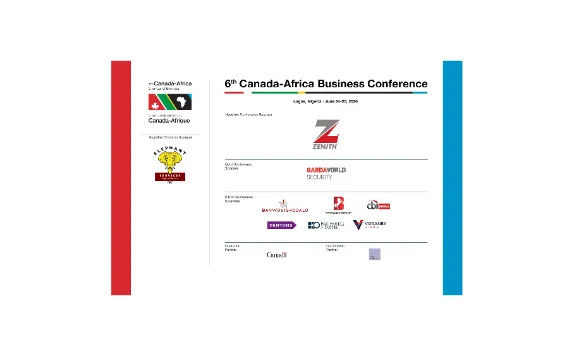
2:55 And for that, I wanna recognize Zenith Bank. Without Zenith Bank, we wouldn't be sitting here today. And I wanna commend you as an institution at all levels for bringing us together. This, I believe, is the start of events to come. Zenith Bank, thank you so, so much. Our overall Chamber headline sponsor, Elephant Trade Services, Gold Conference sponsor, Guarda World Security, and then our silver sponsors, Banwo, Baywood Group, CBI News, Dentons, Echo Hotel and Suites, 4NX Africa, our chamber partner, the Government of Canada and our conference partner, Abide Consulting. We are absolutely honoured to be gathered together here with you today, and thank you very much for taking the time to be with us. And for those watching, I know it's early in Canada, but it is a pleasure to have you with us today.
3:40 I would like to now invite somebody who has been integral to the leadership of this organization. She's received awards at the highest level. She's had distinguished service recognized across Canada, and that is Paula Colbert-Sinonge, my boss, the board chair, but somebody who's been at the forefront. Paula, as you make your way up, The great irony is you are widely officially regarded as retired from government, but I don't think we've been ever keeping you busier than we are today. Thank you for your leadership. You'll be sharing the message from the Prime Minister of Canada, but also the official welcome from our organization. Paula Caldwell has been with us as a chair for several years now, and we're very grateful that instead of retiring to the lake in the cottage after serving at the highest level in Africa, you chose to join the private sector and support us. Paula Koldos-Sinonge, thank you again.
4:35 Well, good morning, Nigeria. My first time here. I'm very, very happy to be here. Wow, it's everything that people told me. I'm super impressed and I'm coming back. So there is Gareth. Let's work on that. But Excellencies, distinguished guests, sponsors, partners, members of the Canada-Africa Chamber of Business, ladies and gentlemen, it is really a great honour to welcome you to this opening ceremony of the 6th Canada-Africa Business Conference here in Lagos, Nigeria. And let me start first by reading a message from our Prime Minister. For those of you who still don't have our booklet, they are out there.
5:22 The message is there, so I won't read it all. But our Prime Minister, Mark Carney, I proudly offer my warmest greetings to everyone attending the 6th Canada-Africa Business Conference in Lagos, Nigeria. As we gather today, I would like to recognize the Canada-Africa Chamber of Business for convening leaders from across Canada and Africa to advance investment, trade, and partnership, connecting businesses and institutions to drive practical collaboration and shared growth. I'm proud of these words from our Prime Minister to everyone here at this conference. So to be in Lagos is to be really at the center of one of the world's greatest growth stories. Nigeria's growth is not just theoretical as we see every day, it is something that is happening.
6:10 It's already being built by the people of this country, Nigerian entrepreneurs, investors, and financial institutions, innovators, and companies, of course, whose ambition reaches across Africa and around the world. And one of the clearest examples, of course, of this reality is Zenith Bank. Zenith Bank is not only one of Africa's leading financial institutions, Zenith Bank is the capital behind what you see here today. And we are proud to recognize them as the headline conference sponsor of the 6th Canada-Africa business conference. And thank you, thank you very much for your leadership in making this conference possible. Zenith Bank represents the skill, the ambition, the discipline, the innovation and the excellence that this conference is showcasing.
7:01 The relationship between Canada and Nigeria has never been more important. Nigeria is Canada's largest bilateral trading partner in sub-Saharan Africa, and our two-way trade between our countries is at $3.2 billion in 2025. Of course, this is where I want to recognize the critical role of the Deputy High Commission in Lagos, led by our Deputy High Commissioner, Carlos Rojas-Arbulu, and his team. Please stand up, the 3 of you, and if there's more. So everyone – okay, where's Goodwin? Perfect. So everyone will know who to go to and see to for further partnership. So the real opportunity lies in the sectors where Canada and Nigeria are already collaborating and where future growth is the most promising.
7:50 It's in financial services, mining and critical minerals, agriculture and agri-food processing, clean technology, infrastructure, energy transition, digital innovation, education, health care and creative industries. Canadian companies, of course, bring expertise, technology, capital, and a commitment to responsible business practices. And Nigerian companies bring scale, innovation, entrepreneurial energy, and deep market knowledge. Together, these strengths create partnerships capable of generating economic growth, creating jobs and delivering lasting prosperity on both sides of the Atlantic. And today, we're seeing that partnership in action. Defining the Canadian side of that two-way relationship are companies such as Garda World, one of Canada's great global success stories.
8:42 Operating across Africa and around the world, Garda World demonstrates how Canadian companies can build trusted partnerships, create employment and contribute meaningfully to local economies. I would like to recognize 2 outstanding leaders from Garda World. We have Mike Gibson, who is arriving, Managing Director for Mongolia, DRC, Mozambique and Nigeria and Yinka Alakija, our Country Director from Garda World, Nigeria. I think Yinka you should rise so people know who you are. At the same time, we look forward to seeing more Nigerian companies establish and expand their presence in Canada. And some of you right here in this room have already talked to me about that, so we can continue the conversation.
9:30 As Nigerian businesses continue to grow globally, Canada does welcome the innovation, investment and entrepreneurial spirit that they will bring. And this is why gatherings such as this conference really matter. To every company and organization represented in our Canadian delegation here, thank you. Thank you to all of our companies that are here today. You're the reason that this work matters. You're here to partner with Nigerian and other African partners and to invest alongside local capital, defining the future of Canada-Africa relations. And to our Silver Conference sponsors, a special shout-out to Banwo Igodalo. I and our Canadian delegates would not have had a visa without your precious help, so thank you for that.
10:19 Voronyx Africa, the Baywood Group with the DBI News, and of course my friend Franca from Dentons, and she's also a special advisor to our Chamber of Commerce. I also want to extend our sincere thanks to the late Adedayo Thomas. Your leadership in the promotion of the Canadian film industry and longstanding engagement with Nigeria's creative and film industries is of course very well known. And I thank you in advance, Your Majesty, for hosting the Canadian delegation at the Royal Palace. Thank you for that. And of course, my friend, His Excellency Adeyinka Asekun, former High Commissioner of Nigeria to Canada.
11:07 I miss you. Come back. We will catch up at the break. But for the participants to know, he was there during our COVID years, and he was the only ambassador, high commissioner, who opened up his residence to many Nigerian students stranded during the height of the COVID restrictions. So, thank you. Now you do know there are 30,000 Nigerian students studying in Canada. Not all came to his home, but anybody who could actually drive there did. So it was something else, a lot of race.
11:57 Now last of course, but never least, I have my predecessor as the chair of the board here who laid the strong foundations to growing this organization Dr. Sebastian Spiel Garbra, who is now our special envoy to the African continental free trade area also sitting here I think maybe you should stand doctor so people know So and thank you I'm trying to continue in your footsteps. So we have already recognized, but I do wanna again say that Toya Biyoye, our special envoy to Nigeria, and Atu Zola, our special envoy to the DRC, are precious, precious resources for us, and thank you for all your hard work.
12:43 And over the next 2 days, we're going to discuss the opportunities, address challenges, build relationships, and of course, identify practical ways to increase investment and trade between Canada, and especially, make new friends. So, the future is being built here and now. Thank you for joining us in Lagos. Thank you for your commitment to strengthening our Canada-Africa commercial ties, and thank you for helping me write the next chapter of this remarkable partnership. I wish you engaging success. Thank you to all. And thank you to everyone. Of course, if there are people in the room who speak French, we can discuss this later. And if you want to speak Spanish, we can do that too. But just saying.
13:29 I do want to recognize that our Lago State Governor has sent his representative here, Mr. Babajide Oli, represented by the Permanent Secretary, Ministry of Commerce, Cooperatives, Trade and Investment, Mr. Babatunde Onigbanjo. Somebody wrote in handwriting. So thank you for that. I think with that we're going to transition in order to save some time, not calling Gareth back up here. We're going to transition into my introduction to Carlos Rojas Arbulu, my friend and the Deputy High Commissioner here in Nigeria. As he makes his way up, I will tell you he has over 20 years of international experience and he's worked in 9 countries across 4 continents, Africa, Asia, South America and North America.
14:25 As a Canadian diplomat abroad, he currently does serve here as our Deputy High Commissioner. He has executive roles and senior trade commissioner in Chile, in Mumbai, India. At the Embassy of Canada to Haiti, where I was the ambassador. He was my right-hand person, and I'm very glad to have had you there, and in Senegal and Guatemala. At Global Affairs Canada, he has served in executive roles and has been advisor to 2 ministers and director and point of contact for the Corporate Social Responsibility for the OECD guidelines. You're also the recipient of the 2026 Africa Illustrious Awards and you're one of our most famous Latinos who inspire Canada. So thank you very much. Muchas gracias, Carlos.
15:11 Please come up to the podium. Thank you. Thank you so much, your call of action is so nice to be here. Planning and to be able to see you all in this room is really, really fantastic. Congratulations to everyone. Distinguished guests, business leaders, investors, entrepreneurs, partners, members of the Canadian and Nigerian business communities, colleagues, friends, welcome. It is a real pleasure to see you here today and to be part of this amazing, amazing event. I do, as others have said just earlier, would like to recognize, of course, the leadership of the Canada-Africa Chamber of Business, our dear Chair of the Board, Oleg Hadwill, President Gareth Bloor. But I also, while I say that I stand on all established protocols, I do want to very much appreciate the participation of the many speakers that were outlined just earlier today, including representatives from the Lago State government, as well as the representatives from the various partners and sponsors that are here today.
16:34 And particularly, I want to provide a shout out as well to Senate Bank, Dr. Adeora, who's ably represented here by Mr. Akin Ogwen-Ranty, Executive Director. I think without your support and without your effort and engagement, this conference wouldn't take place. And likewise, let me just say, Guard the World, I know that you're an institutional partner to this organization, and I hope that you remain engaged and committed over the years to come. And thank you to all other partners as well. Last shout out to the Canadian companies that are visiting Lagos, either for the first time or maybe for the second time. Can you hear me? Yes. And your commitment is certainly appreciated and seen. Your presence reflects the growing momentum between Canada, Nigeria and the African continent.
17:27 Let me just start with a story, And this is a bit of a personal story. Over the last couple of years that I've been living here with my family, I have often spoken to my children about what entrepreneurship really means. Not as a word from a business school, not as a line in a strategy document, but it's something you see every day in this city. I tell them, look around. In Lagos, people see problems, and in Nigeria, people see problems and immediately imagine solutions. They start before conditions are perfect. They adjust, negotiate, rebuild, and keep moving. In Lagos and in Nigeria, entrepreneurship is not just an activity, it is a mindset. That lesson has been transformational for me and for my family.
18:17 Nigeria teaches us that opportunity does not always arrive in perfect form. Sometimes it is hidden inside complexity, inside a challenge, or in a conversation with someone who says, This is difficult, but let us find a way. That spirit, the impossibility and acting on it is why we're here today. The Canada-Nigeria relationship already has a very strong foundation. Some of you know, as dear Paula mentioned, $3.2 billion of bilateral trade, but we also have 620 plus portfolio and direct investment in this country. We have a strong and vibrant diaspora community. Ambassador would concur with me that is I think 120,000 or beyond in Canada that are very much driving the conversation and driving the business. And of course the 25,000 any given year and beyond of Nigerian students in Canada.
19:16 And my personal favorite is that every second meeting that I go to, somebody has a connection to Canada, either through family, either because they've studied there, either because they visited our country, they have a story to tell. And of course, and of course it's remarkable how often Canada is already part of the conversation before the meeting even begins. So these numbers and these personal connections tell us that Canada and Nigeria are already connected through business, investment, education, migration, family and friendship. And still only at the beginning of what it is possible. We'd like to think that Canada brings reliability, world-class expertise, responsible investment, innovation and beyond. As it was mentioned earlier, Nigeria brings scale, talent, creativity, resilience, ambition and an extraordinary sense of entrepreneurship.
20:11 Together, these strengths are very powerful. But the real question is not whether there is potential. We know there is. The question is, what will we do with it? Over the next 2 days, I hope you keep 3 ideas in mind. First, relationships come before transactions. Trust, presence, and listening matter. Strong partnerships begin when we understand the context behind the opportunity. Second, ambition must become action. The work now is to turn conversations into meetings, partnerships, projects, jobs, and growth. From energy and infrastructure to education, technology, and beyond.
20:59 Third, this relationship must be built for the long term. The partnerships that matter are the ones that stay, build capacity, create value on both sides, and survive complexity because they are rooted in trust. Let me say a word about the Trade Commissioner Service. Our role at the Deputy High Commissioner of Canada in Lagos is to help Canadian and Nigerian companies identify partners, collaborators, navigate markets, build opportunities and beyond. I encourage you to connect with our service present here today to help you as you pursue other business possibilities. So my message today is simple. Do not leave this conference with notes. Leave with names, next steps, and 1 or 2 serious conversations to pursue after the panels are over, because that is where the real work begins.
21:55 Before I close, I would like to come back to the story I shared at the beginning. The future belongs to those who are willing to build it before everything is perfect. I think some of you have heard the expression, perfection is the enemy of progress. So it doesn't have to be perfect in order for you to take action and move forward. This is the spirit of entrepreneurship. That is the spirit of Nigeria. And that is the spirit I hope we carry into the next 2 days. And I hope when you return home, whether home is Toronto, Calgary, Vancouver, or whether you live in Nigeria and you're in Kano where you're in Ocean State and beyond, that you will have your own version of that conversation with your children, your colleagues, your board or your team.
22:45 I hope you will say, I was in Lagos at this conference, I saw the energy, I met the people, I understood the opportunity, and I came back convinced that Canada and Nigeria have something important to build together. So once again, welcome to this amazing conference, the 6th Canada Africa Business Conference, And I thank you for your time and for your interest. And let's get some business done. Thank you very much. I'm still here for a few more seconds. Thank you very much for the kind applause. Now I would like to introduce by video our Minister of International Development for Canada, the Honorable Mahinder Sidhu.
23:40 Thank you. Thank you. Thank you. Thank you. Thank you. I did not get appointed by the prime minister a moment ago, but I just want to say that our esteemed honorable Minister will be online momentarily. Can I just get the signal when we've got that connection aka into the rest of the team? I'm going to use the moment to just let you know we're at 31 Canadian companies in the delegation.
24:27 To those who made last minute decisions supported by Banwo getting their visas, Thank you so much. I believe the next one we're going to double those numbers, but we'll be hearing from many of you later. Just a quick note for all of you who I know want to connect with many of those people with us today, using the QR code that's available on the booklet, you'll get the real-time program, the latest information of who's in the room, what they're doing, the sorts of relationships and deals that we can absolutely have here today. I also want to take this moment to recognize the presence of a very key leader at a federal level here in this great country. We know the Honorable Dr. Jamoke Odewale, Federal Minister of Trade and Industry, was with us just a month ago during the visit of the Secretary of State. I'd like to ask Dr. Rachel Mundy-George to kindly rise, madame, head of the Trade Department in the Federal Ministry of Industry, Trade and Investment.
25:17 When we speak about a great country being put on the map as a global driver of growth, we recognize the people who are behind those incredible efforts. At this particular juncture, I will come back in a moment to the Honorable Manandir Situ, but I would like to kindly then call up from the federal government of Nigeria for remarks being offered by Dr. Rachel Mandi George, the opportunity to take the floor. Thank you so much for coming, for being with us, and for your personable commitment to trade and investment. You know, the ability to WhatsApp people and correspond and communicate is incredible. Thank you for your humility, your commitment to this country, and it's an honor that we can receive you here on behalf of the Canadian delegation and this entire conference. Thank you so much, Dr. Rachel, Mandy, George, great to have you.
26:21 The president of Canada Africa Chamber of Business, representatives of government of Canada, Representatives of the federal government of Nigeria. Distinguished business leaders and investors from Canada and Africa. Development, financial institutions. Representatives of the diplomatic corps, members of the private sector, ladies and gentlemen. Morning. It is a great honor to address you this morning on behalf of the Honourable Minister of Industry, Trade and Investment, Dr. Jumoke Odu-Ole MFR, at the 6th Canada-Africa Business Conference here in Lagos.
27:14 I bring warm greetings from the Honourable Minister, who deeply values the importance. The important platform for strengthening business, investment and trade relations between Canada and the Africa continent. Let me sincerely Africa continent. Let me sincerely commend the Canada Africa Chamber of Business. For convening this conference and for its continued commitment to connecting business, investors, institutions, and government across Canada and Africa. This gathering is timely. It comes at a period when Africa is no longer being viewed only as a market of potential, but as a continent of real opportunities, growing enterprise, young talent, and expanding regional integration.
28:15 For Nigeria, this conference is particularly important. Nigeria remains one of Africa's largest economies and a strategic gateway to the continent. With our population, entrepreneurial energy, natural resources, innovation capacity, and location within West Africa, Nigeria offers a strong platform for serious long-term investment partnership. We are therefore pleased to welcome Canadian businesses and investors who are interested in working with Nigeria in a practical and mutually beneficial way.
29:04 The opportunity before us are clear. There is room for deeper cooperation in agriculture and agro-processing, mining and critical minerals, clean energy, infrastructure, digital technology, manufacturing, finance, skilled development and services. But our message today is simple. Nigeria is not only seeking trade, we are seeking productive partnership. We are seeking productive partnership. We want partnership that creates jobs, build industries, transfer technology, strengthen local capacity, expand exports, and support value addition.
29:58 We want investment that helps that help our businesses move from raw materials export to processed, competitive and market ready products. This is 1, this is also why the African continental free trade area is so important. The AFCFTA has opened a new chapter for Africa by creating a larger and more integrated market. It gives investors the opportunity to produce use in 1 Africa country, 1 African country and rich markets across the continent. Canadian businesses. This means that investing in Nigeria is not only about Nigerian market, it is also about access to the wider African market under the AFCFT framework.
31:02 Under the leadership of President Bola Ahmed Tinubu GCFR, the federal government is taking steps to improve the business environment, support industrial growth, promote trade facilitation, and attract responsible investment. Through reforms in customs modernization, the Nigerian single window program, digital trade processes, and investment facilitation, we are working to reduce barriers, improve efficiency, and make Nigeria a more competitive destination for business.
31:47 Distinguished ladies and gentlemen, no government can achieve economic transformation alone. The private sector must lead. The private sector must lead, sorry please. I'm Sorry, the call just came in. Let me take this again. Under the leadership of President Ola Ahmetinugu GFR, the federal government is taking steps to improve the business environment, support industrial growth, promote trade facilitation, and attract responsible investment.
32:43 Through reforms in customs and modernization, the National Single Window Program, digital trade processes and investment facilitation. We are working to reduce barriers, improve efficiency and make Nigeria a more competitive destination for business. Distinguished ladies and gentlemen, no government can achieve economic transformation alone. The private sector must lead while government provides the right policy direction enabling environment and institutional support. This is why platforms like this, like this conference matter.
33:32 They allow us to move beyond speeches and into real conversations, real partnership, and real transactions. As Nigeria continues to strengthen its role in continental trade and Prepares to provide leadership within the AFCF T a framework. We remain open to credible partners who share our vision for industrialization, for industrialization, innovation, inclusive growth. I therefore encourage Canadian and African businesses present here today to use this conference to identify bankable opportunities, build trust, form partnerships and take practical steps towards implementation.
34:32 Let this not be just another conference, let it be a platform where ideas become projects, where contacts become partnerships, and where opportunities become investments. On behalf of the Honorable Minister of Industry, Trade and Investment. I wish to once again found the Canadian African Chamber of Business for this important initiative. I wish all participants fruitful deliberations, successful business engagements, and lasting partnership. Thank you, and God bless the Federal Republic of Nigeria.
35:25 Thank you very much, Dr. Rachel Mundy-George. On behalf of the Honorable Dr. Jamoke Odewale, your words are taken to heart and it's an absolute privilege to receive that message. I would like to also say that we're able now to cross to the Canadian ministerial message for our Minister of Trade. Live to Ottawa and I would like to at this point recognize the Honorable Minister of Trade in the Government of Canada, Manandir Sittu. He's no stranger to the continent. It's been a pleasure as a chamber to host him before, and his message comes on the heels in recent weeks of the Secretary of State's visit to this great country as part of key announcements made. I now invite the team to cross over to Ottawa for the message from the Honorable Manan Dias-Sittu. Good morning, everyone, and welcome to the 6th Canada-Africa Business Conference. I wish I could be in Lagos with you all today, and I'd like to thank the Canada-Africa Chamber of Business, the Deputy High Commission of Canada, and of course, all of our partners for bringing together leaders from across Canada and Africa for these important conversations.
36:28 I've had the opportunity to join the Chamber at events in Kenya, and I've seen the value of creating spaces where businesses can build relationships, find new partners, and turn promising ideas into real opportunities. That work builds on more than 60 years of diplomatic relations between Canada and Nigeria, strengthened today by a dynamic Nigerian community in Canada and a growing economic partnership between our countries. Nigeria is Canada's second largest merchandise trading partner in Africa, with bilateral trade exceeding close to $3 billion in 2025, and there is enormous potential to grow that relationship even further, including in financial services, infrastructure, energy, critical minerals, agriculture, and clean tech. And I know I might be a little bit biased here, but I'm always pleased to see Canadian companies showing up on the world stage.
37:17 Your presence reflects the expertise Canadian businesses have to offer and the growing momentum behind stronger partnerships across Nigeria and the African continent. Canada is committed to working with our Nigerian partners to attract investments, strengthen supply chains and create good jobs and new opportunities in both of our countries. The relationships built at this conference will help move that work forward. They will lead to new partnerships, new investments, and new opportunities for our people. Thank you and I wish you all a very productive and successful conference. Thank you so much to our Honorable Minister. You know, many characteristics are shared between 2 great countries and one of many is that the federal system sees a key leadership role of governors and premiers in the 2 respective nations.
38:09 And I would like to therefore recognize His Excellency Babajide Olusola Sanwo Olu, who is ably represented, and Mr. Babantunde Onyekbanjo. Thank you for joining us and for your commitment on an ongoing basis. Your presence here reflects not just a once-off occasion, but it's a culmination of your work. So I invite you to the floor, sir. Thank you very much. For words from the esteemed governor. Great to have you with us. Morning, everybody. Good morning, everybody.
38:55 Good morning, everybody. I bring you greetings from the government of the state. Mr. Governor would have loved to be here. Other state assignments presently. I would like to recognize the representative of the Prime Minister, Canadian Prime Minister, and Minister of International Trade, that was joined virtually. Also His Excellency, I commission, he goes to Nigeria, Mr. Carlos Rogers, Dr. Richard Mande George, Head of Trade, Department of Federal Ministry of Trade and Industry and Investment, the Chair of Board of the Canadian African Chamber of Commerce and Business, Mr. Paul Khadif, the Group Managing Director of Zenit Bank, Dr.
40:00 Adora. Who is being represented here? I mean, who's representing Dr. Adora? Who? The Managing Director. I'm sorry, the protocol is not well established, so I'll just rest on the existing protocol. Pardon me. I'll go ahead and present the message of the governor of Legal State, who would have loved to be here personally. Sorry. It is my pleasure to welcome distinguished delegates, business leaders, investors and policy makers, development partners and members of the diplomatic corps to Lagos for the 6th Canadian African business conference.
40:48 I commend the Canada African Chamber of Commerce for bringing together this impressive group of leaders from across Canada and Africa to dialogue and strengthen commercial relationship and explore new pathways for shared prosperity. I'm particularly delighted that this important conference is taking place in the city. Thank you. Thank you very much. I'm particularly delighted that this important conference is taking place here in Lagos, a city that continues to demonstrate the power of enterprise, innovation, resilience, and opportunities.
41:34 Today, as nations seek for new growth frontiers, the business look, and businesses looking beyond traditional market for investment opportunities, our relationship between Africa and Canada has been greater significant. The future of global prosperity will increasingly be shaped by partnerships that are mutually beneficial, commercially viable, and strategically aligned. The conference will provide an opportunity for a platform to deepen partnership. For us in Lagos, the international engagement is simply a diplomatic aspiration. It is an economic imperative.
42:22 We understand that in an increasingly on interconnected world, competitiveness depends on our ability to build productive relationship across borders, attract investment and facilitate trade, as well as creating enabling environment where businesses can thrive. Lagos occupies a unique position in this regard. As Nigeria's commercial nav center, and one of Africa's most dynamic and economic hub, Lagos serves as a gateway to market of immense scale and opportunities. With a vibrant private sector and a rapidly expanding technology ecosystem, a thriving creative economy, and a production whose entrepreneurial energy is second to none, Lagos continues to attract investors and innovators from around the world.
43:18 Yet our ambition extends beyond maintaining our position as Africa's leading city. Our vision is to build a globally competitive legos that is connected to international market, powered by modern infrastructure, driven by innovation, and supported by a business environment that rewards enterprise and investment. Over the past years, we have pursued this vision through deliberate investment in critical infrastructure, transportation technology, human capital development, and institutional reforms, with projects such as the Lagos Blue Line Rail, the ongoing development on the Red Line Corridor, improvement in road infrastructure, and inspection of our public transportation system.
44:06 The investment in digital governance and our whole design to improve productivity, reduce the cost of doing business and enhance the quality of life for resident and investors alike. At the same time, Lagos has emerged as Africa's leading center for technology and innovation. Our vibrant ecosystem of startups, innovators, venture capital firms, and technology entrepreneurs continues to attract global investment attention. This ecosystem presents a significant opportunity for collaboration with Canadian companies and institutions that are leaders in technology, in innovation, in artificial intelligence, and digital services, as well as advanced research.
44:57 Beyond technology, there are substantial opportunities for partnerships across infrastructural development, clean energy, financial services, agricultural manufacturing, logistics and technical, health education and the creative industry. These sectors represent not only areas of economic growth, but also platform for addressing shared challenges and creating lasting value for our people. Just recently, Lagos hosted the Invest Lagos Summit 3.0, where we showcase investment ready project across sectors. The summit aired from 8th to 10th of June, in partnership with the Commonwealth Enterprise and Investment Council, CWIC, and other institutional support attracted over 600 investors across Europe and featured deal rooms specifically created for the signing of scalable MOUs.
46:02 Canada brings to the table considerable expertise, capital, innovation, and strong tradition of institution building. Africa and indeed Lagos offer skill, we offer talent, creativity, market opportunities, and increasing sophisticated business environment. Together these trends create a compelling foundation for transformative partnership. I'm encouraged by the growing momentum in Canada-Nigeria relations and the increasing industry interest the Canadian businesses in exploring opportunities across our continent. Recent high-level engagement between our countries reflect a shared recognition of strong economic cooperation, sorry, reflect a shared recognition that stronger cooperation can deliver meaningful benefit for our business communities.
47:03 The task before us therefore is clear, To move from conversation to commitment, from opportunities to identified opportunities realized, and from goodwill to measurable outcomes. As a government, our responsibility is to continue creating the condition that enables investment and innovation to flourish. As business leaders and investors, your responsibility is to seize emerging opportunities, build productive partnership, and contribute to sustainable economic growth. The future belongs to economies and societies that are open, connected, innovative, and collaborative. Lagos embraces this future with utmost confidence.
47:52 We remain committed to strengthening partnership with friends and allies around the world, including Canada. As we work together to unlock new opportunities for trade, for investment, innovation, and inclusive routes. To our Canadian guests, I invite you to look beyond the headlines and discover the realities of today's Lagos, a city of ambition, a city of talent, a city of creativity, a city of innovation and extraordinary possibilities. Lagos is open for business. Lagos is open for partnership. Lagos indeed is open for innovation. Lagos is ready to work with partners who share our vision for sustainable growth and shared prosperity.
48:40 As we direct over the next 2 days, I wish to encourage you to engage boldly, think creatively and pursue collaborations that strengthen economic ties between Canada and Africa, while delivering tangible benefits to our respective people. I wish you all a fruitful discussion and a successful conference. Thank you for your attention. You are welcome to Lagos. Thank you very much. Thank you very much, sir. Thank you to all the dignitaries, to those at the forefront of the bilateral relationships.
49:28 This has been an incredible opening ceremony, but of course we are very excited for the keynote address, the keynote 6th Canada Africa Business Conference address. And as much as I would wish for the privilege and the high honor of introducing our keynote speaker, it's my distinct pleasure to welcome back on stage Paula Caldwell-Sinanj, retired ambassador and chair of the board for the introduction of the address. And once again, a massive thank you to all who have been such a key part of today's opening ceremony. Thank you. Madame Paula, we welcome you back. Thank you so much. Thank you. Protocol being observed. I'm going to introduce Dame Dr. Adaora Umeoji, OON, is the Group Managing Director and Chief Executive Officer of Zenith Bank. She is also the Chairperson of Zenith Bank UK and she sits on the Board of Zenith Bank Ghana as a Non-Executive Director.
50:28 With nearly 3 decades of cognate banking experience and over 20 years of extensive executive management in Zenith Bank, Dr. Ada Ora has established herself as a respected figure in Nigeria's financial services industry. She holds a doctorate in business administration and academic qualifications in law, accounting and sociology. She is a fellow of notable professional bodies, including Chartered Banks Institute of London and various institutes across Nigeria. She's a Lady of the Order of Knights of St. John International and a Papal Knight of the Order of St. Sylvester awarded by His Holiness, Pope Francis. In 2022, the Federal Government of Nigeria honored her with Officer of the Order of Niger as a recognition of her contributions to nation building.
51:17 Dame is with the governor in another state, so she will be represented by the executive director, Mr. Akin Ogundrante. If you can please step up. Good morning.
52:04 Good morning, everyone. Thank you very much. Deputy High Commissioner Carlos, Chairman of the Africa Canada Africa Business Council, Madam Kala. I would like to stand on all other existing protocols. This morning I bring you warm greetings from the Group Managing Director of ZanyBank, Dr. Adora Umuogi, who is unavoidably Dr. Adora Umuogi, OON, who is unavoidably absent due to some certain unforeseen circumstances and the existences of work.
52:59 She has asked me to kindly deliver a keynote address to this august gathering. And it is indeed a pleasure for me to be here. Let me start. The topic that she has chosen is from opportunity to reality, financing Africa as the world's next great growth frontier. Let me start by saying that ZeniBank is very delighted to serve as the headline sponsor of this great event. Many thanks to the Canada-Africa Chamber of Business and to the Deputy High Commissioner of Canada for convening this important business conference, the 6th in the series.
53:47 This morning's conversation is about one question. Where does the world go next for growth? For a century, growth followed a familiar map, From the west to Asia and now to the bricks. The map is now being rewritten and redrawn. The mature economies are aging and many of your cities fast growing markets are slowing. 1 region holds the people, the resources, and the appetites the next century of growth will require. That region is Africa. Africa is the next great growth frontier. And I'm not alone in saying this.
54:34 Indeed, in May this year, the Honorable Randeep Sarai, Canada's Secretary of State for International Development, said the next chapter of global growth is being shaped as much in Lagos, Nairobi, and Accra as it is in London, New York, and Toronto. And that the center of gravity of the global economy is shifted, and indeed it is shifted. Let me be precise, because frontier is too often a slogan. A frontier is not a promise, a frontier is a place where the work has not yet been done.
55:21 My goal this morning is to move us from opportunity to reality. From what Africa could be, to what it is becoming, and to the machinery now being built to take us there. What's the scale of the opportunity? Africa is home to about 1.5 million people. Some say 1.6, some say 1.55. Well, the truth of the matter is that whichever way you look at it, this is a huge market that cannot be ignored. According, but that's part of the sport and and the fact is also that this Africa accounts for 18% of the global population.
56:06 So it tells you almost 20% of the world is inhabited by Africans. According to the United Nations, We are the youngest continent on Earth, with a median age of around 19. So you can imagine, it's a youth population raring to go. And by 2050, more than 1 in 4 people alive will be African. So when we look at it, while other regions, for example, are worrying about shrinking workforces, we're gaining the world's largest and most dynamic labor force. And this is not sentiment. The International Monetary Fund projects that several of the world's fastest growing economies this year are in Africa.
56:56 With several expanding at 7% or more. Even as the global economy slows. We hold a commanding share of the resources the future will be built on. These resources are the like cobalt, lithium, manganese and rare earths for electric vehicles and clean energy. We have the vast supply of arable land to feed the hungry planet. There's also the solar and hydro potential to power industry for generations. Yet here's the uncomfortable truth.
57:44 Africa has roughly 18% of the world's population, as I said, but according to the United Nations trade and development figures, it accounts for just about 3% of world trade and 5% of global output. For too long, we have sold the world cocoa and bought back chocolates. We've exported coffee beans and bought back instant coffee. We have shipped out crude oil and shipped in refined oil. That is the gap between the opportunity and the reality. The question is not whether Africa is rich in potential. It is whether we can turn that potential into prosperity for our people, and it can make them feel good.
58:29 For the first time, the answer is yes, because of the machinery we are now building. So from a fragmented continent to a single market, the machinery begins with the African Continental Free Trade Area, the AFCFTA, the largest free trade area in the world by number of countries. It brings 54 nations into a single market of 1.5 million people, with a combined GDP of $3.4 trillion. The World Bank projects consumer and business spending across the globe will reach 6.7 trillion dollars by 2030. That's just 4 years from now.
59:15 1 market, 1 set of rules, 1 trade in space from Lagos to Nairobi, from Cairo to Cape Town. This removes the fragmentation colonial brothers left behind. For decades, it was easier to trade with Europe than with a neighbor. Intra-African trade still accounts for under 15% of our total trade, far below the levels seen in Europe and parts of Asia. The gains are not theoretical. The World Bank estimates that full implementation could raise Africa's income by $450 billion in 2035. It will also lift 30 million people out of extreme poverty and improve the incomes of nearly 68 million more people.
1:00:07 That is a forecast about lives. The African Continental Free Trade Area is the flagship of Agenda 2063, the African Union's 50-year plan titled The Africa We Want. An integrated and prosperous Africa that is trading with itself and keeping its young people's futures at home. The way you invest in Africa today, you are not betting on a single country or project. You're joining a continental project with a clear destination and years of momentum behind it. What's the engine of the continent? If Africa is the next good frontier, Nigeria is the engine room.
1:00:59 The most populous nation. Thank you. Thank you. Thank you. Thank you. Thank you. Thank you. Thank you. I'm glad that it sank. The most populous nation and one of the largest economies. When Nigeria moves, Africa tends to move with it. The most respected Nelson Mandela captured it well in his days. He believed Africa needed Nigeria to succeed. That A strong and prosperous Nigeria will be a source of pride and confidence for the whole continent. In economic terms, Nigeria's prosperity is Africa's prosperity. So the reforms now underway in Nigeria is not a domestic story alone.
1:01:47 They are a signal to the whole continent of Africa. In recent years, under President Bulao Metinugu, Nigeria has taken decisions long deferred. It removed the petroleum subsidy that drained the Treasury and distorted the economy. It unified the exchange rate, ending years of multiple windows and round trips. It began reforming the tax system to widen the base and free up revenue. Let me be honest about the cost. In the short run, these reforms have been painful. But reforms like this are like clearing the land before a harvest.
1:02:33 The labor comes first, then the yields comes later. Over the medium term, the gains are not in doubt. These reforms have also impacted the financial services industry very positively. We today now have a single transparent foreign currency market which has now been restored. And the CBN recapitalization program, which required internationally licensed banks to raise capital to 500 billion naira by March 2026 has also contributed to strengthening the banking sector tremendously. Zenit Bank completed its recapitalization well ahead of the deadline. Lifting our capital base to 614.65 billion dollar Naira.
1:03:26 In practice, that means Nigerian banks can now finance the large transactions, 1 trillion dollar economy demands. The ports, the power plants, the railways, the factories. Nigeria set itself the target of a $1 trillion economy by 2030. It is a stretching goal, but the right kind of stretch, because on the private sector pool in this how a frontier becomes a market. Moving money across borders. A market size, a market this size cannot run on intention. It needs the systems that led a business Nabuja, a supplier in Abidjan, Naira into CFA francs, or Etrela to Lusaka settled with 1 in Cairo, Quacha into Egyptian pounds as easily as paying someone across the street.
1:04:30 For most of our history, that was impossible. Payments between African countries often traveled through New York or London in dollars, taking days and losing value at each step. That is changing through the Pan-African Payment and Settlement System. Developed by Afrexim, an African institution, the African Union and the African Continental Free Trade Area, it settles cross-border payments instantly in local currencies. Afrexim reports that PAPS is live in around 19 countries and connects more than 150 banks. In 2025, it launched PAPS Card, the continent's first pan-African card scheme.
1:05:19 The effect is direct, lower costs, faster sell to mint, and less value leaking off the continent. Then it chose to help build this, not just watch. So through our FinTech subsidiary, Finope, we partnered with the African Continental Free Trade Area Secretariat and Microsoft with a view to building what is called the Smart Africa Portal, permitting over 1 million US dollars to this project. The portal, when completed, will give African businesses, especially enterprises and young entrepreneurs, a single place to showcase products, find buyers, understand the rules of origin that determine whether they can actually trade under the AFCFTA.
1:06:10 The point is simple. Governments negotiate treaties, but businesses must produce, export, and invest. A trade agreement is only as real as the tools that let an ordinary trader use it. Building those tools is the work of banks like ours. There is one more tool, and it may be the most underrated of all, a story to tell about ourselves. For more than 20 years, Zenit Bank has proudly sponsored Inside Africa on CNN, the program that has just marked its 25th year. Week after week, it carries African enterprise, innovation, and opportunity to a global audience.
1:06:56 We do this by design. Too often, the world is shown a single story of Africa, 1 defined by its art ships rather than by its dynamism, its creativity and entrepreneurs. With Smart AFCFTA, while Smart AFCFTA equips the African trader, Inside Africa tells the trader's story to the world. Both are how we change the picture. This conviction runs from our founder, Jim Ovia, CFR, whose book, Africa Arise and Shine, marks the case, makes the case, that this continent's opportunities are real and within reach. Changing the narrative of Africa has been part of Zenit Bank's purpose from the very beginning.
1:07:46 The kind of capital that we need. A frontier this size needs deep pools of capital, raised and recycled at home. Here, our markets remain shallow. The continent has around 24 stock exchanges, yet together they make up less than half of 1 percent of the world's market capitalization, with the Johannesburg Stock Exchange alone accounting for the lion's share. But the deeper question is not only how much capital we attract, what kind is it? Africa does not need hot money, short-term portfolio flows that arrive on a wave of sentiment and leave at the first sign of risk. We felt the cost of what global interest rates will, we felt the cost of this when global interest rates rose in 2022 and capital fled emerging markets.
1:08:45 Hot money builds nothing that lasts. What this frontier needs is patient capital, long-term, stable financing that stays for the life of a pot, a power plant, or a railway, and is measured in decades, not in quarters. Much of it can come from Africa itself. The Africa Finance Corporation estimates that our pension funds, sovereign wealth, and insurance reserves hold around $1.1 trillion, part of more than $4 trillion in domestic resources. Yet less than 3% of our pension assets are invested in African infrastructure. Too much sits in the government papers locally in the various African countries, and also offshore.
1:09:37 Recycling even a fraction of those savings into African projects will change the picture. Africa's savings should finance African projects first. This is also where Canada is a natural partner. Canada is home to some of the world's largest and most patient pension and infrastructure investors, precisely the long-term capital this continent needs. The horizon matches ours. Let's talk about the digital and AI frontier. Technology is 1 arena where Africa is not waiting for permission and its premise runs straight back to trade, payments, and access for small business. Almost every African technology unicorn is built on financial services. From Fulton Way to OP, Money Point, InterSwitch, Wave, Infraco, West Africa, MNC Holland in Egypt, et cetera.
1:10:37 Some of these now process hundreds of billions of dollars in transactions every year, building the financial rails, the whole system, never extending to ordinary Africans. The next contest is artificial intelligence. The African Development Bank projects AI could add around $1 trillion to Africa's output by 2035. And the African Union has adopted a continental AI strategy. The next contest, AI strategy. Here we hold a rare AI runs on 2 things, energy. The International Energy Agency reports that Africa has 60% of the world's best solar resources, Yet barely 1% of it is installed solar capacity.
1:11:35 We have in abundance the cheap clean power, the energy hungry AI economy is desperate for. That makes Africa a natural home for the green data centers the world will need. The World Economic Forum estimates that investing in green computing would unlock between 1.2 and 1.5 trillion dollars for the continent by 2030. This is already beginning. Passava Technologies, an African company, is rolling out NVIDIA-powered AI data centers across South Africa, Egypt, Kenya, Morocco, and Nigeria in a deal worth over 700 million dollars.
1:12:20 And I want Canadian companies to follow. The principle of the United States matters most. Africa must be an architect of the AI economy, not merely a consumer of it. But only the AI builds elsewhere. Why only the AI builds elsewhere and we're dipping our dependence? Build it here, we with our own sunlight, our own data, our own talent, our own data centers, and we earn a permanent place in the ecosystem. With the youngest population on earth, with all the one raw material, no algorithm can manufacture human talent. Our task is to train it, fund it, and keep it here.
1:13:11 Connecting the continent, I will not paint only the bright side of things. The hardest constraint is infrastructure. The African Development Bank estimates that the poor infrastructure and high logistic costs add as much as 40% to the cost of trading goods between African countries. In some parts, cargo sits for 15 to 20 days, against 3 to 4 days in Asia's leading ports. The African Development Bank estimates Africa's annual infrastructure financing gap to be 68 to $108 billion. And that the AFCFTA loan needs more than $32 billion a year for transport and logistics. These are all opportunities.
1:14:00 Read those numbers the right way. A $100 billion gap is the largest infrastructure investment opportunity left anywhere on Earth. And the continent is now connecting its trade routes. The Lobito Corridor is a 1,739-kilometer railway from Angola's Atlantic coast to the copper and cobalt belt of the DRC and Zambia. It is the first open access transcontinental rail link of its kind. It is cutting the journey from the cobalt to the sea from over a month to about a week. This is not happening by happenstance. It is a deliberate and very intentional decision of Africans to build this gateway.
1:14:57 The African Development Bank has committed $500 million and is helping mobilize additional $1.6 million with the United States, the European Union, and the Africa Finance Corporation leading this journey. The next phase will extend the line across Zambia, giving Africa its first whale spine from the Atlantic to the Indian Ocean. At home, the Lekki Deep Seaport, a public-private partnership, is already reshaping how goods move through West Africa. Replicate that across our corridors and you have the arteries AFCFTA needs. This is where Canada becomes a powerful partner. Canada brings capital, technology and deep expertise across the sectors this continent needs. Financial services, infrastructure and energy, mining and critical minerals, agriculture and clean technologies.
1:15:55 Africa brings the resources, the market and the growth. This is not aid, it is co-investment and it is not one-way traffic. Canada's Minister of International Trade, who just spoke to us now, Honourable Maninda Sidhu, calls Nigeria Canada's second largest merchandise trading partner in Africa, And a key market as Canada works to double its non-oil exports by 2035. So if we're doing $3.2 billion, we can very easily do $6.5 billion. So Let's get it done. I'm glad I was... I was... I was really delighted to hear that we have at least 30 Canadian entrepreneurs and investors in this room.
1:16:47 Let's make it happen. It's very doable. Africa is Central to Canada's own growth, which is the soundest basis of partnership, mutual interest, plainly stated, some are not waiting to be invited. Gatherworlds, a firm with Canadian roots, has operated in Nigeria for more than a decade across 13 African countries. To them, the frontier is not a theory, it is where they already do business. I guess quite a lot of our entrepreneurs in the room from Canada can take a cue from the steps that God of all is taking.
1:17:34 Nigeria is the natural gateway. An investor who establishes here does not reach 1 country. Through the AFCFTA, they reach a continent. The reform only our leaders can make. Not every constraint can be solved with capital. Some need political will. The clearest is the movement of our own people. The Africa visa openness index from the African Development Bank and the African Union finds that just over half of all journeys within Africa still require a visa arranged before departure. Only a couple of nations, such as Rwanda and Gambia, are fully open to every African.
1:18:20 There has been real progress with openness at its highest since 2016, but the pace is far too slow. A trader doing business from Lagos, Cape Town, Dar es Salaam can still spend more time queuing for visas and closing deals. You cannot build a single market while keeping apart the people who will serve it. The instruments exist, the African Unions Protocol and the Free Movement of Persons and a Single African Passport drafted years ago. What they need is ratification and encouragement to implement. I respectively urge our leaders to treat the free movement of Africans with the same seriousness we have given to the free movement of goods.
1:19:08 That reform will complete the market we are building. From opportunity to reality, For a generation, the world called Africa the continent of the future. Too often, that became an excuse, placing our promise permanently in the tense of tomorrow. The tense has now changed. The future has a timetable. A single market signed and traded. A vision, Agenda 2063, with a destination and a date. Payment rails that move money in our own currencies. Platforms like the one we built that put trade within reach of the smallest enterprise.
1:19:55 An engine in Nigeria reforming in real time. And the largest, youngest, and most ambitious workforce on the planet. Will constraints remain? Some will close with capital. Some, our leaders, must close with political will. But my optimism is not blind. It rests on what is already being built, piece by piece. So my invitation is simple. Come and build it with us. Bring your capital, your technology, and your conviction. Trade with us. Invest in the projects that will define the next 50 years. Africa is no longer merely the continent of the future. Africa is the future, and the future has begun. With the right partnerships and the courage to act, this is the generation that will move Africa from opportunity to reality.
1:20:48 Thank you and God bless Africa and God bless our partnership with Canada. Thank you very much. Mr. Akin, Thank you so much for your leadership. Thank you to the Bank and for that message, which is a key call to action. And so much of that action is already underway. We're going to break now for a tea break and an opportunity for networking, but there will be various bilaterals among government leaders here while business continues in the room. So for the VIPs, I'd like to invite you for an official photograph before we lose any of you. So if our VIP table could come to the front, joined by the VIPs from the private sector, Canadian member companies, of course our sponsors and the Canadian company delegation.
1:21:37 If I could ask you to join me. Thank you, Frank. Thank you to all as you make your way to the front. Ahadji Adedoyo Thomas, thank you so much to each one of you. And as we do this, when we return, we're going to go into our panel sessions. So after the break that's commencing now, we'll see you for the first panel on financing across the continent, followed by various others. Well, ladies and gentlemen, I'm pleased to provide remarks from the author and lead on the Africa strategy for Canada's engagements with the continent, the Honourable Rob Oliphant, for remarks he wished to deliver to each one of you today. Thank you very much. Bonjour à toutes et à tous. It's my great pleasure to address you virtually as Parliamentary Secretary to the Minister of Foreign Affairs of Canada, celebrating the 6th Canada-Africa Business Conference in Lagos. Of course, I wish I was there in person. This is second best, but believe me, my sentiments are real for you to have a successful event this day.
1:22:40 This gathering comes at a moment when Africa is increasingly recognized as a global growth engine, a continent where demographic strength, innovation, and economic ambition are reshaping the future of global markets. The New Canada Strategy for Africa reflects this reality. It's focused on shared prosperity and deeper economic ties. It's concentrated on long-term partnerships grounded in mutual benefit, practical collaboration. It signals a new way of working together, founded and rooted in African Union's own The Africa We Want 2063 report. From the outset, African partners were clear about what Canada could and should do.
1:23:26 Long-term, coherent engagement, respect for sovereignty, alignment with national priorities, and partnerships that are built on listening. Nous vous avons entendu et la stratégie reflète ces attentes. Nigeria is central to this vision. As one of Africa's largest economies and most influential markets, Nigeria is not only an investment destination, it's also a gateway to some of the world's largest untapped opportunities. Your leadership, entrepreneurial energy, and regional influence make Nigeria a natural partner for Canada as we look to the future. Our bilateral relationship is strong and growing, with over $3.2 billion in annual two-way trade and expanding collaboration in technology, education, services, sustainable resource development.
1:24:23 Canadian companies bring trusted expertise in innovation, clean technology, responsible mining, finance, skills training. These are all areas that align closely with Nigeria's priorities. Looking ahead, we see enormous potential in energy, in agriculture, agri-food, infrastructure, youth employment and digital transformation. And these sectors are essential to the growth of Nigeria and Africa as a whole. These are also areas where Canadian know-how, Responsible business practices, good governance can unlock long-term value. This is where the private sector can lead.
1:25:10 Governments can set direction, we can set a table, we can open doors, But it's you, it's businesses and financiers who turn opportunity into closed transactions. Real deals. I want to recognize the Canada-Africa Chamber of Business for convening this conversation and for driving the momentum we are seeing across the continent. Real leaders in Canada with real engagement in Africa are making a difference. The Chamber is effective, professional and attuned to what's going on in both the business markets in Canada and in Africa. Thank you to the Chamber. This conference captures exactly what we believe in – practical cooperation, shared ambition, and the confidence that when Canada and Africa work together, we can create opportunities that reach far beyond any of our borders.
1:26:03 Thank you for your important work. I wish you a successful conference. Merci, et je vous souhaite un excellent congrès. Well, we're kicking off the first of 4 sessions following the format. And I would like to welcome for this particular session our panelists on the opening panel, Financing Africa's Next Growth Story. Claude, Claude Amir, Partnerships and Business Advisor at MEDA, who are one of the forefront organizations I know managing a lot of capital, including at the MasterCard Foundation in Canada. A warm welcome. Thank you so much for joining us on stage. Frank Achiambella, Senior Consulting Counsel at Denton's and the newest appointed Senior Advisor to the Canada-Africa Chamber of Business and a massive fan of Nigeria. Thank you so much for your leadership. And of course, someone we all know and who I'm delighted to be able to have a conversation with following that incredible keynote address, Akin Agunrati, Executive Director of Zenith Bank. Please do join me on stage again, sir. And I invite you each to take your seats. Thank you.
1:27:07 We've heard a lot around capital, and I think the point on patient capital was one that came very, very clearly through during the keynote address. And so as we reflect on what we're building together today, thank you so much for the foundations for this panel that were laid during your keynote address, Akin. I deeply, deeply appreciate it. And I suppose in this context, just on a personal level, as we all try to get to know each other in the coming day and in the weeks ahead as we continue these deals and transactions. I'd just like to offer you an opportunity, starting with you, Franca, on a personal note to introduce just who you are, what you do, and of course, why Nigeria at a time like this. Good morning, I think it's still morning.
1:27:52 Ladies and gentlemen, my name is Franca Ciambella and I'm originally from Montreal, Canada, and I'm a lawyer and I work as a senior consulting counsel at Dentons. And maybe I'll just take this opportunity to just do a shout out to some of my colleagues here. We have Tywell Afonja, our managing partner from Dentons, and next to her Omolola Coker, a partner. And we have several more lawyers in the audience. Please stand up. Thank you so much for your support. Okay, that's great. And so I moved to Nigeria about 3 years ago now. And so, well, firstly, let me backtrack. I'm so delighted to see so many Canadian companies here.
1:28:43 And I just want you to go back to Canada and to say how great it is in Nigeria, how much potential there is for business. And I'd also like you to talk about it being a good place, a nice place. The question I get asked all the time is, have I been kidnapped? And the kidnapping that I did have was from my husband of 33 years Nigerian Jizzy stand okay so I'd like you to take that message back with you and spread some of the positive attributes of doing business in Nigeria. The other hat that I hold, I'm sorry, am I taking too long? The other hat that I hold is that I'm also representing McGill University here.
1:29:35 And McGill was just recently named the top university in Canada by QR Rankings and 27th in the world. The McGill Sustainability Program, represented by Professor Nii Adi, also has a program with the chamber, the Canada-Africa Chamber, and we have here present at least 3 McGill alumni. Can you please also stand, Sabrina, Christelle, Abu, please stand. Thank you so much. And I'm sure you're proud of your alma mater. So great, Great. So that's essentially who I am and I think I'll pass the mic now. Thank you so much, Franca. Brilliant.
1:30:22 Thank you, Claude. Welcome. Thank you, Franca. Hello, everyone. Happy to be here. My name is Claude Clautimir. I am originally from Haiti. I work at MEDA. My specialty is blended capital and development finance. So I specialize in creating incentives using public dollars, public money to mobilize capital and to underserve sectors. I primarily work on the US side, but currently definitely working with the Canadian agenda of the trade development nexus, which we'll talk about during the panel. Happy to be here. Thank you. Thank you so much, Claude. Welcome. I came over to you, sir. Thank you very much, Garret.
1:31:12 And it's a pleasure to be here. I did. My name is Ikea Grunty again. I well, I'm currently the executive director of Zenit Bank and also in charge of the oil and gas and corporate banking and in charge of the technology group amongst other sectors that I also cover. I think also one thing that I've had there, I must thank Zenit Bank because it's provided me the platform to be able to develop myself at this level. I was the immediate past managing director of Zany Bank in Ghana. And in my previous life, I was primarily responsible for raising financing, long-term financing from the DFIs and all the multilateral agencies and export credit agencies to finance projects here in Nigeria.
1:32:08 And so I've worked variously in the past with Export Development Canada, the African Bank, the African Development Bank, European Investment Bank, and quite a lot of all these institutions. This was when we didn't have any long-term capital at all or debt in Nigeria. And we, at that time, thanks to our founder and who was then the CEO, he felt, look, Nigeria, we need to be able to bring in some long-term funding if we're going to be able to grow the real sector. And as a result of that, he set up a department called the Multilateral Institutions, which was where I primarily worked for about 8 years of my early career, and gave me an insight to the opportunities that are embedded in Africa, and ever since then, I've been an evangelist for how we're going to be able to build Africa, because we must be able to build the Africa that we'll all be proud of. So that's really been my journey, and it's been an excellent one for me in Zandi Bank.
1:33:19 Zandi Bank is a great bank, and we will continue to support this kind of initiatives and engagements just to continue to see how we can partner and collaborate with a lot of our global partners, into other advanced countries, and also ourselves locally. And that's one of the reasons why we've also supported AFCFT, we've supported the various platforms that have been created to further the integration of Africans with Africa. Thank you very much. Thank you so much. And so I'll ask the first question to you, Zenith. And thanks in the tea break for many of you who lobbied me to ask a few questions off the back of that keynote address. But one of the most common so far is, as you look at the room today and the private sector leaders gathered, in the view of the bank, given the perspective that you've got and the various leadership roles you've had, how do you see the specific Nigerian private sector across the board shaping the next phase of the kind of project development and investments that you've described?
1:34:26 And then I've got one follow-up potentially, but I'll begin with that, sir, thank you. Thank you very much, Gareth. Well, how do I see the Nigerian private sector? The Nigerian private sector is a very dynamic private sector. The entrepreneurs that play in this sector have mastered the act of, what I say, mining water out of stone, if there's any such thing. You know, and I just, Darian and I just had this very short talk. And I just heard one of the challenges that he went through. But the beauty of it is that despite the lack of infrastructure, despite the challenges that we have, we continue to see very phenomenal projects coming out of Nigeria.
1:35:24 Nigerians are putting together a lot of projects that we all should be very proud of. I mean, and before I even go further, I think one of the things, or one of the areas that I like us to focus on, look at what Nigerians have done with the FinTech industry. Look at how Nigeria has produced, out of 7 or 8 unicorns in Africa, we have 4 in Nigeria. 3 of them called Nigerian businesses, right? That's technology which we came on board very recently. So it tells you what the opportunities that are embedded in our country, and I will still like to invite our Canadian investors who have come on this trip, and those who were not able to make it, that look for a local Nigerian partner.
1:36:15 You can't go wrong. Please go through your embassy, your high commission. They will be able to, the trade department will be able to facilitate those connections and you'll be amazed what opportunities, the kind of dollar that you can make out of this country. It's a great country and I believe that we have what it takes to be able to make it happen. Thank you very much. Fantastic. Thank you so much. Claude, you're coming in, you're seeing the opportunities. I think within a week of meeting you, you bought your ticket, you had your visa, you said, I'm here. But I wanna just recognize your organization too as being part of a lot of the key African discussions. You were party to the bilateral we had with the African Development Bank President in Toronto last month. And I know the organization has been involved extensively with various underlying investment groupings involved on the continent. Question to you.
1:37:08 So coming from Mita's perspective, when you look at projects, what makes a project bankable at this present point in time? Because we know how dynamically things are changing. And what are some of the key considerations right now in 2026 that we should keep in mind? Got it. So for 2026, just take a step back and realize the context that we're in, and the Canadian government strategy, which is the trade development nexus. And you can think of a trade development nexus as being the classic definition of a dynamic relationship between trade, finance, and economic progress. However, the way that Prime Minister Carney puts it, it's using the development work that Canada does globally in making sure that there is a trade pathway for Canada to achieve its trade objectives.
1:37:56 It's asking yourselves, what's in it for Canada? How does Canada win by doing both? And 1 can think of the rules-based WTO sanctioned trade system of the past 50 years and how that has benefited the North versus the global South. I'm not going to get into that right now. But I want you to think about that the Canada version of the trade development nexus is asking ourselves and being very honest with the answer is, who wins? Who participates in this trade? How do we make sure that it's inclusive enough so that it's long lasting? Do we do trade the same way that we've been doing it for the past 50 years? Or we realize the lessons to make sure that there's many more people participate in this economic prosperity?
1:38:47 Is it trade that enlarges inequality along the continent? Is it trade that blocks certain players from entering it? No, so I think as a partner like us, is that financing it is realizing that there's a missing middle that has been kept away from that trade for quite a long time. And that missing middle, luckily, capital and money is not going to be a problem. Usually, it's a readiness aspect. Usually, it's reducing the barriers that's preventing the missing middle. So when I say missing middle, companies that are too big for the small humanitarian-led economic development work, but also not structured enough for the private equity or the much more complex financing.
1:39:36 But that's missing middle is a gap that our development organization like META has to do. And we've been doing development for a very long time. And the way that our work is different is that we now have to ask ourselves, you know, what trade problem are we solving for Canada first? That's very new for us. You know, as a development organization, we don't work like that because we typically look around for issues in the global south and say, you know, this is how we solve them. Now we're doing things in the inverse and looking at, you know, how do we solve this Canadian problem? It's usually looking at a Canadian company and say, you know, I have a major food problem right now. I can't source fruit in Latin America or West Africa. And then we work from that business solution and making sure that solution is inclusive and solves our development problems. I think this is what's different.
1:40:28 And it's getting the right players involved to support that missing middle. Because they're the ones who are going to make the difference in this trade 2.0 that we're talking about. Fantastic. Thank you very much, Claude. Franco, knowing your connections to Lagos, your connections across Canada, we put you the Canadian delegates, what are some of the questions you would want asked, as well as to Nigerian member companies? And it's a bit of a loaded question, so please feel free to take the podium, because I think you're an academic number 1 and a teacher. But as the spirit moves you, whatever is most comfortable. And the question that we posed, and I'm glad we had an opportunity to give you a heads up on this one, but what are some of the key legal and structuring considerations right now for the Canadian companies who are here, as well as the international partners? Feel free to take the podium, of course.
1:41:16 We're relaxed here. We're doing business. Frank Kachiambella. Can you hear me? Oh, Perfect. Now it's much better. Thank you very much, Gareth. You're very kind. I firstly would like to say that being part of Denton's, you know, we have offices all over Nigeria, Abuja, Lagos, Port Harcourt, and then of course throughout Canada, Montreal, Ottawa, Toronto, Calgary, Vancouver, to name some, and we're a full service firm. So we've been involved in this type of work for quite a while. So in addressing the question of what makes a transaction or business project bankable from a legal and regulatory perspective, my overriding comment is that the answer would be very similar whether you are in Nigeria or in Canada, with a few tweaks.
1:42:11 So one of the first thing is relying on a robust, clear, developed, and predictable system of law. And the legal and systems in Canada and Nigeria are similar because both are derived and rooted in the English common law which is a case law system and so Our common origins of law and principles of law are very similar. The type of legal concepts, documentation, and things we see in transactions would be very similar, including mergers and acquisitions, contracts, projects, etc. Are very similar as to what we would see in Canada and what a Canadian company would see in Nigeria. And the other similarity is that both countries have a robust collection of laws that complements the case law in all areas, as well as regulations that complement laws.
1:43:06 The second similarity is that in both countries, and going back to the question of finance ability or bankability, and from a business point of view, in both countries we'd see, of course, the business's ability to earn a revenue, a stable currency, attractiveness of the team. You know we we see in in both jurisdictions that the team and the team members are very very valuable in assessing whether the project is bankable. And of course, access to finance and to financial institutions. And from the legal and regulatory point of view, and something that we work on a lot at Dentons, is of course, advising and drawing on local government regulations that support or are conducive to business.
1:43:52 And I can say at least from the legal and regulatory framework in both countries, we have laws and regulations that are conducive. Having well drafted documents and contracts that are enforceable. And access to dispute resolution. And I'll come back to dispute resolution. And the ability to have access to accurate information in the form of, for example, a due diligence. Which is something that we're very, very careful about. And then compliance. Advising on compliance with international standards for ESG, just to name a few. What is maybe somehow a little bit different and where there is more focus in Nigeria are things like sovereign risk, currency constraints and in the past currency fluctuations, some regulatory uncertainty and the guarantee of whether a license or regulation will stay in place throughout a project, adhering to good governance practices and the role of governments and developmental finance institutions.
1:44:56 That may be a bit different, but it's the role of professionals like us lawyers to help mitigate some of these risks. And as I mentioned earlier, for example, by providing a complete and transparent due diligence exercise or by helping draft contracts or to assist in negotiations and not just to assist you in negotiating a legal deal, but also to help you with commercial aspects of the deal. Of course, drafting comprehensive agreements for sale and purchase or joint ventures, etc. And then after the transaction to help you devise a transparent and complete system for governance. These are all things that help mitigate the risk and that are available in both countries. As I said earlier, that looks very similar in both countries. And then the ability to have contracts enforced in court can be a challenge sometimes with delays in transparency here in Nigeria. But like in Canada, more and more parties are drawing on more alternatives to going to court to resolve disputes, such as mediation and arbitration.
1:46:06 But I believe that the best way to try and prevent litigation is to really know your partner, to do your due diligence ahead of time, and to try and prevent the problems from occurring in the first place. So in short, I just want to say that the legal and regulatory environment, with the similarity to Canada, coupled with the availability of international standards of legal and other professionals, make the feasibility of a bankable project or transaction a really, really great one. So I'd like to end on that positive note. Thanks. Thank you so much, Franca. I just love the similarities again between Canada and Nigeria. And I think for the Nigerians in the room, how much we would love to welcome you to Canada as investors to see your companies with branches across Toronto, Montreal, and the length and breadth of the country. It's really a mutual relationship.
1:47:00 I want to come back to Zenith Bank off the grounding of that very clear legal foundation, so to speak, and that is to ask the question around some of the key sectors where you identify in Nigeria some very bankable projects. And this is from the perspective of investors from pension funds to PE funds saying all right well let's start to take a sector by sector analysis given that we're ready to jump in. I wondered if you had any initial thoughts there, I'm sure you do have many. Thank you very Thank you very much again, Gareth. Yeah, so there are quite a lot of sectors, opportunities indeed, that we see that are unfolding.
1:47:48 One of the sectors that is growing at a very fast pace now, and which is very critical to our continued development as a country, is the upstream oil and gas industry, where in the last 13 years or more, we never had any investments going to that sector. Today we've seen Nigerian homegrown companies and entities take over from the multinationals and are actually running those assets. So we've seen a divestment of multinationals and we're seeing great players coming up who are indigenous players and who are helping us to ramp up our production capacity.
1:48:35 The gas sector, which is the midstream, is also another sector where there are a lot of enormous opportunities and we need to be able to, because that's clean energy that we can use that to achieve, we need to be able to take advantage of the opportunities that are coming out of that. Now, all this is coming out on the back of the PIA that was essentially signed into law, and a lot of companies are being able to take advantage of that opportunity. We've also seen what Mr. Dangote has done in the downstream sector. Okay, these are things that tells us, really, that the potentials in our country are indeed enormous and these are sectors that more players are still very much required and they can essentially partner with banks like ours, even if I say so myself.
1:49:32 ZeniBank is one of the leading banks in this country. It's the number 1 bank, and we are the most capitalized bank. We have done quite a lot of projects. We have consistently supported the real sector. So in this country, we financed the Apapa port redevelopment. That's the biggest ports that we have in Nigeria, okay, with the APM terminals. We financed airport development, MMA2, we were one of the leading banks that actually put it together. We financed the refinery itself, we were one of the early entrants into the project of the refinery. And today we're all so proud of it. We've also financed road projects in collaboration, well, by way of guarantees and so on and so forth. We were also one of the early financiers of the telecom sector.
1:50:31 So a lot of the rollout of the likes of MTN, Airtel, which used to be Econet in those days, we essentially financed a lot of the Tonki projects that were done by this sector. So you see that clearly the opportunity for finance, now you can imagine at that time we didn't even have this kind of capacity. That's one of the reasons why our founder and managing director at that time, Mr. Jim Oviya, CFR, actually said we should link up, I mean, work with multilateral agencies and DFRs and export agencies so we could help promote development in Nigeria. And we also financed aircrafts.
1:51:19 So it was the aircraft financing that led us to Export Development Canada, which is an export credit agency. So we've worked with quite a lot of the export credit agencies, whether it's US Ex-Im Bank, whether it's Export Development Canada, UKEF, the UK, FMO, and so on and so forth. So, We have a lot of opportunities for financing here, and I would like to encourage all the Canadian investors who are here. The 111, one-stop shop, call at Zenit Bank. We will hold your hands and take you through the journey. We are invested and vested in this country. But it's not only in this country that we're vested. We're in the United Kingdom, we're in Gambia, we're in Sierra Leone, we're in Cote d'Ivoire, We're in Ghana, we're in Paris.
1:52:17 So you have an international bank that you can actually leverage and work with to be able to make your investments in Nigeria. Thank you very much. Thank you so much. And many of us in this room are praying that you will soon announce you are in Canada. So thank you very much. Do you have something to say on that, sir? Very soon. Wow. Just a quick note for those in the room, especially those for the first time in Nigeria from Canada, Many of our members are Zenith customers. In fact, all I know are, or if there haven't been, they've switched in the past week. Frank, I know you have done so as well. But who in the room is from Zenith? Just so we can continue the networking and Canadian delegates can see who you are, the bankers or the points of contact. Phenomenal, Spread absolutely throughout. I just want to give another applause. He mentions a one-stop shop and delivery of events like these. Thank you so much, Zenith, for your commitment. It's phenomenal.
1:53:12 I wanted to, based off those questions, come to your point, Claude, around development agencies. For context in Canada at the moment, there's been a strong mandate for agencies with the responsibility to look at development to take the approach of trade versus the sort of traditional yester-decade aid mindset. But that includes agencies that are government connected, not government connected. So Claude, what should we know now about the trends coming out of Canada in particular that you think are good observations for people who perhaps may say, traditionally I wouldn't consider working with a development agency, isn't that sort of secondary to the sort of the hardcore traditional capital? How do you approach that? Yeah, so the way that we approach it is again, from the commercial problem, we seek to address commercial problems first, and then work backwards. What this means is, it allows us to capture a type of capital and it's not even patient capital or impact capital. It's traditional capital that pays attention to solving that problem.
1:54:12 And the trade development nexus has 2 sides. It's helping Canadian companies solve a trade problem internationally. But the second side, it's helping to project Canadian expertise by the development pathway. And we're finding these solutions to come up naturally because, you know, I was, you know, we were in Ottawa last fall, and there's, you know, there's these amazing Canadian agri-tech companies that are, that do well in Canada, but, you know, cannot find ways to export their technologies abroad. And you know, I mean, media is an organization that's been doing that for 70 years across the world. So there's a natural linkage here that happens with helping Canadian companies project that. And once you start, you know, getting working with these companies, they bring their capital.
1:55:00 It's a matter of like, you know, evangelizing, you know, a capital that's been around for a very long time and just switching the profile, you know, to look at, you know, after the world. It's not the objective of a Canadian company to look at development problems. It's not their raison d'être. It's not the reason. This is not what they do. But us, we can make sure that we are solving these problems as we're helping them go internationally. I think that's the part. I think we are playing the role of a convener, of a facilitator, and being the bridge between this high potential, high energy, medium enterprise level that's happening throughout the world and giving them exposure to global markets. At the end of the day, we're seeing that this is a natural fit for an organization like META, but not having to invent the capital.
1:55:59 The capital is there. I mean, it's just a matter of D-Day Bank just seeing the potential. And also, there's know-how. How do you get a medium firm to participate in trade with Canada? We are doing some work with TFO on learning the trade aspects on how to export to markets like Canada. We're finding it to be a very natural thing. You know, trade is not new, right? We've been doing that for a very long time. But being intentional about solving development outcomes by a trade, I think this is very interesting for us right now. And I didn't address the first part of the question earlier, why Lagos? You said that everything happens here first, right? Thank you so much. Yeah, yeah. Frank, you've got an impressive roster of clients. If I could just ask, what are some of your observations when you look at those in deal making and economic growth and expanding to Nigeria? Without, of course, divulging any client confidentiality, but I know there's some big announcements to come.
1:57:02 Just a high-level overview from a maybe a business economic perspective on what you're seeing from your vantage point in law with these transactions. One of the things I'm seeing from Canada is definitely a curiosity over Nigeria and wanting to know more about Nigeria. And so one of the first things with new clients coming in is advising and, you know, telling them about how to do business in Nigeria and almost starting from scratch. Because, you know, not many Canadian companies have in the past and now that's changing. So there's a curiosity about wanting to know about, you know, what applies to us if we come, how do we how do we do business in Nigeria. So it's a lot of a lot of there's a learning curve there. And that's, you know, the gap that we fill as lawyers or as other professionals to, you know, to try and show this is the pathway, this is how we do things. I think the other thing is, and touched upon that, is finding local partners.
1:58:19 It is, in my opinion, and in watching this space grow, essential to have a good local partner and a partner that you know through having done a due diligence or having been introduced to you by the Trade Commissioner offices at the Deputy High Commission, and the same thing in Canada, if you're a Nigerian business going to Canada, having an introduction to a trustworthy and viable partner, that's extremely important. And then building on that relationship. I think the other thing that I also see is If you are coming to Nigeria or if you are a Nigerian going to Canada, it is not a bad thing to have your own people on the ground at least initially.
1:59:11 I know there's a debate going on here about no local content, you must have locals take the helm right away. From what I've seen, it's a good idea to have someone from the home office there at least initially to impart even the values of the company. This is how we do things, so forth and so on, and build on that relationship and then of course have your local staff take over at the right moment. That's an observation I've also made. I think dispute resolution is a huge one in the event that there is a dispute, trying to resolve it amicably, you know, not going to courts, which, you know, will, and that's both true in Canada and in Nigeria, it will take a long time.
2:00:00 So I think there's a whole process of learning how to do business in Nigeria and learning how to do business in Canada. Thank you very much, Franca. And the final 2 questions from a banking and finance perspective, to put it effectively. 5 years from now, what do you see as major achievements? Of course, opening a Canadian office is definitely 1 we'd love to see in 6 months, even sooner. But take the next 5 years and the opportunities that we know are here are real. The future has arrived, as you pointed out. What needs to happen between now and reaching those goals in the next 5 years, let's say? And what is the role of people in this room, possibly this chamber, your own organizations, to kind of leave us with that aspirational homework, you know, as we build and grow this incredible relationship, I believe exponentially.
2:00:51 Claude, I'll offer it for you to go first and final word then to Zainab. Thank you. Right now we're in a hunt. We're looking at to meet Canadian companies, you know, wanting to use the development pathway to protect themselves abroad, but also the inverse Nigerian companies who want to do trade with Canada. I'm based in the Caribbean. I traveled here within a week's notice to come here to do this. I mean, this is the role that we are. So we're one of the main partners of Global Affairs Canada when it comes to economic development. So we have broad tools at our disposal with the government to deploy at these activities, either from investment de-risking, even from finding competitive financing tools and impact investing as well, either public or private. So we have these tools at our disposal and we are a designer of solutions, right?
2:01:46 So that's why I'm here, trying to meet as many people as possible. I think 5 days from now, I think we have, we're gonna have a few incidents coming along that can explain our role much more clearer. We have some announcements that we're making with some Canadian companies in the food sector. That's been pretty exciting. So that's gonna be our first flagship rollout of our development nexus programming. So while I'm here over the next 3 days, 2 days is to meet anyone with serious ideas. Again, we're all about the inclusive solutions and figure out how do we do trade for the next 50 years? Who wins and who participates? Thank you very much. And Akin, Thank you. I think for me, what I see to do to now in the next 5 years is actually, let me even start from this kind of conference, okay?
2:02:45 So usually we have a conference of this nature, and we say all the right things, okay? And then at the end of the conference, everybody takes their folders, and we disperse. Now, what we need to begin to do, and I'm hoping that we'll be able to achieve this during this session, this conference as well, is that these 30 plus investors who have come all the way from Canada, before they leave this room, they must have at least 1 or 2 pipeline projects that they would like to participate in. And let's sit together and have a conversation about it and look at the next steps. It is in taking action, okay, about the various opportunities that about, that the money is going to be made at the end of the day and the development that we desire will be achieved.
2:03:34 So there are sectors, I mean I mentioned a few earlier, I mean he talked about food, agro-processing is a major area, logistics is a major challenge in Nigeria, pharmaceuticals is a broad, it's an area that you can actually focus on and you'll scale significantly. So everyday needs of the average African, there are opportunities and there are significant gaps in those spaces. So it's important that wherever you play, one thing you must understand and that's why we say Africa is the next frontier is that we are still developing. We don't have what you already have. Okay? We're ready to deploy our capital to it. Our financial institutions are constantly developing the skills set to be able to package these transactions to make them bankable and to be able to raise capital behind it. We're also going to international capital markets to raise debts to be able to support businesses.
2:04:40 We also have DFI institutions, African-based DFI institutions that we can knock on their doors and they will roll their tanks behind us to support you as you invest in these countries. So we have the African Finance Corporation, we have the African Bank, we have the African Development Bank, and we have so many other small boutique financial companies, I mean, something similar to what he does, who are also operating here, that they are go-to persons. Together with us, we can make this project bankable and we can make quite loads of dollars out of it. So I think indeed we must begin with clear cut execution roadmap.
2:05:26 That's really what matters. It's not the talk, the state talk is cheap. We can make the best speeches in the world, but if we do not translate it into action, nothing's going to happen in the next 5 years. We've set so many targets for ourselves by 2030, by 2035, and we've reeled out so much dollars that should happen. How are we going to make it happen? It's by us getting started now. And that's a message that I have for this room. That's what's going to make a difference. Thank you very much. Thank you very, very much. And ladies and gentlemen, if you would agree with me, I'm sure, in joining me in applauding this entire panel for not only incredibly insightful words, but a track record of action right up until this very moment. Thank you so much for your leadership and your work.
2:06:15 And it is an absolute pleasure. Ladies and gentlemen, once again, as I invite each of our panelists to leave the stage, a big, big thank you. Frank, Chi, and Bella, Denton's law firm, Claude, Codomir, thank you so much. And of course, Senate Bank Executive Director, thank you so much, Mr. Akin Ogunroti, for your leadership and pleasure. We'll take one quick photograph. Thank you. Well, it's my distinct pleasure to move swiftly into our next panel. The ship of Mr. Toye Abiyoye, who among his many professions has been a great champion of the chamber and is the special envoy here to the Federal Republic of Nigeria. Toye, thank you so much for leading on panel 2, Nigeria's global emerging industries. And without further ado, ladies and gentlemen, Mr. Toye Abiyoye, special envoy Nigeria from the Canada Africa Chamber.
2:07:05 Morning, ladies and gentlemen. May I just invite for this panel session now. I'm excited even to be able to just moderate the session and I'll be inviting upstage as we'll be talking about Nigeria's global emerging industries. Can I quickly invite Dr? Adebowale Adeyeye, founder and CEO, Creativo El Matado Group to the stage. Doctor Adeye, in quick succession, I can call me Akinola, the country director of Nigeria Canada E-Academy.
2:07:51 Please join us on stage. And also Mr. Mur Islam, the founder and CEO of EM1 Energy Solutions. So, it's my pleasure to chair this session. As I said, this is the one on Nigeria's global emerging industries. Much of the world talks about the potentials that Nigeria has. But a key part of it is the population. Statistics show that 60% of Nigeria's population is under 30. The ED of Zenit Bank said to Rossella Ron, and it's a fact to check that 5 of the unicorns, that 5 of the 9, 10 unicorns that Africa has, are core Nigerian.
2:08:47 And I did a quick search, and I just find out that the average age of this guy is 31. So the potentials do exist. And not only are we talking about the potentials, we're also talking about what is really happening at this point. And someone asked me, so what is a unicorn? A unicorn is a business that is average of $1 billion. So if you have young Nigerians doing this, that shows what the potentials are, especially even for the Canadian businesses looking in this direction. So I'll just like to pass on the floor, as it were, to the panelists to quickly do an introduction of themselves, because we'll be looking at areas around entrepreneurship. We're looking at value chains, talent pipelines, education, and those things.
2:09:43 So let's start with you, Mayor. You want to introduce yourself? Yeah. Hi. My name is Mir Islam. I'm the CEO and founder of M1 Solutions. This is a company. It's an interesting story, and I would love to share that. I did my engineering in Nigeria and applied for my student visa in this embassy here in Lagos, got to Canada, did my MBA at Schulich School of Business, incorporated M1 Energy Solutions in Canada, initially looking at North America, and then realized that since we're focused on renewable energy, there's a lot more to do back here in Nigeria. So that's how we came back.
2:10:36 We're a Toronto-based company and we've been operating for a decade in Nigeria, 3 space. One is energy for development which is really where we started in 2015, looking at health centers, hospitals, schools across Nigeria. Our first program really was in Lagos. Interestingly, the Lagos Solar Program, some 213 systems for schools and hospitals. And again, these were funded by the UK aid, the FCDO, and then Legos State Government. From then on, we proceeded to, we built a reputation, you know, bringing Canadian expertise and technology, especially on the renewable, and we looked at how do we build a containerized systems, plug and play systems that could be deployed across the country.
2:11:34 And well, it was really good. So European Union got to like our solution. So over a period, we ended up doing some 300 systems in Nigeria and Sierra Leone, hospitals, schools, and all that. Building on our expertise, we then moved to commercial energy solution for commercial and industry. And that has been really interesting for us, because we feel that powering Africa's industry is really the key to economic development. And thirdly, we worked on the Mission 300 projects funded by the World Bank. One of the recent current success stories where the Minister for International Development, Randeep Sarai, visited in Abuja, the University of Abuja, solar microgrid for the whole university, the distribution network, the solar plant, the battery system.
2:12:32 So I'm not going to go on too long, but yeah, that's the story. We'll sort of come around. I'm sure you've got a lot to share. Right, so let's move on to the youth development talent skills and all that. Akinola, AK, you want to tell us? Sure. Thank you very much, Toyin. Hello, everyone. So just for some clarity, because I've seen, I imagine some of you have seen me buzz from nook to corner throughout the course of this afternoon. So I have the privilege of wearing 2 hats today. On the one hand, I am the CEO and founder of Abide Consulting. Abide Consulting is a bespoke consulting agency, and we focus on stakeholder engagement through fostering bilateral ties between countries and unlocking business development and economic growth opportunities therein.
2:13:21 Secondly, I'm wearing the hat of being the country director and head of corporate development for Canada eAcademy. And I'll get into that in a little bit, but you know, a bit about my background. I became a permanent resident of Canada in 2019. I was invited to become a permanent resident. I moved simply because I love to travel and I wanted to dualize my nationality. And I had the privilege of, you know, living in Canada for 6 years. I had the best time. I made the best friends. I think that it enriched my life in a really life-changing way, and of course it allowed me to move about the world freely as a global citizen. So this for me is a very full circle moment and it's just wonderful to be here. I can't wait to get into the conversation. Thank you very much, AK. Thank you very much, Toye.
2:14:09 My name is Adibu Ali Adeyeye. I'm the managing director of Creative World Matador. I work in the space that ensures everybody is happy and alive, the agri-space. Yes, my company started out about 12, 13 years ago. A brief background, I started a company, But before then I wanted to join the military. I tried twice. It didn't work out and I went back to my first love, which is Agric. We started out as a commodities trading company, sourcing from all over the country, all the way to Niger Republic, Chad, supplying companies in the Southwest on the corridor of the Lagos-Ibadon-Ogon Expressway, they were processing for export. We did that for a few years, and we realized that trading wasn't the way forward.
2:15:02 For someone who has a strong background in agriculture from a family perspective and academic perspective, I realized that trading wasn't the way forward. So we forward integrated into processing value addition. In 2017, we took a deliberate decision to stop the export of raw cashew as a company. And in the 8 years we've been doing that, we haven't exported one single nut of cashew. It's been processed. The year after we moved into oil seeds, started processing soybean and a few other oil seeds. Just a few weeks ago, we concluded the construction of our new solvent extraction plant, which takes us to the second largest indigenously owned edible oil processing company in the country.
2:15:55 On the cashew side, we do have a trademark product, which is the BABA Foods. It's an acronym for Buy African, Build Africa. Because of our understanding that we needed to invest more in value addition, value chain optimization, was to really harness the potentials of AGRIC and be able to create opportunities for young people, for women, for people in the rural areas and the country at large. Our dream is big, our ambition is very great. We're currently operating in Nigeria, Ghana, Kenya and France. The dream for us is to take agriculture to the next level, where when you're talking agriculture in Africa, you're talking indigenously owned companies, and not just foreign actors who come here to take advantage of the opportunities that are bound. Thank you.
2:16:49 Thank you very much, Dr. Adeye. So off the back of that, I'm still going to stay with you, if you don't mind. But we see that, obviously, Nigeria has major strengths in agric, in those value chains, the exports, and commodities trading. Where do you see the strongest opportunities for Canadian companies to partner with Nigerian firms, contracting the value chains and serve export demand? So since We have 31 Canadian companies in the room here, and there are some also joining online. Where do you see this collaboration? All right, Tuyi. I would like to uncurl my response and a few statistics. 2025, Nigeria's non-oil export was around $6 billion.
2:17:35 That was a 10% increase from the previous year So Nigeria's GDP agri contributes about 25% employing about 70% of the people directly and indirectly When you talk about what goes to waste post-harvest, about 4 trillion worth of product goes to waste because of poor infrastructure, poor storage, and all that. Therein lies the potentials that we're talking about. It's in processing, it's in storage, it's in the logistics of what happens after the farm. I personally believe that we have an abundance of primary production capacity. What we need to do more, where investors, where businesses can come in, that has been largely derixed, is in the processing space, value addition. You talk about good example, cashew, for instance, where we operate.
2:18:34 2024, Nigeria earned about $830 million, exporting approximately 400,000 tons of raw cashew nut. Vietnam, processing and exporting the same volume, 400,000 of kernel, and about $2.1 billion. That's about 8 times the value of what we got. And that processing gap is not just a policy deficit, it's an opportunity that we can harness. And that is the same story for every commodity you can think of. Talk about cocoa. Average price per ton in the past 4, 5 years has been about 4,000 metric tons. When you process intermediate level cocoa nibs, cocoa powder, liquor, it goes to average of about 8,000.
2:19:20 When you take it further, the chocolates and things like that, about $15,000 to $20,000, depending on where you're selling, depending on branding and all that. So I think Canadian businesses and investors can come in from a few angles. I wouldn't bring funding first. I'll talk about technical expertise and technology. You have abundance of that. Recent events in the geopolitical space has shown that Canada needs to diversify, and Nigeria is a very fertile ground where you can where you can come in and cut off what you see as a triangle trade. It makes no sense that cash flow moves from Nigeria, goes to, joins to Vietnam or India, and comes back to your table in Canada, where you do little or no value addition and you consume it. Canada is primarily positioned where we can cut off that triangle trade, trade directly with Canada, and you take care of the American market south of Canada or the European market where you already operated.
2:20:30 You talk about certifications. Canada is big on that. Europe is big on that. Nigerian products face about 40, 50 rejections annually due to pesticide issues, issues about a flax toxin in the EU market. With the right certifications and operating practices that the Canadian counterparts can bring in, that story can change. Energy, energy-related solutions, cold storage logistics, you want to come and play in that space, go to Benue State for instance, is a boulevard of rotten tomatoes, rotten oranges, rotten produce. You can fix that. And the last one is, of course, the appropriate type of financing that takes care of the needs of these midstream sectors or companies that operate in the agri-export.
2:21:19 Thank you. Thank you very much. Thank you very, very much. I think, let me, in terms of the appropriate financing, I think Zenith Bank already promised us here that they are ready to do this. So before we leave, as the ED mandated, that we should make sure that we have the conversations with the right people and the right persons here. The Deputy High Commissioner reminded us that don't just leave with the notes. Make sure you get a name. You have a name in Dr. Adeyeye here, right? In there. So just make sure you connect. So A.K., let's talk about the youth and their training and their development. So we look at the things, some of the areas that Dr. Adeyeye has spoken about now. From perspective of education and training, what are Nigerian youth looking for most in terms of serving markets and clients like G7, like Canada?
2:22:14 And if you contextualize it with the gaps that we have around it. Practical skills interaction, skills and all that. Thank you so much, Toye. So I'm going to throw out a few impressive stats of my own. Impressive stats of my own. So Between 2021 and 2023, Nigerian international student applications to Canada increased by 260%, from 13,500 to 46,000. And in the first 6 months of 2023 alone, Nigeria was Canada's fastest growing international student population, second only to India. The approval rate from the Canadian high commissions around the world, while certainly those located in Nigeria or Ghana as it were, hit 40%.
2:23:00 So that's more than double what it was for 4 years prior. So this is not a migration statistic. It's a reality. Okay. It is a living, breathing opportunity. There was a demand signal for an entire industry. And I'm going to remind everyone, we talk about oil. We talk about, you know, commodities. We talk about rare earth. But actually, Nigeria's greatest export by share fact, it is the most populous black nation in the world is its talent, its intellect, And we do happen to rank amongst some of the most brilliant and intellectually formidable people in the world. So, you know, right now that export is being shipped raw. Okay, we have a lot of Nigerian students seeking education outside of the shores of this country. Because let's be honest, the existing educational infrastructure isn't always enough for the robust demand of our very talented and very brilliant minds.
2:23:58 So what I'm gonna say is, Kanda eAcademy exists for a number of reasons. So our business is built on 3 pillars, affordability, accessibility, and agility. From the affordability standpoint, I mean, as a digital platform, we're offering the Ontario secondary school diploma at a fraction of the cost as compared with actually relocating your child abroad or going to a brick and mortar school, even 1 within Nigeria or West Africa writ large. So frankly, just in terms of price competition, your child can qualify for a Canadian university, a UK university, an Australian university, an American university from the comfort, safety and security of their home. Secondly, accessibility. You know, it is fully online.
2:24:45 We're the first organization that is fully licensed to supply this offering in a digital sense. And of course, in terms of agility, your ability to access the platform only requires you to have internet as and when due and electricity as and when due. So it is very flexible, it is very agile, and that is part of our offering. So I think that an organization like ours, I know I have many education sector stalwarts in the room today. I'm looking at 2 of my sisters and my mentors, Mr. Lakofatuki, Mrs. Ibumi Akinola, honestly, I'm looking at Ebi Obaro, I'm looking at a lot of people in this room who are absolutely doing what they can to unlock opportunities through education in Nigeria.
2:25:31 And so this is the time to really recognize what education can do to create a symbiosis between Canada and Nigeria. Because you qualify to a Canadian university which rank with some of the finest in the world and you're in a position to come back, you know, and apply that knowledge and that skill to support the businesses and the ambitions of the colleagues and the friends to either side of me and indeed to everyone in this room. So I hope that answers your question, but that's where we are coming from, just in terms of what's available, what the opportunities are, and how we can meet them. Thank you, AK. Right. Mer, energy is foundational to all of this that we're talking about. How can Canadian companies partner with Nigerian companies in this area?
2:26:22 You've talked about your 10 years' experience in Nigeria, both building in energy. How can such companies, other companies in Canada, partner with Nigerian companies, scale this? I think the opportunity is huge. Let's look at the context, the Nigerian power situation, right? 10 gigawatt on a good day, that's the grid capacity. That's compared with South Africa. I think it's in more than 60 gigawatt, compare the population. Egypt has exceeded that 60 gigawatt. South Africa has come up with their private transmission grid, which would expand it to 120 gigawatts.
2:27:09 So you can see the gap in Nigerian situation. In this gap, there's a huge opportunity. The opportunity is that, I mean, we've heard earlier about data centers from Mr. Akin of Zenith Bank. We've heard about so many things at Grigg. You know, when you look at all that, the question should really be the opportunity for Canadian companies getting involved in the development full stack, supported by Canadian Government Development Fund to build the grid of the future, which means Nigeria can actually leapfrog, learning from South Africa's experience. They have an amazing blueprint that could be adopted across Africa and Nigeria specifically. Build a grid.
2:27:56 When you build a grid and make it clean, So you're looking at clean generation, you're looking at smart grid, technology adoption system. And that way you can have a grid that can connect not million plus Nigerians that need reliable electricity, but can also power the Africa's industry here. One more point to that is, let's look at Lagos. A UN report in 2024 showed that you have 20 gigawatt of diesel and petrol generation capacity in Lagos alone. That's a huge opportunity for any Canadian companies in the energy space to be looking at, including M1. That's what we're doing.
2:28:41 The energy solution for CNI and Lagos being one of our major focus is like, this is a great opportunity. How do we bring in clean energy and look at bankable projects and build on that? We are working on a pilot project about 10 megawatt for an industrial cluster. And Finance is not a problem. What is the problem is building the portfolio of bankable? Projects and I think we've already had what is a bankable project earlier from Frank. So I think it's amazing Canadian companies can explore this place. The fact is in Toronto where M1 is based, we've been looking at the ecosystem on artificial intelligence, physical AI. Now why is that an opportunity here when we're talking about data centers?
2:29:36 More than 90% of the operating cost of data centers is energy right? South Africa is already building a grid to become an attractive point for data sovereignty and data centers in Africa. That's another opportunity for Nigeria, for Canadian companies moving to Nigeria. I can go on and on, but there is clearly a lot of opportunity for Canadian developers, Canadian technology companies in the grid, in the AI space, which is what M1 is also looking at using our Toronto-based, the modular data centers working with NVIDIA, because we feel that data sovereignty, which Canada is also very focused on considering our southern neighbor.
2:30:23 So there is a lot of opportunity and M1 is positioned to already set the example for that. Thank you. Thanks, Mayor. I'll come to you in a short while to just talk about some of the lessons that you've learned from your experience working in Nigeria. AK, let me ask you, because now what Mayor has spoken about in terms of where those opportunities exist, what role can education partnerships play in connecting Nigeria's workforce? You talked about Nigeria's biggest talent being the workforce. What role can those education partnerships play in making sure that we connect Nigeria's workforce with Canada-Africa growth strategy and story around?
2:31:12 Well, I just love the full name treatment, So keep it coming to you. Honestly, so I'm going to throw out another stat. Nigeria will be the world's third most populous nation by 2050. So we're going to be surpassing 400 million people. The median age today is 18 years old. And that means that the majority of the Nigerian population has never known a world without internet, without mobile money and without global aspiration. So the question now becomes, what exactly are you doing to satiate the appetites of a very savvy, very discerning, booming population that is gonna shape the future of Africa on a number of levels. And what are you doing to really feed and enhance the ecosystems and the ecostructures that are necessary to utilize that population to the fullest advantage.
2:32:05 So I think, you know, I mean, again, I'm going to go back to, you know, the credentials that an education such as an Ontario secondary school diploma can unlock amongst our youth. You know, they unlock everything. You know, a student with an OSSD has, you know, direct Canadian university access and eligibility to a global pathway of education, which absolutely shapes their futures. But Also, I mean, to your question, I feel like in many ways, what we're looking at right now, you know, between Nigeria, between Canada, but you know, just Africa writ large between Africa and Canada, you know, I have to go back to Rob Oliphant's Canada Africa Strategy, which I believe was published in 2024. Correct me if I'm wrong, could have been early 2025.
2:32:51 You know, it was impressive, you know, but again, I feel like in so many ways, we sometimes overlook, you know, opportunities that exist, you know, as a soft power. And I think that, you know, the education sector and the creative sector are 2 of those sectors which, you know, to pardon the language of the youth, are quite frequently slept on, you know? I think there's so many opportunities we can unlock there because again, you know, intellect is the strongest currency That is what civilizations are built on. And as a student of history, I have a lot of appreciation for exactly what happens when education is prioritized, when education becomes frontal. Not just as something that parents are passionate about and want to perpetuate for their children, but when it is something that a government itself prioritizes above all else.
2:33:41 And I think that that is what we're looking at. I know that's very high level based on your question. But I just think, again, those ecosystems and ecostructures that need to exist to really foster and unlock these opportunities so that every single person here can benefit. Everyone in this room benefits from a better educated society. That is point blank period. And I think that's what we're trying to foster with Canada eAcademy. And that's what we're looking to really engender, as we continue to evangelize our value proposition. Thank you very much. So wet, it's still wet in the appetite of the people, Dr. Adebowale, as we round up, what would make a Canada-Nigeria partnership successful in your sector?
2:34:28 What would make that a success? Well, I think we'll keep having conferences, summits, opportunities like this, but we need to begin to think beyond the conference to balance sheet conversations and transactions. That is where we can have real and measurable impact. Personally I do hope that after now we can have a Canada-Nigeria or Canada-Africa agribusiness fund, co-investment fund, put together, co-engineered and managed by stakeholders on both sides. You talk about the Canada Pension Fund, the FINDEV, on the Nigerian side, the NSAIA, NADF, the commercial banks like Zenith, that's the biggest bank in Nigeria, of course, and stakeholders in the agricultural space will come together with the right fund, not fund anchored, centered around words like low-hanging fruit and quick wins. Of course, you can have that. But patient capital that identifies companies, businesses, ideas, processing opportunities in the midstream that would think equity conversations in those businesses or conversations or opportunities that would talk about trade financing.
2:35:51 AFDB last year said Africa has a deficit of about $1 billion trade finance gap. A chunk of that sits in Nigeria. Opportunities like that should be, gaps like that should be breached. If the right funding come, not only sitting with the financial institutions or the development partners, who then make the bureaucratic process to cumbersome for the real intended ultimate users to access, but channeled directly to the intended businesses for impact to be felt. And after now, we should see better trade. Canada and Nigeria enjoys about $3 billion trade, year worth of trade, worth of business. I think it should be about 10 times that now.
2:36:43 Statistically, you have over 400,000 Nigerians in Canada, a number that would most likely double in under 15, 20 years with the trend and trajectory with all the statistics we have. We should be open to a lot more in terms of unlocking diaspora funding, not only just funding from Canada, but funding from Nigerians in diaspora that can then help us take care of those long-term projects, every investment requirement that we need here in Nigeria. And I think that's the way to go. All right. Thank you. Merr, so hearing that from your own experience in Nigeria, what lessons have you learned from delivering energy solutions like that is applicable or you think can be transferred to other sectors?
2:37:36 Looking at the Canadian businesses in the room and listening to Russ, what are those lessons that you think is shareable from your experience? I think the first lesson would be to look at Nigeria and other African countries as on a long-term commitment, not a short-term coming. The companies have to look at understanding the market, managing the risk, building local the risk, building local talents, going through training and bringing Canadian expertise in our industry, world-class engineering, best practices from so many companies that we have back in Canada.
2:38:24 And looking at the long game, in addition to that, I think definitely understanding How to access financing, as my peers here have mentioned that, well, the challenge with commercial banks here, the interest rates are very high, so patient capital development funds from Canada directed for Nigeria would be very helpful, so that blended financing for project would help take off much quickly. Yeah, So yeah, you have to look at a long game, you have to build your team on ground, you have to understand the market space, you have to be willing to bring best practices from outside into Nigeria and grow with the market. It's still the largest potential in Africa.
2:39:20 That's why we are committed here. Thanks. I can just in closing, outside your own sector, if you were to identify one other sector in Nigeria's emerging industry that global investors and partners should be looking at or paying attention to? What industry would that be and why? Well, I'm going to say, and I mentioned this earlier, I do think there's such importance in unlocking the soft powers that we have as a nation. So of course, I do have a bias, you know, I have a dog in the education sector fight, I have a horse in that race, but I keep thinking about the creative sector, you know, And I wish, hold on a second, I just want to see again, let me just read off some statistics that I found very interesting about what we're calling now the orange sector of Nigeria and its real potential to unlock economic powers.
2:40:14 So I believe that Nigeria's creative economy is a 6.9 billion industry, okay, that the world is now consuming, okay, and the fact of the matter is it is consuming it at such a voracious scale, and yet the investments in the creative sector or the orange sector, the orange economy as we would call it, are minuscule, are disproportionately smaller than its absolute potential. And it's interesting to learn that some of the DFIs are now starting to play in that space. I don't know if they're doing it aggressively or robustly enough. But again, Afrobeat alone generated over $100 million in streaming revenue in 2023. Okay, Nigerian artists headlining, you know, events like Coachella, they're selling out the O2, they're selling out Stadia, you know? So I just think that the creative sector, the sort that, you know, is being built is not just a soft industry, it's a cultural export engine. And I would really like to see because of its potential and because we know that soft powers are just about the most, they are an invisible superpower.
2:41:19 I would really like to see our formal organizations, our institutions, our institutional partners and our knowledge partners through their support and indeed their USD or their Aminbi, their Sterling, whatever it is behind the orange sector to unlock the orange economy. I think that's where I would like to see a lot of the work being done because that is the economy of the future. And that is what really engenders us and puts a stamp on the world. That is Nigeria's signature to the world. So I would love to see a lot more of that happen. Thank you. Thank you Give you the last shot on that. What other sector would you be looking at outside of your own? Outside agriculture Energy The average industry or company in Nigeria does into processing 30 40 percent OPEX is on energy generation Nigeria is moving to a point where I can confidently say 80 90 percent energy wouldn't be off-grid will be privately generated That's a space that anybody who comes in there will thrive. That's a space for the future.
2:42:30 Like Malthus said, we're growing at a geometric rate. The opportunities, the resources are growing, not even at an arithmetic rate. And anybody who is able to bridge that gap stands to win a lot. Energy would be the place for me. Thank you. All right. Thank you very much. Before you go off, I just want to close off by saying that obviously, as we have heard and we have seen from practical experiences shared, The Nigeria's emerging industries are not isolated sectors. They are interconnected from energy that enables enterprise, education that develops talent, and agribusiness exports commodities and value chains that create pathways for Nigerian production to regional and global markets.
2:43:17 And so thank you to our panelists. For Canada-Africa business, the opportunity is not simply to observe Nigeria's growth in all, but to partner as we have heard, with the people and the companies as you find them in the room here today that are building it. As special envoy to Nigeria, I hope this discussion leads to concrete conversations, partnerships, contracts, investments, and new business relationships that we can be proud of throughout the rest of the conference and beyond this conference. Please join me in thanking our panelists. Thank you very much. And yeah, should we take a photograph as well? We'll just come. Thanks a lot. Thank you very much, Toya, and to the entire panel once again, incredible insights.
2:44:46 And that concludes, of course, panel session 2. We're breaking for lunch but we are in the private sector session and so there are 2 key presentations financing and exports into Canada and then the export side Steve Tippmann of the trade facilitation office is with us from Ottawa and then we have from the African Finance Corporation, Mohamed Abdel-Razak, Senior Vice President and Head of Capital Mobilization and Partnerships. And so I'll take the order as per the program. Mohamed, if you would kindly rise and make your way to the stage, it's an absolute pleasure to have you. The Deputy High Commission of Canada, no less, had recommended you to address us, and we received a flurry of recommendations afterwards. We're pleased to say that, make no mistake, the African Finance Corporation will be here. I know you've got some slides and some data, so thank you very much for sharing these insights.
2:45:38 Ladies and gentlemen, from the African Finance Corporation, join me in welcoming Senior Vice President Mohamed Abdul Rezaq. A warm welcome. Thank you very, very much. Good morning, distinguished ladies and gentlemen. Good morning. Okay, apparently it's afternoon now, so good afternoon. So I'm going to give a brief, a short presentation of Africa Finance Corporation. I'll talk about what we do. I'll talk about what we have done. I will also talk about our partnerships with Canada, and I'll talk about what we're looking to do going forward.
2:46:27 If we go on to the first slide. Next slide, please. So Africa Finance Corporation, we've been hearing a lot of talk about development finance institutions in different panels and how they can be active in Nigeria and on the continent. So Africa Finance Corporation is a leading development finance institution. We were formed in 2007 with one key objective, and that objective is to develop finance and de-risk infrastructure projects on the continent. Since we were formed in 2007, We have invested in 36 African countries across the continent. We have deployed close to $19 billion investing in about 200 projects. We are the highest rated financial, African-owned financial institution on the continent. We are rated A3 by Moody's and we have an a positive outlook by S&P in terms of profitability the company has been quite profitable we've been able to generate more than 1 billion dollars of revenues and more than 500 million dollars of net income now in terms of our core focus sectors We invest in power power generation power transmission power distribution In Nigeria, we supported quite a few power projects, whether it's the Zungeru hydro power project.
2:47:52 We also recently supported the federal government's presidential power initiative, which cleared a backlog of about 500 billion naira of legacy debt by the Genco's. We also supported quite a few other energy projects or power projects in Nigeria. We invested across the continent, but I want to focus my examples in Nigeria so that everyone can kind of resonate to that. Energy resources, so we invest in upstream, downstream oil and gas. We're probably one of the only multilaterals that still invest in oil and gas. And because for us, the answer is simple. You have to invest in Africa's natural resources. That's the only way we can transform the continent. That's the only way we can industrialize the continent. So despite the fact that there's a lot of talk about not investing in carbon focus sectors, we continue to invest in those sectors. And we have quite a lot of examples. We probably deployed close to 3 billion in Nigeria alone.
2:48:48 Transport and logistics. I heard our colleague, Dr. Talking about logistics, agro-processing. This is incredibly important. We currently own one of the largest special economic zone platforms on the continent called Arise. We have assets which are operating in Gabon, Chad, Benin and Togo. We are currently also building a special economic zone here in Ogo State in Shagamu, which will focus on agro-processing, which is cashew, soya, cocoa and other similar type projects, textiles, pharmaceuticals, and what have you. We, you know, our special economic zone in Chad, for example, which focuses predominantly on food security.
2:49:33 For example, Chad has over 120 million livestock. They actually have more livestock than people. So we created a special economic zone that actually builds state-of-the-art infrastructure there and processes that livestock into finished products and that's been exported across the continent. Heavy industry, telecom and technology. So everything about value addition, beneficiation, so all your gas to LNG, gas to methanol, gas to fertilizer, we've invested heavily in that space. Cement plants, refineries, I mean obviously one of the key investments in that space is the Dangote refinery, which we invested in in 2020, and we supported that project and other small scale refineries in Nigeria, including Walter Smith, which is a 10,000 barrels per day refinery in Nigeria, in Southern Nigeria.
2:50:22 Metals and mining. So we started investing in metals and mining before critical minerals became a buzzword. We actually supported Segulola Gold. So Nigeria's first commercial gold project in Oshun State. We provided the financing for that in 2019. We actually invested across the entire capital structure, Because for us, what is important is getting the project over the line. So we have the flexibility to actually invest across it. We can provide equity, we can provide senior debt, we can provide anything in between. And that's what makes us unique. We invested about $89 million in that project, and today that project is the single largest commercial gold project in Nigeria. So when Dr.
2:51:08 Aki Ongoroti talks about talk is cheap, talk really is cheap. We work and we act. We also invest in financial solutions and product solutions. So we are able to provide direct lending to federal governments, provide hedges, provide swaps, and we've done that quite well over time. In terms of our investment approach, one thing that we're able to do quite well is that we provide, we can invest anywhere from $2 million to $750 million. $2 million on development, because as we know, 90% of projects in the continent can fall away in the project development phase. You need that early risk capital, $2 million to $5 million to actually de-risk projects. So we are able to provide that money to help you do all the studies to get your project to a state where it's bankable.
2:52:00 One of the examples that we're doing is with Etana, which is the digital free economic zone currently at Laro City, where they are currently building an ecosystem to actually house all of the tech entrepreneurs in Nigeria and provide an enclave and a suitable environment to develop multiple ideas. So, I think the point of the story here is that we don't only invest large, because obviously infrastructure developments require large sums of capital, but we also invest at the early stage to provide that early risk capital. Next slide, please. With Canada, we're proud to say that we already have a good relationship with Canada. First of all, we recently received a financing of about $100 million from Findev, and that was a mating financing product, and where effectively that project, the use of funds from that financing is to invest in climate-friendly projects in sub-Saharan Africa.
2:53:06 We've invested in multiple projects that have involved Canadian contractors and sponsors, such as JD's Energy and Mining, Lecopodium Canada, SkyPower Global, Hatch, et cetera, et cetera. I think the moral of the story is that we already have an established relationship with Canada. We're looking to do more, and obviously we're looking to see how we can channel Canadian technical expertise, Canadian services, with AFC's reach on the continent to support local entrepreneurs on the continent to actually drive the industrialization and transformation that we require on the continent. Next slide, please. So these are some of the pioneer landmark projects. I mean, I've spoken about quite a few. Energy security, we've invested in quite a few significant energy projects, the Dangote refinery being 1 in Nigeria, in Angola, we've invested in the Kabinda refinery. We've actually invested in probably 8 or more refineries across the continent. So all the significant refineries in West Africa, we probably invested in that as well. So SIR in Cote d'Ivoire, we invested in Senegal, we invested in quite a few of those refineries there. Power, I've spoken about that. We've done quite a bit in the power space in Nigeria and Africa.
2:54:22 Actually, across Africa, we currently own the largest renewable energy platform on the continent called Infinity, with 1.4 gigawatts of operating power, with assets in Djibouti, in Senegal, in Egypt, in South Africa as well. Food security, I spoke about what we're doing with our special economic zone in Nogul State through Segilola Gold, sorry, through Arise. And we've also invested in Togo in Benin, where we focused on cashew, soya, value addition, looking to process those raw materials and export them. Trade corridors, we invested in a lot of rail projects across the continent.
2:55:09 In Nigeria, we supported the federal government through some of the rail projects that they've been developing. We also supported the Angolan government in developing one of the largest scale cross-border rail projects that goes from Angola to DRC, effectively opening that entire channel. All the critical minerals are in the DRC. Everything is quite landlocked. They have to go through the east to export, to have been investing in the rail corridors there. Critical minerals, I've also spoken about that as well. Next slide. Why do we think AFC is an ideal partner to Canada? I think first of all, we have a skilled platform. We've invested in 36 African countries. We've deployed close to $19 billion. We're quite innovative in the way we work, quite nimble. There are only 200 of us covering the entire continent and what's unique in the sense that we can provide any type of product that is required to de-risk infrastructure projects.
2:56:07 6 core infrastructure sectors, as I mentioned, power, critical minerals, energy, transport and logistics, heavy industries, telecom and tech is also a new sector that we have currently invested in. I think we did an investment of $100 million about 3 weeks ago in a tech fund here in Nigeria. So we are also able to provide scale in that. I think also another key benefit is that 48 African countries out of the 54 are members of AFC. What that means is that in each one of those countries, they provide diplomatic immunities and privileges for investments that we make. So our investments have preferential treatment, preferred creditor status, we're free from expropriation, we get priority treatment when it comes to FX, we get priority treatment when it comes to certain other risk, certain other aspects that mitigate risk. So that means that investments made by AFC actually have another layer of protection from a risk mitigation perspective.
2:57:10 And we're quite aligned with Canada and Nigeria's priorities, inclusive growth, energy transition, energy security, food security, you know, deepening tech investment. So, obviously, from that perspective, we are able to partner properly and do more. I think for us, what is important is how do you channel that tech, that technical expertise, construction expertise, financing expertise from Canada with companies like AFC here on the continent and channel that into private and public sector. And obviously, as the ED from Zenit Bank said, we just don't wanna talk, we wanna act, and we want to see how we can channel some of that into live projects that we can take forward from this session.
2:58:00 The next couple of slides talks about the people, because we are not able to do any of this without people. We currently have roughly 214 staff, 26 nationalities, with a great degree of prior experience working with blue chip organizations across the world. And the last slide talks about our leadership. This company is led by exemplary leadership. Actually, Mr. Ogunwote that was here sits on our board of our company, but we have a highly experienced team with over 300 years of combined experience. We are accounts at IFRS. We have a very strong board. We have key governance.
2:58:47 And through all of this, we've been able to achieve what we've been able to achieve and we're looking forward to doing more. Happy to address any questions. Thank you. Thank you very much, Mohamed, And I deeply appreciate your availability to stay with us throughout lunch and the remainder of the program. And before we break for lunch on the issue of trade export, particularly Nigerian companies and others into Canada. Steve Chipman, fresh from Ottawa, I believe onward travel elsewhere in West Africa. But thank you so much for your leadership. You've addressed us at many fora, and it's a delight to welcome you once again, this time to Lagos. Thank you.
2:59:32 The floor is yours. The pleasure. Pleasure being here today. Thanks so much to the Canada Africa Chamber of Business for the kind invitation. As I understand it, I'm the person standing here between you and lunch. So it's an extra task, given that I'm a little jet-lagged. I just arrived yesterday. I do have a slide presentation. Sure, okay, sure.
3:00:25 So the title of my presentation is really about advancing Canada-Nigeria trade partnerships for small and medium enterprises. And it'll be abundantly clear as I walk you through a little bit about our organization, why we focus so much on SMEs. You know, 1 quote that I often start presentations with is something actually former UN Secretary General Ben Kim Moon once said at a World Trade Organization meeting back in 2014, right around the time that I actually joined TFO Canada. And Mr. Kim Moon had said that an ounce of trade can be worth a pound of aid. The question is not whether trade matters, but how can we make trade a better driver of equitable, sustainable development?
3:01:15 And really to this day, I think that it's weathered well, has this quote, and it's something that we aim to achieve every day at TFO Canada. So about the organization, we are a Canadian not-for-profit non-government organization So we are not part of the federal government, but we certainly work very closely with the Canadian government, in particular Global Affairs Canada. Our mission is to catalyze economic growth through sustainable and inclusive trade partnerships for small and medium enterprise in developing countries. And literally since we started our work in 1980, we've worked with tens of thousands of small and medium enterprises all around the developing world. We've worked with over 1,200 trade support institutions, which are often parts of the Ministry of Trade for government, oftentimes can be chamber, chambers of commerce as well as sector associations.
3:02:15 And we've worked with in literally over 50 plus countries across Latin America, the Caribbean, Middle East, Asia, and of course here in Africa. So, there's been lots of references around the trade between Canada and Nigeria. And as as Gareth mentioned, our focus has been a lot around. How do we support a greater Nigerian exports into Canada? In fact, in 2000 and 25 we saw a growth over and this is a kind of a 4 year progression of 17% of growth of Nigerian exports into Canada, going from about $2 billion up to 2.4 billion in that timeframe.
3:03:03 The average, if I focus in on a few high commodities that have actually been mentioned earlier by one of the panelists, cocoa beans is by far the largest commodity that's coming in from Nigeria to Canada. Soybeans, flour, sesame seeds, as well as other beans. And so these are agri-food, agricultural products, and I think, you know, I take inspiration from some of the other panelists that talked about, you know, continuing that work, helping to increase more. Oh, perfect, it's there. Good, thank you. And, but also looking at it from the further processing and having higher value exports from Nigeria to Canada.
3:03:51 So why don't I switch gears and talk about our recent experience in Nigeria. So if we can move to the 2 slides. One more. Perfect, Thank you. So as I mentioned, we've been working in Nigeria for quite some time now. And so we actually just last year completed a project called Women in Trade for Inclusive and Sustainable growth. Nigeria is one of the recipient countries. And during that time, we had, you know, building blocks along the way. So our approach was really to look at working with trade support institutions. So again, these are the chambers of Commerce, Ministries of Trade and looking at how can we work together to help build their capacity so that they're able to support.
3:04:39 And really help with the small and medium enterprise to be able to grow their exports to Canada or to other markets. In this particular case. We also trained SMEs during the life of this project. We had 142 small and medium enterprise, of which 107 were women-owned or women-led businesses, and they were trained on export readiness, including market entry strategies on how to export to Canada. We had trade mission support as well. And so this is where we actually brought exporters on mission to 2 different markets. And so one was actually an agri food trade show in Ghana that happened in 2023. And of course, we brought also others to a trade mission in Montreal, actually in 2024, where they were able to exhibit at a large international food show called Sea Owl Canada.
3:05:34 If you move to the next slide, other aspects that were quite unique to this project was we had actually a fund that was set up for women exporters in particular. It stands to reason, right? The name of the project was Women in Trade. And so we really wanted to have a special fund to really have additional support available for those high potential women exporters. And so through that fund, we actually had a very successful engagement here in Nigeria where we were training 200 women led SMEs on export readiness, certification, training, packaging, branding, as well as e-commerce. And we also supported the participation of 10 of these SMEs that actually came to a trade show in Montreal. So this is the large CL trade show.
3:06:24 Lead exporter program mentorship. This is all about mentorship. This is where we actually had SMEs that were being supported getting coaching from those women enterprises, women-led enterprises that have had success in exporting to the Canadian market. So they were there as mentors, helping them, really guiding them and having that first-hand experience in exporting to Canada. Very successful engagement, I would say. And we also have another program that's MBA market entry studies. We have partnerships with a few Canadian universities, MBA students, where they're actually doing a market entry study for exporters from developing countries, and we did have a Nigerian company that benefited from. The engagement with one of our Canadian partners. So if we move forward, oops, to the next slide, I wanted to talk to you about a project that actually we just launched last year called Trade for Resilient, Inclusive and sustainable economic growth.
3:07:32 Nigeria is 1 of 16 countries where we are working. We actually have out of the 16, 8 of them that are here in sub-Saharan Africa. And so the sectors where we're working for this particular project are processed and fresh food, handicrafts, jute diversified products, aromatherapy, fashion accessories, as well as tourism. And so our aim is to work with about 200 beneficiaries per country. So 16 countries, we're looking at 3200 beneficiaries overall 200 here directly in Nigeria. But we're also because we do a lot of our work online, we have quite the repository of information on our website. We're also seeking to engage and to have more and more SMEs that are registering online and benefiting from all the information that we can provide to them. Of note, our website is trilingual, so it's French, English, and Spanish.
3:08:33 If I think about the thematic pillars and activities for this project, on the pillar side, we have export readiness, we have gender equality, social inclusion, digitalization, environmental sustainability and climate resilience, as well as access to finance. And so these are really the thematic areas that we're going to be continuously engaging with our partners in training the SMEs. As far as the activities go, we're actually just completing our country and market assessments of the 16 countries. We're going to be delivering training of trainer as well as the SME training in the thematic areas that I covered earlier. Actually, you can move to the next slide if you don't mind.
3:09:22 One more. Perfect, thank you. And we're also working with our trade support institution partners around an approach for gender equality and social inclusion and streamlining that into the activities because we're very focused on, because our aim is to use trade as a way to achieve development impact, our work is not just about supporting the strong companies, but we also want to provide opportunities for women-owned, women-led businesses, for young entrepreneurs, and for other underrepresented groups to be able to partake and to benefit from our programming. And last and certainly not least, we actually are setting up a new fund. It's our SME Climate Resilience Fund. And this is going to be, again, additional small investments helping to build capacity, providing technical assistance to the SMEs on how they can best prepare their businesses around the damaging effects of climate change.
3:10:24 So the next slide really kind of itemizes some of our key goals and key metrics where we're going to hold ourselves accountable to ensure that we achieve success over the next few years. And so I'd already mentioned, we're looking to train 200 SMEs and 67% of those 200 will be really focused on women led, women owned, and other underrepresented groups. We're gonna have market access activities. So out of the 200, there'll be 40 that will be participating in market access activities. And we expect out of those 40, that a minimum of 5 will have actually concluded sales and had some export success. When you think about it, it's almost like a funnel. You start with a large group of companies, and then over time, there's some that are not quite ready to maybe to be able to export, they'd still need some guidance, some, some, but over time, they can get there. And certainly through that process, or it gets us down to the 5 that we expect, will will have export success.
3:11:33 If I move to the next slide, really I wanted to share maybe some other thoughts in terms of how we can pursue this future and the positive trajectory around Canada-Africa trade. Yeah, that's perfect. Thank you. And so the Parliamentary Secretary Oliphant talked about the Africa strategy, And so we're very much in lockstep with that strategy. And what we feel is that we're going to want to further empower these trade support institutions, partners, many of you probably in the room that we should be working with. And we think that one of the high potentials is really in the agri-food and technology sectors as key entry points working with the SMEs.
3:12:25 You know, there's a number of strategic areas within this strategy and where we feel we're going to be able to have the greatest impact is in the strategic area number 2, which is all about enhancing economic cooperation between our 2 countries. Number 3 is about reducing poverty, supporting economic development, empowering youth, and assisting in climate adaptation. And so you can see already with the project I described earlier that we're very much in line with that. And of course, number 5 around sharing, advancing the shared priorities to increase engagement on the global stage. I think that's been a common theme throughout this conference. And it's certainly an area that we feel we're going to be able to add tremendous value as an organization, working, of course, with many of you in the room.
3:13:19 So I just have maybe one more slide to share. And this is about, you know, the value addition for Canadian companies and the contribution. Claude from META was talking about, you know, this reengagement of using development, financing to be able to attract and to have this really mutually beneficial partnership between Canada and Nigeria. And so for us, really, it's, you know, we're looking at the value addition on SME exporters to have increased productivity, greater efficiency and technology and adapting that technology, new market opportunities, of course, enabling that and having this enabling business environments, climate resilience capacity, enabling environmental sustainability, gender equality, social inclusion and optimizing of trade relationships.
3:14:13 And of course, really, really, we're talking about creating these new opportunities together. And so the contributions from a development aspect are very obvious for us. It's really about poverty reduction or improving livelihoods, if you will. It's green agro processing practices. Women's economic empowerment is has been at the core of what TFO Canada has been doing for at least the last 10 to 15 years. Employment creation. I was talking with a colleague earlier this morning. Jobs and job creation is universally great in any country that you want to work in. And so having greater economic benefits through trade is a key area for us.
3:14:58 And of course, sustainable trade relationships. We actually, through a lot of our projects, We don't just look for the one hit wonders, so to speak. We are actually looking to see. You know, have. Has there been a successful engagement as it has trade happened? And are there repeat orders when there's When we start seeing the repeat orders and greater traction there, that's when we know that our work has been successful and that there's a great engagement between both parties. So I think there's maybe one more slide. Yeah, so Social Media Council, please, I mentioned our website, you can certainly register online on our website, take advantage of all the information that we have, follow us on our socials as well. We try our best to keep them updated as much as we can, but lots of good, exciting things happening on our socials.
3:15:54 And I think the last slide is just some contact details, but of course, please, We're open for business. I mentioned we have a lot of our funding currently with the Canadian government. We thank Global Affairs Canada for their support. But we've also really worked hard to look at win-win partnerships, private sector, public sector investments in our work. Some of you in the room might have heard of this large quick service restaurant in Canada called Tim Hortons. Show of hands who's heard of Tim Hortons? Yeah? Well, so they're actually a new partner of TFO Canada. We're working on a what's called coffee for communities partnership, and so this is a 50 50 contribution, so 50% of the funding. It's coming from the Canadian government, 50% coming from Tim Hortons.
3:16:57 And the focus is on supporting smallholder coffee farmers in 6 countries, of which 2 are in Sub-Saharan Africa, in Tanzania and Kenya. And so this is an example of how TFO Canada is playing the role of working, articulating, and making sure that the private sector objectives are being met and aligning them with the development priorities of the Canadian government and of course, the local communities where we're going to be working. So all that to say that we're very excited. If there's anything that I've presented to you this morning or I guess this afternoon, that is of interest, I'd love to have a chat to see how we can work together. Thanks very much. Steve Tipman, thank you very much. And with that, lunch is officially served. And I believe to give us a bit of direction around the lunch plans today welcoming back into the stage AK and Just from our side. We look forward to seeing each one of you back at 2 p.m As we head into session 3 which will be moderated by none other than the Deputy High Commissioner of Canada.
3:18:03 Welcome back after lunch, distinguished guests, ladies and gentlemen, the Honourable Carlos Rocha-Abalu, Trade Commissioner, High Commissioner, many distinguished roles, but of course today representing Canada at the highest level, chairing our next panel on the dynamic aspect of the catalytic role of Nigeria's economy for worldwide impact and growth. I'd like to invite Your Excellency to the stage for the introduction of your panelists, and once again I'd like to commend the Government of Canada today represented by Prime Minister Carney's designate to Nigeria the Honourable Carlos Rojas Arbelu. Welcome to the stage Excellency. Good afternoon.
3:18:57 Good afternoon, everyone. I hope You had a wonderful, wonderful lunch and an opportunity to connect with various participants of today's conference. I'm going to be sharing the next session and very excited because this one talks about investment. And Let me just say a few words before I'm able to introduce some of our guest panelists. So the session that we are going to be discussing and exchanging is about the catalytic role of the Nigerian economy for worldwide impact. Let me just say a few things. Nigeria is one of the world's most important emerging markets.
3:19:44 Its scale, entrepreneurial depth, capital markets, industrial base and regional influence give it a role that extends far beyond its borders. For Canada, Nigeria is not only a bilateral partner but a gateway to wider opportunities across Africa. Today's discussion will explore Nigeria as an investment destination but also as a catalyst. A country whose growth can help shape trade corridors, capital flows, industrial development, energy transition, food security, infrastructure technology and the success of the African Continental Free Trade Agreement. We've been talking quite a bit about the African Continental Free Trade Agreement. And in order to do that, We are very fortunate to have 3 outstanding speakers who bring perspectives from capital markets, private sector enterprise, investment analysis, and continental trade.
3:20:43 So If please indulge me in welcoming to the stage our 3 panelists, I'll name them and I'll ask them to join me here in the platform. Ms. Jumoke Olanian, Group Chief Strategy Officer, Nigerian Exchange Group. An applause, please. Thank you very much. Welcome. Emperor Chris Baywood-Ibe, Executive Vice Chairman and Founder, Baywood Group. Welcome. And finally, Dr. Sebastian Spioul-Garbra, Global Managing Director and Chief Analyst, the MENA Advisors and the Canada Africa Chamber Special Envoy to the FTA.
3:21:39 Welcome to the panelists and thank you very much for your time and for your presence today. Okay, good afternoon everyone. Once again, thank you very much for joining us this afternoon for this third panel. Welcome to the panelists. Thank you very much for your time and for your engagement. I think this is going to be a very interesting conversation. And the first part of the conversation, I'm going to turn on the mic, you, for introductions, but I do want to frame also the conversation and ask you to offer some comments to that. And the framing is, from your perspective, what makes Nigeria catalytic, not only for its own economy, but for wider African and global business growth.
3:22:35 So why don't I start with you to my right and then we go if that's okay with you. Thank you. Okay, good afternoon. Good afternoon, everyone. It's a pleasure to be here today. So as introduced, I worked for the Nigerian Exchange Group, and so obviously I'm going to be responding with that context in mind. I'm obviously going to be speaking about why I think Nigeria is catalytic from a capital market perspective. And for me to start, allow me to just give you a few statistics and some points just to set the stage.
3:23:26 The all-share index on the Nigerian exchange passed 200,000. This is something we haven't seen in quite a donkey years. And it reached this in March of 2026. And so it's a major milestone for the Nigerian capital market supporting that we now have a market capitalization of about 155 trillion naira. If I roughly convert that in dollars, I think that's about $144 billion market size. Again, another milestone in the size of the capital markets in Nigeria, and this covers all the products that are traded on the Nigerian Securities Exchange. One major and recent development that has happened in Nigerian capital market that is of major consequence is the recent conclusion of the banking sector recapitalization.
3:24:22 4.65 trillion Naira was raised in that exercise across 33 banks over the last 2 years. But what is of critical importance in that figure is that 73% of that capital was raised via domestic investors, and about 30% has come from foreign investors as well. And I'll speak a little bit to why that distinction or that percentage distribution is quite important. Statistics have also shown that foreign investment flows into Nigeria and into the capital market specifically via this banking recapitalization that I talked about is up by 93%, at least as of end of 2025. And that portion of capital that went into the banking sector specifically accounts for 58% of all foreign capital inflows into the Nigerian economy as a whole.
3:25:20 And all of these statistics, I will come in a little bit to give you a bit of a story around them. And so what this is, and I mean, and if I learn this more recent, the Nigerian Stock Exchange year-to-date return, it's about 46 percent, meaning if you invested in something January 1 and as of today On an average you would have gained about 46% on your investment. Why do I belay all of these statistics? I think it's because I want to create the story that the Nigerian capital market is at a structural inface. It's at a structural point in its evolution. I'm sure it's not news to most of us that we're coming out of an economic recession.
3:26:08 The markets were challenged, the economy was challenged, but we've now got into a point where the market is positioned to give returns and to deliver returns and has already started delivering those returns by the statistics I've just shared with you. Every single one of those statistics are positive. And a lot of them are that huge, obviously because we're coming out from the recession. But the point is, this is just the start. This is just the start. So if the start is able to give you this level of return, then the world is enough otherwise. Basically, what this is saying is this. The banking recapitalization is such that it has grown the size of our banking sector for them to be able to now participate in large transactions in the Nigerian capital market.
3:26:55 Now, not only the banking sector has undergone a recapitalization, The insurance sector is currently undergoing 1 as we speak. Likewise, capital market operators are also undergoing 1 as we speak. If we read all of this, what it tells us is capital markets in Nigeria is positioning because we see that the economy is growing. And therefore we're positioning our institutions to be financially sound in governance, in capital, in capacity to be able to offer the services that are required for the economy that is growing. In that case, it therefore tells you that, in addition to 1 true story to Nigeria, which is our population scale, tells you that those 2 combinations make Nigeria in itself catalytic in Africa as a start, and definitely outside Africa and beyond. So I'll just leave it there for a start. Very well. Thank you very much. Very encouraging numbers.
3:27:55 Why don't we pass the mic to Emperor Baywood Ibe for his opening remarks and some context to the question that was asked. Good afternoon. My name is Chris Baywood-Ibe. I run a group called Baywood Group, originally an oil and gas company, and now pivoted to a lot of other things, including media. Plus, we're one of the media partners of this organization. And we have gone into technology as well, digital technology, financial technology, but for me, they haven't been in media for 35 years, and aviation as well. And what gave impetus to all these things is the market size of Nigeria that we all know.
3:28:45 Some years back, when we used to make presentations at the Global Petroleum Show in Canada, as far as 2003, I would always say to them that Nigeria is one place that, if you consider Nigeria as a high-risk area, it's equally a high-yield area. And more so, it has grown to prove itself in that regard, especially when you look at the population size. When you talk about large economies, large economies is not only about industrialization, but it's about the people, about the population, about the role they play in the continental region, the original areas. Nigeria are playing a very big regional power play in Africa, with over 200 million Nigerians.
3:29:37 And demographically, the young ones acquire about 70% of our demography, which is a very big incentive for any investor, which is a very big opportunity for anybody who is one of the business here. So one of the things that we bring to be as a country is the population. We all know that. And of course, apart from population, We have all the natural resources. And today, talk about oil, as much as oil is there, a whole lot of other natural resources. We have the biggest deposit of the rare earth gem. We have lithium. We have a sustainment. And today, we have moved further in creative industry. In Africa and the world at large, you cannot wish away Nigeria when it comes to creativity.
3:30:28 And who occupies this space? Young people. And this is a major catalytic impetus for that matter. The young ones have capitalized on that. Even in Canada, Mr. Carlos, His Excellency Carlos, if we have 4,000 Nigerians in Canada, I can assure you that about 50% of them are tech-prone worlds. Creative industry. Talk about creativity. Just look at the creative nature of Nigerians. So what does that tell us? That any business you do in Nigeria, incubate in Nigeria, I will classify Nigeria as an incubator hub or an innovator hub. Anything you're able to create in Nigeria and you scale. One of the things, again, that will bring to bear in Africa is the scalability of everything we do here. The scale, the people, The resources, the intelligentsias, the entrepreneurial spirit of Nigerians, is skill set.
3:31:21 You never say die. We believe we are 1 people that, listen, if you drop us in an ocean, we're able to swim out. And that is it. And we can sell living ice to Eskimos, because that's the talent we have. That is skill we have. So what am I saying here? If you think anywhere to invest, and if you think anywhere to do business, if you start from Nigeria and it becomes a success to scale. And once it scales, this is the place to take it away from. Here, I will say that, like she said, the capital market size, the people, the natural resources, brings about all those things that will make anybody wear the envy of the world. And like I always say in my opening speech, anywhere I go, Africa remains the only frontier.
3:32:13 It's not just the next frontier. Because every other place has been so developed. The opportunities that we have here is so immense that if you turn right, you have the opportunity. If you turn left, you have the opportunity. It's about identifying those opportunities and building on that scale. And once you innovate in Nigeria and scale, a continental Africa is all yours. Thank you very much. Once again, very, very encouraging. And he tells us more about the role that Nigeria plays in this region, but in this continent as well. And I've seen it myself, and I've understood it myself in these past 2 years. So why don't we go over to Dr.
3:32:59 Espio Garbra for his introduction and some of his comments. Thank you. Thank you, Joey. I definitely agree with 2 other panelists. I started working or coming to Nigeria maybe about 20 years ago. I'm Ghanaian, but the joke is that my great-grandfather left Nigeria 100 years ago to Ghana. So, I mean, I completely 100% agree. It is inconceivable that Africa would develop without Nigeria. Nigeria, in a certain sense, is a locomotive that would drive Africa's growth.
3:33:48 It's just logical. Actually, when you run econometric models, you'll see that about 65%, 70%, 80% of the growth of Ghana, or the growth of Togo, or the growth of Kenya is correlated to the growth of Nigeria. You actually would see that econometric models. I think the challenges by professional risk analysts, I mean, the challenges are such that In a certain sense, apart from the banks, who have over the last, say, 15, 20 years, gone out of Nigeria to effectively conquer the rest of Africa, the risk I actually see is that Nigeria's own internal market is so large and so deep and so potentially lucrative that it would take very far-sighted Nigerian companies to actually venture out of Nigeria.
3:34:47 So I take the view that the long-term risk, actually, to the Nigerian root story is this, what I'll say, an inward-looking, myopic kind of view, which would be a country obsessed with its problems, as opposed to a country obsessed with its destiny. And I think that the economic destiny of Africa, without any doubt in my mind, is intrinsically linked to the economic destiny of Nigeria. So if you go beyond Yorkobank, your Zenith, your UBE, and I see now Dangote is also trying to go to African markets. I think that should become resounded of every major Nigerian company to go out of Nigeria.
3:35:41 And I think in a certain sense, Nigeria, I mean, for instance, 30 years ago, maybe, no, 50 years ago, nobody could have imagined that a Nigerian bank, when they leave Nigeria, would actually become global banks. If you thought of risk in 1985, And you thought of banking, and you thought of 419 schemes, and you thought of Nigerian Bank. I remember I used to work in New York, a very big company years ago. And I was around here when we had the first consolidation of the banks. And we're doing a lot of analysis on the banks at the time. And the analysis were quite good. And a number of Nigerian banks at the time wanted to subscribe to our research.
3:36:29 And my boss just said, no, we don't want to take Nigerian banks as our clients. I don't think that will be the case now. So I'm agreeing with the general sentiment, but I'm pushing the argument a little bit. I think that the great work, for instance, of the Nigerian Stock Exchange, et cetera, would become, in a certain sense, not destiny changing, unless that also links with the Stock Exchange in Ivory Coast or the Stock Exchange in Ghana or the Stock Exchange in Kenya. Other than that, so in a certain sense, what is even happening in South Africa is terribly bad because I'm saying that when I speak to Nigerians, spend time with Nigerians, if Nigerians can make a lot of money in Nigeria, they're not going to go outside Nigeria. And so we who are non-Nigerians and Africans have a certain responsibility to invite Nigerians into our countries and to partner with Nigerians to do business in those countries. Thank you.
3:37:33 Thank you very much. Yes, please, round of applause. Thank you for that. It also gives another lens and another perspective on the place of Nigeria as Nigeria goes out to the world and into the continent, but to expand some of their businesses and invest in other locations. So I think that's a great segue for the second part of the conversation, or rather the 2nd, the 1st segment, but the second part of the conversation. And the core theme is why Nigeria matters to investors, companies, and institutions seeking long-term growth. So, we start once again with Ms. Jumoke. From your vantage point, what is the most compelling investment story Nigeria's capital markets are telling right now, and what does it signal about the kind of long-term returns that serious international investors, including those from Canada, should be actively positioning for?
3:38:28 Thank you. Thank you very much. So forgive I'm a numbers person because numbers don't lie, right? So again, allow me to just give you some figures as perspectives and these are figures that can be fact-checked anywhere at all. Total capital imported into Nigeria in 2025, clues that about $23.5 billion. Now that was for full year 2025. That figure was doubled what we did in 2024, doing 3.5 billion. Q1, 2026, does anyone wanna hazard a guess what we've done with regards to total capital imported? $11 billion already in 1 quarter, which is what? There's 3.35% of what the whole year did in 2025.
3:39:20 Now, foreign investors, I'm sure you know the story. That tells you a clear cut story of how investors are positioned in Nigeria or seeing Nigeria in just the first quarter of the year only. And this involves both what we call foreign portfolio investment, this is investment into securities traded on the exchange, or direct investment, which is investment into industry, puts on ground brick and mortar on ground in Nigeria. I think the story is just pretty clear, that there is an investment arising in Nigeria today, that there is a future on the long term in Nigeria today if we're seeing that amount of capital come into the sector, come into the country, come into the economy.
3:40:13 And I say it again, I think that this is just a very, very critical time. It's a turning point, because if we looked quarters back, these were not all positive figures. There was a time frame where we were going through a change with regards to economy. As a result of the massive reforms we've had to undergo, especially in the capital market with the foreign exchange market, inflation managing in Nigeria, governance in all our institutions and our platforms. And as I mentioned, critical sectors in the economy that would support these investment pieces. So without saying so much, the figures say clearly there is an investment thesis, there's an investment opportunity here, capital flows where there is true returns.
3:41:06 And all of the statistics today seem to be aligning to such that investment is seeing positive returns here. The foreign exchange market is stable. You're able to access the capital, the foreign exchange you need. Inflation is moderating. Yields and returns, and sometimes we dare say that the amount, the kinds of yields, premiums you are able to achieve in Nigeria, you rarely can find it anywhere. And I'll just end this point with saying, if you know investments generally, before a decision is taken which country to go invest in, there are several countries competing for that investment. And it's not just several countries globally. First of all, there's a small portfolio for Africa.
3:41:51 Then when you come to Africa, inside Africa, there's a small portfolio for region, West Africa, East Africa, South Africa. So for us to be seeing 33% or 35% growth by first quarter already. It says a lot that the investment, the credit risk, the assessments of coming to Nigeria, whether it is as a portfolio investor or as a direct investor, is positive. And I say all of this is because the policy reforms have taken shape and are beginning to yield return. So we invite you to Nigeria. Thank you. Thank you. Yes, of course, please, some applause. It's hard to argue with numbers. I'm glad that we're underscoring those statistics to drive the point about importance of a conducive environment for investment.
3:42:41 Emperor Baywood, as someone who has built across sectors, what do foreign partners often misunderstand about Nigeria's private sector? And are we seeing a greater appreciation of reality? So you've built businesses across different sectors. And what do foreign partners often misunderstand about Nigeria's private sector? Let's keep it at that. Yeah, I think it's not far-fetched. What they always misunderstand about the Nigerian business and the Nigerian investment climate. It's the headline news. The headline news is not what you have to write on.
3:43:27 I think for every investor wishing to come to Nigeria, It's not about the social media news. It's not about the headline news, but about a deeper dive, understanding the people, understanding the economy, understanding the culture, understanding the investment climate, understanding those opportunities, understanding the risk as well. But here, I would say, I don't see risk. I see opportunities. And this is what I advise anybody. A percentage of us, A few, very few of Nigerians create this headline news. And every foreign investor just jumps at it and say, hey, this country is unsafe, especially when you hear about kidnapping, hear about fraud.
3:44:15 I'll tell you something. If you go to New York, and if certain areas in New York, if you don't take your time, if they don't kidnap you, they can mug you. But stories are not told about that. It's pushing the narratives. And that's one of the reasons why I have ventured into media. Want to change the narratives, because when the narratives are properly told, investors will see the country from a different perspective. And unfortunately, most of the foreign media are not telling the stories of Africa the right perspective, from the right angle of it. Have you been told the real story of Nigeria? Have you been told that our young people are taking over everywhere in creative industry?
3:45:09 Have you been told that we're digitally savvy? Have you been told that we're technologically advanced? Have you been told about the Nigerians in America making waves? Have you been told why we have the largest number of medical doctors in the US? Have you been told Nigerians are premiers in Canada? Have you been told that we're entrepreneurs? So my dear investor, like one of us said here, the opportunity is in Nigeria. So if you Just remove the veil, that veil that is the headline news, and drive deeper and dig deeper. One of the presenters in, I think, the second panel talked about having to partner with the embassies to find out what are the investment opportunities, what are the risk opportunities, what are the risks that are inherited in those businesses?
3:46:09 Who are my partners? Who am I supposed to partner with? Portfolio contractors, portfolio businessmen, or persons who have invested, or someone who have stayed the course. Like us, we've been in business for 35 years. I started oil and gas, some of our Baywood Continental were one of the guinea pigs in the upstream industry here in Nigeria today. At a point, we got into the industry, it was more for the exporters, for the international organizations. And again, Nigeria is not a walk in the park. Don't see Nigeria as a place where you come in and you want to just win. You must cultivate. You must water it. You must look around. You must identify the right partners.
3:47:00 And When you find the right partners, most often than not, they don't want to leave. And like I said previously, we are incubators of all. We are innovators of all, be it in agriculture, be it in tech, be it even infrastructure. Look at opportunities abound in infrastructure, in health, in agric, in logistics, in maritime, in aviation. So it's about having that patient capital. For those investors who want to come and invest in Nigeria, Don't think about coming in today and working out tomorrow. But the good news for you here, that if you invest 100 naira, you will get 150 naira. And you can never get that anywhere in the part of the world except Nigeria. Thank you very much.
3:47:48 Thank you. Thank you. Thank you. Thank you. Clearly, a conversation to be had around the narrative, or rather an alternative narrative for Nigeria. Clearly, a high yield return as well as part of some of the conversations that you've been hearing this morning. Dr. Spiu-Garbra, against the backdrop of the questions and the answers that you're hearing this morning. How should global investors interpret Nigeria's current microeconomic and reform environment, particularly in the context of Africa's broader growth trajectory? I mean, I think to go back to Moke's points, the numbers have always been there.
3:48:43 For as long as I can remember, I remember more than 20 years ago, I was coming to Nigeria with Ken Griffin, who is head of Citadel. At the time, Citadel was a very small company, was a client of mine. And the very last minute, his wife canceled the trip because she said he might be kidnapped. Talking about images, right? I had brought sorrows before that. And so I think, my honest judgment, I don't think that the Nigeria story, I'm told only in numbers. Not to dismiss what Jumoke is saying, I'm just basically arguing that I think for as long as I've been alive, Nigeria's numbers have been better than almost any country I know in Africa.
3:49:41 I think that I'm trying to be a little difficult here in saying that I think we should actually be pushing Nigerian companies to invest outside of Nigeria. I know it sounds, it's kind of very odd to hear this, but when I was, look, Let me give you an example. Let's say Zambian government is selling bonds. They would do a road show in London. They would do a road show in New York. Why don't they come to Lagos? It's logical to me that if Zambia is selling euro bonds or whatever, Why don't they start here? When Togo needs money, why do they have to go to Paris first and then go from Paris to Belgium and Belgium to Montreal?
3:50:30 So I'm arguing that I think, and again, this is not on Nigerians. I think it's more on the rest of us who are not Nigerians. But I think Nigerian businesses have a responsibility to begin to see. You see, you can't say, For instance, I am the eldest child in the family. I have a responsibility to do well in school and encourage my brothers and sisters to do well in school. And then when you've done well in school, but your brothers and sisters are failing. You don't care. I have 1 child like this. She does very well, but her brothers and sisters, she doesn't really care what's happening to them. So I'm making a very structural argument that up and until I see that Nigeria is not only developing internally and becoming wealthy and successful here, but Nigeria takes on its historic mandate.
3:51:34 Again, making a very political argument that Nigeria has a very important role to play in the destiny, in the economic destiny of Africa. OK? For too long, the countries which were involved in the political destiny of Africa, Ghana, South Africa, Ethiopia, others have taken kind of the big media role. And In a certain sense, the Big Brother, due to any number of issues, has sort of gotten off on the bad rap. And I'm saying that I want Nigerian businesses to not only invest in, if you're in Lagos, don't just go invest in Abyas State or Anambra or Okano or Nasarawa.
3:52:20 Go to Togo, go to Urundi. I mean, so in a certain sense, what I see Ndagote doing is extremely encouraging because I'm telling you, in all of my travels in Africa, you cannot find a more entrepreneurial, more capacitated group of people than Nigerians. So in a certain sense, if Nigerians' businesses are obsessed only about Nigeria, in a certain sense, I think it's a historical failure. And I think that it's extremely important that Nigeria begins to see itself the way America sees the North American continent, or the way the Chinese see Asia, or the way Indians see Southeast Asia. Yeah, there'll be people who resent it. We see it in South Africa, and so what?
3:53:14 But I'm saying that I think if I was on the board of any number of Nigerian companies, if they did a strategy session and they told me their five-year strategy, and that five-year strategy did not include going to acquire companies outside Nigeria, going to expand outside Nigeria, I will consider it strategically. Yeah. Thank you. So I am told that we only have a few more minutes in this segment. So I think I'm going to jump right to the end, which is the perhaps a word of advice, but I'm going to ask you to keep it to 1 minute each, like that we get our audience to benefit for some advice based on experience based on on track record and beyond. So what is What is the one piece of advice that you would give Canadian companies considering Nigeria, those watching live who are probably, they join us or those that are joining us in person as well. So any thoughts on that?
3:54:12 And grateful if you keep your answer to 1 minute. I wanna start with Ms. Jumoke. I am going to use my 1 minute to direct it to the comment that was there. You cannot go out unless you're stable. A Shaking bridge cannot accommodate a trip across it. And just to, for lack of a better word, counter some of your points, there are several brilliant Nigerian companies invested globe across Africa, lots of with money point, banking industry, but they must start at home first. There must be a solid foundation first before you can then extend your level of expertise, growth and development across Africa. But just to speak to what you were talking about around how we can, Nigeria to help Africa grow. I think the digitalization of economy, the world, the globe, one major factor that's gonna help that, it breaks barriers, it breaks challenges, breaks regulation, and can help, you know, catalyze that kind of growth that we want to see across Africa.
3:55:24 To the investors in the room, I think you already have it because you're in the room already today. You know therefore that Nigeria is a compelling enough story for you to have up and traveled, how many hours is it? 18 hours or more, down to Nigeria because you realize that Nigeria is the heartbeat of Africa. And the figures and the stories you've heard today tells you that there's reason to be here, there's reason to invest in here, there's reason to come down here and benefit from the evolution that's going on in Nigeria today, and will transcend Nigeria into the rest of Africa. I mean, the Dangote refinery is just one of it. So welcome to Nigeria. We're looking forward to your investments in Nigeria. Thank you very much.
3:56:11 Emperor, if I can. Thank you, His Excellency again. Again, touch on what my brother said here, 1 minute. I hear you, sir. I think we have the capacity, technical, human, financial, to invest outside of Nigeria. But again, she said something here, stability. Very important. That's one of our strategies, sir. And as I speak today, we're in Tanzania. We're in Uganda. As a matter of fact, we're building a mini LNG today in Tanzania. And because of our digital footprint, I'm concerned.
3:57:02 My strategy is, we are 1.4 billion Nigerians, I mean Africans. What can I build within the digital ecosystem? And I have 5% of Africans, I assume. So thinking about that digital rail, that tells everybody here in the house, our Canadian brothers and sisters, our business partners, wishing to do business in Nigeria, don't just think Nigeria alone, Think about Africa. Everything you put in Nigeria and you make it work, again, let me use the word, Nigeria is an innovator hub. Once you create it in Nigeria and you scale it, it can sell to Africa. Just don't look at the headlines. Look beyond the headlines.
3:57:49 Don't look at the risk. Look at the opportunities. Don't look at the stories that are told. CBI Digital Media is here to tell you a new story about Africa and Nigeria. Thank you very much. Thank you. Thank you very much. Very well said. Dr. Espio, you get the last word before we wrap up and move on to the next panel. Very much. I mean, thank you so much for the comments of the panelists. In a certain sense, I'll say to Canadian investors to be patient. In my view, in some weird sense, Canada also has the same similar structural problem. For so many years, Canada was internally focused. When I say internally focused, I mean in North America. And then 1 day, Mr. Trump emerges and throws off all the assumptions in the equation.
3:58:44 And In a certain sense, I think that that is the danger of the 21st century. The 21st century is so networked and so complex that any strategy that is not hedged or is not diversified is bound to fail. It becomes anti-fragile, comes from fragile, not anti-fragile, right? And so that is what I would say, that if I were, I mean, if I'm investing as a Canadian, a Nigerian company, and say there are 20 banks, to me, I would invest in the one that has a more larger regional footprint because it means that if there's confusion in 1 country, Africa, so I see Nigeria as an entry pool, as an entry point into other African countries. So that's what I would say to Canadians, that I think clearly we should be more patient. But I would encourage that if you have to choose between 2 or 3 companies, and one of them had a more regional footprint, I think that makes more sense as the end.
3:59:53 Thank you very much, thank you. So we've arrived at the end of our conversation. I think we heard a number of different things from Nigerian capital market size to the return on investments that are very favorable, some other statistics that speak to the the power of Nigeria and the size of Nigeria in the continent, and we're ending with some advice on on those that are considering investing in Nigeria, that are looking at Nigeria as a platform for the rest of the continent. So perhaps I'll go back to one of the things that I said earlier, please make sure that you connect, that you exchange cards, and that you have an opportunity to also speak with each of these panelists as they share some of their thoughts, some of their experience, as well as some other advice that may come. So please, a round of applause. Let me thank our esteemed panelists, Ms. Jumoke, Empress Chris Baywood-Ibe, and Dr. Sebastian Spew-Garbrand.
4:00:51 Thank you very much for your time and for your interest today. This is the time for the applause. Thank you. Thank you. Thank you very much and I deeply appreciate your leadership. Once again, Your Excellency, in that panel and to each of our distinguished panelists for their contributions on this key subject around the future of the global economy and the role of Nigeria and the African continent and some of the key dynamics that need to be understood. Once again, thank you very much, your excellency again for the panel and for the leadership of each one of you. We are now going to enter Session 4, and the format will be slightly different to the panel format. We're going to have a few fireside chats with names that for many of you, especially from Nigeria, will be household, but certainly from those in Canada, is a keen awareness.
4:01:48 And our next speaker is an individual who really exemplifies a great export, if you want to use a commercial term, and that is the creative sector of Nigeria, which you feel across Canada and across the world. And so it is my distinct pleasure to call up on stage as we kick off session 4, African success stories for global application, Dare Artelade, chief creative officer and co-founder of LiveSpot 360. Who I get the good privilege of interviewing for this fireside chat today and that will be followed by Yinka a la Keeja who I will invite out up to speak from God of World Nigeria And then we'll be hearing from boron X Africa on pioneering new tech solutions Sorry I've got a mic Dari. Go to mic, yeah.
4:02:45 Dari, thank you again. Such a pleasure to have you with us. You know, we alluded to the creative economy, and it's something we've heard and seen a lot about. And Haji Adedayo Thomas, who's been a regular, certainly, at the Toronto International Film Festival, has spoken a lot to this point. But I'd like to give you the following quote. Nigeria's creative economy is no longer emerging. It is already shaping global culture. In light of that context, from your vantage point, what is Nigeria getting right that the rest of the world should understand in this dynamic global economy? What is Nigeria getting right? The... How did you get it right, I think is a better phrase. No, I mean, of course, we'll use ourselves as case studies, but you heard the applause when, you know, the good gentleman who sat right next to me here, he's not here anymore, I don't recall his name, Mr.
4:03:39 Charles, is it? Yeah, he's an oil and gas boy, he was really bigging up the creative sector, and when he was reeling out the greatness that abounds in Nigeria. Oh yes, there he is. Thank you very much for the creative sector shout out, sir. I know it's not quite your primary constituency, but it is. There you go. Please, a round of applause for him. I think the applause, it goes without saying, because really, Nigeria has it all. We have the cultural influence globally right now, whether it's in film, it's in music, it's in fashion. We run it. The point now is how do we convert all that attention and all of that goodwill, as it were, and global domination, how do we convert that to real problem solving, infrastructure, financing? We've talked about patient finance. I think the creative sector is the one that needs the most patient finance. But in terms of the opportunities for growth, clearly the creative sector, we're in the right position because It's now about taking us serious.
4:04:48 It's about taking us serious. And if you're taking the Nigerian creative sector serious, I just want to reel out some numbers generally across the continent. Africa accounts, unfortunately, for only about 1.5% of the global cultural and creative industries market. That market itself globally is worth around, maybe by 2029, is going to be worth about $3 trillion. So if you look at the fraction of that, we're barely scratching the surface. In terms of exports, about 16 billion, maybe about 17 billion by now in exports, African countries that is contributing to global creative services.
4:05:34 In terms of jobs, 5 million jobs and about 5 billion US across Africa's film and audiovisual sector, just film and audiovisual. So, you know, let that sink in. Now the growth opportunities in Nigeria, maybe about 11.2% growth, the contribution that Nigeria's entertainment and media market is growing by. And This is what maybe about 3 years ago now and counting. We have shy of 107 million internet users. Digital advertising is at about 84%. So the opportunities are there in terms of where we are now. I hope that that kind of touches a little bit on your question.
4:06:23 And in light of that 3 trillion, you're obviously talking about businesses who are scaling dramatically and referring to your own experience and your leadership as an entrepreneur, what has been key to that scale? And as you share that story, perhaps what in your mind is a key opportunity or set of opportunities for Canadian partners to serve and be partner to that kind of growth that you've led? I mean, the work that we do at LiveSpot, some people would say, you know, we're in experiences, the entertainment, but our work is quite vast. We are heavily invested in infrastructure, so whether it's in spaces, venues, opportunity for people to have a place to actually converge and hold events, et cetera, et cetera. We are playing heavily in skill development as well, so training and upskilling is very important.
4:07:19 The kind of platforms that we've built over the years, for example, Entertainment Week Africa, and the work we do with LabSpot, is tackling specifically, you know, talent development and training. As far as, yeah, I've got a couple notes here. The work we do across the entire value chain is, yes, live experiences. We're building actual physical environments. We work with brands, we work with platforms, developing talent and owning original IP as well, which is important. So all of these projects, of course, they generate revenue, but it's the platforms that actually build long-term enterprise and that's where the value is. So we don't only produce moments, we build platforms, we build capabilities, and IP that can actually grow beyond the moment. So if you're looking at the low-hanging fruit, where can Canada partner, join hands together with Nigeria, it's evident, It's in the films, it's in TV, it's in content creation, it's in producing original IP, it's in investing in infrastructure.
4:08:29 We still don't have a world class bill for purpose venue. Why can't we all put heads together, Leading with Zenith Bank, for example, and Carlos and the entire Canadian team. Let's, yeah, let's put money where our mouth is and be that giant. We have the impact. We're already dominating global cultural conversations, but we need that infrastructure to actually move to the next level. And it's that patient capital that's going to be able to help us do that, train and develop the talents. Yes, we have brain drain, the few people that we managed to train get hijacked by the Saudis of the world and the Dubais of the world. And you can't blame the operators, it's because if you're offering me dollars versus the Naira that I'm making here, I would jump by, you know, clearly, but we need more people to have more options, you know, to be able to continue that journey of growth.
4:09:31 You know, I speak often to audiences and I say, what's your perception of Canada and Canadian partners? It was like respect and values come out. And in that context, during lunch, there was a question that came up, which I thought I'd like to ask you publicly, because I think many ask this. And I'm going to quote the question directly as I had it written down when it was asked. Dario, how should international partners work with Nigerian creative companies in a way that respects local leadership, serves market demand, and builds the long-term value, rather than simply importing foreign models, close quote. It's in joining in building. They said it already. It's to take the veil off that fear, the uncertainty. We're here.
4:10:16 If you travel often on almost every other flight coming back into Lagos, you see a lot of expatriates They don't have 2 heads. Why why are you out there? You know watching us online now and being you know, skeptical and being afraid, you know find the right partners and the right partners are here. We're in it, we're doing the job, whether or not you tag with us or you partner with us, we have to carry on anyway. So coming together, joining forces and joining has accelerates the progress that we can make. The potential is there. We've been talking about potential for the last, God knows how many decades. It's time to convert all of that. So again, the low-hanging fruits are there. The entertainment is there, the film and TV, content IP and infrastructure, all of those things that there is to find those existing platforms that are already doing the work and have shown capacity so that we can scale.
4:11:14 And taking that tangible approach, looking to the next 5 years, What do we need to be doing? What do you want to see if we're having this conversation, and I'm sharing viewpoints from across the world on Nigeria's creative sector, what do you want the reputation to be based on these tangible deliverables? What can we achieve? What we will achieve, I'll start with what we need, and I did make a note of that. We need more purpose-built venues. We need more studios. We need more production facilities. We have quite a handful, but we need more so that we can measure up. We need more than equipment. Carlos, we've had this, you know, many conversations before about this. We're looking at Canadian partners who, you know, you guys have a really developed film and TV industry, for example. There's a lot of rental opportunities in terms of equipment that you can bring out here and rent to the entire ecosystem.
4:12:13 And that's where you get your trickling money back in. We need more training, so deeper technical and professional training programs, cross-culture, cross-border partnerships. Patient capital, patient capital, patient capital. You guys, don't rush us. If You give me money, you give me money now, allow me to, you know, let it marinate. Let's actually make, help you make the money because it's still fledgling, it's young, but the potential is immense. We need better access. Our bankers in the building, we need better access to funds. Capital is very important. Single digits, please. Thank you. If The market will allow you. We need stronger IP administration. So we need to continue to tell our own stories our own way.
4:13:08 We can also tell Nigerian, Canadian stories, and that's how we reinforce the partnership and the growth. We also need data, and that's where tech comes in. We need to build the right technology that will help us continue to capture that data. The data helps us to understand where we are and where we can get to, and the people that we're speaking to understanding the audience as well. And then distribution, you know, is one of the biggest headaches that we have in the creative ecosystem. Whatever distribution we even manage to find today, for example, YouTube ownership doesn't belong to us. I was saying earlier this afternoon, if YouTube decides to sneeze today, well, now it's about knowing.
4:13:58 Yes, so talk to you, It's about knowing and then figuring out if that's enough or we need to do more and how much we can do to make it better. So that's, you know, it's interesting that sometimes we're even building and we're building in silos or we don't even, you know, the rest of the ecosystem isn't quite well aware. So I'm quite, you know, happy about that. So yeah, we just need to understand that Africa doesn't have a creativity gap. We have that in abundance. It's actually infrastructure and capital That is the key operative words, I think. Yeah. I think you've laid down a very clear plan, and I count 8 points in terms of next steps between now and the next 5 years. But, you know, for all of us to get to enjoy entertainment, a part of being human that transcends everywhere, is that ability to enjoy and to create.
4:14:55 But behind that is risk, is hard work, is entrepreneurship, is building businesses. And to those of you who are doing that, thank you, I think, on behalf of the rest of us. And long may Nigeria lead the world in this endeavor. And thank you for sharing this. Ladies and gentlemen, once again, what a distinct pleasure to welcome Dare Arts. Thank you, sir. Thank you for everything. Oh, and 1 picture, if I may, because this one I need to post right now. Thank you. Dari Atalade, thank you so much.
4:15:41 Well, Canadian companies have been a discussion point. Many companies are here for the first time, often because they've seen the infrastructure, the support, the companies like Zenith, but then they've met their peers in cities like Montreal, Vancouver and elsewhere, and they've seen people lead the way and demonstrate it's not just a theory, but it's action. And 1 such company is GuardaWorld. GuardaWorld is a firm that has been watched by many, but has made tangible decisions on this continent, and 1 is to ensure and is to have Nigeria serve as a gateway in terms of investment into the entire market. And we'll be visiting operations tomorrow for those in the Canadian delegation seeing this investment in action. And I'd like to invite to the floor for a presentation followed by some discussion, none other than Country Director for Nigeria, Yinka Alakija. The floor is yours. A warm welcome.
4:16:30 And thank you for your support of this event. Good morning, distinguished guests, business leaders, investors, investors, ladies and gentlemen.
4:17:18 Let me begin with a simple question. What is the greatest risk facing your organization? Now many leaders would point to economic uncertainty, cyber threats, rational disruptions, or insecurity. Yet The greatest risk is often something else entirely. The risk we fail to see. Organizations really fail because risk exists. They fail because risk are misunderstood, underestimated, or identified too late.
4:18:13 In today's environment, the difference between disruption and resilience is situational awareness. The ability to identify emerging threats, understand their potential impact, and act before risk becomes reality. My name is Yinka Alakija. And over the next 15 minutes or so, I'd like to share insights into Nigeria's evolving security landscape and why intelligence-led security has become not just a protective function but a critical enabler of business growth, investment and resilience. Next slide. And resilience. Next slide.
4:19:12 One thing becomes immediately clear from this slide. Nigeria is not 1 operating environment. It is 6 distinct operating environments. The Northeast faces insurgency. The Northwest battles kidnapping and banditry. The North Central grapples with communal conflicts, while other regions contend with separatist disruptions, infrastructure attacks and rising urban crime. If the risks are different across the country, why do so many organizations still rely on a one-size-fits-all security strategy?
4:20:04 Nearly 13,000 violent deaths and more than 3,000 kidnapping victims in a single year. And not just security statistics. They are business indicators. The signal disrupted supply chains, increased operating costs, constrained mobility, and tougher questions from investors before capital is deployed. The real question is not what happened. The real question is, What do these numbers mean for growth, investment and business continuity?
4:20:55 The organizations that succeed in Nigeria are not necessarily those that avoid risk. They are the ones that understand risk with greater precision than their competitors. Because security today is no longer just about protection. It is about insight, anticipation, and acting before others are forced to react. In a country of multiple operating environments, can organizations afford to treat every location as if the risk is the same. Next slide. When we talk of insecurity, we often focus on incidents.
4:21:51 But business leaders focus on outcomes. As you look at this slide, consider this. If insecurity has cost the economy an estimated $1 trillion, what is the value of the opportunities that never happened? How many investments never arrived? How many factories were never built? How many expansion plans were delayed or moved elsewhere? The losses across oil and gas, agriculture, manufacturing, logistics, and even banking are significant.
4:22:39 But the hidden costs may be even greater. Reduced investor confidence, higher operating costs, and lost competitiveness. So the question is not whether insecurity is expensive. Question is, what becomes possible when organizations that identify risk earlier act faster and create the confidence required for growth? Because The most resilient organizations do not invest in security because they fear risk.
4:23:26 They invest in security because they value growth. Next slide. When most organizations think about security they focus on today's threats But what if the greatest risk to your business are the ones that haven't fully emerged yet? As unemployment and cost of living pressures persist, Nigeria's risk landscape will be shaped not only by insurgency and kidnapping, but also by organized crime, political tensions, cyber threats, disinformation, and attacks on critical infrastructure.
4:24:17 These are not isolated incidents. They are systemic risks that create uncertainty and can quickly affect operations, people, and reputation. The question every leader should ask is, are we prepared for yesterday's threats or tomorrow's realities? As we approach another election cycle, how quickly could political rhetoric translate into protests, workforce concerns, or reputational risk? And in the world where information travels faster than facts, How do leaders separate noise from intelligence?
4:25:07 The organizations that navigate uncertainty successfully are really the ones with the biggest security budget. They are the ones with the best visibility of emerging risk and the discipline to act early. Because security today is not about predicting the future with certainty. It's about recognizing signals before they become incidents and understanding trends before they become crisis. The real competitive advantage is not knowing what happened yesterday. It's seeing what might happen tomorrow.
4:25:54 Next slide. This slide represents far more than a security framework. It represents a leadership framework. Every successful decision begins with understanding reality. We gather intelligence, we identify patterns, we evaluate risk, we support decision making, We implement controls, then we monitor outcomes and adapt. This process sounds simple. Yet many organizations continue to make critical decisions with incomplete information.
4:26:49 Intelligence-led security is not about producing more reports. It's about creating clarity. Because clarity drives confidence. And confidence drives better decisions. If your organization is not creating its own intelligence picture, who is shaping your understanding of risk? Next slide. Of risk. Next slide. Ladies and Gentlemen, at this point, the conversation is no longer about risk.
4:27:37 We've already established that risk exists everywhere in the world. The real question is this. What separates organizations that thrive in complex environments from those that merely survive them? The answer is not luck. It is not size. And it is not budget. It's preparation. When we examine organizations that consistently operate successfully in high-risk environments, We see the same pattern repeatedly. They understand the exposure before an incident occurs.
4:28:25 They monitor threats in real time. They protect their people before they travel. They rehearse their responses before crisis emerges. And they make decisions based on intelligence, not assumptions. In other words, they move from reactive security to predictive security. Because every crisis asks the same question. Were you prepared before it happened? Not after. Were you prepared before it happened? Not after. Were you prepared before it happened? So if I were to leave this audience with 5 actions today, They will be simple.
4:29:21 1, know your risk. 2, monitor your environment. 3, protect your people. 3, build resilience. And finally, prepare for disruption. Before disruption prepares for you. Next slide. Your strategic partner, Garter World. For this presentation, we have discussed security, insecurity, investment risk, business continuity, intelligence and resilience.
4:30:11 Now let us bring all of those conversations together. Because understanding risk is one thing. Managing it successfully is something entirely different. And this is where Gata World comes in. At Gata World, we do not simply provide security services. We provide confidence. Confidence for investors entering new markets. Confidence for boards making strategic decisions. Confidence for executives traveling across complex environments.
4:30:59 And confidence for organizations determined to grow despite uncertainty. Our intelligence teams monitor risk across 36 states and the FCT. Our analysts transform information into actionable intelligence. Our journey management teams protect personnel movement. Our risk specialists assess vulnerabilities before adversaries exploit them. And our operational teams stand ready to respond when every minute matters. Most importantly, we combine something the organizations can offer simultaneously.
4:31:52 And that is deep local understanding and global standards. Because local knowledge without capability is insufficient. And global capability without local insights is ineffective. That combination intertwined is why multinational corporations, diplomatic missions, NGOs, development agencies and energy companies trust Gata World in some of Nigeria's most challenging environments. Not because we eliminate risk.
4:32:41 Nobody can. But because we help clients understand risk earlier, prepare better, respond faster, and operate with greater confidence. Question is not whether the organisation needs security. The question is whether the organisation has the intelligence, capability and trusted partner required to stay ahead of risk. Next slide. As we close, let me leave you with 4 realities every leader operating in Nigeria should remember.
4:33:38 First, Nigeria's risk landscape is complex, but it is not prohibitive. The danger is not risk itself. The danger is making decisions without understanding it. Second, insecurity has a measurable cost. Every disruption, every delay, every incident impacts revenue, operations, reputation, and growth. The question is not whether you are paying for security. The question is whether you are paying for prevention or paying for consequences. Third, intelligence-led security is not only a competitive advantage.
4:34:32 It's becoming a business necessity. In an environment that changes as quickly as Nigeria's, informed decisions always outperform reactive decisions. Finally, no organization succeeds alone. The right security partner brings local insights, and the ability to turn uncertainty into confidence. Next slide. Ladies and gentlemen, every environment continues to present risk.
4:35:22 That is not the question. The question is whether we choose to see those risks as barriers or as realities we understood and managed. Every investment carries an element of risk. Every expansion introduces a new exposure. Every strategic objective depends on managing uncertainty. So as you leave today, I invite you to consider one question. What risk does your organization know about today that it is still choosing not to act on?
4:36:11 The answer to that question may well determine your next success or your next crisis. Next slide. Thank you very much. Thank you very much. Lika, thank you very much. 2 things struck me on that slide. One is that risks exist everywhere to the extent that you manage them or don't manage them is the nature of the risk. It's not something entirely macro. And given your roots in Canada and the extensive work across Canada, I certainly know that when nobody approaches you as a client there, do they then overstate a macro risk for Canada? And I don't think we should do the same anywhere. The other point is building a local team. And I know a few Canadian companies will have some questions for Garda World on how you do that, because that's a key component, of course, to the success you shared. Ladies and gentlemen, I'm going to give over to the floor. I used to be a politician.
4:37:20 I'm not planning a return, but I'm going to take a vote. Who would like to take a tea break now and who would like to keep going for the next 2 speakers and we go into networking after that? First option, we break now. Second option, we conclude this conference, we break and we continue networking. Who's for the first option? Who wants to break now? All right, we're going to break now for 10 minutes max and we'll be then going into the concluding portion. Please stick around, grab your refreshments and come back. We're looking forward to seeing you shortly. I see, I did, I'm having the electoral outcomes questioned. Madam Chair, Which was the order? To stay? Ah!
4:38:11 Hey, okay. I promise it was not an intentional rigging of the election. I adhere to the majority rule. So we're going. All righty, it's my pleasure at the moment to invite our next speaker. Thank you, ladies and gentlemen, the people I've spoken. I'm going to blame it on my two-hour sleeper jet lag. There's always an excuse. You know, one of the key components that we just heard here is the global application, the global application of Nigerian success. But a key point in the chamber is not just to have speakers and discussants who share that success after the fact, but actually to speak to companies that we believe are taking the lead in working towards the next sort of chapter of growth and of leadership. And so without further ado, one of the companies I'd like to introduce to you is Voronex and the person behind that great company who's with us today. Again, it's a business that has recently joined the chamber, but during the short time with us, it's been amazing to see the impressive growth.
4:39:23 And so without any further fanfare, I'd like to invite for an initial TED talk, followed by Q&A, none other than managing partner of BOREX, Olandrewaju Olokunde. Sir, the floor is yours. Thank you very much. It's great to have you. Inaugural address to the Canada-Africa Chamber of Business. Good afternoon everyone. It was trying to be high neck. You know what high neck means in Nigeria, right? All right. I just want to share a few thoughts this afternoon for 10 minutes, right? We've listened to a lot this afternoon. By the way, my name is Olanrewaju Olukunde, the managing partner at Boranex Africa, and I'm going to explain to you what we do at Vora Next Africa. So in the next 10 minutes, just to share a few thoughts with you, and I've titled this, Execution is the New Entry Barrier.
4:40:28 Execution is the New Entry barrier. All right, so for decades, right, conversations about Africa revolved around potential. So Africa is the continent of the future. Africa is the youngest population. Africa is experiencing unprecedented digital adoption. Africa represent the next frontier for global business. We've had this statement for years and they are true. If I call 10 people here to give me 10 interesting facts about Africa, you have something to say. By 2050, the digital economy will be like $712 billion. We have 700 million Africans, the younger population. So we have a lot of interesting facts about Nigeria.
4:41:23 Despite all this potential, something fascinating continues to happen. Many companies enter African markets with great optimism, and sometimes they might leave with great frustration. So entry in Africa is not about having information alone, is not about the ambition, but now is about the execution. So today I want to propose a simple but powerful idea that execution is the new entry barrier. The companies that succeed in Africa over the next decade will not necessarily be those with the most capital. They will be those with the strongest execution capability on the ground.
4:42:09 You know, 10 years ago, 15 years ago, the whole barrier to entry are falling. Information now is everywhere. Markets reports are available online. Research firms can provide data. Governments are actively promoting investment. Trade missions are increasing as well. Business communities are more connected than ever before. In many ways, it has never been easier to learn about Africa. Yet, it remains surprisingly difficult to execute successfully within Africa. So this afternoon, what I just want to share is what are the execution framework that every Canadian business here can learn and we can put all this information together and then begin to get certain successes.
4:42:56 Let me say this very quickly that entering a market is not an event. Gada can share that with us. It's been a journey for them. Entering a market is not an event, it's a process. And that process is extremely messy. You must identify customers, you must validate assumptions, you must build relationships. You must recruit talent. You must navigate regulation. You must adapt pricing. You must understand the culture. You must create strategic partnerships. You must generate trust. I am incredibly honored to invite our next speaker to the Chamber of Business. We began a growth path of charting events on the ground across this continent.
4:43:50 There were a few key people who championed that, and 1 was Adedayo Thomas, Ahaji Adedayo Thomas, who I first met as a teenager. A very humble man of great nobility, but who always focused on the power of entrepreneurship. And whether it was Cape Town, Nairobi, Lagos, all places where I had the great privilege of seeing you, you carried that message and you brought it to Canada. And as I invite you to the stage for a conversation, I would just like to thank you as well for the great hospitality you've given for all Canadian businesses present here today. Welcome. The last conversation we had came just off the back of your leadership role in the creative sector and regularly featuring as a top Nigerian official at the Toronto International Film Festival.
4:44:49 But it was interesting to many of us who have observed your work that the creative industries in every industry you looked at through the lens of the human person, unlocking human talent, and having a sort of framework through which we grow the work of this organization and all organizations where you've taken your message. So, at the moment, Adedayo, 2 questions. As you look, number 1, to the Canada-Africa relationship, are there any observations that you have around the opportunities for Nigeria or the opportunities for Canadian businesses? And 2, are there any first principles, things that we should look at from the outset as we take on these questions of trade and investment and adapting to the world as we have it and work to the world that we want.
4:45:42 Thank you, Gerrit, and the entire board of Canada African Business. In the first place, let me quickly run into this before we delve deeply into, no matter how short the time is before we delve into the real question. And the first thing is I want to take your attention back to 3 speakers. At times we prepare some certain things. We're going to be discussing unleashing prosperity. The first thing is we have identified that there is an opportunity. So where there is an opportunity, there is prosperity from all speakers across the board, and that energy.
4:46:36 And the second point here is, from all the speakers, but I want to narrow it down to about 4. Emperor Chris, Aki Kumi, Akinola, Dr. Adibowale, Adeyeyi, and of course, Dari Atalade, has critically shown that a leading prosperity, and of course, unleashing prosperity which leads to opportunities is a creative industry. So, if we're looking at the creative industry, virtually all the sections that we have has 1 or 2 things to say in the creative industry. And that is exactly where we started from. Because I realized we use participatory learning and action to teach economics. If you look at my background, you stare at FIM.
4:47:30 But that has been used to teach economics, Adam Smith and whatsoever, because it's practically learning action which falls under creative industry. Now you ask questions. What are the benefits? When we started with the film industry, I met Toronto International Film Festival board in Paris. I first met it in Paris. I said, you cannot place in the entire space of Cannes Festival, You place Ghana here, you place Zimbabwe on the other side. At the end of the bus stop you place Nigeria. I said, no, this is not done. I'm going to write, I'm going to challenge it. Put us in a particular place so that we have Nigeria, Ghana, Toronto. At times, a Ghanaian man might want to go to break. I was standing as a Ghanaian man and walk.
4:48:29 And Cannes accepted it. And that brought AfriCannes up in Paris, I mean in Cannes in France. Then we moved further. Then I met the board of Toronto International Film Festival. I said this must happen, please. This is how we can grow. And of course, I was very shocked. It took me years to convince them in France. But that same year, African Up started in Toronto International Film Festival. And it has grown beyond what we can imagine. So today I can proudly say that this relationship, although we did not from the beginning, we're still studying each other, But there is still a lot to be tapped. As I last day we were able to make up our mind that, okay, small businesses in Toronto, gather the little funds you have.
4:49:30 We'll work with the African business chambers so that we can bring the 2 of you together, take them to Toronto. Whatever short films they'll be able to do, which is collaboration between the 2, definitely is going to make a sale. And there's going to be better understanding of the entire business environment by those who want to invest in Nigeria. And that's the purpose. There is a lot to be learned. But from our own perspective and from the local industry, which I must address you as well, because we are talking of unleashing prosperity. You have all said it, we have all had it, and a lot of you who don't even speak knew that the government in Africa has failed in a lot of things. So it is left for the private sector to hijack a couple of things. We have discussed the problems, and we've seen it's taken off from there.
4:50:23 So we're leading that lead us to public-private, what is it called, public-private partnership, which is presently going. But then I want to change the narratives when we are looking at the leaders. If one of the things we think we need to change from that perspective, leave political will. Government don't have business in any businesses. So leave their political will and let's concentrate on private sector will, based on Africa Free Continental Trade Agreement. We have talked about enabling environments. We are pushing them. Private investors in Nigeria, I must commend you, they started looking into developing infrastructures.
4:51:14 Lagos State is a hub. A couple of the infrastructures you see is by the private investors. So why would Canadian investors not want to come and invest? Since the private has started building their own infrastructures. The second one, we look at security. Somebody has said it. There are places that are at risk, but for everything, even leaving this room, leaving this conference to the other door is a risk. And that's why at times in Africa we say life is a gift. Spend it judiciously when you are still breathing. Let's look at education. A couple of people from here have spoken about education. And what is the basis? It can never be enough. Education can never be enough. The way we study difference from the ones studying now.
4:52:06 And in a couple of years with technology, it's going to change. So the creative industry is a hope for everyone between us and the Canadian business environment. Well, let me quickly talk about this as well. I think we need to do at home. Follow the eAcademy Canada, eAcademy, and probably invite more from Canada to do that. Because what we need is to change the narrative of the bigger population, who are the youths. They are the engineering factor of this place. So within the environment, we need to change the ecosystem and let them understand capitalism is not evil. And now we have added a better word.
4:52:54 Capitalism is being worshiped. What is the characteristics of capitalism? What is the characteristics of entrepreneurship? They are the same. Free market economy, property rights, principle of individualism, and freedom of speech. Basic. But what we are being taught in Africa, we are taught capitalism is what? Colonialism. They are 2 different things. So, from home, we need to change that orientation. And I think I must comment in the creative industry, those changing it from Canada, academia, something like that. I'm sorry, please. Building a strong corporate social responsibility. We're looking for investment, but what about our neighbors?
4:53:40 Have we been able to do enough social corporate responsibility to them so that we become friendly to them. They see the private sector in a different light. And when they're able to see that our business, we grew, we have a good environment, then the Canadian business too, they're already here. More of them will come. I know they are watching us, they read us, they do anything, but we're very sure by the time we're able to build a younger generation and change that school and their thinking through social corporate responsibility. And it has in most cases, don't say because probably I'm a traditional ruler. Let it come from the recognized traditional ruler.
4:54:26 You'll be able to do business. In the creative industry, they have business department in all embassies. Canadian has, and I'm very happy with what I've heard about the Canadian Assistant Commissioner from those in the creative industry here. They said, ah, I'm sorry, they still call our guy. I'm no more in national film, but I'm still in the industry. Orga Epostang, the ambassador. Epostang. I had about 3 or 4 people in this conference came to me and said, this is it. So we are seriously open and it's going to be enlarged, this Toronto International Film Festival, and of course, as a late in Africa, coming in October, I think the creative industry from here is going to have a lot to do with the partners. So please, if you're in creative industry in Canada, also please get in touch with Gary Blair and the board so that we can have your data that will be able to have a co-production, signed agreement with finances.
4:55:30 Capital don't create wealth. Skills, knowledge creates wealth. So Capital is not actually a false problem in Africa, because we have a lot of younger people in the creative industry who will create an idea. Idea creates wealth, not capital. Thank you. Excellent. Thank you. I want to try to tie in a couple of themes over the years at ADIO. 1, of course, is that this chamber exists for networking and information sharing to accelerate trade and investment. On the information sharing through the power of film, one of the premiers of a major film, award-winning film, Poverty, Inc., showed at the Toronto International Film Festival. You became then a big advocate through the power of film for sharing that message.
4:56:23 So 2 questions. What was the core of that message? And for us to enjoy entertainment, but also take away important insights, Do you recommend watching that film or do you have a new top recommendation in the line of business? Well, the film I will ink by Acton Institute's Poverty Cure. It simply says, you see, it was done, Acton Institute is an American think tank, a Christian think tank that exposes the evil in charity. Oh, Christianity, they are bringing food there and things like that. And they show themselves, it's a big documentary.
4:57:09 Names were mentioned, those who benefited came out and regretted that this is what they have done to Africa. They are giving crumbs, giving crumbs, instead of investing, looking for local partners to invest. And that was exactly the theme. So people get to understand the theme. It's like he's talking about African perspective. And it's really true. Non-Africans should, apart from what is it called? George Aite, late Professor George Aite, an economist, the sound economist, capitalist. And of course, the film. Thank you for mentioning the film. There is a young guy here that I met.
4:57:55 He's part of those who taught those years. He's now the director of his own Chita Policy Institute. Dotun, where are you please? Can you stand up and let people see? The film changed, Dotun, and is now a strong advocate of a free market economy. And that's the issue. I don't have any other objective about it, but we should keep on using, investing in the creative industry to pass our message. The message will be passed in the first place. Multi-dimensional advantage. The message will be passed. Your own product that you want to sell, or want them to see you, or your company promotion, is wider than the creative industry, especially film where you invest.
4:58:42 Do you know how much a billboard costs on the streets of Lagos? If a Canadian man brings that, and they are able to do a co-production with the younger ones, the films go wider than that junction and it will be less expensive as the bill. But I don't say billboard don't work, it has an audience, but the issue is film industry, music industry, every other one within the creative industry is what? Is it blue and you're going to make your money? Look at the way we are counting bills now. It's because we've been able to take it upon ourselves. And of course, it will increase the good image of the country and Africa in general. And as we look towards the future and we focus on tangible results, as someone who's come and observed the work of the Chamber, Adedayo, what are some of the key things, apart from coming to Nigeria, which we've done and keeping on coming, but what are some of the key opportunities but also prerogatives that we should focus on as we leave this room and in the months ahead if we continue this work? Well, everybody has to understand our sector, but with what I've said, go into and if you list into all the speakers, none of them has excluded creative industry.
5:00:02 That's tapping into the growing industry. That's what I would suggest. Ladies and gentlemen, Ajay Adedayotos, we're looking forward to welcoming you back to Toronto. Thank you so much. What a pleasure. Close to the conclusion, but really to the conclusion of a dynamic program. For day 1, certainly this portion of the program, I want to thank each one of our speakers and I want to give a note to the future and that is that of course Africa Accelerating 2026 takes place this October.
5:00:53 But the second point is that there's a dynamism in Nigeria and particularly those who are not in the room, who haven't felt it but who need to come here and feel it if you haven't yet. But you often talk about markets in the context of something that you respond to, opportunities you look for, and then you try to navigate your way into a quick opportunity. But I think a key dynamic of Nigeria and one of the themes of building a successful economy that's driving global growth, is entrepreneurship and the makers of markets. The creation of industries and sectors and the taking of human talent that builds entirely new businesses and companies that go into the value of trillions. And we heard just 3 trillion alone, to use the example of the creative sector. So thank you once again to each one of you for being here. Thank you to the Nigerian businesses, to the entrepreneurs, from companies like Voronex, to those who have established themselves like Zenith and are leading the way, not only here but across the continent and hopefully very soon within Canada and likewise for those being in the reverse to God a will to others and to each one of you and finally believe will ever retire but who stands with selfless service to this organization Paula Caldwell-Sinonge Thank you for your leadership and for your presence at each one of our events and for bringing the expertise of the private sector and the government.
5:02:10 And finally, just a quick note to all of the members and to all of the sponsors, Many people are shocked when they hear that this entire chamber is put on with private sector funding. And I think one of the inspirations that we take from that is that you can build without waiting for anyone else. And we're able to build only because people like you in this room aren't waiting. You're ready, and as a result, we're seeing so many others follow. So I thank each and every one of you. Your presence here defines the future that we're building together and it's an honor to consider you a part of our chamber community. Have a wonderful rest of today and see you soon again I'm sure.
Follow The Canada-Africa Chamber of Business into a list and get an email when it puts out news.
Companies on this call
More from The Canada-Africa Chamber of Business
- Oct 07, 2026 Africa Accelerating 2026
- Sep 24, 2026 Storspay: A Faster, Cheaper Way to Pay Teams in Africa
- Sep 23, 2026 Inside the Copperbelt: A Walkthrough of a Mining Technical Report
- Aug 27, 2026 Unlocking Growth in African Markets: Market Entry & Expansion
- Jun 24, 2026 6th Canada-Africa Business Conference - Lagos, Nigeria
- May 14, 2026 Canada-Africa Financing Forum | Cape Town