Automated transcript · Written by software from the replay's audio. It can mishear names and figures; the replay is the record.
34:24 As was mentioned earlier, just under 6 months ago, Prime Minister Carney was here in South Africa in Johannesburg at the first G20 Leaders Summit ever held on African soil. And as then G20 Sherpa, I had a front row seat to the connection our leaders made. Now in my new role as Deputy Minister of International Development, I am here in support of delivering on the commitments made at the summit between Canada and South Africa. Negotiations towards a Canada-South Africa foreign investment promotion and protection agreement, the conclusion of a nuclear cooperation agreement, and South Africa's endorsement of the G7 Critical Minerals Action Plan. And directly relevant to this room, I am here to celebrate that FINDEV Canada, our development finance institution, is increasing their operational presence in South Africa and the continent. And I should say the Government of Canada has just added a significant amount of capital to Findev's budget, so they've got some work to do.
35:37 With such a strong foundation to stand on, the trajectory is clear to build momentum on these commitments that will unlock opportunities for South Africa and Canada together. In 2024, two-way merchandise trade between Canada and Africa reached $15.3 billion, with Canadian exports of $5.8 billion. In 2025, that figure rose to $18.7 billion, with exports increasing to $6.8 billion. Service exports have more than doubled since 2021 to reach $7.2 billion, and Canadian direct investment stands at 12.3 billion dollars. Findev Canada has now deployed more than 865 million dollars across the continent.
36:28 Canadian mining companies hold 46 billion dollars in assets across Africa as of 2024, making Africa Canada's second largest destination globally for mining investment after the Americas. These figures reflect not just growing Canadian engagement, but increasing investor confidence in African markets and in the sophistication, scale and ambition of African-led growth. And South Africa sits at the center of that story. Canada views South Africa, not only as a vital bilateral partner, but as a continental anchor, a hub for finance, services, and policy leadership that is critical to scaling investment across the continent and reinforcing investor confidence in African markets.
37:25 But the opportunity does not stop at South Africa's borders. Across the continent, we see solid fundamentals, rapid demographic growth, accelerated Across the continent, we see fundamentals that are solid. Rapid demographic growth, accelerating urbanization, a transformation in the ICT sector, and regional integration that is deepening as a result of the African Continental Free Trade Agreement.
38:11 Africa is becoming an increasingly important commercial partner for Canada, and South Africa is the platform from which much of that engagement scales. But alongside this momentum there are of course challenges. I want to focus today on one of those that is persistent and well understood by those of you in this room. Too many commercially viable transactions, including projects identified by African governments, firms and financial institutions, are not reaching financial close. The constraint is not a lack of opportunity, and it's not a lack of capital. It's the failure to deploy capital into productive, integrated infrastructure systems at scale.
39:02 It is a lack of financing that works in practice. Persistent gaps in trade finance, project finance and risk mitigation continue to slow deal flows, limit capital deployment and constrain Canadian participation, particularly in infrastructure, transportation, energy and critical minerals, the capital intensive sectors where Canadian capability is most concentrated, projects that should be moving are not. We hear consistent messages on why. Political and currency risk, limited access to scalable project finance, gaps in risk mitigation and de-risking tools, procurement and multilateral access challenges, and limited visibility into bankable pipelines.
39:57 This is why today's forum matters. Our focus is on ensuring that Canada's trade, development and financing instruments work together coherently, that they are integrated with those of our partners and across project life cycles, capable of absorbing risk, mobilizing capital at scale, and supporting African led projects through to implementation. Let me highlight 1 concrete deliverable that demonstrates our seriousness. In partnership with Convergence Blended Finance, a Canadian-founded global leader in this space, Canada has just announced the first cohort of investment managers selected under our blended finance accelerator.
40:48 These managers will now go on to build new investment funds that can deliver capital where it is most needed, to small and medium-sized enterprises, to climate-related projects, and to enterprises that create good jobs in developing markets. This is exactly the kind of catalytic investment instrument we need more of, designed to crowd in, not crowd out, private capital. We are also cognizant of the structural shift across this continent. The African Continental Free Trade Agreement is a case in point. Canada has supported the vision of an economically integrated African continent for more than 2 decades.
41:36 A few weeks ago, I had the great honor of meeting with His Excellency Wamkele Mene, the Secretary General of the AFCFTA, who was visiting Ottawa. And we did not have snow at that time. Let me just make clear. I have to say I was really impressed not just by the Secretary General but with how the AFCFTA has gone from concept to implementation in a relatively short period, certainly short compared to the European Union, but we'll leave that there. The Secretary General's visit has sharpened our thinking on what it means to invest in an African market of 1.4 billion people growing to 2.5 billion people governed by a single progressively integrated trade architecture.
42:25 Rules of origin, services protocols, digital trade, investment protections, purposeful approaches to including Africa's most valuable assets, its youth and women entrepreneurs into the African continental free trade architecture. These are not abstractions. These are the rails on which the next decade of partnership between Canada and Africa will run. Canada is aligning its financing, regulatory cooperation, and Private sector engagement to this continental market logic, not 54 separate approaches. There is much work to be done, but Canada is committed to staying the course with you and with Africa on this trajectory.
43:18 Friends, Canada brings important strengths to this moment. Longstanding partnerships and credibility on the ground. Financial institutions with deep experience in complex markets. World-class regulatory, ESG, and indigenous engagement standards that Canadian companies carry into their international operations. The Toronto stock exchange, which lists more mining companies than any other exchange in the world, and remains the principal source of equity capital for global mineral exploration. And a dynamic Canadian-African diaspora, nearly 1.4 million Canadians of African heritage, increasingly at the centre of how business gets done between our economies.
44:11 L'occasion qui s'offre à nous aujourd'hui est de mettre en commun ces atouts de manière plus efficace, afin de passer un enlignement de principe à un enlignement dans la mise en œuvre. To put together these assets in a more efficient way, in order to move from a principle alignment to an alignment in implementation. So the opportunity that's offered up for us today is to bring all of those capabilities together and move from alignment in principle to alignment in practice. Africa represents one of the principal engines of growth in the global economy, and competition for access to Africa is growing. Canada has a strong foundation, but we know we need to be more focused, more coordinated, and more competitive.
44:58 As I mentioned earlier, capital is more discerning today than at any time in recent memory. Partners are being chosen with greater care. Africa is making its choices and Canada intends to be among them, not by writing larger checks than others, but by being the partner that collaborates, listens, delivers, and stays. Today's forum is part of how we do that. Your perspectives today will inform where Canada chooses to take more risk, how we structure our partnerships, and how we support African and Canadian firms in moving from opportunity to scale. On my first trip to the continent in this new role, let me underline that Canada is not here simply to discuss challenges.
45:48 We are here to identify solutions and to work together with you to unlock them. With that, I look forward to the conversations ahead and how they will influence the trajectory of Canada-South African mutually beneficial partnerships. Merci. Thank you. APPLAUSE Thank you very much, Honourable Deputy Minister, for your remarks and thank you so much for your leadership. You'll be hearing from many of the capital providers that were mentioned, Convergence is here, those 6 investment funds that have been capitalized, Findev is in the room, and many others as we get down to business throughout the rest of today. But before we do that, I would like to share a message that Prime Minister Mark Carney wanted to share directly to each one of you as delegates, people who drive business, who take risks, and who realize the sort of objectives that have just been aligned by each of our leaders in the public sector and from the highest levels of government. And I'd like to do that in the context of remarks from President Soro Ramaphosa to the last meeting where we gathered in Johannesburg. We're here every year in South Africa, but specifically a forum to this that took place over 3 days was 1 in which Prime Minister Ramaphosa made very clear, and I quote, Canada is a longstanding development partner of Africa, joining the African Development Fund in 1973 and the African Development Bank in 1982.
47:16 And this history, together with strong trade and investment ties, provides a firm platform to expand economic growth and collaboration. There are many opportunities for Canadian companies on the continent, and of course we know the sector of natural resource development has been major, but President Ramaphosa also outlined the vast other opportunities, a number of which we will no doubt be discussing today, presenting opportunities, and I quote, in petrochemicals, pharmaceuticals, food and beverages, textiles, fabricated metals, and many others. And this will drive infrastructure investment, roads, rail lines, as well as the ports that handle the movement of goods and services and people. And that full message will be on our website. And in the context of that meeting held between the President and the Prime Minister, The message to this specific forum today and to each one of you from Prime Minister Mark Carney reads as follows.
48:07 I am pleased to extend my warmest greetings to everyone attending the Canada-Africa Financing Forum. Canada and countries across Africa share a dynamic partnership grounded in mutual respect, economic cooperation, and a shared commitment to economic development. As global challenges evolve, so do the opportunities to deepen collaboration in support of innovative, sustainable growth, and long-term prosperity on both sides of the Atlantic. This forum offers a valuable opportunity for leaders from government, finance, and industry to explore new ways for investment and partnership. By fostering dialogue and advancing practical solutions, we can unlock opportunities that benefit communities and economies alike. Canada is proud to support initiatives that promote responsible development, enhance access to capital, and empower entrepreneurs, particularly women and youth, who are driving change and shaping the future.
49:01 The Prime Minister concludes by indicating that he would like to thank each of you here for your leadership and for your vision on this front. Please accept Prime Minister Mark Carney's best wishes for a successful and productive forum. Thank you, Prime Minister, and thank you again to each one of you leaders in making this happen, and of course to our key sponsors. One of the major announcements as mentioned at the G20 Leaders Summit was Fundev with their major scaling of presence here on the African continent. And I have a message from the CEO and represented, Ebenezer Bester, Director of Funds, who's for a long time been based out of Montreal and is now on the ground right here in the Cape. But Laurie wanted to share the following with each one of you, and we'll have some detailed discussion on some of the major projects and deals this afternoon with Ebenezer. But on behalf of Findev Canada, writes Laurie Kerr, the CEO, I thank the Canada-Africa Chamber of Business for convening this forum.
49:53 While I'm unable to join you in person, I'm pleased to share that Findev Canada remains connected to these conversations to our clients and partners in the region. Deepening Canada-Africa economic prosperity for partnerships is a priority for FINDEV Canada. These partnerships depend on capital as much as they depend on trust and alignment. As Canada's development finance institution, we move at the speed of trust. Africa is central to this mission, representing over 1 third of our portfolio across financial services, infrastructure, and agribusiness. That's an incredible number. Thank you, Ebeneez, considering a global portfolio. And I conclude as in reflecting on Laurie's message, being present matters. Proximity improves market insights, transaction structuring and relationships.
50:40 Recent development reinforce our work. We now have staff in the region and I'm thrilled my colleague, Imanis Bester, our director of funds is with you in person today, operating through our branch in South Africa as we grow our presence. In April, the Government of Canada announced its international climate financing commitment and identified Findev Canada as the delivery partner, a key delivery partner. With additional capital, we will be able to secure more clients, crowd in more private investments, and strengthen climate access across the markets we serve. Thank you for the opportunity to contribute to this important forum. Findev Canada looks forward to strengthening our role as a trusted partner in Africa and to supporting economic prosperity. Thank you very much, Laurie. Thank you, Findev and Ebeneez. Thank you so much for being with us today. As we conclude this opening ceremony, we're going to be discussing a lot of projects, financing around those projects, And I wanted to bring to the floor for closing remarks of 5 minutes, Arne Weisenberger, a key supporter of the chamber. 34 years ago, when South Africa and Canada resumed formal relations again, Hatch as a company was at the forefront of saying, how do we accelerate economic engagement?
51:46 I've been fortunate to travel with Ani and see projects from Zimbabwe to Namibia, here in South Africa. We'll be in Ghana soon, we're in Nigeria next month. And so Ani, if I read your bio, I would take away from all the incredible billion dollar projects and deliverables that you've achieved so far in partnership with the people of this continent. But I think my favorite I saw was at Zimplatz in Zimbabwe, a 100% locally owned natural resource project in platinum and the building of energy plants serving Mishunaland West Province. I think that exemplifies Canada-Africa partnerships in action. So to conclude this opening ceremony, Arne Weisenberger for concluding remarks. Welcome. You're going to go to the next slide.
52:51 Good morning. Thank you. Thank you. First, I want to mention I had the pleasure of meeting Dr. Mayer this morning. I came in, it was very quiet this morning. We had a brief chat. And I have to say that after watching him speak up here for a few minutes, very eloquently, I thought to myself, I'm sure glad My wife is not here. So sometimes I like to, I've been in the mining and metals business for about 35 years now. Sometimes I like to just hold my phone up and just remind people that there's about 42 plus metals in a phone.
53:40 And that's pretty profound. And you hear a lot about rare earths and lithium and cobalt now, but these metals are critical for our lives right now. I mentioned I've been in the mining and metals business for about 35 years, and finally, my career is looking a little bit cool. Never looked very cool, but now it's getting there. So the deputy minister and Dr. Mayer spoke today about projects. And there are a couple of common themes. Dr. Mayer spoke about predictability and the deputy minister spoke about risk and about executing projects with speed, and accelerated speed.
54:27 So I think that's going to be kind of my theme today. It's all about understanding risk. It's understanding how to execute projects. So this is just a very busy slide showing Africa and the many mines that are in Africa. Many of you know Africa has about 30% of the world's critical minerals. Only about 12% of those critical minerals are being exploited right now. So there's a huge gap in terms of what we have right now and the opportunities that we have. The other thing I'll mention is a lot of the mining companies and investment companies, we understand mining and we understand mineral processing. What scares us or what we don't understand are those variables that we don't have as much control over.
55:19 Infrastructure, energy, social issues, just to name a few. And without fully understanding those issues, you cannot understand a project. If you look at Simandu, which is a large project in West Africa, really it's a massive iron ore operation. To be honest, it's an infrastructure job that links a mine to the port. You can't look at it any other way. So the critical issues facing those mining companies are governments, are competitiveness with China, with social issues. So I think the mining companies have learned that they need to understand those issues more than the issues that they already understand.
56:09 So I'm going to talk a little bit about what that means in terms of approaching big mining projects or small mining projects. So we've built our company around sort of 3 main muscles, I'll say, mining, infrastructure, and energy. But we have all these other business practices that support these projects, advisory services, social and environmental, just to name a few, that are critical, critical, critical to getting these projects underway. And as I say, you have to understand these projects as you start from the very beginning. And if you're talking about financing these projects, those are the types of issues that can really be a challenge. Everybody's read about major mining companies.
56:56 They have all the capital needed. And What happens at the end when they start to execute is they don't have their social license to operate, or they don't have the community behind them. Whereas companies, there's some good Canadian companies that do understand that from the get go, and that when they do start to execute projects, what they're doing is they're executing a project with the local community. So we've basically worked throughout Africa. And I guess also when we talked about predictability, I think we understand how to execute a project in Africa with agility and also with an appreciation for what you need to do to get, call it Western financing, right? And how to get it to the point where you have really good predictability.
57:51 I'll just mention 3 projects in these different in these different sectors. This one is is the Lumana project for Bear Gold, a good Canadian company. It's a massive expansion in Zambia. Zambia has its challenges, but Zambia, I guess, still is also a very, very business-friendly country. It's great doing business there. We, through the Canada-Africa Business Council, We've been able to meet many of the ministers that help us do our work very well there. It's also a client that knows how to operate in Africa, knows how to engage the community, and really knows their business. This, you've probably heard a lot about the Angola Lobito Corridor. This is another project that is linking the Copper Belt to the West, right? So again, it's a multi-billion dollar project crossing over a number of countries, dipping into Angola, into the DRC, and into Zambia. But what this can do ultimately is unlock more than what's in Zambia and the copper belt now.
59:05 It's one of those, what's the name of the movie? Build it and they will come. Once you start investing in infrastructure, What happens is people follow. And these investments, these small investments initially become massive investments. And the key to all of this is to unlock stranded resources. The last one, and I'll be done. This is in Zimbabwe. This is the Kariba South expansion project. Again, it's a challenge working in Zimbabwe. There's plenty of challenges with cash flow and issues like that. This is also working with a Chinese EPC. And look, when you work in Africa, you have to become extremely agile, extremely flexible, know who to talk to and know how to navigate all these challenges.
59:56 And to be honest, you can actually do anything in Africa and do anything by following the laws and by following the rules. There's no reason to take a new risk. You just have to understand the risks before you jump into it. That's it for me. Thank you very much. Thank you so much, Ani, and for your leadership and for your support once again in making events like these possible. That concludes our opening ceremony, but not without an invitation to the next event. So I am very pleased to officially open to each one of you as guests an invitation to the sixth Canada-Africa Business Conference taking place in Lagos next month, the 24th to the 25th of June. So please be in touch. It would be marvelous to continue this work, especially for those of you focused on investment projects in a dynamic market like Nigeria, also within the context of the West Africa region too. And a massive thank you to Zenith Bank, who have made that possible headline sponsor of the 6th Africa, 6th Canada Africa Business Conference in Lagos. And so we'll conclude with a quick video from the bank.
1:01:08 And once again, thank you so much to our leadership. I would like to advise the room that bilateral engagements will be commencing for those from government. So as we conclude the session, feel free to stand, rise, move around, say hi, and we'll be seated again in about 3 minutes. I'm very, very privileged to say that Minister Bachman, Minister of Finance will be able to stay with us for the remainder of the program. Thank you so much as well, Acting Premier. I know that there's major committees and meetings, and so your extra time today is deeply valued. That concludes our opening ceremony with a message from Zenith Bank. Thinking of banking in Africa, think Zenith. In today's fast-moving, fast-changing world, you need a financial partner that understands your unique expectations. A bank digitally connected across Africa and global financial centers with an enabling platform to facilitate seamlessly whenever, wherever, however.
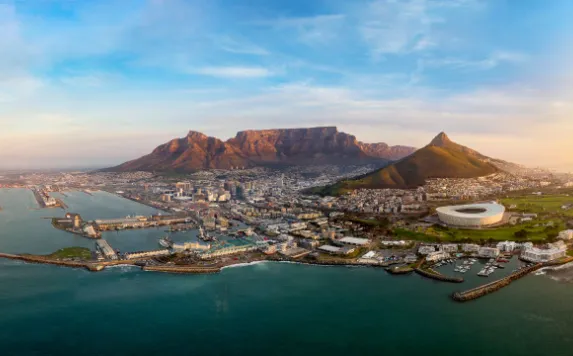
1:02:02 A bank with smart financial solutions from a systemized blend of technology and human touch for easy, fast and secure banking that creates real value. Turning dreams into reality is now in your hands. People, technology, service, Senneth Bank in your best interest. Thank you so much. And for those of you in Toronto, it's just gone off to 4. For those of you in Vancouver, just after 1am. So get your cup of coffee now as well. And we'll convene back in 3 minutes. Thank you. All right. Thank you very much. Welcome back to everybody who's watching the live broadcast. It's everyone in the room here at Cape Town. I know it's a happy challenge of getting all together, but there will be some good opportunities for networking continuing throughout the day.
1:02:53 Just by way of background, the day is effectively structured into 2 main themes. Between now and lunch, we'll be hearing about the opportunities from BC right through to private equity and large-scale investing and then we'll be hearing after lunch from Canadian counterparties, financiers, those with funds under management around some of the opportunities to date and other opportunities for collaboration. Zachariah George, our keynote speaker for session 1, is someone I was privileged to meet shortly after his move to Cape Town. Like many, you came here in 2010 during the World Cup, saw the opportunities, and you've since built significant financing and investments across hundreds of companies, closing major deals and welcoming investors, including Canadian LPs.
1:03:39 As you build out the early stage growth companies that no doubt are going to be some of tomorrow's big success stories. Zach, I also want to thank you for your partnership in delivering this event today, and to your wonderful team, Kamal, Teresha, Jeffrey and others, and of course, your co-founder, Jenaide Duplessis. So, ladies and gentlemen, we're going to be hearing from Zach for the next 20 minutes. We're then going to be hearing from some of the companies, 2 particular firms that have been financed, some of the success stories, and just an unfortunate message. Lisa was joining us from Toronto, just a slight challenge, but hopefully we'll have an opportunity to engage with her great Toronto based fund at a point in future. Without further ado, keynote session 1, keynote speaker 1, Zach George. Thanks so much, Zachariah. Thank you, Gareth.
1:04:27 Well, good morning, everyone. Hopefully everyone's finally coffee'd up and is ready for the meet of this morning, this afternoon, where we talk business. We had a few of the delegates earlier talk about the importance of AI innovation technology as the new harbinger of innovation on the continent and how Africa is doing its part in fostering that and growing that. I'm gonna talk a little bit about the state of venture capital on the African continent. I'm gonna cover the whole of Africa, not just South Africa. And how Canada, for better or for worse, is still a bit far behind compared to the Americans, the Europeans, and the rest of Asia in investing in African technology.
1:05:19 And by technology, I mean specifically software in the FinTech, e-commerce, healthcare, education sectors. But it's never too late. So this sort of presentation, I'll give a high level overview about the state of venture capital, not just the unicorns and the other half 1 billion dollar companies, but how the entire continent is moving and keeping abreast with the state of innovation globally. So you can't talk about venture capital or technology without looking at the macro. And there are 3 or 4 really important themes that I want to talk about here. First of all, Africa has now become the world's largest free trade and fastest growing market from a trade and commerce perspective, especially with the signing of Africa 3 years ago.
1:06:14 But From a demographic perspective, we now realize, according to the World Health Organization, that 1 in 4 people in the next 25 years will be African. So we're looking at a huge population surge, And this is not news to anyone here. But the actual practical implications of this are what makes the innovation industry so important to focus on Africa and not just the rest of the world. But probably the most important thing here is the amount of mobile phones. We had the minister here raise his mobile phone and talk about, was it 42 minerals that go into a mobile phone? But what's really interesting from a venture perspective is the mobile penetration.
1:07:04 When I first came to South Africa 15 years ago, I was here for the World Cup and never left. There were less mobile phones on the continent of Africa than in Manhattan. I used to be, for my sins, an investment banker on Wall Street for many years. I was at Lehman and Barclays. And so I can speak from firsthand experience. More mobile phones in Manhattan than the whole of Africa. But in these 15 years since then, it is absolutely incredible that there are now more mobile phones in Africa than the whole of North America. All right, and that includes, by the way, Central America, Mexico, et cetera.
1:07:52 So just in 15 years, we've had this exponential increase in mobile penetration. And coupled with that is the fact that the cost of data, and this is why telcos are very important. I'm not sure if we have any telco execs here, but the large telcos in Africa, from the MTNs to the Vodacoms to the Airtels to the Oranges, etc., really understood that Just having mobile phones does not increase digital commerce. You have to reduce the cost of data to enable the masses in Africa to actually trade digitally. So again, to just give you a stat, 15 years ago when I first came here, it used to cost on average between 45 to 50 US dollars for 1 gigabyte of data, right? 45 to $50, That's the average across the 54 countries, well, 55 countries before Sudan split.
1:08:51 Today the average cost of data for a gigabyte is less than $2. So you now have this perfect storm of the world's fastest growing population, 1 and 1 half billion people on the continent, which on its own is higher than India and China. The world's youngest population, the average age in Africa is 18. Sorry. And it's getting younger. The average age in Africa will be 15 by 2050. The average age in Europe is 40. The average age in Japan is more than 40. So we have a very young population that's digitally savvy, with more mobile phones in any continent, and with a cost of data that is lower than most places.
1:09:43 So that is a perfect storm for what? For digital commerce. And that's why, and that is what venture capitalists see as a very active target, addressable market with high purchasing power. And people like Mark Zuckerberg and Jack Dorsey and Elon Musk aren't shying away from this, right? So these 3 things a high population growth rising urbanization Africa is by far the quickest Or the the urbanization in Africa the trend towards people moving to big cities and very urban areas is faster than any place on planet Earth in Africa.
1:10:30 And coupled with the accelerated connectivity, we have a situation where the addressable market, as I mentioned earlier, is becoming increasingly attractive from a technology venture perspective. But We're here talking about Canada, Africa, not just Canada, South Africa. So in the 15 years since the VC ecosystem in Africa has been active, there are 5 major regions, well, 4, but increasingly 5 major ecosystems where innovation thrives. And have you ever, I've had the privilege of spending a lot of time in Silicon Valley, I got my MBA from Stanford. There is, There are certain regions in the world where technology and innovation really thrives and technology and innovation thrives by Cities not by countries.
1:11:24 So have you ever thought why why there's so many incredible Technology startups and unicorns for example in San Francisco, but not New York. Why Berlin and not Frankfurt? Why Bangalore but not Mumbai? Why Cape Town and not Johannesburg? And it's because there are 4 or 5 really important trends and components that make a city a hotbed for innovation. And in the last 15 years, we have done a lot of research into what makes these cities hotbed for innovation. And why is this important? If you're a corporate, if you're an investment fund, and you're looking to invest in the future Zuckerbergs, the future Bezos, the future Airbnbs of the world, You need to know what cities are doing to propel innovation.
1:12:21 So one of the first things is you have to have talented tech savvy founders. So one of the things you'll see in San Francisco, in Tel Aviv, in London is there are an abundance of developers, but not just software developers. These are people in innovation, in design, in marketing, in advertising. And cities have to have a certain blend of interests that attract people to them. And it's no coincidence that things like the ocean, the mountain, vineyards, et cetera, et cetera, attract people from different cities to come and make that city their home. Most of the top tech founders aren't originally from San Francisco, but they moved to San Francisco.
1:13:08 Most of the top developers and designers don't live in Berlin, or sorry, aren't from Berlin. They moved to Berlin. So you've got to have a city that's very conducive to attracting talent. Cape Town has that. Nairobi has that. Cairo has that. And so does Lagos, right? So you have to have raw talent that moves to a city and makes that city their home. Number 2 is you've got to have an abundance of risk capital. And note that I didn't mention the word capital. I specifically said risk capital. And why is that important? Just being a wealthy city or having a lot of wealthy corporates, family offices, institutions, means nothing if that capital is not deployed into innovative, high risk return trade off ventures.
1:14:05 Right? Now Cape Town, for example, is a very wealthy city. However, the general attitude of a lot of African cities has been capital preservation versus capital creation. So the older generation, if I dare mention that, tends to want to protect wealth more than create wealth, which is why if you look at cities like San Francisco, the average age of new centi-millionaires is between 25 and 30, whereas in Cities like ours and most cities in the world, the average age is older men in their 60s.
1:14:51 And it's because the attitude to risk is what defines how you create significance in an economy. And there are certain cities. Stellenbosch, for example, someone mentioned that earlier today, is the world's wealthiest town per capita. The world's wealthiest town per capita. So if you take the GDP of Stellenbosch and you divide it by the population of Stellenbosch, at least officially, it's higher than Monaco, it's higher than Tokyo, it's higher than Macau, it's higher than New York City, but it's pointless because None of that wealth goes into innovation, right? So if you look at what determines the quality of innovation globally, it's about your attitude to risk and not just the amount of capital available, right?
1:15:45 Number 3 is how effectively do corporates and startups collaborate? And this isn't just a nice thing, you know, to show in your CSI handbook, but how we work with startups is what do you actually do? Right? Africa is a continent That's very driven by b2b relationships We are let's call a spade a spade we are a very oligopolistic continent, right you've got people talk about the big 5 Big 5 animals, but it's it's a big 5 everything the big 5 insurers, right? I wonder why it's always 5. Sunlum, Metropolitan, Discovery, Momentum, and Old Mutual. Why it's the big 5 banks, right? It's the big 5 telcos, right?
1:16:35 So we are a very oligopolistic continent, but from an innovation perspective, if these corporates aren't working with startups to create proof of concepts and pilots and essentially outsource the innovation or externalize the innovation by working with startups, nothing happens. So It's regions or cities where large telcos and banks work a lot with startups that eventually rise The more mature version of this is what a lot of people often call today as CVC's just corporate venture capital Units so large corporates like Microsoft Ventures Google Ventures Samsung Ventures We unfortunately haven't gotten to a point in that maturity where African corporates have venture capital units.
1:17:29 And without getting too technical, doing venture investment as a corporate, if it's on your balance sheet, it's very hard to invest and raise independent companies if you're using your own balance sheet. So the most successful CVCs are off balance sheet. So again, cities that have great corporate startup collaboration tend to produce more unicorns, more billion dollar companies, and create wealth for investors. You also have to have this concept of entrepreneurial support systems. So accelerators incubators co-working spaces That enable these relationships and these have to be Unfortunately Pioneered by government.
1:18:19 Government has to provide things like, and that's my last point, government support. Governments really, it's this initiative that Premier Windy once talked about, rolling out the red carpet, not the red tape. So how do governments help? By providing tax incentives to founders. It's a pity that of all the African countries, the ones that are classified as the most economically active, like South Africa, don't have startup acts like their counterparts in Tunisia, in Senegal, in Rwanda, that provide tax holidays to founders, R&D grants, et cetera, that essentially enable entrepreneurs to build businesses without bureaucracy and friction, right? So these are some of the very important components that create wealth in cities from a tech innovation standpoint, right?
1:19:15 So let's talk about the state of venture capital in Africa. So just for those of you that aren't in the VC industry or don't work with startups, let me just throw a very interesting fact here. I'm assuming most of you invest in the S&P 500, or the Dow, or the top 25 to 40 global stocks. Well, until the 1990s, Every major component of the Dow and the top 20 stocks in the S&P 500 globally were funded either by private equity or debt Today of the world's 20 most valuable companies every single one of those companies was funded by venture capital, except 2, Berkshire Hathaway and Saudi Aramco.
1:20:14 Save those 2, every single company was VC backed. The question now is where's Africa? Today, Africa's largest companies have no venture capital funding. But I can tell you now that it is not going to stay that way for too long. The world will catch up with Africa. And from a funding perspective, you're seeing an increasing number of companies that are raising venture capital funding to get to where they are. Africa's venture capital journey really started about 6 years ago in 2019. When I first came to the continent in 2010, there was no venture capital. And it stayed at 0 until about 2015. In 2015 we had about $50 million of venture capital, which is now 10 years ago, across the whole of Africa.
1:21:13 Just to compare, when I was at Stanford, there was $50 million of VC every week in San Francisco. At the same time, there was $50 million of venture capital on the whole of Africa in a year. So from very humble beginnings, we've now grown from 2019, with a small dip a couple of years ago with the recession, to about $3.2 billion in venture capital for the whole of Africa. So let's put that in context, that $3.2 billion in venture capital last year, is just over 1% of global venture capital. Right? Are there any traders in the house here? Ex-traders?
1:22:00 Do you know what arbitrage is? Yeah. So Africa accounts for about 18 to 20% of the world's population, about 7 to 8% of the world's GDP. So there's a big arbitrage there. And 1% to 1.2% of the world's venture capital. And we know how arbitrages work, they don't last forever. So that in itself is a huge gap that investors and corporates are coming to realize now. And if you look at where Africa was compared to its 2 closest peers, Latin America and Southeast Asia, we are only about 5 to 7 years behind these 2 regions.
1:22:46 So if you look at the total, so if you were to look at where Latin America and Southeast Asia were 5 to 7 years ago, that's exactly where Africa is today. And if you were to take out that 5 to 7 year lag, Africa today is actually batting at a higher average than where Southeast Asia and Latin America were. So in year 7, we are now doing $14 billion of venture capital, which is much higher than where Southeast Asia and Latin America were at the same time with that difference. So we're now the fastest growing region in the world for venture capital if you factor in the 5 to 7 year lag that we've had.
1:23:36 What are the biggest markets where capital flows into Africa? And I know you wanna hear about unicorns, I'll get to that soon. Nigeria, Egypt, South Africa, and Kenya. Last year alone, more than 500 ventures on the African continent raised at least $100,000. 200 plus of those raised more than 1 million. And 69 startups raised more than $10 million, of which 8 raised more than 100 million. This is in 1 year alone, right? For those of you that love unicorns, the billion dollar companies, My daughter loves them as well. She's 12. So a different kind of unicorn.
1:24:23 Unicorns are billion-dollar companies that are private that have gotten to that valuation in under 10 years. 6 years ago, there were precisely 0 unicorns in Africa. Right? There were $0 billion privately held companies in Africa. Today there are 15. And in the next 2 months, that number will climb to 17. Why is this important? If you look at India, which is the third largest tech ecosystem on planet Earth after the US and China, In 2010, when I first came to Africa, India had 0 unicorns. Does anyone here know how many unicorns India has today?
1:25:11 Take a guess. Billion dollar companies that are still privately held. Anyone? Close? Yeah? It's more than 100. India has $140 billion companies in just the last 14 years. And investors have made, pardon my French, shitloads of money from these companies. Africa had 0 unicorns 6 years ago and we're already at 15. Our fund actually has 4 of them in our portfolio, right? The First of which was Jumia, the Amazon of Africa. That's listed on the NYSE. And several more that are on their way. A lot of people talk about exits, right?
1:26:00 Although the IPO market has been pretty dry, not just in Africa, but globally. For those of you that follow, there were 2 marquee tech IPOs in Africa at the end of last year. One of them was in Johannesburg, a FinTech called Aptasia, listed for more than 1 billion dollars. The other one was a company in Morocco called Cash Plus. So the African sort of IPO market after a lull of 3 to 4 years is now slowly getting back on track. However, The vast majority of exits from a tech M&A perspective happen through corporate M&A. Very acquisitive, and I'll talk about that in this shortly. For those of you that are still with me and haven't gotten bored, These are some hard numbers when it comes to valuations.
1:26:49 Right? I talked about the arbitrage that Africa has because of the population and GDP venture situation. Well, In the big 4, so Nigeria, South Africa, Kenya, and Egypt, the average valuation at the seed stage, which is the first major funding stage of a company, is around $5 million. Again, these are just averages. The average valuation at seed globally in the venture industry is between $10 to $15 million. As you get to Series A, which is your next major round of funding, which is usually a global benchmark when you have pension funds, asset managers, and big VCs investing in you, seed is mostly individuals, family offices, and angel syndicates.
1:27:48 That valuation gap starts to taper off. The average valuation at series A in Africa is around 15 to getting on to 20 million. And globally, it's around 30 to 35 million. Well, guess what? At series B and series C, African startups trade at the exact same average and sometimes even higher than their global peers. And why is that the case? Once you're doing 50 to 100 million dollars in annual recurring revenue, it doesn't matter if you're in Africa or in New York City or in China, revenue is revenue. So that arbitrage completely goes away.
1:28:36 And who benefits from it? Gosh, we have a tough crowd here. Coffee wasn't strong enough. It's the early investors. Early investors in Africa make ridiculous returns when their companies get to Series B and Series C. And it's a pity that the global VC community has not caught up to that. Well, a few funds in Europe and the US and Asia have made a lot of money. I'm yet to see Canada join that, but this is probably an opportunity for people to be educated about what's happening here. People often ask us, who are the top funds that are investing in tech in Africa?
1:29:22 Well, these are some of the top funds based on deals in the last 5 years. No need to sort of explain who these are, Visa, Tencent, Ribbit, Sequoia, Insight, Strat. These are actual deals where US, Asian, and European funds lead or co-lead rounds in Africa that are Series A or beyond. Right? Unicorns. Have to get to them again. 14 unicorns in the last really 6 years. I'm gonna exclude Jumia because it skews everything here. What do you think Or what do you find is the most fascinating fact on this slide? Although we are a bit late to the party, our first unicorns were only minted in 2019, the average number of years it's taken for an African tech startup to get to 1 billion dollar valuation is between 3 and 5 years, at least the most recent ones. Do you know what the average time it takes for an American startup to get to 1 billion dollar valuation?
1:30:32 How many, sorry? Did someone say 2 in the US? The average age for a US startup to get to unicorn valuation? No, you're way off, way off. But 10 to 12 years, yeah. Why do you think African startups, although our sample size is small, we're just off the starting blocks. Why do you think African tech companies become billion dollar companies a lot quicker? Yeah, it's the 3 factors I mentioned above. It's population, it's the cost of data, it's mobile penetration, but more importantly, I mean all those 3 are very important, but it's the fact that when you use technology to solve real world problems in financial inclusion, in healthcare, in education, in agriculture, your revenue is very sticky.
1:31:24 And it's very hard if you're solving a real world problem to not continue growing and scaling. I often give the example, it's a little joke. When I lived in Silicon Valley, there was a company that created drones. Drones were very big back then, that would deliver organic smoothies to high rise buildings in San Francisco and have a little IOT device that would open these windows and you'd get a smoothie from Jamba Juice delivered to the executives desk and you'd pay, I shoot you not, $35 for a smoothie because it was delivered by a drone. That startup raised $20 million in funding, and no shit, Sherlock, crashed and burned a few years later. Because a lot of startups globally, especially in the West, solve problems that are nice to have.
1:32:18 But in Africa and in other developing markets, like India and Southeast Asia, you use technology to solve problems that are needed to have. Like, I would rather have used drones to deliver ARVs, right? And that is an industry or a market that will last forever. So the reason why, yes, it is hard to build billion dollar companies in Africa, but once you build them, they last. And that's the opportunity that people overseas, including Canada, should be aware of. You can't make money unless you have an exit. So it's important to talk about how you exit these positions, right? So in the last 6 years, again, this is an information that you'll see on Bloomberg or the Wall Street Journal or the New York Times, unfortunately, because media tends to be very biased towards or against Africa, unless it's a story about mining and minerals and oil and gas.
1:33:20 Between 2019 and 2025, there were 212 startup exits in Africa, right? One of the biggest ones was Stripe being acquired by Paystack, sorry, the other way around, and InstaDeep in Tunisia being acquired by Biontech. But what's really interesting here is that the time it takes to get to an exit in Africa is actually shorter than the global average. Again, disclaimer, we are working with smaller sample sizes because we are at the nascent stage of our industry, but numbers don't lie, right? So If you look at the number of exits per year, between 20 and 40, last year we had 48 exits.
1:34:08 The vast majority of these exits are corporate M&A. So it's large telcos, insurance companies, retailers, firms like NASPERS buying companies. But increasingly, you're seeing a lot of horizontal M&A. Horizontal M&A basically means larger tech startups acquiring smaller tech startups and paying much higher multiples of EBITDA or earnings, whereas corporate M&A tends to be lower multiples but higher volume. Why is this important? Because early investors need liquidity, and that's where your liquidity is coming from. I'm going to wrap up soon. I know I'm a bit over time, and we have a very interesting panel now. But we are the most active venture capital fund in Africa. We've been around for 6 years.
1:35:00 My partner, Junaid, in the corner there is my co-founder. We have managed 6 funds before this. We currently have a stake in $3 billion companies just in the last 6 years. We've created more than $3 billion in market cap. Although we don't explicitly brand ourselves an impact fund, the personal belief that I have, all this branding, we have helped create more than 80,000 jobs in the last 6 years. We have our first fund was $36 million. Our second fund that we are about to very soon by the end of this year close our capital raise is targeted at $50 million. We've invested in 170 companies and we're currently sitting at a 40% IRR in fund 2.
1:35:53 Again, I'd very humbly look at these returns in Africa from a venture capital fund and compare that against what you'd see in benchmarks in the US or Europe. So again, things like these don't get highlighted in, you know, in Reuters or Bloomberg or global journals. But the reality is there is a lot of commercial returns that venture in Africa can have. Most of our investors that have invested with us over the last 6 years tend to be family offices in Europe, mostly Switzerland, Germany, France, the Netherlands, and the UK, and the US. They're very happy. They have made some really great returns.
1:36:40 And again, it's very important when you enter a relatively nascent market like Africa, you have to understand risk return tradeoffs. A lot of our investors want to invest directly into technology ventures in Africa. You're going to hear from 2 of them on the panel now. But the reality is if you live in Montreal, in Toronto, in New York, in London, or Miami, it's very hard to do active financial, legal, technical, and human diligence on companies that are outside of your comfort zone. And that's why funds exist. We're a 16-person team with advisors all across the African continent. And we allow any of our investors in our fund to do co-investments into the top companies in Africa. So of the $3 billion companies that we've invested in, some of our LPs have a stake in them directly, by courtesy of Bing. So co-investments are a great opportunity for investors.
1:37:41 And investments do not have to be just institutional. The vast majority of our investors are individuals, investing as little as $50,000, all the way up to $5 million. But it's an opportunity to be at the coalface of an industry that is almost identical to where India was 10 years ago, to where Singapore and Indonesia were 7 years ago, and where Brazil and Mexico were similarly 5 to 7 years ago. And it's an important part of the GDP growth on the African continent that a lot of people are just blissfully unaware of. And because our team comes from a Silicon Valley and Wall Street background, we understand, and we can read the tea leaves, as they say, and make a lot of money in the process and do a lot of good.
1:38:32 So that's basically what I wanted to talk about. It's an industry that's actively growing. And if anyone here is interested to learn more, we actually have a few of our investors in the room. I won't disclose who they are, because they might be hounded. But thank you all for listening. We're going to hop into a panel. Do we have time for questions or no? We're going to hop. Final questions, OK. So thank you, everyone. I appreciate it. OK. I'm going to call on 2 incredible entrepreneurs and 1 entrepreneur cum investor to join us on this panel. We're going to ask Vellani Mbaweni from Lula, please come up, give him a big hand.
1:39:26 And Leshego, where are you? Oh, come on up. Is that for me? Oh, OK. That is not Sebastian, that's not Wayne, that's not in line. But it's all right, that's all right. I mean, AI does some amazing things nowadays. How's the energy in the room? Yeah, it was a bit quiet when I was speaking earlier, but I think I'll speak to the guys at UCT and ask them to put something more in the coffee next time.
1:40:13 All right, do you guys want to do a quick round of intros and tell us about your businesses and then we'll go into a quick round of questions. Do you guys have mics? Yeah. Go for it. Can you hear me? Yeah. Hi. Okay. Sure. So, today I'm representing Shiprazer. This is a digital logistics platform operating across Africa. We solve for omni-channel delivery for digital merchants. This is e-commerce merchants in Africa, so import, export, delivery, logistics more broadly. And my second hat is as a general partner at a technology fund called Newtown Partners.
1:41:00 Thank you. Cool. I'm Vellani Mboweni, co-founder and CEO at Lula. We're a mobility platform that provides transportation to businesses, especially during the hours of 6 p.m. To 6 a.m. Where essential workers need to get home. This is a problem where public transport is usually unavailable, unsafe, or unreliable. And so we think about industries like BPO, warehousing, manufacturing, and hospitality. We work all across South Africa, and it's an asset-light platform. So smaller transport providers, independents, all plug into our platform and get matched to work with usually big companies that they couldn't single-handedly provide on their own. So the likes of Cipla, Hyatt Hotels, DHR, Old Mutual, Yoko, all as part of our customer base across South Africa. And Proud Portfolio company of launch Africa found one.
1:41:48 Amazing. Before we get into the nitty gritty, I just want to ask you guys some some very high level questions. Especially for our friends from Canada that are that are visiting us today. Could you tell us what makes African startups, and Africa is 54 countries, I get it, but what makes African startups globally relevant from an investing perspective? I think I covered some of it in my talk, but what in your opinion, both of you, makes an African startup like yours globally relevant? Either one of you. So we're actively busy with our series, and I think we have a lot of data points on what makes us relevant. I think the first is the quality of revenue.
1:42:34 So in South Africa, and again, with a lot of the investors we talked to, B2B revenue is something that is prioritized more over B2C because of recurring revenue rather than incidental revenue. And so when we spoke to investors, that quality of B2B revenue that is contract based is something that stands out quite particularly. Secondly, is the low cost of high quality talent. So when you have dollars being deployed into South Africa, you know, being able to pay a software engineer at a senior level about $100,000 annually, whereas in the US, maybe $300,000, $400,000. That cost-to-have-a-charge is something that's quite unique. And I'd also just emphasize the resilience, right? So I think a lot of the founders that come out of Silicon Valley, maybe dropped out of Harvard, or, you know, are working at 2 other startups and they just have this idea to deliver smoothies via drones. Whereas in South Africa, you solve real problems where you've been resilient over multiple rounds of rejection, multiple rounds of trying to find product market fit. And when you show up with that resilience, with high quality revenue, as well as strong talent that has a good cost arbitrage, that makes you globally relevant, especially when you're solving a problem that can be replicated, not just in South Africa, but other African countries and other emerging markets.
1:43:46 Amazing. I think the cost arbitrage is super important. Cape Town has become, for those of you that aren't aware, Cape Town has become one of the leading testing beds for startups globally. So before a startup launches in San Francisco or London, they do their alpha and beta testing here in Cape Town. So from a replicability standpoint, it's very, very attractive. Sorry, Lashay. Yeah. So I think, you know, your presentation captured it quite wonderfully, is that these are large, fragmented, operationally complex markets where technology can create an enduring competitive advantage. So the opportunity really is in companies that are incredibly resilient, are at the forefront of technology that are solving real economy problems in ways that are globally relevant. I mean, I look at the example of zipline. I mean, In Africa, there were drone delivery for really essential medical services and now they're competing with Amazon for drone delivery in the US.
1:44:54 So we're seeing this constant framework of seeing Africa as, Look, I'll not say testing ground, but if you can build it and solve it in Africa, you can solve it anywhere. Are there misconceptions that, I mean, you guys have dealt with many investors, and Lashego, you specifically wear an investor hat and a founder hat. Are there misconceptions about African tech renovation that you've heard on investor calls that, I mean, I'm assuming this is a safe space And what stays at the GSB stays. What are some of the misconceptions that the investors that you've dealt with have about investing in African tech?
1:45:44 Wrong, unfounded or founded misconceptions. And this is an opportunity for the 2 of you to sort of dispel those myths. Chatham House rules apply, sorry. I think for us, the big one is that, it's concessional funding story, right? That the African investment is part of your impact allocation. But there's a really large economic opportunity. I don't want to discount the impact story. I think a little joke we have internally is that every African company is an impact story, because you've got these downstream effects. But you're building real businesses with real economics and real growth. And we're starting to see some wonderful success stories across the continent.
1:46:32 So you don't necessarily have to have the trade-off between impact and financial returns. And we're starting to see the emergence of some really large companies that are solving real problems, but also really great investments. So you don't necessarily need to make that trade-off initially. I'll add on to the practical example I had on a call 2 months ago. One of the partners briefly said, listen, you're going into this meeting with the whole team. A lot of us as Pan-African VCs are convinced that there's no poor people in South Africa. I said, what do you mean? Like, well, as a South African business, if you're talking about an expansion story throughout Africa, a lot of Pan-African VCs don't believe that South Africans are poor.
1:47:23 And I couldn't understand. So he said, you have to basically explain to people the reality of the ground to distinguish what are the similarities with South Africa and other African countries and what are the differences? The irony of that is that when I looked into the VC space, if I looked at South African VCs, a lot of the investing was, how do you take your South African company and replicate that in Europe and UK and US, versus if you're a pan-African country, a company, they're saying, how do you represent this in Kenya, Nigeria, and Uganda, for argument's sake. I found that that was quite an interesting misconception because in our business, the transport challenges is not just unique to South Africa, it's applicable throughout all 55 countries in Africa. So some of these misconceptions that just needed a lot more clarity and it was the first time I'd ever been in a meeting where an investor said, these partners who are based in Kenya, who are based in Nigeria, I think there's no poor people in South Africa who need transportation.
1:48:18 And so that was just an interesting example that I saw. And I was like, well, I'd expect this from someone coming from Japan. But I'm seeing this now practically from my brothers in East Africa and West Africa. Yeah, It is a big misconception that needs to be dispelled. So speaking about, that's a good segue into this concept of Pan-Africanism. I used to joke around that saying earlier that a lot of South African founders, I hope there aren't too many in the room, have this virtual bottleneck and border where the Limpopo River, anything above the Limpopo River is not Africa, and you can't really expand there. So there are a lot of South African technology firms that would expand to, you know, London or Perth in Australia before expanding the rest of Africa.
1:49:14 And sadly, you can't hoodwink global VCs, right? VCs will not back companies that have a clear regional expansion strategy. And that's the reason why, as amazing as the South African economy is, the venture ecosystem in South Africa lags behind Nigeria, Kenya, and Egypt, and even now increasingly Senegal and Cote d'Ivoire. So you need to find regional and continental winners before you can think about expanding globally. So What are your 2 respective strategies when you look? I mean, both of you are top of your game in mobility and logistics and transportation, respectively, in South Africa. How do you look at expanding into other African countries? And what are some of the things you need to keep in mind?
1:50:05 Anyone can go. Yeah, so I'll go again. I think expansion is expensive, right? Yeah. And in an environment where there's capital scarcity and the cost of capital is high, you can't afford to just spray and pray, as we say, with expansion. So from our side, we're blessed to serve a lot of multinational companies, and companies have presence within Africa. So our growth strategy would be a customer-led and use case-led expansion strategy, rather than just setting up in a market and saying, hey, Lula's here. So, for example, with Ode Mutual, who we serve actively in South Africa, we have a lot of their teams from Uganda and Kenya. When they come into ESEE, they use our business similarly in Botswana. And So now we're taking the view where when we operate in countries like Kenya, Uganda, we would go off the back of an existing contract with a corporation like Oath Mutual, understand the unit economics, see how this stacks up, and if it works, we then double down. If it doesn't, we can quickly retract back. So essentially, our expansion strategy throughout Africa and the region first is customer-led and use case-led rather than a spray and pray approach.
1:51:09 Got you. Yeah, so I think the biggest mistake that a lot of startups make is that they scale operational complexity before they have the capability. So I think partly you need to be quite pragmatic around what the existing infrastructure is. You don't want to be fighting gravity. And you mentioned this idea of regional blocks. And I think that's the way you need to approach it when you think about international expansion. What markets make the most sense and where do you have reciprocity or can be demand driven and you have an existing customers who want you to serve a particular market. In our instance, we started domestically in South Africa, the largest e-commerce market growing at 30% annually. And through the course of business, we've basically seen that there's a large opportunity.
1:51:59 Africa is a net importer. So we've gone to actively try and develop China, India, Japan, and become a market access and channel partner for people bringing products into South Africa. So it needs to happen quite organically. You need to be quite pragmatic around what capabilities you have and where you can build a competitive advantage. I think you're looking for greenfield areas where you can compete. And Everyone likes to speak about incredibly large markets, but I think it often helps to start at a particular niche and then create and expand that particular channel over time. Thank you. I think for those in the room here that want to truly understand how startups in South Africa and the rest of Africa can truly scale and grow at the pace of what their counterparts globally do, and if not higher, this is your opportunity, both of you to just talk about where you started and where you are today.
1:53:09 I mean and feel free to just you know hashtag humble brag but talk about what you've done simply because there are investors in the room. Obviously, disclaimer, these are both portfolio companies of ours. They've grown phenomenally from a revenue, margins, clients perspective. A couple of you guys have even acquired other companies and made us a lot of money. Talk to us, for those that don't have any exposure to venture capital in tech, what are some of your biggest achievements in the last few years? Vellani, you can go ahead. Sure, biggest achievements. So yeah, I mean, 2024, we acquired a competitor of ours, which was really great because it spoke to that philosophy of if you want to go fast, go on your own, but if you want to go far, go together. So acquiring a competitor value in 2024 was a big achievement.
1:53:59 I'd equally say that over the last 3 to 4 years we've probably grown revenue by 10x. 10x in 3 years. 10x in 3 years. As of last month, EBITDA positive. Which is kind of funny because in the early days, you know, investors were like, how fast are you growing? And you grow fast. Like, where are you at profitability? Then you become profitable. And I was like, OK, what about exits? It's like this constant chase. But with the resilience and the African spirit, we've managed to achieve at least 2 of those. I'd say more than anything is that clarity on product market fit and knowing which battles to fight and which ones to say no to, and being able to filter out the noise. Because I think unfortunately we live in a world where you read something on TechCrunch of something that's going well, but you don't get to see when it goes wrong. So being able to have that discernment to really focus on what you need to do and say no to a lot of things and leverage your partnerships and strength. I mean, having been through the startup boot camp accelerator, having walked with Zach and Junaid and all the various investors who supported us, is something I like to brag about because it's both of confidence, it's a bit of trust, as well as you know testament to the resilience and execution of the business over the years.
1:55:07 Yeah, I mean just for everyone's sake here for literally a 2 or 3 member team 5 to 6 years ago to now servicing some of the biggest global corporates, Toyota, Old Mutual. I mean, I've lost track of all your biggest clients. There is serious innovation happening here in our hometown. And we are being recognized globally. So, wanna maybe just talk a little bit about Shipraiser? Yeah, sure. So, it's quite funny we're in the GSB because this is where everything came together. So, Sahil and I, our CEO, we met in GSB, we were in the same pod. Little did we know that 5 years later we'd be running this business together. Shipraiser was started in 2023. It's at a logistics fund. We had this insight around, you know, trade and efficiency and the opportunity in trade infrastructure more generally.
1:56:02 And in the span of 2 years, so from 2023 to 2025, we're doing 50 million rand in revenue annually. We are the distribution partner for, and if you've heard of them, Sheen, Timu, Alibaba, AliExpress. Domestically, We serve over 500 merchants domestically. We've laid on additional value-added services. We, in partnership with, I don't want to mention them now, but We're doing embedded financing. We're working with the largest insurer on parcel protection. So we've really expanded this initial insight in that trade involves multiple flows, informational finance, and the actual movement of products and goods. And if you tackle the most complex problem, which is the delivery of things to your doorstep, we can own trust. So we describe Shipraiser as a trust platform.
1:56:57 And once you own that particular leg, you're able to add additional value-added services on top of that. So we really think of ourselves as a merchant technology business that solves for logistics. And the idea is to not replicate any other international model, but really create something that is African, that is hopefully in one of the unicorn. We can potentially feature 1 day on the unicorn slide. But we've scaled phenomenally over the last couple of years. I think that's the important thing. I mean, the big takeaway here is, I mean, how many brick and mortar businesses that started in 2023, which is what 2 and a half years ago, are now sitting at $5 million of annual revenue?
1:57:44 Because if you're a traditional SME, and you go to F&B or Absurd to get loan funding to grow your business, you'll get to $5 million in revenue maybe in year 10. But with smart venture capital funding, and if you're tech enabled, you can get to that in 2 years or 3 years. And I think this is the piece of the puzzle that international investors have not really started to understand about African businesses. You can grow exponentially with the right mentors, advisors, B2B partnerships, and the right capital stack. And Africa is proving to the world that although we are a bit late off the starting blocks, it's just been 7 to 8 years, we're growing very quickly. And these are 2 homegrown examples in Cape Town of companies that are globally competitive.
1:58:35 I know we're running out of time, but I wanted to touch upon the importance of AI. We had the minister speak about it this morning. AI is obviously becoming an increasingly important part of your operations, both of you guys. How do you balance the threat of AI from a human resource perspective? Because impact and job creation is an important part of what both of you do. How do you manage AI in your businesses? I'm sure you get this question a lot, but just for the folks here, if you could just elucidate on that. So I think the most important thing about transportation, especially when you're moving people, is that transportation is something that when it goes well, you don't hear anything. When it goes wrong, you hear from your customers. And the worst thing that can happen is for a customer to reach out to you during a time of distress and they get an AI bot.
1:59:31 So that fundamental belief is something we've embraced, that whilst we will use AI and technology to enhance our processing, our operations, our optimization vehicle, we will still remain a human-led business and understand that it does not matter what takes place in the world, that people will still need to move from A to B to connect to economic opportunities. And I think that's what Lula is really thinking about and always remains focused on, but we'll use AI to enhance what we're doing. And I always believe in a phrase that was in the Bible that says that the harvest is plenty, but the laborers are few. And I believe that there's much work that is needed to be done in Africa from mobility, from tech, that the harvest is plenty, but the laborers are few. And AI just makes that case even worse.
2:00:17 Yeah. Yeah, so yeah, we've taken a similar approach. So we see AI as an enabler. And if anything, it's allowed us to move a lot faster. So our iteration cycles are much shorter. We're able to implement on design live on calls with customers. We're able to test and test and test and test and get, you know, we're seeing efficiencies all throughout the organization. In terms of, you know, how we see its impact within, you know, on labor, at least, you know, from our perspective, is that we see an increase in productivity only across the organization. And we find that the translation, there's no longer this sided approach between sales and finance and tech and ops.
2:01:09 Everyone becomes digitally capable. It's quite funny, we've actually got certain delivery drivers and we show them how to create an app, right, you know, on Claude. So, you know, it really is, you know, opening up this whole new avenue in the business and something to reap the benefits. And finally, some parting thoughts here. You've got a very captive audience that comes from very diverse walks of life. I know some folks in mining, manufacturing, a few investors here, a few people from the insurance industry. If you had a few parting thoughts on how they could help, not just Lula or Shiprazer, but what they could do better to help grow the African tech entrepreneurial ecosystem.
2:02:00 What would your parting words of advice be? And I'm sure we've got a very captive audience. I'd say definitely speak about your successful experiences. The kind of reasons for success. I mean, Hatch spoke earlier about the 3 projects in Zambia, Zimbabwe, the Lubito Corridor, those are very insightful. I mean, when we talk about investments in Africa, we're not always just speaking about the big 4. But to hear that there's work in Angola, there's work in Zambia, speak about those successes, because I think in this world, we need a good testimony about what's actually working well. The good thing about Africa was we have a lot of problems, that just means 10 times more ways to solve them, so a big opportunity, but we need to always hear about what's actually working, what are good case studies of collaboration. We always talk about the future will be this, the future will be that. Let's talk about what's actually happening. And rather than it just coming from our mouths as African founders, let's talk about the partnerships that are in place because at the end of the day, we take risks, but trust is the most important commodity. So let's talk about what's actually happening and working well.
2:03:06 Thank you. Yeah, I think creating an open collaboration framework, you know, you've got this concept and tech around, you know, creating these sandboxes. And, you know, you know, what I often find is that, you know, you want to increase your surface area of luck, right, this idea of serendipity. And, you know, I think nothing really happens if people innovate within their different silos, right. I think, you know, if you really want to develop the continent, you want to create really meaningful infrastructure and progress towards ultimately what we want, this idea of ultimate prosperity, is that we'd like to see more collaboration between governmental bodies, it could be corporates and startups and technology. Because, you know, from a broad perspective, right, technology has a proportion of GDP in Africa is much, much lower than the rest of the world, right.
2:03:57 And, you know, so there's still lots of room to grow. You know, the market is still incredibly nascent. So, you know, you have a very, you know, it feels like an inflection point, right. You have this really large opportunity to get on the ground for some really interesting, dynamic, young startup founders who are building the infrastructure for the future. It's not just financial infrastructure, it's data infrastructure, AI infrastructure, you know, trade infrastructure. And, you know, this idea of collaboration, I think, needs to be carried with all of us today. Amazing. Ladies and gentlemen, please put your hands together for Vellani Mboweni from Lula and Shego from ShipRazor. Thank you very much for your insights. And they will be here for the rest of the morning, at least. So if you want to talk to them, please feel free to reach out. Be proactive, people. Don't step outside of your comfort zone and meet some incredible entrepreneurs. Thank you for your time.
2:04:56 Zach, thank you so much. I know when you started this, I just want to recognize you. There are a lot of people who started there. They are no longer in Cape Town. They are no longer in Africa. Had they just stayed the course the way you have, we would see the kind of growth, the job creation and everything that you have done. So I just want to say thank you on behalf of I think all of us here and everyone you have invested in and continue to invest in. Ladies and gentlemen, Zach George, thank you so much. We will break now for 20 minutes. Let's network, let's engage. I look forward to meeting every single one of you at some point during the course of today. And then we'll come back for a focus on some of the larger ticket items, looking at private equity and bigger deal sizes. And remember, after lunch, the engagements begin with counterparts from across Canada, including the funds under management and opportunities to see another incredible set of deals flowing. Enjoy the tea break. See you back in 20 minutes. Thank you.
2:05:51 All right, as we make our way back in, thank you so much to each of you for some of the deals. I'm hearing a bit about investors who are here, funds are here, who have already got Canadian capital. So let's increase that. And let's also, I think, just take a moment to recognize, I think in the context of this morning's conversation, how deep the ties have been between Canada and various African countries, but specifically South Africa, with the recent visit to Canada by the Minister of Finance for the Western Cape, MEC Bartman, as well as the African Continental Free Trade Area Secretary General, Mkwele Mene, who's originally from South Africa but based in Accra, heading the establishment of the world's biggest free trade zone by a number of countries participating. And we've been privileged as well to host him last week during his visit to Ottawa.
2:06:39 And so there's a lot of momentum. But of course, behind those momentum is the actions of those who are building projects or financing projects. And We're going to hear from some of those companies that moved from the VC stage into the bigger ticket items. It's my absolute privilege to kick off session 2 shortly and imply, and those I'll be introducing, are absolute veterans in the field of finance and leading on issues of transactions with Canada and the African continent. However, Minister Deidre Bartman, someone I was very fortunate to study with, and who for a time was just across the river, based in Michigan, during your studies, but now very much at the forefront leading year in South Africa as the youngest ever Minister of Finance. During your time in Canada, we received wonderful feedback about your engagements with Quebec, looking at blended finance and opening more channels for financing into the Western Cape and beyond, and really building a template for provincial to provincial engagement for both South Africa and indeed for the continent as a whole. So I'd like to commend you for your leadership. I know you have a distinguished career in law, having obtained your LLB and LLM from the University of Stellenbosch, who admitted to the High Court in 2017.
2:07:50 But despite all that, you decided to enter public service relentlessly, and I couldn't be more grateful to welcome you to the stage to speak a little bit about the work you're doing in the context of the deal-making happening here today. Minister Batman. Good morning. Is it still morning? Good morning. I must admit, I am still suffering a little bit from jet lag. I went from, Pramila always says, you know, South Africa, at Africa, we're actually at the top of the world. So I went from the top of the world to the bottom of the world. And I must admit, not having snow is really a wonderful feature of the South African and the African continent.
2:08:53 To all the dignitaries here today, earlier we had the Deputy Minister for the International Development of Government of Canada, our Acting Premier that was here. Thank you so much, Gareth, as President of the Chamber, representatives of the Canadian government, colleagues across Africa, and our partners in finance, business, development, and government. Good morning, bonjour. I, Like Gareth said, I recently returned from a visit to Canada, particularly the Quebec region, where we visited the Quebec city part, as well as Montreal, on behalf of the Western Cape government. And our delegation was made up of senior officials from our provincial treasury, from our department of infrastructure, as well as agriculture.
2:09:45 And our mission really was to try and explore opportunities within both the alternative and blended finance space, but also market access. I must admit something that I really enjoyed in Canada is I was told it's absolutely fundamental that I cannot leave Canada without having eaten poutine. So I had some poutine. It was interesting. And I have way too much maple syrup. But I'll get back to the maple syrup a little bit later. So many of you may know in South Africa, obviously we have 9 provinces. And as the provinces in South Africa, 95% of our provincial budgets actually come from national transfers. So the national transfers are called equitable share and conditional grants. But all 9 provinces, more or less 95%.
2:10:36 5% of our budgets are actually our own revenue. And those are mostly fueled by motor vehicle licenses and gambling and racing revenue. And yes, if you gamble, the taxes come to us as the province. But given the fiscal constraints in our national economy and what we have faced, and also as provinces, we need to start thinking differently. We need to start thinking much more innovatively if we want to accelerate our infrastructure build, but also if we want to increase our regional growth and create more jobs. In the Western Cape, we have a very ambitious plan. We call it the provincial strategic plan, and it's essentially a big word for the government's vision. And our vision is we want to build a trillion-rand economy by 2035, and we want to add 600,000 new jobs. And you've heard Acting Premier and Minister of Agriculture earlier speak about this growth for Jobs Plan.
2:11:31 And that particular plan, we have 4 pillars in our province. We have growth for jobs, which is the one strategy. We have our safety plan. As you know, in South Africa, we're always talking about safety because it also unlocks the economy. Educated, healthy, and caring society. That's also where a lot of the provincial mandates lie in education and health particularly. And we also have innovation, culture and governance. And in that particular pillar, we work a lot on things like alternative and blended finance, how we do procurement, our AI framework in the provincial government that we've adopted, and how we really look after our people in government as well. In the particular policy priorities, if you want to look at the strategy and how we get to a trillion-rand economy.
2:12:18 What this really means is that as a province, we need to add an extra 5,200 megawatts by 2035 in energy. We need to bring in an additional 320 million cubic meters of water. And we need to triple our exports and we need to increase our private and our public infrastructure investment at least by 20%. Now, 1 would ask, why do we need to do all of this? In the Western Cape region, our GDP grew in the past decade by 9%. But our population is currently growing at 18.1%. I'm just going to give it a second.
2:13:04 18.1% is more, it's double, it's more than double our current economic growth in our province. And it is both in migration, different provinces to 1 another, but it's also immigration, tourism, people wanting to come live in South Africa from different countries. So when you hear municipalities and provinces in South Africa speaking about the pressure, it is real pressure. It is pressure to accelerate energy programs, to accelerate water programs, to accelerate waste programs, roads, housing, health, education, because you have to live some way. Sorry. As much as we want to double and triple our tourism, people need to eat, people need energy, people need water. And I'm so glad that the venture capitalist sessions also spoke about the role of artificial intelligence.
2:14:01 Because there are certain things in the world that AI will not be able to replace. We will always need water. Water is life. It's that simple. It's that simple. It's that simple. It's that simple. It's that simple. Perfect timing. Perfect timing. Water is life. We will always need to eat. Colleagues, people don't want to study agriculture anymore because it's not sexy. We are running out of farmers. And it's all well when you say, oh no, but maybe in 3 years time, maybe in 5 years time, maybe in 7 years time, it will get... If we do not invest in our skills and skills as part of our growth for jobs strategy, and it's not just agriculture, There are certain sectors where we're running out of people who are willing to do the difficult work so that we are able to put food on our table.
2:14:55 No one wants to work in waste. But after water, waste is going to be the next crisis in South Africa. So there are jobs in our country and even in Africa where it might not be the sexiest job to do, but you will need a plumber. You will need an electrician. In our particular economy, in the Western Cape, we have 2 big economies. It is the financial service economy. That's the biggest one, and that includes tourism. And then secondly is agriculture that contributes to our GDP. Those are our 2 biggest ones. But when you look at what drives jobs in the Western Cape, it's a little bit other way around. The agriculture sector and tourism really drives that job creation in our province.
2:15:43 And out of all the agricultural exports from the whole of South Africa. 58% of all agriculture exports come from the Western Cape. And I'm very proud, you know, this morning I was reading about the fact that South Africa is now for the first time the biggest exporter of citrus in the world, having overtaken Spain. So I really want to congratulate if there's any person investing in our citrus farmers and our farm workers and the supply chain in citrus, really thank you so much for the work that you're doing with us. But what do you do when you're faced with a budget that is 95% reliant on your national government and you have a population growth that's almost double your economic growth?
2:16:29 You have to start thinking about things like alternative and blended finance, because we have to accelerate our infrastructure build. And that is also part of why we went to Canada. Many people might not know that Canada and South Africa have very similar constitutions and very, very similar legal framework. I saw, you know, some of the African countries, I'm not sure there's any representatives from Kenya here, but Kenya also similarly has very similar constitution and foundational legal framework. So if our foundations and our values are so similar, surely there are more areas that we can work with one another on. In 2025, this is why the Western Cape government and the provincial treasury in this regard, we launched our very first alternative and blended finance framework.
2:17:21 And Gareth, I'll send you some of the documentation for distribution if anyone is interested. And this framework really is for us to be able to assist departments and municipalities in leveraging our different provincial fiscars and your municipal fiscars to crowd in the support of the private sector in order to accelerate our infrastructure build. We will do this through both on balance sheet and off balance sheet financial instruments, such as loans and credit guarantees, bonds, credit schemes, impact and outcomes finding, or even micro financing. I actually, one of the things I love doing in a different country is I always go to the grocery store. It's one of my favorite activities. I went to the grocery store and I took our head of department from agriculture with me and I said, come, let's go look for the South African products.
2:18:13 So we went and I took photos of all the South African wine and the citrus and the rooibos. But I also went to go speak to people on the street. Because it's fine, the politicians will speak to 1 another in the big boardrooms and stuff, but I want to know what the person in Quebec was thinking. And the person in Quebec has a different wine palette to the person in the Western Cape. And interestingly enough, the women in Quebec are the ones driving the wine sales. We went to go meet with the SAQ because I wanted to know how do I get South African wines onto the shelves. I know you have a problem. I know you said you want to diversify your products. We have products, how do we get them on the shelves? So, SAQ, they have this thing, you have your loyalty cards, and the organization checked the loyalty cards, who is buying what.
2:19:05 Majority of the loyalty cards are owned by women, and women love white wine in Quebec, okay. But also they love different red wine in Quebec, not necessarily the big heavy bodies that we have. So I'm like, OK, can we put together, can your association and our association speak to 1 another so that we can try and solve the problem? And that is really also what market access is about. It's not just the laws that we have to change and the frameworks we're putting in place. It's having these type of networking conversations so we can say to 1 another, this is the problem I have in South Africa, can you unlock it for me, please? This is the problem I have in Canada. Can you unlock it for me, please? So that networking is also so important.
2:19:53 Part of what I loved about the learnings was also about the climate finance that you are very passionate about, how it links to the policy, the dedicated funding that you have, project implementation, and how it really adds to your revenue streams. We met with the Department of Environmental Affairs of Quebec, And they told us, oh, yeah, you know, we have a carbon market. We do cap and trade systems with California. We're going to do another one now with a different state. And I thought to myself, but in South Africa, environmental affairs is also a provincial mandate. We have provinces, and not just the Western Cape. You have the Northern Cape, for example. You have Northwest. There is a lot of mining firms, for example.
2:20:39 If Canada and Quebec and some of the other places were able to do cap and trade systems, why are our provinces not able to do carbon market cap and trade systems as well. And the cap and trade system is linked to the environmental fund, and the environmental fund is linked to the implementation plan. We have an implementation plan. We have an energy and water reserve specifically dedicated to our implementation plan. So what are those opportunities in South Africa and even in sub-nationals that we also can take on in terms of making sure that we really expedite our programs? I was very, very positive about the financial models that Canada has for its dams. We're going to go learn about some of your hydro dams as well as some of your rail. And also different types of rail.
2:21:26 How did the rim work? How did the VR work? You know, how did the tram system work? Because in South Africa, and in particularly in the city of Cape Town and in the Western Cape, we have a congestion problem. You can't have double your population increase into your province. You can't want to increase your tourism double, triple, but you're not investing in your transport. So as a province, we need to invest in our transport. And we need to be able to work with the private sector, who is the type of capital you require in the particular sector is quite substantial. We also met with FinDev Canada, and I'm not sure if there's any representatives here today. Fantastic, oh, you're fantastic, thank you so much.
2:22:11 We had an absolutely wonderful conversation with FinDev Canada, and how you're also working on micro financing for some of the different sectors in the private sector as well. So thank you so much for being able to meet with us. We are currently as the Western Cape government. We're also working with the World Bank and National Treasury at the moment to establish a credit guarantee vehicle. I know investors love a credit guarantee vehicle. Obviously, it's aiming to mobilize private capital by de-risking projects, and this will be majority in the energy, in the water, and in the transport sector space. So last year I went to the World Bank, I said I want my own book. Yes, we're doing it for South Africa, the credit guarantee vehicle, but the Western Cape, we want an infrastructure book with you. So we are going to have a Western Cape book with the World Bank's credit guarantee vehicle.
2:23:07 We have also created alternative and blended finance reserve earlier this year, which will be dedicated exclusively to servicing the borrowings for the infrastructure project, strengthening our capacity to manage strategic development, reinforce our fiscal resilience and help scale our infrastructure portfolio. You know, our infrastructure portfolio, we currently have a 153 billion rand infrastructure pipeline. And later this year, our infrastructure department, South African RAND, not in dollars. Love for it to be in dollars. But later this year, we will be actually launching our infrastructure pipeline online on a website. There are on the infrastructure website a few examples of what is already on the infrastructure pipeline and it is across the private sector and the public sector that you will find projects on there.
2:24:13 Because it's literally investors wanting to build an airport, but then you have no roads to get there. So I have to build a new road. So I have to go to my Department of Infrastructure and I have to say, okay, how do we build a new road? So what we've done, we've bring in some of our motor vehicle licenses, and yes, motor vehicle licenses go directly to roads. And we will be going out for a loan for our own infrastructure later this year. So for anyone who is interested, that will be circulated, the RFI Gareth, through the respective international relations diplomatic and consular cause. So please stay in touch with your international offices because there will be some communication going on from the Western Cape government on this. And this will be the first loan in Western Cape government history that we'll be going out for.
2:25:05 And I'm very proud of that. I'm very proud of the fact that we're really trying to push ourselves as a government to do things differently. Our environmental affairs and development planning department is currently even exploring a biodiversity credit scheme aiming to unlock new streams of alternative and blended financing by monetizing conservation outcomes and attracting private sector investment into nature-based and climate resilient infrastructure. Our Department of Local Government is working with some of our municipalities to put together the very first municipal pooled funding in the world. Because municipalities don't always like working with one another. But what if we can pool our capital together in order to try and do some of these very big projects in water, in energy, in waste.
2:25:54 And so we are moving. And this is not just in the West, when you go to other African countries, and someone said earlier, people have these certain assumptions about African countries and subnational governments. But when we start laying the projects onto the table and the things that we are doing, many of us can actually go toe to toe with some of the first world countries in the Western regions. On the Canada Africa cooperation, I do believe there's much that we can still learn from 1 another, and we are not seeking aid. I just want to put that on the table. We're not standing here with our, I'm not sure who understands Africans. We are not seeking aid. We are asking you to invest in Africa the same way you would invest in that venture capital firm.
2:26:45 Recently, an example of a private sector investment specifically is RAND Merchant Bank actually launched the very first outcomes linked water bond in Africa recently on the JSE. It's a 2.5 billion RAND bond And the beneficiary, most people don't know this, is actually our Cape Nature entity for alien vegetation clearing. Because if you want to mitigate disasters in our province, in our country, in Africa, Clearing alien vegetation is one of the first steps to make sure that you not only have more water, but that you protect your infrastructure. We are excited to be able to learn from Canada's institutional experience in things like pension capital, green finance, private markets, project structuring, and development finance.
2:27:36 But please know that Africa, we have talent, we have opportunities, we have resources, and like the previous speaker said, we are resilient. I mean, earlier when the question was asked, what is it that made us different? And I whispered into Garrett's ear before the answer came, it's like, because our people solve problems. They solve problems, because at the end of the day, we all want the same things. Rich or poor, we all want the same things. You want a roof over your head, you want water in your tap, and electricity in your box, and food on your table. You want quality education, quality health care. You want roads your cars can drive on. You want a dignified job. And you don't want to stand in government queues. You want to be there for your daughter or your son's ballet and the soccer game, and you want to be home for dinner.
2:28:27 So my job in finance, and I know sometimes finance is not always the sexiest department and treasury is not always in the news for things. But my job really is to help the departments accelerate this infrastructure so that the residents of our province can get home for dinner on a good road. So you can get to school in an affordable rail, so you're able to get to the hospital in the time that you need to get there because every second counts. It's to be able to really make sure that you have water available to you, something that AI cannot solve. So just to everyone here, please know that the Western Cape government, we are open for business. And I can I think I can comfortably speak for the rest of South Africa and Africa as well, that we have projects that we believe you can invest in? And it's only through forums like this, networks like this, that we are able to really ask ourselves what is each of us able to put on the table? And I'm actually gonna give some of the venture capitalists some homework.
2:29:36 They always joke with me that you can't leave Treasury without having received homework in a meeting. So if there is a financial instrument that you believe that we have not taken into consideration yet as a government, that you believe can benefit our people, come speak to us about it. We are now embarking as the provincial treasury for the first time ever. I want outcomes-based procurement. I don't know how I'm going to get it right, by the way. But we're gonna get it done. That's the one thing I can tell you about the Western Cape Government. We're gonna get it done. How are we gonna get there? I don't know yet. But we're gonna do outcomes-based procurement. I'm not gonna give you 100 specifications. I'm gonna tell you I want a hospital. You figure it out. I want 10 schools. You figure it out. I want 10 schools, you figure it out. I want 5,200 megawatts in energy, you figure it out. And you give someone your values and you give them the type of things that they need to then to adhere to. But what are those particular things that you believe government should be doing that we are not currently doing yet? Thank you so much, and I hope you have a wonderful day further.
2:30:50 Thank you so much, Minister, and thank you so much. There are those watching in Quebec. I've been getting a few messages. Your presence and your visit was incredibly well received, and in fact, the Canadian Commercial Corporation will be with us after lunch with one of their representatives based out of Montreal. Ladies and gentlemen, before there was this conference, there was an idea, and then there was a gentleman by the name of Ntlai Mwosaya, who has been key in the formulation of this program, in the attendees, and specifically in the sorts of deals that are under discussion. Ntlai will be leading session 2, and just like Zak and Junaid and you, Start, he's playing a key role in a very specific and vital aspect of financing and investment. And that's largely on the issue of your bigger infrastructure, large ticket items, and wholesale private capital. Ndlai is a veteran South African investment banker, consulting executive specializing in power, energy, and infrastructure, and is Executive Director at Autonomy Capital, a company I first came into contact with in Ottawa through your great colleague Deepak Dev.
2:31:52 As Executive Director, you're leading a number of projects, so congratulations on the successes, but you've also been operating on infrastructure and equity across Southern Africa. Prior to that, I know you at Standard Bank. I'm not sure which executive role at Standard Bank you did not hold during your illustrious career, but given what Minister Bartman mentioned, I just want to call attention to your time at Deloitte, where you served as the partner for several years on the team for South African government departments and structuring on state-owned entities. So I think some of those insights for a B2B during lunch would be fantastic. So ladies and gentlemen, as I invite Nklai, he'll be providing a presentation, giving some background, and then we'll have another 2 key panelists active in the space, 20-minute conversation, and then it is, as we were reminded earlier, a beautiful Cape Town day. So we will head up for a rooftop lunch and spend this more time engaging and connecting. And Clyde Mosiah for keynote address, session 2, a warm welcome. Welcome.
2:33:02 Thank you. I've been blessed to ask to have a good one, which is what I intend to do. So good afternoon, everyone. I was watching the clock, and we've just gone past. Got to pass. Thank you very much, MNC, for those excellent words. So for our session today, what we want to do is really focus on private markets. And by that, I mean the capital that's going into infrastructure predominantly, but we also know that capital markets, I mean, private markets are also going to agriculture, into VC, et cetera. So it's keeping within that theme, but really looking at the infrastructure side of things. I won't go through all the slides.
2:33:50 There's a couple of themes from some of the earlier discussions that I want to pull through, almost like golden threads coming through. Firstly, the Africa growth story, and in particular how well African companies have been doing. And that kind of touches a little bit on what Zach spoke about earlier. And of course, the G20 and the B20, of which quite a few of us participated as contributors on the B20 side. But some of the key resolutions that came from that, that should not be ignored. And also to just balance the parity in this whole global energy situation. As you know, some countries going backwards on some of the commitments around ESG, some countries moving forward. It seems like there's a lot that's happening on that space, a lot of the ground shifting underneath our feet.
2:34:44 Then drilling a little bit further into infrastructure and the scope, just to explain a few more things in terms of the panel that's going to sit and where their focus is, because infrastructure is quite a topic. And what the South African in particular, Now that we are in Cape Town, the infrastructure opportunity landscape looks like. And I'm very glad for the words that we've just heard from the MMC. Around R157 billion, I thought I heard, just for the Western Cape. So that's a fantastic figure. Energy has been a driver of infrastructure investment across South Africa and the rest of the continent for quite a while. So a bit of a deep dive into where we think we are in terms of the general energy balance, because quite often energy is mistaken for just power.
2:35:37 And we know that power consumes only about a third of the energy needs. So if we need to, if The global world is going to be divided into those who have energy and don't have energy. It's very important that we look at energy holistically. And then the SA resource base and then some project development funding, and then to close out. So some of the good news, right? So I can't get the pointer quite exactly, but if you ever look at the Africa growth story – okay, don't worry. Don't worry. No problem.
2:36:29 Yeah, yeah, no problem. Ha ha ha ha! That's the least of our problems of the lasers not showing, but at least the main thing is showing. So you'll see this is just something that came up about a month ago. And all the statistics are the same. It's just the percentages that change. So 67% of the fastest growing economies in the world are African. 70% of the top 10 are African. 8 of the top 15 are African. 60 of the top 20 are African. It's a fantastic story. And points of interest on the right-hand side is that to get this balance, which is so important, it's both resource-rich and non-resource countries are growing. So that's very important. For a long time it's just been around the resource growth and that leads to the booms and busts.
2:37:28 Then another point is, just so that we all remember, Guyana, which is one of the countries that's listed, is not African. Just so that people are aware that, you know, it's South American, just above Brazil. But why we like talking about Guyana is it's an excellent segue around how they really move very quickly with legislation and investment enablement, because we've got Namibia as a neighbor here, and they're moving as quickly. And one of the things that we wanna make sure that is happening very quickly as well in Africa is just around legislation that enables proper oil and gas. And I'll show you a map shortly on that.
2:38:25 So if you ever look at the infrascope, what we generally look at is the 5 key areas that you see here. I've just made a point to say, just be aware, the top ones do attract private capital and private markets, of course, but most of these are like your more project finance-based sub-sectors. So when the panel actually sits later on, this will be more of the focus. So we are excluding to some extent, just the schools, universities, what you call the social infrastructure. But those do attract a significant amount of capital. Some of the mechanisms that are often used for procurement in the South African environment include these. The ITP might be one of the new ones and that's for transmission, independent transmission projects or operators, which is where there was speak earlier, I think MMC on the credit guarantee vehicle, CGV, which is being advanced by the National Treasury, together with partners from around the world. And that is really to help drive that. Now, I've also put a bit of a saturation parameter now.
2:39:51 This can be debated in many, many ways, but very simply on the logistic side, let me start in the middle and say on the power side, I may say 75% saturation so far. We've got probably I think 3, 4 gigawatts, 3 or 4 gigawatts of private power that has been, that has come onto the grid. We're probably going to have another 2 or 3 of that in terms of the IRP, but significant investment has gone into private power driven by the shortages of electricity. Now we sit in a bit of a electricity surplus, probably until about 2028, 2029. However, and which is why we like to speak about the broad energy mix, is you've got to be aware that a lot of the energy that is used in SA is actually provided in the form of gas from Mozambique, a project that Mr. Fife over there probably knows very well through the Romco Pipeline.
2:40:59 And that has got... The laser's working. Ah, great, man. Nothing like being empowered with a working laser. And 1 trick that, you know, you do this, it messes around with the people's things. So I'll try and make sure I just point once and not cause you vertigo. So if that gas cliff situation, which is being managed at the moment as best as can, But remember a lot of restaurants are using that gas directly for heating and a lot of other industrial use. If that doesn't get resolved quickly, those restaurants or industrial are going to need another source.
2:41:47 And if they jump onto the grid, it then precipitates this grid shortage, power shortage problem, which we're expecting around 2028, 2029. So the South African energy situation has to be looked at holistically. I was glad to hear about data centers and digital from the earlier speakers. So also very important to keep in mind. And then last but not least, we've got a burgeoning gas project that's on the go. That's where some of the investment is going to be going in, which is why it's got a saturation level there that I roughly estimate 20%, because significant investment has to come in to really transition the South African economy in terms of how we use energy, to use more of the gas.
2:42:39 Now, which is important that we also flip back to the commitments at G20 around gas as a transition fuel. So everybody came, well, except 1, right? So, and this was agreed and this was recorded. So it's very important for us as Africans to say, these commitments have been made. We don't know what's going to happen in the American version, and certainly we won't be there to voice our view as South Africa, but hopefully some of our partners who will be there will be able to carry some of the commitments that came from the G20. So at the moment, highly disaggregated. It's disaggregated, the gas to power program, which is your GTP over there, will be an aggregated program that is run by central government.
2:43:33 But because there's opportunity across the entire value chain, if you look at it across the entire value chain, there'll be a disaggregation from storage to pipelines. A lot of work needs to be done on the pipelines, et cetera. So, great opportunity. I'll skip over this, which is just the infrastructure sector positioning. I'll mention a little bit on the SA-Infra opportunity landscape. These are the main sectors that I showed a little bit earlier on. This is how we break it down into the various sub-segments, just to allow everyone to focus into the areas that they want, including things like the ESCOM call to gas switching, new Section 34 gas to power. Section 34 is a ministerial determination to say that the country will procure this type of energy going forward.
2:44:37 And some of the numbers on the right-hand side, there's a typo somewhere there. So anyone who spots that, I've got my wallet here to give away. Not much in it, so I can give it away easily. But you'll just see here some of the gross needs in terms of what we're looking at. 2.4 trillion in South African rands, and a big part of that being private equity that needs to participate in this. The state is still asked and being required to submit, to provide quite a lot of that capital. There's a barometer we use in South Africa of gross domestic fixed investment as a percentage of GDP and The side from the state has fallen down quite a bit. So there's a big need for that to pick up going forward.
2:45:40 I'll just very quickly over the last few slides, almost up to my 20 minutes allocated time. We've got a really great plan in terms of the energy landscape. These are the 3 key pillars that investors need to be aware of. We're looking at it as energy, like I said. So one aspect of it is the electricity plan, which is over here, but a big part of it is our liquid fuel plan, where there is trouble brewing. Most of our refineries were not able to make the investment to the new Euro standards, And some of those refineries have actually shut down. We've now increased the amount of liquid fuel imports. And of course, as we do that, the whole thing happens in the Strait of Hormuz.
2:46:30 But that is an area that we need to make a solid plan on. And then on gas, I won't go through this in my deck now, but we've got really great news on gas. Firstly, there's a thing called a national gas, onto the next slide. There's a thing called the National Development Plan many years ago that identified, can you get the next slide? This pointer doesn't work for going forward. The laser works, but it doesn't Move me forward. We do what's called a Send Key Diagram. You can go through this in your own time. But it really gives you a good idea of how are we using energy. Where do we get it from? Which is on the left-hand side. There's a slight slider over there on the left-hand side that shows you how much is important, how much is domestic.
2:47:20 So if you look at the middle 3 and the little slider here, you'll see this is where we are most secure. We've got coal. Yeah, we have to burn it cleanly and and efficiently and responsibly Responsibly we've got nuclear. We've got uranium. We've got that fuel source and We've got renewables. That's a natural fuel source. The gas is improving And there's a diagram on that. You'll just look at it very quickly, including domestic gas, and I'm not talking about shale, but there's companies that we are following who are doing all of that. And then the oil at the top is of course a big problem.
2:48:06 And the refineries that I've mentioned as well. And you've got to look at where the oil is being used as a source, non-energy and some export. And here's where most of the energy is being utilized. So, the Sandke diagram is really just a nice, on to the next slide, please. I mentioned that gas, there's a big story on gas. This is from PASA, which is the regulator in this area. And all I can mention here is this is what's happening in Namibia. You'll be aware of a lot of that. Fastest growing economy now, I think top 3 investment destination globally because of the progress that Namibia has made.
2:48:51 And just across the border is South Africa. And a lot of those assets are now, have been actually allocated and it's the legislation catching up that. But this is a great story for SA, in terms of what is available to us and the quality of investors that have come in. There's a big, this is, okay, we are here, Muscle Bay, Cape Town. There's some of the pipeline activity that we expect, but Gauteng also consumes quite a lot of energy. Currently from Romco, Mozambique, but we expect to see a lot of activity around this area. Next one, please. Moving very quickly, we've got great natural resources and that's important.
2:49:43 We've spoken about this. A lot of that action has happened already, but we've got a great program on the ocean economy. Our coastline is not as big as many other countries globally, but we do have that ocean economy. And at the bottom is our critical mineral competitiveness from the report. You may not be able to see, but the red here is our PGM capabilities and the green is our chromium. And we've got a little bit of nickel, copper, iron ore, but we've got a lot of manganese. Next one, please. Some of the other key ingredients which are very important, our industrial capacity, background, manufacturing, we are reindustrializing, so those sources of energy that I've spoken about are very important that we harness those and bring them in as an enabler for the re-industrialization program.
2:50:44 And there's been a lot of talk around trade, And I don't have to go any further on that, how critical trade around the Cape of Good Hope is proving to be. And just in terms of tech and comms, including the space program, by the way. We've got, on to the next slide, we've got one of our companies in SA has got the highest concentration of helium globally. And if you're aware of what's happened in the States, Helium is one of those elements that's been affected. Helium is crucial for space. In case you wonder why at the Kennedy Center when the shuttle goes up, the whole thing doesn't melt. Now, there's a reason, it's called helium.
2:51:32 We also spoke, and the panel is going to speak a lot around the project finance, but what I also want to just point out is project prep and project development funding and how crucial that is. And part of what we have to keep in mind in terms of the partnership. And this is the stage in the project development cycle where this very crucial funding is required. On to the next one. And that should be the end of it. Thank you very much. I'd like to take the opportunity to invite our 2 panelists, our esteemed panelists to join me, being Nat McLem from 921 and Mr. Alan Leuta from Bowmans. From Bowmans. The slide operators, you can take off the free marketing. Thanks, Gareth, for the free marketing.
2:52:44 And put the broader one for the... Our private investors managed to run out of 91. 91 is now a global asset manager.
2:53:50 It would have been a fintech at 1 other stage here based out of Cape Town, grown out of Cape Town and today manages in the region of about 3.4 trillion rands worth of assets, largely on behalf of pension plans and savers, a lot of that being South African, but also increasingly globally. And we effectively invest that capital in South Africa, rest of Africa, and increasingly globally as well. Fantastic, Alan? Right, I'm Alan Luther. I'm a partner at Bowmans. I hold the capacity of the head of the banking department, and I also lead the infrastructure sector group in the firm. Bowmans is a Pan-African firm with a presence in 6 countries on the continent, including some that were noted on the slides as some of the key countries showing significant growth.
2:54:54 So we are in Namibia, we are in Zambia, we are in Kenya, we are in Tanzania, we are in Mauritius as well as being in South Africa. I think we've got a complement of over 650 lawyers and specialists spread out across all of our jurisdictions. Ah, yeah. So, yeah. Thank you. Thank you very much. Nat, I didn't warn you, but we're going to conduct this session in French. Is that okay? Perfect, perfect. Vas-y. Mon ami, parlez-vous? On peut essayer. On va voir. Nat? Okay, sorry, folks. We have to switch back to English for any of the people who are watching. Do you speak French? We can try. We'll see. Are still watching on the recorded stuff.
2:55:49 So let me start with Nat now in English. So Nat from 91's perspective, what are some of the major sort of activities with regards to private markets and in particular infrastructure that you're seeing across the continent. Great. Thank you, Ntlai. And you really did not warn me about that French. I would have brushed up. But perhaps just starting at the very beginning, you know, in the early 2000s we started investing into the private markets. We obviously are a large listed market business, but I think, and it's probably one of the key takeaways I'd say, is the listed markets generally in South Africa and the rest of the continent, and possibly even include some of the more developed markets now getting increasingly shallow in terms of the number of investment opportunities that actually exist. And so private markets, we started about 25 years ago, and we've really just grown and refined our focus.
2:56:47 What is our focus today? Our focus today is what we believe really works, or let's say it's an easier investment activity to carry out, then I have huge respect for venture capitalists, I have huge respect for private equity practitioners, but ours is really private credit and infrastructure credit. And so today, I think we're in the region of about $5 billion that we manage and allocate on that basis. We actually are very fortunate and lucky to have Canadian partners that have invested directly into the funds. If I can mention FinDev with an allocation to Africa Credit Opportunities Credit Funds, of which about 40% of that fund invests in Africa, sorry, in infrastructure across the continent. And then CDPQ, part of the Maple 8s have also backed us with a $100 million investment for transition finance across the emerging markets more generally. So certainly those dialogues are live and it's been incredibly helpful in terms of getting what you really need, which is scale, scaled investment.
2:57:51 And so today our activity is quite significant. It doesn't take a lot of the headlines, but effectively we are doing about 70 investments per annum in this private and a liquid space. Roughly 30 of them are taking place in South Africa, where we're deploying, I just did the conversion now, but roughly about 15 billion rands worth per annum through these funds in infrastructure, in financials, in consumer services, businesses, industrials, businesses, et cetera. So really trying to catalyze that ecosystem and connecting those South African savings pools with the underlying infrastructure and business outcomes. Then we do about 20 or so transactions per annum, And that's probably in the region, similar kind of region size-wise in the rest of the continent.
2:58:38 And again, quite a large infrastructure focus there. And then finally, as I mentioned before, we're doing roughly about 15 to 20 of those investments beyond in other economies that you had up on your screen there. Very, very interesting in terms of the data that you start getting a very good picture of of the relative value, where the risks lie, where the returns lie. But I think, you know, at heart, you know, We're a firm that's really started off here in Cape Town. We consider ourselves global today, but certainly something like infrastructure promotion here, Cape Town, Western Cape, broader South Africa and the continent is something that's very kind of near and dear to what we consider to be our central objective. Yeah, yeah. Very well articulated. And in fact, that leads me to where Alan, I would like to now ask in terms of, as they are making these investments, is Africa considered too risky?
2:59:28 When you look at Africa and you speak to your clients and this audience, how do you want them to understand the risk profile of the continent compared to the returns it offers? Look, I mean, I think, well, I don't think. Risk is matter, right? You, It doesn't disappear. You can shift it, you can allocate it. And what investing in any jurisdiction in any part of the continent requires an intelligent understanding of what that risk is and also models to price it accordingly, and also a clear understanding of what your risk appetite is. Ultimately, the actors who make deals happen are those who have understood those risks, understand what the limits of their appetites are, and are able to make costs based on an analysis of those risks.
3:00:27 What lawyers, for example, can help you understand what the protection of those risks could be. But ultimately, there must be a commercial call that lies at the heart of making things happen. So too risky is probably not the sort of mindset that will get you across the line. But having understood the risks and having understood what the limits of your appetite are in any particular jurisdiction, that's how deals get done. And then having said that, Alan, some of the risks that are hard to mitigate is legal and regulatory, you know, just that area. And it also shifts by region, right? So when you work across the continent, including the Francophone countries, by the way.
3:01:18 How do you interpret that for clients? How do you talk about, if somebody's saying, I'm going in Africa-wide, what they need to be thinking about in terms of legal and regulatory differences? My starting point is probably that Africa is not a country. So in all of the places where you're present, you need to make sure that you've got the right level of support to help you understand what the lay of the land is. And the lay of the land is 2 dimensions. There's the on-paper element of the lay of the land, which kind of tells you what the laws are. And in Africa, that on-paper element of it tends to have a pedigree that comes from the history of those jurisdictions.
3:02:09 What's often under-analyzed is the institutional infrastructure that translates the on-paper law into what happens at the call phase, where law needs to translate into an allocation of who wins, who loses, in an insolvency scenario, who gets what, who doesn't get what. And in the way things work, the predictability of what outcomes, ultimately what the law is, is the ability to mobilize the legitimate force of law to enforce outcomes between commercial actors, or even private, even actors in a society.
3:02:58 So you need to have a certain understanding of how institutions will behave and whether institutions have the capacity to enforce outcomes in a way that allow business to continue, and really having people who can help you navigate. And sometimes in some jurisdictions, you don't have perfections, but there are ways of getting around and there are ways of understanding where you are and understanding how to navigate that terrain. And the positive thing is that in a number of jurisdictions, you are increasingly seeing an evolution and an investment in some of those elements of institutional capacity.
3:03:44 But the critical point is knowing whether that contract that you have on paper and that piece of legislation that allocates certain rights or burdens, how institutions will translate it into an outcome when it counts. Yeah, yeah. And coming back to you, Nat, now, you're an allocator of capital. You hold these investments. I assume you hold a lot of it on your balance sheet, a self-winding instrument. When you look at this risk picture of Africa, and I'm stressing on this because quite often everyone says the opportunity is there, but boy, the risk is too much. How do you as 91 look at this? So it comes down to people at the end of the day. And I think the more understanding there is of the reality of the situation, somebody mentioned it on a previous panel and it's copied many times over. I've got a personal anecdotal story. I spent 2 years living in Nigeria, working in Nigeria for Stanbic IPTC at the time many years ago, and that helped me reframe the context of the continent relative to a South African only viewpoint. And I mean, that was a context shift for me. I think if you're sitting in New York or in Toronto or anything like that, it's a whole different world. I would say realistically, it's a challenge. You know, we were always expecting capital to flow in because to us, it's maybe a little bit more obvious, but certainly this is kind of, you know, multiple continents away from capital actually finding its
3:05:14 way here. But, you know, as an example there, you know, I went over there and people, my colleagues at the time said, you can't pay me enough to send me to Nigeria. It's so dangerous. I went there, lived there for some time, invited a number of what are today friends, but colleagues back here, not to Cape Town at the time, but Johannesburg, and I say, you can't pay me enough to send me to Johannesburg, it's so dangerous. So, there is context in everything. But I think simply the data is what you really need. We talk about AI, I think access to data is obviously going to be one of the key traits. There's lots to say, I'm going to try and slow it down. But it's effectively the loss given default, the actual situations that don't turn out as expected, is that in short, is that a fraction of what you would expect relative to the perception of the risk here. And you see that through Moody's data, you see that through GEMS data, a whole bunch of MDBs, you see that through our data, having been doing this for about 20 years on that continent.
3:06:10 So it is, the data is becoming clearer and clearer. You still need to clear some of these perception hurdles. But I think my constant encouragement is just to start. You have to start somewhere, and you learn by doing. Start off with a small investment somewhere in a diversified portfolio and effectively get more and more comfortable and learn a few things along the way. Okay, now, I mean, you look like a trustworthy guy, so I go with what you say, right? But there is the data. I mean, talk about, for example, the data that Moody's did, that you referenced just now, the Seminole Project Finance Risk Return Study. Yeah, no, sure. So, I mean, it's, yeah, I mean, it's, they're just too good to be true. And I think even though it's so good to be true, it almost, it doesn't have the effect which you really want this report to have, which is why we're kind of triangulating it with a number of other data points. But effectively, what that simple data says is kind of over the period of about 20, 25 years, the cumulative default rates, in other words, situations that have gone bad, is just north of 1%, it's about 1.8%.
3:07:14 And that compares incredibly favorably to Latin America, And I'm just talking the last 10 years, not kind of historic versus the Latin America is, is roughly about 5, 6 times that. So it's sitting at about 10%. Even the first world is sitting at about 5 or 6% North America, Europe. So it really I mean, it defies belief almost. I mean, my simple thesis is just that there's so little capital in continents like ours that you can really afford to protect and structure things incredibly conservatively. Whereas in the US and Europe, you've got 20 capital providers that are all at each other's throats trying to give money into the same situation where either return suffers or your protection suffers. So I think that's ultimately what I've seen, a simple supply-demand economics.
3:08:00 And I mean, the challenge is that you've been seeing it for 10, 20 years, and it doesn't look like it's changing anytime soon. Every time there's a political risk or geopolitical risk, capital gets sucked back into the first world. And, yeah, but I think for us, really our main ambition, our main project is to try and get to scale that gets the interest of the Maple 8, as an example, somebody who actually wants to allocate $200 million in 1 shot, not be the whole fund, not be the whole investment, be one of many, with smart local capital as well, managing big pension funds here, and how do you get that on the map, and then people can actually look through these, walk a journey, and over time, change that dynamic at the moment where it's capital scarce. No, that's good. And I'm keeping an eye on time. How are we doing? Are we tight?
3:08:50 10 minutes? Oh, that's that. And if there may be some questions that members of the audience here today might have, please just, yeah, sir, over here. Yes. We've got the AC2. Oh, thank you very much. So, Helen, do you agree that I do a lot of work in Africa in infrastructure space and obviously... Sorry, can you start with an intro and just name organisations? I'm Bernard O'Vallon from Fasken Attorneys, which is a Canadian law firm. Obviously, I'm not Canadian, as you can hear. So, obviously, the infrastructure space is a sweet spot for Africa, because you work from, let's call it cradle to market. I want to say cradle to grave. From produce, you need electricity and energy. But on the investment side and going back to the risk, I assume on the comments that you made that Africa is perceived as being a risk investment and excluding South Africa, and I have different views on that maybe.
3:09:47 But what I've found is that, and certainly I, and maybe many other colleagues made that mistake in the earlier years when I started working in Africa, is that you go in with the attitude of, we are the capitalist savior for this region or for this country, you're going to have a lot of upset people. If you're going to simply extract without putting something back through EDO, you know, programs, then you also burn your fingers. And I think the lesson to be learned from what I have seen is because I do a lot of DFI work from the Scandinavian that comes in, they are very successful. And I know you have got your funds as well. They are very successful in doing that.
3:10:34 And then your comment on legal risk and regulatory risk. That can be managed. You will always have your individual antisocial. But generally that can be managed, the legal and regulatory risk. But it's on the approach and the mindset as to how you go in and what you're going to put back. And that's what will make you successful. So it's less a question than a statement. Yeah, yeah. No, no, no. I agree. I agree. Thank you. Thanks. Thanks. Yeah, gentleman in front and then. Good day, good day everyone. My name is Oscar Masene Mezamola. I come from Pretoria, that side of South Africa in Pretoria. During the course of the week, I was in Namibia attending Namibia European Business Forum.
3:11:24 My question is that, how do we deal with, in terms of financing, the investors that are here, how do we deal with countries that are under the sanction? Because some other countries, investors, they are afraid to go there because of the sanction that have been put by America or the UK. How do we deal with that? How do we break red tape barriers when they come to – they've been put label against Africa when it comes to African countries when it comes to financing. And then what is the, how do we deal with the, the third question, how do we deal with the interest rate that they are putting too much when it comes to African countries getting their finance.
3:12:21 Yeah, yeah, very good. Anyone on the panel? Start, and you can please jump in. But I think sanctions is a simple one. If these countries are sanctioned, it's virtually impossible to do business there, just based on the capital. And I think, I mean, you touched on an interesting point because that's probably one of the, nevermind the risk return, the perception for noise and reputational damage and capital being linked to situations which nobody wants to find themselves linked to, that's another big dimension to international capital looking to allocate here. I think the simple answer there is just to err on the side of caution always. It's not our role necessarily to go and break some of those, well, break the rules effectively. And so that's number 1. Number 2 on the labeling of countries as being perhaps too dangerous to do risk or to invest in. I think there again, it's just you need to try and get as much data as possible. And you just need to start somewhere, start small.
3:13:21 Obviously it's actually a very large continent but a very small market almost when you break it down into the actual people that are doing business in these markets and especially across markets and regions and almost like a multilateral. So there's a huge amount of intelligence, even in this room, I see a number of people that manage some of the largest funds on the continents in different respects, infrastructure equity or private equity. And so there's a huge amount of combined cumulative intelligence that can be tapped in and it's freely shared because it's not an overly competitive space. So and I think again somebody mentioned it, she mentioned it in terms of people in the solutions, it's very much that solution oriented mindset. We talk about competition rather than competition because there's just, you will go much further together with your partners, even if they are direct competitors of yours.
3:14:10 Then I'll spare. And sorry, the third question. It was on pricing of credit. On interest rates, yes. So I mean, I think you can find, I mean our central thesis as well is that many of these businesses are better than the sovereigns that they find themselves in in terms of the way that they manage their finances. And so, I mean Ghana defaulted the other day. We have many great investments in businesses in Ghana that are performing absolutely perfectly. So the issue is quite often around treasury management. And I think you're very lucky if you find yourself in a geography that is publicly well managed from a treasury perspective. But this is also kind of touch on another deep rabbit hole, which is our rating systems across the continent as well. That is an immediate inhibitor to people getting access to capital. So in short, it's very hard to solve those domestic interest rates.
3:15:01 Some encouragement by governments to try and force banks more into the real economy, I think is certainly 1 obvious way to do that, rather than just holding government bonds all the time. And then, of course, there are hard currency alternatives. Much of Africa's business is done in a hard currency context as well. And then you'll find much more affordable rates. Yeah. Thanks. Thanks, Matt. Greg, you had a question? Hi, thanks. Thanks, Siddhaj. My name is Greg Fyfe. I'm also ex-Standard Bank, Standard bank alumni panel. I'm with the DBSA, the Chief Investment Officer. Just a question, your slide around the project prep and availability of perhaps concessional project preparation funding. I'd be interested to get your views, both you and Clive and the panellists around Is there enough project prep funding to get projects developed?
3:15:55 And is it accessible? Thank you. Yeah, just to, let me invite my panel members just for their thoughts on what you've seen and then I'll add to that. I mean, I think the question around your enough on project prep financing, I wish you could see more because a lot of the time, some of the things that you start to engage with are great ideas, but the basic work has not been done and it's difficult to find funding where sponsors get that funding to deal with the basic elements that need to be in place to get a project to be even looked at by a bank from a limited recourse financing perspective.
3:16:51 You sometimes find sponsors who come in and say, we've got a great project. We want to get to financial close in 3 months and it's going to be amazing. But once you unpack it, there's so much work that needs to be done at the development level, which needs funding. And you find that by the time they get to you, they've burnt a lot of the equity, and it's difficult for them to tap into that sort of development preparatory phase, funding to get their projects across the line. I know that institutions such as yours, and I've heard that the IDC provide a degree of prep funding for projects, But my sense is I wish there could be more without a sense of where the pockets for that sort of funding outside of the traditional commercial funders who generally don't do that.
3:17:45 And in fact, thanks, Alan. I'm going to take that as the panel's answer to you, Greg, but we can pick up in conversation thereafter. And I'd just like to thank the panel. I'm sorry, can we pick up during lunch? We are all here during lunchtime. So if there's any further questions, we'd be excited to speak further. And thank you to the panel members. Please give them a warm round of applause. Thank you so much. Thank you so much as well to our panelists. We'll be heading up to lunch now on the rooftop. If you'd like to walk, it's 2 flights of stairs. If you'd like the elevator, it's button 2. And we will return at 1.40 p.m. And very excited to welcome the African Development Bank, who are a key partner in many of the projects we'll be discussing. Thank you so much. And again, Gly, thank you for an incredible session, really appreciate it.
3:18:38 Welcome back after lunch. Thank you so much for the continued conversations. The African Development Bank has got over 80 members, and Canada as a country is very proud to be one of those members and the fourth largest non-African contributing member. And we as a chamber were privileged 2 weeks ago in Toronto to welcome major financial institutions for the visit of the African Development Bank President. And during those discussions, the key takeaway was let's bring the projects and let's start the de-risking and the financial structuring. And so the topic of the conversation now, and a big thank you to our speaker, Dr. Kennedy Mbiakiani for joining us. And I know you've got a flight straight after this, so time is precious, but is to really have a discussion on the opportunities of working with the bank.
3:19:25 And I would like to quote, if I may, one of the key points out of the meetings in Toronto 2 weeks ago, The African Development Bank is considered by Canada to be a member of Team Canada, so the work we do and the collaboration together is deeply appreciated. Without further ado, Senior Development Economist and Executive Director General for the region for the African Development Bank Group with 25 years of expert experience, Dr. Kennedy K. Mbekiani. Welcome, sir. Thank you so much. So I fixed the clicker, so now it is clicking. So let's just go to the next slide. And this one is for the laser. This one over here. Here we go. Thank you. Have a good one.
3:20:13 Good afternoon. It's a great honor to be invited here. It's a different audience from who I normally deal with, but I realize how little I know after listening to the presentations in the morning. I wish I had spent more time. I hope the next forum you invite me so I can be part of the audience. So it's really a great honor from the African Development Bank side to engage with a different audience. My norm audience are government officials, and we look at things differently. But more and more, we are moving to engaging with the private sector, considering the budget constraints facing governments and how liquid the private sector has. We learnt in the morning.
3:21:08 But let me, for those who may not know the African Development Bank, just start an introduction. We were established in 1964 and we've been operating actively since then. All the African countries are members of the African Development Bank. The African Development Bank group is composed of 3 institutions, the African Development Fund, which provides concessionary lending to low-income countries, and the African Development Bank, which is for middle-income countries and also for private sector and the Nigeria Trust Fund. So the ownership of the bank, 40% are non-African countries, including Canada as one of the major and strategic partner, and 60% owned by African governments, with Nigeria as the largest shareholder of all the members.
3:22:05 South Africa is one of the big members, shareholders of the African Development Bank. So from the, what we call ADB window, which is more like semi-commercial window that is covering the middle income countries, as you can see from the colors, South Africa, Namibia, Botswana in the south, and Angola, and Nigeria, and then you go up north. So these are the middle income countries that would borrow from the African Development Fund, African Development Bank window. Then we have what we call blend countries. These are the countries that are in between low-income countries and middle-income countries, countries of Cameroon, Kenya, and the other countries. So they benefit from concessionary borrowing from the African Development Fund, and also they can also borrow from the African Development Bank window, which is a commercial window.
3:23:08 So then we have the low-income countries, Malawi, Mozambique, Lesotho, Madagascar, and then going up north. So these usually they borrow, they benefit from the concessionary window. The concessionary window is African Development Fund window and as later on you see what we mean by concession in this sense. So the bank provides a variety of products to borrowers and to investors. On the risk management products, derivatives transactions to hedge borrower's exposure to interest rate currency and commodity price. We are also financing trade finance. We do provide guarantees. We provide equity participation, syndications and co-financing.
3:23:54 We also provide loans, including local currency for sovereign and private sector. And a number of different financing instruments, these are based on the map that we indicated. The maturity, for example, for the African Development Fund window is quite generous. We are looking at 50-year maturity with a 10-year grace period. So that's the concessional aspect of it that covers around 62 percent concession, and you can't get anything better than that. That's for the low-income countries. And then you have the blend or the middle-income countries that are getting a 38% 10-year grace period.
3:24:41 And those are some of the fees that we are charging. The interest rate is variable depending on its base rate, but for the African Development Fund window, it couldn't go beyond 1.5% on the interest rate. So that's for the sovereign loans. You can have them as a flexible, but you can also fix. Now, what do we mean by sovereign loans and how do we – the financing happens? So for each of the countries, for the middle income countries, there is a capital, a headroom that is provided every year to the countries. And then that headroom is both for sovereign and also non-sovereign.
3:25:32 We are a financier, We don't implement projects. So the government would come with a list of projects applying for whatever sector that are relevant to our priority areas. It can be what we call policy-based operation, which is like budget support. So the policy-based operation is where there's a policy attached to the lending. And that is important to note. In the policy, these are policies that the governments themselves have designed. So our role is to help the government implement those policies. So that's why it's called policy-based. We don't come up with our own policies. These are government policies, their own policies. So that would be – let's say in the case of South Africa, the dismantling of ESCOM was on the agenda as a policy issue. So they come to us to say, we need an energy policy based operation budget support. So I said, okay, what are the policy measures in the energy sector?
3:26:34 They said, okay, we want prepaid meters, we want dismantling of ESCOM and so on. So those are the policy triggers, and we agree with them on the timeline. It's not our policy, it's a government policy, then we help to implement and then we monitor the implementation and the results. So for investment projects, we funded Midupe in the case of South Africa and other countries. We funded the airport in Accra. We funded Kazungula Bridge and a number of projects. How do we do the financing? We provide the financing. The financing for investment projects don't go to the government. We hold on to it, the sign, and then the government would go on in a procurement process to procure. Ours is to ensure that the procurement brings efficiencies transparent and credible.
3:27:29 And then Once the company is contracted, we pay based on the delivery of the contractor. So the money doesn't go to the government. The money is going – it's government money, but we are holding on, and it goes to the contractor. So in that way, it ensures transparency, it ensures value for money for all those shareholders who are the 60% African countries and the 40% non-African countries. And we do also provide loans to private sector through the African Development Bank window. The definition of private sector also changes when you are dealing with state-owned enterprises. So state-owned enterprises that are borrowing using their own balance sheet, that qualifies as a private sector. But when they're using a government guarantee, then that qualifies as a sovereign lending.
3:28:24 So we have done deals with IDC, DBSA, for the private sector, NEDBank, We provide lines of credit even to DBSA IDC. We have provided lines of credit and they do on lending. We provided corporate loans to Transnet, to Eskom, to Dangote, Ese Taxi, and also we financed Redstone and Lake Tukana, There's a wind farm in Kenya. Technology is – Okay, that's where I was. Okay. So, the trade finance program, at the end of the day, basically our value in all this is provision of risk, covering, And that's where I think you may have an interest in.
3:29:20 For example, if we look at the financing of infrastructure projects on the continent, and in most countries you find that there is a gap in terms of service delivery. So whether it's Western Cape, whether it's Gauteng or the government of Tanzania, they want to provide road infrastructure or rail infrastructure. But the government is constrained in terms of its own fiscus. So government, most of the times, when the private investor is coming in and the government provides a guarantee, there's a contingent liability that affects the government's balance sheet. So it's as good as the government borrowing.
3:30:05 So where we are going now is to look at a situation where the government – we change the mindset of the government in a way that your primary objective is to provide a service to the people, good quality service at affordable prices. Why is it that the governments have been involved in building the assets that provide a service? In Africa, historically, that has happened because we're starting from a low base. Governments have to build roads, have to build schools, have to build hospitals, and so on. In most developed countries, the private sector is building hospitals, is building schools. So the government is just a regulator to ensure that if you are running a private school, it has to be consistent with government policy and the regulation and so on. So the government operates as a regulator.
3:31:01 So where we are trying to move to, I will skip a few of these, but the partial risk guarantees and all these, I will come back to all these issues. I want to look at I want to look at something that would be – yeah. So The – we are saying that private sector, you have capital, private money. In the case of South Africa, the financial institutions have told us that they have over $800 billion that they are ready to invest cross-border on the continent.
3:31:47 However, however, there's risk. How are the – How are those countries going to pay back in forex? What if the government changes its mind and they confiscate the asset? What happens if they bring in a competitor that will end up undermining that particular project? So what we are saying now is you have the money, don't worry about the risk. Let us do the de-risking. We are partners in a TD which provides guarantee across the continent, and we are going to increase our equity.
3:32:33 And the other institutions that are providing keys on the continent, let's bring it as 1 platform. So we assess risk in a particular sector or across sectors. So the risk assessment is consistent because there's a perception of African risk that ends up exaggerating of the pricing. If you look at the sovereign assets, sovereign borrowing, Africa has the lowest default rate in terms of sovereign borrowing. But when you look at the pricing of risk, it's always high because it's a perception. And part of the perception is because African institutions are not investing. So if you have an American institution or Brazilian or Canadian who say, but if an African institution is not investing, it must be risky. So why should I invest there for the price to go up? So that's where we are coming in to say we understand the market.
3:33:26 From the African Development Bank, of course, we have a creditor status that is given priority. There's never been a default. They are in areas, a few countries, 1 or 2, but no one has ever defaulted from our loans. So we come in with that credible record. We are AAA rated. We can provide guarantees, guarantee that will guarantee your money, that you get to get back your money. You are going to get the forex that you need after investing. So where are these projects? Most of the projects are in the government's development program. So therefore, that's where the changing of the mindset comes in, to tell the government that you have all these projects, you don't have the money.
3:34:13 But why do you have these projects? They will tell you because we want to provide a service to our people. That's what the minister was saying earlier on in the morning. Now if I take X as an investor and we create a special purpose vehicle where you bring in the money and that vehicle is protected by African Development Bank, which is triple-a rated and has priority accredited status, that if there is any default by a country, when it comes to payment, we are the first ones to be paid. That is internationally recognized. In that way, your capital is secure. And we are mindful that different financiers would want to enter the project financing chain at different levels.
3:34:59 Patient funds don't want to get involved in project preparation. We are going to finance project preparation with others. So project preparation would be like an investment. There's a risk involved as we heard in the morning, like startups. So you are looking at the project, you incubate, you prepare the project, and it's ready. You are kind of like selling to another investor at a certain level, so you're handing over. It's a relay, kind of. So you're handing over, and the returns, they have to pay you back. So as we also create another vehicle, when they pay back for the project preparation, we use the money for preparing another project. So the architecture that we are moving towards now is an architecture that is called New Architecture for African Financing and Development, Financing for Development.
3:35:54 So this architecture is to bring private capital at mass, to mobilize private capital at mass with a guarantee scheme that will protect the private sector investment. One example, if you look at it, if you take a train from 0.1 to point B, the train takes you from this point to this point and you pay. Is it not the same with electricity, that you are evacuating from electricity generation to the distribution point? Now, government may want to finance the transmission lines, but they don't have money. So what we are working with governments is we create this special purpose vehicle that anyone can invest in, even the government.
3:36:41 And that vehicle is the one that we invest in the transmission line. The transmission line is charging for the evacuation of electricity. You have an escrow account that is collecting the income, and that income is going to be distributed back to the investors. So a couple years ago, when I was younger, when I looked at 20 years, I thought in 20 years' time, everyone will be dead. So there is not going to be 20 years. Now we realize 20 years is a short period of time. Ask the Houtan province, the Houtan. Now Houtan is ready to say, okay, here we are. The concession is over. This is the asset back to Houten province. What are the people saying in Houten?
3:37:28 They're saying the province, you can't run it. Give it to the private sector. So that's what is going to happen. The asset is – we guarantee that the asset is going to go back to the government. The investor is not interested in holding on to the asset forever. So you're managing this transmission line. After 20 years, you're telling the government, we have recouped our money, here's your asset. A reasonable government is going to tell you that, no, why don't you continue running it? We sign a service agreement. And that's what we are moving towards. It can happen the same with road project, the same with health, the same with education, the same with water. We have a project in Rwanda, same. Financed, we create a special purpose vehicle.
3:38:15 The private investor invests in the infrastructure, bringing the water at the gate of the municipality. They sell the water and bath. Whatever the municipality decides to charge, whatever price, it's up to the municipality. If they want to give it for free, that's fine, as long as you are paying the investor what you had agreed. So, it's a concession. So, if it's a concession, you are signing a concession, it's a service agreement. Because it's a concession, it doesn't affect your balance sheet. Because capital expenditure, you are using somebody's capital expenditure to build infrastructure for you. After 20 years, the investor is saying, I've recouped, here's your asset. The government will say, no, no, no, please, can you still continue running it? So in that way, that's a better way of using private capital to finance economic development.
3:39:05 And that's what African Development Bank is going towards. When you hear of NAFAD, the new African Financing Architecture for Development, that is the whole concept. It looks like a simple concept, and I think it is. It's a simple concept because private sector has the money, but private sector is talking about governance in African countries, and we can't deny it. There are serious governance issues. So who is going to bring to provide the insurance on that aspect? That they will not be policy-reversed? It's the African Development Bank. Why? Because it has the credibility. Now, once we start mobilizing African capital, you see now pension funds from the US, from Canada, and all other countries, they will come in.
3:39:54 A Canadian investor may be willing and happy to invest on the continent because the returns are high, But the risk aspect has been problematic. So with the partnership of the African Development Bank and other financial institutions, you find yourself as an investor much more comfortable and secure. So who is participating? The African Development Bank. Later on, you'll see that IFC is coming in. African Financial Corporation is coming in. African Exim Bank is coming in. So within this new financing effort, the new African Financial Architecture for Development, We've been engaging with South African big banks, Standard Bank, Net Bank, Absa, Rand Merchant, First National, all of them, they are willing, and they said we have the money, but we have these issues that need to be resolved, And these are the issues that we are working with.
3:40:49 The other advantage is that we have presence in all African countries. So we understand the political economy in all those countries. We're not going to be telling you that everything is perfect. No. But we can make it better. We're not going to make it perfect, but you can make it better, but you can also be most importantly, you can be guaranteed your returns to the investor because the money that you're holding, money that is coming from other investors and you want a guarantee, and that's what this is providing. So when this was discussed, it was before the new financial architecture for development, but the concept started around that time. How do we use guarantee platforms? How do we use guarantee institutions to bring them together? How do we assess risk?
3:41:37 There's no need for you to do individual assessment of risk for Tanzania or for Kenya. That risk is done once and is shared in that platform. And the mobilization of resources, others would come in with equity, others would say, will come in project by project or program by program. They calculate the returns. You calculate together the returns. But what you are assured of is the guarantee that the money that you have invested, which is investors' money that they entrust in you, will be retained, whether it's in forex, whether it's in local currency. And the guarantee providing institutions, they operate at different levels. Because part of the philosophy, the modality, the operating model of the NAFAD is subsidiarity.
3:42:27 There are small projects where the African development bank is enhancing the capacity of local DFIs, development finance institutions, to fund local projects where the risk is quite is local. But we can still provide the guarantees, but they are also local guarantee providing institutions. Then you have regional projects where you have regional development banks or regional finance institutions that can be able to provide financing at a regional level. And then at Pan-African, the African Development Bank can do that, and others can join in. But the whole – the model is how – responding to the question of financing Africa's economic development and how do we utilize the resources that investors have.
3:43:15 So that's the one – the principle that we are working on. And we feel that this is an exciting period, as we heard in the morning, how Africa is accelerating. There is always an advantage to be underestimated, because when you're underestimated, you end up being a higher achiever than when there is a high expectation. So that's what I wanted to share with you, and I hope that as we continue to engage, we can be able to provide more information about what we are doing and how we can work with the private sector. Thank you very much. Thank you. DR. BAKERYANI, CHIEF EXECUTIVE OFFICER, CENTRE FOR EFFICIENT TRANSPORTATION, BANK OF AMERICA DR. BAKERYANI, CHIEF EXECUTIVE OFFICER, CENTRE FOR EFFICIENT TRANSPORTATION, BANK OF AMERICA DR. BAKERYANI, CHIEF EXECUTIVE OFFICER, CENTRE FOR EFFICIENT TRANSPORTATION, BANK OF AMERICA Thank you. Dr. Bakeryani, thank you so much for your leadership and for your time here and going in such detail. We do have a protocol with the bank, so we can take any questions directly.
3:44:10 Habemaria, who many of you have been in touch with, is responsible on the financing side within our chamber. But just before you head off for your flight, is there any pressing question that we could take from the floor? And I see one hand, and then we will let you go, sir. Thank you very much. Perfect. All right, just straight ahead. Thanks. Good afternoon, everyone. I just really hate, thanks. Good afternoon, everyone. My name is Oscar, my surname is Mola. My company is a little trading enterprise. I come from the capital city in Pretoria. My question is that I was at the Germany Madagascar business forum meeting that was happening in Juwak.
3:44:59 One thing that we heard from Ambassador Excellence of Germany is that in Madagascar, they got a problem when it comes to financing from other financing institutions. Madagascar has been sanctioned by a sanction of a long ago of the USA, that some are still hanging, still hanging. How do we finance the country such as that? As you know, as our neighboring countries in Bami, there's still sanctions that are there hanging, not yet removed. How do we finance countries like those ones? Thank you.
3:45:48 Perhaps a little bit of background. So as I indicated that we don't operate on the premise that everything is perfect, so we anticipate challenges. So, for example, when there is what you call unconstitutional removal of government, we do classify a government as a de facto. De facto meaning that there is a limited engagement whilst the project are still being implemented. So we do have de facto as countries that have been declared de facto, whether it's Mali, Madagascar and so on, but we still continue to provide development projects because, as I indicated, that for investment projects, the money doesn't go to the government.
3:46:45 They contract and we know what the government would like to achieve in terms of the impact on people. So we are mindful as much as we are also a political, but we are mindful of sensitivities of our shareholders. We are mindful of the need to continue to provide development assistance. Just yesterday, at the board of the African Development Bank, they approved financing for a water project in Sudan. Why? Because it's critical. As much as Sudan is at war, the board feels that there is need to provide certain services. So because we are not on the ground in Sudan, then we are using a third-party UN agency to implement the project.
3:47:31 So in the case of Madagascar, we are still processing projects for Madagascar. But the projects are investment projects. So are our partners. The same in Zimbabwe. We do have a number of projects. Zimbabwe is one of the countries in areas, so they cannot borrow from the African Development Bank. But we do provide certain projects, infrastructure projects, that have a welfare impact on people. Thank you. Thank you very much. Once again, a big round of applause. Thank you very much, Dr. Petronius. Safe travels. Safe travels back. Thank you. At this particular point, and I'm not sure actually since I'm double-mic'd which one I should be using. I think I'll return this. Oh, I'll use this until the end. We're going to have a quick video. Wayne Floriani is known to some of you in mining. We've heard about billions, hundreds of billions of investment that flows out of Canada to the Toronto Stock Exchange.
3:48:28 This continent outside of the Americas is the single biggest recipient of that investment. So Wayne's gonna run through the Toronto Stock Exchange. Any opportunities for listing? It's a stock exchange that of course goes beyond mining, but I think mining is a case study and great success. And then we're gonna be hearing, If you were impressed with Zach, with all due respect to you, Zach, Launch Africa is doing something more, a brand new mining fund on the continent. So I won't give away anything further. Let's go with Wayne for the first video. And then from there, I'm going to welcome to the stage, Junaid Duplassie, for the new fund Africa for Africans. Great. Well, thank you very much, Gareth. And hello, everybody. It's a real pleasure for me to be joining you here today. My name is Wayne Floriani. I'm the president of Mine Africa, a business development company that promotes mining investment into Africa. I'm also a longstanding board member of the Canada-Africa Chamber of Business. And again, it's a real real pleasure for me to share a little bit of insight into Canada as your Africa's mining equity partner at today's events.
3:49:34 As we know, Canada and Africa are natural resource mining powerhouses and logical partners for working together. I think we can really work on these strengths, develop them for our mutual benefits and specifically from an equity financing perspective, which is what I want to talk about here today. I think mining equity finance is particularly relevant in today's economy where critical minerals and metals are so relevant and the dramatic role that Africa has in supplying these minerals to the world. So as a case in point, if we look at the DRC, the DRC dominates, for example, global production of cobalt over 70%. South Africa and Gabon are top global producers of manganese. Guinea has 25% or a quarter of the world's bauxite outputs.
3:50:24 South Africa is a critical supplier of platinum group metals as well as chromium. And then The DRC again and Zambia are both major copper producers with the DRC currently ranking number 2 in copper production in the world. So I'm going to talk a little bit about critical metals financing, but that also covers, of course, traditional mineral commodity financing as well. Now before I talk about the Toronto Stock Exchange as a world leader in equity financing for the mining sector, let me just touch very, very briefly on Canada's role as a stable global financial and economic leader. You can see from this slide here and these statistics come from the economist intelligence unit as well as the World Bank, but projected for the next 5 years, Canada's number 2 in the G20 countries for doing business.
3:51:19 Canada for the past 20 years has had the lowest debt to GDP among all G7 countries and it also has the second soundest banking system in the G20. The Toronto Stock Exchange, based obviously in Toronto, comprises 2 exchanges. The TSX, the Toronto Stock Exchange, which is the main board where the larger capitalized companies exist. And the second exchange is the TSX Venture Exchange, TSXV as it's often known, which is the junior exchange. And that's where most of the smaller junior mining exploration companies operate. How important is mining to the Toronto Stock Exchange?
3:52:09 This slide here that I'm showing now shows the total market capitalization of all industry sectors of publicly traded companies on the both exchanges. And you can see that mining comprises 18% of the market cap, which is second only to financial services. The other very, very dramatic number that I love to talk about is on the Toronto Stock Exchange, there's approximately 3,600 publicly traded companies listed on both the exchanges. Of those 3,600 companies, 1,100 are mining companies. So that is basically 31% or 1 in 3. So I think that bears repeating 1 in 3 companies listed on the Toronto Stock Exchange and the TSX Venture Exchange is a mining company.
3:52:59 Now how does that compare with other major exchanges around the world. And you can see from this chart, the highlighted the third column, the blue one is listing both TSX and TSX Venture companies. You can see the second row there, the total number of mining issuers is 1073. I've been saying 1100, just rounding up. So there's your 1100 mining companies on our exchanges here in Toronto. If you add up all of the mining companies listed in London, Australia, Hong Kong, and New York, that total comes out to almost exactly the number of mining companies listed in Toronto. So basically 48%, almost half of the world's publicly traded mining companies are listed in Toronto.
3:53:52 Given that statistic, this slide is not surprising, but that certainly does not lessen the dramatic figures here that I'm now going to relate to you. The first one is that of all the money raised, global equity raised for mining finance in the last 5 years, 32% of that capital was raised in Toronto. 45% of all the mining equity finance transactions done in the world in the last 5 years were done in Toronto. It's a little bit of a discrepancy there between the number of transactions done as well as the amount of money raised and that is simply due to the fact that some major raises were done in exchanges like New York and in London.
3:54:38 But again, almost half of the financings globally in the last 5 years were done in Toronto, raising about a third of the total equity raised for mining. I should also add here I'm talking about the Toronto Stock Exchange and the Venture Exchange. I'm not talking about the Canadian Securities Exchange, which is another exchange in Toronto that has approximately 300 mining companies listed on it. So of the 1100 companies that are operating on the TSX and the TSX-V, where are they operating? You can see from this map that those companies have approximately 5,000 projects around the world.
3:55:25 52%, a little over half logically, are based in Canada. And outside of Canada, you can see the US is the largest source of the company's actions, which comprises about 14%. After that, we have South America, which 12% of the continent of South America as a whole attracts 12% of the Canadian TSX listed companies. Mexico as a country has 7% and then we have Africa at 6%. So Africa as a continent is the fourth largest source of Canadian mining company activity, which I think is pretty significant. If we look a little more specifically now about Africa, which is the theme for today, you can see regionally that out of the 1,100 companies on the TSX mining companies, 96 or almost 10% are active in Africa.
3:56:24 Again, Africa is not an insignificant player in terms of attractive Canadian mining investments. The most popular regional geographic location for the investment, as you can see on the map on the left, is West Africa, where 63 Canadian companies are active. And this is followed then by Southern Africa, with approximately 33 companies active there. I'd like to drill down a little bit deeper now more specifically in Africa and where they are. This chart shows where each of the countries and how many companies are active in them. Canadian miners listed on the TSX are active in 33 African countries. Mali and Namibia are the 2 most attractive destinations for the companies, with 15 companies operating in each of those countries.
3:57:17 Burkina Faso is next with 13, followed by Cote d'Ivoire with 12. So Canada, Toronto, Toronto Stock Exchange, without a doubt is the world's mining equity finance leader. But finance, it's important to bear in mind, is only 1 1, critical, of course, but it's only one piece of the entire mining cycle surrounding the companies listed on the Toronto Stock Exchange, there's an entire mining ecosystem supporting them. Obviously, then you will have the law firms and the investment bankers that make those deals happen. You have engineering firms, consulting engineering firms, geologists. You have R&D, education and training institutions supporting the mining industry.
3:58:05 Mining equipment supply and services associations supplying the industry. Consulting engineers, environmental consultants and so on and so forth. So In addition to financing, Canada has the entire suite of mining services and supply to support the cycle from exploration and financing to mine closure at the end of the day. How then does an African country go about attracting this Canadian mining investment to your country? What can you do to do that? Well, obviously A miner looks at 3 things. If you're a country trying to attract mining investment, if you don't have the commodity in the ground, you're not in the game. That goes without saying, you have to have the deposit, the reserve, or the resources in order to attract the attention of a mining company.
3:58:59 Secondly, you need a robust and transparent mining and investment legislation to support the investments. Mining as we all know is a very, very long term capital intensive and long term investment process. An excellent case in point in this area is the Ivanhoe Mines, Kamoa Copper Complex in the DRC, which is generally perceived to be entitled as a great example of a rapid mine development. Well, that mine took 25 years from exploration to production. So it's a long-term process. A mining investor needs, he understands that there's risks involved, but he has to reduce those risks as much as possible and have a high degree of certainty, or as high a degree of certainty as possible before they will invest in your country.
3:59:53 So you need the resource, you need the legislation, but even then it's not enough. The third piece in the investment detraction process for an African country is actively promoting and marketing yourself. An example here I'd like to share with you is the Prospectors and Developers Association of Canada. Now the PDAC runs each March the biggest mining investment show in the world with 130 countries exhibiting. Every one of those countries that is there is looking to attract mining investment. So you're competing with them at that show. Why would a Canadian company then look at investing in Burkina Faso in Sudan when they're looking also at Peru at Australia and at Canada so you need the resource you need the legislation and you have to actively and progressively promote your country as an investment destination.
4:00:51 And that's where we can help you, both as Mine Africa and the Canada Africa Chamber of Business. We've been doing this for over 30 years and we have 2 major programs that we offer you during the PDAC. As I mentioned, that show takes place each March in 2027. It will take place March 7 to March 10, and we have 2 pieces that we run there. First, we have a, we operate a African pavilion for African governments to exhibit at the show. We provide a turnkey program for you to do that. This is just a little aside, a picture of our African delegation a few years ago, closing trading at the Toronto Stock Exchange. I'm going to run through a few pictures of the PDAC and what we do. Here you can see our African booth.
4:01:43 We have Tanzania, Sudan, Chad, Mali at this point in time. As I mentioned, it's the biggest mining investment show in the world. 130 countries participating, 1300 exhibitors in total and 33,000 delegates from around the world. The second program that we offer you during the PDAC is the biggest African mining event in North America. And that is the Canada Africa Chamber annual African mining breakfast and mine Africa's investing in African mining seminar presented by Hatch. Last year's program that we ran had 650 delegates, 55 speakers, a sold out program that features a keynote address and a breakfast followed by breakout rooms focusing on profiling different countries looking to attract investment.
4:02:45 Last year, as an example, we had a spotlight on the DRC, we had a spotlight on Egypt, we had a spotlight on Francophone Africa, Ghana, a number of countries were featured quite dominant in the programming. Here are some of our world-leading suppliers and experts in the mining space to help facilitate your investment and programming that were partners with us last year at the event. Quick picture of the breakout room from 2 years ago. Sorry, the main breakfast room. This was our spotlight on Ghana, a country focus where we have the minister speaking, followed by various companies that are active in Guinea, sharing their experiences.
4:03:36 So that, ladies and gentlemen, in a nutshell, I know it was a very, very quick presentation, but I wanted to let you get on with the rest of the program. But it tells you a little bit about Canada as your equity partner, what we can do to help you, and we would love to work with you at the PDAC convention next March in Toronto. And thank you very much for your time today. And I hope you enjoy the rest of the conference and have a productive engagement with our other speakers and delegates. Thank you very much. Thank you very much, Wayne. Absolutely brilliant. And I just want to commend Wayne. He is the longest serving board member of the Canada Africa Chamber of Business and our delivery partner in that event that he just described. So we do hope to receive as many of you as possible. I'll be up front.
4:04:21 March is averaging around minus 14 in Toronto, but I promise you installation is great. The atmosphere is excellent. And you get the odd day where it's 2, 3 degrees. Junaid, welcome to the stage. Junaid Duplassie, in the mining sector, founder of Africa for Africans. So we've heard from Wayne some of that background speaking to issues of the opportunity and the role of Canada. But I think what I love about Junaid, about ZAC, Launch Africa, is they've really come and grown and led from the continent and in turn building that invited Canada and the rest of the world into this growth story. And switching from everything we saw this morning in tech, we now go to mining, where you're doing it all over again. So without pre-empting anything, could you tell me a little bit about what you're building through the new fund, Africa for Africans?
4:05:16 Thank you, Gareth, and thank you for having me there. Zach always starts his presentations with a question, so I'm going to ask a question. We saw from Wayne's presentation that Canada attracts 32% of mining equity, which is amazing, given that Canada doesn't have exactly the same number of critical minerals that Africa has. So how much equity in terms of equity investment does Africa, the whole continent get? Any idea? It is a tough crowd, hey, Zach? No, how much private equity capital does mining companies in Africa get? In Canada, they get 32% of all the world's private equity.
4:06:07 2.8%. And so what's happening in Africa is that we have, As we know, 30% of all the critical minerals and 2.8% of the capital. Now, Zach, that sounds like an arbitrage that we sat with 6 years ago, right? Africa has on account, and of course, there's much more reserves that we know, but we have $6.5 trillion of known reserves on this continent. And yet, we receive 2.8% of the capital to invest in those mines. What is more interesting is that most of the capital in Africa, into African mines, are foreign-owned, particularly coming from European DFIs and European investment banks, and then of course state-owned Chinese entities.
4:07:05 Now, the number is uncertain, but African capital support in Africa companies, outside of actually the BE structure in South Africa, which has actually helped the entire African continent be, it sits between 3% and 5% participation. So the African for Africa is based on a structural change that is happening in Africa. When we first started this conversation with an entity called the Africans for Africa Initiative, which is an initiative coming out of Nigeria to provide more African participation in African sectors. Started in infrastructure, they're doing something in the creative economy, and now they're doing something in mining, is that when I started talking to them, 13 African governments had signed up to an agreement called the African Mineral strategy group.
4:08:01 The African Mineral Strategy Group is that within those countries, at least 1 level of beneficiation needs to happen. Now to land that point is last year, 50 billion US dollars was extracted out of the continent in terms of the minerals, the wealth of those minerals. But only 16 billion was beneficiated. So we took out 15 and we only had value from 16 billion, kind of like the oil industry in Africa as well. In Canada, for example, a healthy economic ratio in mining is that it's that should be 2 to 5 times the value that you extract. So you want your beneficiation to drive your economic activity.
4:08:53 But in Africa, we see that that's less than a third. So the governments are now working to change the structure. It will obviously benefit the economies. When we started our conversations with Africa for African Initiative, there were 13 governments that signed up. As of today, there are 24 governments that have signed up. That means every time a government has a transaction with an international player, they are hard negotiating. I'm not saying enforcing, but they are hard negotiating that at least some level of beneficiation is done within the African continent. And so we want to capture that. The Africans for Africa Mining Fund is a collaboration between 3 entities off the back of the African Mineral strategy group, which is a government entity. We are not associated from it.
4:09:49 We are just operating off the back of it. It is a Pan-African advisory firm called Core International. They are the people that are advising governments around mineral exploration and also the electrification of Africa. Then our technical partner is Motimoshi Minerals. It's a mining company. It's been around for 24 years, predominant in gold in Ghana and in West Africa, but a large miner of iron ore in Guinea and in Liberia. And then they were looking for a fund manager and they had an RFP out and we applied and we were awarded it because they were looking for a fund manager that could do something different.
4:10:39 Build a large community, understands how to bring international capital and apply to African businesses. And that's really the fundamental value that launched Africa's down in early stage investing and now we're doing it in mines. So that's the context. Brilliant. Could I, at risk of age, anything proprietary at this stage? What sort of numbers are we looking at, Zach? We're the same people. So we made the big announcement in Cape Town at the mining in Darbar. We are looking to do a target $1 billion fund. It's mining. You have to go big. We have our first close in June in Abuja on the 21st of June, I believe, and that will be our first 100 million close, and then every 100 million, we'll have a close.
4:11:32 To date, we've raised more than $100 million already. Congratulations. And the sort of numbers you speak about are the numbers that Canada is ready and open to looking at. The subtitle of your discussion today is an invitation to Canadian partners. What exactly in that invitation are you looking for, inviting Canada to be a part of this journey for a 1 billion fund? Well, I think Wayne did a big job for me already. You cannot talk about mining and not have Canada almost at the head of the table. So our goal is certainly to build very strong relationships with Canada. Gareth, you're going to be our bridge to do that, of course. But we, obviously Canada's got deep capital pockets for mining activity. So we are looking to talk to family offices, institutions that would want to diversify their risk and also have access to pipeline and investments in Africa.
4:12:29 Something that I think would be much beneficial to junior miners that are looking for expansion capital. Secondly, we saw from Wayne the strongest stock exchange. So our mandate is really 3 anchors. One is to invest 50% of the capital in existing operating mines. We are chasing cash flows. Secondly, we're development. We are impact. So we are going to spend 40% of our capital to invest in development assets. You know, you finished your definitive due diligence, so your DFS is done, your geological studies are done, but you need the capital to get to production.
4:13:14 In the previous infrastructure, they spoke about the pre-construction phase. We are going to be that partner in Africa. And then we want to take advantage of the 96 companies that Wayne said, which are international companies listed on the Toronto Stock Exchange, but have operations in Africa. So 10% of us will be a capital market strategy where we will actually buy shares in these companies so that Africans can benefit from the international companies that operate on the African continent. Those are our 3 strategies. So capital, making sure that our development assets has got a bridge to be able to list on the Canadian stock exchange or Australian stock exchange, but it seems it's going to be Canada, and have the infrastructure knowledge to start doing that in Africa itself.
4:14:12 So third for us is why Canada is important, skills transfer and education. And then obviously, Hatch is not in the pool, but we also want to build a supply chain of developers, ECP contractors that can then work with our company portfolio. Absolutely brilliant. And any markets at the moment in terms of project and deal flow markets that are popping up? Of course, Wayne flagged a few, but how are you experiencing the, let's say, top 5? Yeah, we are. So we're also taking advantage of the commodity cycle at the moment. So 70% of our assets will be critical minerals, so copper, cobalt, lithium, manganese, ore, and 20% will be precious metals, which is your gold, silver, platinum, And then 10% would be exploratory stuff for us.
4:15:07 Most of our pipeline, so you think 1 billion dollars is a lot, but in mining, it's not that big. So that will give us between 12 and 17 investments, because we do want to make substantial investments into these mines. And most of that will be around the critical minerals. We have already done a deal in Ghana, gold tailings and gold. This is pre the fund. And we are currently looking at copper and lithium in the DRC. The DRC government has given us a, was one of the anchor investors in the first 100 million because they want to have a facility in order for their own citizens to benefit. And they are now looking to see how they're going to spend it. We are looking at the team is currently this week in Liberia and Guinea looking at an iron ore plant.
4:16:02 And then we'll probably be in fund 1, be Southern Africa and West Africa heavy in our portfolio construction. That's just where the opportunities are at the moment. Fantastic. And just by way of your background, you've been at the African Development Bank. I think you've been to virtually every African country. You're in demand. Why did you prioritize the opportunity in natural resource development and mining? What do you see as so pivotal now to turn your attention, expand your focus beyond what we heard this morning at Launch Africa? That's a good question, Gary. I haven't thought of it. I think that Launch Africa has laid the rails in order for global investors to understand that you can take capital, you can mitigate risk, and you can get returns and impact.
4:16:54 And I thought that, hang on, if we want to change the dial in Africa, we must look from the ground up. And extraction of minerals have been the same for the past century, and yet we're not seeing the economic benefits for the citizens. And our view is that, hang on, we've got the capital knowledge, we've got the networks into the international community, we know how to mitigate risk, we know how to build strong institutions, why can't we do it for Africans in the mining sector? Fantastic. Junaid, we are currently being live broadcast on six.com for context for those outside of mining. There are about 1 million followers on this platform, mostly serving TSX listed companies, but companies around the world.
4:17:41 And so to everyone at 6 and those watching through 6, you're obviously seeing a major project. This is an evolving story, an exciting one, and it's my pleasure to formally invite you to PDAC. It would be our honour to receive you in Canada for the world's biggest mining convention, and of course we'll be back in Cape Town for Indaba as well. Ladies and gentlemen, Junaid Duplassie, congratulations on another great success. Thank you. Thank you so much. Well, we're going to cross back to Canada this time. Claude Gendron of the Canadian Commercial Corporation is joining us, and the remainder of our speakers are in the room. So Claude, I'm just going to ask if you're there as you take us through a presentation. And as I give you a moment just to prepare and get on screen, I just wanted to also mention our Foreign Affairs ministers from both sides of the Atlantic are keenly watching this, so we do have a message from Canada. The Honorable Rob Oliphant, deputy minister for foreign affairs, will bring that in shortly.
4:18:41 And then the Honorable Ronald de Moula, foreign affairs minister of South Africa, has recorded a message during his current overseas trip, but he wanted to share that with everyone. So, we'll get to those messages shortly. Claude Gendron, Director of Custom Acquisition and Outreach at the Canadian Commercial Corporation. Good morning to you. Good afternoon from Cape Town. Good afternoon. Can you hear me? Loud and clear. Claude, you're usually with me in Cape Town, so it's a sad exception that we don't have you in today. But I want to invite you just to begin with your presentation and then share a bit about the important work you're doing in this space, and then we'll get into some questions and answers. But it's a major crown corporation. You've got an important responsibility. The Prime Minister's got a very clear mandate, so we're eager to hear from you. The floor is yours.
4:19:31 Thank you, Gerrit. Let me share my screen here. Can you see my screen? And not as yet, but hopefully we'll see it shortly. Just wanted to make sure you can see my presentation here. And there we go. Thanks, Claude. It is up. It is up. Fantastic. Well, thank you very much, Garrett. Thanks to all the partners and the Canada-Africa Chamber of Business for inviting CCC to this great event. We've been talking today about governance, about financing. So Canadian Commercial Corporation is a contracting vehicle of the Government of Canada, who can help as well at de-risking in fostering and in strengthening trade between Canada and Africa.
4:20:29 CCC as a Crown Corp, we report to the Canadian Parliament through the Honourable Malinder Sidhu, our Minister of International Trade. We've been in operation for over 80 years. We were established in the context of the reconstruction of Europe after the Second World War. And our organization operates across the spectrum in every in many, many different sectors. We are we do infrastructure projects. We're also very active in aerospace defense. ICT, we talk about digitalization. The security general of the FCFTA in meetings in Ottawa mentioned the importance of digitalising the customs and also a number of sectors of the economy, and these are all roles that CCC can play a great role.
4:21:22 The last, well, last just in June 23-24, we closed $15.7 billion of contract. I believe the last 10 years was $26B, $27B. We're a small corporation based in Ottawa. So our mandate is to help exporters grow internationally, but also to strengthen bilateral trade between Canada and other governments. So we are part of the trade portfolio of the Government of Canada alongside our ECA, Export Development Canada, and also Global Affairs Canada, who looks after investment promotion, bilateral relations and trade. So as a Crown Corp of the Government of Canada, we are Canada's guaranteed government contracting agency. We have the ability to sign a contract as signed with legal effects, signed by the government of Canada. So we, in most of the work we do internationally, CCC will operate before tender, before an RFI in places where perhaps because of a level of governance, because of a number of prerogative by the government who wants to acquire a solution fast on expedited basis or may not have the right sets of expertise in the House to acquire that solution.
4:22:52 For a number of reasons, it could be shortages of expertise or the solution is very innovative. It could be also that an election is coming up in a year or 2. The project was a key priority, a key milestone of the government, but there were undue delays. There could also have been a failed tender. And then the government really needs to acquire that solution. We can do goods services, P3 projects, we can structure consortium in specific cases and joint venture as well. We can do SPV, special purpose vehicle. So, the contracts that we support can take multiple forms. So essentially what CCC will do, we will intervene to offer a government, Canada as a contracting vehicle to help the risk to transaction will provide a contract performance guarantee.
4:23:50 So Canada becomes liable and accountable. And in many instances, the government may ask for a performance bond on a direct award and CCC may be able to lift it because we're a AAA credit rating G7 country. I don't believe we have any history of defaulting on our transaction. So CCC tried to bring added value by de-risking to some transaction and adding itself as a partner of choice in helping both the exporter, reducing the risk appetite and helping them deliver the transaction and also bring the level of confidence in the government, the foreign government, to require the solution. And we can do business with any level of authority in a country, from the municipal up to the president's office, as long as the authority, the contracting authority, has the legal ability to justify a direct award. And if it does, and there's a number of exceptions that they may want to put forward, and this is really up to them, but if it can make a difference in helping them strengthen bilateral relations and acquiring, fulfilling a need that they have that is critical to them, which we can explore and engage.
4:25:08 So CCC is active in 77 countries around the globe. I'll just move quickly to the slides here. Every year, the level of touch points and engagement varies. We have a strong brand in Latin America with the defense sector. Nowadays, Europe is booming. But Africa is a continent that has a lot to offer. We did some projects in Africa, we did a modernization of a stadium Stade de la Reunification in Douala, Cameroon, where we expanded the ability of the stadium to welcome spectators from 24,000 to 38,000 spectators. And also there was an adjacent field that was built as a training center for following FIFA standard.
4:25:59 We also built a terminal warehouse for containers handling with GVDriver in Ghana. We had a number of discussions last year in Côte d'Ivoire, in Senegal, Tanzania, and Morocco as well, but we're really eager to explore potential opportunities and how we can work with different lenders. And working with financial institutions is a, I mean, financing is the challenge for every project. We can work with our export development Canada ECA agency, but we can also work with other financial institutions. There are projects where we can do a bank syndicate and bring several financial institutions to the mix to support a transaction.
4:26:49 So I spoke to our international prime contractor program. So really that's our ability for CCC to take on liability and accountability on a project with government that are aligned with the government of Canada. So if a government is bankable as a Tribal Court for Human Rights is well in tune with our bilateral relations with our Ministry of Foreign Affairs, Global Affairs Canada, then there's ways that we can definitely explore potential engagement. CCC needs to carefully calibrate risk, which means that we don't carry any contractual template. So depending what the government would like to develop, we'll work with 1 or several exporters.
4:27:44 And it's important to know that while we have a mandate to help exporters grow internationally, we understand that trade is, every project is a different journey. So we could be satisfied with a 25% Canadian content on a project that we support. Obviously, we would prefer to have much higher Canadian benefits. Our goal is to help Canada companies in Canada to grow internationally. But that leaves the door open for a number of collaborations. In the infrastructure sector, for instance, if we were to take on an EPCM role, there's local suppliers in the country where we want to operate that could also be added to the project. It could also be a Turkish company or a company in Europe or elsewhere.
4:28:34 We did a stadium international, I'm sorry, we did international airport with the municipality of Quito in Ecuador and it was with Acon and also a Brazilian company. So really, I mean, structuring projects with multiple parties is much more complex than a very simple transaction with 1 business. But I wanna say that there is openness at CCC to explore what could be the most viable option. And structuring a contract brings headaches, definitely, but it is sometimes the best way to go in reducing risk and really making sure that there's a win-win for all of the parties.
4:29:24 Some may say, well, if you're doing a direct award, how can you make sure that your pricing are competitive? We can do benchmarking on pricing. So really, CCC wants to engage with the government to take in-poll time alongside with the business that it works with to discuss the potential needs, work with our Global Affairs Canada partners on the ground to really identify the needs and provide the best solution to fulfill these needs. When a government may lack some governance, and they may have some challenge in outlining the potential specs for an upcoming solicitation, so there's a number of roles that we can assist really to help. We have no intention and interest in signing a contract that would become an irritant for our bilateral relations.
4:30:15 So, most companies would come to CCC with an opportunity. My team plays a role in onboarding new businesses with CCC and there's another business development team who will work with most active accounts. So my team engages around 800 companies every year. We're a small team. The last fiscal year we've handed over internally $1.9Bn of early pricing, around 30 proposals for future development, and there were some from Africa, which I cannot disclose, obviously. But companies often time will come to us with some proposals they want to discuss, we'll help them qualify those, we'll qualify the business, their business, the corporate level, both financial, technical, and then after that we'll qualify the business opportunities and we'll consult with partners on that.
4:31:14 And this is really the best path for success. Government will also come to us. A number of governments asked for assistance in the G2G contract to conduct geological survey, whether it's aerial and in satellite imagery. And we can do those very quick. We did some contracts in many, many areas, potable water, smart water meter, smart cities to allow reducing the traffic, for instance, in urban areas. We're doing a PMO role right now in the largest drip irrigation project in the world. I believe it's in Peru with Hatch.
4:32:03 The training, we're pretty active also on training, training of security forces, tactical teams, emergency response, dispatchment systems, EGov solutions. So there's nameless opportunities in the continent where a CCC could potentially play a role. So once we engage with the government, we'll engage alongside with the business. And this is a pretty organic approach because every project comes with a, sometimes the projects are well-developed, sometimes they're at early stages and will require multiple transaction and interactions with the government. And then the government may ask for a pre-study, some templates, some additional studies and then a proposal.
4:32:51 And this is how we're going to get to work. Recently, there's a major deal that was announced outside of the continent. It was for Germany in the defence sector of 1 billion Euro. And then when I met Germany 2 years ago in Ottawa, they were quite pleased to see that we existed and they wanted to acquire some solutions of national security importance that otherwise with a regular contracting pathway would have taken 5 to 8 years. And we're able to do it in 1 and a half year. I find we could have done faster at CCC, but still, you know, pretty much, pretty faster. So in a number of cases where government has been taking many, many years to implement a solution, a direct contract could be a nice bet.
4:33:43 I had discussion with the AFDB. I saw the presentation earlier today and there's some room where a strong relationship with an exporter and a government could be made to seize the board of AFDB and explore direct award. These are rare cases. Also, we do need insurance products. So when we work with an ACA, it is a new risk of default, depending on how the contract will be structured. The ECA in Canada, EDC could provide some in some places where the risk appetite is something that they cannot support. Potentially, we could explore working with the World Bank or FDB or the third party, depending on also their appetite for risk. But structuring a contract is important and mitigating risk is really, really important.
4:34:38 I'll pass on these slides here, less relevant for our group here today. So example of projects that CCC has delivered. I mentioned International Airport with the Ministry of Quito, a state of the art airport, received multiple awards, industry awards. Also in Bermuda, we built a terminal while we maintain the operations of the airport, not to disrupt any of its operations. So world-class airport in Bermuda. We expanded a port here in St. Kitts-Nevis. I know port development is, these are major undertaking. There's a number of countries that are looking at building ports. I had discussion with Guinea and the deep sea port.
4:35:25 So these are major infrastructure that could go a long way in helping developing a country's economy and export. We deliver firefighting aircraft to address climate changes, wildfire assistance. We do can provide assistance on an emergency basis, but also in this case, we supplied aircraft to multi-country, we developed a multi-country arrangement with the European Union. We rescued the inland container terminal that I mentioned previously with Ghana. Smart water meters in Barbados. I see great opportunities here in replicating these projects in Africa.
4:36:16 So pilot trainings, I mean, sanitation, drainage. This one was in Dominican Republic. Great social impact for residents. Border protection. So we talk about securing critical minerals in Africa. And I mean, border security is, border protection is always a challenge. And this is also whether it's training of security forces, implementing, you know, cameras, supplying, building drone capabilities. I mean, there are many, many different ways that we can help structuring border security. National Lottery, so CCC works with a business that used to be a Crown Corp, Canadian Bank Note, to produce our money in Canada.
4:37:05 And they manage lottery programs in Nicaragua and Honduras to raise funds for these countries to support their social programs. So very interesting model here. So everything is turnkey through CCC with Cain Banknote as the implementer. So, that's the end of my presentation. I would really look forward to continuing to having a discussion with you. I'm sorry, I'm gonna stop sharing my screen. So I mean, I see great opportunities in working with many of you here in exploring projects in the continent. Claude, thank you so much. Incredibly comprehensive presentation.
4:37:55 I'm just gonna ask in the room if there are any pressing questions, because Claude, I know that You've gone into great detail and your availability is second to none. One question and I think with that we'll move to the next session. Thanks, Claude. Good afternoon, good morning, because now I know in Canada it's morning now. My question is that my name is Oscar, my surname is Mola, my company is Lekota 3D Enterprise, I'm here from South Africa, Pretoria. My question is that how is your collaboration Canada, between Canada and Africa in terms of funding and then what is the data information of how many projects across Africa to do fund?
4:38:54 Thanks very much. I mean, I joined CCC 3 or 4 years ago. I believe it's 4 years ago after spending many, many years with Global Affairs Canada, I know CCC has done quite a number of projects in the continent. What I would like to say, what is important here is CCC, yes, in our annual report you could see the areas where we have, we do more business, but we don't really go by priority sector. Tomorrow, if a project makes sense and is anywhere in the African continent where we have a good bilateral relations with the country, I don't see why we could not engage in a discussion to explore supporting that project.
4:39:42 So, I mean, in a number of organizations, when you say, well, this is not a priority sector or country, then you won't be able to support and do any projects over there. I would not take the same read for CCC. Obviously, every authority is structured differently. In South Africa, for instance, it's possible that this is we and the municipal level has more flexibility on contracting on a direct basis. Then it could be from the federal government. But I'm not here to I'm not the expert of South Africa. I mean, some of you here are, but it varies by every country. And we want to bring a alternative to contracting to provide the best results from both on a mandate to strengthen bilateral relations with the other government, but also try to reduce risk for a project to take place with the Canadian exporter.
4:40:41 Because in the end, if risk is impediment to doing business, projects are not happening. So it's very, very difficult. In terms of financing, we can work with any lenders, whether it's GP, Morgan Chase, whether it's the Dutch Bank or Export Development Canada, Sue CC has a number of flexibility there. We can work with private lenders and financing could be structured in a number of ways. I have to say very honestly that you know, we have partners we work very often with. But when we're left with an option where that lender is unable to support, we would love to have more options turning to other lenders, including private lenders, in trying to structure a transaction.
4:41:28 And CCC takes a very calibrated risk approach, which usually generates appetite from lenders to join us in that journey and support a transaction. Because we cannot, as a corporation, expose ourselves. Like right now, we're rehabilitating a nuclear reactor in Romania, very pricey, US$800M, and we're in discussion to build 2 new reactors. And in this case, we needed to use the Canna account with the Ministry of Finance because of the risk exposure. But these are rare, rare cases. Usually, we want to structure the contract in a way that it's going to be a win-win for all of the parties to the table, including the government. And this requires a lot of expertise and agility and time.
4:42:15 But we really are striving to accomplish this and it works. So I mean, in terms of financing, we're open. In terms of any companies in the continent, in South Africa, looking to partner, I think what's very important is to have a discussion and to look at how we can structure something where we would have a Canadian entity playing a role, what's your business, what is a complementary role that could be played, and what are the potential opportunities that are made available with your government authorities. And then we'll work very closely with our embassy colleagues at POST to determine what are the legal framework for which we can operate and whether that authority has the ability to justify direct award and a willingness to do so. It's very, very important.
4:43:03 So I hope I answered your question. Brilliant. Thank you so much. Yeah, you're receiving a widespread appreciation. You're in the room. Again, to those online, if you do have any questions, feel free to put them through. My phone is buzzing. But for now, we're going to close with you, Claude. Everything in the best. Have a great day, the rest of it, and we look forward to seeing you soon. Claude Gendron, Canadian Commercial Corporation. Well, I'd like to call up Ebenezer Bester to join me on stage. We know the Minister mentioned FINDEV. She mentioned the important role of convergence. And it's my pleasure to have 2 conversations before we break. Ebeneez, thanks again. You do something that is interesting for many who've been in Canada and South Africa. You've worked in Canada, you're part of Team Canada, but live in South Africa. And to quote another delegate, that's also called living the dream. So you're based here, you've got to talk through some of the operations.
4:43:56 But if I could just start from a point of clarity, What is the mandate of FINDEF? And then we'll go into your role as 1 who's heading the various funds that you manage worldwide. Thanks, Gareth. And I'll be specific. It's FINDEF Canada. So we are the development finance institution of Canada. Our mandate is to look for developing in the emerging economies for development impact, financial return, and then joint prosperity. So we are different from the other. One of the tools of Canada's development, international development, focus to deliver through private sector. We work closely with private sector to develop our mandate. We focus on 3 core sectors, which is agribusiness, sustainable infrastructure, and that is energy, water, transportation, digital, and agribusiness, financial institutions.
4:45:14 So That's kind of in short what we do. Brilliant. And we heard some of the high level numbers, but could you speak a bit more to what Findev Canada has been doing, you know, specifically on the African continent? Yes. And, you know, so Findev Canada was established in 2018. So we have not as many years as AFDB. We're here earlier. We got about 2.4 billion of assets now globally, and 800 of that in Africa. So 21 clients in total. Yes, quite a lot that we've kind of deployed over the last 7 years. Brilliant. And in terms of any particular deals that you're able to speak to, or anything basically that can help illustrate for those in the room and those watching, what funds and others should be aware of when approaching FinDev Canada so that there's an alignment up front?
4:46:14 Yes, So, I mean, we work a lot through partners. We would do direct projects as well. So I can share. So one of our investments we've done is through a Canadian Toronto-based JCM that actually developed a renewable energy in Malawi. So 2 projects in Malawi, we've made a 20 million investment into the Toronto based company, but operating within in Africa, closer to home in South Africa, we have 100 million facility with first rent bank for green users. So anything around, you know, renewable energy again, you know, and then, you know, more closer we had today here a couple of our fund managers where we invest in the Tisa Food Fund, 2 and 3 focus on agribusiness across Africa. So not just South Africa, but across Africa, but actually have investments in citrus in South Africa. So yes, we participate in that.
4:47:28 Also, Climate Fund Managers through Climate Investor 1. That's a global fund, but also investing in Africa in mostly renewable energy. And then Pembani, RemGrow, also infrastructure in Africa. Again, a lot of data centers there through our exposure at the moment. Brilliant. And to take a bit of a more macro picture, you know how you had a career with various organizations not specific to Canada. You were recruited, you went to Montreal, you spent time there, great city, and now, you know, with the Prime Minister's announcement of the G20, here you are, and you've stuck with Team Canada, so to speak. What do you see as the distinctive relationships and dynamics that make the Canada-Africa or Canada's role and place in Africa quite distinctive. I mean, in the chamber we often hear about a great respect for common values, for partnerships, for collaboration, but I just wondered if you had any reflections there on Canadian institutions and Canadian companies in Africa?
4:48:38 I think one of the things that I can say, so the South African that went to Canada moved back. It is nice and sunny here. But I think Canadians have a lot of respect for all of the people that we work with, looking at partnerships, developing partnerships, how do we work together? I think it was said earlier today as well, not coming in and listening and what can we do, how do we work together, not stepping in and saying, okay, we know better, we can solve all the problems. So I think that's a listening, open-minded, you know, and then I think, you know, part of our focus on development is also gender equality, which is, you know, a big part of what we look at when we look at businesses.
4:49:33 Fantastic. And just as you look to the future with these in mind and these shared commonalities, how are you looking to mobilize more private sector capital? What are some of the key considerations that you see as we look at the next 5 years and 10 years in terms of what Findef Canada has already done and is set to do? Yeah, I mean, that's great. Thanks for bringing that up. We actually just, you know, In addition to the capital that was just announced as additional capital to Findef Canada, we also have a very specific pocket of money that we are deploying focused on private capital mobilization. So we have to mobilize 3 times of what we put in from the private sector, where we can take a more junior tranche. So we can do the first, last, yes, we still want to have a successful project, but if there's something needed that that will bring the private sector to invest, we can help and facilitate that. So we're working on that. We have a couple of transactions that we're working on. One of those is we're working with 91 at the moment, and that hopefully will be announced soon. So that's not yet public knowledge, but we're working with them on saying, what can we do to structure things in such a way where we can take the first loss,
4:51:05 whatever is necessary by private capital, to come and invest in Africa in the same sectors where we focus. Brilliant. So, obviously, not mining. Yeah. There was a question that came through around how you balance a mandate that obviously is very much focused on people. And we heard up front, a humanity-first approach, opening ceramic, but also the commercial objectives that you have. So if you have any insights there, it was a question that we received from an online attendee. But also in that context, if you'd like to add to that, there have been a lot of presentations today and for many people hearing some of this information, for me certainly for the first time. So what is a key takeaway as well about the role of FINDEV in enabling more Canada-Africa trade and investment for attendees with us today? If you'd like to touch on 1 or both of those, Ebeneez, that would be great. So I think key for us is, you know, from a development perspective, it's important that we agree up front what's the development that we're seeking to generate.
4:52:12 We're not bringing grant money, it is investment money, so there needs to be financial return. We're not crowding out commercial investors, you know, so it needs to work with commercial investors in there. And, you know, we set objectives up front of what we want to achieve. Brilliant. Ebony's Vesta, thank you so much. We're incredibly proud. Thank you. A big applause. And I know you're missed in Canada, but it's a good reason for people to come and visit, especially since you're based right here. Thank you once again. Thank you. The pleasure's all ours. Andrea Pampa, Convergence. I know the minister also made mention of your organization, a Canadian company, a fund in a sense funding many other funds. Andrew, we're just together in Toronto. Great to have you here in my old hometown of Cape Town.
4:53:00 Take a seat. Andrew, your background is vast in terms of blended finance, in terms of major deals, and of course, a passion for the continent. So first question is a little bit about convergence and something that you often speak about, the why Canada when it comes to the development and growth of this incredible continent. Thanks very much, Gareth, and very nice to be here. So Convergence is the global network for blended finance. We are a Canadian company that's headquartered in Toronto and our remit, our mission is essentially to boost the mobilization of private investment into developing economies through the use of blended finance. We are a market builder, we look to connect different actors within the ecosystem together, We look to support our members who are designing and structuring blended finance solutions.
4:53:53 We also produce research on blended finance, building the evidence case for blended finance as a structuring approach. And then we also have a team that actually places financing money into early stage blended finance solutions that are particularly innovative. In terms of why Canada and the Canadian connection to Africa, obviously we've heard throughout the day that there's a fantastic opportunity on the continent. And what's really interesting is the extent to which the question now is not just about diverting aid or Africa being essentially a passive recipient of money from overseas, but really the extent to which African governments and other institutions on the continent are actively playing a more direct role, a more active role in terms of structuring their own blended finance solutions and actually catalyzing money into development projects on the ground. So I think really the opportunity is for Canadians, for the Canadian government, Canadian institutions to be effectively coordinating directly with African governments and supporting them in that remit.
4:55:08 Brilliant. You've got a lot of data and I know that's something that you've shared in many rooms. Could you walk us through some of the high level trends that you're seeing when it comes to investments here? Yeah, so thanks very much for that question, Gareth. In terms of what we track in our data, first of all, obviously at a high level, Africa is the biggest market that we capture in convergences data. So maybe I can take a step back. Convergences market data is the largest repository of blended finance information available globally. So typically we're looking for transactions which have at least 1 commercial investor in it, 1 concessional investor in it, and then it's in some way impacting development impact in emerging markets. So as I said, Africa accounts for just under half of all the transactions that we've captured in our dataset. In terms of what we're seeing increasingly more of, I guess it goes back to what I was saying in my first answer, in that we are moving away from an ecosystem in which Africa is just a passive recipient of blended finance attention, and increasingly, particularly in a condition of constrained ODA, where aid is a lot less available, what we're seeing more and more of are examples of African governments, African-based institutions actually intervening directly, creating their own blended finance programs, increasingly taking their destiny into their own hands and structuring vehicles and structuring interventions and programs that can effectively catalyze private investment into their markets. So I guess that's a
4:56:38 high level what we're seeing and there are lots of examples of that from across the continent, you know, not just here in South Africa, you know, We see this kind of activity across the region. So examples include vehicles like Iwimi Invest in Rwanda, which is actively combining guarantees, concessional money, technical assistance to help to create a pipeline of climate-ready investments that the private sector can invest in. We also see, as I said, examples in countries like Uganda, Ghana, and then also South Africa. Brilliant. And the blended finance, do you think that it's come more into the mainstream? I mean, at times, was it seen as a sort of secondary to your main hardcore primary way of investing? Like, how are you seeing the concept of blended finance? I mean, we've heard from governments already today using it, just that sort of trend and the mainstreaming of it? I think that's a really interesting question, Gareth. So at least over the 6 years that I've been with Convergence, it's been really wonderful to see how blended finance has moved from something which not a lot of people know about to something that, you know, people are growing increasingly sophisticated in their knowledge of and you know, I work on the research team. So you can even see it in terms of the work that we do where, you know, when I joined Convergence, a lot of the conversations were just about data in terms of, you know, how much activity is going on, where it's going on, etc. And now increasingly we're being called upon to answer questions in terms of, okay, how do we best structure our blended
4:58:09 finance interventions? What are the challenges that we're going to have to navigate through? Can you actually provide practical advice that we can use to more effectively engage in blended finance? So I think at a high level, that's the growth that we've seen. And again, going back to my earlier point, I think it's really wonderful, particularly in Africa, just to see the extent to which local governments are taking a leadership role in terms of actually implementing blended finance solutions on the ground. Brilliant. And recently during the spring meeting of the World Bank and the IMF, there was a big announcement, 6 funds, and the minister alluded to it, that received funding from Convergence. And I saw quite a strong Africa sort of theme, I think 4 out of 6.
4:58:55 What do you see as a sort of direction that Convergence will be taking? I'm thinking of fund managers in the room, fund managers who are watching this. For those who want to say, I need to get in front of Andrew or his members of his team and actually partner potentially. Could you talk us through that? Yeah, no, thanks, Gareth. And so yes, The A4FM program at Convergence, the accelerator for fund managers, obviously it's an initiative that we're collaborating on with Global Affairs Canada. We're looking to essentially support fund managers with the skills, the expertise, and then also, I guess, the connections and the knowledge to be able to build and develop blended finance funds which can ultimately effectively and efficiently catalyze institutional money into those funds. So in terms of what I would say to any fund managers watching, again, first of all, please continue to apply for the accelerator program. I think that the deadline for receiving concept notes is the 25th of May, so there is still a little bit of time to get your applications in.
5:00:01 But then yes, I think beyond that, the main message I guess from Convergence is just the importance of again continuing to develop a knowledge and connections within the ecosystem, continuing to attend events like this where you can learn from others who are active in the space that you're in, and then also seeing what else has been done historically. So again, working from the research team at Convergence, we publish case studies which kind of go to a great level of detail in terms of how transactions have been structured individually. We also produce other kinds of reports which provide reflections on the opportunities and challenges facing investors and other actors within the ecosystem. So again, there's a wealth of knowledge, a wealth of practical knowledge that can be implemented by any fund managers, any investors, any actors in the ecosystem who are looking to understand how to deploy blended finance solutions more effectively.
5:00:58 Brilliant. Andrew Opampa, Thank you so much for your energy, dynamism, and the great successes, and for that key role of convergence. We're about to break for a short tea and networking coffee, but I did mention 2 messages of reflection, and I'd like to share that. The first from one of the key people associated with Canada's Africa strategy, and that is Rob Oliphant, parliamentary secretary to the minister of foreign affairs. He's kindly taken time to share a message by video, and then immediately following that, Honorable Ronald Mueller has from, I think, his hotel room, wherever he may be at the moment. It might be India at last check. I would also like to share something with each one of you. We'll then break and we'll come in for our final session. The Honourable Rob Oliphant, Member of Parliament for Canada, Secretary to the Minister of Foreign Affairs.
5:01:49 Good morning and bonjour à toutes et à tous. It's a pleasure to join with you for this inaugural Canada-Africa Financing Forum. To the Canada-Africa Chamber of Business, to our South African hosts, and to all the partners gathered in Cape Town today, thank you for bringing this conversation to life. Although I can't be with you in person, I did want to thank you for the work you are doing. Canada is paying close attention, and we are eager to move forward together. A little over a year ago, I was deeply proud to launch Canada's first ever Africa Strategy, a partnership for shared prosperity and security. It marked more than a policy shift. It offered a new way of working as equal partners in a rapidly changing world towards mutual prosperity and mutual security.
5:02:37 From the outset, African partners were clear about what Canada could and should do. Long-term, coherent engagement, not piecemeal initiatives. Respect for sovereignty and alignment with national priorities, partnerships grounded in listening, in mutual respect. We heard you. We acted. This strategy was launched at a time when multilateralism and the world order were under great strain. The pace of disruption has only accelerated since then, but disruption also creates opportunity. And Africa is where some of the most significant opportunities in the global economy are taking shape right now. The conversations you're having today are exactly the right ones. How capital forms, how deals are structured, how risk gets priced and shared.
5:03:23 How Canadian-African partners find each other and build the trust makes transactions possible. These are not abstract questions, practical work of delivering on the Africa strategy. And that work belongs to the private sector. That principle is in the architecture of the strategy itself. Governments can set the table, can set the direction. We can align tools, reduce barriers, open doors. But it's Canadian businesses working alongside African partners that turn strategy into commercial results, benefiting both sides. This is what a Team Canada approach means in practice. Export Development Canada, Findev Canada, the Canadian Commercial Corporation, Trade Commissioner Service working in concert with Canadian businesses, Chambers of Commerce, so that the instruments available to de-risk investment are actually reaching deals.
5:04:15 Not pulling in a different direction, but better aligning our tools with what the market actually needs. We're making progress. It's slow progress. But I want to be direct, there's more to do. Viable transactions are still not reaching financial close. Projects are still stalling at risk mitigation. Capital is ready to move but can't always find the right instrument or entry point. Global Affairs Canada and our partners are working to better align our tools with what the market actually needs, and the insights from today will inform that work. When we launched the strategy, I called on Canadian businesses to step up, step forward. The Canada-Africa Chamber of Business heard that call. Missions have gone to Zambia, Namibia and South Africa. More are coming. Nigeria, Ghana, Morocco, the DRC.
5:05:03 The momentum is real. Missions open doors, but capital needs to walk through them. The opportunity in front of this room is to turn that pipeline into closed deals, real action. To our African partners, thank you for your continued engagement, your ambition and your trust in us. We're committed to earning it every day. To Canadian businesses and financiers in the room, the foundation is there, relationships are being built, now is the time to deploy. I look forward to hearing what comes out of this conversation. It will be good news. We will work together for the benefit of both Africans and Canadians, African countries, the country of Canada and for all of us together. The world will be better because of the work you do today.
5:05:48 Thank you. Merci beaucoup. On behalf of President Cyril Ramaphosa, the President of the Republic of South Africa, it is my great pleasure to convey my warmest regards to the Canada-Africa Financial Forum in Cape Town. With FinDev Canada's new office and engagement in Africa, and the steadfast support of the Canada-Africa Chamber of Commons, we are assured of timely and deepening cooperation in the advancement of high impact, sustainable investment that benefits our people. FINDEV Canada development oriented approach combined with the capabilities of African and Canadian businesses, places us in a strong position to drive inclusive growth, foster resilience and uplift communities.
5:06:38 Africa's economic prospects continue to brighten. Across the continent, we are witnessing resilient growth, strengthened by ongoing reforms, expanding markets, and improving microeconomic stability. The African continental free trade area stands as one of our greatest collective achievements. It is a catalyst for increased investment and industrialization, opening new frontiers in energy, manufacturing and regional value chains as we work to enhance Africa trade. Canada remains an important partner to Africa. Canadian investment, particularly in mining, where Canadian assets have surpassed $37 billion. Demonstrate the depth of this relationship.
5:07:26 Global Affairs Canada New Africa Strategy, launched in March 2025, recognized the dynamism of our continent and its significant opportunities. At the same time, South Africa's investment in Canada is growing as seen in investments in new mining ventures in one of the world's most promising mineral regions. These investments reflect a bilateral relationship built on trust, shared opportunity, and a long-term partnership. As we look into the future, South Africa stands ready to strengthen collaboration with FINDEF Canada, the Canadian African Chamber of Commerce, and our partners across our continent. Together we can unlock new avenues for responsible investment, build resilient supply chains, and advance shared vision of prosperity for both Africa and Canada.
5:08:18 I wish you a productive and a successful forum.