Transcript
Automated transcript · Written by software from the replay's audio. It can mishear names and figures; the replay is the record.
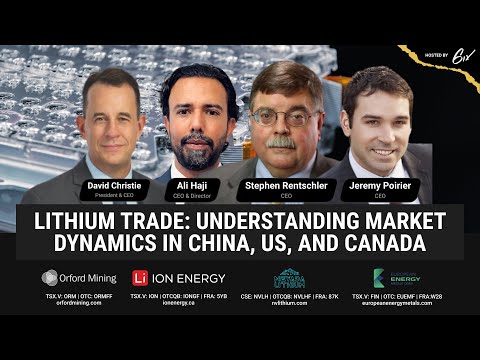
0:08 Hello everyone and thank you for attending today's live event, Lithium Trade, Understanding Market Dynamics in China, US, EU and Canada. This event is being recorded so you can go to fix.com in the following days to watch the replay. Also, I encourage you to ask any lithium related questions in the chat on the bottom right hand side of your screen at any point. I will try my best to incorporate it into the conversation at hand. If you have any company specific questions, you can put them in the chat, but I will most likely not address them. I can get in touch with the management teams afterwards and they can follow up with you directly. Excuse me, gentlemen, Thank you for joining me today. So why don't we first go around the room, please introduce yourself. And I want you to focus on these 3 points to start the discussion and we can go into further detail about your projects as the conversation progresses.
0:57 But Jeremy, why don't you start off and please state your name and title, how long you've been involved in the Lithium industry and where are your Lithium projects located? Thanks for having me, Kyle. Jeremy Poria, and I'm the CEO of European Energy Metals. I've been in the Lithium space for about 8 or 9 years now. After my last project, we took a bit of a hiatus, but back with European Energy Metals, our projects are in central and northern Finland, about 11 miles west of the Caliber Mine, which is currently being built by Sabine Stillwater,
1:36 which is slated to begin production in the second half of 2025.
1:41 Thank you. And Steven? I'm Steve Rentschler. I'm CEO of Novato Lithium Resources. I've been involved directly with lithium for about 2.5 years now. Previous to that, with all natural resources for the past 30 years. We have a project, our single asset, our core asset in Nevada in the US, about 2 hours northwest of Las Vegas called Bonnie Clare.
2:13 My name is Ali Haji, Chief Executive Officer and founder of Ion Energy. I've been involved in lithium since 2016. We have 2 projects currently in Mongolia. One is very much clay and evaporites. The other is traditional brine. And as of this year, we've acquired 2 additional hard rock projects in the Northwest Territories.
2:38 Thank you. And David?
2:41 Good morning. My name is David Christie. I am the CEO of Orford Mining. We have been a critical minerals explorer since the beginning of the company in 2017, looking for nickel, cobalt and copper in the Nunavik region of Quebec. We recently, this past February, added 500 square kilometers of exploration ground looking for lithium. This is a new territory for lithium. There are noted pegmatites everywhere and the highest lake bottom sediment sample anomalies for lithium in the province of Quebec. I have 35 years experience in the mining and mining finance world.
3:20 Great, thank you, everyone. So let's talk to supply demand fundamentals of the lithium market, and I want to see if everyone's on the same page. So I leave this open to discussion. But Is a risk on or risk off time for the lithium market right now?
3:38 I think that's a loaded question, Kyle. I think it's probably risk off for the macro markets right now, but I certainly don't think it's risk off for the Lithium market. I mean, what I would say is, when I started in Lithium, I think it was $6,000
3:56 price, and we were happy when it went to $9,000 or $12,000, and then initially ran to $20,000 and then pulled back. And now we're talking in the $40,000 to $50,000 a ton. So I think most of these projects that I've seen, like most of the low-cost producers have either been taken out or are being built by majors. And
4:18 with anything close to $18,000 to $20,000 a ton, these projects, the economics on them are quite robust. And I'm not sure that you're going to find that in a lot of other minerals within the mining space. Yeah, I tend to take a 30,000 foot view of the lithium space. It's the way I can understand it the best and sort of put it into context of other mature commodities.
4:43 You know to me no matter how you slice and you dice this you know the world's going to need somewhere between 2.5 or 3 million tons of lithium out in 2030, which is, you know, only 7 years away, according to all the forecasts I see. And if we're producing somewhere around 500,000 tons a year, You know, that's a compounded growth rate of 18, 20, 25%. It really doesn't matter. It's really about the magnitude of that growth and what's possible in the world of natural resource development.
5:14 You know, put things in context, again, in mature industries like copper, you know, the supply will grow with demand basically a GDP plus 1.5, 2%. And when things start to get out of whack, you start to get first of all price fluctuations. That's the way that obviously bring demand down to meet supply, you get through inventories, and then you bring in all your basically high cost producers that previously had been inactive. It's totally different with lithium going forward. There is no underlying mature lithium industry to fall back on. And demand is locked in. I mean the car companies are at the bequest of the governments
5:53 and by their own basically actions in terms of ripping out internal combustion engines. You know they're the process the plants where they're going to make them, they're committed to the batteries, they're committed
6:05 to the electric vehicles. So from my perspective, going forward, sure, we're going to have volatility. Nobody knows what Chinese traders are doing from now until whenever. You're going to have ebbs and flows in terms of EV sales. But the targeted penetration rates in the US and globally dictate that all of these projects are going to have to come to fruition. And that is a very, very heavy load to bear. And in the meantime, prices are going to be, they're going to be focused on bringing that, that supply online. And that's going to give an upward push to prices over time. I'm very, very optimistic about lithium prices going forward.
6:47 If I could touch on that, I think, you know, when we started ION in 2016, prices were 4,000 a ton. Of course, Jeremy, you pointed out that they ran in a manner that, of course, is not sustainable, not for a consumer to acquire a lithium vehicle. But now we're seeing things that perhaps were not capable of coming into production a few years ago, much like the clays. So we've
7:09 seen GM invest in Thacker Pass. Clays were sort of a dirty word 3 years ago. And today, with advancements in technology, we're looking at non-conventional assets with respect to brine. Of course the environmental impact as far as evaporation is concerned has now been somewhat mitigated by
7:31 DLE. And so we're seeing more and more non-conventional resources come online. I think the demand, as Steven, you pointed out, will continue to rise. Pricing was a bit dicey, to say the least, over the last few years on the back of government incentives for electrification. But we will require more lithium. And the juniors can perhaps leverage the majors that are building processing facilities in various jurisdictions that ultimately allow the supply chain to come online?
8:05 Yeah, you know, when you look at the demand and supply situation in lithium, there's definitely a growth in the lithium demand over the next 5 to 10 years that is set in stone, as Stephen said. And I think you're gonna see that fluctuate over time. The market is very opaque. You don't really see pricing per se in the contracts that many people will sign because it's not an LME traded commodity.
8:32 So we're always sort of guessing at what contracts people are signing, what prices they get. But I think when you move forward, battery chemistry will change. Lithium is going to stay in there. The amount that's in batteries in the future, we don't know. But I don't think Lithium is going anywhere. It's the lightest element to be in and lightest metal to be in those batteries. So I think the demand is solid. It's going to stay with us
8:55 and move forward. So bringing on new deposits in the next 5 to 10 years, you know, They're forecasting a 20% CAGR for the next 5 years. I think that's going to continue. I don't even know if we're going to get there, so I think we're going to still be undershooting supply for the demand that's going to be there in the next 5 years. It should be very good for pricing as we move forward.
9:23 Lithium companies have been a lot that popped up. It's for this demand that we're all speaking of right now. In terms of supply, They say there's a lot of lithium on this planet, but in terms of major producers of the metal, is there any reserves or anything that can overflow the market at all?
9:44 I think There's 2 big players in the world, Abernale and SQM, and they have been increasing their production over the past number of years, particularly SQM from their own assets and Abernale by buying other assets and diversifying around the world. And even SQM is starting to do that a little bit. I think they'll continue to increase production.
10:06 When you look at SQM in particular, they can't go crazy with their production because they need water and they're in Chile and water is a difficult situation there. So I think the big guys can't increase production in a significant way other than buying the juniors who are discovering new lithium deposits. And I think that's where this group comes in, is that we're out there looking for new Lithium deposits or developing them. And I think that's where you're going to see the big guys move as far as bringing out more production.
10:42 I would add to that, that one of the things that people don't talk about with Lithium is, you're right, it is abundant, but it's very difficult to bring projects online. It's a very complicated mineral. And you see most of the added production actually from Australia, which has been Albemarle. And we actually had a project in Chile that we put about $60 million into. And ultimately it's sold. It was in the Maracuna region. But, you know, there's a lot of political issues in Chile right now. So to David's point, they've been trying to wrap up or say, ramp up
11:17 the Atacama asset, which is the lowest cost producer in the world, but they've had trouble with not only water issues, but political issues that SQM has been having and government issues within Chile. So they're not easy to bring online. They're more science experiments. You know, there's been now about 2.5 billion dollars that have been spent in Quebec trying to bring hard rock projects online. Both of them have gone bankrupt.
11:45 So, you know, I think that, you know, not only are we trying to find new supply, but bringing these projects online is very difficult. And even you look at LAC, Lithium Americas, their Rhine project in Argentina was supposed to be online. I'm not sure of the exact schedule, but it was supposed to be online by now and they've had trouble with the ramp up. I think they'll be fine, obviously, but I'm just saying that bringing supply on is not as easy as it is with some of these other more mature mining markets.
12:16 Yeah, certainly. And to touch on that, I think you look at gold mining, for instance, if you have oxides, you have a heap leach, you have a sulfide deposit, you have a CIL of flotation plant that somewhat is a cookie cutter. Lithium, as you've mentioned, Jeremy, is very different. Each project has its own complexity, and as a result, you have to engineer a solution. And this is why we're finding challenges with respect to various lithium projects coming online with
12:45 the Chinese sort of manufacturers, Ganfeng, Tianqi and CATL, what they're doing in Indonesia and Zimbabwe as well, sort of expanding the ability for us to bring
12:58 assets online. And of course they are the largest consumer. China remains the largest consumer of lithium today. But we do have to become creative. We do have to work together as an industry. And we do have to ensure that we're able to bring these complex projects over the line. And I would add that, you know, these are all very fine points. You know, the reality is, even if the largest suppliers currently were able to double their production, and let's just say over the course of the next 4 or 5 years, it'd be a tremendous feat. And any company would be rewarded very handsomely by its shareholders.
13:36 But even if that were to occur, you know, from all of the basically the supply demand estimates that I've seen going forward, that would still leave the entire industry well under supplied again, buttressing, you know, basically giving the buoyancy to these, to lithium prices, which will incentivize other projects to come forward. One of the other things I just always mentioned, particularly to newer investors in the natural resource spaces,
14:03 you sometimes hear this about, you know, lithium's tremendously abundant, all of this kind of stuff. Well, you know, nitrogen is 85% of the air we breathe, but you know, the cost of nitrogen, if you were to go out and acquire it, it's not costless. It's how much it takes to economically extract this stuff from the world. So you can't just look at it as this simple, well, lithium is everywhere and therefore we can get it. And some of the more vocal people in the lithium space who are associated with cars will make prognostications
14:35 one way or another, which I think benefits them one way or another. But the reality is this is one of the most difficult commodities to bring into a usable form because in the end, this has to go very precisely into a battery grade formulation and a lot of deposits won't be able to do it. And that's the reason for having these bespoke formulations and basically tailor made chemical plants hooked up to these things to get the precise formulation of lithium that's gonna be needed to power the cars.
15:07 Thank you. Let's touch on that. I wanna explain, or you guys explain why it's difficult to extract lithium. And there's many different types of deposits and we have a good group here on to discuss the different kinds. There's lithium clay, brine, hard rock or spodumene. So touch on for the new retail investor interest in the space what's the difference what should you look out for for these specific types of deposits?
15:34 Well traditionally Brine has always been the go-to for lithium out of the lithium triangle in South America. And of course, that's been servicing the vast majority of consumers or consumption around the world. Hard rock is now again gaining traction. They had a run and we're seeing green bushes and various other hard rock projects really step up and provide
16:00 the lithium required. With respect to clay, as I mentioned with Thacker Pass, that's something that's still complex, rather expensive, but of course the commodity price allows you to invest such that you make money. So we are
16:16 finding other resources come online. I think the entire supply chain was very much driven by Latam, as well as Australia. And now we're seeing more and more supply come online. Europe, Finland, Jeremy, to your point, you know, it's a fantastic jurisdiction with a lot of good rock, hard rock assets there. And Mongolia, for instance, where we are, and I hate to take the plug here, but as first movers in Mongolia, we're seeing investment from Sinomine. We have assets that rival perhaps
16:48 the brine deposits in LATAM, but significant clay deposits that have the potential to come online. So it's more a case of finding the right deposit at the right cost curve to be profitable and ultimately provide shareholder value to Stephen's point.
17:06 Yeah, I think when you look at the various types of deposits, you know, the same thing rings through for all of its cost, as Elliot mentioned there. And so that comes back to grade And grade is more important in a hard rock deposit than it is in an oilfield brine deposit, where you're basically pumping water and extracting the brine. So grade for a hard rock deposit, which is what I'm looking for at Orford,
17:32 is extremely important. You need a pretty good grade and you need not many impurities in the Spodumene or Lithium rock you're mining.
17:41 And when you move down the chain to get it into a usable format for the battery suppliers. I think that what's gone wrong before in the hard rock miners who have gone bankrupt is they tried to do it all. They wanted to produce the final product that the battery suppliers would use. And that's not happening now. It's going to battery plants or chemical plants that are going to go down that process. Ford's building a big one in Quebec and there's others being built in North America. So these are things I think you need to have happen for you to actually be able to supply
18:19 the Lithium that's needed for the battery metals in the world. So having someone to work with down that chain, if you try to do the chemical experiment along with the mining or the brine extraction, you start to run into problems.
18:35 I think David and Ali covered the majority of what I would have to say. I would just add that brine is the lowest cost producer and that's why it's been primarily the one that's been used in the past. But most of the Rhine projects are now gone, or either purchased or being built. So that's why it's nowhere near the amount that we need to cover the supply and demand deficit.
19:05 And the other thing I would add is that with brine projects, because as David said, you're pumping the brine to the surface and then you're letting the sun evaporate out the solution until it's concentrated, you have weather issues. So that further disrupts supply. Whereas if you have a hard rock mine, or even a clay mine, even though it is higher cost, it does take on a more conventional mining mindset. 1 wild card I think here, and we don't know necessarily how it's going to play out, is the DLE projects. Some of these low-grade brines, there is a lot of low-grade brines out there, but we haven't seen 1 operate at a commercial scale yet for a long period of time. So that'll be that'll be an interesting one to watch and see how that plays out.
19:56 Yeah, that's an excellent point about the DLE and really watching that carefully, because my feeling is that a lot of the industry is said, you know, thinks that the DLE projects are the panacea for everything. I certainly hope that they work out, but a lot of it is unproven. But when I speak to investors about, you know, the differences in these types of projects, You know, I think about it as sort of an evolution where the brines, you know, to me were the ones, again, when demand wasn't that great, you know, the brines could satisfy that demand and you
20:28 have the hard rock coming, the pegmentites and all of this, and then ultimately ending up with the clays, which is what Bonnie Clare, our project is, were actually a sediment hosted deposit. And you get a lot of talk about just sort of these 3 baskets, but there are some very big differences. But in broad brush strokes, what it requires from all of them is a certain set of processes to get the usable lithium out of it. They're going to be different mining techniques some of which are going to have different benefits, some are going to be disadvantageous. But one of the big things I think that's also really starting to come to the fore is economic nationalism. So it's where these projects are basically being located. And you're seeing some tremendous upheavals as the value of the lithium is starting to be understood.
21:21 And of course, economic nationalism is nothing new. You see it. You've seen it in a lot of areas, a lot of different commodities where governments realized that they were given a lot of value away by just shipping ore someplace else to be processed, etc. But, you know, when in particular, if I look at, you know, South America and the brines or whatever, and then the triangle in Chile in particular, which, you know, is a huge copper producer and is going to have a lot of lithium probably to bring to the market if they can do it efficiently, you sort of have to think about all of these things in a dynamic way. So I would say as previously, you know, yeah, the go-to's were the brines and then you would follow up with a hard rock And
22:01 you know what, the DLE is a question mark. And then you finally get to the sediment hosted. Now, from my perspective, it's all needed. And I think you're going to see developments in all areas. So where we start? I'd love to touch on that, Stephen. Sorry, Kyle, very quickly. With respect to DLE, I think, you know, Sun Resin in China, they've been doing this since about 2018, 2019. Yes, it's not LCE, that's 99.9 purity for battery grade, but it does get to a stage whereby they can further refine to get to it. And then you have groups like Aramid, which is a French national mining company or private, PPE I suppose you could call it that, they're building in Centenario today. They will be producing about 24,000 tonne LCE at 99.9% purity, being carbon neutral in short order.
22:54 And so DLE, yes, was very much a dirty word, much like clays were not so long ago, but it's a thing that's really gaining traction. I think where the market or the generalist investor needs to really pay attention
23:06 is if an organization or a company were to tell you that they're bringing their brine to 99% pure LCE using a DLE tech, the large question or the biggest question one should ask is what is the cost per ton of your pilot plant, right? If you're producing at $120,000
23:27 US per ton, as opposed to where market dynamics are today, yes, you did it on site with expensive reagents that you perhaps cannot scale. But if you're bringing on a partner like the Airmet or the Sun Resins of the world there is a potential for you to do better. So be cognizant as an investor ask the right questions ensure they have the right partners that allow them to be profitable. If you are deploying DLE. Yeah. Just to touch on that because they're all good points on the deal.
23:57 It's been around for decades. This isn't something that's new. It's not something that's some novel technology. This is something that's been around. I think the question for me more so is. Every deposit is different chemistry. So the DLE to your point Ali it's not necessarily going to be economical for every single deposit. But in saying that, I think it's something that we're going to start to see large oil companies get involved in. I know of several that are working on this right now, because remember, oil companies are chemistry companies, liquid chemistry companies.
24:34 So they're very familiar with this. So I think it is something to watch and it's very interesting. I certainly don't want to suggest that DLE isn't going to work. I just think, is it going to work on every single low-grade lithium brine? That's where I'm a little bit more skeptical.
24:51 I agree. Great. So what is the market value right now in lithium plays? Is there a different, and This can be taken in many different ways, but even strategic investors, are they value in specific deposits more than others? What's moving the needle in the markets right now? Well, I would- Go ahead, Dean. I would say grade, close to port or transportation, rail, etc. And the ability to get the thing built and producing sooner than later. If you can deliver those 3 things, strategic investors are going to be there for you. And no matter what kind of deposit you have, If it's going to take a long time to get to production or permitting is difficult or you're not close to port or transportation facilities, then I don't think the strategics are going to
25:45 be that interested. Anyone else have further comments on that?
25:48 Yes, I think that, you know, we touched on it like most of the high grade brine projects in South America are gone. So you know, You can't really look at those anymore. I do agree that infrastructure is very important, but I think at the end of the day, grade is always something that's very important. And if you have something that's world-class and big, then I think guys are gonna be interested. I think you look at what Albemarle just did with Patriot Metals. They think that's a special asset. They paid a premium to market. They put $115M in. And there's a lot of work that still needs to be done there, but they're obviously very excited about it. So I think if you can find
26:35 a high-grade hard rock deposit, you can make the argument that that's a traditional mining set. Yes, it's still Lithium. Yes, it's still very difficult to bring online. But I think that they're comfortable enough and they've done enough hard rock mining projects that is probably, in my estimation, usually the quickest mining project to bring online in my view. So for the precious metal investor interested getting into the lithium space, I hear high grade. What is considered good grade for the specific types of deposits?
27:16 For a hard rock deposit, it's between 1% and 2% lithium. For the other deposits, I'll let my fellow speakers speak. But yeah, as Jeremy said, size is also very important. So a grade with size, you need both to really make it work. David, spot on. I think, you know, grade 1, 1.2 is sort of where you want to be for hard rock for brine.
27:41 But in terms of hard rock as well, let's touch on that for a second. You need veins that are not narrow. You need a deposit that, of course, has significant scale. And there are various narrow vein companies out there putting out grades of 4 4.5 Which is fantastic, but you can't build a mine if you have 200,000 ton LZ you need a significant quantum to be profitable. And with respect to the brine, I think the new entrance with respect to petroleum brines in the 30 to 60 milligrams per liter range are promising because they have scale and volume. But again, we're back at the DLE conversation, something that has not been proven, nothing that's in commercial production. So it's something that perhaps won't get too much attention from strategics.
28:29 Infrastructure, in my view, absolutely paramount, proximity to markets. And then you have to consider ESG protocols as well. So as we start to look at lithium supply from Australia or LATAM servicing perhaps Asia, 15,000 nautical miles on the back of a bunker burning ship for the clean green energy revolution as opposed to Mongolia, for instance, again, within 23 kilometers from the Chinese border being the largest consumer. So perhaps Asia's not too focused on ESG, but I think in terms of grade cutoff, we have to be a bit selective as to what's currently working, what may work, and what is indeed profitable today.
29:16 The precious metal investor who's always heard, you know, great is king. You always have to remember sort of the second part of that saying, which is that all else being equal. You know, and this is reflected as you go through the development of your projects and your preliminary economic assumptions, preliminary feasibility studies, which brings everything together. You know, the clays and the sedimentary deposits I've seen, you know, anywhere from 1000 ppm to higher 2000 ppm. But again, individual projects, Our PEA is very, very robust, you know, at much lower lithium prices than where we are. At 1000 PPM, basically, is our resource number. So there's an example of that. You know, it's very interesting, because if you want to say that the strategics this time around are more than just the big mining companies, but they're also the automobile companies.
30:12 I'll tell you that my experience with them has been that the number 1 thing that they're interested in is how quickly can you get me this lithium? And the point is, they're in sort of a 0 sum game, because if the lithium doesn't exist, they don't have a battery to put in the car, they can't sell the car to a consumer. But these people who are basically running the purchasing departments of the car companies, they basically have no experience with the kind of situation that lithium has put them in. If you're basically the purchasing agent for aluminum and you're looking globally at aluminum. It's always there, you can make your choices, etc. Here they're actually being forced to be portfolio managers, which is how I asked them to sort of think about it, how to address this. And not to necessarily say, hey, look, if I look at my near term needs and I take care of them first, by the time we get to the farther out to the 2028, 29, 30, that kind of stuff, everything else is going to remain constant. And I'll still be able to get my lithium then I say, hey, you don't understand how natural resource development works.
31:19 Because what will happen is those farther projects, those ones that are farther away towards the beginning of the next decade, if they are start to capital, then their ultimate production, you know, time to production is also elongated. So we have to put this into context. This is a very dynamic environment and I think we're going to see a lot of new things going forward. Thank you. Gentlemen, when you have a second, please read the chat because I'll address those questions but just so you get some context. But before we address the questions in the chat, one last question about the different types of deposits. What about the environmental impact and how do they vary? Well these are all very loaded questions Kyle.
32:09 What I would say just is that all of these projects, whether you're talking about brine or clay or DLE or hard rock, they're all created differently. So, you know, to sort of lump 1 in and say, this one's the best and this one isn't, it really is project dependent. But what your question is on the brine projects, Water is an issue, right? I mean, it's an issue obviously on a lot of different projects, but specifically on brine, because you're pumping the water out of the ground, you're evaporating the water, then you usually have to sometimes, or sometimes you have to use a re-injection situation. So, you know, the brine projects I would say have a pretty substantial environmental impact and you've seen, you know, some criticism of them within South America.
32:58 But again, it really varies project to project. But I can tell you that probably everyone on this panel, I can't speak for everyone, but I would assume that we are all practicing best environmental standards and working with local authorities to make sure that we're following all the rules and regulations. I'd agree. I think Brian traditionally has been extremely detrimental, especially when evaporation is concerned, you lose water tables, you have sort of land collapsing below you, you no longer can support agriculture or livestock for that matter. That's something that's now changing. Chile, of course, has been at the forefront of those environmental issues and, you know, they've been a large producer and of course they have to step up and with respect to DLE, there are opportunities to put back between 95 and 98 percent of the groundwater back into those aquifers. So there is a potential there to do things better.
34:00 In terms of Hard Rock, you know, if it's a pristine piece of land in the Northwest territories as we've seen, and we of course have acquired 2 pieces of or 2 licenses up there, you have to leave the land better than you found it. I think that's principally the correct way to do things. It's something that, of course, has been the ethos of the way that we operate well before ESG was a buzzword. And it's a way that we have to continue to operate. So I'll pause there. Yeah, I would actually add to that on the, like an SQM type plant in the Atacama, if any of you have ever been to the Atacama, it's the desert of deserts and they're pumping water from wells. And they've now been forced to look at a seawater plant where they're going to desalinate the seawater, bring it up to the site and use that for their process.
34:55 So that's going to be a very expensive event for them. So that's going to hamper as far as production expansions of those out of cameras deposits that they have. When you look at the hard rock deposits, it's mining. So you got to look at it like mining. You got to put it all back as Ali said to the way the best you possibly can after you're finished with the space and move on. Yeah and just when it comes to natural resource development of course best practices are here to mitigate the impact from all the different aspects whether it's the excavation or the recovery process or whatever. But generally you think about open pits and people don't necessarily like to see them and with associated tailings deposits, which need to be contained so you don't have leakage, how you recover it, do you use sulfuric acid, do you not use it, That kind of thing. So all of this is, I think it's been elevated in importance because the end user of the lithium, and I'm going to say now this is really all about the electric vehicle.
35:58 You know, those end users are very cognizant of the ESG impact. That's basically to a certain extent why they're buying the EVs. So everything from, hey, how far does your material have to go to get into a battery, is important to how you're actually mining it. So you're going to see a lot of extra importance, I think, or at least illumination put into these areas in the lithium industry. Great, thank you. So let's address the question in the chat, if everyone had a chance to read it. What are your thoughts on the replacements of lithium-based batteries with sodium? Sodium seems relatively available as well. Every alternative battery chemistry that I've seen still requires a tremendous amount of lithium. I don't know particularly with sodium, but I think that's also true.
36:46 The other thing that I would say is you see a lot of new amounts of announcements about you know alternative battery chemistries. It strikes me as 1 pops up every month. It's been you know developed in a lab somewhere or whatever. It takes a long time to get something to where it's essentially stable enough to be thought about in a commercial production terms. I don't really see, you know, sort of the lithium ion batteries that we have here now being displaced by anything else that would require a significantly less amount of lithium. Yeah. Yeah. Jeremy. Thanks. Of the things that I worry about that one's probably at the very very bottom of the list You look at a periodic table hydrogen helium lithium. It's the lightest metal it holds the highest charge So I don't see anything replacing lithium ion batteries, at least when it needs to move.
37:40 You know, so like cell phones, cars, things that you need to carry and move around that need to be light. There's absolutely, in my estimation, nothing that can replace it. I will say, you know, there's been talk of like vanadium redox battery for sort of battery storage. Things that don't need to move, that are stationary and can be large, I could see those, but anything that is mobile or close to the outlet that needs to move, I don't see anything else replacing it. As I said Early on in the discussion, I said that battery chemistry is going to change, but I don't think lithium is going to go out of it. It might change in the amount that it is used, which is probably something that battery producers want to do. But I don't think we're going to lose lithium in the battery technology, not for the foreseeable future anyway.
38:34 Other technologies like hydrogen, hydrogen fuel cells may come into play at some point in time. But right now there's no infrastructure for that. Right. Exactly right. Lithium ion batteries have been around for, since the 50s. Nobel laureate invented the technology. So it's tried and tested, it's stable. We know that it works based on its position in the periodic table, based on density as well. Sodium ion and everything else that may potentially come online, yes, they may. And you know what? I welcome competition. I think if sodium ion or graphene batteries or any one of these technologies were to come online, it pushes us as lithium miners and ultimate lithium consumers to be more competitive. Despite the sort of ability to enter the market, we will continue to be competitive because it's a tried and tested, improved technology that is stable.
39:32 Great, thank you, everyone. So the description for today's panel was on the opportunities and challenges in developing and selling lithium assets. So why don't we go around the room and you can talk about your own jurisdiction and what the current scene is looking like there. Is there much activity going on in your country and region? Just educate the listeners that might not be familiar with their area. So I'll start with you, Jeremy, with European Energy Meadows. First off, is there any history of lithium projects in Finland? Why don't you update us on Finland and your project? One of the things that attracted me to Europe, other than Finland being an excellent mining jurisdiction, is that they want to secure 30% of their supply at minimum for critical minerals. And there's just, there's no mines being built or developed really, or very few within the EU.
40:24 So we think that we can potentially fill that supply gap. And as far as what's being developed, There's a mine 11 miles from us. And it has similar, if not the same geology as we have. It's owned by Sabine Stillwater, or the majority owner of Sabine Stillwater, which is a New York Stock Exchange listed company. Last time I checked, I think it was a $5Bn plus market cap, and they're spending about EUR600M and slated to produce 16,000t per annum. And it's going to start in the second half of 2025. So we think we can be part of that supply gap. One of the things I would also add is they're currently building a hydroxide plant with 30% capacity within Kokkola, which is the nearest city to our project, which is on the Baltic. So you have shipping, rail, infrastructure. We're not in the middle of nowhere.
41:15 So those are the things that really attracted me to Finland. And it is relatively underexplored if you compare it to some of the other parts of the world. And Stephen, why don't you go ahead and educate everyone on the Nevada scene? Sure. So, you know, the world obviously is bifurcating in terms of, you know, where your lithium is going to come from. And we've seen in the US the Inflation Reduction Act that was enacted, I guess, finally in its final form at the beginning of the year, even though it's about a year old, which is giving these electric vehicle tax credits for EV material components that are sourced basically from the US, from friendly countries. The US has a tremendous mining history, however not in lithium. We have 1 lithium mine, Alvamarle Silver Peak, which is only about an hour away from where we are in Nevada, a little bit northwest of Las Vegas.
42:13 So down in the southwest corner of Nevada. What I tell people who've never been to the US is to don't always think of New York City and the metropolitan area, etc. We have great expanses of area that are in very mining-friendly jurisdictions. And Nevada is one of them. Tremendous history. It's the silver state, produces gold and silver on the order. I don't know if it's the 4th or 5th largest producer when taken as a state globally, but over 150 years of federal land. The ground is owned by the federal government, 85 percent of it. And we have infrastructure. We have other people who are coming into the area. I think that Nevada is going to become the cornerstone of the U.S. Lithium mining industry, and because of what's going to be needed in terms of infrastructure, you're going to see almost the development like the BC Coalfields or the Pilbara or whatever. You go right up Route 95 and you'll see at least a dozen projects going up along past Albemarle, Silver Peak, up into Thacker, you know, all the way at the top, McDermott, et cetera.
43:18 It's never been needed before, but people understand the need for this lithium now. And one of the ways I put it into context as well is that I calculated the value of those EV tax credits from the inflationary dollar, And it's over $80 billion. And when the time came for the government to try to figure out how to, you know, basically how to administer this, this law, and it shows you sort of how new everybody in the US government is to this. I said, look, if you just took a you gave it to the car co the developers, I mean a It would help to assure t forward. That's all it wo developers to basically g their feasibility studies to bring bring to fruition of lithium carbon and all going to need.
44:09 Our project is a big sedimentary hosted deposit. We have a recovery flow sheet that's in place. We've demonstrated that we can produce battery-grade lithium carbonate, and I hope to be able to show that we can produce battery-grade lithium hydroxide very soon. We're working on our PFS. We just completed a successful financing, and I think that you're going to see over time the strategics and here I'm talking more about the card companies get more involved with companies of our size as they realize that they need the offtake they need to secure it basically on whatever terms are asked because without getting projects like ours to development or through development and to production, they simply won't have a product that they'll be able to sell. So we're looking at a very, very good outlook for the US and I think in Nevada where we're situated in particular going forward.
45:06 Thank you. Ali, you have lithium projects in both Canada and Mongolia. So, 1, can you touch on Mongolia first and the lithium industry there? And if you want to touch on Canada as well, please feel free to do so. Thank you, Kyle. Mongolia is a country that our group has been in since 2009. It's a very resource-rich country, about 1.5 times the size of Ontario, with a very friendly mining jurisdiction. Rio Tinto runs the third largest gold copper mine in the world, Oyutolgoy in Mongolia. We have a very young demographic of individuals that are interested in mining, recognize its economic impact for the country, and thus of course are educated either overseas or in country for the mining industry. So you have labor available for you to advance any sort of initiative you may have from a mining perspective.
46:00 In terms of its sovereignty, it's part of the ex-USSR, so now a sovereign nation that of course is sandwiched between China and Russia. China being the largest consumer of the vast majority of natural resources on the planet makes Mongolia a very fascinating place to work in. You have the likes of Xanadu. China is now starting to invest quite heavily in Mongolia. We're seeing that with our Urgat-Narin project being 7 kilometers from the grid, the national grid, and of course about 50 kilometers from high-speed rail into China. A very strong sort of infrastructure-rich project as opposed to perhaps importing lithium from Australia or Latam.
46:49 So in terms of where we are, we're finding a lot of value. We also have had a major Chinese strategic invest in the lithium mine in Mongolia. So it is a country that of course is getting a fair bit of value with respect to lithium potentially. But us being first movers, we don't quite get the love. And you know, Jeremy, you can probably attest to this with Finland and lithium being rather recent for Finland. But Nevada, it's been there for a while. And you talked about Silver Peak in Nevada, Stephen. Silver Peak as a comparison is very closely related to our Ugandan project, both in terms of elevation and as well as grade. In fact, our grade is twice over peak, the only producing brine asset in North America today. So Mongolia, a very interesting jurisdiction with a lot of potential, but we are first movers. We have to prove ourselves before we receive that strategic investment.
47:44 And what we did in Canada was we looked at the Northwest Territories with respect to lift power, PEMET, GAMMA, and various others that are finding success in a region that had exploration commence in the 60s and into the 70s. And We acquired 2 assets there. And the reason we did so is our goal as a company is to find assets in jurisdictions closest to the market that will require them. Mongolia, of course, will serve the Asian market and the Canadian assets will have to serve the North American market that is now coming online in a rapid way. And Jeremy, that doesn't say we're not looking at Europe, because I think Europe will require lithium. But for now, we're very much focused on Canada and of course, Mongolia as well.
48:31 Thank you. And David, last but not least, you have a diversified basket with Orpher to have an exposure to gold and nickel, but why don't you touch on your lithium project? Yeah, so first of all, I'll say why we were there. We're in the Cape Smith belt of Northern Quebec. It's probably one of the most prolific Nickel belts in the world. We've got the Raglan Nickel mine just down about 90km to the east of us and the Nunavik Nickel mine that the Chinese operate. Raglan mine is probably one of the lowest cash cost producers in the world. So we have a critical minerals hub right around the corner, year-round port facility right there. So last year, sort of mid-year, we started looking at lithium. Quebec was going crazy, staking everything and anything in the province. And we looked at the data that was available in the area, the lake bottom sediment data that Quebec had done across the province, we had the 90th percentile numbers in that area of Quebec.
49:22 There was matte pegmatites by the Quebec government that have never been explored or touched. So we started looking at what we would stake. And then this past January, February, we staked 500 square kilometers of land to explore for lithium in those areas. The first move or advantage in the area since then, there's been a few other companies that come staked around us. But it's an exciting area. You know as far as strategics you know on our Nickel project, Wailu Metals is earning into our project there. They've reached 51% or have made the move to 70. So we've already got a strategic looking at our assets from a Nickel point of view. And I think, you know, it's very early days on our Lithium projects. We've just finished our first sort of, we're working on our first summer of exploration on those projects, but there's definitely pigmentites on the ground, as we've noted in one of our press releases.
50:16 So we've got lots to do there. We're very excited about the potential of the area. We're less than 100 kilometers to a deep sea port that operates year round, that is probably closer to Europe than it is to the rest of Canada. But it's a great place to be. Thank you. And I'm just gonna address Ron's question here in the chat. Can anyone speak to the future of lithium trading price? When will investors be able to see a daily market exchange or monthly index number? I'd love to be able to give him a timeline. They've been talking about this for years. When we were in Chile with our last project, one of our board of directors actually runs a metals exchange And they primarily traded in Copper, obviously being in Chile.
51:08 But there was talk even back then, that would have been 5-6 years ago, there was actually meetings taking place in London talking about having an actual exchange for lithium. And it just hasn't materialized as of yet. And I'm not sure necessarily that it will, it's still a relatively small market if you compare it to other metals. And also the other thing is that there's different types and even you commented on this earlier, there's different types of compounds, different types of battery compounds. So hydroxide in comparison to carbonate, in comparison to some of the other lithium compounds that they use for greases and different industrial uses. So the short answer is that I think it would be good. I think it would provide transparency for the market, but I personally don't don't sort of have a timeline or holding on hope for that.
52:05 I think everyone's in agreement here. So we have 10 minutes left. And for people that are tuning in and might not have heard of your company, this might be the first time, I'm just going to ask you the most direct question. What is your goal with your company and how are you going to make your shareholders money? So I'm going to go in reverse order this time and start with you, David. Yeah, thanks, Kyle. So Earthware Mining is an exploration company. We're looking to find mineral deposits. We have a great Gold project at Kigovic, a great Nickel project at West Raglan, another Gold project in the Abbot Tibi called Chitale Eagle, which we're working on getting a resource on. And of course, we have our Nunavik Lithium projects, which there's a number of properties covering over 500 square kilometers of land. We're looking to find mineral deposits and bring those to development. And I think that's the key here.
52:54 We want to find economic deposits that will bring the share price up by finding those deposits. Ali, give us your pitch. Of course, with ION and our 2 assets in-country, of course, the clay asset has a lot of potential that will perhaps appease those that are interested in clay. As far as Urgatnaren is concerned, the Brine deposit we're currently working on. We have a resource calculation pending. I think that'll be a significant upside on the basis of the volume that we've seen relative to our peers that are in Latam today, trading at significant multiples of our market cap. But of course, you know, you look at the team, we have the likes of Paul Fornazzari, the original chairman of Lithium Americas, founding director of Neolithium, Dr. Mark King, the QP that wrote the final report on Neolithium, price of its sale to Zijid for close to 1 billion dollars. He'll be in country in about a week and a half time to help calculate that resource indication.
53:53 The goal for us with the Mongolian assets is of course to bring on a JV partner to help develop, fund, and ultimately bring those mines to production. That's a liquidity event, I beg your pardon, for our shareholders. And with respect to what we have in the Northwest Territories, being adjacent to the likes of Lit Power, as well as P-MET, we have consolidation opportunities, but we also have a jurisdiction that's really getting a fair bit of a spotlight that of course we can leverage in terms of the work we're planning to do there next year based on flow-through funding. Thank you, Ali. Stephen, why should people consider Nevada Lithium? Well, Nevada Lithium is probably the quietest company, the most unknown company that is actually an advanced development company, I would say, in the lithium space.
54:46 In the course of 2 years, we've consolidated 100% of the Bonnie Clare asset, which mining.com just called the third largest sedimentary deposit globally out there. We've always referred to it as either the 1st or the 2nd largest in North America. It's a massive deposit on which we have preliminary economic assessment that I won't give you the precise figures here. But you know today's anywhere close to today's lithium values is worth billions and billions of dollars. And our market cap is 60 million Canadian. You know we have at least 2 different avenues I think to get value out of Bonny Clair. The first of course is is to build this. And we're going to bring it on production somewhere. 20 29 20 30 32,000 tons of lithium carbonate.
55:33 This is a 40 year mine life. We're only using 5 or 6% of the entire resource that we have. It's primarily getting ready to be upscaled. There's so much that's there. But in the meantime, what we could do as we continue to talk to strategics and to auto companies, etc. Is try to shave off pieces of that with regards to offtake and then selling a piece of it for a percentage of NPV. And I would argue we have one of the most compelling, you know, risk reward metrics out there because of elevated lithium prices and I think that it is safe to think about lithium prices being elevated going forward. So multiple paths to basically extract maximum amount of shareholder value. Some are of the shorter duration than others.
56:20 However, we feel confident that we could ultimately take this to production because we're in arguably the greatest jurisdiction in the world right now, which is Nevada. So that's sort of our pitch in a nutshell. Yeah, thanks. With the European Energy Mail story, we want to be part of that Lithium supply chain within Europe. We have a highly prospective project. We kicked off our initial exploration program on June 26th. We're actually extending it through to the end of October. Originally it was September. And we've been finding a number of pegmatite dikes with some of the indicator minerals that you would want to see. And as I said, a very similar geology to the Caliburn project, which is 11 miles away. And we've recently actually picked up additional ground, bringing our acreage up to 5,000 square kilometres.
57:18 So if you look at us from a risk reward standpoint, we're a 15 million market cap today. We have about 2.5 million dollars in the bank and we'll have a lot of news in the fourth quarter here as far as results with ultimately coming up with what we think is a pretty robust geological model of something that could be worth in the hundreds of millions, if not billions of dollars. So, you know, if you're looking at paying for 15 million for an opportunity to be a shareholder of something that could be worth in the hundreds of millions. I think that's very compelling. And ultimately, I think we're going to be filing for our drill permits here, our initial drill permit in the next probably couple of weeks and hope to be drilling in Q1 of 2024.
58:04 So being right next to a port, right next to a hydroxide plant that has excess capacity and a mine that's being built, I think there's a lot of reasons to take a look at European energy metals. Thank you, gentlemen. It looks like we have one more question and we do have time for it. So I will address it here. My phone's on, excuse me. Is momentum and critical mineral investment building up in the USA. Any examples of this? Is Biden supportive? Can a change in administration impact policy? I don't mind taking that. One of the things I think that happens in the US is once these types of programs get into legislation, they're almost impossible to get out. I mean, even when you hear about perhaps tremendous overruns that are going to occur, I think they value the Inflation Reduction Act somewhere, maybe a couple hundred, yeah, a couple hundred billion dollars.
59:04 And you hear that it could go well over that, be double or triple that when it's all said and done. There's really no way for subsequent administrations to come in and remove that. I mean, almost by virtue of the way the US government is set up with a bicameral, you know, the Senate and the House of Representatives, the Senate in particular, it'd be very, very hard to get stuff to be reversed, to get it all the way through Congress is what I'm saying. So I think we have to think about it in terms of yeah it's here to stay. And I think what you also have at least in the U.S. Is all these announcements coming up of where clearly there is a transition being made away from the internal combustion engine to the electric vehicles. And I just see the development of the lithium industry in particular to be just a natural follow up to that. All this money that the Department of Energy has to give away, they can't just keep giving it to battery plants. You know I mean they understand that kind of stuff.
1:00:04 You know I think intuitively they don't really really understand the natural resource development. But I think it's only a matter of time until that jump is made. I mean you see some of the auto companies making it with early stage projects. I think you're going to see that at the governmental level in the U.S. I think it's here to stay.