David Speck
CFO at Thunder Gold Corp
Replay available
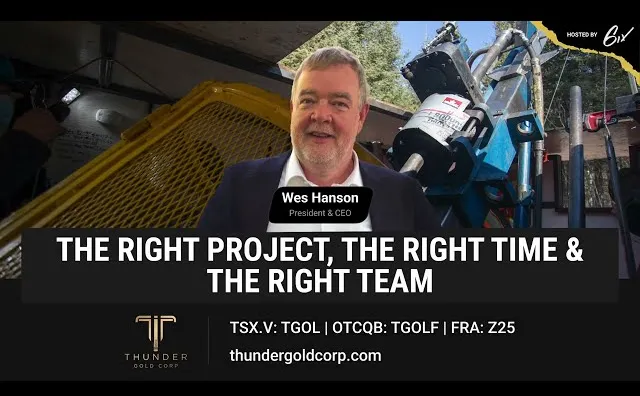
Join Thunder Gold's CEO, Wes Hanson, for an intimate invite-only event for accredited and institutional investors. Here he'll share the opportunities at Thunder Gold and makes himself available for any questions you may have about the company, its holdings, its investment thesis or its busy upcoming quarter.
Automated transcript · Written by software from the replay's audio. It can mishear names and figures; the replay is the record.
0:08 Hello everyone, welcome to ThunderGold's live investment summit. I'm pleased to introduce the president and CEO Wes Hanson. Wes will review the latest ThunderGold corporate deck. Afterwards, we'll do a Q&A session. So feel free to submit any questions on the right-hand side of your screen there in the bottom corner. If you'd like to get in touch with the ThunderGold team, I will be submitting a survey in the Q&A chat once we start the Q&A session. As always, this is gonna be recorded and will be available on six.com in the coming days. So without further ado, I'll let you kick things off here, Wes.
0:42 Hey, thanks Kyle. And thanks to 6 for hosting this event online and thanks for everyone taking time out of their day to attend this presentation. Thundergold is a company based out of Thunder Bay, Ontario, hence the background photo in this opening slide. We believe we hold the right project, we've acquired it at the right time and that we have the right team to drive shareholder value going forward. I'm a QP with over 40 years of experience. I'm a professional geologist. I defy anybody to name a job that I haven't done in the mining or mineral exploration space. This forward-looking statement basically tells you I'm about to tell you nothing but the truth, the whole truth, so help me God. So let's get into the meat of the matter.
1:29 I was, as I said, a 40-year, a geologist, professional geologist with over 40 years of experience in the industry, I was kind of looking to transition out of the space and start enjoying life. Semi-retired, I was going to keep my finger in a few pies, but I wasn't really looking for a full-time opportunity by any stretch of the imagination. I was approached by what was then known as White Metal Resources to fill their vacant CEO role about a year ago. I declined several times because I understand what the role of the CEO entails and I wasn't really willing to commit to another junior company at that particular junction in time and they kept coming back to me and asking me if I'd reconsider.
2:21 And, you know, finally they convinced me to take a look at the data and that was a smart move on their part because one thing about data is it rarely ever lies. And the other thing is the data from their primary asset, which is the Tower Mountain property located just outside of Thunder Bay, Ontario, was a very compelling opportunity. I recognized it right away, and what I see is an opportunity for a tier 1, large tonnage, low-grade discovery. This discovery has the opportunity for over 10 million ounces of total resources or perhaps more, capable of producing over 500,000 ounces of gold annually with a greater than a 10-year mine life. And that's the target that we're talking about here.
3:06 There's no guarantees, there's a lot of exploration work that's going to have to be done to establish that target, but the important thing for you as an investor to remember is that the opportunity is absolutely there, and I'm gonna demonstrate why as we go through the presentation. So the property is 50 kilometers from the port city of Thunder Bay, and that's important for a couple of factors. First of all, that proximity to established infrastructure is a huge benefit. I don't have to build airlines or airports or railroads or roads or anything. All of that infrastructure is already in place. Thunder Bay is a resource sector town with a population of over 100,000 people. It's 50 kilometers away with access via a paved highway.
3:51 There's no logging roads to take. There's no sketchy trails that you have to expand or rehabilitate in order to access the property. We can drive by highway, and then we have a 3 kilometer road, dirt road path that we have to take to get to the property's core shack. The Eastern Shibanu and Greenstone belt is a largely unexplored green. Explored green stealth in cultural resources, about 6 million ounces in the 1 gram per ton range.
4:38 But recently, the company to the northwest of us within 10km, Delta Resources, has been issuing a series of very positive drill results that indicate potential for them to have a deposit similar to what we've begun to outline at Tower Mountain. So now you have 2 multi-million ounce opportunities within the 10-kilometre radius of 1 another, which demonstrates district-scale potential of this camp. And that's an extraordinarily important change in the situation for both us and Delta. Now you've got 2 projects in parallel that have huge upside opportunity. Tower Mountain is by far the more advanced project of the 2. There's more than 24 known geochemical targets. About half of those have been drilled. Over 190 drill holes have been completed, totalling about 41,000 metres. And of that 41,000 metres, over 40,000 have been sampled. That's been sampled entirely for gold and approximately 20 to 25 percent of the database has been sampled for other elements.
5:39 There are currently no significant elements other than gold that are of economic interest. There are some areas of elevated copper grade, but really nothing of significance to date. Of course, that could all change with continued expiration over time. What that drilling has defined is a zone of gold mineralization along the Western boundary of the Tower Mountain Intrusive Complex that measures 1,800 meters along strike and remains open along strike. It's approximately 300 meters wide on average, ranging from 100 meters at the narrowest point to 500 meters at the widest. And it's been drill tested to a depth of 500 meters and it remains open at depth. And 25% of the total drill holes completed on the project end in economically viable gold mineralization.
6:30 So there's lots of opportunities at depth and a long strike, and I'll get into the details on that shortly. Premium jurisdiction, I mean, province of Ontario, one of the most preferred mining jurisdictions in the world. The infrastructure is in place, as I alluded to, we not only have highway access, but both national railroads are within 3 kilometers of the northern boundary of the property. And there's an Ontario hydro line that crosses the claim block. We've established the metallurgy of this particular exploration opportunity. Results of our preliminary metallurgical test work are indicating recoveries of greater than 90%. We have proven geophysical vectors that improve our ability to target the system and return viable results. And we have best of all, our geophysical vectors indicate a potential to increase our known strike length by 3 to 5 times over the currently defined 1800 meters. So there's lots of upside potential on this particular project.
7:27 Drilling costs are quite low, less than $250 a meter, which is spectacular in today's market. Our corporate burn rate is low, less than $50,000 a month. And the management and board of the company have extensive experience, particularly with large tonnage, low-grade deposits. So we know what we're looking for, we know how to find it, and we know how to drill it efficiently. Our objective is simple. We want to demonstrate that Tower Mountain has the opportunity or offers the potential for a Tier 1 gold discovery. And we want to rapidly establish that opportunity, define the quantity and quality of the mineral resources as quickly as we can, and hopefully attract a takeover bid at some point in time in the future from a gold-producing issuer.
8:14 So this is the Eastern Chebandawan Greenstone Belt. I know that Delta Resources has been releasing positive results and they've just announced a major new drill program where they're going to be expanding on their Delta 1 discovery. It's approximately 10 kilometers to the Northwest of Tower Mountain, which is our gold discovery, Thunder Gold. Now that lies dead on the lithostructural trend of the district. These are all basically, these are all intermediate to mafic volcanics and volcano plastic rocks. And the Delta indicates that they're following potentially a structural type system. So more classic of the superior greenstone belts with shearing mineralization hosted in shearing and associated with quartz carbonate tourmaline veins and the plastic deformation that's associated with the shear zones. Ours is kind of a unique beast for superior greenstones.
9:09 Our deposit at Tower Mountain appears to be an intrusion-related gold deposit. It is directly linked to the Tower Mountain Intrusive Complex, a 3 kilometer long by 2 kilometer wide oval sequence or a series of successive intrusive events ranging from cyanides to diorites, but dominantly it's the alkalic cyanides and monzonites that comprise that central intrusive core. And that appears to have introduced mineralization as a halo around that entire intrusive core. And that's what we're targeting with our exploration program. As I noted, Delta is a game changer. It demonstrates the district potential of this particular camp. I'm sure I don't have to go through this with anybody in this call.
9:56 This is meant for a different audience, but basically the right time. I'm very, very bullish on the price of gold. I think there's lots of upside potential and value creation to come on the gold side of the equation in the coming years and acquiring a project and doing the exploration in advance of that anticipated increase in gold prices and valuations is critical to everybody making money on this particular opportunity. Management and board, as I indicated, extensive experience with large tonnage low-grade deposits. Both Warren Bates and Dr. Scott Jobin-Bevins, who are directors of the company, Both are professional geologists, both have 30 to 40 years of experience, both have a specific focus on large tonnage low-grade deposits. David Speck is our CFO, he's got over 35 years of capital markets experience.
10:47 Elliot Strachan is the chair of the company, and he's been with the iterations of ThunderGold since the company was originally formed more than 40 years ago. So he's been through the battles with the company as they've moved from project to project, under different names and different periods, looking for different metals, But he's a huge supporter of the vision not just of Tower Mountain but also of the Chippewa Belt as a whole. Bonnie Linda Bartok is a recognized expert in social governance and she'll have a vital role to play as we begin the process of establishing our social license to operate in the Thunder Bay and Northwestern Ontario District. And Nigel Lees, a professional director with most recently spent 17 years with Yamana.
11:36 So a very solid board of directors with a lot of practical experience in both the junior mining space as well as the geological space. We have 167 million shares issued and outstanding, 193 million fully diluted, a million dollars in Treasury as of the end of May is what's shown, but it's more or less the same balance now. Our burn rate when we're not drilling is $50,000 a month, so it's quite low. The insiders hold 15% of the issued shares. The remainder is largely retail. The institutions, I think, those were largely flow-through funds that are invested in the company in the past. And I think a lot of those have probably changed hands. We have to update that shareholder list.
12:24 This is an overview at aerial view of the property. You can see the original claim block, which is approximately 2000 hectares. We completed our option on that 2,000 hectares 2 weeks ago and announced it to the market. So that is 100% owned by the company. At the same time, we also announced that we acquired an additional 500 hectares from Metallo Resources And that was 2 blocks, 1 to the northwest, 1 to the southwest. So we've got a total land holding now in the district in the range of 2,500 hectares in total. The stars that you see are the known gold showings, the 24 known gold showings. The yellow stars or the gold stars are drilled. The silver stars are yet to be drilled, but they offer compelling exploration targets.
13:15 So the geological, the regional and local geological picture is complex to say the least, but basically the oval tower mountain intrusive complex sits here on the right hand side of the screen and is shown in different shades of pinks and mauves and purples, and that reflects the multi-phase nature of that intrusive complex. It's dominantly an alkalic intrusion, dominantly it's cyanite to monzonite, but there are areas of gabbro and diorite that are present. And all of the known mineralization exists along the western boundary of that intrusive complex. And that edge is basically like a deck of cards that's been shuffled. You have alternating bands or alternating intervals of intrusive rocks mixed with alternating intervals of dominantly volcanic, intermediate volcanic lapilli tufts and tufts. So these things are intermixed.
14:12 The host volcanic sequence, the intermediate volcanics have been shattered. They've been fractured down to the crystal level. That's how intense the pressures have been on this particular system and that shattering has caused a fine network of fractures that are then infilled with pyrite and quartz carbonate tourmaline. The quartz carbonate tourmaline veins generally are a centimeter scale and as yet there is no clear picture on their orientation. They appear, they're almost ubiquitous, they appear everywhere within that 1800 meters of strike length. There are areas that are more concentrated or more intensely stockworked, but that our understanding of that stockwork system is still being developed. Same with the pyrite fracturing. Pyrite fracturing is pyrite, both as disseminated and as fine fracture filling is everywhere and we have a better handle on where our highest pyrite content is largely as a result of our geophysical surveys that we've completed to date. So this is the 1800 meters of strike length from UV here in the Northwest, which is drilled off on almost 25 meter centers and feature a lot of early bonanza grades from 2002 to 2007.
15:29 That was drilled off by a company, Valgold Resources. In 2007, Valgold discovered the bench discovery, which is further to the south, and focused on drilling that off until 2011. ThunderGold's predecessor company, White Metal Resources, acquired the claims in 2020 and initiated drill programs in 2021. That drilling as well as our 2023 drilling basically constitute the 190 drill hole data set that we currently have. This is what the rocks look like. You have a feldspar porphyry unit that's dominant towards the Northwest of the property in the UV drill zone. And it carries grades anywheres from 0 up to 15 grams per ton. And you cannot visually distinguish which is which, so you can't differentiate between feldspar porphyry that averages nothing and feldspar porphyry that averages 15 grams per ton. It visually looks almost identical.
16:30 Same with the volcanic fragmental host rocks. This is a classic example where the host has been shattered by the intrusion or the intrusive events. And that fine fracturing is then infilled with pyrite, which is the dominant, those very fine hair-like wispy fractures that you see and also quartz in some areas, quartz carbonate in some areas. But that's in this particular example, those quartz carbonate veins are discontinuous. And then the final unit of notice, the cyanides, the Alkalic Cyanides, which are dominant towards the bench target area. And same deal, like all 3 of these units feature finely disseminated Pyrite. Pyrite is fracture fill and then Quartz Carbonate Tourmaline veins up to 2cm maximum in size, but down to 2mm as well.
17:21 And oftentimes, our spectacular, our rare instances where we have Bonanza Gold grades are associated with visible Gold that's linked to some of these thicker quartz carbonate veins. But those quartz carbonate veins are multiple orientations and our structural mapping to date has not isolated a preferred direction on those quartz carbonate veins, that stock work system. This is a table that shows and demonstrates our drill results from Tower Mountain. It's a selection of different holes, but it's typical of the type of mineralization we expect to encounter as we continue to advance the project. So the 2021 to 2023 drill programs are summarized on the table to the left and the 2002 to 2011 historical holes are summarized on the table to the right.
18:17 There's a lot more holes to add, especially on the right-hand side of the tables, but it's just a function of time and efficiency. This is just meant to give you an overview of selecting intervals, assay results that we typically see when we're drilling off this deposit. So 80m at 1.7g. Here's a zone that starts at surface 21-108, starts 3.7m down hole, averages 3.9g per ton over 24m with a deeper interval of 12m at 0.583. So all of these intervals are relatively consistent. Here you can see one of the more spectacular Bonanza grade results. This interval from 105 to 140 meters in hole 137, basically 41.5 meters at 35 grams per ton. That includes a 941 gram per ton assay. That was the highest assay ever returned on the property and that was a hole that we drilled a couple of months ago, but that demonstrates that classic Monanza grade skewer in the data set. If we treat that properly by capping it, what we end up with is an average over that 41.5m of a little better than 1.9g per ton.
19:34 So there's still gold there outside of that high assay result and if you treat it properly for a resource estimation which of course everyone will do then you still got an economically viable interval remaining. The 2020-2011 drilling shows exactly similar results. So 70 meters at a gram, 40 meters at 1.2 grams, 78 meters at 1.9 grams. Here's another one with a Bonanza grade intercept 52.5 meters at 17.9 grams. That included the second highest assay in the history of the property. It was drilled in 2004. It originates from the UV zone, which is farther to the north, and that had a 588 gram assay over a meter. So the bonanza grades are there, but they're very, very rare.
20:21 And that makes me very, very happy because it means that you don't have a significant nugget effect that's gonna impact your future, potential future mining of the deposit. So here's a sort of a bleak view looking along the strike length of the of the Northwest trending zone. You have the UV zone up to the north. Of course the the mauve colored large circles are the higher grade. Assay results basically better than 5 grams per ton. Reds range from 1 to 5, the yellow ranges from 0.5 to 1, and the green which represents the final interval cutoff that's shown on this particular view, the green ranges between 0.3 and 0.5 grams per ton. 0.3 grams per ton is currently the economic cutoff grade of most major operating large tonnage, low grade gold mines in the world.
21:11 So we have UV to the north, it's been drilled off almost on 25 meter centers. What
21:17 we have, you know, There was a small historic resource estimated there in the past, but we don't reference that simply because it's so out of date and that has to be updated going forward. I think it ended up around 150,000oz in that range and an average grade of around 1g. But there's been significantly more drilling completed since that resource estimate, but it hasn't been estimated in an updated mineral resource estimate to 43-101 standards. Here we have the bench zone to the south, the Ellen zone up here in the northwest corner, and the A zone a little farther to the south. The A and the Ellen are 2 of the higher-grade
22:05 drill results or areas that we've drilled to date. Both of those start at surface and extend to depths of 50, 60, 70m from surface. There's room to expand on both of those targets going forward. And there's room to fill in in the middle as well as to continue the drilling further to the south. And I'll get back to that story in a moment. But lots of upside opportunity, lots of mineralization in the system to take a look at. So statistically, I've actually had the good fortune to work at the lowest grade gold mine in the world, which is the Paracatu mine in Brazil. It was owned by Kinross, and I was part of the team that looked at the expansion of the Paracadu project after Kinross acquired its 100% interest.
22:51 I never in a million years thought 0.4 grams per ton wasn't gonna work. I was wrong. I was proven wrong. The longer I spent there, the more I realized the benefits of scale and efficiency and low mining costs, keeping your costs under control. But mostly what I realized is there is a tremendous strategic advantage to being able to predict your grade from day to day, week to week, month to month, and year to year. So the grade at Parikitu, that mineralized system, lacked variability
23:25 and this is the second best data population I've ever seen in 40 years in the business. It's extremely well-behaved. It lacks significant variability. There's only 7 samples that have returned grades of greater than 30 grams per ton. Statistically speaking, when you use composite data analysis and evaluate everything on the same interval length, which is in this case is 5 meters. We form 5 meter composites. We capped our grades, our high grades within the data population at 8 grams per ton.
24:02 It only affected a handful of sample intervals. And then we do a statistical analysis of different populations extracting that composite data using things like lithology or alteration or drill direction or depth from surface or I've looked at probably, I would say conservatively over 100 to 120 different options to extract data from the total data set and do comparisons trying to identify any opportunities for enhanced grades or increased grades and I don't see any. In this particular instance what I'm showing is a random selection of that composite data above a 0.3 cutoff grade, because as I mentioned previously, 0.3 grams per ton is currently the economic cutoff grade for mineral resource estimates and plant feed at most large tonnage low-grade gold deposits operating today. So I think it's rather relevant.
25:03 And when we look at the population and we assign a random number to create equal bins of similar size, in this particular case, I've done 10 bins, so 150 composite samples in each bin. And we look at the average grades of each bin, what you see is very little variability. What you're seeing in terms of the average grade is the high of 0.91, a low of 0.685
25:28 and everything else in between. So you've got these red dots basically represent your average grade of each bin and the average grade of the total population, which is over here on the extreme left. And you've got very little variability in that average grade, which means predictability, which is a huge benefit in future development of this particular project. I think it's far more important than grade in many instances, because predictability just can't be beat, and I'll show you why later in the presentation. Bottom line at a 0.3 gram cutoff about 25% of the population of the composite population passes that 0.3 gram per ton cutoff hurdle. It averages 1.1 grams per ton on an uncapped basis And when you cap the high grades at 8 grams per ton, you have an average grade of 0.77 grams per ton. And that's that's probably reflective of reality in terms of evaluating this particular opportunity.
26:30 So of all the things I've looked at, I learned that gold is agnostic about rock type, it's agnostic about logged alteration, it's agnostic about quartz vein content or quartz stock work, although I am still reviewing that particular data, trying to find more clues or opportunities. So what we see is overall, this is for the bench zone only, for the bench zone and the 5-meter composite data, there was over 3,100 composite samples. And the average grade of the total population was 0.3 grams per ton. Now that's everything. That's material below the 0.3 gram per ton cutoff, as well as material above that 0.3 gram per ton cutoff. But what you see again is that amazing consistency when you start isolating by different rock types.
27:21 So where no rock type was defined, the average grade is 0.22, where, and I'm going to have to put my glasses on for this so I can read it. But the fragmental unit, which is basically a volcanic unit that represents the majority of our host rock. The average grade is 0.36. In the volcanics that's not fragmental it's 0.27. In a micro cyanide it's 0.33. In a porphyry it's 0.21. In the cyanide it's 0.22. So again, tremendously consistent grades across all lithologies. And what we do see when we isolate the data population of composite data is using contours of IP chargeability response. So as you increase the IP chargeability response, as the response gets stronger, what you see is an increase in grade.
28:12 So in this particular instance, you can see across the board increase in average grade of 3 to 4 times higher than the mean grade of the total population. So that suggests that the ideal target is IP chargeability and that's awesome for us because we've recently doubled the IP chargeable coverage at the property using Abitibi Geophysics. That survey was completed in January of this year, January, end of January, and it identified lots of targets that are available for immediate drill testing. So You can see our original data set sits here, associated with this very strong IP chargeability anomaly. Our 2023 drilling basically chased this system. What we found with our drill results is the southern portion, in the stronger IP chargeable response that has been drilled in the past.
29:04 That's where we got our best results. As we moved farther to the north in 100m stepouts, we still saw anomalous gold mineralization with all the holes returning intervals of over 100 meters averaging between 0.1 and 0.5 grams per ton. What was absent in these northern holes along this very strong north-south spine were the higher grade hits that you need to generate some of the more higher grades that we're seeking at this particular project. And you've got to remember that the width of this system is a couple of hundred meters wide. And I've got a drill hole that tests the horizontal length within that couple hundred meter wide target of less than a hundred meters. So we really needed to drill 3 or 4 holes per section instead of 1 hole per section, but we were just scouting. We're laying out the groundwork of this opportunity.
30:02 Our objective with our winter program in 2023 was a series of wide-spaced holes, and as long as they were mineralized, I was happy. So the IP chargeability identified coincident IP chargeable responses that are coincident with the mapped edge of the intrusion relative to the host volcanics, if that makes sense. So the white line represents the perimeter of the intrusive complex, the alkalic intrusive complex. And outside of that white perimeter is all volcanic host rocks, largely lapilli tufts and fragmentals. And then these IP chargeability anomalies that are shown in the dashed black line, Those are our primary exploration targets that require significant drilling.
30:50 Of these 3, which collectively the south, the Pea Papa and the northeast target collectively represents close to 6,000 metres of perspective strike length, coincident with the contact of the intrusive. Of those 3 targets, we have 1 drill hole. And that's right here at the P zone. It was drilled by Naranda in the early 1980s. It's drilled in a north-south direction, so it's parallel to the contact. And basically, since then, there's been over 17 rock samples were taken in the Pee Papa target area. Those 100 samples define approximately 100 meters of strike length, more or less in an east-west direction across this contact.
31:35 All of them were returned in intrusives. They were logged and mapped as intrusive rocks, which is interesting because the grades are greater than 6 grams per ton on average. They range from a low of 1 gram all the way up to 27 grams per tonne. And that is a very compelling exploration target for us in the not too distant future. All of these targets are permanent. They're fully permanent. I could move a drill on them within a week or 2 after we advise our Fort William First Nation of our exploration plans. Those permits are approved, those drill permits are approved, but we do want to maintain our relationship with the Fort William First Nation on whose traditional territories Tower Mountain lies. So we make sure that we keep them up to speed on our exploration investments.
32:27 So I spend a lot of time educating people, particularly people that are unfamiliar with large tonnage, low grade deposits, educating them on large tonnage, low grade deposits. And here's one of the slides that I use to do so. I have direct experience at Parroquet too, as I mentioned, the lowest grade gold mine in the world with an average grade of 0.4. Fort Knox was another project I worked on with Kinross when I was with their technical team. It's currently been operating for the last 20 years at a grade of less than a gram. But more compelling are Mall Arctic and Detour Lake, 2 Canadian large tonnage, low-grade open pit mines that are currently operating quite successfully. Both produce over 700,000 ounces a year annually. Detour Lake has delivered a grade of greater than a gram per ton to the mill one time since 2013.
33:20 And Malarctic, it started out with grades that were less than a gram per tonne, but it climbs over the gram per tonne mark, you know, several times in the last 10 years, but it only gets up to a high of 1.2 grams per tonne. And those mines demonstrate the opportunity that we're trying to establish at Tower Mountain. Large tonnages, low grades. And there's several other development projects and operating mines in Canada with similar metrics. And some of those are shown on this particular graph. We have Cote, 7.2 million ounces at an average grade of less than a gram. Springpole, which is currently being developed approximately 200 kilometers to the north of us, of almost 4 million ounces at less than a gram. Moss Lake, I have to update the slide for Moss because of their recent mineral resource update. They've got 6 million ounces at a grade hovering around a gram per tonne on average.
34:16 The Blackwater project in BC, which is probably the best comparable to us, an average grade of 0.8, less than 0.8 with an 8 million ounce resource. Again, the opportunity that we're trying to develop here. The Tower Mountain data, if you look at it, I already talked about the composite data, but even when you look at the raw assay files themselves, the individual assay files, we see at a 0.3 gram per ton cutoff, an average grade of 1.085, which compares very favorable to the composite average grade of 1.11 and 20, 21, 22% of the population above that cutoff grade, which hints or suggests a potential strip ratio of 3 to 1, 4 to 1 in that range. And that, I think in rising gold price environment, that's a more than interesting project for the future.
35:12 In terms back to, these are the top 10 gold producers in Canada today. The lowest grade deposits, Detour in Canadian Malarctic on the left, average grades of less than a gram. And then Bruce Jack in British Columbia and Macasa in Ontario, with grades of, in the case of Bruce Jack, almost 9 grams per ton, and at Macasa, 16 grams per ton. The columns in this graph relate to the left-hand axis, and that's mapping your all-in sustaining cost per ounce. And you can see very clearly that Macassa, Brucejack, Detour Lake, and Canadian Mall Arctic all offer the same all-in sustaining cost, somewhere between $900 to $950 an ounce.
36:00 So even the higher grades, the benefit of higher grades at the Macassa and Brucejack mine, that benefit is negated by the benefit of just overwhelming tonnages at Detour Lake and Canadian Mall Arctic. And I guarantee you that the production profile at Detour and Mall Arctic is a more stable and predictable path than it is at Bruce Jack and Macasa, simply because they don't have the high-grade hits and misses that you typically see in these high-grain underground systems. So all of this information is readily available on CDAR if you want to check it. It comes directly out of the MD&As and annual reports and financial statements of the companies that are noted. And I think it's a very compelling indicator that grade is not necessarily king.
36:50 We've done our preliminary metallurgical test work here. Great news across the board. Recoveries of better than 90% are indicated acid consuming. So the mineralization will not generate any acid mine drainage, which is a huge plus on the environmental front. The only negatives that came out about the test work is the ore is relatively hard with a bond work index of greater than 20. In the past year since I joined the company, we've doubled our induced polarization coverage, got about 40% of the total property. Well, that was the original 2,000 hectares, so we're probably down to about 30% of the current 2,500 hectares that's been covered with true 3D IP chargeability surveys. We've completed our metallurgical testing and demonstrated that the ore is not refractory.
37:36 We've completed additional ICP data looking for relationships between gold and other metals, and to date that's not led to any clues. We re-logged over 25,000 meters of the historical core, again, looking for clues with respect to lithology and alteration. That hasn't pulled any information out of the system. So, again, as I can't iterate this, there's no visual clues when you're looking at the core to distinguish between core that grades 15 grams per ton and core that grades nothing. We completed our initial drill program 4,000 meters in less than 7 weeks I think in total. Very efficient drill program, very low cost, less than 250 bucks a meter. And it identified 90 to 100,000 cubic meters of potentially prospective ground between the bench A and Ellen targets. And it demonstrated viable lower grade mineralization along the 700 meter step out to the north. So I'm very pleased with the drill results. I think they returned exactly what we were looking for and I'm anxious to get in there and start drilling some of these other targets.
38:41 We have a very low burn rate, as I mentioned earlier, less than 50,000 a month, and we have cash flow coming into the company from properties that we've optioned elsewhere in Canada and around the world. Junior explorers have 1 job and the key performance indicator of junior exploration companies has to be meters. The number of meters drilled is where the value lies in the junior space. Here are 16 different large tonnage low-grade deposits around Canada and the United States. On average, what we see is about 35oz of gold resources added per meter drilled. And that's reflected with the silver color here on the slide. So that's the average of the 16 examples that I chose to look at in this particular instance. And where I'm going with this is just to demonstrate the importance of drilling.
39:38 The more meters you drill, the better your mineral resource is going to be, the more accurate you're going to be able to predict the future, and the less surprises you're going to suffer. And it's not to say that the people that are returning more ounces than the average are doing a better job or a worse job. I think what it reflects is probably these people on the right hand side of the average. They're at a different stage as opposed to a detour lake where we had a million meters of drilling when they did their feasibility study. Or Springpole, which had, I think it was 400,000 meters if my memory serves me correctly. But in every instance, every long-term low-grade comparable on this graph has well over 100,000 meters of drilling.
40:27 And in 95% of the cases, well over 250,000 meters of drilling. They have to, in order to develop the resource necessary to get to the stage of potential development. That's our story. This is our 5-year plan. We have a very aggressive plan to double our mineral resources every year for the next 5 years. I think if we're successful in doing that, we'll generate significant shareholder value going forward. Currently, we have 45,000 meters drilled. And if we use the metric that I just showed you in the slide of 35 ounces per meter drilled, then we're probably sitting in the range of a resource of somewhere between 1Moz to 2Moz. There are several other factors that point us in that direction. I don't think 1.5Moz at a grade of 0.8Moz is particularly a compelling investment opportunity for most of the market, especially today.
41:23 But I think we are obligated to grow that resource in the future. So that's our focus going forward. To double it would require another 45,000 meters of core, probably an investment in exploration drilling in the range of 3 to $4 million in total. And that would get us our first double. And then we just keep building off of that momentum going forward. So the plan is to do it in stages and we're always interested in people that understand the opportunity that we're presenting here. I think again, it's very compelling. I think there's district scale potential here that there's going to be multiple discoveries. There's 2 already in my opinion, and I think we're going to grow that in the future as more and more investment dollars come into the Eastern Shabandwan Greenstone Belt.
42:10 And with that, that concludes the presentation, so I'm happy to take any questions. I think we've got about 20 minutes left, if I'm not mistaken. This is actually a photograph of the 941g per tonne assay over a metre and a half. You can see it's associated with a quartz carbonate tourmaline vein. You can see the sulphide mineralisation in there as well. And again, IP is a tremendous benefit to us. We've got more IP coverage than anybody else in the district and lots of targets to pick and choose from. And we can mobilize a drill to those targets immediately. Perfect. Thank you, Wes, for the in-depth presentation. I'm sure everyone appreciates it. You can go ahead and stop sharing your screen and we can get into the Q&A session here.
42:56 We'll post the survey. If you're a little shy and you don't want to post your questions in the chat, feel free to fill out the survey and Wes will be more than happy to touch base with you and you can have a one-on-one meeting. So I'll post that in the chat right now. But if you have questions, please do feel free to submit them in the chat. We do have a couple pre-submitted questions here. So You did mention that all-in drilling costs reduced by 30% to $250 per meter. How did you reduce those drilling costs exactly? I don't want to be critical, but I think that the drilling contractor we hired for our latest program, Shibugaboo Diamond Drilling out of Quebec, they were just able to, first of all, I think their equipment operated reliably and we suffered less downtime.
43:47 They were just a very efficient diamond drilling company. The actual contract cost per meter was a little higher than companies that have been used in the past, but basically they were more productive. They produced more core faster and more reliably than some of the companies that have drilled on the property in the past. And this Shibugumu is a newer contractor? You had 1 previously? Well I had never worked with them previously, but basically they operate, I think it's 100 drill rigs around Canada, and they had drill rigs that were already close to us in the Thunder Bay region because they were working on the Dixie project. They have a number of drills deployed at the Dixie project, which is just outside Red Lake. And they actually are the diamond drill contractor for Delta.
44:35 So they had to drill 5 kilometers from the property. So we also saved on MOAB and DMOAB costs. It was brilliant. Perfect. Well, speaking of Delta, is there any consideration of mergers and acquisitions or consolidations in the Shibandu and Greenstone region? Well, I mean, that's kind of a difficult question to answer. I mean, that makes sense from a value creation perspective. I mean, bigger is always better. And, you know, Mergers of ourselves with other companies in the Shimando and Greenstone belt should absolutely be foremost on the minds of the CEOs that are currently operating in the district. It's all about scalability.
45:23 If you think about it, Hemlo is considered an amazing success story in Canadian mining, but I look at it and all I see is value destruction because you had 3 mills, you had 3 mines, you had 3 head frames, you had 3 of everything. And if all of those had been able, if you had been able to set aside personalities and so forth and merge all of those opportunities into one mining complex, I think the shareholders of all 3 companies would have been much better served in the long run. Perfect. Well, thank you, Wes. Those are the questions I have here. And it looks like the chat is a little shy today, so I will encourage them to again fill out their survey and hopefully they would like to meet you one-on-one. Any closing remarks for for today's presentation?
46:10 Absolutely I mean it's tough it's tough sort of putting yourself front and center out there on the worldwide web So happy to answer anybody's questions either personally, our contact details are on the presentation. You can get all the information you require from www.thundergoldcorp.com. A copy of this corporate presentation is available there for download and you can peruse it at your leisure and formulate your questions. I'm more than happy to go into greater detail. It's always tough when you're dealing with the time limit when you're trying to discuss these things. There's just so many more things that I could say to shed clarity on the situation. And I realize that not everybody has an equal level of comfort with different aspects of the industry. And some people really understand exploration, some people understand mining, some people understand the financial aspects of the job. But you know the bottom line is the number 1 rule of investing is buy low and sell high.
47:18 We're currently low, man, just like everyone of just like all of the all of the companies that I've ever been involved with. There's a tremendous there's been a tremendous slide in the valuation of both producing and exploration companies. And I think that the price of Gold is fundamentally solid going forward in terms of supply and demand. I think at some point in time, interest rates are not going to go up and I think there'll be a significant increase in the gold price, which will drive a significant increase in the valuation of the companies looking for and mining gold. And I see this period as perhaps the greatest value creation opportunity in the gold sector since I started in 40 years.
48:07 If I had more free cash available, I know exactly where I'd be putting it. You
Follow Thunder Gold Corp. into a list and get an email when it puts out news.
CFO at Thunder Gold Corp
CEO at Thunder Gold Corp
Wes C.Hanson P. Geo. has worked continuously in the mining and mineral exploration sector for forty years. An experienced exploration geologist, his early career included being a member of professional teams that found, developed and operated over a half dozen, high grade, underground gold discoveries. Being a member of these small, interdisciplinary team provided an opportunity to round up his professional experience, serving in the engineering, maintenance, metallurgical and mining departments both as a labourer and eventually, in supervisory roles. As a result, Mr. Hanson offers a wealth of hands-on practical experience with a strong background on mineral exploration, resource and reserve estimation and project evaluation. Later in his career, Mr. Hanson was part of teams that evaluated, designed and constructed several low grade, large tonnage open pit mines in the Yukon, Nevada, Chile and Brazil. He served in senior management positions with Kinross Gold and Western Goldfields (Newgold) where he was primarily engaged in technical supervision, project design and mergers and acquisitions.